Deuteronomy 2:34

Hebrew (Westminster Leningrad Codex) Deuteronomy 2:34 appears in the Hebrew Old Testament. The text above is from the Westminster Leningrad Codex. Each word links to its Strong’s number, a concise gloss, and parsing drawn from the Open Scriptures Hebrew Bible morphology. Click any word for its full Brown-Driver-Briggs (BDB) entry.
Download image
Cite this verse

Deuteronomy 2:34 (World English Bible). Public Domain. Lemma interlinear Bible study tool, https://lemma.gebible.app/v/deuteronomy/2/34.

Show BibTeX & RIS
BibTeX
RIS
English Translation
We took all his cities at that time, and utterly destroyed every inhabited city, with the women and the little ones; we left none remaining:
World English Bible · Public Domain
Download a study sheet

One document with this verse’s original text, its word-by-word gloss line, the meaning frame, cross-references with their text, attributed commentary, and full source and license credits — printable, and it pastes into notes with its structure intact.

This verse Autodidact and up

Study sheet (.html) Plain text (.txt)

A passage Seminary Student

Up to 50 verses in one chapter. A passage sheet keeps up to 6 commentary sources and 12 cross-references per verse, in the order this page ranks them, and says so on the sheet whenever that leaves anything out. Ask for a single verse and you get the Autodidact verse sheet above.

Everything on this page stays free to read, with no account — the sheet is a download of what is already on screen, not access to it.

Want to remove ads? Support Godless Engineer
Compare translations 3

The same verse in 3 English versions, stacked beneath the original-language interlinear above. Click any original word for its lexicon entry.

Each is an independent rendering of the whole verse — the interlinear is not word-aligned to these translations.

Highlighted words mark where these versions differ — a whole-verse word diff, not a word-by-word alignment.

  • World English Bible Public Domain
    We took all his cities at that time, and utterly destroyed every inhabited city, with the women and the little ones; we left none remaining:
  • King James Version Public Domain
    And we took all his cities at that time, and utterly destroyed the men, and the women, and the little ones, of every city, we left none to remain:
  • unfoldingWord Literal Text CC BY-SA 4.0
    And we captured all his cities at that time and devoted every city, men and the women and the children; we left no survivor.

unfoldingWord Literal Text — © unfoldingWord, licensed CC BY-SA 4.0. Word-aligned USFM3 via Door43 (git.door43.org/unfoldingWord/en_ult).

Versions to compare (up to 4)

3 of 4 selected

Show all 18 translations

Every available English version of this verse, each an independent rendering of the whole verse.

  • World English Bible Public Domain
    We took all his cities at that time, and utterly destroyed every inhabited city, with the women and the little ones; we left none remaining:
  • Berean Standard Bible Public Domain
    At that time we captured all his cities and devoted to destruction the people of every city, including women and children. We left no survivors.
  • Majority Standard Bible Public Domain
    At that time we captured all his cities and devoted to destruction the people of every city, including women and children. We left no survivors.
  • King James Version Public Domain
    And we took all his cities at that time, and utterly destroyed the men, and the women, and the little ones, of every city, we left none to remain:
  • American Standard Version (1901) Public Domain
    And we took all his cities at that time, and utterly destroyed every inhabited city, with the women and the little ones; we left none remaining:
  • Revised Version (1885) Public Domain
    And we took all his cities at that time, and utterly destroyed every inhabited city, with the women and the little ones; we left none remaining:
  • Geneva Bible (1599) Public Domain
    And we tooke all his cities the same time, and destroyed euery citie, men, and women, and children: we let nothing remaine.
  • Douay-Rheims (1899) Public Domain
    And we took all his cities at that time, killing the inhabitants of them, men and women and children. We left nothing of them:
  • Young's Literal Translation Public Domain
    and we capture all his cities at that time, and devote the whole city, men, and the women, and the infants -- we have not left a remnant;
  • Literal Standard Version CC BY-SA 4.0
    and we capture all his cities at that time, and devote the whole city—men, and the women, and the infants; we have not left a remnant;
  • Unlocked Literal Bible CC BY-SA 4.0
    We took all his cities at that time and completely destroyed every city—men and the women and the little ones; we left no survivor.
  • unfoldingWord Literal Text CC BY-SA 4.0
    And we captured all his cities at that time and devoted every city, men and the women and the children; we left no survivor.
  • Darby Bible Public Domain
    And we took all his cities at that time, and utterly destroyed every city, men, and women, and little ones: we let none escape.
  • World Messianic Bible Public Domain
    We took all his cities at that time, and utterly destroyed every inhabited city, with the women and the little ones. We left no one remaining.
  • Webster's Bible Public Domain
    And we took all his cities at that time, and utterly destroyed the men, and the women, and the little ones of every city, we left none to remain.
  • Free Bible Version CC BY-SA 4.0
    We also captured all his towns, and set apart for destruction the people of every town: men, women, and children. We didn't leave any survivors.
  • Bible in Basic English Public Domain
    At that time we took all his towns, and gave them over to complete destruction, together with men, women, and children; we had no mercy on any:
  • JPS Tanakh (1917) Public Domain
    And we took all his cities at that time, and utterly destroyed every city, the men, and the women, and the little ones; we left none remaining;

Literal Standard Version (2020), Covenant Press — licensed CC BY-SA 4.0. Text via the HelloAO Bible API (eBible.org). Unlocked Literal Bible (unfoldingWord) — licensed CC BY-SA 4.0. Text via the HelloAO Bible API (eBible.org). unfoldingWord Literal Text — © unfoldingWord, licensed CC BY-SA 4.0. Word-aligned USFM3 via Door43 (git.door43.org/unfoldingWord/en_ult). Free Bible Version, Dr. Jonathan Gallagher — licensed CC BY-SA 4.0. Text via the HelloAO Bible API (eBible.org).

Word by word

More ways to search: Search by grammar → Find every occurrence → Compare this word →

Practice this passage: Drill this verse → Learn its vocabulary →

מְתִ֔ם
math
H4962
“men”
Noun, Common, Masculine, Plural, Absolute
Part of Speech
Noun
Type
Common
Gender
Masculine
Number
Plural
State
Absolute
Full BDB Definition

Origin: from the same as H4970

TWOT: 1263

male, man - males, men - few men (in prose) - less emphasis on sex - men (poetic) - less emphasis on sex
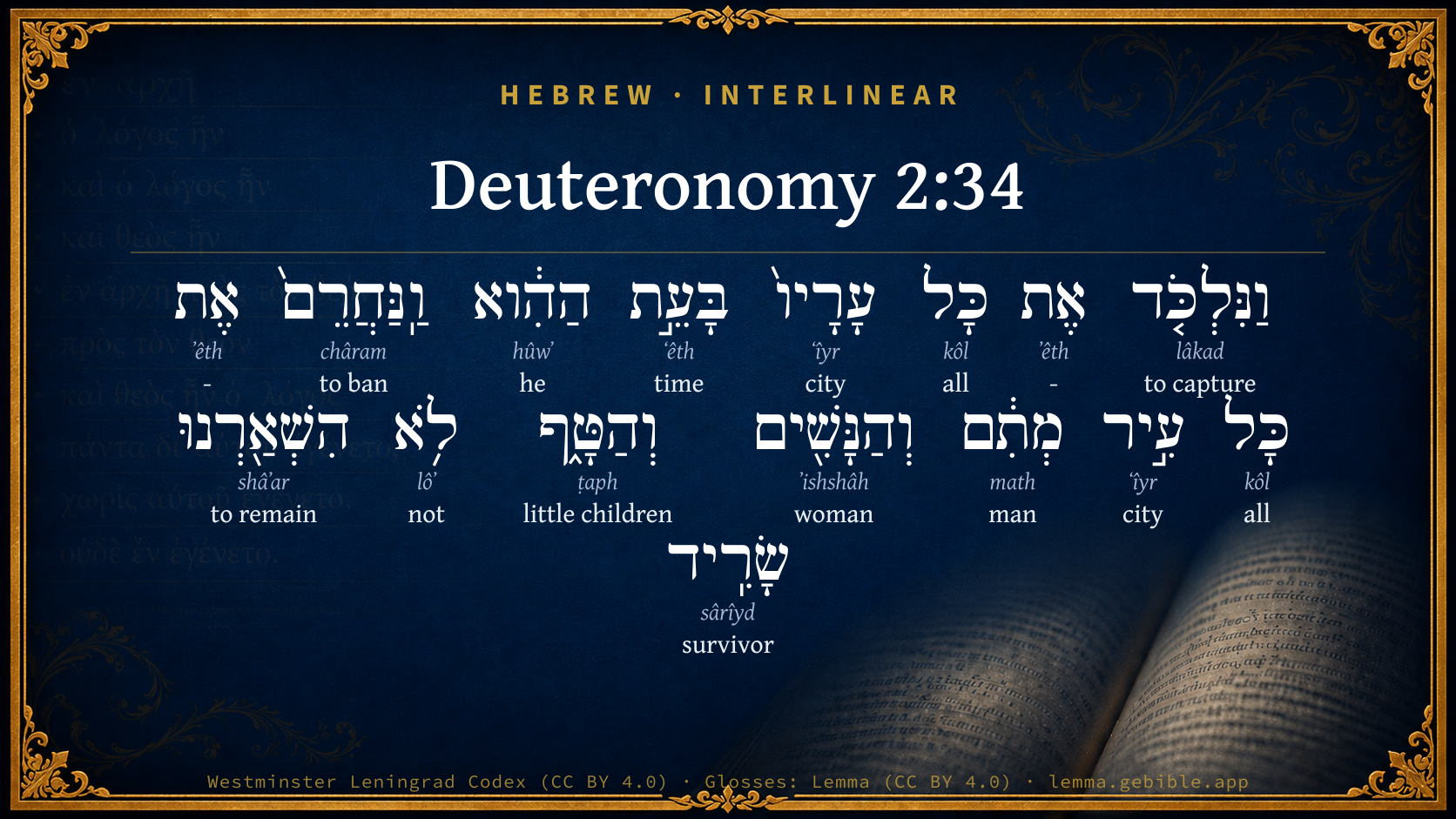
  1. וַנִּלְכֹּ֤ד lâkad H3920 “and · to capture” Conjunction + Verb, Qal, Sequential Imperfect, 1st Person, Common, Plural
  2. אֶת ʼêth H853 “-” Particle, Direct Object
  3. כָּל kôl H3605 “all of” Noun, Common, Masculine, Singular, Construct
  4. עָרָיו֙ ʻîyr H5892 “cities · his” Noun, Common, Feminine, Plural, Construct + Suffix, Personal, 3rd Person, Masculine, Singular
  5. בָּעֵ֣ת ʻêth H6256 “in/at the · time” Preposition, Determined + Noun, Common, Both, Singular, Absolute
  6. הַהִ֔וא hûwʼ H1931 “the · he” Particle, Definite Article + Pronoun, Personal, 3rd Person, Feminine, Singular
  7. וַֽנַּחֲרֵם֙ châram H2763 “and · to ban” Conjunction + Verb, Hiphil, Sequential Imperfect, 1st Person, Common, Plural
  8. אֶת ʼêth H853 “-” Particle, Direct Object
  9. כָּל kôl H3605 “all of” Noun, Common, Masculine, Singular, Construct
  10. עִ֣יר ʻîyr H5892 “city” Noun, Common, Feminine, Singular, Absolute
  11. וְהַנָּשִׁ֖ים ʼishshâh H802 “and · the · women” Conjunction + Particle, Definite Article + Noun, Common, Feminine, Plural, Absolute
  12. וְהַטָּ֑ף ṭaph H2945 “and · the · little children” Conjunction + Particle, Definite Article + Noun, Common, Masculine, Singular, Absolute
  13. לֹ֥א lôʼ H3808 “not” Particle, Negative
  14. הִשְׁאַ֖רְנוּ shâʼar H7604 “to remain” Verb, Hiphil, Perfect, 1st Person, Common, Plural
  15. שָׂרִֽיד sârîyd H8300 “survivor” Noun, Common, Masculine, Singular, Absolute

About this verse

These counts appear in no published source. They are computed here, from the morphology-tagged text and Lemma’s own curated glosses. What Lemma adds →

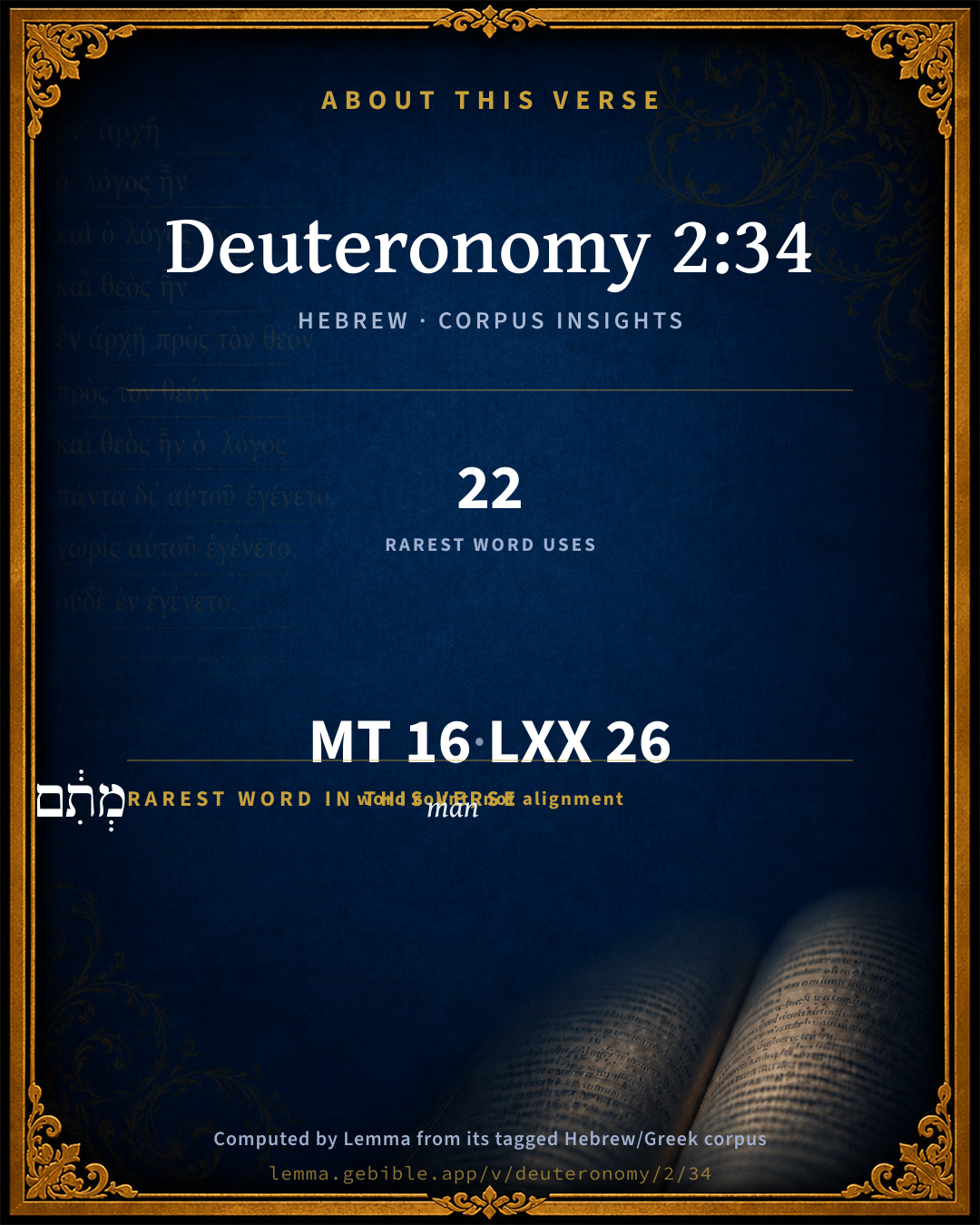
16
words
13
distinct lemmas
Pentateuch
section

Notable vocabulary

The rarest word here is מְתִ֔ם man H4962 — appearing just 22 times in the whole Hebrew Bible.

Shared distinctive vocabulary

מְתִ֔ם man H4962 occurs in 21 verses of the Hebrew Bible. Also found in:

Grammatical profile

  • 3 verbs
  • 9 nouns
  • 1 pronoun
  • 3 particles

Verb forms

  • וַנִּלְכֹּ֤ד Qal · Sequential Imperfect
  • וַֽנַּחֲרֵם֙ Hiphil · Sequential Imperfect
  • הִשְׁאַ֖רְנוּ Hiphil · Perfect

Repetition

Words recur within this verse — often emphatic in Hebrew:

  • כָּל all H3605 ×2
  • עָרָיו֙ city H5892 ×2

Hebrew & Septuagint length

In English translation the verse runs 25 words from the Hebrew and 30 from the Septuagint (LXX English) — closely comparable.

A rough comparison of the two English renderings, which tokenize alike — not a word-level alignment.

Word counts can differ between the Hebrew and the Greek without any difference in meaning — e.g. the Hebrew direct-object marker אֵת has no separate Greek word, and Greek often adds the article ὁ.

In the original languages it is 16 Hebrew tokens and 26 Greek tokens — but the two are counted differently (Hebrew bundles its prefixes and suffixes into one token; the Greek is in lemma form), so that isn’t a like-for-like length.

Cross-references

12

Topical passages linked to Deuteronomy 2:34 in the Treasury of Scripture Knowledge — connected by theme and wording, ordered by reader-vote popularity; previews shown in the World English Bible.

  • Deuteronomy 7:2 and when Yahweh your God shall deliver them up before you, and you shall strike them; then you shall utterly destroy them: you shall make no covenant with them, nor show mercy to them;
  • 1 Samuel 15:3 Now go and strike Amalek, and utterly destroy all that they have, and don't spare them; but kill both man and woman, infant and suckling, ox and sheep, camel and donkey.
  • Deuteronomy 3:6 We utterly destroyed them, as we did to Sihon king of Heshbon, utterly destroying every inhabited city, with the women and the little ones.
  • Leviticus 27:28–29 "'Notwithstanding, no devoted thing, that a man shall devote to Yahweh of all that he has, whether of man or animal, or of the field of his possession, shall be sold or redeemed: every devoted thing is most holy to Yahweh.
  • Numbers 21:2–3 Israel vowed a vow to Yahweh, and said, If you will indeed deliver this people into my hand, then I will utterly destroy their cities.
  • Deuteronomy 7:26 You shall not bring an abomination into your house, and become a devoted thing like it: you shall utterly detest it, and you shall utterly abhor it; for it is a devoted thing.
  • Deuteronomy 20:16–18 But of the cities of these peoples, that Yahweh your God gives you for an inheritance, you shall save alive nothing that breathes;
  • Joshua 7:11 Israel has sinned; yes, they have even transgressed my covenant which I commanded them: yes, they have even taken of the devoted thing, and have also stolen, and dissembled also; and they have even put it among their own stuff.
  • Joshua 8:25–26 All that fell that day, both of men and women, were twelve thousand, even all the men of Ai.
  • Joshua 11:14 All the spoil of these cities, and the cattle, the children of Israel took for a prey to themselves; but every man they struck with the edge of the sword, until they had destroyed them, neither left they any who breathed.
  • 1 Samuel 15:8–9 He took Agag the king of the Amalekites alive, and utterly destroyed all the people with the edge of the sword.
  • Joshua 9:24 They answered Joshua, and said, Because it was certainly told your servants, how that Yahweh your God commanded his servant Moses to give you all the land, and to destroy all the inhabitants of the land from before you; therefore we were sore afraid for our lives because of you, and have done this thing.

Cross-references courtesy of OpenBible.info (CC BY 4.0).

Hebrew and Greek witnesses Masoretic Hebrew ↔ Greek Septuagint

The same verse in the two great witnesses to the Old Testament, shown verse-for-verse.

These are two independent witnesses, not word-aligned to each other, and the Septuagint is shown in lemma (dictionary) form.

Hebrew Deuteronomy 2:34 Masoretic · Westminster Leningrad Codex

וַנִּלְכֹּ֤ד אֶת כָּל עָרָיו֙ בָּעֵ֣ת הַהִ֔וא וַֽנַּחֲרֵם֙ אֶת כָּל עִ֣יר מְתִ֔ם וְהַנָּשִׁ֖ים וְהַטָּ֑ף לֹ֥א הִשְׁאַ֖רְנוּ שָׂרִֽיד

We took all his cities at that time, and utterly destroyed every inhabited city, with the women and the little ones; we left none remaining:

World English Bible · Public Domain

Greek LXX Deuteronomy 2:34 Septuagint · lemma form

καί κρατέω πᾶς ὁ πόλις αὐτός ἐν ὁ καιρός ἐκεῖνος καί ἐκὀλεθρεύω πᾶς πόλις ἑξῆς καί ὁ γυνή αὐτός καί ὁ τέκνον αὐτός οὐ καταλείπω ζωγρίας

And we took possession of all his cities at that time, and we utterly destroyed every city in succession, and their wives, and their children; we left no living prey.

LXX2012 (modern English Septuagint) · Public Domain

Hebrew: Westminster Leningrad Codex (CC BY 4.0). Greek: Septuagint (public domain); English from LXX2012 (modern English Septuagint) (Public Domain). How the Septuagint differs from the Hebrew →

Targum (Aramaic paraphrase)

2

The Targum is the ancient Jewish Aramaic paraphrase of the Hebrew Scriptures — an interpretive translation, not the Hebrew text itself. Onkelos (literal) and Pseudo-Jonathan (expansive) render the Torah, and Jonathan the Prophets. Coverage is partial: where no permissively-licensed English translation exists for a verse, only the Aramaic is shown. This is verse-level text, not a word-by-word alignment to the Hebrew.

  1. Targum Onkelos Torah (Genesis–Deuteronomy)
    וּכְבַשְׁנָא יָת כָּל קִרְווֹהִי בְּעִדָנָא הַהִיא וְגַמַרְנָא יָת כָּל קִרְוֵי גֻבְרַיָא וּנְשַׁיָא וְטַפְלָא לָא אַשְׁאַרְנָא מְשֵׁזִב

    (no public-domain English translation for this verse)

    Targum Onkelos — Aramaic: “Onkelos Genesis” (public domain); “Onkelos Exodus” (public domain); “Onkelos Leviticus” (public domain); “Onkelos Numbers” (public domain); “Onkelos Deuteronomy” (public domain). English: “Sefaria Community Translation” (CC0 1.0 (public-domain dedication)); “J.W. Etheridge. The Targums of Onkelos and Jonathan Ben Uzziel on the Pentateuch. London: Longmans, Green, 1862” (public domain). Text via Sefaria.

  2. Targum Pseudo-Jonathan Torah (Genesis–Deuteronomy)
    וּכְבַשְׁנָא יַת כָּל קִירְווֹי בְּעִדָנָא הַהִיא וּגְמַרְנָא יַת כָּל קִרְוַיָא גוּבְרַיָא וּנְשַׁיָא וְטַפְלַיָא לָא אַשְׁאַרְנָא מְשֵׁזִיב

    And we subdued all his cities at that time, and destroyed all the towns, the men, women, and children, we left none to escape;

    Targum Pseudo-Jonathan — Aramaic: “Targum Jonathan on Genesis” (public domain); “Targum Jonathan on Exodus” (public domain); “Targum Jonathan on Leviticus” (public domain); “Targum Jonathan on Numbers” (public domain); “Targum Jonathan on Deuteronomy” (public domain). English: “The Targum of Jonathan ben Uzziel, trans. J. W. Etheridge, London, 1862” (public domain). Text via Sefaria.

Commentary

Notes on Deuteronomy 2:34 from classic Christian and Jewish commentators (each source and its license shown beneath its notes). The classic Christian expositions comment on the surrounding passage and are grouped to its opening verse, so a note may address several verses; the Jewish commentaries on the Tanakh (Rashi and others) are per-verse, so they appear only where the commentator wrote on this verse.

Lemma curates 59 commentaries, every one of them public domain or Creative Commons licensed, each selected and text-cleaned for this edition rather than reprinted as found. About our sources →

The Cambridge Bible for Schools and Colleges

gen. ed. J. J. S. Perowne

34. And we look all his cities] E, Num_21:24 a, possessed his land from Arnon unto Jabboḳ; J, id. 25: Israel took all these cities and dwelt in all the cities of the Amorites, Ḥeshbon and her towns. Anciently this part of the Plateau was thickly populated. From almost every elevation several groups of ruins are visible, mostly Byzantine, but how much older each site may be cannot yet be said. The land is very good for corn.

utterly destroyed every inhabited city, with the women and the little ones] Devoted—put to the ḥerem or ban—every city-full of males, with, etc. The first mention in Deut. of a custom practised also by other Semites. Mesha (Moabite Stone, 14–17) records that having taken Nebo from Israel he slew the whole population for he ‘had devoted it to Ashtar-Chemosh’; the same verb as in Heb. To Israel as to other peoples a war was from first to last a religious process (see on Deu_20:1 ff.) and the ḥerem was the climax of a series of solemn rites. It consisted of the devotion to the deity, by destruction, of the captives and spoil. The name is from the root ḥrm, ‘to set apart’ or ‘shut off’ (cp. Ar. ḥaram ‘sacred precincts’ and ḥarîm) and was not confined to war. By the earliest code every idolatrous Israelite was put to the ḥerem, E, Exo_22:20 [19]; cp. Deu_13:6-11 of idolaters, and Deu_13:12-18 [13–19] of an idolatrous city; P, Lev_27:28 f. In war the full process was the slaughter of the conquered population and their cattle, the burning of combustible spoil, and the oblation of the rest to the sanctuary. So in the story of the fall of Jericho and Achan’s trespass, Joshua 6 f. (especially Deu_6:17-19; Deu_6:21; Deu_6:24, Deu_7:1; Deu_7:11 ff.), which however contains many editorial additions. But as we see from several narratives and laws, the actual practice varied from time to time under the competing influences of religious feeling, material considerations and humane impulses. The most illustrative passage is 1 Samuel 15. Samuel charges Saul to devote all ‘Amaleḳ and their cattle; Saul spares the king and the best of the cattle. Either his excuse, that he reserved them for sacrifice, is an afterthought; or from the first he had been unwilling that the best cattle should be rendered by the ḥerem unusable by the people in sacrificial feasts. Was the king moved by feelings of humanity? Samuel condemns his action as disobedience against Jehovah; so absolutely at that time was the ḥerem conceived by the religious leaders. The deuteronomic directions, all in the Sg. address, distinguish between Israel’s treatment of the seven Canaanite nations and of Israelite idolaters on the one side, and their treatment of other nations at a distance:—(a) Deu_7:2 : the seven nations are to be put to the ḥerem because of their idolatry and no league with them is allowed; Deu_2:25 f. their idols are to be burned with the silver and gold on them, for they are ḥerem and if used by Israel would make the people ḥerem or devoted to destruction. Similarly in Deu_13:15 f. every Israelite community falling to idolatry shall be devoted, and their city, cattle, and spoil burned to Jehovah thy God. But (b) Deu_20:10 ff directs that distant enemies if they submit shall be spared, though they must become tributary; while if they resist only the males shall be slain, the women, children, cattle and spoil being treated as booty. And in Deu_20:16-17 it is repeated that the nations of Palestine shall be devoted. Religious feeling, the desire that Israel shall not be infected by the idolatry from which they ran most risk of infection, is obviously the paramount motive of these laws. But it is remarkable that the only instances of the ḥerem recorded in Deut., those against Sîḥôn and ‘Ôg, fully agree neither with the treatment enjoined by the deuteronomic laws against the seven nations, nor with that enjoined against distant enemies, but combine features of both. The captive men, women, and children were slain, but the cattle and spoil reserved for booty, Deu_2:34 f., Deu_3:6 f. So too in Jos. (outside the story of Achan):—Jos_8:2; Jos_8:27 spoil and cattle reserved, Jos_10:28 ff., only the people devoted; Jos_11:9 horses houghed, chariots burned; Jos_11:11-15, people devoted, cattle and spoil reserved. Except Jos_11:9 these passages appear to be editorial.—In connection with this subject note that Amos (Amo_1:6; Amo_1:9) condemns as inhuman the selling into captivity of a whole population, just as to-day it is contrary to the Arab conscience to extinguish a ḳabîla or tribe in war (Doughty, Ar. Des. i. 335). Yet, just as by Samuel in the case of Saul, and in Deut., this natural conscience has often been overborne by the rigorous religious demands of Islam. The parallel is instructive; cp. Deu_20:10-18.—See on the use of the term in a criminal case, Exo_22:20, with Driver’s note.

The Cambridge Bible for Schools and Colleges (gen. ed. J. J. S. Perowne; Cambridge University Press, 1878–1918) — public domain. Text from a community e-Sword module.

Joseph Benson's Commentary

Deu 2:34. Utterly destroyed — By God’s command, these being a part of those people who were devoted by the Lord of life and death to utter destruction for their abominable wickedness.

Joseph Benson's Commentary on the Old and New Testaments (1811–1818) — public domain. Text from a community e-Sword module.

Tyndale Open Study Notes

Tyndale Open Resources

2:34 completely destroyed (Hebrew kharam): The Hebrew term refers to the complete consecration of things or people to the Lord, either by destroying them or by giving them as an offering. The underlying rationale was to maintain the Lord’s holiness in the face of pagan idolatry and moral corruption (see also Lev 27:28-29).

Tyndale Open Study Notes — © Tyndale Open Resources, licensed CC BY-SA 4.0. Text via the HelloAO Bible API.

Geneva Bible (1599)

Geneva Bible translators

God had cursed Canaan, and therefore he would not that any of the wicked race should be preserved.

Geneva Bible (1599) marginal notes — public domain. Text via Bolls.life.

Ellicott's Commentary for English Readers

(34) And utterly destroyed.—i.e., devoted to destruction. They made them chêrem, like the spoil of Jericho. This could only be by Divine direction. The word implies nothing less. It will be seen, therefore, that the narrative asserts in this case an extermination of Sihon’s people by the express command of Jehovah.

A Bible Commentary for English Readers, edited by Charles John Ellicott (1878–1897) — public domain. Text from a community e-Sword module.

John Gill's Exposition

And we took all his cities at that time,.... As Heshbon, and others mentioned in Num 21:25,

and utterly destroyed the men, and the women, and the little ones of every city, we left none to remain; for the Amorites were one of the seven nations who were devoted to destruction, the measure of whose iniquity was now full, and therefore vengeance was taken.

John Gill's Exposition of the Whole Bible (1746–1763) — public domain (CC PDM 1.0). Text via the HelloAO Bible API.

Albert Barnes' Notes on the Bible

Utterly destroyed the men, and the women, and the little ones, of every city - Render, laid under ban (compare Lev 27:28 note) every inhabited city, both women and children: these last words being added by way of fuller explanation.

Albert Barnes' Notes on the Bible (1834–1885) — public domain. Text from a community e-Sword/MySword module.

Haydock's Catholic Bible Commentary

Killing, according to God’s express command, chap. xx. 16. (Menochius)

George Leo Haydock (1774–1849), Haydock's Catholic Family Bible and Commentary, 1859 edition — public domain. Excludes Psalms (Douay-Rheims chapter numbering differs from Protestant) and Deuterocanonical books (Catholic canon only).

Matthew Poole's English Annotations

By God’s command, these being a part of those people who were devoted by the Lord of life and death to utter destruction for their abominable wickedness. See Deu 7:2; 20:16.

Matthew Poole's English Annotations on the Holy Bible (1683–1685) — public domain. Text from a community e-Sword/MySword module.

Whedon's Commentary on the Bible

Daniel D. Whedon

34. Utterly destroyed the men,… women,… little ones — Every inhabited city and its inhabitants. In these wars cities were often thus devoted. When captured the walls were razed to the foundation and the inhabitants put to death.

Daniel D. Whedon (gen. ed.), Commentary on the Old and New Testaments (1874–1909) — public domain. Text from a community e-Sword module.

John Wesley's Explanatory Notes

Utterly destroyed - By God's command, these being a part of those people who were devoted by the Lord of life and death, to utter destruction for their abominable wickedness.

John Wesley, Explanatory Notes Upon the Whole Bible (1754–1765) — public domain. Text via the GEBible commentary corpus.

unfoldingWord translationNotes

Door43 World Missions Community

General Information:

Moses continues reminding the people about what happened in the past.

We took all his cities

"We captured all of King Sihon's cities"

completely destroyed every city

"killed all the people who lived in every city"

translationWords

cow

unfoldingWord translationNotes — © Distant Shores Media and the Door43 World Missions Community, licensed CC BY-SA 4.0. Source: git.door43.org/Door43/en_tn.

Rashi

Rabbi Shlomo Yitzchaki (Rashi)

מתם means MEN. — Of the spoil taken from Sihon it is stated (v. 35) בזזנו לנו, an expression denoting plunder (בזה), because then this was an object of desire to them, so that each man took spoil for himself. But when they came to the plundering of Og, they were already full to satiety, and it was contemptible in their eyes, so that they tore in pieces and cast away cattle and garments, and took only silver and gold. On this account it is said (Deuteronomy 3:7) בַּזֹּנוּ לנו which is an expression denoting "holding in contempt" (בזיון). Thus is it expounded in Siphre in the chapter beginning with "And Israel dwelt in Shittim״ (Numbers 25:1).

Rashi on the Tanakh — English translations: “The Judaica Press complete Tanach with Rashi, translated by A. J. Rosenberg” (CC BY 4.0); “Pentateuch with Rashi's commentary by M. Rosenbaum and A.M. Silbermann, 1929-1934” (public domain); “The Metsudah Tanach series, Lakewood, N.J” (CC BY 4.0); and “The Book of Joshua, Metsudah Publications, 1997” (CC BY 4.0). Text via Sefaria.

Ramban (Nachmanides)

Rabbi Moshe ben Nachman (Ramban / Nachmanides)

AND WE UTTERLY DESTROYED EVERY CITY, THE MEN, AND THE WOMEN, AND THE LITTLE ONES — who were of the Amorites, and they were commanded thereon, as it is said, But of the cities of these peoples, that the Eternal thy G-d giveth thee for an inheritance, thou shalt save alive nothing that breatheth. Even so, Moses opened discussions with them peacefully, for such is the commandment [that even for the seven nations we were obligated to proclaim peace to them] as I will explain with the help of G-d. But to Og the king of Bashan he did not proclaim peace because Og had come forth to battle against Israel before they even came to his city. (above, 3:1). I have already explained the subject in the section Zoth Chukath.

Ramban (Nachmanides) on the Tanakh — English translation: “Commentary on the Torah by Ramban (Nachmanides). Translated and annotated by Charles B. Chavel. New York, Shilo Pub. House, 1971-1976” (CC BY 4.0). Text via Sefaria.

Lesson kit

Teaching starters — assembled from the data on this page, not authored interpretation. Every prompt links to the verse data it draws on. Edit before teaching.

Deuteronomy, in the Pentateuch, opens this verse with 16 words (13 distinct Hebrew lemmas). Its most distinctive word is math (“man”). A historical commentator’s framing appears above. Read the whole chapter for the surrounding context.

Discussion questions

  1. The word math carries the sense “man.” How does it shape the verse?
  2. Genesis 34:30 shares the word «man» with this verse. How do the two illuminate each other?
  3. “all” occurs 2× in this one verse. What is the effect of the repetition?
  4. These translations render this verse differently; the difference is in the English rendering, not the original. What questions does that raise?
  5. The verb «וַנִּלְכֹּ֤ד» is Qal Sequential Imperfect. How does its form color the action?
  6. Reading how The Cambridge Bible for Schools and Colleges and Joseph Benson's Commentary read this verse, where do the two commentators agree and where do they part?

Things to notice

Reading settings

Reading text

Shown beneath each verse's original-language words.

Old Testament
Old Testament edition

Read the OT as the Masoretic Hebrew (MT) or the Greek Septuagint (LXX).

English shown for the Greek Septuagint (in the Hebrew ↔ Greek comparison).

Comparing translations? Open the Compare panel on any verse page to stack up to four side by side.