Psalms 69:14

Hebrew (Westminster Leningrad Codex) Psalms 69:14 appears in the Hebrew Old Testament. The text above is from the Westminster Leningrad Codex. Each word links to its Strong’s number, a concise gloss, and parsing drawn from the Open Scriptures Hebrew Bible morphology. Click any word for its full Brown-Driver-Briggs (BDB) entry.
Download image
Cite this verse

Psalms 69:14 (World English Bible). Public Domain. Lemma interlinear Bible study tool, https://lemma.gebible.app/v/psalms/69/14.

Show BibTeX & RIS
BibTeX
RIS
English Translation
Deliver me out of the mire, and don't let me sink. Let me be delivered from those who hate me, and out of the deep waters.
World English Bible · Public Domain
Download a study sheet

One document with this verse’s original text, its word-by-word gloss line, the meaning frame, cross-references with their text, attributed commentary, and full source and license credits — printable, and it pastes into notes with its structure intact.

This verse Autodidact and up

Study sheet (.html) Plain text (.txt)

A passage Seminary Student

Up to 50 verses in one chapter. A passage sheet keeps up to 6 commentary sources and 12 cross-references per verse, in the order this page ranks them, and says so on the sheet whenever that leaves anything out. Ask for a single verse and you get the Autodidact verse sheet above.

Everything on this page stays free to read, with no account — the sheet is a download of what is already on screen, not access to it.

Want to remove ads? Support Godless Engineer
Compare translations 3

The same verse in 3 English versions, stacked beneath the original-language interlinear above. Click any original word for its lexicon entry.

Each is an independent rendering of the whole verse — the interlinear is not word-aligned to these translations.

Highlighted words mark where these versions differ — a whole-verse word diff, not a word-by-word alignment.

  • World English Bible Public Domain
    Deliver me out of the mire, and don't let me sink. Let me be delivered from those who hate me, and out of the deep waters.
  • King James Version Public Domain
    Deliver me out of the mire, and let me not sink: let me be delivered from them that hate me, and out of the deep waters.
  • unfoldingWord Literal Text CC BY-SA 4.0
    Deliver me from the mire, and let me not sink. Let me be delivered from the ones hating me and from the depths of the waters.

unfoldingWord Literal Text — © unfoldingWord, licensed CC BY-SA 4.0. Word-aligned USFM3 via Door43 (git.door43.org/unfoldingWord/en_ult).

Versions to compare (up to 4)

3 of 4 selected

Show all 18 translations

Every available English version of this verse, each an independent rendering of the whole verse.

  • World English Bible Public Domain
    Deliver me out of the mire, and don't let me sink. Let me be delivered from those who hate me, and out of the deep waters.
  • Berean Standard Bible Public Domain
    Rescue me from the mire and do not let me sink; deliver me from my foes and out of the deep waters.
  • Majority Standard Bible Public Domain
    Rescue me from the mire and do not let me sink; deliver me from my foes and out of the deep waters.
  • King James Version Public Domain
    Deliver me out of the mire, and let me not sink: let me be delivered from them that hate me, and out of the deep waters.
  • American Standard Version (1901) Public Domain
    Deliver me out of the mire, and let me not sink: Let me be delivered from them that hate me, and out of the deep waters.
  • Revised Version (1885) Public Domain
    Deliver me out of the mire, and let me not sink: let me be delivered from them that hate me, and out of the deep waters.
  • Geneva Bible (1599) Public Domain
    Deliuer mee out of the myre, that I sinke not: let me be deliuered from them that hate me, and out of the deepe waters.
  • Douay-Rheims (1899) Public Domain
    But as for me, my prayer is to thee, O Lord; for the time of thy good pleasure, O God. In the multitude of thy mercy hear me, in the truth of thy salvation.
  • Young's Literal Translation Public Domain
    Deliver me from the mire, and let me not sink, Let me be delivered from those hating me, And from deep places of waters.
  • Literal Standard Version CC BY-SA 4.0
    Deliver me from the mire, and do not let me sink, || Let me be delivered from those hating me, || And from deep places of waters.
  • Unlocked Literal Bible CC BY-SA 4.0
    Pull me out of the mire, and do not let me sink; let me be taken away from those who hate me and rescued out of the deep waters.
  • unfoldingWord Literal Text CC BY-SA 4.0
    Deliver me from the mire, and let me not sink. Let me be delivered from the ones hating me and from the depths of the waters.
  • Darby Bible Public Domain
    Deliver me out of the mire, let me not sink; let me be delivered from them that hate me, and out of the depths of waters.
  • World Messianic Bible Public Domain
    Deliver me out of the mire, and don’t let me sink. Let me be delivered from those who hate me, and out of the deep waters.
  • Webster's Bible Public Domain
    \\69:13\\But as for me, my prayer is to thee, O LORD, in an acceptable time: O God, in the multitude of thy mercy hear me, in the truth of thy salvation.
  • Free Bible Version CC BY-SA 4.0
    Please rescue me from the mud—don't let me sink! Save me from those who hate me and from drowning in the deep waters!
  • Bible in Basic English Public Domain
    Take me from the grip of the sticky earth, so that I may not go down into it; let me be lifted up from the deep waters.
  • JPS Tanakh (1917) Public Domain
    (69-15) Deliver me out of the mire, and let me not sink; let me be delivered from them that hate me, and out of the deep waters.

Literal Standard Version (2020), Covenant Press — licensed CC BY-SA 4.0. Text via the HelloAO Bible API (eBible.org). Unlocked Literal Bible (unfoldingWord) — licensed CC BY-SA 4.0. Text via the HelloAO Bible API (eBible.org). unfoldingWord Literal Text — © unfoldingWord, licensed CC BY-SA 4.0. Word-aligned USFM3 via Door43 (git.door43.org/unfoldingWord/en_ult). Free Bible Version, Dr. Jonathan Gallagher — licensed CC BY-SA 4.0. Text via the HelloAO Bible API (eBible.org).

Word by word

More ways to search: Search by grammar → Find every occurrence → Compare this word →

Practice this passage: Drill this verse → Learn its vocabulary →

וּמִמַּֽעֲמַקֵּי
maʻămâq
H4615
“and · from · depths of”
Conjunction + Preposition + Noun, Common, Masculine, Plural, Construct
Part of Speech
Conjunction + Preposition + Noun
Type
Common
Gender
Masculine
Number
Plural
State
Construct
Full BDB Definition

Origin: from H6009

TWOT: 1644e

depths
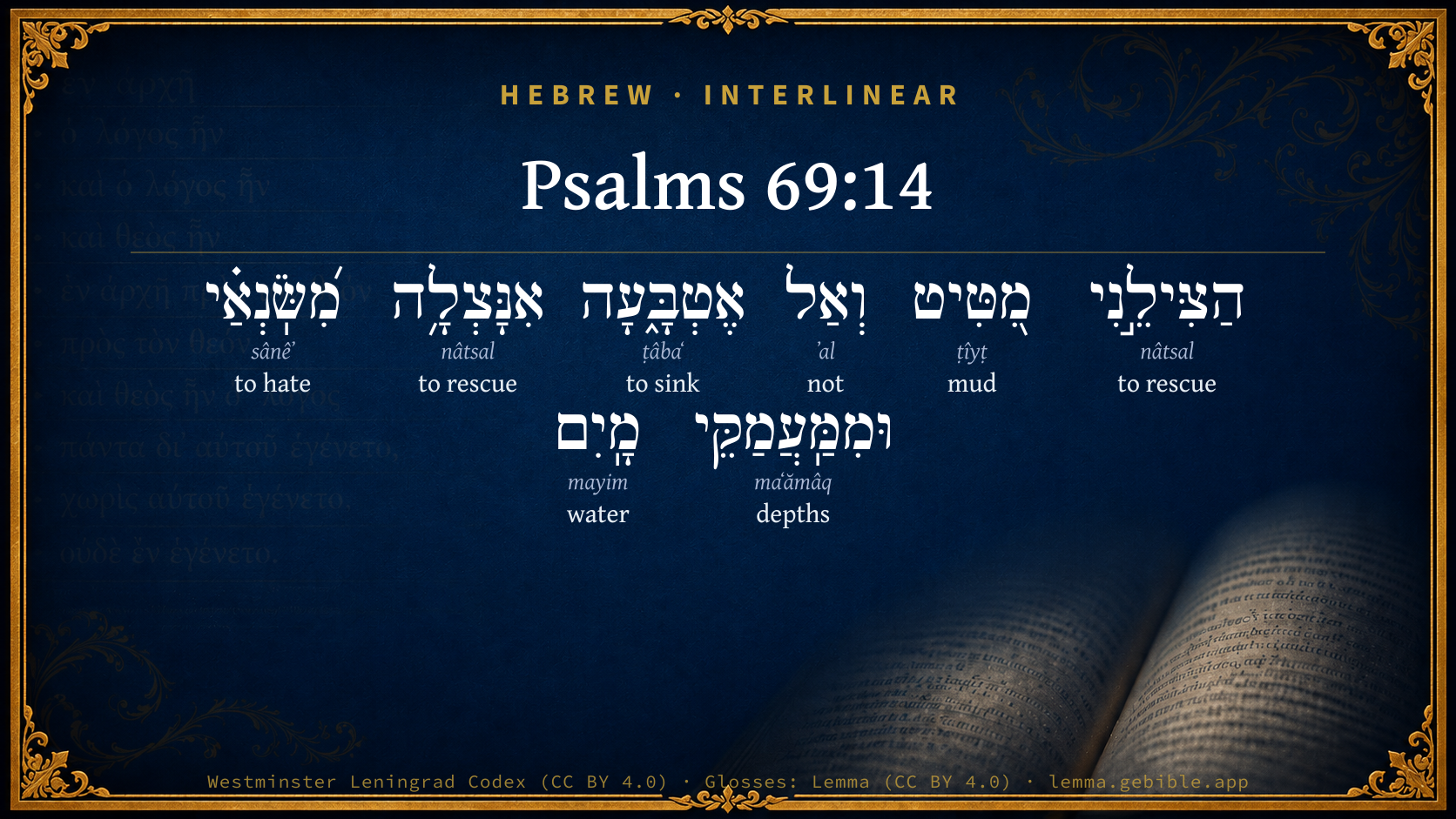
  1. הַצִּילֵ֣נִי nâtsal H5337 “rescue · me” Verb, Hiphil, Imperative, 2nd Person, Masculine, Singular + Suffix, Personal, 1st Person, Common, Singular
  2. מִ֭טִּיט ṭîyṭ H2916 “from · mud” Preposition + Noun, Common, Masculine, Singular, Absolute
  3. וְאַל ʼal H408 “and · not” Conjunction + Particle, Negative
  4. אֶטְבָּ֑עָה ṭâbaʻ H2883 “to sink” Verb, Qal, Cohortative, 1st Person, Common, Singular
  5. אִנָּצְלָ֥ה nâtsal H5337 “to rescue” Verb, Niphal, Cohortative, 1st Person, Common, Singular
  6. מִ֝שֹּֽׂנְאַ֗י sânêʼ H8130 “from · hating · me” Preposition + Verb, Qal, Participle Active, Masculine, Plural, Construct + Suffix, Personal, 1st Person, Common, Singular
  7. מָֽיִם mayim H4325 “water(s)” Noun, Common, Masculine, Plural, Absolute

About this verse

These counts appear in no published source. They are computed here, from the morphology-tagged text and Lemma’s own curated glosses. What Lemma adds →

8
words
7
distinct lemmas
Wisdom
section

Notable vocabulary

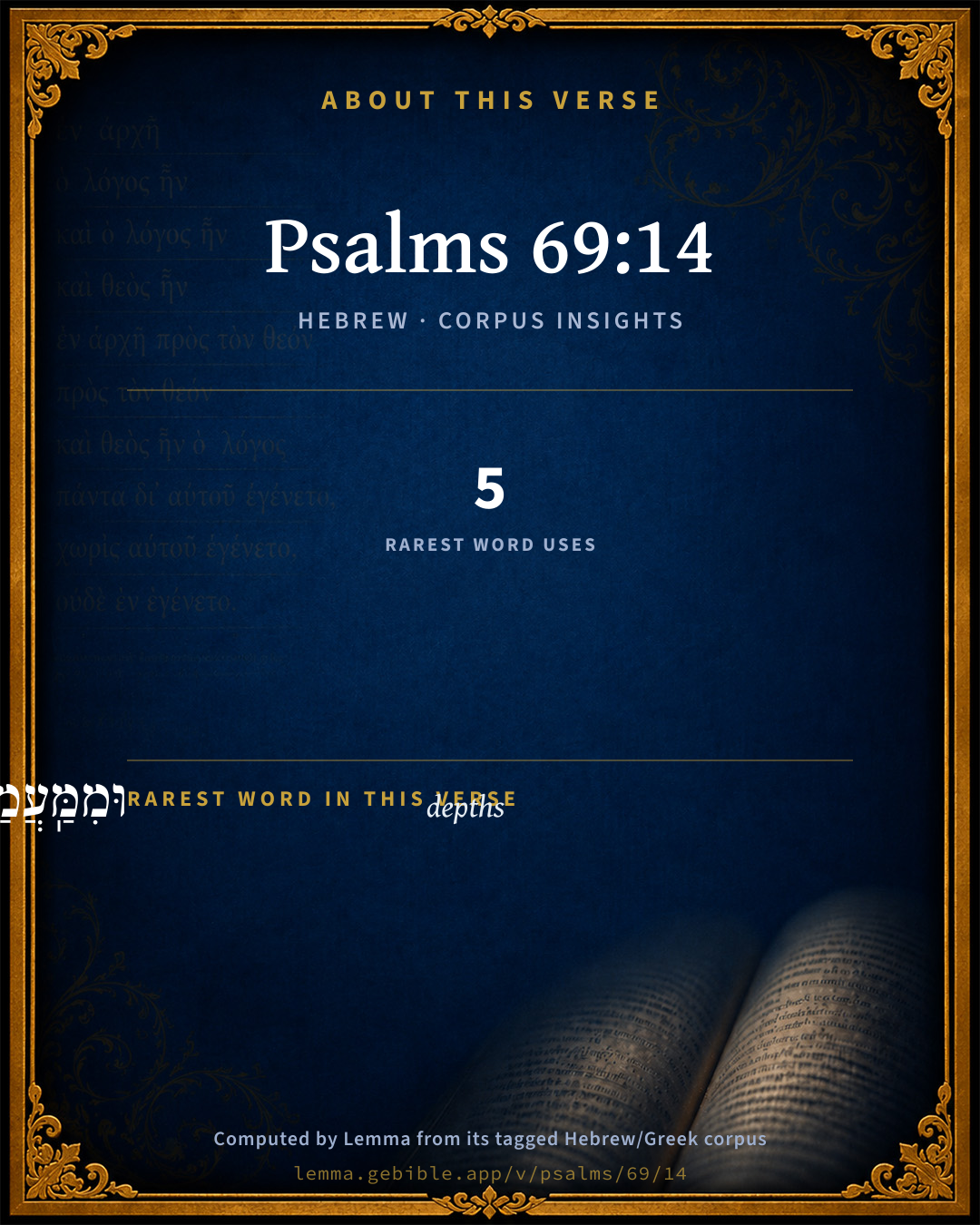
The rarest word here is וּמִמַּֽעֲמַקֵּי depths H4615 — appearing just 5 times in the whole Hebrew Bible.

Shared distinctive vocabulary

וּמִמַּֽעֲמַקֵּי depths H4615 occurs in 5 verses of the Hebrew Bible. Also found in:

Grammatical profile

  • 4 verbs
  • 3 nouns
  • 1 particle

Verb forms

  • הַצִּילֵ֣נִי Hiphil · Imperative
  • אֶטְבָּ֑עָה Qal · Cohortative
  • אִנָּצְלָ֥ה Niphal · Cohortative
  • מִ֝שֹּֽׂנְאַ֗י Qal · Participle Active

Repetition

A word recurs within this verse — often emphatic in Hebrew:

  • הַצִּילֵ֣נִי to rescue H5337 ×2

Hebrew & Septuagint length

In English translation the verse runs 26 words from the Hebrew and 25 from the Septuagint (LXX English) — closely comparable.

A rough comparison of the two English renderings, which tokenize alike — not a word-level alignment.

Word counts can differ between the Hebrew and the Greek without any difference in meaning — e.g. the Hebrew direct-object marker אֵת has no separate Greek word, and Greek often adds the article ὁ.

Cross-references

18

Topical passages linked to Psalms 69:14 in the Treasury of Scripture Knowledge — connected by theme and wording, ordered by reader-vote popularity; previews shown in the World English Bible.

  • Psalms 144:7 Stretch out your hand from above, Rescue me, and deliver me out of great waters, Out of the hands of foreigners;
  • Psalms 109:21 But deal with me, Yahweh the Lord, for your name's sake, Because your loving kindness is good, deliver me;
  • Jeremiah 38:6–13 Then took they Jeremiah, and cast him into the dungeon of Malchijah the king's son, that was in the court of the guard: and they let down Jeremiah with cords. In the dungeon there was no water, but mire; and Jeremiah sank in the mire.
  • Psalms 69:1–2 Save me, God, For the waters have come up to my neck!
  • Psalms 25:18–19 Consider my affliction and my travail. Forgive all my sins.
  • Psalms 35:19 Don't let those who are my enemies wrongfully rejoice over me; Neither let them wink with the eye who hate me without a cause.
  • Psalms 40:1–3 I waited patiently for Yahweh. He turned to me, and heard my cry.
  • Psalms 42:2 My soul thirsts for God, for the living God. When shall I come and appear before God?
  • Psalms 42:7 Deep calls to deep at the noise of your waterfalls. All your waves and your billows have swept over me.
  • Psalms 69:15 Don't let the flood waters overwhelm me, Neither let the deep swallow me up. Don't let the pit shut its mouth on me.
  • Psalms 109:3 They have also surrounded me with words of hatred, And fought against me without a cause.
  • Psalms 124:4–5 Then the waters would have overwhelmed us, The stream would have gone over our soul;
  • Lamentations 3:55 I called on your name, Yahweh, out of the lowest dungeon.
  • Mark 14:34–42 He said to them, "My soul is exceedingly sorrowful, even to death. Stay here, and watch."
  • Mark 15:34 At the ninth hour Jesus cried with a loud voice, saying, "Eloi, Eloi, lama sabachthani?" which is, being interpreted, "My God, my God, why have you forsaken me?"
  • Luke 19:14 But his citizens hated him, and sent an envoy after him, saying, 'We don't want this man to reign over us.'
  • Luke 19:27 But bring those enemies of mine who didn't want me to reign over them here, and kill them before me.'"
  • Acts 5:30–31 The God of our fathers raised up Jesus, whom you killed, hanging him on a tree.

Cross-references courtesy of OpenBible.info (CC BY 4.0).

Hebrew and Greek witnesses Masoretic Hebrew ↔ Greek Septuagint

The same verse in the two great witnesses to the Old Testament, shown verse-for-verse.

You’re reading Greek Psalm 68 (Hebrew Psalm 69). The Septuagint counts the superscription, so verse numbers can differ from the Hebrew — chapter-level alignment, not verse-by-verse. Numbering follows Rahlfs.

These are two independent witnesses, not word-aligned to each other, and the Septuagint is shown in lemma (dictionary) form.

Hebrew Psalms 69:14 Masoretic · Westminster Leningrad Codex

הַצִּילֵ֣נִי מִ֭טִּיט וְאַל אֶטְבָּ֑עָה אִנָּצְלָ֥ה מִ֝שֹּֽׂנְאַ֗י וּמִמַּֽעֲמַקֵּי מָֽיִם

Deliver me out of the mire, and don't let me sink. Let me be delivered from those who hate me, and out of the deep waters.

World English Bible · Public Domain

Greek LXX Greek Psalm 68:14 Septuagint · lemma form

ἐγώ δέ ὁ προσευχή ἐγώ πρός σύ κύριος καιρός εὐδοκία ὁ θεός ἐν ὁ πλῆθος ὁ ἔλεος σύ ἐπιἀκούω ἐγώ ἐν ἀλήθεια ὁ σωτηρία σύ

Save me from the mire, that I stick not in it: let me be delivered from them that hate me, and from the deep waters.

LXX2012 (modern English Septuagint) · Public Domain

On this verse, Keil & Delitzsch discusses the Septuagint’s reading. Read the note in Commentary ↓

Hebrew: Westminster Leningrad Codex (CC BY 4.0). Greek: Septuagint (public domain); English from LXX2012 (modern English Septuagint) (Public Domain). How the Septuagint differs from the Hebrew →

Commentary

Notes on Psalms 69:14 from classic Christian and Jewish commentators (each source and its license shown beneath its notes). The classic Christian expositions comment on the surrounding passage and are grouped to its opening verse, so a note may address several verses; the Jewish commentaries on the Tanakh (Rashi and others) are per-verse, so they appear only where the commentator wrote on this verse.

Lemma curates 59 commentaries, every one of them public domain or Creative Commons licensed, each selected and text-cleaned for this edition rather than reprinted as found. About our sources →

Trapp's Complete Commentary

John Trapp

Psa 69:14 Deliver me out of the mire, and let me not sink: let me be delivered from them that hate me, and out of the deep waters.

Ver. 14. Deliver me out of the mire] i.e. De civitate Gehennae, from the state of hell, saith the Hebrew scholiast; {a} out of that deadly danger whereof he had complained, Psa 69:2. Alphonsus, king of Arragon, by a gracious condescension, helped a laden ass out of the mire with his own hand, and is renowned for it in history (Val. Max. Christ. 41). God helpeth his out full oft, and little notice is taken of it.

{a} One who writes explanatory notes upon an author; esp. an ancient commentator upon a classical writer.

John Trapp, A Commentary or Exposition upon All the Books of the Old and New Testament (1647–1656) — public domain. Text from a community e-Sword module.

The Biblical Illustrator

Joseph S. Exell

Psa_69:14

Deliver me out of the mire, and let me not sink.

The believer sinking in the mire

Many rivers, and especially the Nile, have on their banks deep deposits of black mud, and it is most perilous for any who have the misfortune to fall into it. The more they struggle to get out the deeper they sink. Travellers tell of such incidents. Had David really witnessed such a scene, that speaking of his spiritual sorrows, he said, I sink in deep mire where there is no standing? Now, the prayer of our text suggests--

I. That the true believer may be. In the mire and very near sinking.

1. In the mire of unbelief. Even the firmest in faith lose their foothold at times. All manner of doubts crowd into the mind. They are compelled to pray this prayer.

2. Through lack of full assurance of his own interest in Christ.

3. The mire of temporal trouble.

4. Of inward corruption.

5. Of Satanic temptations.

6. Various are the causes of this sad condition. Sometimes it is through our own sin. It is a chastisement upon us. Sometimes to try our faith; or that we may the better glorify God, or to show the natural weakness of the creature, that no flesh may glory in man; or to make heaven sweeter when we enter its pearly gates. But all the while, these sinking ones are really Gods people, for if they were not, they would have no such trouble. The sinner whose element is sin laughs at the weight by which the believer is borne down. The best of Gods saints have known such trouble. Luther did, and John Knox, and many more.

II. But when in such a state they know that their only help is in God. The Bible cannot help, for unbelief bars you off from all its precious promises. Other believers cannot aid you. God alone can.

III. Prayer is the Christians never-failing resort. When you cannot use your sword, you may take the weapon of all-prayer. That is never forbidden. And it is never futile, it ever has true power. Oh, never let us cease to pray. In asthma you say, I cannot breathe; but you must breathe if you would live. And so in the condition told of here you must, though you think you cannot, pray. But let us walk carefully, lest we fall into the mire. (C. H. Spurgeon.)

The Biblical Illustrator, edited by Joseph S. Exell (c. 1880s–1900s) — public domain. Text from a community e-Sword module.

Joseph Benson's Commentary

Psa 69:14-18. Let me be delivered from them that hate me — By thus speaking, he explains his meaning in the metaphors here used of mire, waters, deep, and pit. For thy loving-kindness is good — Is eminently and unspeakably good; is gracious, or bountiful; the positive degree being put for the superlative: it is most ready to communicate itself to miserable and indigent creatures: the Hebrew word חסד, chesed, here used, signifying abundance of goodness, or mercifulness. Draw nigh unto my soul — To support and relieve it, O thou who seemest to be departed far away from me. Deliver me because of mine enemies — Because they are enemies to thee as well as to me, and if they succeed, will triumph, not only over me, but in some sort over thee and over religion.

Joseph Benson's Commentary on the Old and New Testaments (1811–1818) — public domain. Text from a community e-Sword module.

J. A. Alexander on Psalms

Joseph Addison Alexander

15. (Psa 69:14). Deliver me from the mire, and let me not sink; let me be delivered from my haters, from the depths of water. He here returns to the figures in Psa 69:1, where profound suffering is described as submersion under water and in mire. The meaning of the figure is explained in the last clause of the verse before us by the addition of a literal expression.

Joseph Addison Alexander, The Psalms Translated and Explained (1850) — public domain. Text from a community e-Sword module.

Geneva Bible (1599)

Geneva Bible translators

He showeth a lively faith, in that that he assureth himself, that God is favorable to him, when he seemeth to be angry: and at hand when he seemeth to be far off.

Geneva Bible (1599) marginal notes — public domain. Text via Bolls.life.

John Calvin's Commentaries

14. Deliver me from the mire, that I may not sink. The Psalmist repeats the same similitude which he had used before, but in a different manner. He had previously said that he was sunk in the mire, and now he prays that he may not sink in it. In short, he now prays that those things may not now befall him which he had formerly complained of as having befallen him. But it is very easy to reconcile this diversity of statement; for in the opening of the psalm he spake according to his actual feeling and experience; but now, looking to the issue, although living in the midst of death, he cherishes the hope of deliverance. This is expressed still more clearly in the last clause of the 15th verse, where he prays, Let not the pit close its mouth upon me; which is as if he had said, Let not the great multitude and weight of my afflictions overwhelm me, and let not sorrow swallow me up.

John Calvin's Commentaries (1540-1563) — public domain. Text from the Calvin Translation Society English edition (1840s-50s) via the Christian Classics Ethereal Library (ccel.org). Calvin's coverage is partial (roughly two-thirds of the Bible); uncommented books and verses are honest gaps, never fabricated. The 19th-century editor's footnotes and remarks are omitted so the notes are faithfully Calvin's own voice.

The Cambridge Bible for Schools and Colleges

gen. ed. J. J. S. Perowne

14, 15. In his prayer he repeats the words which he had previously used to describe his plight (Psa_69:2; Psa_69:4). It is difficult to see why the R.V. has substituted overwhelm for overflow here and not in Psa_69:2, the Heb. word being the same in both cases.

let not the pit &c.] Either the grave (Psa_55:23), or a dungeon (Lam_3:53; Lam_3:55), may be meant. In the latter case Jeremiah’s experience (ch. Psa_38:6) may have suggested the metaphor; but the words are not to be understood literally of release from Malchiah’s dungeon.

The Cambridge Bible for Schools and Colleges (gen. ed. J. J. S. Perowne; Cambridge University Press, 1878–1918) — public domain. Text from a community e-Sword module.

John Gill's Exposition

Deliver me out of the mire, and let me not sink,.... In which he was sinking, Psa 69:2; and accordingly he was delivered out of it, Psa 11:2; even out of all the mire of sin, the sins of his people that were upon him, from which he was justified when raised from the dead; and so will appear without sin, when he comes a second time:

let me be delivered from them that hate me, and out of the deep waters; these phrases design the same, even the enemies of Christ; such that hated him, compared to deep waters: these are the floods of the ungodly, and the many waters out of which he was drawn and delivered, Psa 18:4.

John Gill's Exposition of the Whole Bible (1746–1763) — public domain (CC PDM 1.0). Text via the HelloAO Bible API.

Albert Barnes' Notes on the Bible

Deliver me out of the mire - Out of my troubles and calamities. See Psa 69:1-2.

And let me not sink - As in, mire. Let me not be overwhelmed by my sorrows.

Let me be delivered from them that hate me - All my enemies. Let me be saved from their machinations and devices.

And out of the deep waters - See Psa 69:1-2. From my troubles.

Albert Barnes' Notes on the Bible (1834–1885) — public domain. Text from a community e-Sword/MySword module.

Matthew Poole's English Annotations

Them that hate me; whereby he explains his meaning in these metaphors of mire, and waters, and deep, and pit.

Matthew Poole's English Annotations on the Holy Bible (1683–1685) — public domain. Text from a community e-Sword/MySword module.

The Treasury of David

Charles H. Spurgeon

Ver. 14. Deliver me out of the mire and let me not sink. He turns into prayer the very words of his complaint; and it is well, if, when we complain, we neither feel nor say anything which we should fear to utter before the Lord as a prayer. We are allowed to ask for deliverance from trouble as well as for support under it; both petitions are here combined. How strange it seems to hear such language from the Lord of glory. Let me be delivered from them that hate, me, and out of the deep waters. Both from his foes, and the griefs which they caused him, he seeks a rescue. God can help us in all ways, and we may, therefore, put up a variety of requests without fear of exceeding our liberty to ask, or his ability to answer.

None.

Ver. 14-16.

I. The depth from which prayer may rise.

II. The height to which it may ascend. Thus Jonah, when

at the bottom of the sea, says, "My prayer came up, "

etc. G. R.

Psalms 69:15*

Ver. 14-16.

I. The depth from which prayer may rise.

II. The height to which it may ascend. Thus Jonah, when

at the bottom of the sea, says, "My prayer came up, "

etc. G. R.

Ver. 14-16.

I. The depth from which prayer may rise.

II. The height to which it may ascend. Thus Jonah, when

at the bottom of the sea, says, "My prayer came up, "

etc. G. R.

Psalms 69:17*

Charles H. Spurgeon's The Treasury of David (1869–1885) — public domain. Psalms only. Text from a community e-Sword/MySword module.

The Pulpit Commentary

Deliver me out of the mire, and let me not sink (comp. ver. 2, with the comment). Let me be delivered from them that hate me (see ver. 4). And out of the deep waters (comp. vers. 1, 2).

The Pulpit Commentary (1880–1919), ed. H.D.M. Spence-Jones & Joseph S. Exell — public domain. Text from a community e-Sword module.

Keil & Delitzsch

C. F. Keil & F. Delitzsch

In this second part the petition by which the first is as it were encircled, is continued; the peril grows greater the longer it lasts, and with it the importunity of the cry for help. The figure of sinking in the mire or mud and in the depths of the pit (בּאר, Ps 55:24, cf. בור, Psa 40:3) is again taken up, and so studiously wrought out, that the impression forces itself upon one that the poet is here describing something that has really taken place. The combination "from those who hate me and from the depths of the waters" shows that "the depths of the waters" is not a merely rhetorical figure; and the form of the prayer: let not the pit (the well-pit or covered tank) close (תּאטּר with Dagesh in the Teth, in order to guard against its being read תּאטר; cf. on the signification of אטּר, clausus = claudus, scil. manu) its mouth (i.e., its upper opening) upon me, exceeds the limits of anything that can be allowed to mere rhetoric. "Let not the water-flood overflow me" is intended to say, since it has, according to Psa 69:3, already happened, let it not go further to my entire destruction. The "answer me" in Psa 69:17 is based upon the plea that God's loving-kindness is טּוב, i.e., good, absolutely good (as in the kindred passion-Psalm, Psa 109:21), better than all besides (Psa 63:4), the means of healing or salvation from all evil. On Psa 69:17 cf. Psa 51:3, Lam 3:32. In Psa 69:18 the prayer is based upon the painful situation of the poet, which urgently calls for speedy help (מהר beside the imperative, Psa 102:3; Psa 143:7; Gen 19:22; Est 6:10, is certainly itself not an imperative like הרב, Psa 51:4, but an adverbial infinitive as in Psa 79:8). קרבה, or, in order to ensure the pronunciation ḳorbah in distinction from ḳārbah, Deu 15:9, קרבה (in Baer,

(Note: Originally - was the sign for every kind of o6, hence the Masora includes the חטוף also under the name קמץ חטף; vid., Luther. Zeitschrift, 1863, S. 412,f., cf. Wright, Genesis, p. xxix.))

is imperat. Kal; cf. the fulfilment in Lam 3:57. The reason assigned, "because of mine enemies," as in Psa 5:9; Psa 27:11, and frequently, is to be understood according to Psa 13:5 : the honour of the all-holy One cannot suffer the enemies of the righteous to triumph over him.

(Note: Both נפשׁי and איבי, contrary to logical interpunction, are marked with Munach; the former ought properly to have Dech, and the latter Mugrash. But since neither the Athnach-word nor the Silluk-word has two syllables preceding the tone syllable, the accents are transformed according to Accentuationssystem, xviii. 2, 4.)

The accumulation of synonyms in Psa 69:20 is Jeremiah's custom, Jer 13:14; Jer 21:5, Jer 21:7; Jer 32:37, and is found also in Ps 31 (Psa 31:10) and Ps 44 (Psa 44:4, Psa 44:17, Psa 44:25). On הרפּה שׁברה לבּי, cf. Psa 51:19, Jer 23:9. The ἅπαξ γεγραμ, ואנוּשׁה (historical tense), from נוּשׁ, is explained by ענוּשׁ from אנשׁ, sickly, dangerously ill, evil-disposed, which is a favourite word in Jeremiah. Moreover נוּד in the signification of manifesting pity, not found elsewhere in the Psalter, is common in Jeremiah, e.g., Psa 15:5; it signifies originally to nod to any one as a sign of a pity that sympathizes with him and recognises the magnitude of the evil. "To give wormwood for meat and מי־ראשׁ to drink" is a Jeremianic (Jer 8:14; Jer 9:14; Jer 23:15) designation for inflicting the extreme of pain and anguish upon one. ראשׁ (רושׁ) signifies first of all a poisonous plant with an umbellated head of flower or a capitate fruit; but then, since bitter and poisonous are interchangeable notions in the Semitic languages, it signifies gall as the bitterest of the bitter. The lxx renders: καὶ ἔδωκαν εἰς τὸ βρῶμά μου χολήν, καὶ εἰς τὴν δίψαν μου ἐπότισάν με ὄξος. Certainly נתן בּ can mean to put something into something, to mix something with it, but the parallel word לצמאי (for my thirst, i.e., for the quenching of it, Neh 9:15, Neh 9:20) favours the supposition that the בּ of בּברוּתי is Beth essentiae, after which Luther renders: "they give me gall to eat." The ἅπαξ γεγραμ. בּרוּת (Lam 4:10 בּרות) signifies βρῶσις, from בּרה, βιβρώσκειν (root βορ, Sanscrit gar, Latin vor-are).

Keil & Delitzsch — Biblical Commentary on the Old Testament (1861–1891) — public domain (CC PDM 1.0). Text via the HelloAO Bible API. (Old Testament only.)

Rashi

Rabbi Shlomo Yitzchaki (Rashi)

But, as for me, may my prayer to You, O Lord, be may the time of my prayer be a desirable time.

Rashi on the Tanakh — English translations: “The Judaica Press complete Tanach with Rashi, translated by A. J. Rosenberg” (CC BY 4.0); “Pentateuch with Rashi's commentary by M. Rosenbaum and A.M. Silbermann, 1929-1934” (public domain); “The Metsudah Tanach series, Lakewood, N.J” (CC BY 4.0); and “The Book of Joshua, Metsudah Publications, 1997” (CC BY 4.0). Text via Sefaria.

Lesson kit

Teaching starters — assembled from the data on this page, not authored interpretation. Every prompt links to the verse data it draws on. Edit before teaching.

Psalms, in the Wisdom, opens this verse with 8 words (7 distinct Hebrew lemmas). Its most distinctive word is maʻămâq (“depths”). A historical commentator’s framing appears above. Read the whole chapter for the surrounding context.

Discussion questions

  1. What does “depths” (maʻămâq) contribute to the verse as a whole?
  2. Psalms 69:2 shares the word «depths» with this verse. How do the two illuminate each other?
  3. “to rescue” occurs 2× in this one verse. What is the effect of the repetition?
  4. These translations render this verse differently. What is at stake in choosing one wording over another?
  5. The verb «הַצִּילֵ֣נִי» is Hiphil Imperative. How does its form color the action?
  6. Reading how Trapp's Complete Commentary and The Biblical Illustrator read this verse, where do the two commentators agree and where do they part?

Things to notice

  • These translations choose different wording for 8 words in this verse.
  • “to rescue” occurs 2× in this single verse.
  • 7 distinct Hebrew lemmas span 8 words in this verse.

Reading settings

Reading text

Shown beneath each verse's original-language words.

Old Testament
Old Testament edition

Read the OT as the Masoretic Hebrew (MT) or the Greek Septuagint (LXX).

English shown for the Greek Septuagint (in the Hebrew ↔ Greek comparison).

Comparing translations? Open the Compare panel on any verse page to stack up to four side by side.