
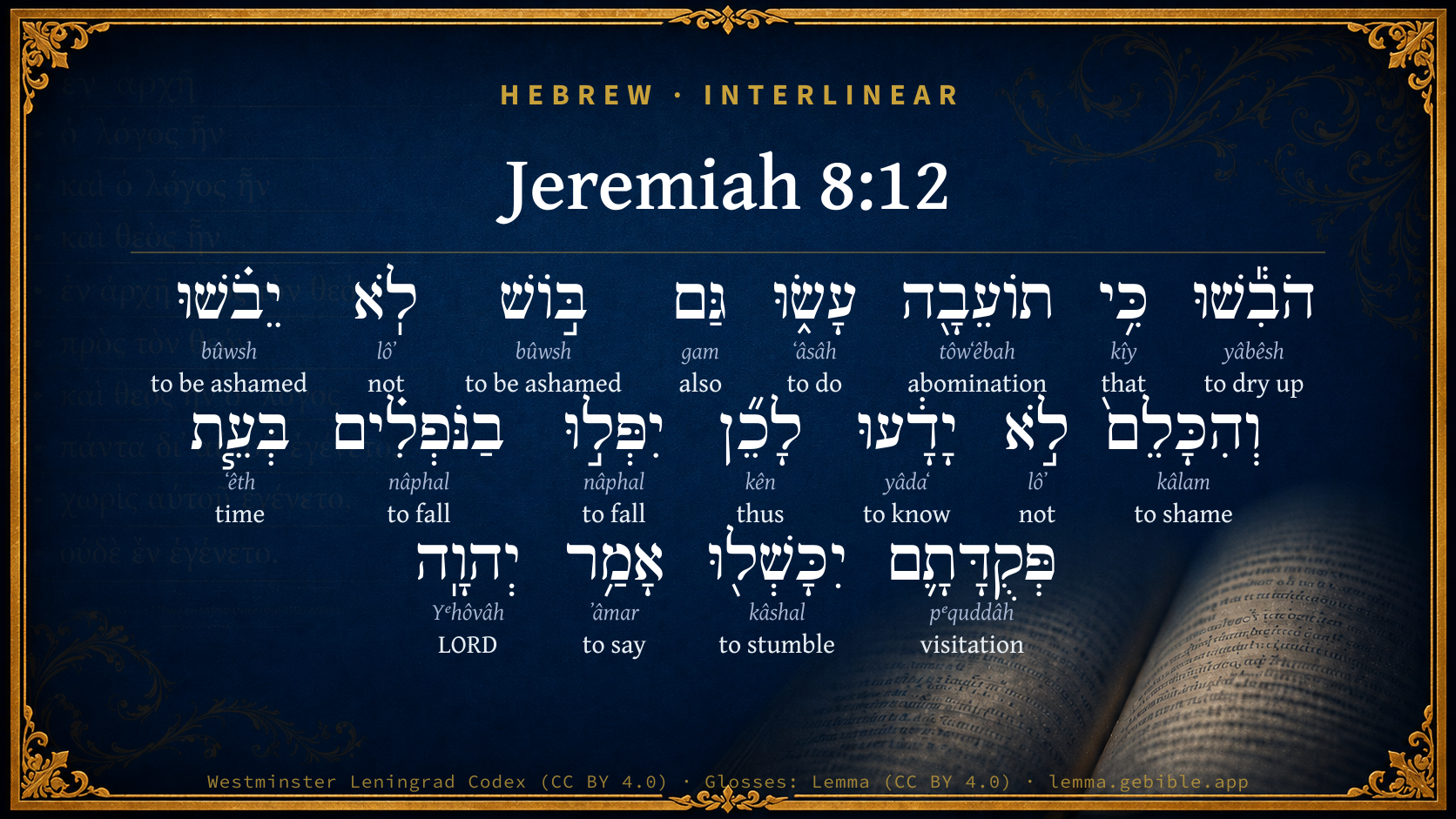
Jeremiah 8:12

Hebrew (Westminster Leningrad Codex) Jeremiah 8:12 appears in the Hebrew Old Testament. The text above is from the Westminster Leningrad Codex. Each word links to its Strong’s number, a concise gloss, and parsing drawn from the Open Scriptures Hebrew Bible morphology. Click any word for its full Brown-Driver-Briggs (BDB) entry.
Download image
Cite this verse

Jeremiah 8:12 (World English Bible). Public Domain. Lemma interlinear Bible study tool, https://lemma.gebible.app/v/jeremiah/8/12.

Show BibTeX & RIS
BibTeX
RIS
English Translation
Were they ashamed when they had committed abomination? nay, they were not at all ashamed, neither could they blush: therefore shall they fall among those who fall; in the time of their visitation they shall be cast down, says Yahweh.
World English Bible · Public Domain
Download a study sheet

One document with this verse’s original text, its word-by-word gloss line, the meaning frame, cross-references with their text, attributed commentary, and full source and license credits — printable, and it pastes into notes with its structure intact.

This verse Autodidact and up

Study sheet (.html) Plain text (.txt)

A passage Seminary Student

Up to 50 verses in one chapter. A passage sheet keeps up to 6 commentary sources and 12 cross-references per verse, in the order this page ranks them, and says so on the sheet whenever that leaves anything out. Ask for a single verse and you get the Autodidact verse sheet above.

Everything on this page stays free to read, with no account — the sheet is a download of what is already on screen, not access to it.

Want to remove ads? Support Godless Engineer
Compare translations 3

The same verse in 3 English versions, stacked beneath the original-language interlinear above. Click any original word for its lexicon entry.

Each is an independent rendering of the whole verse — the interlinear is not word-aligned to these translations.

Highlighted words mark where these versions differ — a whole-verse word diff, not a word-by-word alignment.

  • World English Bible Public Domain
    Were they ashamed when they had committed abomination? nay, they were not at all ashamed, neither could they blush: therefore shall they fall among those who fall; in the time of their visitation they shall be cast down, says Yahweh.
  • King James Version Public Domain
    Were they ashamed when they had committed abomination? nay, they were not at all ashamed, neither could they blush: therefore shall they fall among them that fall: in the time of their visitation they shall be cast down, saith the LORD.
  • unfoldingWord Literal Text CC BY-SA 4.0
    Were they ashamed when they did an abomination? No, being ashamed, they were not ashamed, they did not know to be humiliated! Therefore they will fall among the fallen, they will stumble in the time of their punishment says Yahweh.

unfoldingWord Literal Text — © unfoldingWord, licensed CC BY-SA 4.0. Word-aligned USFM3 via Door43 (git.door43.org/unfoldingWord/en_ult).

Versions to compare (up to 4)

3 of 4 selected

Show all 18 translations

Every available English version of this verse, each an independent rendering of the whole verse.

  • World English Bible Public Domain
    Were they ashamed when they had committed abomination? nay, they were not at all ashamed, neither could they blush: therefore shall they fall among those who fall; in the time of their visitation they shall be cast down, says Yahweh.
  • Berean Standard Bible Public Domain
    Are they ashamed of the abomination they have committed? No, they have no shame at all; they do not even know how to blush. So they will fall among the fallen; when I punish them, they will collapse, says the LORD.
  • Majority Standard Bible Public Domain
    Are they ashamed of the abomination they have committed? No, they have no shame at all; they do not even know how to blush. So they will fall among the fallen; when I punish them, they will collapse, says the LORD.
  • King James Version Public Domain
    Were they ashamed when they had committed abomination? nay, they were not at all ashamed, neither could they blush: therefore shall they fall among them that fall: in the time of their visitation they shall be cast down, saith the LORD.
  • American Standard Version (1901) Public Domain
    Were they ashamed when they had committed abomination? nay, they were not at all ashamed, neither could they blush: therefore shall they fall among them that fall; in the time of their visitation they shall be cast down, saith Jehovah.
  • Revised Version (1885) Public Domain
    Were they ashamed when they had committed abomination? nay, they were not at all ashamed, neither could they blush: therefore shall they fall among them that fall: in the time of their visitation they shall be cast down, saith the LORD.
  • Geneva Bible (1599) Public Domain
    Were they ashamed when they had committed abomination? nay, they were not ashamed, neither coulde they haue any shame: therefore shall they fall among the slaine: when I shall visite them, they shall be cast downe, sayeth the Lord.
  • Douay-Rheims (1899) Public Domain
    They are confounded, because they have committed abomination: yea rather they are not confounded with confusion, and they have not know how to blush: therefore shall they fall among them that fall; in the time of their visitation they shall fall, saith the Lord.
  • Young's Literal Translation Public Domain
    They were ashamed when they did abomination! Yea, they are not at all ashamed, And blushing they have not known, Therefore, they do fall among falling ones, In the time of their inspection they stumble, said Jehovah.
  • Literal Standard Version CC BY-SA 4.0
    They were ashamed when they did abomination! Indeed, they are not ashamed at all, || And they have not known blushing, || Therefore, they fall among falling ones, || They stumble in the time of their inspection, said YHWH.
  • Unlocked Literal Bible CC BY-SA 4.0
    Were they ashamed when they practiced abominations? They were not ashamed; they did not know how to blush! So they will fall among the fallen; they will be brought down when they are punished, says Yahweh.
  • unfoldingWord Literal Text CC BY-SA 4.0
    Were they ashamed when they did an abomination? No, being ashamed, they were not ashamed, they did not know to be humiliated! Therefore they will fall among the fallen, they will stumble in the time of their punishment says Yahweh.
  • Darby Bible Public Domain
    Are they ashamed that they have committed abomination? Nay, they are not at all ashamed, and they know not how to blush. Therefore shall they fall among them that fall: in the time of their visitation they shall stumble, saith Jehovah.
  • World Messianic Bible Public Domain
    Were they ashamed when they had committed abomination? No, they were not at all ashamed. They couldn’t blush. Therefore they will fall among those who fall. In the time of their visitation they will be cast down, says the LORD.
  • Webster's Bible Public Domain
    Were they ashamed when they had committed abomination? no, they were not at all ashamed, neither could they blush: therefore shall they fall among them that fall: in the time of their visitation they shall be cast down, saith the LORD.
  • Free Bible Version CC BY-SA 4.0
    Are they ashamed of the disgusting things they did? No, they're not ashamed at all, they can't even blush. So they will fall just like the others, when I punish them; they will drop down dead, says the Lord.
  • Bible in Basic English Public Domain
    Let them be put to shame because they have done disgusting things. They had no shame, they were not able to become red with shame: so they will come down with those who are falling: in the time of their punishment they will be made low, says the Lord.
  • JPS Tanakh (1917) Public Domain
    They shall be put to shame because they have committed abomination; yea, they are not at all ashamed, neither know they how to blush; therefore shall they fall among them that fall, in the time of their visitation they shall stumble, saith the LORD.

Literal Standard Version (2020), Covenant Press — licensed CC BY-SA 4.0. Text via the HelloAO Bible API (eBible.org). Unlocked Literal Bible (unfoldingWord) — licensed CC BY-SA 4.0. Text via the HelloAO Bible API (eBible.org). unfoldingWord Literal Text — © unfoldingWord, licensed CC BY-SA 4.0. Word-aligned USFM3 via Door43 (git.door43.org/unfoldingWord/en_ult). Free Bible Version, Dr. Jonathan Gallagher — licensed CC BY-SA 4.0. Text via the HelloAO Bible API (eBible.org).

Word by word

More ways to search: Search by grammar → Find every occurrence → Compare this word →

Practice this passage: Drill this verse → Learn its vocabulary →

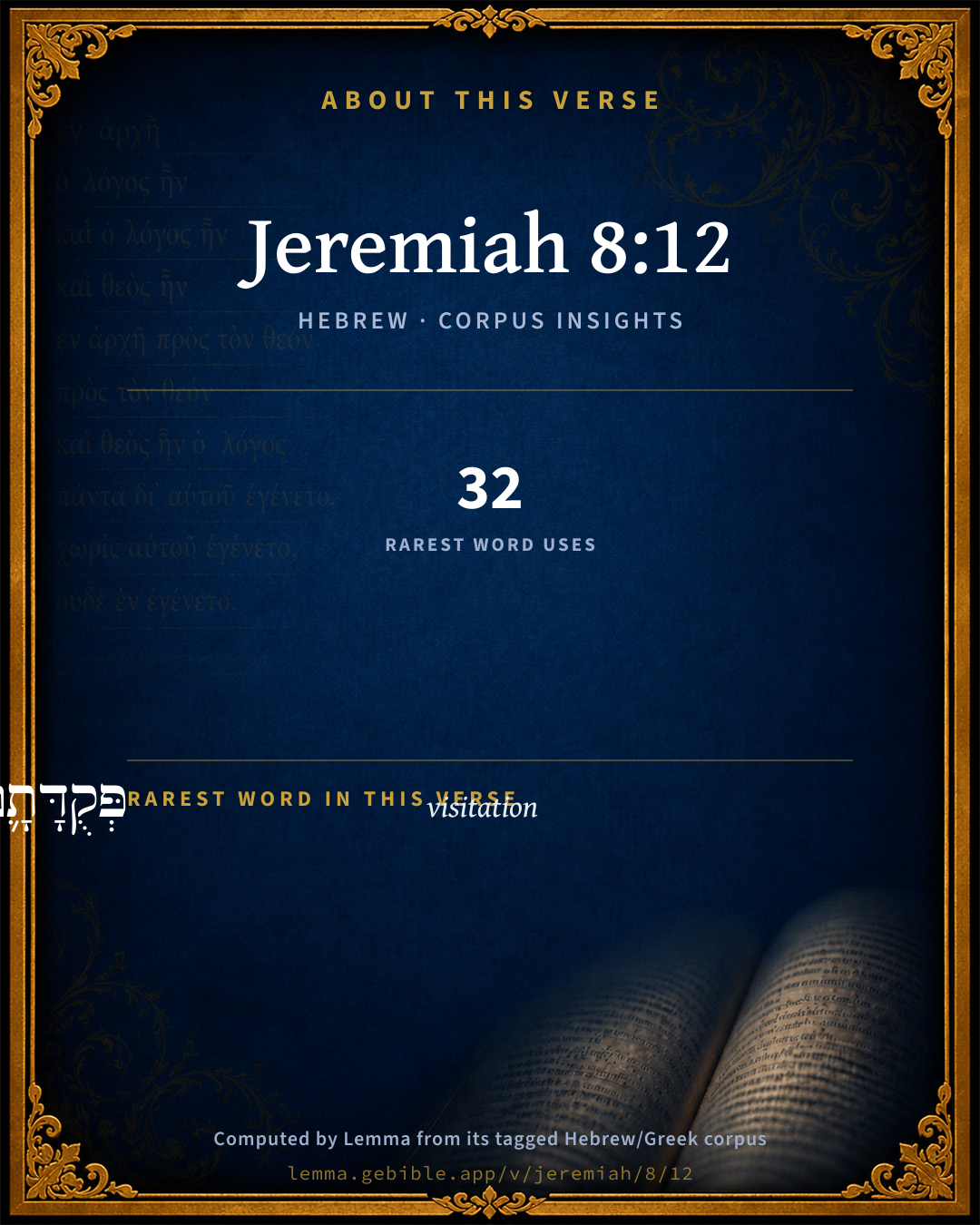
פְּקֻדָּתָ֛ם
pᵉquddâh
H6486
“visitation · their”
Noun, Common, Feminine, Singular, Construct + Suffix, Personal, 3rd Person, Masculine, Plural
Part of Speech
Noun
Type
Common
Gender
Feminine
Number
Singular
State
Construct
Full BDB Definition

Origin: pass part of H6485

TWOT: 1802a

oversight, care, custody, mustering, visitation, store - visitation, punishment - oversight, charge, office, overseer, class of officers - mustering - store
  1. הֹבִ֕שׁוּ yâbêsh H3001 “to dry up” Verb, Hiphil, Perfect, 3rd Person, Common, Plural
  2. כִּ֥י kîy H3588 “that” Conjunction
  3. תוֹעֵבָ֖ה tôwʻêbah H8441 “abomination” Noun, Common, Feminine, Singular, Absolute
  4. עָשׂ֑וּ ʻâsâh H6213 “to do” Verb, Qal, Perfect, 3rd Person, Common, Plural
  5. גַּם gam H1571 “also” Particle, Accusative
  6. בּ֣וֹשׁ bûwsh H954 “to be ashamed” Verb, Qal, Infinitive Absolute
  7. לֹֽא lôʼ H3808 “not” Particle, Negative
  8. יֵבֹ֗שׁוּ bûwsh H954 “to be ashamed” Verb, Qal, Imperfect, 3rd Person, Masculine, Plural
  9. וְהִכָּלֵם֙ kâlam H3637 “and · to shame” Conjunction + Verb, Niphal, Infinitive Construct
  10. לֹ֣א lôʼ H3808 “not” Particle, Negative
  11. יָדָ֔עוּ yâdaʻ H3045 “to know” Verb, Qal, Perfect, 3rd Person, Common, Plural
  12. לָכֵ֞ן kên H3651 “to/for · thus” Preposition + Adverb
  13. יִפְּל֣וּ nâphal H5307 “to fall” Verb, Qal, Imperfect, 3rd Person, Masculine, Plural
  14. בַנֹּפְלִ֗ים nâphal H5307 “in/at the · falling” Preposition, Determined + Verb, Qal, Participle Active, Masculine, Plural, Absolute
  15. בְּעֵ֧ת ʻêth H6256 “in/at · time of” Preposition + Noun, Common, Both, Singular, Construct
  16. יִכָּשְׁל֖וּ kâshal H3782 “to stumble” Verb, Niphal, Imperfect, 3rd Person, Masculine, Plural
  17. אָמַ֥ר ʼâmar H559 “to say” Verb, Qal, Perfect, 3rd Person, Masculine, Singular
  18. יְהוָֽה Yᵉhôvâh H3068 “LORD” Noun, Proper

About this verse

These counts appear in no published source. They are computed here, from the morphology-tagged text and Lemma’s own curated glosses. What Lemma adds →

19
words
16
distinct lemmas
Prophets
section

Shared distinctive vocabulary

פְּקֻדָּתָ֛ם visitation H6486 occurs in 31 verses of the Hebrew Bible. Also found in:

Grammatical profile

  • 10 verbs
  • 4 nouns
  • 1 conjunction
  • 1 adverb
  • 3 particles

Verb forms

  • הֹבִ֕שׁוּ Hiphil · Perfect
  • עָשׂ֑וּ Qal · Perfect
  • בּ֣וֹשׁ Qal · Infinitive Absolute
  • יֵבֹ֗שׁוּ Qal · Imperfect
  • וְהִכָּלֵם֙ Niphal · Infinitive Construct
  • יָדָ֔עוּ Qal · Perfect
  • יִפְּל֣וּ Qal · Imperfect
  • בַנֹּפְלִ֗ים Qal · Participle Active
  • יִכָּשְׁל֖וּ Niphal · Imperfect
  • אָמַ֥ר Qal · Perfect

Repetition

Words recur within this verse — often emphatic in Hebrew:

  • בּ֣וֹשׁ to be ashamed H954 ×2
  • יִפְּל֣וּ to fall H5307 ×2
  • לֹֽא not H3808 ×2

Cross-references

13

Topical passages linked to Jeremiah 8:12 in the Treasury of Scripture Knowledge — connected by theme and wording, ordered by reader-vote popularity; previews shown in the World English Bible.

  • Jeremiah 3:3 Therefore the showers have been withheld, and there has been no latter rain; yet you have a prostitute's forehead, you refused to be ashamed.
  • Deuteronomy 32:35 Vengeance is mine, and recompense, At the time when their foot shall slide: For the day of their calamity is at hand, The things that are to come on them shall make haste.
  • Psalms 52:7 "Behold, this is the man who didn't make God his strength, But trusted in the abundance of his riches, And strengthened himself in his wickedness."
  • Isaiah 3:9 The look of their faces testify against them. They parade their sin like Sodom. They don't hide it. Woe to their soul! For they have brought disaster upon themselves.
  • Jeremiah 6:15 Were they ashamed when they had committed abomination? nay, they were not at all ashamed, neither could they blush: therefore they shall fall among those who fall; at the time that I visit them they shall be cast down, says Yahweh.
  • Psalms 52:1 Why do you boast of mischief, mighty man? God's loving kindness endures continually.
  • Zephaniah 3:5 Yahweh, in the midst of her, is righteous. He will do no wrong. Every morning he brings his justice to light. He doesn't fail, but the unjust know no shame.
  • Isaiah 9:13–17 Yet the people have not turned to him who struck them, neither have they sought Yahweh of Hosts.
  • Isaiah 24:2 It shall be, as with the people, so with the priest; as with the servant, so with his master; as with the maid, so with her mistress; as with the buyer, so with the seller; as with the creditor, so with the debtor; as with the taker of interest, so with the giver of interest to him.
  • Ezekiel 22:25–31 There is a conspiracy of her prophets in the midst of it, like a roaring lion ravening the prey: they have devoured souls; they take treasure and precious things; they have made her widows many in the midst of it.
  • Hosea 4:5–6 You will stumble in the day, And the prophet will also stumble with you in the night; And I will destroy your mother.
  • Hosea 5:9 Ephraim will become a desolation in the day of rebuke. Among the tribes of Israel, I have made known that which will surely be.
  • Philippians 3:19 whose end is destruction, whose god is the belly, and whose glory is in their shame, who think about earthly things.

Cross-references courtesy of OpenBible.info (CC BY 4.0).

Hebrew and Greek witnesses Masoretic Hebrew ↔ Greek Septuagint

The same verse in the two great witnesses to the Old Testament, shown verse-for-verse.

These are two independent witnesses, not word-aligned to each other, and the Septuagint is shown in lemma (dictionary) form.

Hebrew Jeremiah 8:12 Masoretic · Westminster Leningrad Codex

הֹבִ֕שׁוּ כִּ֥י תוֹעֵבָ֖ה עָשׂ֑וּ גַּם בּ֣וֹשׁ לֹֽא יֵבֹ֗שׁוּ וְהִכָּלֵם֙ לֹ֣א יָדָ֔עוּ לָכֵ֞ן יִפְּל֣וּ בַנֹּפְלִ֗ים בְּעֵ֧ת פְּקֻדָּתָ֛ם יִכָּשְׁל֖וּ אָמַ֥ר יְהוָֽה

Were they ashamed when they had committed abomination? nay, they were not at all ashamed, neither could they blush: therefore shall they fall among those who fall; in the time of their visitation they shall be cast down, says Yahweh.

World English Bible · Public Domain

Greek LXX Structure differs

In the Septuagint, Jeremiah is about an eighth shorter than the Hebrew and arranges its material differently — the Oracles Against the Nations (Hebrew chapters 46–51) appear in the middle of the Greek book, after 25:13. Because the chapter and verse boundaries do not line up, a verse-for-verse comparison with the Hebrew is not shown.

A verse-for-verse comparison isn’t shown here because the chapters and verses don’t line up. Switch to the LXX edition with the MT / LXX toggle above to read the Greek directly.

Hebrew: Westminster Leningrad Codex (CC BY 4.0). Greek: Septuagint (public domain); English from a public-domain English Septuagint. How the Septuagint differs from the Hebrew →

Targum (Aramaic paraphrase)

1

The Targum is the ancient Jewish Aramaic paraphrase of the Hebrew Scriptures — an interpretive translation, not the Hebrew text itself. Onkelos (literal) and Pseudo-Jonathan (expansive) render the Torah, and Jonathan the Prophets. Coverage is partial: where no permissively-licensed English translation exists for a verse, only the Aramaic is shown. This is verse-level text, not a word-by-word alignment to the Hebrew.

  1. Targum Jonathan Prophets (Joshua–Malachi)
    עֲלֵיהוֹן לְמִבְהַת אֲרֵי תוֹעֵבָה עֲבָדוּ אַף מִבְהַת לֵית אִינוּן בַּהֲתִין וְאִתְכְּנָעוּ לֵית אִינוּן יָדְעִין בְּכֵן יִתְרְמוֹן קְטִילִין בְּעִדָן דְאַסְעַר עֲלֵיהוֹן חוֹבֵיהוֹן יִתְקְלוּן אֲמַר יְיָ:

    (no public-domain English translation for this verse)

    Targum Jonathan — Aramaic: “Mikraot Gedolot” (public domain). English: “Sefaria Community Translation” (CC0 1.0 (public-domain dedication)); “London "Chaldee Paraphrase," 1871” (public domain). Text via Sefaria.

Commentary

Notes on Jeremiah 8:12 from classic Christian and Jewish commentators (each source and its license shown beneath its notes). The classic Christian expositions comment on the surrounding passage and are grouped to its opening verse, so a note may address several verses; the Jewish commentaries on the Tanakh (Rashi and others) are per-verse, so they appear only where the commentator wrote on this verse.

Lemma curates 59 commentaries, every one of them public domain or Creative Commons licensed, each selected and text-cleaned for this edition rather than reprinted as found. About our sources →

Trapp's Complete Commentary

John Trapp

Jer 8:12 Were they ashamed when they had committed abomination? nay, they were not at all ashamed, neither could they blush: therefore shall they fall among them that fall: in the time of their visitation they shall be cast down, saith the LORD.

Ver. 12. Were they ashamed?] See Jer 6:15.

John Trapp, A Commentary or Exposition upon All the Books of the Old and New Testament (1647–1656) — public domain. Text from a community e-Sword module.

John Calvin's Commentaries

The Prophet in these words shews still more clearly that they were wholly irreclaimable; for they had divested themselves of every shame. It is no doubt a proof of a wickedness past all remedy, when no shame remains. This verse has been also explained in the sixth chapter; it forms the fifteenth verse. But we must bear in mind the design of the Prophet. It is then briefly this, — to shew that the wickedness of the people was unhealable, and for this reason, because they had an iron front.

Hence he asks, Have they been ashamed, because they have committed abomination? as though he had said, “They have been proved guilty of wickedness, can they be made to feel any shame?” To this he answers, Even in their shame they are not ashamed The particle גם, gam, even, is emphatic, Then the meaning may be thus given, — that when God brought against them their shameful conduct, and proved them guilty, so that they could not escape by any evasion — that when they were thus convicted, they yet had no feeling of shame. At the same time, this passage may be explained as referring to what is commonly called actual conviction; for they were well — nigh consumed with miseries, through their untamable perverseness, while contending with God’s judgment. Even then in shame itself they had no feeling of shame

Added is the reason, They know not how to blush By this want of shame, then, Jeremiah proves that they were men past remedy. And on this account he adds, Fall therefore shall they among those who fall, and in the time of their visitation they shall perish, or stumble. By these words he intimates that they were no longer to be reasoned with, and that God’s vengeance would be just in wholly destroying them, for he had in vain spoken to them, he had in vain contended with them, he had in vain tried to bring them to the right way. The import of the whole then is, — that the only thing that remained for them was destruction; for they had without shame rejected all instruction and every warning.

And he says, among the fallen, because every one, as it is commonly the case, encouraged others in their contempt of God, and in their perverseness. When therefore they saw others to be like themselves, they entertained hope of impunity; and hence they were allured to sin by this deception. On this account the Prophet says, that ruin was nigh them all. They shall fall, he says, among the fallen, and stumble in the time of their visitation. He shews that God had fixed a day in which they were to be destroyed. But if he deferred the time, there was no reason for them to think that it would be to their advantage; for they would by their obstinacy procure for themselves a heavier judgment. In short, though God might spare them for a time, yet the Prophet warns them, that this would avail them nothing, as God’s time of visitation was fixed. Then follows a confirmation —

John Calvin's Commentaries (1540-1563) — public domain. Text from the Calvin Translation Society English edition (1840s-50s) via the Christian Classics Ethereal Library (ccel.org). Calvin's coverage is partial (roughly two-thirds of the Bible); uncommented books and verses are honest gaps, never fabricated. The 19th-century editor's footnotes and remarks are omitted so the notes are faithfully Calvin's own voice.

Haydock's Catholic Bible Commentary

They are. Or, "are they?" &c. (St. Jerome) --- No, they are too hardened, chap. vi. 14.

George Leo Haydock (1774–1849), Haydock's Catholic Family Bible and Commentary, 1859 edition — public domain. Excludes Psalms (Douay-Rheims chapter numbering differs from Protestant) and Deuterocanonical books (Catholic canon only).

Rashi

Rabbi Shlomo Yitzchaki (Rashi)

They shall be put to shame Shame and embarrassment shall come upon them.

Neither are they ashamed They are not ashamed of their evil deeds to take heart to repent.

Rashi on the Tanakh — English translations: “The Judaica Press complete Tanach with Rashi, translated by A. J. Rosenberg” (CC BY 4.0); “Pentateuch with Rashi's commentary by M. Rosenbaum and A.M. Silbermann, 1929-1934” (public domain); “The Metsudah Tanach series, Lakewood, N.J” (CC BY 4.0); and “The Book of Joshua, Metsudah Publications, 1997” (CC BY 4.0). Text via Sefaria.

Lesson kit

Teaching starters — assembled from the data on this page, not authored interpretation. Every prompt links to the verse data it draws on. Edit before teaching.

Jeremiah, in the Prophets, opens this verse with 19 words (16 distinct Hebrew lemmas). Its most distinctive word is pᵉquddâh (“visitation”). A historical commentator’s framing appears above. Read the whole chapter for the surrounding context.

Discussion questions

  1. How does “visitation” (pᵉquddâh) shape what this verse is saying?
  2. Numbers 3:32 shares the word «visitation» with this verse. How do the two illuminate each other?
  3. “to be ashamed” occurs 2× in this one verse. What is the effect of the repetition?
  4. These translations render this verse differently; the difference is in the English rendering, not the original. What questions does that raise?
  5. The verb «הֹבִ֕שׁוּ» is Hiphil Perfect. How does its form color the action?
  6. Reading how Trapp's Complete Commentary and John Calvin's Commentaries read this verse, where do the two commentators agree and where do they part?

Things to notice

  • These translations choose different wording for 23 words in this verse.
  • “to be ashamed” occurs 2× in this single verse.
  • 16 distinct Hebrew lemmas span 19 words in this verse.

Reading settings

Reading text

Shown beneath each verse's original-language words.

Old Testament
Old Testament edition

Read the OT as the Masoretic Hebrew (MT) or the Greek Septuagint (LXX).

English shown for the Greek Septuagint (in the Hebrew ↔ Greek comparison).

Comparing translations? Open the Compare panel on any verse page to stack up to four side by side.