
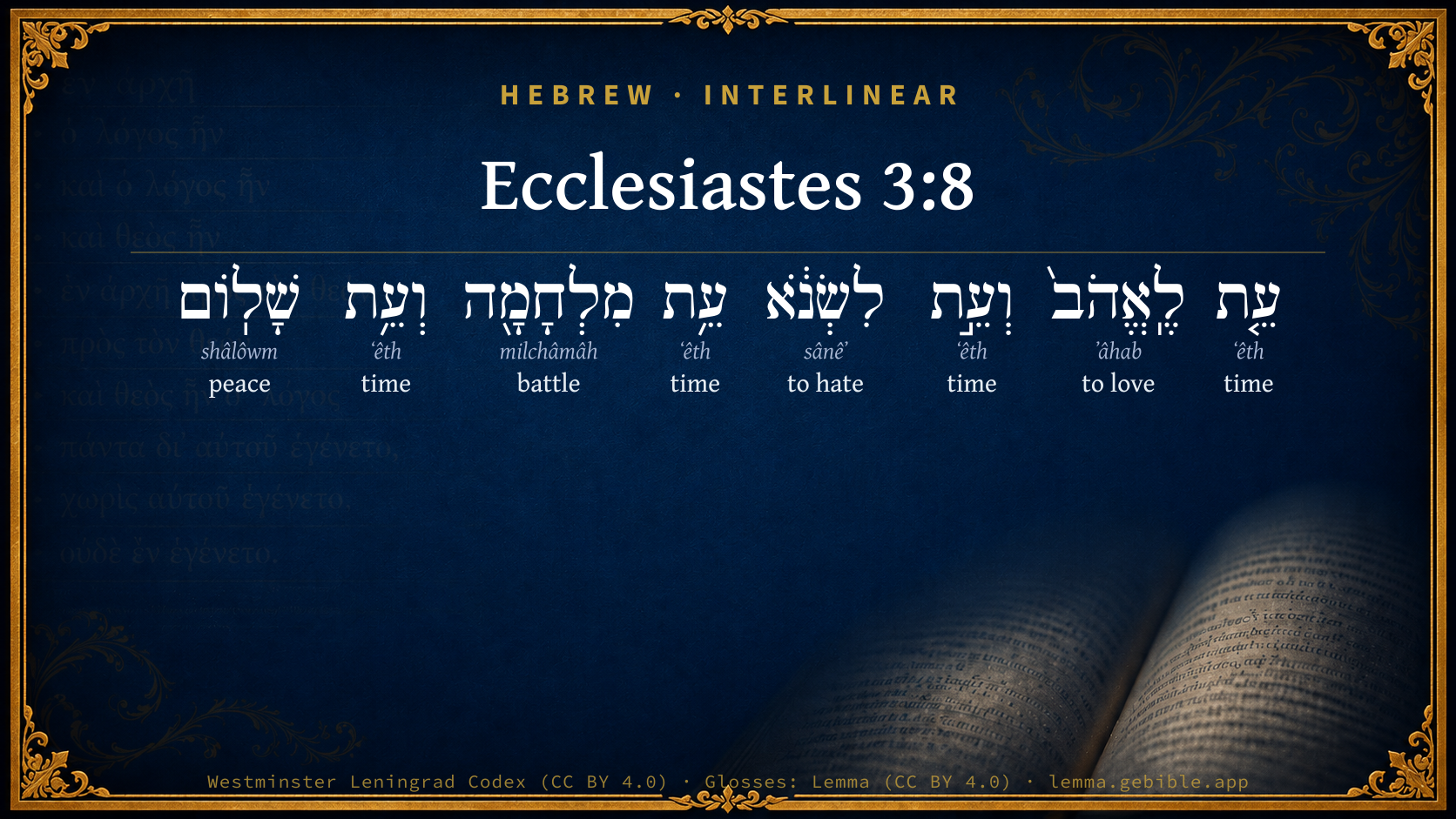
Ecclesiastes 3:8

Hebrew (Westminster Leningrad Codex) Ecclesiastes 3:8 appears in the Hebrew Old Testament. The text above is from the Westminster Leningrad Codex. Each word links to its Strong’s number, a concise gloss, and parsing drawn from the Open Scriptures Hebrew Bible morphology. Click any word for its full Brown-Driver-Briggs (BDB) entry.
Download image
Cite this verse

Ecclesiastes 3:8 (World English Bible). Public Domain. Lemma interlinear Bible study tool, https://lemma.gebible.app/v/ecclesiastes/3/8.

Show BibTeX & RIS
BibTeX
RIS
English Translation
A time to love, And a time to hate; A time for war, And a time for peace.
World English Bible · Public Domain
Download a study sheet

One document with this verse’s original text, its word-by-word gloss line, the meaning frame, cross-references with their text, attributed commentary, and full source and license credits — printable, and it pastes into notes with its structure intact.

This verse Autodidact and up

Study sheet (.html) Plain text (.txt)

A passage Seminary Student

Up to 50 verses in one chapter. A passage sheet keeps up to 6 commentary sources and 12 cross-references per verse, in the order this page ranks them, and says so on the sheet whenever that leaves anything out. Ask for a single verse and you get the Autodidact verse sheet above.

Everything on this page stays free to read, with no account — the sheet is a download of what is already on screen, not access to it.

Want to remove ads? Support Godless Engineer
Compare translations 3

The same verse in 3 English versions, stacked beneath the original-language interlinear above. Click any original word for its lexicon entry.

Each is an independent rendering of the whole verse — the interlinear is not word-aligned to these translations.

Highlighted words mark where these versions differ — a whole-verse word diff, not a word-by-word alignment.

  • World English Bible Public Domain
    A time to love, And a time to hate; A time for war, And a time for peace.
  • King James Version Public Domain
    A time to love, and a time to hate; a time of war, and a time of peace.
  • unfoldingWord Literal Text CC BY-SA 4.0
    a time to love and a time to hate, a time of war and a time of peace.

unfoldingWord Literal Text — © unfoldingWord, licensed CC BY-SA 4.0. Word-aligned USFM3 via Door43 (git.door43.org/unfoldingWord/en_ult).

Versions to compare (up to 4)

3 of 4 selected

Show all 18 translations

Every available English version of this verse, each an independent rendering of the whole verse.

  • World English Bible Public Domain
    A time to love, And a time to hate; A time for war, And a time for peace.
  • Berean Standard Bible Public Domain
    a time to love and a time to hate, a time for war and a time for peace.
  • Majority Standard Bible Public Domain
    a time to love and a time to hate, a time for war and a time for peace.
  • King James Version Public Domain
    A time to love, and a time to hate; a time of war, and a time of peace.
  • American Standard Version (1901) Public Domain
    a time to love, and a time to hate; a time for war, and a time for peace.
  • Revised Version (1885) Public Domain
    a time to love, and a time to hate; a time for war, and a time for peace.
  • Geneva Bible (1599) Public Domain
    A time to loue, and a time to hate: a time of warre, and a time of peace.
  • Douay-Rheims (1899) Public Domain
    A time of love, and a time of hatred. A time of war, and a time of peace.
  • Young's Literal Translation Public Domain
    A time to love, And a time to hate. A time of war, And a time of peace.
  • Literal Standard Version CC BY-SA 4.0
    A time to love, || And a time to hate. A time of war, || And a time of peace.
  • Unlocked Literal Bible CC BY-SA 4.0
    There is a time to love and a time to hate, a time for war and a time for peace.
  • unfoldingWord Literal Text CC BY-SA 4.0
    a time to love and a time to hate, a time of war and a time of peace.
  • Darby Bible Public Domain
    A time to love, and a time to hate; A time of war, and a time of peace.
  • World Messianic Bible Public Domain
    a time to love, and a time to hate; a time for war, and a time for peace.
  • Webster's Bible Public Domain
    A time to love, and a time to hate; a time of war, and a time of peace.
  • Free Bible Version CC BY-SA 4.0
    A time of loving, and a time of hating. A time of warfare, and a time of peace.
  • Bible in Basic English Public Domain
    A time for love and a time for hate; a time for war and a time for peace.
  • JPS Tanakh (1917) Public Domain
    A time to love, and a time to hate; a time for war, and a time for peace.

Literal Standard Version (2020), Covenant Press — licensed CC BY-SA 4.0. Text via the HelloAO Bible API (eBible.org). Unlocked Literal Bible (unfoldingWord) — licensed CC BY-SA 4.0. Text via the HelloAO Bible API (eBible.org). unfoldingWord Literal Text — © unfoldingWord, licensed CC BY-SA 4.0. Word-aligned USFM3 via Door43 (git.door43.org/unfoldingWord/en_ult). Free Bible Version, Dr. Jonathan Gallagher — licensed CC BY-SA 4.0. Text via the HelloAO Bible API (eBible.org).

Word by word

More ways to search: Search by grammar → Find every occurrence → Compare this word →

Practice this passage: Drill this verse → Learn its vocabulary →

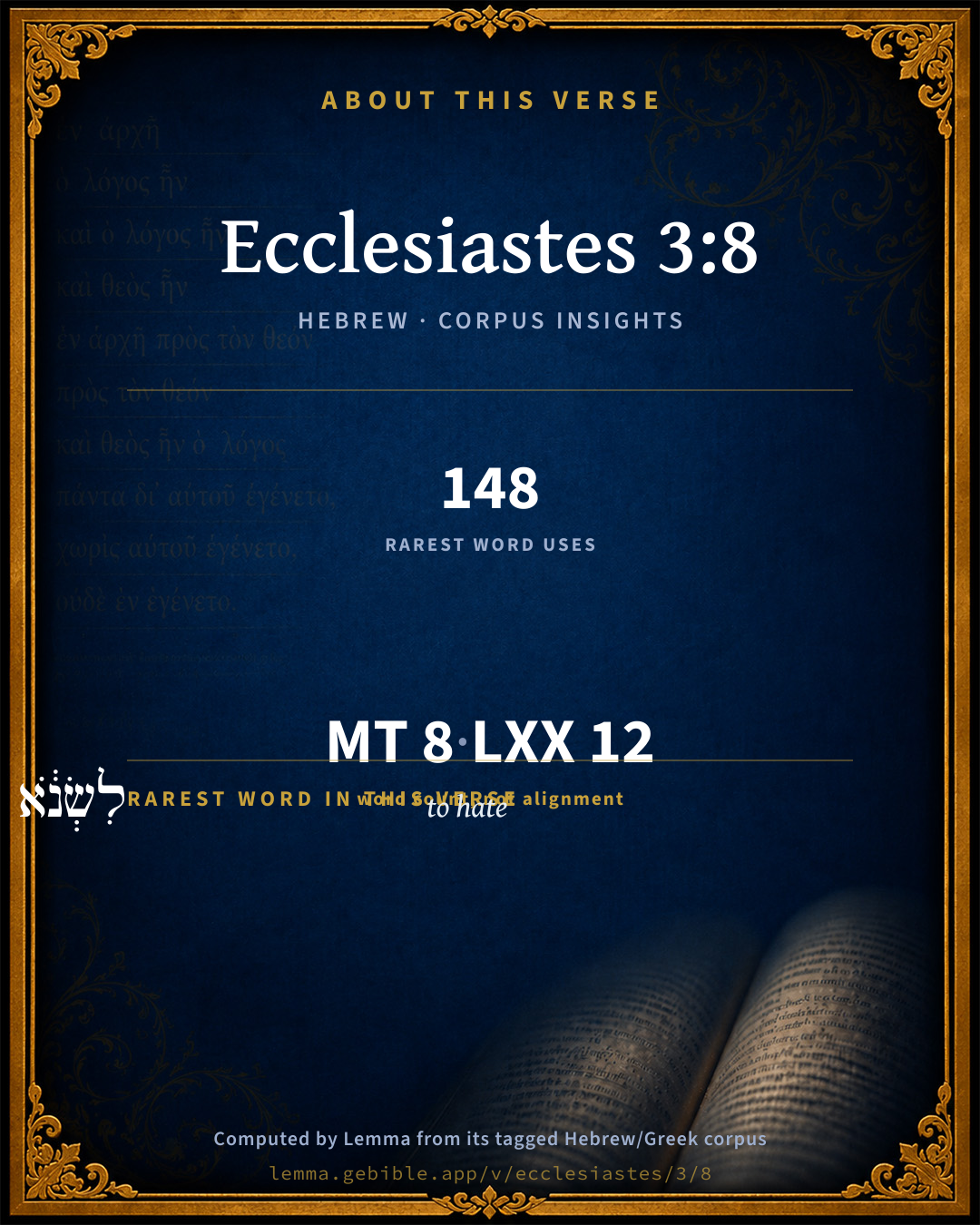
About this verse

These counts appear in no published source. They are computed here, from the morphology-tagged text and Lemma’s own curated glosses. What Lemma adds →

8
words
5
distinct lemmas
Wisdom
section

Grammatical profile

  • 2 verbs
  • 6 nouns

Verb forms

  • לֶֽאֱהֹב֙ Qal · Infinitive Construct
  • לִשְׂנֹ֔א Qal · Infinitive Construct

Repetition

A word recurs within this verse — often emphatic in Hebrew:

  • עֵ֤ת time H6256 ×4

Hebrew & Septuagint length

In English translation the verse runs 18 words from the Hebrew and 18 from the Septuagint (LXX English) — the same length.

A rough comparison of the two English renderings, which tokenize alike — not a word-level alignment.

Word counts can differ between the Hebrew and the Greek without any difference in meaning — e.g. the Hebrew direct-object marker אֵת has no separate Greek word, and Greek often adds the article ὁ.

In the original languages it is 8 Hebrew tokens and 12 Greek tokens — but the two are counted differently (Hebrew bundles its prefixes and suffixes into one token; the Greek is in lemma form), so that isn’t a like-for-like length.

Cross-references

15

Topical passages linked to Ecclesiastes 3:8 in the Treasury of Scripture Knowledge — connected by theme and wording, ordered by reader-vote popularity; previews shown in the World English Bible.

  • Ephesians 5:25 Husbands, love your wives, even as Christ also loved the assembly, and gave himself up for it;
  • Ephesians 5:28–29 Even so ought husbands also to love their own wives as their own bodies. He who loves his own wife loves himself.
  • Luke 14:26 "If anyone comes to me, and doesn't hate his own father, mother, wife, children, brothers, and sisters, yes, and his own life also, he can't be my disciple.
  • 1 Kings 5:4 But now Yahweh my God has given me rest on every side; there is neither adversary, nor evil occurrence.
  • 2 Chronicles 19:2 Jehu the son of Hanani the seer went out to meet him, and said to king Jehoshaphat, Should you help the wicked, and love those who hate Yahweh? for this thing wrath is on you from before Yahweh.
  • Psalms 139:21 Yahweh, don't I hate those who hate you? Am I not grieved with those who rise up against you?
  • Genesis 14:14–17 When Abram heard that his relative was taken captive, he led forth his trained men, born in his house, three hundred and eighteen, and pursued as far as Dan.
  • Joshua 8:1–29 Yahweh said to Joshua, Don't be afraid, neither be dismayed: take all the people of war with you, and arise, go up to Ai; behold, I have given into your hand the king of Ai, and his people, and his city, and his land;
  • Joshua 11:23 So Joshua took the whole land, according to all that Yahweh spoke to Moses; and Joshua gave it for an inheritance to Israel according to their divisions by their tribes. The land had rest from war.
  • 2 Samuel 10:6–19 When the children of Ammon saw that they were become odious to David, the children of Ammon sent and hired the Syrians of Beth Rehob, and the Syrians of Zobah, twenty thousand footmen, and the king of Maacah with one thousand men, and the men of Tob twelve thousand men.
  • Ephesians 3:19 and to know Christ's love which surpasses knowledge, that you may be filled with all the fullness of God.
  • Titus 2:4 that they may train the young women to love their husbands, to love their children,
  • Revelation 2:2 "I know your works, and your toil and perseverance, and that you can't tolerate evil men, and have tested those who call themselves apostles, and they are not, and found them false.
  • 2 Chronicles 20:1–30 It happened after this, that the children of Moab, and the children of Ammon, and with them some of the Ammonites, came against Jehoshaphat to battle.
  • Ezekiel 16:8 Now when I passed by you, and looked at you, behold, your time was the time of love; and I spread my skirt over you, and covered your nakedness: yes, I swore to you, and entered into a covenant with you, says the Lord Yahweh, and you became mine.

Cross-references courtesy of OpenBible.info (CC BY 4.0).

Hebrew and Greek witnesses Masoretic Hebrew ↔ Greek Septuagint

The same verse in the two great witnesses to the Old Testament, shown verse-for-verse.

These are two independent witnesses, not word-aligned to each other, and the Septuagint is shown in lemma (dictionary) form.

Hebrew Ecclesiastes 3:8 Masoretic · Westminster Leningrad Codex

עֵ֤ת לֶֽאֱהֹב֙ וְעֵ֣ת לִשְׂנֹ֔א עֵ֥ת מִלְחָמָ֖ה וְעֵ֥ת שָׁלֽוֹם

A time to love, And a time to hate; A time for war, And a time for peace.

World English Bible · Public Domain

Greek LXX Ecclesiastes 3:8 Septuagint · lemma form

καιρός ὁ φιλέω καί καιρός ὁ μισέω καιρός πόλεμος καί καιρός εἰρήνη

a time to love, and a time to hate; a time of war, and a time of peace.

LXX2012 (modern English Septuagint) · Public Domain

Hebrew: Westminster Leningrad Codex (CC BY 4.0). Greek: Septuagint (public domain); English from LXX2012 (modern English Septuagint) (Public Domain). How the Septuagint differs from the Hebrew →

Commentary

Notes on Ecclesiastes 3:8 from classic Christian and Jewish commentators (each source and its license shown beneath its notes). The classic Christian expositions comment on the surrounding passage and are grouped to its opening verse, so a note may address several verses; the Jewish commentaries on the Tanakh (Rashi and others) are per-verse, so they appear only where the commentator wrote on this verse.

Lemma curates 59 commentaries, every one of them public domain or Creative Commons licensed, each selected and text-cleaned for this edition rather than reprinted as found. About our sources →

Trapp's Complete Commentary

John Trapp

Ecc 3:8 A time to love, and a time to hate; a time of war, and a time of peace.

Ver. 8. A time to love, and a time to hate.] Yet I like not his counsel that said, Ama tanquam osurus, odi tanquam amaturus, {a} Let a man choose whom he may love, and then love whom he hath chosen. "Let love be without dissimulation; abhor the evil, cleave to the good." {Rom 12:9} Hate we may, but then it must be, non virum, sed vitium, not the man, but his evil qualities; whereof also we must seek to bereave him, that he may be totus desiderabilis, "altogether lovely." {Son 5:16}

A time of war, and a time of peace.] Time, saith an interpreter, is a circle; and the Preacher shutteth up this passage of time in a circle. For having begun with "a time to be born," and "a time to die," he endeth with "a time of war," which is a time of dying, and with "a time of peace," which is a time wherein people, by bringing forth, are multiplied.

{a} Cicero De Amicit.

John Trapp, A Commentary or Exposition upon All the Books of the Old and New Testament (1647–1656) — public domain. Text from a community e-Sword module.

Jamieson, Fausset & Brown

Robert Jamieson, A. R. Fausset & David Brown

hate--for example, sin, lusts (Luk 14:26); that is, to love God so much more as to seem in comparison to hate "father or mother," when coming between us and God.

a time of war . . . peace-- (Luk 14:31).

Jamieson, Fausset & Brown — Commentary Critical and Explanatory on the Whole Bible (1871) — public domain (CC PDM 1.0). Text via the HelloAO Bible API.

Adam Clarke's Commentary

Verse 8. A time to love, - hate, - of war, - of peace.]

"Love turns to hatred; interest or caprice

Dissolves the firmest knot by friendship tied.

O'er rival nations, with revenge inflamed,

Or lust of power, fell Discord shakes awhile

Her baleful torch: now smiling Peace returns.

The above paraphrase on the verses cited contains a general view of the principal occurrences of time, in reference to the human being, from his cradle to his grave, through all the operations of life.

Adam Clarke's Commentary on the Bible (1810–1826) — public domain. Text from a community e-Sword/MySword module.

The Cambridge Bible for Schools and Colleges

gen. ed. J. J. S. Perowne

8. A time to love, and a time, to hate] Greek thought again supplies us with a parallel,

ἡμεῖς δὲ πῶς οὐ γνωσόμεσθα σωφρονεῖν;

ἐγὼ δʼ, ἐπίσταμαι γὰρ ἀρτίως ὅτι

ὅ τʼ ἐχθρὸς ἡμῖν ἐς τοσόνδʼ ἐχθαρτέος,

ὡς καὶ φιλήσων αὖθις, ἔς τε τὸν φίλον

τοσαῦθʼ ὑπουργῶν ὠφελεῖν βουλήσομαι,

ὡς αἰὲν οὑ μενοῦντα.

“Shall not we too learn

Our lesson of true wisdom? I indeed

Have learnt but now that we should hate a foe

Only so far as one that yet may love,

And to a friend just so much help I’ll give

As unto one that will not always stay.”

Soph. Aias, 680–686.

a time of war, and a time of peace] The change in the Hebrew, as in the English, from verbs in the infinitive to substantives is probably intended to emphasize the completion of the list. The words are of course closely connected with the “love” and “hate” of the preceding clause, but differ in referring to the wider range of national relations. Here also the wisdom of a king or statesman lies in discerning the opportuneness of war or peace, in seeing when the maxim “si vis pacem para bellum” is applicable or inapplicable.

It may be well to repeat here what was said at the outset in reference to this list of times and seasons, that the idea of a Necessity, Fate, Predestination, which many interpreters, bent on finding traces of a Stoic fatalism, have read into the teaching of the section, is really foreign to the writer’s thoughts. That which he insists on is the thought that the circumstances and events of life form part of a Divine Order, are not things that come at random, and that wisdom, and therefore such a measure of happiness as is attainable, lies in adapting ourselves to the order and accepting the guidance of events in great things and small, while shame and confusion come from resisting it. The lesson is in fact identical with one very familiar to us at once in the commonest of all proverbs, “Take time by the forelock;” “Time and tide wait for no man,” and in a loftier strain,

“There is a tide in the affairs of men

Which, taken at the flood, leads on to fortune;

Omitted, all the remnant of their lives

Is bound in shallows and in miseries.”

Shakespeare, Julius Caesar, iv. 3.

It is well to remember such counsels of prudence. It is well also to remember that a yet higher wisdom bids us in the highest work “to be instant, in season, out of season” (εὐκαίρως, ἀκαίρως, 2Ti_4:2).

The Cambridge Bible for Schools and Colleges (gen. ed. J. J. S. Perowne; Cambridge University Press, 1878–1918) — public domain. Text from a community e-Sword module.

John Gill's Exposition

A time to love, and a time to hate,.... For one to love his friend, and to hate a man, a sinner, as the Targum; to love a friend while he continues such, and hate him, or less love him, when he proves treacherous and unfaithful; an instance of a change of love into hatred may be seen in the case of Amnon, Sa2 13:15. A time of unregeneracy is a time of loving worldly lusts and sinful pleasures, the company of wicked men, and all carnal delights and recreations; and a time of conversion is a time to hate what was before loved, sin, and the conversion of sinners, the garment spotted with the flesh, the principles and practices, though not the persons, of ungodly men; and even to hate, that is, less love, the dearest friends and relations, in comparison of, or when in competition with, Christ;

a time of war, and a time of peace; for nations to be engaged in war with each other, or to be at peace, which are continually revolving; and there is a time when there will be no more war. In a spiritual sense, the present time, or state of things, is a time of war; the Christian's life is a warfare state, though it will be soon accomplished, in which he is engaging in fighting with spiritual enemies, sin, Satan, and the world: the time to come, or future state, is a time of peace, when saints shall enter into peace, and be no more disturbed by enemies from within or from without. In the Midrash, all the above times and seasons are interpreted of Israel, and applied to them.

John Gill's Exposition of the Whole Bible (1746–1763) — public domain (CC PDM 1.0). Text via the HelloAO Bible API.

Matthew Poole's English Annotations

A time to love; when God will stir up the affection of love, or give occasion for the exercise or discovery of it to others.

Matthew Poole's English Annotations on the Holy Bible (1683–1685) — public domain. Text from a community e-Sword/MySword module.

Whedon's Commentary on the Bible

Daniel D. Whedon

8. To love… to hate — Even the movements of human passion are recognised as subject to the inevitable order. Men now “love” and now “hate” each other.

War… peace — Nations are now at “war,” and again in “peace.” The writer does not commit himself to the approval of any of the things here named. He simply takes twenty-eight illustrations from common life to show how the course of the world goes, and urges that this course is irresistible.

Daniel D. Whedon (gen. ed.), Commentary on the Old and New Testaments (1874–1909) — public domain. Text from a community e-Sword module.

The Pulpit Commentary

A time to love, and a time to hate. This reminds one of the gloss to which our Lord refers, (Mat_5:43) "Ye have heard that it hath been said, Thou shalt love thy neighbor, and hate thine enemy," the first member being found in the old Law, (Lev_19:18) the second being a misconception of the spirit which made Israel God"s executioner upon the condemned nations. It was the maxim of Bias, quoted by Aristotle, "Rhet.," 2:13, that we should love as if about some day to hate, and hate as if about to love. And Philo imparts a still more selfish tone to the gnome, when he pronounces ("De Carit.," 21, p. 401, Mang.), "It was well said by them of old, that we ought to deal out friendship without absolutely renouncing enmity, and practice enmity as possibly to turn to friendship. A time of war, and a time of peace. In the previous couplets the infinitive mood of the verb has been used; in this last hemistich substantives are introduced, as being more concise and better fitted to emphasize the close of the catalogue. The first clause referred specially to the private feelings which one is constrained to entertain towards individuals. The second clause has to do with national concerns, and touches on the statesmanship which discovers the necessity or the opportuneness of war and peace, and acts accordingly. In this and in all the other examples adduced, the lesson intended is this that man is not independent; that under all circumstances and relations he is in the hand of a power mightier than himself, which frames time and seasons according to its own good pleasure. God holds the threads of human life; in some mysterious way directs and controls events; success and failure are dependent upon his will. There are certain laws which, regulate the issues of actions and events, and man cannot alter these; his free-will can put them in motion, but they become irresistible when in operation. This is not fatalism; it is the mere statement of a fact in experience. Koheleth never denies man"s liberty, though he is very earnest in asserting God"s sovereignty. The reconciliation of the two is a problem unsolved by him.

The Pulpit Commentary (1880–1919), ed. H.D.M. Spence-Jones & Joseph S. Exell — public domain. Text from a community e-Sword module.

John Wesley's Explanatory Notes

To love - When God stirs up love, or gives occasion for the exercise of it.

John Wesley, Explanatory Notes Upon the Whole Bible (1754–1765) — public domain. Text via the GEBible commentary corpus.

Keil & Delitzsch

C. F. Keil & F. Delitzsch

"To love has its time, and to hate has its time; war has its time, and peace has its time." In the two pairs of contrasts here, the contents of the first are, not exclusively indeed (Psa 120:7), but yet chiefly referred to the mutual relations of peoples. It is the result of thoughtful intention that the quodlibet of 2 x 7 pairs terminates this for and against in "peace;" and, besides, the author has made the termination emphatic by this, that here "instead of infinitives, he introduces proper nouns" (Hitz.).

Keil & Delitzsch — Biblical Commentary on the Old Testament (1861–1891) — public domain (CC PDM 1.0). Text via the HelloAO Bible API. (Old Testament only.)

unfoldingWord translationNotes

Door43 World Missions Community

General Information:

The writer concludes using merisms to describe various aspects of life from one extreme to the other. (See: Merism)

What profit does the worker gain in his labor?

This is a thought provoking question to focus the reader on the next discussion topic. Translate "what profit does ... gain" as you did in Ecclesiastes 1:3. AT: "The worker gains no profit for his labor." (See: Rhetorical Question)

translationWords

time

love

peace

profit

labor

God

unfoldingWord translationNotes — © Distant Shores Media and the Door43 World Missions Community, licensed CC BY-SA 4.0. Source: git.door43.org/Door43/en_tn.

Rashi

Rabbi Shlomo Yitzchaki (Rashi)

A time to love (Deut. 7:13): “and He will love you.”

and a time to hate (Hos. 9:15): “All their evil is in Gilgal; therefore (sic) I hated them.”

Rashi on the Tanakh — English translations: “The Judaica Press complete Tanach with Rashi, translated by A. J. Rosenberg” (CC BY 4.0); “Pentateuch with Rashi's commentary by M. Rosenbaum and A.M. Silbermann, 1929-1934” (public domain); “The Metsudah Tanach series, Lakewood, N.J” (CC BY 4.0); and “The Book of Joshua, Metsudah Publications, 1997” (CC BY 4.0). Text via Sefaria.

Lesson kit

Teaching starters — assembled from the data on this page, not authored interpretation. Every prompt links to the verse data it draws on. Edit before teaching.

Ecclesiastes, in the Wisdom, opens this verse with 8 words (5 distinct Hebrew lemmas). Its most distinctive word is sânêʼ (“to hate”). A historical commentator’s framing appears above. Read the whole chapter for the surrounding context.

Discussion questions

  1. What does “to hate” (sânêʼ) contribute to the verse as a whole?
  2. How does Ephesians 5:25, which shares this passage’s theme, read alongside this verse?
  3. What does the repetition of “time” (4× in this one verse) do in this verse?
  4. «לֶֽאֱהֹב֙» is a Qal Infinitive Construct verb. How does that grammatical form shape the action described?
  5. Compare how Trapp's Complete Commentary and Jamieson, Fausset & Brown read this verse. Where do they agree or differ?

Things to notice

Reading settings

Reading text

Shown beneath each verse's original-language words.

Old Testament
Old Testament edition

Read the OT as the Masoretic Hebrew (MT) or the Greek Septuagint (LXX).

English shown for the Greek Septuagint (in the Hebrew ↔ Greek comparison).

Comparing translations? Open the Compare panel on any verse page to stack up to four side by side.