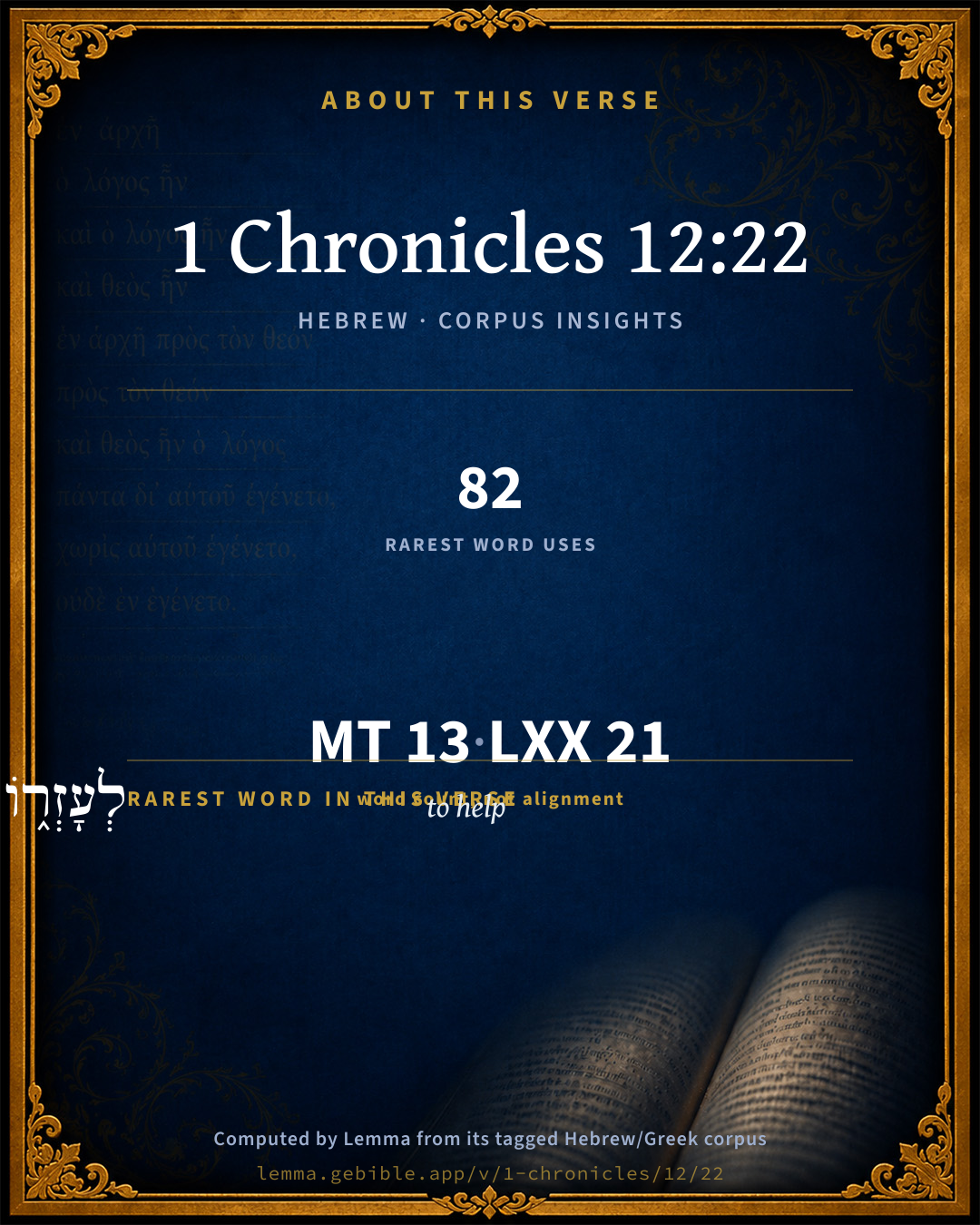
1 Chronicles 12:22

Hebrew (Westminster Leningrad Codex) 1 Chronicles 12:22 appears in the Hebrew Old Testament. The text above is from the Westminster Leningrad Codex. Each word links to its Strong’s number, a concise gloss, and parsing drawn from the Open Scriptures Hebrew Bible morphology. Click any word for its full Brown-Driver-Briggs (BDB) entry.
Download image
Cite this verse

1 Chronicles 12:22 (World English Bible). Public Domain. Lemma interlinear Bible study tool, https://lemma.gebible.app/v/1-chronicles/12/22.

Show BibTeX & RIS
BibTeX
RIS
English Translation
For from day to day men came to David to help him, until there was a great host, like the host of God.
World English Bible · Public Domain
Download a study sheet

One document with this verse’s original text, its word-by-word gloss line, the meaning frame, cross-references with their text, attributed commentary, and full source and license credits — printable, and it pastes into notes with its structure intact.

This verse Autodidact and up

Study sheet (.html) Plain text (.txt)

A passage Seminary Student

Up to 50 verses in one chapter. A passage sheet keeps up to 6 commentary sources and 12 cross-references per verse, in the order this page ranks them, and says so on the sheet whenever that leaves anything out. Ask for a single verse and you get the Autodidact verse sheet above.

Everything on this page stays free to read, with no account — the sheet is a download of what is already on screen, not access to it.

Want to remove ads? Support Godless Engineer
Compare translations 3

The same verse in 3 English versions, stacked beneath the original-language interlinear above. Click any original word for its lexicon entry.

Each is an independent rendering of the whole verse — the interlinear is not word-aligned to these translations.

Highlighted words mark where these versions differ — a whole-verse word diff, not a word-by-word alignment.

  • World English Bible Public Domain
    For from day to day men came to David to help him, until there was a great host, like the host of God.
  • King James Version Public Domain
    For at that time day by day there came to David to help him, until it was a great host, like the host of God.
  • unfoldingWord Literal Text CC BY-SA 4.0
    For at the time of day by day, they were coming to David to help him, until to a great camp, like the camp of God.

unfoldingWord Literal Text — © unfoldingWord, licensed CC BY-SA 4.0. Word-aligned USFM3 via Door43 (git.door43.org/unfoldingWord/en_ult).

Versions to compare (up to 4)

3 of 4 selected

Show all 18 translations

Every available English version of this verse, each an independent rendering of the whole verse.

  • World English Bible Public Domain
    For from day to day men came to David to help him, until there was a great host, like the host of God.
  • Berean Standard Bible Public Domain
    For at that time men came to David day after day to help him, until he had a great army, like the army of God.
  • Majority Standard Bible Public Domain
    For at that time men came to David day after day to help him, until he had a great army, like the army of God.
  • King James Version Public Domain
    For at that time day by day there came to David to help him, until it was a great host, like the host of God.
  • American Standard Version (1901) Public Domain
    For from day to day men came to David to help him, until there was a great host, like the host of God.
  • Revised Version (1885) Public Domain
    For from day to day there came to David to help him, until it was a great host, like the host of God.
  • Geneva Bible (1599) Public Domain
    For at that time day by day there came to Dauid to helpe him, vntill it was a great hoste, like the hoste of God.
  • Douay-Rheims (1899) Public Domain
    Moreover day by day there came some to David to help him till they became a great number, like the army of God.
  • Young's Literal Translation Public Domain
    for at that time, day by day, they come in unto David to help him, till it is a great camp, like a camp of God.
  • Literal Standard Version CC BY-SA 4.0
    for at that time, day by day, they come to David to help him, until it is a great camp, like a camp of God.
  • Unlocked Literal Bible CC BY-SA 4.0
    Day after day, men came to David to help him, until there was a great army, like the army of God.
  • unfoldingWord Literal Text CC BY-SA 4.0
    For at the time of day by day, they were coming to David to help him, until to a great camp, like the camp of God.
  • Darby Bible Public Domain
    For day by day there came [men] to David to help him, until it was a great camp, like the camp of God.
  • World Messianic Bible Public Domain
    For from day to day men came to David to help him, until there was a great army, like God’s army.
  • Webster's Bible Public Domain
    For at that time day by day there came to David to help him, until it was a great host, like the host of God.
  • Free Bible Version CC BY-SA 4.0
    Men arrived daily to help David until he had a large army, like the army of God.
  • Bible in Basic English Public Domain
    And from day to day more supporters came to David, till he had a great army like the army of God.
  • JPS Tanakh (1917) Public Domain
    (12-23) For from day to day men came to David to help him, until there was a great host, like the host of God.

Literal Standard Version (2020), Covenant Press — licensed CC BY-SA 4.0. Text via the HelloAO Bible API (eBible.org). Unlocked Literal Bible (unfoldingWord) — licensed CC BY-SA 4.0. Text via the HelloAO Bible API (eBible.org). unfoldingWord Literal Text — © unfoldingWord, licensed CC BY-SA 4.0. Word-aligned USFM3 via Door43 (git.door43.org/unfoldingWord/en_ult). Free Bible Version, Dr. Jonathan Gallagher — licensed CC BY-SA 4.0. Text via the HelloAO Bible API (eBible.org).

Word by word

More ways to search: Search by grammar → Find every occurrence → Compare this word →

Practice this passage: Drill this verse → Learn its vocabulary →

לְעָזְר֑וֹ
ʻâzar
H5826
“to help · him”
Preposition + Verb, Qal, Infinitive Construct + Suffix, Personal, 3rd Person, Masculine, Singular
Part of Speech
Preposition + Verb
Stem
Qal
Form
Infinitive Construct
Full BDB Definition

Origin: a primitive root

TWOT: 1598

to help, succour, support - (Qal) to help - (Niphal) to be helped - (Hiphil) to help
  1. כִּ֚י kîy H3588 “that” Conjunction
  2. לְעֶת ʻêth H6256 “to/for · time of” Preposition + Noun, Common, Both, Singular, Construct
  3. י֣וֹם yôwm H3117 “day” Noun, Common, Masculine, Singular, Absolute
  4. בְּי֔וֹם yôwm H3117 “in/at · day” Preposition + Noun, Common, Masculine, Singular, Absolute
  5. יָבֹ֥אוּ bôwʼ H935 “to enter” Verb, Qal, Imperfect, 3rd Person, Masculine, Plural
  6. עַל ʻal H5921 “upon” Preposition
  7. דָּוִ֖יד Dâvid H1732 “David” Noun, Proper
  8. עַד ʻad H5704 “until” Preposition
  9. לְמַחֲנֶ֥ה machăneh H4264 “to/for · camp” Preposition + Noun, Common, Both, Singular, Absolute
  10. גָד֖וֹל gâdôwl H1419 “great” Adjective, Adjective, Masculine, Singular, Absolute
  11. כְּמַחֲנֵ֥ה machăneh H4264 “like/as · camp of” Preposition + Noun, Common, Both, Singular, Construct
  12. אֱלֹהִֽים ʼĕlôhîym H430 “God(s)” Noun, Common, Masculine, Plural, Absolute

About this verse

These counts appear in no published source. They are computed here, from the morphology-tagged text and Lemma’s own curated glosses. What Lemma adds →

13
words
11
distinct lemmas
Historical
section

Grammatical profile

  • 2 verbs
  • 7 nouns
  • 1 adjective
  • 2 prepositions
  • 1 conjunction

Verb forms

  • יָבֹ֥אוּ Qal · Imperfect
  • לְעָזְר֑וֹ Qal · Infinitive Construct

Repetition

Words recur within this verse — often emphatic in Hebrew:

  • י֣וֹם day H3117 ×2
  • לְמַחֲנֶ֥ה camp H4264 ×2

Hebrew & Septuagint length

In English translation the verse runs 23 words from the Hebrew and 18 from the Septuagint (LXX English) — closely comparable.

A rough comparison of the two English renderings, which tokenize alike — not a word-level alignment.

Word counts can differ between the Hebrew and the Greek without any difference in meaning — e.g. the Hebrew direct-object marker אֵת has no separate Greek word, and Greek often adds the article ὁ.

In the original languages it is 13 Hebrew tokens and 21 Greek tokens — but the two are counted differently (Hebrew bundles its prefixes and suffixes into one token; the Greek is in lemma form), so that isn’t a like-for-like length.

Cross-references

6

Topical passages linked to 1 Chronicles 12:22 in the Treasury of Scripture Knowledge — connected by theme and wording, ordered by reader-vote popularity; previews shown in the World English Bible.

  • 2 Samuel 3:1 Now there was long war between the house of Saul and the house of David: and David grew stronger and stronger, but the house of Saul grew weaker and weaker.
  • Job 17:9 Yet shall the righteous hold on his way. He who has clean hands shall grow stronger and stronger.
  • Genesis 32:2 When he saw them, Jacob said, "This is God's host." He called the name of that place Mahanaim.
  • Joshua 5:14 He said, No; but [as] prince of the host of Yahweh am I now come. Joshua fell on his face to the earth, and did worship, and said to him, What says my lord to his servant?
  • 2 Samuel 2:2–4 So David went up there, and his two wives also, Ahinoam the Jezreelitess, and Abigail the wife of Nabal the Carmelite.
  • Psalms 148:2 Praise him, all his angels! Praise him, all his host!

Cross-references courtesy of OpenBible.info (CC BY 4.0).

Hebrew and Greek witnesses Masoretic Hebrew ↔ Greek Septuagint

The same verse in the two great witnesses to the Old Testament, shown verse-for-verse.

These are two independent witnesses, not word-aligned to each other, and the Septuagint is shown in lemma (dictionary) form.

Hebrew 1 Chronicles 12:22 Masoretic · Westminster Leningrad Codex

כִּ֚י לְעֶת י֣וֹם בְּי֔וֹם יָבֹ֥אוּ עַל דָּוִ֖יד לְעָזְר֑וֹ עַד לְמַחֲנֶ֥ה גָד֖וֹל כְּמַחֲנֵ֥ה אֱלֹהִֽים

For from day to day men came to David to help him, until there was a great host, like the host of God.

World English Bible · Public Domain

Greek LXX 1 Chronicles 12:22 Septuagint · lemma form

καί αὐτός συνμαχέομαι ὁ δαυίδ ἐπί ὁ γεδδουρ ὅτι δυνατός ἰσχύς πᾶς καί εἰμί ἡγέομαι ἐν ὁ στρατιά ἐν ὁ δύναμις

For daily men came to David, till they amounted to a great force, as the force of God.

LXX2012 (modern English Septuagint) · Public Domain

Hebrew: Westminster Leningrad Codex (CC BY 4.0). Greek: Septuagint (public domain); English from LXX2012 (modern English Septuagint) (Public Domain). How the Septuagint differs from the Hebrew →

Commentary

Notes on 1 Chronicles 12:22 from classic Christian and Jewish commentators (each source and its license shown beneath its notes). The classic Christian expositions comment on the surrounding passage and are grouped to its opening verse, so a note may address several verses; the Jewish commentaries on the Tanakh (Rashi and others) are per-verse, so they appear only where the commentator wrote on this verse.

Lemma curates 59 commentaries, every one of them public domain or Creative Commons licensed, each selected and text-cleaned for this edition rather than reprinted as found. About our sources →

Trapp's Complete Commentary

John Trapp

1Ch 12:22 For at [that] time day by day there came to David to help him, until [it was] a great host, like the host of God.

Ver. 22. Like the host of God,] i.e., A numerous and a notable host, such as God’s is, of angels and all creatures. Dei nimirum Maximi, maxima sunt omnia.

John Trapp, A Commentary or Exposition upon All the Books of the Old and New Testament (1647–1656) — public domain. Text from a community e-Sword module.

Geneva Bible (1599)

Geneva Bible translators

Meaning, mighty or strong: for the Hebrews say a thing is of God, when it is excellent.

Geneva Bible (1599) marginal notes — public domain. Text via Bolls.life.

Jamieson, Fausset & Brown

Robert Jamieson, A. R. Fausset & David Brown

the host of God--that is, a great and powerful army.

Jamieson, Fausset & Brown — Commentary Critical and Explanatory on the Whole Bible (1871) — public domain (CC PDM 1.0). Text via the HelloAO Bible API.

Adam Clarke's Commentary

Verse 22. Like the host of God.] "That is, a very numerous army; like the army of the angel of God." - T.

Adam Clarke's Commentary on the Bible (1810–1826) — public domain. Text from a community e-Sword/MySword module.

Ellicott's Commentary for English Readers

(22) For at that time day by day . . .—Literally, For at the time of each day (i.e., every day) men used to come to David to help him; amounting to a mighty camp, like a camp of God. The verse explains why David required so many captains as have been enumerated, and why the term “army” was used of his troop in the last verse.

A great host, like the host of God.—Literally, camp. The phrase has an antique colouring Comp. Gen_32:1-2 : “And Jacob went on his way, and the angels of God met him. And when Jacob saw them, he said, This is God’s camp (mahançh ‘Elôhîm): and the name of that place was called Mahanaim (i.e., two camps). Mahanaim was a place iύύ Manasseh (Jos_13:30). Ancient Hebrew denotes excellence by reference to the Divine standard, which is the true ideal of all excellence. Comp. Psa_36:6 : “Thy righteousness is like the hills of God”; and so elsewhere we find the expression, “cedars of God” (Psa_80:11). The verse appears to include the considerable accessions to David’s forces which followed upon the defeat and death of Saul.

A Bible Commentary for English Readers, edited by Charles John Ellicott (1878–1897) — public domain. Text from a community e-Sword module.

The Cambridge Bible for Schools and Colleges

gen. ed. J. J. S. Perowne

22. For at that time day by day] R.V. For from day to day.

the host of God] The phrase comes from Gen_32:2; cp. Psa_68:15 (R.V.) “a mountain of God.” The epithet “of God” is used to distinguish a thing as “very great.”

The Cambridge Bible for Schools and Colleges (gen. ed. J. J. S. Perowne; Cambridge University Press, 1878–1918) — public domain. Text from a community e-Sword module.

John Gill's Exposition

And there they were with David three days, eating and drinking,.... Keeping a festival, to testify their joy on this occasion:

for their brethren had prepared for them; not the inhabitants of Hebron only, but all the country round about, brought in provisions on this joyful occasion; otherwise the men of Hebron would not have been able to have provided what was sufficient for such a vast number, as appears by what follows.

John Gill's Exposition of the Whole Bible (1746–1763) — public domain (CC PDM 1.0). Text via the HelloAO Bible API.

Haydock's Catholic Bible Commentary

Of God; very great, (Calmet) particularly when Isboseth was slain, 2 Kings v. 1. (Haydock) --- The angels are to us innumerable, Job xxv. An army in concord is compared to them. (Worthington)

George Leo Haydock (1774–1849), Haydock's Catholic Family Bible and Commentary, 1859 edition — public domain. Excludes Psalms (Douay-Rheims chapter numbering differs from Protestant) and Deuterocanonical books (Catholic canon only).

Matthew Poole's English Annotations

At that time, i.e. while he was at Ziklag, and in his march to Hebron, and principally at Hebron, as the next verse explains it.

Like the host of God, i.e. innumerable, like the stars or angels, both which are called God’s hosts. Otherwise, the host of God, i.e. a very great host, great things being so called, as cedars, mountains, &c. of God. But the particle of likeness here added excludes this sense, for it had been very improper to say, a great host like a great host, i.e. like itself.

Matthew Poole's English Annotations on the Holy Bible (1683–1685) — public domain. Text from a community e-Sword/MySword module.

Whedon's Commentary on the Bible

Daniel D. Whedon

22. A great host, like the host of God — That is, strong, mighty, glorious. Compare “hill of God,” Psa_68:15, “cedars of God,” Psa_80:10, margin; “city of God,” Jon_3:3, margin.

Daniel D. Whedon (gen. ed.), Commentary on the Old and New Testaments (1874–1909) — public domain. Text from a community e-Sword module.

The Pulpit Commentary

The host of God. A forcible comment on the metaphorical use of this phrase is found in 1Sa_14:15; Authorized Version, a very great trembling" is the translation of Hebrew "trembling of God." The for with which this verse commences probably explains the call there was for many and able "captains" for a host becoming daily larger.

A great work needs great help.

The way in which David was prepared for the sovereignty over Israel is very remarkable. He himself was disciplined by adversity for days of power and prosperity. And the people were gradually, during the later years of Saul"s life and reign, made ready for the transfer of their allegiance to his nobler successor. His life as an outlaw was one of many dangers and perplexities and straits. But during this period many able and valiant men became acquainted with the daring and sagacious chief, learned to trust in him, attached themselves to his camp, and qualified themselves for posts of honour and authority in the kingdom that was to be founded by the son of Jesse. It was "at that time," that, "day by day, there came to David to help him, until it was a great host or, "camp, like the camp of God.

I IN ACCOMPLISHING A GREAT WORK, PROVIDENCE MAKES USE OF AN INDIVIDUAL AS THE CENTRE OF INFLUENCE AND AS THE LEADER OF OTHERS. Israel was to be consolidated into a mighty nation, and God chose David to do the work. He qualified him by his Spirit; gave him valour and prudence and the power of attracting others and attaching them to himself. And when God would restore humanity to its intended purpose, and establish his kingdom upon earth, he "set his King upon his holy hill of Zion." He chose to accomplish the great end by means of the Son of man, David"s Son and David"s Lord.

II GOD GATHERS MEN AROUND THIS INDIVIDUAL BY THE ATTRACTION OF SYMPATHY AND FELLOWSHIP. David"s fellow-countrymen recognized in him the qualifications necessary for a leader, a commander, a king. The valiant and capable, the flower of the youth, were drawn to him by the bends of a mighty attraction. He could never have done the work entrusted to him if he had been left alone. But he found lieutenants, counsellors, friends, with whose help everything became possible which was possible to man. This was an emblem of the power which Christ possesses to attach men"s souls to himself. "I," said he, "if I be lifted up, will draw all men unto myself." It was so at the beginning. The apostles were Christ"s lieutenants and captains in his holy war. The early history of the Church tells how capable and devoted men were raised up, to teach and preach, to organize and administer, to write and expound, to suffer, to witness, and to die. And from that time there has never been an era in which noble, brave, self-denying men have not been drawn to the Saviour by the magnetism of the Spirit"s influence, and qualified to render service to the Church and to its Lord.

III THESE HELPERS COME SUCCESSIVELY AND CONSTANTLY, AS NEED REQUIRES. David"s confederates came in successive bands, as emergencies arose in which they were needed. His heart must have been cheered as they came, unexpectedly and yet most welcome, "day by day." A gradual and constant accession was thus made to his following, and to his power to rule when the right time came. It is the same in the kingdom of Christ, which "cometh not with observation," but the history of which is, nevertheless, one of incessant progress. In many ways God is bringing souls to the camp of his Son. And his warriors shall be numerous as the dewdrops of the morning, as the stars in the heavenly host of God.

IV BY THE AGENCY OF NUMEROUS AND MIGHTY HELPERS THE GREAT WORK IS TO BE ACCOMPLISHED. The preparations made, according to the text, issued in the establish, ment of a throne and dominion. And Christ"s kingdom is to come on earth, not by the agency of angels or by the instrumentality of miracles, but by the consecrated adhesion of devoted, fearless, and self-denying spirits. In every congregation may many come, day by day, to Christ, to help him in his kingdom and his warfare! T.

Vers. 22, 23.

One increasing, another decreasing.

So constant and so extensive were the accessions to David"s party, that any observer would have said, "It is evident that Saul is going down and David is going up. This David is the man of the future." When it is seen in which direction the tide is flowing, every one hurries to take advantage of it, hoping to float on it to his own fortune. But this very common process, which may be observed in the various spheres of life any day, is here connected with the Divine purposes and promises. Silently, it may even be said naturally, the nation was coming round to the acceptance of God"s arrangement for it. Men may say that the political change was sufficiently accounted for by political considerations. Scripture shows us in all the outworkings of the Divine will. (1Sa_16:13) The instance in which the rising of one and the decline of another was piously and submissively accepted by the declining one, is that of our Lord and John the Baptist. It is John himself who, clearly seeing the preparatory character of his own work, and the permanent glory of the mission of the Lamb of God, says, "He must increase, but I must decrease." This success of one and failure of another, this success of one resting upon the very failure of another, is one of the most ordinary facts of life. It may be painful and oppressive, or it may become a cause of submissive joy, according to the side from which we view it.

I IT WILL BE PAINFUL TO US IF WE ARE MORE CONCERNED FOR SELF THAN FOR GOD. If a man limits his vision to his own immediate and personal interests, anything like failure must be to him unmitigated distress. He knows no side whence relief can come. Failure can take on no gracious shapes; it can be nothing but miserable failure. Yet is "success for self" the end of life? Can we isolate ourselves from the Divine plan for all? Would it really be well for the individual if he could? And may not God"s great plan for the whole involve, in its outworking, some disabilities for the few? especially if he counts the highest good, the only real good, to be good of character, not of circumstances? If we are more anxious for God than for self, then it need never be hard for us, at his bidding and under his lead, to step down into seeming failure, second places, and disabilities. We may see others go on before us to places of honour, quietly assured that our God knows they may serve him up there better than we could do.

II IT WILL BE PAINFUL TO US IF WE FAIL TO RECOGNIZE THAT ONE MAN"S WORK PREPARES FOR ANOTHER. And so that which seems low down, simple, and humble in character, may be truly honourable and important, because of its preparatory character. David was humbled by God"s refusal to allow him to build his temple; but David could prepare for, and so have a true part in, the success of Solomon. The same may be said of John the Baptist. It did not matter that his particular mission failed when its work was done, and it had prepared the way for the Messiah. Those who only do preparing work must fully accept the fact that, in the world"s eye, their life will seem to be a failure; it may even be so to their own view, but God "soeth not as man seeth," and has his gracious ways of setting "last ones first.

III IT WILL BE PAINFUL TO US IF WE FAIL TO REALIZE THAT REWARDS COME FOR WHAT A MAN IS, AND NOT MERELY FOR WHAT HE DOES. Herein Divine rewards so materially differ from human ones. Man can only recognize what is done, or attained, and he gives his rewards for achievement. God searches into the motive and the character, and gives his rewards for what the man is proved to be in the doing. Success is not necessary to the best character; finer qualities gain expression and culture in failure, disappointment and trouble. Results may be reached under conditions that involve no nobility of character. It is still very largely true that "deep in the valleys rest, the Spirit"s gifts most holy," and heaven may have its welcome rather for poor disabled Lazarus at the gate than for prosperous and luxurious Dives on the silken couch at the sumptuous board. God sets some of us low down and keeps us there, because he puts faithfulness far above success.

IV IT WILL BE PAINFUL TO US IF WE REFUSE TO ADMIT THAT DIVINE JUDGMENTS COME IN THE REMOVAL OF MEN FROM PLACES OF HONOUR AND TRUST; as was the case with King Saul. So now, God deals with his people; sickness sets them aside from the path of ambition. Their best efforts again and again end in failure. And true hearts will not fail to see in such things Divine judgments; solemn recognitions of failings in motive and spirit; holy callings back to the humble and trustful reliances; awakenings to the conviction that a man prospers only "as his soul prospers." Then, when others go on past us to wealth, position, and honour, when they increase and we decrease, may we even rejoice? Yes; if we really care more for God than for self, and more for others than for self. We should be ever ready to stand in the chiefest places, if God would have us stand in them. But we should be quite as willing to stand down and let another take our place, if God would set him up. The disabilities of life may involve our "decreasing;" but the time must come when from our hands the tools and the weapons must fall, and, empty handed, we pass into the eternal world. Then others must step into our places, and it will be well for us if, when our works are burned up, we ourselves are saved, "yet so as by fire." Of this we may be sure, if we failed to win or to keep what we thought our right place in this world, in the next God will put us just where we should be in view of what, in character and spirit, we have been able to win through the failures or successes of our human life. R.T.

The Pulpit Commentary (1880–1919), ed. H.D.M. Spence-Jones & Joseph S. Exell — public domain. Text from a community e-Sword module.

John Wesley's Explanatory Notes

That time - While he was at Ziklag, and in his march to Hebron, and principally at Hebron. Like - Innumerable, like the stars or angels, both which are called God's hosts.

John Wesley, Explanatory Notes Upon the Whole Bible (1754–1765) — public domain. Text via the GEBible commentary corpus.

Keil & Delitzsch

C. F. Keil & F. Delitzsch

And there they were with David three days, eating and drinking,.... Keeping a festival, to testify their joy on this occasion:

for their brethren had prepared for them; not the inhabitants of Hebron only, but all the country round about, brought in provisions on this joyful occasion; otherwise the men of Hebron would not have been able to have provided what was sufficient for such a vast number, as appears by what follows.

Keil & Delitzsch — Biblical Commentary on the Old Testament (1861–1891) — public domain (CC PDM 1.0). Text via the HelloAO Bible API. (Old Testament only.)

Rashi

Rabbi Shlomo Yitzchaki (Rashi)

against the troop of Amalekites when his wives were captured; it was at that time, for when he went to Ziklag when the chiefs of the Philistines sent him away and he came to Ziklag, they had already been captured.

Rashi on the Tanakh — English translations: “The Judaica Press complete Tanach with Rashi, translated by A. J. Rosenberg” (CC BY 4.0); “Pentateuch with Rashi's commentary by M. Rosenbaum and A.M. Silbermann, 1929-1934” (public domain); “The Metsudah Tanach series, Lakewood, N.J” (CC BY 4.0); and “The Book of Joshua, Metsudah Publications, 1997” (CC BY 4.0). Text via Sefaria.

Lesson kit

Teaching starters — assembled from the data on this page, not authored interpretation. Every prompt links to the verse data it draws on. Edit before teaching.

1 Chronicles, in the Historical, opens this verse with 13 words (11 distinct Hebrew lemmas). Its most distinctive word is ʻâzar (“to help”). A historical commentator’s framing appears above. Read the whole chapter for the surrounding context.

Discussion questions

  1. The word ʻâzar carries the sense “to help.” How does it shape the verse?
  2. 2 Samuel 3:1 shares this passage’s theme. How do the two illuminate each other?
  3. “day” occurs 2× in this one verse. What is the effect of the repetition?
  4. These translations render this verse differently; the difference is in the English rendering, not the original. What questions does that raise?
  5. The verb «יָבֹ֥אוּ» is Qal Imperfect. How does its form color the action?
  6. Reading how Trapp's Complete Commentary and Geneva Bible (1599) read this verse, where do the two commentators agree and where do they part?

Things to notice

Reading settings

Reading text

Shown beneath each verse's original-language words.

Old Testament
Old Testament edition

Read the OT as the Masoretic Hebrew (MT) or the Greek Septuagint (LXX).

English shown for the Greek Septuagint (in the Hebrew ↔ Greek comparison).

Comparing translations? Open the Compare panel on any verse page to stack up to four side by side.