
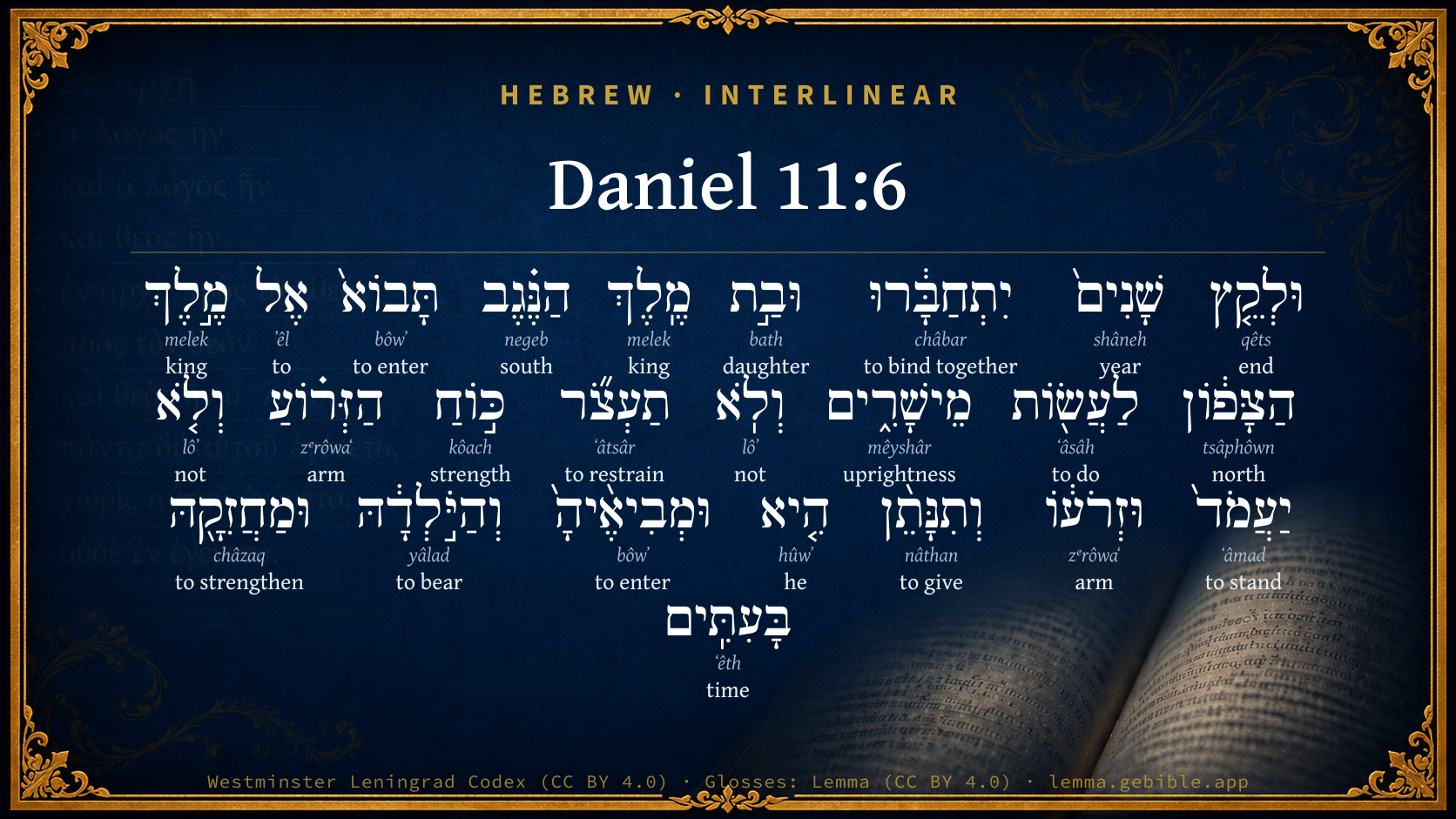
Daniel 11:6

Hebrew (Westminster Leningrad Codex) Daniel 11:6 appears in the Hebrew Old Testament. The text above is from the Westminster Leningrad Codex. Each word links to its Strong’s number, a concise gloss, and parsing drawn from the Open Scriptures Hebrew Bible morphology. Click any word for its full Brown-Driver-Briggs (BDB) entry.
Download image
Cite this verse

Daniel 11:6 (World English Bible). Public Domain. Lemma interlinear Bible study tool, https://lemma.gebible.app/v/daniel/11/6.

Show BibTeX & RIS
BibTeX
RIS
English Translation
At the end of years they shall join themselves together; and the daughter of the king of the south shall come to the king of the north to make an agreement: but she shall not retain the strength of her arm; neither shall he stand, nor his arm; but she shall be given up, and those who brought her, and he who became the father of her, and he who strengthened her in those times.
World English Bible · Public Domain
Download a study sheet

One document with this verse’s original text, its word-by-word gloss line, the meaning frame, cross-references with their text, attributed commentary, and full source and license credits — printable, and it pastes into notes with its structure intact.

This verse Autodidact and up

Study sheet (.html) Plain text (.txt)

A passage Seminary Student

Up to 50 verses in one chapter. A passage sheet keeps up to 6 commentary sources and 12 cross-references per verse, in the order this page ranks them, and says so on the sheet whenever that leaves anything out. Ask for a single verse and you get the Autodidact verse sheet above.

Everything on this page stays free to read, with no account — the sheet is a download of what is already on screen, not access to it.

Want to remove ads? Support Godless Engineer
Compare translations 3

The same verse in 3 English versions, stacked beneath the original-language interlinear above. Click any original word for its lexicon entry.

Each is an independent rendering of the whole verse — the interlinear is not word-aligned to these translations.

Highlighted words mark where these versions differ — a whole-verse word diff, not a word-by-word alignment.

  • World English Bible Public Domain
    At the end of years they shall join themselves together; and the daughter of the king of the south shall come to the king of the north to make an agreement: but she shall not retain the strength of her arm; neither shall he stand, nor his arm; but she shall be given up, and those who brought her, and he who became the father of her, and he who strengthened her in those times.
  • King James Version Public Domain
    And in the end of years they shall join themselves together; for the king's daughter of the south shall come to the king of the north to make an agreement: but she shall not retain the power of the arm; neither shall he stand, nor his arm: but she shall be given up, and they that brought her, and he that begat her, and he that strengthened her in these times.
  • unfoldingWord Literal Text CC BY-SA 4.0
    After some years, they will make an alliance. The daughter of the king of the South will come to the king of the North to make an agreement. But she will not retain the strength of her arm, nor will he endure, or his arm. She will be given up, along with those who brought her, he who fathered her, and he who supported her in those times.

unfoldingWord Literal Text — © unfoldingWord, licensed CC BY-SA 4.0. Word-aligned USFM3 via Door43 (git.door43.org/unfoldingWord/en_ult).

Versions to compare (up to 4)

3 of 4 selected

Show all 18 translations

Every available English version of this verse, each an independent rendering of the whole verse.

  • World English Bible Public Domain
    At the end of years they shall join themselves together; and the daughter of the king of the south shall come to the king of the north to make an agreement: but she shall not retain the strength of her arm; neither shall he stand, nor his arm; but she shall be given up, and those who brought her, and he who became the father of her, and he who strengthened her in those times.
  • Berean Standard Bible Public Domain
    After some years they will form an alliance, and the daughter of the king of the South will go to the king of the North to seal the agreement. But his daughter will not retain her position of power, nor will his strength endure. At that time she will be given up, along with her royal escort and her father and the one who supported her.
  • Majority Standard Bible Public Domain
    After some years they will form an alliance, and the daughter of the king of the South will go to the king of the North to seal the agreement. But his daughter will not retain her position of power, nor will his strength endure. At that time she will be given up, along with her royal escort and her father and the one who supported her.
  • King James Version Public Domain
    And in the end of years they shall join themselves together; for the king's daughter of the south shall come to the king of the north to make an agreement: but she shall not retain the power of the arm; neither shall he stand, nor his arm: but she shall be given up, and they that brought her, and he that begat her, and he that strengthened her in these times.
  • American Standard Version (1901) Public Domain
    And at the end of years they shall join themselves together; and the daughter of the king of the south shall come to the king of the north to make an agreement: but she shall not retain the strength of her arm; neither shall he stand, nor his arm; but she shall be given up, and they that brought her, and he that begat her, and he that strengthened her in those times.
  • Revised Version (1885) Public Domain
    And at the end of years they shall join themselves together; and the daughter of the king of the south shall come to the king of the north to make an agreement: but she shall not retain the strength of her arm; neither shall he stand, nor his arm; but she shall be given up, and they that brought her, and he that begat her, and he that strengthened her in those times.
  • Geneva Bible (1599) Public Domain
    And in the ende of yeeres they shalbe ioyned together: for the Kings daughter of ye South shall come to the King of the North to make an agreement, but she shall not reteine the power of the arme, neither shall he continue, nor his arme: but she shall be deliuered to death, and they that brought her, and he that begate her, and he that comforted her in these times.
  • Douay-Rheims (1899) Public Domain
    And after the end of years they shall be in league together: and the daughter of the king of the south shall come to the king of the north to make friendship, but she shall not obtain the strength of the arm, neither shall her seed stand: and she shall be given up, and her young men that brought her, and they that strengthened her in these times.
  • Young's Literal Translation Public Domain
    `And at the end of years they do join themselves together, and a daughter of the king of the south doth come in unto the king of the north to do upright things; and she doth not retain the power of the arm; and he doth not stand, nor his arm; and she is given up, she, and those bringing her in, and her child, and he who is strengthening her in `these' times.
  • Literal Standard Version CC BY-SA 4.0
    And at the end of years they join themselves together, and a daughter of the king of the south comes to the king of the north to do upright things; and she does not retain the power of the arm; and he does not stand, nor his arm; and she is given up, she, and those bringing her in, and her child, and he who is strengthening her in [these] times.
  • Unlocked Literal Bible CC BY-SA 4.0
    After a few years, when the time is right, they will make an alliance. The daughter of the king of the South will come to the king of the North to confirm the agreement. But she will not keep her arm's strength, nor will he stand, or his arm. She will be abandoned—she and those who brought her, and her father, and the one who supported her in those times.
  • unfoldingWord Literal Text CC BY-SA 4.0
    After some years, they will make an alliance. The daughter of the king of the South will come to the king of the North to make an agreement. But she will not retain the strength of her arm, nor will he endure, or his arm. She will be given up, along with those who brought her, he who fathered her, and he who supported her in those times.
  • Darby Bible Public Domain
    And after the course of years they shall join affinity; and the king's daughter of the south shall come to the king of the north to make equitable conditions: but she shall not retain the strength of her arm; neither shall he stand, nor his arm; and she shall be given up, she and they that brought her, and he that begat her, and he that strengthened her in [those] times.
  • World Messianic Bible Public Domain
    At the end of years they will join themselves together; and the daughter of the king of the south will come to the king of the north to make an agreement, but she will not retain the strength of her arm. He will also not stand, nor will his arm; but she will be given up, with those who brought her, and he who became the father of her, and he who strengthened her in those times.
  • Webster's Bible Public Domain
    And in the end of years they shall join themselves together; for the king's daughter of the south shall come to the king of the north to make an agreement: but she shall not retain the power of the arm; neither shall he stand, nor his arm: but she shall be given up, and they that brought her, and he that begat her, and he that strengthened her in these times.
  • Free Bible Version CC BY-SA 4.0
    Some years later they will form an alliance, and the daughter of the king of the south will be married to the king of the north to guarantee the peace treaty. However, she will not be able to keep her hold on power, nor will his power continue. She and her attendants will be betrayed, along with her child and husband. Later on, however,
  • Bible in Basic English Public Domain
    And at the end of years they will be joined together; and the daughter of the king of the south will come to the king of the north to make an agreement: but she will not keep the strength of her arm; and his offspring will not keep their place; but she will be uprooted, with those who were the cause of her coming, and her son, and he who took her in those times.
  • JPS Tanakh (1917) Public Domain
    And at the end of years they shall join themselves together; and the daughter of the king of the south shall come to the king of the north to make an agreement; but she shall not retain the strength of her arm; neither shall he stand, nor his arm; but she shall be given up, and they that brought her, and he that begot her, and he that obtained her in those times.

Literal Standard Version (2020), Covenant Press — licensed CC BY-SA 4.0. Text via the HelloAO Bible API (eBible.org). Unlocked Literal Bible (unfoldingWord) — licensed CC BY-SA 4.0. Text via the HelloAO Bible API (eBible.org). unfoldingWord Literal Text — © unfoldingWord, licensed CC BY-SA 4.0. Word-aligned USFM3 via Door43 (git.door43.org/unfoldingWord/en_ult). Free Bible Version, Dr. Jonathan Gallagher — licensed CC BY-SA 4.0. Text via the HelloAO Bible API (eBible.org).

Word by word

More ways to search: Search by grammar → Find every occurrence → Compare this word →

Practice this passage: Drill this verse → Learn its vocabulary →

מֵישָׁרִ֑ים
mêyshâr
H4339
“uprightness”
Noun, Common, Masculine, Plural, Absolute
Part of Speech
Noun
Type
Common
Gender
Masculine
Number
Plural
State
Absolute
Full BDB Definition

Origin: from H3474

TWOT: 930e

evenness, uprightness, straightness, equity - evenness, level, smoothness - uprightness, equity - rightly (as adverb)
  1. וּלְקֵ֤ץ qêts H7093 “and · to/for · end of” Conjunction + Preposition + Noun, Common, Masculine, Singular, Construct
  2. שָׁנִים֙ shâneh H8141 “years” Noun, Common, Feminine, Plural, Absolute
  3. יִתְחַבָּ֔רוּ châbar H2266 “to bind together” Verb, Hithpael, Imperfect, 3rd Person, Masculine, Plural
  4. וּבַ֣ת bath H1323 “and · daughter of” Conjunction + Noun, Common, Feminine, Singular, Construct
  5. מֶֽלֶךְ melek H4428 “king of” Noun, Common, Masculine, Singular, Construct
  6. הַנֶּ֗גֶב negeb H5045 “the · south” Particle, Definite Article + Noun, Common, Masculine, Singular, Absolute
  7. תָּבוֹא֙ bôwʼ H935 “to enter” Verb, Qal, Imperfect, 3rd Person, Feminine, Singular
  8. אֶל ʼêl H413 “to” Preposition
  9. מֶ֣לֶךְ melek H4428 “king of” Noun, Common, Masculine, Singular, Construct
  10. הַצָּפ֔וֹן tsâphôwn H6828 “the · north” Particle, Definite Article + Noun, Common, Feminine, Singular, Absolute
  11. לַעֲשׂ֖וֹת ʻâsâh H6213 “to do” Preposition + Verb, Qal, Infinitive Construct
  12. וְלֹֽא lôʼ H3808 “and · not” Conjunction + Particle, Negative
  13. תַעְצֹ֞ר ʻâtsâr H6113 “to restrain” Verb, Qal, Imperfect, 3rd Person, Feminine, Singular
  14. כּ֣וֹחַ kôach H3581 “strength of” Noun, Common, Masculine, Singular, Construct
  15. הַזְּר֗וֹעַ zᵉrôwaʻ H2220 “the · arm” Particle, Definite Article + Noun, Common, Both, Singular, Absolute
  16. וְלֹ֤א lôʼ H3808 “and · not” Conjunction + Particle, Negative
  17. יַעֲמֹד֙ ʻâmad H5975 “to stand” Verb, Qal, Imperfect, 3rd Person, Masculine, Singular
  18. וּזְרֹע֔וֹ zᵉrôwaʻ H2220 “and · arm · his” Conjunction + Noun, Common, Both, Singular, Construct + Suffix, Personal, 3rd Person, Masculine, Singular
  19. וְתִנָּתֵ֨ן nâthan H5414 “and · to give” Conjunction + Verb, Niphal, Imperfect, 3rd Person, Feminine, Singular
  20. הִ֤יא hûwʼ H1931 “he” Pronoun, Personal, 3rd Person, Feminine, Singular
  21. וּמְבִיאֶ֨יהָ֙ bôwʼ H935 “and · entering · her” Conjunction + Verb, Hiphil, Participle Active, Masculine, Plural, Construct + Suffix, Personal, 3rd Person, Feminine, Singular
  22. וְהַיֹּ֣לְדָ֔הּ yâlad H3205 “and · the · bearing · her” Conjunction + Particle, Definite Article + Verb, Qal, Participle Active, Masculine, Singular, Construct + Suffix, Personal, 3rd Person, Feminine, Singular
  23. וּמַחֲזִקָ֖הּ châzaq H2388 “and · strengthening · her” Conjunction + Verb, Hiphil, Participle Active, Masculine, Singular, Construct + Suffix, Personal, 3rd Person, Feminine, Singular
  24. בָּעִתִּֽים ʻêth H6256 “in/at the · times” Preposition, Determined + Noun, Common, Both, Plural, Absolute

About this verse

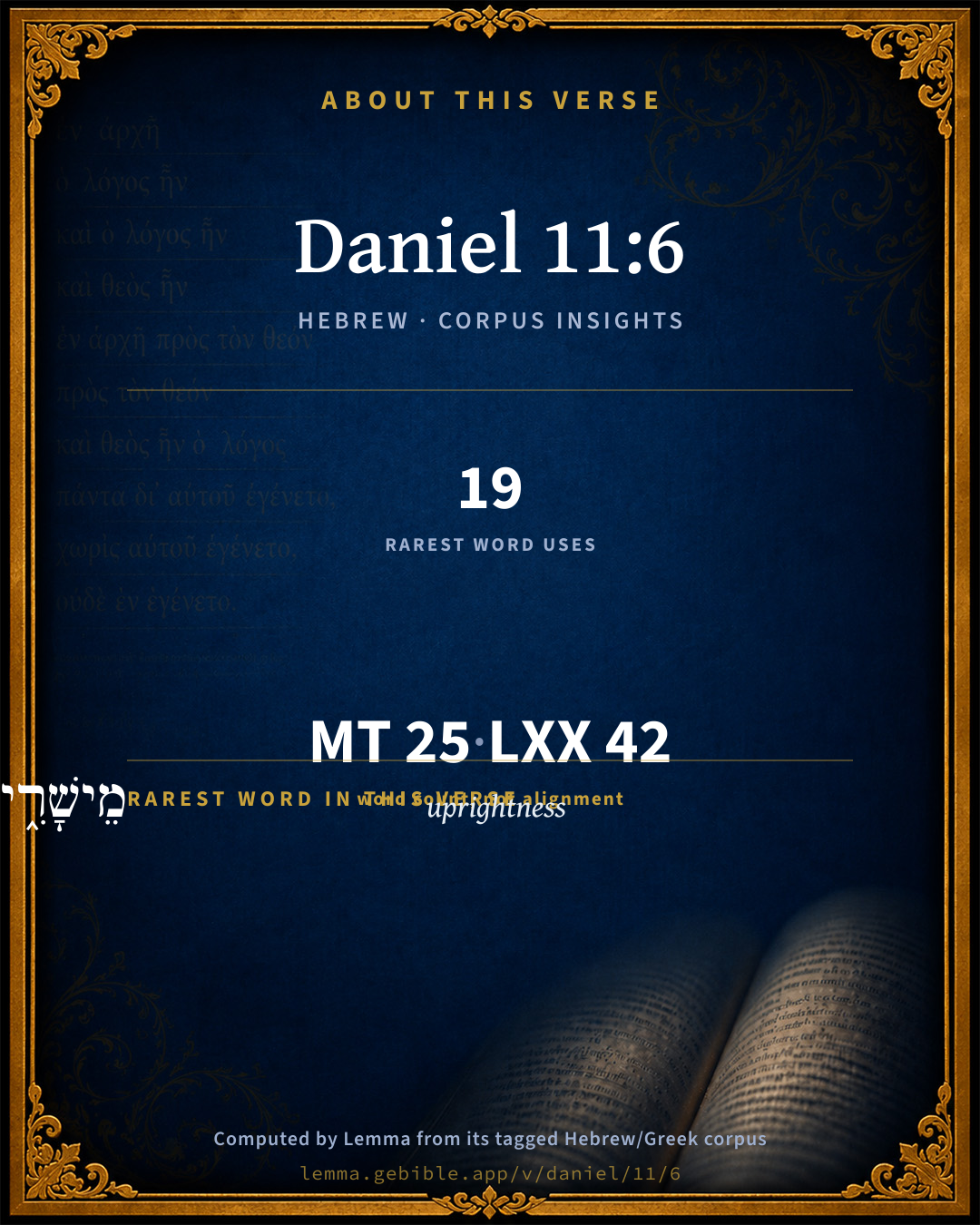
These counts appear in no published source. They are computed here, from the morphology-tagged text and Lemma’s own curated glosses. What Lemma adds →

25
words
21
distinct lemmas
Prophets
section

Notable vocabulary

The rarest word here is מֵישָׁרִ֑ים uprightness H4339 — appearing just 19 times in the whole Hebrew Bible.

Shared distinctive vocabulary

מֵישָׁרִ֑ים uprightness H4339 occurs in 19 verses of the Hebrew Bible. Also found in:

Grammatical profile

  • 9 verbs
  • 12 nouns
  • 1 pronoun
  • 1 preposition
  • 2 particles

Verb forms

  • יִתְחַבָּ֔רוּ Hithpael · Imperfect
  • תָּבוֹא֙ Qal · Imperfect
  • לַעֲשׂ֖וֹת Qal · Infinitive Construct
  • תַעְצֹ֞ר Qal · Imperfect
  • יַעֲמֹד֙ Qal · Imperfect
  • וְתִנָּתֵ֨ן Niphal · Imperfect
  • וּמְבִיאֶ֨יהָ֙ Hiphil · Participle Active
  • וְהַיֹּ֣לְדָ֔הּ Qal · Participle Active
  • וּמַחֲזִקָ֖הּ Hiphil · Participle Active

Repetition

Words recur within this verse — often emphatic in Hebrew:

  • מֶֽלֶךְ king H4428 ×2
  • תָּבוֹא֙ to enter H935 ×2
  • הַזְּר֗וֹעַ arm H2220 ×2
  • וְלֹֽא not H3808 ×2

Hebrew & Septuagint length

In English translation the verse runs 75 words from the Hebrew and 64 from the Septuagint (LXX English) — closely comparable.

A rough comparison of the two English renderings, which tokenize alike — not a word-level alignment.

Word counts can differ between the Hebrew and the Greek without any difference in meaning — e.g. the Hebrew direct-object marker אֵת has no separate Greek word, and Greek often adds the article ὁ.

In the original languages it is 25 Hebrew tokens and 42 Greek tokens — but the two are counted differently (Hebrew bundles its prefixes and suffixes into one token; the Greek is in lemma form), so that isn’t a like-for-like length.

Cross-references

9

Topical passages linked to Daniel 11:6 in the Treasury of Scripture Knowledge — connected by theme and wording, ordered by reader-vote popularity; previews shown in the World English Bible.

  • Daniel 11:13 The king of the north shall return, and shall set forth a multitude greater than the former; and he shall come on at the end of the times, [even of] years, with a great army and with much substance.
  • Job 38:15 From the wicked, their light is withheld, The high arm is broken.
  • Daniel 11:7 But out of a shoot from her roots shall one stand up in his place, who shall come to the army, and shall enter into the fortress of the king of the north, and shall deal against them, and shall prevail.
  • Daniel 11:15 So the king of the north shall come, and cast up a mound, and take a well-fortified city: and the forces of the south shall not stand, neither his chosen people, neither shall there be any strength to stand.
  • Daniel 11:40 At the time of the end shall the king of the south contend with him; and the king of the north shall come against him like a whirlwind, with chariots, and with horsemen, and with many ships; and he shall enter into the countries, and shall overflow and pass through.
  • Psalms 10:5 His ways are prosperous at all times; He is haughty, and your laws are far from his sight: As for all his adversaries, he sneers at them.
  • Ezekiel 30:21 Son of man, I have broken the arm of Pharaoh king of Egypt; and, behold, it has not been bound up, to apply [healing] medicines, to put a bandage to bind it, that it be strong to hold the sword.
  • Zechariah 11:16 For, behold, I will raise up a shepherd in the land, who will not visit those who are cut off, neither will seek those who are scattered, nor heal that which is broken, nor feed that which is sound; but he will eat the flesh of the fat sheep, and will tear their hoofs in pieces.
  • Ezekiel 38:8–9 After many days you shall be visited: in the latter years you shall come into the land that is brought back from the sword, that is gathered out of many peoples, on the mountains of Israel, which have been a continual waste; but it is brought forth out of the peoples, and they shall dwell securely, all of them.

Cross-references courtesy of OpenBible.info (CC BY 4.0).

Hebrew and Greek witnesses Masoretic Hebrew ↔ Greek Septuagint

The same verse in the two great witnesses to the Old Testament, shown verse-for-verse.

These are two independent witnesses, not word-aligned to each other, and the Septuagint is shown in lemma (dictionary) form.

Hebrew Daniel 11:6 Masoretic · Westminster Leningrad Codex

וּלְקֵ֤ץ שָׁנִים֙ יִתְחַבָּ֔רוּ וּבַ֣ת מֶֽלֶךְ הַנֶּ֗גֶב תָּבוֹא֙ אֶל מֶ֣לֶךְ הַצָּפ֔וֹן לַעֲשׂ֖וֹת מֵישָׁרִ֑ים וְלֹֽא תַעְצֹ֞ר כּ֣וֹחַ הַזְּר֗וֹעַ וְלֹ֤א יַעֲמֹד֙ וּזְרֹע֔וֹ וְתִנָּתֵ֨ן הִ֤יא וּמְבִיאֶ֨יהָ֙ וְהַיֹּ֣לְדָ֔הּ וּמַחֲזִקָ֖הּ בָּעִתִּֽים

At the end of years they shall join themselves together; and the daughter of the king of the south shall come to the king of the north to make an agreement: but she shall not retain the strength of her arm; neither shall he stand, nor his arm; but she shall be given up, and those who brought her, and he who became the father of her, and he who strengthened her in those times.

World English Bible · Public Domain

Greek LXX Daniel 11:6 Septuagint · lemma form

καί εἰς συντέλεια ἐνιαυτός ἄγω αὐτός καί εἰςἔρχομαι βασιλεύς αἴγυπτος εἰς ὁ βασιλεία ὁ βορέας ποιέω συνθήκη καί οὐ μή καταἰσχύω ὅτι ὁ βραχίων αὐτός οὐ ἵστημι ἰσχύς καί ὁ βραχίων αὐτός ναρκάω καί ὁ συνπορεύομαι μετά αὐτός καί μένω εἰς ὥρα

And after his years they shall associate; and the daughter of the king of the south shall come to the king of the north, to make agreements with him: but she shall not retain power of arm; neither shall his seed stand: and she shall be delivered up, and they that brought her, and the maiden, and he that strengthened her in these times.

LXX2012 (modern English Septuagint) · Public Domain

On this verse, Ellicott's Commentary for English Readers discusses the Septuagint’s reading. Read the note in Commentary ↓

Hebrew: Westminster Leningrad Codex (CC BY 4.0). Greek: Septuagint (public domain); English from LXX2012 (modern English Septuagint) (Public Domain). How the Septuagint differs from the Hebrew →

Commentary

Notes on Daniel 11:6 from classic Christian and Jewish commentators (each source and its license shown beneath its notes). The classic Christian expositions comment on the surrounding passage and are grouped to its opening verse, so a note may address several verses; the Jewish commentaries on the Tanakh (Rashi and others) are per-verse, so they appear only where the commentator wrote on this verse.

Lemma curates 59 commentaries, every one of them public domain or Creative Commons licensed, each selected and text-cleaned for this edition rather than reprinted as found. About our sources →

The Cambridge Bible for Schools and Colleges

gen. ed. J. J. S. Perowne

6. Ptolemy II. (Philadelphus), 285–247, and Antiochus II. (Theos), 261–246.

Antiochus I. (Soter), b.c. 280–261, is passed by in the survey, as a ruler whose reign was of no importance to the Jews. The allusion in Dan_11:6 is to what happened about b.c. 249. In order to terminate his long wars with Antiochus II. (Theos), Ptolemy Philadelphus gave him in marriage his daughter, Berenice, upon condition that he should divorce his legitimate wife, Laodice, and that his two sons, Seleucus and Antiochus, should renounce all claim to the throne of Syria: in the event of Antiochus and Berenice having issue, Ptolemy hoped in this way to secure Syria as an Egyptian province. After two years, however, Ptolemy died. Antiochus then took back Laodice, and divorced Berenice. Laodice, however, dreading her husband’s fickleness (‘ambiguum viri animum,’ Jerome), and fearing lest he might again evince a preference for Berenice, before long procured his death by poison. She then persuaded her son, Seleucus, to secure the throne for himself by murdering both Berenice and her infant child (Jerome ad loc.; Appian, Syr. 65; Justin xxvii. 1).

at the end of (some) years] 31 years after the death of Seleucus Nicator.

join themselves together] by the matrimonial alliance just described.

and the daughter of the king of the south] Berenice.

come to] in marriage (cf. Jos_15:18; Jdg_12:9).

to make an agreement] lit. uprightness (Psa_9:8), or equity (Psa_98:9), i.e. (here) the equitable adjustment of a dispute. Comp. Dan_11:17.

but she shall not retain the power of the arm] fig. for, she will not be able to maintain herself against her rival, Laodice. As said above, she was first divorced by Antiochus in favour of Laodice, and afterwards murdered at her instigation.

neither shall he stand] Antiochus, who was murdered by Laodice.

nor his arm] his might will come to an end. Theod., Kamph., Prince, ‘nor his seed’ (זַרְעוֹ for זְרֹעוֹ), referring to Antiochus’ issue by Berenice[359].

[359] Bevan and Marti render the last three clauses, but the arm (fig. for the support afforded by Berenice) shall not retain strength, neither shall his (other) arms (supports) abide (prove effectual),—altering (with Hitz.) the division and punctuation of the last two words.

but she shall be given up] Berenice, put to death at the instigation of Laodice.

they that brought her] either into the marriage, or to Syria. The expression is a vague one. The reference may be (Ewald, Meinh.) to Berenice’s attendants, who accompanied her to Antioch, and met there the same fate as their mistress; it may be (Hitz., Keil) simply to Antiochus (the plural being generic, without reference to the number of persons actually meant; cf. Gen_21:7, Mat_2:20); it may even be, more generally, to the ministers of Ptolemy who supported the alliance, and who were ‘given up,’ in the sense of finding their expectations disappointed.

he that begat her and supported (Dan_11:1) her] Ptolemy Philadelphus (so Ew., Hitz., Keil). Or, he that begat her, and he that obtained (Dan_11:21) her; i.e. Ptolemy, and Antiochus (so von Leng., Zöckl., Meinh.).

in the times] at the time in question = in those times (R.V.).

The Cambridge Bible for Schools and Colleges (gen. ed. J. J. S. Perowne; Cambridge University Press, 1878–1918) — public domain. Text from a community e-Sword module.

Trapp's Complete Commentary

John Trapp

Dan 11:6 And in the end of years they shall join themselves together; for the king’s daughter of the south shall come to the king of the north to make an agreement: but she shall not retain the power of the arm; neither shall he stand, nor his arm: but she shall be given up, and they that brought her, and he that begat her, and he that strengthened her in [these] times.

Ver. 6. And in the end of years.] In process of time, after that these two kings had sufficiently worried and wearied out one another in bloody wars.

They shall join themselves together.] Heb., Shall associate themselves, viz., in a friendly amity, and shall make interchangeable marriages, but to little purpose, as it proved. So Calo Joannes, the Christian emperor of Trebizond, gave his daughter Despina in marriage to Usuncassanes, king of Persia, but with ill success; for he soon after lost his empire. {a}

For the king’s daughter of the south.] Bernice, or, as others call her, Berenice or Beronice, i.e., the daughter of innocence or purity, the daughter Ptolemy Philadelph so called for that he married his own sister, and therefore his daughter Beronice was not rightly named. {b}

Shall come to the king of the north.] To Antiochus Theos, king of Syria, so the Milesians first surnamed him, because he had driven out their tyrant Timarch, and he took it upon him, to his utter undoing; for this god was afterwards poisoned by his wife, Laodice. {c}

To make an agreement.] Marriages made in policy, to serve dishonest ends, are ever of ill success. {1Sa 18:21; 1Sa 18:28}

But she shall not retain the power of the arm.] Her interest in her husband, her queendom, and her life were soon after lost. She was not sent home again, as Anne of Cleves was here, but sent out of the world, together with her son and all her retinue, by Laodice, whom Appian maketh to be her own sister; but that is not likely.

Neither shall he stand,] i.e., Antiochus Theus, who was poisoned by his jealous wife - a just punishment from a "jealous God."

Nor his arm.] His young son by Bernice.

And he that begat her.] Her father, Ptolemy Philadelph, who died soon after.

{a} Turkish History, 464.

{b} Junius.

{c} Pausan., Appian.

John Trapp, A Commentary or Exposition upon All the Books of the Old and New Testament (1647–1656) — public domain. Text from a community e-Sword module.

Joseph Benson's Commentary

Dan 11:6. And in the end of years — That is, after several years, for these wars lasted long. They shall join themselves together — Shall enter into a league or confederacy with each other. For the king’s daughter of the south, &c. — They agreed to make peace, upon condition that Antiochus Theus should put away his former wife, Laodice, and her two sons, and marry Berenice, the daughter of Ptolemy Philadelphus. Thus she came to the king of the north to make an agreement — For Ptolemy her father brought her to Antiochus Theus, and with her an immense treasure, so that he received the appellation of the dowry-giver. But she shall not retain the power of the arm — That is, her interest and power with Antiochus; for after some time, in a fit of love, he brought back his former wife, Laodice, with her children, to court again. Neither shall he stand, nor his arm — Or seed, for Laodice, fearing the fickle temper of her husband, lest he should recall Berenice, caused him to be poisoned; and neither did his seed by Berenice succeed him in the kingdom; but Laodice contrived to fix her eldest son, Seleucus Callinicus, on the throne of his ancestors. But she shall be given up — For Laodice, not content with poisoning her husband, caused also Berenice to be murdered. And they that brought her — Or, her Egyptian women and attendants, endeavouring to defend her, were many of them slain with her. And he that begat her — Or rather, as it is in the margin, he whom she brought forth; for the son was murdered as well as the mother, by order of Laodice. And he that strengthened her, &c. — Her husband Antiochus, as Jerome conceives; or rather, her father, who died a little before, and was so very fond of her that he took care continually to send her fresh supplies of the water of the Nile, thinking it better for her to drink of that than any other river, as Polybius relates. See Bishop Newton.

Joseph Benson's Commentary on the Old and New Testaments (1811–1818) — public domain. Text from a community e-Sword module.

Tyndale Open Study Notes

Tyndale Open Resources

11:6 An alliance was formed between Antiochus II Theos, the king of the north (261–246 BC), and Ptolemy II Philadelphus, the king of the south (284–246 BC). Antiochus married Ptolemy’s daughter Berenice Syra in 250 BC, then abandoned her in 246 BC. She and Antiochus were then murdered.

Tyndale Open Study Notes — © Tyndale Open Resources, licensed CC BY-SA 4.0. Text via the HelloAO Bible API.

Geneva Bible (1599)

Geneva Bible translators

Neither Ptolemy nor Antiochus.

That is, Berenice the daughter of Ptolemy Philadelphus shall be given in marriage to Antiochus Theos, thinking by this affinity that Syria and Egypt should have a continual peace together.

That force and strength shall not continue: for soon after Berenice and her young son after her husband’s death, was slain of her stepson Seleucus Callinicus the son of Laodice, the lawful wife of Antiochus, but put away for this woman’s sake.

Some read, seed, meaning, the child begotten of Berenice.

Some read, she that begate her, and thereby understand her nurse, which brought her up: so that all they that were occasion of this marriage, were destroyed.

Geneva Bible (1599) marginal notes — public domain. Text via Bolls.life.

Jamieson, Fausset & Brown

Robert Jamieson, A. R. Fausset & David Brown

in . . . end of years--when the predicted time shall be consummated (Dan 11:13, Margin; Dan 8:17; Dan 12:13).

king's daughter of the south--Berenice, daughter of Ptolemy Philadelphus of Egypt. The latter, in order to end his war with Antiochus Theus, "king of the north" (literally, "midnight": the prophetical phrase for the region whence came affliction to Israel, Jer 1:13-15; Joe 2:20), that is, Syria, gave Berenice to Antiochus, who thereupon divorced his former wife, Laodice, and disinherited her son, Seleucus Callinicus. The designation, "king of the north" and "of the south," is given in relation to Judea, as the standpoint. Egypt is mentioned by name (Dan 11:8, Dan 11:42), though Syria is not; because the former was in Daniel's time a flourishing kingdom, whereas Syria was then a mere dependency of Assyria and Babylon: an undesigned proof of the genuineness of the Book of Daniel.

agreement--literally, "rights," that is, to put things to rights between the belligerents.

she shall not retain the power of the arm--She shall not be able to effect the purpose of the alliance, namely, that she should be the mainstay of peace. Ptolemy having died, Antiochus took back Laodice, who then poisoned him, and caused Berenice and her son to be put to death, and raised her own son, Seleucus Nicator, to the throne.

neither shall he stand--The king of Egypt shall not gain his point of setting his line on the throne of Syria.

his arm--that on which he relied. Berenice and her offspring.

they that brought her--her attendants from Egypt.

he that begat her--rather as Margin, "the child whom she brought forth" [EWALD]. If English Version (which MAURER approves) be retained, as Ptolemy died a natural death, "given up" is not in his case, as in Berenice's, to be understood of giving up to death, but in a general sense, of his plan proving abortive.

he that strengthened her in these times--Antiochus Theus, who is to attach himself to her (having divorced Laodice) at the times predicted [GEJER].

Jamieson, Fausset & Brown — Commentary Critical and Explanatory on the Whole Bible (1871) — public domain (CC PDM 1.0). Text via the HelloAO Bible API.

Adam Clarke's Commentary

Verse 6. In the end of years] Several historical circumstances are here passed by.

The king's daughter of the south] Berenice, daughter of Ptolemy Philadelphus, king of Egypt, was married to Antiochus Theos, king of Syria. These two sovereigns had a bloody war for some years; and they agreed to terminate it by the above marriage, on condition that Antiochus would put away his wife Laodice and her children, which he did; and Berenice having brought an immense fortune to her husband, all things appeared to go on well for a tine.

But she shall not retain the power of the arm] זרע zaro, her posterity, shall not reign in that kingdom.

But she shall be given up] Antiochus recalled his former wife Laodice and her children, and she, fearing that he might recall Berenice, caused him to be poisoned and her to be murdered, and set her son Callinicus upon the throne.

And they that brought her] Her Egyptian women, striving to defend their mistress, were many of them killed.

And he that begat her] Or, as the margin, "he whom she brought forth;" the son being murdered, as well as the mother, by order of Laodice.

And he that strengthened her] Probably her father Ptolemy, who was excessively fond of her, and who had died a few years before.

Adam Clarke's Commentary on the Bible (1810–1826) — public domain. Text from a community e-Sword/MySword module.

John Calvin's Commentaries

As to the explanation of the words, the king of the south, we have stated to be the king of Egypt, and that of the north, of Syria. To do right things, means to make mutual peace; he shall not retain the strength of his arm, is, his arm shall not retain its strength; he shall not stand refers to his father Ptolemy, or Antiochus Theos, as we shall afterwards see. And then we must take the ו, vau, negatively, and read, nor his seed, which some translate his arm. She shall be delivered up, implies being given up to death, while some understand her parent, to be her mother or her nurse. Here, then, the angel prophesies the state of the kingdoms of Egypt and Syria; and still he has respect to the Church of God, as we stated yesterday, which was placed in the midst of these two nations. We must always strive to ascertain the intention of the Holy Spirit. He wished to support the pious under those convulsions by which they would be agitated and afflicted. Their confidence might have been utterly subverted unless they had been persuaded that nothing happens at random, since all these events were proclaimed beforehand. Again, God had sent his angel to Daniel, which proved both his power and his determination to defend his Church, and he would accomplish this, because he wished the faithful admonished beforehand neither rashly nor yet without profit. But we must first relate the history — the angel says, At the end of the times two kings should enter into covenant and friendship He had announced the superiority of the king of Syria; for when Antigonus was conquered, and his son was dead, Seleucus the first king of Syria far surpassed Ptolemy in his power and the magnitude of his dominion. But a mutual rivalry arose between them, and there were some slight skirmishes on both sides, till the condition of Ptolemy became weakened, and then Seleucus rushed tumultuously, with the ferocity of a robber rather than the magnanimity of a king. After they had continued the contest for some time, Berenice the daughter of the second Ptolemy, named Philadelphus, was given in marriage to Antiochus Theos. She is also called Beronice and Bernice. He was so blinded with pride, as to take the name of Theos, which means God; he was the third of that name, the former king being called Soter, meaning preserver For, as Seleueus had acquired so many and such mighty possessions, his sons did not consider their authority fully established, and so they assumed these magnificent titles for the sake of inspiring all nations with the terror of their frame. Hence the first Antiochus was called Sorer, and the second Theos. Now the second Ptolemy, named Philadelphus, gave his daughter in marriage to Antiochus Theos. By this bond peace and friendship were established between them, just as at Rome, Pompey married Julia the daughter of Caesar. And we daily observe similar occurrences, for when one king has in his power a daughter, or niece, or other relatives, another king finds himself possessed of male and female relations, by whose intermarriage they confirm a treaty of peace. It was so in this case, although historians attribute some degree of craft to Philadelphus in bestowing his daughter on Antiochus Theos. He supposed this to be a means by which he might ultimately acquire the dominion over all Syria, and over the other provinces under the sway of Antiochus. Whether this really was so or not, profane historians prove the fulfillment of the angel’s prediction. Without the slightest doubt, God, in his wonderful counsels, dictated to these historians what we read at the present time, and made them witnesses of his own truth. This thought, indeed, never entered their minds, but when God governs the minds and tongues of men, he wishes to establish clear and convincing testimony to this prophecy, for the purpose of shewing the real prediction of every occurrence. At the end of the years, says he, they shall become united.

He next states, And the daughter of the king of the south, meaning Bernice, whom we have mentioned, shall come to the king of the north, meaning the king of Syria, Antiochus Theos. This alliance was contracted in defiance of justice. For Antiochus repudiated his wife Laodice, who was the mother of two sons whom she had born to Antiochus; namely, Seleucus Callinicus, and Antiochus the younger, named Hierax, a hawk, on account of his rapacity. We perceive, then, how he contracted a second marriage, after an unjust and illegal divorce of his first wife. Hence it is not surprising if this alliance was cursed by the Almighty. It turned out unhappily for both the kings of Egypt and Syria. Ptolemy ought not to have thrust his daughter upon Antiochus, who was already married, nor yet to have allowed her to become a second wife, while the king’s real wife was divorced. We perceive, then, how God became the avenger of these crimes, while the plans of Antiochus and Philadelphus turned out in. Some think that Antiochus was fraudulently poisoned by his first wife, but as the point is doubtful, I pronounce no opinion. Whether it was so or not, Antiochus had a son by Bernice, and died immediately after being reconciled to his former wife. Some historians state, that after she had recovered her dignity and rank as queen, having once experienced her husband’s fickleness and perfidy, she took sure means of preventing another repudiation. When Antiochus was dead, this woman was enflamed with vengeance, and in the perverseness of her disposition, she impelled her son to murder her rival, especially stimulating Seleucus Callinicus who succeeded to his father’s throne. Hierax was then prefect of Asia Minor; hence she stimulated her son with fury to murder her rival. For, although Antiochus Theos had been reconciled to her, yet some degree of rank and honor still attached to Bernice the daughter of Ptolemy. And her son perpetrated this murder with the greatest willingness, and with the basest cruelty and perfidy; for he persuaded her to entrust herself to his care, and then he murdered both her and her son.

The angel now says, When the daughter of the king of the south shall come to the king of the north, his arm shall not retain his strength The language is metaphorical, as that marriage was line a common arm to both sides; for the king of Egypt stretched forth his hand to the king of Syria for mutual protection. That arm, then, did not retain its strength; for Bernice was most wickedly slain by her stepson, Seleucus Callinicus, as we have stated. He says, also, she should come to make alliances Here, by way of concession, the angel calls that conjugal bond מישדים, misrim, “rectitudines,” “conditions of agreement,” because at first all parties thought, it would tend to that result. But. Antiochus had already violated his marriage vow, and departed from his lawful alliance. Nothing, therefore, was right on his side. Without the slightest doubt he derived some advantage from the plan, as kings are always in the habit of doing. And with respect to Ptolemy, many historians, as we have already mentioned, suppose him to have longed for the kingdom of Syria. Whether or not this was so, their mutual transactions were not sincere, and so the word signifying “rectitude” is used, as we have said, only by concession. The angel does not speak in their praise, or excuse the, perfidy of either, but he rather enlarges upon their crime, and from this we gather how they abused the sanctity both of marriage and of treaties, which God wished to be held sacred by all mankind. Hence, though the word is honor-able in itself, yet it is used in a disgraceful sense, to shew us how the angel condemned King Ptolemy for this base prostitution of his daughter, and Antiochus for rejecting his wife, and marrying another who was not a real wife, but only a concubine. And, perhaps, God wished to use the lips of his angel to point out the tendency of all royal treaties. They always have the most specious appearances — national, quiet public peace, and similar objects which can be dexterously made prominent. For kings always court favor and praise for themselves from the foolish vulgar, whenever they make treaties of peace. Thus all these alliances have no other tendency than to produce social deception, and at length they degenerate into mutual perfidy, when one party plots insidiously and wickedly against another.

The angel adds next, He shall not stand; using the masculine gender, and most probably referring to Antiochus, as well as to Ptolemy his father-in-law. Neither he nor his seed shall stand, meaning his son by Bernice the daughter of Ptolemy. I dare not translate it “arm,” because in my opinion the letter ו, vau, is needed in the word for “arm;” so I take it to denote “seed.” He afterwards adds, And she shall be delivered up — thus returning to Berenice — either by treachery or to death; and those who led her forth — meaning her companions. Whenever any incestuous marriage is contracted, some persons of disgraceful character are sure to be concerned in bringing his new wife to the king. And very probably there were factions in the palace of Antiochus; one party being more attached to Seleucus and his brother, and his mother Laodice; while others desired a change of government, according to the usual state of affairs. The advisers of the marriage between Antiochus and Bernice were sent as a guard of honor to attend them to Syria, and the angel states all these to have been delivered up together with the queen. He afterwards adds, And those who were her parents From the absence of a grammatical point under the letter ה, he, many think the noun to be of the feminine gender. And as it may mean mother, they treat it as if her nurse was intended, but I leave the question in doubt. He now adds, and those who strengthened her at those times He, doubtless, intends to designate all those who wished to curry favor with the king, and thus took part in this marriage between him and the daughter of the king of Egypt. The whole of that faction perished, when Berenice was slain by Seleucus Callinicus. If, then, he did not spare his stepmother, much less would he spare the faction by which he was deprived of his hope of the kingdom, and through whom his mother Laodice had suffered the disgrace of a divorce. It now follows, —

John Calvin's Commentaries (1540-1563) — public domain. Text from the Calvin Translation Society English edition (1840s-50s) via the Christian Classics Ethereal Library (ccel.org). Calvin's coverage is partial (roughly two-thirds of the Bible); uncommented books and verses are honest gaps, never fabricated. The 19th-century editor's footnotes and remarks are omitted so the notes are faithfully Calvin's own voice.

Ellicott's Commentary for English Readers

(6) In the end.—Comp. Dan_11:8; Dan_11:13, and 2Ch_18:2. Here again the reference is most obscure. If the “joining themselves together” refers to the marriage of Antiochus II. with Berenice, the daughter of Ptolemy Philadelphus, and if “the agreement” (comp. “upright ones,” Dan_11:17) refers to the terms of the marriage, which were that Antiochus should put away his former wife Laodice, and appoint her firstborn son successor to the throne, then it must be remarked that history is irreconcilable with the prophecy. Also it appears from Dan_10:14 that this revelation bears upon the future of Israel, and it does not appear that this marriage affected the Jewish people more than any other marriage. This, and the fact that a period of more than fifty years intervened between the events supposed to be implied in Dan_11:5-6, make the traditional interpretation very unsatisfactory. The language refers to what is mentioned as one of the characteristics of the last empire (Dan_2:43), various attempts to consolidate earthly powers by political marriages. These do not characterise the era of the Seleucidæ any more than they do the times of Ahab, or many other periods of history.

Shall not retain.—The Greek versions show the difficulties experienced by the translators, the LXX. apparently following a different text. The meaning appears to be that the marriage will not accomplish its intended purpose. The king of the south, instead of becoming independent of his northern rival, will only become more subjected to him than he was previously. This does not appear to have happened with regard to Ptolemy Philadelphus and Antiochus Theos, the former of whom is generally identified with “he that begat her,” the latter with “he that strengthened her.”

A Bible Commentary for English Readers, edited by Charles John Ellicott (1878–1897) — public domain. Text from a community e-Sword module.

John Gill's Exposition

And in the end of years they shall join themselves together,.... The two kings of Egypt and Syria; not the two former kings, but their successors: the king of Egypt was Ptolemy Philadelphus, the second king of Egypt, the son of Ptolemy Lagus; this is the king of Egypt who collected such a vast number of books into his library at Alexandria, and got the law of Moses translated into Greek: the king of Syria was Antiochus, surnamed Theos; this name was first given him by the Milesians, upon his delivering them from the tyranny of Timarchus governor of Caria; he was the third king of Syria; Seleucus Nicator the first, Antiochus Soter the second, and this the third: there had been very great wars between these kings for many years; and now, being weary of them, they entered into confederacies and alliances with each other, and which were designed to be strengthened by a marriage next mentioned; this is thought to be about seventy years after the death of Alexander: (q).

for the king's daughter of the south shall come to the king of the north to make an agreement; this was Bernice, daughter of Ptolemy Philadelphus king of Egypt, who carried her to Pelusium, and from thence sailed with her to Seleucia in Syria; where he met with Antiochus king of Syria, to whom he gave her in marriage, with a vast dowry of gold and silver; hence she was called and the marriage was celebrated with great solemnity (r): and this was "to make agreement", or "to make things right or straight" (s); that were wrong and crooked before; to put an end to wars and discords; to make peace and cultivate friendship; to strengthen alliances, and confirm each other in their kingdoms:

but she shall not retain the power of the arm; unite the two kingdoms, and secure the peace of them, which was the thing in view; nor retain her interest in her husband, nor her power at court; for, as soon as her father was dead, Antiochus dismissed Bernice from his bed, and took Laodice his former wife again, by whom he had had two sons, Seleucus Callinicus, and Antiochus Hierax (t):

neither shall he stand, nor his arm; neither Antiochus; for Laodice, knowing that by the late treaty the crown was settled upon the children of Bernice, who already had a son by him, and sensible of his fickleness, and fearing he might divorce her again, and take to Bernice, got him poisoned by his servants: nor Bernice his queen, called "his arm"; who fleeing to Daphne for shelter, on hearing what was done, was there slain; or it may be his son he had by her, so it follows:

but she shall be given up; into the hands of Seleucus Callinicus, the son of Laodice; whom she placed on the throne after the death of his father; and who sent to Daphne to slay Bernice, which was accordingly done (u):

and they that brought her; into Syria; that attended her from Egypt at her marriage, and continued with her in the court of Syria, and fled with her to Daphne:

and he that begat her: or, "whom she brought forth"; as in the margin; her little son, who was murdered at the same time with her; for her father died before:

and he that strengthened her in these times; either her husband, or her father, who were both dead before, and so stood not, and could not help her; unless this is to be understood of her brother, and the cities of the lesser Asia, who, hearing of her distress at Daphne, set out for her relief, but came too late; she and her son were both slain first (w).

(q) See the Universal History, vol. 9. p. 384. (r) Ibid. p. 196. & Jerom. in loc. (s) "ad faciendum reetitudines", Pagninus, Michaelis; "ut faciat rectitudines", Montanus; "recta", Calvin. (t) Universal History, vol. 9, p. 196, 197. (u) Ibid. (w) Justin, l. 27. c. 1.

John Gill's Exposition of the Whole Bible (1746–1763) — public domain (CC PDM 1.0). Text via the HelloAO Bible API.

Albert Barnes' Notes on the Bible

And in the end of years - In the future periods of the history of these two kingdoms. The event here referred to did not occur during the lives of these two kings, Seleucus Nicator and Ptolemy Soter, but in the reign of their successors, Ptolemy Philadelphus and Antiochus Theos or Theus. The phrase “the end of years” would well denote such a future period. The Vulgate renders it, “after the end of years;” that is, after many years have elapsed. The meaning is “after a certain course or lapse of years.” The word “end” in Daniel (קץ qêts) often seems to refer to a time when a predicted event would be fulfilled, whether near or remote; whether it would be really the “end” or “termination” of an empire or of the world, or whether it would be succeeded by other events. It would be the end of that matter - of the thing predicted; and in this sense the word seems to be employed here. Compare Dan 8:17; Dan 11:13 (margin), and Dan 12:13. “They shall join themselves together.” Margin, “associate.” The meaning is, that there would be an alliance formed, or an attempt made, to unite the two kingdoms more closely by a marriage between different persons of the royal families. The word “they” refers to the two sovereigns of Egypt and Syria - the south and the north.

For the king’s daughter of the south shall come to the king of the north to make an agreement - Margin, “rights.” The Hebrew word properly means rectitudes or rights (in the plural מישׁרים mēyshârı̂ym); but here it seems to be used in the sense of “peace,” or an alliance. The act of making peace was regarded as an act of “justice,” or doing “right,” and hence, the word came to be used in the sense of making an alliance or compact. This idea we should now express by saying that the design was “to make things right or straight” - as if they were wrong and crooked before, giving occasion to discord, and misunderstanding, and wars. The intention, now was to establish peace on a permanent basis. The compact here referred to was one formed between Berenice, the daughter of Ptolemy Philadelphus, king of Egypt, and Antiochus Theos, king of Syria. Ptolemy, in order to bring a war in which he was engaged to an end, and to restore peace, gave his daughter in marriage to Antiochus, in hopes of establishing a permanent peace and alliance between the two kingdoms. One of the conditions of this alliance was, that Antiochus should divorce his former wife Laodice, and that the children of that former wife should be excluded from the succession to the throne. In this way Ptolemy hoped that the kingdom of Syria might become ultimately attached to that of Egypt, if there should be children by the marriage of Berenice with Antiochus. Ptolemy, however, died two years after this marriage was consummated, and Antiochus restored again his former wife Laodice, and put away Berenice, but was himself murdered by Laodice, who feared the fickleness of her husband. The officers of the court of Syria then planned the death of Berenice and her children, but she fled with them to Daphne, and was there put to death, with her children. - Appian, c. lxv.; Lengerke, in loc. She was put to death by poison. See Gill, in loc.

But she shall not retain the power of the arm - The word “retain” here is the same as in Dan 10:8, “I retained no strength.” The word “arm” is a word of frequent use in the Old Testament, both in the singular and plural, to denote “strength, power,” whether of an individual or an army. So Job 22:8, “A man of arm,” that is, “strength;” Gen 49:24, “The arms (power) of his hands were made strong by the God of Jacob.” Compare Isa 51:9; Isa 62:8. It is frequently used in this chapter in the sense of “strength,” or “power.” See Dan 11:15, Dan 11:22, Dan 11:31. This alliance was formed with the hope that the succession might be in her. She was, however, as stated above, with her children, put to death. While queen of Syria, she, of course, had power, and had the prospect of succeeding to the supreme authority.

Neither shall he stand - The king of the south; to wit, Egypt. That is, he would not prosper in his ambitious purpose of bringing Syria, by this marriage alliance, under his control.

Nor his arm - What he regarded as his strength, and in which he placed reliance, as one does on his arm in accomplishing any design. The word “arm” here is used in the sense of “help,” or “alliance;” that is, that on which he depended for the stability of his empire.

But she shall be given up - That is, she shall be given up to death, to wit, by the command of Laodice.

And they that brought her - That is, those who conducted her to Daphne; or these who came with her into Syria, and who were her attendants and friends. Of course they would be surrendered or delivered up when she was put to death.

And he that begat her - Margin, “or, whom she brought forth.” The margin expresses the sense more correctly. The Latin Vulgate is, “adolescentes ejus.” The Greek, ἡ νεάνις hē neanis. So the Syriac. The Hebrew (והילרה vehayoledâh) will admit of this construction. The article in the word has the force of a relative, and is connected with the suffix, giving it a relative signification. See Ewald, as quoted by Lengerke, in loc. According to the present pointing, indeed, the literal meaning would be, “and he who begat her;” but this pointing is not authoritative. Dathe, Bertholdt, Dereser, DeWette, and Rosenmuller suppose that the reading should be והילדה vehayaledâh. Then the sense would be, “her child,” or “her offspring.” Lengerke and Ewald, however, suppose that this idea is implied in the present reading of the text, and that no change is necessary. The obvious meaning is, that she and her child, or her offspring, would be thus surrendered. The matter of fact was, that her little son was slain with her. See Prideaux’s “Connexions,” iii. 120.

And he that stregnthened her in these times - It is not known who is here referred to. Doubtless, on such an occasion, she would have some one who would be a confidential counselor or adviser, and, whoever that was, he would be likely to be cut off with her.

Albert Barnes' Notes on the Bible (1834–1885) — public domain. Text from a community e-Sword/MySword module.

Haydock's Catholic Bible Commentary

South. Bernice, daughter of Ptolemeus Philadelphus, given in marriage to Antiochus Theos, grandson of Seleucus, (Challoner) and king of Syria. She brought a great "dowry," and was therefore styled Phernophoros. Antiochus agreed to repudiate Laodicea; but he soon took her back. Fearing his inconstancy, she poisoned him, and slew his son by Bernice. This lady in a rage mounted her chariot, and having knocked down the cruel minister of such barbarity, trampled upon his body. The rest pretended that the infant was still living, and delivered up a part of the palace to Bernice, yet slew her as soon as they had an opportunity. (St. Jerome; Usher, A. 3758 [in the year of the world 3758]; V. Max. ix. 10. &c.) (Calmet)

George Leo Haydock (1774–1849), Haydock's Catholic Family Bible and Commentary, 1859 edition — public domain. Excludes Psalms (Douay-Rheims chapter numbering differs from Protestant) and Deuterocanonical books (Catholic canon only).

Matthew Poole's English Annotations

They shall join themselves together, i.e. the successors of those first kings of Egypt and Syria shall join and make leagues. This confederacy was two several times: the first peace was concluded between Ptolemy Lagus and Antiochus Soter. The other (which is here meant) was between Ptolemy Philadelphus and Antiochus Theus the son of Soter. So Junius and Polanus. The king’s daughter of the south shall come to the king of the north to make an agreement; Bernice shall come from Egypt and marry with Antiochus Theus, who was the son of Antiochus Soter, and nephew to Seleucus Nicanor, for her father brought her to Pelusium with an infinite sum of gold and silver for her dowry. Here was nothing sincere on either side, for each gaped after the other’s kingdom, and covered all with a league and a marriage; for Antiochus put away his lawful wife Laodice, by whom he had two children, that he might take her sister to wife. Thus sacred wedlock and leagues were violated.

But she shall not retain the power of the arm; she continued not in favour and authority, for Antiochus now put away Bernice, and took Laodice again.

Neither shall he stand, nor his arm; for she made away Antiochus by poison, and set up her son Seleucus Callinicus in his stead, who slew Bernice. From hence many cruel wars and tragedies arose between those two kings. See here the miserable fates of wicked princes and courts, where their sinful politics most commonly end in their ruin; for so it did to these two families: which thing God by his angel instructs Daniel in, to inform and satisfy him about these wonderful providences relating to his church and their enemies.

Matthew Poole's English Annotations on the Holy Bible (1683–1685) — public domain. Text from a community e-Sword/MySword module.

Whedon's Commentary on the Bible

Daniel D. Whedon

6. This points to the close alliance between the kings of the south (the Ptolemies) and the kings of the north (the Seleucidae). As only these two empires are being spoken of they are called southern and northern with reference to their geographical relations to each other and in order that they need not be named more definitely, which would have been contrary to the best apocalyptic style. The king’s daughter of the south, who comes to make “equitable conditions” with the king of the north, is evidently Berenice, daughter of Ptolemy Philadelphus, who was accepted as wife by Antiochus Theos (B.C. 250) in order to make peace with Ptolemy, who was at that time invading his kingdom. She shall, not retain the power of the arm, etc. — Antiochus had been compelled by the threats of Ptolemy to discard his real wife, Laodice, and take Berenice instead, agreeing to recognize her sons as his legitimate heirs. But this stroke of diplomacy, by which Egypt probably sought to capture Syria, failed; for a little later, perhaps when her father died, Berenice was given up, being divorced by Antiochus who took again his former wife. Laodice, however — either in revenge for her former treatment or in fear for her future — murdered Antiochus a little later (B.C. 246), as also Berenice and her son; thus all who favored this unhappy queen, and had expected good from this alliance, suffered great ill from it. These are the historical facts to which these purposely obscure phrases refer. Instead of he that begat her we may read “he whom she brought forth;” referring to the babe killed by Laodice.

He that strengthened her — This must refer either to her father or her husband at the beginning of their married life; more likely to the former. (See above.)

Daniel D. Whedon (gen. ed.), Commentary on the Old and New Testaments (1874–1909) — public domain. Text from a community e-Sword module.

The Pulpit Commentary

And in the end of years they shall join themselves together; for the king"s daughter of the south shall come to the king of the north to make an agreement: but she shall not retain the power of the arm; neither shall he stand, nor his arm: but she shall be given up, and they that brought her, and he that begat her, and he that strengthened her in these times. The LXX differs in a remarkable way from this, "And at the end of years he shall lead them, and the King of Egypt shall enter into the kingdom of the north to make covenants: but he shall not prevail, because his arm shall not establish strength (ouj sth sei ijscun); and his arm shall become stiff, and that of those accompanying him, and he shall remain for a season (eijv wrav)." It is certainly difficult to see the reading from which this rendering came. It is noticeable that there is no reference to "the king"s daughter of the south." History confirms the statement in the Massoretic text, but there is no expedition related in the history of Philadelphus undertaken against the kingdom of Syria. It is trite our records of the reign of Philadelphus are somewhat scanty. Theodotion is nearer the Massoretic text, though not quite in accordance with it, "And after his Jays they shall mingle with one another (summighsontai); and the daughter of the king of the south shall enter unto the king of the north to make treaties with him: but she shall not retain the power of the arm; and his seed shall not stand: and she shall be betrayed, and those that brought her, both the damsel and he that did violence to her." The last words are separated from this verse and conjoined to the following verse. The text behind this seems, in many ways, superior to the Massoretic. The Peshitta agrees in the opening clauses with the Massoretic; at the end of the verse the difference is considerable, "But power shall not be in her, from the fear which she feared: and she shall be betrayed, and her youths, and those accompanying her, and those supporting her in this time." The Vulgate agrees pretty closely with this. The reference here is generally understood to be to the affinity made by the Lagids with the Seleucids, when Berenice, the daughter of Ptolemy Philadelphns, married Antiochus II (Theos), who repudiated his first wife, Laodike, in order to do so. The leap over a space of approximately sixty years is not so trying as Professor Fuller imagines; but the uncertainty as to the text is great, and the meaning of even the Massoretic is by no means fixed. Still, the agreement with the course of events is so marked according to the common interpretation, that one feels inclined to adopt it. After the death of her father Philadelphus, Antiochus Theos took back Laodike, who, in order to escape the risk of being again dismissed, unceremoniously poisoned her rival Berenice and her son, and then her husband Antiochus. Yet this transaction seems somewhat dubiously set forth in the Massoretic text. Theodotion is closer to facts, though it is possible that the text has been altered to suit what were known to be facts.

The Pulpit Commentary (1880–1919), ed. H.D.M. Spence-Jones & Joseph S. Exell — public domain. Text from a community e-Sword module.

John Wesley's Explanatory Notes

They - The successors of those first kings of Egypt and Syria. Make an agreement - Bernice shall come from Egypt and marry with Antiochus Theus, who was the son of Antiochus Soter, and nephew to Seleucus Nicanor; for her father brought her to Pelusium with an infinite sum of gold and silver for her dowry. She shall not retain - She continued not in favour and authority. Nor his arm - His power.

John Wesley, Explanatory Notes Upon the Whole Bible (1754–1765) — public domain. Text via the GEBible commentary corpus.

Keil & Delitzsch

C. F. Keil & F. Delitzsch

שׁנים לקץ, "in the end of years," i.e., after the expiry of a course of years; cf. Ch2 18:2. The subject to יתחבּרוּ (join themselves, Ch2 20:35) cannot, it is evident, be אהרים, Dan 11:4 (Kran.), but only the king of the south and his prince who founded a great dominion, since the covenant, according to the following clause, is brought about by the daughter of the king of the south being given in marriage (אל בּוא, to come to, as Jos 15:18; Jdg 1:14) to the king of the north, to make מישׁרים, to effect an agreement. מישׁרים, rectitudes, synonymous with righteousness and right, Pro 1:3, here designates the rectitude of the relation of the two rulers to each other in regard to the intrigues and deceits they had previously practised toward each other; thus not union, but sincerity in keeping the covenant that had been concluded. "But she shall not retain the power of the arm." כּוח עשׂר as Dan 10:8, Dan 10:16, and הזּרוע, the arm as a figure of help, assistance. The meaning is: she will not retain the power to render the help which her marriage should secure; she shall not be able to bring about and to preserve the sincerity of the covenant; and thus the king of the south shall not be preserved with this his help, but shall become subject to the more powerful king of the north. The following passages state this. The subject to יעמד לא is the נגב מלך; and his, i.e., this king's, help is his own daughter, who should establish מישׁרים by her marriage with the king of the north. וּזרעו is a second subject subordinated or co-ordinated to the subject lying in the verb: he together with his help. We may not explain the passage: neither he nor his help, because in this case הוּא could not be wanting, particularly in comparison with the following היא. The "not standing" is further positively defined by ותּנּתן, to be delivered up, to perish. The plur. מביאיה is the plur. of the category: who brought her, i.e., who brought her into the marriage (מביא to be explained after בּוא), without reference to the number of those who were engaged in doing so; cf. The similar plur. in particip. Lev 19:8; Num 24:9, and in the noun, Gen 21:7. היּלדהּ, particip. with the suffix, wherein the article represents the relative אשׁר. מחזיק, in the same meaning as Dan 11:1, the support, the helper. The sense is: not only she, but all who brought about the establishment of this marriage, and the object aimed at by it. בּעתּים has the article: in the times determined for each of these persons.

Keil & Delitzsch — Biblical Commentary on the Old Testament (1861–1891) — public domain (CC PDM 1.0). Text via the HelloAO Bible API. (Old Testament only.)

Scofield Reference Notes

C. I. Scofield

they shall

i.e. the descendants and successors of Ptolemy Lagidae and Seleucus, not those very personages. The prediction was fulfilled in the marriage of Berenice, daughter of Ptolemy Philadelphus, to Antiochus Theos, third king of Syria, B.C. 285-247.

The Scofield Reference Bible (1917 edition), notes by C. I. Scofield — public domain. Text from a community e-Sword module.

Rashi

Rabbi Shlomo Yitzchaki (Rashi)

to make a compromise a compromise of peace between him and her father.

will not retain, etc. The king of the north will capture her, those who brought her, and her father who begot her and supported her in her time of trouble.

will not retain The arm of those who brought her [will not retain] strength to stand, [and her father will not prevail] before him, neither he nor his arm, meaning his mighty men.

will be surrendered into the hands of the king of the north, she and those who brought her, and he who begot her, i.e., her father.

Rashi on the Tanakh — English translations: “The Judaica Press complete Tanach with Rashi, translated by A. J. Rosenberg” (CC BY 4.0); “Pentateuch with Rashi's commentary by M. Rosenbaum and A.M. Silbermann, 1929-1934” (public domain); “The Metsudah Tanach series, Lakewood, N.J” (CC BY 4.0); and “The Book of Joshua, Metsudah Publications, 1997” (CC BY 4.0). Text via Sefaria.

Lesson kit

Teaching starters — assembled from the data on this page, not authored interpretation. Every prompt links to the verse data it draws on. Edit before teaching.

Daniel, in the Prophets, opens this verse with 25 words (21 distinct Hebrew lemmas). Its most distinctive word is mêyshâr (“uprightness”). A historical commentator’s framing appears above. Read the whole chapter for the surrounding context.

Discussion questions

  1. What does “uprightness” (mêyshâr) contribute to the verse as a whole?
  2. How does 1 Chronicles 29:17, which shares the word «uprightness», read alongside this verse?
  3. What does the repetition of “king” (2× in this one verse) do in this verse?
  4. These translations render this verse differently. What is at stake in choosing one wording over another?
  5. «יִתְחַבָּ֔רוּ» is a Hithpael Imperfect verb. How does that grammatical form shape the action described?
  6. Compare how The Cambridge Bible for Schools and Colleges and Trapp's Complete Commentary read this verse. Where do they agree or differ?

Things to notice

Reading settings

Reading text

Shown beneath each verse's original-language words.

Old Testament
Old Testament edition

Read the OT as the Masoretic Hebrew (MT) or the Greek Septuagint (LXX).

English shown for the Greek Septuagint (in the Hebrew ↔ Greek comparison).

Comparing translations? Open the Compare panel on any verse page to stack up to four side by side.