
Job 27:10

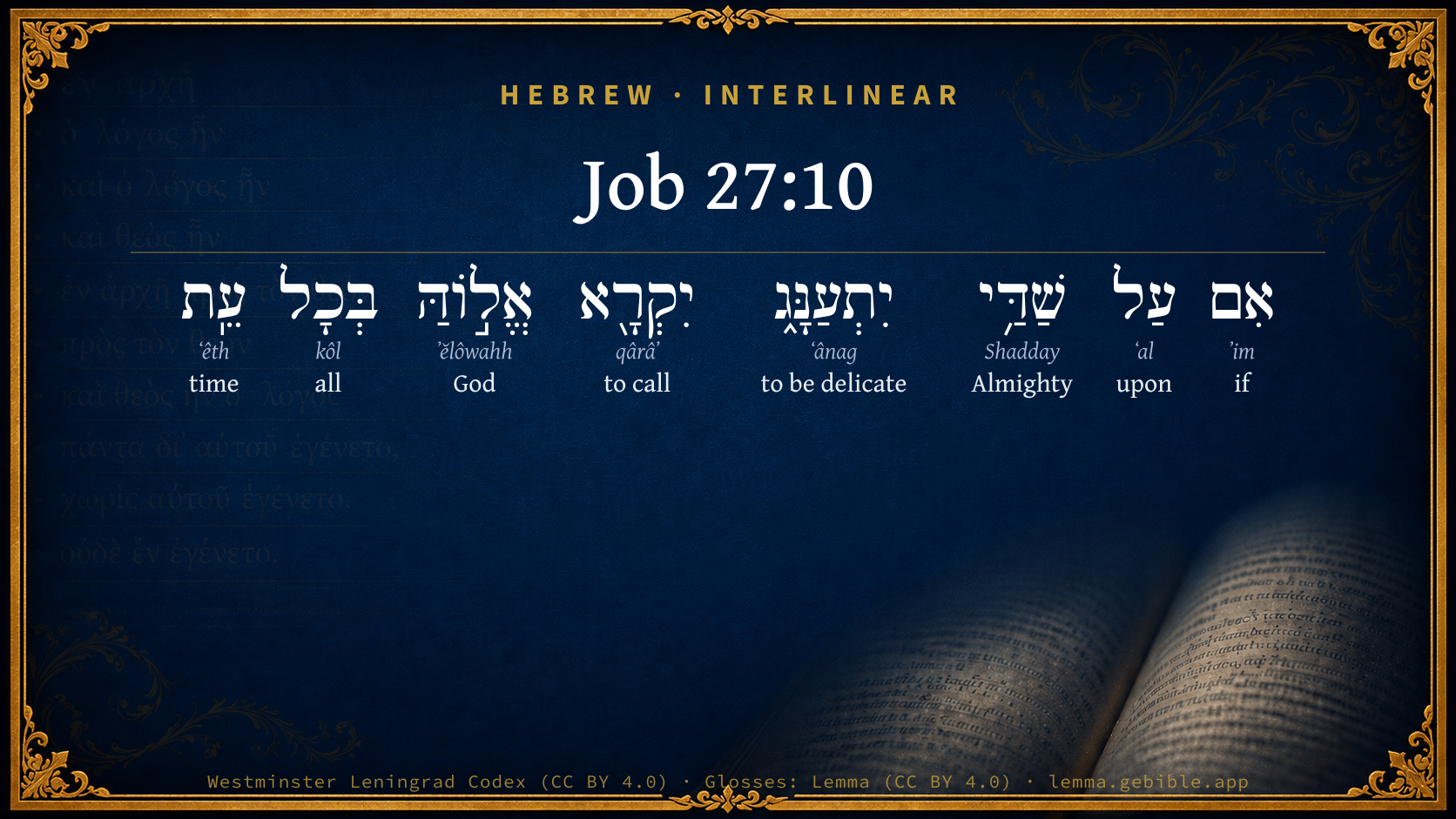
Hebrew (Westminster Leningrad Codex) Job 27:10 appears in the Hebrew Old Testament. The text above is from the Westminster Leningrad Codex. Each word links to its Strong’s number, a concise gloss, and parsing drawn from the Open Scriptures Hebrew Bible morphology. Click any word for its full Brown-Driver-Briggs (BDB) entry.
Download image
Cite this verse

Job 27:10 (World English Bible). Public Domain. Lemma interlinear Bible study tool, https://lemma.gebible.app/v/job/27/10.

Show BibTeX & RIS
BibTeX
RIS
English Translation
Will he delight himself in the Almighty, And call on God at all times?
World English Bible · Public Domain
Download a study sheet

One document with this verse’s original text, its word-by-word gloss line, the meaning frame, cross-references with their text, attributed commentary, and full source and license credits — printable, and it pastes into notes with its structure intact.

This verse Autodidact and up

Study sheet (.html) Plain text (.txt)

A passage Seminary Student

Up to 50 verses in one chapter. A passage sheet keeps up to 6 commentary sources and 12 cross-references per verse, in the order this page ranks them, and says so on the sheet whenever that leaves anything out. Ask for a single verse and you get the Autodidact verse sheet above.

Everything on this page stays free to read, with no account — the sheet is a download of what is already on screen, not access to it.

Want to remove ads? Support Godless Engineer
Compare translations 3

The same verse in 3 English versions, stacked beneath the original-language interlinear above. Click any original word for its lexicon entry.

Each is an independent rendering of the whole verse — the interlinear is not word-aligned to these translations.

Highlighted words mark where these versions differ — a whole-verse word diff, not a word-by-word alignment.

  • World English Bible Public Domain
    Will he delight himself in the Almighty, And call on God at all times?
  • King James Version Public Domain
    Will he delight himself in the Almighty? will he always call upon God?
  • unfoldingWord Literal Text CC BY-SA 4.0
    If he will delight himself in the Almighty? Will he call God in every time?

unfoldingWord Literal Text — © unfoldingWord, licensed CC BY-SA 4.0. Word-aligned USFM3 via Door43 (git.door43.org/unfoldingWord/en_ult).

Versions to compare (up to 4)

3 of 4 selected

Show all 18 translations

Every available English version of this verse, each an independent rendering of the whole verse.

  • World English Bible Public Domain
    Will he delight himself in the Almighty, And call on God at all times?
  • Berean Standard Bible Public Domain
    Will he delight in the Almighty? Will he call upon God at all times?
  • Majority Standard Bible Public Domain
    Will he delight in the Almighty? Will he call upon God at all times?
  • King James Version Public Domain
    Will he delight himself in the Almighty? will he always call upon God?
  • American Standard Version (1901) Public Domain
    Will he delight himself in the Almighty, And call upon God at all times?
  • Revised Version (1885) Public Domain
    Will he delight himself in the Almighty, and call upon God at all times?
  • Geneva Bible (1599) Public Domain
    Will he set his delight on the Almightie? will he call vpon God at all times?
  • Douay-Rheims (1899) Public Domain
    Or can he delight himself in the Almighty, and call upon God at all times?
  • Young's Literal Translation Public Domain
    On the Mighty doth he delight himself? Call God at all times?
  • Literal Standard Version CC BY-SA 4.0
    Does he delight himself on the Mighty? Call God at all times?
  • Unlocked Literal Bible CC BY-SA 4.0
    Will he delight himself in the Almighty and call upon God at all times?
  • unfoldingWord Literal Text CC BY-SA 4.0
    If he will delight himself in the Almighty? Will he call God in every time?
  • Darby Bible Public Domain
    Doth he delight himself in the Almighty? will he at all times call upon +God?
  • World Messianic Bible Public Domain
    Will he delight himself in the Almighty, and call on God at all times?
  • Webster's Bible Public Domain
    Will he delight himself in the Almighty? will he always call upon God?
  • Free Bible Version CC BY-SA 4.0
    Do they have a good relationship with the Almighty? Can they call on God at any time?
  • Bible in Basic English Public Domain
    Will he take delight in the Ruler of all, and make his prayer to God at all times?
  • JPS Tanakh (1917) Public Domain
    Will he have his delight in the Almighty, and call upon God at all times?

Literal Standard Version (2020), Covenant Press — licensed CC BY-SA 4.0. Text via the HelloAO Bible API (eBible.org). Unlocked Literal Bible (unfoldingWord) — licensed CC BY-SA 4.0. Text via the HelloAO Bible API (eBible.org). unfoldingWord Literal Text — © unfoldingWord, licensed CC BY-SA 4.0. Word-aligned USFM3 via Door43 (git.door43.org/unfoldingWord/en_ult). Free Bible Version, Dr. Jonathan Gallagher — licensed CC BY-SA 4.0. Text via the HelloAO Bible API (eBible.org).

Word by word

More ways to search: Search by grammar → Find every occurrence → Compare this word →

Practice this passage: Drill this verse → Learn its vocabulary →

About this verse

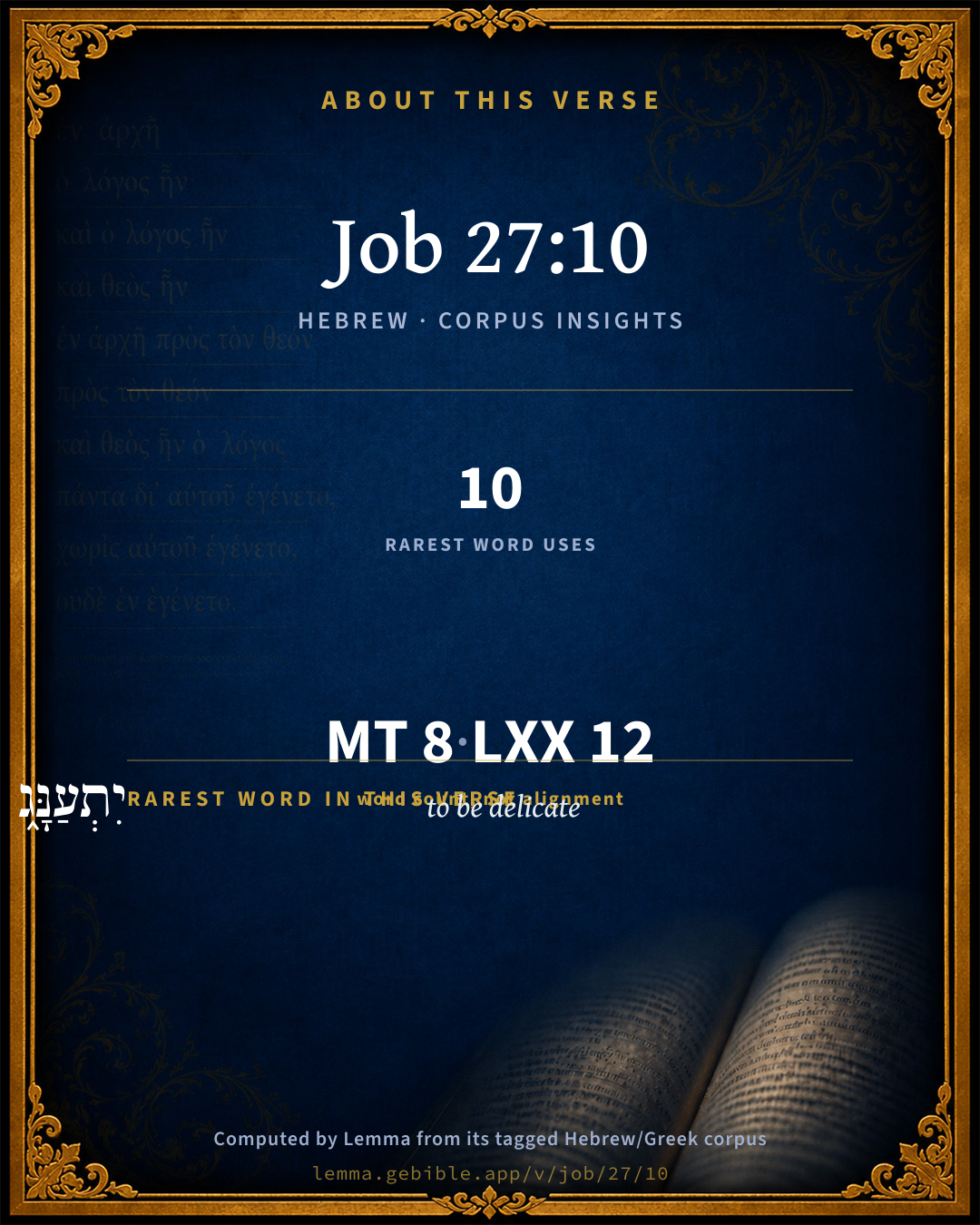
These counts appear in no published source. They are computed here, from the morphology-tagged text and Lemma’s own curated glosses. What Lemma adds →

8
words
8
distinct lemmas
Wisdom
section

Notable vocabulary

The rarest word here is יִתְעַנָּ֑ג to be delicate H6026 — appearing just 10 times in the whole Hebrew Bible.

Shared distinctive vocabulary

יִתְעַנָּ֑ג to be delicate H6026 occurs in 10 verses of the Hebrew Bible. Also found in:

Grammatical profile

  • 2 verbs
  • 4 nouns
  • 1 preposition
  • 1 conjunction

Verb forms

  • יִתְעַנָּ֑ג Hithpael · Imperfect
  • יִקְרָ֖א Qal · Imperfect

Hebrew & Septuagint length

In English translation the verse runs 14 words from the Hebrew and 16 from the Septuagint (LXX English) — closely comparable.

A rough comparison of the two English renderings, which tokenize alike — not a word-level alignment.

Word counts can differ between the Hebrew and the Greek without any difference in meaning — e.g. the Hebrew direct-object marker אֵת has no separate Greek word, and Greek often adds the article ὁ.

In the original languages it is 8 Hebrew tokens and 12 Greek tokens — but the two are counted differently (Hebrew bundles its prefixes and suffixes into one token; the Greek is in lemma form), so that isn’t a like-for-like length.

Cross-references

10

Topical passages linked to Job 27:10 in the Treasury of Scripture Knowledge — connected by theme and wording, ordered by reader-vote popularity; previews shown in the World English Bible.

  • Job 22:26–27 For then shall you delight yourself in the Almighty, And shall lift up your face to God.
  • Psalms 37:4 Also delight yourself in Yahweh, And he will give you the desires of your heart.
  • Habakkuk 3:18 Yet I will rejoice in Yahweh. I will be joyful in the God of my salvation!
  • Psalms 43:4 Then I will go to the altar of God, To God, my exceeding joy. I will praise you on the harp, God, my God.
  • Psalms 78:34–36 When he killed them, then they inquired after him. They returned and sought God earnestly.
  • Matthew 13:21 yet he has no root in himself, but endures for a while. When oppression or persecution arises because of the word, immediately he stumbles.
  • Luke 18:1 He also spoke a parable to them that they must always pray, and not give up,
  • Acts 10:2 a devout man, and one who feared God with all his house, who gave gifts for the needy generously to the people, and always prayed to God.
  • Ephesians 6:18 with all prayer and requests, praying at all times in the Spirit, and being watchful to this end in all perseverance and requests for all the saints:
  • 1 Thessalonians 5:17 Pray without ceasing.

Cross-references courtesy of OpenBible.info (CC BY 4.0).

Hebrew and Greek witnesses Masoretic Hebrew ↔ Greek Septuagint

The same verse in the two great witnesses to the Old Testament, shown verse-for-verse.

These are two independent witnesses, not word-aligned to each other, and the Septuagint is shown in lemma (dictionary) form.

Hebrew Job 27:10 Masoretic · Westminster Leningrad Codex

אִם עַל שַׁדַּ֥י יִתְעַנָּ֑ג יִקְרָ֖א אֱל֣וֹהַּ בְּכָל עֵֽת

Will he delight himself in the Almighty, And call on God at all times?

World English Bible · Public Domain

Greek LXX Job 27:10 Septuagint · lemma form

μή ἔχω τις παρρησία ἔναντι αὐτός ἤ ὡς ἐπικαλέω αὐτός εἰςἀκούω αὐτός

has he any confidence before him? or will God hear him as he calls upon him?

LXX2012 (modern English Septuagint) · Public Domain

Hebrew: Westminster Leningrad Codex (CC BY 4.0). Greek: Septuagint (public domain); English from LXX2012 (modern English Septuagint) (Public Domain). How the Septuagint differs from the Hebrew →

Commentary

Notes on Job 27:10 from classic Christian and Jewish commentators (each source and its license shown beneath its notes). The classic Christian expositions comment on the surrounding passage and are grouped to its opening verse, so a note may address several verses; the Jewish commentaries on the Tanakh (Rashi and others) are per-verse, so they appear only where the commentator wrote on this verse.

Lemma curates 59 commentaries, every one of them public domain or Creative Commons licensed, each selected and text-cleaned for this edition rather than reprinted as found. About our sources →

The Cambridge Bible for Schools and Colleges

gen. ed. J. J. S. Perowne

10. will he delight himself?] Or, doth he delight himself? The wicked man has no consolation, no resource, in the manifold conditions of life when men need higher help than their own; he has no pleasure in God nor fellowship with Him, and cannot appeal to Him.

It is manifest that in these verses the speaker means to contrast his own condition of mind with that of the godless man. He has hope in God, in death and in trouble, for he delighteth himself in God at all times. Such words as those in Job_27:8; Job_27:10, are not out of place in the mouth of Job, comp. ch. Job_16:19 seq., Job_19:25 seq., Job_23:10 seq., Job_31:2-6. It is less easy, however, to combine what is implied in the words of Job_27:9, “Will God hear his cry when trouble cometh upon him?” with Job’s repeated complaints that God refused to hear him, e. g. ch. Job_13:24, Job_19:7, and many other passages. The only solution would be to consider that he had fought his way through to an assured trust in God, such as he had cherished during his past life (ch. Job_12:4 seq.), or rather, that such a trust here suddenly broke upon him and filled his mind, and enabled him to look now for release from his calamities and restoration—in a word to anticipate that issue of his afflictions which actually ensued. And such is the construction which some of the ablest commentators (e.g. Ewald) put upon the language. Such a change of view in regard to the issue of his afflictions implies a complete revolution in Job’s mind, for he had hitherto consistently and even pertinaciously (ch. Job_17:1-2; Job_17:10-16) contended that his malady was mortal, and continued to do this even so late as ch. Job_23:14, “For he will perform the thing appointed for me.” Such a revolution, however, may be conceived and admitted, provided Job’s subsequent utterances are in harmony with it. Unfortunately, however, they are not; for in ch. Job_30:20 he exclaims, “I cry unto thee and thou dost not hear me, I stand up and thou gazest at me”; and in Job_27:23 of the same chapter he says, “For I know that thou wilt bring me unto death” (i. e. through his present afflictions). Here he is found again occupying the same position in regard to his malady under the hand of God as he had consistently maintained throughout. It is very hard to reconcile such expressions with ch. Job_27:7-10, on the assumption that the last-named passage really belongs to Job.

The Cambridge Bible for Schools and Colleges (gen. ed. J. J. S. Perowne; Cambridge University Press, 1878–1918) — public domain. Text from a community e-Sword module.

Trapp's Complete Commentary

John Trapp

Job 27:10 Will he delight himself in the Almighty? will he always call upon God?

Ver. 10. Will he delight himself in the Almighty?] viz. When trouble cometh upon him, as in the former verse. No, this is Christianorum propria virtus, a practice that none can skill of but God’s people, saith Jerome, to rejoice in tribulation, and then to continue instant in prayer, Rom 12:12, for deliverance, with some confidence grounded upon former experience. Crux enim iis inuncta est, saith Bernard. Together with the cross, they have an unction from the Father; anointed they are with that oil of gladness, the Spirit of glory and of God, which resteth upon them, 1Pe 2:14, and refresheth them amidst all their sorrows and sufferings; and hence their delight in the Almighty, yea, though he frown and lay upon them, as he did upon Job, with his own bare hand. Not so the hypocrite; for what reason? he hateth God in his heart, as doth every evildoer, Joh 3:20. Est enim talium poena Deus, utpote qui lux est: et quid talibus tam invisum? (Bernard.) God is light, and therefore hated as a punishment to such inauspicate night birds. He is holiness, but the hypocrite filthiness, as his name also importeth. How then can he delight himself in the Almighty? What complacence can there be, where is such an utter contrariety? They that love the Lord hate evil, Psa 31:23, but so doth not any hypocrite; leave it he may, but not loathe it. Part with it he may (as Jacob did with Benjamin, lest otherwise he should starve; or as Phaltiel with Michal, lest he should lose his head), but his heart is glued to it still; he hath a month’s mind to be doing, if he dare. Finally, he is without faith, and therefore without joy and peace of conscience. And as for his spider web of hope, a little wind bloweth it down. The world hath his heart, and so the love of the Father cannot be in him, 1Jn 2:15. He leaneth upon the Lord, and saith, Is not the Lord among us? Mic 3:11, yet is he rooted in the delights of life. Like as the apricot tree leaneth against the wall, but is fast rooted in the earth.

Will he always call upon God?] Heb. In every time? No, nor scarce at any time. Indeed, as beggars have learned to cant, so have some hypocrites to pray; Isa 26:16, "They have poured forth a charm when thy chastening was upon them." "When he slew them, then they sought him, and they returned and inquired after God," Psa 78:34. But this was only a prayer of the flesh for ease, and not of the Spirit for grace. They spoke God fair (as the devil did Christ) only to be rid of him. Thus Pharaoh, when on the rack, roared out a confession, and called for a prayer. Joab, in danger of death, hangs on the horns of the altar. The captivated Jews fasted and prayed for seventy years, to get off their chains rather than their sins, Zec 7:5, which Daniel therefore reckoned lost labour, Job 9:13. But many wicked men, though in prosperity they have some short winded wishes (such as was that of Balaam, Num 23:10, wherewith compare that of David, Psa 26:9, and see a difference), or perhaps are able by strength of wit and memory to pray handsomely; yet in adversity they set their mouths against heaven, as hunger bitten wolves, and howl upward; they curse their king and their God, and look upward, saith Isaiah, Isa 8:21; they murmur and mutiny, as the Israelites in the wilderness; they ban and blaspheme, as did that Israelitish woman’s son, Lev 14:11, and Micah’s mother, Jdg 17:2. A parrot may be taught to talk like a man (histories tell us of one at Rome that could repeat the whole creed), but let him be but beaten, and he returns to his own natural harsh voice. So a hypocrite, while all goes well with him, may seem very devout at his orisons, but lay thy hand upon him (saith Satan to God concerning Job, presuming thereby to prove him a hypocrite), and he will curse thee to thy face, Job 2:5. But say he be somewhat better conditioned, as they call it, and for a while pray to God for ease and help; yet he will not pray always, he will not persevere in prayer, follow on to pray, wait upon God for an answer, and be content to want it, if God see good to deny it. He cannot draw nigh to God "with a true heart" (such a heart as is well satisfied, if God may be glorified, though himself be not gratified) "in full assurance of faith," Heb 10:22; which is, saith Brentius, Orationis medulla, the marrow of prayer. Hence St James calleth it "the prayer of faith," Job 5:15. Afflictions cause a saint to seek out God’s promise, the promise to seek faith, faith to seek prayer, and prayer to find God; to find him at length, for he is a God that hideth himself, Isa 45:15. But what saith faith? "I will wait upon the Lord, that hideth his face from the house of Jacob, and I will look for him," Isa 8:17. See this exemplified in the woman of Canaan, who fetched Christ out of his retiring room by the force of her faith, Mar 7:24, and prayed on, though denied. She would not be said nay, or set down either with silence or sad answers, but showed herself a woman of a well knit resolution, such as could credere invisibilia, sperare dilata, et amare Deum se ostendentem contrarinm, as Luther speaketh: Believe things invisible, hope for things deferred, and love God when he shows himself most angry and opposite. Now this the hypocrite (who is an infidel) cannot skill of. He is short spirited, and cannot hold out in prayer, cannot, as our Saviour taught by that parable, Luk 18:1, always pray, and not faint, εκκακειν, shrink back, as sluggards do in work, or cowards in war. Oratio est res ardua, et magni laboris, saith Luther. Prayer is a hard work, and a man must tug at it and stick to it, as Jacob did, who wrestled and raised dust, as the Hebrew word signifieth; he held fast, and hung on, yea, he held with his hands when his thigh was lamed. Let me go, saith God, bespeaking his own liberty. No, thou shalt not, saith Jacob, until thou bless me. Lo, such is the generation of them that seek God in sincerity, of them that seek thy face; this is Jacob, Psa 24:6. "One thing have I desired of the Lord, and that I will seek after," saith David, Psa 27:4. If his suit had not been honest, he would never have begun it; but being so, he will never give it over till he hath prevailed; he will pray till he faint, and then to it again, Psa 119:81-82. "Rejoicing in hope; patient in tribulation; continuing instant in prayer," Rom 12:12. So doth not the hypocrite, for want of an inward principle. If God come not at a call, he is out of patience, and ready to say, with that profane prince, 2Ki 6:33, "Behold, this evil is of the Lord; and what should I wait for the Lord any longer?" Away to the witch of Endor, to the god of Ekron. Flectere si nequeo superos, Acheronta movebo. This Job would not do, and therefore no hypocrite.

John Trapp, A Commentary or Exposition upon All the Books of the Old and New Testament (1647–1656) — public domain. Text from a community e-Sword module.

Joseph Benson's Commentary

Job 27:10. Will he delight himself in the Almighty? — When he has nothing else to delight in? No: his delight is in the things of the world, which now sink under him. Will he always call upon God? — Will he have the confidence to pray to God, and expect any comfort from him? Nay, will he not rather despond in such a case, and cease to call upon him? Certainly those who do not delight in God will not long call upon him.

Joseph Benson's Commentary on the Old and New Testaments (1811–1818) — public domain. Text from a community e-Sword module.

Jamieson, Fausset & Brown

Robert Jamieson, A. R. Fausset & David Brown

Alluding to Job 22:26.

always call--He may do so in times of prosperity in order to be thought religious. But he will not, as I do, call on God in calamities verging on death. Therefore I cannot be a "hypocrite" (Job 19:25; Job 20:5; Psa 62:8).

Jamieson, Fausset & Brown — Commentary Critical and Explanatory on the Whole Bible (1871) — public domain (CC PDM 1.0). Text via the HelloAO Bible API.

Ellicott's Commentary for English Readers

(10) Will he delight himself?—It is only the godly who can say, “Whom have I in heaven but Thee, and there is none upon earth that I desire in comparison with Thee;” and again, “I will praise Thy name, because it is so comfortable;” but this man hath no promise that he can plead, and therefore no assurance of access at all times to the presence of God.

A Bible Commentary for English Readers, edited by Charles John Ellicott (1878–1897) — public domain. Text from a community e-Sword module.

John Gill's Exposition

I will teach you by the hand of God,.... To serve God, and speak truth, says one of the Jewish commentators (g); rather the works of God, and methods of his providence, with wicked men and hypocrites; the wisdom of God in his dispensations towards them; the reasons why he suffers them to live in outward prosperity and happiness, and what in the issue will be their case and circumstances; wherefore some render the words, "I will teach you the hand of God", or "of", or "concerning the hand of God" (h); and so Mr. Broughton, of God, his hand; not his works of nature which his hand had wrought, of which he had discoursed in the preceding chapter; but his works of providence, and those more mysterious ones relating to the afflictions of the godly, and the prosperity of the wicked. Job had been a teacher and instructor of others in the times of his prosperity, and his words had upheld, strengthened, and comforted many, Job 4:3; and he was not the less qualified for, nor the less capable of such an office now in his adversity, which had been a school to him, in which he had learned many useful lessons himself, and so was in a better capacity of teaching others. Thus some render the words, "I will teach you", being in or "under the hand of God" (i); under his mighty hand, his afflicting, chastising hand, which had touched him, and pressed him sore, and yet had guided and instructed him in many things, and particularly relating to the subject he proposed to instruct his friends in; who, though they were men of knowledge, and in years, yet he apprehended needed instruction; and he undertook to give them some by the good hand of God upon him, through his help and assistance, and under the influences and teachings of his spirit. The Targum is,

"I will teach you by the prophecy of God;''

see Eze 1:3;

that which is with the Almighty will I not conceal; meaning not the secret purposes and decrees of God within himself, which cannot be known, unless he reveals them; rather secret truths, which are not obvious to everyone, the mysteries of the kingdom, the wisdom of God in a mystery, the knowledge of which the Lord vouchsafes to some of his people in a very peculiar manner; though the mysteries of Providence seem chiefly intended, which those that carefully observe attain to an understanding of, so as to be capable of instructing others; and indeed what is in reserve with God for men among his treasures, whether of grace or glory for his own peculiar people, or especially of wrath and vengeance for wicked men and hypocrites, may be here designed; and whatever knowledge men have of the mysteries of nature, providence, and grace, which may be profitable unto others, and make for the glory of God, should not be concealed from men, see Job 6:10.

(g) Simeon Bar Tzemach. (h) "manum Dei", Beza, Cocceius; "de manu Dei", Mercerus, Piscator, Drusius, Schmidt, Michaelis, Schultens. (i) "In plaga Dei fortis versans", Junius & Tremellius.

John Gill's Exposition of the Whole Bible (1746–1763) — public domain (CC PDM 1.0). Text via the HelloAO Bible API.

Albert Barnes' Notes on the Bible

Will he delight himself in the Almighty? - A truly pious man will delight himself in the Almighty. His supreme happiness will be found in God. He has pleasure in the contemplation of his existence, his perfections, his law, and his government. Coverdale renders this, “Hath he such pleasure and delight in the Almighty that he dare alway call upon God?” The idea of Job is that a hypocrite has not his delight in the Almighty; and, therefore, his condition is not such as he would defend or choose. Job bad been charged with defending the character of the wicked and with maintaining that they were the objects of the divine favor. He now says that he maintained no such opinion. He was aware that the only real and solid happiness was to be found in God, and he knew that a hypocrite would not find delight there. This is true to the letter. A hypocrite has no real happiness in God. He sees nothing in the divine perfections to love; nothing in the divine plan affections. The hypocrite, therefore, is a miserable man. He professes to love what he does not love; tries to find pleasure in what his heart hates; mingles with a people with whom he has no sympathy, and joins in services of prayer and praise which are disgusting and irksome to his soul. The pious man rejoices that there is just such a God as Yahweh is. He sees nothing in him which he desires to be changed, and he has supreme delight in the contemplation of his perfections.

Will he always call upon God? - That is, he will not always call upon God. This is literally true. The hypocrite pray:

(1) when he makes a profession of religion;

(2) on some extraordinary occasion - as when a friend is sick, or when he feels that he himself is about to die, but he does not always maintain habits of prayer.

He suffers his business to break in upon his times for prayer; neglects secret devotion on the slightest pretence, and soon abandons it altogether. One of the best tests of character is the feeling with which we pray, and the habit which we have of calling on God. The man who loves secret prayer has one of the most certain evidences that he is a pious man; compare the notes at Job 20:5.

Albert Barnes' Notes on the Bible (1834–1885) — public domain. Text from a community e-Sword/MySword module.

Matthew Poole's English Annotations

Will he be able to delight and satisfy himself with God alone, and with his love and favour, when he hath no other matter of delight? This I now do, and this a hypocrite cannot do, because his heart is chiefly set upon the world; and when that fails him, his heart sinks, and the thoughts of God are unsavoury and troublesome to him. He may by his afflictions be driven to prayer: but if God doth not speedily answer him, he falls into despair, and neglect of God and of prayer; whereas I constantly continue in prayer, notwithstanding the grievousness and the long continuance of my calamities.

Matthew Poole's English Annotations on the Holy Bible (1683–1685) — public domain. Text from a community e-Sword/MySword module.

Whedon's Commentary on the Bible

Daniel D. Whedon

10. Delight himself — Same as in Job_22:26. If the ungodly have no such experience as his own, Job would have his friends infer that he must be righteous.

Always — Hebrew, In all time. Delight in God manifests itself in habitual communion with him. The question of Job is an unconscious exponent of his own unceasing life of prayer.

Daniel D. Whedon (gen. ed.), Commentary on the Old and New Testaments (1874–1909) — public domain. Text from a community e-Sword module.

The Pulpit Commentary

Will he delight himself in the Almighty? A further ill result of hypocrisy is noted. Not only does it alienate God from us, but it mileages us from God. The hypocrite cannot "delight in the Almighty." He must shriek from him, tear him, dislike to dwell on the thought of his presence and realize it. His natural inclination must be to withdraw his thoughts from God, and give himself up to the worldliness which has been his attraction to assume the hypocrite"s part. Will he always call upon God? Can be even be depended on not to renounce the service of God altogether? The mutual alienation above spoken of must tend to check communion, to disincline to prayer and calling upon God, to erect a barrier between the hypocrite and the Almighty, which, though for a while it may be insufficient to withstand the force of use and wont, will yet, in the long run, be sure to tell, and will either put an end to prayer altogether, or reduce it to a formality.

The Pulpit Commentary (1880–1919), ed. H.D.M. Spence-Jones & Joseph S. Exell — public domain. Text from a community e-Sword module.

John Wesley's Explanatory Notes

Delight - When he has nothing else to delight in? No: his delight is in the things of the world, which now sink under him. And those who do not delight in God, will not always, will not long, call upon him.

John Wesley, Explanatory Notes Upon the Whole Bible (1754–1765) — public domain. Text via the GEBible commentary corpus.

Rashi

Rabbi Shlomo Yitzchaki (Rashi)

Or will he delight with the Almighty The double interrogative is like all double interrogatives. the first one is customarily prefixed by a “hey” and the second one by אִם; e.g., (Amos 6:12), “Will horses run (הירצון) on the rock, or (אִם) will one plow with cattle?” (Job 6:30), “Is there (היש) injustice in my tongue, or (אִם) will my palate not understand wickedness?” Here, too, will God hearken to his cry...or will he delight with the Almighty? Will one who is a wicked man or a flatterer perhaps be able to delight and rely on the salvations of the Holy One, blessed be He, and call to Him in time of trouble? This is a question.

Rashi on the Tanakh — English translations: “The Judaica Press complete Tanach with Rashi, translated by A. J. Rosenberg” (CC BY 4.0); “Pentateuch with Rashi's commentary by M. Rosenbaum and A.M. Silbermann, 1929-1934” (public domain); “The Metsudah Tanach series, Lakewood, N.J” (CC BY 4.0); and “The Book of Joshua, Metsudah Publications, 1997” (CC BY 4.0). Text via Sefaria.

Lesson kit

Teaching starters — assembled from the data on this page, not authored interpretation. Every prompt links to the verse data it draws on. Edit before teaching.

Job, in the Wisdom, opens this verse with 8 words (8 distinct Hebrew lemmas). Its most distinctive word is ʻânag (“to be delicate”). A historical commentator’s framing appears above. Read the whole chapter for the surrounding context.

Discussion questions

  1. What does “to be delicate” (ʻânag) contribute to the verse as a whole?
  2. How does Deuteronomy 28:56, which shares the word «to be delicate», read alongside this verse?
  3. These translations render this verse differently; the difference is in the English rendering, not the original. What questions does that raise?
  4. «יִתְעַנָּ֑ג» is a Hithpael Imperfect verb. How does that grammatical form shape the action described?
  5. Compare how The Cambridge Bible for Schools and Colleges and Trapp's Complete Commentary read this verse. Where do they agree or differ?

Things to notice

Reading settings

Reading text

Shown beneath each verse's original-language words.

Old Testament
Old Testament edition

Read the OT as the Masoretic Hebrew (MT) or the Greek Septuagint (LXX).

English shown for the Greek Septuagint (in the Hebrew ↔ Greek comparison).

Comparing translations? Open the Compare panel on any verse page to stack up to four side by side.