
Deuteronomy 3:21

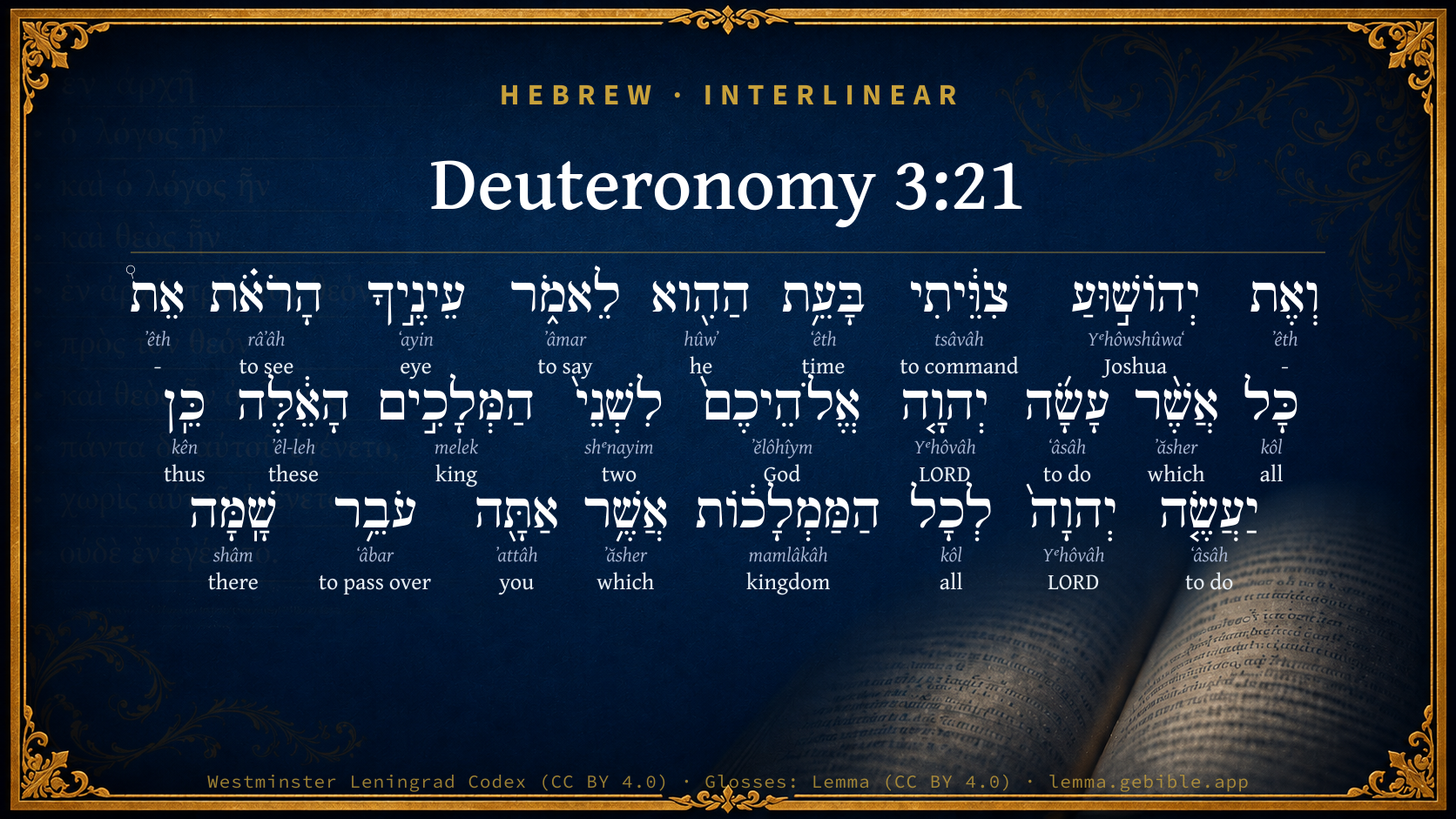
Hebrew (Westminster Leningrad Codex) Deuteronomy 3:21 appears in the Hebrew Old Testament. The text above is from the Westminster Leningrad Codex. Each word links to its Strong’s number, a concise gloss, and parsing drawn from the Open Scriptures Hebrew Bible morphology. Click any word for its full Brown-Driver-Briggs (BDB) entry.
Download image
Cite this verse

Deuteronomy 3:21 (World English Bible). Public Domain. Lemma interlinear Bible study tool, https://lemma.gebible.app/v/deuteronomy/3/21.

Show BibTeX & RIS
BibTeX
RIS
English Translation
I commanded Joshua at that time, saying, Your eyes have seen all that Yahweh your God has done to these two kings: so shall Yahweh do to all the kingdoms where you go over.
World English Bible · Public Domain
Download a study sheet

One document with this verse’s original text, its word-by-word gloss line, the meaning frame, cross-references with their text, attributed commentary, and full source and license credits — printable, and it pastes into notes with its structure intact.

This verse Autodidact and up

Study sheet (.html) Plain text (.txt)

A passage Seminary Student

Up to 50 verses in one chapter. A passage sheet keeps up to 6 commentary sources and 12 cross-references per verse, in the order this page ranks them, and says so on the sheet whenever that leaves anything out. Ask for a single verse and you get the Autodidact verse sheet above.

Everything on this page stays free to read, with no account — the sheet is a download of what is already on screen, not access to it.

Want to remove ads? Support Godless Engineer
Compare translations 3

The same verse in 3 English versions, stacked beneath the original-language interlinear above. Click any original word for its lexicon entry.

Each is an independent rendering of the whole verse — the interlinear is not word-aligned to these translations.

Highlighted words mark where these versions differ — a whole-verse word diff, not a word-by-word alignment.

  • World English Bible Public Domain
    I commanded Joshua at that time, saying, Your eyes have seen all that Yahweh your God has done to these two kings: so shall Yahweh do to all the kingdoms where you go over.
  • King James Version Public Domain
    And I commanded Joshua at that time, saying, Thine eyes have seen all that the LORD your God hath done unto these two kings: so shall the LORD do unto all the kingdoms whither thou passest.
  • unfoldingWord Literal Text CC BY-SA 4.0
    And I commanded Joshua at that time, saying, ‘Your eyes have seen all that Yahweh your God has done to these two kings. Thus Yahweh will do to all the kingdoms that you will be passing through there.

unfoldingWord Literal Text — © unfoldingWord, licensed CC BY-SA 4.0. Word-aligned USFM3 via Door43 (git.door43.org/unfoldingWord/en_ult).

Versions to compare (up to 4)

3 of 4 selected

Show all 18 translations

Every available English version of this verse, each an independent rendering of the whole verse.

  • World English Bible Public Domain
    I commanded Joshua at that time, saying, Your eyes have seen all that Yahweh your God has done to these two kings: so shall Yahweh do to all the kingdoms where you go over.
  • Berean Standard Bible Public Domain
    And at that time I commanded Joshua: “Your own eyes have seen all that the LORD your God has done to these two kings. The LORD will do the same to all the kingdoms you are about to enter.
  • Majority Standard Bible Public Domain
    And at that time I commanded Joshua: “Your own eyes have seen all that the LORD your God has done to these two kings. The LORD will do the same to all the kingdoms you are about to enter.
  • King James Version Public Domain
    And I commanded Joshua at that time, saying, Thine eyes have seen all that the LORD your God hath done unto these two kings: so shall the LORD do unto all the kingdoms whither thou passest.
  • American Standard Version (1901) Public Domain
    And I commanded Joshua at that time, saying, Thine eyes have seen all that Jehovah your God hath done unto these two kings: so shall Jehovah do unto all the kingdoms whither thou goest over.
  • Revised Version (1885) Public Domain
    And I commanded Joshua at that time, saying, Thine eyes have seen all that the LORD your God hath done unto these two kings: so shall the LORD do unto all the kingdoms whither thou goest over.
  • Geneva Bible (1599) Public Domain
    And I charged Ioshua the same time, saying, Thine eyes haue seene all that the Lord your God hath done vnto these two Kings: so shall the Lord doe vnto all the kingdomes whither thou goest.
  • Douay-Rheims (1899) Public Domain
    I commanded Josue also at that time, saying: Thy eyes have seen what the Lord your God hath done to these two kings: so will he do to all the king- dome to which thou shalt pass.
  • Young's Literal Translation Public Domain
    `And Jehoshua I have commanded at that time, saying, Thine eyes are seeing all that which Jehovah your God hath done to these two kings -- so doth Jehovah to all the kingdoms whither thou are passing over;
  • Literal Standard Version CC BY-SA 4.0
    And I have commanded Joshua at that time, saying, Your eyes are seeing all that which your God YHWH has done to these two kings—so YHWH does to all the kingdoms to where you are passing over;
  • Unlocked Literal Bible CC BY-SA 4.0
    I commanded Joshua at that time, saying, 'Your eyes have seen all that Yahweh your God has done to these two kings; Yahweh will do the same to all the kingdoms where you go over.
  • unfoldingWord Literal Text CC BY-SA 4.0
    And I commanded Joshua at that time, saying, ‘Your eyes have seen all that Yahweh your God has done to these two kings. Thus Yahweh will do to all the kingdoms that you will be passing through there.
  • Darby Bible Public Domain
    And I commanded Joshua at that time, saying, Thine eyes have seen all that Jehovah your God hath done to these two kings: so will Jehovah do to all the kingdoms to which thou shalt go.
  • World Messianic Bible Public Domain
    I commanded Joshua at that time, saying, “Your eyes have seen all that the LORD your God has done to these two kings. So shall the LORD do to all the kingdoms where you go over.
  • Webster's Bible Public Domain
    And I commanded Joshua at that time, saying, Thy eyes have seen all that the LORD your God hath done to these two kings: so shall the LORD do to all the kingdoms whither thou passest.
  • Free Bible Version CC BY-SA 4.0
    This was the time I ordered Joshua: “You've seen with your own eyes seen everything the Lord your God did to these two kings. The Lord will do the same to all the kingdoms where you're going.
  • Bible in Basic English Public Domain
    And I gave orders to Joshua at that time, saying, Your eyes have seen what the Lord your God has done to these two kings: so will the Lord do to all the kingdoms into which you come.
  • JPS Tanakh (1917) Public Domain
    And I commanded Joshua at that time, saying: 'Thine eyes have seen all that the LORD your God hath done unto these two kings; so shall the LORD do unto all the kingdoms whither thou goest over.

Literal Standard Version (2020), Covenant Press — licensed CC BY-SA 4.0. Text via the HelloAO Bible API (eBible.org). Unlocked Literal Bible (unfoldingWord) — licensed CC BY-SA 4.0. Text via the HelloAO Bible API (eBible.org). unfoldingWord Literal Text — © unfoldingWord, licensed CC BY-SA 4.0. Word-aligned USFM3 via Door43 (git.door43.org/unfoldingWord/en_ult). Free Bible Version, Dr. Jonathan Gallagher — licensed CC BY-SA 4.0. Text via the HelloAO Bible API (eBible.org).

Word by word

More ways to search: Search by grammar → Find every occurrence → Compare this word →

Practice this passage: Drill this verse → Learn its vocabulary →

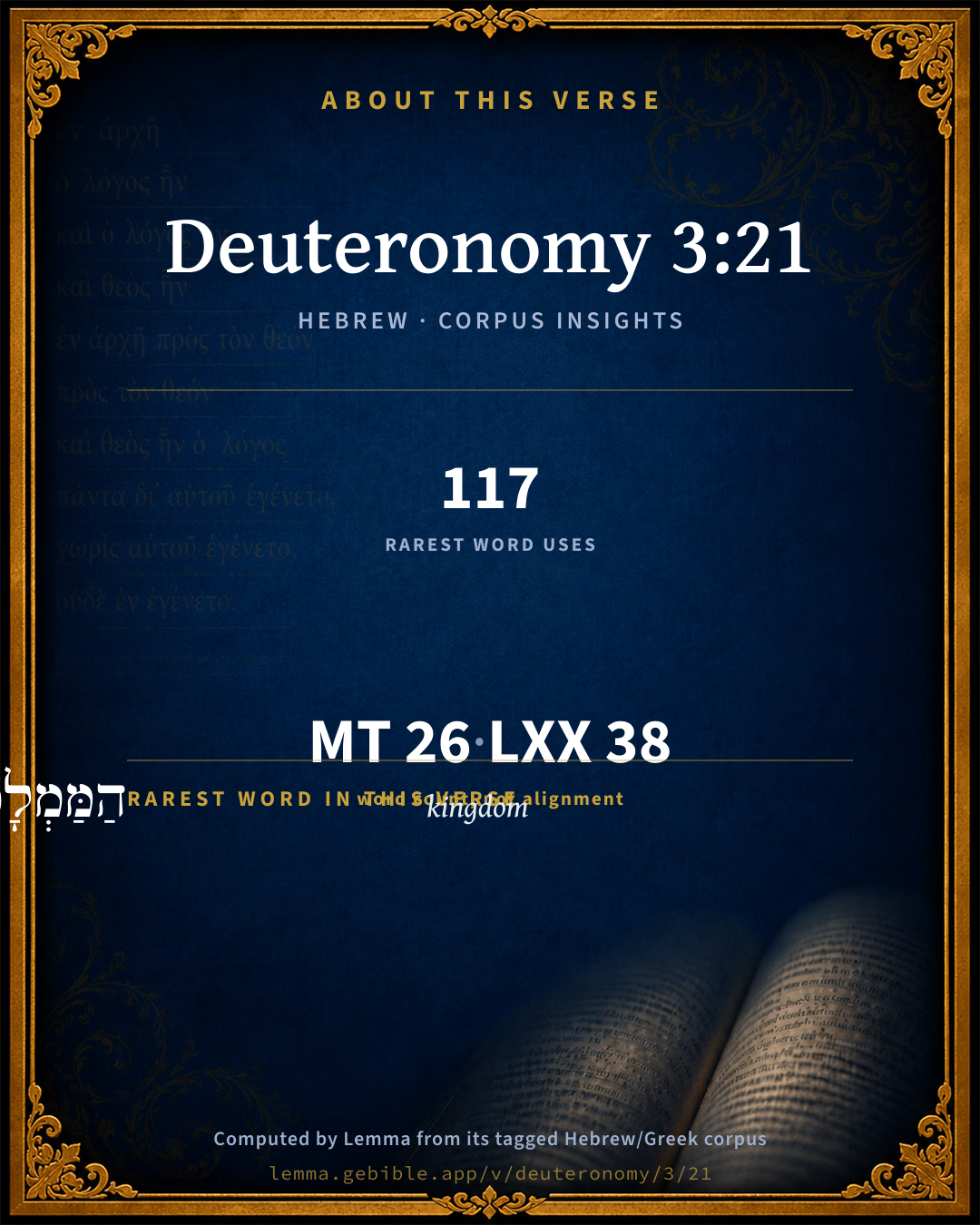
הַמַּמְלָכ֔וֹת
mamlâkâh
H4467
“the · kingdoms”
Particle, Definite Article + Noun, Common, Feminine, Plural, Absolute
Part of Speech
Particle + Noun
Type
Common
Gender
Feminine
Number
Plural
State
Absolute
Full BDB Definition

Origin: from H4427

TWOT: 1199f

kingdom, dominion, reign, sovereignty - kingdom, realm - sovereignty, dominion - reign
  1. וְאֶת ʼêth H853 “and · -” Conjunction + Particle, Direct Object
  2. יְהוֹשׁ֣וּעַ Yᵉhôwshûwaʻ H3091 “Joshua” Noun, Proper
  3. צִוֵּ֔יתִי tsâvâh H6680 “to command” Verb, Piel, Perfect, 1st Person, Common, Singular
  4. בָּעֵ֥ת ʻêth H6256 “in/at the · time” Preposition, Determined + Noun, Common, Both, Singular, Absolute
  5. הַהִ֖וא hûwʼ H1931 “the · he” Particle, Definite Article + Pronoun, Personal, 3rd Person, Feminine, Singular
  6. לֵאמֹ֑ר ʼâmar H559 “to say” Preposition + Verb, Qal, Infinitive Construct
  7. עֵינֶ֣יךָ ʻayin H5869 “eyes · your” Noun, Common, Both, Dual, Construct + Suffix, Personal, 2nd Person, Masculine, Singular
  8. הָרֹאֹ֗ת râʼâh H7200 “the · seeing” Particle, Definite Article + Verb, Qal, Participle Active, Feminine, Plural, Absolute
  9. אֵת֩ ʼêth H853 “-” Particle, Direct Object
  10. כָּל kôl H3605 “all of” Noun, Common, Masculine, Singular, Construct
  11. אֲשֶׁ֨ר ʼăsher H834 “which” Particle, Relative
  12. עָשָׂ֜ה ʻâsâh H6213 “to do” Verb, Qal, Perfect, 3rd Person, Masculine, Singular
  13. יְהוָ֤ה Yᵉhôvâh H3068 “LORD” Noun, Proper
  14. אֱלֹהֵיכֶם֙ ʼĕlôhîym H430 “God(s) · your” Noun, Common, Masculine, Plural, Construct + Suffix, Personal, 2nd Person, Masculine, Plural
  15. לִשְׁנֵי֙ shᵉnayim H8147 “to/for · two” Preposition + Adjective, Cardinal number, Masculine, Dual, Construct
  16. הַמְּלָכִ֣ים melek H4428 “the · kings” Particle, Definite Article + Noun, Common, Masculine, Plural, Absolute
  17. הָאֵ֔לֶּה ʼêl-leh H428 “the · these” Particle, Definite Article + Pronoun, Demonstrative, Common, Plural
  18. כֵּֽן kên H3651 “thus” Particle, Demonstrative
  19. יַעֲשֶׂ֤ה ʻâsâh H6213 “to do” Verb, Qal, Imperfect, 3rd Person, Masculine, Singular
  20. יְהוָה֙ Yᵉhôvâh H3068 “LORD” Noun, Proper
  21. לְכָל kôl H3605 “to/for · all of” Preposition + Noun, Common, Masculine, Singular, Construct
  22. אֲשֶׁ֥ר ʼăsher H834 “which” Particle, Relative
  23. אַתָּ֖ה ʼattâh H859 “you” Pronoun, Personal, 2nd Person, Masculine, Singular
  24. עֹבֵ֥ר ʻâbar H5674 “passing over” Verb, Qal, Participle Active, Masculine, Singular, Absolute
  25. שָֽׁמָּה shâm H8033 “there · toward” Adverb + Suffix, Demonstrative

About this verse

These counts appear in no published source. They are computed here, from the morphology-tagged text and Lemma’s own curated glosses. What Lemma adds →

26
words
21
distinct lemmas
Pentateuch
section

Grammatical profile

  • 6 verbs
  • 10 nouns
  • 1 adjective
  • 3 pronouns
  • 1 adverb
  • 5 particles

Verb forms

  • צִוֵּ֔יתִי Piel · Perfect
  • לֵאמֹ֑ר Qal · Infinitive Construct
  • הָרֹאֹ֗ת Qal · Participle Active
  • עָשָׂ֜ה Qal · Perfect
  • יַעֲשֶׂ֤ה Qal · Imperfect
  • עֹבֵ֥ר Qal · Participle Active

Repetition

Words recur within this verse — often emphatic in Hebrew:

  • כָּל all H3605 ×2
  • עָשָׂ֜ה to do H6213 ×2
  • יְהוָ֤ה LORD H3068 ×2
  • אֲשֶׁ֨ר which H834 ×2

Hebrew & Septuagint length

In English translation the verse runs 34 words from the Hebrew and 41 from the Septuagint (LXX English) — closely comparable.

A rough comparison of the two English renderings, which tokenize alike — not a word-level alignment.

Word counts can differ between the Hebrew and the Greek without any difference in meaning — e.g. the Hebrew direct-object marker אֵת has no separate Greek word, and Greek often adds the article ὁ.

In the original languages it is 26 Hebrew tokens and 38 Greek tokens — but the two are counted differently (Hebrew bundles its prefixes and suffixes into one token; the Greek is in lemma form), so that isn’t a like-for-like length.

Cross-references

8

Topical passages linked to Deuteronomy 3:21 in the Treasury of Scripture Knowledge — connected by theme and wording, ordered by reader-vote popularity; previews shown in the World English Bible.

  • Numbers 27:18–23 Yahweh said to Moses, Take Joshua the son of Nun, a man in whom is the Spirit, and lay your hand on him;
  • Joshua 10:25 Joshua said to them, Don't be afraid, nor be dismayed; be strong and of good courage: for thus shall Yahweh do to all your enemies against whom you fight.
  • 1 Samuel 17:36–37 Your servant struck both the lion and the bear: and this uncircumcised Philistine shall be as one of them, seeing he has defied the armies of the living God.
  • Psalms 9:10 Those who know your name will put their trust in you, For you, Yahweh, have not forsaken those who seek you.
  • 2 Corinthians 1:10 who delivered us out of so great a death, and does deliver; on whom we have set our hope that he will also still deliver us;
  • 2 Corinthians 12:10 Therefore I take pleasure in weaknesses, in injuries, in necessities, in persecutions, in distresses, for Christ's sake. For when I am weak, then am I strong.
  • Ephesians 3:20 Now to him who is able to do exceedingly abundantly above all that we ask or think, according to the power that works in us,
  • 2 Timothy 4:17–18 But the Lord stood by me, and strengthened me, that through me the message might be fully proclaimed, and that all the Gentiles might hear; and I was delivered out of the mouth of the lion.

Cross-references courtesy of OpenBible.info (CC BY 4.0).

Hebrew and Greek witnesses Masoretic Hebrew ↔ Greek Septuagint

The same verse in the two great witnesses to the Old Testament, shown verse-for-verse.

These are two independent witnesses, not word-aligned to each other, and the Septuagint is shown in lemma (dictionary) form.

Hebrew Deuteronomy 3:21 Masoretic · Westminster Leningrad Codex

וְאֶת יְהוֹשׁ֣וּעַ צִוֵּ֔יתִי בָּעֵ֥ת הַהִ֖וא לֵאמֹ֑ר עֵינֶ֣יךָ הָרֹאֹ֗ת אֵת֩ כָּל אֲשֶׁ֨ר עָשָׂ֜ה יְהוָ֤ה אֱלֹהֵיכֶם֙ לִשְׁנֵי֙ הַמְּלָכִ֣ים הָאֵ֔לֶּה כֵּֽן יַעֲשֶׂ֤ה יְהוָה֙ לְכָל הַמַּמְלָכ֔וֹת אֲשֶׁ֥ר אַתָּ֖ה עֹבֵ֥ר שָֽׁמָּה

I commanded Joshua at that time, saying, Your eyes have seen all that Yahweh your God has done to these two kings: so shall Yahweh do to all the kingdoms where you go over.

World English Bible · Public Domain

Greek LXX Deuteronomy 3:21 Septuagint · lemma form

καί ὁ ἰησοῦς ἐντέλλομαι ἐν ὁ καιρός ἐκεῖνος λέγω ὁ ὀφθαλμός σύ ὁράω πᾶς ὅσος ποιέω κύριος ὁ θεός ἐγώ ὁ δύο βασιλεύς οὗτος οὕτως ποιέω κύριος ὁ θεός ἐγώ πᾶς ὁ βασιλεία ἐπί ὅς σύ διαβαίνω ἐκεῖ

And I commanded Joshua at that time, saying, Your eyes have seen all things, which the Lord our God did to these two kings: so shall the Lord our God do to all the kingdoms against which you cross over there.

LXX2012 (modern English Septuagint) · Public Domain

On this verse, The Cambridge Bible for Schools and Colleges discusses the Septuagint’s reading. Read the note in Commentary ↓

Hebrew: Westminster Leningrad Codex (CC BY 4.0). Greek: Septuagint (public domain); English from LXX2012 (modern English Septuagint) (Public Domain). How the Septuagint differs from the Hebrew →

Targum (Aramaic paraphrase)

2

The Targum is the ancient Jewish Aramaic paraphrase of the Hebrew Scriptures — an interpretive translation, not the Hebrew text itself. Onkelos (literal) and Pseudo-Jonathan (expansive) render the Torah, and Jonathan the Prophets. Coverage is partial: where no permissively-licensed English translation exists for a verse, only the Aramaic is shown. This is verse-level text, not a word-by-word alignment to the Hebrew.

  1. Targum Onkelos Torah (Genesis–Deuteronomy)
    וְיָת יְהוֹשׁוּעַ פַּקֵדִית בְּעִדָנָא הַהִיא לְמֵימָר עֵינָיךְ חֲזָאָן יָת כָּל דִי עֲבַד יְיָ אֱלָהֲכוֹן לִתְרֵין מַלְכַיָא הָאִלֵין כֵּן יַעְבֵּד יְיָ לְכָל מַלְכְּוָתָא דִי אַתְּ עָבֵר לְתַמָן

    (no public-domain English translation for this verse)

    Targum Onkelos — Aramaic: “Onkelos Genesis” (public domain); “Onkelos Exodus” (public domain); “Onkelos Leviticus” (public domain); “Onkelos Numbers” (public domain); “Onkelos Deuteronomy” (public domain). English: “Sefaria Community Translation” (CC0 1.0 (public-domain dedication)); “J.W. Etheridge. The Targums of Onkelos and Jonathan Ben Uzziel on the Pentateuch. London: Longmans, Green, 1862” (public domain). Text via Sefaria.

  2. Targum Pseudo-Jonathan Torah (Genesis–Deuteronomy)
    וְיַת יְהוֹשׁוּעַ פַּקֵדִית בְּעִידָנָא הַהוּא לְמֵימָר עֵינָךְ חַמְיָין יַת כָּל דְּעָבַד יְיָ אֱלָהָךְ לִתְרֵין מַלְכַיָא הָאִילֵין הֵיכְדֵין יַעֲבִיד יְיָ לְכָל מַלְכְוָותָא דְאַנְתְּ עָבַר לְתַמָּן

    And I instructed Jehoshua at that time, saying: Thine eyes have seen all that the Lord thy God hath done to these two kings; so will the Lord do unto all the kingdoms to which thou art passing over.

    Targum Pseudo-Jonathan — Aramaic: “Targum Jonathan on Genesis” (public domain); “Targum Jonathan on Exodus” (public domain); “Targum Jonathan on Leviticus” (public domain); “Targum Jonathan on Numbers” (public domain); “Targum Jonathan on Deuteronomy” (public domain). English: “The Targum of Jonathan ben Uzziel, trans. J. W. Etheridge, London, 1862” (public domain). Text via Sefaria.

Commentary

Notes on Deuteronomy 3:21 from classic Christian and Jewish commentators (each source and its license shown beneath its notes). The classic Christian expositions comment on the surrounding passage and are grouped to its opening verse, so a note may address several verses; the Jewish commentaries on the Tanakh (Rashi and others) are per-verse, so they appear only where the commentator wrote on this verse.

Lemma curates 59 commentaries, every one of them public domain or Creative Commons licensed, each selected and text-cleaned for this edition rather than reprinted as found. About our sources →

Matthew Henry's Commentary

Here is I. The encouragement which Moses gave to Joshua, who was to succeed him in the government, Deu 3:21, Deu 3:22. He commanded him not to fear. This those that are aged and experienced in the service of God should do all they can to strengthen the hands of those that are young, and setting out in religion. Two things he would have him consider for his encouragement: - 1. What God has done. Joshua had seen what a total defeat God had given by the forces of Israel to these two kings, and thence he might easily infer, so shall the Lord do to all the rest of the kingdoms upon which we are to make war. He must not only infer thence that thus the Lord can do with them all, for his arm is not shortened, but thus he will do, for his purpose is not changed; he that has begun will finish; as for God, his work is perfect. Joshua had seen it with his own eyes. And the more we have seen of the instances of divine wisdom, power, and goodness, the more inexcusable we are if we fear what flesh can do unto us. 2. What God had promised. The Lord your God he shall fight for you; and that cause cannot but be victorious which the Lord of hosts fights for. If God be for us, who can be against us so as to prevail? We reproach our leader if we follow him trembling.

II. The prayer which Moses made for himself, and the answer which God gave to that prayer.

1. His prayer was that, if it were God's will, he might go before Israel over Jordan into Canaan. At that time, when he had been encouraging Joshua to fight Israel's battles, taking it for granted that he must be their leader, he was touched with an earnest desire to go over himself, which expresses itself not in any passionate and impatient complaints, or reflections upon the sentence he was under, but in humble prayers to God for a gracious reversing of it. I besought the Lord. Note, We should never allow any desires in our hearts which we cannot in faith offer up to God by prayer; and what desires are innocent, let them be presented to God. We have not because we ask not. Observe,

(1.) What he pleads here. Two things: - [1.] The great experience which he had had of God's goodness to him in what he had done for Israel: "Thou hast begun to show thy servant thy greatness. Lord, perfect what thou hast begun. Thou hast given me to see thy glory in the conquest of these two kings, and the sight has affected me with wonder and thankfulness. O let me see more of the outgoings of my God, my King! This great work, no doubt, will be carried on and completed; let me have the satisfaction of seeing it." Note, the more we see of God's glory in his works the more we shall desire to see. The works of the Lord are great, and therefore are sought out more and more of all those that have pleasure therein. [2.] The good impressions that had been made upon his heart by what he had seen: For what God is there in heaven or earth that can do according to thy works? The more we are affected with what we have seen of God, of his wisdom, power, and goodness, the better we are prepared for further discoveries. Those shall see the works of God that admire him in them. Moses had thus expressed himself concerning God and his works long before (Exo 15:11), and he still continues of the same mind, that there are no works worthy to be compared with God's works, Psa 86:8.

(2.) What he begs: I pray thee let me go over, Deu 3:25. God had said he should not go over; yet he prays that he might, not knowing but that the threatening was conditional, for it was not ratified with an oath, as that concerning the people was, that they should not enter. Thus Hezekiah prayed for his own life, and David for the life of his child, after both had ben expressly threatened; and the former prevailed, though the latter did not. Moses remembered the time when he had by prayer prevailed with God to recede from the declarations which he had made of his wrath against Israel, Exo 32:14. And why might he not hope in like manner to prevail for himself? Let me go over and see the good land. Not, "Let me go over and be a prince and a ruler there;" he seeks not his own honour, is content to resign the government to Joshua; but, "Let me go to be a spectator of thy kindness to Israel, to see what I believe concerning the goodness of the land of promise." How pathetically does he speak of Canaan, that good land, that goodly mountain! Note, Those may hope to obtain and enjoy God's favours that know how to value them. What he means by that goodly mountain we may learn from Psa 78:54, where it is said of God's Israel that he brought them to the border of his sanctuary, even to this mountain which his right hand had purchased, where it is plainly to be understood of the whole land of Canaan, yet with an eye to the sanctuary, the glory of it.

2. God's answer to this prayer had in it a mixture of mercy and judgment, that he might sing unto God of both.

(1.) There was judgment in the denial of his request, and that in something of anger too: The Lord was wroth with me for your sakes, Deu 3:26. God not only sees sin in his people, but is much displeased with it; and even those that are delivered from the wrath to come may yet lie under the tokens of God's wrath in this world, and may be denied some particular favour which their hearts are much set upon. God is a gracious, tender, loving Father; but he is angry with his children when they do amiss, and denies them many a thing that they desire and are ready to cry for. But how was he wroth with Moses for the sake of Israel? Either, [1.] For that sin which they provoked him to; see Psa 106:32, Psa 106:33. Or, [2.] The removal of Moses at that time, when he could so ill be spared, was a rebuke to all Israel, and a punishment of their sin. Or, [3.] It was for their sakes, that it might be a warning to them to take heed of offending God by passionate and unbelieving speeches at any time, after the similitude of his transgression; for, if this were done to such a green tree, what should be done to the dry? He acknowledges that God would not hear him. God had often heard him for Israel, yet he would not hear him for himself. It was the prerogative of Christ, the great Intercessor, to be heard always; yet of him his enemies said, He saved others, himself he could not save, which the Jews would not have upbraided him with had they considered that Moses, their great prophet, prevailed for others, but for himself he could not prevail. Though Moses, being one of the wrestling seed of Jacob, did not seek in vain, yet he had not the thing itself which he sought for. God may accept our prayers, and yet not grant us the very thing we pray for.

(2.) Here is mercy mixed with this wrath in several things: - [1.] God quieted the spirit of Moses under the decree that had gone forth by that word (Deu 3:26), Let it suffice thee. With this word, no doubt, a divine power went to reconcile Moses to the will of God, and to bring him to acquiesce in it. If God does not by his providence give us what we desire, yet, if by his grace he makes us content without it, it comes much to one. "Let it suffice thee to have God for they father, and heaven for thy portion, though thou hast not every thing thou wouldest have in this world. Be satisfied with this, God is all-sufficient." [2.] He put an honour upon his prayer in directing him not to insist upon this request: Speak no more to me of this matter. It intimates that what God does not think fit to grant we should not think fit to ask, and that God takes such a pleasure in the prayer of the upright that it is no pleasure to him, no, not in any particular instance, to give a denial to it. [3.] He promised him a sight of Canaan from the top of Pisgah, Deu 3:27. Though he should not have the possession of it, he should have the prospect of it; not to tantalize him, but such a sight of it as would yield him true satisfaction, and would enable him to form a very clear and pleasing idea of that promised land. Probably Moses had not only his sight preserved for other purposes, but greatly enlarged for this purpose; for, if he had not had such a sight of it as others could not have from the same place, it would have been no particular favour to Moses, nor the matter of a promise. Even great believers, in this present state, see heaven but at a distance. [4.] He provided him a successor, one who should support the honour of Moses and carry on and complete that glorious work which the heart of Moses was so much upon, the bringing of Israel to Canaan, and settling them there (Deu 3:28): Charge Joshua and encourage him in this work. Those to whom God gives a charge, he will be sure to give encouragement to. And it is a comfort to the church's friends (when they are dying and going off) to see God's work likely to be carried on by other hands, when they are silent in the dust.

Matthew Henry's Commentary on the Whole Bible (1708–1710) — public domain (CC PDM 1.0). Text via the HelloAO Bible API.

Trapp's Complete Commentary

John Trapp

Deu 3:21 And I commanded Joshua at that time, saying, Thine eyes have seen all that the LORD your God hath done unto these two kings: so shall the LORD do unto all the kingdoms whither thou passest.

Ver. 21. So shall the Lord.] God hath, and, therefore, God will, is a strong medium of hope, if not a demonstration of Scripture logic.

John Trapp, A Commentary or Exposition upon All the Books of the Old and New Testament (1647–1656) — public domain. Text from a community e-Sword module.

Tyndale Open Study Notes

Tyndale Open Resources

3:21-29 See Num 20:2-13; Ps 106:32-33.

3:21 He will do the same: Israel’s military success under Moses’ leadership could be expected to continue under Joshua because the Lord promised to remain with them.

Tyndale Open Study Notes — © Tyndale Open Resources, licensed CC BY-SA 4.0. Text via the HelloAO Bible API.

Geneva Bible (1599)

Geneva Bible translators

So that the victories came not by your own wisdom, strength or multitude.

Geneva Bible (1599) marginal notes — public domain. Text via Bolls.life.

Ellicott's Commentary for English Readers

(21, 22) I commanded Joshua at that time. . . . Thine eyes have seen.—“Thine eyes are the witnesses of all,” &c. The conquest of Sihon and Og, as well as that of Amalek, was to be impressed upon Joshua (comp. Exo_17:14) as a precedent for his encouragement, and also for his instruction. It is remarkable that no details are given us of the battles against Sihon and Og, or of the capture of the cities, except in Jos_12:6, “Them did Moses the servant of the Lord smite.” We see the reflection of Moses’ campaign, which is unwritten, in the recorded campaigns of Joshua. The peculiar form of the sentence, “Thine eyes are they that see,” may also serve to remind us of the fact, that though the Law was given by Moses, no eye saw its full breadth and grasp until it came into the hand of Jesus, the antitype of Joshua.

A Bible Commentary for English Readers, edited by Charles John Ellicott (1878–1897) — public domain. Text from a community e-Sword module.

The Cambridge Bible for Schools and Colleges

gen. ed. J. J. S. Perowne

21. Thine eyes have seen] Rather, Thine own eyes are they that saw. The appeal to personal experience is characteristic of Deuteronomy: cp. Deu_4:3, Deu_11:7. LXX reads your eyes; but thine is confirmed by Sam.

your God] LXX B our God. Omit with Sam. The formula has been added by a copyist.

The Cambridge Bible for Schools and Colleges (gen. ed. J. J. S. Perowne; Cambridge University Press, 1878–1918) — public domain. Text from a community e-Sword module.

John Gill's Exposition

Ye shall not fear them,.... On account of the numbers, strength, courage, and gigantic stature of the inhabitants, at least some of them; nor on account of their walled towns, and fortified cities:

for the Lord your God he shall fight for you; as he did, particularly at Jericho, the walls of which city fell at the sound of rams' horns; and at Gibeon, when he cast down hailstones on their enemies, and more were slain by them than with the sword; and in all their battles it was he that gave them success and victory.

John Gill's Exposition of the Whole Bible (1746–1763) — public domain (CC PDM 1.0). Text via the HelloAO Bible API.

The Pulpit Commentary

Vers. 21, 22. Joshua appointed as Moses" successor in the leadership.

At that time, i.e. after the conquest of the land on the east of the Jordan. (see Num_27:12, etc.) Thine eyes have seen, etc. Joshua was directed to what he had himself witnessed, what his own eyes had seen, in the destruction of Sihon and Og and their hosts, that he might be encouraged to go forward in the course to which he had been called; and the people are reminded of this, that they may keep in mind what God had done for Israel, and may without fear follow Joshua as their leader to the conquest of Canaan. (comp. Deu_31:23)

Vers. 21-29. Prospect of death.

In the full career of triumph, Moses has inward presentiment, and external announcement, that his end was near. Nature has a greater repugnance to death when we are enveloped in the bright sunshine of prosperity. The contrast is more marked. Decay and disease are natural forerunners of dissolution; but in Moses these were wanting. With him, the grave men of the trial was that his life-work was incomplete. The closer we approach to the final stroke of an undertaking, the deeper becomes our anxiety for a successful issue. "How am I straitened till it be accomplished!

I WE HAVE HERE SAGACIOUS PROVISION TO CONSUMMATE HIS WORK. In the judgment of a good man, the perpetuation of his work by others is vastly more important than the continuance of his own life. Individuals pass away, but the progress of the race continues. Up to this point in Israel"s pilgrimage, Moses had been unequalled as a leader; no one among the tribes could have filled his place. But now, a military general, rather than a legislator, is needed, and Joshua has been gradually molded by a Divine hand for this work. We may safely trust human interests with God.

1. The experience of age conveys its lessons to youth. Joshua was scarcely a young man, as we reckon years; yet, compared with Moses, he was juvenile and inexperienced in governing men. Age is a relative quality. The lesson was directly to the point straight at the bull"s-eye of the target. "Fear not." Courage, just then, was the "one thing needful.

2. The command was founded on the most solid reasons, viz. the irresistible might of Jehovah, and the unchangeableness of his purposes.

What he had done, he could yet do. What he had done was a revelation of what he designed to do. Observation of God"s deeds and methods fosters valorous faith. "Whoso is wise, and will observe these things, even he shall understand the loving-kindness of the Lord.

II PRAYER THAT LIFE MAY YET BE PROLONGED, It savors of submissive meekness to the Divine will that Moses first provided for the nation"s welfare, in view of the contingency of death, and then prays that the stroke may be delayed. The latter is secondary.

1. The prayer was earnest. "I besought the Lord." There is indication that it was oft repeated and long continued.

2. The prayer was inspired by noble motive. An unusual display of God"s greatness had been made in the defeat of the two kings, and Moses longed to see further unfoldings of God"s might. Still, his prayer was, "I pray thee show me thy glory!" God had only begun to act; Moses yearned to see the final consummation.

3. Yet this prayer was refused. Unerring wisdom perceived that it was best to refuse best, perhaps, for Moses himself and best for Israel It is better for a man to present an unsuccessful prayer, than not to pray at all. Some blessing is the fruit.

4. The denial was a vicarious chastisement. We have, in God"s kingdom, vicarious blessing and vicarious suffering. For Joseph"s sake, the house of Potiphar was blessed. For David"s sake, Solomon finished his reign in peace. For Paul"s sake, the crew of the doomed vessel escaped. On the other side, God was wroth with Moses for the Hebrews" sake. Present chastisement better far than final banishment.

5. Divine tenderness is displayed even in refusal. The refusal was not wholly from anger; there was a large admixture of kindness. Anger for the sin; kindness for the man. It is as if God had said, "It pains me sore to impose this chastisement; nevertheless, it must be done, and you will add to my pain by seeking an escape." God beseeches him to urge no further. Up to this point, prayer was fitting; beyond this, prayer would have been fresh guilt.

6. Yet compensation for the loss is granted. Prayer is never wholly unsuccessful. A gracious concession is made. Moses had asked to see the land; he shall see it, although his foot shall not tread it. The eye and the heart of the man of God shall be gladdened. Without doubt, Moses" natural eyesight had been preserved for this selfsame occasion, and special power of vision also was vouchsafed in that eventful hour, when Moses stood on Pisgah"s peak. He shall see it without the toil of travel, without the peril of the conflict.

7. A crowning kindness is shown in confirming the succession to Joshua. Though the workman is to be removed, the work shall advance. It was a sweet solace to the mind of Moses that Joshua should have been accepted in his stead. His cherished purpose shall be accomplished, although by other hands. The spirit of Moses would survive in Joshua. "Being dead," Moses would still speak and act. The body may dissolve, but the moral courage and heroic valor are transmitted to another. Rest is the reward of toil, and the cradle of new exertion. "So we abode in the valley." The valley of Beth-peor was the preparation for Pisgah"s peak. Humiliation before exaltation. D.

Vers. 21, 22. Encouragement.

We notice:

1. Past mercies are a pledge of future ones. "Thine eyes have seen," etc.

2. The past victories of the Church mirror her future conquests. "So shall the Lord do," etc.

1. The conditions of success in spiritual conflict are

1. fearlessness,

2. dependence on Divine aid. "Fear not," etc. J.O.

Vers. 21-29. Moses" longing to enter the Promised Land refused.

The two conquests over Sihon and over Og had filled Moses with a sense of God"s matchless power. With a warrior"s instinct for he had had a warrior"s training, it is believed, in Egypt, in his youth he saw in this first portion of the fight the assurance of a glorious invasion. He longed to be at its head, and to see the land which God had promised actually won. Will he not get complete the work he has been instrumental in beginning? He pleaded with God for it, but all he gets is a Pisgah-view; he is denied an entrance into the land.

I IT WAS NATURAL FOR MOSES TO LONG FOR THE COMPLETION OF HIS WORK. The Exodus was his special work. All else in his life was preparatory to this. But the Exodus was to be finished in the invasion of Canaan and the settlement of the people there. Moses is now so interested in the work which he has had on hand for forty years that he is loath to leave it.

So with God"s servants often. They form plans, plans manifestly Divine, and they long to complete them. But God does not respond always to these very natural desires. Public work is attempted literary work but the sowing and the reaping are often separated. One soweth, another reapeth.

II IT IS A GREAT PRIVILEGE TO BE ALLOWED TO ENCOURAGE THOSE COMING AFTER us. Moses is directed to encourage Joshua. This is something done towards successful invasion. An encouraged Joshua may do better than an ever-present Moses. And the privilege of encouragement is greatly prized. Joshua receives all from Moses that son could receive from father, that a leader could receive from his superior and guide (vers. 21, 22). And our successors should be encouraged by us all we can, as one of life"s last and best privileges.

III A PISGAH-VIEW IS FITTING COMPENSATION, BACKED UP AS IT WAS BY SPECIAL CARE. Moses saw the land at last, and died with God, reserved by the All-wise for an entrance into Canaan at the transfiguration of Christ. The view from Pisgah was grand, but the view on Hermon was grander. His entrance of the land with Elijah in glory was grandee than an entrance at the head of the hosts of Israel. And these views from Pisgah may still be ours if we seek the appointed mountaintop of God. He calls us to mountain-tops of prayer and meditation, and shows us wondrous glimpses of his glory and his promises. To be with him there is compensation for much disappointment.

IV A FAITHFUL SON MAY EXPERIENCE A FATHER"S DESERVED WRATH. Moses admits that God was wroth with him, and states the reason. It is well to recognize that deserved wrath and chastisement may coexist with profound and tender love. Moses was well beloved, even though excluded from the land of promise. God gave him paradise instead of Canaan. R.M.E.

The Pulpit Commentary (1880–1919), ed. H.D.M. Spence-Jones & Joseph S. Exell — public domain. Text from a community e-Sword module.

Keil & Delitzsch

C. F. Keil & F. Delitzsch

Nomination of Joshua as his Successor. - This reminiscence also recalls the goodness of God in the appointment of Joshua (Num 27:12.), which took place "at that time," i.e., after the conquest of the land on the east of the Jordan. In accordance with the object of his address, which was to hold up to view what the Lord had done for Israel, he here relates how, at the very outset, he pointed Joshua to the things which he had seen with his eyes (הראת עיניך, thine eyes were seeing; cf. Ewald, 335, b.), namely, to the defeat of the two kings of the Amorites, in which the pledge was contained, that the faithful covenant God would complete the work He had begun, and would do the same to all kingdoms whither Joshua would go over (i.e., across the Jordan).

Deu 3:22

For this reason they were not to be afraid; for Jehovah Himself would fight for them. "He" is emphatic, and adds force to the subject.

Deu 3:23-24

Moses then describes how, notwithstanding his prayer, the Lord had refused him permission to cross over into Canaan and see the glorious land. This prayer is not mentioned in the historical account given in the fourth book; but it must have preceded the prayer for the appointment of a shepherd over the congregation in Num 27:16, as the Lord directs him in His reply (Deu 3:28) to appoint Joshua as the leader of the people. In his prayer, Moses appealed to the manifestations of divine grace which he had already received. As the Lord had already begun to show him His greatness and His mighty hand, so might He also show him the completion of His work. The expression, "begun to show Thy greatness," relates not so much to the mighty acts of the Lord in Egypt and at the Red Sea (as in Exo 32:11-12, and Num 14:13.), as to the manifestation of the divine omnipotence in the defeat of the Amorites, by which the Lord had begun to bring His people into the possession of the promised land, and had made Himself known as God, to whom there was no equal in heaven or on earth. אשׁר before אל מי (v. 24) is an explanatory and causal relative: because (quod, quia), or for. "For what God is there in heaven and on earth," etc. These words recall Exo 15:11, and are echoed in many of the Psalms, - in Psa 86:8 almost verbatim. The contrast drawn between Jehovah and other gods does not involve the reality of the heathen deities, but simply presupposes a belief in the existence of other gods, without deciding as to the truth of that belief. גּבוּרת, manifestations of גּבוּרה, mighty deeds.

Deu 3:25

"I pray Thee, let me go over." אעבּרה־נּא, a form of desire, used as a petition, as in Deu 2:27; Num 21:22, etc. "That goodly mountain" is not one particular portion of the land of Canaan, such as the mountains of Judah, or the temple mountain (according to Exo 15:17), but the whole of Canaan regarded as a mountainous country, Lebanon being specially mentioned as the boundary wall towards the north. As Moses stood on the lower level of the Arabah, the promised land presented itself not only to his eyes, but also to his soul, as a long mountain range; and that no merely as suggestive of the lower contrast, that "whereas the plains in the East are for the most part sterile, on account of the want of springs or rain, the mountainous regions, which are well watered by springs and streams, are very fertile and pleasant" (Rosenmller), but also on a much higher ground, viz., as a high and lofty land, which would stand by the side of Horeb, "where he had spent the best and holiest days of his life, and where he had seen the commencement of the covenant between God and His people" (Schultz).

Deu 3:26

But the Lord would not grant his request. "Let it suffice thee' (satis sit tibi, as in Deu 1:6), substantially equivalent to Co2 12:8, "My grace is sufficient for thee" (Schultz). בּ דּבּר, to speak about a thing (as in Deu 6:7; Deu 11:19, etc.).

Deu 3:27-28

Deu 3:27 is a rhetorical paraphrase of Num 27:12, where the mountains of Abarim are mentioned in the place of Pisgah, which was the northern portion of Abarim. (On Deu 3:28, cf. Deu 1:38 and Num 27:23.)

Deu 3:29

"So we abode in the valley over against Beth-peor," i.e., in the Arboth Moab (Num 22:1), sc., where we still are. The pret. ונּשׁב is used, because Moses fixes his eye upon the past, and looks back upon the events already described in Num 28-34 as having taken place there. On Beth-Peor, see at Num 23:28.

Keil & Delitzsch — Biblical Commentary on the Old Testament (1861–1891) — public domain (CC PDM 1.0). Text via the HelloAO Bible API. (Old Testament only.)

Kretzmann's Popular Commentary

Paul E. Kretzmann

A Charge to Joshua

v. 21. And I commanded Joshua at that time, saying, Thine eyes have seen all that the Lord, your God, hath done unto these two kings; so shall the Lord do unto all the kingdoms whither thou passest. The conquered lands of the vanquished kings were lying before Joshua’s eight, and this fact gave Joshua a perpetual guarantee of the Lord’s assistance in the work which was still before him, which he must do after the death of Moses.

v. 22. Ye shall not fear them, this was more than an encouragement, it was an outright command; for the Lord, your God, he shall fight for you. Note the emphatic repetition of the subject.

v. 23. And I besought the Lord at that time, saying,

v. 24. O Lord God, Thou hast begun to show Thy servant Thy greatness and Thy mighty hand, namely, in the conquest of the country east of Jordan; for what God is there in heaven or in earth that can do according to Thy works and according to Thy might? Jehovah’s majesty and sublimity was singular, because He only is the true God.

v. 25. I pray Thee, let me go over and see the good land that is beyond Jordan, that goodly mountain, the entire mountainous country of Canaan, and Lebanon.

v. 26. But the Lord was wroth with me for your sakes, Num 20:12, and would not hear me, He refused to change the decision which He had made at Meribah; and the Lord said unto me, Let it suffice thee; speak no more unto Me of this matter, Moses was not to add either prayer or wish to his words, for it would avail him nothing.

v. 27. Get thee up into the top of Pisgah, to the highest point of the mountain range, which ran parallel to the Jordan on the eastern aide, and lift up thine eyes westward, and northward, and southward, and eastward, and behold it, the Land of Promise, with thine eyes; for thou shalt not go over this Jordan.

v. 28. But charge Joshua, and encourage him, and strengthen him, Num 27:18-23; for he shall go over before this people, and he shall cause them to inherit the land which thou shalt see.

v. 29. So we abode in the valley, in the plains of the Jordan, over against Beth-peor. Cf Num 23:28. We Christians should always be mindful of the fact that the Lord has given us the victory over all our spiritual enemies and is holding out before us the inheritance of the saints in light. And we should have the firm confidence that the Lord will continue His battling for us and will in due time bring us to the eternal mansions.

Paul E. Kretzmann, Popular Commentary of the Bible (1921–1924) — public domain. Text from a community e-Sword module.

unfoldingWord translationNotes

Door43 World Missions Community

General Information:

Moses continues reminding the people of Israel about what happened in the past.

Your eyes have seen

Here "eyes" refers to Joshua. AT: "You have seen" (See: Synecdoche)

translationWords

command

Joshua

Yahweh

God

king

kingdom

fear

unfoldingWord translationNotes — © Distant Shores Media and the Door43 World Missions Community, licensed CC BY-SA 4.0. Source: git.door43.org/Door43/en_tn.

Lesson kit

Teaching starters — assembled from the data on this page, not authored interpretation. Every prompt links to the verse data it draws on. Edit before teaching.

Deuteronomy, in the Pentateuch, opens this verse with 26 words (21 distinct Hebrew lemmas). Its most distinctive word is mamlâkâh (“kingdom”). A historical commentator’s framing appears above. Read the whole chapter for the surrounding context.

Discussion questions

  1. How does “kingdom” (mamlâkâh) shape what this verse is saying?
  2. How does Numbers 27:18–23, which shares this passage’s theme, read alongside this verse?
  3. What does the repetition of “all” (2× in this one verse) do in this verse?
  4. These translations render this verse differently. What is at stake in choosing one wording over another?
  5. «צִוֵּ֔יתִי» is a Piel Perfect verb. How does that grammatical form shape the action described?
  6. Compare how Matthew Henry's Commentary and Trapp's Complete Commentary read this verse. Where do they agree or differ?

Things to notice

Reading settings

Reading text

Shown beneath each verse's original-language words.

Old Testament
Old Testament edition

Read the OT as the Masoretic Hebrew (MT) or the Greek Septuagint (LXX).

English shown for the Greek Septuagint (in the Hebrew ↔ Greek comparison).

Comparing translations? Open the Compare panel on any verse page to stack up to four side by side.