
Ecclesiastes 3:4

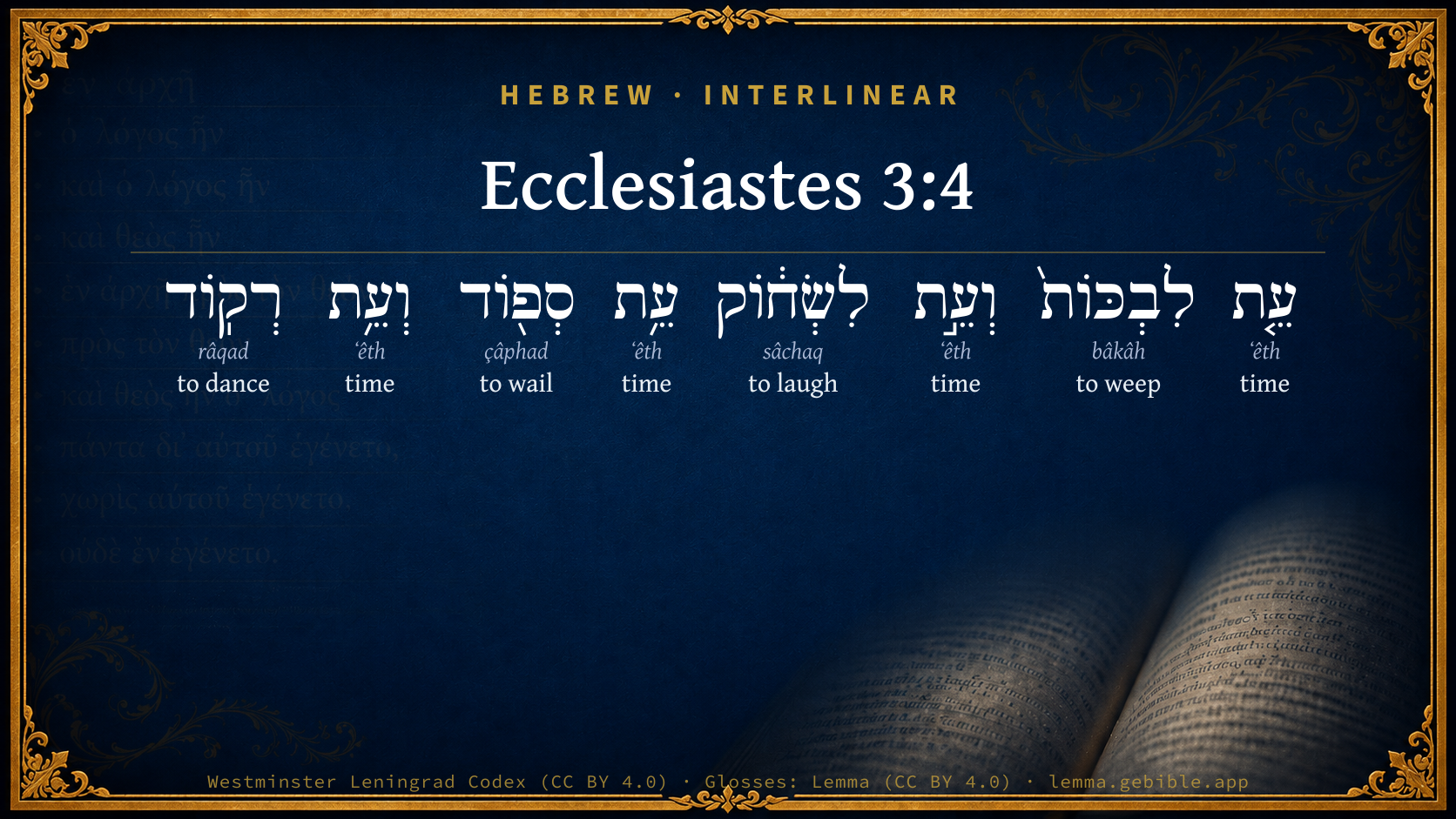
Hebrew (Westminster Leningrad Codex) Ecclesiastes 3:4 appears in the Hebrew Old Testament. The text above is from the Westminster Leningrad Codex. Each word links to its Strong’s number, a concise gloss, and parsing drawn from the Open Scriptures Hebrew Bible morphology. Click any word for its full Brown-Driver-Briggs (BDB) entry.
Download image
Cite this verse

Ecclesiastes 3:4 (World English Bible). Public Domain. Lemma interlinear Bible study tool, https://lemma.gebible.app/v/ecclesiastes/3/4.

Show BibTeX & RIS
BibTeX
RIS
English Translation
A time to weep, And a time to laugh; A time to mourn, And a time to dance;
World English Bible · Public Domain
Download a study sheet

One document with this verse’s original text, its word-by-word gloss line, the meaning frame, cross-references with their text, attributed commentary, and full source and license credits — printable, and it pastes into notes with its structure intact.

This verse Autodidact and up

Study sheet (.html) Plain text (.txt)

A passage Seminary Student

Up to 50 verses in one chapter. A passage sheet keeps up to 6 commentary sources and 12 cross-references per verse, in the order this page ranks them, and says so on the sheet whenever that leaves anything out. Ask for a single verse and you get the Autodidact verse sheet above.

Everything on this page stays free to read, with no account — the sheet is a download of what is already on screen, not access to it.

Want to remove ads? Support Godless Engineer
Compare translations 3

The same verse in 3 English versions, stacked beneath the original-language interlinear above. Click any original word for its lexicon entry.

Each is an independent rendering of the whole verse — the interlinear is not word-aligned to these translations.

Highlighted words mark where these versions differ — a whole-verse word diff, not a word-by-word alignment.

  • World English Bible Public Domain
    A time to weep, And a time to laugh; A time to mourn, And a time to dance;
  • King James Version Public Domain
    A time to weep, and a time to laugh; a time to mourn, and a time to dance;
  • unfoldingWord Literal Text CC BY-SA 4.0
    a time to weep and a time to laugh, a time to mourn and a time to dance,

unfoldingWord Literal Text — © unfoldingWord, licensed CC BY-SA 4.0. Word-aligned USFM3 via Door43 (git.door43.org/unfoldingWord/en_ult).

Versions to compare (up to 4)

3 of 4 selected

Show all 18 translations

Every available English version of this verse, each an independent rendering of the whole verse.

  • World English Bible Public Domain
    A time to weep, And a time to laugh; A time to mourn, And a time to dance;
  • Berean Standard Bible Public Domain
    a time to weep and a time to laugh, a time to mourn and a time to dance,
  • Majority Standard Bible Public Domain
    a time to weep and a time to laugh, a time to mourn and a time to dance,
  • King James Version Public Domain
    A time to weep, and a time to laugh; a time to mourn, and a time to dance;
  • American Standard Version (1901) Public Domain
    a time to weep, and a time to laugh; a time to mourn, and a time to dance;
  • Revised Version (1885) Public Domain
    a time to weep, and a time to laugh; a time to mourn, and a time to dance;
  • Geneva Bible (1599) Public Domain
    A time to weepe, and a time to laugh: a time to mourne, and a time to dance.
  • Douay-Rheims (1899) Public Domain
    A time to weep, and a time to laugh. A time to mourn, and a time to dance.
  • Young's Literal Translation Public Domain
    A time to weep, And a time to laugh. A time to mourn, And a time to skip.
  • Literal Standard Version CC BY-SA 4.0
    A time to weep, || And a time to laugh. A time to mourn, || And a time to skip.
  • Unlocked Literal Bible CC BY-SA 4.0
    There is a time to weep and a time to laugh, a time to mourn and a time to dance,
  • unfoldingWord Literal Text CC BY-SA 4.0
    a time to weep and a time to laugh, a time to mourn and a time to dance,
  • Darby Bible Public Domain
    A time to weep, and a time to laugh; A time to mourn, and a time to dance;
  • World Messianic Bible Public Domain
    a time to weep, and a time to laugh; a time to mourn, and a time to dance;
  • Webster's Bible Public Domain
    A time to weep, and a time to laugh; a time to mourn, and a time to dance;
  • Free Bible Version CC BY-SA 4.0
    A time of crying, and a time of laughing. A time of mourning, and a time of dancing.
  • Bible in Basic English Public Domain
    A time for weeping and a time for laughing; a time for sorrow and a time for dancing;
  • JPS Tanakh (1917) Public Domain
    A time to weep, and a time to laugh; a time to mourn, and a time to dance;

Literal Standard Version (2020), Covenant Press — licensed CC BY-SA 4.0. Text via the HelloAO Bible API (eBible.org). Unlocked Literal Bible (unfoldingWord) — licensed CC BY-SA 4.0. Text via the HelloAO Bible API (eBible.org). unfoldingWord Literal Text — © unfoldingWord, licensed CC BY-SA 4.0. Word-aligned USFM3 via Door43 (git.door43.org/unfoldingWord/en_ult). Free Bible Version, Dr. Jonathan Gallagher — licensed CC BY-SA 4.0. Text via the HelloAO Bible API (eBible.org).

Word by word

More ways to search: Search by grammar → Find every occurrence → Compare this word →

Practice this passage: Drill this verse → Learn its vocabulary →

About this verse

These counts appear in no published source. They are computed here, from the morphology-tagged text and Lemma’s own curated glosses. What Lemma adds →

8
words
5
distinct lemmas
Wisdom
section

Notable vocabulary

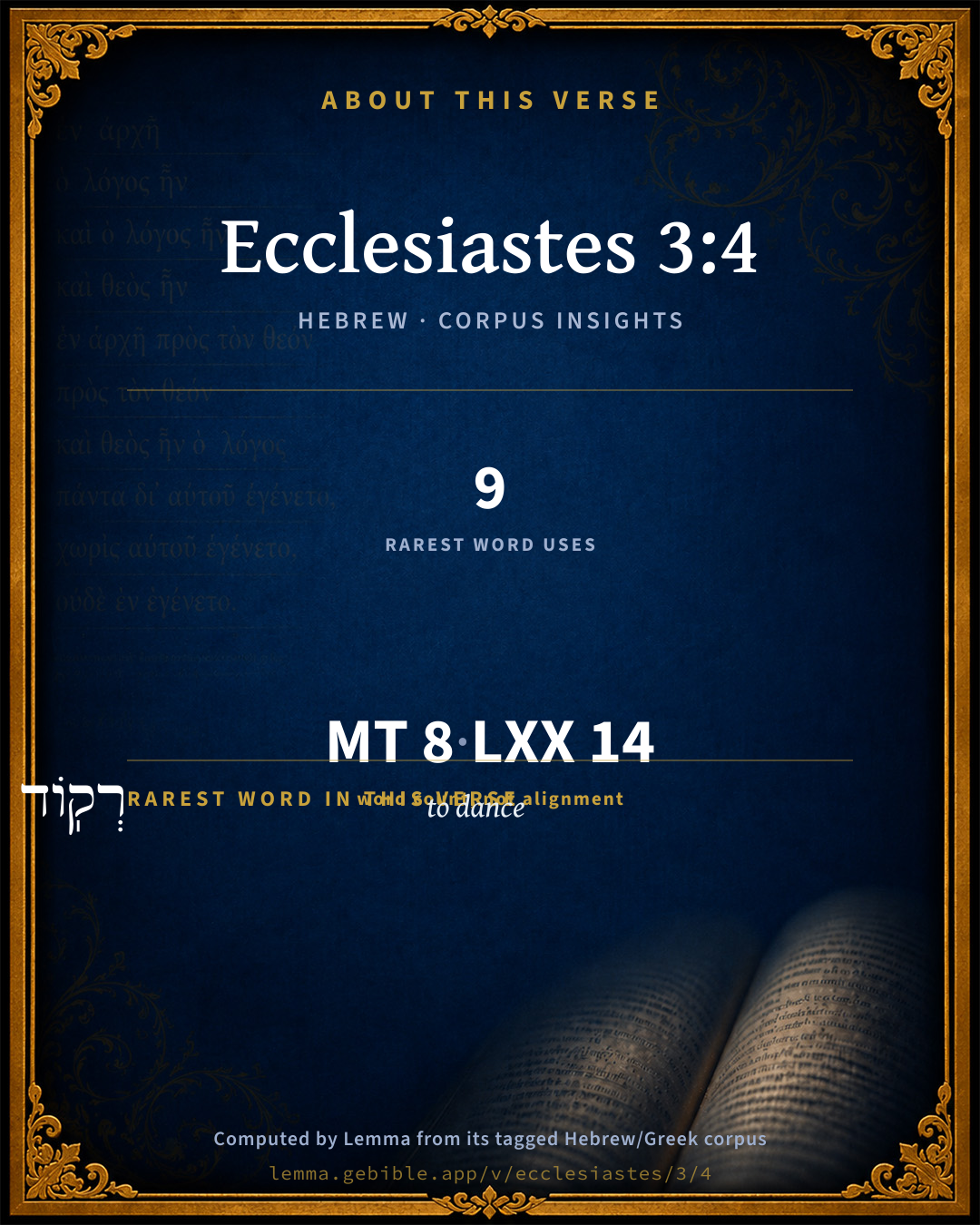
The rarest word here is רְקֽוֹד to dance H7540 — appearing just 9 times in the whole Hebrew Bible.

Shared distinctive vocabulary

רְקֽוֹד to dance H7540 occurs in 9 verses of the Hebrew Bible. Also found in:

Grammatical profile

  • 4 verbs
  • 4 nouns

Verb forms

  • לִבְכּוֹת֙ Qal · Infinitive Construct
  • לִשְׂח֔וֹק Qal · Infinitive Construct
  • סְפ֖וֹד Qal · Infinitive Construct
  • רְקֽוֹד Qal · Infinitive Construct

Repetition

A word recurs within this verse — often emphatic in Hebrew:

  • עֵ֤ת time H6256 ×4

Hebrew & Septuagint length

In English translation the verse runs 18 words from the Hebrew and 18 from the Septuagint (LXX English) — the same length.

A rough comparison of the two English renderings, which tokenize alike — not a word-level alignment.

Word counts can differ between the Hebrew and the Greek without any difference in meaning — e.g. the Hebrew direct-object marker אֵת has no separate Greek word, and Greek often adds the article ὁ.

In the original languages it is 8 Hebrew tokens and 14 Greek tokens — but the two are counted differently (Hebrew bundles its prefixes and suffixes into one token; the Greek is in lemma form), so that isn’t a like-for-like length.

Cross-references

18

Topical passages linked to Ecclesiastes 3:4 in the Treasury of Scripture Knowledge — connected by theme and wording, ordered by reader-vote popularity; previews shown in the World English Bible.

  • Psalms 30:5 For his anger is but for a moment; His favor is for a lifetime. Weeping may stay for the night, But joy comes in the morning.
  • Romans 12:15 Rejoice with those who rejoice. Weep with those who weep.
  • James 4:9 Lament, mourn, and weep. Let your laughter be turned to mourning, and your joy to gloom.
  • Psalms 126:1–2 When Yahweh brought back those who returned to Zion, We were like those who dream.
  • Psalms 126:5–6 Those who sow in tears will reap in joy.
  • John 16:20–22 Most assuredly I tell you, that you will weep and lament, but the world will rejoice. You will be sorrowful, but your sorrow will be turned into joy.
  • Exodus 15:20 Miriam the prophetess, the sister of Aaron, took a tambourine in her hand; and all the women went out after her with tambourines and with dances.
  • Luke 1:58 Her neighbors and her relatives heard that the Lord had magnified his mercy towards her, and they rejoiced with her.
  • Luke 6:21–25 Blessed are you who hunger now, For you will be filled. Blessed are you who weep now, For you will laugh.
  • 2 Corinthians 7:10 For godly sorrow works repentance to salvation, which brings no regret. But the sorrow of the world works death.
  • 2 Samuel 6:16 It was so, as the ark of Yahweh came into the city of David, that Michal the daughter of Saul looked out at the window, and saw king David leaping and dancing before Yahweh; and she despised him in her heart.
  • Matthew 9:15 Jesus said to them, "Can the friends of the bridegroom mourn, as long as the bridegroom is with them? But the days will come when the bridegroom will be taken away from them, and then they will fast.
  • Matthew 11:17 and say, 'We played the flute for you, and you didn't dance. We mourned for you, and you didn't lament.'
  • Luke 1:13–14 But the angel said to him, "Don't be afraid, Zacharias, because your request has been heard, and your wife, Elizabeth, will bear you a son, and you shall call his name John.
  • Genesis 21:6 Sarah said, "God has made me laugh. Everyone who hears will laugh with me."
  • Nehemiah 8:9–12 Nehemiah, who was the governor, and Ezra the priest the scribe, and the Levites who taught the people, said to all the people, This day is holy to Yahweh your God; don't mourn, nor weep. For all the people wept, when they heard the words of the law.
  • Isaiah 22:12–13 In that day did the Lord, Yahweh of Hosts, call to weeping, and to mourning, and to baldness, and to girding with sackcloth:
  • Nehemiah 9:1–38 Now in the twenty-fourth day of this month the children of Israel were assembled with fasting, and with sackcloth, and earth on them.

Cross-references courtesy of OpenBible.info (CC BY 4.0).

Hebrew and Greek witnesses Masoretic Hebrew ↔ Greek Septuagint

The same verse in the two great witnesses to the Old Testament, shown verse-for-verse.

These are two independent witnesses, not word-aligned to each other, and the Septuagint is shown in lemma (dictionary) form.

Hebrew Ecclesiastes 3:4 Masoretic · Westminster Leningrad Codex

עֵ֤ת לִבְכּוֹת֙ וְעֵ֣ת לִשְׂח֔וֹק עֵ֥ת סְפ֖וֹד וְעֵ֥ת רְקֽוֹד

A time to weep, And a time to laugh; A time to mourn, And a time to dance;

World English Bible · Public Domain

Greek LXX Ecclesiastes 3:4 Septuagint · lemma form

καιρός ὁ κλαίω καί καιρός ὁ γελάω καιρός ὁ κόπτω καί καιρός ὁ ὀρχέομαι

a time to weep, and a time to laugh; a time to lament, and a time to dance;

LXX2012 (modern English Septuagint) · Public Domain

Hebrew: Westminster Leningrad Codex (CC BY 4.0). Greek: Septuagint (public domain); English from LXX2012 (modern English Septuagint) (Public Domain). How the Septuagint differs from the Hebrew →

Commentary

Notes on Ecclesiastes 3:4 from classic Christian and Jewish commentators (each source and its license shown beneath its notes). The classic Christian expositions comment on the surrounding passage and are grouped to its opening verse, so a note may address several verses; the Jewish commentaries on the Tanakh (Rashi and others) are per-verse, so they appear only where the commentator wrote on this verse.

Lemma curates 59 commentaries, every one of them public domain or Creative Commons licensed, each selected and text-cleaned for this edition rather than reprinted as found. About our sources →

Trapp's Complete Commentary

John Trapp

Ecc 3:4 A time to weep, and a time to laugh; a time to mourn, and a time to dance;

Ver. 4. A time to weep, and a time to laugh.] Only we must not invert the order, but weep with men that we may laugh with angels; lay godly sorrow as a foundation of spiritual joy. Surely out of this eater comes meat; out of this strong, sweet. Strong and sweet refreshments follow upon penitential performances; these April showers bring on May flowers. Tertullian saith that he was nulli rei natus nisi poenitentiae, born for no other purpose but to repent; but then he that truly repenteth, de peccatis dolet et de dolore gaudet, is grieved for his sins, and then is glad of such a grief. "Those that so sow in tears shall reap in joy": whereas those that will not - in an evil time, especially when God "calls to weeping and mourning," {Isa 22:12} and even thrusts men down, as it were, with a thump on the back - weep here, where there are weeping handkerchiefs in the hands of Christ, are like to have their eyes whipt out in hell, and to howl with devils.

A time to mourn.] Matter enough of mourning we shall be sure of (and we should be soberly sensible of it) while we are in this vale of misery, valley of tears, in hoc exilio, in hoc ergastulo, in hoc peregrinatione, as Bernard hath it, in this prison house, purgatory, pilgrimage. In this place of banishment and bondage, how can we look for better? God sets us not here, as he did Adam in paradise, to take his pleasure, or as he did Leviathan in the sea, to sport and dally. We must not think to do as the people of Tombutum, in Africa, who are said to spend their time in singing and dancing. The way of this world is like the wilderness of Sin, or the vale of Siddim, or the Pacific Sea, which Captain Drake found tempestuous and troublous above measure. {a} Many miseries and molestations, both satanical and secular, we are sure to meet with, to make us mourn. Jerome complains that he had furrows in his face, and icicles from his lips, with continual weeping. Origen is thought to have died of grief. Chrysostom calls the days of his life the days of his sorrow. Basil was made old and unprofitable for God’s Church before his time, with travail and trouble. Rebecca is weary of her life; so is Elijah. Naomi will be Naomi no longer, but Marah; Paul veils all his topsails, and sits down in the dust, {1Ti 1:15} besides his sympathising with others. {2Co 11:29-30}

And a time to dance.] Or, Skip, as young cattle do at spring time. Here is nothing for mixed immodest dancings. Quid opus est talibus salsamentis? What need people provoke themselves to that evil they so naturally incline to? Nemo sobrius saltat, said the heathen orator: No sober man will offer to dance. Where there is dancing, there the devil is, saith a Father: {b} and cannot men be merry unless they have the devil for their playfellow? Dancing, saith another, {c} is a circle, whose centre is the devil, but busily blowing up the fire of lust, as in Herod, that old goat.

{a} Camden’s Elisabeth.

{b} Chrysostom.

{c} Augustine.

John Trapp, A Commentary or Exposition upon All the Books of the Old and New Testament (1647–1656) — public domain. Text from a community e-Sword module.

Jamieson, Fausset & Brown

Robert Jamieson, A. R. Fausset & David Brown

mourn--namely, for the dead (Gen 23:2).

dance--as David before the ark (Sa2 6:12-14; Psa 30:11); spiritually (Mat 9:15; Luk 6:21; Luk 15:25). The Pharisees, by requiring sadness out of time, erred seriously.

Jamieson, Fausset & Brown — Commentary Critical and Explanatory on the Whole Bible (1871) — public domain (CC PDM 1.0). Text via the HelloAO Bible API.

Adam Clarke's Commentary

Verse 4. A time to weep, - laugh, - mourn, - dance]

_________________ "When private griefs affect

The heart, our tears with decent sorrow flow;

Nor less becoming, when the public mourns,

To vent the deepest sighs. But all around

When things a smiling aspect bear, our souls

May well exult; 'tis then a time for joy."

Adam Clarke's Commentary on the Bible (1810–1826) — public domain. Text from a community e-Sword/MySword module.

Ellicott's Commentary for English Readers

(4) Mourn.—This is the ordinary word used for noisy funeral lamentations (Jer_4:8; 1Sa_25:1).

A Bible Commentary for English Readers, edited by Charles John Ellicott (1878–1897) — public domain. Text from a community e-Sword module.

The Cambridge Bible for Schools and Colleges

gen. ed. J. J. S. Perowne

4. a time to weep] The two couples are naturally grouped together, the first taking in the natural spontaneous expression of individual feeling, the second the more formal manifestation of the feelings in the mourners and wailers of a funeral (Zec_12:10, where the same verb is found) and the dancers at a wedding feast. In the parable of the Children in the Market-place our Lord practically inculcates the lesson of the Debater. The Scribes who sneered at the fasts of John’s disciples, and condemned the disciples of Jesus for not fasting were as the children whose dramatic funerals and weddings were alike out of place and inopportune, and so the true followers after the Wisdom which “is justified of her children,” who recognised that the ascetic and the joyous life had each its true time and season, would not weep to their lamenting or dance to their piping (Mat_11:16-19).

The Cambridge Bible for Schools and Colleges (gen. ed. J. J. S. Perowne; Cambridge University Press, 1878–1918) — public domain. Text from a community e-Sword module.

John Gill's Exposition

A time to weep, and a time to laugh,.... There is a time for these things, as it goes ill or well with persons, as to their health, estate, or friends; and as it goes ill or well with kingdoms and states. The Jews wept when they were in Babylon, and their mouths were filled with laughter when their captivity was returned, Psa 137:1; and as it goes ill or well with the church of Christ, when there are corruptions in doctrine and worship, a neglect of ordinances, declensions in faith and practice, few instances of conversion, and there are divisions and contentions, it is a time for the mourners in Zion to weep but when God creates Jerusalem a rejoicing, and her people a joy, or makes her an eternal excellency, and the praise of the whole earth, then it is a time to rejoice and be glad, Isa 61:3; and as it is, with believers, when Christ is withdrawn from them, it is a time to lament, but, when the bridegroom is with them, it is a time of joy; when it is a night of darkness and desertion, weeping endures, but when the morning comes, the day breaks, and the sun of righteousness arises, joy comes with it, Mat 9:15 Joh 16:19. Now in the present state is the saints' weeping time; in the time to come they will laugh, or be filled with joy unspeakable and full of glory, Luk 6:21;

a time to mourn, and a time to dance; to mourn at funerals, and to dance at festivals; in a spiritual sense, God sometimes turns the mourning of his people into dancing, or joy, which that is expressive of; see Psa 30:11.

John Gill's Exposition of the Whole Bible (1746–1763) — public domain (CC PDM 1.0). Text via the HelloAO Bible API.

Matthew Poole's English Annotations

A time to weep; when men shall have just occasion for weeping and mourning.

Matthew Poole's English Annotations on the Holy Bible (1683–1685) — public domain. Text from a community e-Sword/MySword module.

Whedon's Commentary on the Bible

Daniel D. Whedon

4. Weep… laugh… mourn — The human heart must vent its emotions, and they must have appropriate expression. Tears are no more virtuous than laughter. The moral quality lies further back than the mere expression. Life is full of both. “Man, thou pendulum between a smile and tear!” To dance should be to rejoice, which is the exact opposite of to mourn. The Hebrew to dance is clearly used from its rhyming or mating the word to mourn. But even “to dance” expresses joyousness.

Daniel D. Whedon (gen. ed.), Commentary on the Old and New Testaments (1874–1909) — public domain. Text from a community e-Sword module.

The Pulpit Commentary

A time to weep, and a time to laugh, grouped naturally with a time to mourn, and a time to dance. The funeral and the wedding, the hired mourners and the guests at the marriage-feast, are set against one another. The first clause intimates the spontaneous manifestation of the feelings of the heart; the second, their formal expression in the performances at funerals and weddings and on other solemn occasions. The contrast is found in the Lord"s allusion to the sulky children in the marketplace, who would not join their companions" play: "We have piped unto you, and ye have not danced; we have mourned unto you, and ye have not lamented". (Mat_11:17) Dancing sometimes accompanied religious sere-monies, as when David brought up the ark. (2Sa_6:14, 2Sa_6:16)

The Pulpit Commentary (1880–1919), ed. H.D.M. Spence-Jones & Joseph S. Exell — public domain. Text from a community e-Sword module.

John Wesley's Explanatory Notes

To weep - When men have just occasion for weeping.

John Wesley, Explanatory Notes Upon the Whole Bible (1754–1765) — public domain. Text via the GEBible commentary corpus.

Keil & Delitzsch

C. F. Keil & F. Delitzsch

"To weep has its time, and to laugh has its time; to mourn has its time, and to dance has its time." It is possible that the author was led by the consonance from livnoth to livkoth, which immediately follows it; but the sequence of the thoughts is at the same time inwardly mediated, for sorrow kills and joy enlivens, Sir. 32:21-24. ספוד is particularly lamentation for the dead, Zac 12:10; and רקוד, dancing (in the more modern language the usual word for hholēl, kirkēr, hhāgǎg) at a marriage festival and on other festal occasions.

It is more difficult to say what leads the author to the two following pairs of contrasts: -

Keil & Delitzsch — Biblical Commentary on the Old Testament (1861–1891) — public domain (CC PDM 1.0). Text via the HelloAO Bible API. (Old Testament only.)

unfoldingWord translationNotes

Door43 World Missions Community

General Information:

The writer continues with merisms to describe various aspects of life from one extreme to the other. (See: Merism)

embrace

to hold someone in your arms to show love or friendship

translationWords

mourn

unfoldingWord translationNotes — © Distant Shores Media and the Door43 World Missions Community, licensed CC BY-SA 4.0. Source: git.door43.org/Door43/en_tn.

Rashi

Rabbi Shlomo Yitzchaki (Rashi)

A time to weep on the ninth of Av.

and a time to laugh in the future, as it is said (Ps. 126:2): “Then our mouths will be filled with laughter.”

a time of wailing in the days of mourning.

and a time of dancing with bridegrooms and brides.

Rashi on the Tanakh — English translations: “The Judaica Press complete Tanach with Rashi, translated by A. J. Rosenberg” (CC BY 4.0); “Pentateuch with Rashi's commentary by M. Rosenbaum and A.M. Silbermann, 1929-1934” (public domain); “The Metsudah Tanach series, Lakewood, N.J” (CC BY 4.0); and “The Book of Joshua, Metsudah Publications, 1997” (CC BY 4.0). Text via Sefaria.

Lesson kit

Teaching starters — assembled from the data on this page, not authored interpretation. Every prompt links to the verse data it draws on. Edit before teaching.

Ecclesiastes, in the Wisdom, opens this verse with 8 words (5 distinct Hebrew lemmas). Its most distinctive word is râqad (“to dance”). A historical commentator’s framing appears above. Read the whole chapter for the surrounding context.

Discussion questions

  1. What does “to dance” (râqad) contribute to the verse as a whole?
  2. How does 1 Chronicles 15:29, which shares the word «to dance», read alongside this verse?
  3. What does the repetition of “time” (4× in this one verse) do in this verse?
  4. «לִבְכּוֹת֙» is a Qal Infinitive Construct verb. How does that grammatical form shape the action described?
  5. Compare how Trapp's Complete Commentary and Jamieson, Fausset & Brown read this verse. Where do they agree or differ?

Things to notice

Reading settings

Reading text

Shown beneath each verse's original-language words.

Old Testament
Old Testament edition

Read the OT as the Masoretic Hebrew (MT) or the Greek Septuagint (LXX).

English shown for the Greek Septuagint (in the Hebrew ↔ Greek comparison).

Comparing translations? Open the Compare panel on any verse page to stack up to four side by side.