
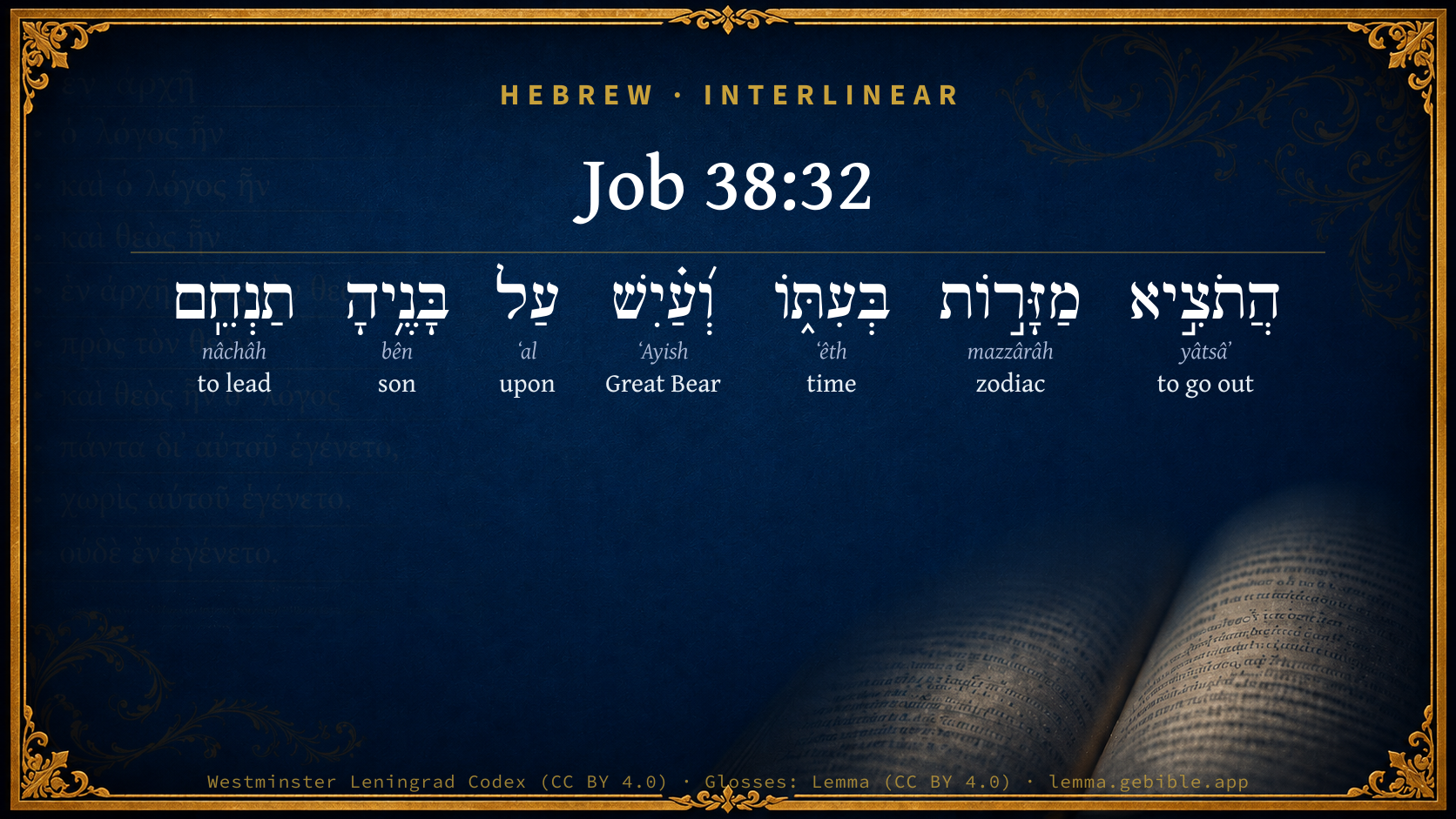
Job 38:32

Hebrew (Westminster Leningrad Codex) Job 38:32 appears in the Hebrew Old Testament. The text above is from the Westminster Leningrad Codex. Each word links to its Strong’s number, a concise gloss, and parsing drawn from the Open Scriptures Hebrew Bible morphology. Click any word for its full Brown-Driver-Briggs (BDB) entry.
Download image
Cite this verse

Job 38:32 (World English Bible). Public Domain. Lemma interlinear Bible study tool, https://lemma.gebible.app/v/job/38/32.

Show BibTeX & RIS
BibTeX
RIS
English Translation
Can you lead forth the constellations in their season? Or can you guide the Bear with her cubs?
World English Bible · Public Domain
Highlights
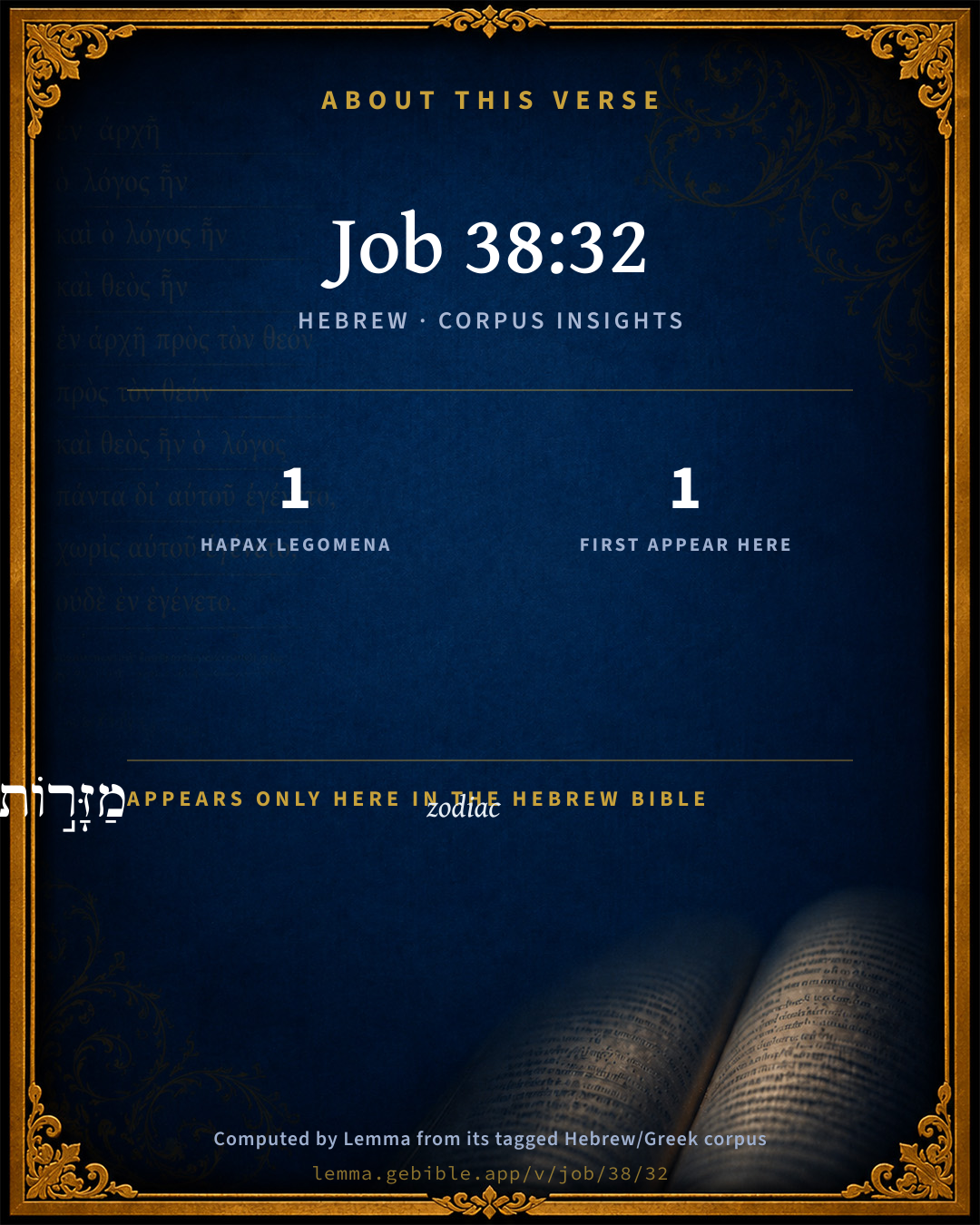
  • 1 hapax legomenon — only here in the Hebrew Bible
  • 1 first appearance in the Hebrew Bible
Full analysis ↓
Download a study sheet

One document with this verse’s original text, its word-by-word gloss line, the meaning frame, cross-references with their text, attributed commentary, and full source and license credits — printable, and it pastes into notes with its structure intact.

This verse Autodidact and up

Study sheet (.html) Plain text (.txt)

A passage Seminary Student

Up to 50 verses in one chapter. A passage sheet keeps up to 6 commentary sources and 12 cross-references per verse, in the order this page ranks them, and says so on the sheet whenever that leaves anything out. Ask for a single verse and you get the Autodidact verse sheet above.

Everything on this page stays free to read, with no account — the sheet is a download of what is already on screen, not access to it.

Want to remove ads? Support Godless Engineer
Compare translations 3

The same verse in 3 English versions, stacked beneath the original-language interlinear above. Click any original word for its lexicon entry.

Each is an independent rendering of the whole verse — the interlinear is not word-aligned to these translations.

Highlighted words mark where these versions differ — a whole-verse word diff, not a word-by-word alignment.

  • World English Bible Public Domain
    Can you lead forth the constellations in their season? Or can you guide the Bear with her cubs?
  • King James Version Public Domain
    Canst thou bring forth Mazzaroth in his season? or canst thou guide Arcturus with his sons?
  • unfoldingWord Literal Text CC BY-SA 4.0
    Will you bring out Mazzaroth in its time? Or will you guide the Bear with its sons?

unfoldingWord Literal Text — © unfoldingWord, licensed CC BY-SA 4.0. Word-aligned USFM3 via Door43 (git.door43.org/unfoldingWord/en_ult).

Versions to compare (up to 4)

3 of 4 selected

Show all 18 translations

Every available English version of this verse, each an independent rendering of the whole verse.

  • World English Bible Public Domain
    Can you lead forth the constellations in their season? Or can you guide the Bear with her cubs?
  • Berean Standard Bible Public Domain
    Can you bring forth the constellations in their seasons or lead out the Bear and her cubs?
  • Majority Standard Bible Public Domain
    Can you bring forth the constellations in their seasons or lead out the Bear and her cubs?
  • King James Version Public Domain
    Canst thou bring forth Mazzaroth in his season? or canst thou guide Arcturus with his sons?
  • American Standard Version (1901) Public Domain
    Canst thou lead forth the Mazzaroth in their season? Or canst thou guide the Bear with her train?
  • Revised Version (1885) Public Domain
    Canst thou lead forth the Mazzaroth in their season? or canst thou guide the Bear with her train?
  • Geneva Bible (1599) Public Domain
    Canst thou bring foorth Mazzaroth in their time? canst thou also guide Arcturus with his sonnes?
  • Douay-Rheims (1899) Public Domain
    Canst thou bring forth the day star in its time, and make the evening star to rise upon the children of the earth?
  • Young's Literal Translation Public Domain
    Dost thou bring out Mazzaroth in its season? And Aysh for her sons dost thou comfort?
  • Literal Standard Version CC BY-SA 4.0
    Do you bring out the twelve signs in [their] season? And do you comfort the Great Bear over her sons?
  • Unlocked Literal Bible CC BY-SA 4.0
    Can you lead the constellations to appear at their proper times? Can you guide the Bear with its children?
  • unfoldingWord Literal Text CC BY-SA 4.0
    Will you bring out Mazzaroth in its time? Or will you guide the Bear with its sons?
  • Darby Bible Public Domain
    Dost thou bring forth the constellations each in its season? or dost thou guide the Bear with her sons?
  • World Messianic Bible Public Domain
    Can you lead the constellations out in their season? Or can you guide the Bear with her cubs?
  • Webster's Bible Public Domain
    Canst thou bring forth Mazzaroth in its season? or canst thou guide Arcturus with its sons?
  • Free Bible Version CC BY-SA 4.0
    Can you guide the stars of Mazzaroth at the right time? Can you direct the Great Bear constellation and its other stars?
  • Bible in Basic English Public Domain
    Do you make Mazzaroth come out in its right time, or are the Bear and its children guided by you?
  • JPS Tanakh (1917) Public Domain
    Canst thou lead forth the Mazzaroth in their season? Or canst thou guide the Bear with her sons?

Literal Standard Version (2020), Covenant Press — licensed CC BY-SA 4.0. Text via the HelloAO Bible API (eBible.org). Unlocked Literal Bible (unfoldingWord) — licensed CC BY-SA 4.0. Text via the HelloAO Bible API (eBible.org). unfoldingWord Literal Text — © unfoldingWord, licensed CC BY-SA 4.0. Word-aligned USFM3 via Door43 (git.door43.org/unfoldingWord/en_ult). Free Bible Version, Dr. Jonathan Gallagher — licensed CC BY-SA 4.0. Text via the HelloAO Bible API (eBible.org).

Word by word

More ways to search: Search by grammar → Find every occurrence → Compare this word →

Practice this passage: Drill this verse → Learn its vocabulary →

About this verse

These counts appear in no published source. They are computed here, from the morphology-tagged text and Lemma’s own curated glosses. What Lemma adds →

7
words
7
distinct lemmas
Wisdom
section

Notable vocabulary

1 hapax legomenon — a word that appears only here in the entire Hebrew Bible:

  • מַזָּר֣וֹת zodiac H4216

First appearance in Scripture

This word makes its first canonical appearance in the Hebrew Bible here:

  • מַזָּר֣וֹת zodiac H4216

Shared distinctive vocabulary

וְ֝עַ֗יִשׁ Great Bear H5906 occurs in 2 verses of the Hebrew Bible. Also found in:

Grammatical profile

  • 2 verbs
  • 4 nouns
  • 1 preposition

Verb forms

  • הֲתֹצִ֣יא Hiphil · Imperfect
  • תַנְחֵֽם Hiphil · Imperfect

Hebrew & Septuagint length

In English translation the verse runs 18 words from the Hebrew and 19 from the Septuagint (LXX English) — closely comparable.

A rough comparison of the two English renderings, which tokenize alike — not a word-level alignment.

Word counts can differ between the Hebrew and the Greek without any difference in meaning — e.g. the Hebrew direct-object marker אֵת has no separate Greek word, and Greek often adds the article ὁ.

Cross-references

3

Topical passages linked to Job 38:32 in the Treasury of Scripture Knowledge — connected by theme and wording, ordered by reader-vote popularity; previews shown in the World English Bible.

  • Job 38:31 "Can you bind the cluster of the Pleiades, Or loosen the cords of Orion?
  • 2 Kings 23:5 He put down the idolatrous priests, whom the kings of Judah had ordained to burn incense in the high places in the cities of Judah, and in the places round about Jerusalem; those also who burned incense to Baal, to the sun, and to the moon, and to the planets, and to all the host of the sky.
  • Job 9:9 Who makes the Bear, Orion, and the Pleiades, And the chambers of the south;

Cross-references courtesy of OpenBible.info (CC BY 4.0).

Hebrew and Greek witnesses Masoretic Hebrew ↔ Greek Septuagint

The same verse in the two great witnesses to the Old Testament, shown verse-for-verse.

These are two independent witnesses, not word-aligned to each other, and the Septuagint is shown in lemma (dictionary) form.

Hebrew Job 38:32 Masoretic · Westminster Leningrad Codex

הֲתֹצִ֣יא מַזָּר֣וֹת בְּעִתּ֑וֹ וְ֝עַ֗יִשׁ עַל בָּנֶ֥יהָ תַנְחֵֽם

Can you lead forth the constellations in their season? Or can you guide the Bear with her cubs?

World English Bible · Public Domain

Greek LXX Job 38:32 Septuagint · lemma form

ἦ δια ἀναοἴγω μαζουρωθ ἐν καιρός αὐτός καί ἕσπερος ἐπί κόμη αὐτός ἄγω αὐτός

Or will you reveal Mazuroth in his season, and the evening star with his rays? Will you guide them?

LXX2012 (modern English Septuagint) · Public Domain

On this verse, Albert Barnes' Notes on the Bible discusses the Septuagint’s reading. Read the note in Commentary ↓

Hebrew: Westminster Leningrad Codex (CC BY 4.0). Greek: Septuagint (public domain); English from LXX2012 (modern English Septuagint) (Public Domain). How the Septuagint differs from the Hebrew →

Commentary

Notes on Job 38:32 from classic Christian and Jewish commentators (each source and its license shown beneath its notes). The classic Christian expositions comment on the surrounding passage and are grouped to its opening verse, so a note may address several verses; the Jewish commentaries on the Tanakh (Rashi and others) are per-verse, so they appear only where the commentator wrote on this verse.

Lemma curates 59 commentaries, every one of them public domain or Creative Commons licensed, each selected and text-cleaned for this edition rather than reprinted as found. About our sources →

Trapp's Complete Commentary

John Trapp

Job 38:32 Canst thou bring forth Mazzaroth in his season? or canst thou guide Arcturus with his sons?

Ver. 32. Canst thou bring forth Mazzaroth?] Or, the twelve signs; or the southern stars that bring in summer. Lucifer, some render it; others, the Hyades, and others again every one of the stars or signs. It is like it was some one star very well known in those days, as were likewise the rest here mentioned, and put for the four seasons of the year.

Or canst thou guide Arcturus with his sons?] Or, Bootes with his wain (those northern stars), or, Autumn with the yearly fruits, the gift and work of God alone. Of Arcturus, Jerome observeth, that semper versatur, nunquam mergitur; this is most true of Christ’s Church, much tossed, never drowned.

John Trapp, A Commentary or Exposition upon All the Books of the Old and New Testament (1647–1656) — public domain. Text from a community e-Sword module.

The Biblical Illustrator

Joseph S. Exell

Job_38:32

Canst thou guide Arcturus with his sons?

The fourth canst

To perceive what we can do, on the one hand, and what we cannot do, on the other, is to hold the key of success. Canst thou? The oft-repeated question is introspective. Inward to the thoughts, backward to the source. It is well to add that the word canst runs through the whole of this penultimate section of the Book of Job. The word is not absent from the earlier chapters; but as you approach the end, this and kindred queries, such as Knowest thou? Hast thou? etc., appear with ever-increasing frequency. To put it somewhat plainer, it is God revealing job to himself--both in what he can and cannot be or do, and then leading him to find rest and refuge in another, grander fact: I know that Thou canst do everything (Job_42:2). Our Bible abounds in pronouns: the thou of this verse is a sample. Oh! star-crowded sky, full of messages, full of God! thou art speaking to me, and thy words go right down into my heart. From every corner of that celestial map Gods heralds proclaim His Word. High up in the northern heavens the Seven Stars, brightest of which shineth Alcyone, speaking for north and eastern sky, and regarded as the centre of the solar system, saith to man: Canst thou bind the sweet influences of the Pleiades? Then, from the southern quarter, that large constellation, belted by three fixed stars, repeats Gods own question: Canst thou . . . loose the bands of Orion? The third canst is from the Zodiac, such it is believed we find in the Mazzaroth of the former clause of the text. Thus do we lead up to, and the better understand, the connection of the last of these cansts. Arcturus is a constellation familiar to us alike under the name of the Plough, or Charless Wain. Job makes reference to this along with the other groups in the ninth chapter. There he speaks of God as the Maker of these various luminaries, now that God is giving him further instruction on the very same matter. We may well ask the meaning of the words Arcturus with his sons. Mythology gives the answer. Arcturus is named from Arcas. Arcas had three sons. The constellation known as the Great Bear, and styled the glory of the northern hemisphere, has a star in the tail part called Arcturus, its very name meaning Bear Tail. It rises in the autumn, and is the precursor of tempest. The sons of Arcturus are placed in the group as three stars, somewhat similarly to Orions belt. Are you able to guide? That is what this fourth canst inquires. In doing so it reminds us of the regulative influences of life.

I. The regulative influences of life affecting a deep-seated human desire. This last canst appeals to us even more forcibly than each or all of the other three. In some particulars it includes them, for to guide is more or less to bind and loose, check and restrain, while leading out and urging on. But even when we have no great desire to restrain influences that are operative, or to loose those that are imprisoned, and bring them into play--we have the wish to guide, arrange, and direct those already and at present in action. In its own domain such desire is quite legitimate. Its absence, indeed, would be a surprise and disappointment. Have you the guiding power? I am sure you want to say yes. I am sure you have the hope that, aided by Divine wisdom and supported by Divine grace, you can make your way through life, well and wisely. Lovers of change are ever idly busy, seeking to rearrange the plans of others, and have their fingers in and over all that they can. Here they have no scope. Arcturus and his three sons have found place, and use, and movement in the seven lights of the Plough; guided by a Higher than thou, they can guide thee, but thou canst not guide nor interfere with them. Thou canst not guide Arcturus, but, high privilege! thou canst guide thyself, if, in the first instance, you submit to the over-guidance, overruling of God. It is not in man that walketh to direct his steps (Jer_10:23). The Lord of Arcturus is the Lord of His people, the Guide of His servants as well as the guide of His stars. God helps us that we may help ourselves, and that we may help others. He awakens in us those powers and faculties, crushed and stifled by sin. How then, through Him, in what way shall we guide ourselves? Training ourselves, and our powers. It is ruling our spirit, bridling our tongue, mortifying our desires (evil), etc. All these culminate in the one thought of self-control. Canst thou then guide thyself, and, in guiding, so strengthen and enrich that better selfhood that it may become a lodestar of influence? Guide myself, but not by narrow aims that end in self. Canst thou guide Arcturus and his sons? No. The world is all the better that you cant. Canst thou help some poor family of earths sons to gain a footing or earn a living? Yes. The world is all the worse if you dont. But if you do, if you help a brother up any rugged steep of trial or duty, or steer him onward through the cross currents of temptation, then not only do you benefit others, but you also fairly and fully gratify that altruistic longing, so inwrought as to be a part of our human nature and heritage.

II. The regulative influences of life viewed in their operation. We have noticed the fact that the stars we cannot guide are nevertheless guided--always, swiftly and surely, silently and well. Each fills its place or goes on its way. It requires great skill and accurate system in order to manage our railways. What far greater skill and more perfect system are required to guide the constellations--to protect from and to avert all the terrible collision and combustion that would otherwise occur! The fact is one, call it Providence, or let it be known as the gigantic machinery of life, or if you will--the age-long balancings, or pause over this phrase--the Eternal Thought. The ever-living, vigorous thought. Thought that thinks into effort, plans, purposes, leads and arranges, makes and moulds the universe, counts and carries the stars, creates and continues the life of man, rules and regulates by guiding, governing, and directing to its final goal--all that is, and all that is to be.

III. The regulative influences of life glorifying God in redeeming man. They are Christocentric--God incarnate. That is the first of a series of clearer explanations: their first translation into the mother tongue of human understanding and heart need. All that was anterior, and there was much, received its value from this nascent light; whether ornate ritual or inspired oracle, sacred bard or mystic seer. To economise, and at the same time best utilise our words, let us say that Blessed Life was the great antidote and corrective of all sin and selfishness, of all folly and meanness, all distortion and dishonour; while it furthered and fostered, guided, regulated, developed all that was worth being, because it had originally come from the Father. The Cross is in the sky, illumined and illumining. Illumined by the clear, silver starlight of the Eternal Providence, of that Providence its most comprehensive range, its farthest sweep, its largest provision. Of Gods mind the highest and deepest conception; of Gods thought the most sublime idea--this is the fight on the Cross. There is also the light from the Cross. It is the guide of the wandering. Our present purpose forbids the further tracing out in the Resurrection and post-Resurrection work of the Redeemer the almighty and regulative influences, the more advanced stages, through which the earth rolls onward into this ever-increasing light. Putting it all together, this is the conclusion of the matter. It is a great work to guide Arcturus, to support as well as to suspend Charless Wain, to regulate and maintain the sidereal system, to bind, or loose, or bring forth one, or any, of the heavenly bodies; but God has performed a greater work. Gods great work is this, to guide our feet into the way of peace (Luk_1:79). (H. B. Aldridge.)

The Biblical Illustrator, edited by Joseph S. Exell (c. 1880s–1900s) — public domain. Text from a community e-Sword module.

Joseph Benson's Commentary

Job 38:32-33. Canst thou bring forth Mazzaroth? — Namely, into view? Canst thou make the stars in the southern signs arise and appear? Or canst thou guide Arcturus? — A northern constellation; with his sons? — The lesser stars which belong to it, which are placed round about it, and attend upon it as children upon their parents. Knowest thou the ordinances of heaven? — The laws which are firmly established concerning their order, motion or rest, and their powerful influences upon this lower world. Didst thou give these laws? Or dost thou perfectly know them? Canst thou set the dominion thereof in the earth? — Canst thou manage and overrule their influences, that they shall bring such seasons and such weather as thou wouldest have?

Joseph Benson's Commentary on the Old and New Testaments (1811–1818) — public domain. Text from a community e-Sword module.

Geneva Bible (1599)

Geneva Bible translators

Certain stars so called: some think they were the twelve signs.

The North star with those that are about him.

Geneva Bible (1599) marginal notes — public domain. Text via Bolls.life.

Jamieson, Fausset & Brown

Robert Jamieson, A. R. Fausset & David Brown

Canst thou bring forth from their places or houses (Mazzaloth, Kg2 23:5, Margin; to which Mazzaroth here is equivalent) into the sky the signs of the Zodiac at their respective seasons--the twelve lodgings in which the sun successively stays, or appears, in the sky?

Arcturus--Ursa Major.

his sons?--the three stars in his tail. Canst thou make them appear in the sky? (Job 9:9). The great and less Bear are called by the Arabs "Daughters of the Bier," the quadrangle being the bier, the three others the mourners.

Jamieson, Fausset & Brown — Commentary Critical and Explanatory on the Whole Bible (1871) — public domain (CC PDM 1.0). Text via the HelloAO Bible API.

Adam Clarke's Commentary

Verse 32. Mazzaroth in his season?] This is generally understood to mean the signs of the zodiac. מזרות Mazzaroth, according to Parkhurst, comes from מזר mazar, to corrupt; and he supposes it to mean that pestilential wind in Arabia, called simoom, the season of which is the summer heats.

Adam Clarke's Commentary on the Bible (1810–1826) — public domain. Text from a community e-Sword/MySword module.

Ellicott's Commentary for English Readers

(32) Mazzaroth is commonly understood to mean the signs of the Zodiac, and by the children of Arc-turus the three stars in the tail of Ursa Major.

A Bible Commentary for English Readers, edited by Charles John Ellicott (1878–1897) — public domain. Text from a community e-Sword module.

The Cambridge Bible for Schools and Colleges

gen. ed. J. J. S. Perowne

32. canst thou bring forth] Rather, dost thou …? and similarly, dost thou guide? The meaning of Mazzaroth is uncertain. The word has been supposed to be another form of Mazzaloth, 2Ki_23:5, which is thought to mean the signs of the Zodiac. The connexion as well as the parallelism of the next clause suggests that some single star or constellation is meant. Others would render the bright stars; the planets, perhaps, or some of them being referred to.

Arcturus with his sons] Or, the bear with her young. The reference is supposed to be to the constellation of the Great Bear. Her “young” are the stars that project from the square; or, taking the popular conception of the constellation as a “plough,” they are the bright stars that form the “beam.”

The Cambridge Bible for Schools and Colleges (gen. ed. J. J. S. Perowne; Cambridge University Press, 1878–1918) — public domain. Text from a community e-Sword module.

John Gill's Exposition

Canst thou lift up thy voice to the clouds, that abundance of waters may cover thee? Thy gardens, fields, and farms; canst thou, in a magisterial way, call to and demand of the clouds to let down rain in large quantities, sufficient to water them and make them fruitful? no, thou canst not: thou mayest cry and call as long as thou wilt, not a cloud will stir, nor a drop of water be let down; rain is to be had in a suppliant way, through the prayer of faith, as by Elijah, but not in a dictatorial authoritative way: the clouds and rain are only at the disposal of the Lord; ask of him, and he will give them; but they are not to be commanded, Zac 10:1; see Amo 5:8.

.

Job 38:35

job 38:35

job 38:35

job 38:35Canst thou send lightnings, that they may go, and say unto thee, Here we are? Thy humble servants; we have been where thou didst send us, and have executed what we were bid to do, and are returned, and here we are waiting further orders; see Mat 8:9; no; lightnings are only at the command of God, and there have been some awful instances of it, Lev 10:1; but not in the power of men; indeed we have an extraordinary instance in Elijah, who, at the motion, and under the impulse of the spirit of prophecy in him, called for fire, or lightning, to consume captains with their fifties, and it came down on them, and consumed them, Kg2 1:10; but he is not to be imitated herein: when the disciples of Christ desired the same upon a provocation, they were severely reproved by him, Luk 9:54; were these at the call and dispose of men, what dreadful things would be done in the world! for if good men, when provoked, would make use of such a power to destroy the lives of men, much more bad men; and our eyes would continually behold the flashes of lighting, and our ears hear the roarings of thunder, and the terrible effects thereof; but neither mercies nor judgments are at the command of men, but of God.

John Gill's Exposition of the Whole Bible (1746–1763) — public domain (CC PDM 1.0). Text via the HelloAO Bible API.

Albert Barnes' Notes on the Bible

Canst thou bring forth Mazzaroth in his season? - Margin, “the twelve signs;” that is, the twelve signs of the zodiac. There has been much diversity of opinion about the meaning of this word. It occurs nowhere else in the Scriptures, and of course it is not easy to determine its signification. The Septuagint retains the word μαξσυρὠθ maxsurōth, without attempting to translate it. Jerome renders it, “Luciferum - Lucifer,” the morning-star. The Chaldee, מזליא שטרי - the constellations of the planets. Coverdale, “the morning-star;” and so Luther renders it. Rosenmuller, “signa celestia” - the celestial signs, and so Herder, Umbreit, Gesenius, and Noyes, “the zodiac.” Gesenius regards the word מזרה mazzârâh, as the same as מזלה mazzâlâh, properly “lodgings, inns;” and hence, the “lodgings” of the sun, or the places or “houses” in which he appears in the heavens, and thus as meaning the signs in the zodiac. Most of the Hebrew interpreters adopt this view, but it rests on no certain foundation, and as we are not certain as to the meaning of the word, the only safe way is to retain the original, as is done in our common version. I do not see how it is possible to determine its meaning with certainty, and probably it is to be regarded as a name given to some constellation or cluster of stars supposed to exert an influence over the seasons, or connected with some change in the seasons, which we cannot now accurately understand.

Or canst thou guide Arcturus? - On the constellation “Arcturus” (עשׁ ‛ayish), see the notes at Job 9:9. The word rendered “guide” in the text, is in the margin “guide them.” The Hebrew is, “and עשׁ ‛ayish upon (or near - על ‛al) her sons, canst thou lead them?” Herder and Umbreit render it, “And lead forth the Bear with her young,” or her children. The reference is to the constellation Arcturus, or Ursa Major, in the northern sky. The “sons” referred to are the stars that accompany it, probably the stars that are now called the” tail of the bear.” “Umbreit.” Another interpretation is suggested by Herder, which is that this constellation is represented as a nightly wanderer - a mother, who is seeking her lost children, the stars that are no longer visible, and that thus revolves around the heavens. But the probable reference is to the constellation conducted round and round the pole as by some unseen hand, like a mother with her children, and the question is, whether Job had skill and power to do this? God appeals to it as a manifestation of his majesty and power, and as far above the skill of man. Who ever looked upon that beautiful constellation and marked its regular revolutions, without feeling that its position and movements were such as God only could produce?

Albert Barnes' Notes on the Bible (1834–1885) — public domain. Text from a community e-Sword/MySword module.

Haydock's Catholic Bible Commentary

Day-star. Hebrew mazzaroth, (Haydock) corresponds with the "inner parts of the south;" (chap. ix. 9) though some translate, "the signs of the zodiac, or the influences," &c. The antarctic constellations could not be seen in Idumea, while those of the north pole (Calmet) must appear to those who live on that side of the line, (Haydock) as the perpetual sentinels of the sky. --- Evening-star. Hebrew, "Wilt thou make hayish and her daughters go to rest?" These indicate the arctic stars. Here two quite opposite stars are meant; (Calmet) though (Haydock) with us the evening and morning star be the same, being so styled according as it appears after or before the sun. (Menochius) --- Protestants, "Canst thou bring forth Mazzaroth (Septuagint also retain the original term, Greek: Mazouroth) in his season, or canst thou guide Arcturus, with his sons?" The former term signifies things "scattered," the planets, (Haydock) or "the grains of gross air dispersed" to all the extremities, which returning to the centre, occasion cold, chap. xxxvii. 9. (Parkhurst)

George Leo Haydock (1774–1849), Haydock's Catholic Family Bible and Commentary, 1859 edition — public domain. Excludes Psalms (Douay-Rheims chapter numbering differs from Protestant) and Deuterocanonical books (Catholic canon only).

Matthew Poole's English Annotations

Canst thou bring forth to wit, into view? canst thou make him to arise and appear in thy hemisphere?

Mazzaroth; by which he designs either,

1. All the constellations, and especially the twelve sign of the zodiac; or rather

2. Some particular constellation, as all the rest here mentioned are understood. But whether this be that which is called the chambers of the south, Job 9:9, or the Dog Star, or some other visible in Job’s country, but not in ours we may be safely and contentedly ignorant, seeing even the Hebrew doctors are not agreed therein.

Arcturus; a northern constellation, of which See Poole "Job 9:9".

With his sons, to wit, the lesser stars which belong to it, and are placed round about it, and attend upon it, as children upon their parents.

Matthew Poole's English Annotations on the Holy Bible (1683–1685) — public domain. Text from a community e-Sword/MySword module.

Whedon's Commentary on the Bible

Daniel D. Whedon

32. Mazzaroth — Even at the time of the translation made by the Seventy, the meaning of this word was uncertain. It is now generally supposed to be the same as Mazzaloth, (“the planets,” 2Ki_23:5,) or a mere variant form, and to stand for the (twelve) signs of the zodiac. The supposition that Mazzaloth and Mazzaroth are one word may be argued from the like termination, which is both plural and feminine, and from the interchangeableness of the liquids l and r in most languages; for instance, the Latin Parilia for Palilia, “the festival of Pales;” the Hebrew Tsahar and Tsahal, “to shine;” the Arabic Kalban and the Hebrew Kereb, “heart.” The division of the ecliptic (the apparent path of the sun) into twelve equal signs or constellations, called signs of the zodiac, is generally understood to be of great antiquity. The porticoes of the temples at Denderah and Esne bear representations of the zodiac which so markedly resemble the zodiacal figures of the ancient Hindus, Persians, Chinese, and Japanese, as to indicate that they had one common origin. The Greeks, however, evidently derived their ideas and arrangements of the zodiac from the Chaldees.

Other commentators, for instance Zockler (in Lange) and Dillmann, are led by a supposed etymology of the word (Mazzaroth) to fix upon some pre-eminently bright stars (for example, the planets Venus, Jupiter, Mars) which were conspicuous for their change of place in the sky. Canon Cook (Speaker’s Com.) points to a very ancient word Masarati, probably derived from a similar hieroglyphic word, signifying the course or march of the Sun-god — indicating “the milky way,” which was thought by the ancients to have “represented the course of the sun at a remote period — the traces, so to speak, of his footsteps.” (See Rawlinson’s Ancient Mon., 2:574, sec. ed.: Layard’s Nineveh, 2:440; Greswell’s Fasti, 3:252-326; Maurice’s Hindostan, 1:272-359.)

Arcturus — See note on Job_9:9. The pregnant question, Canst thou guide? may possibly contain an occult allusion, which none but Jehovah could make, to the diverging movement of these stars, according to which the nearest of “the Pointers” is swiftly approaching our earth, while the other is rapidly receding, in which motion the other five participate — a supposed discovery that science has recently made. Proctor, Expanse, etc.. p. 295.

With his sons — The three bright stars that form the tail of the Bear, which in some languages are fancifully deemed to be children following “the bier,” for such was the name the Arabs gave to the four leading stars of this constellation, which constitute a square. “The expression,” (‘hayish or ‘hash,) says Ideler, in his treatise on the names of the stars, “denotes particularly the bier on which the dead are borne, and, taken in this sense, each of the two biers (in the Ursa Major and Ursa Minor) is accompanied by three mourning women. The biers and the mourning women together are called Benat-n’ash, literally, daughters of the bier, that is, those who pertain to the bier.” Hitzig devotes a learned but exceedingly unsatisfactory note to his view that Mazzaroth is the morning star, and ‘hayish, Arcturus, is the evening star, thus adopting the rendering of the Septuagint, εσπερυς for עישׁ.

Daniel D. Whedon (gen. ed.), Commentary on the Old and New Testaments (1874–1909) — public domain. Text from a community e-Sword module.

The Pulpit Commentary

Canst thou bring forth Mazzaroth in his season? The context implies that "Mazzaroth" is a constellation on a par with the Pleiades, Orion, and the Bear (Kimah, Kesil" and "Aish). This makes it impossible to accept the meaning, so generally assigned, of "the twelve signs of the Zodiac." Again, the plural form is fatal to the conjecture that "Mazzaroth" designates a single star or planet, as Jupiter, Venus, or Sirius (Cook). The word is derived probably from the root zahar, "to shine," "to be bright," and should designate some especially brilliant cluster of stars Whether it is to be regarded as a variant of Mazzaloth (2Ki_23:5) is uncertain. Or canst thou guide Arcturus with his sons? (On the identity of "Ash or "Aish with the Great Bear, see the comment on Job_9:9) The "sons" of Aish are conjectured to be the three large stars in the tail of Ursa Major (Stanley Leathes); but the grounds on which the conjecture rests are very slight.

The Pulpit Commentary (1880–1919), ed. H.D.M. Spence-Jones & Joseph S. Exell — public domain. Text from a community e-Sword module.

John Wesley's Explanatory Notes

Bring forth - Canst thou make the stars in the southern signs arise and appear? Arcturus - Those in the northern. His sons - The lesser stars, which are placed round about them; and attend upon them, as children upon their parents.

John Wesley, Explanatory Notes Upon the Whole Bible (1754–1765) — public domain. Text via the GEBible commentary corpus.

Rashi

Rabbi Shlomo Yitzchaki (Rashi)

constellations All the other constellations.

and...Ayish The largest star in the Pleiades, to which many stars are attached. He took two stars from it to open the windows of the Deluge, and they were placed in the constellation of Aries and the Holy One, blessed be He, is destined to restore them to her. Tanchuma.

Rashi on the Tanakh — English translations: “The Judaica Press complete Tanach with Rashi, translated by A. J. Rosenberg” (CC BY 4.0); “Pentateuch with Rashi's commentary by M. Rosenbaum and A.M. Silbermann, 1929-1934” (public domain); “The Metsudah Tanach series, Lakewood, N.J” (CC BY 4.0); and “The Book of Joshua, Metsudah Publications, 1997” (CC BY 4.0). Text via Sefaria.

Lesson kit

Teaching starters — assembled from the data on this page, not authored interpretation. Every prompt links to the verse data it draws on. Edit before teaching.

Job, in the Wisdom, opens this verse with 7 words (7 distinct Hebrew lemmas). Its most distinctive word is mazzârâh (“zodiac”). A historical commentator’s framing appears above. Read the whole chapter for the surrounding context.

Discussion questions

  1. How does “zodiac” (mazzârâh) shape what this verse is saying?
  2. 1 word here appears nowhere else in the Hebrew Bible. Why might the author reach for such rare wording?
  3. This is the first place “zodiac” appears in Scripture (first appears here). What does its debut here establish?
  4. How does Job 9:9, which shares the word «Great Bear», read alongside this verse?
  5. These translations render this verse differently. What is at stake in choosing one wording over another?
  6. «הֲתֹצִ֣יא» is a Hiphil Imperfect verb. How does that grammatical form shape the action described?
  7. Compare how Trapp's Complete Commentary and The Biblical Illustrator read this verse. Where do they agree or differ?

Things to notice

  • 1 word in this verse appears nowhere else in the Hebrew Bible.
  • 1 word makes its first canonical appearance in Scripture here.
  • These translations choose different wording for 16 words in this verse.
  • 7 distinct Hebrew lemmas span 7 words in this verse.

Reading settings

Reading text

Shown beneath each verse's original-language words.

Old Testament
Old Testament edition

Read the OT as the Masoretic Hebrew (MT) or the Greek Septuagint (LXX).

English shown for the Greek Septuagint (in the Hebrew ↔ Greek comparison).

Comparing translations? Open the Compare panel on any verse page to stack up to four side by side.