
Ecclesiastes 9:8

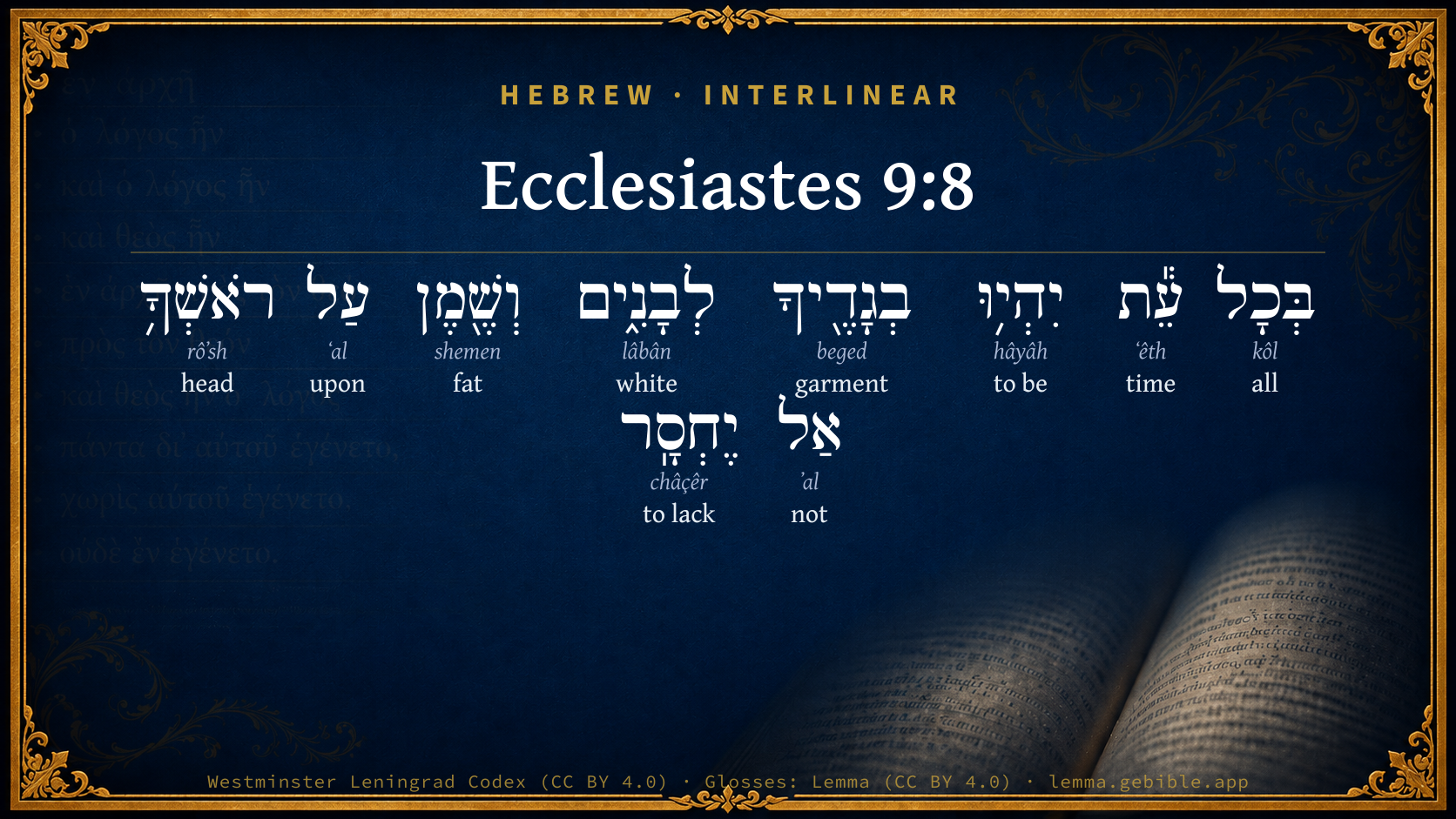
Hebrew (Westminster Leningrad Codex) Ecclesiastes 9:8 appears in the Hebrew Old Testament. The text above is from the Westminster Leningrad Codex. Each word links to its Strong’s number, a concise gloss, and parsing drawn from the Open Scriptures Hebrew Bible morphology. Click any word for its full Brown-Driver-Briggs (BDB) entry.
Download image
Cite this verse

Ecclesiastes 9:8 (World English Bible). Public Domain. Lemma interlinear Bible study tool, https://lemma.gebible.app/v/ecclesiastes/9/8.

Show BibTeX & RIS
BibTeX
RIS
English Translation
Let your garments be always white, and don't let your head lack oil.
World English Bible · Public Domain
Download a study sheet

One document with this verse’s original text, its word-by-word gloss line, the meaning frame, cross-references with their text, attributed commentary, and full source and license credits — printable, and it pastes into notes with its structure intact.

This verse Autodidact and up

Study sheet (.html) Plain text (.txt)

A passage Seminary Student

Up to 50 verses in one chapter. A passage sheet keeps up to 6 commentary sources and 12 cross-references per verse, in the order this page ranks them, and says so on the sheet whenever that leaves anything out. Ask for a single verse and you get the Autodidact verse sheet above.

Everything on this page stays free to read, with no account — the sheet is a download of what is already on screen, not access to it.

Want to remove ads? Support Godless Engineer
Compare translations 3

The same verse in 3 English versions, stacked beneath the original-language interlinear above. Click any original word for its lexicon entry.

Each is an independent rendering of the whole verse — the interlinear is not word-aligned to these translations.

Highlighted words mark where these versions differ — a whole-verse word diff, not a word-by-word alignment.

  • World English Bible Public Domain
    Let your garments be always white, and don't let your head lack oil.
  • King James Version Public Domain
    Let thy garments be always white; and let thy head lack no ointment.
  • unfoldingWord Literal Text CC BY-SA 4.0
    At every time, let your clothes be white, and do not let oil be lacking on your head.

unfoldingWord Literal Text — © unfoldingWord, licensed CC BY-SA 4.0. Word-aligned USFM3 via Door43 (git.door43.org/unfoldingWord/en_ult).

Versions to compare (up to 4)

3 of 4 selected

Show all 18 translations

Every available English version of this verse, each an independent rendering of the whole verse.

  • World English Bible Public Domain
    Let your garments be always white, and don't let your head lack oil.
  • Berean Standard Bible Public Domain
    Let your garments always be white, and never spare the oil for your head.
  • Majority Standard Bible Public Domain
    Let your garments always be white, and never spare the oil for your head.
  • King James Version Public Domain
    Let thy garments be always white; and let thy head lack no ointment.
  • American Standard Version (1901) Public Domain
    Let thy garments be always white; and let not thy head lack oil.
  • Revised Version (1885) Public Domain
    Let thy garments be always white; and let not thy head lack ointment.
  • Geneva Bible (1599) Public Domain
    At all times let thy garments be white, and let not oyle be lacking vpon thine head.
  • Douay-Rheims (1899) Public Domain
    At all times let thy garments be white, and let not oil depart from thy head.
  • Young's Literal Translation Public Domain
    At all times let thy garments be white, and let not perfume be lacking on thy head.
  • Literal Standard Version CC BY-SA 4.0
    At all times let your garments be white, and do not let oil be lacking on your head.
  • Unlocked Literal Bible CC BY-SA 4.0
    Let your clothes be always white and your head anointed with oil.
  • unfoldingWord Literal Text CC BY-SA 4.0
    At every time, let your clothes be white, and do not let oil be lacking on your head.
  • Darby Bible Public Domain
    Let thy garments be always white, and let not thy head lack oil.
  • World Messianic Bible Public Domain
    Let your garments be always white, and don’t let your head lack oil.
  • Webster's Bible Public Domain
    Let thy garments be always white; and let thy head lack no ointment.
  • Free Bible Version CC BY-SA 4.0
    Always wear smart clothes and look good.
  • Bible in Basic English Public Domain
    Let your clothing be white at all times, and let not your head be without oil.
  • JPS Tanakh (1917) Public Domain
    Let thy garments be always white; and let thy head lack no oil.

Literal Standard Version (2020), Covenant Press — licensed CC BY-SA 4.0. Text via the HelloAO Bible API (eBible.org). Unlocked Literal Bible (unfoldingWord) — licensed CC BY-SA 4.0. Text via the HelloAO Bible API (eBible.org). unfoldingWord Literal Text — © unfoldingWord, licensed CC BY-SA 4.0. Word-aligned USFM3 via Door43 (git.door43.org/unfoldingWord/en_ult). Free Bible Version, Dr. Jonathan Gallagher — licensed CC BY-SA 4.0. Text via the HelloAO Bible API (eBible.org).

Word by word

More ways to search: Search by grammar → Find every occurrence → Compare this word →

Practice this passage: Drill this verse → Learn its vocabulary →

יֶחְסָֽר
châçêr
H2637
“to lack”
Verb, Qal, Jussive, 3rd Person, Masculine, Singular
Part of Speech
Verb
Stem
Qal
Form
Jussive
Person
3rd Person
Gender
Masculine
Number
Singular
Full BDB Definition

Origin: a primitive root

TWOT: 705

to lack, be without, decrease, be lacking, have a need - (Qal) - to lack - to be lacking - to diminish, decrease - (Piel) to cause to lack - (Hiphil) to cause to be lacking
  1. בְּכָל kôl H3605 “in/at · all of” Preposition + Noun, Common, Masculine, Singular, Construct
  2. עֵ֕ת ʻêth H6256 “time” Noun, Common, Both, Singular, Absolute
  3. יִהְי֥וּ hâyâh H1961 “to be” Verb, Qal, Imperfect, 3rd Person, Masculine, Plural
  4. בְגָדֶ֖יךָ beged H899 “garments · your” Noun, Common, Masculine, Plural, Construct + Suffix, Personal, 2nd Person, Masculine, Singular
  5. לְבָנִ֑ים lâbân H3836 “white” Adjective, Adjective, Masculine, Plural, Absolute
  6. וְשֶׁ֖מֶן shemen H8081 “and · fat” Conjunction + Noun, Common, Masculine, Singular, Absolute
  7. עַל ʻal H5921 “upon” Preposition
  8. רֹאשְׁךָ֥ rôʼsh H7218 “head · your” Noun, Common, Masculine, Singular, Construct + Suffix, Personal, 2nd Person, Masculine, Singular
  9. אַל ʼal H408 “not” Particle, Negative

About this verse

These counts appear in no published source. They are computed here, from the morphology-tagged text and Lemma’s own curated glosses. What Lemma adds →

10
words
10
distinct lemmas
Wisdom
section

Notable vocabulary

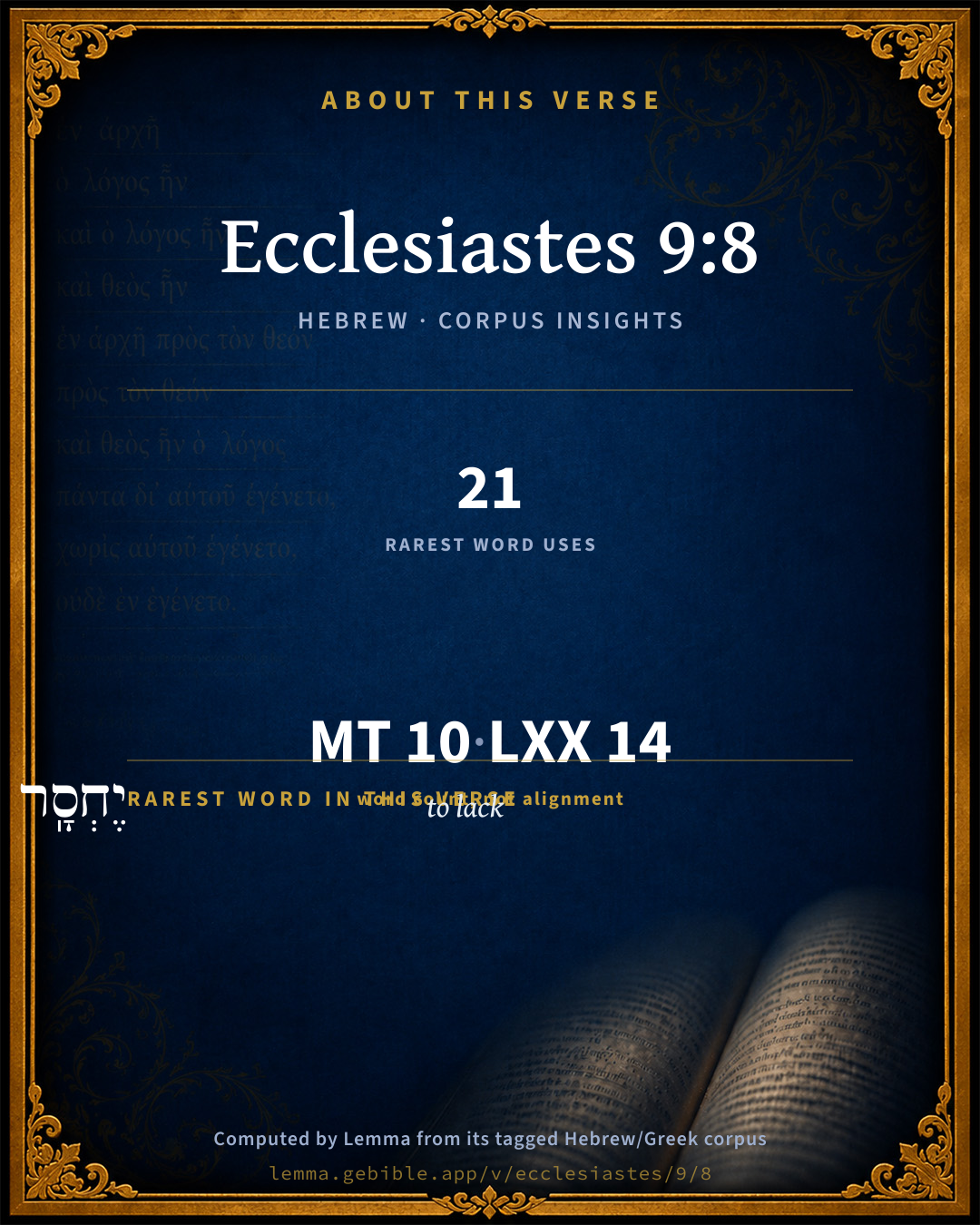
The rarest word here is יֶחְסָֽר to lack H2637 — appearing just 21 times in the whole Hebrew Bible.

Shared distinctive vocabulary

יֶחְסָֽר to lack H2637 occurs in 21 verses of the Hebrew Bible. Also found in:

Grammatical profile

  • 2 verbs
  • 5 nouns
  • 1 adjective
  • 1 preposition
  • 1 particle

Verb forms

  • יִהְי֥וּ Qal · Imperfect
  • יֶחְסָֽר Qal · Jussive

Hebrew & Septuagint length

In English translation the verse runs 13 words from the Hebrew and 15 from the Septuagint (LXX English) — closely comparable.

A rough comparison of the two English renderings, which tokenize alike — not a word-level alignment.

Word counts can differ between the Hebrew and the Greek without any difference in meaning — e.g. the Hebrew direct-object marker אֵת has no separate Greek word, and Greek often adds the article ὁ.

In the original languages it is 10 Hebrew tokens and 14 Greek tokens — but the two are counted differently (Hebrew bundles its prefixes and suffixes into one token; the Greek is in lemma form), so that isn’t a like-for-like length.

Cross-references

15

Topical passages linked to Ecclesiastes 9:8 in the Treasury of Scripture Knowledge — connected by theme and wording, ordered by reader-vote popularity; previews shown in the World English Bible.

  • Revelation 19:14 The armies which are in heaven followed him on white horses, clothed in white, pure, fine linen.
  • Revelation 3:4–5 Nevertheless you have a few names in Sardis that did not defile their garments. They will walk with me in white, for they are worthy.
  • Revelation 7:13–14 One of the elders answered, saying to me, "These who are arrayed in white robes, who are they, and from where did they come?"
  • Revelation 19:8 It was given to her that she would array herself in bright, pure, fine linen: for the fine linen is the righteous acts of the saints.
  • Revelation 7:9 After these things I looked, and behold, a great multitude, which no man could number, out of every nation and of all tribes, peoples, and languages, standing before the throne and before the Lamb, dressed in white robes, with palm branches in their hands.
  • Revelation 16:15 "Behold, I come like a thief. Blessed is he who watches, and keeps his clothes, so that he doesn't walk naked, and they see his shame."
  • Ruth 3:3 Wash yourself therefore, and anoint you, and put your clothing on you, and get you down to the threshing floor, but don't make yourself known to the man, until he shall have done eating and drinking.
  • 2 Samuel 19:24 Mephibosheth the son of Saul came down to meet the king; and he had neither dressed his feet, nor trimmed his beard, nor washed his clothes, from the day the king departed until the day he came home in peace.
  • Esther 8:15 Mordecai went forth from the presence of the king in royal clothing of blue and white, and with a great crown of gold, and with a robe of fine linen and purple: and the city of Shushan shouted and was glad.
  • Psalms 23:5 You prepare a table before me in the presence of my enemies. You anoint my head with oil. My cup runs over.
  • Daniel 10:3 I ate no pleasant bread, neither came flesh nor wine into my mouth, neither did I anoint myself at all, until three whole weeks were fulfilled.
  • 2 Samuel 14:2 Joab sent to Tekoa, and fetched there a wise woman, and said to her, please act like a mourner, and put on mourning clothing, Please, and don't anoint yourself with oil, but be as a woman who has a long time mourned for the dead:
  • Amos 6:6 Who drink wine in bowls, And anoint themselves with the best oils; But they are not grieved for the affliction of Joseph.
  • Matthew 6:17 But you, when you fast, anoint your head, and wash your face;
  • Luke 7:46 You didn't anoint my head with oil, but she has anointed my feet with ointment.

Cross-references courtesy of OpenBible.info (CC BY 4.0).

Hebrew and Greek witnesses Masoretic Hebrew ↔ Greek Septuagint

The same verse in the two great witnesses to the Old Testament, shown verse-for-verse.

These are two independent witnesses, not word-aligned to each other, and the Septuagint is shown in lemma (dictionary) form.

Hebrew Ecclesiastes 9:8 Masoretic · Westminster Leningrad Codex

בְּכָל עֵ֕ת יִהְי֥וּ בְגָדֶ֖יךָ לְבָנִ֑ים וְשֶׁ֖מֶן עַל רֹאשְׁךָ֥ אַל יֶחְסָֽר

Let your garments be always white, and don't let your head lack oil.

World English Bible · Public Domain

Greek LXX Ecclesiastes 9:8 Septuagint · lemma form

ἐν πᾶς καιρός εἰμί ἱμάτιον σύ λευκός καί ἔλαιον ἐπί κεφαλή σύ μή ὑστερέω

Let your garments be always white; and let not oil be lacking on your head.

LXX2012 (modern English Septuagint) · Public Domain

Hebrew: Westminster Leningrad Codex (CC BY 4.0). Greek: Septuagint (public domain); English from LXX2012 (modern English Septuagint) (Public Domain). How the Septuagint differs from the Hebrew →

Commentary

Notes on Ecclesiastes 9:8 from classic Christian and Jewish commentators (each source and its license shown beneath its notes). The classic Christian expositions comment on the surrounding passage and are grouped to its opening verse, so a note may address several verses; the Jewish commentaries on the Tanakh (Rashi and others) are per-verse, so they appear only where the commentator wrote on this verse.

Lemma curates 59 commentaries, every one of them public domain or Creative Commons licensed, each selected and text-cleaned for this edition rather than reprinted as found. About our sources →

Trapp's Complete Commentary

John Trapp

Ecc 9:8 Let thy garments be always white; and let thy head lack no ointment.

Ver. 8. Let thy garments be always white; ] i.e., Neat, spruce, cleanly, comely. Or by a metaphor it may signify, Be merry in good manner, for they used to wear white clothing on festivals and at weddings, as Philo {a} witnesseth. At this day also the Jews come to their synagogues in white raiment the day before the calends of September, which is their New Year’s tide. {b} Purple was affected by the Romans, white by the Jews. {see Jas 2:2} Hence Pilate clad Christ in purple, {Mat 27:28} Herod in white. {Luk 23:11} Herod himself was "arrayed in royal apparel"; {Act 12:21} that is, in cloth of silver, saith Josephus, which, being beaten upon by the sunbeams, dazzled the people’s eyes, and drew from them that blasphemous acclamation, "The voice of God, and not of man."

And let thine head lack no ointment.] That thou mayest look smooth and handsome. {Mat 6:16-17} Ointments were much used with those eastern people in banquetings, bathings, and at other times. {Luk 7:46 Mat 26:7} By "garments" here some understand the affections, {as Col 3:8-12} which must "always be white," i.e., cheerful, even in times of persecution, when thy garments haply are stained with thine own blood. By the "head" they understand the thoughts, which must also be kept lithe and lightsome, as anointed with the oil of gladness. Crucem multi abominantur, crucem videntes, sed non videntes unctionem: crux enim inuncta est, saith Bernard. Many men hate the cross because they see the cross only, but see not the ointment that is upon it, for the cross is anointed, and by the grace of God’s Holy Spirit helping our infirmities, it becomes not only light, but sweet - not only not troublesome, but even desirable and delectable. Martyr etiam in catena gaudet. {c} Paul gloried in his sufferings. His spirit was cheered up by the thoughts of them as by some fragrant ointment.

{a} De vita Theoretica.

{b} Stuckius in Antiq. Conviv.

{c} Augustine.

John Trapp, A Commentary or Exposition upon All the Books of the Old and New Testament (1647–1656) — public domain. Text from a community e-Sword module.

Geneva Bible (1599)

Geneva Bible translators

Rejoice, be merry, and spare for no cost, thus speak the wicked belly-gods.

Geneva Bible (1599) marginal notes — public domain. Text via Bolls.life.

Jamieson, Fausset & Brown

Robert Jamieson, A. R. Fausset & David Brown

white--in token of joy (Isa 61:3). Solomon was clad in white (JOSEPHUS, Antiquities, 8:7,3); hence his attire is compared to the "lilies" (Mat 6:29), typical of the spotless righteousness of Jesus Christ, which the redeemed shall wear (Rev 3:18; Rev 7:14).

ointment-- (Psa 23:5), opposed to a gloomy exterior (Sa2 14:2; Psa 45:7; Mat 6:17); typical, also (Ecc 7:1; Sol 1:3).

Jamieson, Fausset & Brown — Commentary Critical and Explanatory on the Whole Bible (1871) — public domain (CC PDM 1.0). Text via the HelloAO Bible API.

Adam Clarke's Commentary

Verse 8. Let thy garments be always white] The Jews wore white garments on festal occasions, as emblems of joy and innocence. Be always pure, and always happy. The inhabitants of India are all dressed in clean white cotton, and to this is the allusion in the text.

The Targum says: "At all times let thy garments be washed and pure from the stain of sin. Acquire a good name, which is likened to the oil of anointing, that blessings may be called down up thy head, and goodness not forsake thee."

Adam Clarke's Commentary on the Bible (1810–1826) — public domain. Text from a community e-Sword/MySword module.

Ellicott's Commentary for English Readers

(8) 2Sa_12:20; 2Sa_14:2; Psa_45:8; Psa_104:14; Rev_7:9.

A Bible Commentary for English Readers, edited by Charles John Ellicott (1878–1897) — public domain. Text from a community e-Sword module.

The Cambridge Bible for Schools and Colleges

gen. ed. J. J. S. Perowne

8. Let thy garments be always white] In the symbolism of colours, so universal that we may almost call it natural, white garments, cool and refreshing in the heat of an Eastern climate, have always been associated with the idea of purity and joy (2Ch_5:12; Est_8:15). In the religious symbolism of Rev_3:4-5; Rev_3:18; Rev_6:11, the idea of purity is, perhaps, predominant over that of joy. So in Roman life the term “albatus” (clothed in white garments) was used of one who took part in a festive banquet (Hor. Sat. ii. 2. 61; Cic. in Vatin. c. 13). A singular instance of literalism is recorded in the life of Sisinnius, the Novatian bishop of Constantinople, who, as in obedience to this precept, never wore any but white garments (Socr. H. E. vi. 21). Chrysostom censures his ostentation.

let thy head lack no ointment] Here, again, illustrations from Hebrew, Greek and Roman life crowd on us. We think of the “oil of gladness” of Psa_45:7; the “oil of joy” of Isa_61:3; of “the sweet smell” of Isa_3:24; of “the costly wine and ointments” of Wis_2:7; of the “perfusus liquidis odoribus” of Hor. Od. i. 5; of the “Assyriaque nardo potamus uncti” (“let us drink anointed with Assyrian nard”) of Hor. Od. ii. 11.

The Cambridge Bible for Schools and Colleges (gen. ed. J. J. S. Perowne; Cambridge University Press, 1878–1918) — public domain. Text from a community e-Sword module.

John Gill's Exposition

Let thy garments be always white,.... That is, neat and clean, not vile and sordid; what is comely and decent, and suitable to a man's circumstances; this colour is particularly mentioned because much used in the eastern countries, and in Judea; hence we so often read of washing garments, and of fullers that whitened them; and especially on festival days and days of rejoicing, to which Horace (a) refers; and here it signifies that every day should be like a festival or day of rejoicing to a good man, to whom God has given the garment of praise for the spirit of heaviness, Isa 61:3; and though there may be times for mourning, and so of putting on other apparel, yet, in common and ordinarily, this should be the habit, decent and comely apparel. The ancient Jews in Aben Ezra, and so Jarchi, interpret it of an unblemished conversation; and Kimchi (b) of repentance and good works; and so the Targum,

"let thy garments be white (or washed) from all filth of sin;''

or be without any spot of sin, as Alshech; the conversation garments of the saints are made white in the blood of Christ, and his righteousness is fine linen, and white; and even eternal glory and happiness is signified by walking with him in white, Rev 7:14;

and let thy head lack no ointment: which used to be poured plentifully on the heads of guests at feasts (c), for the refreshment of them, which gave pleasure, and a sweet odour and fragrancy, and was much in use in those hot countries; see Psa 23:5; and is opposed to a gloomy and melancholy carriage and deportment, Mat 6:17; hence we read of the oil of joy and gladness, Psa 45:7. The Jews before mentioned interpreted this of a good name better than ointment, Ecc 7:1. So the Targum,

"and a good name, which is like to anointing oil, get; that blessings may come upon thy head, and thy goodness fail not.''

(a) "Ille repotia natales aliosque dierum, festos albatus celebret". Satyr. l. 2. Sat. 2. v. 60, 61. "Cum ipse epuli Dominus albatus esset", Cicero in Vatin. c. 13. (b) Comment. in lsa. lxv. 13. (c) "Coronatus nitentes malabathro Syrio capillos", Horat. Carmin. l. 2. Ode 7. v. 7, 8. "et paulo post: funde capacibus unguenta de conchis", v. 22, 23. "Unguentum (fateor) bonum dedisti convivis", Martial. l. 3. Epigr. 11.

John Gill's Exposition of the Whole Bible (1746–1763) — public domain (CC PDM 1.0). Text via the HelloAO Bible API.

Haydock's Catholic Bible Commentary

White. As in times of joy, and among people of quality, chap. x. 17., and Proverbs xxxi. 23. --- Head. Our Saviour reproaches the Pharisees for neglecting this, Luke vii. 45.

George Leo Haydock (1774–1849), Haydock's Catholic Family Bible and Commentary, 1859 edition — public domain. Excludes Psalms (Douay-Rheims chapter numbering differs from Protestant) and Deuterocanonical books (Catholic canon only).

Matthew Poole's English Annotations

Always; in all convenient times and circumstances; for there are times of mourning, Ecc 3:4; 7:2; compare Pro 5:19.

White; decent, and splendid, as far as is suitable to the condition. The Eastern people of the best sort used white garments, especially in times of rejoicing, as Est 8:15; compare Rev 3:4,5; 6:11. But by this whiteness of garments, he understands a pleasant and cheerful conversation.

Let thy head lack no ointment; which upon joyful occasions was poured upon men’s heads, Amo 6:6; Luk 7:46; Joh 12:3.

Matthew Poole's English Annotations on the Holy Bible (1683–1685) — public domain. Text from a community e-Sword/MySword module.

Whedon's Commentary on the Bible

Daniel D. Whedon

8. Garments… white — White garments, grateful in hot countries, are associated with festivities and triumphs, and are the customary holiday garb.

Ointment — So, also, perfumes were gladdening and demonstrative of gladness. Although Koheleth is by no means now looking at life from a Christian and religious, but only from a moral and practical, point, yet his counsel coincides with that of the psalmist: “Serve the Lord with gladness;” and with that of the apostle, “Rejoice evermore.” Joyfulness of heart is a religious and Christian precept.

Daniel D. Whedon (gen. ed.), Commentary on the Old and New Testaments (1874–1909) — public domain. Text from a community e-Sword module.

The Pulpit Commentary

Let thy garments be always white. The Preacher brings into prominence certain particulars of enjoyment, more noticeable than mere eating and drinking. White garments in the East (as among ourselves) were symbols of joy and purity. Thus the singers in Solomon"s temple were arrayed in white linen. (2Ch_5:12) Mordecai was thus honored by King Ahasuerus, (Est_8:15) the angels are seen similarly decked, (Mar_16:5) and the glorified saints are clothed in white. (Rev_3:4, Rev_3:5, Rev_3:18) So in the pseudepi-graphal books the same imagery is retained. Those that "have fulfilled the Law of the Lord have received glorious garments, and are clothed in white". (RAPC 2Est 2:39, 40) Among the Romans the same symbolism obtained. Horace ("Sat.," 2:2. 60)

Ille repotia, natales aliosve dierum Festes albatus celebret.

Though he in whitened toga celebrate His wedding, birthday, or high festival.

Let thy head lack no ointment. Oil and perfumes were used on festive occasions not only among Eastern nations, but by Greeks and Romans. (see Ecc_7:1) Thus Telemachus is anointed with fragrant oil by the fair Polykaste (Homer, "Od," 3:466). Sappho complains to Phaen (Ovid," Heroid." 15:76)

Non Arabs noster rore capillus olet.

No myrrh of Araby bedews my hair.

Such allusions in Horace are frequent and commonly cited (see "Carm.," 1:5. 2; 2:7. 7, 8; 2:11. 15, etc.). Thus the double injunction in this versecounsels one to be always happy and cheerful. Gregory Thaumaturgus (cited by Plumptre) represents the passage as the error of "men of vanity;" and other commentators have deemed that it conveyed not the Preacher"s own sentiments, but those of an atheist whom he cites. There is, as we have already seen, no need to resort to such an explanation. Doubtless the advice may readily be perverted to evil, and made to sanction sensuality and licentiousness, as we see to have been done in RAPC Wis 2:6-9; but Koheleth only urges the moderate use of earthly goods as consecrated by God"s gift.

The Pulpit Commentary (1880–1919), ed. H.D.M. Spence-Jones & Joseph S. Exell — public domain. Text from a community e-Sword module.

John Wesley's Explanatory Notes

White - The eastern people of the best sort, used white garments, especially in times of rejoicing. Ointment - Which upon joyful occasions was poured upon mens heads.

John Wesley, Explanatory Notes Upon the Whole Bible (1754–1765) — public domain. Text via the GEBible commentary corpus.

Rashi

Rabbi Shlomo Yitzchaki (Rashi)

At all times, let your garments be white Prepare yourself at all times with good deeds, so that if you die today, you will enter in peace. And Solomon likened this to a man whom the king invited for a day of feasting, without setting a time for him. If he is wise or clever, he will immediately launder his garments, and bathe, and anoint himself. So did our Rabbis expound it in Tractate Shabbath (153a).

Rashi on the Tanakh — English translations: “The Judaica Press complete Tanach with Rashi, translated by A. J. Rosenberg” (CC BY 4.0); “Pentateuch with Rashi's commentary by M. Rosenbaum and A.M. Silbermann, 1929-1934” (public domain); “The Metsudah Tanach series, Lakewood, N.J” (CC BY 4.0); and “The Book of Joshua, Metsudah Publications, 1997” (CC BY 4.0). Text via Sefaria.

Lesson kit

Teaching starters — assembled from the data on this page, not authored interpretation. Every prompt links to the verse data it draws on. Edit before teaching.

Ecclesiastes, in the Wisdom, opens this verse with 10 words (10 distinct Hebrew lemmas). Its most distinctive word is châçêr (“to lack”). A historical commentator’s framing appears above. Read the whole chapter for the surrounding context.

Discussion questions

  1. The word châçêr carries the sense “to lack.” How does it shape the verse?
  2. How does Genesis 8:3, which shares the word «to lack», read alongside this verse?
  3. The translations on this page render this verse differently — a whole-verse word diff, not a word-by-word alignment. What might account for the different wordings?
  4. «יִהְי֥וּ» is a Qal Imperfect verb. How does that grammatical form shape the action described?
  5. Compare how Trapp's Complete Commentary and Geneva Bible (1599) read this verse. Where do they agree or differ?

Things to notice

Reading settings

Reading text

Shown beneath each verse's original-language words.

Old Testament
Old Testament edition

Read the OT as the Masoretic Hebrew (MT) or the Greek Septuagint (LXX).

English shown for the Greek Septuagint (in the Hebrew ↔ Greek comparison).

Comparing translations? Open the Compare panel on any verse page to stack up to four side by side.