
Ezra 10:14

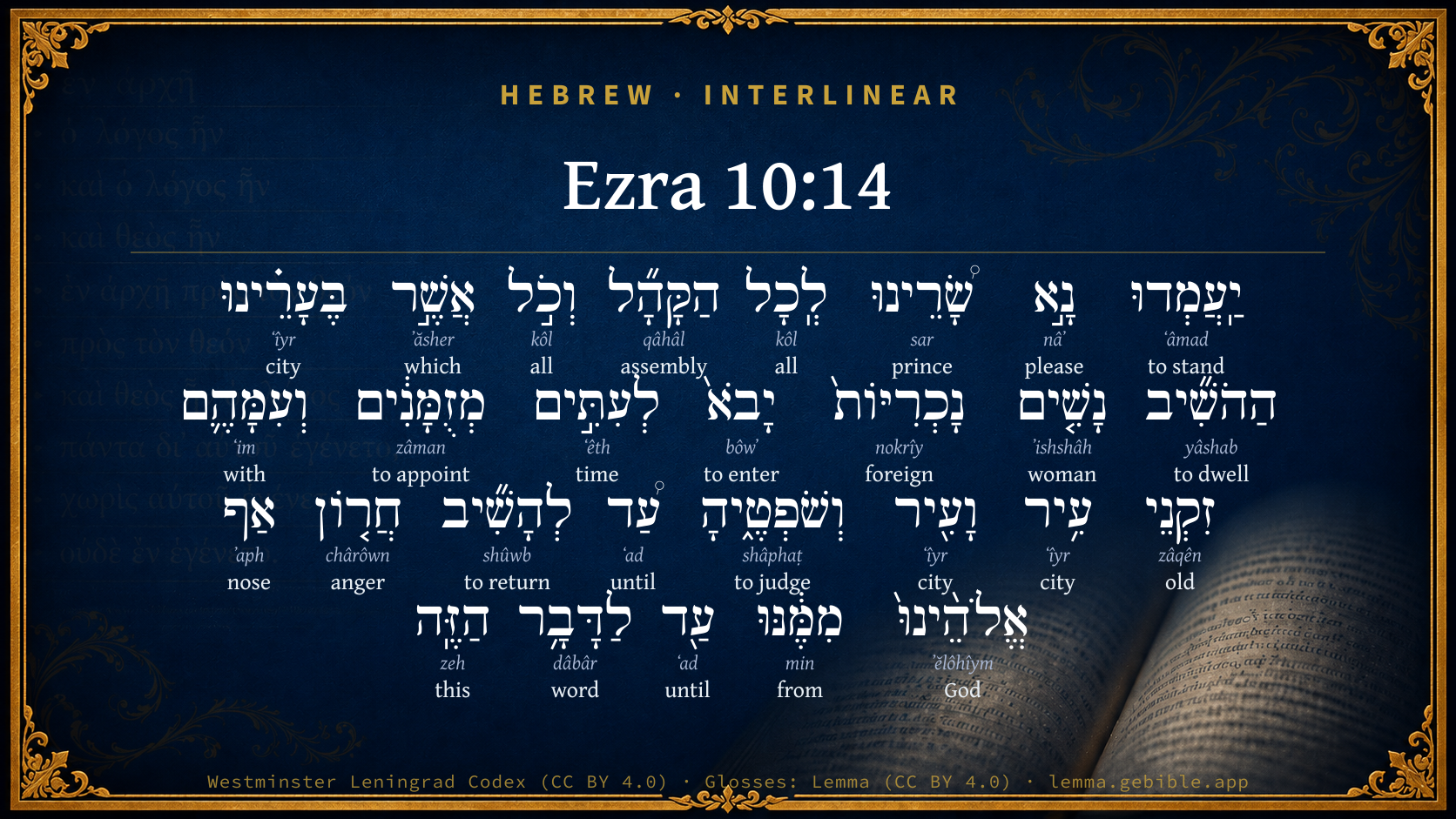
Hebrew (Westminster Leningrad Codex) Ezra 10:14 appears in the Hebrew Old Testament. The text above is from the Westminster Leningrad Codex. Each word links to its Strong’s number, a concise gloss, and parsing drawn from the Open Scriptures Hebrew Bible morphology. Click any word for its full Brown-Driver-Briggs (BDB) entry.
Download image
Cite this verse

Ezra 10:14 (World English Bible). Public Domain. Lemma interlinear Bible study tool, https://lemma.gebible.app/v/ezra/10/14.

Show BibTeX & RIS
BibTeX
RIS
English Translation
Let now our princes be appointed for all the assembly, and let all those who are in our cities who have married foreign women come at appointed times, and with them the elders of every city, and the judges of it, until the fierce wrath of our God be turned from us, until this matter be dispatched.
World English Bible · Public Domain
Highlights
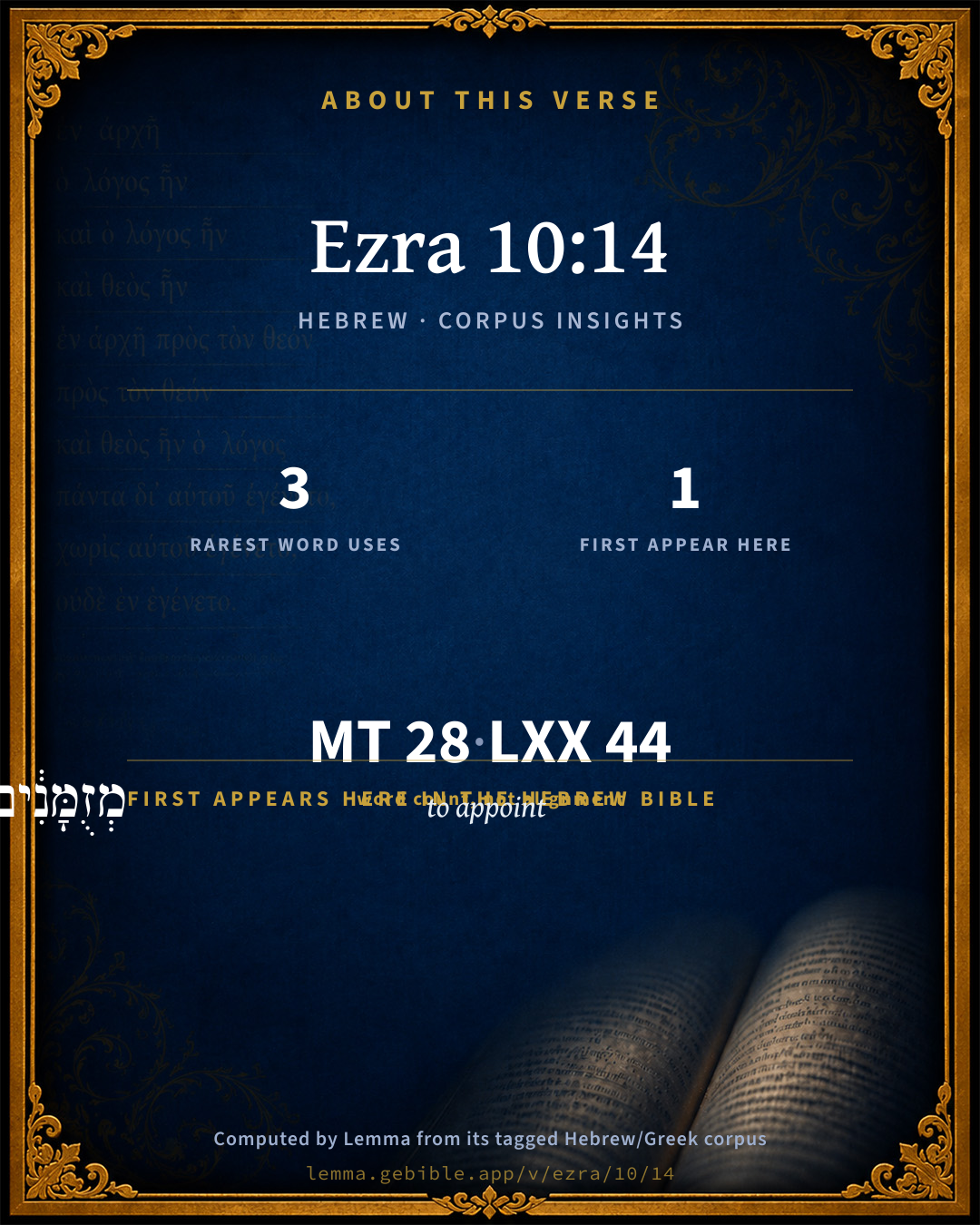
  • 1 first appearance in the Hebrew Bible
Full analysis ↓
Download a study sheet

One document with this verse’s original text, its word-by-word gloss line, the meaning frame, cross-references with their text, attributed commentary, and full source and license credits — printable, and it pastes into notes with its structure intact.

This verse Autodidact and up

Study sheet (.html) Plain text (.txt)

A passage Seminary Student

Up to 50 verses in one chapter. A passage sheet keeps up to 6 commentary sources and 12 cross-references per verse, in the order this page ranks them, and says so on the sheet whenever that leaves anything out. Ask for a single verse and you get the Autodidact verse sheet above.

Everything on this page stays free to read, with no account — the sheet is a download of what is already on screen, not access to it.

Want to remove ads? Support Godless Engineer
Compare translations 3

The same verse in 3 English versions, stacked beneath the original-language interlinear above. Click any original word for its lexicon entry.

Each is an independent rendering of the whole verse — the interlinear is not word-aligned to these translations.

Highlighted words mark where these versions differ — a whole-verse word diff, not a word-by-word alignment.

  • World English Bible Public Domain
    Let now our princes be appointed for all the assembly, and let all those who are in our cities who have married foreign women come at appointed times, and with them the elders of every city, and the judges of it, until the fierce wrath of our God be turned from us, until this matter be dispatched.
  • King James Version Public Domain
    Let now our rulers of all the congregation stand, and let all them which have taken strange wives in our cities come at appointed times, and with them the elders of every city, and the judges thereof, until the fierce wrath of our God for this matter be turned from us.
  • unfoldingWord Literal Text CC BY-SA 4.0
    Let our leaders stand for all the assembly. And let all who are in our cities, the ones who have caused foreign women to dwell, come at appointed times, and with them the elders of city by city and its magistrates, until the burning of the nose of our God is turned back from us as far as it concerns this matter.”

unfoldingWord Literal Text — © unfoldingWord, licensed CC BY-SA 4.0. Word-aligned USFM3 via Door43 (git.door43.org/unfoldingWord/en_ult).

Versions to compare (up to 4)

3 of 4 selected

Show all 18 translations

Every available English version of this verse, each an independent rendering of the whole verse.

  • World English Bible Public Domain
    Let now our princes be appointed for all the assembly, and let all those who are in our cities who have married foreign women come at appointed times, and with them the elders of every city, and the judges of it, until the fierce wrath of our God be turned from us, until this matter be dispatched.
  • Berean Standard Bible Public Domain
    Let our leaders represent the whole assembly. Then let everyone in our towns who has married a foreign woman come at an appointed time, together with the elders and judges of each town, until the fierce anger of our God in this matter is turned away from us.”
  • Majority Standard Bible Public Domain
    Let our leaders represent the whole assembly. Then let everyone in our towns who has married a foreign woman come at an appointed time, together with the elders and judges of each town, until the fierce anger of our God in this matter is turned away from us.”
  • King James Version Public Domain
    Let now our rulers of all the congregation stand, and let all them which have taken strange wives in our cities come at appointed times, and with them the elders of every city, and the judges thereof, until the fierce wrath of our God for this matter be turned from us.
  • American Standard Version (1901) Public Domain
    Let now our princes be appointed for all the assembly, and let all them that are in our cities that have married foreign women come at appointed times, and with them the elders of every city, and the judges thereof, until the fierce wrath of our God be turned from us, until this matter be despatched.
  • Revised Version (1885) Public Domain
    Let now our princes be appointed for all the congregation, and let all them that are in our cities which have married strange women come at appointed times, and with them the elders of every city, and the judges thereof, until the fierce wrath of our God be turned from us, until this matter be despatched.
  • Geneva Bible (1599) Public Domain
    Let our rulers stand therefore before all the Congregation, and let all them which haue taken strange wiues in our cities, come at the time appoynted, and with them the Elders of euery citie and the Iudges thereof, til the fierce wrath of our God for this matter turne away from vs.
  • Douay-Rheims (1899) Public Domain
    Let rulers be appointed in all the multitude: and in all our cities, let them that have taken strange wives come at the times appointed, and with them the ancients and the judges of every city, until the wrath of our God be turned away from us for this sin.
  • Young's Literal Translation Public Domain
    `Let, we pray thee, our heads of all the assembly stand, and all who `are' in our cities, who have settled strange wives, do come in at the times appointed, and with them the elders of city and city, and its judges, till the turning back of the fury of the wrath of our God from us, for this thing.'
  • Literal Standard Version CC BY-SA 4.0
    Please let our heads of all the assembly stand; and all who [are] in our cities, who have settled strange wives, come in at [the] appointed times, and with them [the] elderly of city and city, and judges in it, until the turning back of the fury of the wrath of our God from us, for this thing.”
  • Unlocked Literal Bible CC BY-SA 4.0
    So let our officials represent all the assembly. Let all who have allowed foreign women to live in our cities come at the time that will be fixed with the city elders and the city judges until the raging wrath of our God goes away from us.”
  • unfoldingWord Literal Text CC BY-SA 4.0
    Let our leaders stand for all the assembly. And let all who are in our cities, the ones who have caused foreign women to dwell, come at appointed times, and with them the elders of city by city and its magistrates, until the burning of the nose of our God is turned back from us as far as it concerns this matter.”
  • Darby Bible Public Domain
    Let now our princes, while this matter is going on, stand for all the congregation, and let all those that have taken foreign wives in our cities come at the appointed times, and with them the elders of every city, and the judges thereof, until the fierce anger of our God be turned from us.
  • World Messianic Bible Public Domain
    Now let our princes be appointed for all the assembly, and let all those who are in our cities who have married foreign women come at appointed times, and with them the elders of every city and its judges, until the fierce wrath of our God is turned from us, until this matter is resolved.”
  • Webster's Bible Public Domain
    Let now our rulers of all the congregation stand, and let all them who have taken foreign wives in our cities come at appointed times, and with them the elders of every city, and its judges, until the fierce wrath of our God for this matter shall be turned from us.
  • Free Bible Version CC BY-SA 4.0
    Let our leaders act on behalf of the whole assembly. Then let every man in each of our towns who has married a foreign woman be given an appointment to come and meet, together with the elders and judges of that town, until our God is no longer angry with us over this.”
  • Bible in Basic English Public Domain
    So now let our rulers be representatives for all the people, and let all those in our towns who are married to strange women come at fixed times, and with them the responsible men and the judges of every town, till the burning wrath of our God is turned away from us, and this has been done.
  • JPS Tanakh (1917) Public Domain
    Let now our princes of all the congregation stand, and let all them that are in our cities that have married foreign women come at appointed times, and with them the elders of every city, and the judges thereof, until the fierce wrath of our God be turned from us, as touching this matter.'

Literal Standard Version (2020), Covenant Press — licensed CC BY-SA 4.0. Text via the HelloAO Bible API (eBible.org). Unlocked Literal Bible (unfoldingWord) — licensed CC BY-SA 4.0. Text via the HelloAO Bible API (eBible.org). unfoldingWord Literal Text — © unfoldingWord, licensed CC BY-SA 4.0. Word-aligned USFM3 via Door43 (git.door43.org/unfoldingWord/en_ult). Free Bible Version, Dr. Jonathan Gallagher — licensed CC BY-SA 4.0. Text via the HelloAO Bible API (eBible.org).

Word by word

More ways to search: Search by grammar → Find every occurrence → Compare this word →

Practice this passage: Drill this verse → Learn its vocabulary →

מְזֻמָּנִ֔ים
zâman
H2163
“appointed”
Verb, Pual, Participle Passive, Masculine, Plural, Absolute
Part of Speech
Verb
Stem
Pual
Form
Participle Passive
Gender
Masculine
Number
Plural
State
Absolute
Full BDB Definition

Origin: a primitive root

TWOT: 557

to appoint a time, be fixed, be appointed - (Pual) - to be fixed, be appointed - appointed times (participle)
  1. יַֽעֲמְדוּ ʻâmad H5975 “to stand” Verb, Qal, Jussive, 3rd Person, Masculine, Plural
  2. נָ֣א nâʼ H4994 “please” Particle, Exhortation
  3. שָׂ֠רֵינוּ sar H8269 “princes · our” Noun, Common, Masculine, Plural, Construct + Suffix, Personal, 1st Person, Common, Plural
  4. לְֽכָל kôl H3605 “to/for · all of” Preposition + Noun, Common, Masculine, Singular, Construct
  5. הַקָּהָ֞ל qâhâl H6951 “the · assembly” Particle, Definite Article + Noun, Common, Masculine, Singular, Absolute
  6. וְכֹ֣ל kôl H3605 “and · all” Conjunction + Noun, Common, Masculine, Singular, Absolute
  7. אֲשֶׁ֣ר ʼăsher H834 “which” Particle, Relative
  8. בֶּעָרֵ֗ינוּ ʻîyr H5892 “in/at · cities · our” Preposition + Noun, Common, Feminine, Plural, Construct + Suffix, Personal, 1st Person, Common, Plural
  9. הַהֹשִׁ֞יב yâshab H3427 “the · to dwell” Particle, Definite Article + Verb, Hiphil, Perfect, 3rd Person, Masculine, Singular
  10. נָשִׁ֤ים ʼishshâh H802 “women” Noun, Common, Feminine, Plural, Absolute
  11. נָכְרִיּוֹת֙ nokrîy H5237 “foreign” Adjective, Adjective, Feminine, Plural, Absolute
  12. יָבֹא֙ bôwʼ H935 “to enter” Verb, Qal, Imperfect, 3rd Person, Masculine, Singular
  13. לְעִתִּ֣ים ʻêth H6256 “to/for · times” Preposition + Noun, Common, Both, Plural, Absolute
  14. וְעִמָּהֶ֛ם ʻim H5973 “and · with · them” Conjunction + Preposition + Suffix, Personal, 3rd Person, Masculine, Plural
  15. זִקְנֵי zâqên H2205 “old of” Adjective, Adjective, Masculine, Plural, Construct
  16. עִ֥יר ʻîyr H5892 “city” Noun, Common, Feminine, Singular, Absolute
  17. וָעִ֖יר ʻîyr H5892 “and · city” Conjunction + Noun, Common, Feminine, Singular, Absolute
  18. וְשֹׁפְטֶ֑יהָ shâphaṭ H8199 “and · judging · her” Conjunction + Verb, Qal, Participle Active, Masculine, Plural, Construct + Suffix, Personal, 3rd Person, Feminine, Singular
  19. עַ֠ד ʻad H5704 “until” Preposition
  20. לְהָשִׁ֞יב shûwb H7725 “to return” Preposition + Verb, Hiphil, Infinitive Construct
  21. חֲר֤וֹן chârôwn H2740 “anger of” Noun, Common, Masculine, Singular, Construct
  22. אַף ʼaph H639 “nose” Particle, Accusative
  23. אֱלֹהֵ֨ינוּ֙ ʼĕlôhîym H430 “God(s) · our” Noun, Common, Masculine, Plural, Construct + Suffix, Personal, 1st Person, Common, Plural
  24. מִמֶּ֔נּוּ min H4480 “from · us” Preposition + Suffix, Personal, 1st Person, Common, Plural
  25. עַ֖ד ʻad H5704 “until” Preposition
  26. לַדָּבָ֥ר dâbâr H1697 “to/for the · word” Preposition, Determined + Noun, Common, Masculine, Singular, Absolute
  27. הַזֶּֽה zeh H2088 “the · this” Particle, Definite Article + Pronoun, Demonstrative, Masculine, Singular

About this verse

These counts appear in no published source. They are computed here, from the morphology-tagged text and Lemma’s own curated glosses. What Lemma adds →

28
words
24
distinct lemmas
Historical
section

Notable vocabulary

The rarest word here is מְזֻמָּנִ֔ים to appoint H2163 — appearing just 3 times in the whole Hebrew Bible.

First appearance in Scripture

This word makes its first canonical appearance in the Hebrew Bible here:

  • מְזֻמָּנִ֔ים to appoint H2163

Shared distinctive vocabulary

מְזֻמָּנִ֔ים to appoint H2163 occurs in 3 verses of the Hebrew Bible. Also found in:

Grammatical profile

  • 6 verbs
  • 12 nouns
  • 2 adjectives
  • 1 pronoun
  • 4 prepositions
  • 3 particles

Verb forms

  • יַֽעֲמְדוּ Qal · Jussive
  • הַהֹשִׁ֞יב Hiphil · Perfect
  • יָבֹא֙ Qal · Imperfect
  • מְזֻמָּנִ֔ים Pual · Participle Passive
  • וְשֹׁפְטֶ֑יהָ Qal · Participle Active
  • לְהָשִׁ֞יב Hiphil · Infinitive Construct

Repetition

Words recur within this verse — often emphatic in Hebrew:

  • בֶּעָרֵ֗ינוּ city H5892 ×3
  • לְֽכָל all H3605 ×2
  • עַ֠ד until H5704 ×2

Hebrew & Septuagint length

In English translation the verse runs 57 words from the Hebrew and 47 from the Septuagint (LXX English) — closely comparable.

A rough comparison of the two English renderings, which tokenize alike — not a word-level alignment.

Word counts can differ between the Hebrew and the Greek without any difference in meaning — e.g. the Hebrew direct-object marker אֵת has no separate Greek word, and Greek often adds the article ὁ.

In the original languages it is 28 Hebrew tokens and 44 Greek tokens — but the two are counted differently (Hebrew bundles its prefixes and suffixes into one token; the Greek is in lemma form), so that isn’t a like-for-like length.

Cross-references

10

Topical passages linked to Ezra 10:14 in the Treasury of Scripture Knowledge — connected by theme and wording, ordered by reader-vote popularity; previews shown in the World English Bible.

  • 2 Chronicles 29:10 Now it is in my heart to make a covenant with Yahweh, the God of Israel, that his fierce anger may turn away from us.
  • 2 Chronicles 30:8 Now don't you be stiff-necked, as your fathers were; but yield yourselves to Yahweh, and enter into his sanctuary, which he has sanctified forever, and serve Yahweh your God, that his fierce anger may turn away from you.
  • Numbers 25:4 Yahweh said to Moses, Take all the chiefs of the people, and hang them up to Yahweh before the sun, that the fierce anger of Yahweh may turn away from Israel.
  • Deuteronomy 13:17 There shall cleave nothing of the devoted thing to your hand; that Yahweh may turn from the fierceness of his anger, and show you mercy, and have compassion on you, and multiply you, as he has sworn to your fathers;
  • Deuteronomy 17:9 and you shall come to the priests the Levites, and to the judge who shall be in those days: and you shall inquire; and they shall show you the sentence of judgment.
  • Deuteronomy 17:18–19 It shall be, when he sits on the throne of his kingdom, that he shall write him a copy of this law in a book, out of [that which is] before the priests the Levites:
  • Joshua 7:26 They raised over him a great heap of stones, to this day; and Yahweh turned from the fierceness of his anger. Therefore the name of that place was called "The valley of Achor" to this day.
  • 2 Chronicles 19:5–7 He set judges in the land throughout all the fortified cities of Judah, city by city,
  • Psalms 78:38 But he, being merciful, forgave iniquity, and didn't destroy them. Yes, many times he turned his anger away, And didn't stir up all his wrath.
  • Isaiah 12:1 In that day you will say, "I will give thanks to you, Yahweh; for though you were angry with me, your anger has turned away and you comfort me.

Cross-references courtesy of OpenBible.info (CC BY 4.0).

Hebrew and Greek witnesses Masoretic Hebrew ↔ Greek Septuagint

The same verse in the two great witnesses to the Old Testament, shown verse-for-verse.

These are two independent witnesses, not word-aligned to each other, and the Septuagint is shown in lemma (dictionary) form.

Hebrew Ezra 10:14 Masoretic · Westminster Leningrad Codex

יַֽעֲמְדוּ נָ֣א שָׂ֠רֵינוּ לְֽכָל הַקָּהָ֞ל וְכֹ֣ל אֲשֶׁ֣ר בֶּעָרֵ֗ינוּ הַהֹשִׁ֞יב נָשִׁ֤ים נָכְרִיּוֹת֙ יָבֹא֙ לְעִתִּ֣ים מְזֻמָּנִ֔ים וְעִמָּהֶ֛ם זִקְנֵי עִ֥יר וָעִ֖יר וְשֹׁפְטֶ֑יהָ עַ֠ד לְהָשִׁ֞יב חֲר֤וֹן אַף אֱלֹהֵ֨ינוּ֙ מִמֶּ֔נּוּ עַ֖ד לַדָּבָ֥ר הַזֶּֽה

Let now our princes be appointed for all the assembly, and let all those who are in our cities who have married foreign women come at appointed times, and with them the elders of every city, and the judges of it, until the fierce wrath of our God be turned from us, until this matter be dispatched.

World English Bible · Public Domain

Greek LXX Ezra 10:14 Septuagint · lemma form

ἵστημι δή ὁ ἄρχων ἐγώ ὁ πᾶς ἐκκλησία καί πᾶς ὁ ἐν πόλις ἐγώ ὅς καταἵζω γυνή ἀλλότριος ἔρχομαι εἰς καιρός ἀπό συνταγή καί μετά αὐτός πρεσβύτερος πόλις καί πόλις καί κριτής ὁ ἀποστρέφω ὀργή θυμός θεός ἐγώ ἐκ ἐγώ περί ὁ ῥῆμα οὗτος

Let now our rulers stand, and for all those in our cities who have taken strange wives, let them come at appointed times, and with them elders from every several city, and judges, to turn away the fierce wrath of our God from us concerning this matter.

LXX2012 (modern English Septuagint) · Public Domain

In the Septuagint this is one book — Esdras B (2 Esdras): Ezra is chapters 1–10, Nehemiah 11–23.

Hebrew: Westminster Leningrad Codex (CC BY 4.0). Greek: Septuagint (public domain); English from LXX2012 (modern English Septuagint) (Public Domain). How the Septuagint differs from the Hebrew →

Commentary

Notes on Ezra 10:14 from classic Christian and Jewish commentators (each source and its license shown beneath its notes). The classic Christian expositions comment on the surrounding passage and are grouped to its opening verse, so a note may address several verses; the Jewish commentaries on the Tanakh (Rashi and others) are per-verse, so they appear only where the commentator wrote on this verse.

Lemma curates 59 commentaries, every one of them public domain or Creative Commons licensed, each selected and text-cleaned for this edition rather than reprinted as found. About our sources →

Trapp's Complete Commentary

John Trapp

Ezr 10:14 Let now our rulers of all the congregation stand, and let all them which have taken strange wives in our cities come at appointed times, and with them the elders of every city, and the judges thereof, until the fierce wrath of our God for this matter be turned from us.

Ver. 14. Let now our rulers of all the congregation] Our sanhedrim or seventy seniors, see Deu 17:9. Let there be a matrimonial consistory erected, and matters in question orderly heard and determined.

Until the fierce wrath of God] We must not think that he will cease pursuing us till the traitor’s head be thrown over the wall, till there be a thorough reformation. One Abimelech, left alive, may be the death of Gideon’s 70 sons; so may one sin favoured be thine utter undoing.

John Trapp, A Commentary or Exposition upon All the Books of the Old and New Testament (1647–1656) — public domain. Text from a community e-Sword module.

Joseph Benson's Commentary

Ezr 10:14. Let now our rulers stand — They propose that the rulers in Jerusalem should meet, to take cognizance of this matter, and to judge and determine in all particular cases: and that, at appointed times, the offenders in every city should be brought before them by the elders and judges of those cities, who should either testify against them for offending, or witness that they had seen the divorces made, and their strange wives put away. For these elders and judges of the several cities were best able to inform the great council at Jerusalem, concerning the quality of the persons accused, and all matters of fact, and circumstances. And this proceeding, they proposed, should continue as long as there remained any thing to be done in this business, that the wrath of God might be turned away from them.

Joseph Benson's Commentary on the Old and New Testaments (1811–1818) — public domain. Text from a community e-Sword module.

Geneva Bible (1599)

Geneva Bible translators

Let them be appointed to examine this matter.

Geneva Bible (1599) marginal notes — public domain. Text via Bolls.life.

The Cambridge Bible for Schools and Colleges

gen. ed. J. J. S. Perowne

14. A commission recommended.

Let now our rulers of all the congregation stand] R.V. Let now our princes be appointed (marg. Heb. stand) for all the congregation. The A.V. fails to give the idea of the original, where a difficulty is occasioned by the preposition ‘for’. There are practically two ways of explaining the passage (1) Let now our princes stand for (i.e. in the place of ἀντὶ) all the congregation. (2) Let there now stand our princes for (i.e. in the interests of, ὑπὲρ) all the congregation. The latter is the preferable. The commission then was to consist of the princes who, in conjunction with the local elders and judges, should enquire into the cases that had occurred in each town and district.

and let all them which have taken strange wives in our cities] R.V. and let all them that are in our cities which have married strange women. The R.V. reproduces the two relative sentences of the original, the one giving the locality of the offender, the other particularizing the offence; perhaps the formal character of the actual wording of the decree here peeps out.

in our cities] This expression seems to exclude Jerusalem. The case of those who dwelt in the capital could be investigated by the princes on the spot and without delay. In the case of inhabitants of other towns, the officials of each town were to be convened at Jerusalem and to assist the permanent commission; the offenders at the same time were to be summoned to attend the investigation in person.

at appointed times] Cf. ‘at times appointed’, Neh_10:34; Neh_13:31.

the elders of every city, and the judges thereof] i.e. the representatives of the populace and the administrators of justice, belonging to each town.

until the fierce wrath of our God … be turned from us] So also R.V. It is much to be doubted whether this can be regarded as a satisfactory rendering.

(1) There is no real connexion between the previous sentence ‘let our princes be appointed &c.’ and the words ‘until the fierce wrath, &c.’ ‘The fierce wrath’ had not been displayed, as in David’s day, by a visitation such as a plague or a famine, nor by any fresh hostile oppression. There is therefore no natural explanation for the expression, such as there is for the very similar words ‘Hide thyself for a little moment, until the indignation be overpast’, Isa_26:20; ‘Yea, in the shadow of thy wings will I take refuge, until these calamities be overpast’, Psa_57:1. If there was no external symptom of the Divine displeasure, its continuance could only be apprehended mentally or morally, and would have no sort of relation to the investigation and punishment of the offence.

(2) The work of the commission—in a great measure an undertaking of popular contrition, but very largely also the expression of a definite policy of excluding aliens from the community—could not be concluded, until its ends had been accomplished. Now unless we are prepared to change the words ‘until the fierce wrath, &c.’ into so different a meaning as ‘until the cause of the fierce wrath &c. be removed’, it seems that a limitation of time has no rightful place here.

(3) The English rendering ignores the literal transitive meaning of the verb. Literally translated, the sentence runs, ‘up to the point of, to turn away the fierce wrath of our God’. It seems very probable that we should reject the temporal signification of the word rendered ‘until’, and treat it as an instance of a redundancy not uncommon in late Hebrew. It will then merely strengthen the preposition, denoting purpose, prefixed to the verb. Supposing this to be the true explanation, the rendering will be ‘with a view (or, unto this end) to turn away the fierce wrath of our God’.

The verb, which is transitive, is thus given its proper force familiar in other similar passages. Psa_78:38 ‘Yea, many a time turned he his anger away’; Psa_106:23 ‘Had not Moses his chosen stood before him in the breach to turn away his wrath’; Jer_18:20 ‘Remember how I stood before thee to speak good for them, to turn away thy fury from them’; Pro_15:1 ‘A soft answer turneth away wrath’.

The English version gives the general sense in the same way as the Vulgate ‘donec revertatur ira Dei nostri a vobis’. But the English reader would never guess that the verb is used, not in the intransitive form ‘to return’ (as in Num_25:4; 2Ch_29:10; 2Ch_30:8 : Jer_30:24), but in the causative ‘to cause to return’, ‘to turn away’ ‘to avert’.

the fierce wrath of our God] This particular expression ‘the fierce wrath’, as applied to the Almighty, occurs in the O.T. thirty-four times, being used with special frequency (ten times) in Jeremiah. See also 2Ch_28:11; 2Ch_28:13; 2Ch_29:10; 2Ch_30:8.

for this matter] R.V. until this matter be dispatched. Marg. Or, as touching this matter. Literally rendered, the Hebrew words give ‘up to the point of (or, until), to this matter’. The R.V. apparently coordinates this clause with the preceding one. But there can be but one opinion that the whole sentence ‘Let now our princes be appointed … until the fierce wrath of our God be turned from us, until this matter be dispatched’, is quite intolerably harsh. The last clause only receives definiteness from the insertion of the words ‘be dispatched’. But it constitutes a most empty addition to state that the enquiry should last until its business was dispatched. The present phrase is apparently only another instance, if the text be correct, of the same redundancy of expression in the later Hebrew mentioned above. The word, rendered ‘until’, amplifies the preposition. And the usage of the compound preposition is the same as that of the simple preposition when found with the same words elsewhere. Gen_19:21 ‘concerning this thing’; 1Sa_30:24; Dan_1:14 ‘in this matter’. The rendering of the margin is therefore to be preferred, ‘to turn away the fierce wrath of our God as touching this matter’. The words are the same in meaning as Ezr_9:15 ‘because of this’, Ezr_10:2 ‘concerning this thing’.

The Cambridge Bible for Schools and Colleges (gen. ed. J. J. S. Perowne; Cambridge University Press, 1878–1918) — public domain. Text from a community e-Sword module.

John Gill's Exposition

Let now our rulers of all the congregations stand,.... Let the great sanhedrim, or court of judicature at Jerusalem, be fixed and continued, and others:

and let all them which have taken strange wives in our cities come at appointed times; to the court at Jerusalem, at certain and fixed known times of their sittings there for this purpose:

and with the elders of every city and the judges thereof; the principal magistrates of it, who were to testify that upon search and inquiry those were the men and all the men in their city, that had taken strange wives, and that they had put them away according to the order of the princes and elders; and this they proposed to be done in every city, and the account to be brought to the sanhedrim at Jerusalem, who were to sit at certain times till this affair was finished:

until the fierce wrath of our God for this matter be turned from us: which it seems had broke out in some instances, and they feared would do yet more, unless this step was taken, whereby they hoped it would be averted.

John Gill's Exposition of the Whole Bible (1746–1763) — public domain (CC PDM 1.0). Text via the HelloAO Bible API.

Haydock's Catholic Bible Commentary

Cities. It is not clear whether the rulers went to the different cities, or the principal men of each gave information, and caused the guilty to appear before Esdras, at Jerusalem. (Haydock)

George Leo Haydock (1774–1849), Haydock's Catholic Family Bible and Commentary, 1859 edition — public domain. Excludes Psalms (Douay-Rheims chapter numbering differs from Protestant) and Deuterocanonical books (Catholic canon only).

Matthew Poole's English Annotations

Let our rulers of all the congregation stand; let the great council, called the Sanhedrim, be settled, and meet to judge and determine of all particular causes.

Them which have taken strange wives, to wit, of these heathen nations, such as were not proselyted to the Jewish religion before their marriage, or since revolted from it.

The elders of every city, and the judges thereof; who are best able to inform the great council of the quality of the persons, and of all matters of fact and circumstances.

Until the fierce wrath of our God be turned from us, i.e. until the thing be done, and God’s wrath thereby removed.

Matthew Poole's English Annotations on the Holy Bible (1683–1685) — public domain. Text from a community e-Sword/MySword module.

Whedon's Commentary on the Bible

Daniel D. Whedon

14. Come at appointed times — They probably arranged for them to come according to families, or, perhaps, according to cities, and the elders of every city, and the judges thereof, came along with them to be witnesses and judges of cases known to them.

Daniel D. Whedon (gen. ed.), Commentary on the Old and New Testaments (1874–1909) — public domain. Text from a community e-Sword module.

The Pulpit Commentary

Let now our rulers of the congregation stand. Let Ezra, together with the princes and the elders at Jerusalem (ver. 8), form a standing body to act with the elders and judges of the provincial towns in this matter, and let the case of each town be taken separately, and the inhabitants of each attend at Jerusalem in their turn. Until the fierce wrath of our God for this matter be turned from us. This is probably the true meaning of the writer, but it is not to be obtained from the ordinary text. To produce it we must read by lfor d and haddabar for laddabar hazzeh. As the text stands, it is unintelligible.

The Pulpit Commentary (1880–1919), ed. H.D.M. Spence-Jones & Joseph S. Exell — public domain. Text from a community e-Sword module.

John Wesley's Explanatory Notes

Our rulers - Let the great council, called the Sanhedrim, be settled, and meet to determine of all particular causes. Judges - Who are best able to inform the great council of the quality of the persons, and all matters of fact and circumstances. Until - Until the thing be done, and God's wrath thereby removed.

John Wesley, Explanatory Notes Upon the Whole Bible (1754–1765) — public domain. Text via the GEBible commentary corpus.

Keil & Delitzsch

C. F. Keil & F. Delitzsch

"Let then our rulers stand for the whole congregation, and let all who in all our cities have brought home strange wives come at appointed times, and with them the elders of each city, and the judges thereof, until the fierce wrath of our God be turned away from us, as long as this matter lasts." There were so many cases to deal with, that the rulers, as the judicial authorities, must decide in this matter; and those who in all the cities of the land had transgressed, were to appear before these authorities, and submit their individual cases to their jurisdiction. The choice of the verb יעמדוּ, to stand or set oneself to discharge some business, here therefore to give judgment, is occasioned by the preceding לעמוד. The whole community had assembled according to the proclamation, and was standing there for the purpose of bringing the matter to a close. This they were not, however, able to do, for the reasons stated Ezr 10:13; hence the princes, as rulers of the community, are to remain for the discharge of the business. לכל־הקּהל is not a genitive dependent on שׂרינוּ, and explanatory of the suffix of this word-our, viz., the whole congregation's, princes (Bertheau) - an unnatural and superfluous elucidation; for if the whole congregation say: our princes, it is self-evident that not the princes of a section or portion of the people, but of the whole congregation, must be intended. לכל־הקּהל is the object of יעמדוּ: let them stand for the whole congregation (ל עמד like ל קוּם, Psa 94:16), not instead of, but for the good of the congregation, and transact its business. In our cities, i.e., including the capital, for there is here no contrast between Jerusalem and the other cities. The article to ההשׁיב stands, as is often the case, for the relative אשׁר, e.g., Ezr 10:17, Ezr 8:25. מזמּנים עתּים, appointed times, stated terms, used only here and in Neh 10:35; Neh 13:31. זמּן is a Chaldaistic expression. With the accused were to come the elders and judges of every city, to furnish the necessary explanations and evidence. להשׁיב עד, until the turning away of the fierceness of the wrath (ל עד according to the later usage of the language instead of עד only, comp. Ewald, 315, a, not instead of ל only, as Bertheau seeks, by incorrectly interpreted passages, to prove). The meaning is: until the fierce wrath of God concerning these marriages shall be turned away, by their dissolution and the dismissal of the strange women from the congregation. The last words, הזּה לדּבר עד, offer some difficulty. De Wette and Bertheau translate them: on account of this matter, which ל עד can by no means signify. We regard ל עד = עד of the older language, in the sense of during, like Kg2 9:22, according to which the meaning is: as long as this thing lasts; but we connect these words, not, as J. H. Michaelis, with the immediately preceding clause: the wrath which is fierce during this matter (quae usque, i.e., constanter ardet), but take them as more exactly defining the leading idea of the verse: the princes are to stand and judge the guilty as long as this matter lasts, so that הזּה לדּבר עד is co-ordinate with וגו להשׁיב עד.

Keil & Delitzsch — Biblical Commentary on the Old Testament (1861–1891) — public domain (CC PDM 1.0). Text via the HelloAO Bible API. (Old Testament only.)

unfoldingWord translationNotes

Door43 World Missions Community

at the time that will be fixed with the city elders and the city judges

This can be translated in active form and as separate sentences. AT: "at the time that you will determine. Let them come with the city elder and the city judges" (See: Active or Passive)

Jonathan ... Asahel ... Jahzeiah ... Tikvah ... Meshullam ... Shabbethai

men's names (See: How to Translate Names)

Jonathan son of Asahel and Jahzeiah son of Tikvah opposed this

Possible meanings are, 1) these men did not want the city officials to investigate the offenses or 2) they did not want anyone to investigate the people's marriages.

translationWords

judge, judges

wrath

Jonathan

Levi

unfoldingWord translationNotes — © Distant Shores Media and the Door43 World Missions Community, licensed CC BY-SA 4.0. Source: git.door43.org/Door43/en_tn.

Rashi

Rabbi Shlomo Yitzchaki (Rashi)

with the entire congregation Heb. לְכָל הַקָהָל

who took in Heb. הַהשִּׁיב equivalent to אֲשֶּׁר הוֹשִּׁיב.

until we avert until the burning anger of the Holy One, blessed be He, returns from upon us.

Rashi on the Tanakh — English translations: “The Judaica Press complete Tanach with Rashi, translated by A. J. Rosenberg” (CC BY 4.0); “Pentateuch with Rashi's commentary by M. Rosenbaum and A.M. Silbermann, 1929-1934” (public domain); “The Metsudah Tanach series, Lakewood, N.J” (CC BY 4.0); and “The Book of Joshua, Metsudah Publications, 1997” (CC BY 4.0). Text via Sefaria.

Lesson kit

Teaching starters — assembled from the data on this page, not authored interpretation. Every prompt links to the verse data it draws on. Edit before teaching.

Ezra, in the Historical, opens this verse with 28 words (24 distinct Hebrew lemmas). Its most distinctive word is zâman (“to appoint”). A historical commentator’s framing appears above. Read the whole chapter for the surrounding context.

Discussion questions

  1. What does “to appoint” (zâman) contribute to the verse as a whole?
  2. The word “to appoint” first appears here in Scripture. What is being introduced at this debut?
  3. Nehemiah 10:34 shares the word «to appoint» with this verse. How do the two illuminate each other?
  4. “city” occurs 3× in this one verse. What is the effect of the repetition?
  5. These translations render this verse differently. What is at stake in choosing one wording over another?
  6. The verb «יַֽעֲמְדוּ» is Qal Jussive. How does its form color the action?
  7. Reading how Trapp's Complete Commentary and Joseph Benson's Commentary read this verse, where do the two commentators agree and where do they part?

Things to notice

Reading settings

Reading text

Shown beneath each verse's original-language words.

Old Testament
Old Testament edition

Read the OT as the Masoretic Hebrew (MT) or the Greek Septuagint (LXX).

English shown for the Greek Septuagint (in the Hebrew ↔ Greek comparison).

Comparing translations? Open the Compare panel on any verse page to stack up to four side by side.