

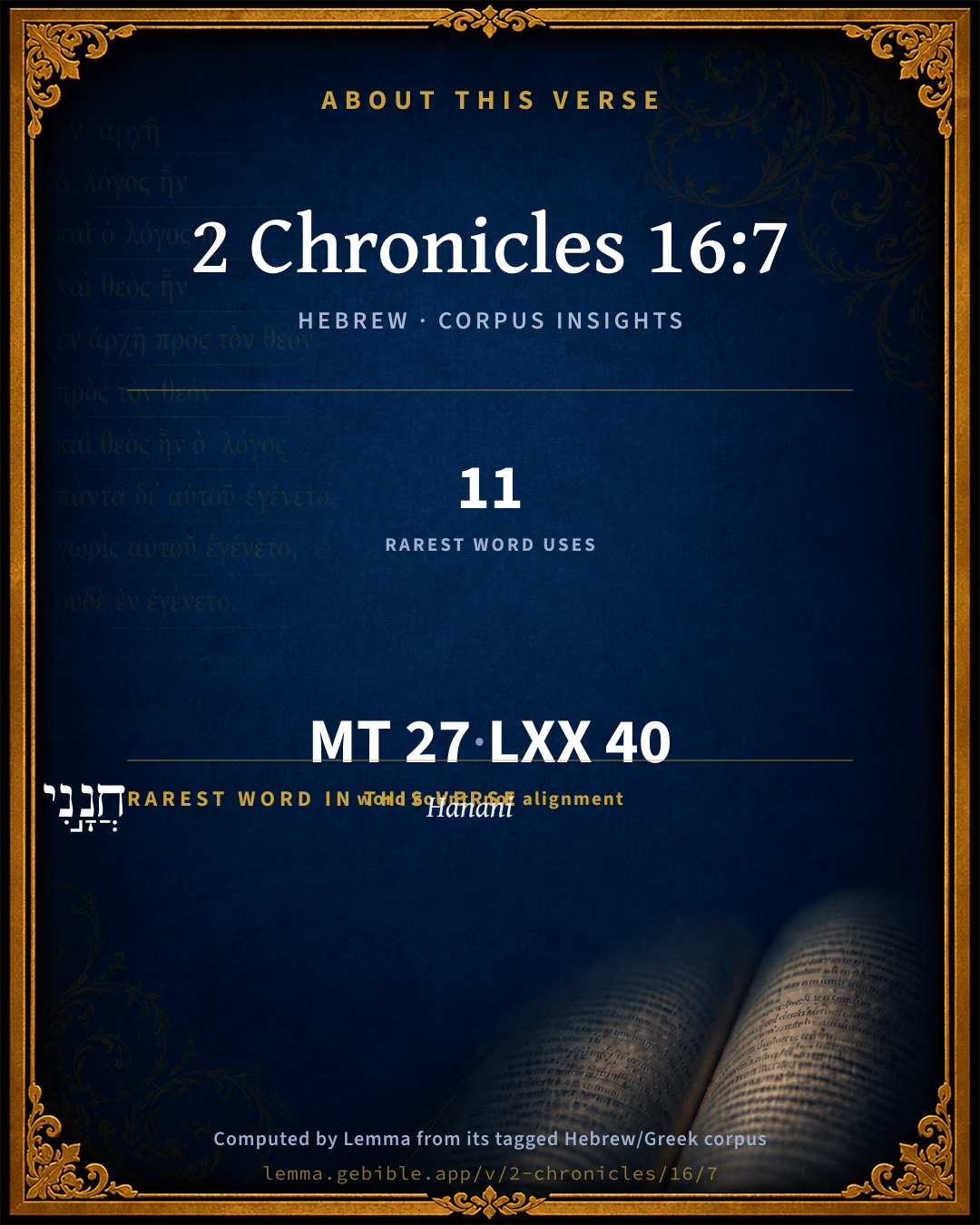
2 Chronicles 16:7

Hebrew (Westminster Leningrad Codex) 2 Chronicles 16:7 appears in the Hebrew Old Testament. The text above is from the Westminster Leningrad Codex. Each word links to its Strong’s number, a concise gloss, and parsing drawn from the Open Scriptures Hebrew Bible morphology. Click any word for its full Brown-Driver-Briggs (BDB) entry.
Download image
Cite this verse

2 Chronicles 16:7 (World English Bible). Public Domain. Lemma interlinear Bible study tool, https://lemma.gebible.app/v/2-chronicles/16/7.

Show BibTeX & RIS
BibTeX
RIS
English Translation
At that time Hanani the seer came to Asa king of Judah, and said to him, Because you have relied on the king of Syria, and have not relied on Yahweh your God, therefore is the host of the king of Syria escaped out of your hand.
World English Bible · Public Domain
Download a study sheet

One document with this verse’s original text, its word-by-word gloss line, the meaning frame, cross-references with their text, attributed commentary, and full source and license credits — printable, and it pastes into notes with its structure intact.

This verse Autodidact and up

Study sheet (.html) Plain text (.txt)

A passage Seminary Student

Up to 50 verses in one chapter. A passage sheet keeps up to 6 commentary sources and 12 cross-references per verse, in the order this page ranks them, and says so on the sheet whenever that leaves anything out. Ask for a single verse and you get the Autodidact verse sheet above.

Everything on this page stays free to read, with no account — the sheet is a download of what is already on screen, not access to it.

Want to remove ads? Support Godless Engineer
Compare translations 3

The same verse in 3 English versions, stacked beneath the original-language interlinear above. Click any original word for its lexicon entry.

Each is an independent rendering of the whole verse — the interlinear is not word-aligned to these translations.

Highlighted words mark where these versions differ — a whole-verse word diff, not a word-by-word alignment.

  • World English Bible Public Domain
    At that time Hanani the seer came to Asa king of Judah, and said to him, Because you have relied on the king of Syria, and have not relied on Yahweh your God, therefore is the host of the king of Syria escaped out of your hand.
  • King James Version Public Domain
    And at that time Hanani the seer came to Asa king of Judah, and said unto him, Because thou hast relied on the king of Syria, and not relied on the LORD thy God, therefore is the host of the king of Syria escaped out of thine hand.
  • unfoldingWord Literal Text CC BY-SA 4.0
    And at that time Hanani the seer came to Asa, the king of Judah, and he said to him, “Because you relied on the king of Aram, and you did not rely on Yahweh your God, therefore the army of the king of Aram escaped from your hand.

unfoldingWord Literal Text — © unfoldingWord, licensed CC BY-SA 4.0. Word-aligned USFM3 via Door43 (git.door43.org/unfoldingWord/en_ult).

Versions to compare (up to 4)

3 of 4 selected

Show all 18 translations

Every available English version of this verse, each an independent rendering of the whole verse.

  • World English Bible Public Domain
    At that time Hanani the seer came to Asa king of Judah, and said to him, Because you have relied on the king of Syria, and have not relied on Yahweh your God, therefore is the host of the king of Syria escaped out of your hand.
  • Berean Standard Bible Public Domain
    At that time Hanani the seer came to King Asa of Judah and told him, “Because you have relied on the king of Aram and not on the LORD your God, the army of the king of Aram has escaped from your hand.
  • Majority Standard Bible Public Domain
    At that time Hanani the seer came to King Asa of Judah and told him, “Because you have relied on the king of Aram and not on the LORD your God, the army of the king of Aram has escaped from your hand.
  • King James Version Public Domain
    And at that time Hanani the seer came to Asa king of Judah, and said unto him, Because thou hast relied on the king of Syria, and not relied on the LORD thy God, therefore is the host of the king of Syria escaped out of thine hand.
  • American Standard Version (1901) Public Domain
    And at that time Hanani the seer came to Asa king of Judah, and said unto him, Because thou hast relied on the king of Syria, and hast not relied on Jehovah thy God, therefore is the host of the king of Syria escaped out of thy hand.
  • Revised Version (1885) Public Domain
    And at that time Hanani the seer came to Asa king of Judah, and said unto him, Because thou hast relied on the king of Syria, and hast not relied on the LORD thy God, therefore is the host of the king of Syria escaped out of thine hand.
  • Geneva Bible (1599) Public Domain
    And at that same time Hanani the Seer came to Asa King of Iudah, and saide vnto him, Because thou hast rested vpon the king of Aram, and not rested in the Lord thy God, therefore is the hoste of the King of Aram escaped out of thine hande.
  • Douay-Rheims (1899) Public Domain
    At that time Hanani the prophet came to Asa king of Juda, and said to him: Because thou hast had confidence in the king of Syria, and not in the Lord thy God, therefore hath the army of the king of Syria escaped out of thy hand.
  • Young's Literal Translation Public Domain
    And at that time hath Hanani the seer come in unto Asa king of Judah, and saith unto him, `Because of thy leaning on the king of Aram, and thou hast not leaned on Jehovah thy God, therefore hath the force of the king of Aram escaped from thy hand.
  • Literal Standard Version CC BY-SA 4.0
    And at that time Hanani the seer has come to Asa king of Judah and says to him, “Because of your leaning on the king of Aram, and you have not leaned on your God YHWH, therefore the force of the king of Aram has escaped from your hand.
  • Unlocked Literal Bible CC BY-SA 4.0
    At that time Hanani the seer went to Asa, king of Judah, and said to him, “Because you have relied on the king of Aram, and have not relied on Yahweh your God, the army of the king of Aram has escaped out of your hand.
  • unfoldingWord Literal Text CC BY-SA 4.0
    And at that time Hanani the seer came to Asa, the king of Judah, and he said to him, “Because you relied on the king of Aram, and you did not rely on Yahweh your God, therefore the army of the king of Aram escaped from your hand.
  • Darby Bible Public Domain
    And at that time Hanani the seer came to Asa king of Judah, and said unto him, Because thou hast relied on the king of Syria, and hast not relied on Jehovah thy God, therefore has the army of the king of Syria escaped out of thy hand.
  • World Messianic Bible Public Domain
    At that time Hanani the seer came to Asa king of Judah, and said to him, “Because you have relied on the king of Syria, and have not relied on the LORD your God, therefore the army of the king of Syria has escaped out of your hand.
  • Webster's Bible Public Domain
    And at that time Hanani the seer came to Asa king of Judah, and said to him, Because thou hast relied on the king of Syria, and not relied on the LORD thy God, therefore hath the host of the king of Syria escaped out of thy hand.
  • Free Bible Version CC BY-SA 4.0
    But right then Hanani the seer came to Asa, king of Judah, and told him, “Because you have put your trust in the king of Aram and have not put your trust in the Lord your God, your opportunity to destroy the army of the king of Aram has gone.
  • Bible in Basic English Public Domain
    At that time Hanani the seer came to Asa, king of Judah, and said to him, Because you have put your faith in the king of Aram and not in the Lord your God, the army of the king of Aram has got away out of your hands.
  • JPS Tanakh (1917) Public Domain
    And at that time Hanani the seer came to Asa king of Judah, and said unto him: 'Because thou hast relied on the king of Aram, and hast not relied on the LORD thy God, therefore is the host of the king of Aram escaped out of thy hand.

Literal Standard Version (2020), Covenant Press — licensed CC BY-SA 4.0. Text via the HelloAO Bible API (eBible.org). Unlocked Literal Bible (unfoldingWord) — licensed CC BY-SA 4.0. Text via the HelloAO Bible API (eBible.org). unfoldingWord Literal Text — © unfoldingWord, licensed CC BY-SA 4.0. Word-aligned USFM3 via Door43 (git.door43.org/unfoldingWord/en_ult). Free Bible Version, Dr. Jonathan Gallagher — licensed CC BY-SA 4.0. Text via the HelloAO Bible API (eBible.org).

Word by word

More ways to search: Search by grammar → Find every occurrence → Compare this word →

Practice this passage: Drill this verse → Learn its vocabulary →

חֲנָ֣נִי
Chănânîy
H2607
“Hanani”
Noun, Proper
Part of Speech
Noun
Type
Proper
Full BDB Definition

Origin: from H2603

TWOT: None

Hanani = "gracious" - one of the sons of Heman, a chief musician of David, and head of the 18th course of the service - a seer who rebuked Asa, king of Judah, and was imprisoned - maybe, father of Jehu the seer who testified against Baasha - one of the priests who in the time of Ezra took a foreign wife - brother of Nehemiah whom Nehemiah appointed governor of Jerusalem - another priest who was the chief musician under Nehemiah
  1. וּבָעֵ֣ת ʻêth H6256 “and · in/at the · time” Conjunction + Preposition, Determined + Noun, Common, Both, Singular, Absolute
  2. הַהִ֗יא hûwʼ H1931 “the · he” Particle, Definite Article + Pronoun, Personal, 3rd Person, Feminine, Singular
  3. בָּ֚א bôwʼ H935 “to enter” Verb, Qal, Perfect, 3rd Person, Masculine, Singular
  4. הָרֹאֶ֔ה râʼâh H7200 “the · seer” Particle, Definite Article + Noun, Common, Masculine, Singular, Absolute
  5. אֶל ʼêl H413 “to” Preposition
  6. אָסָ֖א ʼÂçâʼ H609 “Asa” Noun, Proper
  7. מֶ֣לֶךְ melek H4428 “king of” Noun, Common, Masculine, Singular, Construct
  8. יְהוּדָ֑ה Yᵉhûwdâh H3063 “Judah” Noun, Proper
  9. וַיֹּ֣אמֶר ʼâmar H559 “and · to say” Conjunction + Verb, Qal, Sequential Imperfect, 3rd Person, Masculine, Singular
  10. אֵלָ֗יו ʼêl H413 “to · him” Preposition + Suffix, Personal, 3rd Person, Masculine, Singular
  11. בְּהִשָּׁ֨עֶנְךָ֜ shâʻan H8172 “in/at · to lean on · you” Preposition + Verb, Niphal, Infinitive Construct + Suffix, Personal, 2nd Person, Masculine, Singular
  12. עַל ʻal H5921 “upon” Preposition
  13. מֶ֤לֶךְ melek H4428 “king of” Noun, Common, Masculine, Singular, Construct
  14. אֲרָם֙ ʼĂrâm H758 “Aram” Noun, Proper
  15. וְלֹ֤א lôʼ H3808 “and · not” Conjunction + Particle, Negative
  16. נִשְׁעַ֨נְתָּ֙ shâʻan H8172 “to lean on” Verb, Niphal, Perfect, 2nd Person, Masculine, Singular
  17. עַל ʻal H5921 “upon” Preposition
  18. יְהוָ֣ה Yᵉhôvâh H3068 “LORD” Noun, Proper
  19. אֱלֹהֶ֔יךָ ʼĕlôhîym H430 “God(s) · your” Noun, Common, Masculine, Plural, Construct + Suffix, Personal, 2nd Person, Masculine, Singular
  20. עַל ʻal H5921 “upon” Preposition
  21. כֵּ֗ן kên H3651 “thus” Particle, Demonstrative
  22. נִמְלַ֛ט mâlaṭ H4422 “to escape” Verb, Niphal, Perfect, 3rd Person, Masculine, Singular
  23. חֵ֥יל chêyl H2426 “fortress of” Noun, Common, Masculine, Singular, Construct
  24. מֶֽלֶךְ melek H4428 “king of” Noun, Common, Masculine, Singular, Construct
  25. אֲרָ֖ם ʼĂrâm H758 “Aram” Noun, Proper
  26. מִיָּדֶֽךָ yâd H3027 “from · hand · your” Preposition + Noun, Common, Both, Singular, Construct + Suffix, Personal, 2nd Person, Masculine, Singular

About this verse

These counts appear in no published source. They are computed here, from the morphology-tagged text and Lemma’s own curated glosses. What Lemma adds →

27
words
20
distinct lemmas
Historical
section

Notable vocabulary

The rarest word here is חֲנָ֣נִי Hanani H2607 — appearing just 11 times in the whole Hebrew Bible.

Shared distinctive vocabulary

חֲנָ֣נִי Hanani H2607 occurs in 11 verses of the Hebrew Bible. Also found in:

Grammatical profile

  • 5 verbs
  • 14 nouns
  • 1 pronoun
  • 5 prepositions
  • 2 particles

Verb forms

  • בָּ֚א Qal · Perfect
  • וַיֹּ֣אמֶר Qal · Sequential Imperfect
  • בְּהִשָּׁ֨עֶנְךָ֜ Niphal · Infinitive Construct
  • נִשְׁעַ֨נְתָּ֙ Niphal · Perfect
  • נִמְלַ֛ט Niphal · Perfect

Repetition

Words recur within this verse — often emphatic in Hebrew:

  • מֶ֣לֶךְ king H4428 ×3
  • עַל upon H5921 ×3
  • בְּהִשָּׁ֨עֶנְךָ֜ to lean on H8172 ×2
  • אֲרָם֙ Aram H758 ×2
  • אֶל to H413 ×2

Hebrew & Septuagint length

In English translation the verse runs 47 words from the Hebrew and 46 from the Septuagint (LXX English) — closely comparable.

A rough comparison of the two English renderings, which tokenize alike — not a word-level alignment.

Word counts can differ between the Hebrew and the Greek without any difference in meaning — e.g. the Hebrew direct-object marker אֵת has no separate Greek word, and Greek often adds the article ὁ.

In the original languages it is 27 Hebrew tokens and 40 Greek tokens — but the two are counted differently (Hebrew bundles its prefixes and suffixes into one token; the Greek is in lemma form), so that isn’t a like-for-like length.

Cross-references

11

Topical passages linked to 2 Chronicles 16:7 in the Treasury of Scripture Knowledge — connected by theme and wording, ordered by reader-vote popularity; previews shown in the World English Bible.

  • 1 Kings 16:1 The word of Yahweh came to Jehu the son of Hanani against Baasha, saying,
  • 2 Chronicles 19:2 Jehu the son of Hanani the seer went out to meet him, and said to king Jehoshaphat, Should you help the wicked, and love those who hate Yahweh? for this thing wrath is on you from before Yahweh.
  • Psalms 146:3–6 Don't put your trust in princes, Each a son of man in whom there is no help.
  • Isaiah 31:1 Woe to those who go down to Egypt for help, and rely on horses, and trust in chariots because they are many, and in horsemen because they are very strong, but they don't look to the Holy One of Israel, neither seek Yahweh!
  • 2 Chronicles 20:34 Now the rest of the acts of Jehoshaphat, first and last, behold, they are written in the history of Jehu the son of Hanani, which is inserted in the book of the kings of Israel.
  • 2 Chronicles 32:7–8 Be strong and of good courage, don't be afraid nor dismayed for the king of Assyria, nor for all the multitude who is with him; for there is a greater with us than with him:
  • Ephesians 1:12–13 to the end that we should be to the praise of his glory, we who had before hoped in Christ:
  • 2 Kings 18:5 He trusted in Yahweh, the God of Israel; so that after him was none like him among all the kings of Judah, nor [among them] that were before him.
  • 1 Chronicles 5:20 They were helped against them, and the Hagrites were delivered into their hand, and all who were with them; for they cried to God in the battle, and he was entreated of them, because they put their trust in him.
  • 2 Chronicles 13:18 Thus the children of Israel were brought under at that time, and the children of Judah prevailed, because they relied on Yahweh, the God of their fathers.
  • Jeremiah 17:5–6 Thus says Yahweh: Cursed is the man who trusts in man, and makes flesh his arm, and whose heart departs from Yahweh.

Cross-references courtesy of OpenBible.info (CC BY 4.0).

Hebrew and Greek witnesses Masoretic Hebrew ↔ Greek Septuagint

The same verse in the two great witnesses to the Old Testament, shown verse-for-verse.

These are two independent witnesses, not word-aligned to each other, and the Septuagint is shown in lemma (dictionary) form.

Hebrew 2 Chronicles 16:7 Masoretic · Westminster Leningrad Codex

וּבָעֵ֣ת הַהִ֗יא בָּ֚א חֲנָ֣נִי הָרֹאֶ֔ה אֶל אָסָ֖א מֶ֣לֶךְ יְהוּדָ֑ה וַיֹּ֣אמֶר אֵלָ֗יו בְּהִשָּׁ֨עֶנְךָ֜ עַל מֶ֤לֶךְ אֲרָם֙ וְלֹ֤א נִשְׁעַ֨נְתָּ֙ עַל יְהוָ֣ה אֱלֹהֶ֔יךָ עַל כֵּ֗ן נִמְלַ֛ט חֵ֥יל מֶֽלֶךְ אֲרָ֖ם מִיָּדֶֽךָ

At that time Hanani the seer came to Asa king of Judah, and said to him, Because you have relied on the king of Syria, and have not relied on Yahweh your God, therefore is the host of the king of Syria escaped out of your hand.

World English Bible · Public Domain

Greek LXX 2 Chronicles 16:7 Septuagint · lemma form

καί ἐν ὁ καιρός ἐκεῖνος ἔρχομαι ανανι ὁ προφήτης πρός ασα βασιλεύς ἰουδά καί εἶπον αὐτός ἐν ὁ πείθω σύ ἐπί βασιλεύς συρία καί μή πείθω σύ ἐπί κύριος θεός σύ διά οὗτος σώζω δύναμις συρία ἀπό ὁ χείρ σύ

And at that time came Anani the prophet to Asa king of Juda, and said to him, Because you did trust on the king of Syria, and did not trust on the Lord your God, therefore the army of Syria is escaped out of your hand.

LXX2012 (modern English Septuagint) · Public Domain

Hebrew: Westminster Leningrad Codex (CC BY 4.0). Greek: Septuagint (public domain); English from LXX2012 (modern English Septuagint) (Public Domain). How the Septuagint differs from the Hebrew →

Commentary

Notes on 2 Chronicles 16:7 from classic Christian and Jewish commentators (each source and its license shown beneath its notes). The classic Christian expositions comment on the surrounding passage and are grouped to its opening verse, so a note may address several verses; the Jewish commentaries on the Tanakh (Rashi and others) are per-verse, so they appear only where the commentator wrote on this verse.

Lemma curates 59 commentaries, every one of them public domain or Creative Commons licensed, each selected and text-cleaned for this edition rather than reprinted as found. About our sources →

Matthew Henry's Commentary

Here is, I. A plain and faithful reproof given to Asa by a prophet of the Lord, for making this league with Baasha. The reprover was Hanani the seer, the father of Jehu, another prophet, whom we read of Kg1 16:1; Ch2 19:2. We observed several things amiss in Asa's treaty with Benhadad. But that which the prophet here charges upon him as the greatest fault he was guilty of in that matter is his relying on the king of Syria and not on the Lord his God, Ch2 16:7. He thought that, though God was on his side, this would not stand him in stead unless he had Benhadad on his side, that God either could not or would not help him, but he must take this indirect course to help himself. Note, God is much displeased when he is distrusted and when an arm of flesh is relied on more than his power and goodness. By putting our confidence in God we give honour to him, and therefore he thinks himself affronted if we give that honour to another. He plainly tells the king that herein he had done foolishly, Ch2 16:9. It is a foolish thing to lean on a broken reed, when we have the rock of ages to rely upon. To convince him of his folly he shows him,

1. That he acted against his experience, Ch2 16:8. He, of all men, had no reason to distrust God, who had found him such a present powerful helper, by whom he had been made to triumph over a threatening enemy, as his father before him, because he relied upon the Lord his God, Ch2 13:18; Ch2 14:11. "What!" said the prophet, "Were not the Ethiopians and the Lubim a huge host, enough to swallow up a kingdom? And yet, because thou didst rely on the Lord, he delivered them into thy hand; and was not he sufficient to help thee against Baasha?" Note, The many experiences we have had of the goodness of God to us aggravate our distrust of him. Has he not helped us in six troubles? And have we any reason to suspect him in the seventh? But see how deceitful our hearts are! We trust in God when we have nothing else to trust to, when need drives us to him; but, when we have other things to stay on, we are apt to stay too much on them and to lean on our own understanding as long as that has any thing to offer; but a believing confidence will be in God only, when a smiling world courts it most.

2. That he acted against his knowledge of God and his providence, Ch2 16:9. Asa could not be ignorant that the eyes of the Lord run to and fro through the earth, strongly to hold with those (so it may be read) whose heart is perfect towards him; that is, (1.) That God governs the world in infinite wisdom, and the creatures, and all their actions, are continually under his eye. The eye of Providence is quick-sighted - it runs; it is intent - it runs to and fro; it reaches far - through the whole earth, no corner of which is from under it, not the most dark or distant; and his eye directs his hand, and the arm of his power; for he shows himself strong. Does Satan walk to and fro in the earth? Providence runs to and fro, is never out of the way, never to seek, never at a loss. (2.) That God governs the world for the good of his people, does all in pursuance of the counsels of his love concerning their salvation, all for Jacob his servant's sake, and Israel his elect, Isa 45:4. Christ is head over all things to his church, Eph 1:22. (3.) That those whose hearts are upright with him may be sure of his protection and have all the reason in the world to depend upon it. He is able to protect them in the way of their duty (for wisdom and might are his), and he actually intends their protection. A practical disbelief of this is at the bottom of all our departures from God and double-dealing with him. Asa could not trust God and therefore made court to Benhadad.

3. That he acted against his interest. (1.) He had lost an opportunity of checking the growing greatness of the king of Syria, (Ch2 16:7): His host has escaped out of thy hand, which otherwise would have joined with Baasha's and fallen with it. (2.) He had incurred God's displeasure and henceforth must expect no peace, but the constant alarms of war, Ch2 16:9. Those that cannot find in their hearts to trust God forfeit his protection and throw themselves out of it.

II. Asa's displeasure at this reproof. Though it came from God by one that was known to be his messenger, though the reproof was just and the reasoning fair, and all intended for his good, yet he was wroth with the seer for telling him of his folly; nay, he was in a rage with him, Ch2 16:10. Is this Asa? Is this he whose heart was perfect with the Lord all his days? Well, let him that thinks he stands take heed lest he fall. A wise man, and yet in a rage! An Israelite, and yet in a rage with a prophet! A good man, and yet impatient of reproof, and that cannot bear to be told of his faults! Lord, what is man, when God leaves him to himself? Those that idolize their own conduct cannot bear contradiction; and those that indulge a peevish passionate temper may be transported by it into impieties as well as into indecencies, and will, some time or other, fly in the face of God himself. See what gall and wormwood this root of bitterness bore. 1. In his rage he committed the prophet to the jail, put him in a prison-house, as a malefactor, in the stocks (so some read it,) or into little-ease. God's prophets meet with many that cannot bear reproof, but take it much amiss, yet they must do their duty. 2. Having proceeded thus far, he oppressed some of the people, probably such as owned the prophet in his sufferings, or were known to be his particular friends. He that abused his power for the persecuting of God's prophet was left to himself further to abuse it for the crushing of his own subjects, whereby he weakened himself and lost his interest. Most persecutors have been tyrants.

III. His sickness. Two years before he died he was diseased in his feet (Ch2 16:12), afflicted with the gout in a high degree. He had put the prophet in the stocks, and now God put him in the stocks; so his punishment answered his sin. His disease was exceedingly great; it came to the height (so some); it flew up to his head (so others), and then it was mortal. This was his affliction; but his sin was that in his disease, instead of seeking to the Lord for relief, he sought to the physicians. His making use of physicians was his duty; but trusting to them, and expecting that from them which was to be had from God only, were his sin and folly. The help of creatures must always be used with an eye to the Creator, and in dependence upon him, who makes every creature that to us which it is, and without whom the most skilful and faithful are physicians of no value. Some think that these physicians were strangers to the commonwealth of Israel, and were a sort of conjurers, to whom he applied as if there were not a God in Israel.

IV. His death and burial. His funeral had something of extraordinary solemnity in it, Ch2 16:14. They made a very magnificent burying for him. I am loth to think (as some do) that he himself ordered this funeral pomp, and that it was an instance of his vanity, that he would be buried like the Gentiles, and not after the way of the Jews. It is said indeed, He digged the sepulchre for himself, as one mindful of his grave; but I am willing to believe that this funeral pomp was rather an expression of the great respect his people retained for him, notwithstanding the failings and infirmities of his latter days. It was agreed to do him honour at his death. Note, The eminent piety and usefulness of good men ought to be remembered to their praise, though they have had their blemishes. Let their faults be buried in their graves, while their services are remembered over their graves. He that said, There is not a just man that doeth good and sinneth not, yet said also, The memory of the just is blessed; and let it be so.

Matthew Henry's Commentary on the Whole Bible (1708–1710) — public domain (CC PDM 1.0). Text via the HelloAO Bible API.

Ellicott's Commentary for English Readers

HANANI THE SEER REBUKES ASA, AND IS IMPRISONED

(2Ch_16:7-10).

(7) Hanani the seer.—Ha-rô’eh. (See on 1Sa_9:9.) The use of this term seems to point to an ancient source of this narrative which is peculiar to the chronicler. Nothing beyond what is here told is known of Hanani. He was perhaps the father of the prophet Jehu the son of Hanani, who prophesied against Baasha (1Ki_16:1 sqq.) and rebuked Jehoshaphat (2Ch_19:2).

Because thou hast relied on the king of Syria.—Hanani’s words are in perfect accord with the teachings of the greater prophets, a fact which favours their authenticity. (Comp. Isa_30:2; Isa_30:7; Isa_30:15 sqq., Isa_31:1; Isa_31:3; Jer_17:5; Hos_5:13; Hos_7:11; Hos_8:9; Hos_12:1.)

Therefore is the host of the king of Syria escaped out of thine hand.—Asa had doubtless been afraid that Benhadad would co-operate with Baasha his ally in hostilities against Judah, and therefore bribed the Syrian king at the expense of the Temple treasury (2Ch_16:3). This politic act secured its object, but from the prophetic point of view such success was no better than loss and failure; for it had deprived Asa of an assured triumph over the combined forces of Israel and Syria. Not only the defeat of Baasha’s schemes, but victory over his formidable ally, would have been conceded to faith (comp. 2Ki_13:14-19). The Syriac renders, “Therefore shall the army of Adûm (Aram) fly from thee.” Then follows the curious addition: “And they shall go, and become strong, they and the Hindoos [Hendewoye], and the kings that are with them, and they shall become armies and chariots and horsemen, a great multitude; and when thou shalt ask of the Lord God, He will deliver them into thy hands.” It continues: “Because the eyes of the Lord see in all the earth. And show yourselves strong, and let your heart be devoted to his fear, and understand ye all his wonders, because the Lord your God maketh war for you. And Asa was wroth against the Seer, and put him in the prison, because he told what he saw not, and stirred the heart of the people.” So also the Arabic.

A Bible Commentary for English Readers, edited by Charles John Ellicott (1878–1897) — public domain. Text from a community e-Sword module.

Trapp's Complete Commentary

John Trapp

2Ch 16:7 And at that time Hanani the seer came to Asa king of Judah, and said unto him, Because thou hast relied on the king of Syria, and not relied on the LORD thy God, therefore is the host of the king of Syria escaped out of thine hand.

Ver. 7. At that time Hanani.] Father to Jehu the prophet. {1Ki 16:1}

And not relied on the Lord.] He trusteth not God at all, who trusteth him not over all.

Therefore is the host of the king of Syria escaped.] Thou hast lost the glory and booty, that I would have given thee, if Benhadad had come up with Baasha against thee, as by covenant he should have done. Nay, more, the Syrians having now found the way to this good land, will hereafter invade and overrun a great part of it, as they did in the days of Ahab and Joash, and perhaps of Asa also. {2Ch 16:9} Therefore from henceforth thou shalt have war.

John Trapp, A Commentary or Exposition upon All the Books of the Old and New Testament (1647–1656) — public domain. Text from a community e-Sword module.

Albert Barnes' Notes on the Bible

The rebuke of Hanani and his imprisonment by Asa, omitted by the writer of Kings, are among the most important of the additions to Asa’s history for which we are indebted to the author of Chronicles.

2Ch 16:7

Escaped out of thine hand - Hanani means, “Hadst thou been faithful, and opposed in arms the joint host of Israel and Syria, instead of bribing the Syrian king to desert to thy side, the entire host would have been delivered into thy hand, as was Zerah’s. But now it is escaped from thee. Thou hast lost a glorious opportunity.”

2Ch 16:9

From henceforth thou shalt have wars - As peace had been the reward of Asa’s earlier faith 2Ch 14:5; 2Ch 15:5, so his want of faith was now to be punished by a period of war and disturbance.

2Ch 16:10

In a prison house - Or, “in the stocks.” Compare 1Ki 22:26-27.

Albert Barnes' Notes on the Bible (1834–1885) — public domain. Text from a community e-Sword/MySword module.

The Biblical Illustrator

Joseph S. Exell

2Ch_16:7

Because thou hast relied on the king of Syria, and not relied on the Lord.

Asas want of faith

Sin like Asas has been the supreme apostasy of the Church in all her branches and through all her generations: Christ has been denied, not by lack of devotion, but by want of faith. Champions of the faith, reformers and guardians of the temple, like Asa, have been eager to attach to their holy cause the cruel prejudices of ignorance and folly, the greed and vindictiveness of selfish men. They have feared lest these potent forces should be arrayed amongst the enemies of the Church and her Master. It has even been suggested that national Churches and great national vices were so intimately allied that their supporters were content that they should stand or fall together. On the other hand, the advocates of reform have not been slow to appeal to popular jealousy and to aggravate the bitterness of social feuds. (W. H. Bennett, M.A.)

The Biblical Illustrator, edited by Joseph S. Exell (c. 1880s–1900s) — public domain. Text from a community e-Sword module.

Joseph Benson's Commentary

2Ch 16:7. At that time Hanani the seer came to Asa, &c. — Here follows, in addition to what is recorded concerning Asa in the first book of Kings, a remarkable history, which relates his great weakness in his declining years, and God’s displeasure on account of it. Because thou hast relied on the king of Syria, and not on the Lord thy God — It is a great weakness in our nature, which cannot be too much guarded against, to be ever prone to forego our confidence in God for human means; or to put a greater and more assured trust in them, than in the power, love, and faithfulness of God. Therefore is the host of the king of Syria escaped out of thy hand — And so reserved to be a scourge to thy kingdom and posterity: whereas, if the Syrians had continued their league with Baasha, and joined him against thee, thou shouldest have overthrown both them and Baasha, as thou didst the Ethiopians, and thereby have prevented all the mischiefs which the king of Syria will do to thy family.

Joseph Benson's Commentary on the Old and New Testaments (1811–1818) — public domain. Text from a community e-Sword module.

The Pulpit Commentary

Vers. 7, 8. The very impressive episode of four verses begun by the seventh verse is not found in the parallel. The fact furnishes clear indication that our compiler was not indebted to the writer of Kings for material. And the moral aspects of the matter here preserved by the compiler of Chronicles show the paramount reasons why he would not miss bringing it to the front for the returned people"s better religious education. Presumably Hanani the seer is the father of that other faithful seer and prophet Jehu, who appeared to Baasha (1Ki_16:1, 1Ki_16:7) and to Jehoshaphat. (2Ch_19:1, 2Ch_19:2) Therefore is the host of the King of Syria escaped out of thy hand It is plain that, reading the lines only, this expression (remarkable considering its following close upon successful help given by Benhadad, and help unaccompanied, so far as we are told, by any infidelity or untoward circumstance), suggests option of explanation, and would engender the supposition that something very threatening was on the horizon, at any rate. But reading between the lines, and giving due weight to the significance of the illustration adduced of the combined Ethiopians and Lubim, (2Ch_14:9-15) we may warrantably judge that Hanani"s inspired language went a cut deeper, and meant that if the alliance had been not broken between Benhadad and Baasha, both would surely have been taken in one net, (Psa_124:7) as they would have entered into the conflict in alliance. A decisive victory over the King of Syria would have been any way a grand day in the history of Judah; But such a victory over the Kings of Syria and of the northern schismatic kingdom would have been more than a doubly grand day; it would have been a tenfold demonstration of God"s judgment, that "though hand join in hand, yet shall not the wicked go unpunished". (see particularly same Hebrew verb used of a bird escaped in Psa_124:7)

Vers. 7-10.

The king and the prophet.

I THE PROPHET"S MESSAGE TO THE KING. (Vers. 7-9.)

1. The prophets name. Hanani, "Favourable" (Gesenius); otherwise unknown, though conjectured to be the father of "Jehu the son of Hanani," who announced to Baasha the ruin of his house, (1Ki_16:1) and afterwards appeared at the court of Jehoshaphat, (2Ch_19:2) having probably been obliged to flee from the northern kingdom on account of his ill-omened communication.

(1) This was the second time God had sent a prophet to Asa. God usually gives to men "line upon line, and precept upon precept". (Isa_28:10)

(2) This was a second prophet God had sent to Asa. God has no lack of messengers to run upon his errands. When a word wants speaking to the Church or to the state, he can always find the man to speak it. (Psa_68:11)

(3) The message God sent by Hanani was different from that sent by Azariah. That was a word of counsel; this, of rebuke. God always suits his communications to the needs of his hearers. "Every Scripture inspired by God is profitable," etc.. (2Ti_3:16)

(4) Those who serve God faithfully as his messengers are sure to find ample remuneration. Because of this mission well executed, Hanani has obtained a posthumous renown, which will carry his name throughout the world and to the end of time (cf. Mar_14:9)

2. The prophet"s sermon.

(1) A great opportunity lost, with the reason of it. The Syrians might have been crushed, whereas they had escaped, because, instead of relying on Jehovah, he, Asa, had relied upon Benhadad (ver. 7). Compare Elisha"s language to Joash of Israel. (2Ki_13:19) Nothing commoner than for men to be blind to their own best interests; to be neglectful of the opportunities Providence sets before them for advancing these; and to call in the aid of enemies rather than of friends of their worst enemy, the devil, rather than of their best friend, Jehovah when they find themselves placed in some critical situation.

(2) A great victory recalled, with the secret of it. The mighty host of the Ethiopians and the Libyans had been defeated; their horsemen and chariots routed by Judah"s spearmen and bowmen, and that, as Asa knew, not by their own prowess or by his generalship, but because, in answer to prayer, Jehovah had entered the field upon his side (ver. 8). It is strange how easily and quickly men forget Divine interpositions on their behalf, and how readily, almost how naturally, they put these to their own credit rather than to God"s. "Time hath, my lord, a wallet on his back" (Shakespeare, Troilus and Cressida," act 3. sc. 3). No example better to be followed by a Christian than that of David. (Psa_103:2) A good memory would often save a Christian from foolish blunders.

(3) A great doctrine stated, with the lesson of it. Asa should have known that the eyes of the Lord were ever running to and fro throughout the earth, to show himself strong in behalf of those whose hearts were perfect before him, and that all he had to do was to see that his heart was perfect before God, and to show the same by trusting in him (ver. 9). See homily on "The eyes of the Lord.

(4) A great sin committed, with the disastrous result of it. In turning his back upon Jehovah and repairing to Benhadad, he, Asa, had acted foolishly (ver. 9). He had not only blundered, perpetrated an error in judgment, but done what was inherently wicked; and, as a consequence both of his blunder and of his sin, he "would have wars which he had in the continued hostility of the northern kingdom. Observe the double aspect of sin, as an act of folly and a deed of wickedness, and the double aspect of retribution, as at once the natural outcome or result of human folly and the positive infliction of a judicial sentence.

II THE KING"S ANSWER TO THE PROPHET. (Ver. 10.)

1. He was angry with the prophet. Good men as well as bad may fall into danger, but in both it is sin. If Asa"s "heart was perfect all his days," it is clear his life was not. He was "wroth with the seer." Anger is a work of the, (Gal_5:20) the passion of a foolish heart, (Ecc_7:9) and the foam of an unbridled tongue (Pro_25:28; Hos_7:16) Outrageous in any, (Pro_27:4) it is unbecoming in all, but especially in kings, and not allowable in Christians. (Col_3:8) Asa was angry with Hanani because Hanani told him of his fault. Even good men require large grace before they can say, "Let the righteous smite me," etc.. (Psa_141:5) Yet the rebukes of the righteous should be received submissively (Lev_19:17) and with grateful affection. (Pro_9:8) He who so welcomes them shall be honoured; (Pro_13:18) get understanding; (Pro_15:32) exhibit prudence; (Pro_15:5) and abide among the wise. (Pro_15:31)

2. He put the prophet in a prison-house; literally, "in a house of stocks," the stock" being "an instrument of torture, by which the body was forced into an unnatural, twisted position, the victim, perhaps, being bent double, with the hands and feet fastened together" (Keil). Into some such place of confinement Jeremiah was thrust, (Jer_20:2 Jer_29:26) and Paul and Silas. (Act_16:24) "The king"s wrath is as the roaring of a lion". (Pro_19:12) If, in Hanani"s case, it did not turn out "messengers of death", (Pro_16:14) it was because Asa was at bottom a good man, whose hand as well as heart were in the keeping of the Lord. (Psa_76:10)

3. He oppressed those who took the prophets side. These were, doubtless, the pious section of the people who had not approved of the Syrian alliance. It is seldom that a wicked policy can be entered on by kings or parliaments (at least in a Christian land) without some voice or voices being raised against it. Unhappily, these have often to share obloquy and oppression, as Hanani"s supporters did. Yet nothing is more calamitous for a country than to see the best people in it persecuted by its rulers for protesting against their crooked ways. When a policy cannot be defended or carried through without imprisoning those who are opposed to it, that policy is wrong!

LESSONS.

1. The certainty that God sees everything that is done beneath thesun.

2. The goodness of God in reproving wrong-doers.

3. The folly of leaning upon an arm of flesh instead of upon God.

4. The source of all caamity among men, viz. sin.

5. The sign of an evil conscience anger against an accuser.

6. The uselessness of force as a remedy for evils of any kind.

7. The courage required of them who would champion the cause oftruth and right. W.

The Pulpit Commentary (1880–1919), ed. H.D.M. Spence-Jones & Joseph S. Exell — public domain. Text from a community e-Sword module.

Keil & Delitzsch

C. F. Keil & F. Delitzsch

The rebuke of the prophet Hanani, and Asa's crime. - Ch2 16:7. The prophet Hanani is met with only here. Jehu, the son of Hanani, who announced to Baasha the ruin of his house (Kg1 16:1), and who reappears under Jehoshaphat (Ch2 19:2), was without doubt his son. Hanani said to King Asa, "Because thou hast relied on the king of Aram, and not upon Jahve thy God, therefore is the host of the king of Aram escaped out of thy hand." Berth. has correctly given the meaning thus: "that Asa, if he had relied upon God, would have conquered not only the host of Baasha, but also the host of the king of Damascus, if he had, as was to be feared, in accordance with his league with Baasha (Ch2 16:3), in common with Israel, made an attack upon the kingdom of Judah." To confirm this statement, the prophet points to the victory over the great army of the Cushites, which Asa had won by his trust in God the Lord. With the Cushites Hanani names also פּרשׁים, Libyans (cf. Ch2 12:3), and besides רכב, the war-chariots, also פּרשׁים osla ,sto, horsemen, in order to portray the enemy rhetorically, while in the historical narrative only the immense number of warriors and the multitude of the chariots is spoken of.

Keil & Delitzsch — Biblical Commentary on the Old Testament (1861–1891) — public domain (CC PDM 1.0). Text via the HelloAO Bible API. (Old Testament only.)

Tyndale Open Study Notes

Tyndale Open Resources

16:7-9 Hanani the seer announced to Asa that he would suffer war from then on as a consequence of his disobedience. This judgment was a clear antithesis to Asa’s earlier victory over Zerah, when the odds were against him but he trusted in the Lord (14:9-13). Just as Asa’s previous reliance on the Lord had brought the land peace (14:5), his reliance on military power now destined him to continual warfare.

Tyndale Open Study Notes — © Tyndale Open Resources, licensed CC BY-SA 4.0. Text via the HelloAO Bible API.

Geneva Bible (1599)

Geneva Bible translators

Or, Prophet.

Geneva Bible (1599) marginal notes — public domain. Text via Bolls.life.

Jamieson, Fausset & Brown

Robert Jamieson, A. R. Fausset & David Brown

Hanani the seer came to Asa . . . and said--His object was to show the king his error in forming his recent league with Ben-hadad. The prophet represented the appropriation of the temple treasures to purchase the services of the Syrian mercenaries, as indicating a distrust in God most blameable with the king's experience. He added, that in consequence of this want of faith, Asa had lost the opportunity of gaining a victory over the united forces of Baasha and Ben-hadad, more splendid than that obtained over the Ethiopians. Such a victory, by destroying their armies, would have deprived them of all power to molest him in the future; whereas by his foolish and worldly policy, so unworthy of God's vicegerent, to misapply the temple treasures and corrupt the fidelity of an ally of the king of Israel, he had tempted the cupidity of the one, and increased the hostility of the other, and rendered himself liable to renewed troubles (Kg1 15:32). This rebuke was pungent and, from its truth and justness, ought to have penetrated and afflicted the heart of such a man as Asa. But his pride was offended at the freedom taken by the honest reprover of royalty, and in a burst of passionate resentment, he ordered Hanani to be thrown into prison.

Jamieson, Fausset & Brown — Commentary Critical and Explanatory on the Whole Bible (1871) — public domain (CC PDM 1.0). Text via the HelloAO Bible API.

Adam Clarke's Commentary

Verse 7. Escaped out of thine hand.] It is difficult to know what is here intended. Perhaps the Divine providence had intended to give Asa a grand victory over the Syrians, who had always been the inveterate enemies of the Jews; but by this unnecessary and very improper alliance between Asa and Ben-hadad, this purpose of the Divine providence was prevented, and thus the Syrians escaped out of his hands.

Adam Clarke's Commentary on the Bible (1810–1826) — public domain. Text from a community e-Sword/MySword module.

The Cambridge Bible for Schools and Colleges

gen. ed. J. J. S. Perowne

7. Hanani the seer] Hanani as a seer is known to us from this passage only; in 2Ch_19:2 and 2Ch_20:34 (also 1Ki_16:1) however Jehu the prophet is called son of Hanani.

therefore is the host of the king of Syria escaped] The prophet declares that if Asa had not detached Syria by his presents, he might have smitten Israel and Syria combined.

7–10 (not in 1 Kin.). The Intervention of Hanani

The Chronicler stands alone both in recording the condemnation of Asa in this passage and in himself condemning him in 2Ch_16:12. In 1 Kin. no blame is passed on Asa.

The Cambridge Bible for Schools and Colleges (gen. ed. J. J. S. Perowne; Cambridge University Press, 1878–1918) — public domain. Text from a community e-Sword module.

John Gill's Exposition

Were not the Ethiopians and the Lubim a huge host, with very many chariots and horsemen?.... They were no less than 1,000,000 men, and three hundred chariots, Ch2 14:9, the Lubim were the Libyans, a people near Egypt, that dwelt in Africa; according to an Arabic writer (l), they were the Nubians:

yet, because thou didst rely on the Lord, he delivered them into thine hand; and with equal ease could and would have delivered the Syrian army unto him, had he as then trusted in the Lord.

(l) Abulpharag. Hist. Dynast. dyn. 3. p. 57.

John Gill's Exposition of the Whole Bible (1746–1763) — public domain (CC PDM 1.0). Text via the HelloAO Bible API.

Haydock's Catholic Bible Commentary

Syria. It seems more natural to read Israel. C. --- But we must remember that Benadad was an ally of Israel; and if he had not been bribed, he would have come to the assistance of Baasa, (H.) and thus both might have fallen a prey to Asa, as the much greater forces of Zara had done. T.

George Leo Haydock (1774–1849), Haydock's Catholic Family Bible and Commentary, 1859 edition — public domain. Excludes Psalms (Douay-Rheims chapter numbering differs from Protestant) and Deuterocanonical books (Catholic canon only).

Matthew Poole's English Annotations

And so reserved to be a scourge to thy kingdom and posterity hereafter; whereas if he had joined with Baasha against thee, thou shouldst have overthrown them both, and prevented all that mischief which that monarch will do one day to thy family.

Matthew Poole's English Annotations on the Holy Bible (1683–1685) — public domain. Text from a community e-Sword/MySword module.

Whedon's Commentary on the Bible

Daniel D. Whedon

7. Hanani the seer — See note on 1Ki_16:1. This prophet and his son Jehu (compare 1Ch_19:2) were noted for uttering oracles of rebuke and judgment. They boldly stood up before kings to admonish them of their sins, and to proclaim the threatened judgments of the Almighty.

Therefore is the host… of Syria escaped out of thine hand — Thus the prophet implies that had Asa assumed the defensive, and fought against Baasha and Ben-hadad, the Syrian host would, like the Egyptian under Zerah, have fallen into his hands.

Daniel D. Whedon (gen. ed.), Commentary on the Old and New Testaments (1874–1909) — public domain. Text from a community e-Sword module.

John Wesley's Explanatory Notes

Escaped - And so reserved to be a scourge to thy kingdom and posterity: whereas if he had joined with Baasha against thee, thou shouldst have overthrown them both, and prevented all that mischief which that monarch will do to thy family.

John Wesley, Explanatory Notes Upon the Whole Bible (1754–1765) — public domain. Text via the GEBible commentary corpus.

Kretzmann's Popular Commentary

Paul E. Kretzmann

Asa Reproved by Hanani

v. 7. And at that time Hanani, the seer, came to Asa, king of Judah, and said unto him, Because thou hast relied on the king of Syria, placing his trust in flesh, and not relied on the Lord, thy God, for whom it would have been an easy matter to find a way of deliverance, therefore is the host of the king of Syria escaped out of thine hand, he had lost the opportunity of a victory over the combined forces of Israel and Syria.

v. 8. Were not the Ethiopians and the Lubims a huge host, 2Ch 14:9; 2Ch 12:3, with very many chariots and horsemen? Yet, because thou didst rely on the Lord, He delivered them into thine hand. This experience should have strengthened Asa’s faith to such an extent that he would not have thought of making use of the political tricks wherewith he had shown a lack of trust in Jehovah. V. 9. For the eyes of the Lord run to and fro throughout the whole earth, He is the omniscient and omnipresent God, to show Himself strong in the behalf of them whose heart is perfect toward Him, who cling to Him with undivided loyalty. His mighty help has never yet abandoned His children. Herein thou hast done foolishly, acted like a fool, without proper understanding; therefore from henceforth, as a punishment for this lack of trust, thou shalt have wars. Both Asa and his successors were entangled in the quarrels of the great powers which were neighbors to Judah.

v. 10. Then Asa, adding to his foolishness, was wroth with the seer and put him in a prison-house; for he was in a rage with him because of this thing. His pride was offended, he resented the frankness of the prophet. And Asa oppressed some of the people the same time, he vented his spite also on others of whom he knew or thought that they agreed in the censure of the prophet.

v. 11. And, behold, the acts of Asa, first and last, a full account of his reign, lo, they are written in the Book of the Kings of Judah and Israel.

v. 12. And Asa, in the thirty and ninth year of his reign, was diseased in his feet, probably with the gout or a similar sickness, until his disease was exceeding great, literally, "till it reached a great height," either because it slowly spread upward through his body, or because the pain was exceedingly severe; yet in his disease he sought not to the Lord, but to the physicians, His transgression did not consist in his consulting good medical skill, but in placing his trust in these men without first and primarily consulting the Lord, since without His blessing the greatest skill of physicians is useless.

v. 13. And Asa slept with his fathers, and died in the one and fortieth year of his reign, having, as it seems, returned to a better state of mind.

v. 14. And they buried him in his own sepulchers, which he had made for himself in the City of David, very likely excavated in the side of a rock, according to the custom then in use, and laid him in the bed, which was filled with sweet odors and divers kinds of spices, very costly embalming compounds, prepared by the apothecaries’ art; and they made a very great burning for him, of the sweet-smelling substances mentioned, an honor which was shown especially to such kings as were held in general love and esteem, Jer 34:5. Asa, it seems, returned to the Lord in true repentance before his death, 1Ki 15:24. God has patience with the weakness of His children and brings them back from their ways of error.

Paul E. Kretzmann, Popular Commentary of the Bible (1921–1924) — public domain. Text from a community e-Sword module.

unfoldingWord translationNotes

Door43 World Missions Community

Hanani

This is the name of a man. (See: How to Translate Names)

out of your hand

Here the king's "hand" refers to his control. This means that his army was unable to conquer the king of Aram's army. AT: "from you" or "from your control" (See: Metonymy)

Were not the Cushites and the Libyans a huge army, with very many chariots and horsemen?

Hanani uses this rhetorical question to remind Asa of a previous victory. This can be written as a statement. AT: "The Cushites and the Libyans were a huge army, with very many chariots and horsemen." (See: Rhetorical Question)

Libyans

These are people from Libya. (See: How to Translate Names)

he gave you victory

This means that king Asa's army was able to defeat the opposing army. AT: "he gave your army victory" (See: Synecdoche)

translationWords

prophet

king

Yahweh

God

hand

Ethiopia

chariot

horseman

unfoldingWord translationNotes — © Distant Shores Media and the Door43 World Missions Community, licensed CC BY-SA 4.0. Source: git.door43.org/Door43/en_tn.

Rashi

Rabbi Shlomo Yitzchaki (Rashi)

therefore...escaped You did not prevail against them. Why not? Because you did not trust in the Holy One, blessed be He. For had you trusted in the Holy One, blessed be He, when the king of Israel and the king of Aram made a treaty against you, as you trusted in Him when the Cushites attacked you, they would not have escaped from your hand, and you would have defeated them all, and you would not have lost your money, which you gave him in order that he abrogate his treaty with Baasha. Now that you did not trust in the Holy One, blessed be He, you lost your money, and the king of Aram escaped from your hand.

Rashi on the Tanakh — English translations: “The Judaica Press complete Tanach with Rashi, translated by A. J. Rosenberg” (CC BY 4.0); “Pentateuch with Rashi's commentary by M. Rosenbaum and A.M. Silbermann, 1929-1934” (public domain); “The Metsudah Tanach series, Lakewood, N.J” (CC BY 4.0); and “The Book of Joshua, Metsudah Publications, 1997” (CC BY 4.0). Text via Sefaria.

Lesson kit

Teaching starters — assembled from the data on this page, not authored interpretation. Every prompt links to the verse data it draws on. Edit before teaching.

2 Chronicles, in the Historical, opens this verse with 27 words (20 distinct Hebrew lemmas). Its most distinctive word is Chănânîy (“Hanani”). A historical commentator’s framing appears above. Read the whole chapter for the surrounding context.

Discussion questions

  1. What does “Hanani” (Chănânîy) contribute to the verse as a whole?
  2. 1 Kings 16:1 shares the word «Hanani» with this verse. How do the two illuminate each other?
  3. “king” occurs 3× in this one verse. What is the effect of the repetition?
  4. These translations render this verse differently. What is at stake in choosing one wording over another?
  5. The verb «בָּ֚א» is Qal Perfect. How does its form color the action?
  6. Reading how Matthew Henry's Commentary and Ellicott's Commentary for English Readers read this verse, where do the two commentators agree and where do they part?

Things to notice

Reading settings

Reading text

Shown beneath each verse's original-language words.

Old Testament
Old Testament edition

Read the OT as the Masoretic Hebrew (MT) or the Greek Septuagint (LXX).

English shown for the Greek Septuagint (in the Hebrew ↔ Greek comparison).

Comparing translations? Open the Compare panel on any verse page to stack up to four side by side.