

Jeremiah 15:11

Hebrew (Westminster Leningrad Codex) Jeremiah 15:11 appears in the Hebrew Old Testament. The text above is from the Westminster Leningrad Codex. Each word links to its Strong’s number, a concise gloss, and parsing drawn from the Open Scriptures Hebrew Bible morphology. Click any word for its full Brown-Driver-Briggs (BDB) entry.
Download image
Cite this verse

Jeremiah 15:11 (World English Bible). Public Domain. Lemma interlinear Bible study tool, https://lemma.gebible.app/v/jeremiah/15/11.

Show BibTeX & RIS
BibTeX
RIS
English Translation
Yahweh said, Most assuredly I will strengthen you for good; most assuredly I will cause the enemy to make supplication to you in the time of evil and in the time of affliction.
World English Bible · Public Domain
Highlights
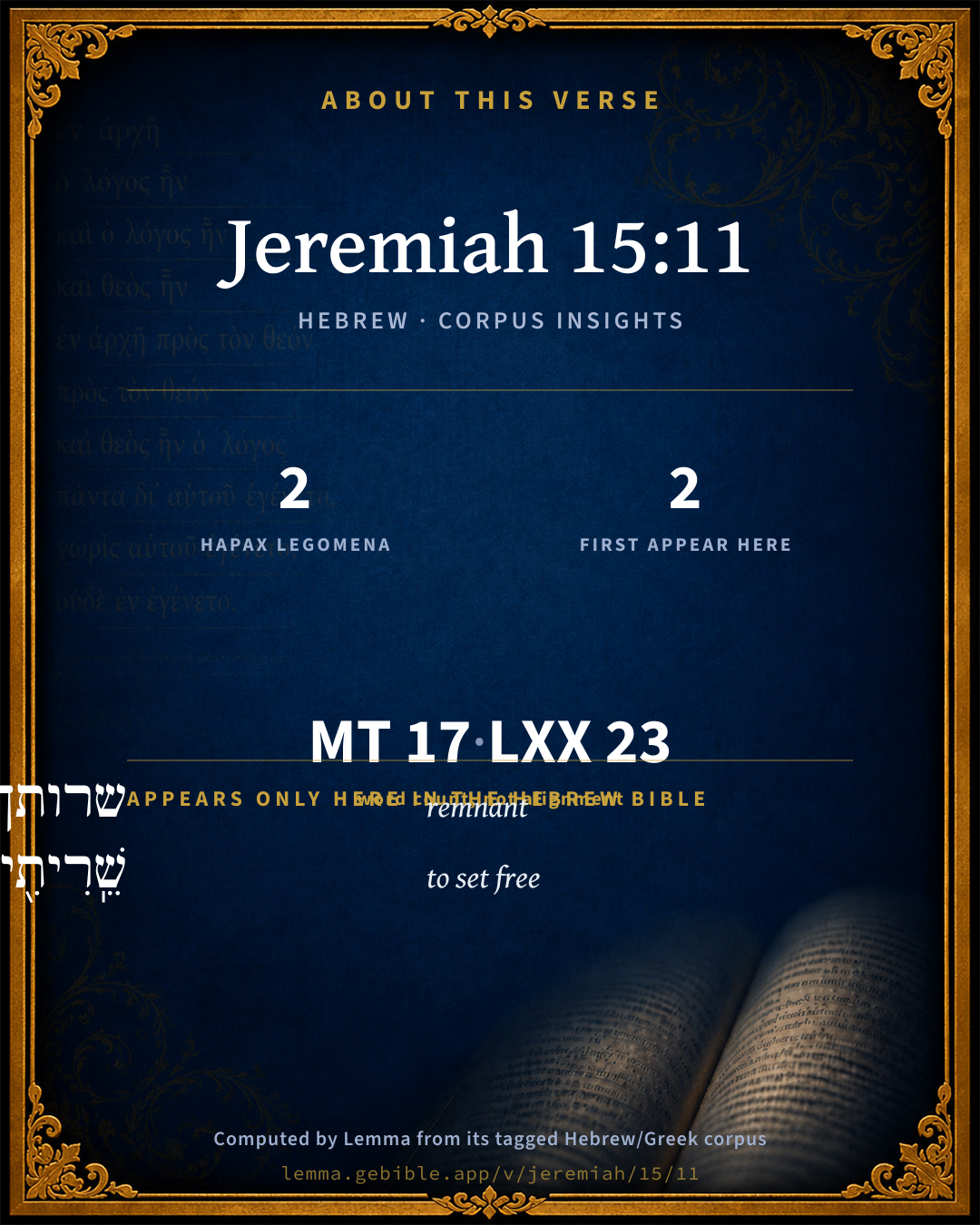
  • 2 hapax legomena — only here in the Hebrew Bible
  • 2 first appearances in the Hebrew Bible
Full analysis ↓
Download a study sheet

One document with this verse’s original text, its word-by-word gloss line, the meaning frame, cross-references with their text, attributed commentary, and full source and license credits — printable, and it pastes into notes with its structure intact.

This verse Autodidact and up

Study sheet (.html) Plain text (.txt)

A passage Seminary Student

Up to 50 verses in one chapter. A passage sheet keeps up to 6 commentary sources and 12 cross-references per verse, in the order this page ranks them, and says so on the sheet whenever that leaves anything out. Ask for a single verse and you get the Autodidact verse sheet above.

Everything on this page stays free to read, with no account — the sheet is a download of what is already on screen, not access to it.

Want to remove ads? Support Godless Engineer
Compare translations 3

The same verse in 3 English versions, stacked beneath the original-language interlinear above. Click any original word for its lexicon entry.

Each is an independent rendering of the whole verse — the interlinear is not word-aligned to these translations.

Highlighted words mark where these versions differ — a whole-verse word diff, not a word-by-word alignment.

  • World English Bible Public Domain
    Yahweh said, Most assuredly I will strengthen you for good; most assuredly I will cause the enemy to make supplication to you in the time of evil and in the time of affliction.
  • King James Version Public Domain
    The LORD said, Verily it shall be well with thy remnant; verily I will cause the enemy to entreat thee well in the time of evil and in the time of affliction.
  • unfoldingWord Literal Text CC BY-SA 4.0
    Yahweh said: “Surely I have loosened you for good; surely I will make the enemy plead with you in the time of disaster and in the time of distress!

unfoldingWord Literal Text — © unfoldingWord, licensed CC BY-SA 4.0. Word-aligned USFM3 via Door43 (git.door43.org/unfoldingWord/en_ult).

Versions to compare (up to 4)

3 of 4 selected

Show all 18 translations

Every available English version of this verse, each an independent rendering of the whole verse.

  • World English Bible Public Domain
    Yahweh said, Most assuredly I will strengthen you for good; most assuredly I will cause the enemy to make supplication to you in the time of evil and in the time of affliction.
  • Berean Standard Bible Public Domain
    The LORD said: “Surely I will deliver you for a good purpose; surely I will intercede with your enemy in your time of trouble, in your time of distress.
  • Majority Standard Bible Public Domain
    The LORD said: “Surely I will deliver you for a good purpose; surely I will intercede with your enemy in your time of trouble, in your time of distress.
  • King James Version Public Domain
    The LORD said, Verily it shall be well with thy remnant; verily I will cause the enemy to entreat thee well in the time of evil and in the time of affliction.
  • American Standard Version (1901) Public Domain
    Jehovah said, Verily I will strengthen thee for good; verily I will cause the enemy to make supplication unto thee in the time of evil and in the time of affliction.
  • Revised Version (1885) Public Domain
    The LORD said, Verily I will strengthen thee for good; verily I will cause the enemy to make supplication unto thee in the time of evil and in the time of affliction.
  • Geneva Bible (1599) Public Domain
    The Lord sayd, Surely thy remnant shall haue wealth: surely I will cause thine enemie to intreate thee in the time of trouble, and in the time of affliction.
  • Douay-Rheims (1899) Public Domain
    The Lord saith to me: Assuredly it shall be well with thy remnant, assuredly I shall help thee in the time of affliction, and in the time of tribulation against the enemy.
  • Young's Literal Translation Public Domain
    Jehovah said, Did I not direct thee for good? Did not I intercede for thee in a time of evil, And in a time of adversity, with the enemy?
  • Literal Standard Version CC BY-SA 4.0
    YHWH said, “Did I not direct you for good? Did I not intercede for you in a time of evil, || And in a time of adversity, with the enemy?
  • Unlocked Literal Bible CC BY-SA 4.0
    Yahweh said: “Will I not rescue you for good? I will certainly make your enemies beg for help in the time of calamity and distress.
  • unfoldingWord Literal Text CC BY-SA 4.0
    Yahweh said: “Surely I have loosened you for good; surely I will make the enemy plead with you in the time of disaster and in the time of distress!
  • Darby Bible Public Domain
    Jehovah said, Verily I will set thee free for [thy] good; verily I will cause the enemy to meet thee kindly in the time of evil and in the time of affliction.
  • World Messianic Bible Public Domain
    The LORD said, “Most certainly I will strengthen you for good. Most certainly I will cause the enemy to make supplication to you in the time of evil and in the time of affliction.
  • Webster's Bible Public Domain
    The LORD said, Verily it shall be well with thy remnant; verily I will cause the enemy to treat thee well in the time of evil and in the time of affliction.
  • Free Bible Version CC BY-SA 4.0
    But the Lord told me: Don't worry, I'm going to take away your problems so you can do good. I will make your enemies plead with you whenever they're in trouble or suffering.
  • Bible in Basic English Public Domain
    ...
  • JPS Tanakh (1917) Public Domain
    The LORD said: 'Verily I will release thee for good; verily I will cause the enemy to make supplication unto thee in the time of evil and in the time of affliction.

Literal Standard Version (2020), Covenant Press — licensed CC BY-SA 4.0. Text via the HelloAO Bible API (eBible.org). Unlocked Literal Bible (unfoldingWord) — licensed CC BY-SA 4.0. Text via the HelloAO Bible API (eBible.org). unfoldingWord Literal Text — © unfoldingWord, licensed CC BY-SA 4.0. Word-aligned USFM3 via Door43 (git.door43.org/unfoldingWord/en_ult). Free Bible Version, Dr. Jonathan Gallagher — licensed CC BY-SA 4.0. Text via the HelloAO Bible API (eBible.org).

Word by word

More ways to search: Search by grammar → Find every occurrence → Compare this word →

Practice this passage: Drill this verse → Learn its vocabulary →

שרותך
shêrûwth
H8293
“remnant · you”
Verb, Qal, Perfect, 1st Person, Common, Singular + Suffix, Personal, 2nd Person, Masculine, Singular
Part of Speech
Verb
Stem
Qal
Form
Perfect
Person
1st Person
Gender
Common
Number
Singular
Full BDB Definition

Origin: from H8281 abbreviated

TWOT: 2463

remnant
  1. אָמַ֣ר ʼâmar H559 “to say” Verb, Qal, Perfect, 3rd Person, Masculine, Singular
  2. יְהוָ֔ה Yᵉhôvâh H3068 “LORD” Noun, Proper
  3. אִם ʼim H518 “if” Conjunction
  4. לֹ֥א lôʼ H3808 “not” Particle, Negative
  5. שֵֽׁרִיתִ֖יךָ shârâh H8281 “to set free · you” Verb, Piel, Perfect, 1st Person, Common, Singular + Suffix, Personal, 2nd Person, Masculine, Singular
  6. לְט֑וֹב ṭôwb H2896 “to/for · good” Preposition + Adjective, Adjective, Masculine, Singular, Absolute
  7. אִם ʼim H518 “if” Conjunction
  8. ל֣וֹא lôʼ H3808 “not” Particle, Negative
  9. הִפְגַּ֣עְתִּֽי pâgaʻ H6293 “to meet” Verb, Hiphil, Perfect, 1st Person, Common, Singular
  10. בְּעֵ֥ת ʻêth H6256 “in/at · time of” Preposition + Noun, Common, Both, Singular, Construct
  11. רָעָ֛ה raʻ H7451 “evil” Adjective, Adjective, Feminine, Singular, Absolute
  12. וּבְעֵ֥ת ʻêth H6256 “and · in/at · time of” Conjunction + Preposition + Noun, Common, Both, Singular, Construct
  13. צָרָ֖ה tsârâh H6869 “distress” Noun, Common, Feminine, Singular, Absolute
  14. אֶת ʼêth H853 “-” Particle, Direct Object
  15. הָאֹיֵֽב ʼôyêb H341 “the · enemy” Particle, Definite Article + Verb, Qal, Participle Active, Masculine, Singular, Absolute

About this verse

These counts appear in no published source. They are computed here, from the morphology-tagged text and Lemma’s own curated glosses. What Lemma adds →

17
words
13
distinct lemmas
Prophets
section

Notable vocabulary

2 hapax legomena — words that appear only here in the entire Hebrew Bible:

  • שרותך remnant H8293
  • שֵֽׁרִיתִ֖יךָ to set free H8281

First appearance in Scripture

These words make their first canonical appearance in the Hebrew Bible here:

  • שרותך remnant H8293
  • שֵֽׁרִיתִ֖יךָ to set free H8281

Shared distinctive vocabulary

הִפְגַּ֣עְתִּֽי to meet H6293 occurs in 43 verses of the Hebrew Bible. Also found in:

Grammatical profile

  • 5 verbs
  • 4 nouns
  • 2 adjectives
  • 1 preposition
  • 2 conjunctions
  • 3 particles

Verb forms

  • אָמַ֣ר Qal · Perfect
  • שרותך Qal · Perfect
  • שֵֽׁרִיתִ֖יךָ Piel · Perfect
  • הִפְגַּ֣עְתִּֽי Hiphil · Perfect
  • הָאֹיֵֽב Qal · Participle Active

Repetition

Words recur within this verse — often emphatic in Hebrew:

  • בְּעֵ֥ת time H6256 ×2
  • אִם if H518 ×2
  • לֹ֥א not H3808 ×2

Hebrew & Septuagint length

In the original languages it is 17 Hebrew tokens and 23 Greek tokens — but the two are counted differently (Hebrew bundles its prefixes and suffixes into one token; the Greek is in lemma form), so that isn’t a like-for-like length.

Cross-references

11

Topical passages linked to Jeremiah 15:11 in the Treasury of Scripture Knowledge — connected by theme and wording, ordered by reader-vote popularity; previews shown in the World English Bible.

  • Proverbs 16:7 When a man's ways please Yahweh, He makes even his enemies to be at peace with him.
  • Jeremiah 29:11–14 For I know the thoughts that I think toward you, says Yahweh, thoughts of peace, and not of evil, to give you hope in your latter end.
  • Psalms 106:46 He made them also to be pitied By all those who carried them captive.
  • Psalms 37:3–11 Trust in Yahweh, and do good. Dwell in the land, and enjoy safe pasture.
  • Ecclesiastes 8:12 Though a sinner commits crimes a hundred times, and lives long, yet surely I know that it will be better with those who fear God, who are reverent before him.
  • Jeremiah 37:3 Zedekiah the king sent Jehucal the son of Shelemiah, and Zephaniah the son of Maaseiah, the priest, to the prophet Jeremiah, saying, Pray now to Yahweh our God for us.
  • Jeremiah 21:2 Please inquire of Yahweh for us; for Nebuchadrezzar king of Babylon makes war against us: peradventure Yahweh will deal with us according to all his wondrous works, that he may go up from us.
  • Jeremiah 40:2–6 The captain of the guard took Jeremiah, and said to him, Yahweh your God pronounced this evil on this place;
  • Jeremiah 42:2 and said to Jeremiah the prophet, Let, we pray you, our supplication be presented before you, and pray for us to Yahweh your God, even for all this remnant; for we are left but a few of many, as your eyes do see us:
  • Proverbs 21:1 The king's heart is in Yahweh's hand like the watercourses. He turns it wherever he desires.
  • Jeremiah 39:11–12 Now Nebuchadrezzar king of Babylon gave charge concerning Jeremiah to Nebuzaradan the captain of the guard, saying,

Cross-references courtesy of OpenBible.info (CC BY 4.0).

Hebrew and Greek witnesses Masoretic Hebrew ↔ Greek Septuagint

The same verse in the two great witnesses to the Old Testament, shown verse-for-verse.

These are two independent witnesses, not word-aligned to each other, and the Septuagint is shown in lemma (dictionary) form.

Hebrew Jeremiah 15:11 Masoretic · Westminster Leningrad Codex

אָמַ֣ר יְהוָ֔ה אִם לֹ֥א שרותך שֵֽׁרִיתִ֖יךָ לְט֑וֹב אִם ל֣וֹא הִפְגַּ֣עְתִּֽי בְךָ֗ בְּעֵ֥ת רָעָ֛ה וּבְעֵ֥ת צָרָ֖ה אֶת הָאֹיֵֽב

Yahweh said, Most assuredly I will strengthen you for good; most assuredly I will cause the enemy to make supplication to you in the time of evil and in the time of affliction.

World English Bible · Public Domain

Greek LXX Structure differs

In the Septuagint, Jeremiah is about an eighth shorter than the Hebrew and arranges its material differently — the Oracles Against the Nations (Hebrew chapters 46–51) appear in the middle of the Greek book, after 25:13. Because the chapter and verse boundaries do not line up, a verse-for-verse comparison with the Hebrew is not shown.

A verse-for-verse comparison isn’t shown here because the chapters and verses don’t line up. Switch to the LXX edition with the MT / LXX toggle above to read the Greek directly.

On this verse, The Cambridge Bible for Schools and Colleges discusses the Septuagint’s reading. Read the note in Commentary ↓

Hebrew: Westminster Leningrad Codex (CC BY 4.0). Greek: Septuagint (public domain); English from a public-domain English Septuagint. How the Septuagint differs from the Hebrew →

Targum (Aramaic paraphrase)

1

The Targum is the ancient Jewish Aramaic paraphrase of the Hebrew Scriptures — an interpretive translation, not the Hebrew text itself. Onkelos (literal) and Pseudo-Jonathan (expansive) render the Torah, and Jonathan the Prophets. Coverage is partial: where no permissively-licensed English translation exists for a verse, only the Aramaic is shown. This is verse-level text, not a word-by-word alignment to the Hebrew.

  1. Targum Jonathan Prophets (Joshua–Malachi)
    אֲמַר יְיָ אִם לָא סוֹפֵךְ יְהֵא לְטַב אִם לָא יֵיתוּן וְיִבְעוֹן מִנָךְ בְּעִדַן דְאַיְתִי עֲלֵיהוֹן סַנְאָה וְיָעִיק לְהוֹן בָּעֵיל דְבָבָא:

    (no public-domain English translation for this verse)

    Targum Jonathan — Aramaic: “Mikraot Gedolot” (public domain). English: “Sefaria Community Translation” (CC0 1.0 (public-domain dedication)); “London "Chaldee Paraphrase," 1871” (public domain). Text via Sefaria.

Commentary

Notes on Jeremiah 15:11 from classic Christian and Jewish commentators (each source and its license shown beneath its notes). The classic Christian expositions comment on the surrounding passage and are grouped to its opening verse, so a note may address several verses; the Jewish commentaries on the Tanakh (Rashi and others) are per-verse, so they appear only where the commentator wrote on this verse.

Lemma curates 59 commentaries, every one of them public domain or Creative Commons licensed, each selected and text-cleaned for this edition rather than reprinted as found. About our sources →

Trapp's Complete Commentary

John Trapp

Jer 15:11 The LORD said, Verily it shall be well with thy remnant; verily I will cause the enemy to entreat thee [well] in the time of evil and in the time of affliction.

Ver. 11. Verily it shall be well with thy remnant.] Heb., If it be not well, q.d., then trust me no more; thy latter end shall be comfortable; {Psa 37:37} the end of that man is peace, be his beginning and middle never so troublesome.

Verily I will cause the enemy to entreat thee well.] Or, I will intercede for thee with the enemy. See this fulfilled, Jer 40:4. God can speak for his in the hearts of their enemies, and make their foes to favour them, as many of the Papists here did Wycliffe, and after him Bradford.

John Trapp, A Commentary or Exposition upon All the Books of the Old and New Testament (1647–1656) — public domain. Text from a community e-Sword module.

Scofield Reference Notes

C. I. Scofield

the Lord said

The Remnant, of whom Jeremiah was the representative, are carefully distinguished from the unbelieving mass of the people. The coming captivity, which they must share, for they too have sinned Jer 15:13 though Jehovah’s judgment upon the nation, will be but a purifying chastisement to them, and they receive a special promise Jer 15:11. Verses Jer 15:15-18 give the answer of the Remnant to verses Jer 15:11-14. Two things characterize the believing Remnant always-loyal to the word of God, and separation from those who mock at that word Jer 15:16; Jer 15:17 Cf. Rev 3:8-10.

The Scofield Reference Bible (1917 edition), notes by C. I. Scofield — public domain. Text from a community e-Sword module.

Tyndale Open Study Notes

Tyndale Open Resources

15:11-14 The Lord replied to Jeremiah’s lament with reassurance and then explained what would be happening soon.

15:11 When trouble and distress fell upon the people, they would ask Jeremiah to plead on their behalf.

Tyndale Open Study Notes — © Tyndale Open Resources, licensed CC BY-SA 4.0. Text via the HelloAO Bible API.

Geneva Bible (1599)

Geneva Bible translators

In this perplexity the Lord comforted me, and said that my last days should be quiet: and by the enemy he meaneth here, Nebuzaradan the captain of Nebuchadnezzar, who gave Jeremiah the choice either to remain in his country, or to go whither he would: or by the enemy he meaneth the Jews, which should afterward know Jeremiah’s fidelity, and therefore favor him.

Geneva Bible (1599) marginal notes — public domain. Text via Bolls.life.

Jamieson, Fausset & Brown

Robert Jamieson, A. R. Fausset & David Brown

Verily--literally, "Shall it not be?" that is, "Surely it shall be."

thy remnant--the final issue of thy life; thy life, which now seems to thee so sad, shall eventuate in prosperity [CALVIN]. They who think that they shall be the surviving remnant, whereas thou shalt perish, shall themselves fall, whereas thou shalt remain and be favored by the conquerors [JUNIUS], (Jer 40:4-5; Jer 39:11-12). The Keri reads, "I will set thee free (or as MAURER, 'I will establish thee') for good" (Jer 14:11; Ezr 8:22; Psa 119:122).

to entreat thee well--literally, "to meet thee"; so "to be placable, nay, of their own accord to anticipate in meeting thee with kindness" [CALVIN]. I prefer this translation as according with the event (Jer 39:11-12; Jer 40:4-5). GESENIUS, from Jer 7:16; Jer 27:18; Job 21:15, translates (not only will I relieve thee from the enemy's vexations, but) "I will make thine enemy (that now vexeth thee) apply to thee with prayers" (Jer 38:14; Jer 42:2-6).

Jamieson, Fausset & Brown — Commentary Critical and Explanatory on the Whole Bible (1871) — public domain (CC PDM 1.0). Text via the HelloAO Bible API.

Adam Clarke's Commentary

Verse 11. I will cause the enemy to entreat thee well in the time of evil] This was literally fulfilled; see Jer 39:11, &c. Nebuchadnezzar had given strict charge to Nebuzar-adan, commander in chief, to look well to Jeremiah, to do him no harm, and to grant him all the privileges he was pleased to ask.

Adam Clarke's Commentary on the Bible (1810–1826) — public domain. Text from a community e-Sword/MySword module.

John Calvin's Commentaries

God at the beginning of this verse no doubt intimates that he would be propitious to his servant, and grant him what he asked. We then conclude that the Prophet’s prayer was heard; and hence also becomes manifest what I have stated, that the Prophet was not so led away by the force of grief, but that he chiefly regarded the benefit of the people. God then was so propitious to his request, that he said that it would be well with his remnant, that what remained would be blessed.

Interpreters differ as to the second clause: some apply what is said to the people, I will make the enemy to meet thee in the time of evil, and in the time of trouble: and so they take this view, that God at the beginning of the verse answers the Prophet, and intimates that his request was accepted, so that there would be a better and happier end than what then appeared; and they think that God then turns his discourse to the people, “With regard to you, I will make the enemy to meet you in the day of affliction.” But this explanation seems forced. I prefer to regard the whole verse as addressed to the Prophet. God promises first that his remnant would be prosperous; and by remnant he means the remaining time or the end of life, as though he had said, “I will at length have pity on thee, so that the things which cause thee the greatest grief shall turn into joy: thine end then shall be more prosperous than thou thinkest.” Then the words which follow confirm the previous sentence: for the Prophet might have objected and said, “Then either the people shall be delivered from all trouble, or I shall not escape a part of the calamity.” To this God replies and says, “Thou and others nmst suffer many things, but I will make the enemy to meet thee, that is, I will make the enemy to be propitious to thee, and even of his own accord to anticipate thee.

Interpreters differ still farther respecting the verb הפגעתי epegoti; some regard it in a transitive sense, “To meet thee will I make the enemy;” others render the sentence thus, “I will meet the enemy for thee,” or, “I will cause the enemy to ask for thee.” The verb, פגע pego, means sometimes to meet, either in a good or bad sense; as when one goes as an enemy against another, he is said to meet him; or, when one offers help and shews kindness to another, he is said to meet him. But the word has another meaning, and signifies sometimes to ask, and so some take it here, “I will cause the enemy to ask for thee.” But this is far — fetched: God did not send messengers to pacify the Babylonians towards his servant Jeremiah. I prefer to render the words thus, “I will meet the enemy for thee,” or, “I will cause the enemy to meet thee;” that is, “I will pacify him by my secret influence, so that he will of himself spare thee and treat thee kindly.” And we know that it so happened; for Jeremiah was loosed from his chains and was allowed his liberty, so that he was permitted to go wherever he wished. As then the enemies treated him with so nmch kindness, it appears evident that what God had before promised was fulfined.

As to the main thing intended, there is no ambiguity in the words: God promised that the latter end of Jeremiah would be happy, and that though he was to suffer somewhat in the common calamity of the whole people, yet the enemy would treat him kindly, so that his condition would be better and more desirable than that of others.

But why did Jeremiah make this public? why did he give this description? why did he commit it to writing? even that the Jews might understand that they who harassed him, when he had done them no injury, dealt unjustly with him. They had indeed been excited by him, but it was through what his office required, for he could not deny obedience to God. Jeremiah then made public what God only knew before, that he might produce an impression on them, provided any hope of repentance yet remained. And for the same reason also was the promise of God added; for the Jews ought to have been terrified, when they saw that such an end was promised by God to the Prophet; for what must have happened to them, except the curse of God to the utter-most? We hence see, that in the complaint of the Prophet, and in the answer given by God, the salvation of the people was regarded; for the complaint contains a most severe reproof and the answer of God threatens a most dreadful judgment to the rebellious people. It follows —

John Calvin's Commentaries (1540-1563) — public domain. Text from the Calvin Translation Society English edition (1840s-50s) via the Christian Classics Ethereal Library (ccel.org). Calvin's coverage is partial (roughly two-thirds of the Bible); uncommented books and verses are honest gaps, never fabricated. The 19th-century editor's footnotes and remarks are omitted so the notes are faithfully Calvin's own voice.

Ellicott's Commentary for English Readers

(11) Verily it shall be well with thy remnant.—The passage is obscure, and the reading uncertain; (1) Thy freedom shall be for good, or (2) I afflict thee for thy good, or (3) I strengthen thee for thy good, have been proposed as better renderings. The second seems to give the meaning most in harmony with the context. Jehovah comforts the despairing prophet by the promise that in due time there shall be a deliverance from the discords of his life, and that “all things shall work together for his good.”

I will cause the enemy to entreat thee well.—The final adverb, which is not found in the Hebrew, obscures the sense, suggesting the English phrase of “treating well.” Better, I will cause the enemy to be a suppliant to thee in time of evil. Partial fulfilments of the promise are found in Jer_21:1; Jer_37:3; Jer_42:2.

A Bible Commentary for English Readers, edited by Charles John Ellicott (1878–1897) — public domain. Text from a community e-Sword module.

The Cambridge Bible for Schools and Colleges

gen. ed. J. J. S. Perowne

11. The v. is difficult without applying considerable conjectural emendation. The whole is best taken as Jeremiah’s utterance. “The Lord said “is not a formula which elsewhere in Jeremiah introduces a Divine utterance. The LXX’s rendering of the passage, however, suggests that their text had the usual formula. The verb translated “strengthen” is not pure Heb. but Aramaic. Jer_15:10 seems to want rather an assertion that the prophet on his side had deserved the reverse of revilings from the people. Hence Co. with certain changes in MT. renders “Amen, Jehovah, to their curses, if I did not make intercession with Thee for the enemy’s welfare at the time of their misfortune and need.”

strengthen] mg. suggests release, which is perhaps the meaning of the reading in MT. R.V. text follows the mg. of MT.

I will cause, etc.] mg. I will intercede for thee with the enemy. But see above.

The Cambridge Bible for Schools and Colleges (gen. ed. J. J. S. Perowne; Cambridge University Press, 1878–1918) — public domain. Text from a community e-Sword module.

John Gill's Exposition

The Lord said,.... In answer to the prophet's complaint:

verily it shall be well with thy remnant: not with the remnant of his people, or those that should escape the threatened calamities; but the sense is, that it should be well with him in his latter end; the remainder of his days should be comfortable or be spent in peace and prosperity; and so the Targum,

"if thine end shall not be for good.''

The words are in the form of an oath, as Kimchi and Ben Melech observe; and the meaning is, that if it is not well with thee in thy last days, then say I am unfaithful, and not true to my word. According to Donesh, cited by Jarchi, the word translated "remnant" has the signification of loosing; and he renders it, "if I loose thee not for good" (m); which accordingly was done, Jer 40:4, and this sense is confirmed by the note of the Masorites: "verily I will cause the enemy to entreat thee well"; or, "if I do not", &c. for it is also in the form of an oath, as before, as Jarchi notes; and so it was, Nebuchadnezzar gave charge to Nebuzaradan, the captain of the guard, to look well to him, and do him no harm; who, when he loosed him, gave him his choice to go with him to Babylon, or continue in the land, Jer 39:11, or, "verily I will", or, "shall I not entreat the enemy for thee?" (n) and make him gentle and humane, so that he shall use thee kindly. Jarchi interprets this of Zedekiah and his courtiers seeking to Jeremiah, in the time of their distress, to pray for them, Jer 37:2, and to which sense the Targum inclines,

"if they shall not come and help thee, &c.''

in the time of evil, and in the time of affliction; when the city is taken, and the people carrying captive.

(m) "si non absolvero te in bonum", Schmidt. Vid. De Dieu in loc. (n) "sed faciam hostem occurrere tibi", Calvin: "annon intervenirem pro te apud inimicum?" Junius & Tremellius; "nisi interveniam pro te apud inimicum", Piscator.

John Gill's Exposition of the Whole Bible (1746–1763) — public domain (CC PDM 1.0). Text via the HelloAO Bible API.

Albert Barnes' Notes on the Bible

Shall be well with thy remnant - Or, thy loosing shall be for good; in the sense of being set free, deliverance.

To entreat thee well ... - Rather, “to supplicate thee in the time of evil etc.;” fulfilled in Jer 21:1-2; Jer 37:3; Jer 42:2.

Albert Barnes' Notes on the Bible (1834–1885) — public domain. Text from a community e-Sword/MySword module.

Haydock's Catholic Bible Commentary

Remnant; posterity, (Calmet) or rather possessions, as the prophet never married, chap. xvi. 2. (Haydock) --- God assures him that he shall be protected. (Menochius) --- The Chaldeans treated him with respect, chap. xxxix. 2., and xl. 1. Sedecias and the people had often recourse to him. Chaldean, "They will come to intreat thee, when the enemy shall straiten them." (Calmet)

George Leo Haydock (1774–1849), Haydock's Catholic Family Bible and Commentary, 1859 edition — public domain. Excludes Psalms (Douay-Rheims chapter numbering differs from Protestant) and Deuterocanonical books (Catholic canon only).

Matthew Poole's English Annotations

The latter words of the verse expound the former; for by remnant is here meant the residue or remnant of days Jeremiah had yet to live, not the remnant of the people who should come out of Babylon.

I will cause the enemy to entreat thee well in the time of evil and in the time of affliction; I will, by my providence, so order it, that how cruelly and severely soever the enemy deals with thy country, yet he shall use thee kindly when he shall take the city. See the fulfilling of this prophecy Jer 39:11; 40:3,4.

Matthew Poole's English Annotations on the Holy Bible (1683–1685) — public domain. Text from a community e-Sword/MySword module.

Whedon's Commentary on the Bible

Daniel D. Whedon

11. It shall be well with thy remnant — The passage is exceedingly difficult. This difficulty pressed upon the Jews themselves, for the keri is manifestly a struggle for relief. Many translations have been given, for the most important of which see the critical note of Nagelsbach in loc. The following deserve mention: “I afflict thee for thy good,” Gesenius, Meyer, Nagelsbach. “I will strengthen thee for good,” Ewald, Keil. “I will loose thee for good,” Furst, Rosenmuller. Of these the last is preferable, both on the score of etymology and sense, combining, as it does, substantially both the kethil and keri. The word occurs elsewhere only in Job_37:3, where it applies to the lightning, and is rendered in the English version “directeth,” but probably should be translated hath set loose.

To entreat thee well — Rather, to supplicate thee, a prophecy which was literally fulfilled. See Jer_21:1, etc.; Jer_37:3; Jer_38:14, etc.; Jer_43:2.

Daniel D. Whedon (gen. ed.), Commentary on the Old and New Testaments (1874–1909) — public domain. Text from a community e-Sword module.

The Pulpit Commentary

The Lord said. The prophets are usually so tenacious of the same formulae that even their slight deviations are noteworthy. "The Lord said," for "Thus saith the Lord," occurs only here and in Jer_46:25 (where, however, the phrase has possibly been detached by mistake from the preceding verse). It shall be well with thy remnant; rather, I have loosed thee for (thy) good, or, thy loosing (shall be) for (thy good), according as we adopt the reading of the Hebrew text or that of the margin, which differs in form as slightly as it is possible to do. If we accept the historical setting proposed by Gratz for this paragraph, the reference will be to the "loosing" of Jeremiah from his chains mentioned in Jer_40:4. The rendering given here is, however, only a probable one; it is in conformity with the Aramaic usage of the verb, (the Targum uses it in this sense in Jer_40:4) and is supported by its suitability to the context and, philologically, by the fact of the growing influence of Aramaic upon Hebrew. Gesenius, in his anxiety to keep close to the native use of the root, produces a rendering (of the Hebrew marginal reading) which does not suit the context, viz. "I afflict thee for (thy) good." Jeremiah does not complain of being afflicted by God, but that all the world is against him; Ewald, comparing a different Aramaic verb to that appealed to above, renders, "I strengthen thee," etc., which is adopted by Keil, but does not accord with the second half of the verse so well as the rendering adopted. The Authorized Version follows the Targum, the Vulgate, Aquila, Symmachus, Rashi, and Kimchi, assuming that sherith is contracted from sh"erith, (as in 1Ch_12:38) and that "remnant" is equivalent to "remnant of life." But, though the sense is not unacceptable (comp. Vers. 20, 21), the form of expression is unnatural; we should have expected akharith"ka, "thy latter end". (comp. Job_8:7) I will cause the enemy to entreat thee well. This expression is as difficult as the preceding, and our rendering of it will depend entirely on our view of the context. If "the enemy" means the Chaldeans, the Authorized Version will be substantially correct. Rashi has already mentioned the view that the phrase alludes to Nebnzar-adan"s respectful inquiry as to the wishes of Jeremiah in Jer_40:2-5. In this ease, the literal rendering is, I will cause the enemy to meet thee (as a friend); comp. Isa_47:3 Isa_64:4. But if "the enemy" means the Jews, then we must render, I grill cause the enemy to supplicate thee , and illustrate the phrase by the repeated applications of Zedekiah to the prophet, (Jer_21:1, 2 37:3 38:14) and the similar appeal of the "captains of the forces," in Jer_42:1-3.

The Pulpit Commentary (1880–1919), ed. H.D.M. Spence-Jones & Joseph S. Exell — public domain. Text from a community e-Sword module.

John Wesley's Explanatory Notes

Thy remnant - The latter words of the verse expound the former; for by remnant is meant the remnant of days that Jeremiah had to live.

John Wesley, Explanatory Notes Upon the Whole Bible (1754–1765) — public domain. Text via the GEBible commentary corpus.

Rashi

Rabbi Shlomo Yitzchaki (Rashi)

1 leave you over I leave you over, an expression of a remnant. In this manner, Menahem (Machbereth p. 181) interpreted it, but Dunash (Teshuvoth Dunash p. 36) interpreted it as an expression of release. And שֵרִיתִיךָ is like (Dan. 5:12) “And untying (וּמְֹשָרֵא) knots,” and the interpretation of שֵרִיתִיךָ is so, as it is stated (below 40:4): “Behold I have released you from the chains that are on your hand.” That is to say, on that day that the Lord fulfilled His word, it was said to him, “And now, behold I have released you today from the chains that are on your hand, if it pleases you to come with me to Babylon.” And also, Israel begged him to pray for them, as it was said to him (below 42:4): “Pray on our behalf to the Lord our Cod, for we remain few from many.”

Verily I will lit., if not, an expression of an oath.

I will cause [them] to beg you in time of evil with the enemy. When evil befalls them, they will beg you to supplicate God for mercy upon them, for example, Zedekiah said to him, (below 21:2) “Beseech God now on our behalf, etc.” Another explanation. Nebuzaradan will beg you (below 40:4), “If it pleases you to come with me to Babylon.”

Rashi on the Tanakh — English translations: “The Judaica Press complete Tanach with Rashi, translated by A. J. Rosenberg” (CC BY 4.0); “Pentateuch with Rashi's commentary by M. Rosenbaum and A.M. Silbermann, 1929-1934” (public domain); “The Metsudah Tanach series, Lakewood, N.J” (CC BY 4.0); and “The Book of Joshua, Metsudah Publications, 1997” (CC BY 4.0). Text via Sefaria.

Lesson kit

Teaching starters — assembled from the data on this page, not authored interpretation. Every prompt links to the verse data it draws on. Edit before teaching.

Jeremiah, in the Prophets, opens this verse with 17 words (13 distinct Hebrew lemmas). Its most distinctive word is shêrûwth (“remnant”). A historical commentator’s framing appears above. Read the whole chapter for the surrounding context.

Discussion questions

  1. What does “remnant” (shêrûwth) contribute to the verse as a whole?
  2. 2 words here appear nowhere else in the Hebrew Bible. Why might the author reach for such rare wording?
  3. 2 words make their first appearance in Scripture here. What does this debut establish?
  4. How does Genesis 23:8, which shares the word «to meet», read alongside this verse?
  5. What does the repetition of “time” (2× in this one verse) do in this verse?
  6. These translations render this verse differently; the difference is in the English rendering, not the original. What questions does that raise?
  7. «אָמַ֣ר» is a Qal Perfect verb. How does that grammatical form shape the action described?
  8. Compare how Trapp's Complete Commentary and Scofield Reference Notes read this verse. Where do they agree or differ?

Things to notice

  • 2 words in this verse appear nowhere else in the Hebrew Bible.
  • 2 words make their first canonical appearance in Scripture here.
  • This verse counts 17 Hebrew ↔ 23 Greek words.
  • These translations choose different wording for 23 words in this verse.
  • “time” occurs 2× in this single verse.

Reading settings

Reading text

Shown beneath each verse's original-language words.

Old Testament
Old Testament edition

Read the OT as the Masoretic Hebrew (MT) or the Greek Septuagint (LXX).

English shown for the Greek Septuagint (in the Hebrew ↔ Greek comparison).

Comparing translations? Open the Compare panel on any verse page to stack up to four side by side.