
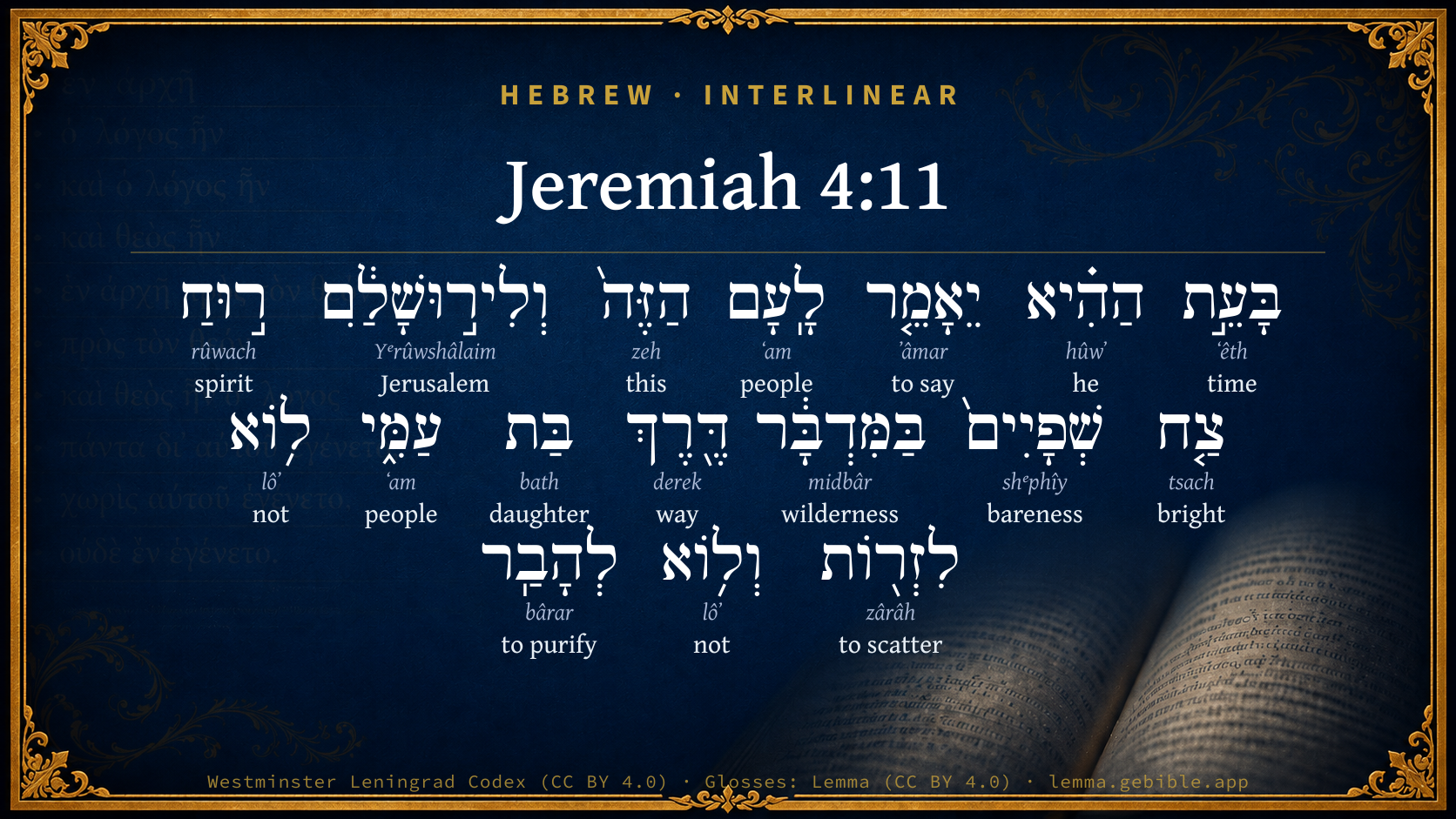
Jeremiah 4:11

Hebrew (Westminster Leningrad Codex) Jeremiah 4:11 appears in the Hebrew Old Testament. The text above is from the Westminster Leningrad Codex. Each word links to its Strong’s number, a concise gloss, and parsing drawn from the Open Scriptures Hebrew Bible morphology. Click any word for its full Brown-Driver-Briggs (BDB) entry.
Download image
Cite this verse

Jeremiah 4:11 (World English Bible). Public Domain. Lemma interlinear Bible study tool, https://lemma.gebible.app/v/jeremiah/4/11.

Show BibTeX & RIS
BibTeX
RIS
English Translation
At that time shall it be said to this people and to Jerusalem, A hot wind from the bare heights in the wilderness toward the daughter of my people, not to winnow, nor to cleanse;
World English Bible · Public Domain
Download a study sheet

One document with this verse’s original text, its word-by-word gloss line, the meaning frame, cross-references with their text, attributed commentary, and full source and license credits — printable, and it pastes into notes with its structure intact.

This verse Autodidact and up

Study sheet (.html) Plain text (.txt)

A passage Seminary Student

Up to 50 verses in one chapter. A passage sheet keeps up to 6 commentary sources and 12 cross-references per verse, in the order this page ranks them, and says so on the sheet whenever that leaves anything out. Ask for a single verse and you get the Autodidact verse sheet above.

Everything on this page stays free to read, with no account — the sheet is a download of what is already on screen, not access to it.

Want to remove ads? Support Godless Engineer
Compare translations 3

The same verse in 3 English versions, stacked beneath the original-language interlinear above. Click any original word for its lexicon entry.

Each is an independent rendering of the whole verse — the interlinear is not word-aligned to these translations.

Highlighted words mark where these versions differ — a whole-verse word diff, not a word-by-word alignment.

  • World English Bible Public Domain
    At that time shall it be said to this people and to Jerusalem, A hot wind from the bare heights in the wilderness toward the daughter of my people, not to winnow, nor to cleanse;
  • King James Version Public Domain
    At that time shall it be said to this people and to Jerusalem, A dry wind of the high places in the wilderness toward the daughter of my people, not to fan, nor to cleanse,
  • unfoldingWord Literal Text CC BY-SA 4.0
    At that time it will be said to this people and to Jerusalem, “A searing wind of the bare hills in the wilderness—the way of the daughter of my people, not to winnow and not to cleanse,

unfoldingWord Literal Text — © unfoldingWord, licensed CC BY-SA 4.0. Word-aligned USFM3 via Door43 (git.door43.org/unfoldingWord/en_ult).

Versions to compare (up to 4)

3 of 4 selected

Show all 18 translations

Every available English version of this verse, each an independent rendering of the whole verse.

  • World English Bible Public Domain
    At that time shall it be said to this people and to Jerusalem, A hot wind from the bare heights in the wilderness toward the daughter of my people, not to winnow, nor to cleanse;
  • Berean Standard Bible Public Domain
    At that time it will be said to this people and to Jerusalem, “A searing wind from the barren heights in the desert blows toward the daughter of My people, but not to winnow or to sift;
  • Majority Standard Bible Public Domain
    At that time it will be said to this people and to Jerusalem, “A searing wind from the barren heights in the desert blows toward the daughter of My people, but not to winnow or to sift;
  • King James Version Public Domain
    At that time shall it be said to this people and to Jerusalem, A dry wind of the high places in the wilderness toward the daughter of my people, not to fan, nor to cleanse,
  • American Standard Version (1901) Public Domain
    At that time shall it be said to this people and to Jerusalem, A hot wind from the bare heights in the wilderness toward the daughter of my people, not to winnow, nor to cleanse;
  • Revised Version (1885) Public Domain
    At that time shall it be said to this people and to Jerusalem, A hot wind from the bare heights in the wilderness toward the daughter of my people, not to fan, nor to cleanse;
  • Geneva Bible (1599) Public Domain
    At that time shall it bee saide to this people and to Ierusalem, A dry winde in the hie places of the wildernes commeth towarde ye daughter of my people, but neither to fanne nor to clense.
  • Douay-Rheims (1899) Public Domain
    At that time it shall be said to this people, and to Jerusalem: A burning wind is in the ways that are in the desert of the way of the daughter of my people, not to fan, nor to cleanse.
  • Young's Literal Translation Public Domain
    At that time it is said of this people, And of Jerusalem: `A dry wind of high places in the wilderness,' The way of the daughter of My people, (Not for winnowing, nor for cleansing,)
  • Literal Standard Version CC BY-SA 4.0
    At that time it is said of this people, || And of Jerusalem: “A dry wind of high places in the wilderness, || The way of the daughter of My people || (Not for winnowing, nor for cleansing),
  • Unlocked Literal Bible CC BY-SA 4.0
    In that time it will be said of this people and Jerusalem, “A burning wind from the plains of the desert will make its way to the daughter of my people. It will not winnow or cleanse them.
  • unfoldingWord Literal Text CC BY-SA 4.0
    At that time it will be said to this people and to Jerusalem, “A searing wind of the bare hills in the wilderness—the way of the daughter of my people, not to winnow and not to cleanse,
  • Darby Bible Public Domain
    At that time shall it be said to this people and to Jerusalem, A hot wind [cometh] from the heights in the wilderness, on the way of the daughter of my people, not for fanning, nor for cleansing.
  • World Messianic Bible Public Domain
    At that time it will be said to this people and to Jerusalem, “A hot wind blows from the bare heights in the wilderness toward the daughter of my people, not to winnow, nor to cleanse.
  • Webster's Bible Public Domain
    At that time shall it be said to this people and to Jerusalem, A dry wind of the high places in the wilderness towards the daughter of my people, not to fan, nor to cleanse,
  • Free Bible Version CC BY-SA 4.0
    At that time the people of Jerusalem will be told, “A burning wind from the bare hills of the desert is blowing toward Jerusalem, but not to blow away the chaff or the dust.
  • Bible in Basic English Public Domain
    At that time it will be said to this people and to Jerusalem, A burning wind from the open hilltops in the waste land is blowing on the daughter of my people, not for separating or cleaning the grain;
  • JPS Tanakh (1917) Public Domain
    At that time shall it be said of this people and of Jerusalem; A hot wind of the high hills in the wilderness toward the daughter of My people, not to fan, nor to cleanse;

Literal Standard Version (2020), Covenant Press — licensed CC BY-SA 4.0. Text via the HelloAO Bible API (eBible.org). Unlocked Literal Bible (unfoldingWord) — licensed CC BY-SA 4.0. Text via the HelloAO Bible API (eBible.org). unfoldingWord Literal Text — © unfoldingWord, licensed CC BY-SA 4.0. Word-aligned USFM3 via Door43 (git.door43.org/unfoldingWord/en_ult). Free Bible Version, Dr. Jonathan Gallagher — licensed CC BY-SA 4.0. Text via the HelloAO Bible API (eBible.org).

Word by word

More ways to search: Search by grammar → Find every occurrence → Compare this word →

Practice this passage: Drill this verse → Learn its vocabulary →

צַ֤ח
tsach
H6703
“bright”
Adjective, Adjective, Masculine, Singular, Absolute
Part of Speech
Adjective
Type
Adjective
Gender
Masculine
Number
Singular
State
Absolute
Full BDB Definition

Origin: from H6705

TWOT: 1903a

dazzling, glowing, clear, bright
  1. בָּעֵ֣ת ʻêth H6256 “in/at the · time” Preposition, Determined + Noun, Common, Both, Singular, Absolute
  2. הַהִ֗יא hûwʼ H1931 “the · he” Particle, Definite Article + Pronoun, Personal, 3rd Person, Feminine, Singular
  3. יֵאָמֵ֤ר ʼâmar H559 “to say” Verb, Niphal, Imperfect, 3rd Person, Masculine, Singular
  4. לָֽעָם ʻam H5971 “to/for the · people” Preposition, Determined + Noun, Common, Masculine, Singular, Absolute
  5. הַזֶּה֙ zeh H2088 “the · this” Particle, Definite Article + Pronoun, Demonstrative, Masculine, Singular
  6. וְלִיר֣וּשָׁלִַ֔ם Yᵉrûwshâlaim H3389 “and · to/for · Jerusalem” Conjunction + Preposition + Noun, Proper
  7. ר֣וּחַ rûwach H7307 “spirit” Noun, Common, Both, Singular, Absolute
  8. שְׁפָיִים֙ shᵉphîy H8205 “bare heights” Noun, Common, Masculine, Plural, Absolute
  9. בַּמִּדְבָּ֔ר midbâr H4057 “in/at the · wilderness” Preposition, Determined + Noun, Common, Masculine, Singular, Absolute
  10. דֶּ֖רֶךְ derek H1870 “way of” Noun, Common, Both, Singular, Construct
  11. בַּת bath H1323 “daughter of” Noun, Common, Feminine, Singular, Construct
  12. עַמִּ֑י ʻam H5971 “people · my” Noun, Common, Masculine, Singular, Construct + Suffix, Personal, 1st Person, Common, Singular
  13. ל֥וֹא lôʼ H3808 “not” Particle, Negative
  14. לִזְר֖וֹת zârâh H2219 “to scatter” Preposition + Verb, Qal, Infinitive Construct
  15. וְל֥וֹא lôʼ H3808 “and · not” Conjunction + Particle, Negative
  16. לְהָבַֽר bârar H1305 “to purify” Preposition + Verb, Hiphil, Infinitive Construct

About this verse

These counts appear in no published source. They are computed here, from the morphology-tagged text and Lemma’s own curated glosses. What Lemma adds →

17
words
15
distinct lemmas
Prophets
section

Notable vocabulary

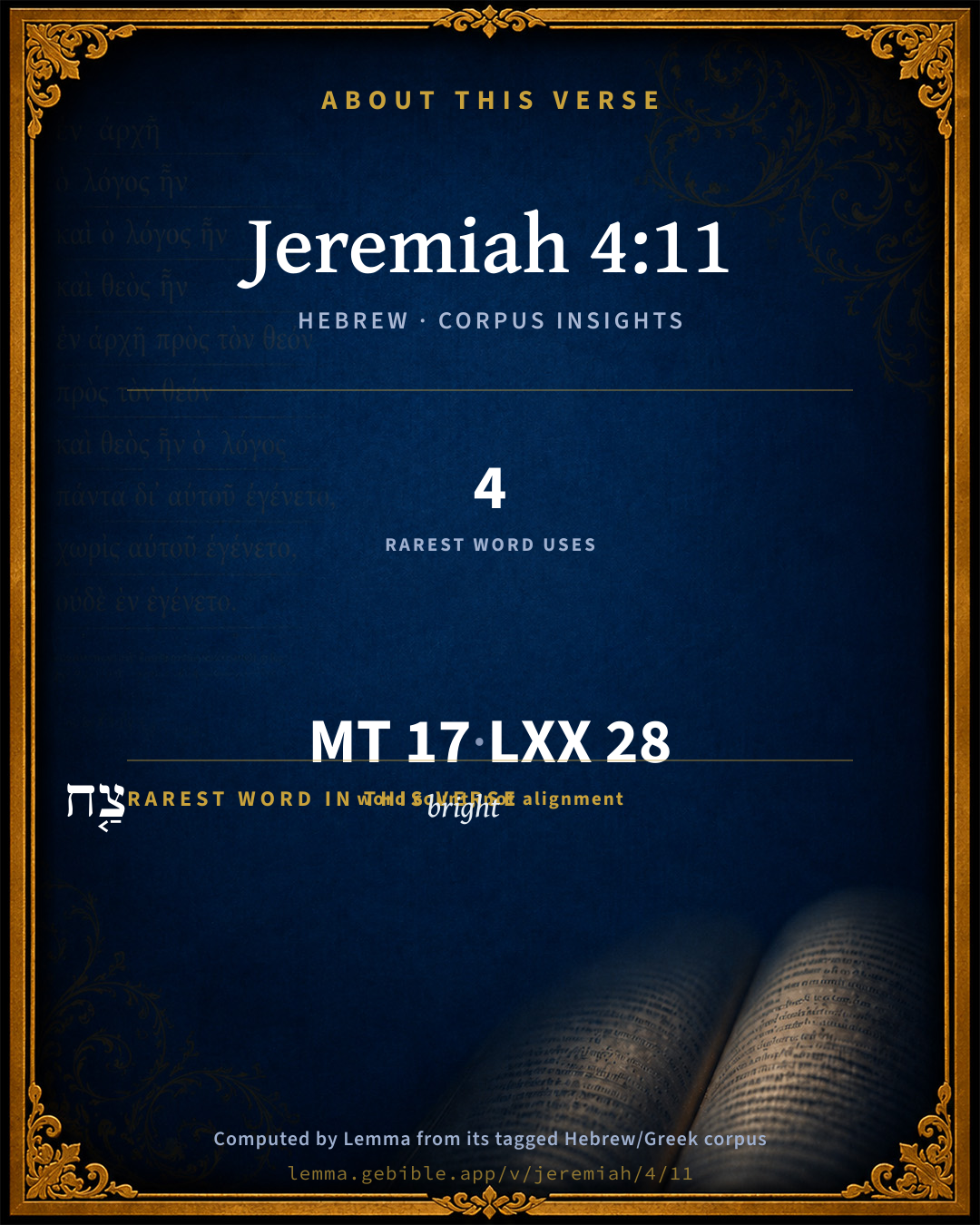
The rarest word here is צַ֤ח bright H6703 — appearing just 4 times in the whole Hebrew Bible.

Shared distinctive vocabulary

צַ֤ח bright H6703 occurs in 4 verses of the Hebrew Bible. Also found in:

Grammatical profile

  • 3 verbs
  • 9 nouns
  • 1 adjective
  • 2 pronouns
  • 2 particles

Verb forms

  • יֵאָמֵ֤ר Niphal · Imperfect
  • לִזְר֖וֹת Qal · Infinitive Construct
  • לְהָבַֽר Hiphil · Infinitive Construct

Repetition

Words recur within this verse — often emphatic in Hebrew:

  • לָֽעָם people H5971 ×2
  • ל֥וֹא not H3808 ×2

Hebrew & Septuagint length

In the original languages it is 17 Hebrew tokens and 28 Greek tokens — but the two are counted differently (Hebrew bundles its prefixes and suffixes into one token; the Greek is in lemma form), so that isn’t a like-for-like length.

Cross-references

22

Topical passages linked to Jeremiah 4:11 in the Treasury of Scripture Knowledge — connected by theme and wording, ordered by reader-vote popularity; previews shown in the World English Bible.

  • Ezekiel 17:10 Yes, behold, being planted, shall it prosper? shall it not utterly wither, when the east wind touches it? it shall wither in the beds where it grew.
  • Hosea 13:15 Though he is fruitful among his brothers, an east wind will come, The breath of Yahweh coming up from the wilderness; And his spring will become dry, And his fountain will be dried up. He will plunder the storehouse of treasure.
  • Isaiah 22:4 Therefore said I, Look away from me, I will weep bitterly; don't labor to comfort me for the destruction of the daughter of my people.
  • Isaiah 27:8 In measure, when you send them away, you do contend with them; he has removed [them] with his rough blast in the day of the east wind.
  • Isaiah 41:16 You shall winnow them, and the wind shall carry them away, and the whirlwind shall scatter them; and you shall rejoice in Yahweh, you shall glory in the Holy One of Israel.
  • Isaiah 64:6 For we are all become as one who is unclean, and all our righteousness are as a polluted garment: and we all do fade as a leaf; and our iniquities, like the wind, take us away.
  • Jeremiah 8:19 Behold, the voice of the cry of the daughter of my people from a land that is very far off: isn't Yahweh in Zion? Isn't her King in her? Why have they provoked me to anger with their engraved images, and with foreign vanities?
  • Jeremiah 9:1 Oh that my head were waters, and my eyes a spring of tears, that I might weep day and night for the slain of the daughter of my people!
  • Jeremiah 9:7 Therefore thus says Yahweh of Hosts, Behold, I will melt them, and try them; for how [else] should I do, because of the daughter of my people?
  • Jeremiah 14:17 You shall say this word to them, Let my eyes run down with tears night and day, and let them not cease; for the virgin daughter of my people is broken with a great breach, with a very grievous wound.
  • Jeremiah 23:19 Behold, the tempest of Yahweh, [even his] wrath, is gone forth, yes, a whirling tempest: it shall burst on the head of the wicked.
  • Jeremiah 30:23–24 Behold, the tempest of Yahweh, [even his] wrath, is gone forth, a sweeping tempest: it shall burst on the head of the wicked.
  • Jeremiah 51:1–2 Thus says Yahweh: Behold, I will raise up against Babylon, and against those who dwell in Lebkamai, a destroying wind.
  • Lamentations 2:11 My eyes do fail with tears, my heart is troubled; My liver is poured on the earth, because of the destruction of the daughter of my people, Because the young children and the infants swoon in the streets of the city.
  • Lamentations 3:48 My eye runs down with streams of water, for the destruction of the daughter of my people.
  • Lamentations 4:3 Even the jackals draw out the breast, they give suck to their young ones: The daughter of my people is become cruel, like the ostriches in the wilderness.
  • Lamentations 4:6 For the iniquity of the daughter of my people is greater than the sin of Sodom, That was overthrown as in a moment, and no hands were laid on her.
  • Ezekiel 19:12 But it was plucked up in fury, it was cast down to the ground, and the east wind dried up its fruit: its strong rods were broken off and withered; the fire consumed them.
  • Hosea 13:3 Therefore they will be like the morning cloud, And like the dew that passes away early, Like the chaff that is driven with the whirlwind out of the threshing floor, And like the smoke out of the chimney.
  • Matthew 3:12 His winnowing fork is in his hand, and he will thoroughly cleanse his threshing floor. He will gather his wheat into the barn, but the chaff he will burn up with unquenchable fire."
  • Luke 3:17 whose fan is in his hand, and he will thoroughly cleanse his threshing floor, and will gather the wheat into his barn; but he will burn up the chaff with unquenchable fire."
  • Lamentations 4:10 The hands of the pitiful women have boiled their own children; They were their food in the destruction of the daughter of my people.

Cross-references courtesy of OpenBible.info (CC BY 4.0).

Hebrew and Greek witnesses Masoretic Hebrew ↔ Greek Septuagint

The same verse in the two great witnesses to the Old Testament, shown verse-for-verse.

These are two independent witnesses, not word-aligned to each other, and the Septuagint is shown in lemma (dictionary) form.

Hebrew Jeremiah 4:11 Masoretic · Westminster Leningrad Codex

בָּעֵ֣ת הַהִ֗יא יֵאָמֵ֤ר לָֽעָם הַזֶּה֙ וְלִיר֣וּשָׁלִַ֔ם ר֣וּחַ צַ֤ח שְׁפָיִים֙ בַּמִּדְבָּ֔ר דֶּ֖רֶךְ בַּת עַמִּ֑י ל֥וֹא לִזְר֖וֹת וְל֥וֹא לְהָבַֽר

At that time shall it be said to this people and to Jerusalem, A hot wind from the bare heights in the wilderness toward the daughter of my people, not to winnow, nor to cleanse;

World English Bible · Public Domain

Greek LXX Structure differs

In the Septuagint, Jeremiah is about an eighth shorter than the Hebrew and arranges its material differently — the Oracles Against the Nations (Hebrew chapters 46–51) appear in the middle of the Greek book, after 25:13. Because the chapter and verse boundaries do not line up, a verse-for-verse comparison with the Hebrew is not shown.

A verse-for-verse comparison isn’t shown here because the chapters and verses don’t line up. Switch to the LXX edition with the MT / LXX toggle above to read the Greek directly.

On this verse, The Cambridge Bible for Schools and Colleges discusses the Septuagint’s reading. Read the note in Commentary ↓

Hebrew: Westminster Leningrad Codex (CC BY 4.0). Greek: Septuagint (public domain); English from a public-domain English Septuagint. How the Septuagint differs from the Hebrew →

Targum (Aramaic paraphrase)

1

The Targum is the ancient Jewish Aramaic paraphrase of the Hebrew Scriptures — an interpretive translation, not the Hebrew text itself. Onkelos (literal) and Pseudo-Jonathan (expansive) render the Torah, and Jonathan the Prophets. Coverage is partial: where no permissively-licensed English translation exists for a verse, only the Aramaic is shown. This is verse-level text, not a word-by-word alignment to the Hebrew.

  1. Targum Jonathan Prophets (Joshua–Malachi)
    בְּעִדָנָא הַהִיא יִתְאַמֵר לְעַמָא הָדֵין וּלְיַתְבֵי יְרוּשְׁלֵם כְּרוּחַ טִיהֲרִין עַל רֵישֵׁי נַגְרִין דְמַיִין בְּמַדְבְּרָא כֵּן אוֹרַח כְּנִשְׁתָּא דְעַמִי לָא לְמִדְרֵי וְלָא לְבַדָרָא:

    (no public-domain English translation for this verse)

    Targum Jonathan — Aramaic: “Mikraot Gedolot” (public domain). English: “Sefaria Community Translation” (CC0 1.0 (public-domain dedication)); “London "Chaldee Paraphrase," 1871” (public domain). Text via Sefaria.

Commentary

Notes on Jeremiah 4:11 from classic Christian and Jewish commentators (each source and its license shown beneath its notes). The classic Christian expositions comment on the surrounding passage and are grouped to its opening verse, so a note may address several verses; the Jewish commentaries on the Tanakh (Rashi and others) are per-verse, so they appear only where the commentator wrote on this verse.

Lemma curates 59 commentaries, every one of them public domain or Creative Commons licensed, each selected and text-cleaned for this edition rather than reprinted as found. About our sources →

Trapp's Complete Commentary

John Trapp

Jer 4:11 At that time shall it be said to this people and to Jerusalem, A dry wind of the high places in the wilderness toward the daughter of my people, not to fan, nor to cleanse,

Ver. 11. A dry wind of the high places.] Ventus urens et exsiccans, as the north wind is. Understand hereby the King of Babylon, {as Jer 4:6} blasting and wasting all before him.

Not to fan, nor to cleanse.] But to dissipate and destroy.

John Trapp, A Commentary or Exposition upon All the Books of the Old and New Testament (1647–1656) — public domain. Text from a community e-Sword module.

The Biblical Illustrator

Joseph S. Exell

Jer_4:11-13

A dry wind of the high places in the wilderness toward the daughter of My people, not to fan, nor to cleanse.

Untempered judgments

The prophet intimates that God will one day send a judgment upon His people comparable only to the sirocco of the desert. The harvestman welcomes almost all the winds of the summer time but this. Their gentle currents lend themselves to the winnowing processes that are necessary to complete the toil of the year. But the sirocco comes with no element of helpfulness or beneficent service in its terrible wings. It is the agent of unmixed ruin, overthrow, death; the symbol of judgment without mercy. The successive invasions that were soon to close in upon the Holy Land were to be of this unmixed character. The flower of one generation was to perish in the overthrow. Whole districts were to be depopulated and re-peopled by alien races. The wind that came from the desert Came to crash and to scorch and to destroy. It was not to fan, nor to cleanse. Some men claim that all judgment must be ultimately puttying. This inspired utterance however assures us that there is such a thing in the Divine economy as punishment that is purely punitive and not disciplinary.

I. Let us inquire if this penal element has a place in the best human governments. If we work out to its logical conclusion the theory that all punishment must be disciplinary only, we shall be bound to adopt methods of procedure in our law courts more grotesque than the most audacious caricature has ever imagined. We must have no short sentences if all penalty is to be educating. We have no right to discharge a man, however slight his transgression, till he has given sufficient assurance that his character has been entirely transformed. Judge and jury would no longer need to concern themselves with the particular category into which his crime came. The only question for them to ask would be, how far does the root of evil go down in this mans character? and what amount of force will be necessary to pull it up? Some men, who are incapable of amendment through pain, can perhaps be stirred to better desires, or at least taken away from their criminal tendencies, by wholesome excitements. Experts would have to step into the witness box. In some cases it might be found that a garrotter would be more sensibly improved by wholesome excitements than by flogging. Carlyle inveighed from time to time against this unhealthy sentimentalism which would sap the foundation of all human and Divine law alike. In the Life of Bishop Wilberforce reference is made to a party at which Monckton Milnes, Thomas Carlyle, and other distinguished men were present. The conversation turned upon the question of capital punishment. Mr. Monckton Milnes was arguing against death-penalties, on the ground that we could not know how far the offender was responsible and consciously wrong. Carlyle broke out, None of your heaven-and-hell amalgamation companies for me! We do know what is wickedness. I know wicked men I would not live with: men whom under some conceivable circumstances I would kill or they should kill me. No, Milnes; there is no truth or greatness in that. Its just poor, miserable littleness. There was far more greatness in the way of your German forefathers, who, when they found one of those wicked men, dragged him to a peat bog, and thrust him in, and said, There! go in there. There is the place for all such as thee:

II. If this penal element is admitted into human governments, upon what conceivable principle can it be excluded from the Divine? Many causes combine to weaken the sense we have of our own authority to punish wrong-doing. It is a strictly delegated authority. We always feel ourselves bound to greater restraint and circumspection in the exercise of delegated than original rights. We often feel ourselves incompetent judges of all that has transpired. We judge and punish in dim twilights. That tends to make us hesitating and indeterminate. And then the sense of our own authority to judge and to punish is weakened by the recollection we have of our own desert of punishment in many things. Unless the offence is very flagrant, we fear to incriminate ourselves by judging another. And yet, notwithstanding all these things, we are absolutely sure of our clear abstract right to punish even in cases where the punishment has no educating purpose to fulfil to the individual, whatever it may have to the community. How much stronger is Gods right! His authority is original, and not delegated. He guarantees in every soul He judges the sufficiency of the past training and discipline. He dwells in the perfect light. His judgment can never be unnerved by the fear of error.

III. Disciplinary are distinguished from penal judgments, not so much by any quality in the judgments themselves, as by the temper of those who become the subjects of such judgments. The question whether purely penal elements can enter into Gods government is one that must be looked at from the standpoint of the transgressor rather than that of the Judge. Are there incorrigible elements in human nature? As a matter of fact, judgments very often fail to sober and to purify here. There are men who can never be taught wisdom by the longest succession of business reverses. There are men who, humanly speaking, can never be taught common morality, however heavy the penalties they are made to pay for its breach. There are worldly men whom no number of sicknesses and providential bereavements can discipline into religiousness. Where there are unreformable elements in human character, disciplinary judgment necessarily passes into the purely punitive stage. It is often argued that the keener judgments of the life to come will produce penitence in those who have continued stubborn under the milder judgments of the present life. There is not only no proof of that, but nothing even to suggest that it is probable. We cannot predicate anything from the cumulative power of pain. The wind does not become purifying by mere increase of the force with which it blows. After reaching a certain pitch of violence it can neither fan nor cleanse.

IV. The judgment that has passed out of the disciplinary into the penal stage for the individual is still disciplinary in its significance for the race at large. The wind that blows to crush and to scorch and to uproot in one zone of the earth, after it has passed into new latitudes, and been tempered by the seas over which it travels, may become a wind of winnowing beneficence. The penal visitation of one generation may become the saving chastisement of the generation that follows it. We must not get into the habit of supposing that Gods purposes ever terminate in the individual. That mystery of unending punishment, which seems to frustrate the Divine purpose of mercy to the individual, may fulfil a purpose of gracious admonition to the race. The law of vicariousness pervades the moral universe just as widely as the law of gravitation overspreads the natural universe. There is a priesthood of vicarious judgment as well as of mercy. As great fires are kindled in times of plague to burn up the germs of infection floating in the air, so the atmosphere of Gods universe may need to be kept pure by the flames of a quenchless Gehenna. (T. G. Selby.)

The Biblical Illustrator, edited by Joseph S. Exell (c. 1880s–1900s) — public domain. Text from a community e-Sword module.

Joseph Benson's Commentary

Jer 4:11. At that time — When that calamity commences; shall it be said to this people and to Jerusalem — There shall be tidings brought both to the country and city; A dry wind of the high places — “The prophet here describes the Chaldean army coming up for the destruction of Judea, under the metaphor of a hot, pestilential wind, which sweeps away multitudes in a moment, blasts the fruits of the earth, and spreads desolation everywhere around. The passage, like that in the preceding verses, is spirited and sublime; but it loses a good deal of its elegance in our version. Houbigant renders it thus: ‘Behold, a wind hangs over the mountains of the deserts; behold, it shall come upon the daughter of my people, but not to fan or to cleanse, Jer 4:12. A mighty wind shall come from thence upon her, and then at length will I declare my judgment concerning them, or her, Jer 4:13. Behold, as clouds it shall hang over; its chariots shall be as a whirlwind; its horses swifter than eagles,’“ &c. See Lowth and Dodd.

Joseph Benson's Commentary on the Old and New Testaments (1811–1818) — public domain. Text from a community e-Sword module.

Keil & Delitzsch

C. F. Keil & F. Delitzsch

Description of the impending ruin, from which nothing can save but speedy repentance. - Jer 4:11. "At that time shall it be said to this people and to Jerusalem, A hot wind from the bleak hills in the wilderness cometh on the way toward the daughter of my people, not to winnow and not to cleanse. Jer 4:12. A wind fuller than for this shall come to me; now will I also utter judgments upon them. Jer 4:13. Behold, like clouds it draws near, and like the storm are it chariots, swifter than eagles its horses. Woe unto us! for we are spoiled. Jer 4:14. Wash from wickedness thy heart, Jerusalem, that thou mayest be saved. How long shall thine iniquitous thoughts lodge within thee? Jer 4:15. For a voice declareth from Dan, and publisheth affliction from the Mount Ephraim. Jer 4:16. Tell it to the peoples; behold, publish it to Jerusalem: Besiegers come from a far country, and let their voice ring out against the cities of Judah. Jer 4:17. As keepers of a field, they are against her round about; for against me hath she rebelled, saith Jahveh. Jer 4:18. Thy way and thy doings have wrought thee this. This is thy wickedness; yea, it is bitter, yea, it reaCheth unto thine heart."

A more minute account of the impending judgment is introduced by the phrase: at that time. It shall be said to this people; in other words, it shall be said of this people; substantially, that shall fall upon it which is expressed by the figure following, a hot wind blowing from the naked hills of the wilderness. רוּח is stat. constr., and שׁפים dna its genitive, after which latter the adjective צח should be placed; but it is interpolated between the nomen regens and the n. rectum by reason of its smallness, and partly, too, that it may not be too far separated from its nomen, while בּמּדבּר belongs to שׁפים. The wind blowing from the bleak hills in the wilderness, is the very severe east wind of Palestine. It blows in incessant gusts, and cannot be used for winnowing or cleansing the grain, since it would blow away chaff and seed together; cf. Wetzst. in Del., Job, S. 320. דּרך is universally taken adverbially: is on the way, i.e., comes, moves in the direction of the daughter of Zion. The daughter of Zion is a personification of the inhabitants of Zion or Jerusalem. This hot blast is a figure for the destruction which is drawing near Jerusalem. It is not a chastisement to purify the people, but a judgment which will sweep away the whole people, carry away both wheat and chaff - a most effective figure for the approaching catastrophe of the destruction of Jerusalem, and the carrying away captive of its inhabitants. Hitz. and Graf have, however, taken דּרך as subject of the clause: the path, i.e., the behaviour of my people, is a keen wind of the bare hills in the wilderness. Thus the conduct of the people would be compared with that wind as unprofitable, inasmuch as it was altogether windy, empty, and further as being a hurtful storm. But the comparison of the people's behaviour with a parched violent wind is a wholly unnatural one, for the justification of which it is not sufficient to point to Hos 8:7 : sow wind and reap storm. Besides, upon this construction of the illustration, the description: not to winnow and not to cleanse, is not only unmeaning, but wholly unsuitable. Who is to be winnowed and cleansed by the windy ways of the people? Jahveh?! Jer 4:14 is indeed so managed by Hitz. and Graf that the tempestuous wind blows against God, "is directed against Jahveh like a blast of defiance and hostility." But this argument is sufficient to overthrow that unnatural view of the figure, which, besides, obtains no support from Jer 4:12. מאלּה cannot refer to בּת־עמּי: a full wind from these, i.e., the sons of my people; and יבוא לי, in spite of the passages, Jer 22:23; Jer 50:26; Jer 51:48; Job 3:25, does not mean: comes towards me, or: blows from them on me; for in all these passages לי is dativ commodi or incommodi. Here, too, לי is dative, used of the originator and efficient cause. The wind comes for me - in plainer English: from me. Properly: it comes to God, i.e., at His signal, to carry out His will. מלא מאלּה is comparative: fuller than these, namely, the winds useful for winnowing and cleansing. Now will I too utter. The intensifying גּם does not point to a contrast in the immediately preceding clause: because the people blows against God like a strong wind, He too will utter judgment against it. The גּם refers back to the preceding לי: the storm comes from me; for now will I on my side hold judgment with them. The contrast implied in גּם lies in the wider context, in the formerly described behaviour of the people, particularly in the sayings of the false prophets mentioned in Jer 4:10, that there will be peace. On דּבּר משׁפּטים, cf. Jer 1:16.

These judgments are already on the way in Jer 4:13. "Like clouds it draws near." The subject is not mentioned, but a hostile army is meant, about to execute God's judgments. "Like clouds," i.e., in such thick dark masses; cf. Eze 38:16. The war-chariots drive with the speed of the tempest; cf. Isa 5:28; Isa 66:15. The running of the horses resembles the flight of the eagle; cf. Hab 1:8, where the same is said of the horsemen of the hostile people. Both passages are founded on Deu 28:49; but Jeremiah, while he had the expression קלּוּ מנּמרים סוּסיו, Hab 1:8, in his mind, chose נשׁרים; instead of leopards (נמרים), in this following the original in Deut.; cf. Sa2 1:23 and Lam 4:19. Already is heard the cry of woe: we are spoiled, cf. Jer 4:20, Jer 9:18; Jer 48:1.

Jer 4:14

If Jerusalem wishes to be saved, it must thoroughly turn from its sin, wash its heart clean; not merely abstain outwardly from wickedness, but renounce the evil desires of the heart. In the question: How long shall...remain? we have implied the thought that Jerusalem has already only too long cherished and indulged wicked thoughts. תּלין is 3rd pers. imperf. Kal, not 2nd pers. Hiph.: wilt thou let remain (Schnur. and others). For the Hiphil of luwn is not in use, and besides, would need to be תּליני. The מחשׁבות און, as in Pro 6:18; Isa 59:7, refer chiefly to sins against one's neighbour, such as are reckoned up in Jer 7:5., Jer 7:8.

Keil & Delitzsch — Biblical Commentary on the Old Testament (1861–1891) — public domain (CC PDM 1.0). Text via the HelloAO Bible API. (Old Testament only.)

Tyndale Open Study Notes

Tyndale Open Resources

4:11-12 The Lord’s people would soon feel the burning wind and roaring blast of God’s judgment (13:24; Hos 13:15).

Tyndale Open Study Notes — © Tyndale Open Resources, licensed CC BY-SA 4.0. Text via the HelloAO Bible API.

Geneva Bible (1599)

Geneva Bible translators

But to carry away both corn, and chaff.

The North wind whereby he meaneth Nebuchadnezzar.

Geneva Bible (1599) marginal notes — public domain. Text via Bolls.life.

Jamieson, Fausset & Brown

Robert Jamieson, A. R. Fausset & David Brown

dry wind--the simoom, terrific and destructive, blowing from the southeast across the sandy deserts east of Palestine. Image of the invading Babylonian army (Hos 13:15). Babylon in its turn shall be visited by a similar "destroying wind" (Jer 51:1).

of . . . high places--that is, that sweeps over the high places.

daughter--that is, the children of my people.

not to fan--a very different wind from those ordinary winds employed for fanning the grain in the open air.

Jamieson, Fausset & Brown — Commentary Critical and Explanatory on the Whole Bible (1871) — public domain (CC PDM 1.0). Text via the HelloAO Bible API.

Adam Clarke's Commentary

Verse 11. - 13. A dry wind - a fall wind - as clouds - as a whirlwind] All these expressions appear to refer to the pestilential winds, suffocating vapours, and clouds and pillars of sand collected by whirlwinds, which are so common and destructive in the east, (See Clarke on Isa 21:1;) and these images are employed here to show the overwhelming effect of the invasion of the land by the Chaldeans.

Adam Clarke's Commentary on the Bible (1810–1826) — public domain. Text from a community e-Sword/MySword module.

John Calvin's Commentaries

Jeremiah proceeds with the same prediction: he says, that a terrible wind was coming, which would not only disperse or clear away, but dissipate and overthrow all things. He then expresses how great and how grievous would be the calamity which he had before mentioned. He compares it to dry or and wind; for צח, tsach, sometimes means “clear,” and sometimes “arid,” as the greatest dryness is found on high places. He means, no doubt, here the wind, which is violent, and disturbs the whole atmosphere, when there are no clouds, and where no trees impede its course. Hence, he speaks of high and desert places. It is the same as though he had said, that so great would be the violence of God’s vengeance, and so irresistible would be the eruption, that it would be like a violent wind when it passes through high regions and through dry land or desert places. He says, Towards the way of the daughter of my people; as though he had said, — that the course of the wind would be such as to bear directly on Judea. The mode of speaking here used is well known to all who are in any degree acquainted with the writings of the prophets. “The daughter of my people, “means the people themselves. Come, then, shall wind towards Judea.

He then adds, Not to scatter nor to cleanse Husbandmen are wont to winnow the corn when taken from the thrashing — floor, that the chaff may be carried away by the wind: but the Prophet says, that this wind would not be to clear away or scatter the chaff; for it will be, he says, a very vehement wind He means, in short, that God would shew so much displeasure towards the Jews, that he would no longer chastise them in a moderate degree, or use any moderation, as he had done previously; for God had already often punished the Jews, but had hitherto acted the part of a physician, having endeavored to heal the vices of the people. As, then, these corrections had been without fruit, the Prophet now says, that God’s wrath would now come, not to cleanse as before, nor to scatter the chaff, but to consume everything among the people. Hence he adds (for the two verses are connected together) a fuller wind, or one more complete, shall come to them. Some read, “from these places, “so they render מ; but it is rather to be taken as noting the comparative degree, — that this wind would be much rougher and more violent than other winds which usually clear the land or scatter away the chaff, and separate it from the corn: come, then, shall a much more violent wind

John Calvin's Commentaries (1540-1563) — public domain. Text from the Calvin Translation Society English edition (1840s-50s) via the Christian Classics Ethereal Library (ccel.org). Calvin's coverage is partial (roughly two-thirds of the Bible); uncommented books and verses are honest gaps, never fabricated. The 19th-century editor's footnotes and remarks are omitted so the notes are faithfully Calvin's own voice.

Ellicott's Commentary for English Readers

(11) At that time.—i.e., when the lion and destroyer of Jer_4:7 should begin his work of destruction.

A dry wind.—Literally, a clear wind, the simoom, the scorching blast from the desert, coming clear and without clouds. Other winds might be utilised for the threshing-floor, but this made all such work impossible, and was simply devastating, and was therefore a fit symbol of the terrible invader.

A Bible Commentary for English Readers, edited by Charles John Ellicott (1878–1897) — public domain. Text from a community e-Sword module.

The Cambridge Bible for Schools and Colleges

gen. ed. J. J. S. Perowne

11. A hot wind] The foe comes not as a gentle wind, such as that used (see on Jer_15:7) to separate wheat from chaff, but one that shall whirl away both together. Thomson (op. cit. p. 295) describes the sirocco thus: “The air becomes loaded with fine dust, which it whirls in rainless clouds hither and thither at its own wild will.… The eyes inflame, the lips blister, and the moisture of the body evaporates, under the ceaseless application of this persecuting wind”; and again (p. 536), “We have two kinds of sirocco, one accompanied with vehement wind, which fills the air with dust and fine sand.” Cp. Joe_2:30 f.

bare heights] omitted by LXX. Cp. on Jer_3:2.

toward] we may understand cometh from Jer_4:12.

daughter] fem. sing. in a collective sense. Cp. Jer_4:30, Jer_6:14, Jer_8:11, etc.

11–18. As the burning sirocco, the dense clouds accompanied by the whirlwind, or the savage creatures of the air, so shall the enemy prove to be, as they descend on Judah in doom. Let her even now seek to avert it by repentance.

11–18. See summary at commencement of section.

The Cambridge Bible for Schools and Colleges (gen. ed. J. J. S. Perowne; Cambridge University Press, 1878–1918) — public domain. Text from a community e-Sword module.

John Gill's Exposition

At that time shall it be said to this people, and to Jerusalem,.... The inhabitants of Judea and Jerusalem, the people of the Jews; or "concerning" (x) them, as Jarchi interprets it:

a dry wind of the high places in the wilderness toward the daughter of my people. The Targum is,

"as the south wind upon the heads of floods of water in the wilderness, so is the way of the congregation of my people;''

but rather the north wind is designed, since that is a dry one, and the south wind a moist one; and the rather, since this wind intends Nebuchadnezzar and his army, which should come from Babylon, from the north. Some render it, "a neat clean wind" (y); which strips the trees, lays bare rocks and mountains, carries away the earth and dust before it, and makes the stones look white and clean: it denotes a very strong, rushing, stormy, and boisterous wind. The Vulgate Latin version renders it, "a burning one"; and it represents the force and power with which the enemy should come, without any opposition or resistance to him; for a wind on high places, hills, and mountains, and which comes through deserts and wildernesses, has nothing to hinder it, as Kimchi observes; whereas, when it blows in habitable places, there are houses, walls, hedges, and fences, which resist it; and it is observed, that in the way from Babylon to Judea, which the prophet calls "the daughter of my people", were many desert places. The Septuagint version is, "the spirit of error in the desert, the way of the daughter of my people"; which the Syriac and Arabic versions seem to follow; the former rendering it, "as the wind that wanders through the paths of the desert, so is the way of the daughter of my people"; and the latter thus, "there is a spirit of error in the desert, in the way of the daughter of my people";

not to purity, nor to holiness, as it with the Septuagint renders the next clause: "not to fan, nor to cleanse"; of which use a more moderate wind is in winnowing and cleansing the corn from chaff, and light and useless grain.

(x) "de hoc populo", Calvin, Vatablus. (y) "ventus nitidus", Junius & Tremellius, Piscator.

John Gill's Exposition of the Whole Bible (1746–1763) — public domain (CC PDM 1.0). Text via the HelloAO Bible API.

Albert Barnes' Notes on the Bible

At that time - See Jer 4:7. Though the revelation of the certainty of Judah’s ruin wrings from Jeremiah a cry of despair, yet it is but for a moment; he immediately returns to the delivery of God’s message.

A dry wind - literally, A clear wind. The Samum is probably meant, a dry parching east wind blowing from the Arabian desert, before which vegetation withers, and human life becomes intolerable.

Not to fan ... - The Syrian farmers make great use of the wind for separating the chaff from the grain: but when the Samum blows labor becomes impossible. It is not for use, but for destruction.

Albert Barnes' Notes on the Bible (1834–1885) — public domain. Text from a community e-Sword/MySword module.

Haydock's Catholic Bible Commentary

Desert of Arabia. It may designate Nechao, (2 Paralipomenon xxxv. 20.) who slew Josias, after whose death all fell to ruin.

George Leo Haydock (1774–1849), Haydock's Catholic Family Bible and Commentary, 1859 edition — public domain. Excludes Psalms (Douay-Rheims chapter numbering differs from Protestant) and Deuterocanonical books (Catholic canon only).

Matthew Poole's English Annotations

At that time, viz. when Nebuchadnezzar is upon this expedition, Jer 4:7, shall it be said to this people and to Jerusalem; there shall be tidings brought both to the country and city, Jer 4:5.

A dry wind: the meaning is, a drying wind, such as shall blast and scorch where it comes, without any rain or moisture, or any other way for use or refreshment, as the last word in the verse intimates; and it may also allude unto the coast from whence this wind comes, viz. from Babylon, or the north, which drives away rain, Pro 25:23; for it points at the stormy and furious irruption of the Babylonian army, destroying all before them, a metaphorical allegory, Jer 23:19; 30:23,24.

In the wilderness; or, in the plain, where there is no stop or obstacle in the way to hinder the wind, or to break its fury, Isa 21:1; Jer 13:24. See Poole "Isa 63:13".

Toward, i.e. directly and designedly, coming along in the way leading to my people; for so we are to understand this expression,

the daughter of my people, as the daughter of Zion, Isa 1:8, or rather, the daughter Zion, which is as comely and beautiful in my eyes and tender to me as a daughter, Jer 9:1.

Not to fan, nor to cleanse; not such a gentle wind which is made choice of to separate the chaff from the wheat, the bad from the good; but so boisterous and violent, that it shall depopulate, sweep away, and lay waste all together, Jer 51:1; Eze 21:3.

Matthew Poole's English Annotations on the Holy Bible (1683–1685) — public domain. Text from a community e-Sword/MySword module.

Whedon's Commentary on the Bible

Daniel D. Whedon

11. A dry wind — “A hot wind,” Keil; “a violent wind,” Furst. The reference is to the simoom, which is too fierce to be used for winnowing, as it would carry away both chaff and grain; a fit symbol of irresistible destruction. The figure of the lion sets forth the fierceness and bloodthirstiness of their enemies; the simoom, their resistlessness.

Daniel D. Whedon (gen. ed.), Commentary on the Old and New Testaments (1874–1909) — public domain. Text from a community e-Sword module.

The Pulpit Commentary

Shall it be said to this people; i.e. words like these may be used with reference to this people. A dry wind, etc.; literally, a clear wind. (but the notions of dryness and heat are closely connected with that of heat; comp. Isa_18:4) The prophet doubtless means the east wind, which is very violent in Palestine, and, of course, quite unsuitable for the winnowing process. High places should rather be bare hills. Toward; or (is) the way of. So Hitzig, supposing the conduct of the Jews to be likened to a wind which brings no blessing, but only drought and desolation.

Vers. 11-13. The uses of the wind.

Not all the uses of the wind are set forth here, but enough is mentioned to remind us how God can turn a beneficial agent into a destructive one very rapidly and decisively. The force Of the unquenchable fire has already been spoken of (ver. 4); and it is a sufficiently dreadful thought that fire, so genial, so useful, with such a place in the house, and so far as Israel was concerned such a place in the service of God, should thus have become, in the thoughts to be associated with it, dreadful as sword, famine, or pestilence. The man who has had his house burned down, to the utter loss of all his goods, will henceforth be apt to make grim comments in his own heart when he hears men extolling the benefactor fire. And now God comes to another great force in the material world, and shows how it can be the symbol of the workings out of his holy wrath.

1. Observe how he calls attention to the beneficial working of the wind. Frequently the force of the wind is of such a moderated, yet effectual kind, that it is used to fan and to cleanse. These invading hosts, it was to be remembered, were not essentially destructive. They were made up of human individuals, each of whom had measureless capabilities of benefiting his fellow men. Possibly from these very northern lands there had come buyers and sellers, bringing commercial prosperity to Israel. Is it not plain that we should always consider, when one approaches us in a hostile and threatening way, that it may be possible by a certain course of conduct to have him come in a very different way? Many enemies have been friends, and after their enmity has come to a head and done much damage, it is possible for them to become friends again. This destroying wind, fierce and dreadful as it was for a time, would yet subside, and fanning and cleansing work be done again.

2. It is worth noticing that the Spirit of God which has such large power to bless has also power to destroy. The Spirit of God is, on the highest authority, compared to the wind. Indeed, that is what the name signifies the breath or wind from God. Working through Peter in the glorious apostolic days, we see that Spirit healing the lame man; we hear him speaking mighty, convincing, renewing words to thousands hitherto indifferent; bringing men into correct and firm apprehensions of truth that had been misunderstood or not understood at all; and filling their minds with such a light of promise as gave reality and indescribable charm to the future. But that same Spirit struck down Ananias and Sapphira with an appalling and fatal blow, and made Elymas the sorcerer suddenly blind. Only a turn is needed, and the open hand which God extends, the hollow of it filled with the gifts of his grace, can be closed so as to smite in wrath. God does not need to go far a field for the instruments of his chastisement. The energy of his Holy Spirit can destroy as well as make alive; and Jesus, who is Savior, is also appointed to judge and condemn. Y.

The Pulpit Commentary (1880–1919), ed. H.D.M. Spence-Jones & Joseph S. Exell — public domain. Text from a community e-Sword module.

John Wesley's Explanatory Notes

At that time - There shall be tidings brought both to the country and city. A dry wind - A drying wind, such as shall blast and scorch where it comes, without any rain or moisture. It points at the stormy and furious irruption of the Babylonian army. In the plain - Where there is no stop in the way to break its fury. Toward - Directly, and designedly, coming in the way leading to my people. Not - Not such a gentle wind, as is made choice of to separate the chaff from the wheat; but so boisterous and violent, that it shall sweep away, and lay waste, all together.

John Wesley, Explanatory Notes Upon the Whole Bible (1754–1765) — public domain. Text via the GEBible commentary corpus.

unfoldingWord translationNotes

Door43 World Missions Community

it will be said

This can be stated in active form. AT: "Yahweh will say" (See: Active or Passive)

burning wind from the plains ... wind far stronger

Here a "burning wind" represents a fierce and merciless enemy. (See: Metaphor)

will make its way

"will travel" or "will rush"

the daughter of my people

Yahweh shows his love for his people by speaking of them as a daughter. AT: "my people, who are like a daughter to me" or "my dear people" (See: Metaphor)

It will not winnow or cleanse them

The words "winnow" and "cleanse" refer to blowing away the useless skins from grain. Only a light wind was needed for that. AT: "It will not be a light wind for blowing the chaff away from the grain" (See: Doublet and Metaphor)

will come at my command

"will come when I command it to come"

at my command

This expression in Hebrew is interpreted by some modern versions as "for me" or "from me."

pass sentence against them

"announce their punishment"

translationWords

desert

people of God

winnow

clean

command

unfoldingWord translationNotes — © Distant Shores Media and the Door43 World Missions Community, licensed CC BY-SA 4.0. Source: git.door43.org/Door43/en_tn.

Rashi

Rabbi Shlomo Yitzchaki (Rashi)

of this people Concerning this people when they are all exiled.

has swept the rivulets It sweeps even the fields with rivulets of water to make them into a desert. Another explanation: צח is an expression of thirst, which is translated צחותא.

[on] the way of the daughter of My people That wind will come, and also, not to winnow the chaff from the threshing floor ([a]vanner in O.F.). Comp. (infra 15:7) “And I winnowed them with a sieve (ואזרם במזרה).”

and not to cleanse And not to cleanse grain does it come. That is to say, not for good but for evil, to exile men [women], and children, and livestock.

Rashi on the Tanakh — English translations: “The Judaica Press complete Tanach with Rashi, translated by A. J. Rosenberg” (CC BY 4.0); “Pentateuch with Rashi's commentary by M. Rosenbaum and A.M. Silbermann, 1929-1934” (public domain); “The Metsudah Tanach series, Lakewood, N.J” (CC BY 4.0); and “The Book of Joshua, Metsudah Publications, 1997” (CC BY 4.0). Text via Sefaria.

Lesson kit

Teaching starters — assembled from the data on this page, not authored interpretation. Every prompt links to the verse data it draws on. Edit before teaching.

Jeremiah, in the Prophets, opens this verse with 17 words (15 distinct Hebrew lemmas). Its most distinctive word is tsach (“bright”). A historical commentator’s framing appears above. Read the whole chapter for the surrounding context.

Discussion questions

  1. The word tsach carries the sense “bright.” How does it shape the verse?
  2. How does Song of Solomon 5:10, which shares the word «bright», read alongside this verse?
  3. What does the repetition of “people” (2× in this one verse) do in this verse?
  4. The translations on this page render this verse differently — a whole-verse word diff, not a word-by-word alignment. What might account for the different wordings?
  5. «יֵאָמֵ֤ר» is a Niphal Imperfect verb. How does that grammatical form shape the action described?
  6. Compare how Trapp's Complete Commentary and The Biblical Illustrator read this verse. Where do they agree or differ?

Things to notice

Reading settings

Reading text

Shown beneath each verse's original-language words.

Old Testament
Old Testament edition

Read the OT as the Masoretic Hebrew (MT) or the Greek Septuagint (LXX).

English shown for the Greek Septuagint (in the Hebrew ↔ Greek comparison).

Comparing translations? Open the Compare panel on any verse page to stack up to four side by side.