Ecclesiastes 10:17

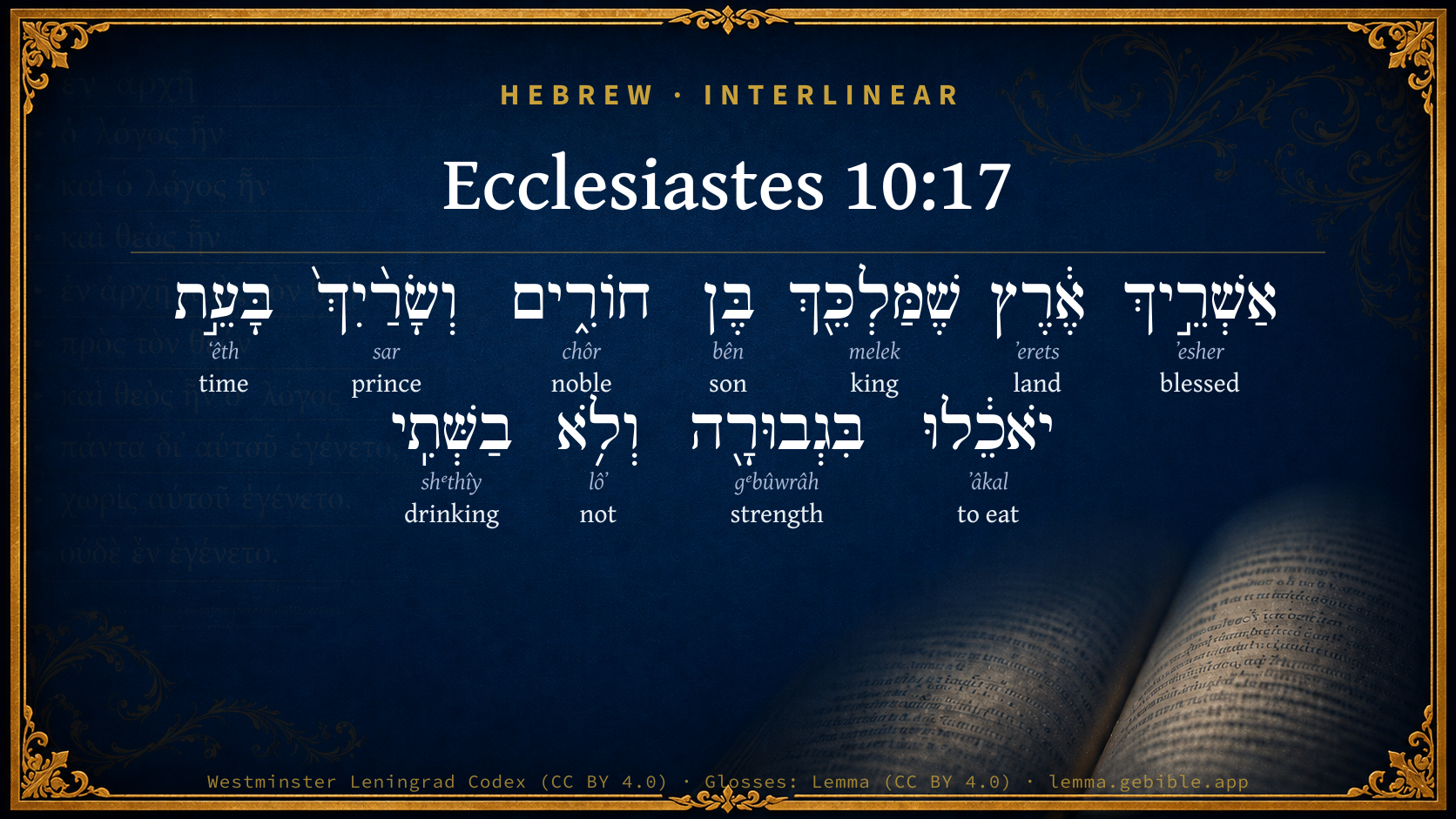
Hebrew (Westminster Leningrad Codex) Ecclesiastes 10:17 appears in the Hebrew Old Testament. The text above is from the Westminster Leningrad Codex. Each word links to its Strong’s number, a concise gloss, and parsing drawn from the Open Scriptures Hebrew Bible morphology. Click any word for its full Brown-Driver-Briggs (BDB) entry.
Download image
Cite this verse

Ecclesiastes 10:17 (World English Bible). Public Domain. Lemma interlinear Bible study tool, https://lemma.gebible.app/v/ecclesiastes/10/17.

Show BibTeX & RIS
BibTeX
RIS
English Translation
Happy are you, land, when your king is the son of nobles, And your princes eat in due season, For strength, and not for drunkenness!
World English Bible · Public Domain
Highlights
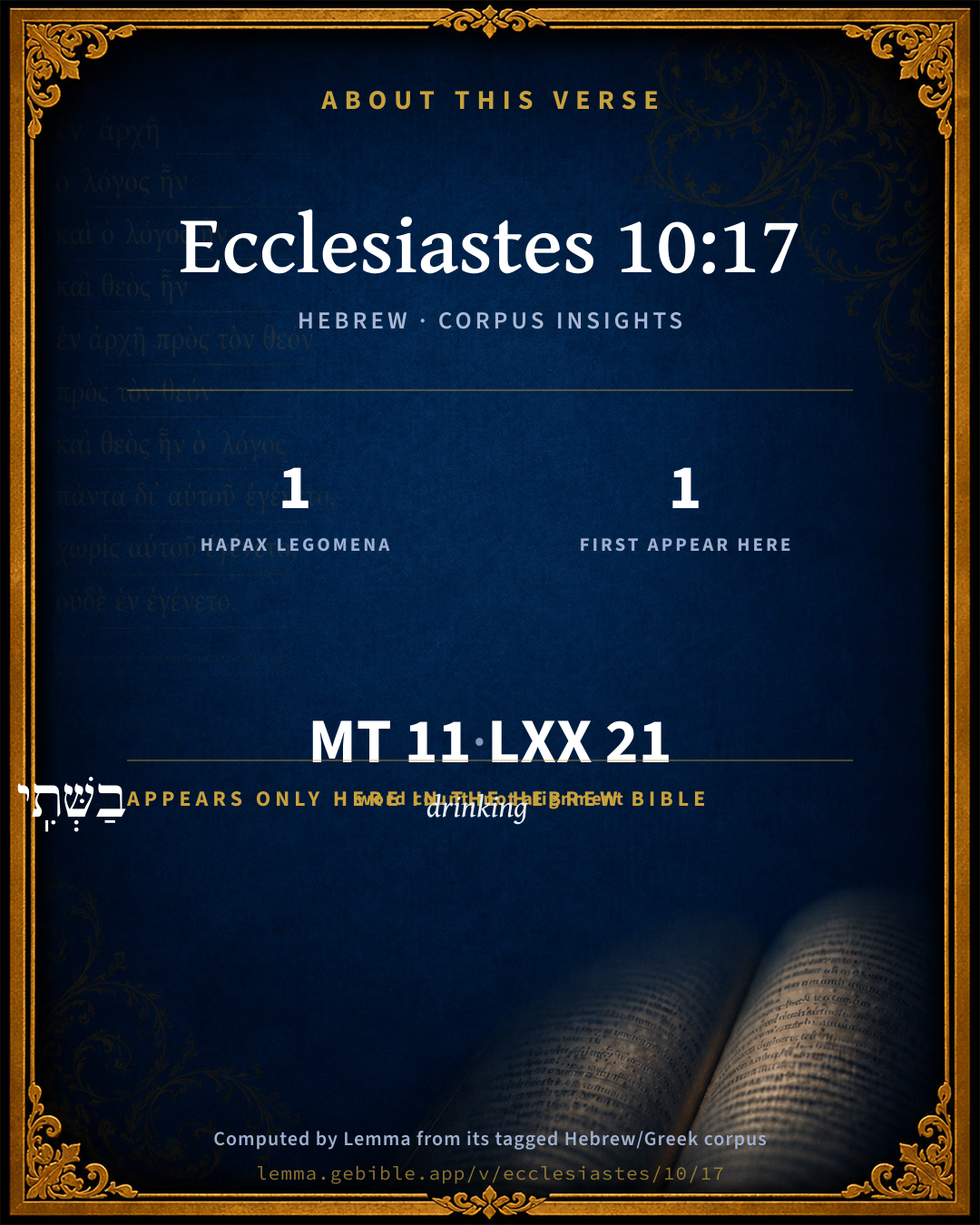
  • 1 hapax legomenon — only here in the Hebrew Bible
  • 1 first appearance in the Hebrew Bible
Full analysis ↓
Download a study sheet

One document with this verse’s original text, its word-by-word gloss line, the meaning frame, cross-references with their text, attributed commentary, and full source and license credits — printable, and it pastes into notes with its structure intact.

This verse Autodidact and up

Study sheet (.html) Plain text (.txt)

A passage Seminary Student

Up to 50 verses in one chapter. A passage sheet keeps up to 6 commentary sources and 12 cross-references per verse, in the order this page ranks them, and says so on the sheet whenever that leaves anything out. Ask for a single verse and you get the Autodidact verse sheet above.

Everything on this page stays free to read, with no account — the sheet is a download of what is already on screen, not access to it.

Want to remove ads? Support Godless Engineer
Compare translations 3

The same verse in 3 English versions, stacked beneath the original-language interlinear above. Click any original word for its lexicon entry.

Each is an independent rendering of the whole verse — the interlinear is not word-aligned to these translations.

Highlighted words mark where these versions differ — a whole-verse word diff, not a word-by-word alignment.

  • World English Bible Public Domain
    Happy are you, land, when your king is the son of nobles, And your princes eat in due season, For strength, and not for drunkenness!
  • King James Version Public Domain
    Blessed art thou, O land, when thy king is the son of nobles, and thy princes eat in due season, for strength, and not for drunkenness!
  • unfoldingWord Literal Text CC BY-SA 4.0
    Blessed are you, land, that your king a son of nobles and your princes will eat at the time with might and not with drunkenness.

unfoldingWord Literal Text — © unfoldingWord, licensed CC BY-SA 4.0. Word-aligned USFM3 via Door43 (git.door43.org/unfoldingWord/en_ult).

Versions to compare (up to 4)

3 of 4 selected

Show all 18 translations

Every available English version of this verse, each an independent rendering of the whole verse.

  • World English Bible Public Domain
    Happy are you, land, when your king is the son of nobles, And your princes eat in due season, For strength, and not for drunkenness!
  • Berean Standard Bible Public Domain
    Blessed are you, O land whose king is a son of nobles, and whose princes feast at the proper time—for strength and not for drunkenness.
  • Majority Standard Bible Public Domain
    Blessed are you, O land whose king is a son of nobles, and whose princes feast at the proper time—for strength and not for drunkenness.
  • King James Version Public Domain
    Blessed art thou, O land, when thy king is the son of nobles, and thy princes eat in due season, for strength, and not for drunkenness!
  • American Standard Version (1901) Public Domain
    Happy art thou, O land, when thy king is the son of nobles, and thy princes eat in due season, for strength, and not for drunkenness!
  • Revised Version (1885) Public Domain
    Happy art thou, O land, when thy king is the son of nobles, and thy princes eat in due season, for strength, and not for drunkenness!
  • Geneva Bible (1599) Public Domain
    Blessed art thou, O land, when thy King is the sonne of nobles, and thy princes eate in time, for strength and not for drunkennesse.
  • Douay-Rheims (1899) Public Domain
    Blessed is the land, whose king is noble, and whose princes eat in due season for refreshment, and not for riotousness.
  • Young's Literal Translation Public Domain
    Happy art thou, O land, When thy king `is' a son of freemen, And thy princes do eat in due season, For might, and not for drunkenness.
  • Literal Standard Version CC BY-SA 4.0
    Blessed are you, O land, || When your king [is] a son of nobles, || And your princes eat in due season, || For might, and not for drunkenness.
  • Unlocked Literal Bible CC BY-SA 4.0
    But blessed are you, land, if your king is the son of nobles, and if your leaders eat at the right time, for strength, and not for drunkenness!
  • unfoldingWord Literal Text CC BY-SA 4.0
    Blessed are you, land, that your king a son of nobles and your princes will eat at the time with might and not with drunkenness.
  • Darby Bible Public Domain
    Happy art thou, O land, when thy king is a son of nobles, and thy princes eat in [due] season, for strength, and not for drunkenness!
  • World Messianic Bible Public Domain
    Happy are you, land, when your king is the son of nobles, and your princes eat in due season, for strength, and not for drunkenness!
  • Webster's Bible Public Domain
    Blessed art thou, O land, when thy king is the son of nobles, and thy princes eat in due season, for strength, and not for drunkenness!
  • Free Bible Version CC BY-SA 4.0
    You're fortunate if your king comes from a noble family, and your leaders feast at the proper time to give themselves energy, and not to get drunk.
  • Bible in Basic English Public Domain
    Happy is the land whose ruler is of noble birth, and whose chiefs take food at the right time, for strength and not for feasting.
  • JPS Tanakh (1917) Public Domain
    Happy art thou, O land, when thy king is a free man, and thy princes eat in due season, in strength, and not in drunkenness!

Literal Standard Version (2020), Covenant Press — licensed CC BY-SA 4.0. Text via the HelloAO Bible API (eBible.org). Unlocked Literal Bible (unfoldingWord) — licensed CC BY-SA 4.0. Text via the HelloAO Bible API (eBible.org). unfoldingWord Literal Text — © unfoldingWord, licensed CC BY-SA 4.0. Word-aligned USFM3 via Door43 (git.door43.org/unfoldingWord/en_ult). Free Bible Version, Dr. Jonathan Gallagher — licensed CC BY-SA 4.0. Text via the HelloAO Bible API (eBible.org).

Word by word

More ways to search: Search by grammar → Find every occurrence → Compare this word →

Practice this passage: Drill this verse → Learn its vocabulary →

בַשְּׁתִֽי
shᵉthîy
H8358
“in/at the · drinking”
Preposition, Determined + Noun, Common, Masculine, Singular, Absolute
Part of Speech
Preposition + Noun
Type
Common
Gender
Masculine
Number
Singular
State
Absolute
Full BDB Definition

Origin: from H8354

TWOT: 2477a

a drinking, drinking bout Ecc 10:17
  1. אַשְׁרֵ֣יךְ ʼesher H835 “blessed · your” Noun, Common, Masculine, Plural, Construct + Suffix, Personal, 2nd Person, Feminine, Singular
  2. אֶ֔רֶץ ʼerets H776 “land” Noun, Common, Both, Singular, Absolute
  3. שֶׁמַּלְכֵּ֖ךְ melek H4428 “who/which · king · your” Particle, Relative + Noun, Common, Masculine, Singular, Construct + Suffix, Personal, 2nd Person, Feminine, Singular
  4. בֶּן bên H1121 “son of” Noun, Common, Masculine, Singular, Construct
  5. חוֹרִ֑ים chôr H2715 “nobles” Noun, Common, Masculine, Plural, Absolute
  6. וְשָׂרַ֨יִךְ֙ sar H8269 “and · princes · your” Conjunction + Noun, Common, Masculine, Plural, Construct + Suffix, Personal, 2nd Person, Feminine, Singular
  7. בָּעֵ֣ת ʻêth H6256 “in/at the · time” Preposition, Determined + Noun, Common, Both, Singular, Absolute
  8. יֹאכֵ֔לוּ ʼâkal H398 “to eat” Verb, Qal, Imperfect, 3rd Person, Masculine, Plural
  9. בִּגְבוּרָ֖ה gᵉbûwrâh H1369 “in/at · strength” Preposition + Noun, Common, Feminine, Singular, Absolute
  10. וְלֹ֥א lôʼ H3808 “and · not” Conjunction + Particle, Negative

About this verse

These counts appear in no published source. They are computed here, from the morphology-tagged text and Lemma’s own curated glosses. What Lemma adds →

11
words
11
distinct lemmas
Wisdom
section

Notable vocabulary

1 hapax legomenon — a word that appears only here in the entire Hebrew Bible:

  • בַשְּׁתִֽי drinking H8358

First appearance in Scripture

This word makes its first canonical appearance in the Hebrew Bible here:

  • בַשְּׁתִֽי drinking H8358

Shared distinctive vocabulary

חוֹרִ֑ים noble H2715 occurs in 13 verses of the Hebrew Bible. Also found in:

Grammatical profile

  • 1 verb
  • 9 nouns
  • 1 particle

Verb forms

  • יֹאכֵ֔לוּ Qal · Imperfect

Hebrew & Septuagint length

In English translation the verse runs 25 words from the Hebrew and 25 from the Septuagint (LXX English) — the same length.

A rough comparison of the two English renderings, which tokenize alike — not a word-level alignment.

Word counts can differ between the Hebrew and the Greek without any difference in meaning — e.g. the Hebrew direct-object marker אֵת has no separate Greek word, and Greek often adds the article ὁ.

In the original languages it is 11 Hebrew tokens and 21 Greek tokens — but the two are counted differently (Hebrew bundles its prefixes and suffixes into one token; the Greek is in lemma form), so that isn’t a like-for-like length.

Cross-references

6

Topical passages linked to Ecclesiastes 10:17 in the Treasury of Scripture Knowledge — connected by theme and wording, ordered by reader-vote popularity; previews shown in the World English Bible.

  • Proverbs 31:4–5 It is not for kings, Lemuel; It is not for kings to drink wine; Nor for princes to say, 'Where is strong drink?'
  • Deuteronomy 14:26 and you shall bestow the money for whatever your soul desires, for oxen, or for sheep, or for wine, or for strong drink, or for whatever your soul asks of you; and you shall eat there before Yahweh your God, and you shall rejoice, you and your household.
  • Proverbs 28:2–3 In rebellion, a land has many rulers, But order is maintained by a man of understanding and knowledge.
  • Ecclesiastes 10:6–7 Folly is set in great dignity, and the rich sit in a low place.
  • Isaiah 5:11 Woe to those who rise up early in the morning, that they may follow strong drink; Who stay late into the night, until wine inflames them!
  • Jeremiah 30:21 Their prince shall be of themselves, and their ruler shall proceed from the midst of them; and I will cause him to draw near, and he shall approach to me: for who is he who has had boldness to approach to me? says Yahweh.

Cross-references courtesy of OpenBible.info (CC BY 4.0).

Hebrew and Greek witnesses Masoretic Hebrew ↔ Greek Septuagint

The same verse in the two great witnesses to the Old Testament, shown verse-for-verse.

These are two independent witnesses, not word-aligned to each other, and the Septuagint is shown in lemma (dictionary) form.

Hebrew Ecclesiastes 10:17 Masoretic · Westminster Leningrad Codex

אַשְׁרֵ֣יךְ אֶ֔רֶץ שֶׁמַּלְכֵּ֖ךְ בֶּן חוֹרִ֑ים וְשָׂרַ֨יִךְ֙ בָּעֵ֣ת יֹאכֵ֔לוּ בִּגְבוּרָ֖ה וְלֹ֥א בַשְּׁתִֽי

Happy are you, land, when your king is the son of nobles, And your princes eat in due season, For strength, and not for drunkenness!

World English Bible · Public Domain

Greek LXX Ecclesiastes 10:17 Septuagint · lemma form

μακάριος σύ γῆ ὅς ὁ βασιλεύς σύ υἱός ἐλεύθερος καί ὁ ἄρχων σύ πρός καιρός ἐσθίω ἐν δύναμις καί οὐ αἰσχύνω

Blessed are you, O land, whose king is a son of nobles, and whose princes shall eat seasonably, for strength, and shall not be ashamed.

LXX2012 (modern English Septuagint) · Public Domain

On this verse, Adam Clarke's Commentary discusses the Septuagint’s reading. Read the note in Commentary ↓

Hebrew: Westminster Leningrad Codex (CC BY 4.0). Greek: Septuagint (public domain); English from LXX2012 (modern English Septuagint) (Public Domain). How the Septuagint differs from the Hebrew →

Commentary

Notes on Ecclesiastes 10:17 from classic Christian and Jewish commentators (each source and its license shown beneath its notes). The classic Christian expositions comment on the surrounding passage and are grouped to its opening verse, so a note may address several verses; the Jewish commentaries on the Tanakh (Rashi and others) are per-verse, so they appear only where the commentator wrote on this verse.

Lemma curates 59 commentaries, every one of them public domain or Creative Commons licensed, each selected and text-cleaned for this edition rather than reprinted as found. About our sources →

The Cambridge Bible for Schools and Colleges

gen. ed. J. J. S. Perowne

17. Blessed art thou, O land, when thy king is the son of nobles] The epithet has been taken as instance of the Hebrew of expressing character by the phrase “the son of …,” and hence as having a meaning here like that of the Latin generosus. Probably, however, the maxim reflects the thought of Greek political writers that they “are truly noble who can point to ancestors distinguished for both excellence and wealth” (Aristot. Polit. Ecc_10:17) that if there were any one family with an hereditary character for excellence, it was just that it should be recognised as kingly, and that the king should be chosen from it (Ibid. iii. 16). Such, the writer may have meant covertly to imply, ought a true descendant of the Ptolemies to have been instead of sinking into a degenerate profligacy.

thy princes eat in due season] The word “season” reminds us of the sense in which in chap. Ecc_3:1-8 it is said that every thing, feasting included, has its proper “time.” In the case supposed the character of the king is reflected in the princes that rule under him. The words “for strength” may, perhaps, mean “in strength,” i.e. with the self-control of temperance, the ἐγκρατεία of Greek ethics, and not in the drunkenness which accompanies the morning revels.

The Cambridge Bible for Schools and Colleges (gen. ed. J. J. S. Perowne; Cambridge University Press, 1878–1918) — public domain. Text from a community e-Sword module.

Trapp's Complete Commentary

John Trapp

Ecc 10:17 Blessed [art] thou, O land, when thy king [is] the son of nobles, and thy princes eat in due season, for strength, and not for drunkenness!

Ver. 17. Blessed art thou, O land, &c.] Ita nati estis ut bona malaque vestra ad Remp. pertineant. You governors are of such condition as that your good or evil deeds are of public concernment, saith he in Tacitus. {a} It is either wealth or woe with the land, as it is well or ill governed.

When thy king is the son of nobles.] Well born and yet better bred; for else they will be noti magis quam nobiles, notable or notorious, but not noble {b} Our Henry I (surnamed Beauclerc) was often heard to say that an unlearned king was no better than a crowned ass. {c} Sure it is that royalty without righteousness is but eminent dishonour, gilded rottenness, golden damnation. Godly men are the excellent ones of the earth, {Psa 16:1-11} the Beraeans were more noble, {d} or better gentlemen, than those of Thessalonica, non per civilem dignitatem, sed per spiritualem dignationem, not by civil, but by spiritual dignity; without which riches, revenue, retinue, high birth, &c., are but shadows and shapes of nobleness. "Since thou hast been precious in my sight, thou hast been honourable," saith God, {Isa 43:4} who is the top of good men’s kin, as religion is the root. But for want of this it was that Jehoiakim, though royally descended, is likened to an ass; {Jer 22:19} and Antiochus, though a mighty monarch, is called a "vile person." {Dan 11:21}

And thy princes eat in due season for strength, &c.] Being modest and moderate, not diffluent and debauched. Great men should not "cater for the flesh," {Rom 13:11-14} but so serve the body that the body politic may be served by it, and the Lord by both. Did ever any one see King Dejotarus dancing or drunken? saith Cicero, {e} and this he holds to be a singular commendation. See Pro 31:3-4. {See Trapp on "Pro 31:3"} {See Trapp on "Pro 31:3"} See my Common Place of Abstinence.

{a} Annal., lib. iv.

{b} Princeps bonis moribus et liberaliter institutus. - Jerome, in loc.

{c} Speed.

{d} ευγενεστεροι. {Act 17:11}

{e} Orat. pro Rege Deiotaro.

John Trapp, A Commentary or Exposition upon All the Books of the Old and New Testament (1647–1656) — public domain. Text from a community e-Sword module.

Geneva Bible (1599)

Geneva Bible translators

Meaning, when he is noble for virtue and wisdom, and with the gifts of God.

Geneva Bible (1599) marginal notes — public domain. Text via Bolls.life.

Jamieson, Fausset & Brown

Robert Jamieson, A. R. Fausset & David Brown

son of nobles--not merely in blood, but in virtue, the true nobility (Sol 7:1; Isa 32:5, Isa 32:8).

in due season-- (Ecc 3:1), not until duty has first been attended to.

for strength--to refresh the body, not for revelry (included in "drunkenness").

Jamieson, Fausset & Brown — Commentary Critical and Explanatory on the Whole Bible (1871) — public domain (CC PDM 1.0). Text via the HelloAO Bible API.

Adam Clarke's Commentary

Verse 17. When thy king is the son of nobles] υιος ελευθερων, the son of freemen; persons well acquainted with the principles of civil liberty, and who rule according to them.-Septuagint. Such a one as comes to the throne in a legitimate way, from an ancient regal family, whose right to the throne is incontestable. It requires such a long time to establish a regal right, that the state is in continual danger from pretenders and usurpers, where the king is not the son of nobles.

And thy princes eat in due season] All persons in places of trust for the public weal, from the king to the lowest public functionary, should know, that the public are exceedingly scandalized at repeated accounts of entertainments, where irregularity prevails, much money is expended, and no good done. These things are drawn into precedent, and quoted to countenance debauch in the inferior classes. The natural division of the day for necessary repasts is, BREAKFAST, eight, or half after; DINNER, one, or half after; SUPPER, eight, or half after. And these, or even earlier hours were formerly observed in these countries. Then we had scarcely any such thing as gout, and no nervous disorders.

In ancient nations the custom was to eat but once; and then about mid-day.

Adam Clarke's Commentary on the Bible (1810–1826) — public domain. Text from a community e-Sword/MySword module.

John Gill's Exposition

Blessed art thou, O land, when thy king is the son of nobles,.... Or "heroes" (z), called "Hhorim" in the Hebrew, which signifies "white"; either from the white garment they wore, or rather from the purity and ingenuity of their minds and manners; being illustrious persons, not only by birth and education, but in their lives and actions. Now a land is happy when it is governed by a king that is not only descended from a race of heroes and illustrious men, and has a princely and liberal education; but that imitates his ancestors, and treads in their steps, and is famous himself for wisdom, virtue, and real piety, in which true nobility consists; and so the Vulgate Latin version renders it, "whose king is noble"; who is of an ingenuous mind, has princely virtues and qualifications; who is wise and prudent, skilful in the affairs of government, and assiduous and industrious therein; for as, on the one hand, kings may, as they commonly do, descend from illustrious progenitors, and yet be base and wicked, ignoble and infamous, in their administration; and, on the other hand, persons may be raised from a low estate to royal dignity, as David and others, and yet behave with great prudence and ingenuity. The Targum applies this to the land of Israel also, and instances in Hezekiah, a man mighty in the law;

and thy princes eat in due season, for strength, and not for drunkenness; that is, eat their meals at proper times, and that after they have been at business; to refresh nature, and recruit their strength, that they may be fit for further service; and do not indulge themselves, and spend their time, in rioting and drunkenness; which would render them very unfit for public business, to sit in council, or in any court of judicature: according to the Targum, the time was four o'clock, that is, ten o'clock in the morning. Or, "not unto drinking" or "drunkenness" (a); they do not eat so as to cause an appetite, or eager desire for drinking to excess: or, not "with drinking" (b); their eating is not attended with excessive drinking; they eat and drink moderately. The Egyptians had a law, which fixed such a measure of wine to be allowed their kings daily, and no more (c); and it was Solon's law, given to the Athenians, that if a prince was found drunk, death was his punishment (d); and, with the Indians, if a woman killed a drunken king, her reward was to marry his successor (e): all which show how odious drunkenness was with the Heathens, and especially in their kings and princes; see Pro 31:4. So Plato observes (f), that

"drunkenness ought to be abstained from; and rather it should be allowed to any than to a keeper, (that is, of a city and its laws, a Civil magistrate), for it would be ridiculous for a keeper to need a keeper.''

Jerom, as before observed, interprets this figuratively, "blessed is the land", of the church; whose "King" is Christ, the son of nobles, Abraham, Isaac, and Jacob; and whose "princes" are the apostles, who seek not pleasure in this world, but shall eat in the world to come.

(z) "heroum", Montanus. (a) non "autem ad compotationem", Junius & Tremellius, Piscator, Drusius, Gejerus, Rambachius; so Broughton. (b) "Non cum ingurgitatione", Cocceius; "non eum compotatione", Schmidt. (c) Plutarch. de Iside & Osir. "in principio". Vid. Alex. ab Alex. Genial. Dier. l. 3. c. 11. (d) Laert. Vit. Solon. p. 38. (e) Strabo. Geograph. l. 15. p. 488. (f) De Republic. l. 3. p. 621.

John Gill's Exposition of the Whole Bible (1746–1763) — public domain (CC PDM 1.0). Text via the HelloAO Bible API.

Haydock's Catholic Bible Commentary

Noble. Royal extraction, (Greek: Esthlon genesthai. Euripides, Hec.) and education, afford many advantages which others, who raise themselves to the throne, do not enjoy. Hebrew, "the son of those in white," (Calmet) or "of heroes." (Montanus) --- Eurim, (Haydock) or Chorim seems to have give rise to the word Hero. The advantages of birth only make the defects of degenerate children more observable. (Calmet) --- Heroum filii noxæ. "The sons of heroes are a nuisance," (Haydock) was an ancient proverb. --- Season. The time was not fixed; but it was deemed a mark of intemperance to eat before noon, when judges ought to have decided causes, Daniel xiii. 7., and Acts ii. 15.

George Leo Haydock (1774–1849), Haydock's Catholic Family Bible and Commentary, 1859 edition — public domain. Excludes Psalms (Douay-Rheims chapter numbering differs from Protestant) and Deuterocanonical books (Catholic canon only).

Matthew Poole's English Annotations

The son of nobles; not so much by birth, as even the worst of kings commonly are, and have been, as by their noble and worthy dispositions, and endowments, and carriages; for such a one is opposed to the child in the former verse. Sons of nobles are put for noble persons, as the sons of men for men, and the sons of physicians for physicians.

Eat in due season; so as may further, and not hinder, their main business.

For strength; to refresh and strengthen their natures, that they may be fit for action and business.

Not for drunkenness; not only nor chiefly to please their palates, and indulge themselves in sensuality.

Matthew Poole's English Annotations on the Holy Bible (1683–1685) — public domain. Text from a community e-Sword/MySword module.

Whedon's Commentary on the Bible

Daniel D. Whedon

17. A son of nobles is a strong phrase for a noble man. So uniform is the connexion between the wise control of appetite by those who have ample means for its indulgence and a proper regard for public welfare, that such abstinence fairly presumes the possession of a wise regard for the welfare of those over whom they rule.

Daniel D. Whedon (gen. ed.), Commentary on the Old and New Testaments (1874–1909) — public domain. Text from a community e-Sword module.

The Pulpit Commentary

Blessed art thou, O land, when thy king is the son of nobles! cujus rex nobilis est (Vulgate), uiJorwn, "son of free men" (Septuagint). Some would regard "son of nobles" as a periphrasis expressive of character, equivalent to the Latin generous, as "son of strength," equivalent to "strong man;" "son of wickedness," equivalent to "wicked man;" but the phrase may well be taken literally. Koheleth (ver. 7) has expressed his disgust at the exaltation of unworthy slaves to high positions; he here intimates his adherence to the idea that those who descend from noble ancestors, and have been educated in the higher ranks of society, are more likely to prove a blessing to their land than upstarts who have been placed by caprice or favoritism in situations of trust and eminence. Of course, it is not universally true that men of high birth make good rulers; but proverbs of general tenor must not be pressed in particulars, and the author must be understood to affirm that the fact of having distinguished ancestors is an incentive to right action, stirs a worthy emulation in a man, gives him a motive which is wanting in the lowborn parvenu. The feeling, noblesse oblige, has preserved many from baseness. (Joh_8:39) Thy princes eat in due season; not like those mentioned in ver. 16, but in tempore, pron, at the right time, the "season" which appertains to all mundane things. (Ecc_3:1-8) For strength, and net for drunkenness. The preposition here is taken as expressing the object they eat to gain strength, not to indulge sensuality; but it is more in accordance with usage to translate "in, or with, manly strength," i.e. as man"s strength demands, and not degenerating into a carouse. If it is thought incongruous, as Ginsburg deems, to say, "princes eat for drunkenness," we may take drunkenness as denoting excess of any kind The word in the form here used occurs nowhere else. The Septuagint, regarding rather the consequences of intoxication than the actual word in the text, renders, Kaisontai, "And they shall not be ashamed." Thus, too, St. Jerome, Et non in confusione. St. Augustine ("De Civit.," 17:20) deduces from this passage that there are two kingdoms that of Christ and that of the devil, and he explains the allegory at some length, going into details which are of homiletic utility. Another interpretation is given by St. Jerome, quoted at length by Corn. a Lapide, in his copious commentary.

Vers. 17, 18.

Ruin its forms and its sources.

A material "ruin" may be a very picturesque and even pleasant sight, when that which has answered its end loses its form and does well to disappear. But otherwise a ruin is a pitiable spectacle.

I THREE FORMS OF RUIN.

1. Health. When a man should be in his prime, with all his physical and mental forces at their best; when he should be able to work effectively and continuously, and should be the stay of his home and a strength to his Church and to his friends; and when, instead of this, he is worn, feeble, incapable, obviously declining, and clearly drawing towards the end, we have a melancholy ruin.

2. Circumstance. The once wealthy merchant, or the once powerful family, or the once strong and influential state, is brought down to poverty, helplessness, and general disregard; this also is a pitiful sight. But the worst of all is that which relates to:

3. Character. When a man once upright, pure, godly, respecting himself and living in the enjoyment of general esteem, is brought down to moral ruin and becomes a human wreck, then we see the saddest sight beneath the sun. What was once the fairest and noblest thing in the world a sound, strong, beautiful human character has lost all its excellency and become foul and ugly. How does this happen? Here are

II TWO SOURCES OF RUIN.

1. Self-indulgence. To "eat for strength and not for revelry" (drunkenness) is the right and the becoming thing; "to eat (feast) in the, morning," when the precious hours should be given to duty, this is a shameful and a fatal thing. Self-indulgence, which constantly tends to become greater and grosser, leads down fast to feebleness, to poverty, to demoralization, to shame, to death.

2. Idleness, or carelessness.

(1) The man who does not think it worth his while to study the laws of health, and to take pains to keep them, need not wonder if he becomes weak and sickly, if his life is threatened.

(2) The man who pursues his pleasure when he should be doing his work will certainly find his business "decaying," his credit falling, his prospects of success "dropping through." So also the housewife, the student, the minister, the secretary, the statesman.

(3) The man who treats his own spirit as something of secondary importance, who does not read that he may be enlightened, who does not worship that he may be edified, who does not pray that he may be guarded and sustained, who does not seek the companionship of the good and fellowship with Christ, who leaves his spiritual nature at the mercy of all the adverse forces that are circling round him and acting on him, may expect that his soul will be impaired, that his character will decay, that the most precious "house" which man can build will fall, and great and sad will be the fall of it. C. (Mat_7:27)

The Pulpit Commentary (1880–1919), ed. H.D.M. Spence-Jones & Joseph S. Exell — public domain. Text from a community e-Sword module.

John Wesley's Explanatory Notes

Nobles - Not so much by birth, as by their noble dispositions.

John Wesley, Explanatory Notes Upon the Whole Bible (1754–1765) — public domain. Text via the GEBible commentary corpus.

Rashi

Rabbi Shlomo Yitzchaki (Rashi)

in might and not in drinking They engage in the might of wisdom and understanding and not in drinking wine.

Rashi on the Tanakh — English translations: “The Judaica Press complete Tanach with Rashi, translated by A. J. Rosenberg” (CC BY 4.0); “Pentateuch with Rashi's commentary by M. Rosenbaum and A.M. Silbermann, 1929-1934” (public domain); “The Metsudah Tanach series, Lakewood, N.J” (CC BY 4.0); and “The Book of Joshua, Metsudah Publications, 1997” (CC BY 4.0). Text via Sefaria.

Lesson kit

Teaching starters — assembled from the data on this page, not authored interpretation. Every prompt links to the verse data it draws on. Edit before teaching.

Ecclesiastes, in the Wisdom, opens this verse with 11 words (11 distinct Hebrew lemmas). Its most distinctive word is shᵉthîy (“drinking”). A historical commentator’s framing appears above. Read the whole chapter for the surrounding context.

Discussion questions

  1. The word shᵉthîy carries the sense “drinking.” How does it shape the verse?
  2. 1 word here appears nowhere else in the Hebrew Bible. Why might the author reach for such rare wording?
  3. This is the first place “drinking” appears in Scripture (first appears here). What does its debut here establish?
  4. How does 1 Kings 21:8, which shares the word «noble», read alongside this verse?
  5. The translations on this page render this verse differently — a whole-verse word diff, not a word-by-word alignment. What might account for the different wordings?
  6. «יֹאכֵ֔לוּ» is a Qal Imperfect verb. How does that grammatical form shape the action described?
  7. Compare how The Cambridge Bible for Schools and Colleges and Trapp's Complete Commentary read this verse. Where do they agree or differ?

Things to notice

Reading settings

Reading text

Shown beneath each verse's original-language words.

Old Testament
Old Testament edition

Read the OT as the Masoretic Hebrew (MT) or the Greek Septuagint (LXX).

English shown for the Greek Septuagint (in the Hebrew ↔ Greek comparison).

Comparing translations? Open the Compare panel on any verse page to stack up to four side by side.