

Haggai 1:4

Hebrew (Westminster Leningrad Codex) Haggai 1:4 appears in the Hebrew Old Testament. The text above is from the Westminster Leningrad Codex. Each word links to its Strong’s number, a concise gloss, and parsing drawn from the Open Scriptures Hebrew Bible morphology. Click any word for its full Brown-Driver-Briggs (BDB) entry.
Download image
Cite this verse

Haggai 1:4 (World English Bible). Public Domain. Lemma interlinear Bible study tool, https://lemma.gebible.app/v/haggai/1/4.

Show BibTeX & RIS
BibTeX
RIS
English Translation
"Is it a time for you yourselves to dwell in your paneled houses, while this house lies waste?
World English Bible · Public Domain
Download a study sheet

One document with this verse’s original text, its word-by-word gloss line, the meaning frame, cross-references with their text, attributed commentary, and full source and license credits — printable, and it pastes into notes with its structure intact.

This verse Autodidact and up

Study sheet (.html) Plain text (.txt)

A passage Seminary Student

Up to 50 verses in one chapter. A passage sheet keeps up to 6 commentary sources and 12 cross-references per verse, in the order this page ranks them, and says so on the sheet whenever that leaves anything out. Ask for a single verse and you get the Autodidact verse sheet above.

Everything on this page stays free to read, with no account — the sheet is a download of what is already on screen, not access to it.

Want to remove ads? Support Godless Engineer
Compare translations 3

The same verse in 3 English versions, stacked beneath the original-language interlinear above. Click any original word for its lexicon entry.

Each is an independent rendering of the whole verse — the interlinear is not word-aligned to these translations.

Highlighted words mark where these versions differ — a whole-verse word diff, not a word-by-word alignment.

  • World English Bible Public Domain
    "Is it a time for you yourselves to dwell in your paneled houses, while this house lies waste?
  • King James Version Public Domain
    Is it time for you, O ye, to dwell in your cieled houses, and this house lie waste?
  • unfoldingWord Literal Text CC BY-SA 4.0
    “ a time for you yourselves to live in your paneled houses, while this house desolate?

unfoldingWord Literal Text — © unfoldingWord, licensed CC BY-SA 4.0. Word-aligned USFM3 via Door43 (git.door43.org/unfoldingWord/en_ult).

Versions to compare (up to 4)

3 of 4 selected

Show all 18 translations

Every available English version of this verse, each an independent rendering of the whole verse.

  • World English Bible Public Domain
    "Is it a time for you yourselves to dwell in your paneled houses, while this house lies waste?
  • Berean Standard Bible Public Domain
    “Is it a time for you yourselves to live in your paneled houses, while this house lies in ruins?”
  • Majority Standard Bible Public Domain
    “Is it a time for you yourselves to live in your paneled houses, while this house lies in ruins?”
  • King James Version Public Domain
    Is it time for you, O ye, to dwell in your cieled houses, and this house lie waste?
  • American Standard Version (1901) Public Domain
    Is it a time for you yourselves to dwell in your ceiled houses, while this house lieth waste?
  • Revised Version (1885) Public Domain
    Is it a time for you yourselves to dwell in your cieled houses, while this house lieth waste?
  • Geneva Bible (1599) Public Domain
    Is it time for your selues to dwell in your sieled houses, and this House lie waste?
  • Douay-Rheims (1899) Public Domain
    Is it time for you to dwell in ceiled houses, and this house lie desolate?
  • Young's Literal Translation Public Domain
    Is it time for you -- you! To dwell in your covered houses, And this house to lie waste?
  • Literal Standard Version CC BY-SA 4.0
    “Is it time for you to dwell in your covered houses, || And this house to lie waste?”
  • Unlocked Literal Bible CC BY-SA 4.0
    “Is it a time for you yourselves to live in your finished houses, while this house lies ruined?
  • unfoldingWord Literal Text CC BY-SA 4.0
    “ a time for you yourselves to live in your paneled houses, while this house desolate?
  • Darby Bible Public Domain
    Is it time for you that ye should dwell in your wainscoted houses, while this house lieth waste?
  • World Messianic Bible Public Domain
    “Is it a time for you yourselves to dwell in your paneled houses, while this house lies waste?
  • Webster's Bible Public Domain
    Is it time for you, O ye, to dwell in your ceiled houses, and this house lie waste?
  • Free Bible Version CC BY-SA 4.0
    Is it the proper time for you to live in your paneled houses while this house remains a ruin?
  • Bible in Basic English Public Domain
    Is it a time for you to be living in roofed houses while this house is a waste?
  • JPS Tanakh (1917) Public Domain
    'Is it a time for you yourselves to dwell in your cieled houses, while this house lieth waste?

Literal Standard Version (2020), Covenant Press — licensed CC BY-SA 4.0. Text via the HelloAO Bible API (eBible.org). Unlocked Literal Bible (unfoldingWord) — licensed CC BY-SA 4.0. Text via the HelloAO Bible API (eBible.org). unfoldingWord Literal Text — © unfoldingWord, licensed CC BY-SA 4.0. Word-aligned USFM3 via Door43 (git.door43.org/unfoldingWord/en_ult). Free Bible Version, Dr. Jonathan Gallagher — licensed CC BY-SA 4.0. Text via the HelloAO Bible API (eBible.org).

Word by word

More ways to search: Search by grammar → Find every occurrence → Compare this word →

Practice this passage: Drill this verse → Learn its vocabulary →

סְפוּנִ֑ים
çâphan
H5603
“covered”
Verb, Qal, Participle Passive, Masculine, Plural, Absolute
Part of Speech
Verb
Stem
Qal
Form
Participle Passive
Gender
Masculine
Number
Plural
State
Absolute
Full BDB Definition

Origin: a primitive root

TWOT: 1537

to cover, cover in, wainscotted, covered with boards or panelling - (Qal) - to cover in, panel - covered, panelled (participle)
  1. הַעֵ֤ת ʻêth H6256 “time” Particle, Interrogative + Noun, Common, Both, Singular, Absolute
  2. אַתֶּ֔ם ʼattâh H859 “you” Pronoun, Personal, 2nd Person, Masculine, Plural
  3. לָשֶׁ֖בֶת yâshab H3427 “to dwell” Preposition + Verb, Qal, Infinitive Construct
  4. בְּבָתֵּיכֶ֣ם bayith H1004 “in/at · houses · your” Preposition + Noun, Common, Masculine, Plural, Construct + Suffix, Personal, 2nd Person, Masculine, Plural
  5. וְהַבַּ֥יִת bayith H1004 “and · the · house” Conjunction + Particle, Definite Article + Noun, Common, Masculine, Singular, Absolute
  6. הַזֶּ֖ה zeh H2088 “the · this” Particle, Definite Article + Pronoun, Demonstrative, Masculine, Singular
  7. חָרֵֽב chârêb H2720 “desolate” Adjective, Adjective, Masculine, Singular, Absolute

About this verse

These counts appear in no published source. They are computed here, from the morphology-tagged text and Lemma’s own curated glosses. What Lemma adds →

9
words
7
distinct lemmas
Prophets
section

Notable vocabulary

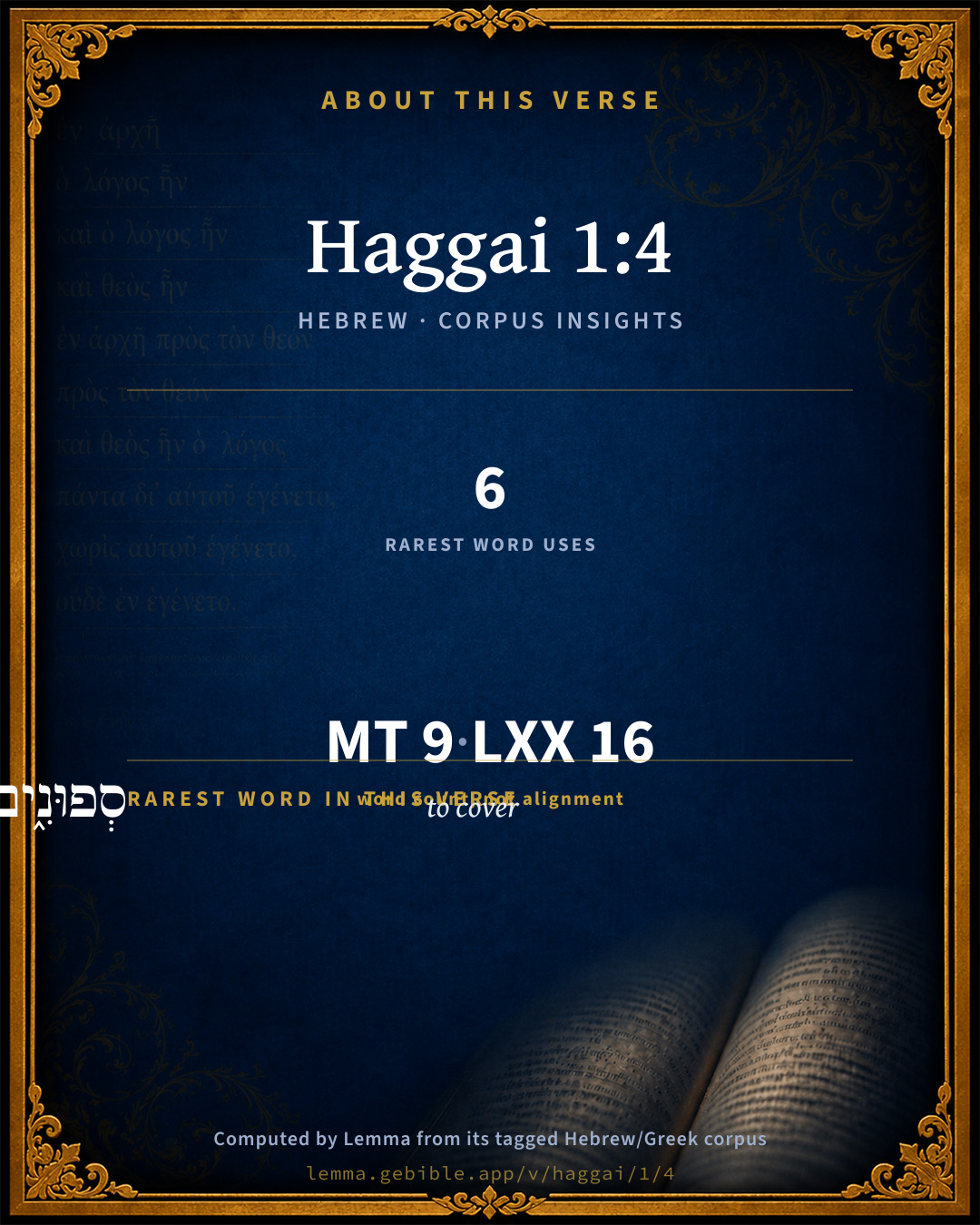
The rarest word here is סְפוּנִ֑ים to cover H5603 — appearing just 6 times in the whole Hebrew Bible.

Shared distinctive vocabulary

סְפוּנִ֑ים to cover H5603 occurs in 6 verses of the Hebrew Bible. Also found in:

Grammatical profile

  • 2 verbs
  • 3 nouns
  • 1 adjective
  • 2 pronouns
  • 1 preposition

Verb forms

  • לָשֶׁ֖בֶת Qal · Infinitive Construct
  • סְפוּנִ֑ים Qal · Participle Passive

Repetition

A word recurs within this verse — often emphatic in Hebrew:

  • בְּבָתֵּיכֶ֣ם house H1004 ×2

Hebrew & Septuagint length

In English translation the verse runs 18 words from the Hebrew and 16 from the Septuagint (LXX English) — closely comparable.

A rough comparison of the two English renderings, which tokenize alike — not a word-level alignment.

Word counts can differ between the Hebrew and the Greek without any difference in meaning — e.g. the Hebrew direct-object marker אֵת has no separate Greek word, and Greek often adds the article ὁ.

In the original languages it is 9 Hebrew tokens and 16 Greek tokens — but the two are counted differently (Hebrew bundles its prefixes and suffixes into one token; the Greek is in lemma form), so that isn’t a like-for-like length.

Cross-references

19

Topical passages linked to Haggai 1:4 in the Treasury of Scripture Knowledge — connected by theme and wording, ordered by reader-vote popularity; previews shown in the World English Bible.

  • 2 Samuel 7:2 that the king said to Nathan the prophet, See now, I dwell in a house of cedar, but the ark of God dwells within curtains.
  • Psalms 132:3–5 "Surely I will not come into the structure of my house, Nor go up into my bed;
  • Philippians 2:21 For they all seek their own, not the things of Jesus Christ.
  • Haggai 1:9 "You looked for much, and, behold, it came to little; and when you brought it home, I blew it away. Why?" says Yahweh of Hosts, "Because of my house that lies waste, while each of you is busy with his own house.
  • Matthew 6:33 But seek first God's Kingdom, and his righteousness; and all these things will be given to you as well.
  • Jeremiah 52:13 and he burned the house of Yahweh, and the king's house; and all the houses of Jerusalem, even every great house, burned he with fire.
  • Lamentations 4:1 How is the gold become dim! [how] is the most pure gold changed! The stones of the sanctuary are poured out at the head of every street.
  • Daniel 9:17–18 Now therefore, our God, listen to the prayer of your servant, and to his petitions, and cause your face to shine on your sanctuary that is desolate, for the Lord's sake.
  • Micah 3:12 Therefore Zion for your sake will be plowed like a field, And Jerusalem will become heaps of rubble, And the mountain of the temple like the high places of a forest.
  • Psalms 74:7 They have burned your sanctuary to the ground. They have profaned the dwelling-place of your Name.
  • Psalms 102:14 For your servants take pleasure in her stones, And have pity on her dust.
  • Jeremiah 26:6 then will I make this house like Shiloh, and will make this city a curse to all the nations of the earth.
  • Jeremiah 26:18 Micah the Morashtite prophesied in the days of Hezekiah king of Judah; and he spoke to all the people of Judah, saying, Thus says Yahweh of Hosts: Zion shall be plowed as a field, and Jerusalem shall become heaps, and the mountain of the house as the high places of a forest.
  • Jeremiah 33:10 Thus says Yahweh: Yet again there shall be heard in this place, about which you say, It is waste, without man and without animal, even in the cities of Judah, and in the streets of Jerusalem, that are desolate, without man and without inhabitant and without animal,
  • Jeremiah 33:12 Thus says Yahweh of Hosts: Yet again shall there be in this place, which is waste, without man and without animal, and in all the cities of it, a habitation of shepherds causing their flocks to lie down.
  • Lamentations 2:7 The Lord has cast off his altar, he has abhorred his sanctuary; He has given up into the hand of the enemy the walls of her palaces: They have made a noise in the house of Yahweh, as in the day of a solemn assembly.
  • Ezekiel 24:21 Speak to the house of Israel, Thus says the Lord Yahweh: Behold, I will profane my sanctuary, the pride of your power, the desire of your eyes, and that which your soul pities; and your sons and your daughters whom you have left behind shall fall by the sword.
  • Daniel 9:26–27 After the sixty-two weeks the Anointed One shall be cut off, and shall have nothing: and the people of the prince who shall come shall destroy the city and the sanctuary; and the end of it shall be with a flood, and even to the end shall be war; desolations are determined.
  • Matthew 24:1–2 Jesus went out from the temple, and was going on his way. His disciples came to him to show him the buildings of the temple.

Cross-references courtesy of OpenBible.info (CC BY 4.0).

Hebrew and Greek witnesses Masoretic Hebrew ↔ Greek Septuagint

The same verse in the two great witnesses to the Old Testament, shown verse-for-verse.

These are two independent witnesses, not word-aligned to each other, and the Septuagint is shown in lemma (dictionary) form.

Hebrew Haggai 1:4 Masoretic · Westminster Leningrad Codex

הַעֵ֤ת לָכֶם֙ אַתֶּ֔ם לָשֶׁ֖בֶת בְּבָתֵּיכֶ֣ם סְפוּנִ֑ים וְהַבַּ֥יִת הַזֶּ֖ה חָרֵֽב

"Is it a time for you yourselves to dwell in your paneled houses, while this house lies waste?

World English Bible · Public Domain

Greek LXX Haggai 1:4 Septuagint · lemma form

εἰ καιρός σύ μέν εἰμί ὁ οἰκέω ἐν οἶκος σύ κοιλόσταθμος ὁ δέ οἶκος οὗτος ἐκἐρημόω

Is it time for you to dwell in your ceiled houses, whereas our house is desolate?

LXX2012 (modern English Septuagint) · Public Domain

On this verse, The Pulpit Commentary discusses the Septuagint’s reading. Read the note in Commentary ↓

Hebrew: Westminster Leningrad Codex (CC BY 4.0). Greek: Septuagint (public domain); English from LXX2012 (modern English Septuagint) (Public Domain). How the Septuagint differs from the Hebrew →

Targum (Aramaic paraphrase)

1

The Targum is the ancient Jewish Aramaic paraphrase of the Hebrew Scriptures — an interpretive translation, not the Hebrew text itself. Onkelos (literal) and Pseudo-Jonathan (expansive) render the Torah, and Jonathan the Prophets. Coverage is partial: where no permissively-licensed English translation exists for a verse, only the Aramaic is shown. This is verse-level text, not a word-by-word alignment to the Hebrew.

  1. Targum Jonathan Prophets (Joshua–Malachi)
    הֲכְדֵין כָּשֵׁר לְכוֹן דְאַתּוּן יָתְבִין בְּבָתַּיָא דִי מְטַלְלִין בְּנִסְרֵי אֲרָזַיָא וּבֵית מַקְדְשָׁא הָדֵין חֲרוֹב:

    (no public-domain English translation for this verse)

    Targum Jonathan — Aramaic: “Mikraot Gedolot” (public domain). English: “Sefaria Community Translation” (CC0 1.0 (public-domain dedication)); “London "Chaldee Paraphrase," 1871” (public domain). Text via Sefaria.

Commentary

Notes on Haggai 1:4 from classic Christian and Jewish commentators (each source and its license shown beneath its notes). The classic Christian expositions comment on the surrounding passage and are grouped to its opening verse, so a note may address several verses; the Jewish commentaries on the Tanakh (Rashi and others) are per-verse, so they appear only where the commentator wrote on this verse.

Lemma curates 59 commentaries, every one of them public domain or Creative Commons licensed, each selected and text-cleaned for this edition rather than reprinted as found. About our sources →

Trapp's Complete Commentary

John Trapp

Hag 1:4 [Is it] time for you, O ye, to dwell in your cieled houses, and this house [lie] waste?

Ver. 4. Is it time for you, O ye, to dwell in your ceiled houses, &c.] Not covered only, but ceiled with cedar (as the Chaldee here hath it), arched and garnished, as the Greek, carved and trimmed, as Ambrose rendereth it (Lib. 3. epist. 12). Sure, either your beds are very soft or your hearts very hard, that you can not only come into the tabernacles of your houses, but give sleep to your eyes, or slumber to your eyelids, before ye have found "a place for the Lord, a habitation for the mighty God of Jacob," Psa 132:4-5. Good David could not find in his heart to dwell in a house of cedar when the ark of God dwelt within curtains, 2Sa 7:2. Valiant Uriah deemed it altogether unfit and unreasonable that when the ark, and Israel, and Judah, abode in tents, he should go to his house to eat and drink, and to take his ease and pleasure, 2Sa 11:11. Solomon first built a house for God, and then for himself. The Christian emperors, Constantine, Theodosius, Honorius, &c., exceeded in building churches, which, from their stateliness, were styled Basilicae, or places for a king. The very Turks to this day, though content to dwell in mean and homely houses, yet their Mosques or meeting houses are very sumptuously built and set forth. It is a principle in nature, that the things of God are older and more to be respected than the things of men (τα του Yεου πρεσβυτερα η τα των ανθρωπων. Herodot.). A professor of the Turks’ laws proclaims, before they attempt anything, that nothing be done against religion. This is better than that which was written over the gate of the senate house in Rome (which yet is not to be disliked, in its place and order), Ne quid detrimenti Resp. capiat. Let nothing be done to the harm of the republic. Give unto Caesar the things that are Caesar’s: but with all, and above all, Give unto God the things that are God’s. The Greek article is twice repeated by our Saviour, when he speaketh for God, more than when for Caesar (τα του θεου τω θεω, Mat 22:21); to show that our special care should be to give God his due, to "seek first the kingdom of God and his righteousness," and then all other things shall seek us. Caetera aut aderunt, aut caetera non oberunt The rest either will happen or the rest will not harm. (Cicero). But most people are so busied about their own houses, their cottages of clay, 2Co 5:1, the body, that God’s house, the soul, lies waste and neglected; the lean kine eat up the fat; the strength of the ground is spent in nourishing weeds. Earthly mindedness sucketh the sap of grace from the heart, as the ivy doth from the oak, and maketh it unfruitful. Men are so taken up about the world, that they think not of God’s kingdom: as the Duke of Alva told the French king, who asked him whether he had observed the recent great eclipse? No, said he, I have so much to do upon earth, that I have no leisure to look toward heaven. But is not one thing necessary, and all others but side businesses? And have we not in our daily prayer five petitions for spirituals and but one for temporals? Are we not taught to make it our first request, that God’s name may be hallowed, though our turn should not be served? Is not Esau stigmatized for selling his birthright for a mess of broth? Heb 12:16. And is not Shimei chronicled for a fool, who, by seeking after his servants, lost his life? Pope Sixtus for a madman, that sold his soul to the devil, to enjoy the Popedom for seven years? "What shall it profit a man to win the world and lose his own soul?" to win Venice, and then be hanged at the gates thereof, as the Italian proverb hath it? Surely such a man’s loss will be, 1. Incomparable, 2. Irreparable; for "What shall a man give in exchange of his soul?" Mat 16:26. It was no evil counsel that was given to John III, King of Portugal, to meditate every day a quarter of an hour on that Divine sentence. It would be time well spent to ponder as often and as long together on this text, "Is it time for you, O ye," that are so sharp set upon the world, so wholly taken up about your private profits, your pleasures and preferments, to sit in your ceiled houses, as Ahab once did in his ivory palace, or Nebuchadnezzar in his house of the kingdom (as he vain gloriously calleth it, Dan 4:30), and God’s house lie waste, and his service neglected, to whom we ourselves owe, 1Co 6:19, our lives, Mat 16:25, our parents, children, friends, means, Mat 19:29, our gifts and abilities, 1Co 4:7, our honours and offices, Psa 2:10-12, all that we are and have? How justly may God curse our blessings (as he threateneth these self-seeking, God neglecting Jews both here and Mal 2:2), scatter brimstone upon our houses, dry up our roots beneath, and above cut off our branches, drive us from light into darkness, and chase us out of the world with his terrors, Job 16:15-21. Surely such are the (ceiled) dwellings of the wicked, and this is the place of him that knoweth not God, that inverteth the order appointed of him, by coveting, not the best gifts, 1Co 12:21, but an evil covetousness, Hab 2:9, by setting his affections, not on things above, but on things on the earth, by seeking their own things, every man, and not the things of Jesus Christ, Col 3:2 Php 2:21.

John Trapp, A Commentary or Exposition upon All the Books of the Old and New Testament (1647–1656) — public domain. Text from a community e-Sword module.

Tyndale Open Study Notes

Tyndale Open Resources

1:4 Why are you? Rhetorical questions in prophetic literature call for agreement rather than a reply (see 2:3). The purpose of this question is to remove the listeners’ opportunity to offer excuses in response to the message. • The luxurious (or covered, paneled) houses of the people contrasted with God’s Temple, which was in ruins (or desolate) and thus unusable.

Tyndale Open Study Notes — © Tyndale Open Resources, licensed CC BY-SA 4.0. Text via the HelloAO Bible API.

Geneva Bible (1599)

Geneva Bible translators

Showing that they sought not only their necessities, but their very pleasures before God’s honor.

Geneva Bible (1599) marginal notes — public domain. Text via Bolls.life.

Jamieson, Fausset & Brown

Robert Jamieson, A. R. Fausset & David Brown

Is it time--It is not time (Hag 1:2), ye say, to build Jehovah's house; yet how is it that ye make it a fit time not only to build, but to "dwell" at ease in your own houses?

you, O ye--rather, for "you, you"; the repetition marking the shameful contrast between their concern for themselves, and their unconcern for God [MAURER]. Compare a similar repetition in Sa1 25:24; Zac 7:5.

ceiled--rather, "wainscoted," or "paneled," referring to the walls as well as the ceilings; furnished not only with comfort but luxury, in sad contrast to God's house not merely unadorned, but the very walls not raised above the foundations. How different David's feelings (Sa2 7:2)!

Jamieson, Fausset & Brown — Commentary Critical and Explanatory on the Whole Bible (1871) — public domain (CC PDM 1.0). Text via the HelloAO Bible API.

Adam Clarke's Commentary

Verse 4. Is it time for you] If the time be not come to rebuild the temple, it cannot be come for you to build yourselves comfortable houses: but ye are rebuilding your houses; why then do ye not rebuild the house of the Lord? The foundation of the temple had been laid fourteen years before, and some considerable progress made in the building; and it had been lying waste in that unfinished state to the present time.

Adam Clarke's Commentary on the Bible (1810–1826) — public domain. Text from a community e-Sword/MySword module.

Ellicott's Commentary for English Readers

(4) Is it time for you . . .—Literally, Is it time for you to dwell in your houses, and those ceiled?—i.e., probably with cedar and other costly woods. A crushing retort. If the adverse decree of Artaxerxes, which disallowed the building of Jerusalem (Ezr_4:21), had not hindered them from erecting magnificent residences for themselves, how could it reasonably excuse an utter neglect of God’s House?

A Bible Commentary for English Readers, edited by Charles John Ellicott (1878–1897) — public domain. Text from a community e-Sword module.

The Cambridge Bible for Schools and Colleges

gen. ed. J. J. S. Perowne

4. for you, O ye] Lit., for you, you: you, yourselves, R. V. The repetition of the pronoun is emphatic, “you are the people I mean;” or you in implied contrast to Almighty God, comp. 1Sa_25:24, where Abigail, anxious to appease David’s anger at the churlishness of Nabal, exclaims, “upon me, my Lord, I (am the person at fault), let this iniquity be.”

your cieled houses] Lit. your houses cieled, i.e. your houses (and they too) cieled. The adjective thus added without an article has the force of a predicate and so becomes emphatic. With the article it would form part of the subject. Comp. Psa_143:10 : “Let Thy Spirit good (as it is, and therefore ready to help and guide the sinful and infirm), lead me,” &c. The translators in A. V., feeling the force of the adjective as a predicate, have broken the first part of the sentence into a separate proposition, “Thy Spirit is good, lead me,” &c. The Prayer-Book version is, “Let thy loving Spirit lead me,” &c.

cieled] Lit. covered or boarded. The word is used with reference to the roof of the Temple, which was high-pitched like our modern roofs, and cieled with boards within. “He covered the house with beams (rafters) and boards of cedar,” 1Ki_6:9. It is also used of the cieling with boards of Solomon’s house of the forest of Lebanon, 1Ki_7:3, and of some kind of covering or boarding (the passage is obscure) of his “Porch of Judgment,” 1Ki_7:7. The practice was luxurious and magnificent even in a king (Jer_22:14). Yet they who professed themselves unable to restore the House of the Lord were indulging in it in their own houses. They built costly houses for themselves, even using, it may be, to decorate them, the cedar wood which had been brought for the Temple (Ezr_3:7; Dict. of the Bible, Art. Zerubbabel), and had grown indifferent to the ruin and desolation of the House of God.

The Cambridge Bible for Schools and Colleges (gen. ed. J. J. S. Perowne; Cambridge University Press, 1878–1918) — public domain. Text from a community e-Sword module.

John Gill's Exposition

Is it time for you, O ye, to dwell in your panelled houses,.... They could not only find time, leisure, and convenience to build houses to dwell in; but to wainscot them, and line them with boards of cedar, as the Targum; as bad as the times were complained of; and could sit in them, indulging themselves in luxury, ease, and sloth; and why then was it not a fit and convenient time as well to build the house of the Lord in?

and this house lie waste? or, "and shall this house lie waste?" or, "when this house lies waste?" (o) not indeed in its rubbish and ruins, as it was demolished by the Chaldeans, and left; but with a bare foundation, laid some years ago; and ever since neglected; the superstructure not carried on, and much less built up to be fit for service; and therefore might be said with propriety to lie waste and desolate, being unfinished, unfit for use, and no regard had unto it. David was of another mind, Sa2 7:2 and truly religious persons will be more concerned for the house of God than for their own houses.

(o) "et domus ista deserta manebit?" Drusius; "quum domus haec vasta est?" Junius & Tremellius, Piscator; "dum domus haec desolata est?" Cocceius.

John Gill's Exposition of the Whole Bible (1746–1763) — public domain (CC PDM 1.0). Text via the HelloAO Bible API.

Albert Barnes' Notes on the Bible

Is it time for you - You, being what you are, the creatures of God, “to dwell in your ceiled houses,” more emphatically, in your houses, and those “ceiled,” probably with costly woods, such as cedar . But where then was the excuse of want of means? They imitated, in their alleged poverty, what is spoken of as magnificent in their old kings, Solomon and Shallum, but not having, as Solomon first did (1Ki 6:9, ויספן), “covered the house of God with beams and rows of cedar” . “Will ye dwell in houses artificially adorned, not so much for use as for delight, and shall My dwelling-place, wherein was the Holy of holies, and the cherubim, and the table of showbread, be bestreamed with rains, desolated in solitude, scorched by the sun?”

“With these words carnal Christians are reproved, who have no glow of zeal for God, but are full of self-love, and so make no effort to repair, build, or strengthen the material temples of Christ, and houses assigned to His worship, when aged, ruinous, decaying or destroyed, but build for themselves curious, voluptuous, superfluous dwellings. In these the love of Christ gloweth not; these Isaiah threateneth, Isa 5:8, Isa 5:12. “Woe to you who join house to house and field to field, and regard not the work of the Lord!”

To David and Solomon the building of God’s temple was their heart’s desire; to early Christian Emperors, to the ages of faith, the building of Churches; now mostly, owners of lands build houses for this world’s profit, and leave it to the few to build in view of eternity, and for the glory of God.

Albert Barnes' Notes on the Bible (1834–1885) — public domain. Text from a community e-Sword/MySword module.

Haydock's Catholic Bible Commentary

Ceiled: superbly adorned. Hebrew, "covered." You are not content with what is merely necessary, while the temple lies in ruins. (Calmet)

George Leo Haydock (1774–1849), Haydock's Catholic Family Bible and Commentary, 1859 edition — public domain. Excludes Psalms (Douay-Rheims chapter numbering differs from Protestant) and Deuterocanonical books (Catholic canon only).

Matthew Poole's English Annotations

Is it time? you think it full time to build your own houses, you judge it seasonable enough to lay out much cost on adorning them, what pretence can you make that it is not seasonable to build my house?

For you, Jews, who were by a king (that knew not your God) sent to build my house, you unthankful and forgetful ones.

To dwell; to settle yourselves securely, and for continuance with stateliness.

Ceiled; searched and with cedar wainscot, curiously carved and covered, and as richly adorned as if you were full of treasures.

Houses: it seems to intimate some of them had more than one house, a city and a country house, and whilst God’s house lay waste; they thus lavish out their wealth on private worldly conveniences, but grudge the charge on God’s house. Can you thus live without a temple, an altar, a sacrifice, and yet cannot live without stately houses? Do you owe so much to yourselves, and so little to your God? so much to your bodies, so little to your souls?

Lie waste; in its rubbish, or in bare, naked foundations without any superstructure.

Matthew Poole's English Annotations on the Holy Bible (1683–1685) — public domain. Text from a community e-Sword/MySword module.

The Pulpit Commentary

For you, O ye; for you, yourselves; such as ye are. (see Zec_7:5) He appeals to their consciences. You can make yourselves comfortable; you have time and means and industry to expend on your own private interests, and can you look with indifference on the house of God lying waste? Your cieled houses; your houses, and those cieled wainscoted and roofed with costly woods (1Ki_7:3, 1Ki_7:7; Jer_22:14) perhaps with the very cedar provided for the rebuilding of the temple. (Ezr_3:7) Septuagint, ejn oi]koiv uJmwn koilosta>qmoiv, "your vaulted houses," or, as St. Cyril explains, "houses whose doorposts were elaborately adorned with emblems and devices." They had naught of the feeling of David, (2Sa_7:2) "I dwell in a house of cedar, but the ark of God dwelleth within curtains.

The house of the Lord lying waste.

The temple was designed to be the centre of hallowed influence to the Jewish nation. It was the recognized dwelling place of God, the shrine where, in bright symbol, his glory, was specially revealed. The pious Jew rejoiced to repair to it, and wherever his lot might be cast he looked towards it with ardent and longing desire. The desecration of it by the introduction of idolatrous practices into its courts had materially contributed to the nation"s collapse. It was of the utmost importance, therefore, that the work of its restoration should be pressed forward with all zest, now that the captives bad been permitted to return, and at first it seemed as though this course would have been pursued, but unhappily they soon allowed their zeal to flag, and year after year passed by and nothing was done. The house of the Lord lay "waste." The Divine Teacher, when he came to usher in a new dispensation, declared that God is a Spirit, and is to be worshipped "in spirit and in truth". (Joh_4:23, Joh_4:24) He taught that place has but little to do with worship, and that there is no spot we may not consecrate by our praises and prayers, and render to us "hallowed ground." Still, he constantly resorted to the temple, and we read of his apostles how that they went up to the temple "at the hour of prayer". (Act_3:1) The erection and maintenance of Christian sanctuaries is most thoroughly in harmony with his will, and is calculated to promote the truest interests of the race. Close all such sanctuaries, and

(1) good men would be left to sigh for the holy fellowship they had lost;

(2) spiritual darkness would steal over the land;

(3) the streams of true benevolence would rapidly diminish;

(4) men in general, losing sight of the common relationship they sustain to the Eternal, would also overlook the interest they ought to feel in each other"s weal;

(5) iniquity would pass unreproved, and vice unchecked. As lovers of God, our country, and our fellow men, we do well to sustain Christian sanctuaries, and not to allow them to "lie waste." Notice, "the house of the Lord" may "lie waste

I IN THE SENSE OF THE MATERIAL STRUCTURE BEING NEGLECTED. There should be correspondence in respect of beauty and adornment, comfort and cleanliness, between the houses in which we live and the sanctuary in which we meet for worship, and where this is lacking, the want indicates a wrong state of mind and heart.

II IN THE SENSE OF ITS PECUNIARY RESOURCES BEING OVERLOOKED, AND THERE BEING THUS STRAITNESS IN RESPECT TO MEETING THE EXPENSES NECESSARILY INCURRED IN ITS MAINTENANCE. Giving should be regarded as an act of worship. "Bring an offering, and come into his courts". (Psa_96:8) Contributions for the maintenance of the worship of God ought not to be regarded in the light of charitable gifts, but as the discharge of bounden obligation.

III IN THE SENSE OF ITS SEATS BEING UNOCCUPIED. There is far too much of "waste" in this respect. The growing habit of attending only one of the services on the sabbath, and none during the week days, needs to be checked Personal influence should be brought more to bear upon the inhabitants of a locality with a view to securing their presence. "Come, let us go up to the house of the Lord". (Psa_122:1)

IV IN THE SENSE OF THE EXERCISES CONDUCTED THEREIN BEING MARKED BY BALDNESS AND INEFFICIENCY. The services should be marked by culture, variety, heart; the worshippers should throw their whole souls into all its engagements, and render each part of the service "heartily" and as "unto the Lord.

V IN THE SENSE OF PAUCITY OF SPIRITUAL RESULTS. With a view to the prevention of this, let us "pray for Jerusalem," that its services may yield comfort to the mourning and guidance to the perplexed, and that through these the cold in heart may regain the fervour of their "first love," and "the dead in trespasses and sins" be quickened to a new and heavenly life. "Save now, O Lord; O Lord, we beseech thee send us now prosperity"; (Psa_118:25) "Repair the waste places of Zion"; (Isa_58:12) "Build thou the walls of Jerusalem". S.D.H. (Psa_51:18)

The Pulpit Commentary (1880–1919), ed. H.D.M. Spence-Jones & Joseph S. Exell — public domain. Text from a community e-Sword module.

John Wesley's Explanatory Notes

Ceiled - Arched and richly adorned.

John Wesley, Explanatory Notes Upon the Whole Bible (1754–1765) — public domain. Text via the GEBible commentary corpus.

Rashi

Rabbi Shlomo Yitzchaki (Rashi)

Is it [an appropriate] time for you? This is an interrogative expression; therefore the “heh” is vowelized with a “pattah.”

ceiled covered with boards of cedar, as in (I Kings 6:9): “And he covered the house” and (ibid. 7:3) “And it was covered with cedar.” And so did Jonathan render: “Is such a way proper for you, that you sit in the houses that are covered with boards of cedar, and this Temple is destroyed?”

Rashi on the Tanakh — English translations: “The Judaica Press complete Tanach with Rashi, translated by A. J. Rosenberg” (CC BY 4.0); “Pentateuch with Rashi's commentary by M. Rosenbaum and A.M. Silbermann, 1929-1934” (public domain); “The Metsudah Tanach series, Lakewood, N.J” (CC BY 4.0); and “The Book of Joshua, Metsudah Publications, 1997” (CC BY 4.0). Text via Sefaria.

Lesson kit

Teaching starters — assembled from the data on this page, not authored interpretation. Every prompt links to the verse data it draws on. Edit before teaching.

Haggai, in the Prophets, opens this verse with 9 words (7 distinct Hebrew lemmas). Its most distinctive word is çâphan (“to cover”). A historical commentator’s framing appears above. Read the whole chapter for the surrounding context.

Discussion questions

  1. What does “to cover” (çâphan) contribute to the verse as a whole?
  2. Deuteronomy 33:21 shares the word «to cover» with this verse. How do the two illuminate each other?
  3. “house” occurs 2× in this one verse. What is the effect of the repetition?
  4. These translations render this verse differently. What is at stake in choosing one wording over another?
  5. The verb «לָשֶׁ֖בֶת» is Qal Infinitive Construct. How does its form color the action?
  6. Reading how Trapp's Complete Commentary and Tyndale Open Study Notes read this verse, where do the two commentators agree and where do they part?

Things to notice

Reading settings

Reading text

Shown beneath each verse's original-language words.

Old Testament
Old Testament edition

Read the OT as the Masoretic Hebrew (MT) or the Greek Septuagint (LXX).

English shown for the Greek Septuagint (in the Hebrew ↔ Greek comparison).

Comparing translations? Open the Compare panel on any verse page to stack up to four side by side.