Ezekiel 21:25

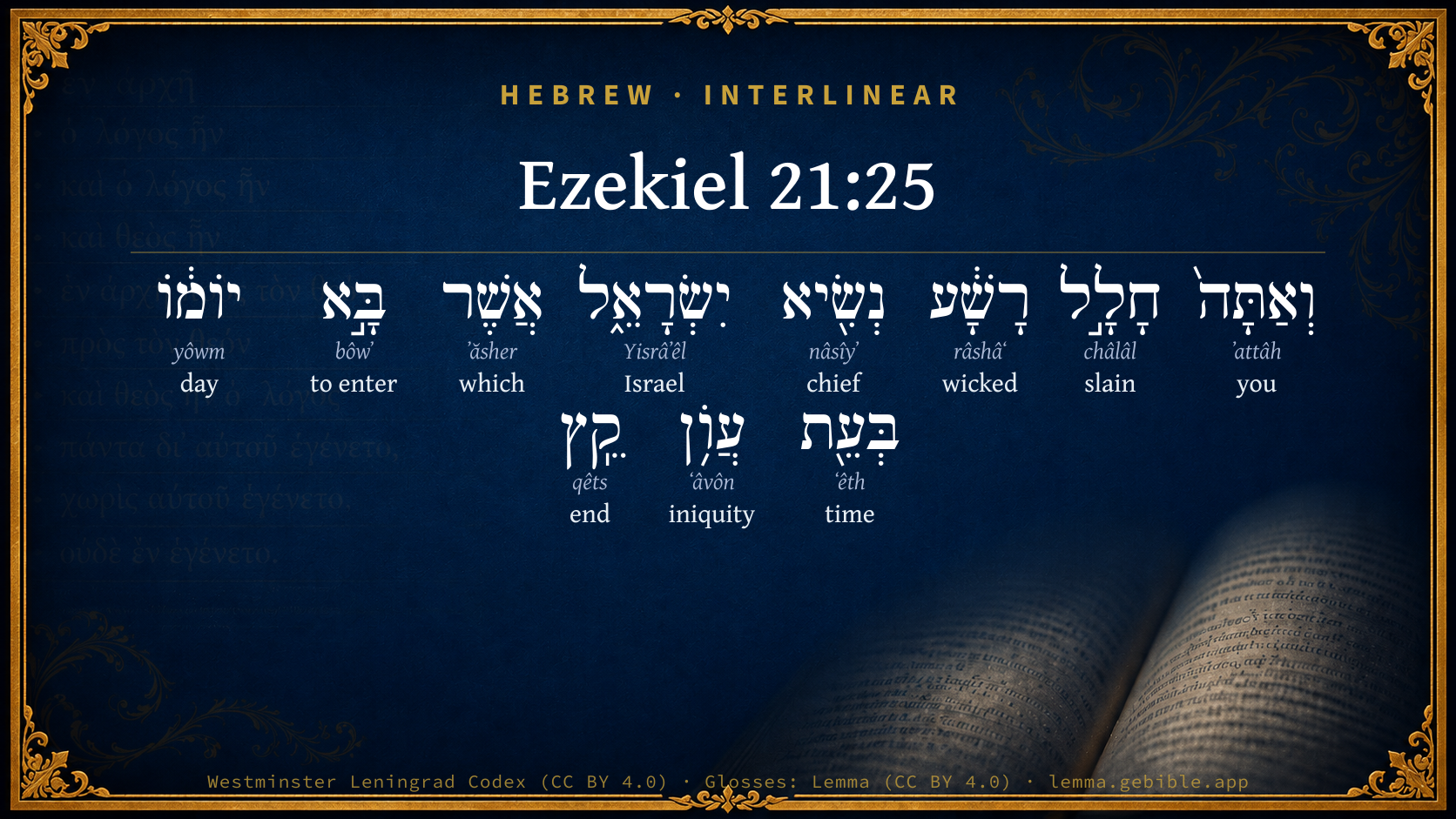
Hebrew (Westminster Leningrad Codex) Ezekiel 21:25 appears in the Hebrew Old Testament. The text above is from the Westminster Leningrad Codex. Each word links to its Strong’s number, a concise gloss, and parsing drawn from the Open Scriptures Hebrew Bible morphology. Click any word for its full Brown-Driver-Briggs (BDB) entry.
Download image
Cite this verse

Ezekiel 21:25 (World English Bible). Public Domain. Lemma interlinear Bible study tool, https://lemma.gebible.app/v/ezekiel/21/25.

Show BibTeX & RIS
BibTeX
RIS
English Translation
You, deadly wounded wicked one, the prince of Israel, whose day is come, in the time of the iniquity of the end,
World English Bible · Public Domain
Download a study sheet

One document with this verse’s original text, its word-by-word gloss line, the meaning frame, cross-references with their text, attributed commentary, and full source and license credits — printable, and it pastes into notes with its structure intact.

This verse Autodidact and up

Study sheet (.html) Plain text (.txt)

A passage Seminary Student

Up to 50 verses in one chapter. A passage sheet keeps up to 6 commentary sources and 12 cross-references per verse, in the order this page ranks them, and says so on the sheet whenever that leaves anything out. Ask for a single verse and you get the Autodidact verse sheet above.

Everything on this page stays free to read, with no account — the sheet is a download of what is already on screen, not access to it.

Want to remove ads? Support Godless Engineer
Compare translations 3

The same verse in 3 English versions, stacked beneath the original-language interlinear above. Click any original word for its lexicon entry.

Each is an independent rendering of the whole verse — the interlinear is not word-aligned to these translations.

Highlighted words mark where these versions differ — a whole-verse word diff, not a word-by-word alignment.

  • World English Bible Public Domain
    You, deadly wounded wicked one, the prince of Israel, whose day is come, in the time of the iniquity of the end,
  • King James Version Public Domain
    And thou, profane wicked prince of Israel, whose day is come, when iniquity shall have an end,
  • unfoldingWord Literal Text CC BY-SA 4.0
    As for you, profane and wicked ruler of Israel, whose day of punishment has come, and whose time of committing iniquity has ended,

unfoldingWord Literal Text — © unfoldingWord, licensed CC BY-SA 4.0. Word-aligned USFM3 via Door43 (git.door43.org/unfoldingWord/en_ult).

Versions to compare (up to 4)

3 of 4 selected

Show all 18 translations

Every available English version of this verse, each an independent rendering of the whole verse.

  • World English Bible Public Domain
    You, deadly wounded wicked one, the prince of Israel, whose day is come, in the time of the iniquity of the end,
  • Berean Standard Bible Public Domain
    And you, O profane and wicked prince of Israel, the day has come for your final punishment.’
  • Majority Standard Bible Public Domain
    And you, O profane and wicked prince of Israel, the day has come for your final punishment.’
  • King James Version Public Domain
    And thou, profane wicked prince of Israel, whose day is come, when iniquity shall have an end,
  • American Standard Version (1901) Public Domain
    And thou, O deadly wounded wicked one, the prince of Israel, whose day is come, in the time of the iniquity of the end,
  • Revised Version (1885) Public Domain
    And thou, O deadly wounded wicked one, the prince of Israel, whose day is come, in the time of the iniquity of the end;
  • Geneva Bible (1599) Public Domain
    And thou prince of Israel polluted, and wicked, whose day is come, when iniquitie shall haue an ende,
  • Douay-Rheims (1899) Public Domain
    But thou profane wicked prince of Israel, whose day is come that hath been appointed in the time of iniquity:
  • Young's Literal Translation Public Domain
    And thou, wounded, wicked one, Prince of Israel, whose day hath come, In the time of the iniquity of the end!
  • Literal Standard Version CC BY-SA 4.0
    And you, wounded, wicked one, || Prince of Israel, whose day has come, || In the time of the iniquity of the end,
  • Unlocked Literal Bible CC BY-SA 4.0
    As for you, profane and wicked ruler of Israel, whose day of punishment has come, and whose time of committing iniquity has ended,
  • unfoldingWord Literal Text CC BY-SA 4.0
    As for you, profane and wicked ruler of Israel, whose day of punishment has come, and whose time of committing iniquity has ended,
  • Darby Bible Public Domain
    And thou, profane, wicked prince of Israel, whose day is come, at the time of the iniquity of the end,
  • World Messianic Bible Public Domain
    “‘You, deadly wounded wicked one, the prince of Israel, whose day has come, in the time of the iniquity of the end,
  • Webster's Bible Public Domain
    And thou, profane wicked prince of Israel, whose day is come, when iniquity shall have an end,
  • Free Bible Version CC BY-SA 4.0
    As for you, you unclean, wicked prince of Israel, the time has come to complete your punishment.
  • Bible in Basic English Public Domain
    And you, O evil one, wounded to death, O ruler of Israel, whose day has come in the time of the last punishment;
  • JPS Tanakh (1917) Public Domain
    (21-30) And thou, O wicked one, that art to be slain, the prince of Israel, whose day is come, in the time of the iniquity of the end;

Literal Standard Version (2020), Covenant Press — licensed CC BY-SA 4.0. Text via the HelloAO Bible API (eBible.org). Unlocked Literal Bible (unfoldingWord) — licensed CC BY-SA 4.0. Text via the HelloAO Bible API (eBible.org). unfoldingWord Literal Text — © unfoldingWord, licensed CC BY-SA 4.0. Word-aligned USFM3 via Door43 (git.door43.org/unfoldingWord/en_ult). Free Bible Version, Dr. Jonathan Gallagher — licensed CC BY-SA 4.0. Text via the HelloAO Bible API (eBible.org).

Word by word

More ways to search: Search by grammar → Find every occurrence → Compare this word →

Practice this passage: Drill this verse → Learn its vocabulary →

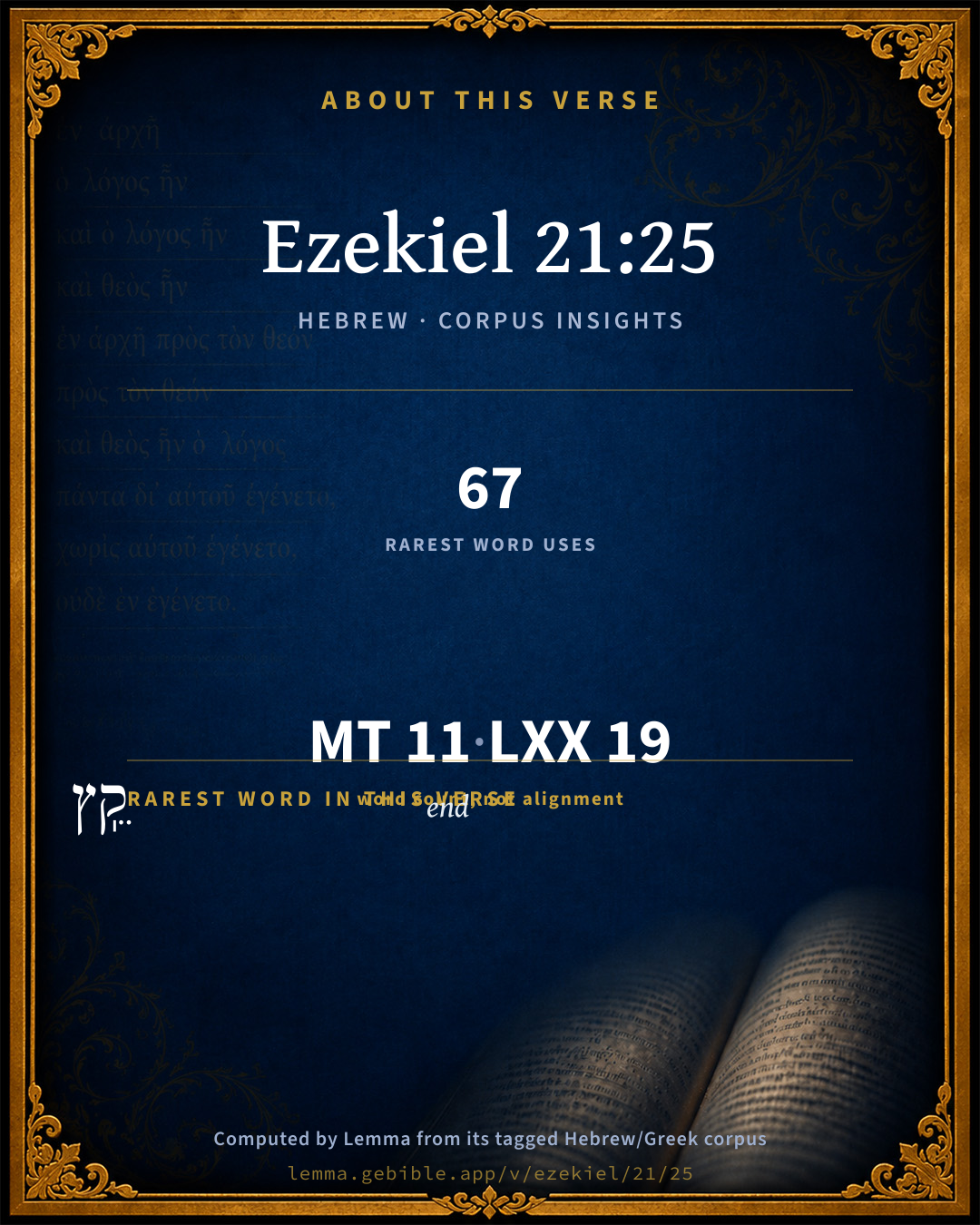
קֵֽץ
qêts
H7093
“end”
Noun, Common, Masculine, Singular, Absolute
Part of Speech
Noun
Type
Common
Gender
Masculine
Number
Singular
State
Absolute
Full BDB Definition

Origin: contracted from H7112 , an extremity

TWOT: 2060a

end - end, at the end of (of time) - end (of space)
  1. וְאַתָּה֙ ʼattâh H859 “and · you” Conjunction + Pronoun, Personal, 2nd Person, Masculine, Singular
  2. חָלָ֣ל châlâl H2491 “slain” Adjective, Adjective, Masculine, Singular, Absolute
  3. רָשָׁ֔ע râshâʻ H7563 “wicked” Adjective, Adjective, Masculine, Singular, Absolute
  4. נְשִׂ֖יא nâsîyʼ H5387 “chief of” Noun, Common, Masculine, Singular, Construct
  5. יִשְׂרָאֵ֑ל Yisrâʼêl H3478 “Israel” Noun, Proper
  6. אֲשֶׁר ʼăsher H834 “which” Particle, Relative
  7. בָּ֣א bôwʼ H935 “to enter” Verb, Qal, Perfect, 3rd Person, Masculine, Singular
  8. יוֹמ֔וֹ yôwm H3117 “day · his” Noun, Common, Masculine, Singular, Construct + Suffix, Personal, 3rd Person, Masculine, Singular
  9. בְּעֵ֖ת ʻêth H6256 “in/at · time of” Preposition + Noun, Common, Both, Singular, Construct
  10. עֲוֺ֥ן ʻâvôn H5771 “iniquity of” Noun, Common, Both, Singular, Construct

About this verse

These counts appear in no published source. They are computed here, from the morphology-tagged text and Lemma’s own curated glosses. What Lemma adds →

11
words
11
distinct lemmas
Prophets
section

Grammatical profile

  • 1 verb
  • 6 nouns
  • 2 adjectives
  • 1 pronoun
  • 1 particle

Verb forms

  • בָּ֣א Qal · Perfect

Hebrew & Septuagint length

In English translation the verse runs 22 words from the Hebrew and 23 from the Septuagint (LXX English) — closely comparable.

A rough comparison of the two English renderings, which tokenize alike — not a word-level alignment.

Word counts can differ between the Hebrew and the Greek without any difference in meaning — e.g. the Hebrew direct-object marker אֵת has no separate Greek word, and Greek often adds the article ὁ.

In the original languages it is 11 Hebrew tokens and 19 Greek tokens — but the two are counted differently (Hebrew bundles its prefixes and suffixes into one token; the Greek is in lemma form), so that isn’t a like-for-like length.

Cross-references

11

Topical passages linked to Ezekiel 21:25 in the Treasury of Scripture Knowledge — connected by theme and wording, ordered by reader-vote popularity; previews shown in the World English Bible.

  • Ezekiel 35:5 Because you have had a perpetual enmity, and have given over the children of Israel to the power of the sword in the time of their calamity, in the time of the iniquity of the end;
  • 2 Chronicles 36:13 He also rebelled against king Nebuchadnezzar, who had made him swear by God: but he stiffened his neck, and hardened his heart against turning to Yahweh, the God of Israel.
  • Jeremiah 52:2 He did that which was evil in the sight of Yahweh, according to all that Jehoiakim had done.
  • Ezekiel 17:19 Therefore thus says the Lord Yahweh: As I live, surely my oath that he has despised, and my covenant that he has broken, I will even bring it on his own head.
  • Ezekiel 21:29 while they see for you false visions, while they divine lies to you, to lay you on the necks of the wicked who are deadly wounded, whose day is come in the time of the iniquity of the end.
  • Psalms 7:9 Oh let the wickedness of the wicked come to an end, But establish the righteous; Their minds and hearts are searched by the righteous God.
  • Psalms 9:5–6 You have rebuked the nations. You have destroyed the wicked. You have blotted out their name forever and ever.
  • Jeremiah 24:8 As the bad figs, which can't be eaten, they are so bad, surely thus says Yahweh, So will I give up Zedekiah the king of Judah, and his princes, and the residue of Jerusalem, who remain in this land, and those who dwell in the land of Egypt,
  • Jeremiah 51:13 You who dwell on many waters, abundant in treasures, your end is come, the measure of your covetousness.
  • Ezekiel 7:6 An end is come, the end is come; it awakes against you; behold, it comes.
  • Ezekiel 30:3 For the day is near, even the day of Yahweh is near; it shall be a day of clouds, a time of the nations.

Cross-references courtesy of OpenBible.info (CC BY 4.0).

Hebrew and Greek witnesses Masoretic Hebrew ↔ Greek Septuagint

The same verse in the two great witnesses to the Old Testament, shown verse-for-verse.

These are two independent witnesses, not word-aligned to each other, and the Septuagint is shown in lemma (dictionary) form.

Hebrew Ezekiel 21:25 Masoretic · Westminster Leningrad Codex

וְאַתָּה֙ חָלָ֣ל רָשָׁ֔ע נְשִׂ֖יא יִשְׂרָאֵ֑ל אֲשֶׁר בָּ֣א יוֹמ֔וֹ בְּעֵ֖ת עֲוֺ֥ן קֵֽץ

You, deadly wounded wicked one, the prince of Israel, whose day is come, in the time of the iniquity of the end,

World English Bible · Public Domain

Greek LXX Ezekiel 21:25 Septuagint · lemma form

ὁδός διατάσσω ὁ εἰςἔρχομαι ῥομφαία ἐπί ραββαθ υἱός αμμων καί ἐπί ὁ ἰουδαία καί ἐπί ἰερουσαλήμ ἐν μέσος αὐτός

And you profane wicked prince of Israel, whose day, even an end, is come in a sea of iniquity, thus says the Lord;

LXX2012 (modern English Septuagint) · Public Domain

On this verse, The Pulpit Commentary discusses the Septuagint’s reading. Read the note in Commentary ↓

Hebrew: Westminster Leningrad Codex (CC BY 4.0). Greek: Septuagint (public domain); English from LXX2012 (modern English Septuagint) (Public Domain). How the Septuagint differs from the Hebrew →

Targum (Aramaic paraphrase)

1

The Targum is the ancient Jewish Aramaic paraphrase of the Hebrew Scriptures — an interpretive translation, not the Hebrew text itself. Onkelos (literal) and Pseudo-Jonathan (expansive) render the Torah, and Jonathan the Prophets. Coverage is partial: where no permissively-licensed English translation exists for a verse, only the Aramaic is shown. This is verse-level text, not a word-by-word alignment to the Hebrew.

  1. Targum Jonathan Prophets (Joshua–Malachi)
    אוֹרְחָא אַתְקֵין דְיֵיתוּן בָּהּ קְטוֹלֵי חַרְבָּא מֵרַבַּת בְּנֵי עַמוֹן וְעַל דְבֵית יְהוּדָה דִי נְפַקוּ מִירוּשְׁלֵם לְמֵיתַב בְּקִרְוִין כְּרִיכָן:

    (no public-domain English translation for this verse)

    Targum Jonathan — Aramaic: “Mikraot Gedolot” (public domain). English: “Sefaria Community Translation” (CC0 1.0 (public-domain dedication)); “London "Chaldee Paraphrase," 1871” (public domain). Text via Sefaria.

Commentary

Notes on Ezekiel 21:25 from classic Christian and Jewish commentators (each source and its license shown beneath its notes). The classic Christian expositions comment on the surrounding passage and are grouped to its opening verse, so a note may address several verses; the Jewish commentaries on the Tanakh (Rashi and others) are per-verse, so they appear only where the commentator wrote on this verse.

Lemma curates 59 commentaries, every one of them public domain or Creative Commons licensed, each selected and text-cleaned for this edition rather than reprinted as found. About our sources →

Trapp's Complete Commentary

John Trapp

Eze 21:25 And thou, profane wicked prince of Israel, whose day is come, when iniquity [shall have] an end,

Ver. 25. And thou profane.] Or, Worthy to be wounded to death.

Wicked prince.] Zedekiah, who now hath his own told him plainly by a prophet. See the like done, 1Sa 13:13 1Ki 18:18 2Ki 3:13-14. {See Trapp on "1Sa 13:13"} {See Trapp on "1Ki 18:18"} {See Trapp on "2Ki 3:13"} {See Trapp on "2Ki 3:14"}

John Trapp, A Commentary or Exposition upon All the Books of the Old and New Testament (1647–1656) — public domain. Text from a community e-Sword module.

Joseph Benson's Commentary

Eze 21:25-26. And thou, profane wicked prince of Israel — The words are directed to Zedekiah, whom the prophet calls profane and wicked, chiefly with respect to his breaking that solemn oath, uttered in the name of God, whereby he had engaged himself to be tributary to the king of Babylon. By this action he and his courtiers did great dishonour to the true God. The king of Babylon, it appears, kept the oath which he sware to them by his false gods, while they broke the oath which they sware to him by Jehovah! Thus disgracing the true God before the Babylonians and other heathen, who must needs entertain a contemptible opinion of that being, whose worshippers durst break the oath which they had sworn by him. Therefore with respect to this, as well as his unalterable regard to truth and the due observance of oaths, God could not but look with indignation upon the breach of their oath, and inflict punishment upon them for it. See note on Eze 17:15. Whose day is come — The day of whose calamity is near at hand, when he shall receive the due punishment of his iniquity. Remove the diadem — The original word is often used for the priestly mitre, but here it means some kingly ornament, probably the royal tire of the head. Take off the crown — Depose him from his kingly dignity. This shall not be the same — The kingdom shall never be what it has been. Exalt him that is low — This seems to be spoken of Jehoiachin, who was many years kept in prison at Babylon; but at length, as we read 2Ki 25:27, was taken out of prison, kindly treated, and advanced to great honour by Evil-merodach, king of Babylon. And abase him that is high — Namely, Zedekiah; who was to be pulled down from his throne, have his eyes put out, and be kept in prison the remainder of his days.

Joseph Benson's Commentary on the Old and New Testaments (1811–1818) — public domain. Text from a community e-Sword module.

Tyndale Open Study Notes

Tyndale Open Resources

21:25-27 This judgment would extend against Zedekiah, the corrupt and wicked prince of Israel, as well as against the people. Ezekiel identifies Zedekiah by title rather than by name, indicating that his office was also under judgment. He would be stripped of the emblems of royalty and brought low, while the Lord exalted the lowly. The old order would experience destruction. • the one appears who has the right to judge it: This coming judge is often understood to be the Messiah (cp. Gen 49:10). In this context, however, the Lord was handing Judah over to the Babylonians for judgment (see Ezek 23:24). Ezekiel was probably reshaping the traditional messianic oracle of Gen 49:10 into a message of imminent judgment by the hand of Nebuchadnezzar, acting as an agent of God. God temporarily took away the scepter from Judah because Israel’s rulers had sinned, but he would eventually give it back.

Tyndale Open Study Notes — © Tyndale Open Resources, licensed CC BY-SA 4.0. Text via the HelloAO Bible API.

Geneva Bible (1599)

Geneva Bible translators

Meaning, Zedekiah, who practiced with the Egyptians to make himself high and able to resist the Babylonians.

Geneva Bible (1599) marginal notes — public domain. Text via Bolls.life.

Jamieson, Fausset & Brown

Robert Jamieson, A. R. Fausset & David Brown

profane--as having desecrated by idolatry and perjury his office as the Lord's anointed. HAVERNICK translates, as in Eze 21:14, "slain," that is, not literally, but virtually; to Ezekiel's idealizing view Zedekiah was the grand victim "pierced through" by God's sword of judgment, as his sons were slain before his eyes, which were then put out, and he was led a captive in chains to Babylon. English Version is better: so GESENIUS (Ch2 36:13; Jer 52:2).

when iniquity shall have an end-- (Eze 21:29). When thine iniquity, having reached its last stage of guilt, shall be put an end to by judgment (Eze 35:5).

Jamieson, Fausset & Brown — Commentary Critical and Explanatory on the Whole Bible (1871) — public domain (CC PDM 1.0). Text via the HelloAO Bible API.

Adam Clarke's Commentary

Verse 25. And thou profane wicked prince of Israel] Zedekiah, called here profane, because he had broken his oath; and wicked, because of his opposition to God and his prophet.

Whose day is come] Who in a short time shalt be delivered into the hands of thy enemies.

Adam Clarke's Commentary on the Bible (1810–1826) — public domain. Text from a community e-Sword/MySword module.

Ellicott's Commentary for English Readers

(25) Profane.—The prophet now turns from the people as a whole to the individual prince at their head. The word for “profane” is the same as is translated “slain” in Eze_21:14; it would be better rendered here, as there, overthrown. What is close at hand is described as accomplished.

When iniquity shall have an end.—Literally, at the time of the iniquity of the end. The same expression is repeated in Eze_21:29, and the meaning is plainly, at the time of that final transgression which shall be closed by the immediate manifestation of the Divine judgment. The representation of iniquity as being allowed to run a certain course through the Divine forbearance, and arrested and punished when it has reached its culmination, is a common one in Scripture. (See Gen_15:16; Dan_8:23; Mat_23:34-36, &c.)

A Bible Commentary for English Readers, edited by Charles John Ellicott (1878–1897) — public domain. Text from a community e-Sword module.

The Cambridge Bible for Schools and Colleges

gen. ed. J. J. S. Perowne

25. profane wicked prince] Or, and thou wicked one, who art to be slain, prince of Israel. The sense “profane” is not quite certain, cf. fem., Lev_21:7; Lev_21:14.

when iniquity … an end] in the time of the iniquity of the end, i.e. when iniquity shall receive its final chastisement—in the downfall of the state and captivity of the king. Cf. Eze_35:5.

The Cambridge Bible for Schools and Colleges (gen. ed. J. J. S. Perowne; Cambridge University Press, 1878–1918) — public domain. Text from a community e-Sword module.

John Gill's Exposition

I will overturn, overturn, overturn, it,.... The crown and kingdom of Judah; which being expressed three times, has not respect, as Kimchi thinks, to the three generations, in which the crown ceased after the captivity, as those of Asir, Shealtiel, Pedaiah; and in the fourth generation was restored to Zerubbabel; for he was no king, nor was there any of David's line after; nor were the Maccabees or Hasmoneans properly kings; but the phrase denotes the utter abolition of the kingly power, and the certainty of it, which could not be restored, notwithstanding the attempts made by Gedaliah and Ishmael; all their schemes were overturned, and so in successive ages and may also denote and include the troubles that were in the Jewish state, not only during the captivity, but from that time unto the Messiah's coming; there were nothing but overturnings, overturnings till that time came:

and it shall be no more; a kingdom governed by one of the seed of the then present family, or of the seed of David; there shall be no more a king of his race, as there was not till Shiloh came, intended in the next clause:

until he come whose right it is; the right of the crown and kingdom of Israel; which belongs to Jesus the Messiah, being descended from a race of kings of the house of Judah, and of the seed of David: or,

to whom the judgment is (s); to whom the Father hath committed all judgment, Joh 5:22 all power of judging both his church and people, and the whole world:

and I will give it him; the crown and kingdom, which is his right; put him in the possession of it, as he was at his resurrection and ascension; and which will more fully appear in the latter day, when all kingdoms will become his; especially he has, and will appear to have, the throne of his father David, and of his kingdom there will be no end, Luk 1:31. This is understood and interpreted of the Messiah, by R. Abendana (t), a modern Jew.

(s) "cujus est judicium", Pagninus, Starckius; "vel jus", Junius & Tremellius, Polanus, Piscator. (t) Not. in Ben Melech, Miclol Yophi in loc.

John Gill's Exposition of the Whole Bible (1746–1763) — public domain (CC PDM 1.0). Text via the HelloAO Bible API.

Haydock's Catholic Bible Commentary

Thou profane, &c. He speaks to king Sedecias, who had broken his oath, and was otherwise a wicked prince. (Challoner) --- Hebrew, "Criminal, (sentenced to die) wicked," &c. (Calmet)

George Leo Haydock (1774–1849), Haydock's Catholic Family Bible and Commentary, 1859 edition — public domain. Excludes Psalms (Douay-Rheims chapter numbering differs from Protestant) and Deuterocanonical books (Catholic canon only).

Matthew Poole's English Annotations

Then; Zedekiah.

Profane; tainted with secret deep irreligious opinions, whence he despised God and his oath, and profaned the name of God. Prince: so much was his royal dignity lessened, that indeed he was rather a prince subject and dependent than a king.

Whose day, day of sorrows, and sufferings, and punishment, is at hand. Iniquity; the irreligion which is spread by thee among thy courtiers shall cease to spread itself, because of thy low estate. Or, when iniquity shall bring the fatal ruin of king and kingdom, and both shall be destroyed, and with the overthrow of your state the opportunities and means of sinning shall end too.

Matthew Poole's English Annotations on the Holy Bible (1683–1685) — public domain. Text from a community e-Sword/MySword module.

Whedon's Commentary on the Bible

Daniel D. Whedon

25. Thou, profane wicked prince of Israel — Rather, “O deadly wounded wicked one, the prince of Israel” (R.V.).

When iniquity shall have an end — Rather, “in the time of the iniquity [or, punishment] of the end” (R.V.). Then Zedekiah shall be captured and the state overthrown “in the time of the end” (Eze_35:5). “The end” with Ezekiel was the “now” in which wickedness had reached its climax. It is a vital truth that every generation lives in the end of time.

Daniel D. Whedon (gen. ed.), Commentary on the Old and New Testaments (1874–1909) — public domain. Text from a community e-Sword module.

The Pulpit Commentary

And thou, profane wicked prince of Judah, etc.; better, with the Revised Version, O deadly wounded, etc., as in ver. 29, where the same word is translated in the Authorized Version as "slain" The Authorized Version follows the LXX and Vulgate, apparently in order to make the word fit in with the fact that Zedekiah was not slain, but carried into exile. The word "deadly wounded," or "sorely smitten," may rightly be applied to one who fell, as Zedekiah did, from his high estate. From the sins of the people the prophet turns to the special guilt of Zedekiah, who had proved unfaithful alike to Jehovah and to the Chaldean king, whom he had owned as his suzerain. His day had at last come, the time of the iniquity of the end of the last transgression which was to bring down on him the final punishment.

The Pulpit Commentary (1880–1919), ed. H.D.M. Spence-Jones & Joseph S. Exell — public domain. Text from a community e-Sword module.

John Wesley's Explanatory Notes

And thou - Zedekiah. Whose day - The day of sorrows, and sufferings, and punishment is at hand. Shall have an end - Shall bring the ruin of king and kingdom, and with the overthrow of your state, the means of sinning shall end too.

John Wesley, Explanatory Notes Upon the Whole Bible (1754–1765) — public domain. Text via the GEBible commentary corpus.

unfoldingWord translationNotes

Door43 World Missions Community

General Information:

Yahweh gives Ezekiel his message to the ruler of Israel.

whose day of punishment has come

This is an idiom. AT: "whom Yahweh will now punish" (See: Idiom)

whose time of committing iniquity has ended

"at the time when Yahweh ends iniquity"

the turban

"the king's turban." A turban is a beautiful piece of cloth that kings wore wrapped on their heads as a symbol of their authority.

the lowly ... the exalted

This refers to people with low status and people who are exalted. AT: "those who are lowly ... those who are exalted" or "those with low status ... those with high status" (See: Nominal Adjectives)

It will not be restored

Here the crown represents the position of king. The kingship will not be restored until the Messiah comes. AT: "There will no longer be a king" (See: Metonymy)

the one comes who is assigned

This can be stated in active form. AT: "the one comes who I assign" (See: Active or Passive)

translationWords

profane

evil

rule

Israel

punish

iniquity

crown

exalt

lowly

humble

ruin

unfoldingWord translationNotes — © Distant Shores Media and the Door43 World Missions Community, licensed CC BY-SA 4.0. Source: git.door43.org/Door43/en_tn.

Rashi

Rabbi Shlomo Yitzchaki (Rashi)

You shall make a road for the coming, etc. These two roads symbolize the king of Babylon, who is leaving his country with the intention of going either to Jerusalem or to Rabbah of the children of Ammon. To whichever of the two of them the lot will fall for him by his divinations, he will march, as is delineated (verse 26): “For the king of Babylon stood, etc.”

Rashi on the Tanakh — English translations: “The Judaica Press complete Tanach with Rashi, translated by A. J. Rosenberg” (CC BY 4.0); “Pentateuch with Rashi's commentary by M. Rosenbaum and A.M. Silbermann, 1929-1934” (public domain); “The Metsudah Tanach series, Lakewood, N.J” (CC BY 4.0); and “The Book of Joshua, Metsudah Publications, 1997” (CC BY 4.0). Text via Sefaria.

Lesson kit

Teaching starters — assembled from the data on this page, not authored interpretation. Every prompt links to the verse data it draws on. Edit before teaching.

Ezekiel, in the Prophets, opens this verse with 11 words (11 distinct Hebrew lemmas). Its most distinctive word is qêts (“end”). A historical commentator’s framing appears above. Read the whole chapter for the surrounding context.

Discussion questions

  1. What does “end” (qêts) contribute to the verse as a whole?
  2. How does Ezekiel 35:5, which shares this passage’s theme, read alongside this verse?
  3. These translations render this verse differently; the difference is in the English rendering, not the original. What questions does that raise?
  4. «בָּ֣א» is a Qal Perfect verb. How does that grammatical form shape the action described?
  5. Compare how Trapp's Complete Commentary and Joseph Benson's Commentary read this verse. Where do they agree or differ?

Things to notice

Reading settings

Reading text

Shown beneath each verse's original-language words.

Old Testament
Old Testament edition

Read the OT as the Masoretic Hebrew (MT) or the Greek Septuagint (LXX).

English shown for the Greek Septuagint (in the Hebrew ↔ Greek comparison).

Comparing translations? Open the Compare panel on any verse page to stack up to four side by side.