Daniel 11:35

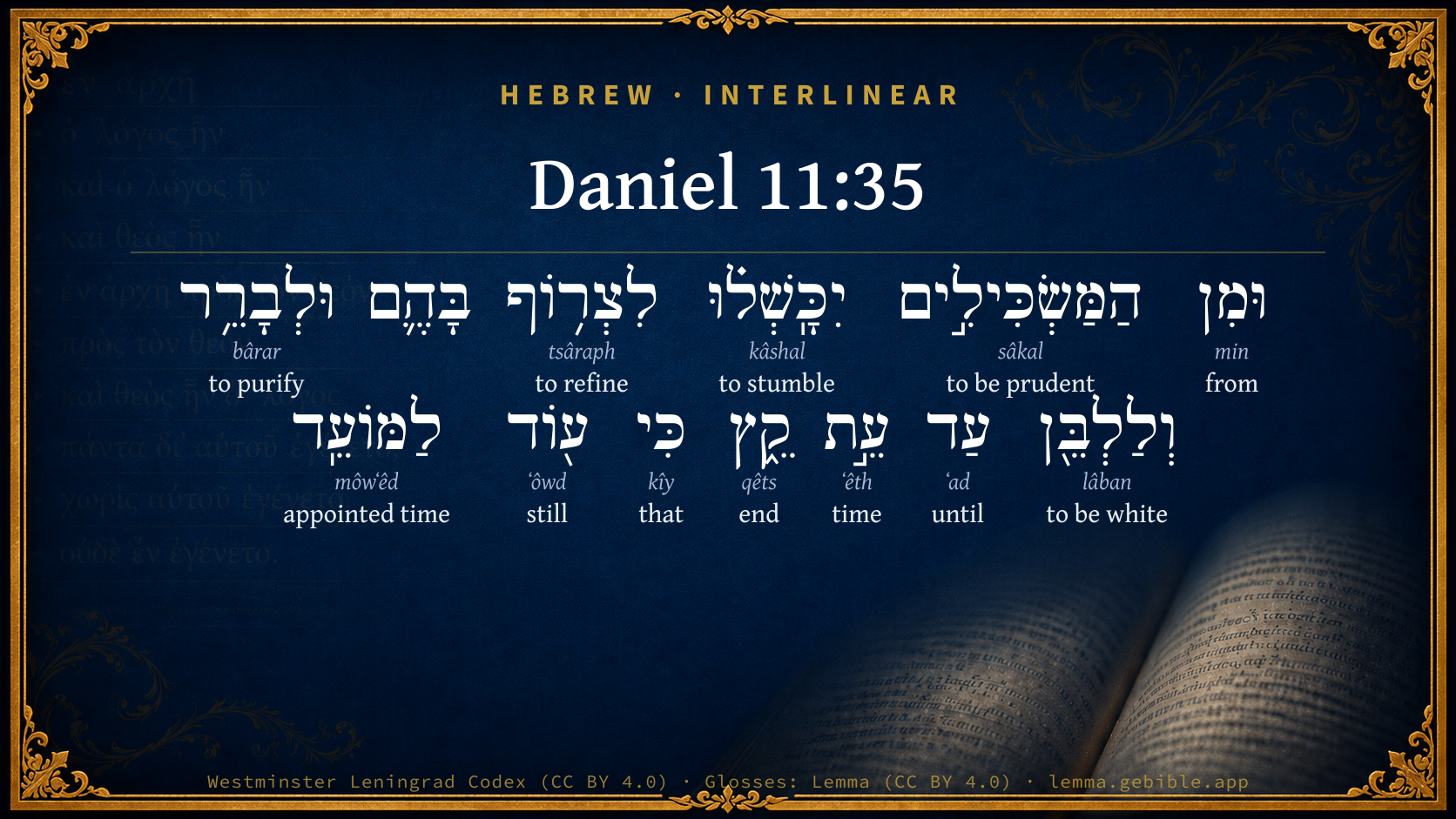
Hebrew (Westminster Leningrad Codex) Daniel 11:35 appears in the Hebrew Old Testament. The text above is from the Westminster Leningrad Codex. Each word links to its Strong’s number, a concise gloss, and parsing drawn from the Open Scriptures Hebrew Bible morphology. Click any word for its full Brown-Driver-Briggs (BDB) entry.
Download image
Cite this verse

Daniel 11:35 (World English Bible). Public Domain. Lemma interlinear Bible study tool, https://lemma.gebible.app/v/daniel/11/35.

Show BibTeX & RIS
BibTeX
RIS
English Translation
Some of those who are wise shall fall, to refine them, and to purify, and to make them white, even to the time of the end; because it is yet for the time appointed.
World English Bible · Public Domain
Download a study sheet

One document with this verse’s original text, its word-by-word gloss line, the meaning frame, cross-references with their text, attributed commentary, and full source and license credits — printable, and it pastes into notes with its structure intact.

This verse Autodidact and up

Study sheet (.html) Plain text (.txt)

A passage Seminary Student

Up to 50 verses in one chapter. A passage sheet keeps up to 6 commentary sources and 12 cross-references per verse, in the order this page ranks them, and says so on the sheet whenever that leaves anything out. Ask for a single verse and you get the Autodidact verse sheet above.

Everything on this page stays free to read, with no account — the sheet is a download of what is already on screen, not access to it.

Want to remove ads? Support Godless Engineer
Compare translations 3

The same verse in 3 English versions, stacked beneath the original-language interlinear above. Click any original word for its lexicon entry.

Each is an independent rendering of the whole verse — the interlinear is not word-aligned to these translations.

Highlighted words mark where these versions differ — a whole-verse word diff, not a word-by-word alignment.

  • World English Bible Public Domain
    Some of those who are wise shall fall, to refine them, and to purify, and to make them white, even to the time of the end; because it is yet for the time appointed.
  • King James Version Public Domain
    And some of them of understanding shall fall, to try them, and to purge, and to make them white, even to the time of the end: because it is yet for a time appointed.
  • unfoldingWord Literal Text CC BY-SA 4.0
    Some of those who have insight will stumble in order to refine, purify, and cleanse them, until the time of the end. For it is still to come at the appointed time.

unfoldingWord Literal Text — © unfoldingWord, licensed CC BY-SA 4.0. Word-aligned USFM3 via Door43 (git.door43.org/unfoldingWord/en_ult).

Versions to compare (up to 4)

3 of 4 selected

Show all 18 translations

Every available English version of this verse, each an independent rendering of the whole verse.

  • World English Bible Public Domain
    Some of those who are wise shall fall, to refine them, and to purify, and to make them white, even to the time of the end; because it is yet for the time appointed.
  • Berean Standard Bible Public Domain
    Some of the wise will fall, so that they may be refined, purified, and made spotless until the time of the end, for it will still come at the appointed time.
  • Majority Standard Bible Public Domain
    Some of the wise will fall so that they may be refined, purified, and made spotless until the time of the end, for it will still come at the appointed time.
  • King James Version Public Domain
    And some of them of understanding shall fall, to try them, and to purge, and to make them white, even to the time of the end: because it is yet for a time appointed.
  • American Standard Version (1901) Public Domain
    And some of them that are wise shall fall, to refine them, and to purify, and to make them white, even to the time of the end; because it is yet for the time appointed.
  • Revised Version (1885) Public Domain
    And some of them that be wise shall fall, to refine them, and to purify, and to make them white, even to the time of the end: because it is yet for the time appointed.
  • Geneva Bible (1599) Public Domain
    And some of the of vnderstanding shall fall to trie them, and to purge, and to make them white, till the time be out: for there is a time appointed.
  • Douay-Rheims (1899) Public Domain
    And some of the learned shall fall, that they may be tried, and may be chosen, and made white even to the appointed time, because yet there shall be another time.
  • Young's Literal Translation Public Domain
    And some of the teachers do stumble for refining by them, and for purifying, and for making white -- till the end of the time, for `it is' yet for a time appointed.
  • Literal Standard Version CC BY-SA 4.0
    And some of the teachers stumble for refining by them, and for purifying, and for making white—until the end of the time, for [it is] yet for a time appointed.
  • Unlocked Literal Bible CC BY-SA 4.0
    Some of the wise will stumble so that refining will happen to them, and cleansing, and purifying, until the time of the end. For the appointed time is still to come.
  • unfoldingWord Literal Text CC BY-SA 4.0
    Some of those who have insight will stumble in order to refine, purify, and cleanse them, until the time of the end. For it is still to come at the appointed time.
  • Darby Bible Public Domain
    And [some] of the wise shall fall, to try them, and to purge and to make them white, to the time of the end: for it shall yet be for the time appointed.
  • World Messianic Bible Public Domain
    Some of those who are wise will fall—to refine them, and to purify, and to make them white, even to the time of the end, because it is yet for the time appointed.
  • Webster's Bible Public Domain
    And some of them of understanding shall fall, to try them, and to purge, and to make them white, even to the time of the end: because it is yet for a time appointed.
  • Free Bible Version CC BY-SA 4.0
    Some of the wise will be killed, so that they may be refined and purified and cleansed until the time of the end, for the predicted time is still to come.
  • Bible in Basic English Public Domain
    And some of those who are wise will have wisdom in testing themselves and making themselves clean, till the time of the end: for it is still for the fixed time.
  • JPS Tanakh (1917) Public Domain
    And some of them that are wise shall stumble, to refine among them, and to purify, and to make white, even to the time of the end; for it is yet for the time appointed.

Literal Standard Version (2020), Covenant Press — licensed CC BY-SA 4.0. Text via the HelloAO Bible API (eBible.org). Unlocked Literal Bible (unfoldingWord) — licensed CC BY-SA 4.0. Text via the HelloAO Bible API (eBible.org). unfoldingWord Literal Text — © unfoldingWord, licensed CC BY-SA 4.0. Word-aligned USFM3 via Door43 (git.door43.org/unfoldingWord/en_ult). Free Bible Version, Dr. Jonathan Gallagher — licensed CC BY-SA 4.0. Text via the HelloAO Bible API (eBible.org).

Word by word

More ways to search: Search by grammar → Find every occurrence → Compare this word →

Practice this passage: Drill this verse → Learn its vocabulary →

וְלַלְבֵּ֖ן
lâban
H3835
“and · to be white”
Conjunction + Preposition + Verb, Hiphil, Infinitive Construct
Part of Speech
Conjunction + Preposition + Verb
Stem
Hiphil
Form
Infinitive Construct
Full BDB Definition

Origin: a primitive root

TWOT: 1074b , 1074h

to be white - (Hiphil) - to make white, become white, purify - to show whiteness, grow white - (Hithpael) to become white, be purified (ethical) - (Qal) to make bricks
  1. וּמִן min H4480 “and · from” Conjunction + Preposition
  2. הַמַּשְׂכִּילִ֣ים sâkal H7919 “the · being prudent” Particle, Definite Article + Verb, Hiphil, Participle Active, Masculine, Plural, Absolute
  3. יִכָּֽשְׁל֗וּ kâshal H3782 “to stumble” Verb, Niphal, Imperfect, 3rd Person, Masculine, Plural
  4. לִצְר֥וֹף tsâraph H6884 “to refine” Preposition + Verb, Qal, Infinitive Construct
  5. וּלְבָרֵ֥ר bârar H1305 “and · to purify” Conjunction + Preposition + Verb, Piel, Infinitive Construct
  6. עַד ʻad H5704 “until” Preposition
  7. עֵ֣ת ʻêth H6256 “time of” Noun, Common, Both, Singular, Construct
  8. קֵ֑ץ qêts H7093 “end” Noun, Common, Masculine, Singular, Absolute
  9. כִּי kîy H3588 “that” Conjunction
  10. ע֖וֹד ʻôwd H5750 “still” Adverb
  11. לַמּוֹעֵֽד môwʻêd H4150 “to/for the · appointed time” Preposition, Determined + Noun, Common, Masculine, Singular, Absolute

About this verse

These counts appear in no published source. They are computed here, from the morphology-tagged text and Lemma’s own curated glosses. What Lemma adds →

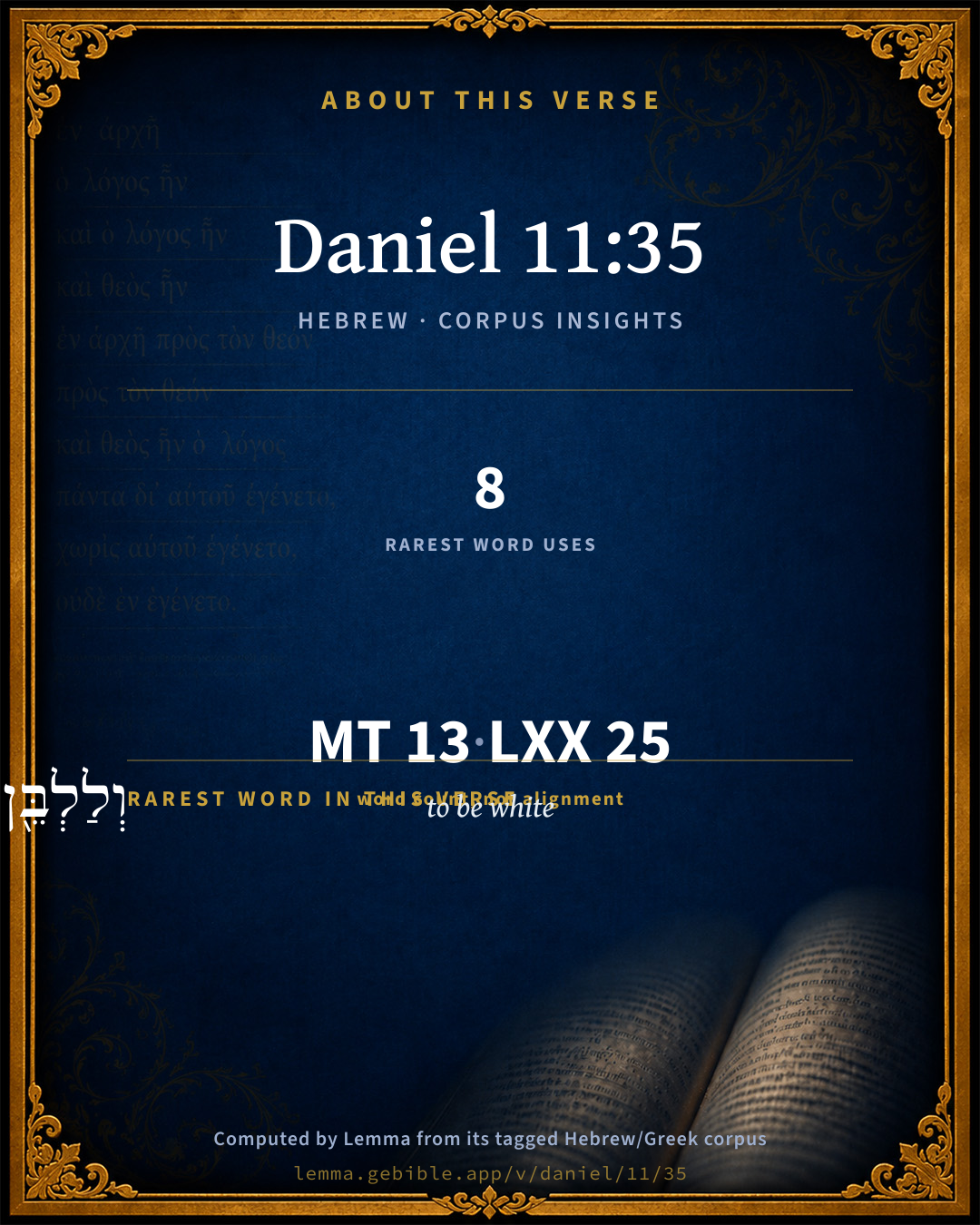
13
words
12
distinct lemmas
Prophets
section

Notable vocabulary

The rarest word here is וְלַלְבֵּ֖ן to be white H3835 — appearing just 8 times in the whole Hebrew Bible.

Shared distinctive vocabulary

וְלַלְבֵּ֖ן to be white H3835 occurs in 8 verses of the Hebrew Bible. Also found in:

Grammatical profile

  • 5 verbs
  • 3 nouns
  • 3 prepositions
  • 1 conjunction
  • 1 adverb

Verb forms

  • הַמַּשְׂכִּילִ֣ים Hiphil · Participle Active
  • יִכָּֽשְׁל֗וּ Niphal · Imperfect
  • לִצְר֥וֹף Qal · Infinitive Construct
  • וּלְבָרֵ֥ר Piel · Infinitive Construct
  • וְלַלְבֵּ֖ן Hiphil · Infinitive Construct

Hebrew & Septuagint length

In English translation the verse runs 34 words from the Hebrew and 39 from the Septuagint (LXX English) — closely comparable.

A rough comparison of the two English renderings, which tokenize alike — not a word-level alignment.

Word counts can differ between the Hebrew and the Greek without any difference in meaning — e.g. the Hebrew direct-object marker אֵת has no separate Greek word, and Greek often adds the article ὁ.

In the original languages it is 13 Hebrew tokens and 25 Greek tokens — but the two are counted differently (Hebrew bundles its prefixes and suffixes into one token; the Greek is in lemma form), so that isn’t a like-for-like length.

Cross-references

31

Topical passages linked to Daniel 11:35 in the Treasury of Scripture Knowledge — connected by theme and wording, ordered by reader-vote popularity; previews shown in the World English Bible.

  • Zechariah 13:9 I will bring the third part into the fire, And will refine them as silver is refined, And will test them like gold is tested. They will call on my name, and I will hear them. I will say, 'It is my people;' And they will say, 'Yahweh is my God.'"
  • Malachi 3:2–4 "But who can endure the day of his coming? And who will stand when he appears? For he is like a refiner's fire, and like launderer's soap;
  • Revelation 7:14 I told him, "My lord, you know." He said to me, "These are those who came out of the great tribulation. They washed their robes, and made them white in the Lamb's blood.
  • Proverbs 17:3 The refining pot is for silver, and the furnace for gold, But Yahweh tests the hearts.
  • Revelation 2:10 Don't be afraid of the things which you are about to suffer. Behold, the devil is about to throw some of you into prison, that you may be tested; and you will have oppression for ten days. Be faithful to death, and I will give you the crown of life.
  • Daniel 12:10–11 Many shall purify themselves, and make themselves white, and be refined; but the wicked shall do wickedly; and none of the wicked shall understand; but those who are wise shall understand.
  • 1 Peter 1:6–7 Wherein you greatly rejoice, though now for a little while, if need be, you have been put to grief in various trials,
  • James 1:2 Count it all joy, my brothers, when you fall into various temptations,
  • Deuteronomy 8:16 who fed you in the wilderness with manna, which your fathers didn't know; that he might humble you, and that he might prove you, to do you good at your latter end:
  • Daniel 8:10 It grew great, even to the host of the sky; and some of the host and of the stars it cast down to the ground, and trampled on them.
  • Daniel 11:40 At the time of the end shall the king of the south contend with him; and the king of the north shall come against him like a whirlwind, with chariots, and with horsemen, and with many ships; and he shall enter into the countries, and shall overflow and pass through.
  • Revelation 14:15 Another angel came out from the temple, crying with a loud voice to him who sat on the cloud, "Send forth your sickle, and reap; for the hour to reap has come; for the harvest of the earth is ripe!"
  • Revelation 17:17 For God has put in their hearts to do what he has in mind, and to be of one mind, and to give their kingdom to the beast, until the words of God should be accomplished.
  • Deuteronomy 8:2–3 You shall remember all the way which Yahweh your God has led you these forty years in the wilderness, that he might humble you, to prove you, to know what was in your heart, whether you would keep his commandments, or not.
  • 2 Chronicles 32:31 However in [the business of] the ambassadors of the princes of Babylon, who sent to him to inquire of the wonder that was done in the land, God left him, to try him, that he might know all that was in his heart.
  • Daniel 8:17 So he came near where I stood; and when he came, I was frightened, and fell on my face: but he said to me, Understand, son of man; for the vision belongs to the time of the end.
  • Daniel 8:19 He said, Behold, I will make you know what shall be in the latter time of the indignation; for it belongs to the appointed time of the end.
  • Daniel 9:27–10:1 He shall make a firm covenant with many for one week: and in the midst of the week he shall cause the sacrifice and the offering to cease; and on the wing of abominations [shall come] one who makes desolate; and even to the full end, and that determined, shall [wrath] be poured out on the desolate.
  • Daniel 11:27 As for both these kings, their hearts shall be to do mischief, and they shall speak lies at one table: but it shall not prosper; for yet the end shall be at the time appointed.
  • Daniel 11:29 At the time appointed he shall return, and come into the south; but it shall not be in the latter time as it was in the former.
  • Daniel 11:33 Those who are wise among the people shall instruct many; yet they shall fall by the sword and by flame, by captivity and by spoil, [many] days.
  • Daniel 12:4 But you, Daniel, shut up the words, and seal the book, even to the time of the end: many shall run back and forth, and knowledge shall be increased."
  • Malachi 4:1–3 "For, behold, the day comes, it burns as a furnace; and all the proud, and all who work wickedness, will be stubble; and the day that comes will burn them up," says Yahweh of Hosts, "that it shall leave them neither root nor branch.
  • Matthew 16:17 Jesus answered him, "Blessed are you, Simon Bar Jonah, for flesh and blood has not revealed this to you, but my Father who is in heaven.
  • Matthew 26:56 But all this has happened, that the Scriptures of the prophets might be fulfilled." Then all the disciples left him, and fled.
  • Matthew 26:69–75 Now Peter was sitting outside in the court, and a maid came to him, saying, "You were also with Jesus, the Galilean!"
  • John 15:2 Every branch in me that doesn't bear fruit, he takes away. Every branch that bears fruit, he prunes, that it may bear more fruit.
  • John 20:25 The other disciples therefore said to him, "We have seen the Lord!" But he said to them, "Unless I see in his hands the print of the nails, and put my hand into his side, I will not believe."
  • Acts 15:37–39 Barnabas planned to take John, who was called Mark, with them also.
  • Habakkuk 2:3 For the vision is yet for the appointed time, and it hurries toward the end, and won't prove false. Though it takes time, wait for it; because it will surely come. It won't delay.
  • Acts 13:13 Now Paul and his company set sail from Paphos, and came to Perga in Pamphylia. John departed from them and returned to Jerusalem.

Cross-references courtesy of OpenBible.info (CC BY 4.0).

Hebrew and Greek witnesses Masoretic Hebrew ↔ Greek Septuagint

The same verse in the two great witnesses to the Old Testament, shown verse-for-verse.

These are two independent witnesses, not word-aligned to each other, and the Septuagint is shown in lemma (dictionary) form.

Hebrew Daniel 11:35 Masoretic · Westminster Leningrad Codex

וּמִן הַמַּשְׂכִּילִ֣ים יִכָּֽשְׁל֗וּ לִצְר֥וֹף בָּהֶ֛ם וּלְבָרֵ֥ר וְלַלְבֵּ֖ן עַד עֵ֣ת קֵ֑ץ כִּי ע֖וֹד לַמּוֹעֵֽד

Some of those who are wise shall fall, to refine them, and to purify, and to make them white, even to the time of the end; because it is yet for the time appointed.

World English Bible · Public Domain

Greek LXX Daniel 11:35 Septuagint · lemma form

καί ἐκ ὁ συνἵημι διανοέομαι εἰς ὁ καθαρίζω ἑαυτοῦ καί εἰς ὁ ἐκλέγω καί εἰς ὁ καθαρίζω ἕως καιρός συντέλεια ἔτι γάρ καιρός εἰς ὥρα

And some of them that understand shall fall, to try them as with fire, and to test them, and that they may be manifested at the time of the end, for the matter is yet for a set time.

LXX2012 (modern English Septuagint) · Public Domain

On this verse, The Pulpit Commentary discusses the Septuagint’s reading. Read the note in Commentary ↓

Hebrew: Westminster Leningrad Codex (CC BY 4.0). Greek: Septuagint (public domain); English from LXX2012 (modern English Septuagint) (Public Domain). How the Septuagint differs from the Hebrew →

Commentary

Notes on Daniel 11:35 from classic Christian and Jewish commentators (each source and its license shown beneath its notes). The classic Christian expositions comment on the surrounding passage and are grouped to its opening verse, so a note may address several verses; the Jewish commentaries on the Tanakh (Rashi and others) are per-verse, so they appear only where the commentator wrote on this verse.

Lemma curates 59 commentaries, every one of them public domain or Creative Commons licensed, each selected and text-cleaned for this edition rather than reprinted as found. About our sources →

Trapp's Complete Commentary

John Trapp

Dan 11:35 And [some] of them of understanding shall fall, to try them, and to purge, and to make [them] white, [even] to the time of the end: because [it is] yet for a time appointed.

Ver. 35. And some of them of understanding shall fall.] Depth of divine knowledge, and height of holiness, is no target against persecution; the best fall under it soonest. None out of hell have ever suffered more than saints.

To try them.] As hard weather tries what health: hang heavy weights on rotten boughs, and they suddenly break. Withered leaves fall off in a strong wind; not so the green, that have sap.

And to purge, and to make them white.] As foul and stained clothes are whitened by lying abroad in cold frosty nights. Black soap maketh white clothes; so, said that martyr, doth the black cross help us to more whiteness, if God strike with his battledores. {a} {b} You know the vessel, before it be made bright, said John Charles the martyr, in a letter to Mr Philpot, another martyr, is soiled with oil and other things, that it may scour the better. Oh happy be you, that you be now in this scouring house, for shortly you shall be set upon the celestial shelf as bright as angels, {c} &c. Refiners of sugar, saith another author, {d} taking sugar out of the same chest, some thereof they melt but once, other again and again; not that it hath more dross in it, but because they would have it more refined: so dealeth the Lord with his best children, &c.

{a} Acts and Mon.

{b} A beetle or wooden ‘bat’ used in washing, also (when made cylindrical) for smoothing out or ‘mangling’ linen clothes; hence also applied to similarly shaped instruments, e.g. the paddle of a canoe, a utensil for inserting loaves into an oven, or glassware into the kiln, etc. ŒD

{c} Acts and Mon., 1743.

{d} Dr Goodwin.

John Trapp, A Commentary or Exposition upon All the Books of the Old and New Testament (1647–1656) — public domain. Text from a community e-Sword module.

Joseph Benson's Commentary

Dan 11:35. Some of them of understanding shall fall — Some of the principal men for piety and knowledge shall fall under this persecution, and suffer grievous miseries and torments: see Dan 11:33. To try them, and to purge, &c. — For the trial of their faith and patience, and to purge them from those corruptions which are the usual effects of prosperity: compare 1Pe 1:7 : and to make it the more evident how sincere they were in their profession, and that no temptations or sufferings could induce them to violate God’s law, and act contrary to their duty. The persecutions which were to befall the church under antichrist were and are designed for the same purpose, as appears by comparing Dan 12:10 with the words here; Antiochus’s persecution being a type and figure of that under antichrist. Even to the time of the end — Namely, the time appointed by God for the ending of these calamities. Because it is yet for a time appointed — It will be still some time before a deliverance will be granted: or, these calamities are appointed to last for some time. Mr. Mede refers the latter part of this sentence to the following verse, and so connects the following prophecy with what went before, thus: “This persecution shall last to the time of the end; for as yet, for a time appointed, a king shall do according to his will.”

Joseph Benson's Commentary on the Old and New Testaments (1811–1818) — public domain. Text from a community e-Sword module.

Geneva Bible (1599)

Geneva Bible translators

To wit, of them that fear God and will lose their life for the defense of true religion. Signifying also that the Church must continually be tried and purged, and ought to look for one persecution after another: for God hath appointed the time: therefore we must obey.

Geneva Bible (1599) marginal notes — public domain. Text via Bolls.life.

Jamieson, Fausset & Brown

Robert Jamieson, A. R. Fausset & David Brown

to try them--the design of affliction. Image from metals tried with fire.

to purge--Even in the elect there are dregs which need to be purged out (Pe1 1:7). Hence they are allowed to fall for a time; not finally (Ch2 32:31; Luk 22:31). Image from wheat cleared of its chaff by the wind.

make . . . white--image from cloth (Rev 7:9).

to . . . time of . . . end--God will not suffer His people to be persecuted without limitation (Co1 10:13). The godly are to wait patiently for "the end" of "the time" of trial; "for it is (to last) yet for a time appointed" by God.

Jamieson, Fausset & Brown — Commentary Critical and Explanatory on the Whole Bible (1871) — public domain (CC PDM 1.0). Text via the HelloAO Bible API.

Adam Clarke's Commentary

Verse 35. And some of them of understanding] Disputes on certain points of religion soon agitated the Christian Church; and now, having no outward persecution, they began to persecute each other. And many excellent men, men of understanding, fell victims because they would not embrace erroneous doctrines, when professed by the state. But this was permitted,-

To try them, and to purge, and to make them white] To bring all to the pure profession, possession, and practice of Christianity.

To the time of the end] To the time that God shall cause pure and undefiled religion every where to prevail. But when is the time appointed for this?

Adam Clarke's Commentary on the Bible (1810–1826) — public domain. Text from a community e-Sword/MySword module.

John Calvin's Commentaries

The angel pursues the same sentiment as before shewing us how the children of God, in their eagerness to defend the cause of piety, should be subject to many grievous persecutions. Some of the learned shall fall; meaning, that calamity shall not be for a single moment only; for those who earnestly desired to defend the true worship of God should perish by the sword, and by fire, and by other methods of destruction, and their successors, too, should suffer the same calamities. The phrase, the learned should fall, implies the perishing of the very flower of the Church. There will always be much refuse among a people, and the greater part of it flies off and revolts when their religion requires of them the sacrifice of their life. A few remain, here called intelligent, who, as we stated yesterday, are not wise after the flesh. Making provision for the flesh, implies taking care of themselves, and of their own interests, running no risks, and avoiding all troubles; while those are called intelligent, who, forgetful of their own lives, offer themselves in sacrifice to God. They do not hesitate to incur universal hatred, and are prepared to meet death with fortitude. The angel, therefore, predicts the perishing of the flower of the Church. For who could have expected the name of God to have existed upon earth when all His sincere worshippers were thus murdered with impunity? The severity of the despotism of Antiochus is notorious, no one dared to utter a word, all the sacred books were burnt, and he thought the worship of God entirely abolished. Women with their children were promiscuously seized for burning, and the satellites of this tyrant did not spare the mothers with infants hanging on their breasts. (1 Maccabees 1.) During the progress of such atrocious cruelty, who would not have thought the whole seed of God to have been extinct? But the angel here shews the true result to have been different, namely, that the sons of God should be purged, cleansed, and whitened He signifies that all events should not prove so destructive, but should rather promote their salvation. This passage unfolds to us the nature of true prudence in the sight of God; for we ought to be prepared for death, rather than be turned aside from the free and ingenuous profession of the heavenly doctrine, and from the true worship of God. For this necessity is imposed on the sons of God — to fall either by the sword or by fire, and to suffer the spoiling of their goods, and banishment from their homes. The angel points out from the result how persecutions which seem to issue in the destruction of the Church, are yet profitable and salutary to the sons of God, as This is the method of their being purified, and cleansed, and whitened But we must always remember how some defiling dregs, which require clearing out, remain in the elect, nay, even among the holy Martyrs. The angel does not here treat of hypocrites, or of ordinary believers, but of whatever is most conspicuous and most perfect in the Church, and yet asserts their need of purification. None, therefore, he concludes, possess such sanctity and purity as to prevent the remnant of some pollution which requires to be removed. Hence it becomes necessary for them to pass through the furnace, and to be purified like gold and silver. This is extended to all God’s martyrs.

This reminds us of the great folly of the Papists, in imagining the merits of saints to be transferred to us, as if they had more than they required for themselves. Indulgences, as they call them, depend upon this error, according to the following reasoning, — had Peter lived to the ordinary period of human life, he would have proved faithful to the end, and then would have merited the crown of the heavenly kingdom; but when he went beyond this, and poured out his blood in martyrdom, some merits were superabundant; these ought not to be lost, and hence the blood of Peter and Paul profit us at this day for the remission of sins. This is the Papal theology, and these miserable sophists are not ashamed of these gross blasphemies, while they vomit forth such foul sacrilege. But the angel’s teaching is far different; — the martyrs themselves are benefited by meeting death for their adherence to the truth, because God purges, and cleanses, and refines, and whitens them. The angel would not have said this except some admixture of dross still defiled the purity of the saints. But this doctrine ought to be more than enough to animate us to undergo all dangers, when we see ourselves stained and polluted with hidden dross; besides this, we ought certainly to determine that death would be profitable in this sense, as God will then purge us from those vices by which we are both infected and defiled. Whence the value of the repetition here; the angel does not simply say to purge them, but adds, to cleanse and whiten them. Whatever holiness may shine forth in the best of men, yet many stains and much defilement he concealed within them; and thus in consequence of their many failings, persecution was always useful to them.

The angel mitigates whatever might seem exceedingly bitter, by saying, until the time of an end, meaning, a fixed and definite time. These words imply the merciful character of God, in not urging his people beyond their strength, as Paul also states his faithfulness in granting them a happy issue out of their trials, and in not pressing’ us beyond the measure of that strength and fortitude which he has conferred upon us. (1 Corinthians 10:13.) The angel predicts an end to these evils, and confirms this opinion by saying, even to a determined time In the last clause he signified the temporary nature of the persecutions of which he had spoken; for they should not cease directly, nor yet for two or three years. By the words, as yet even to a time determined, he urges the sons of God to prepare themselves for new contests, as they should not reach the goal for the space of a year. But if God wished to humble them for three, or ten, or a hundred years, they should not despond, but wait for the time divinely predetermined, without depending on their own will. This is the substance of the instruction conveyed. It now follows:

John Calvin's Commentaries (1540-1563) — public domain. Text from the Calvin Translation Society English edition (1840s-50s) via the Christian Classics Ethereal Library (ccel.org). Calvin's coverage is partial (roughly two-thirds of the Bible); uncommented books and verses are honest gaps, never fabricated. The 19th-century editor's footnotes and remarks are omitted so the notes are faithfully Calvin's own voice.

Ellicott's Commentary for English Readers

(35) Some of them.—The reason of this persecution is revealed. Whilst in Dan_11:33 it appears that the sufferings of “those that understand” would instruct others, it appears that they would themselves profit by their sufferings. These gradations are mentioned (1) “to try “—i.e., to refine, as a precious metal is refined by fire; (2) “to purge “—i.e., to separate the bad from the good; (3) “to make white”—i.e., to cause them to become completely purified. (Comp. Psa_51:7; Isa_1:18). In this way the dissemblers are made known. The patient example of the sufferers is followed by others who are faithful, while the “flatterers” become open apostates.

A Bible Commentary for English Readers, edited by Charles John Ellicott (1878–1897) — public domain. Text from a community e-Sword module.

The Cambridge Bible for Schools and Colleges

gen. ed. J. J. S. Perowne

35. And some of them that be wise (Dan_11:33) shall fall, to refine among them (among the people at large), and to cleanse, and to make white] The martyrdom of some of the godly leaders in the struggle would have the effect of testing the faith of the people at large, and of confirming and perfecting the character of those who were loyal. Cf. Dan_12:10.

to refine] the word means properly to smelt gold or silver ore (or alloy), so as to free the noble metal from impurities; it is then often used figuratively, sometimes of testing, sometimes of purifying, by severe discipline: cf. Isa_1:25, ‘and smelt away as with lye thy dross’; Jer_6:29, ‘in vain the smelter smelteth, for the evil are not separated’; Dan_9:6 ‘Behold, I will smelt them, and try them’; Zec_13:9.

1. Silver Tetradrachm. Head of Antiochus, with diadem (in other coins of this type a star is seen distinctly on the forehead: Babelon, Les Rois de Syrie, xii. 3, 4).

Reverse: Apollo, seated on omphalos, holding arrow and bow. Inscription: ΒΑΣΙΛΕΩΕ ΑΝΤΙΟΧΟΥ (‘Of King Antiochus’).

2. Silver Drachm. Head of Antiochus, radiate.

Reverse: Eagle, with closed wings, standing on thunderbolt. Inscription: ΒΑΣΙΛΕΩΣ ΑΝΤΙΟΧΟΥ ΘΕΟΥ ΕΠΙΦΑΝΟΥΣ (‘Of King Anthichus, God Manifest’).

3. Silver Tetradrachm. Head of Anthiochus, as Zeus, with laurels.

Reverse: Zeus, wearing himation over shoulder, seated on throne: holds Nike (Victory), who crowns Inscription; and rests on sceptre. Inscription: ΒΑΣΙΛΕΩΣ ΑΝΤΙΟΧΟΥ ΘΕΟΥ ΕΠΙΦΑΝΟΥΣ ΝΙΚΗΦΟΡΟΥ (‘Of King Antiochus, God Manifest, Victory-bearer’).

4. Copper Pentechalcon. Head of Zeus-Serapis, wearing laurel-wreath, ending above in cap of Osiris.

Reverse: Eagle, with closed wings, standing on thunderbolt. Inscription: ΒΑΣΙΛΕΩΣ ΑΝΤΙΟΧΟΥ ΘΕΟΥ ΕΠΙΦΑΝΟΥΣ (‘Of King Antiochus, God Manifest’). This coin was struck in Egypt, and illustrates Antiochus’ conquest of that country (cf. Babelon, p. c).

(From casts taken from coins in the British Museum. The descriptions from Gardner’s Coins of the Seleucid Kings of Syria, xi. 2, xii. 13, xi. 9, xii. 11.)

until the time of the end] the fall of the maskîlîm will continue till the final end of the present order of things (Dan_8:17), which the author pictures as coinciding with the close of Antiochus’ reign (Dan_11:40).

for (it is) yet for the time appointed] the end has not come yet; it has still to wait for the moment fixed in the counsels of God: cf. Dan_11:27 end.

The Cambridge Bible for Schools and Colleges (gen. ed. J. J. S. Perowne; Cambridge University Press, 1878–1918) — public domain. Text from a community e-Sword module.

John Gill's Exposition

And some of them of understanding shall fall,.... Not into sin, or from the religion they profess; and the doctrines they have an understanding of, and have instructed others in; but into distresses and calamities for their steadfast adherence to the word, worship, and ordinances of God:

to try them, and purge and make them white; to try their faith, patience, and other graces, and whether they would hold fast their profession, and persevere in the good ways of God; and to purge and separate them from others, that were like chaff, hypocrites, that so they might be manifest, both the one and the other; and these good men appear to be sincere and upright: moreover, the best of men have their dross, and chaff, and spots, to be removed from them; and this is one way of doing it, even by afflictions: the allusion, in the first word, is to the melting, purifying, and refining of metals, gold and silver; the second to the winnowing of a grain floor, and separating the chaff from the wheat; and the third to the cleansing and whitening of cloths, and taking the spots out of them by the fuller. Afflictions are the furnace in which the Lord refines and purifies his people; the fan with which he purges his floor; and the fuller's soap with which he makes his people white; by all this the iniquity of Jacob is purged, and the fruit of it is to take away sin, Isa 27:9, so that afflictions are not hurtful, but beneficial to the saints, even those more violent ones, severe persecutions.

Even to the time of the end; because it is yet for a time appointed; these distresses, calamities, and persecutions, would have an end, and the time for it was appointed of God; as yet it was not come, but quickly would, and then an end would be put to the third or Grecian monarchy; a hint of the Roman power over that being given, Dan 11:30, hence we have no further account of Antiochus or his sons. Very remarkable are the words of Aemilius Sara (m),

"the Assyrians first were possessors of monarchy; then the Medes; afterwards the Persians; then the Macedonians; from that time the kings, Philip and Antiochus, who sprung from the Macedonians, being conquered, not long after Carthage was subdued, the supreme power of empire came to the Roman people;''

of whom, under one character or another, the following part of the prophecy is chiefly to be understood. So another historian says (n), Antiochus being drove out of Asia, the Romans first set footing there; and another (o) observes, that Antiochus being defeated by L. Cornelius Scipio, he took the name of Asiaticus, because he had conquered Asia; as his brother was called Africanus, from his subduing Africa: wherefore Asia and Africa being now in the hands of the Romans, the supreme power might well be said to be with them; and therefore, henceforward, are only spoken of, and particularly the Roman antichrist.

(m) De annis populi Romani apud Velleii Paterculi Hist. Roman. l. 1. c. 6. (n) "Festi Breviarium, prope initium". (o) Eutropii Hist. Rom. l. 4. So Plutarch. in Vita Scipionis Africani.

John Gill's Exposition of the Whole Bible (1746–1763) — public domain (CC PDM 1.0). Text via the HelloAO Bible API.

Albert Barnes' Notes on the Bible

And some of them understanding shall fall - Some of those who have a correct understanding of religion, and who have joined the army from pure motives. The idea seems to be that on some occasion they would meet with a temporary defeat, in order that the sincerity of the others might be tested, or that it might be seen who adhered to the cause from principle, and who from selfish purposes. If they should not always be successful; if they should be temporarily defeated; if some of the most eminent among them should fall among the slain; and if the cause should at any time look dark, this would serve to try the sin cerity of the remainder of the army, and would be likely to “thin it off” of those who had joined it only from mercenary motives.

To try them - Margin, “or, by them.” So the Hebrew - בהם bâhem. The meaning perhaps is, that it would be “by” them, as it were, that the army would be tried. As they would fall in battle, and as the cause would seem to be doubtful, this would test the fidelity of others. The word “try” here (צרף tsâraph) means, properly, “to melt, to smelt” - as metals; then to prove anyone; and then to purify.

And to purge - To purify; to test the army and to make it pure.

And to make them white - To wit, by thus allowing those who had joined the army from mercenary motives to withdraw. Compare 2 Macc. 12:39-41.

Even to the time of the end - The end of the war or the conflict. There would be an end of these persecutions and trials, and this process had reference to that, or tended to bring it about. The act of freeing the army from false friends - from those who had joined it from mercenary motives, would have a tendency to accomplish the result in the best way possible, and in the speediest manner.

Because it is yet for a time appointed - See the notes at Dan 11:27. This seems to be designed for an assurance that the calamity would come to an end, or that there was a limit beyond which it could not pass. Thus it would be an encouragement to those who were engaged in the struggle, for they would see that success must ultimately crown their labors.

Albert Barnes' Notes on the Bible (1834–1885) — public domain. Text from a community e-Sword/MySword module.

Haydock's Catholic Bible Commentary

Fall, or became martyrs. (Haydock) --- Such were Eleazar, &c. (Calmet) --- Another time, after death; (Haydock) or the perfect deliverance shall take place later, ver. 27.

George Leo Haydock (1774–1849), Haydock's Catholic Family Bible and Commentary, 1859 edition — public domain. Excludes Psalms (Douay-Rheims chapter numbering differs from Protestant) and Deuterocanonical books (Catholic canon only).

Matthew Poole's English Annotations

To try them: we see hereby that the best of men have some dross, which makes afflictions, yea, fiery trials, necessary for them, for the word signifies all kind of examination and trials, either as founders try metals to purge them, or as corn is winnowed to cleanse it from chaff, or as fullers that wash and scour to take out spots, Mal 3:1-3.

Even to the time of the end: now mark here the Spirit of God seems to slide into the Roman monarchy, for this began in the reign of Antiochus, so that he did begin that which the Romans afterward in process of time acted more highly against the Jews and Christians too. For Antiochus is made by all a type of antichrist; as Maldonate confesseth. And thus you find the prophets, and our Saviour too. David brings in Christ; Psa 72:8, when the rest is spoken of Solomon. So Psa 16; Isa 49; Isa 44; Isa 60. So our Saviour, speaking of the temple, speaks with it of the end of the word. And thus the end of this chapter is clearly of antichrist, and this prophecy of Daniel cads with the world’s end. Therefore Antiochus is a type of antichrist, in his pride, covetousness, craft, and cruelty against the people of God, and blasphemies and idolatries to the reproach of Christ. Therefore it is here added,

because it is yet for a time appointed.

Matthew Poole's English Annotations on the Holy Bible (1683–1685) — public domain. Text from a community e-Sword/MySword module.

Whedon's Commentary on the Bible

Daniel D. Whedon

35. R.V., “And some of them that be wise shall fall, to refine them, and to purify, and to make them white, even to the time of the end: because it is yet for the time appointed.” Suffering and martyrdom are not proofs of God’s forgetfulness. This is the refining fire which comes “to test and purify” the saints. Blessed is he that shall endure to the end — which end God knows and the time of which He has fixed.

Daniel D. Whedon (gen. ed.), Commentary on the Old and New Testaments (1874–1909) — public domain. Text from a community e-Sword module.

The Pulpit Commentary

And some of them of understanding shall fall, to try them, and to purge, and to make them white, even to the time of the end; because it is yet for a time appointed. The rendering of the LXX is, "And some of those of understanding shall consider to purify themselves beth to be chosen and to be purified to the time of the end, for the season is for hours." The translator must have read Wlkcyi, instead of WlvK; yi. The reading of the Massoretes is to be preferred. Theodotion"s, while closer to the Massoretic text," is not identical with the sense as represented by the Authorized and Revised Versions, "And some of those of understanding shall be weak to try them, that they may be chosen out and revealed at the end of time, for it yet is for a season." Both Greek versions, as will be seen, render barar, "choose a meaning it has in the pual and both omit one of the clauses. In this the Greek versions have the support of the Peshitta, which renders, "And (some) of the wise shall be overthrown to choose among them, and that they may understand to the end, because it is again protracted for a season." Here, too, the last of the clauses descriptive of the effect of the fall of the wise is omitted. Although the Vulgate supports the Massoretic in this, we feel it suspicious. And some of them of understanding shall fall. Though marvellously successful, yet Judas and his comrades suffered some reverses; the reference may be to those that fell in battle. The rendering in Theodotion would seem to point to some apostatizing. We have no record of any such cases, yet it is not impossible that some would fall away. This would be a greater trial than defeat and the death in battle of such heroes as Eleazar, surnamed Avaran, or even of Judas Maccabaeus himself. To try them, and to purge, and to make them white. The death of teachers and of military leaders would be a severe test of the zeal and enthusiasm of the faithful. All the fearful and insincere would fall off from the ranks of the faithful. Those zealous for the Law of God would be at once tried and purified by these untoward events. This has been the experience of the Christian Church in every age. Because more a trial, therefore more purifying would be the failure of some to maintain the faith under trial. Even to the time of the end: because it is yet for a time appointed. It is in perfect accordance with the view that the purpose of the death of teachers and leaders, even their failure, is the purification of the saints, that the time of the trial should be fixed and definite. This view is frequent in the Apocalypse.

Purged by trial.

I THE CHURCH NEEDS PURIFICATION. The people "of understanding" are to be purged and made white. These are clearly the people who are "wise unto salvation the true Church.

1. The ends of the gospel are not attained until the Church is completely purified. The first aim is to gather men into the Church by penitence and faith. The second is to perfect them when they are in the Church. The forgiving grace of God does not dispense with the necessity of holiness. It passes over the sin of the past, that it may secure a better life for the future. The ends of Christ"s work are not satisfied in releasing us from the penalties of our sins, and securing present peace and future blessedness. They seek the complete renewal and purification of our lives.

2. These ends are only attained by a lifelong process of purification. The act of conversion does not satisfy them. Though the life may be turned from sin to God, evil still lingers, old sins rise up again, and new temptations often prove too strong. Hence the need of the Christian"s daily prayer for forgiveness, and the need of a continual discipline in holiness.

II THE CHURCH IS PURIFIED BY HER TRIALS. Some of them fall to try, and thus to purge. Trial purges:

(1) by making us think humbly of ourselves, and suggesting the question whether we have not brought it on ourselves by our sin;

(2) by making us dissatisfied with this world, and therefore anxious to be right in relation to the spiritual world;

(3) by leading us to feel the need of God, and so to seek to be conformed to his mind. These, however, are only secondary means, and need right using. Trouble may harden in sin or result in complaints against Providence. We need the Spirit of God to enable us to profit by the holy influences of trial. This conception of the end of trial should lead us

(1) to accept it with patient submission, since it is sent, not as vindictive punishment, but as purifying chastisement; and

(2) to seek grace to use it profitably.

III WHEN THE PURIFICATION OF THE CHURCH IS ACCOMPLISHED, HER TRIALS WILL CEASE.

1. This will be complete. The battle with sin will not last for ever. The dross will be all purged away, and the people of God will be free from all taint of sin and all indwelling love and power of it. This is the final issue of the discipline of this life which will be accomplished in the next.

2. Then trial will cease. The present life of probation, education, and discipline is only temporary. (2Co_4:17) It will be followed by a life of perfect peace. (Rev_21:4)

The Pulpit Commentary (1880–1919), ed. H.D.M. Spence-Jones & Joseph S. Exell — public domain. Text from a community e-Sword module.

Scofield Reference Notes

C. I. Scofield

the time of the end

Here the prophetic foreview, having traced the history of the two parts of Alexander’s empire which had to do with Palestine and the Jews, viz. Syria and Egypt, to the time of Antiochus Epiphanes, and having described his career, overleaps the centuries to "the time of the end," when he of whom Antiochus Epiphanes was a type, the "little horn" of Dan 7:8 the "Beast out of the sea" of Rev 13:4-10 shall appear (cf) (See Scofield "Dan 7:8"). Prophecy does not concern itself with history as such, but only with history as it affects Israel and the Holy Land. Antiochus Epiphanes was insignificant as compared with historical personages whom the Bible does not mention, but he scourged the covenant people and defiled God’s altar, thus coming into prophetic light. From Dan 11:36 the "little horn" of Dan 7:8; Dan 7:24-26 fills the scene. His prosperity lasts until "the indignation" (the "time of trouble" of; Dan 12:1; Mat 24:21 is accomplished (Dan 11:36). This is parallel with; Rev 17:10-14; Rev 19:19-21. Dan 11:37-45 supply details not mentioned in the N.T. The expression "God of his fathers" (Dan 11:37) has been held to indicate that the "king" is an apostate Jew, but this does not accord with Dan 9:26 which was fulfilled by the Gentile armies of Rome. The "little horn" is an apostate, but from Christianity, not Judaism (cf) 1Jn 2:18; 1Jn 2:19. Dan 11:38-45 describe his career. Substituting "the god of forces" (i.e. forces of nature) for the true God (Dan 11:38; Dan 11:39), he soon presents himself as that god (cf) 2Th 2:3; 2Th 2:4. While his career lasts he is an irresistible conqueror Dan 11:40-44). He established his palace in Jerusalem, probably at the time of his supreme act of blasphemous impiety; Dan 9:27; Dan 12:11; Mat 24:15; 2Th 2:4. From this time begins the great tribulation; Dan 12:1; Mat 24:21 which runs its course during the last half of Daniel’s seventieth week, viz. three and one half years; Dan 7:25; Dan 12:7; Dan 12:11; Rev 13:5. Scofield "Rev 19:20".

The Scofield Reference Bible (1917 edition), notes by C. I. Scofield — public domain. Text from a community e-Sword module.

Rashi

Rabbi Shlomo Yitzchaki (Rashi)

will stumble to clarify some of them They will stumble in the calculations of the end, for they will put their mind to refine them and to resolve them to know them, but they will err concerning them.

Rashi on the Tanakh — English translations: “The Judaica Press complete Tanach with Rashi, translated by A. J. Rosenberg” (CC BY 4.0); “Pentateuch with Rashi's commentary by M. Rosenbaum and A.M. Silbermann, 1929-1934” (public domain); “The Metsudah Tanach series, Lakewood, N.J” (CC BY 4.0); and “The Book of Joshua, Metsudah Publications, 1997” (CC BY 4.0). Text via Sefaria.

Lesson kit

Teaching starters — assembled from the data on this page, not authored interpretation. Every prompt links to the verse data it draws on. Edit before teaching.

Daniel, in the Prophets, opens this verse with 13 words (12 distinct Hebrew lemmas). Its most distinctive word is lâban (“to be white”). A historical commentator’s framing appears above. Read the whole chapter for the surrounding context.

Discussion questions

  1. How does “to be white” (lâban) shape what this verse is saying?
  2. How does Genesis 11:3, which shares the word «to be white», read alongside this verse?
  3. The translations on this page render this verse differently — a whole-verse word diff, not a word-by-word alignment. What might account for the different wordings?
  4. «הַמַּשְׂכִּילִ֣ים» is a Hiphil Participle Active verb. How does that grammatical form shape the action described?
  5. Compare how Trapp's Complete Commentary and Joseph Benson's Commentary read this verse. Where do they agree or differ?

Things to notice

Reading settings

Reading text

Shown beneath each verse's original-language words.

Old Testament
Old Testament edition

Read the OT as the Masoretic Hebrew (MT) or the Greek Septuagint (LXX).

English shown for the Greek Septuagint (in the Hebrew ↔ Greek comparison).

Comparing translations? Open the Compare panel on any verse page to stack up to four side by side.