

Ecclesiastes 3:7

Hebrew (Westminster Leningrad Codex) Ecclesiastes 3:7 appears in the Hebrew Old Testament. The text above is from the Westminster Leningrad Codex. Each word links to its Strong’s number, a concise gloss, and parsing drawn from the Open Scriptures Hebrew Bible morphology. Click any word for its full Brown-Driver-Briggs (BDB) entry.
Download image
Cite this verse

Ecclesiastes 3:7 (World English Bible). Public Domain. Lemma interlinear Bible study tool, https://lemma.gebible.app/v/ecclesiastes/3/7.

Show BibTeX & RIS
BibTeX
RIS
English Translation
A time to tear, And a time to sew; A time to keep silence, And a time to speak;
World English Bible · Public Domain
Download a study sheet

One document with this verse’s original text, its word-by-word gloss line, the meaning frame, cross-references with their text, attributed commentary, and full source and license credits — printable, and it pastes into notes with its structure intact.

This verse Autodidact and up

Study sheet (.html) Plain text (.txt)

A passage Seminary Student

Up to 50 verses in one chapter. A passage sheet keeps up to 6 commentary sources and 12 cross-references per verse, in the order this page ranks them, and says so on the sheet whenever that leaves anything out. Ask for a single verse and you get the Autodidact verse sheet above.

Everything on this page stays free to read, with no account — the sheet is a download of what is already on screen, not access to it.

Want to remove ads? Support Godless Engineer
Compare translations 3

The same verse in 3 English versions, stacked beneath the original-language interlinear above. Click any original word for its lexicon entry.

Each is an independent rendering of the whole verse — the interlinear is not word-aligned to these translations.

Highlighted words mark where these versions differ — a whole-verse word diff, not a word-by-word alignment.

  • World English Bible Public Domain
    A time to tear, And a time to sew; A time to keep silence, And a time to speak;
  • King James Version Public Domain
    A time to rend, and a time to sew; a time to keep silence, and a time to speak;
  • unfoldingWord Literal Text CC BY-SA 4.0
    a time to tear and a time to mend, a time to be silent and a time to speak,

unfoldingWord Literal Text — © unfoldingWord, licensed CC BY-SA 4.0. Word-aligned USFM3 via Door43 (git.door43.org/unfoldingWord/en_ult).

Versions to compare (up to 4)

3 of 4 selected

Show all 18 translations

Every available English version of this verse, each an independent rendering of the whole verse.

  • World English Bible Public Domain
    A time to tear, And a time to sew; A time to keep silence, And a time to speak;
  • Berean Standard Bible Public Domain
    a time to tear and a time to mend, a time to be silent and a time to speak,
  • Majority Standard Bible Public Domain
    a time to tear and a time to mend, a time to be silent and a time to speak,
  • King James Version Public Domain
    A time to rend, and a time to sew; a time to keep silence, and a time to speak;
  • American Standard Version (1901) Public Domain
    a time to rend, and a time to sew; a time to keep silence, and a time to speak;
  • Revised Version (1885) Public Domain
    a time to rend, and a time to sew; a time to keep silence, and a time to speak;
  • Geneva Bible (1599) Public Domain
    A time to rent, and a time to sowe: a time to keepe silence, and a time to speake.
  • Douay-Rheims (1899) Public Domain
    A time to rend, and a time to sew. A time to keep silence, and a time to speak.
  • Young's Literal Translation Public Domain
    A time to rend, And a time to sew. A time to be silent, And a time to speak.
  • Literal Standard Version CC BY-SA 4.0
    A time to tear, || And a time to sew. A time to be silent, || And a time to speak.
  • Unlocked Literal Bible CC BY-SA 4.0
    a time to tear clothing and a time to repair clothing, a time to keep silent and a time to speak.
  • unfoldingWord Literal Text CC BY-SA 4.0
    a time to tear and a time to mend, a time to be silent and a time to speak,
  • Darby Bible Public Domain
    A time to rend, and a time to sew; A time to keep silence, and a time to speak;
  • World Messianic Bible Public Domain
    a time to tear, and a time to sew; a time to keep silence, and a time to speak;
  • Webster's Bible Public Domain
    A time to rend, and a time to sew; a time to keep silence, and a time to speak;
  • Free Bible Version CC BY-SA 4.0
    A time of tearing, and a time of mending. A time of keeping quiet, a time of speaking up.
  • Bible in Basic English Public Domain
    A time for undoing and a time for stitching; a time for keeping quiet and a time for talk;
  • JPS Tanakh (1917) Public Domain
    A time to rend, and a time to sew; a time to keep silence, and a time to speak;

Literal Standard Version (2020), Covenant Press — licensed CC BY-SA 4.0. Text via the HelloAO Bible API (eBible.org). Unlocked Literal Bible (unfoldingWord) — licensed CC BY-SA 4.0. Text via the HelloAO Bible API (eBible.org). unfoldingWord Literal Text — © unfoldingWord, licensed CC BY-SA 4.0. Word-aligned USFM3 via Door43 (git.door43.org/unfoldingWord/en_ult). Free Bible Version, Dr. Jonathan Gallagher — licensed CC BY-SA 4.0. Text via the HelloAO Bible API (eBible.org).

Word by word

More ways to search: Search by grammar → Find every occurrence → Compare this word →

Practice this passage: Drill this verse → Learn its vocabulary →

About this verse

These counts appear in no published source. They are computed here, from the morphology-tagged text and Lemma’s own curated glosses. What Lemma adds →

8
words
5
distinct lemmas
Wisdom
section

Notable vocabulary

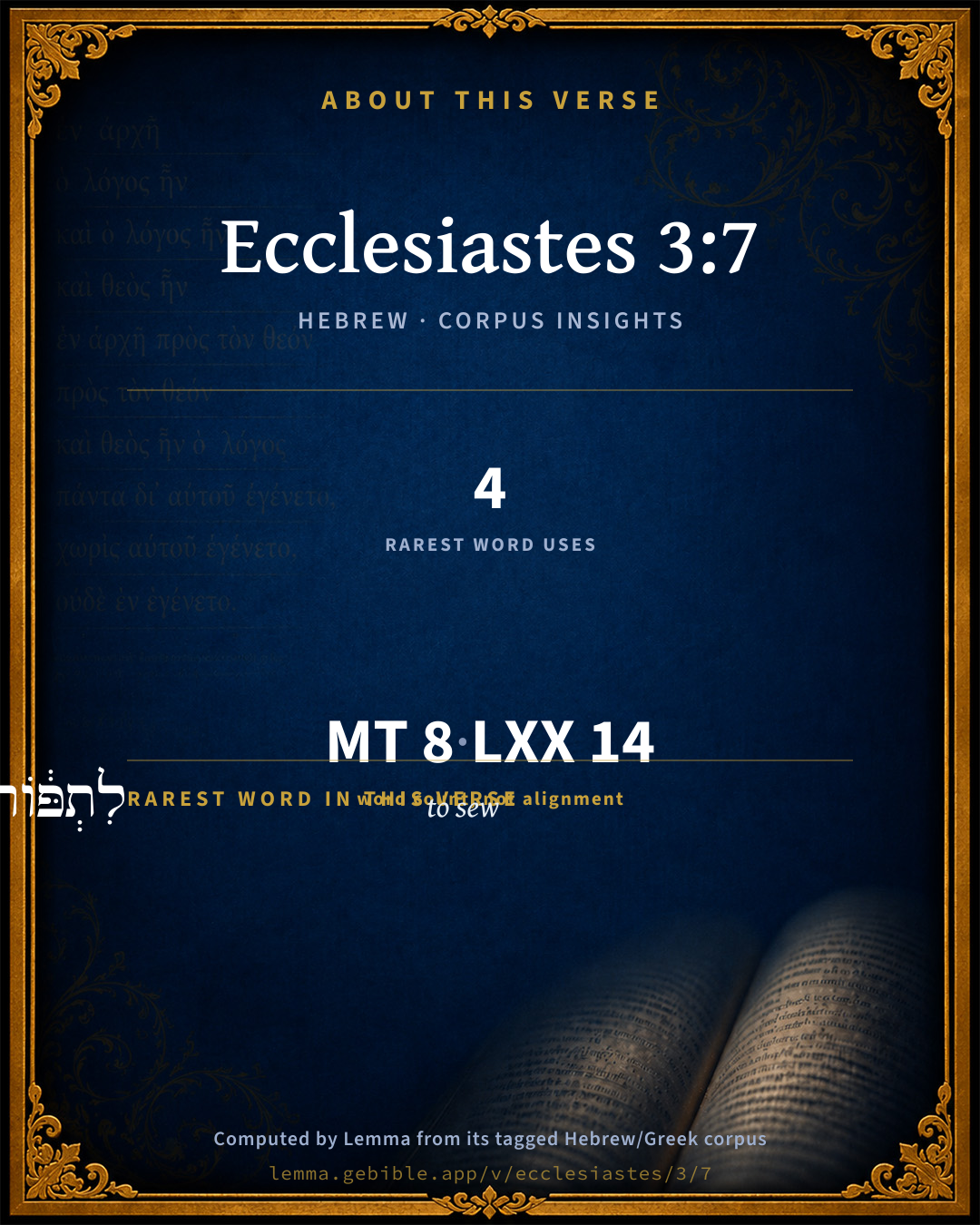
The rarest word here is לִתְפּ֔וֹר to sew H8609 — appearing just 4 times in the whole Hebrew Bible.

Shared distinctive vocabulary

לִתְפּ֔וֹר to sew H8609 occurs in 4 verses of the Hebrew Bible. Also found in:

Grammatical profile

  • 4 verbs
  • 4 nouns

Verb forms

  • לִקְר֨וֹעַ֙ Qal · Infinitive Construct
  • לִתְפּ֔וֹר Qal · Infinitive Construct
  • לַחֲשׁ֖וֹת Qal · Infinitive Construct
  • לְדַבֵּֽר Piel · Infinitive Construct

Repetition

A word recurs within this verse — often emphatic in Hebrew:

  • עֵ֤ת time H6256 ×4

Hebrew & Septuagint length

In English translation the verse runs 19 words from the Hebrew and 19 from the Septuagint (LXX English) — the same length.

A rough comparison of the two English renderings, which tokenize alike — not a word-level alignment.

Word counts can differ between the Hebrew and the Greek without any difference in meaning — e.g. the Hebrew direct-object marker אֵת has no separate Greek word, and Greek often adds the article ὁ.

In the original languages it is 8 Hebrew tokens and 14 Greek tokens — but the two are counted differently (Hebrew bundles its prefixes and suffixes into one token; the Greek is in lemma form), so that isn’t a like-for-like length.

Cross-references

29

Topical passages linked to Ecclesiastes 3:7 in the Treasury of Scripture Knowledge — connected by theme and wording, ordered by reader-vote popularity; previews shown in the World English Bible.

  • Amos 5:13 Therefore he who is prudent shall keep silence in such a time; For it is an evil time.
  • Micah 7:5 Don't trust in a neighbor. Don't put confidence in a friend. With the woman lying in your embrace, Be careful of the words of your mouth!
  • Esther 4:13–14 Then Mordecai bade them return answer to Esther, Don't think to yourself that you shall escape in the king's house, more than all the Jews.
  • Lamentations 3:28 Let him sit alone and keep silence, because he has laid it on him.
  • Proverbs 31:8–9 Open your mouth for the mute, In the cause of all who are left desolate.
  • Acts 4:20 for we can't help telling the things which we saw and heard."
  • Esther 7:4 for we are sold, I and my people, to be destroyed, to be slain, and to perish. But if we had been sold for bondservants and bondmaids, I had held my peace, although the adversary could not have compensated for the king's damage.
  • Job 32:4–22 Now Elihu had waited to speak to Job, because they were elder than he.
  • Proverbs 24:11–12 Rescue those who are being led away to death! Indeed, hold back those who are staggering to the slaughter!
  • Joel 2:13 Tear your heart, and not your garments, And turn to Yahweh, your God; For he is gracious and merciful, Slow to anger, and abundant in loving kindness, And relents from sending calamity.
  • 1 Samuel 25:24–44 She fell at his feet, and said, On me, my lord, on me be the iniquity; and please let your handmaid speak in your ears. Hear the words of your handmaid.
  • 1 Kings 21:27 It happened, when Ahab heard those words, that he tore his clothes, and put sackcloth on his flesh, and fasted, and lay in sackcloth, and went softly.
  • 2 Kings 5:7 It happened, when the king of Israel had read the letter, that he tore his clothes, and said, Am I God, to kill and to make alive, that this man does send to me to recover a man of his leprosy? but consider, I pray you, and see how he seeks a quarrel against me.
  • 2 Kings 6:30 It happened, when the king heard the words of the woman, that he tore his clothes (now he was passing by on the wall); and the people looked, and, behold, he had sackcloth within on his flesh.
  • Psalms 39:2 I was mute with silence. I held my peace, even from good. My sorrow was stirred.
  • Isaiah 36:21 But they held their peace, and answered him not a word; for the king's commandment was, saying, Don't answer him.
  • Luke 19:37–40 As he was now getting near, at the descent of the Mount of Olives, the whole multitude of the disciples began to rejoice and praise God with a loud voice for all the mighty works which they had seen,
  • Genesis 37:29 Reuben returned to the pit; and saw that Joseph wasn't in the pit; and he tore his clothes.
  • Genesis 37:34 Jacob tore his clothes, and put sackcloth on his loins, and mourned for his son many days.
  • Genesis 44:18 Then Judah came near to him, and said, "Oh, my lord, please let your servant speak a word in my lord's ears, and don't let your anger burn against your servant; for you are even as Pharaoh.
  • 2 Samuel 1:11 Then David took hold on his clothes, and tore them; and likewise all the men who were with him:
  • 2 Samuel 3:31 David said to Joab, and to all the people who were with him, Tear your clothes, and gird you with sackcloth, and mourn before Abner. King David followed the bier.
  • Amos 8:3 The songs of the temple will be wailings in that day," says the Lord Yahweh. "The dead bodies will be many. In every place they will throw them out with silence.
  • Genesis 44:34 For how will I go up to my father, if the boy isn't with me? Lest I see the evil that will come on my father."
  • 1 Samuel 19:4–5 Jonathan spoke good of David to Saul his father, and said to him, Don't let the king sin against his servant, against David; because he has not sinned against you, and because his works have been very good toward you:
  • Job 2:13 So they sat down with him on the ground seven days and seven nights, and none spoke a word to him, for they saw that his grief was very great.
  • Jeremiah 8:14 Why do we sit still? assemble yourselves, and let us enter into the fortified cities, and let us be silent there; for Yahweh our God has put us to silence, and given us water of gall to drink, because we have sinned against Yahweh.
  • Jeremiah 36:24 They were not afraid, nor tore their garments, neither the king, nor any of his servants who heard all these words.
  • Acts 9:39 Peter got up and went with them. When he had come, they brought him into the upper chamber. All the widows stood by him weeping, and showing the coats and garments which Dorcas had made while she was with them.

Cross-references courtesy of OpenBible.info (CC BY 4.0).

Hebrew and Greek witnesses Masoretic Hebrew ↔ Greek Septuagint

The same verse in the two great witnesses to the Old Testament, shown verse-for-verse.

These are two independent witnesses, not word-aligned to each other, and the Septuagint is shown in lemma (dictionary) form.

Hebrew Ecclesiastes 3:7 Masoretic · Westminster Leningrad Codex

עֵ֤ת לִקְר֨וֹעַ֙ וְעֵ֣ת לִתְפּ֔וֹר עֵ֥ת לַחֲשׁ֖וֹת וְעֵ֥ת לְדַבֵּֽר

A time to tear, And a time to sew; A time to keep silence, And a time to speak;

World English Bible · Public Domain

Greek LXX Ecclesiastes 3:7 Septuagint · lemma form

καιρός ὁ ῥηγνύναι καί καιρός ὁ ῥάπτω καιρός ὁ σιγάω καί καιρός ὁ λαλέω

a time to rend, and a time to sew; a time to be silent, and a time to speak;

LXX2012 (modern English Septuagint) · Public Domain

Hebrew: Westminster Leningrad Codex (CC BY 4.0). Greek: Septuagint (public domain); English from LXX2012 (modern English Septuagint) (Public Domain). How the Septuagint differs from the Hebrew →

Commentary

Notes on Ecclesiastes 3:7 from classic Christian and Jewish commentators (each source and its license shown beneath its notes). The classic Christian expositions comment on the surrounding passage and are grouped to its opening verse, so a note may address several verses; the Jewish commentaries on the Tanakh (Rashi and others) are per-verse, so they appear only where the commentator wrote on this verse.

Lemma curates 59 commentaries, every one of them public domain or Creative Commons licensed, each selected and text-cleaned for this edition rather than reprinted as found. About our sources →

Trapp's Complete Commentary

John Trapp

Ecc 3:7 A time to rend, and a time to sew; a time to keep silence, and a time to speak;

Ver. 7. A time to rend, and a time to sew.] As in making a new or translating an old garment. Turks wonder at the English for pinking or cutting their clothes, and making holes in whole cloth, which time of itself would tear too soon. {a} It was a custom among the Jews to rend their clothes in the case of sad occurrences. The prophet Ahijah rent Jeroboam’s new garment in twelve pieces, to show that God would rend the kingdom out of the hand of Solomon. {1Ki 11:31} Schismatics rend the Church, heretics the Scriptures. God will stitch up all in his own time, and heal the breaches thereof. {Psa 60:2}

A time to keep silence, and a time to speak.] It is a singular skill to "time a word," {Isa 50:4} to set it upon its wheels, {Pro 25:11} as Abigail did for her family, {1Sa 25:23-31} as Esther did against Haman. And it is a happy thing when a man can pray, as one once did, Det Deus ut sermo meus adeo commodus sit, quam sit accommodus, God grant my speech may be as profitable as it is seasonable. He that would be able to speak when and as he ought, must first learn silence, as the Pythagoreans did of old, {b} as the Turks do at this day, Perpetuum silentium tenent ut muti, they are not suffered to speak. Discamus prius non loqui, saith Jerome upon this text. Let us first learn not to speak, that afterwards we may open our mouths to speak wisely. Silence is fitly set here before speaking, and first takes its time and turn. It is a good rule that one gives, either keep silence, or speak that which is better than silence. {c}

{a} Fuller.

{b} εχεμυθια Pythagorica. - Cuspin. de Caesarib., 475.

{c} H σιγαν η κρεισσονα σιγης λεγειν.

John Trapp, A Commentary or Exposition upon All the Books of the Old and New Testament (1647–1656) — public domain. Text from a community e-Sword module.

The Biblical Illustrator

Joseph S. Exell

Ecc_3:7

A time to keep silence.

Silence

There is a proverb which says, Speech is silvern, silence is golden. Like all proverbs, this admits of qualification. There is a silence that means cowardice, sulkiness, and stupidity; and there is a speech that is more precious than any gold, triumphant over error and wrong, quickening and beneficent as the sunbeam. Notice two or three kinds of silences.

I. There is the silence of emotional fulness. It is a physiological fact that great emotions choke the utterance.

1. Great painful emotions do this (Mat_22:12). Will not all the wicked who stand at the bar of their Maker at the last day be struck with this silence? Emotions of surprise, remorse, despair, will rush with such tumultuousness upon them as to paralyze all articulating power.

2. Great joyous emotions do this. When the father embraced his prodigal son, his heart was so full of joyous feelings that he could not speak. It has been said that superficial emotions chatter, deep emotions are mute: there are joys that are unutterable.

II. There is the silence of Pious resignation. It is said that Aaron held his peace, and the psalmist said, I was dumb and opened not my mouth because Thou didst it. This indeed is a golden silence: it implies unbounded confidence in the character and procedure of our Heavenly Father. It is a loving, loyal acquiescence in the will of Him who is all-loving, all-wise, and all-good. This silence reveals--

1. The highest reason. Is there a sublimer philosophy than this?

2. The highest faith. Faith in the immutable realities of love and right.

III. There is the silence of holy self-respect. This was the silence which Christ displayed before His judges. He seemed to feel that to speak to such virulently prejudiced creatures would be a degradation. The man who can stand and listen to the language of stolid ignorance, venomous bigotry, and personal insult addressed to him in an offensive spirit, and offer no reply, exerts a far greater power upon the minds of his assailants than he could by words, however forceful. His silence reflects a moral majesty, before which the heart of his assailants will scarcely fail to cower. (Homilist.)

A time of war, and a time of peace.--

The Christian view of war

There are those, among the most conscientious of men, who maintain that war is never permissible, that it has always the nature of sin. Among Englishmen the Quakers have clung to the doctrine of non-resistance as one of their most distinctive tenets; among modern thinkers Count Tolstoi has restated it with considerable force. They have based their argument not so much upon the general tenor of Christs teaching as upon misinterpretations of isolated texts--e.g. Resist not evil, All they that take the sword shall perish with the sword. It is to their honour that they have been consistent in their interpretation of such passages, often to their own loss, and have applied them both to individual and to national conduct. Yet it is strange that they have not seen how far their argument carries them, and how by exaggerating one counsel of the Gospel they have made other of its precepts of none effect. Toleration of personal injury, to the point of self-effacement, is indeed enjoined upon Christians, but only so far as it does not conflict with other laws of justice and the like. Non-resistance, tolerance of evil and injustice from an individual, may often be most dangerous to society, as an encouragement to crime; and to let an offender go free may be to do him no kindness, but the cruelest of injuries. As with individuals, so with nations. National injustice, greed, insolence, is to be resisted as a danger to humanity. And those who make their appeal to isolated passages of Holy Scripture may be answered by other considerations. To take one only, it may justly be argued that if it were unlawful to wage war, as they assert, it would be unlawful for the Christian to bear arms, and that the soldiers calling would be reprobated in the New Testament. But the exact opposite is the case. The soldiers calling is treated as of equal honour with others, a vocation in which God may be well and truly served. The Christian life is itself compared to a warfare, in which the soldier of Christ is exhorted to fidelity by the example of the Roman soldier. The soldiers who inquire their duty of St. John the Baptist are not told to forsake their calling, but to exercise it with justice and mercy. And from Cornelius, the devout man whose prayers and alms were accepted of God, to St. Martin and General Gordon, a long line of soldier-saints bears eloquent witness to the fact that the grace of God may be looked for, and will bear fruit, in that vocation as in others. We may even go further, and say that war and the military vocation undoubtedly develop in nations and in individuals certain of the simpler virtues. It is often through war, as Mr. Ruskin has told us, that truth of word and strength of thought are learnt by nations. Peace and the vices of civil life only flourish together. We talk of peace and learning, and of peace and plenty, and of peace and civilization; but I found that these were not the words which the muse of history coupled together: and that on her lips the words were--peace, and sensuality--peace, and selfishness--peace, and death. No less marked are its bracing effects upon the individual. On the whole, the habit of living lightly hearted in daily presence of death, always has had, and always must have, power both in the making and testing of honest men. Many a man by losing himself has found himself, and through the stern discipline of the soldiers life has gained the self-control which otherwise he would have lost. In war men have the opportunity of rising to higher levels of virtue than they would have thought possible of attainment. From Sir Philip Sidney, dying in agony on the field of Zutphen, and refusing the water which another seemed to need more, to the trooper in Matabeleland who gave his horse--and with it his life--for a wounded comrade, there are countless instances of noble unselfishness developed under the stress of sudden decision, sometimes in the most unexpected characters. Nor, if we be wise, shall we complain that the cost is too great. We cannot know that those who have died nobly would have lived nobly. And so we cannot refuse the conclusion that warfare is not necessarily wrong in itself; that it is lawful for Christian men, at the command of the magistrate, to wear weapons and to serve in the wars: that war is even in some cases a gain in that it tends to the development of national and individual virtues. But of course when this is conceded we are still very far from admitting that it is ever to be undertaken with a light heart, as the French declared war upon Prussia. The amount of direct and indirect suffering which it causes, immeasurable as that is, is not the greatest of the evils which war brings inevitably in its train. The racial hatreds which it engenders often linger on for scores of years, smouldering fires which a chance gust of passion may easily fan again into flame. Nor can we regard it in any sense as an appeal to the Divine justice, as our forefathers regarded it. War is infinitely the most wasteful, crudest, and least just way of settling international quarrels. And above all, for all its indirect gains, it is to be avoided by Christian nations to the very limits of forbearance, because it hinders the progress of mankind towards the ideals of peace and brotherhood which the Incarnation revealed. War, however just, is an acknowledgment that Christian methods and Christian love have so far failed to be effective. We inquire, lastly, on what conditions warfare may be pronounced justifiable. St. Thomas Aquinas defines the conditions as three in number--the command of the prince, a just cause, and a good intention. The Christian will not hesitate to justify wars morally safeguarded by regard to these conditions. And yet for all that may be said in justification of warfare, war will ever remain a thing grievous to the Christian, ranking with the famine and the pestilence as scourges of God. Upon all Christians there is laid the supreme duty of striving continually for peace, and in these days of democracy no one is without his share of responsibility for national acts. Christians will not shrink from just wars; at the same time they will denounce wars of aggression for material gain. They will endeavour to emphasize the overwhelming responsibility of those in whose power it is t,o declare war, and of those who may influence their decision. They will lose no opportunity of dissociating themselves from those who wantonly disturb the peace of nations, by fostering race-hatreds, magnifying disagreements, offering petty insults, whether in the columns of an intemperate Press, or in any other way. They will promote the principles of arbitration; for though the arbitrators between nations are not backed by force, and cannot compel submission to their decisions, and though long centuries may pass before arbitration can supersede war, yet there is among nations a growing desire to settle differences by that method--an increasing disposition to submit to arbitration, because the justice of the principle is acknowledged. Above all, they will not be ashamed to assert their belief in the efficacy of prayer to the Lord mighty in battle, who is also the Prince of peace, that He would direct aright the counsels of the nations, and would give peace in our time. Who can doubt that wars, in Christendom at least, would soon become rare if all Christians were continually to pray from their inmost heart that God would give to all nations unity, peace, and concord? (E. H. Day, M. A.)

The Biblical Illustrator, edited by Joseph S. Exell (c. 1880s–1900s) — public domain. Text from a community e-Sword module.

Jamieson, Fausset & Brown

Robert Jamieson, A. R. Fausset & David Brown

rend--garments, in mourning (Joe 2:13); figuratively, nations, as Israel from Judah, already foretold, in Solomon's time (Kg1 11:30-31), to be "sewed" together hereafter (Eze 37:15, Eze 37:22).

silence-- (Amo 5:13), in a national calamity, or that of a friend (Job 2:13); also not to murmur under God's visitation (Lev 10:3; Psa 39:1-2, Psa 39:9).

Jamieson, Fausset & Brown — Commentary Critical and Explanatory on the Whole Bible (1871) — public domain (CC PDM 1.0). Text via the HelloAO Bible API.

Adam Clarke's Commentary

Verse 7. A time to rend, - sew, - keep silence, - speak]

_______________ "Intestine broils

And factions rend a state: at length the breach

Is heal'd, and rest ensues. Wisdom restrains

The tongue, when words are vain: but now,

'Tis time to speak, and silence would be criminal."

Adam Clarke's Commentary on the Bible (1810–1826) — public domain. Text from a community e-Sword/MySword module.

The Cambridge Bible for Schools and Colleges

gen. ed. J. J. S. Perowne

7. A time to rent, and a time to sew] The words are commonly connected with the practice of rending the garments as a sign of sorrow (Gen_37:29; Gen_37:34; Gen_44:13; Job_1:20; 2Sa_1:2) and sewing them up again when the season of mourning is past and men return again to the routine of their daily life. It is, however, somewhat against this view that it makes this generalisation practically identical with that of Ecc_3:4. The symbolic use of “rending a garment” to represent the division of a kingdom, as in the prophecy of Ahijah the Shilonite (1Ki_11:30) and therefore of “sewing” for the restoration of unity (so the “seamless garment” of Joh_19:23 has always been regarded as a type of the unity of Christ’s Church) seems to suggest a more satisfying sense. There are seasons when it is wise to risk or even to cause discord and division in families (Mat_10:34-35) or schism in Church or State, other seasons when men should strive to restore unity and to be healers of the breach (Isa_58:12). In the parable of the New Patch upon the old Garment we have an instance of an inopportune sewing which does but make the rent worse (Mat_9:16).

a time to keep silence, and a time to speak] Here again the range of thought has been needlessly limited by interpreters to the silence which belongs to deep sorrow, of which we have an example in the conduct of the friends of Job (Job_2:12-13), of the want of which in the sons of the prophets Elisha complained bitterly (2Ki_2:3; 2Ki_2:5). This is, of course, not excluded, but the range of the law is wider, and takes in on the one hand, the unseasonable talk of the “prating fool” of Pro_10:8, and on the other the “word spoken in due season” (Pro_15:23), to one that is weary (Isa_50:4), the right word at the right time, in the utterance of which we rightly see a genius akin to inspiration. If it is true at times that speech is silvern and silence golden, there are times when the converse also is true, when the word in season is like “apples of gold (= perhaps, oranges) in a basket of silver” (Pro_25:11).

The Cambridge Bible for Schools and Colleges (gen. ed. J. J. S. Perowne; Cambridge University Press, 1878–1918) — public domain. Text from a community e-Sword module.

John Gill's Exposition

A time to rend, and a time to sew,.... To rend garments, in case of blasphemy, and in times of mourning and fasting, and then to sew them up when they are over; see Isa 37:1; This the Jews apply to the rending of the ten tribes from Rehoboam, signified by the rending of Jeroboam's garment, Kg1 11:30; the sewing up or uniting of which is foretold, Eze 37:22. Some interpret it of the rending of the Jewish church state, signified by the rending of the vail, at the death of Christ; and of the constituting the Gospel church state among the Gentiles;

a time to keep silence, and a time to speak (k); when it is an evil time, a time of calamity in a nation, it is not a time to be loquacious and talkative, especially in a vain and ludicrous way, Amo 5:13; or when a particular friend or relation is in distress, as in the case of Job and his friends, Job 2:13; or when in the presence of wicked men, who make a jest of everything serious and religious, Psa 39:1; and so when under afflictive dispensations of Providence, it is a time to be still and dumb, and not open the mouth in a murmuring and complaining way, Lev 10:3. And, on the other hand, there is a time to speak, either publicly, of the truths of the Gospel, in the ministry of it, and in vindication of them; or privately, of Christian experience: there is a time when an open profession should be made of Christ, his word and ordinances, and when believers should speak to God in prayer and praise; which, should they not, the stones in the wall would cry out.

(k) , , Homer. Odyss. 11. v. 378.

John Gill's Exposition of the Whole Bible (1746–1763) — public domain (CC PDM 1.0). Text via the HelloAO Bible API.

Albert Barnes' Notes on the Bible

Rend - i. e., Tear garments in sign of mourning or anger. See 2Sa 1:2, 2Sa 1:11 ff.

Albert Barnes' Notes on the Bible (1834–1885) — public domain. Text from a community e-Sword/MySword module.

Matthew Poole's English Annotations

A time to rend; when men shall rend their garments, as they did in great and sudden griefs, as Gen 37:29; Joe 2:13.

A time to keep silence; wherein men will or shall be silent, either through grief, as Job 2:12,13, or by sickness or weakness, or because God denies a man ability to utter his mind.

Matthew Poole's English Annotations on the Holy Bible (1683–1685) — public domain. Text from a community e-Sword/MySword module.

Whedon's Commentary on the Bible

Daniel D. Whedon

7. To rend… to sew… keep silence… speak — The rending of garments and sitting down in silence is token of great sorrow; the repairing of them and the recommencing of conversation is evidence of the relief of sorrow. These are thus properly grouped in one verse.

Daniel D. Whedon (gen. ed.), Commentary on the Old and New Testaments (1874–1909) — public domain. Text from a community e-Sword module.

The Pulpit Commentary

A time to rend, and a time to sew (kairov tou rJhxai kai kairoyai). This is usually understood of the rending of garments in token of grief, (Gen_37:29, Gen_37:34, etc.) and the repairing of the rent then made when the season of mourning was ended. The Talmudists laid down careful rules concerning the extent of the ritual tear, and how long it was to remain unmended, both being regulated by the nearness of the relationship of the deceased person. In this interpretation there are these two difficulties: first, it makes the clause a virtual repetition of ver. 4; and secondly, it is not known for certain that the closing of the rent was a ceremonial custom in the times of Koheleth. Hence Plumptre inclines to take the expression metaphorically of the division of a kingdom by schism, and the restoration of unity, comparing the Prophet Ahijah"s communication to Jeroboam. (1Ki_11:30, 1Ki_11:31) But surely this would be a most unlikely allusion to put into Solomon"s mouth; nor can we properly look for such a symbolical representation amid the other realistic examples given in the series. What Koheleth says is this There are times when it is natural to tear clothes to pieces, whether from grief, or anger, or any other cause, e.g. as being old and worthless, or infected; and there are times when it is equally natural to mend them, and to make them serviceable by timely repairs. Connected with the notion of mourning contributed by this clause, though by no means confined to that notion, it is added, A time to keep silence, and a time to speak. The silence of deep sorrow may be intimated, as when Job"s friends sat by him in sympathizing silence, (Job_2:13) and the psalmist cried, "I was dumb with silence, I held my peace, even from good; and my sorrow was stirred"; (Psa_39:2) and Elisha could not bear to hear his master"s departure mentioned. (2Ki_2:3, 2Ki_2:5) There are also occasions when the sorrow of the heart should find utterance, as in David"s lament over Saul and Jonathan (2Sa_1:17, etc.) and over Abner. (2Sa_3:33, etc.) But the gnome is of more general application. The young should hold their peace in the presence of their elders; (Job_32:4, etc.) silence is often golden: "Even a fool, when he holdeth his peace, is counted wise: when he shutteth his lips, he is esteemed as prudent". (Pro_17:28) On the other hand, wise counsel is of infinite value, and must not be withheld at the right moment, and "a word in due season, how good is it!". (Pro_15:23 Pro_25:11) "If thou hast understanding, answer thy neighbor; if not, lay thy hand upon thy mouth" (Ecc_5:12; see more, Ecc 20:5, etc.).

The Pulpit Commentary (1880–1919), ed. H.D.M. Spence-Jones & Joseph S. Exell — public domain. Text from a community e-Sword module.

John Wesley's Explanatory Notes

To rent - When men rend their garments, as they did in great and sudden griefs.

John Wesley, Explanatory Notes Upon the Whole Bible (1754–1765) — public domain. Text via the GEBible commentary corpus.

Keil & Delitzsch

C. F. Keil & F. Delitzsch

7a. "To rend has its time, and to sew has its time." When evil tidings come, when the tidings of death come, then is the time for rending the garments (Sa2 13:31), whether as a spontaneous outbreak of sorrow, or merely as a traditionary custom. - The tempest of the affections, however, passes by, and that which was torn is again sewed together.

Perhaps it is the recollection of great calamities which leads to the following contrasts: -

7b. "To keep silence has its time, and to speak has its time." Severe strokes of adversity turn the mind in quietness back upon itself; and the demeanour most befitting such adversity is silent resignation (cf. Kg2 2:3, Kg2 2:5). This mediation of the thought is so much the more probable, as in all these contrasts it is not so much the spontaneity of man that comes into view, as the pre-determination and providence of God.

The following contrasts proceed on the view that God has placed us in relations in which it is permitted to us to love, or in which our hatred is stirred up: -

Keil & Delitzsch — Biblical Commentary on the Old Testament (1861–1891) — public domain (CC PDM 1.0). Text via the HelloAO Bible API. (Old Testament only.)

Rashi

Rabbi Shlomo Yitzchaki (Rashi)

A time to rend the kingdom of the House of David, as it is said (I Kings 14:8): “And I tore the kingdom, etc.”

and a time to sew (Ezek. 37:17): “and they shall be one in your hand”; (ibid. verse 22): “neither shall they any longer be divided into two kingdoms.”

a time to be silent Sometimes a person is silent and receives a reward, as it is said (Lev. 10:3): “and Aaron was silent,” and he merited that the Divine speech be especially addressed to him, as it is said (ibid. verse 8): “And the Lord spoke to Aaron: Drink neither wine nor strong drink.”

and a time to speak (Exod. 15:1): “Then Moses... sang”; (Jud. 5:1): “Now Deborah...sang”; (Hos. 14:3): “Take words with you.”

Rashi on the Tanakh — English translations: “The Judaica Press complete Tanach with Rashi, translated by A. J. Rosenberg” (CC BY 4.0); “Pentateuch with Rashi's commentary by M. Rosenbaum and A.M. Silbermann, 1929-1934” (public domain); “The Metsudah Tanach series, Lakewood, N.J” (CC BY 4.0); and “The Book of Joshua, Metsudah Publications, 1997” (CC BY 4.0). Text via Sefaria.

Lesson kit

Teaching starters — assembled from the data on this page, not authored interpretation. Every prompt links to the verse data it draws on. Edit before teaching.

Ecclesiastes, in the Wisdom, opens this verse with 8 words (5 distinct Hebrew lemmas). Its most distinctive word is tâphar (“to sew”). A historical commentator’s framing appears above. Read the whole chapter for the surrounding context.

Discussion questions

  1. The word tâphar carries the sense “to sew.” How does it shape the verse?
  2. Genesis 3:7 shares the word «to sew» with this verse. How do the two illuminate each other?
  3. “time” occurs 4× in this one verse. What is the effect of the repetition?
  4. The translations on this page render this verse differently — a whole-verse word diff, not a word-by-word alignment. What might account for the different wordings?
  5. The verb «לִקְר֨וֹעַ֙» is Qal Infinitive Construct. How does its form color the action?
  6. Reading how Trapp's Complete Commentary and The Biblical Illustrator read this verse, where do the two commentators agree and where do they part?

Things to notice

Reading settings

Reading text

Shown beneath each verse's original-language words.

Old Testament
Old Testament edition

Read the OT as the Masoretic Hebrew (MT) or the Greek Septuagint (LXX).

English shown for the Greek Septuagint (in the Hebrew ↔ Greek comparison).

Comparing translations? Open the Compare panel on any verse page to stack up to four side by side.