
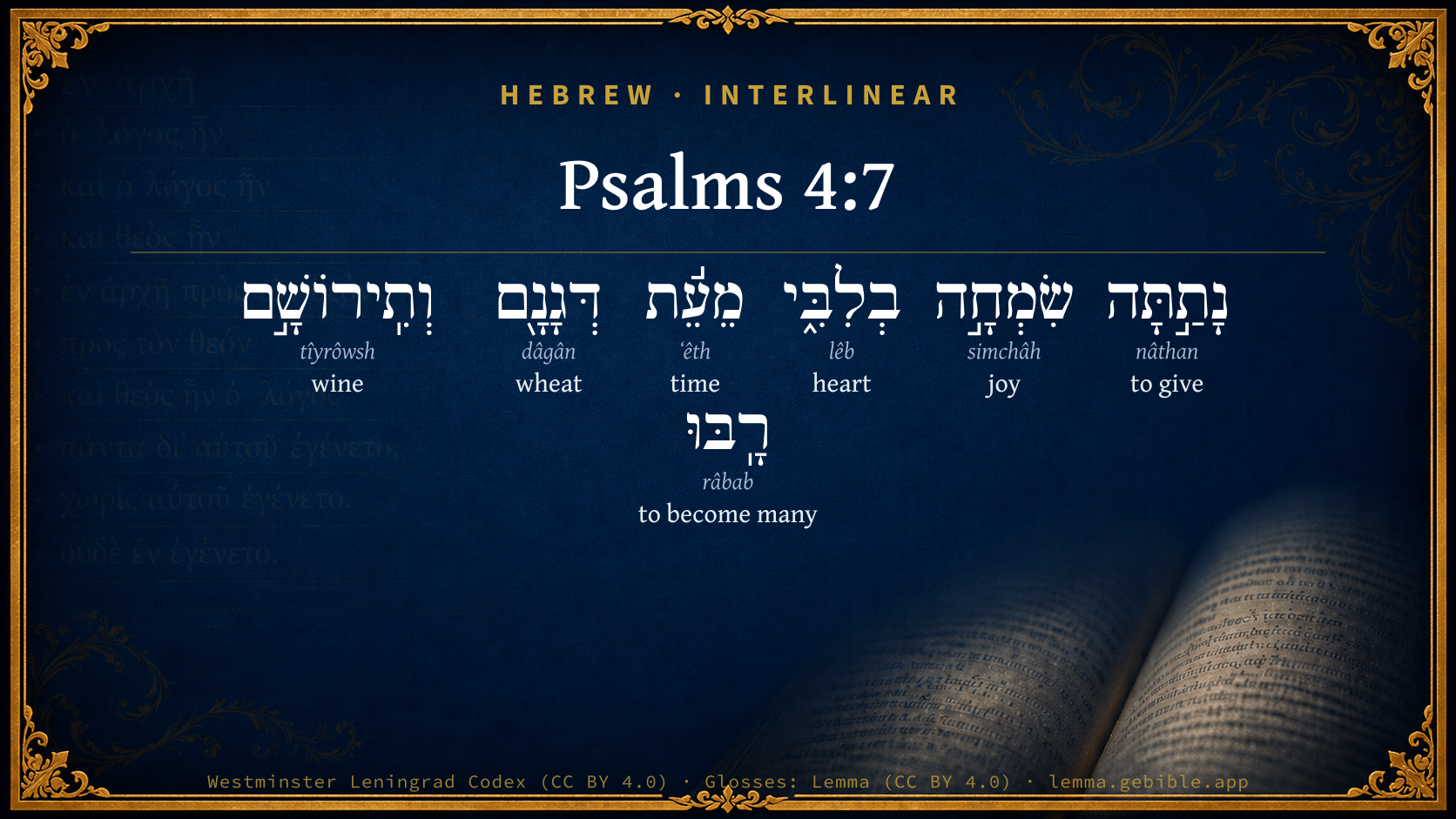
Psalms 4:7

Hebrew (Westminster Leningrad Codex) Psalms 4:7 appears in the Hebrew Old Testament. The text above is from the Westminster Leningrad Codex. Each word links to its Strong’s number, a concise gloss, and parsing drawn from the Open Scriptures Hebrew Bible morphology. Click any word for its full Brown-Driver-Briggs (BDB) entry.
Download image
Cite this verse

Psalms 4:7 (World English Bible). Public Domain. Lemma interlinear Bible study tool, https://lemma.gebible.app/v/psalms/4/7.

Show BibTeX & RIS
BibTeX
RIS
English Translation
You have put gladness in my heart, More than when their grain and their new wine are increased.
World English Bible · Public Domain
Download a study sheet

One document with this verse’s original text, its word-by-word gloss line, the meaning frame, cross-references with their text, attributed commentary, and full source and license credits — printable, and it pastes into notes with its structure intact.

This verse Autodidact and up

Study sheet (.html) Plain text (.txt)

A passage Seminary Student

Up to 50 verses in one chapter. A passage sheet keeps up to 6 commentary sources and 12 cross-references per verse, in the order this page ranks them, and says so on the sheet whenever that leaves anything out. Ask for a single verse and you get the Autodidact verse sheet above.

Everything on this page stays free to read, with no account — the sheet is a download of what is already on screen, not access to it.

Want to remove ads? Support Godless Engineer
Compare translations 3

The same verse in 3 English versions, stacked beneath the original-language interlinear above. Click any original word for its lexicon entry.

Each is an independent rendering of the whole verse — the interlinear is not word-aligned to these translations.

Highlighted words mark where these versions differ — a whole-verse word diff, not a word-by-word alignment.

  • World English Bible Public Domain
    You have put gladness in my heart, More than when their grain and their new wine are increased.
  • King James Version Public Domain
    Thou hast put gladness in my heart, more than in the time that their corn and their wine increased.
  • unfoldingWord Literal Text CC BY-SA 4.0
    You have put joy in my heart more than the time their grain and their new wine abound.

unfoldingWord Literal Text — © unfoldingWord, licensed CC BY-SA 4.0. Word-aligned USFM3 via Door43 (git.door43.org/unfoldingWord/en_ult).

Versions to compare (up to 4)

3 of 4 selected

Show all 18 translations

Every available English version of this verse, each an independent rendering of the whole verse.

  • World English Bible Public Domain
    You have put gladness in my heart, More than when their grain and their new wine are increased.
  • Berean Standard Bible Public Domain
    You have filled my heart with more joy than when grain and new wine abound.
  • Majority Standard Bible Public Domain
    You have filled my heart with more joy than when grain and new wine abound.
  • King James Version Public Domain
    Thou hast put gladness in my heart, more than in the time that their corn and their wine increased.
  • American Standard Version (1901) Public Domain
    Thou hast put gladness in my heart, More than `they have' when their grain and their new wine are increased.
  • Revised Version (1885) Public Domain
    Thou hast put gladness in my heart, more than they have when their corn and their wine are increased.
  • Geneva Bible (1599) Public Domain
    Thou hast giuen mee more ioye of heart, then they haue had, when their wheate and their wine did abound.
  • Douay-Rheims (1899) Public Domain
    The light of thy countenance O Lord, is signed upon us: thou hast given gladness in my heart.
  • Young's Literal Translation Public Domain
    Thou hast given joy in my heart, From the time their corn and their wine Have been multiplied.
  • Literal Standard Version CC BY-SA 4.0
    You have given joy in my heart, || From the time their grain and their wine || Have been multiplied.
  • Unlocked Literal Bible CC BY-SA 4.0
    You have given my heart more gladness than others have when their grain and new wine abound.
  • unfoldingWord Literal Text CC BY-SA 4.0
    You have put joy in my heart more than the time their grain and their new wine abound.
  • Darby Bible Public Domain
    Thou hast put joy in my heart, more than in the time that their corn and their new wine was in abundance.
  • World Messianic Bible Public Domain
    You have put gladness in my heart, more than when their grain and their new wine are increased.
  • Webster's Bible Public Domain
    \\4:6\\There are many that say, Who will show us any good? LORD, lift thou upon us the light of thy countenance.
  • Free Bible Version CC BY-SA 4.0
    The happiness you give me is better than those who have a plentiful harvest of grain and new wine.
  • Bible in Basic English Public Domain
    Lord, you have put joy in my heart, more than they have when their grain and their wine are increased.
  • JPS Tanakh (1917) Public Domain
    (4-8) Thou hast put gladness in my heart, more than when their corn and their wine increase.

Literal Standard Version (2020), Covenant Press — licensed CC BY-SA 4.0. Text via the HelloAO Bible API (eBible.org). Unlocked Literal Bible (unfoldingWord) — licensed CC BY-SA 4.0. Text via the HelloAO Bible API (eBible.org). unfoldingWord Literal Text — © unfoldingWord, licensed CC BY-SA 4.0. Word-aligned USFM3 via Door43 (git.door43.org/unfoldingWord/en_ult). Free Bible Version, Dr. Jonathan Gallagher — licensed CC BY-SA 4.0. Text via the HelloAO Bible API (eBible.org).

Word by word

More ways to search: Search by grammar → Find every occurrence → Compare this word →

Practice this passage: Drill this verse → Learn its vocabulary →

About this verse

These counts appear in no published source. They are computed here, from the morphology-tagged text and Lemma’s own curated glosses. What Lemma adds →

7
words
7
distinct lemmas
Wisdom
section

Notable vocabulary

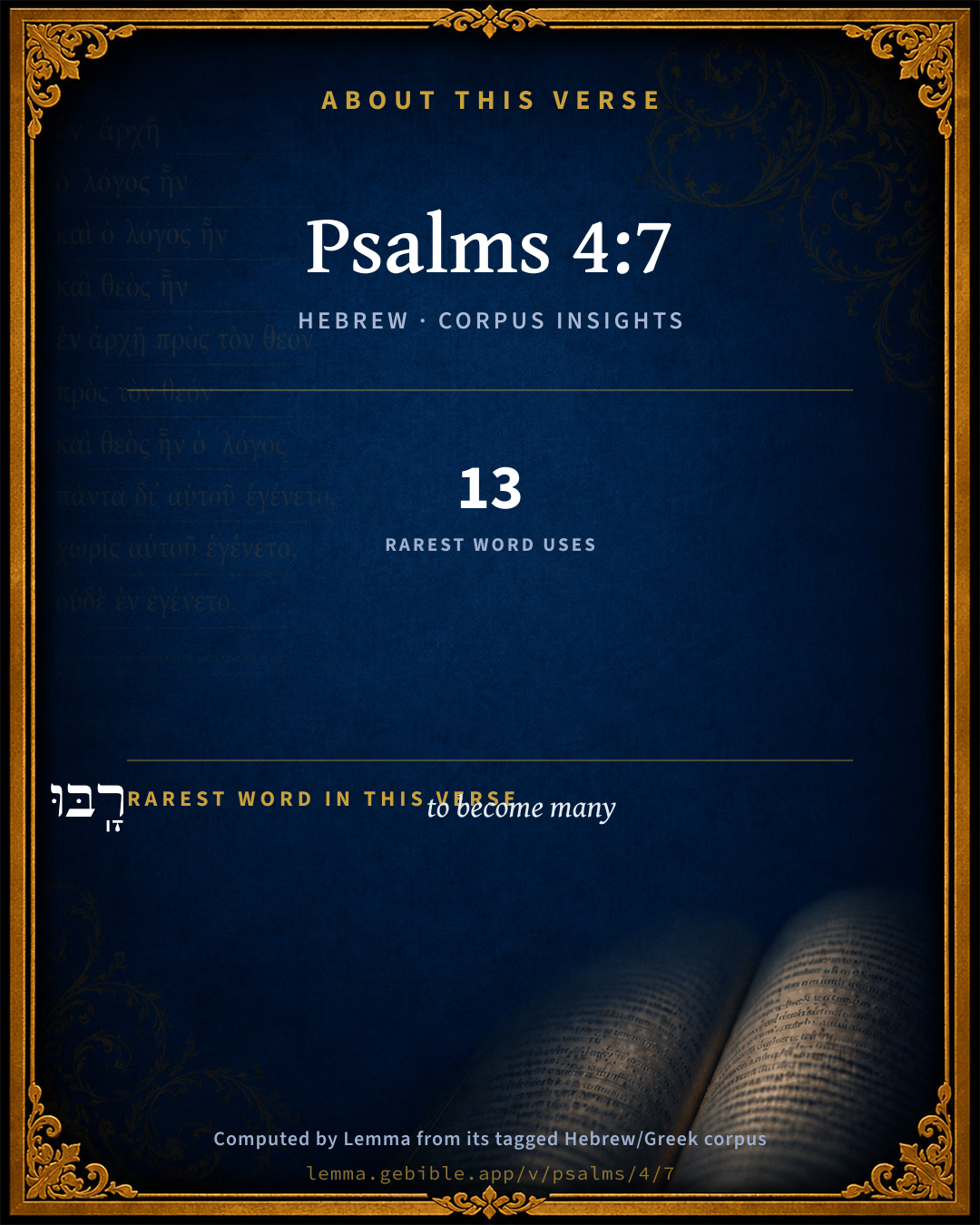
The rarest word here is רָֽבּוּ to become many H7231 — appearing just 13 times in the whole Hebrew Bible.

Shared distinctive vocabulary

רָֽבּוּ to become many H7231 occurs in 13 verses of the Hebrew Bible. Also found in:

Grammatical profile

  • 2 verbs
  • 5 nouns

Verb forms

  • נָתַ֣תָּה Qal · Perfect
  • רָֽבּוּ Qal · Perfect

Hebrew & Septuagint length

In English translation the verse runs 18 words from the Hebrew and 21 from the Septuagint (LXX English) — closely comparable.

A rough comparison of the two English renderings, which tokenize alike — not a word-level alignment.

Word counts can differ between the Hebrew and the Greek without any difference in meaning — e.g. the Hebrew direct-object marker אֵת has no separate Greek word, and Greek often adds the article ὁ.

Cross-references

10

Topical passages linked to Psalms 4:7 in the Treasury of Scripture Knowledge — connected by theme and wording, ordered by reader-vote popularity; previews shown in the World English Bible.

  • Isaiah 9:3 You have multiplied the nation, you have increased their joy: they joy before you according to the joy in harvest, as men rejoice when they divide the spoil.
  • Psalms 63:2–5 So I have seen you in the sanctuary, Watching your power and your glory.
  • Psalms 37:4 Also delight yourself in Yahweh, And he will give you the desires of your heart.
  • Psalms 43:4 Then I will go to the altar of God, To God, my exceeding joy. I will praise you on the harp, God, my God.
  • Psalms 92:4 For you, Yahweh, have made me glad through your work. I will triumph in the works of your hands.
  • Acts 14:17 Yet he didn't leave himself without witness, in that he did good and gave you rains from the sky and fruitful seasons, filling our hearts with food and gladness."
  • Judges 9:27 They went out into the field, and gathered their vineyards, and trod [the grapes], and held festival, and went into the house of their god, and did eat and drink, and cursed Abimelech.
  • Song of Solomon 1:4 Take me away with you. Let us hurry. The king has brought me into his chambers. Friends We will be glad and rejoice in you. We will praise your love more than wine! Beloved They are right to love you.
  • Jeremiah 48:33 Gladness and joy is taken away from the fruitful field and from the land of Moab; and I have caused wine to cease from the wine presses: none shall tread with shouting; the shouting shall be no shouting.
  • 1 Peter 1:8 whom not having known you love; in whom, though now you don't see him, yet believing, you rejoice greatly with joy unspeakable and full of glory--

Cross-references courtesy of OpenBible.info (CC BY 4.0).

Hebrew and Greek witnesses Masoretic Hebrew ↔ Greek Septuagint

The same verse in the two great witnesses to the Old Testament, shown verse-for-verse.

You’re reading Greek Psalm 4 (Hebrew Psalm 4). The Septuagint counts the superscription, so verse numbers can differ from the Hebrew — chapter-level alignment, not verse-by-verse. Numbering follows Rahlfs.

These are two independent witnesses, not word-aligned to each other, and the Septuagint is shown in lemma (dictionary) form.

Hebrew Psalms 4:7 Masoretic · Westminster Leningrad Codex

נָתַ֣תָּה שִׂמְחָ֣ה בְלִבִּ֑י מֵעֵ֬ת דְּגָנָ֖ם וְתִֽירוֹשָׁ֣ם רָֽבּוּ

You have put gladness in my heart, More than when their grain and their new wine are increased.

World English Bible · Public Domain

Greek LXX Greek Psalm 4:7 Septuagint · lemma form

πολύς λέγω τίς δεικνύω ἐγώ ὁ ἀγαθός σημειόω ἐπί ἐγώ ὁ φῶς ὁ πρόσωπον σύ κύριος

You have put gladness into my heart: they have been satisfied with the fruit of their corn and wine and oil.

LXX2012 (modern English Septuagint) · Public Domain

On this verse, John Gill's Exposition discusses the Septuagint’s reading. Read the note in Commentary ↓

Hebrew: Westminster Leningrad Codex (CC BY 4.0). Greek: Septuagint (public domain); English from LXX2012 (modern English Septuagint) (Public Domain). How the Septuagint differs from the Hebrew →

Commentary

Notes on Psalms 4:7 from classic Christian and Jewish commentators (each source and its license shown beneath its notes). The classic Christian expositions comment on the surrounding passage and are grouped to its opening verse, so a note may address several verses; the Jewish commentaries on the Tanakh (Rashi and others) are per-verse, so they appear only where the commentator wrote on this verse.

Lemma curates 59 commentaries, every one of them public domain or Creative Commons licensed, each selected and text-cleaned for this edition rather than reprinted as found. About our sources →

Trapp's Complete Commentary

John Trapp

Psa 4:7 Thou hast put gladness in my heart, more than in the time [that] their corn and their wine increased.

Ver. 7. Thou hast put gladness in my heart, more than, &c.] Joys unspeakable, and full of glory, 1Pe 1:8. We read of some godly men, that they have been overwhelmed with spiritual joy, till they have cried out, Hold, Lord, stay thine hand, I can bear no more; like weak eyes, that cannot endure to bear the light. Indeed, this is not every good man’s case, witness that saying of sweet Master Bath, I thank God in Christ, sustentation I have, but suavities spiritual I taste not any. And that of holy Rolloc, While I live I never look to see perfect reformation in the Church, or to feel perfect ravishing joys in mine heart. But those God’s people have are far beyond all carnal comforts.

Than in the time that their corn, &c.] These indeed are the precious fruits of the earth, Jas 5:7, but they seal not up special favour. A man may have together with them animam triticeam, as that rich fool had. Animas etiam incarnavimus, as a Father complaineth. These outward things are got within men, and have stolen away their warmest and liveliest affections from God. Not so in the saints; they must have God, or else they die. The people mourned and put on black when they heard that God would not go with them himself, but send an angel with them, Exo 33:2-3. And when great gifts were sent to Luther, he sent them back again with this brave speech, I will not be put off with these poor things; I look for better. Let God bestow himself upon me, and it sufficeth. As with manna there fell a dew, so to a good soul, together with corn and wine (be it more or less) there is a secret influence of God, which the carnal heart is not acquainted with. A fly cannot make that of a flower that a bee can do. The treacherous Shechemites had plenty of grain and wine, Jdg 9:27, but having not the grace of God with it, they were soon after destroyed by Abimelech.

John Trapp, A Commentary or Exposition upon All the Books of the Old and New Testament (1647–1656) — public domain. Text from a community e-Sword module.

The Biblical Illustrator

Joseph S. Exell

Psa_4:7

Thou hast put gladness in my heart, more than in the time that their corn and their wine increased.

Thanksgiving for harvest

1. The joy in harvest is based on the successful result of labour. Labour is Gods law, and obedience to it secures a result corresponding to the means used, and that result is a real blessing in the ratio in which God is recognised and honoured, by obeying Him in the law which He has enjoined. Spiritual blessings are only attained through spiritual means. How few men recognise, in Gods ministration of natural plenty, a silent sermon on the passage, He giveth all things richly to enjoy. A Christian looks upon a plentiful harvest, not simply as a pledge of cheaper bread, but as a mark of Gods approval of the industry which wrought for this end. All industrious nations are thriving, though all are not God-fearing nations.

2. Joy in harvest commemorates the termination of solicitude, in reference to a favourable season for ripening and gathering in the crops. Scripture alludes to many of the trials and disappointments of the husbandman. There is a proverbial impatience and murmuring among tillers of the soil. A like impatience is not rare among some Christians. The harvest, as an annual ripening and realising of profit, should suggest annual inquiry into our own scale of personal maturity in the things of God. Has the past year yielded a good spiritual return for mental toil, and thought, and prayer, and the means of grace?

3. The joy of harvest reasonably includes the prospect of an adequate supply for our own and others necessities. There is danger, as well as misery, m a public deficiency of the necessaries of life. The law and the loaf flourish best together.

4. The joy of an abundant harvest should stimulate us to renewed and enhanced confidence in God. If He thus blesses the labour of the field, doubt not He will bless every believer in his personal calling. (Joseph B. Owen, M. A.)

Plus gladness

Christianity is a religion of gladness. You cannot have one Divine idea in you without being glad. You cannot have any Divine ideas so long as you are unpardoned. It is the distinction of the gospel to proclaim possible forgiveness, and when forgiveness has taken effect then joy begins; on every bough of every tree there is a singing bird. But until we are pardoned, and pardoned at the Cross, we cannot admit God the Father, God the Son, and God the Holy Ghost into our hearts to abide with us and sup with us and manifest themselves to us, and therefore we cannot have this simple, pure, celestial, inexhaustible joy. Christianity gives joy unspeakable, joy unutterable. Joy has no words; joy takes up all our little words, and uses them, and then says, I want more, more, another language, and because it has no more articulation it bursts forth into songs without words, it mingles with the melody of the spheres. To that high festival we are called! But is not the religion of Christ a religion of melancholy? No. It has in it the deepest melancholy ever known, but one thing is so often forgotten by Christian evangelists: Christ died only once. They will not think of that--only once. He did die--died as never man died; He was despised and rejected of men, He gave His back to the smiters and His cheeks to them that pluck off the hair; but He died only once. He lives for evermore. Why do we not at our Eastertides remember this?--the death for a moment, the life forever! So we come up out of darkness to sing of light; we leave the desert, one little mile long, and enter upon the boundless paradise of God. Do not condemn yourselves because you have not a continual consciousness of this joy. Much of that want of consciousness may be due to physical infirmity; we are fearfully and wonderfully made; the body may be having the upper hand for a time. Then some mens self lies such a long way within themselves they have to shed off coat after coat, to slough off bad skin after bad skin a thousand in number, before they get at their real Ego, their real I, their real and divinest self. Some of us have a hard fight. Some of you think you are going to lose. Hear me: you are not. Gad, a troop shall overcome him, but he shall overcome at the last. For the moment he is down, but God is in him, and he will spring from the dust, and at the last even the poor tribe called Gad shall sing of victory, sit down with conquerors! (Joseph Parker, D. D.)

The duty, method, and importance of being happy

There are wants of the soul which no earthly good can satisfy. The happiness to meet these wants consists in a calm, cheerful, submissive, contented frame of mind.

I. This happiness is not only a privilege, it is a sacred and most important christian duty.

1. By far the greater part of the unhappiness which people complain of, is of their own procuring, and is to be set down as resulting, not from any unavoidable necessity, either in nature or circumstances, but from a perverted free agency, from violating some of the laws of our being, from voluntary indiscretions, errors, and sins. Remove the sources of unhappiness, and little comparatively would remain to embitter the cup of life, or make us unhappy. If the unhappiness is caused by ourselves, then it is our duty to cease from so profitless, so bad a work.

2. It is our duty to be happy, because it is our duty to be right--right in our feelings, principles, habits, and aims; and just so far as we are so, we must, and we shall be happy. The happiness of which I speak is in the state of the mind, and independent, in great measure, of outward circumstances.

3. God wishes us to be happy. This cannot be doubted by any who believe that God is a Being of infinite wisdom and goodness. True, in our present state, there are many things within and without, which tend to perplex and try us, and, in point of fact, do often greatly interrupt and disturb our happiness. These, we have seen, are partly our own procuring. So far as they come in the course of Divine Providence, they are means designed of our Father in heaven to promote our present and future happiness. They are among the all things that work together for good.

4. Look at the constitution of man as made in the image of God, and formed to share, in his measure, in the happiness of God. A law pervades your whole mental constitution, making it certain that the right normal exercise of your powers and affections can result only in making you happy.

5. From the abundant means God has provided to render you happy. He who made you, and made you to be happy, has provided means adapted to gratify all your desires and aspirations, so far as they are right and proper. The means God has provided for our happiness do not stop in the things of earth and time.

II. The method or way to be happy.

1. We must leave off making ourselves unhappy. Turn out all those consumers of happiness which are so apt to find a home in the bosom. Their name is legion, and by many they are indulged and nursed to the overthrow of all internal peace and comfort.

2. Cultivate kind and benevolent affections--love, joy, peace, long suffering, gentleness, meekness, goodness, truth. These virtues, in habitual exercise, as they are required to be, cannot fail to diffuse sunshine and pleasantness over the whole mind and life.

3. Note the Saviours prescription for being happy, as contained in the opening of His Sermon on the Mount. Blessed are they, etc. What is the principle, the source, of the blessedness expressed in these different terms? Plainly it is internal; it springs from the affections.

III. The importance of being happy. It is not necessary to dwell on this. It is not, however, common for happiness to be inculcated as a duty. It is usually regarded as a matter which everyone must be left to dispose of as he chooses, without incurring any moral responsibility. (J. Hawes, D. D.)

Religion no enemy to joy

Joy and pleasure are things so truly desired by all mankind, that religion suffers by being thought an enemy to them. Religion restrains us from nothing, but what our own reason and interest should restrain us from, In all harmless and innocent satisfactions, that neither entrench upon the honour of God, nor the rights of others, nor our own peace and quiet, we have leave to pick and choose.

I. The nature of this inward joy and pleasure. Not a natural gaiety and cheerfulness of humour, or a few light and transient fits of mirth, nor yet any strong and confident presumptions of Gods love and favour, or any rapturous transports, and sensible ravishments of joy. That which I intend is, a solid and rational satisfaction of mind, in the goodness and soundness of a mans estate towards God, and flows usually from these two things--from a sincere and regular discharge of our duty, which brings its own comfort and tranquillity along With it. And from a cheerful reflection upon a mans innocency, and the integrity of his actions, when a man dares look back upon what he has done, and knows that he has the testimony and approbation of heaven on his side, bearing witness to the vote and suffrage of his own conscience.

II. What influence religion has upon the joy and pleasure of a mans mind.

1. Religion restores a man to the grace and favour of God, and assures him that his sins are pardoned, and his peace made with heaven.

2. A course of virtue and religion subdues our inordinate appetites and vicious inclinations, which are the great fountains of inquietude and trouble. Religion circulates through all our powers, disposes every faculty to act in its due place and order, and determines every affection to its peculiar object.

3. A pious and religious life secures to a man the peculiar care and protection of the Divine Providence, than which there cannot be a stronger support and comfort to the mind of a wise and good man.

4. Religion refreshes the mind of a good man with a joyful assurance of the glory and blessedness of the Other world.

III. The excellency of the pleasures of religion, above all the delights and pleasures of this world. More than when the corn and the wine increases.

1. The delights of this world are gross and corporeal, and affect only the external senses, and are the pleasures of the brute, rather than of the man.

2. The pleasures of religion are more solid and satisfying than anything this world can afford. They fill our appetites, and fix our desires, and settle the soul upon the right basis and temper.

3. Religions pleasures are more large and comprehensive, they take in a vaster compass, the delights both of this and of the other world.

4. The pleasures of religion have infinitely the advantage of all others in point of duration and continuance. They abide with us when other comforts fly, or are rifled away from us The sum is this--the work of righteousness is peace, and the effect of righteousness is quietness and assurance forever. (William Cave, D. D.)

The saints gladness

The chief distinction between a child of God and a man of the world lies in the prevailing tendency of their desires.

1. The Psalmists description of opposite characters. See the description of worldly men, in Psa_4:6 : It is obvious--

(1) That this question betrays a great degree of inward dissatisfaction and perplexity. They say any good, anything to fill up the craving vacuity of our minds. At the time of the question they cannot find anything in their lot that deserves the name of good.

(2) The only good they inquire for is some present sensible enjoyment, which may be pointed out to the eye of sense, They look not at the things which are unseen and eternal.

(3) They make no discrimination of the objects which they seek after.

(4) They do not turn their thoughts at all to God. They seek counsel from others, but none from Him. Turn to consider the temper of a child of God. He too seeks good; but

(i) It is not any good that will satisfy him. He cannot feed upon husks. He seeks the chief good.

(ii) He knows where that good is to be found. The favour of God, and the sense of His loving kindness, are the only sources of true happiness. The worldly mind is in a state of perpetual fluctuation.

(iii) The child of God goes directly to God Himself, and begs the blessing from Him.

(iv) The Psalmist, in the name of the godly, uses this prayer in direct opposition to the carnal language, of worldly men. Intimating to us, that a child of God can relish no sweetness m any inferior good, till he be assured of the Divine favour.

2. The propositions which arise from this comparison.

(1) Worldly men have little cause to rejoice in the temporal advantages which they possess. These outward things may consist with the present misery of the person who possesses them. Indeed, these things are frequently the means of making men miserable, and of fixing them in that deplorable state. These things may end in misery, and leave the owner in everlasting woe.

(2) Consider those solid grounds of joy which belong to the people of God. He is possessed of the joy which results from comparing his present and happy condition with the misery in which he was once involved. Source of joy to a child of God, also consists in the actual honours and privileges conferred upon him. He is advanced to the dearest and most intimate relation to God, adopted into His family, and invested with all the rights of a son. The joy of a saint also proceeds from the contemplation of those future blessings which are yet only the objects of hope. These sources of joy are of such a nature as that no outward distress or calamity can take them away.

Improvement of this subject.

1. Inquire which of the characters described by the Psalmist belongs to us.

2. I exhort those of you who are yet carnally minded, to think seriously of your condition.

3. Let those who have been taught to value the light of Gods countenance above all things, learn to be humble and thankful. (R. Walker.)

Christians should reflect on their felicity

Living in Rome, a famous antiquarian and artist (Winkelman) tells how he gave himself half an hour every day to meditate on his Italian happiness. Thousands have lived in Rome with the same pure sky smiling over them, and the same articulate antiquity on every side accosting them, and never been aware of their felicity. And is it not thus with the average Christian life? For the want of reflection and a calm survey of our standing and inheritance in Jesus Christ, our icy and gladness are intermittent instead of perennial and abiding. (James Hamilton, D. D.)

Happy without a fortune

Recovering from an illness, Mr. Wilberforce remarked, I can scarcely understand why my life is spared so long, except it be to show them a man can be as happy without a fortune as with one.

A happy life

Now, as they were going along and talking, they espied a boy feeding his fathers sheep. The boy was in very mean clothes, but of a very fresh and well-favoured countenance, and as he sat by himself, he sang--

He that is down needs fear no fall;

He that is low no pride;

He that is humble ever shall

Have God to be his guide.

I am content with what I have,

Little be it or much;

And, Lord, contentment still I crave,

Because Thou savest such.

Fulness to such a burden is,

That go on pilgrimage:

Here little, and hereafter bliss,

Is best from age to age.

Then said their guide, Do you hear him? I will dare to say that this boy lives a merrier life, and wears more of that herb called hearts ease in his bosom, than he that is clad in silk and velvet. (John Bunyan.)

The Biblical Illustrator, edited by Joseph S. Exell (c. 1880s–1900s) — public domain. Text from a community e-Sword module.

Joseph Benson's Commentary

Psa 4:7. Thou hast put gladness in my heart — Whatsoever thou shalt do with me for the future, as to my outward distresses and concerns, I have, at present, unspeakable pleasure and full satisfaction in the manifestations and testimonies of thy love to and in my soul. Hereby thou hast, many a time, put gladness into my heart; not only supported and refreshed me, but filled me with joy unspeakable, and therefore this it is which I will still pursue, and which I will seek after, all the days of my life. Observe, reader, when God puts grace into the heart, he puts gladness into it; nor is any joy comparable to that which gracious souls have in the communications of the divine favour, no, not the joy of harvest, even of a plentiful harvest, when the corn and wine greatly increase. This is gladness in the heart, inward, solid, substantial joy; but the mirth of carnal and worldly people is only a flash, a shadow, for even in laughter their hearts are sorrowful, Pro 14:13.

Joseph Benson's Commentary on the Old and New Testaments (1811–1818) — public domain. Text from a community e-Sword module.

Jamieson, Fausset & Brown

Robert Jamieson, A. R. Fausset & David Brown

corn and wine--literally, "new corn and wine."

increased--an abundant harvest giving great joy (Isa 9:3).

Jamieson, Fausset & Brown — Commentary Critical and Explanatory on the Whole Bible (1871) — public domain (CC PDM 1.0). Text via the HelloAO Bible API.

Adam Clarke's Commentary

Verse 7. Thou hast put gladness in my heart] Thou hast given my soul what it wanted and wished for. I find now a happiness which earthly things could not produce. I have peace of conscience, and joy in the Holy Ghost; such inward happiness as they cannot boast who have got the highest increase of corn and wine; those TWO THINGS in the abundance of which many suppose happiness to be found.

To corn and wine all the versions, except the Chaldee, add oil; for corn, wine, and oil, were considered the highest blessings of a temporal kind that man could possess.

Adam Clarke's Commentary on the Bible (1810–1826) — public domain. Text from a community e-Sword/MySword module.

John Calvin's Commentaries

7. Thou hast given more joy to my heart. By another comparison he better expresses and illustrates the strength of his affection, showing that, having obtained the good which he had longed for, he does not in the least degree envy the wealth and enjoyments of others, but is altogether contented with his own lot. The sum is, that he had more satisfaction in seeing the reconciled countenance of God beaming upon him, than if he had possessed garners full of corn, and cellars full of wine. The allusion is to the joy of the harvest and vintage.

“Or combien que les expositeurs varient en ce mot que nous avons traduit, Au temps: pource qu’aucuns traduisent, Tu m’as donne liesse au coeur depuis le temps que, etc., comme s’il disoit, Je suis joyeux quand je voy prosperer mes ennemis en ce monde.” — Fr.

John Calvin's Commentaries (1540-1563) — public domain. Text from the Calvin Translation Society English edition (1840s-50s) via the Christian Classics Ethereal Library (ccel.org). Calvin's coverage is partial (roughly two-thirds of the Bible); uncommented books and verses are honest gaps, never fabricated. The 19th-century editor's footnotes and remarks are omitted so the notes are faithfully Calvin's own voice.

Ellicott's Commentary for English Readers

(7) Thou hast.—Either “Thou hast put a gladness in my heart more than when their corn and new wine are much,” or, “More than when one has much corn,” &c. The expression is one of pregnant brevity for, “A gladness greater than that when corn and wine are plentiful.”

A Bible Commentary for English Readers, edited by Charles John Ellicott (1878–1897) — public domain. Text from a community e-Sword module.

The Cambridge Bible for Schools and Colleges

gen. ed. J. J. S. Perowne

7. more than &c.] Lit. more than (the joy of) the time of their corn and wine when they were increased: i.e. more than their rejoicings for harvest and vintage even when they were most abundant: well expressed in R.V., more than they have when their corn and their wine are increased. The persons referred to may be either the malcontents, or men in general. The boisterous mirth of harvest and vintage rejoicings (Isa_9:3; Jer_48:33) is the highest form of joy which they know whose desires are limited to earthly things; but deeper far is that inward joy which is the gift of God, for it is one of the fruits of the Spirit, Gal_5:11; cp. Rom_14:17.

The words gain fresh point when it is remembered that David was reduced to straits for the bare necessaries of life till he reached his hospitable friends at Mahanaim (2Sa_17:27-29).

7, 8. A joy and peace which are independent of outward circumstances.

The Cambridge Bible for Schools and Colleges (gen. ed. J. J. S. Perowne; Cambridge University Press, 1878–1918) — public domain. Text from a community e-Sword module.

John Gill's Exposition

Thou hast put gladness in my heart,.... The Ethiopic version reads it "into our heart"; in granting the above request; for, nothing so rejoices the hearts of God's people as the light of his countenance, or the enjoyment of his gracious presence: this was matter of exceeding joy to Christ himself, Psa 21:6; and so it is to all his members; this causes inward gladness, gladness of heart, and is opposed to the external rejoicings of wicked men and of hypocrites: and this is of God's putting into the heart; and indeed none can put gladness either into a wounded conscience, into the heart of a sensible sinner, or into the soul of one that is panting after the presence of God, and communion with him, but God himself;

more than in the time that their corn and their wine increased: meaning the time of harvest and of vintage; when there is a good harvest, and a good vintage, there is joy among men, and the contrary when it is otherwise, Isa 9:3; these things being of general use, spread an universal joy among people; there is scarce any earthly thing that occasions more joy than these do: and yet the joy on such occasions is not to be compared with spiritual joy, that is a joy unspeakable and full of glory. Some take the to be not comparative, but causal, and render the words (s), "thou hast put gladness in ray heart from the time that their corn", &c. as do the Chaldee paraphrase and Syriac versions; and the Arabic version renders it, "because of the multitude of fruits", &c. and then the sense is, as if David should say concerning his enemies,

"I never envied their prosperity, I always rejoiced when they had a good harvest, or vintage, and still do; and yet they have rose up and rebelled against me, and requited me evil for good.''

And this sense is given into by the Jewish commentators (t), and shows of what an admirable spirit, and in what a sweet disposition of mind, the psalmist was; that while his enemies were seeking his life he was rejoicing in their prosperity; and is a sad aggravation of their wickedness: and this may also be understood of the rejoicing of David, and even of the Messiah, and likewise of all good men, at the spiritual prosperity of the saints, at any increase of grace, spiritual knowledge, and joy, signified by these outward things, as in Jer 31:12; the Septuagint, Vulgate Latin, Syriac, Arabic, and Ethiopic versions, add "oil" to corn and wine.

(s) "a vel ex tempore quo frumentum eorum", &c. Pagninus, Montanus, Musculus, Cocceius. (t) Jarchi, Aben Ezra, & Kimchi in loc.

John Gill's Exposition of the Whole Bible (1746–1763) — public domain (CC PDM 1.0). Text via the HelloAO Bible API.

Albert Barnes' Notes on the Bible

Thou hast put gladness in my heart - Thou hast made me happy, to wit, in the manner specified in Psa 4:6. Many had sought happiness in other things; he had sought it in the favor of the Lord, and the Lord had given him a degree of happiness which they had never found in the most prosperous worldly condition. This happiness had its seat in the “heart,” and not in any external circumstances. All true happiness must have its seat there, for if the heart is sad, of what avail are the most prosperous external circumstances?

More than in the time - More than they have had in the time referred to; or, more than I should have in such circumstances.

That their corn and their wine increased - When they were most successful and prosperous in worldly things. This shows that when, in Psa 4:6, he says that many inquired who would show them any “good,” what they aspired after was worldly prosperity, here expressed by an increase of grain and wine. The word rendered “corn” means grain in general; the word rendered “wine” - תירושׁ tı̂yrôsh - means properly “must, new wine,” Isa 65:8. The reference here is probably to the joy of harvest, when the fruits of the earth were gathered in, an occasion among the Hebrews, as it is among most people, of joy and rejoicing.

Albert Barnes' Notes on the Bible (1834–1885) — public domain. Text from a community e-Sword/MySword module.

Matthew Poole's English Annotations

Whatsoever thou shalt do with me for the future, as to my outward distresses and concernments, I have at present unspeakable pleasure and full satisfaction in the impressions and testimonies of thy love in and to my soul; whereby also I am encouraged with confidence to expect good success to my righteous cause.

Than in the time that their corn and their wine increased; than worldly persons have in the time of a plentiful harvest, which is a time of great rejoicing, Jdg 9:27; Isa 9:3; Jer 48:33.

Matthew Poole's English Annotations on the Holy Bible (1683–1685) — public domain. Text from a community e-Sword/MySword module.

The Treasury of David

Charles H. Spurgeon

Ver. 7. What madness and folly is it that the favourites of heaven should envy the men of the world, who at best do but feed upon the scraps that come from God's table! Temporals are the bones; spirituals are the marrow. Is it below a man to envy the dogs, because of the bones? And is it not much more below a Christian to envy others for temporals, when himself enjoys spirituals? Thomas Brooks.

Ver. 7. Thou hast put gladness in my heart. The comforts which God reserves for his mourners are filling comforts (Ro 15:13); "The God of hope fill you with joy" (Joh 16:24); "Ask that your joy may be full." When God pours in the joys of heaven they fill the heart, and make it run over (2Co 7:4); "I am exceeding joyful;" the Greek is, I overflow with joy, as a cup that is filled with wine till it runs over. Outward comforts can no more fill the heart than a triangle can fill a circle. Spiritual joys are satisfying (Ps 63:5); "My heart shall be satisfied as with marrow and fatness; and my mouth shall praise thee with joyful lips;" "Thou hast put gladness in my heart." Worldly joys do put gladness into the face, but the spirit of God puts gladness into the heart; divine joys are heart joys (Zec 10:7 Joh 16:22); "Your heart shall rejoice" (Lu 1:47); "My spirit rejoiced in God." And to show how filling these comforts are, which are of a heavenly extraction, the psalmist says they create greater joy than when "corn and wine increase." Wine and oil may delight but not satisfy; they have their vacuity and indigence. We may say, as Zec 10:2, "They comfort in vain;" outward comforts do sooner cloy than cheer, and sooner weary that fill. Xerxes offered great rewards to him that could find out a new pleasure; but the comforts of the Spirit are satisfactory, they recruit the heart (Ps 94:19), "Thy comforts delight my soul." There is as much difference between heavenly comforts and earthly, as between a banquet that is eaten, and one that is painted on the wall. Thomas Watson.

Ver. 6-7. An assurance of the Saviour's love, the source of unrivalled joy.

Ver. 7. The believer's joys.

(1) Their source, Thou; (2) Their seasoneven nowThou hast; (3) Their position, in my heart; (4) Their excellence, more than in the time that their corn and their wine increased.

Another excellent theme suggests itself"The superiority of the joys of grace to the joys of earth;" or, "Two sorts of prosperity which is to be the more desired?"

Ver. 8. Sweet Evening Hymn! I shall not sit up to watch through fear, but I will lie down; and then I will not lie awake listening to every rustling sound, but I will lie down in peace and sleep, for I have nought to fear. He that hath the wings of God above him needs no other curtain. Better than bolts or bars is the protection of the Lord. Armed men kept the bed of Solomon, but we do not believe that he slept more soundly than his father, whose bed was the hard ground, and who was haunted by blood-thirsty foes. Note the word only, which means that God alone was his keeper, and that though alone, without man's help, he was even then in good keeping, for he was "alone with God." A quiet conscience is a good bedfellow. How many of our sleepless hours might be traced to our untrusting and disordered minds. They slumber sweetly whom faith rocks to sleep. No pillow so soft as a promise; no coverlet so warm as an assured interest in Christ.

O Lord, give us this calm repose on thee, that like David we may lie down in peace, and sleep each night while we live; and joyfully may we lie down in the appointed season, to sleep in death, to rest in God!

Dr. Hawker's reflection upon this Psalm is worthy to be prayed over and fed upon with sacred delight. We cannot help transcribing it.

"Reader! let us never lose sight of the Lord Jesus while reading this Psalm. He is the Lord our righteousness; and therefore, in all our approaches to the mercy seat, let us go there in a language corresponding to this which calls Jesus the Lord our righteousness. While men of the world, from the world are seeking their chief good, let us desire his favour which infinitely transcends corn and wine, and all the good things which perish in the using. Yes, Lord, thy favour is better than life itself. Thou causest them that love thee to inherit substance, and fillest all their treasure.

"Oh! thou gracious God and Father, hast thou in such a wonderful manner set apart one in our nature for thyself? Hast thou indeed chosen one out of the people? Hast thou beheld him in the purity of his nature,as one in every point Godly? Hast thou given him as the covenant of the people? And hast thou declared thyself well pleased in him? Oh! then, well may my soul be well pleased in him also. Now do I know that my God and Father will hear me when I call upon him in Jesus' name, and when I look up to him for acceptance for Jesus' sake! Yes, my heart is fixed, O Lord, my heart is fixed; Jesus is my hope and righteousness; the Lord will hear me when I call. And henceforth will I both lay me down in peace and sleep securely in Jesus, accepted in the Beloved; for this is the rest wherewith the Lord causeth the weary to rest, and this is the refreshing."

Ver. 8. It is said of the husbandman, that having cast his seed into the ground, he sleeps and riseth day and night, and the seed springs and grows he knoweth not how. Mr 4:26, 27. So a good man having by faith and prayer cast his care upon God, he resteth night and day, and is very easy, leaving it to his God to perform all things for him according to his holy will. Matthew Henry.

Charles H. Spurgeon's The Treasury of David (1869–1885) — public domain. Psalms only. Text from a community e-Sword/MySword module.

Whedon's Commentary on the Bible

Daniel D. Whedon

7. Thou hast put gladness—Evidently this relates to some recent answer to prayer since he left Jerusalem, which lighted up his soul in joyful confidence. See on Psa_3:6.

More than in the time… their corn and… wine increased—The supplies brought to the king in his flight and on his arrival at Mahanaim (2Sa_16:1-4; 2Sa_17:27-29) were cheering, especially as the latter evidenced a loyal spirit in the Gileadites, who, at the first, for seven years, had supported the house of Saul against David; but the allusion appears to be rather to the joy of the national harvest and the vintage, when the revenues of the king flowed in, and the land resounded with festive songs. Above this joy was that now experienced by some recent token of divine favour in answer to prayer.

Daniel D. Whedon (gen. ed.), Commentary on the Old and New Testaments (1874–1909) — public domain. Text from a community e-Sword module.

The Pulpit Commentary

Thou hast put gladness in my heart. David is an example to the desponding ones. Notwithstanding his sufferings and calamities, God has looked on him, and so "put gladness in his heart a gladness which far exceeds that of his adversaries. Though they are in prosperity, and have their corn and wine increased, and enjoy all the "outward material blessings promised to Israel the wheat and the grape for a supply of which he is indebted to the generosity of friends" (Kay), yet he would not change places with them. The spiritual joy which fills his own heart is preferable to any amount of material comforts and pleasures.

The Pulpit Commentary (1880–1919), ed. H.D.M. Spence-Jones & Joseph S. Exell — public domain. Text from a community e-Sword module.

John Wesley's Explanatory Notes

Thou hast - Whatsoever thou shalt do with me for the future, I have at present unspeakable satisfaction in the testimonies of thy love to my soul; more than worldly persons have in the time of a plentiful harvest.

John Wesley, Explanatory Notes Upon the Whole Bible (1754–1765) — public domain. Text via the GEBible commentary corpus.

J. A. Alexander on Psalms

Joseph Addison Alexander

7. Many (there are) saying, Who will shew us good? This may be in allusion to the anxious fears of his companions in misfortune, but is more probably a picture of the disquiet and unsatisfied desire arising from the want of faith and righteousness described in the foregoing verse. Of all who do not trust in God it may be said, that they are continually asking Who will shew us good, who will shew us wherein happiness consists, and how we may obtain it? In contrast with this restlessness of hope or of despair, he shews his own acquaintance with the true source of tranquillity by a petition founded on the ancient and authoritative form in which the High Priest was required to bless the people (Num 6:24-26). "The Lord bless thee and keep thee; the Lord make his face shine upon thee and be gracious unto thee; the Lord lift up his countenance upon thee and give thee peace." Two of these solemn benedictions are here mingled in a prayer. Lift upon us the light of thy countenance, O Lord, Jehovah! The light of the countenance is a favourite figure in the Psalms, for a favourable aspect or expression. See Psa 31:17; Psa 44:4; Psa 53:4. The lifting up may have reference to the rising of the sun, or be put in opposition to the act of looking down or away from any object, as a token of aversion or displeasure. Upon us extends the prayer to his companions in misfortune, or to all God's people, or to men in general, as if he had said, This is the only hope of our lost race. The plural form may be compared with those in the Lord's Prayer, as indicating the expansive comprehensive spirit of true piety.

Joseph Addison Alexander, The Psalms Translated and Explained (1850) — public domain. Text from a community e-Sword module.

Rashi

Rabbi Shlomo Yitzchaki (Rashi)

Many say, “Who will show us goodness?” There are many Jews who see the nations of the world in wealth and tranquility, and say, “Who will show us goodness,” to be wealthy and achieve desires like these people?

Raise up over us Heb. נסה Raise up over us for a banner the light of Your countenance, an expression of (Isa. 62:10): “lift up a banner (נס)”;(ibid. 49:22), “I will raise My standard (נסי).” Another interpretation: נסה is reflordir(?) (resplendir) in Old French, gleam, as (Zech. 9:16), “crown stones gleam (מתנוססות).” But I do not envy them, for joy has been given into my heart from the time that the corn and the wine of the nations have increased. I am confident that if those who anger Him [have] such [tranquility], how much more will those who perform His will have it in the future, which is the day of the reception of their reward!

Rashi on the Tanakh — English translations: “The Judaica Press complete Tanach with Rashi, translated by A. J. Rosenberg” (CC BY 4.0); “Pentateuch with Rashi's commentary by M. Rosenbaum and A.M. Silbermann, 1929-1934” (public domain); “The Metsudah Tanach series, Lakewood, N.J” (CC BY 4.0); and “The Book of Joshua, Metsudah Publications, 1997” (CC BY 4.0). Text via Sefaria.

Radak

Rabbi David Kimhi (Radak)

Many (there be that) say:- – viz. those he has spoken of as sons of men; and he says concerning them, many say of my soul – they say longingly in their rebellion,

Oh that He would shew us prosperity: – that the rebellion of Absalom might succeed, and David perish and his son become king. And my evil is their good, and for it they are longing; but Thou,

Lord, lift up (נסה) the light of Thy countenance upon us: – not according to their purpose. And the word נַסה (is written) with samek (ס) instead of the (usual) sin (שׂ), and is equivalent to נשׂא. And it is possible to explain it according to the sense of and put your trust in the Lord. He says: as for many their thought is only for the prosperity of this world, and they are longing for it and saying Oh that He would shew us prosperity! while I and those with me say, Lord, lift up the light of Thy countenance upon us! All our desire is for the light of Thy countenance for the world to come.

Radak on the Tanakh — English translations: “Sefaria Community Translation” (CC0 1.0 (public-domain dedication)); “Eliyahu Munk, HaChut Hameshulash” (CC BY 4.0); “Rabbi Mike Feuer, Jerusalem Anthology” (CC BY 4.0); and “R. David Kimhi on the first book of Psalms, Translated by R.G. Finch, London, 1919” (public domain). Text via Sefaria.

Ibn Ezra

Rabbi Abraham ibn Ezra

Many (רַבִּים - rabbim): He returns to mention the words of those seeking falsehood [from v. 3]. For when I and my men were in distress, those seeking falsehood were speaking [these words] against me and against my men:

"Who will show us good?" (מִי־יַרְאֵנוּ טוֹב - Mi yar'enu tov): [Regarding the next word, נְסָה - Nesah ("Bestow" / "Lift up")] Some say: That the word Nesah is from the verbs lacking the Lamed [final root letter] (alumei ha-lamed), [with the root being] נ-ס (N-S). And it properly should have been [formed] according to the pattern of [imperatives like] u-Re'eh ("and see!") and va-Aseh ("and do!"). And it appears in the form that it has [נְסָה, with the final Heh typical of this verb class], similar to (Psalm 119:117) "ve-esh'ah be-chukekha" ("and I will gaze upon Your statutes" - from root שעה). And it is correct [however] for the Heh [in נסה] to be like the Alef [of נשא - N-S-A, lift up], and the Samekh [in נסה] to be like the Shin [of נשא]. [Aside on verb types]: There are verbs called "lacking the Ayin" [middle root letter] (alumei ha-ayin), such as all the verbs [that appear to have only] two letters, like kam (קָם - arose) and shav (שָׁב - returned). And they are all as if one were to say [the imperatives] Kum! (קוּם) and Shuv! (שׁוּב), where the middle letter [Vav or Yod] is hidden (alumah), which corresponds to the Ayin [middle position] of the standard root pattern pa'al. [Returning to נסה]: And it is correct for the Heh to be like the Alef and the Samekh like the Shin, in the manner of (Numbers 6:26): "Yissa Ad-nai panav eilekha" ("May Ad-nai lift up His countenance upon you" - yissa from נשא), and like (Job 4:2): "Ha-nisah davar eilekha til'eh" ("If one attempts/lifts up a word to you, will you be weary?" - ha-nisah).

Ibn Ezra on the Tanakh — English translations: “Sefaria Community Translation” (CC0 1.0 (public-domain dedication)); “Yalkut, Sifsei Chachomim Chumash, Metsudah Publications, 2009” (CC BY 4.0); and “Commentary of Ibn Ezra on Isaiah - trans. by M. Friedlander, 1873” (public domain). Text via Sefaria.

Lesson kit

Teaching starters — assembled from the data on this page, not authored interpretation. Every prompt links to the verse data it draws on. Edit before teaching.

Psalms, in the Wisdom, opens this verse with 7 words (7 distinct Hebrew lemmas). Its most distinctive word is râbab (“to become many”). A historical commentator’s framing appears above. Read the whole chapter for the surrounding context.

Discussion questions

  1. How does “to become many” (râbab) shape what this verse is saying?
  2. How does Genesis 6:1, which shares the word «to become many», read alongside this verse?
  3. These translations render this verse differently. What is at stake in choosing one wording over another?
  4. «נָתַ֣תָּה» is a Qal Perfect verb. How does that grammatical form shape the action described?
  5. Compare how Trapp's Complete Commentary and The Biblical Illustrator read this verse. Where do they agree or differ?

Things to notice

Reading settings

Reading text

Shown beneath each verse's original-language words.

Old Testament
Old Testament edition

Read the OT as the Masoretic Hebrew (MT) or the Greek Septuagint (LXX).

English shown for the Greek Septuagint (in the Hebrew ↔ Greek comparison).

Comparing translations? Open the Compare panel on any verse page to stack up to four side by side.