
Jeremiah 2:27

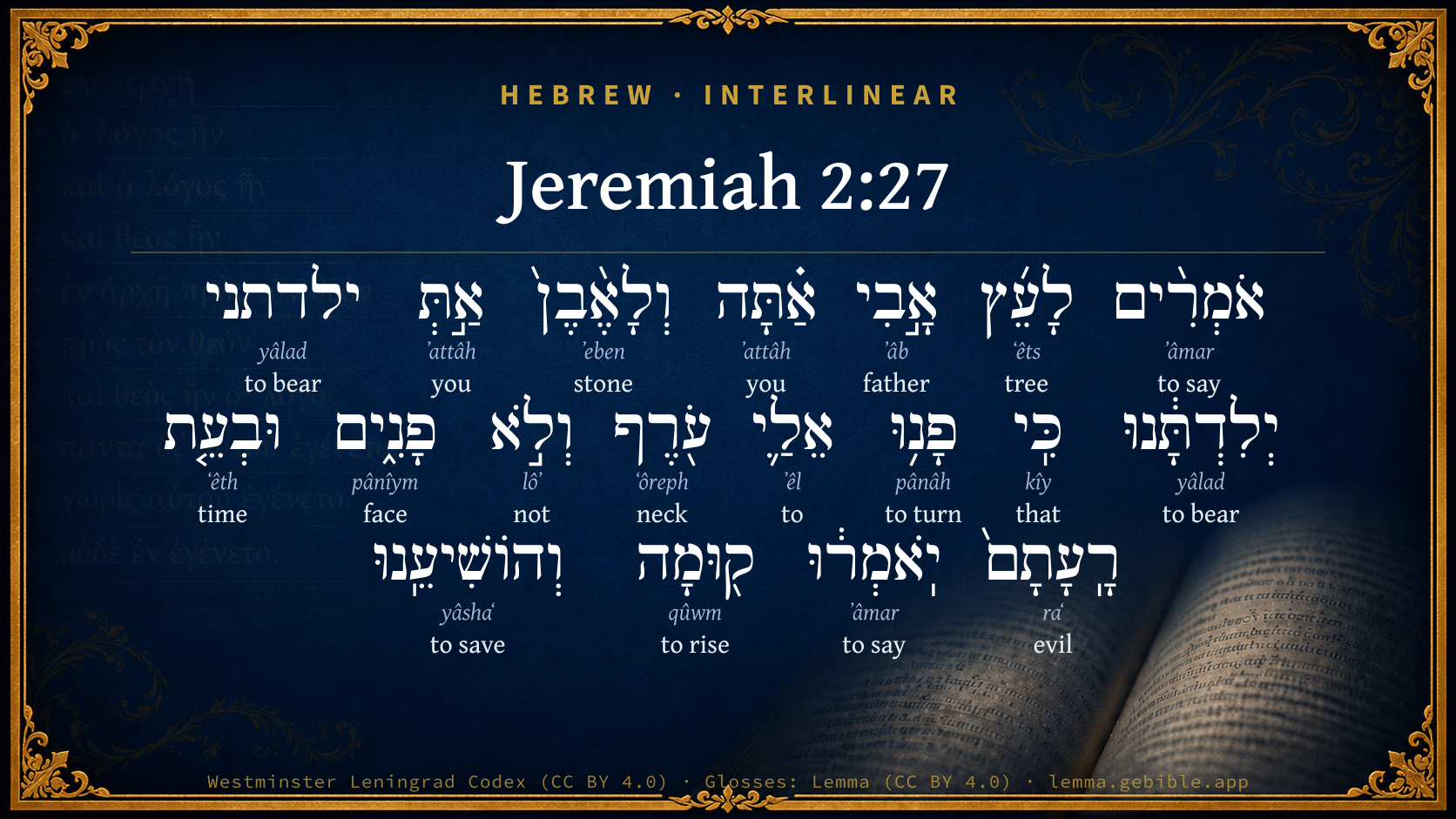
Hebrew (Westminster Leningrad Codex) Jeremiah 2:27 appears in the Hebrew Old Testament. The text above is from the Westminster Leningrad Codex. Each word links to its Strong’s number, a concise gloss, and parsing drawn from the Open Scriptures Hebrew Bible morphology. Click any word for its full Brown-Driver-Briggs (BDB) entry.
Download image
Cite this verse

Jeremiah 2:27 (World English Bible). Public Domain. Lemma interlinear Bible study tool, https://lemma.gebible.app/v/jeremiah/2/27.

Show BibTeX & RIS
BibTeX
RIS
English Translation
who tell a stock, You are my father; and to a stone, You have brought me forth: for they have turned their back to me, and not their face; but in the time of their trouble they will say, Arise, and save us.
World English Bible · Public Domain
Download a study sheet

One document with this verse’s original text, its word-by-word gloss line, the meaning frame, cross-references with their text, attributed commentary, and full source and license credits — printable, and it pastes into notes with its structure intact.

This verse Autodidact and up

Study sheet (.html) Plain text (.txt)

A passage Seminary Student

Up to 50 verses in one chapter. A passage sheet keeps up to 6 commentary sources and 12 cross-references per verse, in the order this page ranks them, and says so on the sheet whenever that leaves anything out. Ask for a single verse and you get the Autodidact verse sheet above.

Everything on this page stays free to read, with no account — the sheet is a download of what is already on screen, not access to it.

Want to remove ads? Support Godless Engineer
Compare translations 3

The same verse in 3 English versions, stacked beneath the original-language interlinear above. Click any original word for its lexicon entry.

Each is an independent rendering of the whole verse — the interlinear is not word-aligned to these translations.

Highlighted words mark where these versions differ — a whole-verse word diff, not a word-by-word alignment.

  • World English Bible Public Domain
    who tell a stock, You are my father; and to a stone, You have brought me forth: for they have turned their back to me, and not their face; but in the time of their trouble they will say, Arise, and save us.
  • King James Version Public Domain
    Saying to a stock, Thou art my father; and to a stone, Thou hast brought me forth: for they have turned their back unto me, and not their face: but in the time of their trouble they will say, Arise, and save us.
  • unfoldingWord Literal Text CC BY-SA 4.0
    the ones who say to the tree, ‘You my father,’ and to the stone, ‘You gave birth to me.’ For they have turned back to me and not faces. But in the time of their trouble they say, ‘Arise and save us!’

unfoldingWord Literal Text — © unfoldingWord, licensed CC BY-SA 4.0. Word-aligned USFM3 via Door43 (git.door43.org/unfoldingWord/en_ult).

Versions to compare (up to 4)

3 of 4 selected

Show all 18 translations

Every available English version of this verse, each an independent rendering of the whole verse.

  • World English Bible Public Domain
    who tell a stock, You are my father; and to a stone, You have brought me forth: for they have turned their back to me, and not their face; but in the time of their trouble they will say, Arise, and save us.
  • Berean Standard Bible Public Domain
    say to a tree, ‘You are my father,’ and to a stone, ‘You gave me birth.’ For they have turned their backs to Me and not their faces, yet in the time of trouble they beg, ‘Rise up and save us!’
  • Majority Standard Bible Public Domain
    say to a tree, ‘You are my father,’ and to a stone, ‘You gave me birth.’ They have turned their backs to Me and not their faces. Yet in the time of trouble, they say, ‘Rise up and save us!’
  • King James Version Public Domain
    Saying to a stock, Thou art my father; and to a stone, Thou hast brought me forth: for they have turned their back unto me, and not their face: but in the time of their trouble they will say, Arise, and save us.
  • American Standard Version (1901) Public Domain
    who say to a stock, Thou art my father; and to a stone, Thou hast brought me forth: for they have turned their back unto me, and not their face; but in the time of their trouble they will say, Arise, and save us.
  • Revised Version (1885) Public Domain
    which say to a stock, Thou art my father; and to a stone, Thou hast brought me forth: for they have turned their back unto me, and not their face: but in the time of their trouble they will say, Arise, and save us.
  • Geneva Bible (1599) Public Domain
    Saying to a tree, Thou art my father, and to a stone, Thou hast begotten me: for they haue turned their back vnto me, and not their face: but in ye time of their troble they wil say, Arise, and help vs.
  • Douay-Rheims (1899) Public Domain
    Saying to a stock: Thou art my father: and to a stone: thou hast begotten me: they have turned their back to me, and not their face: and in the time of their affliction they will say: Arise, and deliver us.
  • Young's Literal Translation Public Domain
    Saying to wood, `My father `art' thou!' And to a stone, `Thou hast brought me forth,' For they turned unto me the back and not the face, And in the time of their vexation, They say, `Arise Thou, and save us.'
  • Literal Standard Version CC BY-SA 4.0
    Saying to wood, You [are] my father! And to a stone, You have brought me forth, || For they turned to me the back and not the face, || And in the time of their distress, || They say, Arise, and save us.
  • Unlocked Literal Bible CC BY-SA 4.0
    These are the ones who say to the tree, 'You are my father,' and to the stone, 'You gave birth to me.' For their back faces me and not their faces. Nevertheless, they say in the time of troubles, 'Arise and save us!'
  • unfoldingWord Literal Text CC BY-SA 4.0
    the ones who say to the tree, ‘You my father,’ and to the stone, ‘You gave birth to me.’ For they have turned back to me and not faces. But in the time of their trouble they say, ‘Arise and save us!’
  • Darby Bible Public Domain
    saying to a stock, Thou art my father; and to a stone, Thou hast brought me forth; for they have turned the back unto me, and not the face; and in the time of their trouble they will say, Arise, and save us!
  • World Messianic Bible Public Domain
    who tell wood, ‘You are my father,’ and a stone, ‘You have given birth to me,’ for they have turned their back to me, and not their face, but in the time of their trouble they will say, ‘Arise, and save us!’
  • Webster's Bible Public Domain
    Saying to a stock, Thou art my father; and to a stone, Thou hast brought me forth: for they have turned their back to me, and not their face: but in the time of their trouble they will say, Arise, and save us.
  • Free Bible Version CC BY-SA 4.0
    They say to an idol made of wood, “You are my father,” and one made of stone, “You gave birth to me.” They turn their backs on me, and hide their faces from me. But when they're in trouble they come begging to me, saying, “Please come and save us!”
  • Bible in Basic English Public Domain
    Who say to a tree, You are my father; and to a stone, You have given me life: for their backs have been turned to me, not their faces: but in the time of their trouble they will say, Up! and be our saviour.
  • JPS Tanakh (1917) Public Domain
    Who say to a stock: 'Thou art my father', and to a stone: 'Thou hast brought us forth', for they have turned their back unto Me, and not their face; but in the time of their trouble they will say: 'Arise, and save us.'

Literal Standard Version (2020), Covenant Press — licensed CC BY-SA 4.0. Text via the HelloAO Bible API (eBible.org). Unlocked Literal Bible (unfoldingWord) — licensed CC BY-SA 4.0. Text via the HelloAO Bible API (eBible.org). unfoldingWord Literal Text — © unfoldingWord, licensed CC BY-SA 4.0. Word-aligned USFM3 via Door43 (git.door43.org/unfoldingWord/en_ult). Free Bible Version, Dr. Jonathan Gallagher — licensed CC BY-SA 4.0. Text via the HelloAO Bible API (eBible.org).

Word by word

More ways to search: Search by grammar → Find every occurrence → Compare this word →

Practice this passage: Drill this verse → Learn its vocabulary →

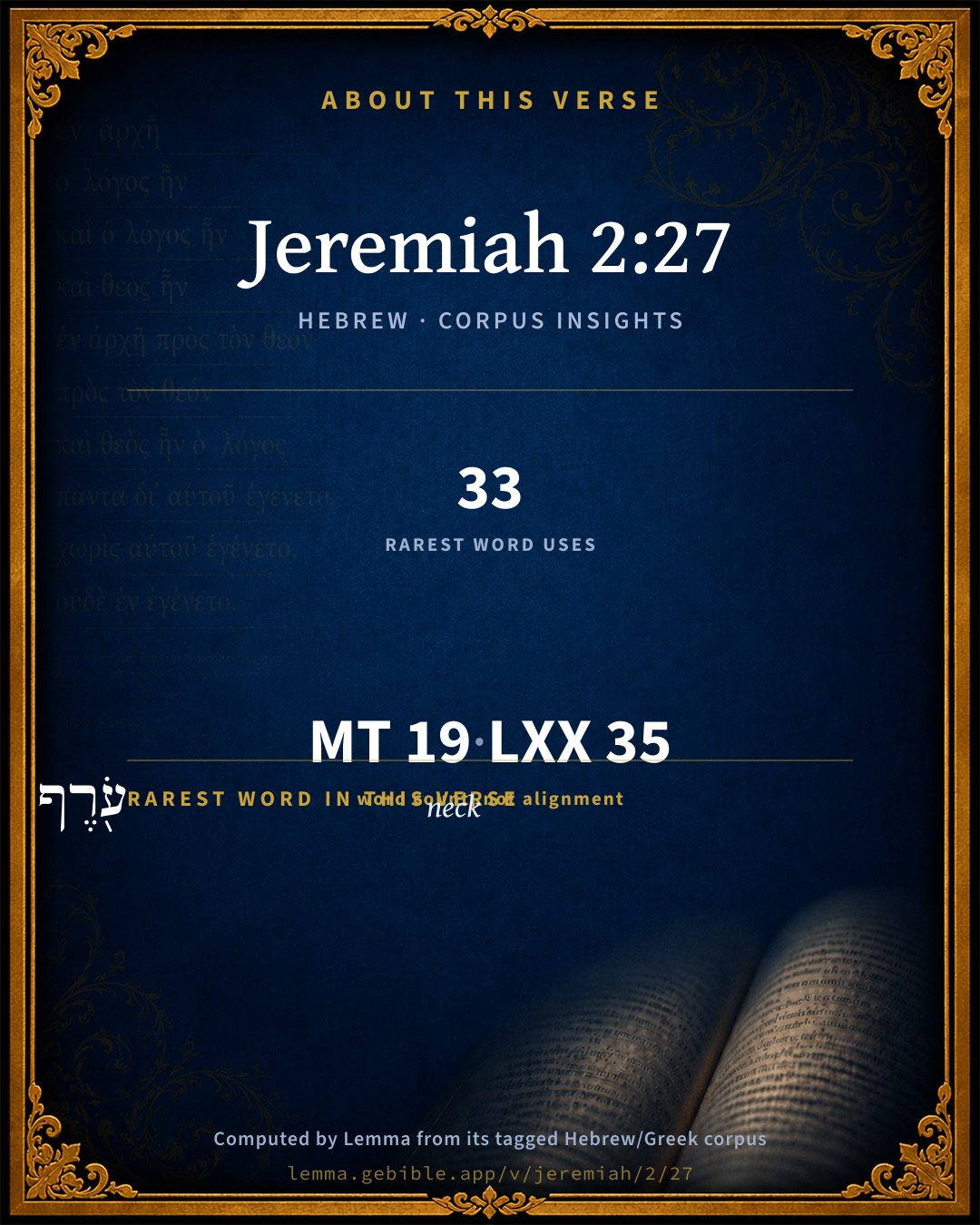
עֹ֖רֶף
ʻôreph
H6203
“neck”
Noun, Common, Masculine, Singular, Absolute
Part of Speech
Noun
Type
Common
Gender
Masculine
Number
Singular
State
Absolute
Full BDB Definition

Origin: from H6202

TWOT: 1700a

neck, back of the neck, back - back of the neck - of fleeing foe - of apostasy (figuratively) - stiff of neck, obstinate (figuratively)
  1. אֹמְרִ֨ים ʼâmar H559 “saying” Verb, Qal, Participle Active, Masculine, Plural, Absolute
  2. לָעֵ֜ץ ʻêts H6086 “to/for the · tree” Preposition, Determined + Noun, Common, Masculine, Singular, Absolute
  3. אָ֣בִי ʼâb H1 “father · my” Noun, Common, Masculine, Singular, Construct + Suffix, Personal, 1st Person, Common, Singular
  4. אַ֗תָּה ʼattâh H859 “you” Pronoun, Personal, 2nd Person, Masculine, Singular
  5. וְלָאֶ֨בֶן֙ ʼeben H68 “and · to/for the · stone” Conjunction + Preposition, Determined + Noun, Common, Feminine, Singular, Absolute
  6. אַ֣תְּ ʼattâh H859 “you” Pronoun, Personal, 2nd Person, Feminine, Singular
  7. ילדתני yâlad H3205 “to bear · me” Verb, Qal, Perfect, 2nd Person, Feminine, Singular + Suffix, Personal, 1st Person, Common, Singular
  8. יְלִדְתָּ֔נוּ yâlad H3205 “to bear · us” Verb, Qal, Perfect, 2nd Person, Feminine, Singular + Suffix, Personal, 1st Person, Common, Plural
  9. כִּֽי kîy H3588 “that” Conjunction
  10. פָנ֥וּ pânâh H6437 “to turn” Verb, Qal, Perfect, 3rd Person, Common, Plural
  11. אֵלַ֛י ʼêl H413 “to · me” Preposition + Suffix, Personal, 1st Person, Common, Singular
  12. וְלֹ֣א lôʼ H3808 “and · not” Conjunction + Particle, Negative
  13. פָנִ֑ים pânîym H6440 “face(s)” Noun, Common, Both, Plural, Absolute
  14. וּבְעֵ֤ת ʻêth H6256 “and · in/at · time of” Conjunction + Preposition + Noun, Common, Both, Singular, Construct
  15. רָֽעָתָם֙ raʻ H7451 “evil · their” Noun, Common, Feminine, Singular, Construct + Suffix, Personal, 3rd Person, Masculine, Plural
  16. יֹֽאמְר֔וּ ʼâmar H559 “to say” Verb, Qal, Imperfect, 3rd Person, Masculine, Plural
  17. ק֖וּמָה qûwm H6965 “rise” Verb, Qal, Imperative, 2nd Person, Masculine, Singular + Suffix, h
  18. וְהוֹשִׁיעֵֽנוּ yâshaʻ H3467 “and · save · us” Conjunction + Verb, Hiphil, Imperative, 2nd Person, Masculine, Singular + Suffix, Personal, 1st Person, Common, Plural

About this verse

These counts appear in no published source. They are computed here, from the morphology-tagged text and Lemma’s own curated glosses. What Lemma adds →

19
words
16
distinct lemmas
Prophets
section

Shared distinctive vocabulary

עֹ֖רֶף neck H6203 occurs in 32 verses of the Hebrew Bible. Also found in:

Grammatical profile

  • 7 verbs
  • 7 nouns
  • 2 pronouns
  • 1 preposition
  • 1 conjunction
  • 1 particle

Verb forms

  • אֹמְרִ֨ים Qal · Participle Active
  • ילדתני Qal · Perfect
  • יְלִדְתָּ֔נוּ Qal · Perfect
  • פָנ֥וּ Qal · Perfect
  • יֹֽאמְר֔וּ Qal · Imperfect
  • ק֖וּמָה Qal · Imperative
  • וְהוֹשִׁיעֵֽנוּ Hiphil · Imperative

Repetition

Words recur within this verse — often emphatic in Hebrew:

  • אֹמְרִ֨ים to say H559 ×2
  • ילדתני to bear H3205 ×2
  • אַ֗תָּה you H859 ×2

Hebrew & Septuagint length

In the original languages it is 19 Hebrew tokens and 35 Greek tokens — but the two are counted differently (Hebrew bundles its prefixes and suffixes into one token; the Greek is in lemma form), so that isn’t a like-for-like length.

Cross-references

16

Topical passages linked to Jeremiah 2:27 in the Treasury of Scripture Knowledge — connected by theme and wording, ordered by reader-vote popularity; previews shown in the World English Bible.

  • Isaiah 26:16 Yahweh, in trouble have they visited you; they poured out a prayer [when] your chastening was on them.
  • Hosea 7:14 They haven't cried to me with their heart, But they howl on their beds. They assemble themselves for grain and new wine. They turn away from me.
  • Judges 10:8–16 They vexed and oppressed the children of Israel that year: eighteen years [oppressed they] all the children of Israel that were beyond the Jordan in the land of the Amorites, which is in Gilead.
  • Psalms 78:34–37 When he killed them, then they inquired after him. They returned and sought God earnestly.
  • Psalms 115:4–8 Their idols are silver and gold, The work of men's hands.
  • Isaiah 44:9–20 Those who fashion an engraved image are all of them vanity; and the things that they delight in shall not profit; and their own witnesses don't see, nor know: that they may be disappointed.
  • Isaiah 46:6–8 Some pour out gold from the bag, and weigh silver in the balance. They hire a goldsmith, and he makes it a god. They fall down--yes, they worship.
  • Jeremiah 2:24 a wild donkey used to the wilderness, that snuffs up the wind in her desire; in her occasion who can turn her away? all those who seek her will not weary themselves; in her month they shall find her.
  • Jeremiah 10:8 But they are together brutish and foolish: the instruction of idols! it is but a stock.
  • Jeremiah 18:17 I will scatter them as with an east wind before the enemy; I will show them the back, and not the face, in the day of their calamity.
  • Jeremiah 22:23 Inhabitant of Lebanon, who makes your nest in the cedars, how greatly to be pitied shall you be when pangs come on you, the pain as of a woman in travail!
  • Jeremiah 32:33 They have turned to me the back, and not the face: and though I taught them, rising up early and teaching them, yet they have not listened to receive instruction.
  • Ezekiel 8:16 He brought me into the inner court of Yahweh's house; and see, at the door of the temple of Yahweh, between the porch and the altar, were about twenty-five men, with their backs toward the temple of Yahweh, and their faces toward the east; and they were worshipping the sun toward the east.
  • Ezekiel 23:35 Therefore thus says the Lord Yahweh: Because you have forgotten me, and cast me behind your back, therefore bear you also your lewdness and your prostitution.
  • Hosea 5:15 I will go and return to my place, until they acknowledge their offense, And seek my face. In their affliction they will seek me earnestly."
  • Habakkuk 2:18–19 "What value does the engraved image have, that its maker has engraved it; the molten image, even the teacher of lies, that he who fashions its form trusts in it, to make mute idols?

Cross-references courtesy of OpenBible.info (CC BY 4.0).

Hebrew and Greek witnesses Masoretic Hebrew ↔ Greek Septuagint

The same verse in the two great witnesses to the Old Testament, shown verse-for-verse.

These are two independent witnesses, not word-aligned to each other, and the Septuagint is shown in lemma (dictionary) form.

Hebrew Jeremiah 2:27 Masoretic · Westminster Leningrad Codex

אֹמְרִ֨ים לָעֵ֜ץ אָ֣בִי אַ֗תָּה וְלָאֶ֨בֶן֙ אַ֣תְּ ילדתני יְלִדְתָּ֔נוּ כִּֽי פָנ֥וּ אֵלַ֛י עֹ֖רֶף וְלֹ֣א פָנִ֑ים וּבְעֵ֤ת רָֽעָתָם֙ יֹֽאמְר֔וּ ק֖וּמָה וְהוֹשִׁיעֵֽנוּ

who tell a stock, You are my father; and to a stone, You have brought me forth: for they have turned their back to me, and not their face; but in the time of their trouble they will say, Arise, and save us.

World English Bible · Public Domain

Greek LXX Structure differs

In the Septuagint, Jeremiah is about an eighth shorter than the Hebrew and arranges its material differently — the Oracles Against the Nations (Hebrew chapters 46–51) appear in the middle of the Greek book, after 25:13. Because the chapter and verse boundaries do not line up, a verse-for-verse comparison with the Hebrew is not shown.

A verse-for-verse comparison isn’t shown here because the chapters and verses don’t line up. Switch to the LXX edition with the MT / LXX toggle above to read the Greek directly.

On this verse, John Gill's Exposition discusses the Septuagint’s reading. Read the note in Commentary ↓

Hebrew: Westminster Leningrad Codex (CC BY 4.0). Greek: Septuagint (public domain); English from a public-domain English Septuagint. How the Septuagint differs from the Hebrew →

Targum (Aramaic paraphrase)

1

The Targum is the ancient Jewish Aramaic paraphrase of the Hebrew Scriptures — an interpretive translation, not the Hebrew text itself. Onkelos (literal) and Pseudo-Jonathan (expansive) render the Torah, and Jonathan the Prophets. Coverage is partial: where no permissively-licensed English translation exists for a verse, only the Aramaic is shown. This is verse-level text, not a word-by-word alignment to the Hebrew.

  1. Targum Jonathan Prophets (Joshua–Malachi)
    אָמְרִין לְצֵלֶם אָעָא אֲבוּנָא אַתְּ וּלְמָה דְמִתְעֲבֵיד מִן אַבָנָא אָמְרִין לֵיהּ אַתְּ בְּרֵיתָנָא אֲרֵי אַחְזָרוּ בְּפוּלְחָנִי קְדַל וְלָא שַׁוִיאוּ דְחַלְתִּי לִקְבֵיל אַפֵיהוֹן וּכְעִידַן דְבִישְׁתָא אַתְיָא עֲלֵיהוֹן כָּפְרִין בְּטַעֲוַתְהוֹן וּמוֹדָן קָדָמַי וְאָמְרִין רַחֵים עֲלָנָא וּפְרוֹקָנָא:

    (no public-domain English translation for this verse)

    Targum Jonathan — Aramaic: “Mikraot Gedolot” (public domain). English: “Sefaria Community Translation” (CC0 1.0 (public-domain dedication)); “London "Chaldee Paraphrase," 1871” (public domain). Text via Sefaria.

Commentary

Notes on Jeremiah 2:27 from classic Christian and Jewish commentators (each source and its license shown beneath its notes). The classic Christian expositions comment on the surrounding passage and are grouped to its opening verse, so a note may address several verses; the Jewish commentaries on the Tanakh (Rashi and others) are per-verse, so they appear only where the commentator wrote on this verse.

Lemma curates 59 commentaries, every one of them public domain or Creative Commons licensed, each selected and text-cleaned for this edition rather than reprinted as found. About our sources →

Trapp's Complete Commentary

John Trapp

Jer 2:27 Saying to a stock, Thou [art] my father; and to a stone, Thou hast brought me forth: for they have turned [their] back unto me, and not [their] face: but in the time of their trouble they will say, Arise, and save us.

Ver. 27. Saying to a stock, Thou art my father,] i.e., My God. {Isa 44:17} We are not the children of fornication, said those boasting Jews; {Joh 8:41} that is, we are not idolaters, who say, as here, to a stock, Thou art my father. The Samaritans they called bastards.

But in the time of their trouble they will say, Arise, and save us.] Thus in their month they will be found. {Jer 2:24} When they had run themselves barefoot in following their lovers, {Jer 2:25} who answered their expectation with nothing but fear, and sent them away with shame instead of glory, then God was thought upon and sought unto. Let us make God our choice, and not our necessity, and labour to maintain such constant cause with him, that he may know our souls in adversity, and not turn us off, as he doth these, with,

John Trapp, A Commentary or Exposition upon All the Books of the Old and New Testament (1647–1656) — public domain. Text from a community e-Sword module.

Tyndale Open Study Notes

Tyndale Open Resources

2:27 These idols of a father and mother probably represented Baal and Asherah. • in times of trouble they cry out: See, e.g., Judg 10:10; Isa 26:16; Hos 5:15.

Tyndale Open Study Notes — © Tyndale Open Resources, licensed CC BY-SA 4.0. Text via the HelloAO Bible API.

Geneva Bible (1599)

Geneva Bible translators

Meaning, that idolaters spoil God of his honor: and whereas he hath taught to call him the father of all flesh, they attribute this title to their idols.

Geneva Bible (1599) marginal notes — public domain. Text via Bolls.life.

Jamieson, Fausset & Brown

Robert Jamieson, A. R. Fausset & David Brown

Thou art my father--(Contrast Jer 3:4; Isa 64:8).

in . . . trouble they will say--namely, to God (Psa 78:34; Isa 26:16). Trouble often brings men to their senses (Luk 15:16-18).

Jamieson, Fausset & Brown — Commentary Critical and Explanatory on the Whole Bible (1871) — public domain (CC PDM 1.0). Text via the HelloAO Bible API.

Adam Clarke's Commentary

Verse 27. Thou art my father] By thee we have been produced, and by thee we are sustained. This was the property of the true God; for he is the Author and Supporter of being. How deeply fallen and brutishly ignorant must they be when they could attribute this to the stock of a tree!

Adam Clarke's Commentary on the Bible (1810–1826) — public domain. Text from a community e-Sword/MySword module.

John Calvin's Commentaries

The Prophet here confirms what he had before said of the perverse wickedness of the people. He shews that he had not said without reason, that their sins were extremely gross, and could not be excused by any evasions: for they say, he adds, to the wood, Thou art my father, and to the stone, Thou hast begotten, me By these words the Prophet shews, that idolatry was so rampant among the people, that they openly ascribed to their statues, made of wood or stone, the honor due to the only true God.

But the Prophet points out here what is especially to be detested in idolatry, and that is, the transferring of the honor, due to God, to statues, not only as to the external act by bending the knee before them, but by seeking salvation from them.

And this is what we ought particularly to notice: for the Papists at this day, though they prostrate themselves before their pictures and statues, do not yet acknowledge themselves guilty of idolatry, when such a charge is brought against them. They say that they worship the statues, not with the honor due to God, but with such honor as a servant renders to his master. They think that they thus exculpate themselves. But were we to grant what they allege, they yet cannot deny but that they address prayers and supplications to statues. As then they ask the very statues to save them, whatever sophistry they may adopt, it is altogether nugatory: for the prophets condemn not merely the outward gesture, the bowing down, and other ceremonious acts, as they are called, when they condemned idolaters. What then? They condemned them, because they said to statues, Thou art my Father; that is, because they ascribed the power, which belongs only to God, to statues made of wood or stone. It is indeed certain, that the Jews never sunk into so great a depth of sottishness as expressly to profess that gods of wood and stone were equal to the true God, and they never said any such thing. Yet the Prophet did not calumniate them, in ascribing what is here said to them: but as it is clearly evident from other places, the Prophet regarded their thoughts rather than their words: for the Jews professed the same thing as the Papists of the present day, when they prostrated themselves before their statues; they said that they worshipped the only true God and sought salvation from him; and yet they thought that the power of God was inherent in the statues themselves: hence they said, Thou art my father, Thou hast begotten me The case is the same with the Papists of the present day. When any one prostrates himself before the statue of Catherine or of Christopher, he says, “Our Father.” When he justifies himself in doing this, he says that it is done in honor to the one true God: and yet thou runnest blindly, now to one statue, and then to another, and muttcrest, “Our Father.” There is not the least doubt but that the superstition which now prevails under the Papacy, is even more gross than that which prevailed among the Jews. But to say nothing of the Papists, because they mutter, “Our Father,” before their statues, there is no doubt but that when they present their prayers to statues, they consider God’s power to be in them.

We must now, then, bear in mind, that the Jews were not only condemned, because they burnt incense and offered sacrifices to idols, but because they transferred the glory of God to their statues, when they asked salvation from them. And as this was not done in express words, the Prophet here brings to light their impious thoughts; for they did not raise up their minds and thoughts to God, but turned them to their statues.

It afterwards follows, They have turned to me the neck and not the face In these words, God again confirms what he had before said, that the apostasy or defection of the people was more manifest than what could be disguised by any colorings. He then adds, Yet (the ו is to be taken here adversatively) in the time of their affliction, they will say, Arise, and save us God here complains that the Jews most strangely abused his kindness; for they came to him when any grievous calamity constrained them. “What have I to do with you?” he says, “Ye are wholly devoted to your idols, ye call them your fathers, and ascribe to them the glory of your salvation, when things go on peaceably with you; but when your idols in time of distress give you no aid, then ye return to me and say, Arise, and save us; but, since idols are your fathers, and ye expect salvation from them, I shall have nothing to do with you; be contented with your idols, and trouble me no more, for I have been forsaken by you.”

John Calvin's Commentaries (1540-1563) — public domain. Text from the Calvin Translation Society English edition (1840s-50s) via the Christian Classics Ethereal Library (ccel.org). Calvin's coverage is partial (roughly two-thirds of the Bible); uncommented books and verses are honest gaps, never fabricated. The 19th-century editor's footnotes and remarks are omitted so the notes are faithfully Calvin's own voice.

Ellicott's Commentary for English Readers

(27) Saying to a stock . . .—The “stock” and the “stone” represent respectively the images of wood and marble. In Hebrew the latter word is feminine, and thus determines the parts assigned to them in the figurative parentage.

To a stock, Thou art my father.—Literally, to a tree. The words seem as if they were an actual quotation from the hymns of the idolatrous ritual.

In the time of their trouble.—So in Hosea (Hosea 2, 3) it is the discipline of suffering that leads the adulterous wife to repentance. In times of trouble and dismay those who had before turned their backs on Jehovah shall seek Him with outstretched hands, and the cry for help. The prophet half implies that then it maybe too late till chastisement has done its perfect work.

A Bible Commentary for English Readers, edited by Charles John Ellicott (1878–1897) — public domain. Text from a community e-Sword module.

The Cambridge Bible for Schools and Colleges

gen. ed. J. J. S. Perowne

27. The “stock” and “stone” symbolize the god worshipped, and doubtless include the wooden poles (Asherahs) and stone obelisks or pillars by which they were represented. The words addressed to them by the worshippers do not imply that the latter considered the spirits of their ancestors to be there embodied. Such worship was not a Hebrew practice. It was only as patrons or guardians of house or land that such titles as father or mother were given them.

which say] In this consists their disgrace. They attribute to their idols the honour due to the Creator alone.

in the time of their trouble they will say, Arise, and save us] Their idols are but fair-weather friends. When a crisis comes, they will recognise this, and appeal for help to Him Whom they have rejected.

The Cambridge Bible for Schools and Colleges (gen. ed. J. J. S. Perowne; Cambridge University Press, 1878–1918) — public domain. Text from a community e-Sword module.

John Gill's Exposition

But where are thy gods that thou hast made thee?.... This is, or would be, the Lord's answer to them, what is become of your gods? why do not you apply to them for help in time of trouble? the gods that you have chosen for yourselves and worshipped; the gods, not that made you, but whom you yourselves have made:

let them arise, if they can save thee in the time of thy trouble; call upon them to arise, those statues of wood and stone, those lifeless and senseless images; let them rise off their seats, and move out of their places, if they can, and see whether they can save in a time of trouble and distress; for there is enough of them, if numbers will do:

for according to the number of thy cities are thy gods, O Judah; in imitation of the Heathens, who had not only in every country, but in every city and town, a different god, the patron and tutelar deity of the place; see Kg2 17:29. The Septuagint and Arabic versions "add, according to the number of the ways, or streets, of Jerusalem", they sacrificed to Baal; see Jer 11:13.

John Gill's Exposition of the Whole Bible (1746–1763) — public domain (CC PDM 1.0). Text via the HelloAO Bible API.

Albert Barnes' Notes on the Bible

“Stone” being feminine in Hebrew is here represented as the mother.

Arise, and save us - Whether it be idolatry or infidelity, it satisfies only in tranquil and prosperous times. No sooner does trouble come, than the deep conviction of the existence of a God, which is the witness for Him in our heart, resumes its authority, and man prays.

Albert Barnes' Notes on the Bible (1834–1885) — public domain. Text from a community e-Sword/MySword module.

Matthew Poole's English Annotations

A stone; idol; a metonymy of the matter, because idols are made of these materials, Dan 5:4.

Brought me forth; or, begotten me; so is the word used, Gen 4:18. This notes the sottish stupidity of this people, to take a lifeless stock or stone to be their maker, and to give the honour of God unto them, Isa 44:17. They that make them are like unto them, as senseless as they, Psa 115:8.

They have turned their back unto me, and not their face; they turn their faces wholly towards their idols: it notes the openness of their apostacy, Jer 7:24.

Arise, and save us; the usual language of God’s children in distress, Psa 3:7, and often elsewhere; then they found the vanity of their idols, and their own folly in relying on them, that cannot help or save, and rejecting me, Jer 2:31, then they will come to me, Jdg 10:10; Hos 5:15; the same thing with finding her in her month, Jer 2:24; herein abusing God’s gentleness, making him their necessity, not their choice.

Matthew Poole's English Annotations on the Holy Bible (1683–1685) — public domain. Text from a community e-Sword/MySword module.

Whedon's Commentary on the Bible

Daniel D. Whedon

27. In the time of… trouble — As with the prodigal when he “began to be in want,” or the sailors with Jonah in the storm. A little pressure of calamity will often develop a vivid sense of God, and most fervent appeals for mercy and help.

Daniel D. Whedon (gen. ed.), Commentary on the Old and New Testaments (1874–1909) — public domain. Text from a community e-Sword module.

The Pulpit Commentary

And to a stone, etc. Stone ("ebhen) is feminine in Hebrew, and therefore addressed as the mother.

The Pulpit Commentary (1880–1919), ed. H.D.M. Spence-Jones & Joseph S. Exell — public domain. Text from a community e-Sword module.

John Wesley's Explanatory Notes

Brought me forth - Or begotten me; so is the word used, Gen. iv, 18. This denotes the sottish stupidity of this people, to take a lifeless stock or stone to be their maker, and to give the honour of God unto them, Isaiah xliv, 17. Turned - They turn their faces towards their idols.

John Wesley, Explanatory Notes Upon the Whole Bible (1754–1765) — public domain. Text via the GEBible commentary corpus.

Rashi

Rabbi Shlomo Yitzchaki (Rashi)

and at the time of their misfortune they say i.e., they say to Me, “Arise and save us.” Jonathan, too, translates in this manner: And at the time that misfortune befalls them, they deny their idols and confess before Me, and say. “Have mercy upon us and save us.”

Rashi on the Tanakh — English translations: “The Judaica Press complete Tanach with Rashi, translated by A. J. Rosenberg” (CC BY 4.0); “Pentateuch with Rashi's commentary by M. Rosenbaum and A.M. Silbermann, 1929-1934” (public domain); “The Metsudah Tanach series, Lakewood, N.J” (CC BY 4.0); and “The Book of Joshua, Metsudah Publications, 1997” (CC BY 4.0). Text via Sefaria.

Lesson kit

Teaching starters — assembled from the data on this page, not authored interpretation. Every prompt links to the verse data it draws on. Edit before teaching.

Jeremiah, in the Prophets, opens this verse with 19 words (16 distinct Hebrew lemmas). Its most distinctive word is ʻôreph (“neck”). A historical commentator’s framing appears above. Read the whole chapter for the surrounding context.

Discussion questions

  1. What does “neck” (ʻôreph) contribute to the verse as a whole?
  2. Genesis 49:8 shares the word «neck» with this verse. How do the two illuminate each other?
  3. “to say” occurs 2× in this one verse. What is the effect of the repetition?
  4. The translations on this page render this verse differently — a whole-verse word diff, not a word-by-word alignment. What might account for the different wordings?
  5. The verb «אֹמְרִ֨ים» is Qal Participle Active. How does its form color the action?
  6. Reading how Trapp's Complete Commentary and Tyndale Open Study Notes read this verse, where do the two commentators agree and where do they part?

Things to notice

Reading settings

Reading text

Shown beneath each verse's original-language words.

Old Testament
Old Testament edition

Read the OT as the Masoretic Hebrew (MT) or the Greek Septuagint (LXX).

English shown for the Greek Septuagint (in the Hebrew ↔ Greek comparison).

Comparing translations? Open the Compare panel on any verse page to stack up to four side by side.