2 Kings 8:22

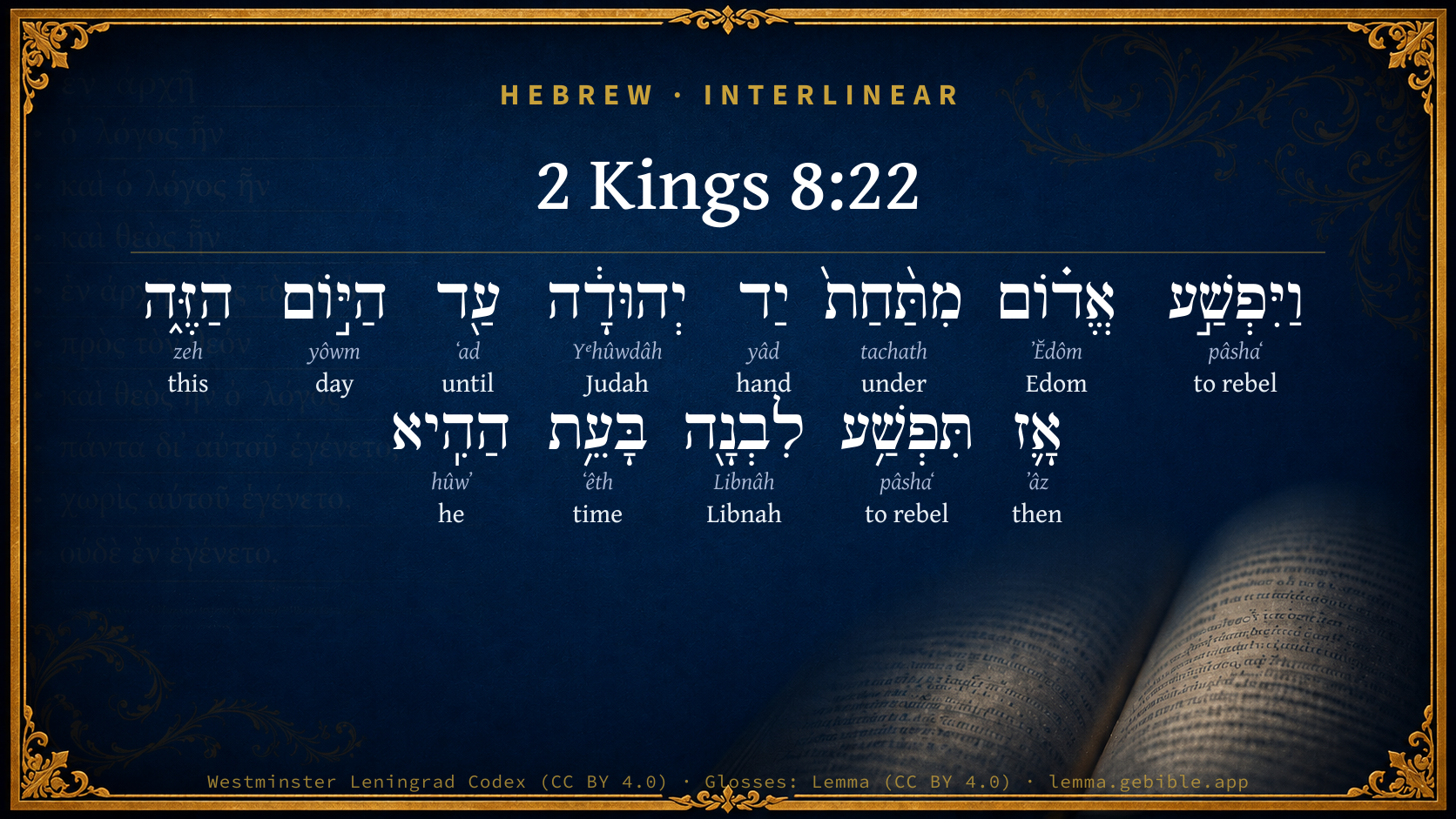
Hebrew (Westminster Leningrad Codex) 2 Kings 8:22 appears in the Hebrew Old Testament. The text above is from the Westminster Leningrad Codex. Each word links to its Strong’s number, a concise gloss, and parsing drawn from the Open Scriptures Hebrew Bible morphology. Click any word for its full Brown-Driver-Briggs (BDB) entry.
Download image
Cite this verse

2 Kings 8:22 (World English Bible). Public Domain. Lemma interlinear Bible study tool, https://lemma.gebible.app/v/2-kings/8/22.

Show BibTeX & RIS
BibTeX
RIS
English Translation
So Edom revolted from under the hand of Judah to this day. Then did Libnah revolt at the same time.
World English Bible · Public Domain
Download a study sheet

One document with this verse’s original text, its word-by-word gloss line, the meaning frame, cross-references with their text, attributed commentary, and full source and license credits — printable, and it pastes into notes with its structure intact.

This verse Autodidact and up

Study sheet (.html) Plain text (.txt)

A passage Seminary Student

Up to 50 verses in one chapter. A passage sheet keeps up to 6 commentary sources and 12 cross-references per verse, in the order this page ranks them, and says so on the sheet whenever that leaves anything out. Ask for a single verse and you get the Autodidact verse sheet above.

Everything on this page stays free to read, with no account — the sheet is a download of what is already on screen, not access to it.

Want to remove ads? Support Godless Engineer
Compare translations 3

The same verse in 3 English versions, stacked beneath the original-language interlinear above. Click any original word for its lexicon entry.

Each is an independent rendering of the whole verse — the interlinear is not word-aligned to these translations.

Highlighted words mark where these versions differ — a whole-verse word diff, not a word-by-word alignment.

  • World English Bible Public Domain
    So Edom revolted from under the hand of Judah to this day. Then did Libnah revolt at the same time.
  • King James Version Public Domain
    Yet Edom revolted from under the hand of Judah unto this day. Then Libnah revolted at the same time.
  • unfoldingWord Literal Text CC BY-SA 4.0
    And Edom rebelled from under the hand of Judah, to this day. Then Libnah rebelled at that time.

unfoldingWord Literal Text — © unfoldingWord, licensed CC BY-SA 4.0. Word-aligned USFM3 via Door43 (git.door43.org/unfoldingWord/en_ult).

Versions to compare (up to 4)

3 of 4 selected

Show all 18 translations

Every available English version of this verse, each an independent rendering of the whole verse.

  • World English Bible Public Domain
    So Edom revolted from under the hand of Judah to this day. Then did Libnah revolt at the same time.
  • Berean Standard Bible Public Domain
    So to this day Edom has been in rebellion against the hand of Judah. Likewise, Libnah rebelled at the same time.
  • Majority Standard Bible Public Domain
    So to this day Edom has been in rebellion against the hand of Judah. Likewise, Libnah rebelled at the same time.
  • King James Version Public Domain
    Yet Edom revolted from under the hand of Judah unto this day. Then Libnah revolted at the same time.
  • American Standard Version (1901) Public Domain
    So Edom revolted from under the hand of Judah unto this day. Then did Libnah revolt at the same time.
  • Revised Version (1885) Public Domain
    So Edom revolted from under the hand of Judah, unto this day. Then did Libnah revolt at the same time.
  • Geneva Bible (1599) Public Domain
    So Edom rebelled from vnder the hand of Iudah vnto this day. then Libnah rebelled at that same time.
  • Douay-Rheims (1899) Public Domain
    So Edom revolted from being under Juda, unto this day. Then Lobna also revolted at the same time.
  • Young's Literal Translation Public Domain
    and Edom revolteth from under the hand of Judah till this day; then doth Libnah revolt at that time.
  • Literal Standard Version CC BY-SA 4.0
    and Edom revolts from under the hand of Judah until this day; then Libnah revolts at that time.
  • Unlocked Literal Bible CC BY-SA 4.0
    So Edom has been in rebellion against the rule of Judah to this present day. Libnah also revolted at the same time.
  • unfoldingWord Literal Text CC BY-SA 4.0
    And Edom rebelled from under the hand of Judah, to this day. Then Libnah rebelled at that time.
  • Darby Bible Public Domain
    But the Edomites revolted from under the hand of Judah unto this day. Then Libnah revolted at the same time.
  • World Messianic Bible Public Domain
    So Edom revolted from under the hand of Judah to this day. Then Libnah revolted at the same time.
  • Webster's Bible Public Domain
    Yet Edom revolted from under the hand of Judah to this day. Then Libnah revolted at the same time.
  • Free Bible Version CC BY-SA 4.0
    As a result Edom has been in rebellion against Judah's rule to this day. At the same time Libnah also decided to rebel.
  • Bible in Basic English Public Domain
    So Edom made themselves free from the rule of Judah to this day. And at the same time, Libnah made itself free.
  • JPS Tanakh (1917) Public Domain
    Yet Edom revolted from under the hand of Judah, unto this day. Then did Libnah revolt at the same time.

Literal Standard Version (2020), Covenant Press — licensed CC BY-SA 4.0. Text via the HelloAO Bible API (eBible.org). Unlocked Literal Bible (unfoldingWord) — licensed CC BY-SA 4.0. Text via the HelloAO Bible API (eBible.org). unfoldingWord Literal Text — © unfoldingWord, licensed CC BY-SA 4.0. Word-aligned USFM3 via Door43 (git.door43.org/unfoldingWord/en_ult). Free Bible Version, Dr. Jonathan Gallagher — licensed CC BY-SA 4.0. Text via the HelloAO Bible API (eBible.org).

Word by word

More ways to search: Search by grammar → Find every occurrence → Compare this word →

Practice this passage: Drill this verse → Learn its vocabulary →

לִבְנָ֖ה
Libnâh
H3841
“Libnah”
Noun, Proper
Part of Speech
Noun
Type
Proper
Full BDB Definition

Origin: the same as H3839

TWOT: None

Libnah = "pavement" - a royal city of the Canaanites in the southwest captured by Joshua; allocated to Judah and made a Levitical city; site unknown - a station between Sinai and Kadesh of Israel during their wilderness wanderings
  1. וַיִּפְשַׁ֣ע pâshaʻ H6586 “and · to rebel” Conjunction + Verb, Qal, Sequential Imperfect, 3rd Person, Masculine, Singular
  2. אֱד֗וֹם ʼĔdôm H123 “Edom” Noun, Proper
  3. מִתַּ֨חַת֙ tachath H8478 “from · under” Preposition + Preposition
  4. יַד yâd H3027 “hand of” Noun, Common, Both, Singular, Construct
  5. יְהוּדָ֔ה Yᵉhûwdâh H3063 “Judah” Noun, Proper
  6. עַ֖ד ʻad H5704 “until” Preposition
  7. הַיּ֣וֹם yôwm H3117 “the · day” Particle, Definite Article + Noun, Common, Masculine, Singular, Absolute
  8. הַזֶּ֑ה zeh H2088 “the · this” Particle, Definite Article + Pronoun, Demonstrative, Masculine, Singular
  9. אָ֛ז ʼâz H227 “then” Adverb
  10. תִּפְשַׁ֥ע pâshaʻ H6586 “to rebel” Verb, Qal, Imperfect, 3rd Person, Feminine, Singular
  11. בָּעֵ֥ת ʻêth H6256 “in/at the · time” Preposition, Determined + Noun, Common, Both, Singular, Absolute
  12. הַהִֽיא hûwʼ H1931 “the · he” Particle, Definite Article + Pronoun, Personal, 3rd Person, Feminine, Singular

About this verse

These counts appear in no published source. They are computed here, from the morphology-tagged text and Lemma’s own curated glosses. What Lemma adds →

13
words
12
distinct lemmas
Historical
section

Notable vocabulary

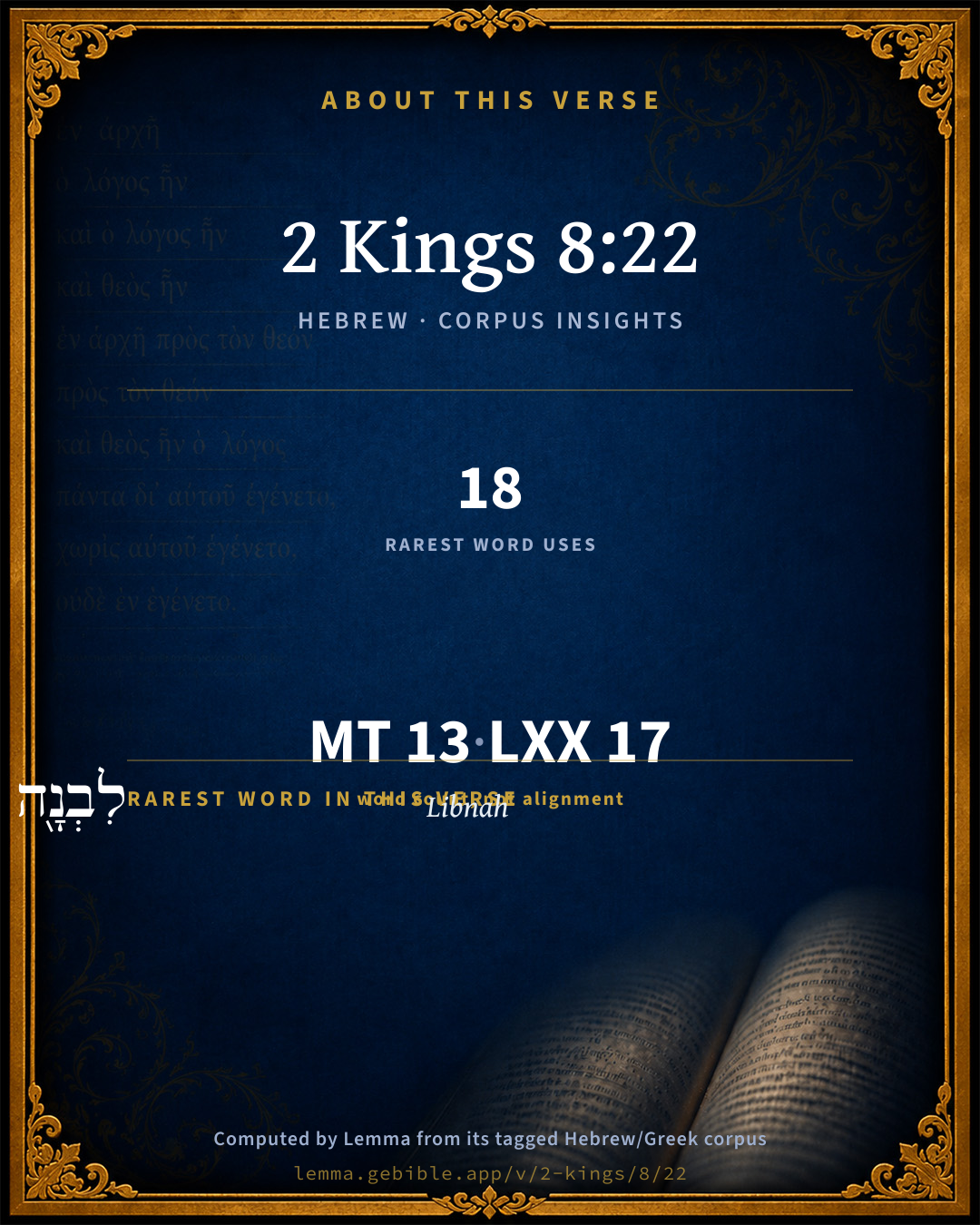
The rarest word here is לִבְנָ֖ה Libnah H3841 — appearing just 18 times in the whole Hebrew Bible.

Shared distinctive vocabulary

לִבְנָ֖ה Libnah H3841 occurs in 17 verses of the Hebrew Bible. Also found in:

Grammatical profile

  • 2 verbs
  • 6 nouns
  • 2 pronouns
  • 2 prepositions
  • 1 adverb

Verb forms

  • וַיִּפְשַׁ֣ע Qal · Sequential Imperfect
  • תִּפְשַׁ֥ע Qal · Imperfect

Repetition

A word recurs within this verse — often emphatic in Hebrew:

  • וַיִּפְשַׁ֣ע to rebel H6586 ×2

Hebrew & Septuagint length

In English translation the verse runs 20 words from the Hebrew and 18 from the Septuagint (LXX English) — closely comparable.

A rough comparison of the two English renderings, which tokenize alike — not a word-level alignment.

Word counts can differ between the Hebrew and the Greek without any difference in meaning — e.g. the Hebrew direct-object marker אֵת has no separate Greek word, and Greek often adds the article ὁ.

In the original languages it is 13 Hebrew tokens and 17 Greek tokens — but the two are counted differently (Hebrew bundles its prefixes and suffixes into one token; the Greek is in lemma form), so that isn’t a like-for-like length.

Cross-references

4

Topical passages linked to 2 Kings 8:22 in the Treasury of Scripture Knowledge — connected by theme and wording, ordered by reader-vote popularity; previews shown in the World English Bible.

  • Joshua 21:13 To the children of Aaron the priest they gave Hebron with its suburbs, the city of refuge for the manslayer, and Libnah with its suburbs,
  • 2 Kings 19:8 So Rabshakeh returned, and found the king of Assyria warring against Libnah; for he had heard that he was departed from Lachish.
  • Genesis 27:40 By your sword will you live, and you will serve your brother. It will happen, when you will break loose, That you shall shake his yoke from off your neck."
  • 2 Chronicles 21:10 So Edom revolted from under the hand of Judah to this day: then did Libnah revolt at the same time from under his hand, because he had forsaken Yahweh, the God of his fathers.

Cross-references courtesy of OpenBible.info (CC BY 4.0).

Hebrew and Greek witnesses Masoretic Hebrew ↔ Greek Septuagint

The same verse in the two great witnesses to the Old Testament, shown verse-for-verse.

These are two independent witnesses, not word-aligned to each other, and the Septuagint is shown in lemma (dictionary) form.

Hebrew 2 Kings 8:22 Masoretic · Westminster Leningrad Codex

וַיִּפְשַׁ֣ע אֱד֗וֹם מִתַּ֨חַת֙ יַד יְהוּדָ֔ה עַ֖ד הַיּ֣וֹם הַזֶּ֑ה אָ֛ז תִּפְשַׁ֥ע לִבְנָ֖ה בָּעֵ֥ת הַהִֽיא

So Edom revolted from under the hand of Judah to this day. Then did Libnah revolt at the same time.

World English Bible · Public Domain

Greek LXX 2 Kings 8:22 Septuagint · lemma form

καί ἀθετέω εδωμ ὑποκάτωθεν χείρ ιουδα ἕως ὁ ἡμέρα οὗτος τότε ἀθετέω λοβενα ἐν ὁ καιρός ἐκεῖνος

Yet Edom revolted from under the hand of Juda till this day. Then Lobna revolted at that time.

LXX2012 (modern English Septuagint) · Public Domain

Hebrew: Westminster Leningrad Codex (CC BY 4.0). Greek: Septuagint (public domain); English from LXX2012 (modern English Septuagint) (Public Domain). How the Septuagint differs from the Hebrew →

Targum (Aramaic paraphrase)

1

The Targum is the ancient Jewish Aramaic paraphrase of the Hebrew Scriptures — an interpretive translation, not the Hebrew text itself. Onkelos (literal) and Pseudo-Jonathan (expansive) render the Torah, and Jonathan the Prophets. Coverage is partial: where no permissively-licensed English translation exists for a verse, only the Aramaic is shown. This is verse-level text, not a word-by-word alignment to the Hebrew.

  1. Targum Jonathan Prophets (Joshua–Malachi)
    וּמְרָדוּ אֱדוֹמָאֵי מִתְּחוֹת יַד אֱנַשׁ יְהוּדָה עַד יוֹמָא הָדֵין בְּכֵן מְרַדוּ יַתְבֵי לִבְנָה בְּעִדָנָא הַהִיא:

    (no public-domain English translation for this verse)

    Targum Jonathan — Aramaic: “Mikraot Gedolot” (public domain). English: “Sefaria Community Translation” (CC0 1.0 (public-domain dedication)); “London "Chaldee Paraphrase," 1871” (public domain). Text via Sefaria.

Commentary

Notes on 2 Kings 8:22 from classic Christian and Jewish commentators (each source and its license shown beneath its notes). The classic Christian expositions comment on the surrounding passage and are grouped to its opening verse, so a note may address several verses; the Jewish commentaries on the Tanakh (Rashi and others) are per-verse, so they appear only where the commentator wrote on this verse.

Lemma curates 59 commentaries, every one of them public domain or Creative Commons licensed, each selected and text-cleaned for this edition rather than reprinted as found. About our sources →

Trapp's Complete Commentary

John Trapp

2Ki 8:22 Yet Edom revolted from under the hand of Judah unto this day. Then Libnah revolted at the same time.

Ver. 22. Then Libna revolted at the same time.] So that Joram taken off thereby, could not prosecute his victory over the Edmonites. Libna was a city of Judah, and given to the priests. {Jos 21:13 1Ch 6:57} These not enduring the late innovations in religion, and other abominations committed by Joram, cast off their obedience, "because he had forsaken the Lord God of his fathers." {2Ch 21:10}

John Trapp, A Commentary or Exposition upon All the Books of the Old and New Testament (1647–1656) — public domain. Text from a community e-Sword module.

Tyndale Open Study Notes

Tyndale Open Resources

8:22 The town of Libnah was located in southwestern Judah, not far from the Philistine border. The Philistines and the Arabians also launched an attack against Jerusalem during Jehoram’s reign; all of Jehoram’s sons except Ahaziah were killed (2 Chr 21:16-17).

Tyndale Open Study Notes — © Tyndale Open Resources, licensed CC BY-SA 4.0. Text via the HelloAO Bible API.

Geneva Bible (1599)

Geneva Bible translators

This was a city in Judah given to the Levites, Josh. 21:13, and after turned from King Jehoram, because of his idolatry.

Geneva Bible (1599) marginal notes — public domain. Text via Bolls.life.

Ellicott's Commentary for English Readers

(22) Yet.—Rather, and (i.e., so).

Unto this day.—Down to the time of composition of the original account from which this epitome is extracted. This notice is borne out by the Assyrian monuments. Esarhaddon and Assurbanipal mention Qa’us-gabrî king of Udumu (Edom), along with Manasseh of Judah, among their tributaries. Esarhaddon also states that his father Sennacherib had reduced “Adumû, a fortified city of Arabia.”

Then Libnah revolted at the same time.—The point of the statement is that the success of Edom encouraged Libnah to throw off the Judæan supremacy. For the locality see Jos_10:29 seq., Jos_15:42; Jos_21:13. Keil thinks the revolt of Libnah coincided with (it was probably supported by) the Philistine invasion recorded in 2Ch_21:16, and continued until Uzziah reduced the Philistines (2Ch_26:6 seq.). From the time of Hezekiah, Libnah again belonged to Judah (2Ki_19:8; 2Ki_23:31; 2Ki_24:18).

A Bible Commentary for English Readers, edited by Charles John Ellicott (1878–1897) — public domain. Text from a community e-Sword module.

The Cambridge Bible for Schools and Colleges

gen. ed. J. J. S. Perowne

22. Yet [R.V. so] Edom revolted] The conjunction is changed to conform to the rendering in 2 Chronicles 21. As the army of Joram was defeated, the Edomites secured their independence, and that continued till the date of the record from which the compiler of the Kings drew his information. So he copies faithfully ‘unto this day’.

Then Libnah revolted] R.V. did Libnah revolt. The change is in conformity with Chronicles, because of the similarity of the Hebrew. Libnah was situate in the lowland between the mountains of Judah and the Mediterranean coast. It was a strong city with a king when the Israelites took it under Joshua (Jos_10:29-39). It is mentioned afterwards (2Ki_19:8) as besieged by Sennacherib. The narrative of the Chronicler adds as the reason of the revolt ‘because he [Joram] had forsaken the Lord the God of his fathers’. The revolt of Libnah does not seem to be connected in any way with that of Edom. The time was opportune and both Edomites and Libnites availed themselves of it.

The Cambridge Bible for Schools and Colleges (gen. ed. J. J. S. Perowne; Cambridge University Press, 1878–1918) — public domain. Text from a community e-Sword module.

John Gill's Exposition

Yet Edom revolted from under the hand of Judah unto this day,.... Joram not pursuing the enemy, and taking the advantage of the victory, but returning to his own land, the reason of which follows:

then Libnah revolted at the same time; a considerable city in his own kingdom, a Levitical one; this revolt was occasioned, perhaps, by his idolatrous practices, and which he compelled his subjects to; of this city, see Jos 10:29.

John Gill's Exposition of the Whole Bible (1746–1763) — public domain (CC PDM 1.0). Text via the HelloAO Bible API.

Albert Barnes' Notes on the Bible

Libnah revolted - Libnah being toward the southwest of Palestine Jos 15:42, its revolt cannot well have had any direct connection with that of Edom. It had been the capital of a small Canaanite state under a separate king before its conquest by Joshua Jos 10:30; Jos 12:15, and may perhaps always have retained a considerable Canaanite population. Or its loss may have been connected with the attacks made by the Philistines on Jehoram’s territories 2Ch 21:16-17.

Albert Barnes' Notes on the Bible (1834–1885) — public domain. Text from a community e-Sword/MySword module.

Haydock's Catholic Bible Commentary

Day, when Jeremias, the author lived. (Tostat) --- Lobna, a frontier town bordering on Idumea. It was a strong place assigned to priests; but strangers had probably again taken possession of it, and caused it now to revolt. The kings of Juda had retaken it when Sennacherib laid siege to the place. See chap. xix. 8., and Josue x. 30., and xxi. 13.

George Leo Haydock (1774–1849), Haydock's Catholic Family Bible and Commentary, 1859 edition — public domain. Excludes Psalms (Douay-Rheims chapter numbering differs from Protestant) and Deuterocanonical books (Catholic canon only).

Matthew Poole's English Annotations

Edom revolted; for though Joram had given them a defeat, yet it may seem to have been no great slaughter, but only a putting them to flight; and therefore they might easily rally again. And Joram could not pursue the victory, because he was recalled by the revolt of his own subjects, which had taken the occasion of his absence, and probably feared that others would follow their example, if they had the like occasion.

Libnah; a considerable city in Judah, belonging to the priests, Jos 15:42; 21:13. Why Libnah revolted, see 2Ch 21:10,11. It is probable they returned to their obedience, because those words, unto this day, which are added to the former clause, are omitted here.

Matthew Poole's English Annotations on the Holy Bible (1683–1685) — public domain. Text from a community e-Sword/MySword module.

Whedon's Commentary on the Bible

Daniel D. Whedon

22. Edom revolted… unto this day — Some sixty years later the Edomites were again subdued by Amaziah king of Judah, (chap. 2Ki_14:7,) so that this record would seem to have been made before the reign of Amaziah. Or it may be, that the subjection of Edom to Amaziah and to his successor Azariah (2Ki_14:21-22) was regarded as so temporary and partial as not to amount to a real crushing out of the revolt under Jehoram, for soon after, in the days of Ahaz, the Edomites made inroads upon Judah, (2Ch_28:17,) and when the Chaldeans overthrew the Jewish state, and carried the Jews into captivity, the Edomites assisted in the conquest. Oba_1:11.

Libnah — A city in the southwestern part of the Holy Land, whose inhabitants Joshua once utterly destroyed. See Jos_10:29-30. Its site is now unknown. The slight notice of this revolt of Libnah indicates that it was of comparatively little importance, but its success shows the weakness of Jehoram’s reign.

Daniel D. Whedon (gen. ed.), Commentary on the Old and New Testaments (1874–1909) — public domain. Text from a community e-Sword module.

The Pulpit Commentary

Yet Edom revolted; rather, and Edom revolted; or, so Edom revolted. Joram"s attempt having failed, the independence of the country was established. From under the hand of Judah unto this day. The successes of Amaziah and Azariah against Edom (2Ki_14:7, 2Ki_14:22) did not amount to reconquests. Edom continued a separate country, not subject to Judaea, and frequently at war with it, until the time of John Hyrcanus, by whom it was subjugated. "Unto this day" means, at the most, until the time when the Books of Kings took their present shape, which was before the return from the Captivity. Then Libnah revolted at the same time. Libnah was situated on the borders of Philistia, in the Shefelah, or low country, but towards its eastern edge. Its exact position is uncertain; but it is now generally thought to be identical with the modern Tel-es-Safi, between Gath and Ekron, about long. 34 50" E., Int. 31 38" N. It had been an independent city, with a king of its own, in the earlyCanaanite time, (Jos_10:30 Jos_12:15) but had been assigned to Judah, (Jos_15:42) and had hitherto remained, so far as appears, contented with its position. Its people can scarcely have had any sympathy with the Edomites, and its revolt at this time can have had no close connection with the Edomite rebellion. Libnah"s sympathies would be with Philistia, and the occasion of the revolt may have been the invasion of Judaea by the Philistines in the reign of Jehoram, of which the author of Chronicles speaks, (2Ch_21:16) and in which Jehoram"s sons were carried off.

The Pulpit Commentary (1880–1919), ed. H.D.M. Spence-Jones & Joseph S. Exell — public domain. Text from a community e-Sword module.

unfoldingWord translationNotes

Door43 World Missions Community

General Information:

King Jehoram of Judah dies and his son Ahaziah becomes king.

So Edom has been in rebellion against the rule of Judah to this present day

"So after that, Edom was no longer controlled by Judah, and it is still like that"

the rule of Judah

Here "Judah" refers to the king of Judah. AT: "the rule of the king of Judah" or "the authority of the king of Judah" (See: Metonymy)

to this present day

to the time that this book was written

Libnah also revolted at the same time

Libnah rebelled against the king of Judah just as Edom had. AT: "During that same time, Libnah also rebelled against the king of Judah" (See: Assumed Knowledge and Implicit Information)

Libnah

This is another city that was originally part of Judah. Here "Libnah" refers to the people who live there. AT: "the people of Libnah" (See: How to Translate Names and Metonymy)

As for the other matters concerning Jehoram, all that he did

"To read more about the history of Jehoram and what he did,"

are they not written ... Judah?

This question is used to either inform or remind the readers that the information about Jehoram is in this other book. AT: "these things are written ... Judah." or "someone has written about them ... Judah." (See: Rhetorical Question and Active or Passive)

Jehoram rested with his fathers and was buried with them

Here "rested" is a polite way of referring to someone dying. After he died, his body was buried in the same place as the bodies of his forefathers. The phrase "was buried" can be stated in active form. AT: "Jehoram died as his ancestors had died, and they buried him with his ancestors" (See: Euphemism and Active or Passive)

Then Ahaziah his son became king in his place

"Then Ahaziah, Jehoram's son, became king after he died"

translationWords

rebel

written

die

rest

ancestor

bury

city of David

Ahaziah

unfoldingWord translationNotes — © Distant Shores Media and the Door43 World Missions Community, licensed CC BY-SA 4.0. Source: git.door43.org/Door43/en_tn.

Rashi

Rabbi Shlomo Yitzchaki (Rashi)

Livnoh rebelled. The inhabitants of Livnoh rebelled, and they rebelled against the king. I do not know from what nation they were, because Livnoh is part of Eretz Yisroel. But I say that they were of the tribe of Yehudah and they rebelled against the king.

Rashi on the Tanakh — English translations: “The Judaica Press complete Tanach with Rashi, translated by A. J. Rosenberg” (CC BY 4.0); “Pentateuch with Rashi's commentary by M. Rosenbaum and A.M. Silbermann, 1929-1934” (public domain); “The Metsudah Tanach series, Lakewood, N.J” (CC BY 4.0); and “The Book of Joshua, Metsudah Publications, 1997” (CC BY 4.0). Text via Sefaria.

Lesson kit

Teaching starters — assembled from the data on this page, not authored interpretation. Every prompt links to the verse data it draws on. Edit before teaching.

2 Kings, in the Historical, opens this verse with 13 words (12 distinct Hebrew lemmas). Its most distinctive word is Libnâh (“Libnah”). A historical commentator’s framing appears above. Read the whole chapter for the surrounding context.

Discussion questions

  1. How does “Libnah” (Libnâh) shape what this verse is saying?
  2. Numbers 33:20 shares the word «Libnah» with this verse. How do the two illuminate each other?
  3. “to rebel” occurs 2× in this one verse. What is the effect of the repetition?
  4. The translations on this page render this verse differently — a whole-verse word diff, not a word-by-word alignment. What might account for the different wordings?
  5. The verb «וַיִּפְשַׁ֣ע» is Qal Sequential Imperfect. How does its form color the action?
  6. Reading how Trapp's Complete Commentary and Tyndale Open Study Notes read this verse, where do the two commentators agree and where do they part?

Things to notice

Reading settings

Reading text

Shown beneath each verse's original-language words.

Old Testament
Old Testament edition

Read the OT as the Masoretic Hebrew (MT) or the Greek Septuagint (LXX).

English shown for the Greek Septuagint (in the Hebrew ↔ Greek comparison).

Comparing translations? Open the Compare panel on any verse page to stack up to four side by side.