
2 Chronicles 21:10

Hebrew (Westminster Leningrad Codex) 2 Chronicles 21:10 appears in the Hebrew Old Testament. The text above is from the Westminster Leningrad Codex. Each word links to its Strong’s number, a concise gloss, and parsing drawn from the Open Scriptures Hebrew Bible morphology. Click any word for its full Brown-Driver-Briggs (BDB) entry.
Download image
Cite this verse

2 Chronicles 21:10 (World English Bible). Public Domain. Lemma interlinear Bible study tool, https://lemma.gebible.app/v/2-chronicles/21/10.

Show BibTeX & RIS
BibTeX
RIS
English Translation
So Edom revolted from under the hand of Judah to this day: then did Libnah revolt at the same time from under his hand, because he had forsaken Yahweh, the God of his fathers.
World English Bible · Public Domain
Download a study sheet

One document with this verse’s original text, its word-by-word gloss line, the meaning frame, cross-references with their text, attributed commentary, and full source and license credits — printable, and it pastes into notes with its structure intact.

This verse Autodidact and up

Study sheet (.html) Plain text (.txt)

A passage Seminary Student

Up to 50 verses in one chapter. A passage sheet keeps up to 6 commentary sources and 12 cross-references per verse, in the order this page ranks them, and says so on the sheet whenever that leaves anything out. Ask for a single verse and you get the Autodidact verse sheet above.

Everything on this page stays free to read, with no account — the sheet is a download of what is already on screen, not access to it.

Want to remove ads? Support Godless Engineer
Compare translations 3

The same verse in 3 English versions, stacked beneath the original-language interlinear above. Click any original word for its lexicon entry.

Each is an independent rendering of the whole verse — the interlinear is not word-aligned to these translations.

Highlighted words mark where these versions differ — a whole-verse word diff, not a word-by-word alignment.

  • World English Bible Public Domain
    So Edom revolted from under the hand of Judah to this day: then did Libnah revolt at the same time from under his hand, because he had forsaken Yahweh, the God of his fathers.
  • King James Version Public Domain
    So the Edomites revolted from under the hand of Judah unto this day. The same time also did Libnah revolt from under his hand; because he had forsaken the LORD God of his fathers.
  • unfoldingWord Literal Text CC BY-SA 4.0
    And Edom rebelled from under the hand of Judah until this day. Then Libnah rebelled at that time from under his hand, for he abandoned Yahweh, the God of his fathers.

unfoldingWord Literal Text — © unfoldingWord, licensed CC BY-SA 4.0. Word-aligned USFM3 via Door43 (git.door43.org/unfoldingWord/en_ult).

Versions to compare (up to 4)

3 of 4 selected

Show all 18 translations

Every available English version of this verse, each an independent rendering of the whole verse.

  • World English Bible Public Domain
    So Edom revolted from under the hand of Judah to this day: then did Libnah revolt at the same time from under his hand, because he had forsaken Yahweh, the God of his fathers.
  • Berean Standard Bible Public Domain
    So to this day Edom has been in rebellion against the hand of Judah. Likewise, Libnah rebelled against his rule at the same time, because Jehoram had forsaken the LORD, the God of his fathers.
  • Majority Standard Bible Public Domain
    So to this day Edom has been in rebellion against the hand of Judah. Likewise, Libnah rebelled against his hand at the same time, because Jehoram had forsaken the LORD, the God of his fathers.
  • King James Version Public Domain
    So the Edomites revolted from under the hand of Judah unto this day. The same time also did Libnah revolt from under his hand; because he had forsaken the LORD God of his fathers.
  • American Standard Version (1901) Public Domain
    So Edom revolted from under the hand of Judah unto this day: then did Libnah revolt at the same time from under his hand, because he had forsaken Jehovah, the God of his fathers.
  • Revised Version (1885) Public Domain
    So Edom revolted from under the hand of Judah, unto this day: then did Libnah revolt at the same time from under his hand: because he had forsaken the LORD, the God of his fathers.
  • Geneva Bible (1599) Public Domain
    But Edom rebelled from vnder the hande of Iudah vnto this day. then did Libnah rebell at the same time from vnder his hand, because he had forsaken the Lord God of his fathers.
  • Douay-Rheims (1899) Public Domain
    However Edom revolted, from being under the dominion of Juda unto this day: at that time Lobna also revolted, from being under his hand. For he had forsaken the Lord the God of his fathers:
  • Young's Literal Translation Public Domain
    and Edom revolteth from under the hand of Judah unto this day; then doth Libnah revolt at that time from under his hand, because he hath forsaken Jehovah, God of his fathers,
  • Literal Standard Version CC BY-SA 4.0
    and Edom revolts from under the hand of Judah to this day; then Libnah revolts at that time from under his hand, because he has forsaken YHWH, God of his fathers;
  • Unlocked Literal Bible CC BY-SA 4.0
    So Edom has been in rebellion from the control of Judah to this present day. Libnah also revolted at the same time from his control, because Jehoram had forsaken Yahweh, the God of his ancestors.
  • unfoldingWord Literal Text CC BY-SA 4.0
    And Edom rebelled from under the hand of Judah until this day. Then Libnah rebelled at that time from under his hand, for he abandoned Yahweh, the God of his fathers.
  • Darby Bible Public Domain
    But the Edomites revolted from under the hand of Judah unto this day. Then Libnah revolted at the same time from under his hand, because he had forsaken Jehovah the God of his fathers.
  • World Messianic Bible Public Domain
    So Edom has been in revolt from under the hand of Judah to this day. Then Libnah revolted at the same time from under his hand, because he had forsaken the LORD, the God of his fathers.
  • Webster's Bible Public Domain
    So the Edomites revolted from under the hand of Judah to this day. The same time also did Libnah revolt from under his hand; because he had forsaken the LORD God of his fathers.
  • Free Bible Version CC BY-SA 4.0
    From this time on Edom was in rebellion against Judah's rule, and remains so to this day. At the same time Libnah also rebelled against his rule, because he had abandoned the Lord, the God of his forefathers.
  • Bible in Basic English Public Domain
    So Edom made themselves free from the rule of Judah, to this day: and at the same time Libnah made itself free from his rule; because he was turned away from the Lord, the God of his fathers.
  • JPS Tanakh (1917) Public Domain
    So Edom revolted from under the hand of Judah unto this day; then did Libnah revolt at the same time from under his hand; because he had forsaken the LORD, the God of his fathers.

Literal Standard Version (2020), Covenant Press — licensed CC BY-SA 4.0. Text via the HelloAO Bible API (eBible.org). Unlocked Literal Bible (unfoldingWord) — licensed CC BY-SA 4.0. Text via the HelloAO Bible API (eBible.org). unfoldingWord Literal Text — © unfoldingWord, licensed CC BY-SA 4.0. Word-aligned USFM3 via Door43 (git.door43.org/unfoldingWord/en_ult). Free Bible Version, Dr. Jonathan Gallagher — licensed CC BY-SA 4.0. Text via the HelloAO Bible API (eBible.org).

Word by word

More ways to search: Search by grammar → Find every occurrence → Compare this word →

Practice this passage: Drill this verse → Learn its vocabulary →

לִבְנָ֛ה
Libnâh
H3841
“Libnah”
Noun, Proper
Part of Speech
Noun
Type
Proper
Full BDB Definition

Origin: the same as H3839

TWOT: None

Libnah = "pavement" - a royal city of the Canaanites in the southwest captured by Joshua; allocated to Judah and made a Levitical city; site unknown - a station between Sinai and Kadesh of Israel during their wilderness wanderings
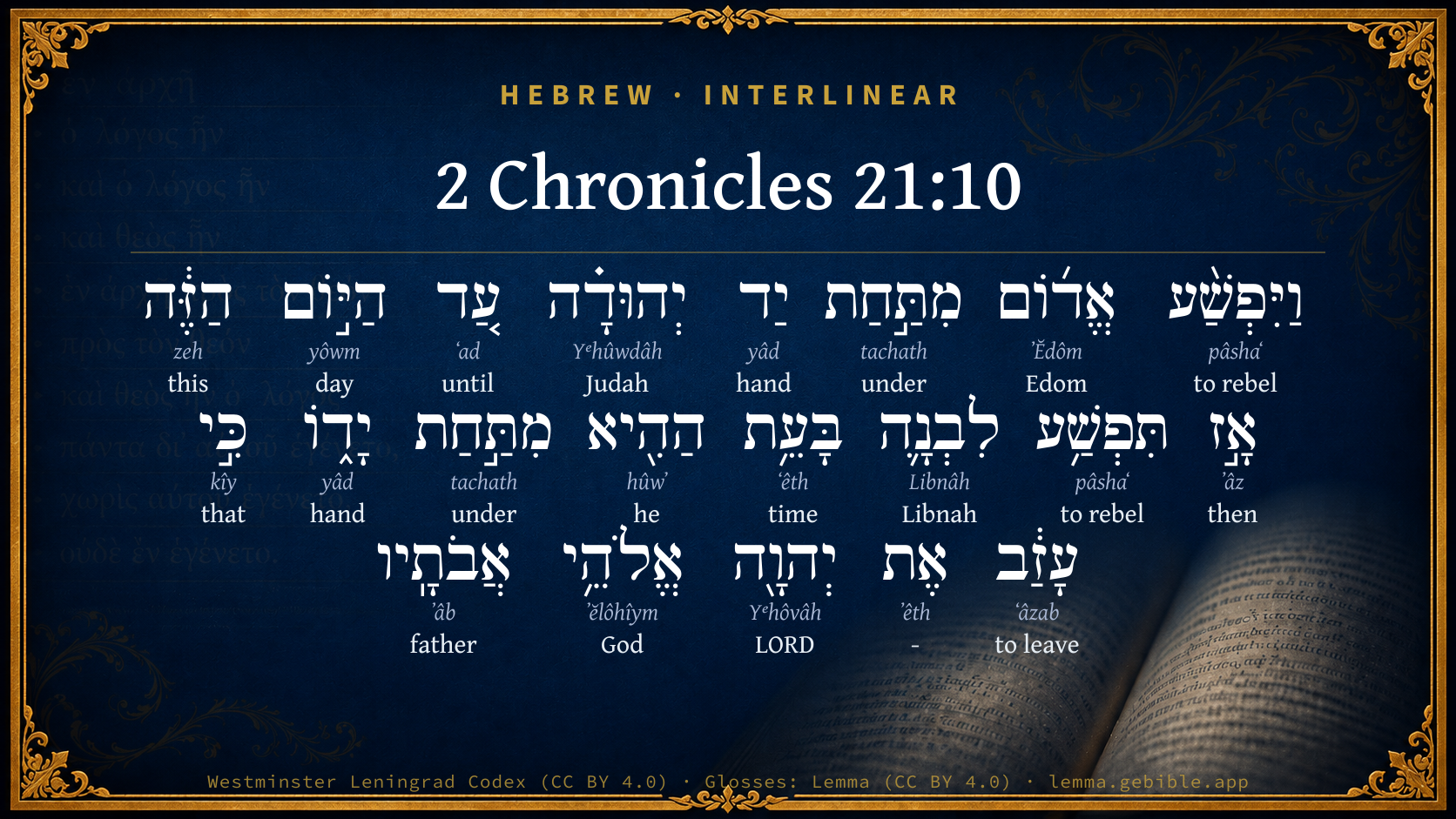
  1. וַיִּפְשַׁ֨ע pâshaʻ H6586 “and · to rebel” Conjunction + Verb, Qal, Sequential Imperfect, 3rd Person, Masculine, Singular
  2. אֱד֜וֹם ʼĔdôm H123 “Edom” Noun, Proper
  3. מִתַּ֣חַת tachath H8478 “from · under” Preposition + Preposition
  4. יַד yâd H3027 “hand of” Noun, Common, Both, Singular, Construct
  5. יְהוּדָ֗ה Yᵉhûwdâh H3063 “Judah” Noun, Proper
  6. עַ֚ד ʻad H5704 “until” Preposition
  7. הַיּ֣וֹם yôwm H3117 “the · day” Particle, Definite Article + Noun, Common, Masculine, Singular, Absolute
  8. הַזֶּ֔ה zeh H2088 “the · this” Particle, Definite Article + Pronoun, Demonstrative, Masculine, Singular
  9. אָ֣ז ʼâz H227 “then” Adverb
  10. תִּפְשַׁ֥ע pâshaʻ H6586 “to rebel” Verb, Qal, Imperfect, 3rd Person, Feminine, Singular
  11. בָּעֵ֥ת ʻêth H6256 “in/at the · time” Preposition, Determined + Noun, Common, Both, Singular, Absolute
  12. הַהִ֖יא hûwʼ H1931 “the · he” Particle, Definite Article + Pronoun, Personal, 3rd Person, Feminine, Singular
  13. מִתַּ֣חַת tachath H8478 “from · under” Preposition + Preposition
  14. יָד֑וֹ yâd H3027 “hand · his” Noun, Common, Both, Singular, Construct + Suffix, Personal, 3rd Person, Masculine, Singular
  15. כִּ֣י kîy H3588 “that” Conjunction
  16. עָזַ֔ב ʻâzab H5800 “to leave” Verb, Qal, Perfect, 3rd Person, Masculine, Singular
  17. אֶת ʼêth H853 “-” Particle, Direct Object
  18. יְהוָ֖ה Yᵉhôvâh H3068 “LORD” Noun, Proper
  19. אֱלֹהֵ֥י ʼĕlôhîym H430 “God(s) of” Noun, Common, Masculine, Plural, Construct
  20. אֲבֹתָֽיו ʼâb H1 “fathers · his” Noun, Common, Masculine, Plural, Construct + Suffix, Personal, 3rd Person, Masculine, Singular

About this verse

These counts appear in no published source. They are computed here, from the morphology-tagged text and Lemma’s own curated glosses. What Lemma adds →

21
words
18
distinct lemmas
Historical
section

Notable vocabulary

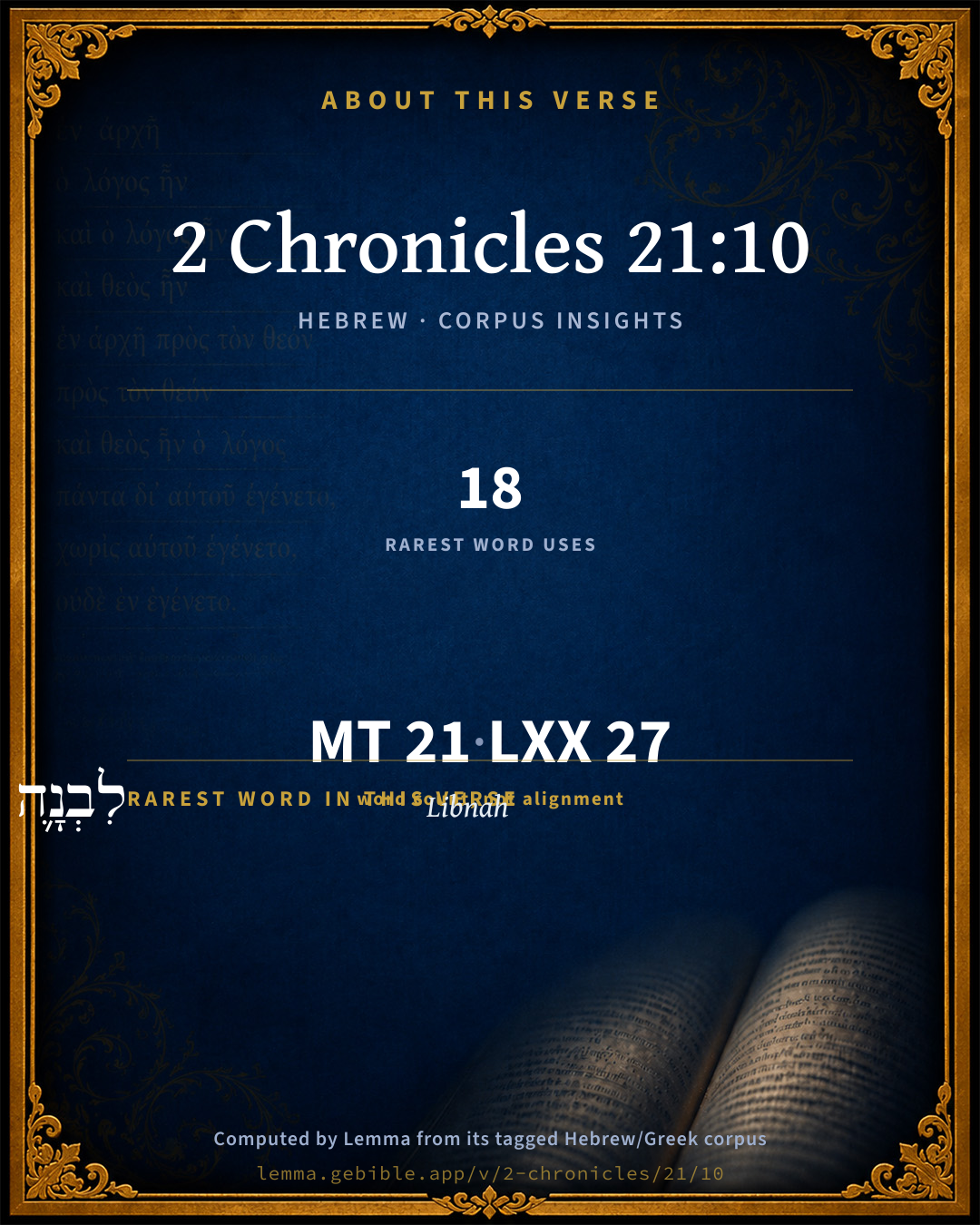
The rarest word here is לִבְנָ֛ה Libnah H3841 — appearing just 18 times in the whole Hebrew Bible.

Shared distinctive vocabulary

לִבְנָ֛ה Libnah H3841 occurs in 17 verses of the Hebrew Bible. Also found in:

Grammatical profile

  • 3 verbs
  • 10 nouns
  • 2 pronouns
  • 3 prepositions
  • 1 conjunction
  • 1 adverb
  • 1 particle

Verb forms

  • וַיִּפְשַׁ֨ע Qal · Sequential Imperfect
  • תִּפְשַׁ֥ע Qal · Imperfect
  • עָזַ֔ב Qal · Perfect

Repetition

Words recur within this verse — often emphatic in Hebrew:

  • וַיִּפְשַׁ֨ע to rebel H6586 ×2
  • מִתַּ֣חַת under H8478 ×2
  • יַד hand H3027 ×2

Hebrew & Septuagint length

In English translation the verse runs 34 words from the Hebrew and 27 from the Septuagint (LXX English) — closely comparable.

A rough comparison of the two English renderings, which tokenize alike — not a word-level alignment.

Word counts can differ between the Hebrew and the Greek without any difference in meaning — e.g. the Hebrew direct-object marker אֵת has no separate Greek word, and Greek often adds the article ὁ.

In the original languages it is 21 Hebrew tokens and 27 Greek tokens — but the two are counted differently (Hebrew bundles its prefixes and suffixes into one token; the Greek is in lemma form), so that isn’t a like-for-like length.

Cross-references

8

Topical passages linked to 2 Chronicles 21:10 in the Treasury of Scripture Knowledge — connected by theme and wording, ordered by reader-vote popularity; previews shown in the World English Bible.

  • Deuteronomy 32:21 They have moved me to jealousy with that which is not God; They have provoked me to anger with their vanities: I will move them to jealousy with those who are not a people; I will provoke them to anger with a foolish nation.
  • Joshua 21:13 To the children of Aaron the priest they gave Hebron with its suburbs, the city of refuge for the manslayer, and Libnah with its suburbs,
  • 1 Kings 11:31 He said to Jeroboam, Take ten pieces; for thus says Yahweh, the God of Israel, Behold, I will tear the kingdom out of the hand of Solomon, and will give ten tribes to you
  • 1 Kings 11:33 because that they have forsaken me, and have worshiped Ashtoreth the goddess of the Sidonians, Chemosh the god of Moab, and Milcom the god of the children of Ammon; and they have not walked in my ways, to do that which is right in my eyes, and [to keep] my statutes and my ordinances, as did David his father.
  • 2 Kings 19:8 So Rabshakeh returned, and found the king of Assyria warring against Libnah; for he had heard that he was departed from Lachish.
  • 2 Chronicles 13:10 But as for us, Yahweh is our God, and we have not forsaken him; and [we have] priests ministering to Yahweh, the sons of Aaron, and the Levites in their work:
  • 2 Chronicles 15:2 and he went out to meet Asa, and said to him, Hear you me, Asa, and all Judah and Benjamin: Yahweh is with you, while you are with him; and if you seek him, he will be found of you; but if you forsake him, he will forsake you.
  • Jeremiah 2:13 For my people have committed two evils: they have forsaken me, the spring of living waters, and hewed them out cisterns, broken cisterns, that can hold no water.

Cross-references courtesy of OpenBible.info (CC BY 4.0).

Hebrew and Greek witnesses Masoretic Hebrew ↔ Greek Septuagint

The same verse in the two great witnesses to the Old Testament, shown verse-for-verse.

These are two independent witnesses, not word-aligned to each other, and the Septuagint is shown in lemma (dictionary) form.

Hebrew 2 Chronicles 21:10 Masoretic · Westminster Leningrad Codex

וַיִּפְשַׁ֨ע אֱד֜וֹם מִתַּ֣חַת יַד יְהוּדָ֗ה עַ֚ד הַיּ֣וֹם הַזֶּ֔ה אָ֣ז תִּפְשַׁ֥ע לִבְנָ֛ה בָּעֵ֥ת הַהִ֖יא מִתַּ֣חַת יָד֑וֹ כִּ֣י עָזַ֔ב אֶת יְהוָ֖ה אֱלֹהֵ֥י אֲבֹתָֽיו

So Edom revolted from under the hand of Judah to this day: then did Libnah revolt at the same time from under his hand, because he had forsaken Yahweh, the God of his fathers.

World English Bible · Public Domain

Greek LXX 2 Chronicles 21:10 Septuagint · lemma form

καί ἀποἵστημι ἀπό ἰουδά εδωμ ἕως ὁ ἡμέρα οὗτος τότε ἀποἵστημι λομνα ἐν ὁ καιρός ἐκεῖνος ἀπό χείρ αὐτός ὅτι ἐν καταλείπω κύριος θεός ὁ πατήρ αὐτός

And Edom revolted from Juda until this day. Then Lomna at that time revolted from under his hand, because he forsook the Lord God of his fathers.

LXX2012 (modern English Septuagint) · Public Domain

Hebrew: Westminster Leningrad Codex (CC BY 4.0). Greek: Septuagint (public domain); English from LXX2012 (modern English Septuagint) (Public Domain). How the Septuagint differs from the Hebrew →

Commentary

Notes on 2 Chronicles 21:10 from classic Christian and Jewish commentators (each source and its license shown beneath its notes). The classic Christian expositions comment on the surrounding passage and are grouped to its opening verse, so a note may address several verses; the Jewish commentaries on the Tanakh (Rashi and others) are per-verse, so they appear only where the commentator wrote on this verse.

Lemma curates 59 commentaries, every one of them public domain or Creative Commons licensed, each selected and text-cleaned for this edition rather than reprinted as found. About our sources →

Trapp's Complete Commentary

John Trapp

2Ch 21:10 So the Edomites revolted from under the hand of Judah unto this day. The same time [also] did Libnah revolt from under his hand; because he had forsaken the LORD God of his fathers.

Ver. 10. Did Libnah revolt.] See 2Ki 8:22.

John Trapp, A Commentary or Exposition upon All the Books of the Old and New Testament (1647–1656) — public domain. Text from a community e-Sword module.

Joseph Benson's Commentary

2Ch 21:10. The same time did Libnah revolt — Libnah seems to have set up for a free state. And the reason is here given, both why God permitted it, and why they did it, because Jehoram was become an idolater. While he adhered to God, they adhered to him; but when he cast God off, they cast him off. Whether this would justify them in their revolt or not, it justified God’s providence which suffered it.

Joseph Benson's Commentary on the Old and New Testaments (1811–1818) — public domain. Text from a community e-Sword module.

Geneva Bible (1599)

Geneva Bible translators

Read 2 Kings 8:22.

Geneva Bible (1599) marginal notes — public domain. Text via Bolls.life.

Ellicott's Commentary for English Readers

(10) Unto this day.—See on 2Ch_5:9. The date thus assigned is some time prior to the captivity. No account is taken of Amaziah’s reduction of Edom (2Ch_25:11-15), which was probably not permanent.

The same time also.—Literally, then revolted Libnah at that time. 2Ki_8:22 ends here. The chronicler adds, “from under his (i.e., Jehoram’s) hand,” and assigns a moral ground for the successful rebellion: “For he had forsaken Jehovah, the God of his fathers.” (Thenius can hardly be right in asserting that the chronicler meant to say that Libnah, as a city of the priests, refused obedience to the idolatrous king; nor Hitzig, in explaining the revolt as merely a religious secession. ) He forsook Jehovah, by “walking in the way of the kings of Israel, as did the house of Ahab,” i.e., by adopting and popularising the worship of the Tyrian Baal, to please his wife and her people. In those days friendship with an alien race seems to have involved recognition of their gods. (Comp. Amo_1:9 for the alliance between Tyre and Judah.)

Libnah.—Syriac, “the Edomites that lived in Libnah.”

A Bible Commentary for English Readers, edited by Charles John Ellicott (1878–1897) — public domain. Text from a community e-Sword module.

The Cambridge Bible for Schools and Colleges

gen. ed. J. J. S. Perowne

10. The same time also did Libnah revolt] R.V. Then did Libnah revolt at the same time. The exact position of Libnah is not known, but it was in the south of Judah, probably not far from Lachish (Tell-el-Hesi) and from the Edomite territory. The reason of the revolt is probably given in the Pesh. rendering of this clause, viz. “Then did the Edomites who dwelt in Libnah revolt.” Libnah was perhaps partly Edomite. According to 1Ch_6:57 (42 Heb.) Libnah was a priestly city.

because he had forsaken, etc.] Not in Kings.

the Lord God] R.V. the LORD, the God; cp. 2Ch_28:6 (note).

The Cambridge Bible for Schools and Colleges (gen. ed. J. J. S. Perowne; Cambridge University Press, 1878–1918) — public domain. Text from a community e-Sword module.

Haydock's Catholic Bible Commentary

Day, when the author lived. See 4 K. viii. 20.

George Leo Haydock (1774–1849), Haydock's Catholic Family Bible and Commentary, 1859 edition — public domain. Excludes Psalms (Douay-Rheims chapter numbering differs from Protestant) and Deuterocanonical books (Catholic canon only).

Matthew Poole's English Annotations

To wit, publicly and avowedly, setting him at defiance, as the next verse shows. And this is mentioned, either,

1. As the reason why the priests, whose city Libnah was, forsook him, because he had forsaken God; or rather,

2. As the reason why God raised up so many enemies against him, both from abroad and at home.

Matthew Poole's English Annotations on the Holy Bible (1683–1685) — public domain. Text from a community e-Sword/MySword module.

The Pulpit Commentary

Libnah because he had forsaken. The parallel states the revolt of Libnah also, but does not make the closing remark of our verse.

The Pulpit Commentary (1880–1919), ed. H.D.M. Spence-Jones & Joseph S. Exell — public domain. Text from a community e-Sword module.

John Wesley's Explanatory Notes

Libnah - Libnah seems to have set up for a free state. And the reason is here given, both why God permitted it, and why they did it, because Jehoram was become an idolater. While he adhered to God, they adhered to him; but when he cast God off, they cast him off. Whether this would justify them in their revolt or no, it justified God's providence which suffered it.

John Wesley, Explanatory Notes Upon the Whole Bible (1754–1765) — public domain. Text via the GEBible commentary corpus.

Keil & Delitzsch

C. F. Keil & F. Delitzsch

The chronicler concludes the account of the revolt of Edom and of the city of Libnah against Judah's dominion with the reflection: "For he (Joram) had forsaken Jahve the God of the fathers," and consequently had brought this revolt upon himself, the Lord punishing him thereby for his sin. "Yea, even high places did he make." The גּם placed at the beginning may be connected with בּמות (cf. Isa 30:33), while the subject is emphasized by הוּא: The same who had forsaken the God of the fathers, made also high places, which Asa and Jehoshaphat had removed, Ch2 14:2, Ch2 14:4; Ch2 17:6. "And he caused the inhabitants of Jerusalem to commit fornication," i.e., seduced them into the idolatrous worship of Baal. That the Hiph. ויּזן is to be understood of the spiritual whoredom of Baal-worship we learn from Ch2 21:13 : "as the house of Ahab caused to commit fornication." וידּח, "and misled Judah," i.e., drew them away by violence from the right way. ידּח is to be interpreted in accordance with Deu 13:6, Deu 13:11.

Keil & Delitzsch — Biblical Commentary on the Old Testament (1861–1891) — public domain (CC PDM 1.0). Text via the HelloAO Bible API. (Old Testament only.)

Rashi

Rabbi Shlomo Yitzchaki (Rashi)

And Edom rebelled Was it not already stated above (verse 8): “In his days, Edom rebelled?” But this is the manner of Scripture: because a verse is interposed, and it now wishes to continue with “then Libnah rebelled,” it repeats the [original words] stating, “And Edom rebelled.” then Libnah rebelled It belonged to Judah, and it was situated on the border of Edom, as is written in the Book of Joshua (15:21, 42): “And the outermost cities of the tribe of the children of Judah toward the border of Edom.” When they saw that the Edomites rebelled, they too rebelled, for they lived on the border of Edom, and they aided Edom. This is [the meaning of] “then Libnah rebelled.”

because he had forsaken the Lord, the God of his forefathers [Scripture] explains what it was that caused them to rebel in his time more than during [the time of] the rest of the kings of Judah who preceded him.

Rashi on the Tanakh — English translations: “The Judaica Press complete Tanach with Rashi, translated by A. J. Rosenberg” (CC BY 4.0); “Pentateuch with Rashi's commentary by M. Rosenbaum and A.M. Silbermann, 1929-1934” (public domain); “The Metsudah Tanach series, Lakewood, N.J” (CC BY 4.0); and “The Book of Joshua, Metsudah Publications, 1997” (CC BY 4.0). Text via Sefaria.

Lesson kit

Teaching starters — assembled from the data on this page, not authored interpretation. Every prompt links to the verse data it draws on. Edit before teaching.

2 Chronicles, in the Historical, opens this verse with 21 words (18 distinct Hebrew lemmas). Its most distinctive word is Libnâh (“Libnah”). A historical commentator’s framing appears above. Read the whole chapter for the surrounding context.

Discussion questions

  1. The word Libnâh carries the sense “Libnah.” How does it shape the verse?
  2. Numbers 33:20 shares the word «Libnah» with this verse. How do the two illuminate each other?
  3. “to rebel” occurs 2× in this one verse. What is the effect of the repetition?
  4. These translations render this verse differently; the difference is in the English rendering, not the original. What questions does that raise?
  5. The verb «וַיִּפְשַׁ֨ע» is Qal Sequential Imperfect. How does its form color the action?
  6. Reading how Trapp's Complete Commentary and Joseph Benson's Commentary read this verse, where do the two commentators agree and where do they part?

Things to notice

Reading settings

Reading text

Shown beneath each verse's original-language words.

Old Testament
Old Testament edition

Read the OT as the Masoretic Hebrew (MT) or the Greek Septuagint (LXX).

English shown for the Greek Septuagint (in the Hebrew ↔ Greek comparison).

Comparing translations? Open the Compare panel on any verse page to stack up to four side by side.