2 Chronicles 13:18

Hebrew (Westminster Leningrad Codex) 2 Chronicles 13:18 appears in the Hebrew Old Testament. The text above is from the Westminster Leningrad Codex. Each word links to its Strong’s number, a concise gloss, and parsing drawn from the Open Scriptures Hebrew Bible morphology. Click any word for its full Brown-Driver-Briggs (BDB) entry.
Download image
Cite this verse

2 Chronicles 13:18 (World English Bible). Public Domain. Lemma interlinear Bible study tool, https://lemma.gebible.app/v/2-chronicles/13/18.

Show BibTeX & RIS
BibTeX
RIS
English Translation
Thus the children of Israel were brought under at that time, and the children of Judah prevailed, because they relied on Yahweh, the God of their fathers.
World English Bible · Public Domain
Download a study sheet

One document with this verse’s original text, its word-by-word gloss line, the meaning frame, cross-references with their text, attributed commentary, and full source and license credits — printable, and it pastes into notes with its structure intact.

This verse Autodidact and up

Study sheet (.html) Plain text (.txt)

A passage Seminary Student

Up to 50 verses in one chapter. A passage sheet keeps up to 6 commentary sources and 12 cross-references per verse, in the order this page ranks them, and says so on the sheet whenever that leaves anything out. Ask for a single verse and you get the Autodidact verse sheet above.

Everything on this page stays free to read, with no account — the sheet is a download of what is already on screen, not access to it.

Want to remove ads? Support Godless Engineer
Compare translations 3

The same verse in 3 English versions, stacked beneath the original-language interlinear above. Click any original word for its lexicon entry.

Each is an independent rendering of the whole verse — the interlinear is not word-aligned to these translations.

Highlighted words mark where these versions differ — a whole-verse word diff, not a word-by-word alignment.

  • World English Bible Public Domain
    Thus the children of Israel were brought under at that time, and the children of Judah prevailed, because they relied on Yahweh, the God of their fathers.
  • King James Version Public Domain
    Thus the children of Israel were brought under at that time, and the children of Judah prevailed, because they relied upon the LORD God of their fathers.
  • unfoldingWord Literal Text CC BY-SA 4.0
    And the sons of Israel were humbled at that time, and the sons of Judah were strong because they relied on Yahweh, the God of their fathers.

unfoldingWord Literal Text — © unfoldingWord, licensed CC BY-SA 4.0. Word-aligned USFM3 via Door43 (git.door43.org/unfoldingWord/en_ult).

Versions to compare (up to 4)

3 of 4 selected

Show all 18 translations

Every available English version of this verse, each an independent rendering of the whole verse.

  • World English Bible Public Domain
    Thus the children of Israel were brought under at that time, and the children of Judah prevailed, because they relied on Yahweh, the God of their fathers.
  • Berean Standard Bible Public Domain
    Thus the Israelites were subdued at that time, and the men of Judah prevailed because they relied on the LORD, the God of their fathers.
  • Majority Standard Bible Public Domain
    Thus the Israelites were subdued at that time, and the men of Judah prevailed because they relied on the LORD, the God of their fathers.
  • King James Version Public Domain
    Thus the children of Israel were brought under at that time, and the children of Judah prevailed, because they relied upon the LORD God of their fathers.
  • American Standard Version (1901) Public Domain
    Thus the children of Israel were brought under at that time, and the children of Judah prevailed, because they relied upon Jehovah, the God of their fathers.
  • Revised Version (1885) Public Domain
    Thus the children of Israel were brought under at that time, and the children of Judah prevailed, because they relied upon the LORD, the God of their fathers.
  • Geneva Bible (1599) Public Domain
    So the children of Israel were brought vnder at that time: and the children of Iudah preuailed, because they stayed vpon the Lord God of their fathers.
  • Douay-Rheims (1899) Public Domain
    And the children of Israel were brought down, at that time, and the children of Juda were exceedingly strengthened, because they had trusted in the Lord the God of their fathers.
  • Young's Literal Translation Public Domain
    And the sons of Israel are humbled at that time, and the sons of Judah are strong, for they have leant on Jehovah, God of their fathers.
  • Literal Standard Version CC BY-SA 4.0
    And the sons of Israel are humbled at that time, and the sons of Judah are strong, for they have leaned on YHWH, God of their fathers.
  • Unlocked Literal Bible CC BY-SA 4.0
    In this way, the people of Israel were subdued at that time; the people of Judah won because they relied on Yahweh, the God of their ancestors.
  • unfoldingWord Literal Text CC BY-SA 4.0
    And the sons of Israel were humbled at that time, and the sons of Judah were strong because they relied on Yahweh, the God of their fathers.
  • Darby Bible Public Domain
    And the children of Israel were humbled at that time, and the children of Judah were strengthened, because they relied upon Jehovah the God of their fathers.
  • World Messianic Bible Public Domain
    Thus the children of Israel were brought under at that time, and the children of Judah prevailed, because they relied on the LORD, the God of their fathers.
  • Webster's Bible Public Domain
    Thus the children of Israel were brought under at that time, and the children of Judah prevailed, because they relied upon the LORD God of their fathers.
  • Free Bible Version CC BY-SA 4.0
    So the Israelites were subdued at that time, and the people of Judah were victorious because they relied on the Lord, the God of their forefathers.
  • Bible in Basic English Public Domain
    So at that time the children of Israel were overcome, and the children of Judah got the better of them, because they put their faith in the Lord, the God of their fathers.
  • JPS Tanakh (1917) Public Domain
    Thus the children of Israel were brought under at that time, and the children of Judah prevailed, because they relied upon the LORD, the God of their fathers.

Literal Standard Version (2020), Covenant Press — licensed CC BY-SA 4.0. Text via the HelloAO Bible API (eBible.org). Unlocked Literal Bible (unfoldingWord) — licensed CC BY-SA 4.0. Text via the HelloAO Bible API (eBible.org). unfoldingWord Literal Text — © unfoldingWord, licensed CC BY-SA 4.0. Word-aligned USFM3 via Door43 (git.door43.org/unfoldingWord/en_ult). Free Bible Version, Dr. Jonathan Gallagher — licensed CC BY-SA 4.0. Text via the HelloAO Bible API (eBible.org).

Word by word

More ways to search: Search by grammar → Find every occurrence → Compare this word →

Practice this passage: Drill this verse → Learn its vocabulary →

נִשְׁעֲנ֔וּ
shâʻan
H8172
“to lean on”
Verb, Niphal, Perfect, 3rd Person, Common, Plural
Part of Speech
Verb
Stem
Niphal
Form
Perfect
Person
3rd Person
Gender
Common
Number
Plural
Full BDB Definition

Origin: a primitive root

TWOT: 2434

to lean on, trust in, support - (Niphal) to lean, lean upon, support oneself - of trust in God (figuratively)
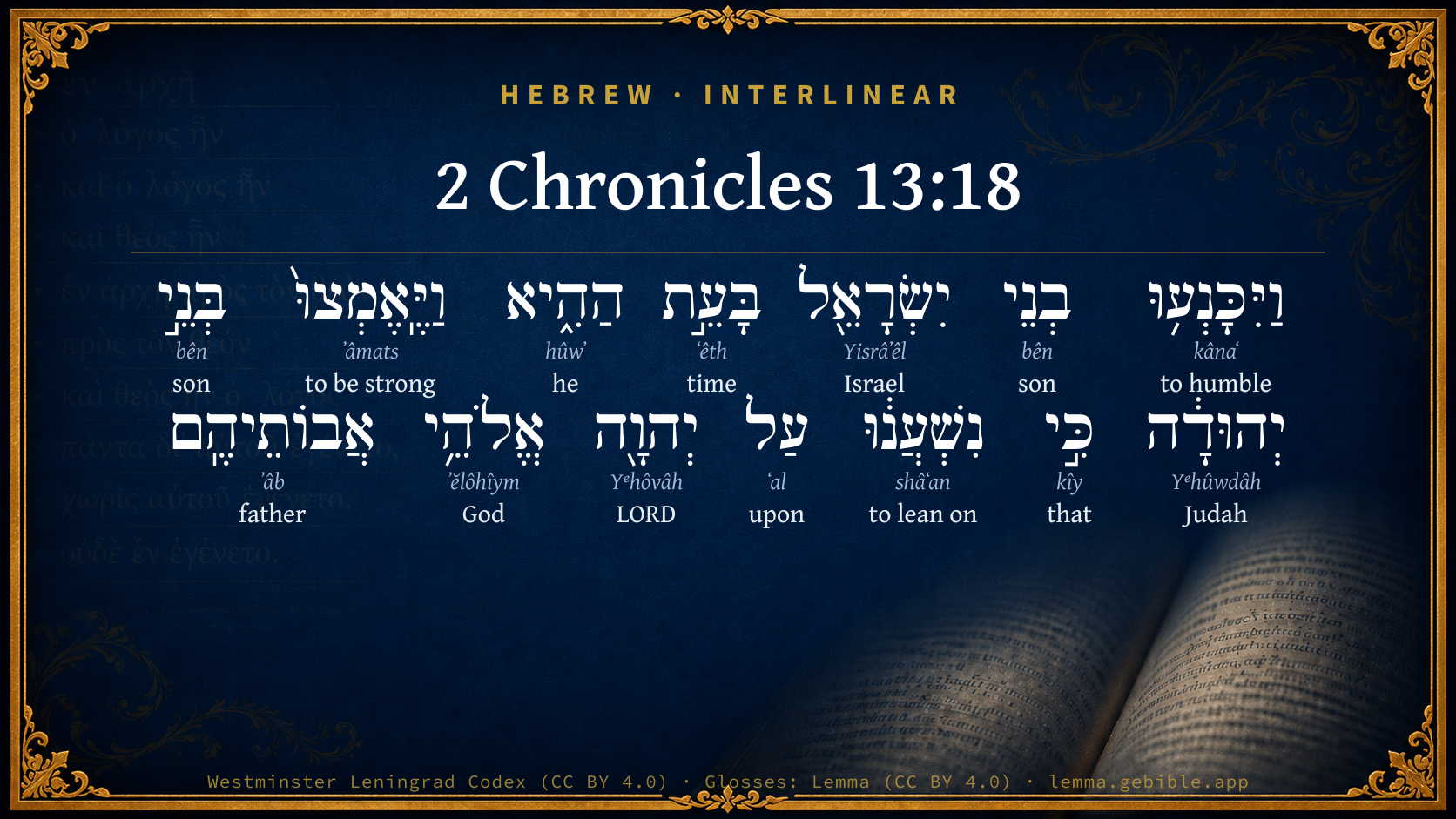
  1. וַיִּכָּנְע֥וּ kânaʻ H3665 “and · to humble” Conjunction + Verb, Niphal, Sequential Imperfect, 3rd Person, Masculine, Plural
  2. בְנֵי bên H1121 “sons of” Noun, Common, Masculine, Plural, Construct
  3. יִשְׂרָאֵ֖ל Yisrâʼêl H3478 “Israel” Noun, Proper
  4. בָּעֵ֣ת ʻêth H6256 “in/at the · time” Preposition, Determined + Noun, Common, Both, Singular, Absolute
  5. הַהִ֑יא hûwʼ H1931 “the · he” Particle, Definite Article + Pronoun, Personal, 3rd Person, Feminine, Singular
  6. וַיֶּֽאֶמְצוּ֙ ʼâmats H553 “and · to be strong” Conjunction + Verb, Qal, Sequential Imperfect, 3rd Person, Masculine, Plural
  7. בְּנֵ֣י bên H1121 “sons of” Noun, Common, Masculine, Plural, Construct
  8. יְהוּדָ֔ה Yᵉhûwdâh H3063 “Judah” Noun, Proper
  9. כִּ֣י kîy H3588 “that” Conjunction
  10. עַל ʻal H5921 “upon” Preposition
  11. יְהוָ֖ה Yᵉhôvâh H3068 “LORD” Noun, Proper
  12. אֱלֹהֵ֥י ʼĕlôhîym H430 “God(s) of” Noun, Common, Masculine, Plural, Construct
  13. אֲבוֹתֵיהֶֽם ʼâb H1 “fathers · their” Noun, Common, Masculine, Plural, Construct + Suffix, Personal, 3rd Person, Masculine, Plural

About this verse

These counts appear in no published source. They are computed here, from the morphology-tagged text and Lemma’s own curated glosses. What Lemma adds →

14
words
13
distinct lemmas
Historical
section

Notable vocabulary

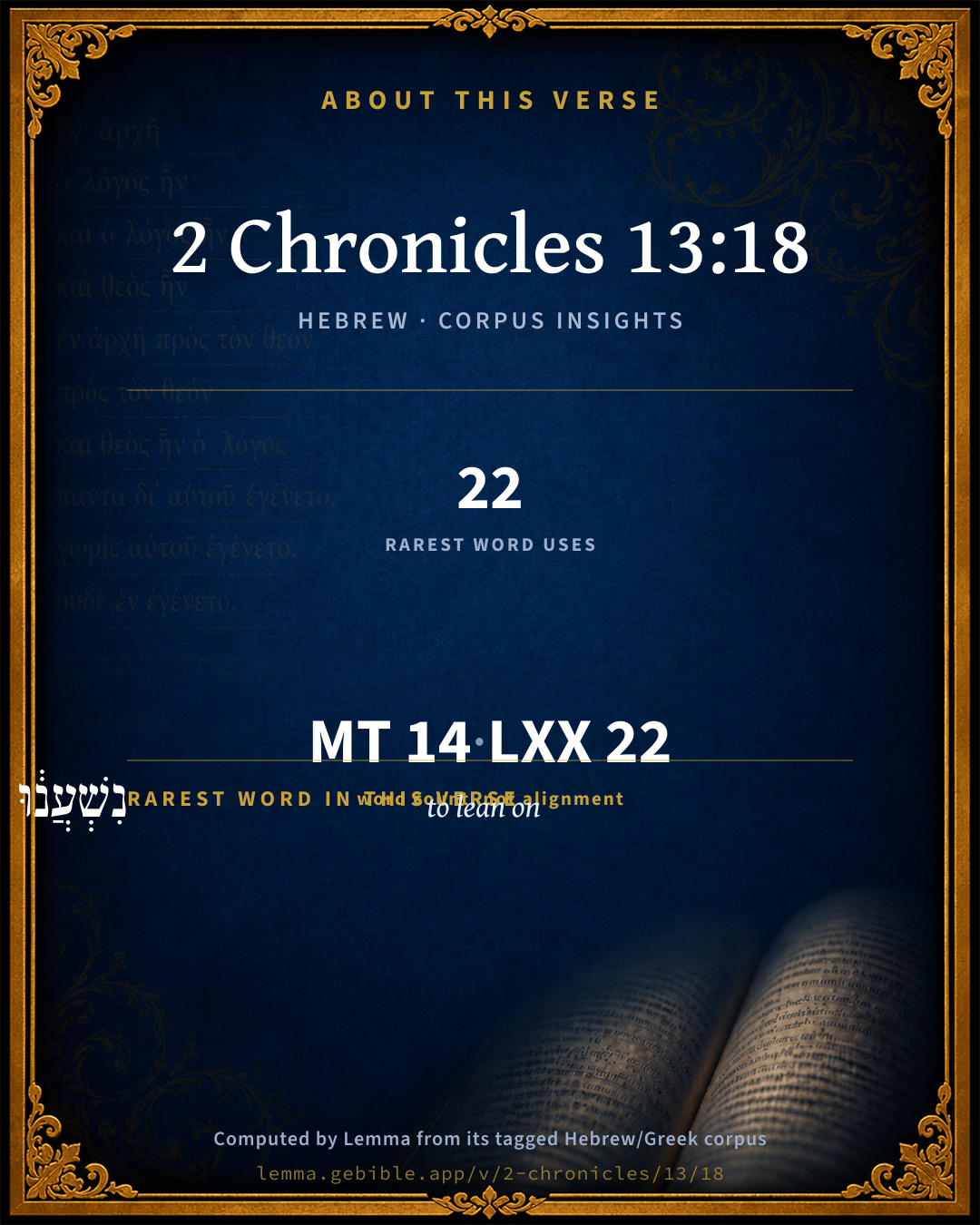
The rarest word here is נִשְׁעֲנ֔וּ to lean on H8172 — appearing just 22 times in the whole Hebrew Bible.

Shared distinctive vocabulary

נִשְׁעֲנ֔וּ to lean on H8172 occurs in 20 verses of the Hebrew Bible. Also found in:

Grammatical profile

  • 3 verbs
  • 8 nouns
  • 1 pronoun
  • 1 preposition
  • 1 conjunction

Verb forms

  • וַיִּכָּנְע֥וּ Niphal · Sequential Imperfect
  • וַיֶּֽאֶמְצוּ֙ Qal · Sequential Imperfect
  • נִשְׁעֲנ֔וּ Niphal · Perfect

Repetition

A word recurs within this verse — often emphatic in Hebrew:

  • בְנֵי son H1121 ×2

Hebrew & Septuagint length

In English translation the verse runs 27 words from the Hebrew and 27 from the Septuagint (LXX English) — the same length.

A rough comparison of the two English renderings, which tokenize alike — not a word-level alignment.

Word counts can differ between the Hebrew and the Greek without any difference in meaning — e.g. the Hebrew direct-object marker אֵת has no separate Greek word, and Greek often adds the article ὁ.

In the original languages it is 14 Hebrew tokens and 22 Greek tokens — but the two are counted differently (Hebrew bundles its prefixes and suffixes into one token; the Greek is in lemma form), so that isn’t a like-for-like length.

Cross-references

10

Topical passages linked to 2 Chronicles 13:18 in the Treasury of Scripture Knowledge — connected by theme and wording, ordered by reader-vote popularity; previews shown in the World English Bible.

  • 1 Chronicles 5:20 They were helped against them, and the Hagrites were delivered into their hand, and all who were with them; for they cried to God in the battle, and he was entreated of them, because they put their trust in him.
  • 2 Chronicles 14:11 Asa cried to Yahweh his God, and said, Yahweh, there is none besides you to help, between the mighty and him who has no strength: help us, Yahweh our God; for we rely on you, and in your name are we come against this multitude. Yahweh, you are our God; don't let man prevail against you.
  • Nahum 1:7 Yahweh is good, a stronghold in the day of trouble; and he knows those who take refuge in him.
  • 2 Kings 18:5 He trusted in Yahweh, the God of Israel; so that after him was none like him among all the kings of Judah, nor [among them] that were before him.
  • 2 Chronicles 16:8–9 Weren't the Ethiopians and the Lubim a huge host, with chariots and horsemen exceeding many? yet, because you did rely on Yahweh, he delivered them into your hand.
  • 2 Chronicles 20:20 They rose early in the morning, and went forth into the wilderness of Tekoa: and as they went forth, Jehoshaphat stood and said, Hear me, Judah, and you inhabitants of Jerusalem: believe in Yahweh your God, so shall you be established; believe his prophets, so shall you prosper.
  • Psalms 22:4–5 Our fathers trusted in you. They trusted, and you delivered them.
  • Psalms 146:5 Happy is he who has the God of Jacob for his help, Whose hope is in Yahweh, his God:
  • Daniel 3:28 Nebuchadnezzar spoke and said, Blessed be the God of Shadrach, Meshach, and Abednego, who has sent his angel, and delivered his servants who trusted in him, and have changed the king's word, and have yielded their bodies, that they might not serve nor worship any god, except their own God.
  • Ephesians 1:12 to the end that we should be to the praise of his glory, we who had before hoped in Christ:

Cross-references courtesy of OpenBible.info (CC BY 4.0).

Hebrew and Greek witnesses Masoretic Hebrew ↔ Greek Septuagint

The same verse in the two great witnesses to the Old Testament, shown verse-for-verse.

These are two independent witnesses, not word-aligned to each other, and the Septuagint is shown in lemma (dictionary) form.

Hebrew 2 Chronicles 13:18 Masoretic · Westminster Leningrad Codex

וַיִּכָּנְע֥וּ בְנֵי יִשְׂרָאֵ֖ל בָּעֵ֣ת הַהִ֑יא וַיֶּֽאֶמְצוּ֙ בְּנֵ֣י יְהוּדָ֔ה כִּ֣י נִשְׁעֲנ֔וּ עַל יְהוָ֖ה אֱלֹהֵ֥י אֲבוֹתֵיהֶֽם

Thus the children of Israel were brought under at that time, and the children of Judah prevailed, because they relied on Yahweh, the God of their fathers.

World English Bible · Public Domain

Greek LXX 2 Chronicles 13:18 Septuagint · lemma form

καί ταπεινόω ὁ υἱός ἰσραήλ ἐν ὁ ἡμέρα ἐκεῖνος καί καταἰσχύω ὁ υἱός ἰουδά ὅτι ἐλπίζω ἐπί κύριος θεός ὁ πατήρ αὐτός

So the children of Israel were brought low in that day, and the children of Juda prevailed, because they trusted on the Lord God of their fathers.

LXX2012 (modern English Septuagint) · Public Domain

Hebrew: Westminster Leningrad Codex (CC BY 4.0). Greek: Septuagint (public domain); English from LXX2012 (modern English Septuagint) (Public Domain). How the Septuagint differs from the Hebrew →

Commentary

Notes on 2 Chronicles 13:18 from classic Christian and Jewish commentators (each source and its license shown beneath its notes). The classic Christian expositions comment on the surrounding passage and are grouped to its opening verse, so a note may address several verses; the Jewish commentaries on the Tanakh (Rashi and others) are per-verse, so they appear only where the commentator wrote on this verse.

Lemma curates 59 commentaries, every one of them public domain or Creative Commons licensed, each selected and text-cleaned for this edition rather than reprinted as found. About our sources →

Trapp's Complete Commentary

John Trapp

2Ch 13:18 Thus the children of Israel were brought under at that time, and the children of Judah prevailed, because they relied upon the LORD God of their fathers.

Ver. 18. Because they relied upon the Lord.] Deo confisi nunquam confusi. Trust in God never miscarrieth.

John Trapp, A Commentary or Exposition upon All the Books of the Old and New Testament (1647–1656) — public domain. Text from a community e-Sword module.

Joseph Benson's Commentary

2Ch 13:18. Thus the children of Israel were brought under at that time — And had not the determinate counsel of God been otherwise, surely so great a blow would have brought them back to the house of David. And Judah prevailed, because they relied on the God of their fathers — It was not by their own valour that they obtained this great victory, but by their relying on God, their depending on his power to help them, and their committing themselves and their cause to him.

Joseph Benson's Commentary on the Old and New Testaments (1811–1818) — public domain. Text from a community e-Sword module.

MacLaren's Expositions of Holy Scripture

Alexander MacLaren

2 Chronicles

THE SECRET OF VICTORY

2Ch 13:18.

These words are the summing-up of the story of a strange old-world battle between Jeroboam, the adventurer who rent the kingdom, and Abijah, the son of the foolish Rehoboam, whose unseasonable blustering had played into the usurper’s hands. The son was a wiser and better man than his father. It is characteristic of the ancient world, that before battle was joined Abijah made a long speech to the enemy, recounting the ritual deficiencies of the Northern kingdom, and proudly contrasting the punctilious correctness of the Temple service with the irregular cult set up by Jeroboam. He confidently pointed to the priests ‘with their trumpets’ in his army as the visible sign that ‘God is with us at our head,’ and while charging Israel with having ‘forsaken the Lord our God,’ to whom he and his people had kept true, besought them not to carry their rebellion to the extreme of fighting against their fathers’ God, and assured them that no success could attend their weapons in such a strife. The passionate appeal had no effect, but while Abijah was orating, Jeroboam was carrying out a ruse, and planting part of his troops behind Judah, so as to put them between two fires and draw a net round the outnumbered and outmanoeuvred enemy.

Abijah and his men suddenly detected their desperate position, and did the only wise thing. When, with a shock of surprise, they saw that ‘behold! the battle was before and behind them,’ they ‘cried unto the Lord, and the priests sounded with the trumpets.’ The sharp, short cry from thousands of agitated men ringed round by foes, and the blare of the trumpets were both prayers, and heartened the suppliants for their whirlwind charge, before which the men of Israel, double in number as they were, broke and fled. The defeat was thorough, and, for a while, Rehoboam and his kingdom were ‘brought under,’ and a comparatively long peace followed. Our text gathers up the lesson taught, not to Judah or Israel alone, by victory and defeat, when it declares that to rely upon the Lord is to prevail. It opens for us the secret of victory, in that old far-off struggle and in to-day’s conflicts.

I. We note the faith of the fighters.

‘They relied,’ says the chronicler, ‘upon the Lord.’ Now the word rendered ‘relied’ is one of several picturesque words by which the Old Testament, which we are sometimes told, with a great flourish of learning, has no mention of ‘faith,’ expresses ‘trust,’ by metaphors drawn from bodily actions which symbolise the spiritual act. The word here literally signifies to lean on, as a feeble hand might on a staff, or a tremulous arm on a strong one. And does not that picture carry with it much insight into what the essence of Old Testament ‘trust’ or New Testament ‘faith’ is? If we think of faith as leaning, we shall not fall into that starved misconception of it which takes it to be nothing more than intellectual assent. We shall see there is a far fuller pulse of feeling than that beating in it. A man who leans on some support, does so because he knows that his own strength is insufficient for his need. The consciousness of weakness is the beginning of faith. He who has never despaired of himself has scarcely trusted in God. Abijah’s enemies were two to one of his own men. No wonder that they cried unto the Lord, and felt a stound of despair shake their courage. And who of us can face life with its heavy duties, its thick-clustering dangers and temptations, its certain struggles, its possible failures, and not feel the cold touch of dread gripping our hearts, though strong and brave? Surely he has had little experience, or has learned little wisdom from the experience he has had, who has yet to discover his own weakness. But the consciousness of weakness is by itself debilitating, and but increases the weakness of which it is painfully aware. There is no surer way to sap what strength we have than to tell ourselves what poor creatures we are. The purpose and end of self-contemplation which becomes aware of our own feebleness is to lead us to the contemplation of God, our immortal strength. Abijah’s assurance that ‘God is with us at our head’ rang out triumphantly. Faith has an upper and an under side: the under side is self-distrust; the upper, trust in God. He will never lean all his weight on a prop, who fancies that he can stand alone, or has other stays to hold him up.

But Abijah’s example teaches us another lesson-that for a vigorous faith, there must be obedience to all God’s known will. True, thank God! faith often springs in its power in a soul that is conscious but of sin, but a continuance in disobedience will inevitably kill faith. It was because Abijah and his people had kept ‘the charge of the Lord our God,’ that they were sure that God was with them. We can only be sure of God to lean on when we are doing His will, and we shall do His will only as we are sure that we lean on Him. Our trust in Him will be strong and operative in the measure in which our lives are conformed to His commandments. Much elaborate dissertation has been devoted to expounding what faith is, and the strong, vivid Scriptural conception of it has been woefully darkened and overlaid with cobwebs of theology, but surely this eloquent metaphor of our text tells us more than do many learned volumes. It bids us lean on God, rest the whole weight of our needs, our weaknesses, and our sins on Him. Like any human friend or helper, He is better pleased when we lean hard on Him than when we gingerly put a finger on His arm, and lay no pressure on it, as we do when in ceremonial fashion we seem to accept another’s support, and hold ourselves back from putting a weight on the offered arm. We cannot rely too utterly on Him. We honour Him most when we repose our whole selves on His strong arm.

II. The increase of faith by sudden fear.

‘When Judah looked back, behold, the battle was before and behind them.’ The shock of seeing the flashing spears in the rear would make the bravest hold their breath for one overwhelming moment, but the next moment their faith in God surged back with tenfold force, increased by the sudden new peril. The sharp collision of flint and steel struck out a spark of faith. ‘What time I am afraid, I will trust in Thee,’ said an expert in the genesis and growth of trust. Peril kills a feeble trust, but vivifies it, if strong. The recognition of danger is meant to drive us to God. If each fresh difficulty or danger makes us tighten our clasp of Him, and lean the harder on Him, it has done its highest service to us, and we have conquered it, and are the stronger because of it. The storm that makes the traveller, fighting with the wind and the rain in his face, clasp his cloak tighter round him, does him no harm. The purpose of our trials is to drive us to God, and a fair-weather faith which had all but fallen asleep is often roused to energy that works wonders, by the sudden dash of danger flung into and disturbing a life. It is wise seamanship to make a run to get snugly behind the breakwater when a sudden gale springs up.

III. The expression of faith in appeal to God.

When the ambush was unmasked, the surrounded men of Judah ‘cried unto the Lord, and the priests sounded with the trumpets,’ before they flung themselves on the enemy. We may be sure that their cry was short and sharp, and poignant with appeal to God. There would be no waste words, nor perfunctory petitions without wings of desire, in that cry. Should we not look for the essential elements of prayer rather to such cries, pressed from burdened hearts by a keen sense of absolute helplessness, and very careless of proprieties so long as they were shrill enough to pierce God’s ear and touch His heart, than to the formal petitions of well-ordered worship? A single ejaculation flung heavenward in a moment of despair or agony is more precious in God’s sight than a whole litany of half-hearted devotions.

The text puts in a striking form another lesson well worth learning, that, in the greatest crises, no time is better spent than time used for prayer. A rush on the enemy would not have served Abijah’s purpose nearly so well as that moment’s pause for crying to the Lord, before his charge. Hands lifted to heaven are nerved to clutch the sword and strike manfully. It is not only that Christ’s soldiers are to fight and pray, but that they fight by praying. That is true in the small conflicts and antagonisms of the lives of each of us, and it is true in regard to the agelong battle against ignorance and sin. Christian’s sword was named ‘All-prayer.’

The priests, too, blew a prayer through their trumpets, for the ordinance had appointed that ‘when ye go to war . . . then shall ye sound an alarm with the trumpets; and ye shall be remembered before the Lord your God, and ye shall be saved from your enemies.’ The clear, strident blare was not intended to hearten warriors, or to sing defiance, but to remind God of His promises, and to bring Him on to the battlefield, as He had said that He would be. The truest prayer is that which but picks up the arrows of promise shot from heaven to earth, and casts them back from earth to heaven. He prays best who fills his mouth with God’s words, turning every ‘I will’ of His into ‘Do Thou!’

IV. The strength that comes through faith.

‘As the men of Judah shouted, it came to pass that God smote Jeroboam and all Israel before Abijah and Judah.’ There is no such quickener of all a man’s natural force as even the lowest forms of faith. He who throws himself into any enterprise sure of success will often succeed just because he was sure he would. The world’s history is full of instances where men, with every odds against them, have plucked the flower safety out of the nettle danger, just because they trusted in their star, or their luck, or their destiny. We all know how a very crude faith turned a horde of wild Arabs into a conquering army, that in a century dominated the world from Damascus to Seville. The truth that is in ‘Christian Science’ is that many forms of disease yield to the patient’s firm persuasion of recovery. And from these and many other facts the natural power of faith is beginning to dawn on the most matter-of-fact and unspiritual people. They are beginning to think that perhaps Christ was right after all in saying ‘All things are possible to him that believeth,’ and that it is not such a blunder after all to make faith the first step to all holiness and purity, and the secret of victory in life’s tussle. Leaving out of view for the moment the supernatural effects of faith, which Christianity alleges are its constant consequences, it is clear that its natural effects are all in the direction of increasing the force of the trusting man. It calms, it heartens for all work, effort, and struggle. It imparts patience, it brightens hope, it forbids discouragement, it rebukes and cures despondency. And besides all this, there is the supernatural communication of a strength not our own, which is the constant result of Christian faith. Christian faith knits the soul and the Saviour in so close a union, that all that is Christ’s becomes the Christian’ s, and every believer may hear His Lover’s voice whispering to him what one of His servants once heard in an hour of despondency, ‘My grace is sufficient for thee, for My power is made perfect in weakness.’ Faith joins us to the Lord, and ‘he that is joined to the Lord is one spirit’; and that Lord has said to all His disciples, ‘I give thee Myself, and in Myself all that is Mine.’ We do not go to warfare at our own charges, but there will pass into and abide in our hearts the warlike might of the true King and Captain of the Lord’s host, and we shall hear the ring of His encouraging voice saying, ‘Be of good cheer! I have overcome the world.’

Alexander MacLaren, Expositions of Holy Scripture (1904–1910) — public domain. Text from a community e-Sword module.

Geneva Bible (1599)

Geneva Bible translators

He showeth that the stay of all kingdoms, and assurance of victories depend upon our trust and confidence in the Lord.

Geneva Bible (1599) marginal notes — public domain. Text via Bolls.life.

Adam Clarke's Commentary

Verse 18. Judah prevailed, because] "They depended on the WORD of the God of their fathers." - T.

Adam Clarke's Commentary on the Bible (1810–1826) — public domain. Text from a community e-Sword/MySword module.

Ellicott's Commentary for English Readers

(18) Were brought under.—Were humbled, bowed down (the same word as in 2Ch_12:6). (Jdg_3:30.)

Prevailed.—Was strong. (Psa_18:13; Gen_25:23.)

They relied upon the Lord.—Isa_10:20. (Authorised Version, “stay upon.”)

A Bible Commentary for English Readers, edited by Charles John Ellicott (1878–1897) — public domain. Text from a community e-Sword module.

The Cambridge Bible for Schools and Colleges

gen. ed. J. J. S. Perowne

18. because they relied] Cp. note on 2Ch_12:2.

The Cambridge Bible for Schools and Colleges (gen. ed. J. J. S. Perowne; Cambridge University Press, 1878–1918) — public domain. Text from a community e-Sword module.

John Gill's Exposition

And Abijah pursued after Jeroboam,.... As he and his army fled:

and took cities from him; the following ones:

Bethel with the towns thereof; the villages adjoining to it; here one of the calves was set up, which either Jeroboam took care to remove before this place fell into the hands of Abijah, or Abijah let it remain, and did not destroy it:

and Jeshanah with the towns thereof; which Reland (x) thinks is the same that is called by Jerom (y) Jethaba:

and Ephraim with the towns thereof; a city so called, thought to be the same that is mentioned in the passage; see Gill on Joh 11:54; it is here called, in the Targum, Ephron; so Jerom (z) calls it, and says it was Sichem.

(x) Palestin. Illustrat. p. 861. (y) De loc. Heb. fol. 92. L. (z) Trad. Heb. fol. 85. A.

John Gill's Exposition of the Whole Bible (1746–1763) — public domain (CC PDM 1.0). Text via the HelloAO Bible API.

Albert Barnes' Notes on the Bible

Brought under - “Humbled” or “defeated,” not reduced to subjection.

Albert Barnes' Notes on the Bible (1834–1885) — public domain. Text from a community e-Sword/MySword module.

Matthew Poole's English Annotations

They put their trust in him, and confidently expected help from him; which is a disposition of heart that God prizeth and taketh kindly. See 2Ki 18:5; 2Ch 20:20; Psa 22:4; Dan 3:28.

Matthew Poole's English Annotations on the Holy Bible (1683–1685) — public domain. Text from a community e-Sword/MySword module.

Whedon's Commentary on the Bible

Daniel D. Whedon

18. Israel were brought under — Rather, were humbled. Jehovah saw fit to humble and defeat their pride, and he did so by means of Abijah and his army.

Daniel D. Whedon (gen. ed.), Commentary on the Old and New Testaments (1874–1909) — public domain. Text from a community e-Sword module.

Lesson kit

Teaching starters — assembled from the data on this page, not authored interpretation. Every prompt links to the verse data it draws on. Edit before teaching.

2 Chronicles, in the Historical, opens this verse with 14 words (13 distinct Hebrew lemmas). Its most distinctive word is shâʻan (“to lean on”). A historical commentator’s framing appears above. Read the whole chapter for the surrounding context.

Discussion questions

  1. The word shâʻan carries the sense “to lean on.” How does it shape the verse?
  2. How does Genesis 18:4, which shares the word «to lean on», read alongside this verse?
  3. What does the repetition of “son” (2× in this one verse) do in this verse?
  4. The translations on this page render this verse differently — a whole-verse word diff, not a word-by-word alignment. What might account for the different wordings?
  5. «וַיִּכָּנְע֥וּ» is a Niphal Sequential Imperfect verb. How does that grammatical form shape the action described?
  6. Compare how Trapp's Complete Commentary and Joseph Benson's Commentary read this verse. Where do they agree or differ?

Things to notice

Reading settings

Reading text

Shown beneath each verse's original-language words.

Old Testament
Old Testament edition

Read the OT as the Masoretic Hebrew (MT) or the Greek Septuagint (LXX).

English shown for the Greek Septuagint (in the Hebrew ↔ Greek comparison).

Comparing translations? Open the Compare panel on any verse page to stack up to four side by side.