
Jeremiah 8:7

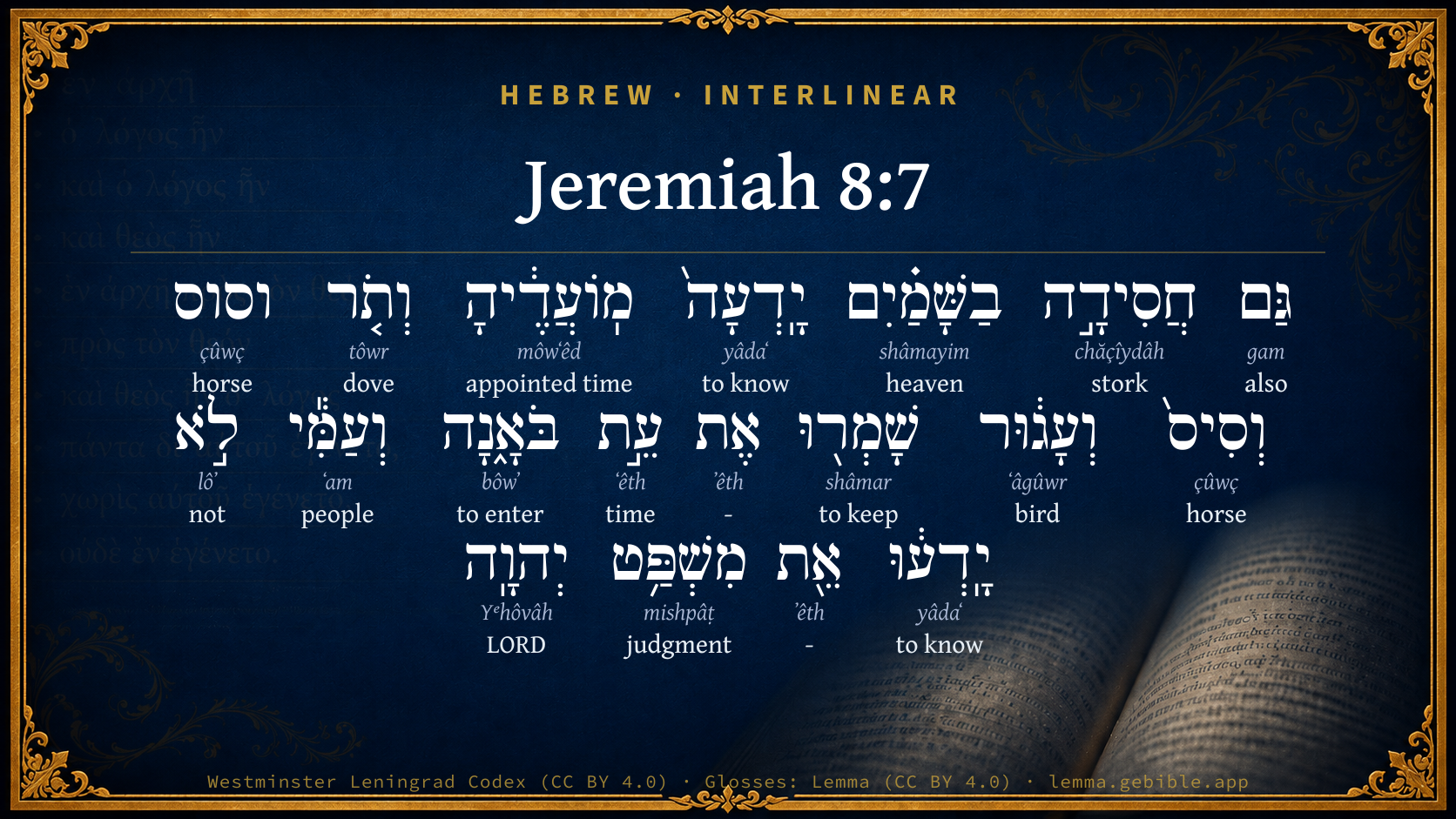
Hebrew (Westminster Leningrad Codex) Jeremiah 8:7 appears in the Hebrew Old Testament. The text above is from the Westminster Leningrad Codex. Each word links to its Strong’s number, a concise gloss, and parsing drawn from the Open Scriptures Hebrew Bible morphology. Click any word for its full Brown-Driver-Briggs (BDB) entry.
Download image
Cite this verse

Jeremiah 8:7 (World English Bible). Public Domain. Lemma interlinear Bible study tool, https://lemma.gebible.app/v/jeremiah/8/7.

Show BibTeX & RIS
BibTeX
RIS
English Translation
Yes, the stork in the sky knows her appointed times; and the turtle-dove and the swallow and the crane observe the time of their coming; but my people don't know Yahweh's law.
World English Bible · Public Domain
Download a study sheet

One document with this verse’s original text, its word-by-word gloss line, the meaning frame, cross-references with their text, attributed commentary, and full source and license credits — printable, and it pastes into notes with its structure intact.

This verse Autodidact and up

Study sheet (.html) Plain text (.txt)

A passage Seminary Student

Up to 50 verses in one chapter. A passage sheet keeps up to 6 commentary sources and 12 cross-references per verse, in the order this page ranks them, and says so on the sheet whenever that leaves anything out. Ask for a single verse and you get the Autodidact verse sheet above.

Everything on this page stays free to read, with no account — the sheet is a download of what is already on screen, not access to it.

Want to remove ads? Support Godless Engineer
Compare translations 3

The same verse in 3 English versions, stacked beneath the original-language interlinear above. Click any original word for its lexicon entry.

Each is an independent rendering of the whole verse — the interlinear is not word-aligned to these translations.

Highlighted words mark where these versions differ — a whole-verse word diff, not a word-by-word alignment.

  • World English Bible Public Domain
    Yes, the stork in the sky knows her appointed times; and the turtle-dove and the swallow and the crane observe the time of their coming; but my people don't know Yahweh's law.
  • King James Version Public Domain
    Yea, the stork in the heaven knoweth her appointed times; and the turtle and the crane and the swallow observe the time of their coming; but my people know not the judgment of the LORD.
  • unfoldingWord Literal Text CC BY-SA 4.0
    Even the stork in the heavens knows its appointed times, and a turtledove, and a swift one, and a crane keep the time of their coming, but my people do not know the rule of Yahweh.

unfoldingWord Literal Text — © unfoldingWord, licensed CC BY-SA 4.0. Word-aligned USFM3 via Door43 (git.door43.org/unfoldingWord/en_ult).

Versions to compare (up to 4)

3 of 4 selected

Show all 18 translations

Every available English version of this verse, each an independent rendering of the whole verse.

  • World English Bible Public Domain
    Yes, the stork in the sky knows her appointed times; and the turtle-dove and the swallow and the crane observe the time of their coming; but my people don't know Yahweh's law.
  • Berean Standard Bible Public Domain
    Even the stork in the sky knows her appointed seasons. The turtledove, the swift, and the thrush keep their time of migration, but My people do not know the requirements of the LORD.
  • Majority Standard Bible Public Domain
    Even the stork in the sky knows her appointed seasons. The turtledove, the swift, and the thrush keep their time of migration, but My people do not know the requirements of the LORD.
  • King James Version Public Domain
    Yea, the stork in the heaven knoweth her appointed times; and the turtle and the crane and the swallow observe the time of their coming; but my people know not the judgment of the LORD.
  • American Standard Version (1901) Public Domain
    Yea, the stork in the heavens knoweth her appointed times; and the turtle-dove and the swallow and the crane observe the time of their coming; but my people know not the law of Jehovah.
  • Revised Version (1885) Public Domain
    Yea, the stork in the heaven knoweth her appointed times; and the turtle and the swallow and the crane observe the time of their coming; but my people know not the ordinance of the LORD.
  • Geneva Bible (1599) Public Domain
    Euen the storke in the aire knoweth her appointed times, and the turtle and the crane and the swallowe obserue the time of their comming, but my people knoweth not the iudgement of the Lord.
  • Douay-Rheims (1899) Public Domain
    The kite in the air hath known her time: the turtle, and the swallow, and the stork have observed the time of their coming: but my people have not known the judgment of the Lord.
  • Young's Literal Translation Public Domain
    Even a stork in the heavens hath known her seasons, And turtle, and swallow, and crane, Have watched the time of their coming, And -- My people have not known the judgment of Jehovah.
  • Literal Standard Version CC BY-SA 4.0
    Even a stork in the heavens has known her seasons, || And turtle, and swallow, and crane, || Have watched the time of their coming, || And—My people have not known the judgment of YHWH.
  • Unlocked Literal Bible CC BY-SA 4.0
    Even the stork in heaven knows the right times; and the doves, swifts, and cranes. They go on their migrations at the right time, but my people do not know Yahweh's decrees.
  • unfoldingWord Literal Text CC BY-SA 4.0
    Even the stork in the heavens knows its appointed times, and a turtledove, and a swift one, and a crane keep the time of their coming, but my people do not know the rule of Yahweh.
  • Darby Bible Public Domain
    Even a stork in the heavens knoweth her appointed times, and the turtle-dove and the swallow and the crane observe the time of their coming; but my people know not the judgment of Jehovah.
  • World Messianic Bible Public Domain
    Yes, the stork in the sky knows her appointed times. The turtledove, the swallow, and the crane observe the time of their coming; but my people don’t know the LORD’s law.
  • Webster's Bible Public Domain
    Yes, the stork in the heaven knoweth her appointed times; and the turtle and the crane and the swallow observe the time of their coming; but my people know not the judgment of the LORD.
  • Free Bible Version CC BY-SA 4.0
    Even storks high in the sky know when it's time to migrate. Turtledoves, swifts, and songbirds know when to fly away at the right time of the year. But my people don't know the laws of the Lord.
  • Bible in Basic English Public Domain
    Truly, the stork in the heavens is conscious of her fixed times; the dove and the swallow and the crane keep to the times of their coming; but my people have no knowledge of the law of the Lord.
  • JPS Tanakh (1917) Public Domain
    Yea, the stork in the heaven knoweth her appointed times; and the turtle and the swallow and the crane observe the time of their coming; but My people know not the ordinance of the LORD.

Literal Standard Version (2020), Covenant Press — licensed CC BY-SA 4.0. Text via the HelloAO Bible API (eBible.org). Unlocked Literal Bible (unfoldingWord) — licensed CC BY-SA 4.0. Text via the HelloAO Bible API (eBible.org). unfoldingWord Literal Text — © unfoldingWord, licensed CC BY-SA 4.0. Word-aligned USFM3 via Door43 (git.door43.org/unfoldingWord/en_ult). Free Bible Version, Dr. Jonathan Gallagher — licensed CC BY-SA 4.0. Text via the HelloAO Bible API (eBible.org).

Word by word

More ways to search: Search by grammar → Find every occurrence → Compare this word →

Practice this passage: Drill this verse → Learn its vocabulary →

וְעָג֔וּר
ʻâgûwr
H5693
“and · bird”
Conjunction + Noun, Common, Masculine, Singular, Absolute
Part of Speech
Conjunction + Noun
Type
Common
Gender
Masculine
Number
Singular
State
Absolute
Full BDB Definition

Origin: pass part [but with active sense] of an unused root meaning to twitter

TWOT: 1563a

name of a bird - perhaps a thrush, swallow, crane
  1. גַּם gam H1571 “also” Particle, Accusative
  2. חֲסִידָ֣ה chăçîydâh H2624 “stork” Noun, Common, Feminine, Singular, Absolute
  3. בַשָּׁמַ֗יִם shâmayim H8064 “in/at the · heaven(s)” Preposition, Determined + Noun, Common, Masculine, Dual, Absolute
  4. יָֽדְעָה֙ yâdaʻ H3045 “to know” Verb, Qal, Perfect, 3rd Person, Feminine, Singular
  5. מֽוֹעֲדֶ֔יהָ môwʻêd H4150 “appointed times · her” Noun, Common, Masculine, Plural, Construct + Suffix, Personal, 3rd Person, Feminine, Singular
  6. וְתֹ֤ר tôwr H8449 “and · dove” Conjunction + Noun, Common, Both, Singular, Absolute
  7. וסוס çûwç H5483 “and · horse” Conjunction + Noun, Common, Masculine, Singular, Absolute
  8. וְסִיס֙ çûwç H5483 “and · horse” Conjunction + Noun, Common, Masculine, Singular, Absolute
  9. שָׁמְר֖וּ shâmar H8104 “to keep” Verb, Qal, Perfect, 3rd Person, Common, Plural
  10. אֶת ʼêth H853 “-” Particle, Direct Object
  11. עֵ֣ת ʻêth H6256 “time of” Noun, Common, Both, Singular, Construct
  12. בֹּאָ֑נָה bôwʼ H935 “to enter · them” Verb, Qal, Infinitive Construct + Suffix, Personal, 3rd Person, Feminine, Plural
  13. וְעַמִּ֕י ʻam H5971 “and · people · my” Conjunction + Noun, Common, Masculine, Singular, Construct + Suffix, Personal, 1st Person, Common, Singular
  14. לֹ֣א lôʼ H3808 “not” Particle, Negative
  15. יָֽדְע֔וּ yâdaʻ H3045 “to know” Verb, Qal, Perfect, 3rd Person, Common, Plural
  16. אֵ֖ת ʼêth H853 “-” Particle, Direct Object
  17. מִשְׁפַּ֥ט mishpâṭ H4941 “judgment of” Noun, Common, Masculine, Singular, Construct
  18. יְהוָֽה Yᵉhôvâh H3068 “LORD” Noun, Proper

About this verse

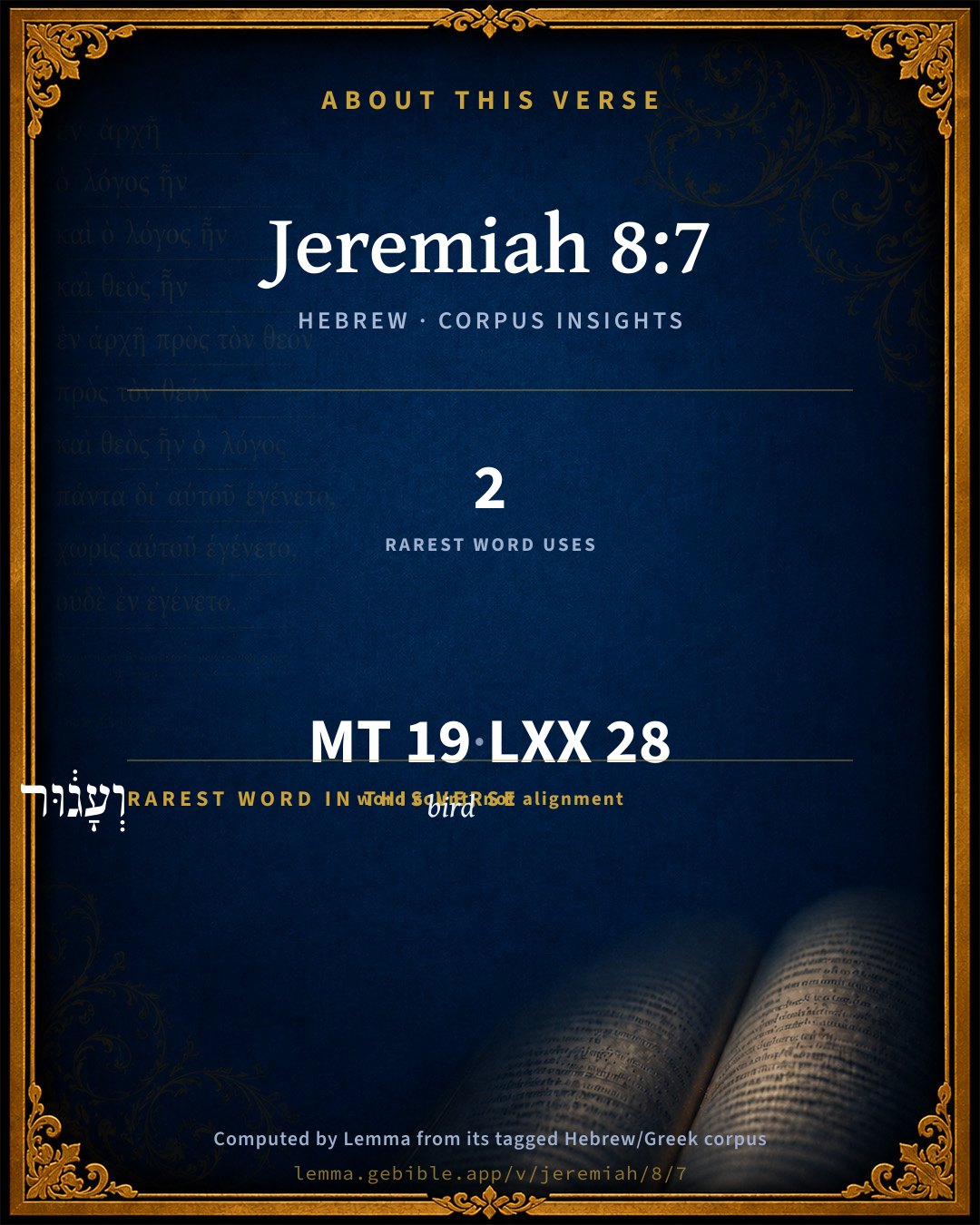
These counts appear in no published source. They are computed here, from the morphology-tagged text and Lemma’s own curated glosses. What Lemma adds →

19
words
16
distinct lemmas
Prophets
section

Notable vocabulary

The rarest word here is וְעָג֔וּר bird H5693 — appearing just 2 times in the whole Hebrew Bible.

Shared distinctive vocabulary

וְעָג֔וּר bird H5693 occurs in 2 verses of the Hebrew Bible. Also found in:

Grammatical profile

  • 4 verbs
  • 11 nouns
  • 4 particles

Verb forms

  • יָֽדְעָה֙ Qal · Perfect
  • שָׁמְר֖וּ Qal · Perfect
  • בֹּאָ֑נָה Qal · Infinitive Construct
  • יָֽדְע֔וּ Qal · Perfect

Repetition

Words recur within this verse — often emphatic in Hebrew:

  • יָֽדְעָה֙ to know H3045 ×2
  • וסוס horse H5483 ×2

Hebrew & Septuagint length

In the original languages it is 19 Hebrew tokens and 28 Greek tokens — but the two are counted differently (Hebrew bundles its prefixes and suffixes into one token; the Greek is in lemma form), so that isn’t a like-for-like length.

Cross-references

5

Topical passages linked to Jeremiah 8:7 in the Treasury of Scripture Knowledge — connected by theme and wording, ordered by reader-vote popularity; previews shown in the World English Bible.

  • Isaiah 1:3 The ox knows his owner, And the donkey his master's crib; But Israel doesn't know, My people don't consider.
  • Jeremiah 5:4–5 Then I said, Surely these are poor; they are foolish; for they don't know the way of Yahweh, nor the law of their God:
  • Proverbs 6:6–8 Go to the ant, you sluggard. Consider her ways, and be wise;
  • Isaiah 5:12 The harp, lyre, tambourine, and flute, with wine, are at their feasts; But they don't regard the work of Yahweh, Neither have they considered the operation of his hands.
  • Song of Solomon 2:12 The flowers appear on the earth; The time of the singing has come, And the voice of the turtle-dove is heard in our land.

Cross-references courtesy of OpenBible.info (CC BY 4.0).

Hebrew and Greek witnesses Masoretic Hebrew ↔ Greek Septuagint

The same verse in the two great witnesses to the Old Testament, shown verse-for-verse.

These are two independent witnesses, not word-aligned to each other, and the Septuagint is shown in lemma (dictionary) form.

Hebrew Jeremiah 8:7 Masoretic · Westminster Leningrad Codex

גַּם חֲסִידָ֣ה בַשָּׁמַ֗יִם יָֽדְעָה֙ מֽוֹעֲדֶ֔יהָ וְתֹ֤ר וסוס וְסִיס֙ וְעָג֔וּר שָׁמְר֖וּ אֶת עֵ֣ת בֹּאָ֑נָה וְעַמִּ֕י לֹ֣א יָֽדְע֔וּ אֵ֖ת מִשְׁפַּ֥ט יְהוָֽה

Yes, the stork in the sky knows her appointed times; and the turtle-dove and the swallow and the crane observe the time of their coming; but my people don't know Yahweh's law.

World English Bible · Public Domain

Greek LXX Structure differs

In the Septuagint, Jeremiah is about an eighth shorter than the Hebrew and arranges its material differently — the Oracles Against the Nations (Hebrew chapters 46–51) appear in the middle of the Greek book, after 25:13. Because the chapter and verse boundaries do not line up, a verse-for-verse comparison with the Hebrew is not shown.

A verse-for-verse comparison isn’t shown here because the chapters and verses don’t line up. Switch to the LXX edition with the MT / LXX toggle above to read the Greek directly.

Hebrew: Westminster Leningrad Codex (CC BY 4.0). Greek: Septuagint (public domain); English from a public-domain English Septuagint. How the Septuagint differs from the Hebrew →

Targum (Aramaic paraphrase)

1

The Targum is the ancient Jewish Aramaic paraphrase of the Hebrew Scriptures — an interpretive translation, not the Hebrew text itself. Onkelos (literal) and Pseudo-Jonathan (expansive) render the Torah, and Jonathan the Prophets. Coverage is partial: where no permissively-licensed English translation exists for a verse, only the Aramaic is shown. This is verse-level text, not a word-by-word alignment to the Hebrew.

  1. Targum Jonathan Prophets (Joshua–Malachi)
    אַף חִוָרִיתָא בִּשְׁמַיָא יָדְעָא זִמְנָהָא וְשַׁפְנִינָא וְכוּרְכַיָא וּסְנוּנִיתָא נַטְרִין יַת עִדַן מֵיַעלְהוֹן וְעַמִי לָא הֲווֹ יָדְעִין לְמֶעְבַּד יַת קְיָמָא דַיָי:

    (no public-domain English translation for this verse)

    Targum Jonathan — Aramaic: “Mikraot Gedolot” (public domain). English: “Sefaria Community Translation” (CC0 1.0 (public-domain dedication)); “London "Chaldee Paraphrase," 1871” (public domain). Text via Sefaria.

Commentary

Notes on Jeremiah 8:7 from classic Christian and Jewish commentators (each source and its license shown beneath its notes). The classic Christian expositions comment on the surrounding passage and are grouped to its opening verse, so a note may address several verses; the Jewish commentaries on the Tanakh (Rashi and others) are per-verse, so they appear only where the commentator wrote on this verse.

Lemma curates 59 commentaries, every one of them public domain or Creative Commons licensed, each selected and text-cleaned for this edition rather than reprinted as found. About our sources →

Trapp's Complete Commentary

John Trapp

Jer 8:7 Yea, the stork in the heaven knoweth her appointed times; and the turtle and the crane and the swallow observe the time of their coming; but my people know not the judgment of the LORD.

Ver. 7. Yea, the stork in the heaven knoweth her appointed times.] These souls, though wanting reason, know well when to change quarters, whether against summer, as the stork, turtle, and swallow, or against winter, as the crane.

But my people know not the judgment of the Lord.] Whether his summer of grace offered, or his winter of punishment threatened; to embrace the one or to prevent the other. See a like dissimilitude and opposition, Isa 1:3.

John Trapp, A Commentary or Exposition upon All the Books of the Old and New Testament (1647–1656) — public domain. Text from a community e-Sword module.

The Biblical Illustrator

Joseph S. Exell

Jer_8:7

But My people know not the Judgment of the Lord.

A set time for judgment

The judgment of God is either directive, corrective, or destructive. This last is meant here. It is spoken of the judgment of utter ruin and desolation upon whom the former judgment has not taken due effect. In the count of the Holy Ghost in Scripture, a man knows no more than he believes, and is affected with, and makes use of: they knew not, they considered not, believed not, were not affected with, neither did they make use of it, either the judgment itself, nor the time of the judgment, either to fear it, or to fly from it: so that they were more unwise for themselves, and for their temporal and eternal safety, than the unreasonable creatures; they knew not the judgment of the Lord.

I. There is unto a sinful nation a set and appointed time of judgment.

1. There is a time of sinning, a set and an appointed time.

(1) A fulness of sin, appointed by God that it shall have its period (Gen_15:16; Zec_5:6).

(2) A measure of wrath, which every vessel of wrath shall treasure up (Rom_2:4-5).

2. There is a time of patience, when the Lord holds His peace and reproves not (Psa_50:21; Psa_50:23). There is a time of repentance, when God defers the judgment after sinning, on purpose that man may return and come in (Rev_2:21).

3. The times of patience and repentance have their periods; indeed these times are not of the same length to all: to some God shows but a little patience, and to others a great deal, riches of patience and forbearance. But the longest day hath its evening.

4. When the time of patience is expired, there is then a time for judgment, a day of recompense, a year of vengeance, a time for the expending of those treasures of wrath that have been so long laying in; because there was by sinning a time of treasuring: and so there shall also come a time of spending (Rom_2:4-5); a time for the wall that is swelled out to hang, but there will come a time also when it will fall (Isa_30:13).

5. When this time doth come, the Lord will forbear a people no longer: this determinating of judgment in the time of it is exceedingly set before us in the Word, and that under divers expressions.

(1) The Lord doth express it by a full and a peremptory resolution that He will do it (Eze_21:27).

(2) It is called a decree, or the bringing forth the decree (Zep_2:2). Decrees are acts of authority. They are established and firm.

(3) It is called swearing in His wrath (Psa_9:11).

(4) Those means that usually prevail with God, and turn away threatened judgment, prevail nothing in the time of judgment. Repentance, prayer, fasting, intercession of the godly. When once the set time for judgment is come, the Lord will forbear a people no longer.

II. This time of judgment may and most be known. Otherwise they could not be blamed. What, then, are the signs preceding judgment?

1. A fulness of sin (Joe_3:16; Jer_1:11-12). An almond tree hath the first ripe fruit of any tree, and it notes the hastening of them to ripen their sins; and the Lord saith, as they did hasten their sins to a ripeness, so He would hasten to ripen His judgments, so that this is a certain sign foregoing judgment. But when is sin full? When is it ripe in a nation?

(1) When a people seeks to make void the law.

(2) Corrupting the worship of God by human inventions.

(3) Confederacy with idolaters.

(4) Abusing the messengers of God.

(5) Not laying to heart the afflictions of our brethren.

2. The beginnings of judgment are an evident token that the time of judgment draws near (Luk_2:30-31). By a lesser judgment God makes way for His anger, for a perfect and an utter ruin (Psa_78:50).

(1) All nations about them were against them (Jer_12:9).

(2) The general corruption and decay of truth and wisdom of men in places of greatest trust (Isa_1:22).

(3) The subversion of fundamental laws (Psa_82:5).

(4) Private and intestine divisions.

Use--

1. Not to know the time is misery enough; therefore men are taken suddenly and unawares (Ecc_9:12).

2. That you may know the time to improve this promise (Ecc_8:5).

3. A wise man foresees the evil, and hides himself, but fools pass on and are punished (Pro_22:3).

(1) By a work of humiliation (Hab_3:16).

(2) A work of reformation (Zep_2:3).

(3) Improve all the promises.

(4) Be much in prayer.

(5) Betake thyself to the mediation of Christ. (W. Strong.)

Seek safety before the storm comes

Merchants take care to insure their goods before the ship clears the dock. It would be useless, when the news of a terrible sea storm came, to run to the office, and then expect to make all safe and right. O living but dying man, at once, today, prepare for the coming storm. (E. Foster.)

Jer_8:7-8

The stork in the heaven knoweth her appointed times.

Instinct contrasted with reason in its discernment of times

I. The birds of passage show in their periodic migrations, their discernment of seasons, and this both as regards the time of their visiting and the time of their leaving us. Probably some peculiarity in the material structure of migratory birds renders them extremely sensitive to changes of temperature--and as these changes always recur at certain seasons of the year, they observe seasons, and make a corresponding change in their places of abode. So great is their sagacity, so true their instinct.

II. Consider the operation of unsanctified reason in discerning times.

1. Consider the invitations of this season of grace.

(1) The Saviours voice issuing forth from the pages of the written Word, addresses sinners in such soothing accents, and holds forth to them promises so refreshing, that one would think it could hardly fail of winning an entrance into their hearts, and finding a response there!

(2) But we believe that in every case in which the sinner has made a nominal profession of Christs religion, and been formally admitted to the participation of Christian privileges, the Holy Spirit seconds, by an inward action upon the conscience, this external call of the Saviour. In the abysmal depths of the consciousness He strives with the reluctant soul, and whispers in accents, which even the giddy whirl of vanity and frivolity cannot entirely drown or shut out, Come.

(3) God employs subordinate human agents to herald in the ears of His people His invitations of grace. The bride, that is the Church, says Come. She says so by her ministers, who are her commissioned representatives.

(4) God invites us to return in penitence and faith to His bosom by the dispensations of His providence, no less than by more immediate and direct summons (Hos_5:15; Mic_6:9).

2. But if the majority of sinners be not gently won by the invitations of grace, they will haply be driven by terror to take refuge in those offers. Let growing age and infirmity bring death and judgment very near--the prospect will surely urge the wanderer to return with hurried steps to the sheepfold! When hoar hairs are here and there upon him, he will lay to heart the cheerless desolate prospect which lies before him in the vista of futurity, and fly before the approaching winter of Gods wrath! (Dean Goulburn.)

Migration heavenward

When God would set fast a beautiful thought, He plants it in a tree. When He would put it afloat, He fashions it into a fish. When He would have it glide the air, He moulds it into a bird. The prophet was out of doors, thinking of the impenitences of the people of his day, when he heard a great cry overhead. He looks up, and there are flocks of storks, and turtledoves, and cranes, and swallows, drawn out in long line for flight southwards. As is their habit, the cranes had arranged themselves into two lines, making an angle--a wedge--splitting the air with wild velocity; the old crane, with commanding call, bidding them onward, until the towns, and the cities, and the continents slid under them. The prophet, almost blinded from looking into the dazzling heavens, stoops down and begins to think how much superior the birds are in sagacity about their safety than men.

I. They mingle music with their work. The most serious undertaking of a birds life is this annual travel. Naturalists tell us that they arrive weary and plumage ruffled, and yet they go singing all the way, the ground the lower line of the music, the sky the upper line of the music, themselves the notes scattered up and down between. I suppose their song gives elasticity to their wings, and helps on the journey. Would God that we were as wise as they, mingling Christian song with our everyday work. A violin, chorded and strung, if something accidentally strike it, makes music; and I suppose there is such a thing as having our hearts so attuned by Divine glory that even the rough collisions of life will make heavenly vibration. Some one asked Haydn why he always composed such cheerful music. Why, he said, I cannot do otherwise. When I think of God, my soul is so full of joy that the notes leap and dance from my pen. I wish we might all exult melodiously before the Lord. The Church of God will never become a triumphal Church until it becomes a singing Church.

II. They fly very high. During the summer, when they are in the fields, they often come within reach of the gun; but when they start for their annual flight southward they take their places mid-heaven, and go straight as a mark. The longest rifle that was ever brought to shoulder cannot reach them. We fly so low that we are within range of the world, the flesh, and the devil. So poor is the type of piety in the Church of God at this day that men actually caricature the idea that there is any such thing as a higher life. Moles never did believe in eagles. But because we have not reached these heights ourselves, shall we deride the fact that there are any such heights? I do not believe that God exhausted all His grace in Paul, and Latimer, and Edward Payson. I believe there are higher points of Christian attainment to be reached in the future ages of the Christian world.

III. They know when to start. If you should go out now, and shout, Stop, storks and cranes, dont be in a hurry, they would say, No, we cannot stop. Last night we heard the roaring of the woods bidding us away, and the shrill flute of the north wind has sounded the retreat. We must go. So they gather themselves into companies, and turning not aside for storm or mountain top, or shock of musketry, over land and sea, straight as an arrow to the mark, they go. And if you come out this morning with a sack of corn, and throw it in the fields, and try to get them to stop, they are so far up that they would hardly see it. They are on their way south. You could not stop them. Oh! that we were as wise about the best time to start for God and heaven. I was reading of an entertainment given in a kings court, and there were musicians there with elaborate pieces of music. After a while Mozart came and began to play, and he had a blank piece of paper before him, and the king familiarly looked over his shoulder and said, What are you playing? I see no music before you. And Mozart put his hand on his brow, as much as to say, I am making it up as I go along. It was very well for him; but, oh! we cannot extemporise heaven. If we do not get prepared in this world, we will never take part in the orchestral harmonies of the saved. Oh! that we were as wise as the crane and the stork, flying away, flying away from the tempest. Some of you have felt the pinching frost of sin. You feel it today. You are not happy. There are voices within your soul that will not be silenced, telling you that you are sinners, and that without the pardon of God you are undone forever. Oh! that you would go away into the warm heart of Gods mercy. The southern grove, redolent with the magnolia and cactus, never waited for northern flocks as God has waited for you. Another frost is bidding you away: it is the frost of trouble. Where do you live now? Oh, you say, I have moved. Why did you move? You say, I dont want as large a house now as I used to want. Why do you not want as large a house? You say, My family is not so large. Where have they gone to? Eternity! (T. De Witt Talmage.)

Migratory birds

(childrens address):--It is very remarkable that in the whole globe there is no place suitable all the year round for birds of this order; and that these untaught and unthinking creatures should shift their habitation, and make long voyages through the vast empire of the air. God has imprinted upon their nature that wonderful instinct which enables them to determine when to go and which way to take. The prophet, with the deep instinct of a poet, sees, and declares to Israel, the inner meaning and lessons of the laws and habits of these aerial voyagers.

I. We must obey the call of God. At the appointed time the birds feel an impulse or moving within them that they must be going, they congregate together, like swallows in autumn, all ready for their long journey. So in the same way, by the movements of conscience and the voice of Divine truth, God is calling us. Abraham obeyed that call, and left his idolatrous surroundings, and so did the fishers of Galilee, they left their nets and followed Christ. In the second part of Bunyans Pilgrims Progress, you see how the children left the city of destruction and went on the heavenly journey.

II. Do not delay to start. You have noticed the birds preparing: the trees and hedgerows are covered with them, and there is such a chattering! Stragglers are coming in, one after the other, and, at last, the signal is given, wings flutter, and then, like a moving dark cloud, the birds begin their wonderful passage across the pathless seas. But some swallows are too late, they are left behind, and perish in the cold. We read in the Bible that Lots wife lingered and was overtaken by death: the five foolish virgins were all unprepared and too late; but the Psalmist was of a different character; he said, I made haste, I delayed not to keep Thy commandments.

III. Beware of temptations. What is it that makes some of the birds late, so that they cannot start with the others? Perhaps, the sunshine! Everything looked so beautiful, the trees were decked in splendour, like Josephs coat of many colours, and the fat red berries glowed like little balls of fire, and so the birds were tempted to delay their journey until it was too late. It was so with the Jews in Babylon. God called them out of the land of captivity, and opened a way for them through the desert, back to the temple and city of their fathers, but many of them were tempted to remain behind; they had nice houses in Babylon, and there were many pleasant things there, from which it was hard to break away. So the world today will seek to keep you back from God, and prevent you beginning the heavenward journey. Beware of its temptations, and pray God to make you strong to overcome.

IV. Like birds, fly high, that is, live near to God. There are two advantages the birds have when they fly high up in the air, they can see farther, and they are a greater distance from the guns and snares of the earth, and the weapon of the enemy. In churches, the lectern, on which rests the Bible, is generally a burnished eagle, as if to say, that just as the eagle soars upward and upward towards the sun, so the Bible, if we daily and prayerfully read it, will bring us into the light of Gods own presence. Then shall we see the way of life more clearly, and escape the fiery darts of the evil one. God, too, will fit us for our long journey just as He strengthens the birds for theirs, giving to the swallow long and powerful wings, and to the quail and other birds of shorter pinions marvellous strength of body. Cullen Bryant beautifully says of the waterfowl--

He who from zone to zone,

Guides thro the boundless sky thy certain flight,

In the long way which I must tread alone,

Will lead my steps aright.

(A. Hampden Lee.)

Duty of repentance illustrated

I. Respecting the nature of the duty; the similitude in the text directs us to consider it as a return, a treading back our steps, as birds of passage return to the country from which they departed. We may then define repentance to be, A change of mind, operating in a change of conduct.

1. The leading step in the process must of necessity be conviction. No man will think of returning into the right way, unless he be made sensible that he has wandered out of it. Conviction is produced gradually. Upon some hint given to a man, either from within or from without, he begins to suspect himself in the wrong; and then, if he be honest enough to prosecute the inquiry, discovers at length that he actually is so. Sometimes it is flashed upon the mind at once--he awakes, and the dream is at an end. It is produced by various means, by disappointments, by crosses, by losses, by sickness, by the death of a friend, by a passage in Scripture, or a discourse upon one, by the incidents of common life, or the changes that happen in the natural world; in short, there is hardly a circumstance of so trivial a nature, but that providence, in some instance or other, has been pleased to make it instrumental to this salutary purpose.

2. The next step to conviction, in the process of repentance, is sorrow. The man who has offended his Maker, and is become thoroughly sensible that he has done so, and of the consequences of his having done so, cannot but be grieved to find himself in such a situation. The degree of this sorrow is varied almost infinitely by the different temperaments of mind and body in the penitents, and the different views under which sin presents itself to their several imaginations. And, therefore, the same degree is not to be exacted of all. By enthusiasm it has been, not unfrequently, aggravated even to frenzy and madness. In Scripture it is drawn with an aspect perfectly sober, but yet described, in many instances, as very intense, like that occasioned by the languors of sickness in its last stage, or the pain arising from dislocated or broken bones, and venting itself in complaints and lamentations, in sighs and tears. There are temporal ealamities, which can draw tears plentifully from most persons; nay, a fictitious representation of them can produce the effect. Spiritual ones, perhaps, would do the same, if we felt them as we ought to feel them; as due retirement and meditation would cause us to feel them; and as we shall one day feel them, when death shall be seen levelling his dart at our pillow, and the throne of judgment rising to the view, beyond him.

3. A third step is confession. One of an ingenuous mind, who is heartily sorry for his offences, will not be ashamed or backward to own that sorrow.

4. A fourth step is resolution to amend.

5. One step more remains, and only one, but that very steep and difficult of ascent, which is, to carry what we have resolved into execution. It is this which finishes and crowns all the rest.

II. The motives to it. Evil to be avoided, and good to be obtained, are the motives, which influence and produce all human actions. To escape from the rigours and storms of winter, and to enjoy the sweets of a milder and more gracious season, is the instinctive cause, why the heaven-taught monitors, to whom we are referred, migrate from one country to another. It is to avoid the judgments of God, and partake of His mercies, that man is called to repent.

1. The evil, then, to be avoided, is the judgment of God, consequent upon sin, and sure to overtake it, if unrepented of Sin, which is the transgression of the law, cannot but be noticed by Him who gave that law; and if noticed, must be punished, either in this life, or that which is to come. Sin is often punished in this life; much oftener than we are aware; indeed so often, that we may say to you as Moses to Israel (Num_32:23). It would be in vain, however, to dissemble, that in the present state, as is the offence, such is not always the punishment. Notorious sinners often partake not, to appearance, the common evils of life, but pass their days in prosperity and health, and die without any visible tokens of the Divine displeasure. To take off, in some measure, the force of the objection, it must be remarked, that, besides those judgments of God, which lie open to the observation of mankind, there are others, even in the present life, of a secret and invisible kind, known only to the party by whom they are felt. In the brilliant scenes of splendor, of luxury and dissipation, surrounded by the companions of his pleasures, and the flatterers of his vices, amidst the flashes of wit and merriment, when all wears the face of gaiety and festivity, the profligate often reads his doom, written by the hand whose characters are indelible. Should he turn away his eyes from beholding it, and succeed in the great work, during the course of his revels, yet the time will come, when from scenes like these he must retire, and be alone: and then, as Dr. South says, What is all that a man can enjoy in this way for a week, a month, or a year, compared with what he feels for one hour, when his conscience shall take him aside, and rate him by himself? There is likewise another hour which will come, and that soon--the hour when life must end; when the accumulated wealth of the east and the west, with all the assistance it is able to procure, will not be competent to obtain the respite of a moment. It will still be alleged, perhaps, that instances are not wanting of the worst of men, in principle and practice, going out of life with no less composure than the best. I believe these instances to be very rare indeed. But however, by habits either of sensuality or infidelity, the conscience may be drugged, and laid asleep in this world, let it not be forgotten that there is another world beyond this, in which it must awake, to sleep no more. And if in this world some sins are punished, as we have assurance they are, while others of far greater magnitude and more atrocious guilt are permitted to go unpunished, it will follow, by a consequence which the wit of man cannot gainsay, should he study for a thousand years to do it, that such sins, not being punished here, will most inevitably be punished there.

2. The good to be obtained needeth few words.

(1) The light of heaven shining upon our tabernacle, the Divine favour attending us and ours, through every stage of our existence, sanctifying prosperity, and turning adversity itself into a blessing, while it becomes an instrument to rectify the disorders of our minds, to soften the few hard places remaining in our hearts, to smooth and lay even the little roughnesses in our tempers; thus gradually and gently preparing us for our departure hence, and fitting us for the company of the spirits of just men made perfect.

(2) The answer of a good conscience, diffusing peace and serenity over all the powers and faculties of the soul, refreshing like the dew falling on the top of Hermon, exhilarating as the flagrance of the holy oil descending from the head of Aaron; sweetening the converse of society, and the charities of active life, and affording, in retirement and solitude, pleasures concealed from the world around us, joys in which a stranger intermeddleth not.

(3) The reward in heaven, the glory that shall be revealed, to be known only when it shall be revealed; the bliss without alloy, and without end, which he cannot conceive who has not experienced, and which he who has experienced can find no human language able to express.

III. Some short rules for the conduct of our repentance.

1. Stifle not convictions. Attend to every suggestion of this salutary kind, from what quarter soever it may proceed: attend and slight it not. It is the voice of God calling you to repentance. Listen, and obey.

2. Be serious. The subject will cause any man to become so, who considers it as he ought to do; who reflects, what sin is in the sight of God, what sorrow it occasioned to the Son of God, what destruction it hath brought upon the world, and is about to bring upon himself, unless prevented by a timely repentance. (Bp. Borne.)

The Biblical Illustrator, edited by Joseph S. Exell (c. 1880s–1900s) — public domain. Text from a community e-Sword module.

Joseph Benson's Commentary

Jer 8:7. Yea, the stork knoweth her appointed times — Of going and returning; the turtle and the crane, &c., the time of their coming — The proper season for changing their climate. Taught by natural instinct, they change their quarters as the temper of the air alters, removing to a warmer climate when the winter approaches, and returning when the spring comes on; but my people know not the judgment of the Lord — Understand neither their duty nor their happiness; they apprehend not the meaning either of God’s mercies or judgments, nor how to accommodate themselves to either so as to answer God’s intention therein. They know not how to improve the seasons of grace which God affords them when he sends them his prophets; nor how to make use of the rebukes they are under when his voice cries in the city. They discern not the signs of the times, (Mat 16:3,) nor are aware how God is dealing with them. They know not the law which God has prescribed them, though it be written both in their hearts and in their books.

Joseph Benson's Commentary on the Old and New Testaments (1811–1818) — public domain. Text from a community e-Sword module.

Tyndale Open Study Notes

Tyndale Open Resources

8:7 stork . . . turtledove . . . swallow . . . crane: The Creator gave certain birds the ability to navigate the sky from summer nesting places to winter feeding grounds, and they always follow those instincts precisely. By contrast, the people of Israel ignored God’s revelations and the covenant laws he had established.

Tyndale Open Study Notes — © Tyndale Open Resources, licensed CC BY-SA 4.0. Text via the HelloAO Bible API.

Geneva Bible (1599)

Geneva Bible translators

He accuseth them in that that they are more ignorant of God’s judgments, than these birds are of their appointed seasons to discern the cold and heat, as Isa. 1:3.

Geneva Bible (1599) marginal notes — public domain. Text via Bolls.life.

Jamieson, Fausset & Brown

Robert Jamieson, A. R. Fausset & David Brown

The instinct of the migratory birds leads them with unfailing regularity to return every spring from their winter abodes in summer climes (Sol 2:12); but God's people will not return to Him even when the winter of His wrath is past, and He invites them back to the spring of His favor.

in the heaven--emphatical. The birds whose very element is the air, in which they are never at rest, yet show a steady sagacity, which God's people do not.

times--namely, of migrating, and of returning.

my people--This honorable title aggravates the unnatural perversity of the Jews towards their God.

know not, &c.-- (Jer 5:4-5; Isa 1:3).

Jamieson, Fausset & Brown — Commentary Critical and Explanatory on the Whole Bible (1871) — public domain (CC PDM 1.0). Text via the HelloAO Bible API.

Adam Clarke's Commentary

Verse 7. The stork in the heaven] The birds of passage know the times of their going and return, and punctually observe them; they obey the dictates of nature, but my people do not obey my law.

Adam Clarke's Commentary on the Bible (1810–1826) — public domain. Text from a community e-Sword/MySword module.

John Calvin's Commentaries

Here again Jeremiah condemns the shameful insensibility of the people, — that they had less wisdom than birds, not endued with reason and understanding. He then says, that the Jews were more foolish than cranes, swallows, and storks. He no doubt deeply wounded the feelings of the people by so severe a reproof; but it was necessary thus sharply to reprehend the despisers of God; for it appears evident by these words, that they were become exceedingly hardened in their vices. No wonder, then, that the Prophet declares that they were more silly than cranes and swallows. Isaiah also exposes the same sort of madness, when he says that the ox knew his own master, and the ass his master’s crib, but that God was not known by his people. (Isaiah 1:3.) Now Isaiah made the Jews worse than oxen and asses, because these brute animals possess something like memory, so that they keep to their own manger and crib. So now Jeremiah, speaking of storks, etc., says, —

Behold, the stork knows the time in which it ought to migrate from one country to another; and the same is observed by swallows and cranes For at stated times they seek a warmer climate; that is, they leave a cold country, that they may escape the severity of winter; and they afterwards know the time in which they are to return. As, then, the birds of the air observe their seasons, how is it that my people do not consider the judgment of God? By mentioning the heavens, he no doubt alludes to the constant flying of birds, the birds having hardly any rest, for they continually rove through the air. Since, then, there is so much wisdom in birds, which yet the air wafts here and there, how comes it, that a people, who dwell quietly at home, who can leisurely meditate on God’s law — how comes it that this people understand nothing? We hence see that there is an import in the word heavens which has not been noticed. Readers may yet have their doubts; for it is nothing strange that birds in the heavens should have a clearer view, as they come nearer the sun and the element of fire: but different seems to have been the Prophet’s object; which was to shew, that though birds labor as it were continually, they yet contrive to know the suitable time for going and returning. Hence, then, is exaggerated more fully the insensibility of that people, who, while sitting leisurely at home, did not consider what God did set before them.

The particle גם, gam, even, is emphatical; Even the stork, he says. What means this, that birds, though not possessed of understanding, do yet know their time? But my people, etc. By saying “my people, “the Prophet no doubt intended more clearly to set forth their wickedness. For, as I have before said, such blindness in heathens would not have been so strange; but as they were the holy and peculiar people of God, it was far more shameful and monstrous that they knew not his judgment.

Christ uses other words in condemning the Pharisees for not attending to the time of their visitation; for he says, “Ye are wont to conclude what will be the state of the heavens in the morning; for if the sky be red in the evening, ye say, It will be fine to — morrow; and ye know the signs of future and approaching rain: ye possess, he says, judgment sufficiently acute in external things, which conduce to the benefit of the present life; yet ye know not the time of your visitation, and still ye seek signs: but were ye attentive, God would shew to you in a way clear enough, and as it were by the finger, that the time of deliverance which ye pretend to expect is now nigh at hand.” But the Prophet reproves the Jews in a severer strain, when he says that there was more fatuity and madness in them than in birds. They know not, he says, the judgment of Jehovah, though it had been shewn to them many times, and for a long season.

But some one might have objected and said, “No wonder if we perceive not God’s judgment, for his judgments are a great deep; and since these exceed what we can comprehend, there is no reason to find fault with us.” But the Prophet speaks not here of hidden judgments, which elude the comprehension of men, but of punishments, of which they had been so often warned. Since, then, they were so blind as not to see what was clear and evident, the Prophet justly says that they were more foolish than cranes, and the other birds which he mentions. It follows —

John Calvin's Commentaries (1540-1563) — public domain. Text from the Calvin Translation Society English edition (1840s-50s) via the Christian Classics Ethereal Library (ccel.org). Calvin's coverage is partial (roughly two-thirds of the Bible); uncommented books and verses are honest gaps, never fabricated. The 19th-century editor's footnotes and remarks are omitted so the notes are faithfully Calvin's own voice.

Ellicott's Commentary for English Readers

(7) The stork in the heaven.—The eye of the prophet looked on nature at once with the quick observation of one who is alive to all her changes, and with the profound thought of a poet finding inner meanings in all phenomena. The birds of the air obey their instincts as the law of their nature. Israel, with its fatal gift of freedom, resists that which is its law of life. The stork arrives in Palestine in March, and leaves for the north of Europe in April or May. The Hebrew name, chasideh (literally, the pious bird), indicating its care for its young, is suggestive, as also is the phrase “in the heavens,” as applied to its characteristic mode of flight. The turtle-dove appears at the approach of spring (Song Son_2:12).

The crane and the swallow.—In the judgment of Tristram and other modern naturalists, the words should change places, and perhaps “swift” take the place of swallow. The word for “swallow” in Psa_84:3 is different. The same combination meets us in Isa_38:14.

Judgment.—Better, perhaps, ordinance, the appointed rule of life which brute creatures obey and man transgresses.

A Bible Commentary for English Readers, edited by Charles John Ellicott (1878–1897) — public domain. Text from a community e-Sword module.

The Cambridge Bible for Schools and Colleges

gen. ed. J. J. S. Perowne

7. Instinct renders migratory birds punctual in departure and arrival. How much more should man’s reason and conscience exercise over him an effective control. Cp. Isa_1:3.

stork] There are two species found in Palestine, the white and the black, the former dispersed generally in pairs over the whole country, the latter living in the deserts and in large flocks.

in the heaven] at the time of their migration they fly high. (See HDB. and Tristram, Nat. Hist. of Bible, 205, 219, 246.)

turtle] There are three species of turtle dove in Palestine.

swallow] better, swift, or martin. All three are common in Palestine. The swift has a harsh cry, constantly repeated.

crane] perhaps a species of bird akin to that preceding. It may very possibly be the swallow, but no clear indication can be got from any sense of the root in Hebrew or cognate languages.

ordinance] though it is thus recognised by the lower animals.

The Cambridge Bible for Schools and Colleges (gen. ed. J. J. S. Perowne; Cambridge University Press, 1878–1918) — public domain. Text from a community e-Sword module.

John Gill's Exposition

Yea, the stork in the heaven knoweth her appointed times,.... Of going and returning; for this is a bird of passage, as Pliny (d) and other naturalists observe; which goes away as winter approaches, and returns when that is over. The temperature of the air, as to heat and cold, and the natural propensity of such birds of passage to breed their young, are thought to be the incentives to change their habitation; and wonderful thing it is in nature, that they should know the proper time of their passage, what places to go to, and how to steer their course thither; and, as the above naturalist observes, they go and come in the night:

and the turtle, and the crane, and the swallow, observe the time of their coming: for these also are birds of passage; the turtle is absent in the winter, and its coming is a sign of spring, Sol 2:11, the crane, according to Aelianus (e), goes away with the stork, and returns when winter is over; and the same is observable of the swallow; hence the common saying, one swallow does not make spring; so Horace (f) uses "hirundine prima" for the beginning of spring. Where these birds retire to is not known; some think the swallows fly into Egypt and Ethiopia; but Olaus Magnus (g) says they lurk in holes, and even under water, where they hang together, and are sometimes drawn out in clusters, and being brought to the fire, and thawed, will revive and fly about.

But my people know not the judgment of the Lord; meaning not the unsearchable judgments of God, or those providential dispensations of God which are a great deep, and are not clearly discerned and known by the best of men; but either his own judgments, which are inflicted upon wicked men as punishments for sin, which yet are not taken notice of, and duly attended to, as they should be; or rather the law of God, and his revealed word, which is the rule of judgment and justice, and a declaration of righteousness, showing what is just and good, and ought to be done, which they were willingly ignorant of; or else the final and future judgment of God after death, to which all men must come, and into which every thought, word, and work, will be brought, and which day wicked men put far from them; see Isa 1:3.

(d) Nat. Hist. l. 10. c. 23. (e) De Animal. l. 3. c. 23. (f) Ep. l. 1. Ep. 7. (g) De Ritu Gent. Septent. l. 19. c. 11.

John Gill's Exposition of the Whole Bible (1746–1763) — public domain (CC PDM 1.0). Text via the HelloAO Bible API.

Albert Barnes' Notes on the Bible

Jeremiah appeals to the obedience which migratory birds render to the law of their natures. The “stork” arrives in Palestine about March 21, and after a six weeks’ halt departs for the north of Europe. It takes its flight by day, at a vast height in the air (“in the heaven”). The appearance of the “turtle-dove” is one of the pleasant signs of the approach of spring.

The crane and the swallow - Rather, “the swift and the crane.”

Albert Barnes' Notes on the Bible (1834–1885) — public domain. Text from a community e-Sword/MySword module.

Haydock's Catholic Bible Commentary

Stork. These birds retire at the approach of winter to warmer climates. In Poland swallows plunge into marshes, like frogs. If instinct teach them to do so, for their preservation, is it not strange that men should be so inconsiderate?

George Leo Haydock (1774–1849), Haydock's Catholic Family Bible and Commentary, 1859 edition — public domain. Excludes Psalms (Douay-Rheims chapter numbering differs from Protestant) and Deuterocanonical books (Catholic canon only).

Matthew Poole's English Annotations

In the heaven, i.e. in the air, which is often called heaven, where the birds fly, Psa 8:8; compare Jer 7:33, who possibly observe the fit time by the temperature of the air.

Knoweth her appointed times, i.e. observeth the several seasons of her going and coming by some natural instinct, and this is said of the stork: what kind of fowl is here meant is disputable: see English Annotations and Latin Synopsis.

Observe the time of their coming; the same thing diversified in these several fowls, that know also their seasons.

But my people know not: this notes the great stupidity of his people, seeming not to have as much sense in them as the birds in the air, not knowing their summer of prosperity, to make a good use of God’s favours, nor the winter of adversity, either to prevent or remove that wrath of God that hangs over their heads, Isa 5:12; Luk 19:42,44; they know not their time for repentance, and making their peace with God, compared also, on the same account, to the beasts of the field, Isa 1:3; and thus Christ upbraids the Pharisees, Mat 16:2,3.

The judgment of the Lord; either God’s vengeance in general, or particularly hovering over Jerusalem and Judea; or rather, the manner of God’s dispensations with them. So the word is used 1Sa 2:13; 8:11.

Matthew Poole's English Annotations on the Holy Bible (1683–1685) — public domain. Text from a community e-Sword/MySword module.

Whedon's Commentary on the Bible

Daniel D. Whedon

7. Yea, the stork… knoweth, etc. — Even the birds obey the law of God written on their natures, but my people are more brutish than the irrational animals themselves.

Daniel D. Whedon (gen. ed.), Commentary on the Old and New Testaments (1874–1909) — public domain. Text from a community e-Sword module.

The Pulpit Commentary

The appeal to the regularity of animal instincts reminds us of Isa_1:3. Yea, the stork, etc. The minatory birds obey their instinct with the most unfailing regularity. Those referred to are:

(1) the stork, whose "regular and sudden return is one of the most interesting natural sights of Palestine. The expression "stork in the heavens" refers to the immense height at which they fly during migration" (Tristram);

(2) the turtle, or turtle-dove, whose return is the sure sign of spring; (Son_2:11)

(3 and 4) the crane and the swallow, or rather, "the swift and the crane." These birds are again mentioned together in Isa_38:14 (the psalm of Hezekiah), where special reference is made to the penetrating quality of their note. "The whooping or trumpeting of the crane rings through the night air in spring, and the vast flocks which we noticed passing north near Beersheba were a wonderful sight." The introduction of the swallow in the Authorized Version is misleading, as that bird is not a regular migrant in Palestine. The note of the swift is a shrill scream. "No bird is more conspicuous by the suddenness of its return than the swift," is the remark of Canon Tristram, who saw large flocks passing northwards over Jerusalem, on the 12th of February ("Nat. Hist. of Bible," p. 208). It is an interesting fact that the swift bears the same name (sus) in the vernacular Arabic as in the Hebrew of Jeremiah. The judgment; better, the law . (see Jer_5:4)

A lesson from the birds.

It is interesting to observe that the Scripture references to natural history are hot directed so much to theological arguments as to moral lessons. While questions concerning the being and nature of God absorb almost the exclusive attention of the natural theologian, the prophet, who assumes the belief of his hearers in the immanence of God in Nature, is more concerned to show how she rebukes man for his own shortcomings and incites to goodness by her mute example. The scriptural treatment is, therefore, more nearly followed by the regard for the human and moral aspects of nature in the spirit of Wordsworth and Ruskin, which is characteristic of the better thought of our own age, than by the cold, prosaic examination of the physical world, as simply affording one section of the evidences of religion, which was pursued in the days of Paley.

I. THE BIRDS REMIND US THAT WE ARE SURROUNDED BY DIVINE ORDINANCES. Migratory birds have their appointed times. Every creature has its special vocation. To the lower animals this comes as a necessary law, as a course determined by unconscious instinct. To man it comes as a mandate of duty, an impulse in the conscience, a way to be clearly perceived and freely chosen. But, though the same method for exacting the performance of the Divine ordinances which obtains in nature is not enforced on man, those ordinances extend to him; to him also they come with Divine sanction. Though man is physically free to rebel, morally he is no more his own master than are the birds who are bound by the laws of their instincts. Freedom from compulsion is not freedom from obligation.

II THE BIRDS REMIND US THAT IT IS AS WELL TO OBEY THE DIVINE ORDINANCES. In their migrations they find their welfare secured. Driven by the inward impulse of Divine law written on their instincts, they speed them over vast tracts of unknown lands, and at length find themselves in the clime and at the season which is beat suited for them. What an image of implicit faith! We are called to go forth, like Abraham, we know not whither, but like him to find a possession in the unknown. (Heb_11:8) The future is unseen, the way is wild and pathless, dark clouds as of brooding storms gather on the horizon; but if we take as our compass the known will of God, we too shall find sunny climes beyond the seas of trouble, a home at the end of our pilgrimage.

III THE BIRDS, BY THEIR EXAMPLE, REBUKE OUR DISOBEDIENCE TO THE DIVINE ORDINANCES. Free to roam through illimitable regions of air, the high-flying stork, the turtle-dove, the swift, and the crane all keep to their true course, not dropping down, tempted by the attractions of leafy vales or fruitful gardens, not turned aside terrified by the horrors of high mountains, lonely deserts, or stormy seas, till they reach their destination in punctual obedience to the mysterious law of their nature. These migratory birds are representative of external liberty restrained by inward law. We are not under any outward compulsion nor any inward law of instinct like that of the birds. But we are capable of following a higher law. We have light which is denied to them, and high motives of fear and love to prompt to obedience. If we disobey, the obedience of the birds is an ever-recurring rebuke.

The Pulpit Commentary (1880–1919), ed. H.D.M. Spence-Jones & Joseph S. Exell — public domain. Text from a community e-Sword module.

John Wesley's Explanatory Notes

Appointed time - The seasons of her going and coming. The judgment - God's vengeance, hovering over Jerusalem, and Judea.

John Wesley, Explanatory Notes Upon the Whole Bible (1754–1765) — public domain. Text via the GEBible commentary corpus.

Rashi

Rabbi Shlomo Yitzchaki (Rashi)

Even the stork (Cigogne in French).

her seasons The time they pass to the islands of the sea because of the cold, and the time of their return.

await Heb. שמרו.

and the turtledove and the crane and the swallow Jonathan renders: ושפנינא וכורכיא וּסנוּניתא. כּורכיא is (grue in French), a crane. סנוּניתא is (hirondelle in French), a swallow.

Rashi on the Tanakh — English translations: “The Judaica Press complete Tanach with Rashi, translated by A. J. Rosenberg” (CC BY 4.0); “Pentateuch with Rashi's commentary by M. Rosenbaum and A.M. Silbermann, 1929-1934” (public domain); “The Metsudah Tanach series, Lakewood, N.J” (CC BY 4.0); and “The Book of Joshua, Metsudah Publications, 1997” (CC BY 4.0). Text via Sefaria.

Lesson kit

Teaching starters — assembled from the data on this page, not authored interpretation. Every prompt links to the verse data it draws on. Edit before teaching.

Jeremiah, in the Prophets, opens this verse with 19 words (16 distinct Hebrew lemmas). Its most distinctive word is ʻâgûwr (“bird”). A historical commentator’s framing appears above. Read the whole chapter for the surrounding context.

Discussion questions

  1. How does “bird” (ʻâgûwr) shape what this verse is saying?
  2. Isaiah 38:14 shares the word «bird» with this verse. How do the two illuminate each other?
  3. “to know” occurs 2× in this one verse. What is the effect of the repetition?
  4. These translations render this verse differently; the difference is in the English rendering, not the original. What questions does that raise?
  5. The verb «יָֽדְעָה֙» is Qal Perfect. How does its form color the action?
  6. Reading how Trapp's Complete Commentary and The Biblical Illustrator read this verse, where do the two commentators agree and where do they part?

Things to notice

Reading settings

Reading text

Shown beneath each verse's original-language words.

Old Testament
Old Testament edition

Read the OT as the Masoretic Hebrew (MT) or the Greek Septuagint (LXX).

English shown for the Greek Septuagint (in the Hebrew ↔ Greek comparison).

Comparing translations? Open the Compare panel on any verse page to stack up to four side by side.