

Job 22:16

Hebrew (Westminster Leningrad Codex) Job 22:16 appears in the Hebrew Old Testament. The text above is from the Westminster Leningrad Codex. Each word links to its Strong’s number, a concise gloss, and parsing drawn from the Open Scriptures Hebrew Bible morphology. Click any word for its full Brown-Driver-Briggs (BDB) entry.
Download image
Cite this verse

Job 22:16 (World English Bible). Public Domain. Lemma interlinear Bible study tool, https://lemma.gebible.app/v/job/22/16.

Show BibTeX & RIS
BibTeX
RIS
English Translation
Who were snatched away before their time, Whose foundation was poured out as a stream,
World English Bible · Public Domain
Download a study sheet

One document with this verse’s original text, its word-by-word gloss line, the meaning frame, cross-references with their text, attributed commentary, and full source and license credits — printable, and it pastes into notes with its structure intact.

This verse Autodidact and up

Study sheet (.html) Plain text (.txt)

A passage Seminary Student

Up to 50 verses in one chapter. A passage sheet keeps up to 6 commentary sources and 12 cross-references per verse, in the order this page ranks them, and says so on the sheet whenever that leaves anything out. Ask for a single verse and you get the Autodidact verse sheet above.

Everything on this page stays free to read, with no account — the sheet is a download of what is already on screen, not access to it.

Want to remove ads? Support Godless Engineer
Compare translations 3

The same verse in 3 English versions, stacked beneath the original-language interlinear above. Click any original word for its lexicon entry.

Each is an independent rendering of the whole verse — the interlinear is not word-aligned to these translations.

Highlighted words mark where these versions differ — a whole-verse word diff, not a word-by-word alignment.

  • World English Bible Public Domain
    Who were snatched away before their time, Whose foundation was poured out as a stream,
  • King James Version Public Domain
    Which were cut down out of time, whose foundation was overflown with a flood:
  • unfoldingWord Literal Text CC BY-SA 4.0
    who were carried off and not time; their foundations were washed away by a torrent;

unfoldingWord Literal Text — © unfoldingWord, licensed CC BY-SA 4.0. Word-aligned USFM3 via Door43 (git.door43.org/unfoldingWord/en_ult).

Versions to compare (up to 4)

3 of 4 selected

Show all 18 translations

Every available English version of this verse, each an independent rendering of the whole verse.

  • World English Bible Public Domain
    Who were snatched away before their time, Whose foundation was poured out as a stream,
  • Berean Standard Bible Public Domain
    They were snatched away before their time, and their foundations were swept away by a flood.
  • Majority Standard Bible Public Domain
    They were snatched away before their time, and their foundations were swept away by a flood.
  • King James Version Public Domain
    Which were cut down out of time, whose foundation was overflown with a flood:
  • American Standard Version (1901) Public Domain
    Who were snatched away before their time, Whose foundation was poured out as a stream,
  • Revised Version (1885) Public Domain
    Who were snatched away before their time, whose foundation was poured out as a stream:
  • Geneva Bible (1599) Public Domain
    Which were cut downe before the time, whose foundation was as a riuer that ouerflowed:
  • Douay-Rheims (1899) Public Domain
    Who were taken away before their time, and a flood hath overthrown their foundation.
  • Young's Literal Translation Public Domain
    Who have been cut down unexpectedly, A flood is poured out on their foundation.
  • Literal Standard Version CC BY-SA 4.0
    Who have been cut down unexpectedly? A flood is poured out on their foundation.
  • Unlocked Literal Bible CC BY-SA 4.0
    those who were snatched away before their time, those whose foundations have washed away like a river,
  • unfoldingWord Literal Text CC BY-SA 4.0
    who were carried off and not time; their foundations were washed away by a torrent;
  • Darby Bible Public Domain
    Who were carried off before the time, whose foundation was overflowed with a flood;
  • World Messianic Bible Public Domain
    who were snatched away before their time, whose foundation was poured out as a stream,
  • Webster's Bible Public Domain
    Who were cut down out of time, whose foundation was overflowed with a flood!
  • Free Bible Version CC BY-SA 4.0
    They were taken before their time; all they had built was washed away.
  • Bible in Basic English Public Domain
    Who were violently taken away before their time, who were overcome by the rush of waters:
  • JPS Tanakh (1917) Public Domain
    Who were snatched away before their time, whose foundation was poured out as a stream;

Literal Standard Version (2020), Covenant Press — licensed CC BY-SA 4.0. Text via the HelloAO Bible API (eBible.org). Unlocked Literal Bible (unfoldingWord) — licensed CC BY-SA 4.0. Text via the HelloAO Bible API (eBible.org). unfoldingWord Literal Text — © unfoldingWord, licensed CC BY-SA 4.0. Word-aligned USFM3 via Door43 (git.door43.org/unfoldingWord/en_ult). Free Bible Version, Dr. Jonathan Gallagher — licensed CC BY-SA 4.0. Text via the HelloAO Bible API (eBible.org).

Word by word

More ways to search: Search by grammar → Find every occurrence → Compare this word →

Practice this passage: Drill this verse → Learn its vocabulary →

About this verse

These counts appear in no published source. They are computed here, from the morphology-tagged text and Lemma’s own curated glosses. What Lemma adds →

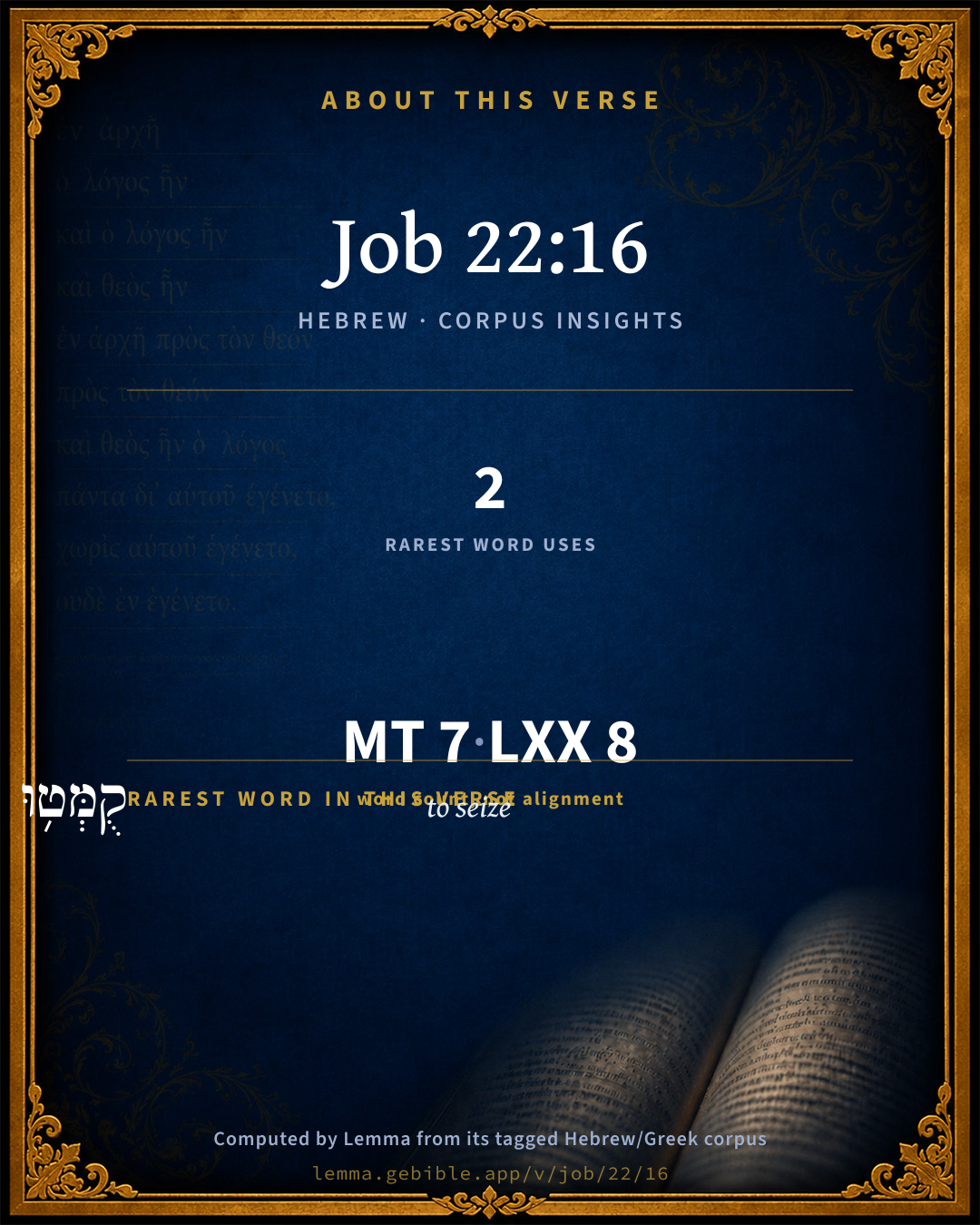
7
words
7
distinct lemmas
Wisdom
section

Notable vocabulary

The rarest word here is קֻמְּט֥וּ to seize H7059 — appearing just 2 times in the whole Hebrew Bible.

Shared distinctive vocabulary

קֻמְּט֥וּ to seize H7059 occurs in 2 verses of the Hebrew Bible. Also found in:

Grammatical profile

  • 2 verbs
  • 3 nouns
  • 2 particles

Verb forms

  • קֻמְּט֥וּ Pual · Perfect
  • יוּצַ֥ק Hophal · Imperfect

Hebrew & Septuagint length

In English translation the verse runs 15 words from the Hebrew and 13 from the Septuagint (LXX English) — closely comparable.

A rough comparison of the two English renderings, which tokenize alike — not a word-level alignment.

Word counts can differ between the Hebrew and the Greek without any difference in meaning — e.g. the Hebrew direct-object marker אֵת has no separate Greek word, and Greek often adds the article ὁ.

In the original languages it is 7 Hebrew tokens and 8 Greek tokens — but the two are counted differently (Hebrew bundles its prefixes and suffixes into one token; the Greek is in lemma form), so that isn’t a like-for-like length.

Cross-references

11

Topical passages linked to Job 22:16 in the Treasury of Scripture Knowledge — connected by theme and wording, ordered by reader-vote popularity; previews shown in the World English Bible.

  • Job 15:32 It shall be accomplished before his time. His branch shall not be green.
  • Genesis 7:17–24 The flood was forty days on the earth. The waters increased, and lifted up the ark, and it was lifted up above the earth.
  • Genesis 7:11 In the six hundredth year of Noah's life, in the second month, on the seventeenth day of the month, on the same day all the fountains of the great deep were burst open, and the sky's windows were opened.
  • Psalms 55:23 But you, God, will bring them down into the pit of destruction. Bloodthirsty and deceitful men shall not live out half their days, But I will trust in you.
  • Matthew 24:37–39 "As the days of Noah were, so will be the coming of the Son of Man.
  • 1 Peter 3:19–20 in which he also went and preached to the spirits in prison,
  • 2 Peter 2:5 and didn't spare the ancient world, but preserved Noah with seven others, a preacher of righteousness, when he brought a flood on the world of the ungodly;
  • Job 14:19 The waters wear the stones; The torrents of it wash away the dust of the earth: So you destroy the hope of man.
  • Psalms 102:24 I said, "My God, don't take me away in the midst of my days. Your years are throughout all generations.
  • Ecclesiastes 7:17 Don't be too wicked, neither be foolish. Why should you die before your time?
  • Matthew 7:26–27 Everyone who hears these words of mine, and doesn't do them will be like a foolish man, who built his house on the sand.

Cross-references courtesy of OpenBible.info (CC BY 4.0).

Hebrew and Greek witnesses Masoretic Hebrew ↔ Greek Septuagint

The same verse in the two great witnesses to the Old Testament, shown verse-for-verse.

These are two independent witnesses, not word-aligned to each other, and the Septuagint is shown in lemma (dictionary) form.

Hebrew Job 22:16 Masoretic · Westminster Leningrad Codex

אֲשֶֽׁר קֻמְּט֥וּ וְלֹא עֵ֑ת נָ֝הָ֗ר יוּצַ֥ק יְסוֹדָֽם

Who were snatched away before their time, Whose foundation was poured out as a stream,

World English Bible · Public Domain

Greek LXX Job 22:16 Septuagint · lemma form

ὅς συνλαμβάνω ἄωρος ποταμός ἐπιῥέω ὁ θεμέλιος αὐτός

who were seized before their time: their foundations are as an overflowing stream.

LXX2012 (modern English Septuagint) · Public Domain

On this verse, Adam Clarke's Commentary discusses the Septuagint’s reading. Read the note in Commentary ↓

Hebrew: Westminster Leningrad Codex (CC BY 4.0). Greek: Septuagint (public domain); English from LXX2012 (modern English Septuagint) (Public Domain). How the Septuagint differs from the Hebrew →

Commentary

Notes on Job 22:16 from classic Christian and Jewish commentators (each source and its license shown beneath its notes). The classic Christian expositions comment on the surrounding passage and are grouped to its opening verse, so a note may address several verses; the Jewish commentaries on the Tanakh (Rashi and others) are per-verse, so they appear only where the commentator wrote on this verse.

Lemma curates 59 commentaries, every one of them public domain or Creative Commons licensed, each selected and text-cleaned for this edition rather than reprinted as found. About our sources →

Trapp's Complete Commentary

John Trapp

Job 22:16 Which were cut down out of time, whose foundation was overflown with a flood:

Ver. 16. Which were cut down out of time] Or, Which grew full of wrinkles (as those that have long lain in the water are apt to do), and not time; that is, before that time of life that they had promised themselves on earth; or before they had fulfilled the days of their forefathers, who, though wicked above measure many of them, yet the flood could not come till Methuselah (the last alive of the ten patriarchs) were laid up. God cuts off some notoriously wicked sometimes, Intempeata morte abrepti (Jun.), when in the course of nature they might have lived longer, that they may do no more hurt, as the gardener destroyeth young henbane, and the countryman young vermins.

Whose foundation was overflown with a flood] Heb. A river was poured upon their foundation. This some understand of that river of brimstone and fire poured from heaven upon Sodom and her sisters; but better take it of those in Noah’s days, whose foundation (that is, the earth, that foundation of mankind; or their wealth and prosperity, whereon they thought themselves firmly founded, or their lives, &c.), were overflown with a flood; which came rushing in upon them with mighty force, and drowned the universe. And here the Hebrews make to be the middle of this book of Job, wherein they reckon in all one thousand and seventy verses.

John Trapp, A Commentary or Exposition upon All the Books of the Old and New Testament (1647–1656) — public domain. Text from a community e-Sword module.

Whedon's Commentary on the Bible

Daniel D. Whedon

b. The wrath of God, intensified by such scepticism, visits the world, overthrowing the boastful wicked, and calling forth the triumphal songs of the righteous, Job_22:16-20.

16. Cut down out of time, etc. — Literally, who were snatched away before the time — prematurely. Their foundation was poured away as a stream. Snatched away — Kamat is used only here and Job_16:8. See note.

With a flood — As a stream. Their foundation became fluid, an undoubted reference to the deluge. Compare Mat_7:27.

Daniel D. Whedon (gen. ed.), Commentary on the Old and New Testaments (1874–1909) — public domain. Text from a community e-Sword module.

Geneva Bible (1599)

Geneva Bible translators

He proveth God’s providence by the punishment of the wicked, whom he taketh away before they can bring their wicked purposes to pass.

Geneva Bible (1599) marginal notes — public domain. Text via Bolls.life.

Jamieson, Fausset & Brown

Robert Jamieson, A. R. Fausset & David Brown

cut down--rather, "fettered," as in Job 16:8; that is, arrested by death.

out of time--prematurely, suddenly (Job 15:32; Ecc 7:17); literally, "whose foundation was poured out (so as to become) a stream or flood." The solid earth passed from beneath their feet into a flood (Gen 7:11).

Jamieson, Fausset & Brown — Commentary Critical and Explanatory on the Whole Bible (1871) — public domain (CC PDM 1.0). Text via the HelloAO Bible API.

Adam Clarke's Commentary

Verse 16. Whose foundation was overflown with a flood] The unrighteous in the days of Noah, who appear to have had an abundance of all temporal good, (Job 22:18,) and who surpassed the deeds of all the former wicked, said in effect to God, Depart from us. And when Noah preached unto them the terrors of the Lord, and the necessity of repentance, they rejected his preaching with, What can the Almighty do for us? Let him do his worst; we care not for him, Job 22:17.

For למו lamo, to THEM, the Septuagint, Syriac, and Arabic have evidently read לנו lanu, to US. This reading quotes their own saying; the former reading narrates it in the third person. The meaning, however, is the same.

Adam Clarke's Commentary on the Bible (1810–1826) — public domain. Text from a community e-Sword/MySword module.

Ellicott's Commentary for English Readers

(16) Which were cut down out of time.—Or, which were snatched away before their time. It is generally supposed that there is an allusion here to the history of the Flood; if so, the reference is of course very important in its bearing on the age of that record, since the Book of Job can hardly fail to be very old itself.

Whose foundation was overflown with a flood.—Or, upon whose foundation a stream was poured out; or, whose foundation became as a flowing stream; or, whose foundation is like a flowing stream: that is, their principles are infectious, and bear all before them.

A Bible Commentary for English Readers, edited by Charles John Ellicott (1878–1897) — public domain. Text from a community e-Sword module.

The Cambridge Bible for Schools and Colleges

gen. ed. J. J. S. Perowne

16. out of time] i. e. before their time, prematurely, by the judgment of God for their sin. Comp. Job_15:32.

whose foundation was overthrown] lit. whose foundation was poured away and became a flood—that on which they stood became a flood in which they sank. The reference is probably to the Deluge, though others, e.g. Ewald, think of the Cities of the Plain.

The Cambridge Bible for Schools and Colleges (gen. ed. J. J. S. Perowne; Cambridge University Press, 1878–1918) — public domain. Text from a community e-Sword module.

John Gill's Exposition

Which said unto God, depart from us,.... Choosing not to be admonished of their sins, nor be exhorted to repentance for them, nor be instructed by him in the way of their duty, nor to attend the worship and ordinances of God, nor be under his rule and government; the same is observed by Job of wicked men, but to a different purpose; he makes this to be the language of such who were in very prosperous circumstances, and continued in them, notwithstanding their impiety; here by this Eliphaz describes such persons who were cut off, and destroyed for their wickedness, see Job 21:14;

and what can the Almighty do for them? that is, for us; for these are either the words of the wicked continued, being so self-sufficient, and full of good things, having as much, or more, than heart can wish, that they stood in no need of anything from God; nor could they imagine they should receive any profit and advantage from him, by listening to his instructions, or obeying his will; they had such low and mean thoughts of God, that he would neither do them good nor evil; they expected no good from him, and feared no ill at his hands; they ascribed all the good things they had to their own care, industry, and diligence; and when any ill befell them, they attributed it to chance, and second causes, thinking nothing of God: as these are the words of Eliphaz, they may be rendered, "what has the Almighty done to them", or "against them?" (e) what injury has he done them, or ill will has he shown them, that they should treat him in so contemptuous a manner? so far from it, that he has bestowed abundance of good things on them, as follows, see Jer 2:5.

(e) "et quid fecerat omnipotens illis?" Piscator.

John Gill's Exposition of the Whole Bible (1746–1763) — public domain (CC PDM 1.0). Text via the HelloAO Bible API.

Albert Barnes' Notes on the Bible

Which were cut down - Who were suddenly destroyed by a flood. On the word used here (קמט qâmaṭ) see the notes at Job 16:8. It occurs only in that place and this. Its primary notion is that of drawing together or contracting - as the feet of a lamb or calf are drawn together and tied preparatory to being killed; and the meaning here is, probably, “who were huddled together by the waters,” or who were driven in heaps by the deluge, so rapidly and suddenly did it come upon them.

Out of time - Hebrew “And there was no time;” that is, it was done in a moment, or suddenly. No time was given them; no delay was granted. The floods rushed over them, and nothing could stay them.

Whose foundation was overflown - Margin, or, “a flood was poured upon their foundation.” That is, all on which they relied was swept away. The word “foundation” refers to that on which their happiness and security rested, as a house rests on its foundation, and when that is swept away the house falls.

With a flood - Hebrew (נהר nâhâr) “river.” The word is commonly applied to a river; and in the Scriptures, by way of eminence, to the Euphrates; see Isa 7:20, note; Isa 8:7, note. It may be used, however, to denote a river which is swollen, and then a flood - and it is several times rendered “flood” in the Scriptures; Job 14:11; Jon 2:3 (where it means the sea); Jos 24:2-3, Jos 24:14-15; Psa 66:6; Job 28:11; Psa 24:2; Psa 93:3; Son 8:7. Prof. Lee supposes that the allusion here is to some overflowing of the Euphrates, but the reference seems to be decidedly to the deluge in the time of Noah. The “language” is such as would be used in referring to that, and the fact is just such an one as would be pertinent to the argument of Eliphaz. The fact was undoubtedly well known to all, so that a bare allusion to it would be enough.

Albert Barnes' Notes on the Bible (1834–1885) — public domain. Text from a community e-Sword/MySword module.

Haydock's Catholic Bible Commentary

Flood. Hebrew, "river," (Septuagint; Calmet) or "flood." (Protestants) This does not certainly allude to the deluge, though Job could not be unacquainted with an event (Haydock) which appears in the writings of the most ancient pagan authors. (Grotius, Relig.)

George Leo Haydock (1774–1849), Haydock's Catholic Family Bible and Commentary, 1859 edition — public domain. Excludes Psalms (Douay-Rheims chapter numbering differs from Protestant) and Deuterocanonical books (Catholic canon only).

Matthew Poole's English Annotations

Out of time, i.e. before their time; who died a violent and untimely death.

Whose foundation was overflown with a flood; who, together with their foundation, to wit, the earth, and all their supports and enjoyments in it, were destroyed by the general deluge; which doubtless was very well known to them, because they lived not long after it; and which was most proper for this argument. Or,

whose foundation, i.e. all their power, and riches, and policy, upon which they build all their hopes and happiness, was like a flood poured forth; which made a great show and noise for a time, but speedily vanished and came to nothing.

Matthew Poole's English Annotations on the Holy Bible (1683–1685) — public domain. Text from a community e-Sword/MySword module.

The Pulpit Commentary

Which were cut down (rather, swept or snatched away) out of time; i.e. before their time, prematurely. Whose foundation was overflown with a flood. Some suppose an allusion to the general destruction of mankind by the Noachian Deluge; but perhaps no more is meant than that the supports of the wicked are ordinarily loosened and carried away by a flood of calamity. No single event need be referred to.

The Pulpit Commentary (1880–1919), ed. H.D.M. Spence-Jones & Joseph S. Exell — public domain. Text from a community e-Sword module.

John Wesley's Explanatory Notes

Out of - Before their time. A flood - Who, together with their foundation, the earth and all their supports and enjoyments in it, were destroyed by the general deluge.

John Wesley, Explanatory Notes Upon the Whole Bible (1754–1765) — public domain. Text via the GEBible commentary corpus.

Rashi

Rabbi Shlomo Yitzchaki (Rashi)

Who were cut off when it was not their time They were cut off before their time.

a river And the river of the Flood or the brimstone and fire of Sodom was poured into their foundation.

Rashi on the Tanakh — English translations: “The Judaica Press complete Tanach with Rashi, translated by A. J. Rosenberg” (CC BY 4.0); “Pentateuch with Rashi's commentary by M. Rosenbaum and A.M. Silbermann, 1929-1934” (public domain); “The Metsudah Tanach series, Lakewood, N.J” (CC BY 4.0); and “The Book of Joshua, Metsudah Publications, 1997” (CC BY 4.0). Text via Sefaria.

Lesson kit

Teaching starters — assembled from the data on this page, not authored interpretation. Every prompt links to the verse data it draws on. Edit before teaching.

Job, in the Wisdom, opens this verse with 7 words (7 distinct Hebrew lemmas). Its most distinctive word is qâmaṭ (“to seize”). A historical commentator’s framing appears above. Read the whole chapter for the surrounding context.

Discussion questions

  1. What does “to seize” (qâmaṭ) contribute to the verse as a whole?
  2. Job 16:8 shares the word «to seize» with this verse. How do the two illuminate each other?
  3. These translations render this verse differently; the difference is in the English rendering, not the original. What questions does that raise?
  4. The verb «קֻמְּט֥וּ» is Pual Perfect. How does its form color the action?
  5. Reading how Trapp's Complete Commentary and Whedon's Commentary on the Bible read this verse, where do the two commentators agree and where do they part?

Things to notice

Reading settings

Reading text

Shown beneath each verse's original-language words.

Old Testament
Old Testament edition

Read the OT as the Masoretic Hebrew (MT) or the Greek Septuagint (LXX).

English shown for the Greek Septuagint (in the Hebrew ↔ Greek comparison).

Comparing translations? Open the Compare panel on any verse page to stack up to four side by side.