
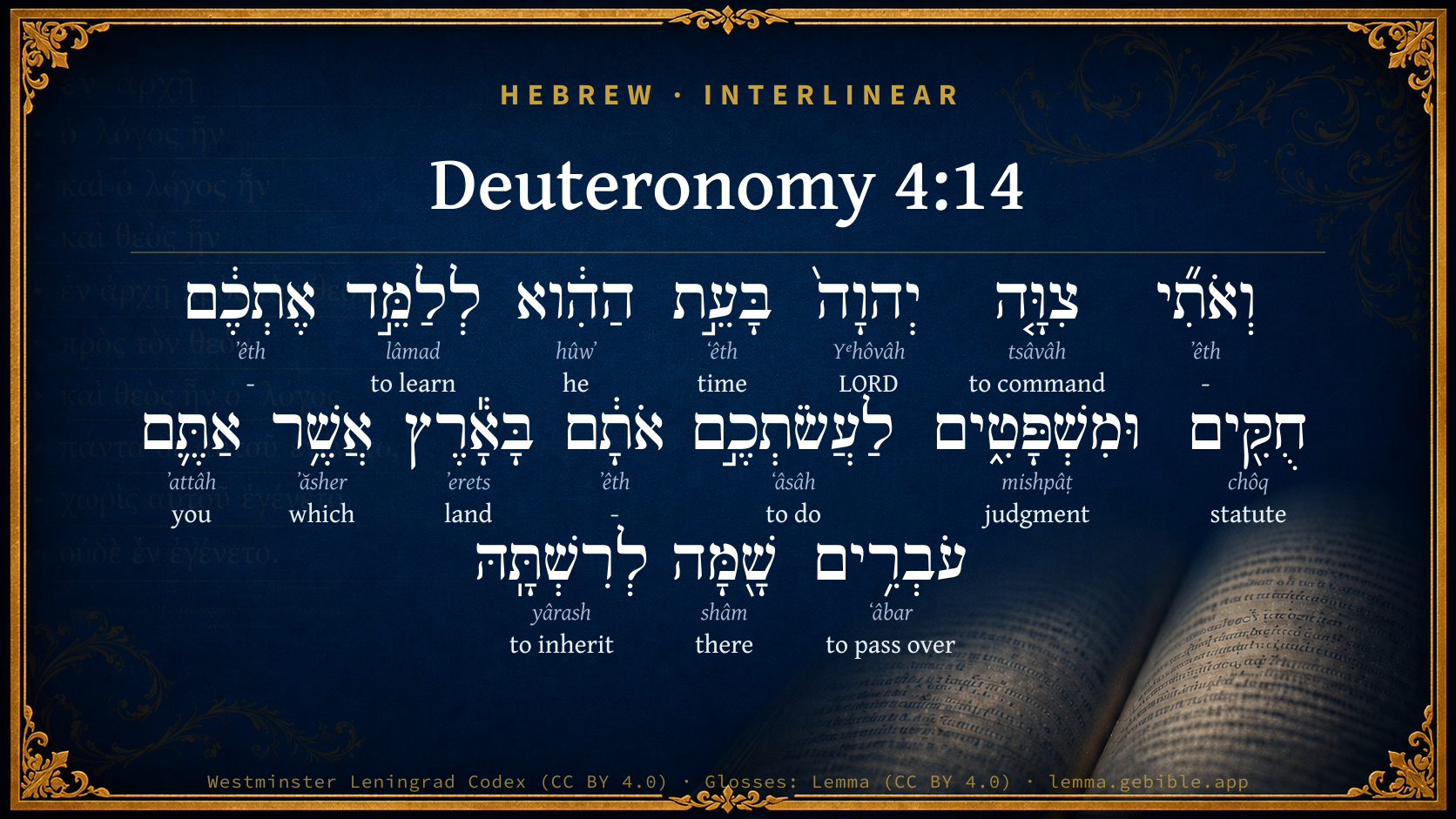
Deuteronomy 4:14

Hebrew (Westminster Leningrad Codex) Deuteronomy 4:14 appears in the Hebrew Old Testament. The text above is from the Westminster Leningrad Codex. Each word links to its Strong’s number, a concise gloss, and parsing drawn from the Open Scriptures Hebrew Bible morphology. Click any word for its full Brown-Driver-Briggs (BDB) entry.
Download image
Cite this verse

Deuteronomy 4:14 (World English Bible). Public Domain. Lemma interlinear Bible study tool, https://lemma.gebible.app/v/deuteronomy/4/14.

Show BibTeX & RIS
BibTeX
RIS
English Translation
Yahweh commanded me at that time to teach you statutes and ordinances, that you might do them in the land where you go over to possess it.
World English Bible · Public Domain
Download a study sheet

One document with this verse’s original text, its word-by-word gloss line, the meaning frame, cross-references with their text, attributed commentary, and full source and license credits — printable, and it pastes into notes with its structure intact.

This verse Autodidact and up

Study sheet (.html) Plain text (.txt)

A passage Seminary Student

Up to 50 verses in one chapter. A passage sheet keeps up to 6 commentary sources and 12 cross-references per verse, in the order this page ranks them, and says so on the sheet whenever that leaves anything out. Ask for a single verse and you get the Autodidact verse sheet above.

Everything on this page stays free to read, with no account — the sheet is a download of what is already on screen, not access to it.

Want to remove ads? Support Godless Engineer
Compare translations 3

The same verse in 3 English versions, stacked beneath the original-language interlinear above. Click any original word for its lexicon entry.

Each is an independent rendering of the whole verse — the interlinear is not word-aligned to these translations.

Highlighted words mark where these versions differ — a whole-verse word diff, not a word-by-word alignment.

  • World English Bible Public Domain
    Yahweh commanded me at that time to teach you statutes and ordinances, that you might do them in the land where you go over to possess it.
  • King James Version Public Domain
    And the LORD commanded me at that time to teach you statutes and judgments, that ye might do them in the land whither ye go over to possess it.
  • unfoldingWord Literal Text CC BY-SA 4.0
    And Yahweh commanded me at that time to teach you statutes and judgments for your doing of them in the land which you are going over to possess it.

unfoldingWord Literal Text — © unfoldingWord, licensed CC BY-SA 4.0. Word-aligned USFM3 via Door43 (git.door43.org/unfoldingWord/en_ult).

Versions to compare (up to 4)

3 of 4 selected

Show all 18 translations

Every available English version of this verse, each an independent rendering of the whole verse.

  • World English Bible Public Domain
    Yahweh commanded me at that time to teach you statutes and ordinances, that you might do them in the land where you go over to possess it.
  • Berean Standard Bible Public Domain
    At that time the LORD commanded me to teach you the statutes and ordinances you are to follow in the land that you are crossing the Jordan to possess.
  • Majority Standard Bible Public Domain
    At that time the LORD commanded me to teach you the statutes and ordinances you are to follow in the land that you are crossing the Jordan to possess.
  • King James Version Public Domain
    And the LORD commanded me at that time to teach you statutes and judgments, that ye might do them in the land whither ye go over to possess it.
  • American Standard Version (1901) Public Domain
    And Jehovah commanded me at that time to teach you statutes and ordinances, that ye might do them in the land whither ye go over to possess it.
  • Revised Version (1885) Public Domain
    And the LORD commanded me at that time to teach you statutes and judgments, that ye might do them in the land whither ye go over to possess it.
  • Geneva Bible (1599) Public Domain
    And the Lord commanded me that same time, that I should teach you ordinances and lawes, which ye should obserue in the lande, whither ye goe, to possesse it.
  • Douay-Rheims (1899) Public Domain
    And he commanded me at that time that I should teach you the ceremonies and judgments which you shall do in the land, that you shall possess.
  • Young's Literal Translation Public Domain
    `And me hath Jehovah commanded at that time to teach you statutes and judgments, for your doing them in the land whither ye are passing over to possess it;
  • Literal Standard Version CC BY-SA 4.0
    And YHWH has commanded me at that time to teach you statutes and judgments, for your doing them in the land to where you are passing over to possess it.
  • Unlocked Literal Bible CC BY-SA 4.0
    Yahweh commanded me at that time to teach you statutes and ordinances, so that you might do them in the land that you are crossing over to take possession of.
  • unfoldingWord Literal Text CC BY-SA 4.0
    And Yahweh commanded me at that time to teach you statutes and judgments for your doing of them in the land which you are going over to possess it.
  • Darby Bible Public Domain
    And Jehovah commanded me at that time to teach you statutes and ordinances, that ye might do them in the land whither ye are passing over to possess it.
  • World Messianic Bible Public Domain
    The LORD commanded me at that time to teach you statutes and ordinances, that you might do them in the land where you go over to possess it.
  • Webster's Bible Public Domain
    And the LORD commanded me at that time to teach you statutes and judgments, that ye might do them in the land whither ye go over to possess it.
  • Free Bible Version CC BY-SA 4.0
    This was the time that the Lord ordered me to teach you the rules and regulations that you are to follow when you arrive in the country you're going to own once you've crossed the Jordan.
  • Bible in Basic English Public Domain
    And the Lord gave me orders at that time to make clear to you these laws and decisions, so that you might do them in the land to which you are going, and which is to be your heritage.
  • JPS Tanakh (1917) Public Domain
    And the LORD commanded me at that time to teach you statutes and ordinances, that ye might do them in the land whither ye go over to possess it.

Literal Standard Version (2020), Covenant Press — licensed CC BY-SA 4.0. Text via the HelloAO Bible API (eBible.org). Unlocked Literal Bible (unfoldingWord) — licensed CC BY-SA 4.0. Text via the HelloAO Bible API (eBible.org). unfoldingWord Literal Text — © unfoldingWord, licensed CC BY-SA 4.0. Word-aligned USFM3 via Door43 (git.door43.org/unfoldingWord/en_ult). Free Bible Version, Dr. Jonathan Gallagher — licensed CC BY-SA 4.0. Text via the HelloAO Bible API (eBible.org).

Word by word

More ways to search: Search by grammar → Find every occurrence → Compare this word →

Practice this passage: Drill this verse → Learn its vocabulary →

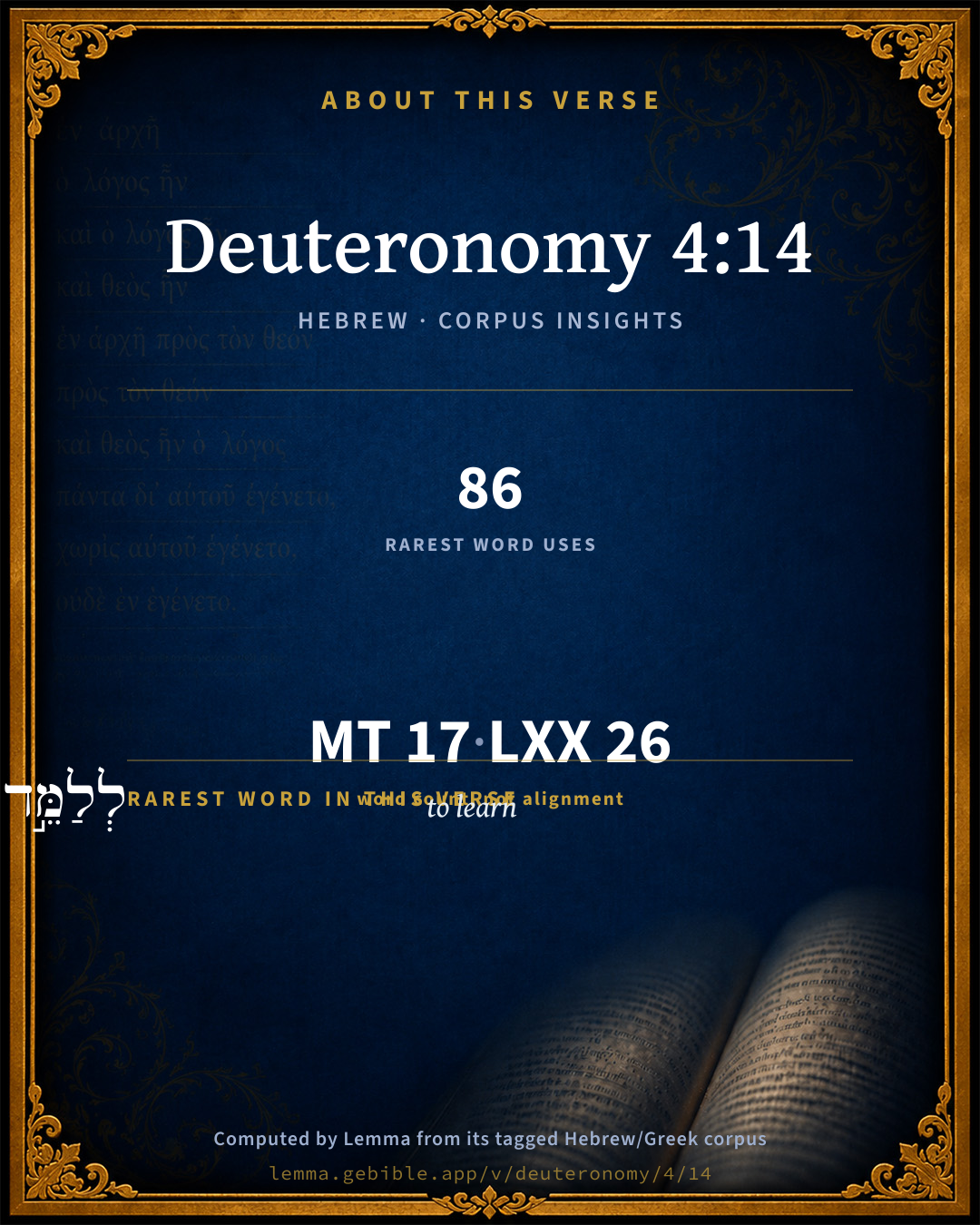
לְלַמֵּ֣ד
lâmad
H3925
“to learn”
Preposition + Verb, Piel, Infinitive Construct
Part of Speech
Preposition + Verb
Stem
Piel
Form
Infinitive Construct
Full BDB Definition

Origin: a primitive root

TWOT: 1116

to learn. teach, exercise in - (Qal) to learn - (Piel) to teach - (Pual) to be taught, be trained
  1. וְאֹתִ֞י ʼêth H853 “and · - · me” Conjunction + Particle, Direct Object + Suffix, Personal, 1st Person, Common, Singular
  2. צִוָּ֤ה tsâvâh H6680 “to command” Verb, Piel, Perfect, 3rd Person, Masculine, Singular
  3. יְהוָה֙ Yᵉhôvâh H3068 “LORD” Noun, Proper
  4. בָּעֵ֣ת ʻêth H6256 “in/at the · time” Preposition, Determined + Noun, Common, Both, Singular, Absolute
  5. הַהִ֔וא hûwʼ H1931 “the · he” Particle, Definite Article + Pronoun, Personal, 3rd Person, Feminine, Singular
  6. אֶתְכֶ֔ם ʼêth H853 “- · you” Particle, Direct Object + Suffix, Personal, 2nd Person, Masculine, Plural
  7. חֻקִּ֖ים chôq H2706 “statutes” Noun, Common, Masculine, Plural, Absolute
  8. וּמִשְׁפָּטִ֑ים mishpâṭ H4941 “and · judgments” Conjunction + Noun, Common, Masculine, Plural, Absolute
  9. לַעֲשֹׂתְכֶ֣ם ʻâsâh H6213 “to do · you” Preposition + Verb, Qal, Infinitive Construct + Suffix, Personal, 2nd Person, Masculine, Plural
  10. אֹתָ֔ם ʼêth H853 “- · them” Particle, Direct Object + Suffix, Personal, 3rd Person, Masculine, Plural
  11. בָּאָ֕רֶץ ʼerets H776 “in/at the · land” Preposition, Determined + Noun, Common, Both, Singular, Absolute
  12. אֲשֶׁ֥ר ʼăsher H834 “which” Particle, Relative
  13. אַתֶּ֛ם ʼattâh H859 “you” Pronoun, Personal, 2nd Person, Masculine, Plural
  14. עֹבְרִ֥ים ʻâbar H5674 “passing over” Verb, Qal, Participle Active, Masculine, Plural, Absolute
  15. שָׁ֖מָּה shâm H8033 “there · toward” Adverb + Suffix, Demonstrative
  16. לְרִשְׁתָּֽהּ yârash H3423 “to inherit · her” Preposition + Verb, Qal, Infinitive Construct + Suffix, Personal, 3rd Person, Feminine, Singular

About this verse

These counts appear in no published source. They are computed here, from the morphology-tagged text and Lemma’s own curated glosses. What Lemma adds →

17
words
15
distinct lemmas
Pentateuch
section

Grammatical profile

  • 5 verbs
  • 5 nouns
  • 2 pronouns
  • 1 adverb
  • 4 particles

Verb forms

  • צִוָּ֤ה Piel · Perfect
  • לְלַמֵּ֣ד Piel · Infinitive Construct
  • לַעֲשֹׂתְכֶ֣ם Qal · Infinitive Construct
  • עֹבְרִ֥ים Qal · Participle Active
  • לְרִשְׁתָּֽהּ Qal · Infinitive Construct

Hebrew & Septuagint length

In English translation the verse runs 27 words from the Hebrew and 29 from the Septuagint (LXX English) — closely comparable.

A rough comparison of the two English renderings, which tokenize alike — not a word-level alignment.

Word counts can differ between the Hebrew and the Greek without any difference in meaning — e.g. the Hebrew direct-object marker אֵת has no separate Greek word, and Greek often adds the article ὁ.

In the original languages it is 17 Hebrew tokens and 26 Greek tokens — but the two are counted differently (Hebrew bundles its prefixes and suffixes into one token; the Greek is in lemma form), so that isn’t a like-for-like length.

Cross-references

2

Topical passages linked to Deuteronomy 4:14 in the Treasury of Scripture Knowledge — connected by theme and wording, ordered by reader-vote popularity; previews shown in the World English Bible.

Cross-references courtesy of OpenBible.info (CC BY 4.0).

Hebrew and Greek witnesses Masoretic Hebrew ↔ Greek Septuagint

The same verse in the two great witnesses to the Old Testament, shown verse-for-verse.

These are two independent witnesses, not word-aligned to each other, and the Septuagint is shown in lemma (dictionary) form.

Hebrew Deuteronomy 4:14 Masoretic · Westminster Leningrad Codex

וְאֹתִ֞י צִוָּ֤ה יְהוָה֙ בָּעֵ֣ת הַהִ֔וא לְלַמֵּ֣ד אֶתְכֶ֔ם חֻקִּ֖ים וּמִשְׁפָּטִ֑ים לַעֲשֹׂתְכֶ֣ם אֹתָ֔ם בָּאָ֕רֶץ אֲשֶׁ֥ר אַתֶּ֛ם עֹבְרִ֥ים שָׁ֖מָּה לְרִשְׁתָּֽהּ

Yahweh commanded me at that time to teach you statutes and ordinances, that you might do them in the land where you go over to possess it.

World English Bible · Public Domain

Greek LXX Deuteronomy 4:14 Septuagint · lemma form

καί ἐγώ ἐντέλλομαι κύριος ἐν ὁ καιρός ἐκεῖνος διδάσκω σύ δικαίωμα καί κρίσις ποιέω αὐτός σύ ἐπί ὁ γῆ εἰς ὅς σύ εἰςπορεύομαι ἐκεῖ κληρονομέω αὐτός

And the Lord commanded me at that time, to teach you ordinances and judgments, that you⌃ should do them on the land, into which you⌃ go to inherit it.

LXX2012 (modern English Septuagint) · Public Domain

Hebrew: Westminster Leningrad Codex (CC BY 4.0). Greek: Septuagint (public domain); English from LXX2012 (modern English Septuagint) (Public Domain). How the Septuagint differs from the Hebrew →

Targum (Aramaic paraphrase)

2

The Targum is the ancient Jewish Aramaic paraphrase of the Hebrew Scriptures — an interpretive translation, not the Hebrew text itself. Onkelos (literal) and Pseudo-Jonathan (expansive) render the Torah, and Jonathan the Prophets. Coverage is partial: where no permissively-licensed English translation exists for a verse, only the Aramaic is shown. This is verse-level text, not a word-by-word alignment to the Hebrew.

  1. Targum Onkelos Torah (Genesis–Deuteronomy)
    וְיָתִי פַּקִיד יְיָ בְּעִדְנָא הַהִיא לְאַלָפָא יַתְכוֹן קְיָמִין וְדִינִין לְמֶעְבָּדְכוֹן יָתְהוֹן בְּאַרְעָא דִי אַתּוּן עָבְרִין תַּמָן לְמֵירְתַהּ

    (no public-domain English translation for this verse)

    Targum Onkelos — Aramaic: “Onkelos Genesis” (public domain); “Onkelos Exodus” (public domain); “Onkelos Leviticus” (public domain); “Onkelos Numbers” (public domain); “Onkelos Deuteronomy” (public domain). English: “Sefaria Community Translation” (CC0 1.0 (public-domain dedication)); “J.W. Etheridge. The Targums of Onkelos and Jonathan Ben Uzziel on the Pentateuch. London: Longmans, Green, 1862” (public domain). Text via Sefaria.

  2. Targum Pseudo-Jonathan Torah (Genesis–Deuteronomy)
    וְיָתִי פַקֵּיד יְיָ בְּעִידָנָא הַהִוא לְמַלְפָא יַתְכוֹן קְיָמִין וְדִינִין לְמֶעֱבַדְכוֹן יַתְהוֹן בְּאַרְעָא דְאַתּוּן עָבְרִין לְתַמָּן לְמֵירְתָהּ

    And the Lord commanded me at that time to teach you the statutes and judgments, that you may do them in the land which you pass over to possess.

    Targum Pseudo-Jonathan — Aramaic: “Targum Jonathan on Genesis” (public domain); “Targum Jonathan on Exodus” (public domain); “Targum Jonathan on Leviticus” (public domain); “Targum Jonathan on Numbers” (public domain); “Targum Jonathan on Deuteronomy” (public domain). English: “The Targum of Jonathan ben Uzziel, trans. J. W. Etheridge, London, 1862” (public domain). Text via Sefaria.

Commentary

Notes on Deuteronomy 4:14 from classic Christian and Jewish commentators (each source and its license shown beneath its notes). The classic Christian expositions comment on the surrounding passage and are grouped to its opening verse, so a note may address several verses; the Jewish commentaries on the Tanakh (Rashi and others) are per-verse, so they appear only where the commentator wrote on this verse.

Lemma curates 59 commentaries, every one of them public domain or Creative Commons licensed, each selected and text-cleaned for this edition rather than reprinted as found. About our sources →

Trapp's Complete Commentary

John Trapp

Deu 4:14 And the LORD commanded me at that time to teach you statutes and judgments, that ye might do them in the land whither ye go over to possess it.

Ver. 14. Statutes and judgments.] {See Trapp on "Deu 1:1"}

John Trapp, A Commentary or Exposition upon All the Books of the Old and New Testament (1647–1656) — public domain. Text from a community e-Sword module.

The Biblical Illustrator

Joseph S. Exell

Deu_4:14

That ye might do them.

Knowledge and practice

I. God is the one great source both of truth and of authority.

1. The office of every true teacher is to unfold the revelation of the Eternal, whether in nature, in history, or in the written Word.

2. The office of every true lawgiver and ruler is to expound and enforce the precepts and commandments of the Lord of lords. There is no sound knowledge, and no law worthy of reverence, which does not emanate from the Supreme.

II. True religion corresponds to the composite nature of man, as a being possessed of intelligence and endowed with will.

1. False religions are one-sided: they either embody certain theories and doctrines and neglect morality, or they prescribe certain services without basing them on eternal truth.

2. Judaism appealed to the understanding in its many statements regarding God and regarding human life; it appealed to the practical nature in its rigid prescriptions of duty, its rigid prohibitions of sin.

3. Christianity is the highest example of the combination of the doctrinal and the moral, laying a foundation of truth and love, and rearing upon it an edifice of obedience and holiness.

III. Acceptable obedience consists in at once receiving the Gospel and doing the will of Christ. An empty profession of faith and a soulless conformity of conduct are alike repugnant to a heart-searching God. The true Christian shows his faith by his works. (Family Churchman.)

The Biblical Illustrator, edited by Joseph S. Exell (c. 1880s–1900s) — public domain. Text from a community e-Sword module.

Joseph Benson's Commentary

Deu 4:14. To teach you statutes and judgments — This relates to the rest of the laws which God gave to Moses, immediately after he himself had delivered to them the ten commandments, (Exodus 21.,) it being the people’s desire that God would communicate to them the rest of his will by Moses.

Joseph Benson's Commentary on the Old and New Testaments (1811–1818) — public domain. Text from a community e-Sword module.

The Cambridge Bible for Schools and Colleges

gen. ed. J. J. S. Perowne

14. And the Lord commanded me at that time, etc.] Heb. emphasises me; these additional laws given through Moses appear, from the following phrase, to be the laws he is now about to publish, cp. Deu_4:5; yet the words at that time point to the inclusion with them of the laws at Ḥoreb, E, Exo_20:22 to Exo_23:33.

whither ye go over to possess it] A phrase peculiar to passages in the Pl. address. Contrast Deu_4:5. See on Deu_6:1.

Deu_4:13 f. form a slight digression from the main subject of 9–24, and are taken by some as a later intrusion. But this is to forget the general discursiveness of the author. See too next note.

The Cambridge Bible for Schools and Colleges (gen. ed. J. J. S. Perowne; Cambridge University Press, 1878–1918) — public domain. Text from a community e-Sword module.

John Gill's Exposition

And the Lord commanded me at that time,.... When the ten commandments were delivered on Mount Sinai, and Moses was ordered to come up to God in the mount:

to teach you statutes and judgments; laws ceremonial and judicial, besides the ten commands given them:

that ye may do them in the land whither ye go over to possess it; the land of Canaan, which was on the other side of Jordan, and over which they must go in order to possess it; and when they came there, they were to hold the possession of it by attending to those laws which forbad the sins for which the old inhabitants of it were expelled out of it; and besides these, there were also several laws, both ceremonial and judicial, which were to be peculiarly observed in the land, as well as others they were obliged to do while without it.

John Gill's Exposition of the Whole Bible (1746–1763) — public domain (CC PDM 1.0). Text via the HelloAO Bible API.

Matthew Poole's English Annotations

Statutes and judgments, i.e. the ceremonial and judicial laws, which are here distinguished from the moral, or the ten commandments, Deu 4:13.

Matthew Poole's English Annotations on the Holy Bible (1683–1685) — public domain. Text from a community e-Sword/MySword module.

John Wesley's Explanatory Notes

Statutes and judgments - The ceremonial and judicial laws which are here distinguished from the moral, or the ten commandments.

John Wesley, Explanatory Notes Upon the Whole Bible (1754–1765) — public domain. Text via the GEBible commentary corpus.

Kretzmann's Popular Commentary

Paul E. Kretzmann

Warning Against Idolatry

v. 14. And the Lord commanded me at that time to teach you statutes and judgments that ye might do them in the land whither ye go over to possess it, namely, the precepts contained in the legislation beginning with Exodus 21.

v. 15. Take ye, therefore, good heed unto yourselves, every one was to watch carefully over his soul; for ye saw no manner of similitude, no form or outline which could be used as the basis for a picture, on the day that the Lord spake unto you in Horeb out of the midst of the fire;

v. 16. lest ye corrupt yourselves, and make you a graven image, either carved or hewn, the similitude of any figure, the likeness of male or female,

v. 17. the likeness of any beast that is on the earth, the likeness of any winged fowl that flieth in the air,

v. 18. the likeness of anything that creepeth on the ground, the likeness of any fish that is in the waters beneath the earth, any statue or picture whatever which might be used for purposes of gross idolatry;

v. 19. and lest thou lift up thine eyes unto heaven, and when thou seest the sun and the moon and the stars, even. all the host of heaven, shouldest be driven to worship them, Rom 1:25, and serve them, which the Lord, thy God, hath divided unto all nations under the whole heaven. God’s original purpose was that the heavenly bodies should serve mankind, Gen 1:17-18. Since the heathen, however, carried away by the lure of the unknown, by the enticement of the light bodies, had given them divine honor, the Lord had permitted them to remain in their foolishness, as a punishment for turning from Him.

v. 20. But the Lord hath taken you and brought you forth out of their on furnace, a significant picture of the most severe misery and oppression, even out of Egypt, to be unto Him a people of inheritance, as ye are this day, Exo 19:5.

v. 21. Furthermore, the Lord was angry with me for your sakes, Num 20:12, and sware that I should not go over Jordan, and that I should not go in unto that good land which the Lord, thy God, giveth thee for an inheritance;

v. 22. but I must die in this land, I must not go over Jordan; but ye shall go over and possess that good land. The wistful tone which Moses employs shows how deeply he was affected by the Lord’s ruling that excluded him from the Land of Promise.

v. 23. Take heed unto yourselves, lest ye forget the covenant of the Lord, your God, which he made with you, and make you, a graven image or the likeness of anything which the Lord, thy God, hath forbidden thee.

v. 24. For the Lord, thy God, is a consuming fire, even a jealous God, whose righteous anger devours the children of disobedience. We should remember at all times that God will not be mocked, but that He resents every attack upon His holiness and righteousness and will punish all willful transgressors.

Paul E. Kretzmann, Popular Commentary of the Bible (1921–1924) — public domain. Text from a community e-Sword module.

Rashi

Rabbi Shlomo Yitzchaki (Rashi)

ואתי צוה, ה' ללמד אתכם AND THE LORD COMMANDED ME TO TEACH YOU, the Oral Law.

Rashi on the Tanakh — English translations: “The Judaica Press complete Tanach with Rashi, translated by A. J. Rosenberg” (CC BY 4.0); “Pentateuch with Rashi's commentary by M. Rosenbaum and A.M. Silbermann, 1929-1934” (public domain); “The Metsudah Tanach series, Lakewood, N.J” (CC BY 4.0); and “The Book of Joshua, Metsudah Publications, 1997” (CC BY 4.0). Text via Sefaria.

Lesson kit

Teaching starters — assembled from the data on this page, not authored interpretation. Every prompt links to the verse data it draws on. Edit before teaching.

Deuteronomy, in the Pentateuch, opens this verse with 17 words (15 distinct Hebrew lemmas). Its most distinctive word is lâmad (“to learn”). A historical commentator’s framing appears above. Read the whole chapter for the surrounding context.

Discussion questions

  1. The word lâmad carries the sense “to learn.” How does it shape the verse?
  2. Psalms 105:44–45 shares this passage’s theme. How do the two illuminate each other?
  3. The translations on this page render this verse differently — a whole-verse word diff, not a word-by-word alignment. What might account for the different wordings?
  4. The verb «צִוָּ֤ה» is Piel Perfect. How does its form color the action?
  5. Reading how Trapp's Complete Commentary and The Biblical Illustrator read this verse, where do the two commentators agree and where do they part?

Things to notice

Reading settings

Reading text

Shown beneath each verse's original-language words.

Old Testament
Old Testament edition

Read the OT as the Masoretic Hebrew (MT) or the Greek Septuagint (LXX).

English shown for the Greek Septuagint (in the Hebrew ↔ Greek comparison).

Comparing translations? Open the Compare panel on any verse page to stack up to four side by side.