2 Chronicles 35:17

Hebrew (Westminster Leningrad Codex) 2 Chronicles 35:17 appears in the Hebrew Old Testament. The text above is from the Westminster Leningrad Codex. Each word links to its Strong’s number, a concise gloss, and parsing drawn from the Open Scriptures Hebrew Bible morphology. Click any word for its full Brown-Driver-Briggs (BDB) entry.
Download image
Cite this verse

2 Chronicles 35:17 (World English Bible). Public Domain. Lemma interlinear Bible study tool, https://lemma.gebible.app/v/2-chronicles/35/17.

Show BibTeX & RIS
BibTeX
RIS
English Translation
The children of Israel who were present kept the Passover at that time, and the feast of unleavened bread seven days.
World English Bible · Public Domain
Download a study sheet

One document with this verse’s original text, its word-by-word gloss line, the meaning frame, cross-references with their text, attributed commentary, and full source and license credits — printable, and it pastes into notes with its structure intact.

This verse Autodidact and up

Study sheet (.html) Plain text (.txt)

A passage Seminary Student

Up to 50 verses in one chapter. A passage sheet keeps up to 6 commentary sources and 12 cross-references per verse, in the order this page ranks them, and says so on the sheet whenever that leaves anything out. Ask for a single verse and you get the Autodidact verse sheet above.

Everything on this page stays free to read, with no account — the sheet is a download of what is already on screen, not access to it.

Want to remove ads? Support Godless Engineer
Compare translations 3

The same verse in 3 English versions, stacked beneath the original-language interlinear above. Click any original word for its lexicon entry.

Each is an independent rendering of the whole verse — the interlinear is not word-aligned to these translations.

Highlighted words mark where these versions differ — a whole-verse word diff, not a word-by-word alignment.

  • World English Bible Public Domain
    The children of Israel who were present kept the Passover at that time, and the feast of unleavened bread seven days.
  • King James Version Public Domain
    And the children of Israel that were present kept the passover at that time, and the feast of unleavened bread seven days.
  • unfoldingWord Literal Text CC BY-SA 4.0
    And the sons of Israel who were found did the Passover at that time and the Feast of Unleavened Bread seven days.

unfoldingWord Literal Text — © unfoldingWord, licensed CC BY-SA 4.0. Word-aligned USFM3 via Door43 (git.door43.org/unfoldingWord/en_ult).

Versions to compare (up to 4)

3 of 4 selected

Show all 18 translations

Every available English version of this verse, each an independent rendering of the whole verse.

  • World English Bible Public Domain
    The children of Israel who were present kept the Passover at that time, and the feast of unleavened bread seven days.
  • Berean Standard Bible Public Domain
    The Israelites who were present also observed the Passover at that time, as well as the Feast of Unleavened Bread for seven days.
  • Majority Standard Bible Public Domain
    The Israelites who were present also observed the Passover at that time, as well as the Feast of Unleavened Bread for seven days.
  • King James Version Public Domain
    And the children of Israel that were present kept the passover at that time, and the feast of unleavened bread seven days.
  • American Standard Version (1901) Public Domain
    And the children of Israel that were present kept the passover at that time, and the feast of unleavened bread seven days.
  • Revised Version (1885) Public Domain
    And the children of Israel that were present kept the passover at that time, and the feast of unleavened bread seven days.
  • Geneva Bible (1599) Public Domain
    And the children of Israel that were present, kept the Passeouer the same time, and the feast of the vnleauened bread seuen dayes.
  • Douay-Rheims (1899) Public Domain
    And the children of Israel that were found there, kept the phase at that time, and the feast of unleavened bread seven days.
  • Young's Literal Translation Public Domain
    And the sons of Israel who are found make the passover at that time, and the feast of unleavened things, seven days.
  • Literal Standard Version CC BY-SA 4.0
    And the sons of Israel who are found make the Passover at that time, and the Celebration of Unleavened Things, [for] seven days.
  • Unlocked Literal Bible CC BY-SA 4.0
    The people of Israel who were present kept the Passover at that time, and then the Festival of Unleavened Bread for seven days.
  • unfoldingWord Literal Text CC BY-SA 4.0
    And the sons of Israel who were found did the Passover at that time and the Feast of Unleavened Bread seven days.
  • Darby Bible Public Domain
    And the children of Israel that were present held the passover at that time, and the feast of unleavened bread seven days.
  • World Messianic Bible Public Domain
    The children of Israel who were present kept the Passover at that time, and the feast of unleavened bread seven days.
  • Webster's Bible Public Domain
    And the children of Israel that were present kept the passover at that time, and the feast of unleavened bread seven days.
  • Free Bible Version CC BY-SA 4.0
    The Israelites who were there also celebrated Passover at that time, and also the Feast of Unleavened Bread for the following seven days.
  • Bible in Basic English Public Domain
    And all the children of Israel who were present kept the Passover and the feast of unleavened bread at that time for seven days.
  • JPS Tanakh (1917) Public Domain
    And the children of Israel that were present kept the passover at that time, and the feast of unleavened bread seven days.

Literal Standard Version (2020), Covenant Press — licensed CC BY-SA 4.0. Text via the HelloAO Bible API (eBible.org). Unlocked Literal Bible (unfoldingWord) — licensed CC BY-SA 4.0. Text via the HelloAO Bible API (eBible.org). unfoldingWord Literal Text — © unfoldingWord, licensed CC BY-SA 4.0. Word-aligned USFM3 via Door43 (git.door43.org/unfoldingWord/en_ult). Free Bible Version, Dr. Jonathan Gallagher — licensed CC BY-SA 4.0. Text via the HelloAO Bible API (eBible.org).

Word by word

More ways to search: Search by grammar → Find every occurrence → Compare this word →

Practice this passage: Drill this verse → Learn its vocabulary →

הַפֶּ֖סַח
peçach
H6453
“the · Passover”
Particle, Definite Article + Noun, Common, Masculine, Singular, Absolute
Part of Speech
Particle + Noun
Type
Common
Gender
Masculine
Number
Singular
State
Absolute
Full BDB Definition

Origin: from H6452

TWOT: 1786a

passover - sacrifice of passover - animal victim of the passover - festival of the passover
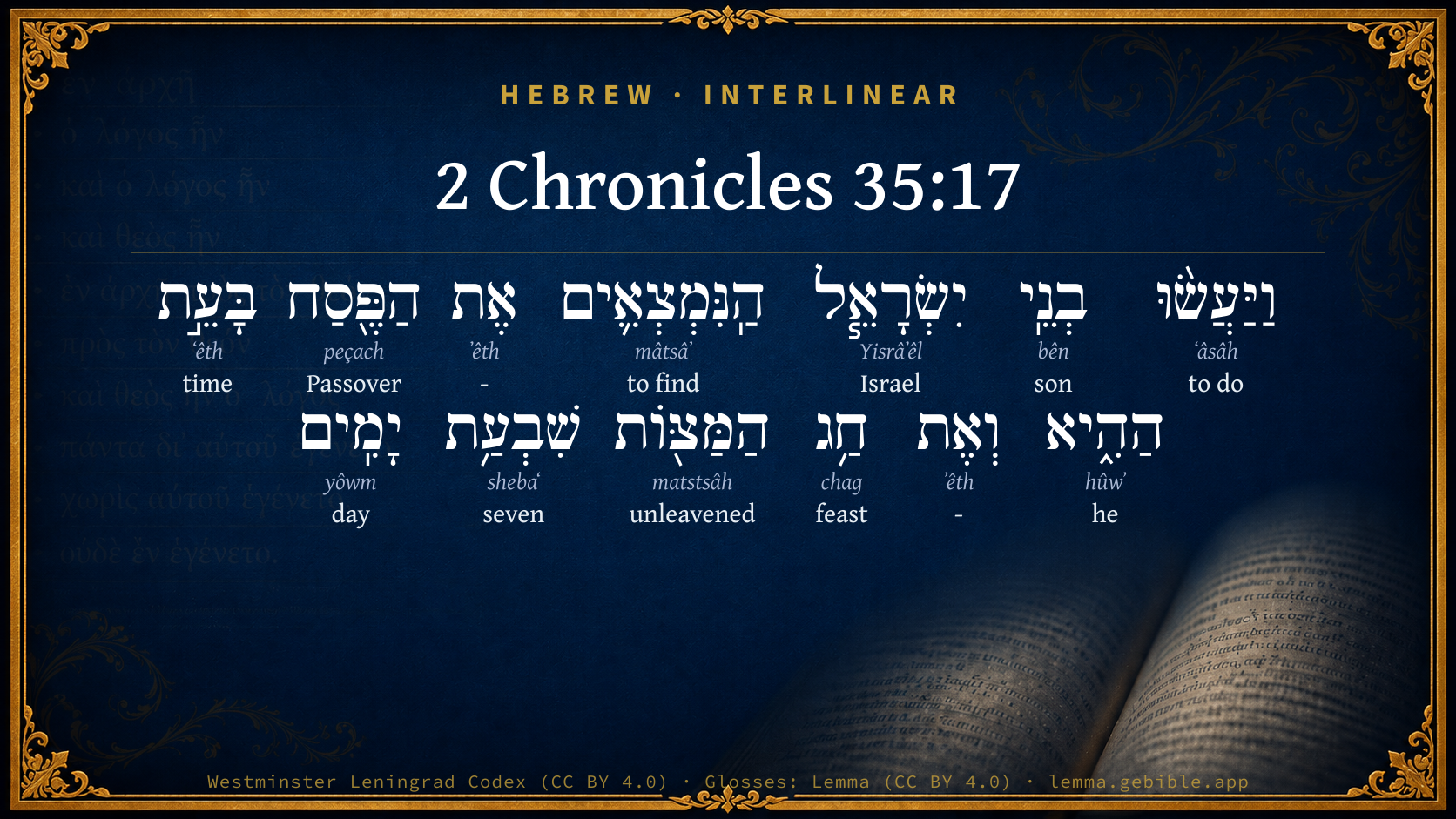
  1. וַיַּעֲשׂ֨וּ ʻâsâh H6213 “and · to do” Conjunction + Verb, Qal, Sequential Imperfect, 3rd Person, Masculine, Plural
  2. בְנֵֽי bên H1121 “sons of” Noun, Common, Masculine, Plural, Construct
  3. יִשְׂרָאֵ֧ל Yisrâʼêl H3478 “Israel” Noun, Proper
  4. הַֽנִּמְצְאִ֛ים mâtsâʼ H4672 “the · finding” Particle, Definite Article + Verb, Niphal, Participle Active, Masculine, Plural, Absolute
  5. אֶת ʼêth H853 “-” Particle, Direct Object
  6. בָּעֵ֣ת ʻêth H6256 “in/at the · time” Preposition, Determined + Noun, Common, Both, Singular, Absolute
  7. הַהִ֑יא hûwʼ H1931 “the · he” Particle, Definite Article + Pronoun, Personal, 3rd Person, Feminine, Singular
  8. וְאֶת ʼêth H853 “and · -” Conjunction + Particle, Direct Object
  9. חַ֥ג chag H2282 “feast of” Noun, Common, Masculine, Singular, Construct
  10. הַמַּצּ֖וֹת matstsâh H4682 “the · unleavened bread” Particle, Definite Article + Noun, Common, Feminine, Plural, Absolute
  11. שִׁבְעַ֥ת shebaʻ H7651 “seven” Adjective, Cardinal number, Masculine, Singular, Construct
  12. יָמִֽים yôwm H3117 “days” Noun, Common, Masculine, Plural, Absolute

About this verse

These counts appear in no published source. They are computed here, from the morphology-tagged text and Lemma’s own curated glosses. What Lemma adds →

13
words
12
distinct lemmas
Historical
section

Shared distinctive vocabulary

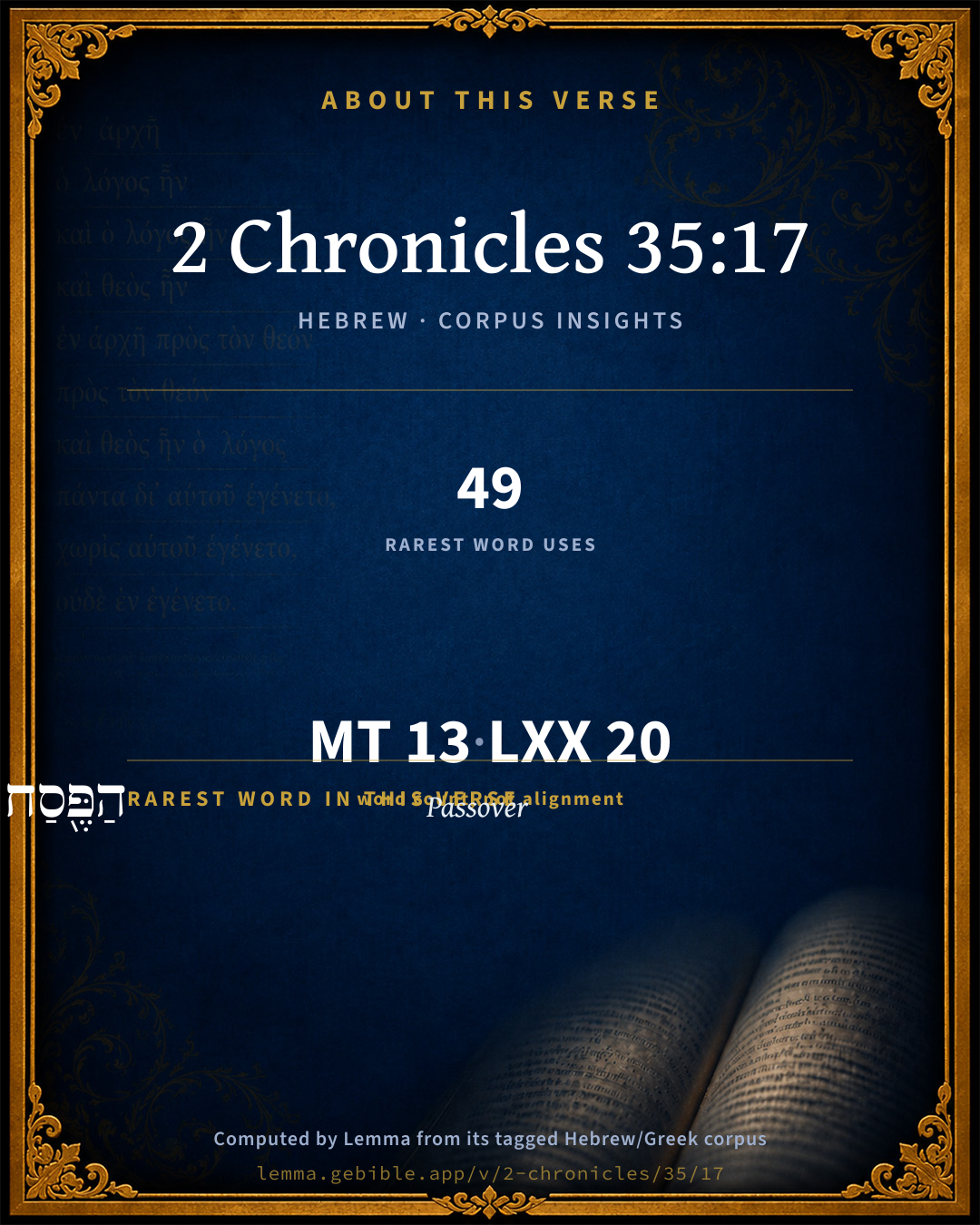
הַפֶּ֖סַח Passover H6453 occurs in 46 verses of the Hebrew Bible. Also found in:

Grammatical profile

  • 2 verbs
  • 7 nouns
  • 1 adjective
  • 1 pronoun
  • 2 particles

Verb forms

  • וַיַּעֲשׂ֨וּ Qal · Sequential Imperfect
  • הַֽנִּמְצְאִ֛ים Niphal · Participle Active

Hebrew & Septuagint length

In English translation the verse runs 21 words from the Hebrew and 22 from the Septuagint (LXX English) — closely comparable.

A rough comparison of the two English renderings, which tokenize alike — not a word-level alignment.

Word counts can differ between the Hebrew and the Greek without any difference in meaning — e.g. the Hebrew direct-object marker אֵת has no separate Greek word, and Greek often adds the article ὁ.

In the original languages it is 13 Hebrew tokens and 20 Greek tokens — but the two are counted differently (Hebrew bundles its prefixes and suffixes into one token; the Greek is in lemma form), so that isn’t a like-for-like length.

Cross-references

10

Topical passages linked to 2 Chronicles 35:17 in the Treasury of Scripture Knowledge — connected by theme and wording, ordered by reader-vote popularity; previews shown in the World English Bible.

  • Exodus 12:15–20 Seven days shall you eat unleavened bread; even the first day you shall put away yeast out of your houses, for whoever eats leavened bread from the first day until the seventh day, that soul shall be cut off from Israel.
  • Exodus 13:6–7 Seven days you shall eat unleavened bread, and in the seventh day shall be a feast to Yahweh.
  • Exodus 23:15 You shall observe the feast of unleavened bread. Seven days you shall eat unleavened bread, as I commanded you, at the time appointed in the month Abib (for in it you came out from Egypt), and no one shall appear before me empty.
  • Exodus 34:18 "You shall keep the feast of unleavened bread. Seven days you shall eat unleavened bread, as I commanded you, at the time appointed in the month Abib; for in the month Abib you came out from Egypt.
  • Leviticus 23:5–8 In the first month, on the fourteenth day of the month in the evening, is Yahweh's Passover.
  • Numbers 28:16–25 In the first month, on the fourteenth day of the month, is Yahweh's Passover.
  • Deuteronomy 16:3–4 You shall eat no leavened bread with it; seven days shall you eat unleavened bread therewith, even the bread of affliction; for you came forth out of the land of Egypt in haste: that you may remember the day when you came forth out of the land of Egypt all the days of your life.
  • Deuteronomy 16:8 Six days you shall eat unleavened bread; and on the seventh day shall be a solemn assembly to Yahweh your God; you shall do no work [therein].
  • 2 Chronicles 30:21–23 The children of Israel who were present at Jerusalem kept the feast of unleavened bread seven days with great gladness; and the Levites and the priests praised Yahweh day by day, [singing] with loud instruments to Yahweh.
  • 1 Corinthians 5:7–8 Purge out the old yeast, that you may be a new lump, even as you are unleavened. For indeed Christ, our Passover, has been sacrificed in our place.

Cross-references courtesy of OpenBible.info (CC BY 4.0).

Hebrew and Greek witnesses Masoretic Hebrew ↔ Greek Septuagint

The same verse in the two great witnesses to the Old Testament, shown verse-for-verse.

These are two independent witnesses, not word-aligned to each other, and the Septuagint is shown in lemma (dictionary) form.

Hebrew 2 Chronicles 35:17 Masoretic · Westminster Leningrad Codex

וַיַּעֲשׂ֨וּ בְנֵֽי יִשְׂרָאֵ֧ל הַֽנִּמְצְאִ֛ים אֶת הַפֶּ֖סַח בָּעֵ֣ת הַהִ֑יא וְאֶת חַ֥ג הַמַּצּ֖וֹת שִׁבְעַ֥ת יָמִֽים

The children of Israel who were present kept the Passover at that time, and the feast of unleavened bread seven days.

World English Bible · Public Domain

Greek LXX 2 Chronicles 35:17 Septuagint · lemma form

καί ποιέω ὁ υἱός ἰσραήλ ὁ εὑρίσκω ὁ φασεχ ἐν ὁ καιρός ἐκεῖνος καί ὁ ἑορτή ὁ ἄζυμος ἑπτά ἡμέρα

And the children of Israel that were present kept the passover at that time, and the feast of unleavened bread seven days.

LXX2012 (modern English Septuagint) · Public Domain

Hebrew: Westminster Leningrad Codex (CC BY 4.0). Greek: Septuagint (public domain); English from LXX2012 (modern English Septuagint) (Public Domain). How the Septuagint differs from the Hebrew →

Commentary

Notes on 2 Chronicles 35:17 from classic Christian and Jewish commentators (each source and its license shown beneath its notes). The classic Christian expositions comment on the surrounding passage and are grouped to its opening verse, so a note may address several verses; the Jewish commentaries on the Tanakh (Rashi and others) are per-verse, so they appear only where the commentator wrote on this verse.

Lemma curates 59 commentaries, every one of them public domain or Creative Commons licensed, each selected and text-cleaned for this edition rather than reprinted as found. About our sources →

Ellicott's Commentary for English Readers

CHARACTER OF THE PASSOVER THUS HELD, AND ITS DATE (2Ch_35:17-19).

(17) At that time.—The Passover was kept on the evening of the 14th Nisan, and the Mazzoth from the 15th to the 21st of the same month.

A Bible Commentary for English Readers, edited by Charles John Ellicott (1878–1897) — public domain. Text from a community e-Sword module.

Trapp's Complete Commentary

John Trapp

2Ch 35:17 And the children of Israel that were present kept the passover at that time, and the feast of unleavened bread seven days.

Ver. 17. And the feast of unleavened bread.] See on 2Ch 35:7.

John Trapp, A Commentary or Exposition upon All the Books of the Old and New Testament (1647–1656) — public domain. Text from a community e-Sword module.

John Gill's Exposition

And the children of Israel that were present kept the passover at that time,.... In its proper time, on the fourteenth day of Nisan:

and the feast of unleavened bread seven days; the seven days following the passover, as the Lord by Moses appointed.

John Gill's Exposition of the Whole Bible (1746–1763) — public domain (CC PDM 1.0). Text via the HelloAO Bible API.

The Pulpit Commentary

Vers. 17-19.

The moral of the Passover.

The keeping of this Passover is very particularly described in this chapter, and we may be sure that it was entered into and enjoyed, as a religious festival, with exceeding zest. We naturally ask What was its significance? What did it mean to those who celebrated it? We reply that in it and by it

I THEY RECOGNIZED THEIR UNITY AS THE PEOPLE OF GOD. They went back in thought to the time when they were bound together in the strong bond of a common sorrow; when they were a suffering people bent beneath the same yoke, bleeding with the same blows; and they recognized the fact that they were all the children of their fathers to whom Moses came as the great prophet and saviour. And the lamb of which they partook, with not a bone of its body broken, was the symbol of the national unity.

II THEY REJOICED IN A GREAT DIVINE DELIVERANCE A DELIVERANCE THROUGH SACRIFICE. The prevailing thought of the whole institution was God"s merciful and mighty interposition on their behalf, redeeming them from the land of bondage and misery, bringing them out into liberty and happiness, and constituting them a nation, holy unto himself. And closely connected with the main idea of deliverance was that of sacrifice; they commemorated the fact that through the sacrifice of a slain lamb they had been spared and redeemed.

III THEY HAD FELLOWSHIP WITH GOD AND WITH ONE ANOTHER. The Feast of the Passover and of Unleavened Bread was one in which they rejoiced together both as families and as a congregated nation "before the Lord." Then they had true fellowship with one another, meeting and greeting one another as members of the same redeemed nation, whom the Lord had pitied and restored; and while they were thus gladdened in heart as they associated one with another, they were also solemnized by the thought that they met together in the city of God, in the courts of the Lord"s house, in his own presence. Theirs was a sacred union and communion; it was fellowship with the Supreme.

When we meet, as Christian men, in ordinary worship, and more particularly when we gather together at the Lord"s table, we are moved and animated by this same spirit, by these same convictions and considerations.

1. We realize our essential unity, our oneness in Jesus Christ. Are we notall members of that race on which, in all its distance from the home of God, he had compassion and which he stooped to save? Are we not bound together, not only as partakers of the same human nature, but as those who have bowed beneath the same yoke, who have needed the same Divine Redeemer, who have suffered in the same affliction?

2. We rejoice together in the same glorious redemption a redemption that

(1) not only was designed and begun, but was triumphantly completed;

(2) a redemption which, in its spiritual character and its everlasting issues, dwarfs even such a great national deliverance as that which this Passover commemorated;

(3) a redemption which could only be (and was) accomplished through the sacrifice of the "Lamb of God," slain from the foundation of the world for the recovery of the world.

3. We meet to have holy and happy fellowship with one another, and also hallowed and elevating fellowship with our Father and his Son Jesus Christ. C. (1Jn_1:3)

The Pulpit Commentary (1880–1919), ed. H.D.M. Spence-Jones & Joseph S. Exell — public domain. Text from a community e-Sword module.

Lesson kit

Teaching starters — assembled from the data on this page, not authored interpretation. Every prompt links to the verse data it draws on. Edit before teaching.

2 Chronicles, in the Historical, opens this verse with 13 words (12 distinct Hebrew lemmas). Its most distinctive word is peçach (“Passover”). A historical commentator’s framing appears above. Read the whole chapter for the surrounding context.

Discussion questions

  1. How does “Passover” (peçach) shape what this verse is saying?
  2. Exodus 12:11 shares the word «Passover» with this verse. How do the two illuminate each other?
  3. The translations on this page render this verse differently — a whole-verse word diff, not a word-by-word alignment. What might account for the different wordings?
  4. The verb «וַיַּעֲשׂ֨וּ» is Qal Sequential Imperfect. How does its form color the action?
  5. Reading how Ellicott's Commentary for English Readers and Trapp's Complete Commentary read this verse, where do the two commentators agree and where do they part?

Things to notice

Reading settings

Reading text

Shown beneath each verse's original-language words.

Old Testament
Old Testament edition

Read the OT as the Masoretic Hebrew (MT) or the Greek Septuagint (LXX).

English shown for the Greek Septuagint (in the Hebrew ↔ Greek comparison).

Comparing translations? Open the Compare panel on any verse page to stack up to four side by side.