
Isaiah 18:7

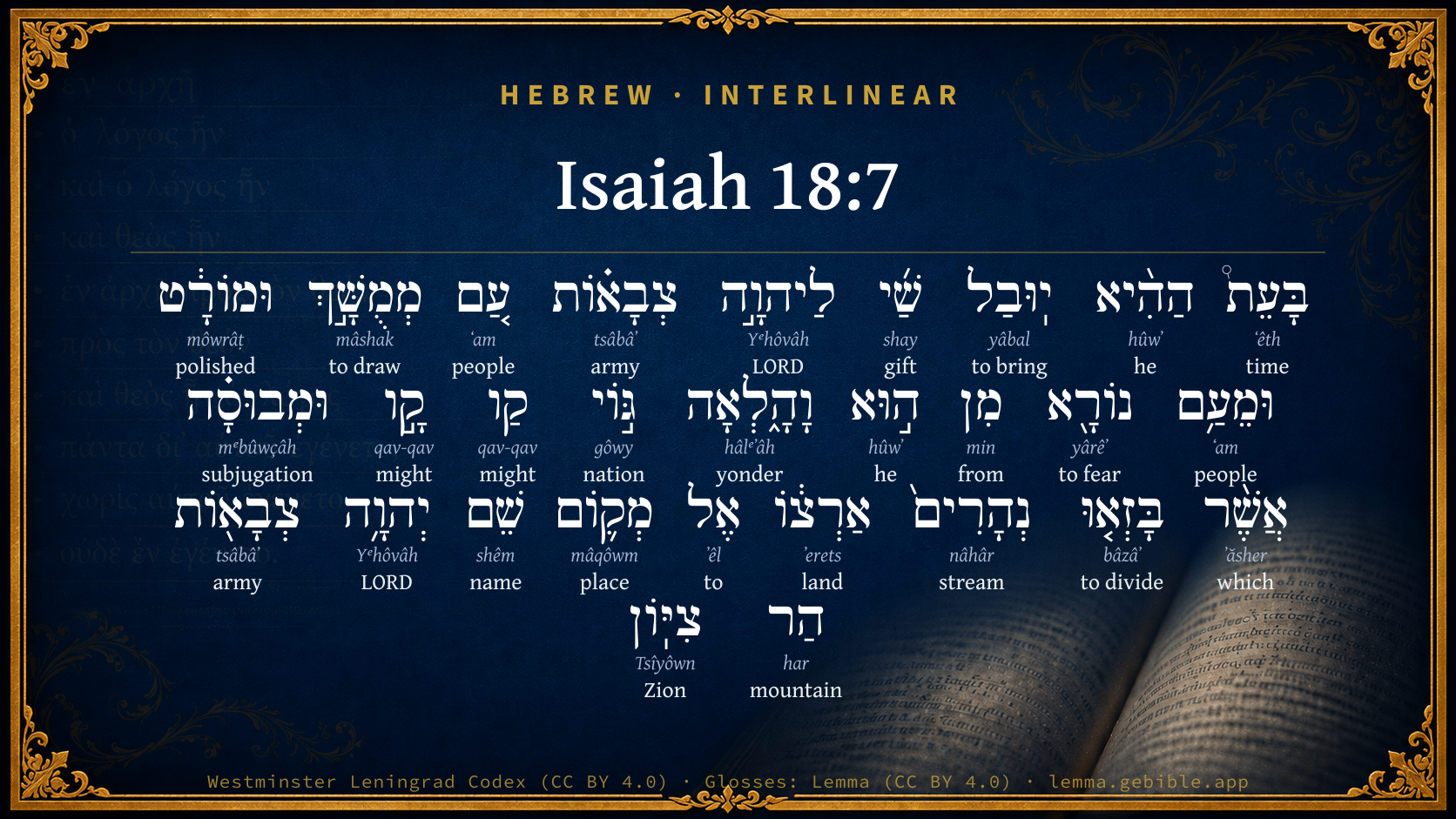
Hebrew (Westminster Leningrad Codex) Isaiah 18:7 appears in the Hebrew Old Testament. The text above is from the Westminster Leningrad Codex. Each word links to its Strong’s number, a concise gloss, and parsing drawn from the Open Scriptures Hebrew Bible morphology. Click any word for its full Brown-Driver-Briggs (BDB) entry.
Download image
Cite this verse

Isaiah 18:7 (World English Bible). Public Domain. Lemma interlinear Bible study tool, https://lemma.gebible.app/v/isaiah/18/7.

Show BibTeX & RIS
BibTeX
RIS
English Translation
In that time shall a present be brought to Yahweh of Hosts [from] a people tall and smooth, even from a people awesome from their beginning onward, a nation that measures out and treads down, whose land the rivers divide, to the place of the name of Yahweh of Hosts, Mount Zion.
World English Bible · Public Domain
Download a study sheet

One document with this verse’s original text, its word-by-word gloss line, the meaning frame, cross-references with their text, attributed commentary, and full source and license credits — printable, and it pastes into notes with its structure intact.

This verse Autodidact and up

Study sheet (.html) Plain text (.txt)

A passage Seminary Student

Up to 50 verses in one chapter. A passage sheet keeps up to 6 commentary sources and 12 cross-references per verse, in the order this page ranks them, and says so on the sheet whenever that leaves anything out. Ask for a single verse and you get the Autodidact verse sheet above.

Everything on this page stays free to read, with no account — the sheet is a download of what is already on screen, not access to it.

Want to remove ads? Support Godless Engineer
Compare translations 3

The same verse in 3 English versions, stacked beneath the original-language interlinear above. Click any original word for its lexicon entry.

Each is an independent rendering of the whole verse — the interlinear is not word-aligned to these translations.

Highlighted words mark where these versions differ — a whole-verse word diff, not a word-by-word alignment.

  • World English Bible Public Domain
    In that time shall a present be brought to Yahweh of Hosts [from] a people tall and smooth, even from a people awesome from their beginning onward, a nation that measures out and treads down, whose land the rivers divide, to the place of the name of Yahweh of Hosts, Mount Zion.
  • King James Version Public Domain
    In that time shall the present be brought unto the LORD of hosts of a people scattered and peeled, and from a people terrible from their beginning hitherto; a nation meted out and trodden under foot, whose land the rivers have spoiled, to the place of the name of the LORD of hosts, the mount Zion.
  • unfoldingWord Literal Text CC BY-SA 4.0
    At that time, tribute will be brought to Yahweh of Armies a people heightened and smooth, indeed, from a people feared from it and beyond, a nation line, line and trampling, whose land the rivers divide, to the place of the name of Yahweh of Armies, Mount Zion.

unfoldingWord Literal Text — © unfoldingWord, licensed CC BY-SA 4.0. Word-aligned USFM3 via Door43 (git.door43.org/unfoldingWord/en_ult).

Versions to compare (up to 4)

3 of 4 selected

Show all 18 translations

Every available English version of this verse, each an independent rendering of the whole verse.

  • World English Bible Public Domain
    In that time shall a present be brought to Yahweh of Hosts [from] a people tall and smooth, even from a people awesome from their beginning onward, a nation that measures out and treads down, whose land the rivers divide, to the place of the name of Yahweh of Hosts, Mount Zion.
  • Berean Standard Bible Public Domain
    At that time gifts will be brought to the LORD of Hosts—from a people tall and smooth-skinned, from a people widely feared, from a powerful nation of strange speech, whose land is divided by rivers—to Mount Zion, the place of the Name of the LORD of Hosts.
  • Majority Standard Bible Public Domain
    At that time gifts will be brought to the LORD of Hosts—from a people tall and smooth-skinned, from a people widely feared, from a powerful nation of strange speech, whose land is divided by rivers—to Mount Zion, the place of the Name of the LORD of Hosts.
  • King James Version Public Domain
    In that time shall the present be brought unto the LORD of hosts of a people scattered and peeled, and from a people terrible from their beginning hitherto; a nation meted out and trodden under foot, whose land the rivers have spoiled, to the place of the name of the LORD of hosts, the mount Zion.
  • American Standard Version (1901) Public Domain
    In that time shall a present be brought unto Jehovah of hosts `from' a people tall and smooth, even from a people terrible from their beginning onward, a nation that meteth out and treadeth down, whose land the rivers divide, to the place of the name of Jehovah of hosts, the mount Zion.
  • Revised Version (1885) Public Domain
    In that time shall a present be brought unto the LORD of hosts of a people tall and smooth, and from a people terrible from their beginning onward; a nation that meteth out and treadeth down, whose land the rivers divide, to the place of the name of the LORD of hosts, the mount Zion.
  • Geneva Bible (1599) Public Domain
    At that time shall a present be brought vnto the Lord of hostes, (a people that is scattered abroade, and spoyled, and of a terrible people from their beginning hitherto, a nation, by litle and litle euen troden vnder foote, whose land the riuers haue spoyled) to the place of the Name of the Lord of hostes, euen the mount Zion.
  • Douay-Rheims (1899) Public Domain
    At that time shall a present be brought to the Lord of hosts, from a people rent and torn in pieces: from a terrible people, after which there hath been no other: from a nation expecting, expecting and trodden under foot, whose land the rivers have spoiled, to the place of the name of the Lord of hosts, to mount Sion.
  • Young's Literal Translation Public Domain
    At that time brought is a present to Jehovah of Hosts, A nation drawn out and peeled. Even of a people fearful from the beginning hitherto, A nation meting out by line, and treading down, Whose land floods have spoiled, Unto the place of the name of Jehovah of Hosts -- mount Zion!'
  • Literal Standard Version CC BY-SA 4.0
    At that time a present is brought to YHWH of Hosts, || A nation drawn out and peeled. Even of a people fearful from the beginning until now, || A nation meting out by line, and treading down, || Whose land floods have spoiled, || To the place of the Name of YHWH of Hosts—Mount Zion!”
  • Unlocked Literal Bible CC BY-SA 4.0
    At that time tribute will be brought to Yahweh of hosts from a people tall and smooth, from a people feared far and near, a nation strong and trampling down, whose land the rivers divide, to the place of the name of Yahweh of hosts, to Mount Zion.
  • unfoldingWord Literal Text CC BY-SA 4.0
    At that time, tribute will be brought to Yahweh of Armies a people heightened and smooth, indeed, from a people feared from it and beyond, a nation line, line and trampling, whose land the rivers divide, to the place of the name of Yahweh of Armies, Mount Zion.
  • Darby Bible Public Domain
    In that time shall a present be brought unto Jehovah of hosts of a people scattered and ravaged, -- and from a people terrible from their existence and thenceforth, a nation of continued waiting and of treading down, whose land the rivers have spoiled,... to the place of the name of Jehovah of hosts, the mount Zion.
  • World Messianic Bible Public Domain
    In that time, a present will be brought to the LORD of Hosts from a people tall and smooth, even from a people awesome from their beginning onward, a nation that measures out and treads down, whose land the rivers divide, to the place of the name of the LORD of Hosts, Mount Zion.
  • Webster's Bible Public Domain
    In that time shall the present be brought to the LORD of hosts of a people scattered and peeled, and from a people terrible from their beginning hitherto; a nation measured by line and trodden under foot, whose land the rivers have spoiled, to the place of the name of the LORD of hosts, the mount Zion.
  • Free Bible Version CC BY-SA 4.0
    At that time a gift will be brought to the Lord Almighty from a tall and smooth-skinned people, from a people feared by everyone, from a very powerful nation of conquerors, whose land is washed away by rivers. It will be brought to Mount Zion, the place identified with the Lord Almighty.
  • Bible in Basic English Public Domain
    In that time an offering will be made to the Lord of armies from a people tall and smooth, causing fear through all their history; a strong nation, crushing down its haters, whose land is cut through by rivers, an offering taken to the place of the name of the Lord of armies, even Mount Zion.
  • JPS Tanakh (1917) Public Domain
    In that time shall a present be brought unto the LORD of hosts of a people tall and of glossy skin, and from a people terrible from their beginning onward; a nation that is sturdy and treadeth down, whose land the rivers divide, to the place of the name of the LORD of hosts, the mount Zion.

Literal Standard Version (2020), Covenant Press — licensed CC BY-SA 4.0. Text via the HelloAO Bible API (eBible.org). Unlocked Literal Bible (unfoldingWord) — licensed CC BY-SA 4.0. Text via the HelloAO Bible API (eBible.org). unfoldingWord Literal Text — © unfoldingWord, licensed CC BY-SA 4.0. Word-aligned USFM3 via Door43 (git.door43.org/unfoldingWord/en_ult). Free Bible Version, Dr. Jonathan Gallagher — licensed CC BY-SA 4.0. Text via the HelloAO Bible API (eBible.org).

Word by word

More ways to search: Search by grammar → Find every occurrence → Compare this word →

Practice this passage: Drill this verse → Learn its vocabulary →

וּמוֹרָ֔ט
môwrâṭ
H4178
“and · polished”
Conjunction + Verb, Pual, Participle Passive, Masculine, Singular, Absolute
Part of Speech
Conjunction + Verb
Stem
Pual
Form
Participle Passive
Gender
Masculine
Number
Singular
State
Absolute
Full BDB Definition

Origin: from H3399

TWOT: 1244

(Pual) scoured, polished, smooth
  1. בָּעֵת֩ ʻêth H6256 “in/at the · time” Preposition, Determined + Noun, Common, Both, Singular, Absolute
  2. הַהִ֨יא hûwʼ H1931 “the · he” Particle, Definite Article + Pronoun, Personal, 3rd Person, Feminine, Singular
  3. יֽוּבַל yâbal H2986 “to bring” Verb, Hophal, Imperfect, 3rd Person, Masculine, Singular
  4. שַׁ֜י shay H7862 “gift” Noun, Common, Masculine, Singular, Absolute
  5. לַיהוָ֣ה Yᵉhôvâh H3068 “to/for · LORD” Preposition + Noun, Proper
  6. צְבָא֗וֹת tsâbâʼ H6635 “armies” Noun, Common, Both, Plural, Absolute
  7. עַ֚ם ʻam H5971 “people” Noun, Common, Masculine, Singular, Absolute
  8. מְמֻשָּׁ֣ךְ mâshak H4900 “drawn” Verb, Pual, Participle Passive, Masculine, Singular, Absolute
  9. וּמֵעַ֥ם ʻam H5971 “and · from · people” Conjunction + Preposition + Noun, Common, Masculine, Singular, Absolute
  10. נוֹרָ֖א yârêʼ H3372 “fearing” Verb, Niphal, Participle Active, Masculine, Singular, Absolute
  11. מִן min H4480 “from” Preposition
  12. ה֣וּא hûwʼ H1931 “he” Pronoun, Personal, 3rd Person, Masculine, Singular
  13. וָהָ֑לְאָה hâlᵉʼâh H1973 “and · yonder” Conjunction + Adverb
  14. גּ֣וֹי gôwy H1471 “nation of” Noun, Common, Masculine, Singular, Construct
  15. קַו qav-qav H6978 “might” Noun, Common, Masculine, Singular, Absolute
  16. קָ֣ו qav-qav H6978 “might” Noun, Common, Masculine, Singular, Absolute
  17. וּמְבוּסָ֗ה mᵉbûwçâh H4001 “and · subjugation” Conjunction + Noun, Common, Feminine, Singular, Absolute
  18. אֲשֶׁ֨ר ʼăsher H834 “which” Particle, Relative
  19. בָּזְא֤וּ bâzâʼ H958 “to divide” Verb, Qal, Perfect, 3rd Person, Common, Plural
  20. נְהָרִים֙ nâhâr H5104 “streams” Noun, Common, Masculine, Plural, Absolute
  21. אַרְצ֔וֹ ʼerets H776 “land · his” Noun, Common, Both, Singular, Construct + Suffix, Personal, 3rd Person, Masculine, Singular
  22. אֶל ʼêl H413 “to” Preposition
  23. מְק֛וֹם mâqôwm H4725 “place of” Noun, Common, Masculine, Singular, Construct
  24. שֵׁם shêm H8034 “name of” Noun, Common, Masculine, Singular, Construct
  25. יְהוָ֥ה Yᵉhôvâh H3068 “LORD” Noun, Proper
  26. צְבָא֖וֹת tsâbâʼ H6635 “armies” Noun, Common, Both, Plural, Absolute
  27. הַר har H2022 “mountain of” Noun, Common, Masculine, Singular, Construct
  28. צִיּֽוֹן Tsîyôwn H6726 “Zion” Noun, Proper

About this verse

These counts appear in no published source. They are computed here, from the morphology-tagged text and Lemma’s own curated glosses. What Lemma adds →

29
words
24
distinct lemmas
Prophets
section

Notable vocabulary

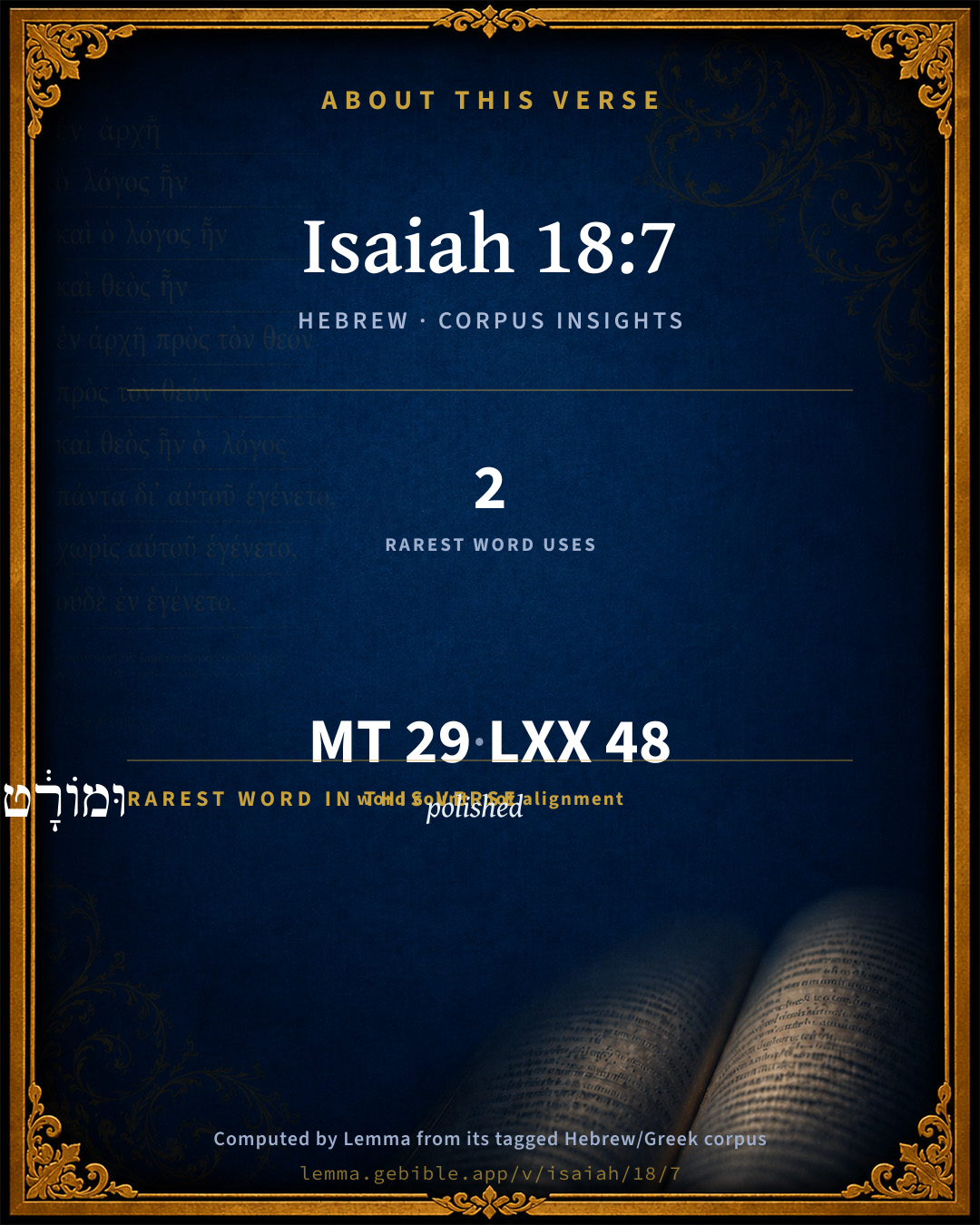
The rarest word here is וּמוֹרָ֔ט polished H4178 — appearing just 2 times in the whole Hebrew Bible.

Shared distinctive vocabulary

וּמוֹרָ֔ט polished H4178 occurs in 2 verses of the Hebrew Bible. Also found in:

Grammatical profile

  • 5 verbs
  • 18 nouns
  • 2 pronouns
  • 2 prepositions
  • 1 adverb
  • 1 particle

Verb forms

  • יֽוּבַל Hophal · Imperfect
  • מְמֻשָּׁ֣ךְ Pual · Participle Passive
  • וּמוֹרָ֔ט Pual · Participle Passive
  • נוֹרָ֖א Niphal · Participle Active
  • בָּזְא֤וּ Qal · Perfect

Repetition

Words recur within this verse — often emphatic in Hebrew:

  • לַיהוָ֣ה LORD H3068 ×2
  • צְבָא֗וֹת army H6635 ×2
  • עַ֚ם people H5971 ×2
  • קַו might H6978 ×2
  • הַהִ֨יא he H1931 ×2

Hebrew & Septuagint length

In English translation the verse runs 52 words from the Hebrew and 61 from the Septuagint (LXX English) — closely comparable.

A rough comparison of the two English renderings, which tokenize alike — not a word-level alignment.

Word counts can differ between the Hebrew and the Greek without any difference in meaning — e.g. the Hebrew direct-object marker אֵת has no separate Greek word, and Greek often adds the article ὁ.

In the original languages it is 29 Hebrew tokens and 48 Greek tokens — but the two are counted differently (Hebrew bundles its prefixes and suffixes into one token; the Greek is in lemma form), so that isn’t a like-for-like length.

Cross-references

14

Topical passages linked to Isaiah 18:7 in the Treasury of Scripture Knowledge — connected by theme and wording, ordered by reader-vote popularity; previews shown in the World English Bible.

  • Zephaniah 3:10 From beyond the rivers of Cush, my worshipers, even the daughter of my dispersed people, will bring my offering.
  • Zechariah 14:16–17 It will happen that everyone who is left of all the nations that came against Jerusalem will go up from year to year to worship the King, Yahweh of Hosts, and to keep the feast of tents.
  • Acts 8:27–28 He arose and went; and behold, there was a man of Ethiopia, a eunuch of great authority under Candace, queen of the Ethiopians, who was over all her treasure, who had come to Jerusalem to worship.
  • 2 Chronicles 32:23 Many brought gifts to Yahweh to Jerusalem, and precious things to Hezekiah king of Judah; so that he was exalted in the sight of all nations from thenceforth.
  • Isaiah 18:4 For thus has Yahweh said to me, I will be still, and I will see in my dwelling-place, like clear heat in sunshine, like a cloud of dew in the heat of harvest.
  • Isaiah 45:14 Thus says Yahweh: "The labor of Egypt, and the merchandise of Ethiopia, and the Sabeans, men of stature, shall come over to you, and they shall be yours. They shall go after you. In chains they shall come over; and they shall fall down to you. They shall make supplication to you: 'Surely God is in you; and there is none else, there is no other god.
  • Micah 4:13 Arise and thresh, daughter of Zion; For I will make your horn iron, And I will make your hoofs brass; And you will beat in pieces many peoples: And I will devote their gain to Yahweh, And their substance to the Lord of the whole earth.
  • Psalms 68:29–31 Because of your temple at Jerusalem, Kings shall bring presents to you.
  • Psalms 72:9–15 Those who dwell in the wilderness shall bow before him. His enemies shall lick the dust.
  • Isaiah 16:1 Send you the lambs for the ruler of the land from Selah to the wilderness, to the mountain of the daughter of Zion.
  • Isaiah 23:17–18 It shall happen after the end of seventy years, that Yahweh will visit Tyre, and she shall return to her hire, and shall play the prostitute with all the kingdoms of the world on the surface of the earth.
  • Isaiah 60:6–9 The multitude of camels shall cover you, the dromedaries of Midian and Ephah; all they from Sheba shall come; they shall bring gold and frankincense, and shall proclaim the praises of Yahweh.
  • Malachi 1:11 For from the rising of the sun even to the going down of the same, my name is great among the nations, and in every place incense will be offered to my name, and a pure offering: for my name is great among the nations," says Yahweh of Hosts.
  • Matthew 2:11 They came into the house and saw the young child with Mary, his mother, and they fell down and worshiped him. Opening their treasures, they offered to him gifts: gold, frankincense, and myrrh.

Cross-references courtesy of OpenBible.info (CC BY 4.0).

Hebrew and Greek witnesses Masoretic Hebrew ↔ Greek Septuagint

The same verse in the two great witnesses to the Old Testament, shown verse-for-verse.

These are two independent witnesses, not word-aligned to each other, and the Septuagint is shown in lemma (dictionary) form.

Hebrew Isaiah 18:7 Masoretic · Westminster Leningrad Codex

בָּעֵת֩ הַהִ֨יא יֽוּבַל שַׁ֜י לַיהוָ֣ה צְבָא֗וֹת עַ֚ם מְמֻשָּׁ֣ךְ וּמוֹרָ֔ט וּמֵעַ֥ם נוֹרָ֖א מִן ה֣וּא וָהָ֑לְאָה גּ֣וֹי קַו קָ֣ו וּמְבוּסָ֗ה אֲשֶׁ֨ר בָּזְא֤וּ נְהָרִים֙ אַרְצ֔וֹ אֶל מְק֛וֹם שֵׁם יְהוָ֥ה צְבָא֖וֹת הַר צִיּֽוֹן

In that time shall a present be brought to Yahweh of Hosts [from] a people tall and smooth, even from a people awesome from their beginning onward, a nation that measures out and treads down, whose land the rivers divide, to the place of the name of Yahweh of Hosts, Mount Zion.

World English Bible · Public Domain

Greek LXX Isaiah 18:7 Septuagint · lemma form

ἐν ὁ καιρός ἐκεῖνος ἀναφέρω δῶρον κύριος σαβαωθ ἐκ λαός θλίβω καί τίλλω καί ἀπό λαός μέγας ἀπό ὁ νῦν καί εἰς ὁ αἰών χρόνος ἔθνος ἐλπίζω καί καταπατέω ὅς εἰμί ἐν μέρος ποταμός ὁ χώρα αὐτός εἰς ὁ τόπος οὗ ὁ ὄνομα κύριος σαβαωθ ἐπικαλέω ὄρος σιων

In that time shall presents be brought to the Lord of hosts from a people afflicted and peeled, and from a people great from henceforth and for ever; a nation hoping and yet trodden down, which is in a part of a river of his land, to the place where is the name of the Lord of hosts, the mount Sion.

LXX2012 (modern English Septuagint) · Public Domain

On this verse, Adam Clarke's Commentary discusses the Septuagint’s reading. Read the note in Commentary ↓

Hebrew: Westminster Leningrad Codex (CC BY 4.0). Greek: Septuagint (public domain); English from LXX2012 (modern English Septuagint) (Public Domain). How the Septuagint differs from the Hebrew →

Targum (Aramaic paraphrase)

1

The Targum is the ancient Jewish Aramaic paraphrase of the Hebrew Scriptures — an interpretive translation, not the Hebrew text itself. Onkelos (literal) and Pseudo-Jonathan (expansive) render the Torah, and Jonathan the Prophets. Coverage is partial: where no permissively-licensed English translation exists for a verse, only the Aramaic is shown. This is verse-level text, not a word-by-word alignment to the Hebrew.

  1. Targum Jonathan Prophets (Joshua–Malachi)
    בְּעִדָנָא הַהִיא יַיְתִינֵיהּ בְּתוּקְרַבְתָּא לִקֳדָם יְיָ צְבָאוֹת לְעַמָא אֲנֵיסָא וּבְזִיזָאוּ לְוַת עַמָא דְיִתְקֵף מִבְּכֵן וּלְהַלָא עַמָא אֲנִיסָא וּבָזִיזָא דְבַזוּ עַמְמַיָא אַרְעֵהּ לְאַתְרָא דְאִתְקְרֵי שְׁמָא דַייָ צְבָאוֹת דִשְׁכִנְתֵּהּ בְּטוּרָא דְצִיוֹן:

    At that time shall one bring an offering unto the Lord of hosts, to a people oppressed and spoiled, to a people that was mighty in times past, and shall be so in time to come, a people oppressed and robbed, whose land the nations have spoiled, unto the place which is called by the name of the Lord of hosts, whose Shekinah is in the mountain of Zion.

    Targum Jonathan — Aramaic: “Mikraot Gedolot” (public domain). English: “Sefaria Community Translation” (CC0 1.0 (public-domain dedication)); “London "Chaldee Paraphrase," 1871” (public domain). Text via Sefaria.

Commentary

Notes on Isaiah 18:7 from classic Christian and Jewish commentators (each source and its license shown beneath its notes). The classic Christian expositions comment on the surrounding passage and are grouped to its opening verse, so a note may address several verses; the Jewish commentaries on the Tanakh (Rashi and others) are per-verse, so they appear only where the commentator wrote on this verse.

Lemma curates 59 commentaries, every one of them public domain or Creative Commons licensed, each selected and text-cleaned for this edition rather than reprinted as found. About our sources →

Trapp's Complete Commentary

John Trapp

Isa 18:7 In that time shall the present be brought unto the LORD of hosts of a people scattered and peeled, and from a people terrible from their beginning hitherto; a nation meted out and trodden under foot, whose land the rivers have spoiled, to the place of the name of the LORD of hosts, the mount Zion.

Ver. 7. In that time.] When the Assyrians are thus slain.

Shall the present be brought,] sc., By the Jews, who shall consecrate a considerable part of the spoils of the Assyrians, according to Num 31:28; Num 31:47; Num 31:50; Num 31:54. Thankfulness for public deliverances is still due to the Most High: "Bring presents unto him that ought to be feared." {Psa 76:11}

John Trapp, A Commentary or Exposition upon All the Books of the Old and New Testament (1647–1656) — public domain. Text from a community e-Sword module.

Joseph Benson's Commentary

Isa 18:7. In that time — After the execution of this signal judgment; shall the present be brought unto the Lord, &c. — Here the prophet foretels that Egypt, being delivered from the oppression of the Assyrian, and avenged, by the hand of God, of the wrongs which she had suffered, should return thanks for the wonderful deliverance, both of herself and of the Jews, from this most powerful adversary. “The Egyptians,” it must be observed, “were in alliance with the kingdom of Judah, and were fellow- sufferers with the Jews, under the invasion of the common enemy Sennacherib; and so were very nearly interested in the great and miraculous deliverance of that kingdom, by the destruction of the Assyrian army. Upon which wonderful event it is said, (2Ch 32:23,) that many brought gifts unto Jehovah, to Jerusalem, and presents to Hezekiah; so that he was magnified of all nations from thenceforth. And it is not to be doubted, that among these the Egyptians distinguished themselves in their acknowledgments on this occasion.” These offerings, then made from Egypt and other nations, were a prelude of a more perfect conversion of the Gentiles to the God of Israel; and there is nothing more certain than that God, after the remarkable overthrow of Sennacherib, was like the clear heat after rain, and like dew in the time of harvest, to the people of Israel. See Bishop Lowth and Vitringa.

Joseph Benson's Commentary on the Old and New Testaments (1811–1818) — public domain. Text from a community e-Sword module.

Keil & Delitzsch

C. F. Keil & F. Delitzsch

What effect this act of Jehovah would have upon the Ethiopian kingdom, if it should now take place, is described in Isa 18:7 : "At that time will there be offered as a homage to Jehovah of hosts a nation stretched out and polished, and from a terrible people, far away on the other side; a nation of command upon command and treading down, whose land rivers cut through, at the place of the name of Jehovah of hosts, the mountain of Zion." עם (a people), at the commencement, cannot possibly be equivalent to מעם (from a people). If it were taken in this sense, it would be necessary to make the correction accordingly, as Knobel has done; but the important parallels in Isa 66:20 and Zep 3:10 are against this. Consequently ‛am and goi (people and nation) must be rendered as subjects; and the מן in מעם must be taken as partitive. Ethiopia is offered, i.e., offers itself, as a free-will offering to Jehovah, impelled irresistibly by the force of the impression made by the mighty act of Jehovah, or, as it is expressed in "the Titan among the Psalms" (Psa 68:32, probably a Davidic psalm of the time of Hezekiah), "there come kingdoms of splendour out of Egypt; Cush rapidly stretches out its hands to Elohim." In order that the greatness of this spiritual conquest might be fully appreciated, the description of this strangely glorious people is repeated here; and with this poetical rounding, the prophecy itself, which was placed as a kind of overture before the following massa Mitzraim when the prophet collected the whole of his prophecies together, is brought to a close.

Keil & Delitzsch — Biblical Commentary on the Old Testament (1861–1891) — public domain (CC PDM 1.0). Text via the HelloAO Bible API. (Old Testament only.)

Lange's Commentary on the Holy Scriptures

ג) THE SALVATION THAT ETHIPIA EXPECTS IN THE DISTANT FUTURE

Isa_18:7

7     In that time shall 21the present be brought unto the Lord of hosts

22Of a people 23 24scattered and peeled,

And from a people terrible 25from their beginning hitherto;

A nation 26meted out and trodden under foot,

Whose land the rivers have spoiled,

To the place of the name of the Lord of hosts, the mount Zion.

TEXTUAL AND GRAMMATICAL

Only עַם and מֵעָם present difficulty.——It is ungrammatical to supply the preposition before עַם from מֵעַם. To amend the text by prefixing the מ is needless violence.——הוּבַל in Isaiah again Isa_53:7; Isa_55:12.——שַׁי, of uncertain derivation, is found again only Psa_68:30; Psa_76:12.—The expression מְקוֹם שֵׁם י׳ occurs only here: yet comp. Lev_14:13; Isa_60:13; Isa_66:1.

EXEGETICAL AND CRITICAL

1. The gaze of the Prophet embraces the immediate and the most remote future, while he overleaps all time spaces that lie between as unessential. The consequence of that mighty overthrow will be this, that Ethiopia presents itself as a sacrificial gift to the Lord, and that out of this people will be sent sacrificial gifts to the spot where men call on the name of the Lord.

2. In that time——mount Zion.

Isa_18:7. By the “in that time” the Prophet joins what follows close on to what precedes. Although what Isa_18:7 affirms belongs to the remote future, yet the Prophet sees it as the great chief effect immediately after the cause, Isa_18:5-6.——By עם and מעם the Prophet would say that the entire nation shall be brought to the Lord as present, tribute, or sacrificial gift; that is it will bring itself—a thought, that is familiar: Isa_66:20; Psa_68:32,—that also, in consequence thereof, presents out of the nation will be brought to the place of the worship of Jehovah. For that is two different things; in order to bring itself, the nation does not need to leave its own place; but in order to bring presents to the sanctuary of the Lord, there must be a motion from one place to another. Therefore a double definition appears, for “there shall be brought a present:” 1) “to the Lord of hosts a people,” 2) “from the people dreaded,” etc. “to the place,” etc.——The passage Zep_3:10 is a reminiscence of our text.

Footnotes:

[21]a gift.

[22]omit of.

[23]Or, outspread and polished.

[24]grown high and shining.

[25]from far away.

[26]of stern command and rough tread.

Lange's Commentary on the Holy Scriptures (Critical, Doctrinal, and Homiletical), ed. John Peter Lange, English translation edited by Philip Schaff (1864–1880) — public domain. Text from a community e-Sword module.

Tyndale Open Study Notes

Tyndale Open Resources

18:7 Conquered or weaker nations were often forced to pay tribute to a dominant king in the region (see 16:1; 2 Kgs 3:4-5). The Ethiopians would come bringing gifts to honor the Lord for his defeat of the Assyrians (see also 2 Chr 32:23).

Tyndale Open Study Notes — © Tyndale Open Resources, licensed CC BY-SA 4.0. Text via the HelloAO Bible API.

Geneva Bible (1599)

Geneva Bible translators

Meaning, that God will pity his Church, and receive that little remnant as an offering unto himself.

Geneva Bible (1599) marginal notes — public domain. Text via Bolls.life.

Jamieson, Fausset & Brown

Robert Jamieson, A. R. Fausset & David Brown

present . . . people scattered and peeled--For the right rendering, see on Isa 18:2. The repetition of epithets enhances the honor paid to Jehovah by so mighty a nation. The Ethiopians, wonder-struck at such an interposition of Jehovah in behalf of His people, shall send gifts to Jerusalem in His honor (Isa 16:1; Psa 68:31; Psa 72:10). Thus translate: "a present . . . from a people." Or translate, as English Version; "the present" will mean "the people" of Ethiopia converted to God (Rom 15:16). HORSLEY takes the people converted to Jehovah, as the Jews in the latter days.

place of the name--where Jehovah peculiarly manifests His glory; Act 2:10 and Act 8:27 show how worshippers came up to Jerusalem from Egypt" and "Ethiopia." Frumentius, an Egyptian, in the fourth century, converted Abyssinia to Christianity; and a Christian church, under an abuna or bishop, still flourishes there. The full accomplishment is probably still future.

The nineteenth and twentieth chapters are connected, but with an interval between. Egypt had been held by an Ethiopian dynasty, Sabacho, Sevechus, or Sabacho II, and Tirhakah, for forty or fifty years. Sevechus (called So, the ally of Hoshea, Kg2 17:4), retired from Lower Egypt on account of the resistance of the priests; and perhaps also, as the Assyrians threatened Lower Egypt. On his withdrawal, Sethos, one of the priestly caste, became supreme, having Tanis ("Zoan") or else Memphis as his capital, 718 B.C.; while the Ethiopians retained Upper Egypt, with Thebes as its capital, under Tirhakah. A third native dynasty was at Sais, in the west of Lower Egypt; to this at a later period belonged Psammetichus, the first who admitted Greeks into Egypt and its armies; he was one of the dodecarchy, a number of petty kings between whom Egypt was divided, and by aid of foreign auxiliaries overcame the rest, 670 B.C. To the divisions at this last time, GESENIUS refers Isa 19:2; and Psammetichus, Isa 19:4, "a cruel lord." The dissensions of the ruling castes are certainly referred to. But the time referred to is much earlier than that of Psammetichus. In Isa 19:1, the invasion of Egypt is represented as caused by "the Lord"; and in Isa 19:17, "Judah" is spoken of as "a terror to Egypt," which it could hardly have been by itself. Probably, therefore, the Assyrian invasion of Egypt under Sargon, when Judah was the ally of Assyria, and Hezekiah had not yet refused tribute as he did in the beginning of Sennacherib's reign, is meant. That Assyria was in Isaiah's mind appears from the way in which it is joined with Israel and Egypt in the worship of Jehovah (Isa 19:24-25). Thus the dissensions referred to (Isa 19:2) allude to the time of the withdrawal of the Ethiopians from Lower Egypt, probably not without a struggle, especially with the priestly caste; also to the time when Sethos usurped the throne and entered on the contest with the military caste, by the aid of the town populations: when the Saitic dynasty was another cause of division. Sargon's reign was between 722-715 B.C. answering to 718 B.C., when Sethos usurped his throne [G. V. SMITH].

Next: Isaiah Chapter 19

Jamieson, Fausset & Brown — Commentary Critical and Explanatory on the Whole Bible (1871) — public domain (CC PDM 1.0). Text via the HelloAO Bible API.

Adam Clarke's Commentary

Verse 7. The present - "A gift"] The Egyptians were in alliance with the kingdom of Judah, and were fellow-sufferers with the Jews under the invasion of their common enemy Sennacherib; and so were very nearly interested in the great and miraculous deliverance of that kingdom, by the destruction of the Assyrian army. Upon which wonderful event it is said, 2Ch 32:23, that "many brought gifts unto Jehovah to Jerusalem, and presents to Hezekiah king of Judah; so that he was magnified of all nations from henceforth." It is not to be doubted, that among these the Egyptians distinguished themselves in their acknowledgments on this occasion.

Of a people - "From a people"] Instead of עם am, a people, the Septuagint and Vulgate read מעם meam, from a people, which is confirmed by the repetition of it in the next line. The difference is of importance; for if this be the true reading, the prediction of the admission of Egypt into the true Church of God is not so explicit as it might otherwise seem to be. However, that event is clearly foretold at the end of the next chapter. - L.

Adam Clarke's Commentary on the Bible (1810–1826) — public domain. Text from a community e-Sword/MySword module.

Ellicott's Commentary for English Readers

(7) In that time shall the present be brought . . .—Not “of the people,” but a people, as being themselves the present. The prophet foresees, as one result of the defeat of the Assyrian armies, that the nation, which he again describes instead of naming, will offer themselves to the service of Jehovah. So taken the words have an interesting parallel in Psa_68:31, “Ethiopia stretches out her hands unto God,” or in the mention of Ethiopia in Psa_87:3, as among the nations whose children are to be enrolled among the citizens of Zion. Messengers who may have justified Isaiah’s words were probably found among the envoys mentioned in 2Ch_32:23. Here, again, the words have been referred as before, to Israel.

A Bible Commentary for English Readers, edited by Charles John Ellicott (1878–1897) — public domain. Text from a community e-Sword module.

The Cambridge Bible for Schools and Colleges

gen. ed. J. J. S. Perowne

7. Ethiopia shall then pay homage to Jehovah at Mount Zion, the earthly seat of His sovereignty.

For the present read a present. The word is rare, occurring again only in Psa_68:29; Psa_76:11, in both passages coupled with the same poetic word as is here used for “brought.”

of a people] Read from as in the next clause. The idea meant to be conveyed by the E.V. might be justified by an appeal to ch. Isa_45:14, but it is far more likely that the preposition has been accidentally omitted in the Hebr. text.

the place of the name of Lord] See 1Ki_8:17; Deu_12:5; Deu_12:11.

For other anticipations of the conversion of Ethiopia, cf. ch. Isa_45:14; Zep_3:10; Psa_68:31; Psa_87:4.

The Cambridge Bible for Schools and Colleges (gen. ed. J. J. S. Perowne; Cambridge University Press, 1878–1918) — public domain. Text from a community e-Sword module.

John Gill's Exposition

In that time shall the present be brought unto the Lord of hosts,.... Not exactly at the time when this destruction should be, but some time after, even in Gospel times; for to them this part of the prophecy refers:

of a people scattered and peeled; this explains what the present is, that shall be brought to the Lord; it is a people, and therefore not the spoils of Sennacherib's army, as some interpret it; nor yet the people of the Jews, that shall be brought by the Gentiles out of all nations in the latter day, as an offering to the Lord, as Aben Ezra and Kimchi; see Isa 11:11 (p); but the Ethiopians or Egyptians, described Isa 18:2 as here, who, being converted, shall stretch out their hands to God, submit unto him, and present themselves soul and body as an acceptable sacrifice unto him; when these prophecies in Psa 68:31 shall be fulfilled, and which began to be in the conversion of the Ethiopian eunuch, Act 8:27 and of which there were other instances in the times of the apostles, and in following ages:

and from a people terrible from their beginning hitherto; that is, some of the people, not all of them; the same people are designed as before, only this Hebraism is used, to show a distinction among them:

a nation meted out, and trodden under foot, whose land the rivers have spoiled; these descriptive characters, with those in the preceding clauses, are retained, to show that the same people are here meant as in Isa 18:2 and to magnify the riches of God's grace, in the conversion of a people to whom such characters belonged; which show that it was not owing to themselves, or any deserts of theirs, but to the free favour and good will of God:

to the place of the name of the Lord of hosts, the mount Zion; hither the present was to be brought, and here the persons to present themselves to the Lord, even in the mount Zion, the church of God; where the name of the Lord is named and called upon, his word is preached, his ordinances are administered, and where he dwells, and grants his presence.

(p) So Manasseh ben Israel, Spes. Israelis, sect. 17. p. 57.

Next: Isaiah Chapter 19

John Gill's Exposition of the Whole Bible (1746–1763) — public domain (CC PDM 1.0). Text via the HelloAO Bible API.

Albert Barnes' Notes on the Bible

In that time - When shall thus be disconcerted, and their armies be overthrown.

Shall the present be brought... - The word ‘present’ (שׁי shay) denotes a gift, and is found only in the phrase ‘to bring gifts,’ or ‘presents’ Psa 68:30; Psa 76:11. It means here evidently a tribute, or an offering to Yahweh as the only true God; and possibly may mean that the people would be converted to him, and embrace the true religion.

Of a people ... - From a people. The description which follows is the same precisely as in Isa 18:2. Numerous repetitions of this kind will be recollected by the classic reader in the “Iliad.”

To the place of the name ... - The place where Yahweh is worshipped, that is, Jerusalem (compare the notes at Isa 1:8-9). We have no means of knowing with certainty when or how this prophecy was fulfilled. That the Jewish religion spread into Upper Egypt, and that the Christian religion was afterward established there, there can be no doubt. The Jews were scattered into nearly every nation, and probably many of this people became proselytes, and went with them to Jerusalem to worship (see Act 2:10; Act 8:27). ‘The Abyssinian annals represent the country as converted to Judaism several centuries before the Christian era; and it certainly retains many appearances bearing the stamp of that faith. In the fourth century, the nation was converted to Christianity by the efforts of Frumentius, an Egyptian, who raised himself to high favor at court. Abyssinia remained impenetrable to the arms or the creed of the followers of Mahomet, and, affording shelter to the refugees from Egypt and Arabia, it became more decidedly Christian.’ ‘The Abyssinians profess the same form of Christianity with the Copts of Egypt, and even own the supremacy of the patriarch at Cairo. They combine with their Christian profession many Judaical observances, such as circumcision, abstinence from meats, and the observance of Saturday as well as Sunday as a Sabbath.’ (“Encyc. of Geography,” vol. ii. pp. 585, 588.) in these facts - in the prevalence of the true religion there in former periods, the prophecy may be regarded as having been in part fulfilled. Still, as is the case with a large portion of the prophecies of Isaiah, we must regard this as having reference to a period of greater light and truth than has yet existed there; and as destined to receive a more complete fulfillment when all lands shall be full of the knowledge of the Lord.

Albert Barnes' Notes on the Bible (1834–1885) — public domain. Text from a community e-Sword/MySword module.

Haydock's Catholic Bible Commentary

Sion. Egypt shall send presents to the Lord, 2 Paralipomenon xxxii. 23. (Calmet)

George Leo Haydock (1774–1849), Haydock's Catholic Family Bible and Commentary, 1859 edition — public domain. Excludes Psalms (Douay-Rheims chapter numbering differs from Protestant) and Deuterocanonical books (Catholic canon only).

Matthew Poole's English Annotations

In that day; which is to be taken largely and indefinitely, as it is frequently in the prophets, as we have already seen, and shall more fully see hereafter. At or after that time, when the judgment threatened in the foregoing verses shall be fully and completely executed, whereby that people will be awakened to repentance.

A people; the people of whom I am speaking shall present and offer themselves and their sacrifices unto the true God. He speaks of their conversion to God and Christ by the preaching of the gospel; the accomplishment of which promise is recorded in the histories of the church.

Matthew Poole's English Annotations on the Holy Bible (1683–1685) — public domain. Text from a community e-Sword/MySword module.

Whedon's Commentary on the Bible

Daniel D. Whedon

7. In that time shall the present be brought — Now that Ethiopia is delivered by the fall of her enemy, the usual offerings of submission and gratitude are due from her. The proper offering is, that of herself to her deliverer, making herself over to him and to his religion as established on mount Zion. The terms characterizing Ethiopia are the same as in Isa_18:2, where see explanations. Was this call to the Ethiopians unheeded? Did this wonder from Jehovah — the Assyrian destruction — prove a vain event in directing the world’s attention to Him as its almighty Creator and Sovereign? “This particular case has already thrown forward some foreshadowing of its future fulfilment in the scenes briefly sketched in Act_8:26-39, when the prime minister of a celebrated queen of Ethiopia found Christ, by the aid of Philip, in reading this very book of Isaiah, and went home to his country rejoicing. Also in the further fact, that some vestiges of Christianity — traces of its early power, and perhaps prophecies of its later — have lived in that remote land unto this day. Assuredly ‘Ethiopia shall yet stretch forth her hands unto God.’” — Cowles.

Daniel D. Whedon (gen. ed.), Commentary on the Old and New Testaments (1874–1909) — public domain. Text from a community e-Sword module.

The Pulpit Commentary

In that time shall the present be brought; rather, a present. It would not be at all improbable that Tirkakah should, after the destruction of Sennacherib"s army, send a gift to the temple of the Jews, either as a recognition of the miracle as wrought by Jehovah, or simply as a thank offering. Necho sent the armor in which he had fought at Megiddo to the temple of Apollo at Branchidae, near Miletus, as a thank offering (Herod., 2:159). We have, however, no historical record of Tirkakah"s present as sent. Of a people; rather, from a people (compare the next clause, which supplies the ellipse of the preposition). (For the rest of the verse, see notes on ver. 2.)

The Pulpit Commentary (1880–1919), ed. H.D.M. Spence-Jones & Joseph S. Exell — public domain. Text from a community e-Sword module.

John Wesley's Explanatory Notes

In that time - At or after that time, when the judgment shall be compleatly executed. A people - The people of whom I am speaking shall present themselves, and their sacrifices, to the true God.

John Wesley, Explanatory Notes Upon the Whole Bible (1754–1765) — public domain. Text via the GEBible commentary corpus.

J. A. Alexander on Isaiah

Joseph Addison Alexander

“At that time shall be brought a gift to Jehovah of Hosts, a people drawn out and shorn, and for a people terrible since it has been and onward (or still more terrible and still further off), a nation of double power and trampling, whose land streams divide, to the place of the name of Jehovah of Hosts, Mount Zion.” Here, as in v. 2, the sense of some particular expressions is so doubtful, that it seems better to retain, as far as possible, the form of the original, with all its ambiguity, than to attempt an explanatory paraphrase. All are agreed that we have here the prediction of an act of homage to Jehovah, occasioned by the great event described in the preceding verses. The Jews, who understand the second verse as a description of the sufferings endured by Israel, explain this as a prophecy of their return from exile and dispersion, aided and as it were presented as an offering to Jehovah by the heathen (see below, Isa 66:20). The older Christian writers understand it as predicting the conversion of the Egyptians or Ethiopians to the true religion. The most natural construction of the words would seem to be that the gift to Jehovah should consist of one people offered by another. The place of God’s name is not merely the place called by his name, but the place where his name, (i.e., the manifestation of his attributes) resides.

Joseph Addison Alexander, The Prophecies of Isaiah (1846–1847; New York: Scribner, 1870–1878) — public domain. Text from a community e-Sword module.

Ibn Ezra

Rabbi Abraham ibn Ezra

שי Present. Comp. Ps. 76:12.

A people dragged and peeled. Israel, who has been dragged and flayed during the period of his captivity, will now be brought, to the honour of God, to His abode on Mount Zion. According to R. Moses Hakkohen, this chapter describes the redemption announced by the words—The Lord shall set His hand again the second time to recover the remnant of the people, etc. (11:11.

Ibn Ezra on the Tanakh — English translations: “Sefaria Community Translation” (CC0 1.0 (public-domain dedication)); “Yalkut, Sifsei Chachomim Chumash, Metsudah Publications, 2009” (CC BY 4.0); and “Commentary of Ibn Ezra on Isaiah - trans. by M. Friedlander, 1873” (public domain). Text via Sefaria.

Lesson kit

Teaching starters — assembled from the data on this page, not authored interpretation. Every prompt links to the verse data it draws on. Edit before teaching.

Isaiah, in the Prophets, opens this verse with 29 words (24 distinct Hebrew lemmas). Its most distinctive word is môwrâṭ (“polished”). A historical commentator’s framing appears above. Read the whole chapter for the surrounding context.

Discussion questions

  1. What does “polished” (môwrâṭ) contribute to the verse as a whole?
  2. How does Isaiah 18:2, which shares the word «polished», read alongside this verse?
  3. What does the repetition of “LORD” (2× in this one verse) do in this verse?
  4. These translations render this verse differently; the difference is in the English rendering, not the original. What questions does that raise?
  5. «יֽוּבַל» is a Hophal Imperfect verb. How does that grammatical form shape the action described?
  6. Compare how Trapp's Complete Commentary and Joseph Benson's Commentary read this verse. Where do they agree or differ?

Things to notice

Reading settings

Reading text

Shown beneath each verse's original-language words.

Old Testament
Old Testament edition

Read the OT as the Masoretic Hebrew (MT) or the Greek Septuagint (LXX).

English shown for the Greek Septuagint (in the Hebrew ↔ Greek comparison).

Comparing translations? Open the Compare panel on any verse page to stack up to four side by side.