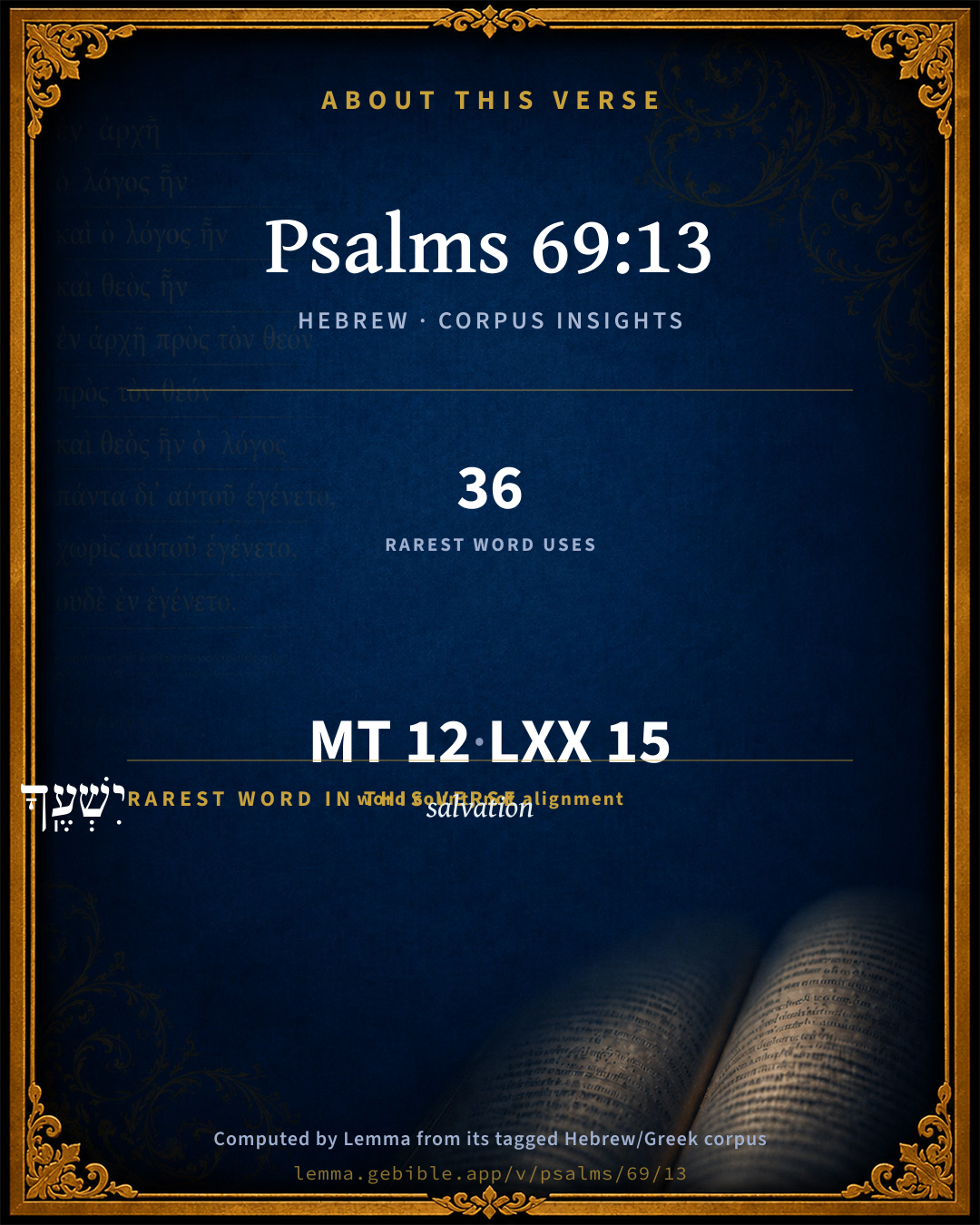
Psalms 69:13

Hebrew (Westminster Leningrad Codex) Psalms 69:13 appears in the Hebrew Old Testament. The text above is from the Westminster Leningrad Codex. Each word links to its Strong’s number, a concise gloss, and parsing drawn from the Open Scriptures Hebrew Bible morphology. Click any word for its full Brown-Driver-Briggs (BDB) entry.
Download image
Cite this verse

Psalms 69:13 (World English Bible). Public Domain. Lemma interlinear Bible study tool, https://lemma.gebible.app/v/psalms/69/13.

Show BibTeX & RIS
BibTeX
RIS
English Translation
But as for me, my prayer is to you, Yahweh, in an acceptable time. God, in the abundance of your loving kindness, answer me in the truth of your salvation.
World English Bible · Public Domain
Download a study sheet

One document with this verse’s original text, its word-by-word gloss line, the meaning frame, cross-references with their text, attributed commentary, and full source and license credits — printable, and it pastes into notes with its structure intact.

This verse Autodidact and up

Study sheet (.html) Plain text (.txt)

A passage Seminary Student

Up to 50 verses in one chapter. A passage sheet keeps up to 6 commentary sources and 12 cross-references per verse, in the order this page ranks them, and says so on the sheet whenever that leaves anything out. Ask for a single verse and you get the Autodidact verse sheet above.

Everything on this page stays free to read, with no account — the sheet is a download of what is already on screen, not access to it.

Want to remove ads? Support Godless Engineer
Compare translations 3

The same verse in 3 English versions, stacked beneath the original-language interlinear above. Click any original word for its lexicon entry.

Each is an independent rendering of the whole verse — the interlinear is not word-aligned to these translations.

Highlighted words mark where these versions differ — a whole-verse word diff, not a word-by-word alignment.

  • World English Bible Public Domain
    But as for me, my prayer is to you, Yahweh, in an acceptable time. God, in the abundance of your loving kindness, answer me in the truth of your salvation.
  • King James Version Public Domain
    But as for me, my prayer is unto thee, O LORD, in an acceptable time: O God, in the multitude of thy mercy hear me, in the truth of thy salvation.
  • unfoldingWord Literal Text CC BY-SA 4.0
    But I, my prayer to you, Yahweh. a time of favor, God, in the greatness of your covenant faithfulness, answer me in the truth of your salvation.

unfoldingWord Literal Text — © unfoldingWord, licensed CC BY-SA 4.0. Word-aligned USFM3 via Door43 (git.door43.org/unfoldingWord/en_ult).

Versions to compare (up to 4)

3 of 4 selected

Show all 18 translations

Every available English version of this verse, each an independent rendering of the whole verse.

  • World English Bible Public Domain
    But as for me, my prayer is to you, Yahweh, in an acceptable time. God, in the abundance of your loving kindness, answer me in the truth of your salvation.
  • Berean Standard Bible Public Domain
    But my prayer to You, O LORD, is for a time of favor. In Your abundant loving devotion, O God, answer me with Your sure salvation.
  • Majority Standard Bible Public Domain
    But my prayer to You, O LORD, is for a time of favor. In Your abundant loving devotion, O God, answer me with Your sure salvation.
  • King James Version Public Domain
    But as for me, my prayer is unto thee, O LORD, in an acceptable time: O God, in the multitude of thy mercy hear me, in the truth of thy salvation.
  • American Standard Version (1901) Public Domain
    But as for me, my prayer is unto thee, O Jehovah, in an acceptable time: O God, in the abundance of thy lovingkindness, Answer me in the truth of thy salvation.
  • Revised Version (1885) Public Domain
    But as for me, my prayer is unto thee, O LORD, in an acceptable time: O God, in the multitude of thy mercy, answer me in the truth of thy salvation.
  • Geneva Bible (1599) Public Domain
    But Lord, I make my praier vnto thee in an acceptable time, euen in the multitude of thy mercie: O God, heare me in the trueth of thy saluation.
  • Douay-Rheims (1899) Public Domain
    They that sat in the gate spoke against me: and they that drank wine made me their song.
  • Young's Literal Translation Public Domain
    And I -- my prayer `is' to Thee, O Jehovah, A time of good pleasure, O God, In the abundance of Thy kindness, Answer me in the truth of Thy salvation.
  • Literal Standard Version CC BY-SA 4.0
    And my prayer [is] to You, O YHWH, || A time of good pleasure, O God, || In the abundance of Your kindness, || Answer me in the truth of Your salvation.
  • Unlocked Literal Bible CC BY-SA 4.0
    But as for me, my prayer is to you, Yahweh, at a time that you will accept; answer me in the trustworthiness of your salvation.
  • unfoldingWord Literal Text CC BY-SA 4.0
    But I, my prayer to you, Yahweh. a time of favor, God, in the greatness of your covenant faithfulness, answer me in the truth of your salvation.
  • Darby Bible Public Domain
    But as for me, my prayer is unto thee, Jehovah, in an acceptable time: O God, in the abundance of thy loving-kindness answer me, according to the truth of thy salvation:
  • World Messianic Bible Public Domain
    But as for me, my prayer is to you, LORD, in an acceptable time. God, in the abundance of your loving kindness, answer me in the truth of your salvation.
  • Webster's Bible Public Domain
    \\69:12\\They that sit in the gate speak against me; and I was the song of the drunkards.
  • Free Bible Version CC BY-SA 4.0
    But my prayer is to you, Lord, believing this is a good time to respond to me. God, in your wonderful trustworthy love, answer me with your sure salvation.
  • Bible in Basic English Public Domain
    But as for me, let my prayer be made to you, O Lord, at a time when you are pleased; O God, give me an answer in your great mercy, for your salvation is certain.
  • JPS Tanakh (1917) Public Domain
    (69-14) But as for me, let my prayer be unto Thee, O LORD, in an acceptable time; O God, in the abundance of Thy mercy, answer me with the truth of Thy salvation.

Literal Standard Version (2020), Covenant Press — licensed CC BY-SA 4.0. Text via the HelloAO Bible API (eBible.org). Unlocked Literal Bible (unfoldingWord) — licensed CC BY-SA 4.0. Text via the HelloAO Bible API (eBible.org). unfoldingWord Literal Text — © unfoldingWord, licensed CC BY-SA 4.0. Word-aligned USFM3 via Door43 (git.door43.org/unfoldingWord/en_ult). Free Bible Version, Dr. Jonathan Gallagher — licensed CC BY-SA 4.0. Text via the HelloAO Bible API (eBible.org).

Word by word

More ways to search: Search by grammar → Find every occurrence → Compare this word →

Practice this passage: Drill this verse → Learn its vocabulary →

יִשְׁעֶֽךָ
yeshaʻ
H3468
“salvation · your”
Noun, Common, Masculine, Singular, Construct + Suffix, Personal, 2nd Person, Masculine, Singular
Part of Speech
Noun
Type
Common
Gender
Masculine
Number
Singular
State
Construct
Full BDB Definition

Origin: from H3467

TWOT: 929a

deliverance, salvation, rescue, safety, welfare - safety, welfare, prosperity - salvation - victory
  1. וַאֲנִ֤י ʼănîy H589 “and · I” Conjunction + Pronoun, Personal, 1st Person, Common, Singular
  2. תְפִלָּתִֽי tᵉphillâh H8605 “prayer · my” Noun, Common, Feminine, Singular, Construct + Suffix, Personal, 1st Person, Common, Singular
  3. יְהוָ֡ה Yᵉhôvâh H3068 “LORD” Noun, Proper
  4. עֵ֤ת ʻêth H6256 “time of” Noun, Common, Both, Singular, Construct
  5. רָצ֗וֹן râtsôwn H7522 “pleasure” Noun, Common, Masculine, Singular, Absolute
  6. אֱלֹהִ֥ים ʼĕlôhîym H430 “God(s)” Noun, Common, Masculine, Plural, Absolute
  7. בְּרָב rôb H7230 “in/at · multitude of” Preposition + Noun, Common, Both, Singular, Construct
  8. חַסְדֶּ֑ךָ chêçêd H2617 “kindness · your” Noun, Common, Masculine, Singular, Construct + Suffix, Personal, 2nd Person, Masculine, Singular
  9. עֲ֝נֵ֗נִי ʻânâh H6030 “answer · me” Verb, Qal, Imperative, 2nd Person, Masculine, Singular + Suffix, Personal, 1st Person, Common, Singular
  10. בֶּאֱמֶ֥ת ʼemeth H571 “in/at · faithfulness of” Preposition + Noun, Common, Feminine, Singular, Construct

About this verse

These counts appear in no published source. They are computed here, from the morphology-tagged text and Lemma’s own curated glosses. What Lemma adds →

12
words
11
distinct lemmas
Wisdom
section

Shared distinctive vocabulary

יִשְׁעֶֽךָ salvation H3468 occurs in 35 verses of the Hebrew Bible. Also found in:

Grammatical profile

  • 1 verb
  • 9 nouns
  • 1 pronoun
  • 1 preposition

Verb forms

  • עֲ֝נֵ֗נִי Qal · Imperative

Hebrew & Septuagint length

In English translation the verse runs 30 words from the Hebrew and 32 from the Septuagint (LXX English) — closely comparable.

A rough comparison of the two English renderings, which tokenize alike — not a word-level alignment.

Word counts can differ between the Hebrew and the Greek without any difference in meaning — e.g. the Hebrew direct-object marker אֵת has no separate Greek word, and Greek often adds the article ὁ.

In the original languages it is 12 Hebrew tokens and 15 Greek tokens — but the two are counted differently (Hebrew bundles its prefixes and suffixes into one token; the Greek is in lemma form), so that isn’t a like-for-like length.

Cross-references

23

Topical passages linked to Psalms 69:13 in the Treasury of Scripture Knowledge — connected by theme and wording, ordered by reader-vote popularity; previews shown in the World English Bible.

  • 2 Corinthians 6:2 for he says, "At an acceptable time I listened to you, In a day of salvation I helped you." Behold, now is the acceptable time. Behold, now is the day of salvation.
  • Isaiah 49:8 Thus says Yahweh, In an acceptable time have I answered you, and in a day of salvation have I helped you; and I will preserve you, and give you for a covenant of the people, to raise up the land, to make them inherit the desolate heritage:
  • Psalms 55:16–17 As for me, I will call on God. Yahweh will save me.
  • Psalms 91:15 He will call on me, and I will answer him. I will be with him in trouble. I will deliver him, and honor him.
  • Psalms 40:10–11 I have not hidden your righteousness within my heart. I have declared your faithfulness and your salvation. I have not concealed your loving kindness and your truth from the great assembly.
  • Isaiah 55:6 Seek you Yahweh while he may be found; call you on him while he is near:
  • 1 Samuel 25:8 Ask your young men, and they will tell you: therefore let the young men find favor in your eyes; for we come in a good day. Please give whatever comes to your hand, to your servants, and to your son David.
  • 1 Peter 2:23 Who, when he was cursed, didn't curse back. When he suffered, didn't threaten, but committed himself to him who judges righteously;
  • Genesis 24:27 He said, "Blessed be Yahweh, the God of my master Abraham, who has not forsaken his loving kindness and his truth toward my master. As for me, Yahweh has led me in the way to the house of my master's relatives."
  • Hebrews 5:7 He, in the days of his flesh, having offered up prayers and petitions with strong crying and tears to him who was able to save him from death, and having been heard for his godly fear,
  • Esther 5:2 It was so, when the king saw Esther the queen standing in the court, that she obtained favor in his sight; and the king held out to Esther the golden scepter that was in his hand. So Esther drew near, and touched the top of the scepter.
  • Esther 5:6 The king said to Esther at the banquet of wine, What is your petition? and it shall be granted you: and what is your request? even to the half of the kingdom it shall be performed.
  • Esther 7:2 The king said again to Esther on the second day at the banquet of wine, What is your petition, queen Esther? and it shall be granted you: and what is your request? even to the half of the kingdom it shall be performed.
  • Psalms 32:6 For this, let everyone who is godly pray to you in a time when you may be found. Surely when the great waters overflow, they shall not reach to him.
  • Psalms 51:1 Have mercy on me, God, according to your loving kindness. According to the multitude of your tender mercies, blot out my transgressions.
  • Psalms 98:3 He has remembered his loving kindness and his faithfulness toward the house of Israel. All the ends of the earth have seen the salvation of our God.
  • Matthew 26:36–46 Then Jesus came with them to a place called Gethsemane, and said to his disciples, "Sit here, while I go there and pray."
  • Luke 22:44 Being in agony he prayed more earnestly. His sweat became like great drops of blood falling down on the ground.
  • John 17:1–26 Jesus said these things, and lifting up his eyes to heaven, he said, "Father, the time has come. Glorify your Son, that your Son may also glorify you;
  • Acts 13:32–33 We bring you good news of the promise made to the fathers,
  • Romans 15:8–9 Now I say that Christ has been made a minister of the circumcision for the truth of God, that he might confirm the promises given to the fathers,
  • Luke 1:72 To show mercy towards our fathers, To remember his holy covenant,
  • Micah 7:20 You will give truth to Jacob, and mercy to Abraham, As you have sworn to our fathers from the days of old.

Cross-references courtesy of OpenBible.info (CC BY 4.0).

Hebrew and Greek witnesses Masoretic Hebrew ↔ Greek Septuagint

The same verse in the two great witnesses to the Old Testament, shown verse-for-verse.

You’re reading Greek Psalm 68 (Hebrew Psalm 69). The Septuagint counts the superscription, so verse numbers can differ from the Hebrew — chapter-level alignment, not verse-by-verse. Numbering follows Rahlfs.

These are two independent witnesses, not word-aligned to each other, and the Septuagint is shown in lemma (dictionary) form.

Hebrew Psalms 69:13 Masoretic · Westminster Leningrad Codex

וַאֲנִ֤י תְפִלָּתִֽי לְךָ֨ יְהוָ֡ה עֵ֤ת רָצ֗וֹן אֱלֹהִ֥ים בְּרָב חַסְדֶּ֑ךָ עֲ֝נֵ֗נִי בֶּאֱמֶ֥ת יִשְׁעֶֽךָ

But as for me, my prayer is to you, Yahweh, in an acceptable time. God, in the abundance of your loving kindness, answer me in the truth of your salvation.

World English Bible · Public Domain

Greek LXX Greek Psalm 68:13 Septuagint · lemma form

κατά ἐγώ ἀδολεσχέω ὁ καταἧμαι ἐν πύλη καί εἰς ἐγώ ψάλλω ὁ πίνω ὁ οἶνος

But I will cry to you, O Lord, in my prayer; O God, it is a propitious time: in the multitude of your mercy hear me, in the truth of your salvation.

LXX2012 (modern English Septuagint) · Public Domain

Hebrew: Westminster Leningrad Codex (CC BY 4.0). Greek: Septuagint (public domain); English from LXX2012 (modern English Septuagint) (Public Domain). How the Septuagint differs from the Hebrew →

Commentary

Notes on Psalms 69:13 from classic Christian and Jewish commentators (each source and its license shown beneath its notes). The classic Christian expositions comment on the surrounding passage and are grouped to its opening verse, so a note may address several verses; the Jewish commentaries on the Tanakh (Rashi and others) are per-verse, so they appear only where the commentator wrote on this verse.

Lemma curates 59 commentaries, every one of them public domain or Creative Commons licensed, each selected and text-cleaned for this edition rather than reprinted as found. About our sources →

Matthew Henry's Commentary

David had been speaking before of the spiteful reproaches which his enemies cast upon him; here he adds, But, as for me, my prayer is unto thee. They spoke ill of him for his fasting and praying, and for that he was made the song of the drunkards; but, notwithstanding that, he resolves to continue praying. Note, Though we may be jeered for well-doing, we must never be jeered out of it. Those can bear but little for God, and their confessing his name before men, that cannot bear a scoff and a hard word rather than quit their duty. David's enemies were very abusive to him, but this was his comfort, that he had a God to go to, with whom he would lodge his cause. "They think to carry their cause by insolence and calumny; but I use other methods. Whatever they do, As for me, my prayer is unto thee, O Lord!" And it was in an acceptable time, not the less acceptable for being a time of affliction. God will not drive us from him, though it is need that drives us to him; nay, it is the more acceptable, because the misery and distress of God's people make them so much the more the objects of his pity: it is seasonable for him to help them when all other helps fail, and they are undone, and feel that they are undone, if he do not help them. We find this expression used concerning Christ. Isa 49:8, In an acceptable time have I heard thee. Now observe,

I. What his requests are. 1. That he might have a gracious audience given to his complaints, the cry of his affliction, and the desire of his heart. Hear me (Psa 69:13), and again, Hear me, O Lord! (Psa 69:16), Hear me speedily (Psa 69:17), not only hear what I say, but grant what I ask. Christ knew that the Father heard him always, Joh 11:42. 2. That he might be rescued out of his troubles, might be saved from sinking under the load of grief (Deliver me out of the mire; let me not stick in it, so some, but help me out, and set my feet on a rock, Psa 40:2), might be saved from his enemies, that they might not swallow him up, nor have their will against him: "Let me be delivered from those that hate me, as a lamb from the paw of a lion, Psa 69:14. Though I have come into keep waters (Psa 69:2), where I am ready to conclude that the floods will overflow me, yet let my fears be prevented and silenced; let not the waterflood, though it flow upon me, overflow me, Psa 69:15. Let me not fall into the gulf of despair; let not that deep swallow me up; let not that pit shut her mouth upon me, for then I am undone." He gave himself up for lost in the beginning of the psalm; yet now he has his head above water, and is not so weary of crying as he thought himself. 3. That God would turn to him (Psa 69:16), that he would smile upon him, and not hide his face from him, Psa 69:17. The tokens of God's favour to us, and the light of his countenance shining upon us, are enough to keep our spirits from sinking in the deepest mire of outward troubles, nor need we desire any more to make us safe and easy, Psa 69:18. "Draw nigh to my soul, to manifest thyself to it, and that shall redeem it."

II. What his pleas are to enforce these petitions. 1. He pleads God's mercy and truth (Psa 69:13): In the multitude of thy mercy hear me. There is mercy in God, a multitude of mercies, all kinds of mercy, inexhaustible mercy, mercy enough for all, enough for each; and hence we must take our encouragement in praying. The truth also of his salvation (the truth of all those promises of salvation which he has made to those that trust in him) is a further encouragement. He repeats his argument taken from the mercy of God: "Hear me, for thy lovingkindness of good. It is so in itself; it is rich and plentiful and abundant. It is so in the account of all the saints; it is very precious to them, it is their life, their joy, their all. O let me have the benefit of it! Turn to me, according to the multitude of thy tender mercies," Psa 69:16. See how highly he speaks of the goodness of God: in him there are mercies, tender mercies, and a multitude of them. If we think well of God, and continue to do so under the greatest hardships, we need not fear but God will do well for us; for he takes pleasure in those that hope in his mercy, Psa 147:11. 2. He pleads his own distress and affliction: "Hide not thy face from me, for I am in trouble (Psa 69:17), and therefore need thy favour; therefore it will come seasonably, and therefore I shall know how to value it." He pleads particularly the reproach he was under and the indignities that were done him (Psa 69:19): Thou hast known my reproach, my shame, and my dishonour. See what a stress is laid upon this; for, in the sufferings of Christ for us, perhaps nothing contributed more to the satisfaction he made for sin, which had been so injurious to God in his honour, than the reproach, and shame, and dishonour he underwent, which God took notice of, and accepted as more than an equivalent for the everlasting shame and contempt which our sins had deserved, and therefore we must by repentance take shame to ourselves and bear the reproach of our youth. And if at any time we be called out to suffer reproach, and shame, and dishonour, for his sake, this may be our comfort, that he knows it, and, as he is before-hand with us, so he will not be behind-hand with us. The Psalmist speaks the language of an ingenuous nature when he says (Psa 69:20): Reproach has broken my heart; I am full of heaviness; for it bears hard upon one that knows the worth of a good name to be put under a bad character; but when we consider what an honour it is to be dishonoured for God, and what a favour to be counted worthy to suffer shame for his name (as they deemed it, Act 5:41), we shall see there is no reason at all why it should sit so heavily or be any heart-breaking to us. 3. He pleads the insolence and cruelty of his enemies (Psa 69:18): Deliver me because of my enemies, because they were such as he had before described them, Psa 69:4. "My adversaries are all before thee (Psa 69:19); thou knowest what sort of men they are, what danger I am in from them, what enemies they are to thee, and how much thou art reflected upon in what they do and design against me." One instance of their barbarity is given (Psa 69:21): They gave me gall for my meat (the word signifies a bitter herb, and is often joined with wormwood) and in my thirst they gave me vinegar to drink. This was literally fulfilled in Christ, and did so directly point to him that he would not say It is finished till this was fulfilled; and, in order that his enemies might have occasion to fulfil it, he said, I thirst, Joh 19:28, Joh 19:29. Some think that the hyssop which they put to his mouth with the vinegar was the bitter herb which they gave him with the vinegar for his meat. See how particularly the sufferings of Christ were foretold, which proves the scripture to be the word of God, and how exactly the predictions were fulfilled in Jesus Christ, which proves him to be the true Messiah. This is he that should come, and we are to look for no other. 4. He pleads the unkindness of his friends and his disappointment in them (Psa 69:20): I looked for some to take pity, but there was none; they all failed him like the brooks in summer. This was fulfilled in Christ, for in his sufferings all his disciples forsook him and fled. We cannot expect too little from men (miserable comforters are they all); nor can we expect too much from God, for he is the Father of mercy and the God of all comfort and consolation.

Matthew Henry's Commentary on the Whole Bible (1708–1710) — public domain (CC PDM 1.0). Text via the HelloAO Bible API.

Trapp's Complete Commentary

John Trapp

Psa 69:13 But as for me, my prayer [is] unto thee, O LORD, [in] an acceptable time: O God, in the multitude of thy mercy hear me, in the truth of thy salvation.

Ver. 13. But as for me, my prayer is unto thee, O Lord] So St Paul, "Being defamed," saith he, "we pray." Christ in like case committed himself to God in well-doing, 1Pe 2:15

In an acceptable time] Or, there will be an acceptable time.

Flebile principium melior fortuna sequetur.

John Trapp, A Commentary or Exposition upon All the Books of the Old and New Testament (1647–1656) — public domain. Text from a community e-Sword module.

The Biblical Illustrator

Joseph S. Exell

Psa_69:13-29

But as for me, my prayer is unto Thee, O Lord, in an acceptable time.

The compassionable, commendable, and censurable

I. The compassionable. The representation which the author here gives of his sufferings, appeals strongly to our pity. Those sufferings are--

1. Great. Deep waters, mine, pit.

2. Varied. Involving reproach, torture, depression.

II. The commendable. What does this suffering man do in his suffering?

1. He goes to God in his distress (Psa_69:18). Who can deliver us but He? What hand but His can lift us from the mire into which we are sinking, can arrest the floods that are rushing on us? Science may mitigate some of our sufferings for a brief period; but it cannot remove any of them, and some it cannot touch. Saintly counsel and sympathy may yield us some succour and support, but God alone can deliver us out of all our sufferings.

2. He pleads His goodness for relief (Psa_69:16).

III. The censurable. His imprecations (Psa_69:22-28). Be bravely revenged, says old Quarles; he is below himself who is not above an injury. (Homilist.)

O God, in the multitude of Thy mercy hear me, in the truth of Thy salvation.

The truth of Gods salvation

I. Gods salvation is a great reality. The truth of Thy salvation. There is a substance in it; it is not a shadow, it is not a myth, it is not a mere type or figure of speech, it is a substantial thing, there is a truth in it: The truth of Thy salvation.

1. View it in reference to the Lord himself. To God, His salvation is in the highest sense full of grace and truth. If I may venture to speak concerning Him of whom we can know nothing except as He reveals Himself, I may say that the truest and deepest thought of God is for the salvation of His people. This lies in the very centre of His heart; and the drift of His other thoughts and acts is all towards this point.

2. Gods salvation is a great reality to ourselves, as well as to Him. That day when I saw Christ as my souls salvation, the great sacrifice for sin was to my soul the most real thing I had ever seen.

II. We have proved it to be so--

1. By our experience of a new life.

2. By our sense of sonship.

3. By our ecstatic joy.

4. We have had Divine support in trouble.

5. God has wrought great deliverances for us. (C. H. Spurgeon.)

The Biblical Illustrator, edited by Joseph S. Exell (c. 1880s–1900s) — public domain. Text from a community e-Sword module.

Joseph Benson's Commentary

Psa 69:13. But my prayer is unto thee — While they scoff, I will pray, and not be driven from thee, nor from prayer and other duties, by all their reproaches, or any other discouragements. In an acceptable time — Hebrew, עת רצון, gneet ratzon, in a time of grace, of good will, or good pleasure. These words may be joined, either, 1st, With the following, by way of limitation, thus: Hear me in thy accepted time, that is, I do not limit thee to any time; but when thou seest it will be best, hear and help me. Or rather, with the foregoing, as an argument to enforce his prayer: as if he had said, I pray in a time of grace, or acceptance; I seek thee when thou mayest be found, (see Psa 32:6; Isa 55:6,) in a good day, as they said, 1Sa 25:8, in the day of grace and mercy: or, in a time of great trouble, which is the proper season for prayer, Psa 50:15; and while I have thee engaged to me by promises, which thy honour and truth oblige thee to perform. I come not too late, and therefore do thou hear me. In the truth of thy salvation — That is, for, or according to, thy saving truth, or faithfulness; whereby thou hast promised to deliver those who trust in thee.

Joseph Benson's Commentary on the Old and New Testaments (1811–1818) — public domain. Text from a community e-Sword module.

J. A. Alexander on Psalms

Joseph Addison Alexander

14. (Psa 69:13). And I, but as for me, in contradistinction from these mockers, my prayer (is) to thee, I pray to thee in spite of their derision, O Jehovah; (let there come or let there be) a time of acceptance, in the abundance of thy mercy; answer me, grant my petition, in the truth of thy salvation, or thy truth of salvation, in the exercise of that fidelity which secures the salvation of all who trust it. Compare Isa 49:8; Isa 61:2.

Joseph Addison Alexander, The Psalms Translated and Explained (1850) — public domain. Text from a community e-Sword module.

Tyndale Open Study Notes

Tyndale Open Resources

69:13-18 The psalmist’s only recourse is to pray for rescue and relief from his enemies.

Tyndale Open Study Notes — © Tyndale Open Resources, licensed CC BY-SA 4.0. Text via the HelloAO Bible API.

Geneva Bible (1599)

Geneva Bible translators

Knowing that albeit I suffer now trouble, yet thou hast a time wherein thou hast appointed my deliverance.

Geneva Bible (1599) marginal notes — public domain. Text via Bolls.life.

Jamieson, Fausset & Brown

Robert Jamieson, A. R. Fausset & David Brown

With increasing reliance on God, he prays for help, describing his distress in the figures of Psa 69:1-2.

Jamieson, Fausset & Brown — Commentary Critical and Explanatory on the Whole Bible (1871) — public domain (CC PDM 1.0). Text via the HelloAO Bible API.

Adam Clarke's Commentary

Verse 13. My prayer is unto thee, O Lord, in an acceptable time] This seems to refer to the end of the captivity, which Jeremiah had said should last seventy years, Jer 25:11-12: "The whole land shall be a desolation, and an astonishment; and these nations shall serve the king of Babylon seventy years. And it shall come to pass, when seventy years are accomplished, that I will punish the king of Babylon," c. The conclusion of this period was the accepted time of which the psalmist speaks. Now, they incessantly pray for the fulfilment of the promise made by Jeremiah: and to hear them, would be the truth of God's salvation it would show the promise to be true, because the salvation-the deliverance, was granted.

Adam Clarke's Commentary on the Bible (1810–1826) — public domain. Text from a community e-Sword/MySword module.

John Calvin's Commentaries

13. But as for me, my prayer is to thee, O Jehovah! It was a sign of uncommon virtue in David, that even this hard treatment could not shake his mind, and sink him into despondency. He informs us of the means by which he fortified himself against that terrible stumbling-block. When the wicked directed against him their witty and scoffing remarks, as if engines of war, to overthrow his faith, the means to which he had recourse for repelling all their assaults was pouring out his heart in prayer to God. He was constrained to keep silence before men, and, being thus driven out from the world, he betook himself to God. In like manner, although the faithful in the present day may be unable to make any impression upon the wicked, yet they will ultimately triumph, provided they retire from the world, and go directly to God to present their prayers before him. The meaning, in short, is, that David, having tried every means in his power, and finding that his labor was to no purpose, left off dealing with men, and dealt with God only. What follows, a time of thy favor, O God! is explained otherwise by many interpreters, who read the two clauses of the verse in one sentence, thus: But as for me, I prayed to God in a time of his favor; corresponding to that passage in Isaiah 55:6, “Call ye upon him while he is near.” Others resolve it thus: I prayed that the time of favor might come, and that God would begin to be merciful to me. But David is rather speaking of the consolation which he then received by reflecting with himself, that although it was now a time of trouble with him, and although his prayers seemed to be altogether unavailing, yet God’s favor would have its turn also. Thus the Prophet Habakkuk says,

“I will stand upon my watch, and set me upon the tower, and will watch to see what he will say unto me.” (Habakkuk 2:1)

In like manner, Isaiah says,

“I will wait upon the Lord, that hideth his face from the house of Jacob;” (Isaiah 8:17)

and Jeremiah 14:22,) “We will wait upon thee.” The only means by which, in our affliction, we can obtain the victory, is by our having hope shining in us in the midst of darkness, and by our having the sustaining influence which arises from waiting for the favor of God. After David has thus fortified himself for continued perseverance in the attitude of waiting, he immediately adds, Answer me in the multitude of thy goodness; and to goodness he joins the truth of salvation, intimating that God’s mercy is proved by indubitable effect when he succours his servants who are reduced to the very depths of despair. What prompted him to present this prayer was, the full persuasion which he had, that the darkness in which he was now involved would in due time be dispelled, and that a serene and unclouded season of God’s favor would succeed; a persuasion which arose from his recalling all his thoughts to God, lest he should faint by reason of the harassing treatment which he met with from the wicked.

John Calvin's Commentaries (1540-1563) — public domain. Text from the Calvin Translation Society English edition (1840s-50s) via the Christian Classics Ethereal Library (ccel.org). Calvin's coverage is partial (roughly two-thirds of the Bible); uncommented books and verses are honest gaps, never fabricated. The 19th-century editor's footnotes and remarks are omitted so the notes are faithfully Calvin's own voice.

Ellicott's Commentary for English Readers

(13) But.—A better arrangement of the clauses of this verse is:

But as for me my prayer (is) to Thee

Jehovah in a time of grace,

God in the abundance of Thy (covenant) mercy

Hear me with the faithfulness of Thy help.

For the favourable or gracious time comp Isa_49:8.

Whatever the sin of Psa_69:5, &c., it had not cut the offender off from the sense of the blessings of the covenant, or he had been by pardon restored to it.

A Bible Commentary for English Readers, edited by Charles John Ellicott (1878–1897) — public domain. Text from a community e-Sword module.

The Cambridge Bible for Schools and Colleges

gen. ed. J. J. S. Perowne

13. It is best to divide the clauses somewhat differently:

But as for me, my prayer is unto thee, O Jehovah,

At the time thou pleasest, O God, in the abundance of thy lovingkindness,

Answer me in the truth of thy salvation.

In an acceptable time, lit. a time of good pleasure (Psa_40:13; Psa_51:18) is most naturally connected with answer me, as in Isa_49:8, “In an acceptable time have I answered thee.” He cannot tell that it is yet God’s will to deliver him, but he can be sure that the time will come, for God has revealed Himself to be a God “abundant in lovingkindness and truth” (Exo_34:6), and if He is true to His character, He must save His servant. Cp. Psa_51:1.

13–18. From the hardheartedness of men he turns to the mercy of God.

The Cambridge Bible for Schools and Colleges (gen. ed. J. J. S. Perowne; Cambridge University Press, 1878–1918) — public domain. Text from a community e-Sword module.

John Gill's Exposition

But as for me, my prayer is unto thee, O Lord,.... Christ betook himself to prayer in these circumstances, and not to railing and reviling again: he applied to his divine Father, and committed himself to him that judgeth righteously, and prayed both for himself and for his enemies too: and this he did

in an acceptable time; or "a time of good will" (c); which was the time of his sufferings and death; so called, because the good will and pleasure of God was seen therein; in not sparing his Son, his own and only begotten Son, his beloved Son, and delivering him up to justice and death for the worst of sinners; and because at this time the good will of God was done: Christ laid down his life by the commandment of his Father, offered himself a sacrifice by the will of God, and hereby the law of God was fulfilled, justice satisfied, and the work of man's redemption finished; which was the pleasure of the Lord, that prospered in his hands; and therefore this must be an acceptable time to God. The sufferings of Christ were well pleasing to him; the sacrifice of Christ was for a sweet smelling savour; the righteousness of Christ was acceptable to him, the law being magnified and made honourable by it: peace was now made by the blood of his cross; the perfections of God were glorified, his purposes executed, his promises fulfilled, his covenant confirmed, and his people saved; and so a proper time for the Mediator to offer up his supplications and prayers, in which he was heard, as appears from Isa 49:8;

O God, in the multitude of thy mercy; these words, according to the accents in the Hebrew text, should be rendered in connection with the preceding words, thus: "in the time of good will, O God"; or "in the time of the good will of God, through the multitude of thy mercy"; and then the sense is, that the acceptable time was owing to the greatness of divine mercy; it was from hence that the dayspring from on high visited men; or Christ came in the flesh, and suffered in the room and stead of sinners; in which there was a wonderful display of the abundant mercy of God to men; for otherwise there was none shown to the surety and Saviour; he was not spared, but delivered up; and then it follows,

hear me, in the truth of thy salvation; or "because of", or "by thy true salvation" (d); that which God contrived in council, and secured in covenant, and sent his Son to effect, and which he is become the author of, is a true and real salvation; not figurative and shadowy, as the salvation of Israel out of Egypt and Babylon were: or because of the truth and faithfulness of God, who had promised salvation to the Messiah, that he should be carried through his sufferings, be raised from the dead, and be crowned with glory and honour; and therefore he prays he might be heard on this account, and his prayer follows, and the several petitions in it.

(c) "tempus beneplaciti", V. L. Pagninus, Montanus, &c. (d) "per salutem tuam veram", Gejerus.

John Gill's Exposition of the Whole Bible (1746–1763) — public domain (CC PDM 1.0). Text via the HelloAO Bible API.

Albert Barnes' Notes on the Bible

But as for me - In respect to my conduct and my feelings in these circumstances, and under this treatment.

My prayer is unto thee - I indulge in no reproaches of others, and no recriminations. I do not permit myself to indulge in any revengeful feelings. I give myself to prayer. I look to God alone. I keep up my devotions, I maintain my habits of religion, notwithstanding their reproaches, and revilings. I do not allow these things to alter my course of life. Compare the notes at Dan 6:10.

In an acceptable time - A time that is well-pleasing to thee; a time when thou wilt hear me. See Isa. 49:83; Isa 61:2; 2Co 6:2. This implies

(a) that he had come to God when he was “disposed” to hear; and

(b) that he had heard him, and had answered his requests.

While others mocked, he continued to pray, and the Lord heard him. No time for prayer can be more “acceptable” to God than when others are reproaching us because we are his friends.

In the multitude of thy mercy hear me - In the abundance of thy mercy; or, in thy abounding compassion. This was the substance of his prayer.

In the truth of thy salvation - In the exercise of that faithfulness on which salvation depends; or which is manifested in the salvation of people. He prayed that God would show himself faithful to the promises which he had made to those who were seeking salvation.

Albert Barnes' Notes on the Bible (1834–1885) — public domain. Text from a community e-Sword/MySword module.

Matthew Poole's English Annotations

But my prayer is unto thee; but whilst they scoff I will pray, and not be driven from God, and from my prayers and other duties, by all their reproaches or other discouragements.

In an acceptable time, Heb. in a time of acceptation, or grace, or thy good will, or good pleasure. These words may be joined, either,

1. With the following words, by way of limitation: Hear me in thy accepted time, i.e. I do not limit thee to a day or time, but when thou seest fit hear and help me. Or rather,

2. With the foregoing, as an argument to enforce his prayer: I pray in a time of grace or acceptation; I seek thee when thou mayest be found, as Psa 32:6; Isa 55:6; in a good day, as they said, 1Sa 25:8, in the day of grace and mercy, in a time of great trouble, which is the proper season for prayer, Psa 50:15; and whilst I have thee engaged to me by promises, which thy honour and truth oblige thee to perform, I come not too late, and therefore do thou hear me.

In the truth of thy salvation; or, for or according to thy saving truth or faithfulness; whereby thou art obliged to grant unto me that salvation which thou hast graciously promised.

Matthew Poole's English Annotations on the Holy Bible (1683–1685) — public domain. Text from a community e-Sword/MySword module.

The Treasury of David

Charles H. Spurgeon

Ver. 13. But as for me, my prayer is unto thee, O Lord. He turned to Jehovah in prayer as being the most natural thing for the godly to do in their distress. To whom should a child turn but to his father. He did not answer them; like a sheep before her shearers he was dumb to them, but he opened his mouth unto the Lord his God, for he would hear and deliver.

In an acceptable time. It was a time of rejection with man, but of acceptance with God. Sin ruled on earth, but grace reigned in heaven. There is to each of us an accepted time, and woe to us if we suffer it to glide away unimproved. God's time must be our time, or it will come to pass that, when time closes, we shall look in vain for space for repentance. Our Lord's prayers were well timed, and always met with acceptance.

O God, in the multitude of thy mercy hear me. Even the perfect one makes his appeal to the rich mercy of God, much more should we. To misery no attribute is more sweet than mercy, and when sorrows multiply, the multitude of mercy is much prized. When enemies are more than the hairs of our head, they are yet to be numbered, but God's mercies are altogether innumerable, and let it never be forgotten that every one of them is an available and powerful argument in the hand of faith.

In the truth of thy salvation. "Jehovah's faithfulness is a further mighty plea." His salvation is no fiction, no mockery, no changeable thing, therefore he is asked to manifest it, and make all men see his fidelity to his promise. Our Lord teaches us here the sacred art of wrestling in prayer, and ordering our cause with arguments; and he also indicates to us that the nature of God is the great treasury of strong reasons, which shall be to us most prevalent in supplication.

Ver. 13. But as for me, my prayer, etc. The phrase is full of emphasis; And I, my prayer to thee: that is, such am I altogether, this is my main occupation; as it is in Ps 109:4: And I, a prayer; this was my employment, this ever my only refuge, this my present help and remedy. Venema.

Ver. 13. An acceptable time. All times are not alike. We will not always find admittance at the same rate, with the same ease. As we will not always be chiding, so he will not always be so pleasing neither. We may knock, and knock again, and yet stand without a while; sometimes, so long, till our knees are ready to sink under us, our eyes ready to drop out, as well as drop with expectation, and our hearts ready to break in pieces, while none heareth, or none regardeth. We should have come before, or pitched our coming at a better time... The prophet David expressly speaks of an acceptable time to make our prayers in. And, "Today if you will hear his voice, "in the psalmist, paraphrased by the apostle, "Today, while it is called today, "shows there is a set day, or days, of audience with God, wherein he sets himself, as it were, with all readiness to hear and help us-- an accepted time. And will ye, next, know what it is that makes it so? There are but two things that do. Either God's being in a good or pleasing disposition towards us, or our being in a good and pleasing disposition towards him. Come we but to him in either of these, and we have nicked the time; we are sure to be accepted. Mark Frank. 1613-1664.

Ver. 13. --

Heavier the cross, the heartier prayer;

The bruised herbs most fragrant are.

If sky and wind were always fair,

The sailor would not watch the star;

And David's Psalms had never been sung

If grief his heart had never wrung. From the German.

Ver. 13. An acceptable time. While life lasts usually, and especially when we are repentant, feel our need, are importunate, give all glory to God, have faith in his promise, and expect a gracious reply.

Ver. 13. Multitude of thy mercy. Seen in many forbearances before conversion, countless pardons, innumerable gifts, many promises, frequent visits, and abundant deliverances. Of all these who can count the thousandth part?

Ver. 13. The truth of thy salvation. An instructive topic. Its reality, certainty, completeness, eternity, etc., all illustrate its truth under various aspects.

Psalms 69:14*

Charles H. Spurgeon's The Treasury of David (1869–1885) — public domain. Psalms only. Text from a community e-Sword/MySword module.

Whedon's Commentary on the Bible

Daniel D. Whedon

13. But as for me—The emphatic contrast between his conduct and theirs now appears. In all these particulars how fitly are the character and circumstances of the suffering Saviour set forth!

Psa_69:14-15 are similar to Psa_69:1-2, which see.

Daniel D. Whedon (gen. ed.), Commentary on the Old and New Testaments (1874–1909) — public domain. Text from a community e-Sword module.

The Pulpit Commentary

Vers. 13-21. The psalmist now betakes himself to earnest prayer he has sufficiently represented his condition, though he still adds a few words respecting it (vers. 19-21), and the immediate need is relief. He therefore approaches God in what he hopes is "an acceptable time" (ver. 13), and humbly entreats for mercy (vers. 14-18).

But as for me, my prayer is unto thee, O Lord, in an acceptable time. (comp. Psa_32:6 Isa_49:8) Professor Cheyne asks, "How has it been revealed to the psalmist that this is an acceptable time?" We can only answer Perhaps it has not been revealed; he may express a hope rather than a full assurance. Or it may have been revealed to him in the way that other things were. O God, in the multitude of thy mercy hear me; or, "in the greatness of thy mercy;" i.e. as thy mercy is so great. In the truth of thy salvation. "In the exercise of that fidelity which secures the salvation of all that trust it" (Professor Alexander).

The Pulpit Commentary (1880–1919), ed. H.D.M. Spence-Jones & Joseph S. Exell — public domain. Text from a community e-Sword module.

John Wesley's Explanatory Notes

In the truth - Or, According to thy saving truth, or faithfulness; grant me that salvation, which thou hast graciously promised.

John Wesley, Explanatory Notes Upon the Whole Bible (1754–1765) — public domain. Text via the GEBible commentary corpus.

unfoldingWord translationNotes

Door43 World Missions Community

at a time that you will accept

"in your accepted time" or "when you are willing"

answer me in the trustworthiness of your salvation

The abstract nouns "trustworthiness" and "salvation" can be stated as "faithfully" and "rescue." AT: "rescue me because you faithfully love me, as you have promised to do" (See: Abstract Nouns)

Pull me out ... do not let me sink

These two phrases mean the same thing. (See: Parallelism)

Pull me out of the mire, and do not let me sink

The writer speaks of his danger from his enemies as if he was sinking into a pit of mud. "Do not allow me to sink anymore in the mud" (See: Metaphor)

let me be taken away

Here "take away" refers to being removed from danger. This can be stated in active form. AT: "take me away" or "rescue me" (See: Idiom and Active or Passive)

rescued out

It is understood that "let me be" is implied here. It can be stated in active form. AT: "please rescue me out" (See: Ellipsis and Active or Passive)

the deep water ... the floods of water ... the deep

These phrases mean the same thing. (See: Parallelism)

rescued out of the deep waters

The writer speaks about his danger from his enemies as if he was drowning in deep water. (See: Metaphor)

the floods of water overwhelm me

The writer speaks about his danger from his enemies as if flood waters were covering him completely. (See: Metaphor)

the deep swallow me up

The writer speaks of the deep as if it was a deadly animal that was about to eat him. AT: "the deep waters swallow me up like a dangerous animal" (See: Personification and Metaphor)

Do not let the pit shut its mouth on me

Here the "pit" is spoken of as if it has a mouth like a person and could eat the writer. AT: "Do not let the pit consume me" or "Do not let the pit of death close over me" (See: Personification and Metaphor)

translationWords

pray

Yahweh

trust

save

flood

water

pit

unfoldingWord translationNotes — © Distant Shores Media and the Door43 World Missions Community, licensed CC BY-SA 4.0. Source: git.door43.org/Door43/en_tn.

Rashi

Rabbi Shlomo Yitzchaki (Rashi)

and melodies they made of me for those who imbibe strong drink.

Rashi on the Tanakh — English translations: “The Judaica Press complete Tanach with Rashi, translated by A. J. Rosenberg” (CC BY 4.0); “Pentateuch with Rashi's commentary by M. Rosenbaum and A.M. Silbermann, 1929-1934” (public domain); “The Metsudah Tanach series, Lakewood, N.J” (CC BY 4.0); and “The Book of Joshua, Metsudah Publications, 1997” (CC BY 4.0). Text via Sefaria.

Lesson kit

Teaching starters — assembled from the data on this page, not authored interpretation. Every prompt links to the verse data it draws on. Edit before teaching.

Psalms, in the Wisdom, opens this verse with 12 words (11 distinct Hebrew lemmas). Its most distinctive word is yeshaʻ (“salvation”). A historical commentator’s framing appears above. Read the whole chapter for the surrounding context.

Discussion questions

  1. How does “salvation” (yeshaʻ) shape what this verse is saying?
  2. How does 2 Samuel 22:3, which shares the word «salvation», read alongside this verse?
  3. These translations render this verse differently; the difference is in the English rendering, not the original. What questions does that raise?
  4. «עֲ֝נֵ֗נִי» is a Qal Imperative verb. How does that grammatical form shape the action described?
  5. Compare how Matthew Henry's Commentary and Trapp's Complete Commentary read this verse. Where do they agree or differ?

Things to notice

Reading settings

Reading text

Shown beneath each verse's original-language words.

Old Testament
Old Testament edition

Read the OT as the Masoretic Hebrew (MT) or the Greek Septuagint (LXX).

English shown for the Greek Septuagint (in the Hebrew ↔ Greek comparison).

Comparing translations? Open the Compare panel on any verse page to stack up to four side by side.