Isaiah 17:14

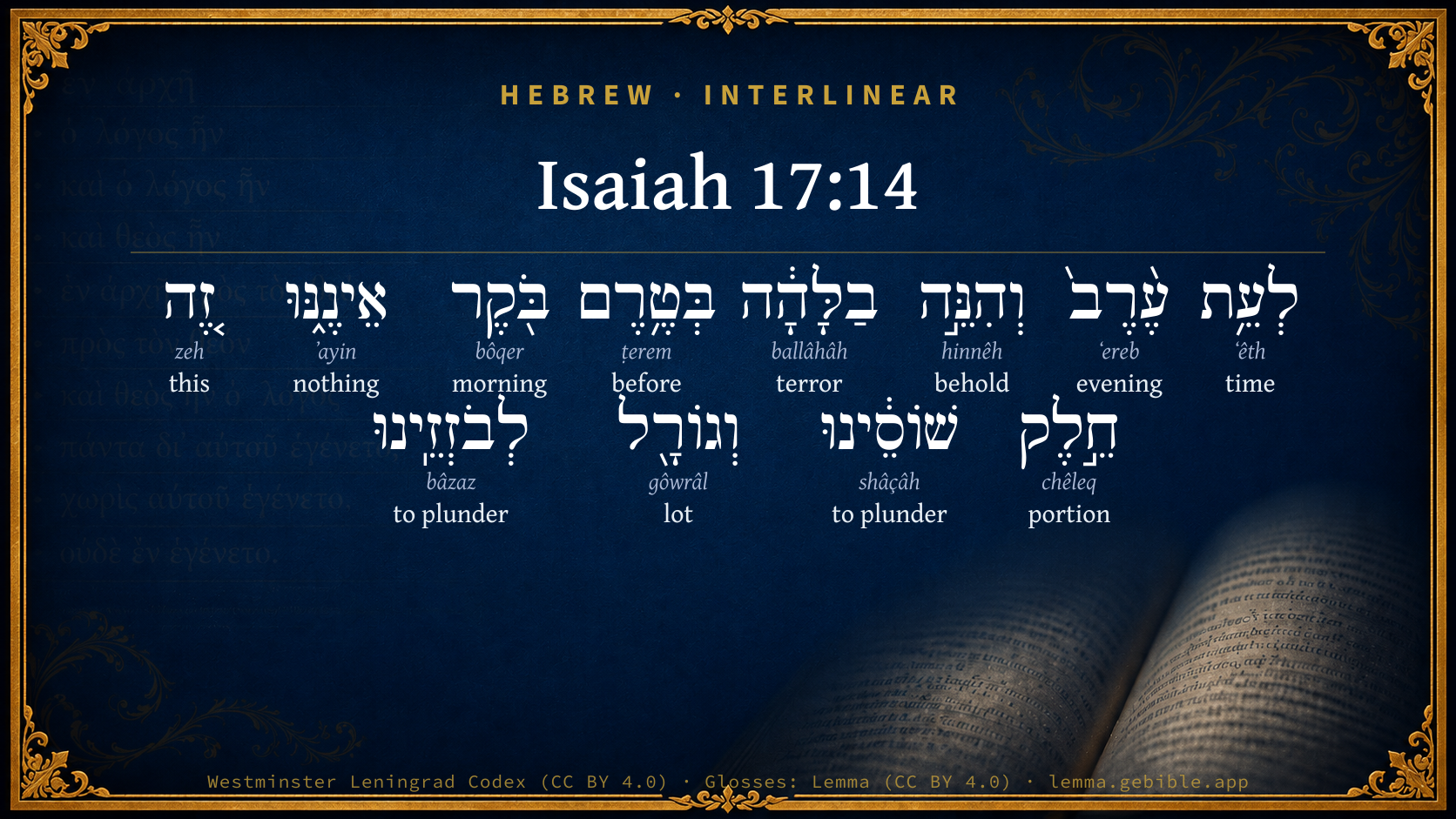
Hebrew (Westminster Leningrad Codex) Isaiah 17:14 appears in the Hebrew Old Testament. The text above is from the Westminster Leningrad Codex. Each word links to its Strong’s number, a concise gloss, and parsing drawn from the Open Scriptures Hebrew Bible morphology. Click any word for its full Brown-Driver-Briggs (BDB) entry.
Download image
Cite this verse

Isaiah 17:14 (World English Bible). Public Domain. Lemma interlinear Bible study tool, https://lemma.gebible.app/v/isaiah/17/14.

Show BibTeX & RIS
BibTeX
RIS
English Translation
At evening, behold, terror; [and] before the morning they are no more. This is the portion of those who despoil us, and the lot of those who rob us.
World English Bible · Public Domain
Download a study sheet

One document with this verse’s original text, its word-by-word gloss line, the meaning frame, cross-references with their text, attributed commentary, and full source and license credits — printable, and it pastes into notes with its structure intact.

This verse Autodidact and up

Study sheet (.html) Plain text (.txt)

A passage Seminary Student

Up to 50 verses in one chapter. A passage sheet keeps up to 6 commentary sources and 12 cross-references per verse, in the order this page ranks them, and says so on the sheet whenever that leaves anything out. Ask for a single verse and you get the Autodidact verse sheet above.

Everything on this page stays free to read, with no account — the sheet is a download of what is already on screen, not access to it.

Want to remove ads? Support Godless Engineer
Compare translations 3

The same verse in 3 English versions, stacked beneath the original-language interlinear above. Click any original word for its lexicon entry.

Each is an independent rendering of the whole verse — the interlinear is not word-aligned to these translations.

Highlighted words mark where these versions differ — a whole-verse word diff, not a word-by-word alignment.

  • World English Bible Public Domain
    At evening, behold, terror; [and] before the morning they are no more. This is the portion of those who despoil us, and the lot of those who rob us.
  • King James Version Public Domain
    And behold at eveningtide trouble; and before the morning he is not. This is the portion of them that spoil us, and the lot of them that rob us.
  • unfoldingWord Literal Text CC BY-SA 4.0
    At the time of evening, and behold, terror! Before morning, he is not. This the portion of our plunderers and the lot of our looters.

unfoldingWord Literal Text — © unfoldingWord, licensed CC BY-SA 4.0. Word-aligned USFM3 via Door43 (git.door43.org/unfoldingWord/en_ult).

Versions to compare (up to 4)

3 of 4 selected

Show all 18 translations

Every available English version of this verse, each an independent rendering of the whole verse.

  • World English Bible Public Domain
    At evening, behold, terror; [and] before the morning they are no more. This is the portion of those who despoil us, and the lot of those who rob us.
  • Berean Standard Bible Public Domain
    In the evening, there is sudden terror! Before morning, they are no more! This is the portion of those who loot us and the lot of those who plunder us.
  • Majority Standard Bible Public Domain
    In the evening, there is sudden terror! Before morning, they are no more! This is the portion of those who loot us and the lot of those who plunder us.
  • King James Version Public Domain
    And behold at eveningtide trouble; and before the morning he is not. This is the portion of them that spoil us, and the lot of them that rob us.
  • American Standard Version (1901) Public Domain
    At eventide, behold, terror; `and' before the morning they are not. This is the portion of them that despoil us, and the lot of them that rob us.
  • Revised Version (1885) Public Domain
    At eventide behold terror; and before the morning they are not. This is the portion of them that spoil us, and the lot of them that rob us.
  • Geneva Bible (1599) Public Domain
    And loe, in the euening there is trouble: but afore the morning it is gone. This is the portion of them that spoyle vs, and the lot of them that robbe vs.
  • Douay-Rheims (1899) Public Domain
    In the time of the evening, behold there shall be trouble: the morning shall come, and he shall not be: this is the portion of them that have wasted us, and the lot of them that spoiled us.
  • Young's Literal Translation Public Domain
    At even-time, lo, terror, before morning it is not, This `is' the portion of our spoilers, And the lot of our plunderers!
  • Literal Standard Version CC BY-SA 4.0
    At evening, behold, terror, before morning it is not, || This [is] the portion of our spoilers, || And the lot of our plunderers!
  • Unlocked Literal Bible CC BY-SA 4.0
    In the evening, see, terror! Before the morning they will be gone! This is the portion of those who loot us, the lot of those who rob us.
  • unfoldingWord Literal Text CC BY-SA 4.0
    At the time of evening, and behold, terror! Before morning, he is not. This the portion of our plunderers and the lot of our looters.
  • Darby Bible Public Domain
    behold, at eventide, trouble; before the morning they are not. This is the portion of them that spoil us, and the lot of them that rob us.
  • World Messianic Bible Public Domain
    At evening, behold, terror! Before the morning, they are no more. This is the portion of those who plunder us, and the lot of those who rob us.
  • Webster's Bible Public Domain
    And behold at the time of evening trouble; and before the morning he is not. This is the portion of them that ravage us, and the lot of them that rob us.
  • Free Bible Version CC BY-SA 4.0
    Sudden terror comes in the evening! By morning, they're gone! This is what happens to those who loot us, the fate of those who plunder us.
  • Bible in Basic English Public Domain
    In the evening there is fear, and in the morning they are gone. This is the fate of those who take our goods, and the reward of those who violently take our property for themselves.
  • JPS Tanakh (1917) Public Domain
    At eventide behold terror; and before the morning they are not. This is the portion of them that spoil us, and the lot of them that rob us.

Literal Standard Version (2020), Covenant Press — licensed CC BY-SA 4.0. Text via the HelloAO Bible API (eBible.org). Unlocked Literal Bible (unfoldingWord) — licensed CC BY-SA 4.0. Text via the HelloAO Bible API (eBible.org). unfoldingWord Literal Text — © unfoldingWord, licensed CC BY-SA 4.0. Word-aligned USFM3 via Door43 (git.door43.org/unfoldingWord/en_ult). Free Bible Version, Dr. Jonathan Gallagher — licensed CC BY-SA 4.0. Text via the HelloAO Bible API (eBible.org).

Word by word

More ways to search: Search by grammar → Find every occurrence → Compare this word →

Practice this passage: Drill this verse → Learn its vocabulary →

בַלָּהָ֔ה
ballâhâh
H1091
“terror”
Noun, Common, Feminine, Singular, Absolute
Part of Speech
Noun
Type
Common
Gender
Feminine
Number
Singular
State
Absolute
Full BDB Definition

Origin: from H1089

TWOT: 247a

terror, destruction, calamity, dreadful event
  1. לְעֵ֥ת ʻêth H6256 “to/for · time of” Preposition + Noun, Common, Both, Singular, Construct
  2. עֶ֨רֶב֙ ʻereb H6153 “evening” Noun, Common, Masculine, Singular, Absolute
  3. וְהִנֵּ֣ה hinnêh H2009 “and · behold” Conjunction + Particle, Demonstrative
  4. בְּטֶ֥רֶם ṭerem H2962 “in/at · before” Preposition + Adverb
  5. בֹּ֖קֶר bôqer H1242 “morning” Noun, Common, Masculine, Singular, Absolute
  6. אֵינֶ֑נּוּ ʼayin H369 “nothing · him” Particle, Negative + Suffix, Personal, 3rd Person, Masculine, Singular
  7. זֶ֚ה zeh H2088 “this” Pronoun, Demonstrative, Masculine, Singular
  8. חֵ֣לֶק chêleq H2506 “portion of” Noun, Common, Masculine, Singular, Construct
  9. שׁוֹסֵ֔ינוּ shâçâh H8154 “plundering · us” Verb, Qal, Participle Active, Masculine, Plural, Construct + Suffix, Personal, 1st Person, Common, Plural
  10. וְגוֹרָ֖ל gôwrâl H1486 “and · lot” Conjunction + Noun, Common, Masculine, Singular, Absolute
  11. לְבֹזְזֵֽינוּ bâzaz H962 “to/for · plundering · us” Preposition + Verb, Qal, Participle Active, Masculine, Plural, Construct + Suffix, Personal, 1st Person, Common, Plural

About this verse

These counts appear in no published source. They are computed here, from the morphology-tagged text and Lemma’s own curated glosses. What Lemma adds →

12
words
12
distinct lemmas
Prophets
section

Notable vocabulary

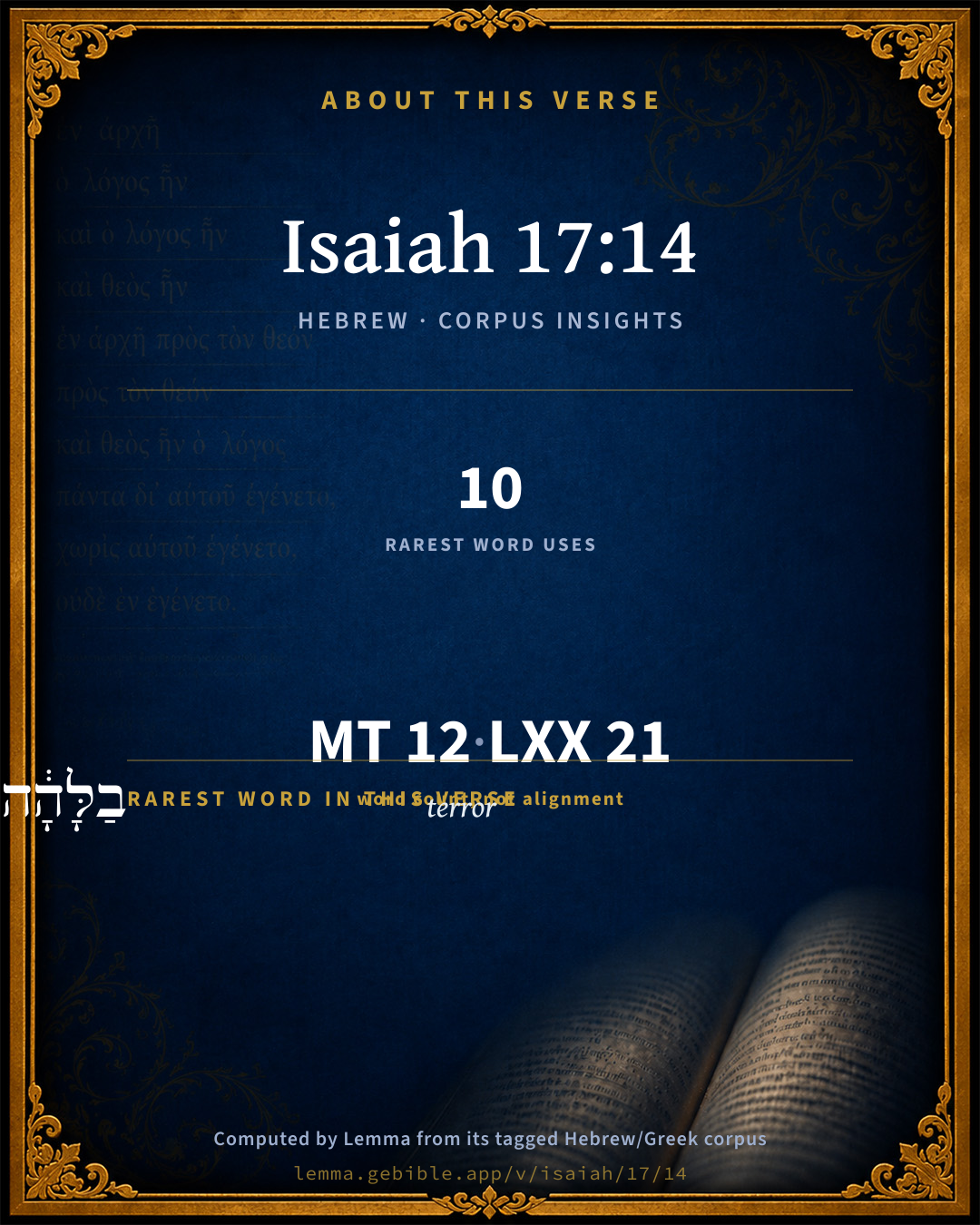
The rarest word here is בַלָּהָ֔ה terror H1091 — appearing just 10 times in the whole Hebrew Bible.

Shared distinctive vocabulary

בַלָּהָ֔ה terror H1091 occurs in 10 verses of the Hebrew Bible. Also found in:

Grammatical profile

  • 2 verbs
  • 6 nouns
  • 1 pronoun
  • 1 adverb
  • 2 particles

Verb forms

  • שׁוֹסֵ֔ינוּ Qal · Participle Active
  • לְבֹזְזֵֽינוּ Qal · Participle Active

Hebrew & Septuagint length

In English translation the verse runs 29 words from the Hebrew and 35 from the Septuagint (LXX English) — closely comparable.

A rough comparison of the two English renderings, which tokenize alike — not a word-level alignment.

Word counts can differ between the Hebrew and the Greek without any difference in meaning — e.g. the Hebrew direct-object marker אֵת has no separate Greek word, and Greek often adds the article ὁ.

In the original languages it is 12 Hebrew tokens and 21 Greek tokens — but the two are counted differently (Hebrew bundles its prefixes and suffixes into one token; the Greek is in lemma form), so that isn’t a like-for-like length.

Cross-references

13

Topical passages linked to Isaiah 17:14 in the Treasury of Scripture Knowledge — connected by theme and wording, ordered by reader-vote popularity; previews shown in the World English Bible.

  • 2 Kings 19:35 It happened that night, that the angel of Yahweh went forth, and struck in the camp of the Assyrians one hundred eighty-five thousand: and when men arose early in the morning, behold, these were all dead bodies.
  • Proverbs 22:23 For Yahweh will plead their case, And plunder the life of those who plunder them.
  • Judges 5:31 So let all your enemies perish, Yahweh: But let those who love him be as the sun when he goes forth in his might. The land had rest forty years.
  • 2 Kings 19:3 They said to him, Thus says Hezekiah, This day is a day of trouble, and of rebuke, and of rejection; for the children are come to the birth, and there is not strength to bring forth.
  • Job 20:29 This is the portion of a wicked man from God, The heritage appointed to him by God."
  • Psalms 37:36 But he passed away, and, behold, he was not. Yes, I sought him, but he could not be found.
  • Isaiah 10:28–32 He is come to Aiath, he is passed through Migron; at Michmash he lays up his baggage;
  • Isaiah 33:1 Woe to you who destroy, and you weren't destroyed; and deal treacherously, and they didn't deal treacherously with you! When you have ceased to destroy, you shall be destroyed; and when you have made an end of dealing treacherously, they shall deal treacherously with you.
  • Jeremiah 2:3 Israel [was] holiness to Yahweh, the first fruits of his increase: all who devour him shall be held guilty; evil shall come on them, says Yahweh.
  • Jeremiah 13:25 This is your lot, the portion measured to you from me, says Yahweh; because you have forgotten me, and trusted in falsehood.
  • Ezekiel 39:10 so that they shall take no wood out of the field, neither cut down any out of the forests; for they shall make fires of the weapons; and they shall plunder those who plundered them, and rob those who robbed them, says the Lord Yahweh.
  • Habakkuk 2:16–17 You are filled with shame, and not glory. You will also drink, and be exposed! The cup of Yahweh's right hand will come around to you, and disgrace will cover your glory.
  • Zephaniah 2:9–10 Therefore as I live, says Yahweh of Hosts, the God of Israel, surely Moab will be as Sodom, and the children of Ammon as Gomorrah, a possession of nettles, and salt pits, and a perpetual desolation. The remnant of my people will plunder them, and the survivors of my nation will inherit them.

Cross-references courtesy of OpenBible.info (CC BY 4.0).

Hebrew and Greek witnesses Masoretic Hebrew ↔ Greek Septuagint

The same verse in the two great witnesses to the Old Testament, shown verse-for-verse.

These are two independent witnesses, not word-aligned to each other, and the Septuagint is shown in lemma (dictionary) form.

Hebrew Isaiah 17:14 Masoretic · Westminster Leningrad Codex

לְעֵ֥ת עֶ֨רֶב֙ וְהִנֵּ֣ה בַלָּהָ֔ה בְּטֶ֥רֶם בֹּ֖קֶר אֵינֶ֑נּוּ זֶ֚ה חֵ֣לֶק שׁוֹסֵ֔ינוּ וְגוֹרָ֖ל לְבֹזְזֵֽינוּ

At evening, behold, terror; [and] before the morning they are no more. This is the portion of those who despoil us, and the lot of those who rob us.

World English Bible · Public Domain

Greek LXX Isaiah 17:14 Septuagint · lemma form

πρός ἑσπέρα εἰμί πένθος πρίν ἤ πρωί καί οὐ εἰμί οὗτος ὁ μερίς ὁ σύ προνομεύω καί κληρονομία ὁ σύ κληρονομέω

Toward evening, and there shall be grief; before the morning, and he shall not be. This is the portion of them that spoiled you, and the inheritance to them that robbed you of your inheritance.

LXX2012 (modern English Septuagint) · Public Domain

On this verse, Adam Clarke's Commentary discusses the Septuagint’s reading. Read the note in Commentary ↓

Hebrew: Westminster Leningrad Codex (CC BY 4.0). Greek: Septuagint (public domain); English from LXX2012 (modern English Septuagint) (Public Domain). How the Septuagint differs from the Hebrew →

Targum (Aramaic paraphrase)

1

The Targum is the ancient Jewish Aramaic paraphrase of the Hebrew Scriptures — an interpretive translation, not the Hebrew text itself. Onkelos (literal) and Pseudo-Jonathan (expansive) render the Torah, and Jonathan the Prophets. Coverage is partial: where no permissively-licensed English translation exists for a verse, only the Aramaic is shown. This is verse-level text, not a word-by-word alignment to the Hebrew.

  1. Targum Jonathan Prophets (Joshua–Malachi)
    לְעִדַן רַמְשָׁא וְהָא כִדְלָא הֲוָה עַד דְלָא צַפְרָא וְהָא כִדְלֵיתוֹהִי דֵין חוּלַק לְאָסְנָנָא וַעֲדַב לְבָזְזָנָא:

    And at eveningtide behold, as if he had not been; and before the morning behold, as if he had not been. This is the portion of those that hate us, and the lot of those who spoil us.

    Targum Jonathan — Aramaic: “Mikraot Gedolot” (public domain). English: “Sefaria Community Translation” (CC0 1.0 (public-domain dedication)); “London "Chaldee Paraphrase," 1871” (public domain). Text via Sefaria.

Commentary

Notes on Isaiah 17:14 from classic Christian and Jewish commentators (each source and its license shown beneath its notes). The classic Christian expositions comment on the surrounding passage and are grouped to its opening verse, so a note may address several verses; the Jewish commentaries on the Tanakh (Rashi and others) are per-verse, so they appear only where the commentator wrote on this verse.

Lemma curates 59 commentaries, every one of them public domain or Creative Commons licensed, each selected and text-cleaned for this edition rather than reprinted as found. About our sources →

Trapp's Complete Commentary

John Trapp

Isa 17:14 And behold at eveningtide trouble; [and] before the morning he [is] not. This [is] the portion of them that spoil us, and the lot of them that rob us.

Ver. 14. And behold at eventide trouble.] Or, Terror - sc., within Jerusalem, besieged by Sennacherib’s forces. But this mourning lasted but till morning. The time of affliction is ordinarily short; a day, or night; a piece of a night, as here; a "moment"; {Isa 54:8} "a small moment." {Isa 54:7} Or if longer, yet (1.) There are some breathing time between; (2.) There is much good got by it; (3.) It is nothing to eternity.

Before morning he is not.] He and his forces are all gone. The wicked, saith Oecolampadius here, at the eventide of their death have a hard tug of it; and in the morning of the resurrection they are not, or could wish they were not.

This is the portion of them that spoil us.] Epiphonema ad populum Dei. He closeth up his discourse with a word of comfort to all God’s people; for whose sake also it is that all this is said against Assyria, Syria, and other foreign states, enemies to the Church.

John Trapp, A Commentary or Exposition upon All the Books of the Old and New Testament (1647–1656) — public domain. Text from a community e-Sword module.

The Biblical Illustrator

Joseph S. Exell

Isa_17:14

Behold at evening tide trouble

The night

God fights some battles between evening and morning.

The black night is the field of war. The darkness fights for God. The night is needed for more than rest. How busy the angels are on the fields of darkness! Men are fetched at night by the invisible constable. Who reckons the night when he adds up his time? It may go for nothing to us because of our unconsciousness, but God sleeps not. Speaking of the wicked we may apply the figure of night so as to find in it terror and fear, sorrow and judgment, and death; speaking of the good man, we may say, Dry thy tears, thou foolish unbelieving weeper, or shed them gratefully to get rid of a needless burden; for sorrow endureth but for a night, joy cometh in the morning: take in the black guest, do what thou canst for him, he is sent of God for holy purposes; he can live but for a night, thou mightest afford to be kind to him; it were but one night in a long life. (J. Parker, D. D.)

.

The Biblical Illustrator, edited by Joseph S. Exell (c. 1880s–1900s) — public domain. Text from a community e-Sword module.

Tyndale Open Study Notes

Tyndale Open Resources

17:14 In the evening . . . by dawn: Despite frightening circumstances, Israel can have confidence in the Lord’s ability to save quickly (see 37:36-38).

Tyndale Open Study Notes — © Tyndale Open Resources, licensed CC BY-SA 4.0. Text via the HelloAO Bible API.

Geneva Bible (1599)

Geneva Bible translators

He compareth the enemies the Assyrians to a tempest, which riseth overnight, and in the morning is gone.

Geneva Bible (1599) marginal notes — public domain. Text via Bolls.life.

Jamieson, Fausset & Brown

Robert Jamieson, A. R. Fausset & David Brown

eventide . . . before morning--fulfilled to the letter in the destruction "before morning" of the vast host that "at eveningtide" was such a terror ("trouble") to Judah; on the phrase see Psa 90:6; Psa 30:5.

he is not--namely, the enemy.

us--the Jews. A general declaration of the doom that awaits the foes of God's people (Isa 54:17).

Isaiah announces the overthrow of Sennacherib's hosts and desires the Ethiopian ambassadors, now in Jerusalem, to bring word of it to their own nation; and he calls on the whole world to witness the event (Isa 18:3). As Isa 17:12-14 announced the presence of the foe, so Isa 18:1-7 foretells his overthrow.

Next: Isaiah Chapter 18

Jamieson, Fausset & Brown — Commentary Critical and Explanatory on the Whole Bible (1871) — public domain (CC PDM 1.0). Text via the HelloAO Bible API.

Adam Clarke's Commentary

Verse 14. He is not - "He is no more."] For איננו einennu ten MSS. of Dr. Kennicott's, (three ancient,) ten of De Rossi's, and two editions, and the Septuagint, Syriac, Chaldee, Vulgate, and Arabic, have ואיננו veeinenno. This particle, authenticated by so many good vouchers, restores the sentence to its true poetical form, implying a repetition of some part of the parallel line preceding, thus: -

"At the season of evening, behold terror!

Before the morning, and [behold] he is no more!"

That spoil us] For שוסינו shoseynu, them that spoil us, fifteen MSS., one edition, and the Syriac have שוסנו shosenu, him that spoileth us. And for לבזזינו lebozezeynu, them that rob us, six MSS. and the Syriac have לבוזזנו lebozzeno, him that robbeth us: and these readings make the place answer better to Sennacherib, according to Lowth's conjecture. Though God may permit the wicked to prevail for a time against his people, yet in the end those shall be overthrown, and the glory of the Lord shall shine brightly on them that fear him; for the earth shall be subdued, and the universe filled with his glory. Amen, and Amen!

Adam Clarke's Commentary on the Bible (1810–1826) — public domain. Text from a community e-Sword/MySword module.

Ellicott's Commentary for English Readers

(14) And behold at eveningtide trouble.—The words, though spoken in general terms, received a special fulfilment in the destruction of Sennacherib’s army (Isa_37:36). Possibly the parallelism they present to Isa_17:11 may have led to the insertion of the oracle in this place.

A Bible Commentary for English Readers, edited by Charles John Ellicott (1878–1897) — public domain. Text from a community e-Sword module.

The Cambridge Bible for Schools and Colleges

gen. ed. J. J. S. Perowne

14. The destruction of the Assyrian shall be accomplished between evening and daybreak. The expression denotes a very short space of time, as in Psa_30:5; Job_27:19; but the destruction of Sennacherib’s army took place literally in the night (ch. Isa_37:36).

And behold … he is not] Render: At eventime, behold terror! before morning, it (the tumult) is gone!

them that spoil us, &c.] the Assyrians; cf. ch. Isa_10:6; Isa_10:13.

The Cambridge Bible for Schools and Colleges (gen. ed. J. J. S. Perowne; Cambridge University Press, 1878–1918) — public domain. Text from a community e-Sword module.

John Gill's Exposition

And behold at eveningtide trouble,.... Or terror (a) and consternation; which some understand of that which was in the Assyrian army, when the Angel of the Lord destroyed it, taking "evening for night", for it was in the night that that was done; so Jarchi interprets it of Shedim, a sort of spirits or demons, that came against the enemy, and troubled and frightened them: but it is best to take it in the more common sense, of the trouble that Hezekiah and the inhabitants of Jerusalem were in, on the evening or night before their deliverance; the whole land of Judea round about them being laid waste, their city besieged by a powerful army, and the enemy blaspheming, blustering, and triumphing:

and before the morning he is not; Sennacherib, the king of Assyria, he was not before Jerusalem, he was fled: or "it was not" (b); the Assyrian army was not, it was destroyed by an angel in the night, and in the morning were all dead corpses, Kg2 19:35 or trouble was not, that was all over, joy came in the morning; see Psa 30:5,

this is the portion of them that spoil us, and the lot of them that rob us; these are the words of the prophet, and of the people of God, he represents, making observation upon, and use of the above dispensation, though not confining it to that; and their meaning is, that this is not the case of these Assyrians only, but of all the enemies of God's people, who, sooner or later, come to destruction; and which is not by chance, but by the appointment and disposition of God, who allots and portions out ruin unto them, as the just reward of their works; see Job 20:29.

(a) "terror", Junius & Tremellius, Piscator. (b) "non ipsa", Montanus.

Next: Isaiah Chapter 18

John Gill's Exposition of the Whole Bible (1746–1763) — public domain (CC PDM 1.0). Text via the HelloAO Bible API.

Albert Barnes' Notes on the Bible

At evening-tide trouble - In the time of evening - that is, in the night.

Before the morning he is not - That is, he is destroyed. This is strikingly descriptive of the destruction of the army of Sennacherib on that fatal night when the angel of the Lord killed 185,000 men (see the note at Isa 37:36).

This is the portion of them that spoil us - Of those who would plunder us. This is a “general” declaration in regard to the enemies of the Jewish people. This is the lot, the end, the destiny of all who attempt to destroy them. That is, the people of God shall be safe whoever rises up against them; and whatever may be the number, or the power of their foes, they shall be overthrown.

Albert Barnes' Notes on the Bible (1834–1885) — public domain. Text from a community e-Sword/MySword module.

Haydock's Catholic Bible Commentary

CHAPTER XVII.

Not be. Phacee and Rasin were presently exterminated. --- Spoiled us. The kingdom of Achaz, 4 Kings xvii. 5.

George Leo Haydock (1774–1849), Haydock's Catholic Family Bible and Commentary, 1859 edition — public domain. Excludes Psalms (Douay-Rheims chapter numbering differs from Protestant) and Deuterocanonical books (Catholic canon only).

Matthew Poole's English Annotations

Behold at evening-tide trouble; and before the morning he is not: at even there is a great terror and consternation among God’s people, for fear of their enemies; and ere the morning cometh, their enemies are cut off by the hand of God. This was literally and eminently fulfilled in the destruction of Sennacherib’s army before Jerusalem. Although the words may be more generally understood of any great and sudden change, and unexpected deliverance, granted to God’s people, when their enemies were ready to devour them. And this place may be compared with that in Psa 30:5, Weeping may endure for a night, but joy cometh in the morning. This is the portion of them that spoil us, and the lot of them that rob us: this is a triumphant conclusion, uttered by the prophet in the name of God’s people.

Matthew Poole's English Annotations on the Holy Bible (1683–1685) — public domain. Text from a community e-Sword/MySword module.

Whedon's Commentary on the Bible

Daniel D. Whedon

14. And behold… trouble — The different renderings are, terror, trouble, consternation, horror, the shriek of death.

At eveningtide — At the time of evening.

Before… morning he is not — Some suppose a proleptic allusion here to the swoop of destruction upon Sennacherib’s army. Possibly the imagery is purposely suited to that slaughter, yet the language will apply to many other deliverances and judgments. Judgment upon the imperial powers began in the evening, raged through the night: in the morning all were destroyed. This power had finished Damascus and Ephraim; it essayed to demolish Judah; but was itself swept, as it were in a moment, out of existence. So went, ultimately, the whole empire, broken, scattered, and swallowed up by other powers.

Daniel D. Whedon (gen. ed.), Commentary on the Old and New Testaments (1874–1909) — public domain. Text from a community e-Sword module.

The Pulpit Commentary

Behold at evening-tide trouble; rather, terror, as the word is elsewhere always translated. (comp. 2Ki_19:35, "It came to pass that night that the angel of the Lord went out," etc.) He is not. (comp. 2Ki_19:35, "They were all dead corpses That spoil us... that rob us. (see 2Ki_18:13-16)

HOMILIES BY W.M. STATHAM Ver. 14. The gloomy evening.

"Behold at evening-tide trouble." We all love beautiful evenings, whether on land or sea. Then, when the clouds of purple and amber across the horizon constitute a royal chariot for the setting sun, we gaze with admiration and delight on the glorious close of day.

I TROUBLE IS NEVER SO SAD AS IN THE EVENING. At morning or midday we have more of strength to bear it; we can brace our energies to fight the battle or to endure the burden. But in the evening, when heart and strength fail, we look for quiet comfort and considerate friends, and the gentle words of love. Trouble in the evening is a pensive sight. But if it be connected with sin, with personal wrong-doing, how bitter a cup it is! Then, when there should be memory of holy deeds and earnest words; then, when we may fairly think of an honorable reputation well earned, and an influence which we may hope, indeed, will be an "after-glow" after we are dead. Yet so it is. Sin has its judgments, which "follow after" even here below.

II TROUBLE IN THE EVENING IS WELL EXPLAINED. The prophet says (ver. 13), "God shall-rebuke them." It is all contained in that. Rebuke! That involves in its utterance conscience and memory, else how could we feel rebuke? We feel all that is meant by rebuke more from some than others. It does not always need words. A little spectacle that recalls some past scene, an old letter, the Visiting of half-forgotten places, the swift rush at times of old memories, these often have rebukes in them. We have neglected so many never-recurring opportunities, we have scattered so many seeds of evil. But when God, the living God, rebukes us, how can we stand? For he knows our most secret thoughts, and in his book all the life is written.

III TROUBLE IN THE EVENING MAY STILL BE THE LAST ANGEL OF GOD"S MERCY HERE. Even then it is evening, and the light lingers. The Savior"s power to save is still the same. The city of refuge has its gates open. God"s renewing and redeeming grace may yet be ours. Not even then need we despair; for as there is a strain of hope coming for the nation Israel which will occupy us further on in these prophecies, so there is hope in personal life, even in the latter days, if we turn to the Lord with full purpose of heart. The lingering light of evening skill falls on the cross of him who said, "I came not to call the righteous, but sinners to repentance. W.M.S.

The Pulpit Commentary (1880–1919), ed. H.D.M. Spence-Jones & Joseph S. Exell — public domain. Text from a community e-Sword module.

John Wesley's Explanatory Notes

Behold - At even there is great terror among God's people, for fear of their enemies; and before the morning comes, their enemies are cut off.

John Wesley, Explanatory Notes Upon the Whole Bible (1754–1765) — public domain. Text via the GEBible commentary corpus.

J. A. Alexander on Isaiah

Joseph Addison Alexander

“At evening-tide, and behold terror; before morning he is not. This is (or be) the portion of our plunderers, and the lot of our spoilers.” The Prophet is the speaker, and he uses the plural pronouns only to identify himself with the people.

Joseph Addison Alexander, The Prophecies of Isaiah (1846–1847; New York: Scribner, 1870–1878) — public domain. Text from a community e-Sword module.

Rashi

Rabbi Shlomo Yitzchaki (Rashi)

and behold there is fright Demons come upon the enemy and frighten him.

before morning he is no more The enemy is not in the world.

this is the portion of our plunderers The portion of Sennacherib and the portion of Gog and Magog, when they come to plunder us.

Rashi on the Tanakh — English translations: “The Judaica Press complete Tanach with Rashi, translated by A. J. Rosenberg” (CC BY 4.0); “Pentateuch with Rashi's commentary by M. Rosenbaum and A.M. Silbermann, 1929-1934” (public domain); “The Metsudah Tanach series, Lakewood, N.J” (CC BY 4.0); and “The Book of Joshua, Metsudah Publications, 1997” (CC BY 4.0). Text via Sefaria.

Ibn Ezra

Rabbi Abraham ibn Ezra

At eveningtide, that is, when the inhabitants of Jerusalem are afraid of him.

בלהה Trouble. Comp. בלהות terror (Ez. 26:21); בהלה ═ בלהה like כבש ═ כשב lamb.

And he is not. When the angel will have come forth and destroyed the greater part of the camp.

This is the portion of them that spoil us. These are the words of the prophet in his rejoicing.

Ibn Ezra on the Tanakh — English translations: “Sefaria Community Translation” (CC0 1.0 (public-domain dedication)); “Yalkut, Sifsei Chachomim Chumash, Metsudah Publications, 2009” (CC BY 4.0); and “Commentary of Ibn Ezra on Isaiah - trans. by M. Friedlander, 1873” (public domain). Text via Sefaria.

Lesson kit

Teaching starters — assembled from the data on this page, not authored interpretation. Every prompt links to the verse data it draws on. Edit before teaching.

Isaiah, in the Prophets, opens this verse with 12 words (12 distinct Hebrew lemmas). Its most distinctive word is ballâhâh (“terror”). A historical commentator’s framing appears above. Read the whole chapter for the surrounding context.

Discussion questions

  1. The word ballâhâh carries the sense “terror.” How does it shape the verse?
  2. Job 18:11 shares the word «terror» with this verse. How do the two illuminate each other?
  3. These translations render this verse differently. What is at stake in choosing one wording over another?
  4. The verb «שׁוֹסֵ֔ינוּ» is Qal Participle Active. How does its form color the action?
  5. Reading how Trapp's Complete Commentary and The Biblical Illustrator read this verse, where do the two commentators agree and where do they part?

Things to notice

Reading settings

Reading text

Shown beneath each verse's original-language words.

Old Testament
Old Testament edition

Read the OT as the Masoretic Hebrew (MT) or the Greek Septuagint (LXX).

English shown for the Greek Septuagint (in the Hebrew ↔ Greek comparison).

Comparing translations? Open the Compare panel on any verse page to stack up to four side by side.