Isaiah 13:22

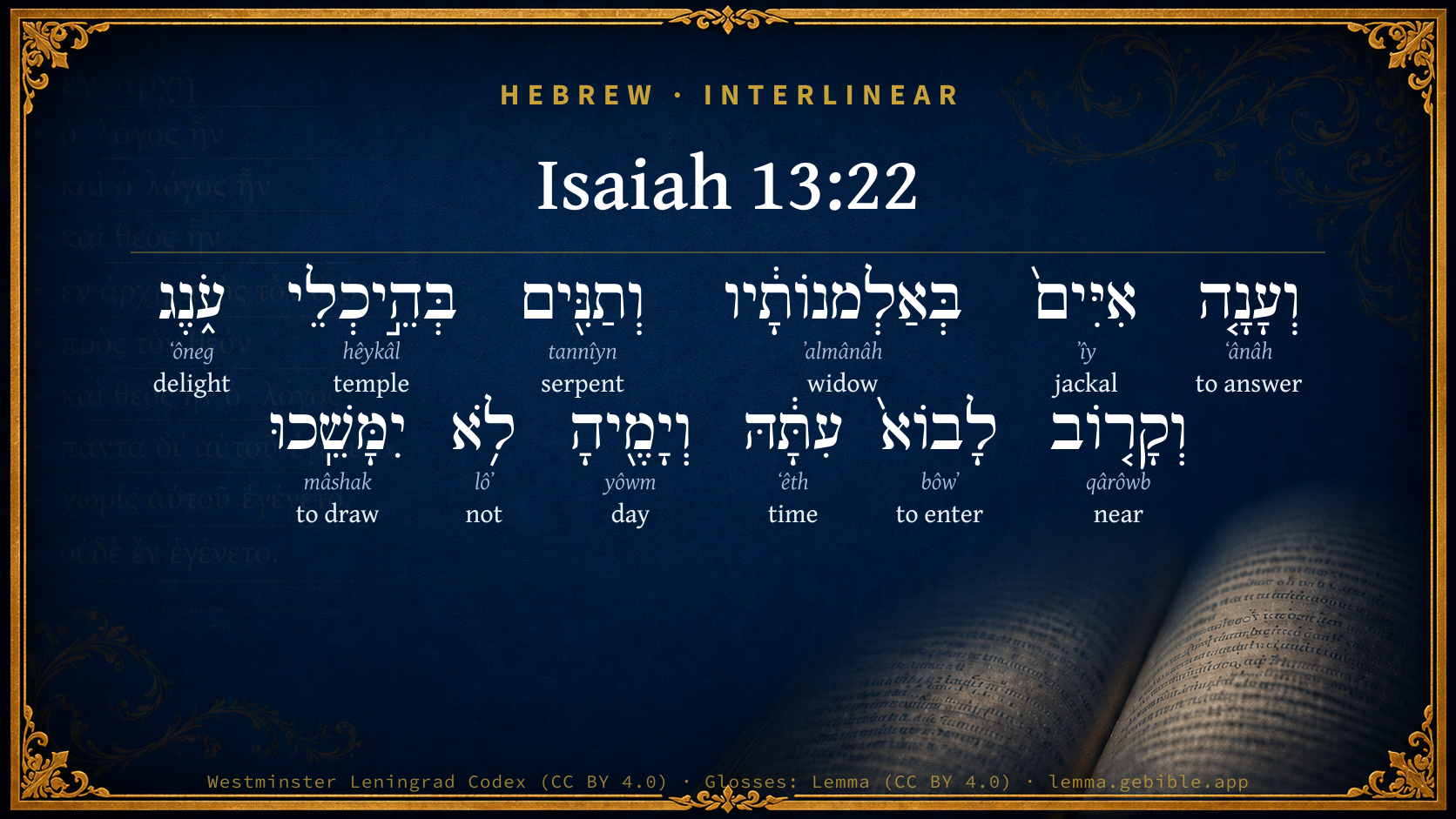
Hebrew (Westminster Leningrad Codex) Isaiah 13:22 appears in the Hebrew Old Testament. The text above is from the Westminster Leningrad Codex. Each word links to its Strong’s number, a concise gloss, and parsing drawn from the Open Scriptures Hebrew Bible morphology. Click any word for its full Brown-Driver-Briggs (BDB) entry.
Download image
Cite this verse

Isaiah 13:22 (World English Bible). Public Domain. Lemma interlinear Bible study tool, https://lemma.gebible.app/v/isaiah/13/22.

Show BibTeX & RIS
BibTeX
RIS
English Translation
Wolves shall cry in their castles, and jackals in the pleasant palaces: and her time is near to come, and her days shall not be prolonged.
World English Bible · Public Domain
Highlights
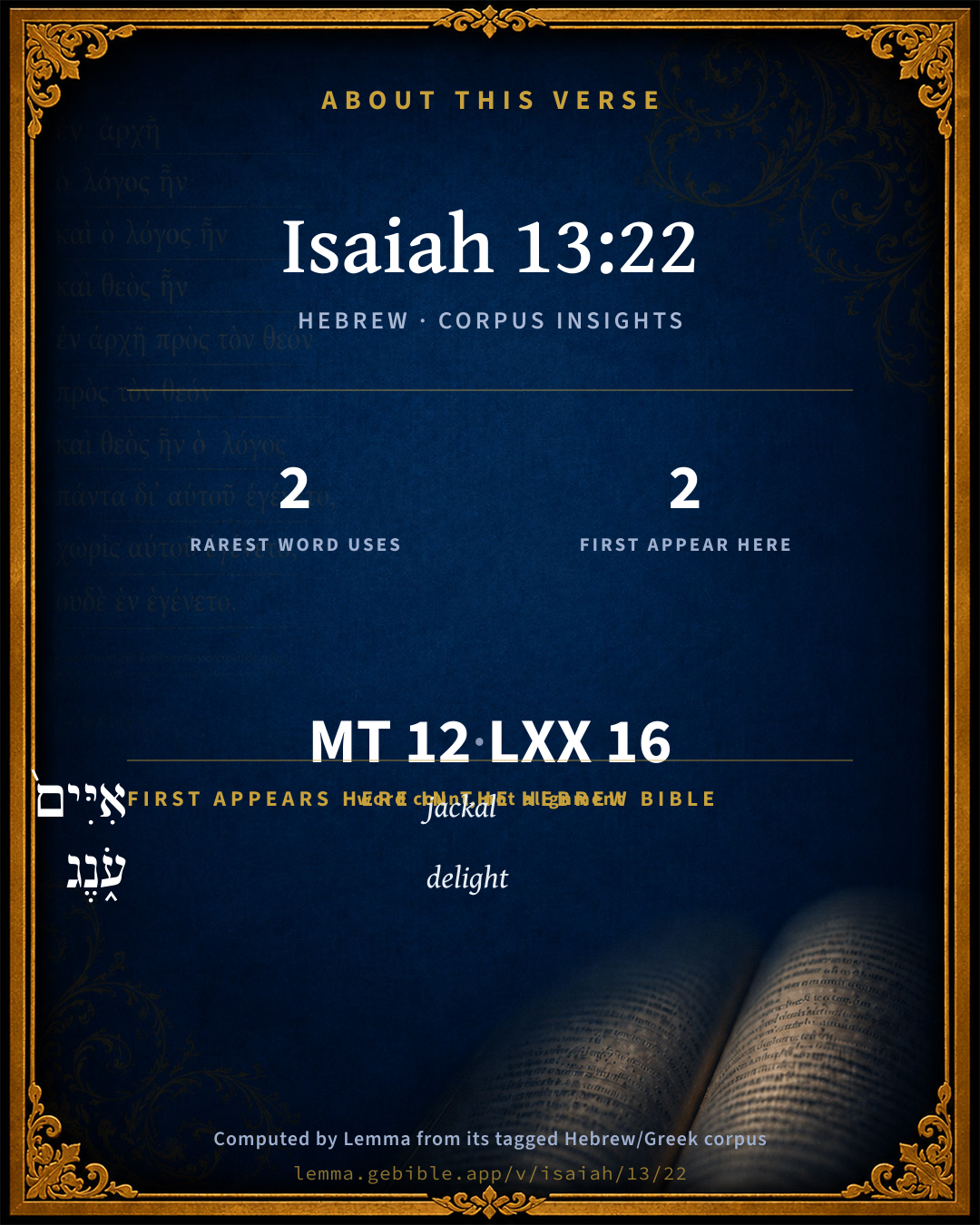
  • 2 first appearances in the Hebrew Bible
Full analysis ↓
Download a study sheet

One document with this verse’s original text, its word-by-word gloss line, the meaning frame, cross-references with their text, attributed commentary, and full source and license credits — printable, and it pastes into notes with its structure intact.

This verse Autodidact and up

Study sheet (.html) Plain text (.txt)

A passage Seminary Student

Up to 50 verses in one chapter. A passage sheet keeps up to 6 commentary sources and 12 cross-references per verse, in the order this page ranks them, and says so on the sheet whenever that leaves anything out. Ask for a single verse and you get the Autodidact verse sheet above.

Everything on this page stays free to read, with no account — the sheet is a download of what is already on screen, not access to it.

Want to remove ads? Support Godless Engineer
Compare translations 3

The same verse in 3 English versions, stacked beneath the original-language interlinear above. Click any original word for its lexicon entry.

Each is an independent rendering of the whole verse — the interlinear is not word-aligned to these translations.

Highlighted words mark where these versions differ — a whole-verse word diff, not a word-by-word alignment.

  • World English Bible Public Domain
    Wolves shall cry in their castles, and jackals in the pleasant palaces: and her time is near to come, and her days shall not be prolonged.
  • King James Version Public Domain
    And the wild beasts of the islands shall cry in their desolate houses, and dragons in their pleasant palaces: and her time is near to come, and her days shall not be prolonged.
  • unfoldingWord Literal Text CC BY-SA 4.0
    And hyenas will cry out in its fortresses, and jackals, in palaces of luxury. And its time near to coming, and its days will not be prolonged.

unfoldingWord Literal Text — © unfoldingWord, licensed CC BY-SA 4.0. Word-aligned USFM3 via Door43 (git.door43.org/unfoldingWord/en_ult).

Versions to compare (up to 4)

3 of 4 selected

Show all 18 translations

Every available English version of this verse, each an independent rendering of the whole verse.

  • World English Bible Public Domain
    Wolves shall cry in their castles, and jackals in the pleasant palaces: and her time is near to come, and her days shall not be prolonged.
  • Berean Standard Bible Public Domain
    Hyenas will howl in her fortresses and jackals in her luxurious palaces. Babylon’s time is at hand, and her days will not be prolonged.
  • Majority Standard Bible Public Domain
    Hyenas will howl in her fortresses and jackals in her luxurious palaces. Babylon’s time is at hand, and her days will not be prolonged.
  • King James Version Public Domain
    And the wild beasts of the islands shall cry in their desolate houses, and dragons in their pleasant palaces: and her time is near to come, and her days shall not be prolonged.
  • American Standard Version (1901) Public Domain
    And wolves shall cry in their castles, and jackals in the pleasant palaces: and her time is near to come, and her days shall not be prolonged.
  • Revised Version (1885) Public Domain
    And wolves shall cry in their castles, and jackals in the pleasant palaces: and her time is near to come, and her days shall not be prolonged.
  • Geneva Bible (1599) Public Domain
    And Iim shall crie in their palaces, and dragons in their pleasant palaces: and the time thereof is readie to come, and the daies thereof shall not be prolonged.
  • Douay-Rheims (1899) Public Domain
    And owls shall answer one another there, in the houses thereof, and sirens in the temples of pleasure.
  • Young's Literal Translation Public Domain
    And Aiim have responded in his forsaken habitations, And dragons in palaces of delight, And near to come `is' her time, And her days are not drawn out!
  • Literal Standard Version CC BY-SA 4.0
    And howlers—he has responded in his forsaken habitations, || And dragons in palaces of delight, || And her time [is] near to come, || And her days are not drawn out!”
  • Unlocked Literal Bible CC BY-SA 4.0
    Hyenas will cry in their fortresses, and jackals in the beautiful palaces. Her time is near, and her days will not be delayed.
  • unfoldingWord Literal Text CC BY-SA 4.0
    And hyenas will cry out in its fortresses, and jackals, in palaces of luxury. And its time near to coming, and its days will not be prolonged.
  • Darby Bible Public Domain
    And jackals shall cry to one another in their palaces, and wild dogs in the pleasant castles. And her time is near to come, and her days shall not be prolonged.
  • World Messianic Bible Public Domain
    Hyenas will cry in their fortresses, and jackals in the pleasant palaces. Her time is near to come, and her days will not be prolonged.
  • Webster's Bible Public Domain
    And the wild beasts of the isles shall cry in their desolate houses, and dragons in their pleasant palaces: and her time is near to come, and her days shall not be prolonged.
  • Free Bible Version CC BY-SA 4.0
    Hyenas will howl in her fortresses and jackals in her lavish palaces. Babylon's time is coming soon—they will not last much longer.
  • Bible in Basic English Public Domain
    And wolves will be answering one another in their towers, and jackals in their houses of pleasure: her time is near, and her days of power will quickly be ended.
  • JPS Tanakh (1917) Public Domain
    And jackals shall howl in their castles, and wild-dogs in the pleasant palaces; and her time is near to come, and her days shall not be prolonged.

Literal Standard Version (2020), Covenant Press — licensed CC BY-SA 4.0. Text via the HelloAO Bible API (eBible.org). Unlocked Literal Bible (unfoldingWord) — licensed CC BY-SA 4.0. Text via the HelloAO Bible API (eBible.org). unfoldingWord Literal Text — © unfoldingWord, licensed CC BY-SA 4.0. Word-aligned USFM3 via Door43 (git.door43.org/unfoldingWord/en_ult). Free Bible Version, Dr. Jonathan Gallagher — licensed CC BY-SA 4.0. Text via the HelloAO Bible API (eBible.org).

Word by word

More ways to search: Search by grammar → Find every occurrence → Compare this word →

Practice this passage: Drill this verse → Learn its vocabulary →

עֹ֑נֶג
ʻôneg
H6027
“delight”
Noun, Common, Masculine, Singular, Absolute
Part of Speech
Noun
Type
Common
Gender
Masculine
Number
Singular
State
Absolute
Full BDB Definition

Origin: from H6026

TWOT: 1648a

exquisite delight, daintiness, delight, pleasantness
  1. וְעָנָ֤ה ʻânâh H6030 “and · to answer” Conjunction + Verb, Qal, Sequential Perfect, 3rd Person, Masculine, Singular
  2. אִיִּים֙ ʼîy H338 “jackals” Noun, Common, Masculine, Plural, Absolute
  3. בְּאַלְמנוֹתָ֔יו ʼalmânâh H490 “in/at · widows · his” Preposition + Noun, Common, Feminine, Plural, Construct + Suffix, Personal, 3rd Person, Masculine, Singular
  4. וְתַנִּ֖ים tannîyn H8577 “and · serpents” Conjunction + Noun, Common, Masculine, Plural, Absolute
  5. בְּהֵ֣יכְלֵי hêykâl H1964 “in/at · temples of” Preposition + Noun, Common, Masculine, Plural, Construct
  6. וְקָר֤וֹב qârôwb H7138 “and · near” Conjunction + Adjective, Adjective, Masculine, Singular, Absolute
  7. לָבוֹא֙ bôwʼ H935 “to enter” Preposition + Verb, Qal, Infinitive Construct
  8. עִתָּ֔הּ ʻêth H6256 “time · her” Noun, Common, Both, Singular, Construct + Suffix, Personal, 3rd Person, Feminine, Singular
  9. וְיָמֶ֖יהָ yôwm H3117 “and · days · her” Conjunction + Noun, Common, Masculine, Plural, Construct + Suffix, Personal, 3rd Person, Feminine, Singular
  10. לֹ֥א lôʼ H3808 “not” Particle, Negative
  11. יִמָּשֵֽׁכוּ mâshak H4900 “to draw” Verb, Niphal, Imperfect, 3rd Person, Masculine, Plural

About this verse

These counts appear in no published source. They are computed here, from the morphology-tagged text and Lemma’s own curated glosses. What Lemma adds →

12
words
12
distinct lemmas
Prophets
section

Notable vocabulary

The rarest word here is עֹ֑נֶג delight H6027 — appearing just 2 times in the whole Hebrew Bible.

First appearance in Scripture

These words make their first canonical appearance in the Hebrew Bible here:

  • אִיִּים֙ jackal H338
  • עֹ֑נֶג delight H6027

Shared distinctive vocabulary

עֹ֑נֶג delight H6027 occurs in 2 verses of the Hebrew Bible. Also found in:

Grammatical profile

  • 3 verbs
  • 7 nouns
  • 1 adjective
  • 1 particle

Verb forms

  • וְעָנָ֤ה Qal · Sequential Perfect
  • לָבוֹא֙ Qal · Infinitive Construct
  • יִמָּשֵֽׁכוּ Niphal · Imperfect

Hebrew & Septuagint length

In the original languages it is 12 Hebrew tokens and 16 Greek tokens — but the two are counted differently (Hebrew bundles its prefixes and suffixes into one token; the Greek is in lemma form), so that isn’t a like-for-like length.

Cross-references

9

Topical passages linked to Isaiah 13:22 in the Treasury of Scripture Knowledge — connected by theme and wording, ordered by reader-vote popularity; previews shown in the World English Bible.

  • Isaiah 25:2 For you have made of a city a heap, of a fortified city a ruin, a palace of strangers to be no city; it shall never be built.
  • Isaiah 35:7 The glowing sand shall become a pool, and the thirsty ground springs of water: in the habitation of jackals, where they lay, shall be grass with reeds and rushes.
  • Jeremiah 51:33 For thus says Yahweh of hosts, the God of Israel: The daughter of Babylon is like a threshing floor at the time when it is trodden; yet a little while, and the time of harvest shall come for her.
  • Deuteronomy 32:35 Vengeance is mine, and recompense, At the time when their foot shall slide: For the day of their calamity is at hand, The things that are to come on them shall make haste.
  • Isaiah 34:13 Thorns shall come up in its palaces, nettles and thistles in the fortresses of it; and it shall be a habitation of jackals, a court for ostriches.
  • Ezekiel 7:7–10 Your doom is come to you, inhabitant of the land: the time is come, the day is near, [a day of] tumult, and not [of] joyful shouting, on the mountains.
  • Habakkuk 2:3 For the vision is yet for the appointed time, and it hurries toward the end, and won't prove false. Though it takes time, wait for it; because it will surely come. It won't delay.
  • 2 Peter 2:3 In covetousness they will exploit you with deceptive words: whose sentence now from of old doesn't linger, and their destruction will not slumber.
  • 2 Peter 3:9–10 The Lord is not slow concerning his promise, as some count slowness; but is patient with us, not wishing that any should perish, but that all should come to repentance.

Cross-references courtesy of OpenBible.info (CC BY 4.0).

Hebrew and Greek witnesses Masoretic Hebrew ↔ Greek Septuagint

The same verse in the two great witnesses to the Old Testament, shown verse-for-verse.

These are two independent witnesses, not word-aligned to each other, and the Septuagint is shown in lemma (dictionary) form.

Hebrew Isaiah 13:22 Masoretic · Westminster Leningrad Codex

וְעָנָ֤ה אִיִּים֙ בְּאַלְמנוֹתָ֔יו וְתַנִּ֖ים בְּהֵ֣יכְלֵי עֹ֑נֶג וְקָר֤וֹב לָבוֹא֙ עִתָּ֔הּ וְיָמֶ֖יהָ לֹ֥א יִמָּשֵֽׁכוּ

Wolves shall cry in their castles, and jackals in the pleasant palaces: and her time is near to come, and her days shall not be prolonged.

World English Bible · Public Domain

Greek LXX Isaiah 13:22 Septuagint · lemma form

καί ὀνοκένταυρος ἐκεῖ καταοικέω καί νοσσοποιέω ἐχῖνος ἐν ὁ οἶκος αὐτός ταχύς ἔρχομαι καί οὐ χρονίζω

No English rendering of this Greek verse — the small residue in the structurally divergent books.

On this verse, John Gill's Exposition discusses the Septuagint’s reading. Read the note in Commentary ↓

Hebrew: Westminster Leningrad Codex (CC BY 4.0). Greek: Septuagint (public domain); English from a public-domain English Septuagint. How the Septuagint differs from the Hebrew →

Targum (Aramaic paraphrase)

1

The Targum is the ancient Jewish Aramaic paraphrase of the Hebrew Scriptures — an interpretive translation, not the Hebrew text itself. Onkelos (literal) and Pseudo-Jonathan (expansive) render the Torah, and Jonathan the Prophets. Coverage is partial: where no permissively-licensed English translation exists for a verse, only the Aramaic is shown. This is verse-level text, not a word-by-word alignment to the Hebrew.

  1. Targum Jonathan Prophets (Joshua–Malachi)
    וִינַפְצוּן חֲתוּלִין בְּבִרְנְיָתְהוֹן וִירוּדוּן בְּבֵית מֵישְׁרֵי תַּפְנוּקֵיהוֹן וְקָרֵיב לְמֵיתֵי עִדָן תַּבְרָהּ דְבָבֶל וְיוֹמָהָא לָא יִתְרַחֲקּוּן:

    The wild cats shall shriek in their palaces; and dragons in the place of the abodes of their luxuries. And nigh to come is the time of the destruction of Babylon, and her days shall not be prolonged.

    Targum Jonathan — Aramaic: “Mikraot Gedolot” (public domain). English: “Sefaria Community Translation” (CC0 1.0 (public-domain dedication)); “London "Chaldee Paraphrase," 1871” (public domain). Text via Sefaria.

Commentary

Notes on Isaiah 13:22 from classic Christian and Jewish commentators (each source and its license shown beneath its notes). The classic Christian expositions comment on the surrounding passage and are grouped to its opening verse, so a note may address several verses; the Jewish commentaries on the Tanakh (Rashi and others) are per-verse, so they appear only where the commentator wrote on this verse.

Lemma curates 59 commentaries, every one of them public domain or Creative Commons licensed, each selected and text-cleaned for this edition rather than reprinted as found. About our sources →

Trapp's Complete Commentary

John Trapp

Isa 13:22 And the wild beasts of the islands shall cry in their desolate houses, and dragons in [their] pleasant palaces: and her time [is] near to come, and her days shall not be prolonged.

Ver. 22. And the wild beasts of the islands.] Heb., Ijim - i.e., desolate places and far remote.

And her time is near to come.] Though two hundred years hence and more ere it commence. So "Babylon is fallen, is fallen" {Rev 19:2} that is, certo, cito, penitus - surely, shortly, utterly.

“ O mora! Christe veni. ”

“O delay, Christ, be come.”

John Trapp, A Commentary or Exposition upon All the Books of the Old and New Testament (1647–1656) — public domain. Text from a community e-Sword module.

Jamieson, Fausset & Brown

Robert Jamieson, A. R. Fausset & David Brown

wild beasts of the islands--rather, "jackals"; called by the Arabs "sons of howling"; an animal midway between a fox and a wolf [BOCHART and MAURER].

cry--rather, "answer," "respond" to each other, as wolves do at night, producing a most dismal effect.

dragons--serpents of various species, which hiss and utter dolorous sounds. Fable gave them wings, because they stand with much of the body elevated and then dart swiftly. MAURER understands here another species of jackal.

her time . . . near--though one hundred seventy-four years distant, yet "near" to Isaiah, who is supposed to be speaking to the Jews as if now captives in Babylon (Isa 14:1-2).

"It moves in lengthened elegiac measure like a song of lamentation for the dead, and is full of lofty scorn" [HERDER].

a pledge to assure the captives in Babylon that He who, with such ease, overthrew the Assyrian, could likewise effect His purpose as to Babylon. The Babylonian king, the subject of this prediction, is Belshazzar, as representative of the kingdom (Dan. 5:1-31).

Next: Isaiah Chapter 14

Jamieson, Fausset & Brown — Commentary Critical and Explanatory on the Whole Bible (1871) — public domain (CC PDM 1.0). Text via the HelloAO Bible API.

Adam Clarke's Commentary

Verse 22. In their pleasant palaces - "In their palaces"] באלמנותיו bealmenothaiv; a plain mistake, I presume, for בארמנתיו bearmenothaiv. It is so corrected in two MSS., the Syriac, Chaldee, and Vulgate.

Πουλυποδες δ' εν εμοι θαλαμας φωκαι τε μελαιναι

Οικα ποιησονται ακηδεα, χητεΐ λαων.

HOM. Hymn. in Apol. 77.

Of which the following passage of Milton may be taken for a translation, though not so designed: -

"And in their palaces,

Where luxury late reigned, sea monsters whelped,

And stabled." Par. Lost, xi. 750.

This image of desolation is handled with great propriety and force by some of the Persian poets: -

[Arabic]

[Arabic]

"The spider holds the veil in the palace of Caesar;

The owl stands centinel on the watch-tower of Afrasiab."

On this quotation Sir W. Jones observes, [Arabic] noubet is an Arabic word, signifying a turn, a change, a watch; hence [Arabic] noubet zudun in Persian signifies to relieve the guards by the sounds of drums and trumpets. Their office is given by the poet to the owl; as that of [Arabic] purdeh dar, or chamberlain, is elegantly assigned to the spider.

Adam Clarke's Commentary on the Bible (1810–1826) — public domain. Text from a community e-Sword/MySword module.

Ellicott's Commentary for English Readers

(22) Wild beasts of the islands . . .—The Authorised version rests on a false etymology of the words, which strictly mean “wailers,” and in its form ey probably represents the cry of a wild beast, such as the jackal, with which it is commonly identified (see Isa_34:14; Jer_50:39), or, possibly, the hyæna. Perhaps, however, as the word “jackal” is wanting in the next clause, it would be best to keep “wailers.”

In their desolate houses.—Literally, as the text stands, among their widows; but the word closely resembles that for “castles” or “fortresses” in Isa_32:14; Isa_34:13. The Authorised version is either an attempt to combine the two meanings, or to take the word “widow” figuratively, as in Isa_47:8, for a house bereaved of its owner.

Dragons in their pleasant palaces.—Better, jackals (Isa_34:13; Jer_51:37, and elsewhere) in their palaces of pleasure.

Her time.—The appointed day of visitation (Jer_46:21; Jer_50:27).

The whole passage finds a singular parallel in an inscription of Assurbanipal’s recording his devastation of the fields of Elam: “Wild asses, serpents, beasts of the desert and galhus (bull-shaped demons), safely I caused to lie down in them” (Records of the Past, i., p. 80). Isaiah may have known of such boasts, and if so, his words may have pointed to the working of a law of retribution like that invoked by the Babylonian exiles in Psa_137:8. The doom that Babylon had inflicted on others was to come upon herself. The language of modern travellers illustrates the fulfilment of the prediction. “Owls start from the scanty thickets, and the foul jackal stalks among the furrows” (Layard, Nineveh and Babylon, p. 484, quoted by Kay).

A Bible Commentary for English Readers, edited by Charles John Ellicott (1878–1897) — public domain. Text from a community e-Sword module.

The Cambridge Bible for Schools and Colleges

gen. ed. J. J. S. Perowne

22. the wild beasts of the islands] R.V. wolves. The word has certainly nothing to do with that for “island.” It probably comes from another root meaning “to howl”; but again it is impossible to specify the particular animal.

their desolate houses] The word is ’almânôth, “widows,” which A.V. following, as so often, Jewish authorities understands figuratively. It is either a by-form or a copyist’s error for ’armìnôthâm, their palaces (see ch. Isa_34:13). For dragons render jackals (R.V.).

The Cambridge Bible for Schools and Colleges (gen. ed. J. J. S. Perowne; Cambridge University Press, 1878–1918) — public domain. Text from a community e-Sword module.

John Gill's Exposition

And the wild beasts of the islands shall cry in their desolate houses,.... The Targum and Syriac version, "in their palaces", and so the Vulgate Latin; or "with their widows", such as have lost their mates: what creatures are here meant is very uncertain; we in general call them the wild beasts of the islands, because the word is sometimes used for islands; the Targum renders it "cats", wild ones; the Syriac version, "sirens"; and the Arabic, the "hyaenae"; the Septuagint version, "onocentaurs"; and the Vulgate Latin version, "owls", which live in desolate houses, and cry or answer to one another, which is the sense of the phrase here:

and dragons in their pleasant palaces; where they delight to be, though otherwise very dismal. The Septuagint and Arabic versions render it, "hedgehogs": the Syriac version, "wild dogs"; and the Vulgate Latin version, "sirens"; the word is commonly used for "whales", and sometimes for serpents, which seems to be the sense here; and to this agrees the account that R. Benjamin Tudelensis (r) gives of Babylon, who, when he was there, about five or six hundred years ago, saw the palace of Nebuchadnezzar in ruins, but men were afraid to enter into it, because of serpents and scorpions, which were within it. Rauwolff, a German traveller, about the year 1574, reports of the tower of Babylon, that it was so ruinous, so low, and so full of venomous creatures, which lodge in holes made by them in the rubbish, that no one durst approach nearer to it than within half a league, excepting during two months in the winter, when these animals never stir out of their holes (s):

and her time is near to come; that is, the time of the destruction of Babylon, as the Targum expresses it; which, though two hundred years or more from the time of this prophecy, yet but a short time with God; and when this was made known to the Jews in captivity, for whose comfort it is written, it was not afar off:

and her days shall not be prolonged; the days of her prosperity and happiness, but should be shortened.

(r) Itinerarium, p. 76. (s) Vid. Prideaux's Connection, par. 1. p. 569.

Next: Isaiah Chapter 14

John Gill's Exposition of the Whole Bible (1746–1763) — public domain (CC PDM 1.0). Text via the HelloAO Bible API.

Albert Barnes' Notes on the Bible

And the wild beasts of the islands - (איים 'ı̂yı̂ym); see the notes at Isa 11:11; Isa 41:1, on the word rendered ‘islands.’ The word denotes islands, or coasts, and as those coasts and islands were unknown and unexplored, the word seems to have denoted unknown and uninhabited regions in general. Boehart supposes that by the word here used is denoted a species of wolves, the jackal, or the “thoes.” It is known as a wild animal, exceedingly fierce, and is also distinguished by alternate howlings in the night (“see” Bochart’s “Hieroz.” i. 3. 12). The word wolf probably will not express an erroneous idea here. The Chaldee renders it, ‘Cats.’

Shall cry - Hebrew, ‘Shall answer, or respond to each other.’ This is known to be the custom of wolves and some other wild animals, who send forth those dismal howls in alternate responses at night. This alternation of the howl or cry gives an additional impressiveness to the loneliness and desolation of forsaken Babylon.

And dragons - (תנין tannı̂yn). This word, in its various forms of “tannim, taninim, tannin, and tannoth,” denotes sometimes “jackals or thoes,” as in Job 30:29; Psa 44:19; Mic 1:8; Mal 1:3. But it also denotes a great fish, a whale, a sea monster, a dragon, a serpent. It is translated ‘a whale’ in Gen 1:21; Job 7:12; Eze 32:2; ‘serpents,’ Exo 7:9-10, Exo 7:12; ‘dragons,’ or ‘dragon,’ Deu 32:33; Neh 2:13; Psa 44:19; Psa 74:13; Psa 91:13; Psa 148:7; Isa 27:1; Isa 51:9; Jer 14:6; Jer 51:34; Mal 1:3, “et al.;” and once ‘sea monsters,’ Lam 4:3. A “dragon” properly means a kind of winged serpent much celebrated in the dark ages. Here it may not improperly be rendered “jackal” (“see” Bochart’s “Hieroz.” i. 1. 9, p. 69).

In their pleasant palaces - Hebrew, ‘Their palaces of luxury and pleasure.’ The following testimonies from travelers will show how minutely this was accomplished: ‘There are many dens of wild beasts in various parts.’ ‘There are quantities of porcupine quills.’ ‘In most of the cavities are numberless bats and owls.’ ‘These caverns, over which the chambers of majesty may have been spread, are now the refuge of jackals and other savage animals. The mouths of their entrances are strewed with the bones of sheep and “goats;” and the loathsome smell that issues from most of them is sufficient warning not to proceed into the den.’ - (Sir R. K. Porter’s “Travels,” vol. ii. p. 342.) ‘The mound was full of large holes; we entered some of them, and found them strewed with the carcasses and skeletons of animals recently killed. The ordure of wild beasts was so strong, that prudence got the better of curiosity, for we had no doubt as to the savage nature of the inhabitants. Our guides, indeed, told us that all the ruins abounded in lions and other wild beasts; so literally has the divine prediction been fulfilled, that wild beasts of the deserts should lie there.’ - (Keppel’s “Narrative,” vol. i. pp. 179, 180.)

And her time is near to come - This was spoken about 174 years before the destruction of Babylon. But we are to bear in mind that the prophet is to be supposed to be speaking to the captive Jews “in” Babylon, and speaking to them respecting their release (see Isa 14:1-2; compare remarks on the Analysis of this chapter). Thus considered, supposing the prophet to be addressing the Jews in captivity, or ministering consolation to them, the time was near. Or if we suppose him speaking as in his own time, the period when Babylon was to be destroyed was at no great distance.

On this whole prophecy, we may observe:

(1) That it was uttered at least 170 years before it was fulfilled. Of this there is all the proof that can be found in regard to any ancient writings.

(2) When uttered, there was the strongest improbability that it would be fulfilled. This improbability arose from the following circumstances:

(a) The Jews were secure in their own land, and they had no reason to dread the Babylonians; they had no wars with them, and it was improbable that they would be plucked up as a nation and carried there as captives. Such a thing had never occurred, and there were no circumstances that made it probable that it would occur.

(b) The great strength and security of Babylon rendered it improbable. It was the capital of the pagan world; and if there was any city that seemed impregnable, it was this.

(c) It was improbable that it would be overthrown by “the Medes.” Media, at the time when the prophecy was uttered, was a dependent province of Assyria (note, Isa 13:17), and it was wholly improbable that the Medes would revolt; that they would subdue their masters; that they would be united to the Persians, and that thus a new kingdom would arise, that should overthrow the most mighty capital of the world.

(d) It was improbable that Babylon would become uninhabitable. It was in the midst of a most fertile country; and by no human sagacity could it have been seen that the capital would be removed to Susa, or that Seleucia would be founded, thus draining it of its inhabitants; or that by the inundation of waters it would become unhealthy. How could mere human sagacity have foreseen that there would not be a house in it in the sixteenth century; or that now, in 1839, it would be a wide and dreary waste? Can any man now tell what London, or Paris, or New York, or Philadelphia, will be two years hence? Yet a prediction that those cities shall be the residence of ‘wild beasts of the desert,’ of ‘satyrs’ and ‘dragons,’ would be as probable now as was the prediction respecting Babylon at the time when Isaiah uttered these remarkable prophecies.

(3) The prophecy is not vague conjecture. It is not a “general” statement. It is minute, and definite, and particular; and it has been as definitely, and minutely, and particularly fulfilled.

(4) This is one of the evidences of the divine origin of the Bible. How will the infidel account for this prophecy and its fulfillment? It will not do to say that it is accident. It is too minute, and too particular. It is not human sagacity. No human sagacity could have foretold it. It is not “fancied fulfillment.” It is real, in the most minute particulars. And if so, then Isaiah was commissioned by Yahweh as he claimed to be - for none but the omniscient Jehovah can foresee and describe future events as the destruction of Babylon was foreseen and described. And if “this” prophecy was inspired by God, by the same train of reasoning it can be proved that the whole Bible is a revelation from heaven. For a very interesting account of the present state of the ruins of Babylon, furnishing the most complete evidence of the fulfillment of the Prophecies in regard to it, the reader may consult an article in the “Amos Bib. Rep.,” vol. viii. pp. 177-189. (See also the two “Memoirs on the Ruins of Babylon,” by C. John Rich, Esq. London, 1816 and 1818.) The frontispiece to this volume, compiled from the sketches of recent travelers, gives accurate and interesting views of those ruins.

Albert Barnes' Notes on the Bible (1834–1885) — public domain. Text from a community e-Sword/MySword module.

Haydock's Catholic Bible Commentary

Owls. Or jackals, which resemble foxes, and going in packs, will devour the largest creatures. (Bochart) (Parkhurst in aje.) (Haydock) --- But St. Jerome explains it of birds, Job xxviii. 7., and Leviticus xiv. --- Sirens, fabulously supposed to be sweet singing women with wings. --- Thannim denotes some great sea monsters, such as whales or sea calves. (Calmet)

George Leo Haydock (1774–1849), Haydock's Catholic Family Bible and Commentary, 1859 edition — public domain. Excludes Psalms (Douay-Rheims chapter numbering differs from Protestant) and Deuterocanonical books (Catholic canon only).

Matthew Poole's English Annotations

Her time is near to come; so it was, though not according to man’s rash judgment and impatient expectation, yet according to God’s estimation, and to the eye of faith, whereby Abraham saw Christ’s day as present, many ages before it came, Joh 8:56; and comparatively; for it happened within two hundred years; which is but a small proportion of time, if it be compared either with the foregoing or following ages of the world, or with the immense duration of eternity, from whence it was decreed by God, and therefore might well be said now to be near the accomplishment of it. In like manner the apostles speak of the day of judgment as near in their time, though it was at many ages distance.

Her days shall not be prolonged beyond the time prefixed and appointed by God. Compare Hab 2:3.

Matthew Poole's English Annotations on the Holy Bible (1683–1685) — public domain. Text from a community e-Sword/MySword module.

Whedon's Commentary on the Bible

Daniel D. Whedon

22. Beasts of the islands — See note on Isa_11:11. Literally, the first idea is islands, then coasts, and, on further advance of the conception, some desolate place.

Shall cry — As in responsive wailing, like that of jackals.

Dragons — The word may mean serpents, and when the idea is fitted to the conditions of the place, it probably does mean this. See further in notes on Job_7:12; Job_30:29. No man ever excelled Isaiah in painting deep, strong, tragic, thrilling words into a scene. Compare Isa_10:28-32.

That Cyrus, at the head of the greet Medo-Persian army, is seen in the foreground as the commencing agency of this terrific desolation, there can be no doubt. Unbelievers admit this. But the point of chief importance in this prediction is, the thorough eventual desolation of Babylon. For hundreds of years the prophecy has been completely fulfilled. Travellers furnish a description quite well enough answering to a state of things presented in the prediction. It answers little for an objection to this, even if here and there, on the large tract once occupied by the great city, a miserable village or larger town like Hillah has now and then sprung up, for the main truth stands; and as to Hillah, a town of ten thousand inhabitants, (NEWMAN’S Babylon and Nineveh,) Rawlinson is authority for doubt whether it stands on any part of the ancient site. Be it that it does so stand, it occupies but a speck in the area of two hundred square miles or more of old Babylon. The prophet’s vision had “its appointed time;” but at the end it spake, and did not lie: it came and tarried not. Hab_2:3.

Daniel D. Whedon (gen. ed.), Commentary on the Old and New Testaments (1874–1909) — public domain. Text from a community e-Sword module.

The Pulpit Commentary

Wild beasts of the islands. In the Hebrew, iyyim, which means "wailers" or "howlers," probably "jackals." The Revised Version gives "wolves." In their desolate houses; or, in their castles (Cheyne). And dragons; i.e. "serpents." These have not been observed recently; but one of our old travelers notes that "the lande of Baby-lone," in his day, "was fulle of dragons and grote serpentes, and dyverse other veney-mouse ecstes alle abouten" (Mandeville, quoted by Ker Porter, "Travels," vol. 2. p. 36). Near to come. About one hundred and eighty years elapsed between the utterance of this prophecy and the fall of Babylon a short period in the lifetime of a nation.

The Pulpit Commentary (1880–1919), ed. H.D.M. Spence-Jones & Joseph S. Exell — public domain. Text from a community e-Sword module.

John Wesley's Explanatory Notes

Prolonged - Beyond the time appointed by God.

John Wesley, Explanatory Notes Upon the Whole Bible (1754–1765) — public domain. Text via the GEBible commentary corpus.

J. A. Alexander on Isaiah

Joseph Addison Alexander

“And wolves shall howl in his (the king of Babylon’s) palaces, and jackals in the temples of pleasure. And near to come is her (Babylon’s) time, and her days shall not be prolonged.” The latest writers seem to be agreed that these are different appellations of the jackal, but in order to retain the original variety of expression, substitute another animal in one of the clauses, such as wolves, wild-cats, etc. Whatever be the species here intended, the essential idea is the same as in the foregoing verse, viz. that Babylon should one day be inhabited exclusively by animals peculiar to the wilderness, implying that it should become a wilderness itself.

The contrast is heightened here by the particular mention of palaces and abodes of pleasure, as about to be converted into dens and haunts of solitary animals. This fine poetical conception is adopted by Milton in his sublime description of the flood. ‘And in their palaces,’ where luxury late reigned, sea-monsters whelped and stabled. The meaning of the word translated palaces, in every other case where it occurs, is widows, in which sense some rabbinical and other writers understand it here. It is possible that the two forms were designedly confounded by the writer, in order to suggest both ideas, that of palaces and that of widowhood or desolation. This explanation is adopted in the English Version, which has palaces in the margin, but in the text desolate houses.

The last clause of the verse may be strictly understood, but in application to the Jewish captives in the Babylonian exile, for whose consolation the prophecy was partly intended. Or we may understand it as denoting proximity in reference to the events which had been passing in the Prophet’s view. He sees the signals erected, he hears a noise in the mountains, and regarding these as actually present, he exclaims, her time is near to come! It may, however, mean, as similar expressions do in other cases, that when the appointed time should come, the event would certainly take place, there could be no postponement or delay.

Joseph Addison Alexander, The Prophecies of Isaiah (1846–1847; New York: Scribner, 1870–1878) — public domain. Text from a community e-Sword module.

Rashi

Rabbi Shlomo Yitzchaki (Rashi)

And cats shall dwell in his palaces Heb. וְעָנָה אִיִּים בְּאַלְמְנוֹתָיו. And cats shall dwell in his palaces.

וְעָנַָה is similar to (Hosea 2:17) “And she shall dwell (וְעָנְתָה) there.” Also (Nahum 2:13) “And his dens (וּמְעוֹנוֹתָיו) with what he had torn.” וְעָנָה may also be interpreted as an expression of raising the voice.

and serpents shall dwell [or howl] in their temples of pleasure.

and her days The days of her flourishing shall not be extended, for Israel was promised (Jer. 29:10): “When seventy years of Babylon are over, I will remember you.” And that remembering will be through Cyrus king of Persia, who will take the kingdom from Babylon after Darius the Mede, for they both, Media and Persia, joined over it, [i.e., over Babylon,] and stipulated between themselves, if the kings are from us, the governors are from you.

Rashi on the Tanakh — English translations: “The Judaica Press complete Tanach with Rashi, translated by A. J. Rosenberg” (CC BY 4.0); “Pentateuch with Rashi's commentary by M. Rosenbaum and A.M. Silbermann, 1929-1934” (public domain); “The Metsudah Tanach series, Lakewood, N.J” (CC BY 4.0); and “The Book of Joshua, Metsudah Publications, 1997” (CC BY 4.0). Text via Sefaria.

Ibn Ezra

Rabbi Abraham ibn Ezra

איים Vultures. Plural of אַיׇה Vulture (Lev. 11:14).

וענה And will sing or And will dwell; comp. מעון habitation (Ps. 26:8).

באלמנותיו According to some the same as בארמנותיו in his palaces; comp. Ez. 19:7; but as the letters—with the exception of אׄ הׄ וֹ יׄ—do not interchange;, Moznaim, sub voce המתהפכים. it is better to explain the expression thus: And every one of the vultures will sing with his widows.

ותנים And dragons. Comp. Job 30:29

Ibn Ezra on the Tanakh — English translations: “Sefaria Community Translation” (CC0 1.0 (public-domain dedication)); “Yalkut, Sifsei Chachomim Chumash, Metsudah Publications, 2009” (CC BY 4.0); and “Commentary of Ibn Ezra on Isaiah - trans. by M. Friedlander, 1873” (public domain). Text via Sefaria.

Lesson kit

Teaching starters — assembled from the data on this page, not authored interpretation. Every prompt links to the verse data it draws on. Edit before teaching.

Isaiah, in the Prophets, opens this verse with 12 words (12 distinct Hebrew lemmas). Its most distinctive word is ʻôneg (“delight”). A historical commentator’s framing appears above. Read the whole chapter for the surrounding context.

Discussion questions

  1. What does “delight” (ʻôneg) contribute to the verse as a whole?
  2. 2 words make their first appearance in Scripture here. What does this debut establish?
  3. How does Isaiah 58:13, which shares the word «delight», read alongside this verse?
  4. The translations on this page render this verse differently — a whole-verse word diff, not a word-by-word alignment. What might account for the different wordings?
  5. «וְעָנָ֤ה» is a Qal Sequential Perfect verb. How does that grammatical form shape the action described?
  6. Compare how Trapp's Complete Commentary and Jamieson, Fausset & Brown read this verse. Where do they agree or differ?

Things to notice

Reading settings

Reading text

Shown beneath each verse's original-language words.

Old Testament
Old Testament edition

Read the OT as the Masoretic Hebrew (MT) or the Greek Septuagint (LXX).

English shown for the Greek Septuagint (in the Hebrew ↔ Greek comparison).

Comparing translations? Open the Compare panel on any verse page to stack up to four side by side.