
Jeremiah 18:23

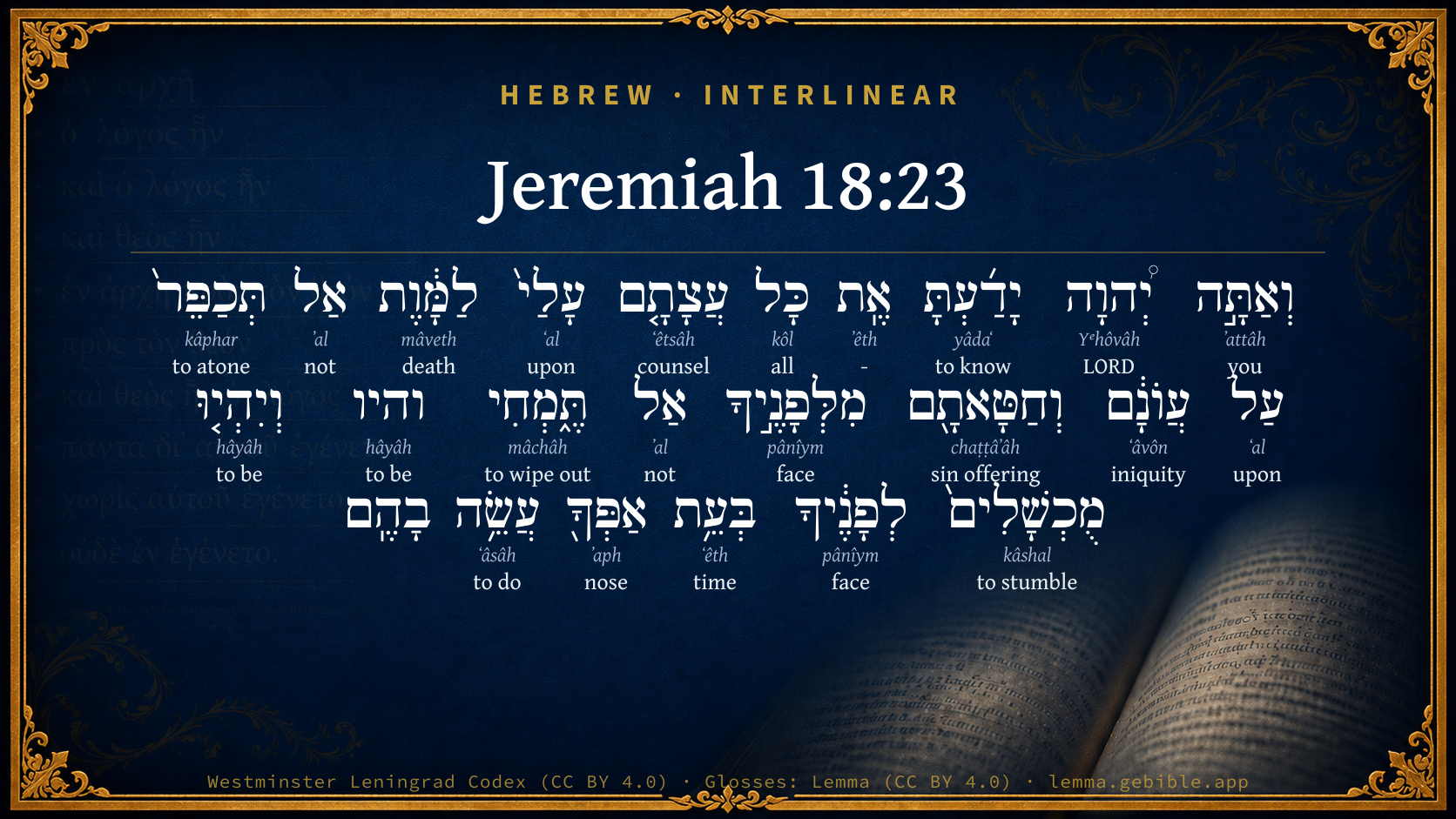
Hebrew (Westminster Leningrad Codex) Jeremiah 18:23 appears in the Hebrew Old Testament. The text above is from the Westminster Leningrad Codex. Each word links to its Strong’s number, a concise gloss, and parsing drawn from the Open Scriptures Hebrew Bible morphology. Click any word for its full Brown-Driver-Briggs (BDB) entry.
Download image
Cite this verse

Jeremiah 18:23 (World English Bible). Public Domain. Lemma interlinear Bible study tool, https://lemma.gebible.app/v/jeremiah/18/23.

Show BibTeX & RIS
BibTeX
RIS
English Translation
Yet, Yahweh, you know all their counsel against me to kill me; don't forgive their iniquity, neither blot out their sin from your sight; but let them be overthrown before you; deal you with them in the time of your anger.
World English Bible · Public Domain
Download a study sheet

One document with this verse’s original text, its word-by-word gloss line, the meaning frame, cross-references with their text, attributed commentary, and full source and license credits — printable, and it pastes into notes with its structure intact.

This verse Autodidact and up

Study sheet (.html) Plain text (.txt)

A passage Seminary Student

Up to 50 verses in one chapter. A passage sheet keeps up to 6 commentary sources and 12 cross-references per verse, in the order this page ranks them, and says so on the sheet whenever that leaves anything out. Ask for a single verse and you get the Autodidact verse sheet above.

Everything on this page stays free to read, with no account — the sheet is a download of what is already on screen, not access to it.

Want to remove ads? Support Godless Engineer
Compare translations 3

The same verse in 3 English versions, stacked beneath the original-language interlinear above. Click any original word for its lexicon entry.

Each is an independent rendering of the whole verse — the interlinear is not word-aligned to these translations.

Highlighted words mark where these versions differ — a whole-verse word diff, not a word-by-word alignment.

  • World English Bible Public Domain
    Yet, Yahweh, you know all their counsel against me to kill me; don't forgive their iniquity, neither blot out their sin from your sight; but let them be overthrown before you; deal you with them in the time of your anger.
  • King James Version Public Domain
    Yet, LORD, thou knowest all their counsel against me to slay me: forgive not their iniquity, neither blot out their sin from thy sight, but let them be overthrown before thee; deal thus with them in the time of thine anger.
  • unfoldingWord Literal Text CC BY-SA 4.0
    But you, Yahweh, you know all of their counsel against me for death. Do not atone for their iniquity, and do not blot out their sin from before your face; but let them be overthrown to your face. In the time of your nose, deal with them.

unfoldingWord Literal Text — © unfoldingWord, licensed CC BY-SA 4.0. Word-aligned USFM3 via Door43 (git.door43.org/unfoldingWord/en_ult).

Versions to compare (up to 4)

3 of 4 selected

Show all 18 translations

Every available English version of this verse, each an independent rendering of the whole verse.

  • World English Bible Public Domain
    Yet, Yahweh, you know all their counsel against me to kill me; don't forgive their iniquity, neither blot out their sin from your sight; but let them be overthrown before you; deal you with them in the time of your anger.
  • Berean Standard Bible Public Domain
    But You, O LORD, know all their deadly plots against me. Do not wipe out their guilt or blot out their sin from Your sight. Let them be overthrown before You; deal with them in the time of Your anger.
  • Majority Standard Bible Public Domain
    But You, O LORD, know all their deadly plots against me. Do not wipe out their guilt or blot out their sin from Your sight. Let them be overthrown before You; deal with them in the time of Your anger.
  • King James Version Public Domain
    Yet, LORD, thou knowest all their counsel against me to slay me: forgive not their iniquity, neither blot out their sin from thy sight, but let them be overthrown before thee; deal thus with them in the time of thine anger.
  • American Standard Version (1901) Public Domain
    Yet, Jehovah, thou knowest all their counsel against me to slay me; forgive not their iniquity, neither blot out their sin from thy sight; but let them be overthrown before thee; deal thou with them in the time of thine anger.
  • Revised Version (1885) Public Domain
    Yet, LORD, thou knowest all their counsel against me to slay me; forgive not their iniquity, neither blot out their sin from thy sight: but let them be overthrown before thee; deal thou with them in the time of thine anger.
  • Geneva Bible (1599) Public Domain
    Yet Lord thou knowest al their counsel against me tendeth to death: forgiue not their iniquitie, neither put out their sinne from thy sight, but let them be ouerthrowen before thee: deale thus with them in the time of thine anger.
  • Douay-Rheims (1899) Public Domain
    But thou, O Lord, knowest all their counsel against me unto death: forgive not their iniquity, and let not their sin be blotted out from thy sight: let them be overthrown before thy eyes, in the time of thy wrath do thou destroy them.
  • Young's Literal Translation Public Domain
    And Thou, O Jehovah, Thou hast known, All their counsel against me `is' for death, Thou dost not cover over their iniquity, Nor their sin from before Thee blottest out, And they are made to stumble before Thee, In the time of Thine anger work against them!
  • Literal Standard Version CC BY-SA 4.0
    And You, O YHWH, You have known, || All their counsel against me [is] for death, || You do not cover over their iniquity, || Nor blot out their sin from before You, || And they are made to stumble before You, || Work against them in the time of Your anger!
  • Unlocked Literal Bible CC BY-SA 4.0
    But you, Yahweh, you know all of their plans against me to kill me. Do not forgive their iniquities and sins. Do not wipe their sins away from you. Instead, let them be overthrown before you. Act against them in the time of your wrath.
  • unfoldingWord Literal Text CC BY-SA 4.0
    But you, Yahweh, you know all of their counsel against me for death. Do not atone for their iniquity, and do not blot out their sin from before your face; but let them be overthrown to your face. In the time of your nose, deal with them.
  • Darby Bible Public Domain
    And thou, Jehovah, knowest all their counsel against me to slay me. Forgive not their iniquity, neither blot out their sin from thy sight, but let them be overthrown before thee: deal with them in the time of thine anger.
  • World Messianic Bible Public Domain
    Yet, LORD, you know all their counsel against me to kill me. Don’t forgive their iniquity. Don’t blot out their sin from your sight, Let them be overthrown before you. Deal with them in the time of your anger.
  • Webster's Bible Public Domain
    Yet, LORD, thou knowest all their counsel against me to slay me: forgive not their iniquity, neither blot out their sin from thy sight, but let them be overthrown before thee; deal thus with them in the time of thy anger.
  • Free Bible Version CC BY-SA 4.0
    But Lord, you know about all their plots to try and kill me. Don't forgive their wickedness; don't wipe away their sin. Bring them down! Deal with them when you're angry!
  • Bible in Basic English Public Domain
    But you, Lord, have knowledge of all the designs which they have made against my life; let not their evil-doing be covered or their sin be washed away from before your eyes: but let it be a cause of falling before you: so do to them in the time of your wrath.
  • JPS Tanakh (1917) Public Domain
    Yet, LORD, Thou knowest all their counsel against me to slay me; forgive not their iniquity, neither blot out their sin from Thy sight; but let them be made to stumble before Thee; Deal Thou with them in the time of Thine anger.

Literal Standard Version (2020), Covenant Press — licensed CC BY-SA 4.0. Text via the HelloAO Bible API (eBible.org). Unlocked Literal Bible (unfoldingWord) — licensed CC BY-SA 4.0. Text via the HelloAO Bible API (eBible.org). unfoldingWord Literal Text — © unfoldingWord, licensed CC BY-SA 4.0. Word-aligned USFM3 via Door43 (git.door43.org/unfoldingWord/en_ult). Free Bible Version, Dr. Jonathan Gallagher — licensed CC BY-SA 4.0. Text via the HelloAO Bible API (eBible.org).

Word by word

More ways to search: Search by grammar → Find every occurrence → Compare this word →

Practice this passage: Drill this verse → Learn its vocabulary →

תֶּ֑מְחִי
mâchâh
H4229
“to wipe out”
Verb, Hiphil, Jussive, 2nd Person, Masculine, Singular
Part of Speech
Verb
Stem
Hiphil
Form
Jussive
Person
2nd Person
Gender
Masculine
Number
Singular
Full BDB Definition

Origin: a primitive root

TWOT: 1178 , 1179 , 1181c

to wipe, wipe out - (Qal) - to wipe - to blot out, obliterate - to blot out, exterminate - (Niphal) - to be wiped out - to be blotted out - to be exterminated - (Hiphil) to blot out (from memory) - (Qal) to strike - (Pual) full of marrow (participle)
  1. וְאַתָּ֣ה ʼattâh H859 “and · you” Conjunction + Pronoun, Personal, 2nd Person, Masculine, Singular
  2. יְ֠הוָה Yᵉhôvâh H3068 “LORD” Noun, Proper
  3. יָדַ֜עְתָּ yâdaʻ H3045 “to know” Verb, Qal, Perfect, 2nd Person, Masculine, Singular
  4. אֶֽת ʼêth H853 “-” Particle, Direct Object
  5. כָּל kôl H3605 “all of” Noun, Common, Masculine, Singular, Construct
  6. עֲצָתָ֤ם ʻêtsâh H6098 “counsel · their” Noun, Common, Feminine, Singular, Construct + Suffix, Personal, 3rd Person, Masculine, Plural
  7. עָלַי֙ ʻal H5921 “upon · me” Preposition + Suffix, Personal, 1st Person, Common, Singular
  8. לַמָּ֔וֶת mâveth H4194 “to/for the · death” Preposition, Determined + Noun, Common, Masculine, Singular, Absolute
  9. אַל ʼal H408 “not” Particle, Negative
  10. תְּכַפֵּר֙ kâphar H3722 “to atone” Verb, Piel, Jussive, 2nd Person, Masculine, Singular
  11. עַל ʻal H5921 “upon” Preposition
  12. עֲוֺנָ֔ם ʻâvôn H5771 “iniquity · their” Noun, Common, Both, Singular, Construct + Suffix, Personal, 3rd Person, Masculine, Plural
  13. וְחַטָּאתָ֖ם chaṭṭâʼâh H2403 “and · sin offering · their” Conjunction + Noun, Common, Feminine, Singular, Construct + Suffix, Personal, 3rd Person, Masculine, Plural
  14. מִלְּפָנֶ֣יךָ pânîym H6440 “from · to/for · face(s) · your” Preposition + Preposition + Noun, Common, Both, Plural, Construct + Suffix, Personal, 2nd Person, Masculine, Singular
  15. אַל ʼal H408 “not” Particle, Negative
  16. והיו hâyâh H1961 “and · to be” Conjunction + Verb, Qal, Sequential Perfect, 3rd Person, Common, Plural
  17. וְיִהְי֤וּ hâyâh H1961 “and · to be” Conjunction + Verb, Qal, Imperfect, 3rd Person, Masculine, Plural
  18. מֻכְשָׁלִים֙ kâshal H3782 “stumbled” Verb, Hophal, Participle Passive, Masculine, Plural, Absolute
  19. לְפָנֶ֔יךָ pânîym H6440 “to/for · face(s) · your” Preposition + Noun, Common, Both, Plural, Construct + Suffix, Personal, 2nd Person, Masculine, Singular
  20. בְּעֵ֥ת ʻêth H6256 “in/at · time of” Preposition + Noun, Common, Both, Singular, Construct
  21. אַפְּךָ֖ ʼaph H639 “nose · your” Noun, Common, Masculine, Singular, Construct + Suffix, Personal, 2nd Person, Masculine, Singular
  22. עֲשֵׂ֥ה ʻâsâh H6213 “do” Verb, Qal, Imperative, 2nd Person, Masculine, Singular

About this verse

These counts appear in no published source. They are computed here, from the morphology-tagged text and Lemma’s own curated glosses. What Lemma adds →

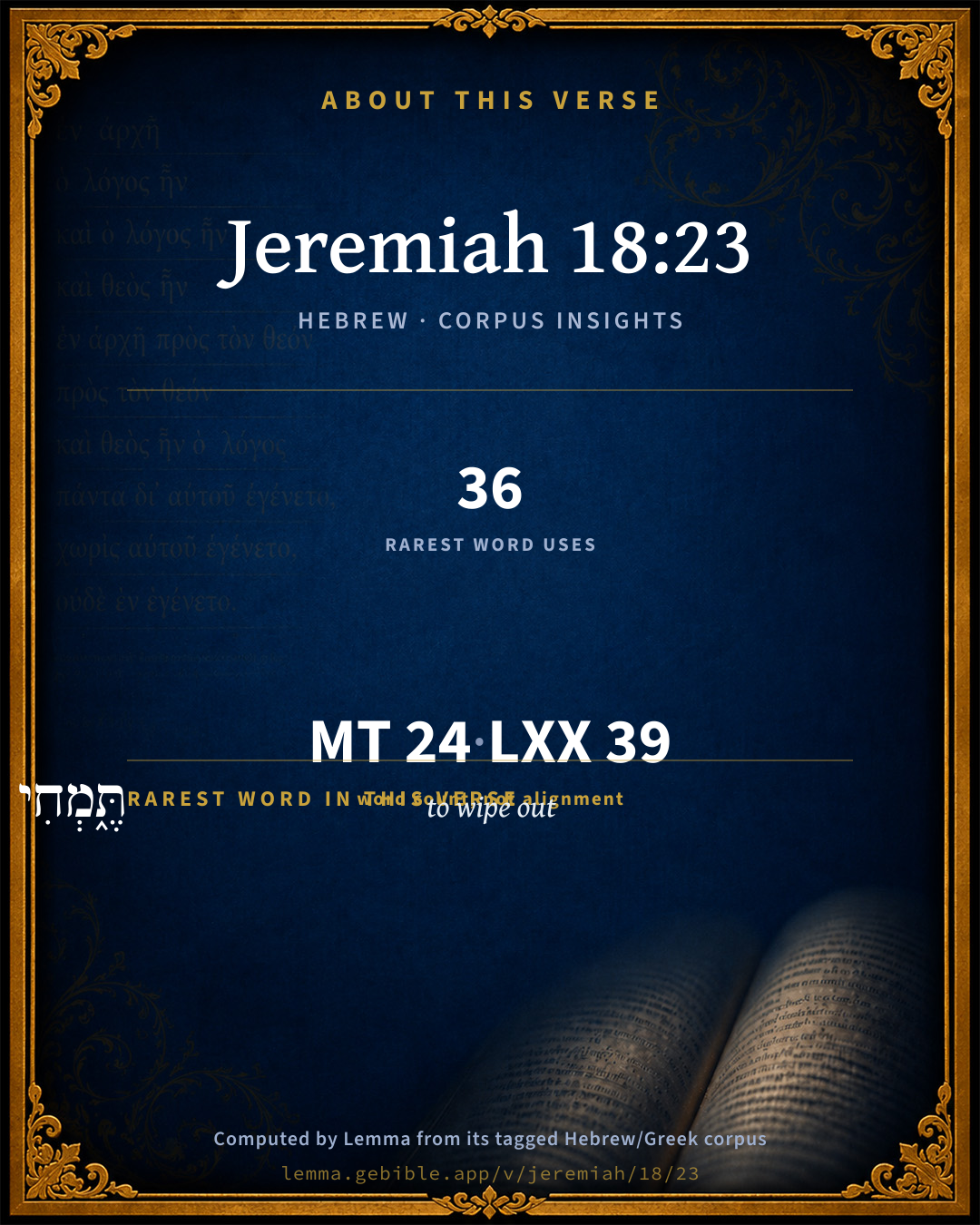
24
words
19
distinct lemmas
Prophets
section

Shared distinctive vocabulary

תֶּ֑מְחִי to wipe out H4229 occurs in 32 verses of the Hebrew Bible. Also found in:

Grammatical profile

  • 7 verbs
  • 10 nouns
  • 1 pronoun
  • 3 prepositions
  • 3 particles

Verb forms

  • יָדַ֜עְתָּ Qal · Perfect
  • תְּכַפֵּר֙ Piel · Jussive
  • תֶּ֑מְחִי Hiphil · Jussive
  • והיו Qal · Sequential Perfect
  • וְיִהְי֤וּ Qal · Imperfect
  • מֻכְשָׁלִים֙ Hophal · Participle Passive
  • עֲשֵׂ֥ה Qal · Imperative

Repetition

Words recur within this verse — often emphatic in Hebrew:

  • עָלַי֙ upon H5921 ×2
  • מִלְּפָנֶ֣יךָ face H6440 ×2
  • והיו to be H1961 ×2
  • אַל not H408 ×2

Hebrew & Septuagint length

In the original languages it is 24 Hebrew tokens and 39 Greek tokens — but the two are counted differently (Hebrew bundles its prefixes and suffixes into one token; the Greek is in lemma form), so that isn’t a like-for-like length.

Cross-references

15

Topical passages linked to Jeremiah 18:23 in the Treasury of Scripture Knowledge — connected by theme and wording, ordered by reader-vote popularity; previews shown in the World English Bible.

  • Psalms 35:4 Let those who seek after my soul be disappointed and brought to dishonor. Let those who plot my ruin be turned back and confounded.
  • Psalms 69:22–28 Let their table before them become a snare. May it become a retribution and a trap.
  • Nehemiah 4:4–5 Hear, our God; for we are despised: and turn back their reproach on their own head, and give them up for a spoil in a land of captivity;
  • Psalms 109:14–15 Let the iniquity of his fathers be remembered by Yahweh. Don't let the sin of his mother be blotted out.
  • Isaiah 2:9 Man is brought low, And mankind is humbled; Therefore don't forgive them.
  • Psalms 37:32–33 The wicked watches the righteous, And seeks to kill him.
  • Psalms 59:5 You, Yahweh God of hosts, the God of Israel, Rouse yourself to punish the nations. Show no mercy to the wicked traitors. Selah.
  • Isaiah 10:3 What will you do in the day of visitation, and in the desolation which shall come from far? to whom will you flee for help? and where will you leave your glory?
  • Jeremiah 8:12 Were they ashamed when they had committed abomination? nay, they were not at all ashamed, neither could they blush: therefore shall they fall among those who fall; in the time of their visitation they shall be cast down, says Yahweh.
  • Jeremiah 11:18–20 Yahweh gave me knowledge of it, and I knew it: then you shown me their doings.
  • Jeremiah 11:23 and there shall be no remnant to them: for I will bring evil on the men of Anathoth, even the year of their visitation.
  • Jeremiah 15:15 Yahweh, you know; remember me, and visit me, and avenge me of my persecutors; don't take me away in your longsuffering: know that for your sake I have suffered reproach.
  • Jeremiah 18:18 Then said they, Come, and let us devise devices against Jeremiah; for the law shall not perish from the priest, nor counsel from the wise, nor the word from the prophet. Come, and let us strike him with the tongue, and let us not give heed to any of his words.
  • Luke 21:22 For these are days of vengeance, that all things which are written may be fulfilled.
  • Romans 2:5 But according to your hardness and unrepentant heart you are treasuring up for yourself wrath in the day of wrath, revelation, and of the righteous judgment of God;

Cross-references courtesy of OpenBible.info (CC BY 4.0).

Hebrew and Greek witnesses Masoretic Hebrew ↔ Greek Septuagint

The same verse in the two great witnesses to the Old Testament, shown verse-for-verse.

These are two independent witnesses, not word-aligned to each other, and the Septuagint is shown in lemma (dictionary) form.

Hebrew Jeremiah 18:23 Masoretic · Westminster Leningrad Codex

וְאַתָּ֣ה יְ֠הוָה יָדַ֜עְתָּ אֶֽת כָּל עֲצָתָ֤ם עָלַי֙ לַמָּ֔וֶת אַל תְּכַפֵּר֙ עַל עֲוֺנָ֔ם וְחַטָּאתָ֖ם מִלְּפָנֶ֣יךָ אַל תֶּ֑מְחִי והיו וְיִהְי֤וּ מֻכְשָׁלִים֙ לְפָנֶ֔יךָ בְּעֵ֥ת אַפְּךָ֖ עֲשֵׂ֥ה בָהֶֽם

Yet, Yahweh, you know all their counsel against me to kill me; don't forgive their iniquity, neither blot out their sin from your sight; but let them be overthrown before you; deal you with them in the time of your anger.

World English Bible · Public Domain

Greek LXX Structure differs

In the Septuagint, Jeremiah is about an eighth shorter than the Hebrew and arranges its material differently — the Oracles Against the Nations (Hebrew chapters 46–51) appear in the middle of the Greek book, after 25:13. Because the chapter and verse boundaries do not line up, a verse-for-verse comparison with the Hebrew is not shown.

A verse-for-verse comparison isn’t shown here because the chapters and verses don’t line up. Switch to the LXX edition with the MT / LXX toggle above to read the Greek directly.

Hebrew: Westminster Leningrad Codex (CC BY 4.0). Greek: Septuagint (public domain); English from a public-domain English Septuagint. How the Septuagint differs from the Hebrew →

Targum (Aramaic paraphrase)

1

The Targum is the ancient Jewish Aramaic paraphrase of the Hebrew Scriptures — an interpretive translation, not the Hebrew text itself. Onkelos (literal) and Pseudo-Jonathan (expansive) render the Torah, and Jonathan the Prophets. Coverage is partial: where no permissively-licensed English translation exists for a verse, only the Aramaic is shown. This is verse-level text, not a word-by-word alignment to the Hebrew.

  1. Targum Jonathan Prophets (Joshua–Malachi)
    וְאַתְּ יְיָ יְדִיעַ וּגְלֵי קֳדָמָךְ יַת כָּל אִתְמְלוּכֵיהוֹן עֲלַי לְמִקְטְלֵי לָא תְכַפֵּר עַל חוֹבֵיהוֹן וְחַטָאֵיהוֹן מִן קֳדָמָךְ לָא יִתְמְחוּן וִיהוֹן מַתְכְּלִין דְמִן קֳדָמָךְ בְּעִדַן פּוּרְעֲנוּת רוּגְזָךְ אֶתְפְּרַע מִנְהוֹן:

    (no public-domain English translation for this verse)

    Targum Jonathan — Aramaic: “Mikraot Gedolot” (public domain). English: “Sefaria Community Translation” (CC0 1.0 (public-domain dedication)); “London "Chaldee Paraphrase," 1871” (public domain). Text via Sefaria.

Commentary

Notes on Jeremiah 18:23 from classic Christian and Jewish commentators (each source and its license shown beneath its notes). The classic Christian expositions comment on the surrounding passage and are grouped to its opening verse, so a note may address several verses; the Jewish commentaries on the Tanakh (Rashi and others) are per-verse, so they appear only where the commentator wrote on this verse.

Lemma curates 59 commentaries, every one of them public domain or Creative Commons licensed, each selected and text-cleaned for this edition rather than reprinted as found. About our sources →

Trapp's Complete Commentary

John Trapp

Jer 18:23 Yet, LORD, thou knowest all their counsel against me to slay [me]: forgive not their iniquity, neither blot out their sin from thy sight, but let them be overthrown before thee; deal [thus] with them in the time of thine anger.

Ver. 23. Yet, Lord, thou knowest all their counsel.] Though I know it not, yet thou art privy to it, and canst prevent it; for wisdom and might are thine. {Dan 2:20}

To slay me.] All malice is bloody.

Forgive not their iniquity.] He knew their sin to be unpardonable; and therefore prayeth for vengeance upon them unavoidable. This was fulfilled upon the Jews by the Babylonians in respect of Jeremiah, and by the Romans in respect of Christ.

Neither blot out their sin from thy sight.] A heavy curse. Woe to such as whose debts stand uncrossed in God’s book. Their sins may sleep a long time, like a sleeping debt, not called for of many years; as Saul’s sin in slaying the Gibeonites was not punished till forty years after; as Joab’s killing of Abner slept all David’s days. Men’s consciences also may sleep (in such a case) for a season; but their damnation sleepeth not, nor can their condition be safe till God have wiped out their sins for his own sake, till he have crossed out the black lines of our iniquities with the red lines of his Son’s blood, and taken out of his coffers so much as may fully satisfy, &c.

John Trapp, A Commentary or Exposition upon All the Books of the Old and New Testament (1647–1656) — public domain. Text from a community e-Sword module.

Jamieson, Fausset & Brown

Robert Jamieson, A. R. Fausset & David Brown

forgive not-- (Psa 109:9-10, Psa 109:14).

blot out--image from an account-book (Rev 20:12).

before thee--Hypocrites suppose God is not near, so long as they escape punishment; but when He punishes, they are said to stand before Him, because they can no longer flatter themselves they can escape His eye (compare Psa 90:8).

deal thus--exert Thy power against them [MAURER].

time of thine anger--Though He seems to tarry, His time shall come at last (Ecc 8:11-12; Pe2 3:9-10).

Referred by MAURER, &c., to the beginning of Zedekiah's reign.

Next: Jeremiah Chapter 19

Jamieson, Fausset & Brown — Commentary Critical and Explanatory on the Whole Bible (1871) — public domain (CC PDM 1.0). Text via the HelloAO Bible API.

John Calvin's Commentaries

The words of the last verse of the eighteenth chapter we gave yesterday. Let us now see what the Prophet means by them, and what fruit we ought to gather from them. He says, that God was a witness of the wickedness of his enemies — that all their counsels had in view his destruction. There is, moreover, to be understood a contrast, — that the Prophet, as we have before seen, cared faithfully for their salvation. It was then a most base ingratitude in them to plot the death of the holy Prophet, who was not only innocent, but highly deserved their thanks for laboring for their salvation. We hence conclude that they deserved no mercy. Thou knowest, he says, their counsel, that what they consult among themselves tends to bring death on me: be not thou then propitious to their iniquity, and blot not out their sin

We said in our last lecture that this vehemence, as it was dictated by the Holy Spirit, is not to be condemned, nor ought it to be made an example of, for it was peculiar to the Prophet to know that they were reprobates: and we also shewed why no common law is to be made from particular examples: for Jeremiah was endued with the spirit of wisdom and judgment, and zeal also for God’s glory so ruled in his heart, that the feelings of the flesh were wholly subdued, or at least brought under subjection; and farther, he pleaded not a private cause. We said in the first place, that it was oracular; for God designed to make it known, that they who thus obstinately resisted true doctrine were reprobate and irreclaimable. As all these things fall not to our lot, we ought not indiscriminately to imitate Jeremiah in this prayer: for that would then apply to us which Christ said to his disciples,

“Ye know not what spirit, governs you.” (Luke 9:55.)

And doubtless it ought to fill us with dread when we hear, Be not propitious to them, nor blot out their sin. God testifies in many plaices that he is gracious and inclined to mercy, and that when he is angry it is only for a moment. (Numbers 14:18; Psalm 103:8; Psalm 30:5) There seems then a great difference between the words of the Prophet and these testimonies, by which God makes known his own nature. But we have said already that the destruction of the people, against whom the Prophet thus prayed, had been made evident to him: and we must also bear in mind what we have stated, that he did not include the people without exception; for he knew that there was a seed remaining among them. He then confined his imprecation to the reprobate and irreclaimable, as he knew that they were already doomed to ruin, even by the eternal purpose of God’ and as they had over and over again destroyed themselves, he boldly declares that God would never be propitious to them.

To the same purpose is what follows, Let them ever stumble before thy face. He mentions face here for manifest judgment; for the wicked exult as long as he spares them. The Prophet then would have God to sit on his throne, that he might appear as a Judge, and thus check the wantonness of those who despised his judgment, being constrained to know that they could not escape. There is also a contrast to be understood here between the presence and the absence of God. For hypocrites think that God is absent as long as he is indulgent to them and does not take vengeance hence they grow wanton, as though they had a permission to deceive him: but when God constrains them to acknowledge what they are unwilling to do, they are said to stand in his presence; for they are pressed too near to render it possible for them to evade, and willing or unwilling they are held fast, as the Lord proves that he is their Judge. We hence see the meaning of the expression when the Prophet says, Let them stumble before thy face.

He in the last place adds, In the time of thy wrath deal thus with them. The manner of his presence is set forth. There is, however, no doubt but that the Prophet here checks both himself and all the godly, that they may not be hasty, for we are often too precipitant in our wishes; for we would that God would fulminate every moment from heaven. This hastiness ought to be moderated; and the Prophet here prescribes to us the rule of moderation, by saying, In the time of thy wrath; as though he had said, “Even though thou deferrest and seemest now to connive at these great crimes, yet the time will eventually come in which thou wilt take vengeance on the reprobate.”

Whenever then the Scripture speaks of the time of God’s wrath, let us know that under this form of speaking there is an exhortation to patience, so that excessive ardor may not lead us beyond the limits of moderation, but that we may wait with resigned minds until the due time of judgment comes. This is one thing; but at the same time the Prophet expresses also something more: for he would have the reprobate of whom he speaks, to be so involved in endless judgment as never to be able to extricate themselves. It is said in Psalm 106:4,

“Remember me, O Lord, with the favor of thy people,”

that is, “O Lord, this only I ask, to be joined to thy people; for even when thy Church is afflicted and deemed miserable, it will still be enough for me to be of the number of those whom thou honorest with thy paternal favor.” The favor then of God’s people is that paternal regard which he entertains for his Church. So, on the other hand, the time of wrath is that judgment by which God devotes the reprobate to eternal perdition, so that there is no hope of salvation remaining for them. Deal thou with them, but when? even in the time of thy wrath; that is, deal with them as thou art wont to deal with thine irreclaimable enemies, to whom thou wilt never be reconcilable. This is the meaning. Now another discourse follows.

John Calvin's Commentaries (1540-1563) — public domain. Text from the Calvin Translation Society English edition (1840s-50s) via the Christian Classics Ethereal Library (ccel.org). Calvin's coverage is partial (roughly two-thirds of the Bible); uncommented books and verses are honest gaps, never fabricated. The 19th-century editor's footnotes and remarks are omitted so the notes are faithfully Calvin's own voice.

Ellicott's Commentary for English Readers

(23) Yet, Lord, thou knowest all their counsel . . .—Secret as their plots had been, they were not hidden from Jehovah, nor, indeed, as the words show, from the prophet himself. The words might seem, at first, to refer specially to the conspiracy of the men of Anathoth (Jer_11:21), but by this time, as Jer_18:18 shows, the hatred provoked by the warnings of the prophet had spread further, and united the priests and false prophets of Jerusalem in a common hostility against him. So afterwards, in the Gospel history, the conspiracies that began at Capernaum (Mar_3:6) were developed in Jerusalem (Mat_27:1).

Deal thus with them.—The interpolated word “thus,” intended to emphasise the prayer, really weakens it: in the. time of Thine anger deal with them, as implying that the day of grace was past, that nothing now remained but retribution. The prayer was the utterance of an indignation, not unrighteous in itself, yet showing all too plainly, as has been said above, like the language of the so-called imprecatory Psalms, the contrast between the Jewish and the Christian and Christ-like way of meeting wrong and hatred. For us such prayers are among the things that have passed away, and we have learnt to admire and imitate the nobler temper of the proto-martyr, “Lord, lay not this sin to their charge” (Act_7:60). The New Testament utterances of St. Peter against Simon the sorcerer (Act_8:20), of St. Paul against Ananias (Act_23:3), the Judaisers of Galatia (Gal_1:9), and Alexander the coppersmith (2Ti_4:14), present an apparent parallelism; but the words spoken in these cases have more the character of an authoritative judicial sentence.

A Bible Commentary for English Readers, edited by Charles John Ellicott (1878–1897) — public domain. Text from a community e-Sword module.

The Cambridge Bible for Schools and Colleges

gen. ed. J. J. S. Perowne

23. overthrown] lit. as mg. made to stumble. Cp. Jer_6:15; Jer_6:21.

The Cambridge Bible for Schools and Colleges (gen. ed. J. J. S. Perowne; Cambridge University Press, 1878–1918) — public domain. Text from a community e-Sword module.

Albert Barnes' Notes on the Bible

Yet, Lord - Better, But, Lord. They conceal their plots, but God knows, and therefore must punish.

Neither blot out ... - Or, “blot not out their sin from before Thy face that they may be made to stumble before Thee.”

Thus - Omit this word. Since there is an acceptable time and a day of salvation, so there is a time of anger, and Jeremiah’s prayer is that God would deal with his enemies at such a time, and when therefore no mercy would be shown. On imprecations such as these, see Ps. 109 introductory note. Though they did not flow from personal vengeance, but from a pure zeal for God’s honor, yet they belong to the legal spirit of the Jewish covenant. We must not, because we have been shown a “more excellent way,” condemn too harshly that sterner spirit of justice which animated so many of the saints of the earlier dispensation.

Albert Barnes' Notes on the Bible (1834–1885) — public domain. Text from a community e-Sword/MySword module.

Haydock's Catholic Bible Commentary

Destroy. Hebrew, "with them." use them as vessels of ignominy: abutere. (Haydock)

George Leo Haydock (1774–1849), Haydock's Catholic Family Bible and Commentary, 1859 edition — public domain. Excludes Psalms (Douay-Rheims chapter numbering differs from Protestant) and Deuterocanonical books (Catholic canon only).

Matthew Poole's English Annotations

Lord, thou knowest all their counsel against me to slay me; Lord, thou knowest I do not charge them falsely, though their counsels have been secret against my life. Forgive not their iniquity, neither blot out their sin from thy sight.

Object. Will some say, Doth Jeremiah here pray for the eternal damnation of his adversaries? Is this lawful?

Solut. I do not think this is to be granted lawful, being so highly against charity; nor that Jeremiah in this is to be excused as a prophet, for even prophets had no such revelations; but I take these phrases to be expounded by the next words,

let them be overthrown before thee; and that all which the prophet prayeth for is God’s showing some temporal displeasure and vengeance against them. For forgiving, and not forgiving sin, doth not always in holy writ signify the discharging or not discharging the persons, from the obligation to eternal death, under which sin layeth them; but sometimes the discharging or not discharging of them from the punishments in this life, to which sin doth expose the sinner; and all Jeremiah’s meaning is, that however it should please God to deal with these wicked men as to their eternal state, yet he would so far not forgive, not blot out, their sins, as that he would set some mark of his vengeance on them in this life for their treachery and ingratitude to him. Whether we in it consider Jeremiah as an ordinary suppliant in this cause, praying in faith, or as a prophet, foreknowing what God would do, it ought to lay a law upon, all to take heed of being mischievous and treacherous to others. It is seldom but God, before they die, repays such men into their own bosom, especially if it be against any who are God’s ministers or people; and that for their speaking to or doing before them the will of God: it is a sin seldom escapes without a temporal vengeance; and if such men be saved at last, it will be as through fire. God will mind them that he hath said, Touch not mine anointed, and do my prophets no harm, 1Ch 16:22; Psa 105:15.

Matthew Poole's English Annotations on the Holy Bible (1683–1685) — public domain. Text from a community e-Sword/MySword module.

Whedon's Commentary on the Bible

Daniel D. Whedon

23. Thou knowest all their counsel — A comprehensive summing up of the whole prayer. For some excellent observations on Jeremiah’s imprecatory prayers, see Keil in his Commentary on this place.

Daniel D. Whedon (gen. ed.), Commentary on the Old and New Testaments (1874–1909) — public domain. Text from a community e-Sword module.

The Pulpit Commentary

Let them be overthrown before thee; i.e. count them as those who have been brought to ruin. This explanation seems required by the parallelism, the companion clause meaning do not regard their sin as cancelled." The ruin may be either spiritual or temporal; the parallelism favors the former. (comp. ver. 14; Hos_14:9, where "fall" should be "stumble Deal thus with them. "Thus" is interpolated by the Authorized Version; "deal" should rather be deal terribly. ("deal" is constantly used in a pregnant sense; see on Jer_14:7)

The Pulpit Commentary (1880–1919), ed. H.D.M. Spence-Jones & Joseph S. Exell — public domain. Text from a community e-Sword module.

Rashi

Rabbi Shlomo Yitzchaki (Rashi)

let not be erased let it not be erased. And because it is a feminine gender, he placed a ‘yud’ therein. This too is superfluous, as the ‘yud’ of (Ezekiel 16:17) “And you played the harlot (וַתִּזְנִי) with them.”

Rashi on the Tanakh — English translations: “The Judaica Press complete Tanach with Rashi, translated by A. J. Rosenberg” (CC BY 4.0); “Pentateuch with Rashi's commentary by M. Rosenbaum and A.M. Silbermann, 1929-1934” (public domain); “The Metsudah Tanach series, Lakewood, N.J” (CC BY 4.0); and “The Book of Joshua, Metsudah Publications, 1997” (CC BY 4.0). Text via Sefaria.

Lesson kit

Teaching starters — assembled from the data on this page, not authored interpretation. Every prompt links to the verse data it draws on. Edit before teaching.

Jeremiah, in the Prophets, opens this verse with 24 words (19 distinct Hebrew lemmas). Its most distinctive word is mâchâh (“to wipe out”). A historical commentator’s framing appears above. Read the whole chapter for the surrounding context.

Discussion questions

  1. The word mâchâh carries the sense “to wipe out.” How does it shape the verse?
  2. How does Genesis 6:7, which shares the word «to wipe out», read alongside this verse?
  3. What does the repetition of “upon” (2× in this one verse) do in this verse?
  4. These translations render this verse differently. What is at stake in choosing one wording over another?
  5. «יָדַ֜עְתָּ» is a Qal Perfect verb. How does that grammatical form shape the action described?
  6. Compare how Trapp's Complete Commentary and Jamieson, Fausset & Brown read this verse. Where do they agree or differ?

Things to notice

Reading settings

Reading text

Shown beneath each verse's original-language words.

Old Testament
Old Testament edition

Read the OT as the Masoretic Hebrew (MT) or the Greek Septuagint (LXX).

English shown for the Greek Septuagint (in the Hebrew ↔ Greek comparison).

Comparing translations? Open the Compare panel on any verse page to stack up to four side by side.