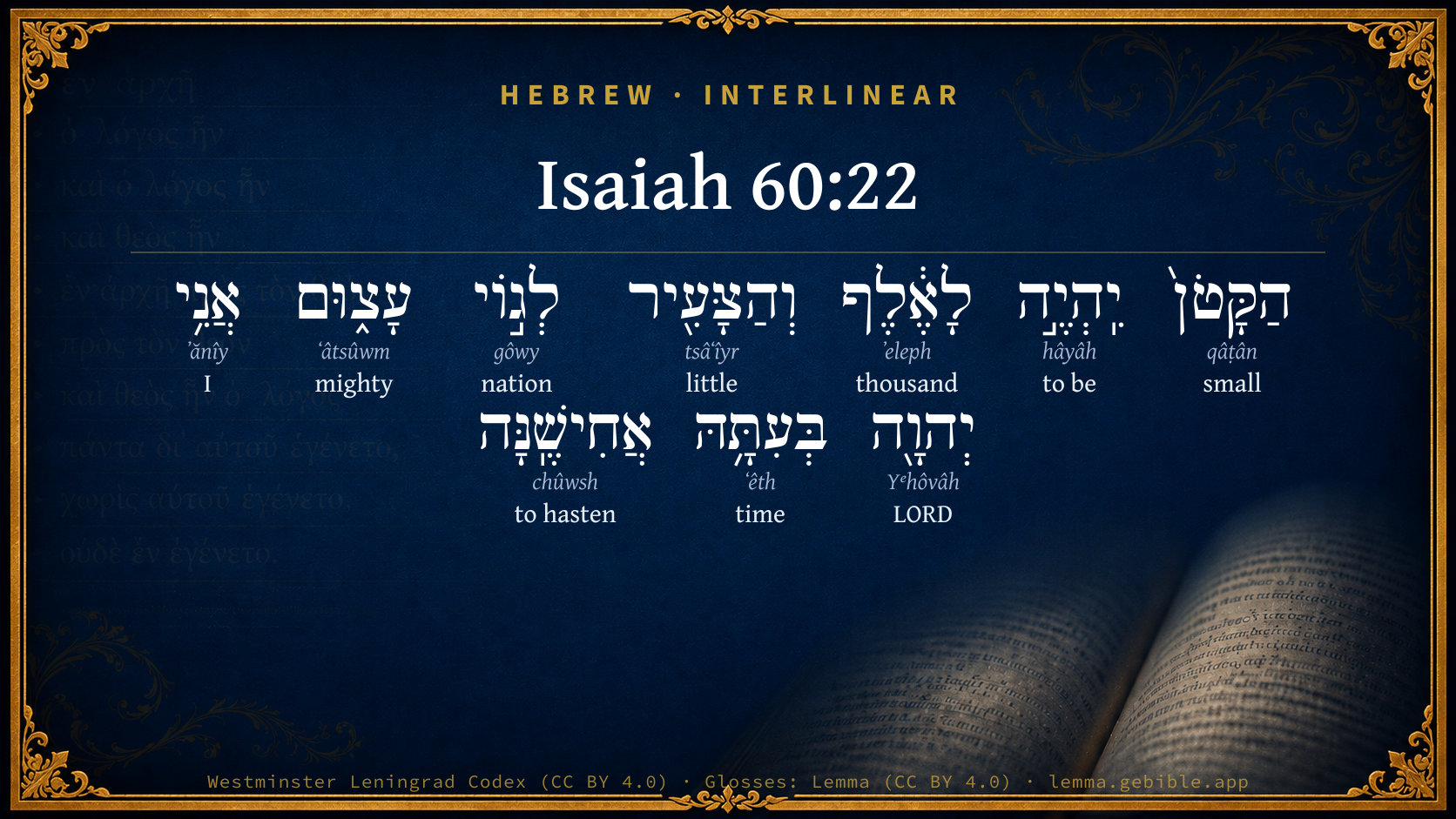
Isaiah 60:22

Hebrew (Westminster Leningrad Codex) Isaiah 60:22 appears in the Hebrew Old Testament. The text above is from the Westminster Leningrad Codex. Each word links to its Strong’s number, a concise gloss, and parsing drawn from the Open Scriptures Hebrew Bible morphology. Click any word for its full Brown-Driver-Briggs (BDB) entry.
Download image
Cite this verse

Isaiah 60:22 (World English Bible). Public Domain. Lemma interlinear Bible study tool, https://lemma.gebible.app/v/isaiah/60/22.

Show BibTeX & RIS
BibTeX
RIS
English Translation
The little one shall become a thousand, and the small one a strong nation; I, Yahweh, will hasten it in its time.
World English Bible · Public Domain
Download a study sheet

One document with this verse’s original text, its word-by-word gloss line, the meaning frame, cross-references with their text, attributed commentary, and full source and license credits — printable, and it pastes into notes with its structure intact.

This verse Autodidact and up

Study sheet (.html) Plain text (.txt)

A passage Seminary Student

Up to 50 verses in one chapter. A passage sheet keeps up to 6 commentary sources and 12 cross-references per verse, in the order this page ranks them, and says so on the sheet whenever that leaves anything out. Ask for a single verse and you get the Autodidact verse sheet above.

Everything on this page stays free to read, with no account — the sheet is a download of what is already on screen, not access to it.

Want to remove ads? Support Godless Engineer
Compare translations 3

The same verse in 3 English versions, stacked beneath the original-language interlinear above. Click any original word for its lexicon entry.

Each is an independent rendering of the whole verse — the interlinear is not word-aligned to these translations.

Highlighted words mark where these versions differ — a whole-verse word diff, not a word-by-word alignment.

  • World English Bible Public Domain
    The little one shall become a thousand, and the small one a strong nation; I, Yahweh, will hasten it in its time.
  • King James Version Public Domain
    A little one shall become a thousand, and a small one a strong nation: I the LORD will hasten it in his time.
  • unfoldingWord Literal Text CC BY-SA 4.0
    The small will become a thousand, and the little, a strong nation. I, Yahweh, will hasten it in its time.”

unfoldingWord Literal Text — © unfoldingWord, licensed CC BY-SA 4.0. Word-aligned USFM3 via Door43 (git.door43.org/unfoldingWord/en_ult).

Versions to compare (up to 4)

3 of 4 selected

Show all 18 translations

Every available English version of this verse, each an independent rendering of the whole verse.

  • World English Bible Public Domain
    The little one shall become a thousand, and the small one a strong nation; I, Yahweh, will hasten it in its time.
  • Berean Standard Bible Public Domain
    The least of you will become a thousand, and the smallest a mighty nation. I am the LORD; in its time I will accomplish it quickly.
  • Majority Standard Bible Public Domain
    The least of you will become a thousand, and the smallest a mighty nation. I am the LORD; in its time I will accomplish it quickly.
  • King James Version Public Domain
    A little one shall become a thousand, and a small one a strong nation: I the LORD will hasten it in his time.
  • American Standard Version (1901) Public Domain
    The little one shall become a thousand, and the small one a strong nation; I, Jehovah, will hasten it in its time.
  • Revised Version (1885) Public Domain
    The little one shall become a thousand, and the small one a strong nation: I the LORD will hasten it in its time.
  • Geneva Bible (1599) Public Domain
    A litle one shall become as a thousande, and a small one as a strong nation: I the Lord wil hasten it in due time.
  • Douay-Rheims (1899) Public Domain
    The least shall become a thousand, and a little one a most strong nation: I the Lord will suddenly do this thing in its time.
  • Young's Literal Translation Public Domain
    The little one doth become a chief, And the small one a mighty nation, I, Jehovah, in its own time do hasten it!
  • Literal Standard Version CC BY-SA 4.0
    The little one becomes a chief, || And the small one a mighty nation, || I, YHWH, hurry it in its own time!”
  • Unlocked Literal Bible CC BY-SA 4.0
    The little one shall become a thousand, and the small one a strong nation; I, Yahweh, will swiftly accomplish these things when the time comes.
  • unfoldingWord Literal Text CC BY-SA 4.0
    The small will become a thousand, and the little, a strong nation. I, Yahweh, will hasten it in its time.”
  • Darby Bible Public Domain
    The little one shall become a thousand, and the smallest a mighty nation: I, Jehovah, will hasten it in its time.
  • World Messianic Bible Public Domain
    The little one will become a thousand, and the small one a strong nation. I, the LORD, will do this quickly in its time.”
  • Webster's Bible Public Domain
    A little one shall become a thousand, and a small one a strong nation: I the LORD will hasten it in its time.
  • Free Bible Version CC BY-SA 4.0
    The smallest of your families will increase to a thousand, and the most insignificant will become a great nation. I am the Lord; at the right time I will do this quickly.
  • Bible in Basic English Public Domain
    The smallest of their families will become a thousand, and a small one a strong nation: I, the Lord, will make it come quickly in its time.
  • JPS Tanakh (1917) Public Domain
    The smallest shall become a thousand, and the least a mighty nation; I the LORD will hasten it in its time.

Literal Standard Version (2020), Covenant Press — licensed CC BY-SA 4.0. Text via the HelloAO Bible API (eBible.org). Unlocked Literal Bible (unfoldingWord) — licensed CC BY-SA 4.0. Text via the HelloAO Bible API (eBible.org). unfoldingWord Literal Text — © unfoldingWord, licensed CC BY-SA 4.0. Word-aligned USFM3 via Door43 (git.door43.org/unfoldingWord/en_ult). Free Bible Version, Dr. Jonathan Gallagher — licensed CC BY-SA 4.0. Text via the HelloAO Bible API (eBible.org).

Word by word

More ways to search: Search by grammar → Find every occurrence → Compare this word →

Practice this passage: Drill this verse → Learn its vocabulary →

אֲחִישֶֽׁנָּה
chûwsh
H2363
“to hasten · her”
Verb, Hiphil, Imperfect, 1st Person, Common, Singular + Suffix, Personal, 3rd Person, Feminine, Singular
Part of Speech
Verb
Stem
Hiphil
Form
Imperfect
Person
1st Person
Gender
Common
Number
Singular
Full BDB Definition

Origin: a primitive root

TWOT: 631

to haste, make haste, hurry - (Qal) to make haste - (Hiphil) - to show haste, act quickly, hasten, come quickly - to enjoy, be excited
  1. הַקָּטֹן֙ qâṭân H6996 “the · small” Particle, Definite Article + Adjective, Adjective, Masculine, Singular, Absolute
  2. יִֽהְיֶ֣ה hâyâh H1961 “to be” Verb, Qal, Imperfect, 3rd Person, Masculine, Singular
  3. לָאֶ֔לֶף ʼeleph H505 “to/for the · thousand” Preposition, Determined + Adjective, Cardinal number, Both, Singular, Absolute
  4. וְהַצָּעִ֖יר tsâʻîyr H6810 “and · the · little” Conjunction + Particle, Definite Article + Adjective, Adjective, Masculine, Singular, Absolute
  5. לְג֣וֹי gôwy H1471 “to/for · nation” Preposition + Noun, Common, Masculine, Singular, Absolute
  6. עָצ֑וּם ʻâtsûwm H6099 “mighty” Adjective, Adjective, Masculine, Singular, Absolute
  7. אֲנִ֥י ʼănîy H589 “I” Pronoun, Personal, 1st Person, Common, Singular
  8. יְהוָ֖ה Yᵉhôvâh H3068 “LORD” Noun, Proper
  9. בְּעִתָּ֥הּ ʻêth H6256 “in/at · time · her” Preposition + Noun, Common, Both, Singular, Construct + Suffix, Personal, 3rd Person, Feminine, Singular

About this verse

These counts appear in no published source. They are computed here, from the morphology-tagged text and Lemma’s own curated glosses. What Lemma adds →

10
words
10
distinct lemmas
Prophets
section

Notable vocabulary

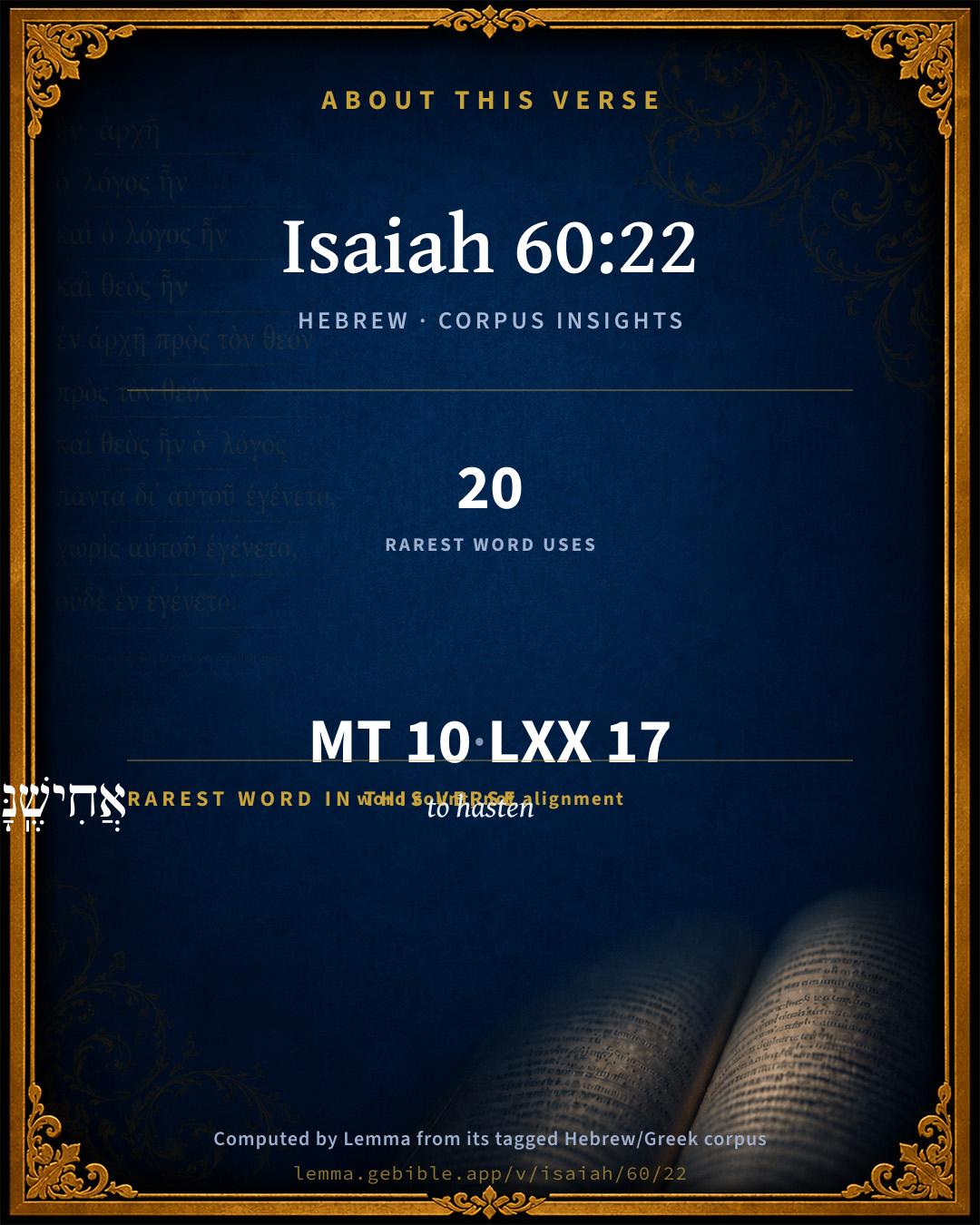
The rarest word here is אֲחִישֶֽׁנָּה to hasten H2363 — appearing just 20 times in the whole Hebrew Bible.

Shared distinctive vocabulary

אֲחִישֶֽׁנָּה to hasten H2363 occurs in 20 verses of the Hebrew Bible. Also found in:

Grammatical profile

  • 2 verbs
  • 3 nouns
  • 4 adjectives
  • 1 pronoun

Verb forms

  • יִֽהְיֶ֣ה Qal · Imperfect
  • אֲחִישֶֽׁנָּה Hiphil · Imperfect

Hebrew & Septuagint length

In English translation the verse runs 22 words from the Hebrew and 21 from the Septuagint (LXX English) — closely comparable.

A rough comparison of the two English renderings, which tokenize alike — not a word-level alignment.

Word counts can differ between the Hebrew and the Greek without any difference in meaning — e.g. the Hebrew direct-object marker אֵת has no separate Greek word, and Greek often adds the article ὁ.

In the original languages it is 10 Hebrew tokens and 17 Greek tokens — but the two are counted differently (Hebrew bundles its prefixes and suffixes into one token; the Greek is in lemma form), so that isn’t a like-for-like length.

Cross-references

12

Topical passages linked to Isaiah 60:22 in the Treasury of Scripture Knowledge — connected by theme and wording, ordered by reader-vote popularity; previews shown in the World English Bible.

  • Habakkuk 2:3 For the vision is yet for the appointed time, and it hurries toward the end, and won't prove false. Though it takes time, wait for it; because it will surely come. It won't delay.
  • Hebrews 10:36 For you need endurance so that, having done the will of God, you may receive the promise.
  • Luke 18:7 Won't God avenge his chosen ones, who are crying out to him day and night, and yet he exercises patience with them?
  • Matthew 13:31–32 He set another parable before them, saying, "The Kingdom of Heaven is like a grain of mustard seed, which a man took, and sowed in his field;
  • Isaiah 66:8 Who has heard such a thing? who has seen such things? Shall a land be born in one day? shall a nation be brought forth at once? for as soon as Zion travailed, she brought forth her children.
  • 2 Peter 3:8 But don't forget this one thing, beloved, that one day is with the Lord as a thousand years, and a thousand years as one day.
  • Isaiah 5:19 Who say, "Let him make speed, let him hasten his work, that we may see it; And let the counsel of the Holy One of Israel draw near and come, That we may know it!"
  • Daniel 2:44 In the days of those kings shall the God of heaven set up a kingdom which shall never be destroyed, nor shall the sovereignty of it be left to another people; but it shall break in pieces and consume all these kingdoms, and it shall stand forever.
  • Revelation 7:9 After these things I looked, and behold, a great multitude, which no man could number, out of every nation and of all tribes, peoples, and languages, standing before the throne and before the Lamb, dressed in white robes, with palm branches in their hands.
  • Acts 5:14 More believers were added to the Lord, multitudes of both men and women.
  • Acts 2:41 Then those who gladly received his word were baptized. There were added that day about three thousand souls.
  • Daniel 2:35 Then was the iron, the clay, the brass, the silver, and the gold, broken in pieces together, and became like the chaff of the summer threshing floors; and the wind carried them away, so that no place was found for them: and the stone that struck the image became a great mountain, and filled the whole earth.

Cross-references courtesy of OpenBible.info (CC BY 4.0).

Hebrew and Greek witnesses Masoretic Hebrew ↔ Greek Septuagint

The same verse in the two great witnesses to the Old Testament, shown verse-for-verse.

These are two independent witnesses, not word-aligned to each other, and the Septuagint is shown in lemma (dictionary) form.

Hebrew Isaiah 60:22 Masoretic · Westminster Leningrad Codex

הַקָּטֹן֙ יִֽהְיֶ֣ה לָאֶ֔לֶף וְהַצָּעִ֖יר לְג֣וֹי עָצ֑וּם אֲנִ֥י יְהוָ֖ה בְּעִתָּ֥הּ אֲחִישֶֽׁנָּה

The little one shall become a thousand, and the small one a strong nation; I, Yahweh, will hasten it in its time.

World English Bible · Public Domain

Greek LXX Isaiah 60:22 Septuagint · lemma form

ὁ ὀλιγοστός εἰμί εἰς χιλιάς καί ὁ ἐλαχύς εἰς ἔθνος μέγας ἐγώ κύριος κατά καιρός συνἄγω αὐτός

The little one shall become thousands, and the least a great nation; I the Lord will gather them in due time.

LXX2012 (modern English Septuagint) · Public Domain

On this verse, Albert Barnes' Notes on the Bible discusses the Septuagint’s reading. Read the note in Commentary ↓

Hebrew: Westminster Leningrad Codex (CC BY 4.0). Greek: Septuagint (public domain); English from LXX2012 (modern English Septuagint) (Public Domain). How the Septuagint differs from the Hebrew →

Targum (Aramaic paraphrase)

1

The Targum is the ancient Jewish Aramaic paraphrase of the Hebrew Scriptures — an interpretive translation, not the Hebrew text itself. Onkelos (literal) and Pseudo-Jonathan (expansive) render the Torah, and Jonathan the Prophets. Coverage is partial: where no permissively-licensed English translation exists for a verse, only the Aramaic is shown. This is verse-level text, not a word-by-word alignment to the Hebrew.

  1. Targum Jonathan Prophets (Joshua–Malachi)
    דִזְעֵיר בְּהוֹן יְהֵי לְאַלָפָא וּדְחַלָשׁ לְעַם תַּקִיף אֲנָא יְיָ בְּזִמְנָהּ אַיְתִינָהּ:

    He that is little amongst them shall become a thousand, and he that is weak shall become a strong nation: I the Lord will bring it to pass in its time.

    Targum Jonathan — Aramaic: “Mikraot Gedolot” (public domain). English: “Sefaria Community Translation” (CC0 1.0 (public-domain dedication)); “London "Chaldee Paraphrase," 1871” (public domain). Text via Sefaria.

Commentary

Notes on Isaiah 60:22 from classic Christian and Jewish commentators (each source and its license shown beneath its notes). The classic Christian expositions comment on the surrounding passage and are grouped to its opening verse, so a note may address several verses; the Jewish commentaries on the Tanakh (Rashi and others) are per-verse, so they appear only where the commentator wrote on this verse.

Lemma curates 59 commentaries, every one of them public domain or Creative Commons licensed, each selected and text-cleaned for this edition rather than reprinted as found. About our sources →

Trapp's Complete Commentary

John Trapp

Isa 60:22 A little one shall become a thousand, and a small one a strong nation: I the LORD will hasten it in his time.

Ver. 22. A little one shall become a thousand.] Three thousand were added to the Church in one day, {Act 2:41} five thousand in another. {Act 4:4} Homo ille tricubitalis, as Chrysostom calleth Paul, that little man, and least of all the apostles, what great pains took he! how many churches planted he! how many thousand souls gained he to Christ! See what a circuit he set, and what a deal of work he despatched at one bout. {Rom 15:18-20} Here was minimus in mille, the least out of a thousand, as it is here. Think the like of the rest of the apostles, as also of Luther, Melanchthon, Ferullus, &c. Mr Foxe telleth us that many were made to see the falsities of Popery by reading Chaucer; more by reading Erasmus’s Colloquies.

I the Lord will hasten it in his time.] Heb., In its time - that is, in the time of the New Testament; but most completely and gloriously at the resurrection shall all these things that are foretold be accomplished.

John Trapp, A Commentary or Exposition upon All the Books of the Old and New Testament (1647–1656) — public domain. Text from a community e-Sword module.

The Biblical Illustrator

Joseph S. Exell

Isa_60:22

A little one shall become a thousand

The amplitude of the Church

The Church of Christ has been often subject to persecution in past ages; but at a future time it will obtain general protection and patronage.

I. THE IMPORT OF THE PROPHECY. After a careful examination of the text in connection with the former part of the chapter, I am led to conclude that it refers, primarily and in part, to the time when our Lord appeared as the Light of men, a Sun of righteousness to illuminate a benighted world, and graciously introduced His kingdom and dispensation upon earth: but that the principal and pre-eminent fulfilment of the prophecy is reserved for a future and happier era than men have ever yet witnessed. The slight and partial fulfilment of the prediction in the primitive age seems to have been only a shadowy resemblance of its more complete accomplishment hereafter.

II. AT WHAT PERIOD THE PREDICTION WILL BE FULFILLED. I the Lord will hasten it in his time--not before the proper time--but in its season--in due time. We are not justified, by the spirit of out religion, in cherishing an unhallowed curiosity or presumptuous confidence in our attempts to ascertain the purposes of God. It is on the wings of faith and hope, not those of pride and speculation, that the Christian is authorized to soar. Yet whilst a sacred obscurity invests the whole of this mysterious subject, there seems to be ample encouragement given to those who are disposed to pursue their investigations with a devout and docile disposition--with a sober and humble mind.

III. CONCLUDING REMARKS.

1. The certainty of these events.

2. Our duty in prospect of such events.

(1) To anticipate with delight the approaching happiness of the world.

(2) The crisis that is approaching calls upon us to aim at a superior degree of piety. (T. Sims, M. A.)

The miraculous propagation of the Gospel

I. THE MATTER OF FACT ITSELF, to which this prophecy refers,--how swift and strange a progress the Gospel made at, and after its first setting out in, Jerusalem.

II. THIS SUCCESS OF THE GOSPEL WAS CERTAINLY MIRACULOUS, and owing chiefly to the mighty operations of the Holy Spirit, and for this plain reason: because the natural and visible causes which concurred to the production of this great effect were not any ways equal to the effect produced. The Gospel of Christ, at its earliest appearance, had all the probabilities in the world against its success: for it was possessed scarcely of any one of those advantages which do most signally recommend a new doctrine, and make it thrive. It had no complying tenets, to soothe mens appetites and passions. It had no encouragement, no protection from the civil power; no force or cunning to uphold it; no men of eminence and esteem to engage on its side. The age which was pitched upon for the discovery of it was more discerning and enlightened, more curious and inquisitive, than, perhaps, any that either preceded or followed it; and therefore the success of this doctrine could not be owing to mens ignorance or supineness. Finally, its promulgators delivered it out not by parcels, as is the way of cunning and designing men; but offered the whole of it to be altogether examined and compared. Nevertheless, though pressed with all these encumbrances, it sprang forth, and made its way into the world by a swift and incredible progress. The inference from hence is plain and indubitable: that a Divine power and virtue certainly went along with it, to supply what was wanting to it upon other accounts.

III. CONSIDER WHAT SHIFTS THE ENEMIES OF THE GOSPEL MAKE USE OF, TO EVADE THE FORCE OF THIS PRESSING ARGUMENT. It is true, they will own, Christians multiplied very fast, and the increase of them was, in some sense, miraculous: that is, it was wonderful; as every unusual thing is to those who do not know or consider the causes of it. But to a man, they say, who dares to go out of the common road, and to think for himself, it will appear that there was at that time a set of natural causes on foot, sufficient to account for this effect, without any recourse to a Divine and supernatural agent. E.g. The sufferings of the martyrs made mighty impressions upon men. The purity of the Christian morals was a mighty argument to bring the men of probity and virtue into the interests of the Gospel. The analogy of some of its mystical truths to the doctrines of Plato (then in great esteem) was a very good bait to the men of learning. The distribution of goods which the first Christians made, and their living together in common, was a good reason for many mens embracing that faith which, they were sure, would maintain them. The casual cessation of oracles was immediately turned to the advantage of the religion of Christ, as if that had procured it. And the destruction of the Jewish State contributed greatly to the increase of the Christian numbers; because it seemed to have been foretold by the Founder of their faith: and, therefore, luckily coming to pass about that time, raised a high opinion in men of His Person and doctrine. The causes here assigned were utterly insufficient to produce the event for which they are assigned.

IV. SHOW HOW GREAT AN ADVANTAGE IT IS TO THE CHRISTIAN INSTITUTION TO HAVE BEEN PROPAGATED AFTER SO SWIFT AND UNACCOUNTABLE A MANNER. No other religion ever had so large an increase with so little of human aid.

V. INQUIRE INTO THE TIME WHEN, AND THE MANNER HOW, THIS MIRACLE CEASED, and make suitable reflections upon it with regard both to those who lived then, when this check was given to the Gospel, and to us who live now. The plain answer to the inquiry proposed is that the miracle ceased when the civil power began to declare openly in behalf of Christianity; that is, soon after Constantine came to the throne. For it was no longer a wonder that our religion should thrive and flourish when, instead of bitter persecutions, it met with all manner of encouragements. For a century after Constantine, and upwards, the number of Christians multiplied exceedingly in all the parts of the world in which it had already been planted, and to which the empire of the Romans, or their influence, did extend. For above a century after that, Christianity seems to have been at a stand. But then it declined apace every day; dissensions among Christians grew hot, and their zeal for religion waxed cold. The great honours and endowments which religious princes had bestowed on the Church did too often occasion ambition and luxury in those who contended for them, or possessed them. In a word, all the vices of prosperity abounded, together with the advantages of it. So that the name of Christianity was no longer venerable in the eyes of men; and its holy doctrine, not producing an answerable sanctity of life, made no further impressions upon them. This unhappy opportunity Mohammed laid hold of to set up his religion; which, being suited to the voluptuous manners of the

East, and seconded by the power of the sword, made large inroads into Christendom, and tore away entire provinces at once from the profession of the Gospel. (F. Atterbury, D. D.)

The law of life and increase

So is it with every institution planted in the fear and love of God, with an aim to advance His glory and mans good. Its life and increase are assured, for it becomes Gods work anal enlists Gods aid. The first hospital was founded by a Christian woman in her own house just outside the gates of Rome. Now there are hundreds in every land. So we may trace the rise and growth of institutions for the poor and the insane; of the universities, once small conventual schools where Christian truth was taught, developing into comprehensive and influential seats of learning. So, notably, the growth of the missionary enterprise. The latter was almost unknown a century ago. It began in the reveries of men or the dreams of Christian women, who began by collecting small amounts and consecrating them to Christ. Now modern missions are a power, immense, world-embracing. They emphatically illustrate the grace of Christ, present and dominant in the world. So it is with every endeavour. That which has the element of righteousness in it, God will care for. It has a vast future before it. Here, then, is illustrated the indebtedness of the race to the Gospel of Christ. Men of the world sometimes fancy that this matter of religion is an obstacle to their secular plans. But, for the very instruments they use in art and commerce and literature, they are more or less directly indebted to Christianity. (R. S. Storrs, D. D.)

Spiritual growth

This law of life and increase obtains in the growth of gracious affections in our own hearts. We seem at times to be making but little progress; but we have this pledge, A little one shall become a thousand and a small one a strong nation. Christs mighty energy is at work in us, as in society, impressing His image on all things. (R. S.Storrs, D. D.)

The thousand and the one

There is a threefold line of thought in this passage; three points of contrast in the prophets mind between the old world, the world in which he himself lived, and that new world, our world, of Christ and Christianity.

I. He says that the old world magnified masses, the thousands; whereas IN THAT NEW WORLD WHICH CHRIST IS TO BRING, OR RATHER HAS NOW BROUGHT, NOT THE MASS BUT THE INDIVIDUAL IS TO BE THE POWERFUL THING. Imagine if an angel were to come to me to-day to offer to prepare me for the study of ancient history. I say to him, Will you show me the secret of the old worlds greatness? And in answer he takes me up on a lofty mountain and shows me immense masses. Do you see that Chinese Empire, he says, do you see that long line of ancestors going back, back, back further than the eye can see? That is the secret of Chinas greatness. Do you see that great Indian Continent--that long line of caste going back into antiquity; the thousand? That is the secret of Indias greatness, Do you see that Jewish Empire? Do you see that long family tree going back to Abraham, and further back still to the very foundation of all things? That is the secret of Judeas greatness. The old world magnified the thousand. But now let us take another side of it. Suppose this angel came to me and said, I have come to prepare you for a study of modern history, of the world of Christs time, and I say, Well, I should like very much to get a specimen of the difference here. I wish you to show me the secret of Englands greatness during the last century (the nineteenth). Let me see, first of all, the secret of Englands greatness in mechanical powers. I have not the slightest doubt that in answer he is going to take me at once into the dockyards where the thousand hammers are clanging and all the mechanical powers are at work. Instead of that, to my astonishment, he takes me through to Glasgow; he passes down the Clyde; he comes to Greenock, and he never looks at the shipping; he passes it altogether. He takes me through the streets, turns into a gloomy, narrow entry, climbs the stair, opens the door, and, lo I in a humble room and in a very small crib there lies a delicate infant, and he points to it and says, That is the secret of Englands mechanical greatness., What! I say, that puny thing that a breath would put out like a candle? Yes, he says, that is the secret of Englands mechanical greatness. That is James Watt; that is the one that has taken the place of the thousand. Or suppose I say to him, I want to see the secret of Englands scientific greatness in the last century. I have no doubt whatever that he is going to take me into the laboratories where the thousand workmen are plying with the crucible, the pestle, and the mortar. Instead of that he takes me up to Grantham, into the village school, and there, at the very foot of the class, sits a very dull-looking boy, more distinguished for fighting than for anything else. He says, That is the secret of Englands greatness in science. That is Isaac Newton. That one is going to take the place of the thousand in years to come. Or yet again, suppose I say to him, I wish you would show me the secret of Englands religious greatness in the last century. I have no doubt whatever that he is going to take me into the great cathedrals where the aisles are dark with worshippers. Instead of that he takes me up to a little place called Epworth at midnight, where there is a ministers manse on fire, and they are carrying out a screaming infant from the house. And the angel cries, That is the secret of Englands religious greatness. That is John Wesley, one time to have his screams heard all over England, all over Europe. The one little fire-burned child will in time to come take the place of the thousand. And why is it that I attribute this to Christianity? You might say, What has Christ to do with this? It is because if you and I go back nineteen centuries we shall see all Europe sleeping in an egg-shell: a little child; a little child laid outside in a stable. There it lay, holding all Europe in its little breast; its evolutions, its revolutions, its convolutions; its wars and rumours of wars; its cries for bread; its cries for light; its cries for liberty. The One has taken the place of the thousand.

II. The second point of the prophet I take to be this: that IN THE NEW WORLD THAT CHRIST HAS BROUGHT IN, THE GLORY CONSISTS IN THIS, THAT THE ONE INDIVIDUAL CAN PASS BY SYMPATHY THROUGH MYRIAD TYPES OF CHARACTER. One has become a thousand. Let me try to illustrate this by the case of two boarding-schools. I will call the one the boarding-school of the old world, and the other the boarding-school of the new. The boarding-school of the old world says, Do you see these girls? In a few months you will not know your own little girl from any other. They will all become so like that no one could possibly distinguish the difference between them. The thousand shall become one--thoroughly Chinese. But the second boarding-school, Christs boarding-school, says, Will you give me this little girl of yours? She is just now very like other people. There is not much difference; hut I will undertake to send this little girl through My school, and she will catch a little bit of every, body in the now vacant mirror of her mind, she will catch a little bit of every light. Why is it that I attribute this to Christ? It is because Christ Himself is many members in one body. Christ is our Representative before the throne of God. What does that mean? What is a representative before the throne? Why, it is a Member of Parliament. What is the function of a member for Glasgow? He has to take into the mirror of his mind all the different wants of the thousand, and give them due consideration.

III. As a result of these points, the course of the old world has been still, stagnant, unprogressive; whereas IN THE NEW WORLD WHICH CHRIST HAS BROUGHT IN THINGS ARE TO MOVE WITH TREMENDOUS SPEED. I the Lord will hasten it in its time (R.V.). We commonly read it that God will hasten the time of its coming. I understand it to mean that there are times of acceleration, times when everything with double quick march; times when you take up the newspaper and find the unexpected has happened. This is what I understand, an accelerated progress; The Lord will hasten it in its time. I wonder if there is any man here between eighty and ninety years old? If there is, that man has seen more events than all the history of the Chinese Empire from the beginning up till now! Think what he has seen. He has seen wings of steam--the steamboat; then he has seen wings of fire--the railroad; then wings of light--the telegraph; then wings of sound--the telephone. Aye, and he has seen something more than that; he has seen physical wings of memory--the phonograph. He has seen the voice bottled up in jars, and carried across the Atlantic. He has seen greater things than these. He has beheld social changes of the most momentous type. He has seen the institution of the rights of man; he has seen something greater still--the institution of the rights of woman. He has seen the bursting of the fetters of the slave; he has seen the birth of charity. It has been a world of wondrous acceleration. The power that can pass through these thousand changes must be Divine. You tell me that Christianity has not lived so long as some of the Eastern religious; that Buddhism, Brahmanism, and Parseeism have lived longer than Christianity. Yes, so they have; it is easy to be steadfast in a stagnant pool. Better thirty years of Europe than a cycle of Cathay. The power of my Lords religion is not its duration, it is the fact that its duration, such as it is, has been against tremendous odds. It is that the one has been battling ever with the thousand. (G. Matheson, D. D.)

I the Lord will hasten it in his time

The ministries of time

God is Sovereign and omnipotent, but He waits the ministration of time. He could force seasons and laws, but it is His way rather to work through them and by them. He has ordained them as servitors of His will. His purposes on the earth, in the conduct of human affairs, had, in respect to their accomplishment, a germination, a process, and a harvest-hour of consummation. Time is the prime-minister of Providence, and brings to pass in due order, at their full periods, and at the appointed juncture, the patient counsels of the Most High. There is no hurrying and no sickness of deferred hope on that eternal and tranquil Mind. One day is with the Lord as a thousand years, and a thousand years as one day. It lends a new dignity and a sterner and loftier majesty to time, when we consider it thus, not impersonally, as the passing away of our days rather swift, mute lapse of the stream of life sliding down the vale--but as a strong executive angel, a sceptred and conscious force that has it in charge to reveal and fulfil the hidden plan of God. (A. L. Stone, D. D.)

Time

Time is among men the revealer, the attester, the vindicator, the rectifier, the fulfiller. (A. L. Stone, D. D.)

Time a test

1. Time tests the principles of human conduct.

2. Time is the test of friendships.

3. Time tries his tests upon character.

4. God even commits His own vindication to time. (A. L. Stone, D. D.)

Gods purpose sure a fulfilment

All that is here said relating to the Jewish and Christian Church, to the militant and triumphant Church, and to every particular believer,--

1. It may seem too difficult to be brought about, and therefore may be despaired of; but the God of almighty power hath undertaken it. I, the Lord, will do it, who can do it, and who have determined to do it.

2. It may seem to be delayed and put off so long that we are out of hopes of it; but, as the Lord will do it, so He will hasten it; will do it with all convenient speed--though much time may be passed before it is done, no time shall be lost; He will hasten it in its time, in the proper time, in the season wherein it will be beautiful. (M. Henry.)

The Biblical Illustrator, edited by Joseph S. Exell (c. 1880s–1900s) — public domain. Text from a community e-Sword module.

Tyndale Open Study Notes

Tyndale Open Resources

60:22 I, the Lord: The Lord identifies himself as the covenant God of Israel. His identity ensures that he will make it happen (see 27:3-4).

Tyndale Open Study Notes — © Tyndale Open Resources, licensed CC BY-SA 4.0. Text via the HelloAO Bible API.

Geneva Bible (1599)

Geneva Bible translators

Meaning, that the Church should be miraculously multiplied.

Geneva Bible (1599) marginal notes — public domain. Text via Bolls.life.

Jamieson, Fausset & Brown

Robert Jamieson, A. R. Fausset & David Brown

little one--Even one, and that the smallest in number and rank, shall be multiplied a thousandfold in both respects (Mic 5:2; Mat 13:31-32).

his time--not our time; we might wish to hasten it, but it will come in due time, as in the case of Jesus' first coming (Gal 4:4); so in that of the restoration of Israel and the conversion of the world (Isa 66:8; Hab 2:3; Act 1:7; Heb 10:37).

Messiah announces His twofold commission to bring gospel mercy at His first coming, and judgments on unbelievers and comfort to Zion at His second coming (Isa 61:1-9); the language can be applied to Isaiah, comforting by his prophecies the exiles in Babylon, only in a subordinate sense.

Next: Isaiah Chapter 61

Jamieson, Fausset & Brown — Commentary Critical and Explanatory on the Whole Bible (1871) — public domain (CC PDM 1.0). Text via the HelloAO Bible API.

Adam Clarke's Commentary

Verse 22. I the Lord will hasten it in his time] There is a time set for the fulfilment of this prophecy: that time must come before it begins to take place; but when it does begin, the whole will be performed in a short space. It is not, therefore, the time determined for the event that shall be hastened, but all the circumstances of the event; all the parts of the prediction shall be speedily completed. I the Lorde in hys tyme sodeynly schal doun thys. - Old MS. Bible. And because it is the LORD, therefore it will be done: for although it be difficult, he is almighty.

Adam Clarke's Commentary on the Bible (1810–1826) — public domain. Text from a community e-Sword/MySword module.

Ellicott's Commentary for English Readers

(22) A little one shall become a thousand.—The noun is probably to be taken not in its merely numerical value, but, as in Jdg_6:15, 1Sa_23:23, Mic_5:2, for a clan or sub-division of a tribe.

A Bible Commentary for English Readers, edited by Charles John Ellicott (1878–1897) — public domain. Text from a community e-Sword module.

The Cambridge Bible for Schools and Colleges

gen. ed. J. J. S. Perowne

22. A little one … a small one] Better perhaps: The least … the smallest. The word for “thousand” (’éleph) means also a larger or smaller group of families,—“clan” or tribe. This is doubtless the sense in which it is employed here: comp. the parallel “nation” in the next line.

will hasten it in his time] The fulfilment shall be instantaneous when once the appointed time has arrived. The reference is to the whole of the preceding prophecy.

The Cambridge Bible for Schools and Colleges (gen. ed. J. J. S. Perowne; Cambridge University Press, 1878–1918) — public domain. Text from a community e-Sword module.

John Gill's Exposition

A little one shall become a thousand,.... A small family, a little handful of people in all ages, scattered up and down in the world, of no esteem and account in it, being all gathered together, that ever were in the world, will appear to be thousands and millions, and such a number as no man can number, Rev 7:9.

and a small one a strong nation; a company of weak persons, persecuted by their enemies, and unable to resist them, as in the present state: now there will be a nation of them strong and mighty; the feeble among them shall be as David, and the house of David as God, as the Angel of the Lord, Zac 12:8,

I the Lord will hasten it in his time: as there was a fixed appointed time for Christ's first coming, so there is for his second coming, when this state and dispensation of things will commence; and when that time comes, it will be deferred no longer; as soon as ever it is up, the Lord will hasten the accomplishment of what he has promised, and who is able also to perform; see Ti1 6:15.

Next: Isaiah Chapter 61

John Gill's Exposition of the Whole Bible (1746–1763) — public domain (CC PDM 1.0). Text via the HelloAO Bible API.

Albert Barnes' Notes on the Bible

A little one shall become a thousand - There shall be a great increase, as if one, and that the smallest, should be multiplied to a thousand. The idea is, that the people, then small in number, would be greatly increased by the accession of the Gentile world. Lowth and Noyes render this, ‘The little one.’ Grotius, ‘The least one.’ So the Septuagint, Ο ὀλιγιστὸς Ho oligistos.

I the Lord will hasten it in his time - Noyes, ‘Its time.’ Lowth ‘Due time.’ Septuagint, ‘I will do it in the proper time’ (κατα καιρὸν kata kairon). The sense is, that this would be done at the proper time - called, in Gal 4:4, ‘the fullness of time.’ There was a proper season when this was to be accomplished. There were important preparations to be made before it could be done. The nations, under the divine arrangement, were to be put into a proper position to receive the Messiah. He was not to come until:

1. The experiment had been fairly made to show how weak and feeble man was without a rerelation - to show that philosophy, and learning, and the policy of statesmen, could do nothing effectual for the salvation of men.

2. He was not to come until the world should be at peace, and until there would be facilities for the rapid propagation of religion in all lands.

3. Or was he to come until all that had been said in prophecy should be fulfilled - until all the circumstances should combine, which had been foretold as favorable to the introduction of the reign of the Messiah. But when that period should arrive, then the Lord would ‘hasten’ it.

There would be no unnecessary delay; none which the circumstances of the case did not call for. So it will be in the universal spread of the gospel referred to in this chapter. When the world shall be moulded into a proper state to welcome it; when the nations are prepared to receive it and profit by it; then the universal propagation shall be hastened, and a nation shall be born in a day (see the notes at Isa 66:8). Meantime, for the coming of that day we should pray and labor. By the diffusion of truth: by schools; by the spread of the Bible; by preaching; by the translation of the Word of God into every language: by establishing the press in all the strong points of Pagan influence; by placing missionaries in all the holds of power in the pagan world; and by training up many to enter into the harvest, the Christian world should prepare for the universal conversion of the world to God. In due time it shall be hastened. and ‘he that shall come, will come, and will not tarry’ Heb 10:37.

Albert Barnes' Notes on the Bible (1834–1885) — public domain. Text from a community e-Sword/MySword module.

Haydock's Catholic Bible Commentary

The least of the apostles shall bring many converts, (Calmet) or shall be spiritual (Haydock) governor of a great city, (Micheas v. 2.) in the Church militant. (Calmet) --- A small shoot, or family, in the Church, shall produce many others. (Menochius)

George Leo Haydock (1774–1849), Haydock's Catholic Family Bible and Commentary, 1859 edition — public domain. Excludes Psalms (Douay-Rheims chapter numbering differs from Protestant) and Deuterocanonical books (Catholic canon only).

Matthew Poole's English Annotations

A little one shall become a thousand; though of very small beginning, and contemptible, yet shall greatly multiply. Though the church at first will be but a very few, yet will it increase into many thousands; this plant or seed will spring up to many. Some understand it, that many shall be converted, and brought into the church, by men of very few, low, and mean parts; however, these things seem to agree better to some state of the church here, than to the state of the church triumphant.

A small one a strong nation: if this signify, not the same with the other, as probably it may, the word strong signifying numerous, Joe 1:6, then we may understand it, that as the former respected their number, so this their strength.

Will hasten it in his time, viz. in due time, the time that I have appointed: q.d. Let not this be doubted, because I have undertaken it, to whom nothing is difficult. When the time of the promise comes, he will make haste, it will be done speedily; or as soon as it begins it shall hasten apace, as it did in Peter’s sermon, three thousand in one day, Ac 2, and five thousand in another, Ac 4, and so soon filled the whole world, and one Paul planted whole churches, as the people in Egypt increased from seventy persons to a vast multitude.

Matthew Poole's English Annotations on the Holy Bible (1683–1685) — public domain. Text from a community e-Sword/MySword module.

Whedon's Commentary on the Bible

Daniel D. Whedon

22. A little one shall become a thousand — To the broadest dimensions the relatively small one shall be extended. Gen_18:18. Not, however, from descent from Abraham is this increase of numbers to obtain, but from an extension of spiritual fellowship to all the families of the earth.

Mic_4:7. This is surely to come to pass, but in God’s own time. The meaning is, God prepares by stages for the times of Messiah, then for the grand and final conquests of his Church militant. This chapter is addressed to Zion-Jerusalem, and so sustains the address, predicting growth and blessedness to the end.

Daniel D. Whedon (gen. ed.), Commentary on the Old and New Testaments (1874–1909) — public domain. Text from a community e-Sword module.

The Pulpit Commentary

A little one; i.e. the "little flock" of our Lord"s own time on, (Luk_12:32) will become a strong nation a countless multitude. (Rev_7:9) In his time; rather, in its time, when the time fixed in God"s counsels for the final establishment of Christ"s kingdom arrives.

Multiplication.

"A little one shall become a thousand," etc. This is a Divine rebuke of our estimates. We look at outward magnitudes; God looks at that which has inward extension in itself.

I THIS IS TRUE HISTORICALLY. Israel found it so. The Pilgrim Fathers found it so. And many Churches have found it so, where there has been loving co-operation and personal consecration. Look how the despised mission work in India grew to a mighty force, despite the satirical review of Jefferies. Look how the native schools, with their slender beginnings, have grown to millions of disciples.

II THIS IS TRUE CONDITIONALLY. God must be with us! "I the Lord will hasten it." "It is to be in his time." There is no promise to the "little one," whatever skill, energy, or endeavour there may be only God is with them. When we are on the side of truth, we are on the side of conquest. When we are waiting in disappointed moods, God is hastening on the sure foundation, which he is laying. When we are fascinated with the meretricious glory of the world, we see it laid low and Christ"s kingdom established on its ruins. W.M.S.

The Pulpit Commentary (1880–1919), ed. H.D.M. Spence-Jones & Joseph S. Exell — public domain. Text from a community e-Sword module.

John Wesley's Explanatory Notes

In time - In due time, the time that I have appointed.

John Wesley, Explanatory Notes Upon the Whole Bible (1754–1765) — public domain. Text via the GEBible commentary corpus.

Keil & Delitzsch

C. F. Keil & F. Delitzsch

The life of this church, which is newly created, new-born, through judgment and grace, gradually expands from the most unassuming centre in ever widening circles until it has attained the broadest dimensions. "The smallest one will become thousands, and the meanest one a powerful nation." "The small and mean one," or, as the idea is a relative one, "the smallest and meanest one" (Ges. 119, 2), is either a childless one, or one blessed with very few children. At the same time, the reference is not exclusively to growth through the blessing of children, but also to growth through the extension of fellowship. We have a similar expression in Mic 4:7 (cf., Isa 5:1), where 'eleph is employed, just as it is here, in the sense of לאלף, "to thousands (or chiliads)."

The whole of the prophetic address is now sealed with this declaration: "I Jehovah, will hasten it in His time." The neuter נּה (as in Isa 43:13; Isa 46:11) refers to everything that has been predicted from Isa 60:1 downwards. Jehovah will fulfil it rapidly, when the point of time (καιρός) which He has fixed for it shall have arrived. As this point of time is known to Him only, the predicted glory will burst all at once with startling suddenness upon the eyes of those who have waited believingly for Him.

This chapter forms a connected and self-contained whole, as we may see very clearly from the address to Zion-Jerusalem, which is sustained throughout. If we compare together such passages as Isa 51:17-23 ("Awake, awake, stand up, O Jerusalem"), Isa 52:1-2 ("Awake, awake, put on thy strength, O Zion"), and chapter 54 ("Sing, O barren"), which are all closely related so far as their contents are concerned, we shall find that these addresses to Zion form an ascending series, chapter 60 being the summit to which they rise, and that the whole is a complete counterpart to the address to the daughter of Babylon in Isa 47:1-15.

Keil & Delitzsch — Biblical Commentary on the Old Testament (1861–1891) — public domain (CC PDM 1.0). Text via the HelloAO Bible API. (Old Testament only.)

J. A. Alexander on Isaiah

Joseph Addison Alexander

“The little one shall become a thousand, and the small one a6 strong nation; I, Jehovah, in its time will hasten it.” This verse is simply a description of increase, like that in Isa 26:15; Isa 49:19; Isaiah 20. etc. The pronouns in the last clause refer to the whole preceding series of prophecies. (Compare Isa 43:13; Isa 46:11). The ‘his’ in the common version is equivalent to ‘its’ in modern English, a possessive form apparently unknown to the translators of the Bible. ‘I will hasten it’ has reference to the time ordained for the event, or may denote the suddenness of its occurrence, without regard to its remoteness or the length of the intervening period. (See above, on Isa 13:22) The Jerusalem or Zion of this passage is not the primitive or apostolic church, to which the description is in many points inapplicable; whereas it is perfectly appropriate to the New Jerusalem, the Christian Church, not as it was, or is, or will be at any period of its history exclusively, but viewed in reference to the whole course of that history, and in contrast with the many disadvantages and hardships of the old economy.

Joseph Addison Alexander, The Prophecies of Isaiah (1846–1847; New York: Scribner, 1870–1878) — public domain. Text from a community e-Sword module.

Rashi

Rabbi Shlomo Yitzchaki (Rashi)

in its time I will hasten it If they are worthy, I will hasten it; if they are not worthy, it will be in its time.

Rashi on the Tanakh — English translations: “The Judaica Press complete Tanach with Rashi, translated by A. J. Rosenberg” (CC BY 4.0); “Pentateuch with Rashi's commentary by M. Rosenbaum and A.M. Silbermann, 1929-1934” (public domain); “The Metsudah Tanach series, Lakewood, N.J” (CC BY 4.0); and “The Book of Joshua, Metsudah Publications, 1997” (CC BY 4.0). Text via Sefaria.

Ibn Ezra

Rabbi Abraham ibn Ezra

The little one, etc. The small family, that numbers a few, shall become a thousand.

In his time, that is, when the time of salvation will come, I will hasten it, that is, the salvation; or, I shall hasten to make the little one a strong nation; לגוי עצום A strong nation. Comp. And I shall make thee a great nation (Gen. 12:2)

Ibn Ezra on the Tanakh — English translations: “Sefaria Community Translation” (CC0 1.0 (public-domain dedication)); “Yalkut, Sifsei Chachomim Chumash, Metsudah Publications, 2009” (CC BY 4.0); and “Commentary of Ibn Ezra on Isaiah - trans. by M. Friedlander, 1873” (public domain). Text via Sefaria.

Lesson kit

Teaching starters — assembled from the data on this page, not authored interpretation. Every prompt links to the verse data it draws on. Edit before teaching.

Isaiah, in the Prophets, opens this verse with 10 words (10 distinct Hebrew lemmas). Its most distinctive word is chûwsh (“to hasten”). A historical commentator’s framing appears above. Read the whole chapter for the surrounding context.

Discussion questions

  1. The word chûwsh carries the sense “to hasten.” How does it shape the verse?
  2. How does Numbers 32:17, which shares the word «to hasten», read alongside this verse?
  3. These translations render this verse differently; the difference is in the English rendering, not the original. What questions does that raise?
  4. «יִֽהְיֶ֣ה» is a Qal Imperfect verb. How does that grammatical form shape the action described?
  5. Compare how Trapp's Complete Commentary and The Biblical Illustrator read this verse. Where do they agree or differ?

Things to notice

Reading settings

Reading text

Shown beneath each verse's original-language words.

Old Testament
Old Testament edition

Read the OT as the Masoretic Hebrew (MT) or the Greek Septuagint (LXX).

English shown for the Greek Septuagint (in the Hebrew ↔ Greek comparison).

Comparing translations? Open the Compare panel on any verse page to stack up to four side by side.