Isaiah 33:2

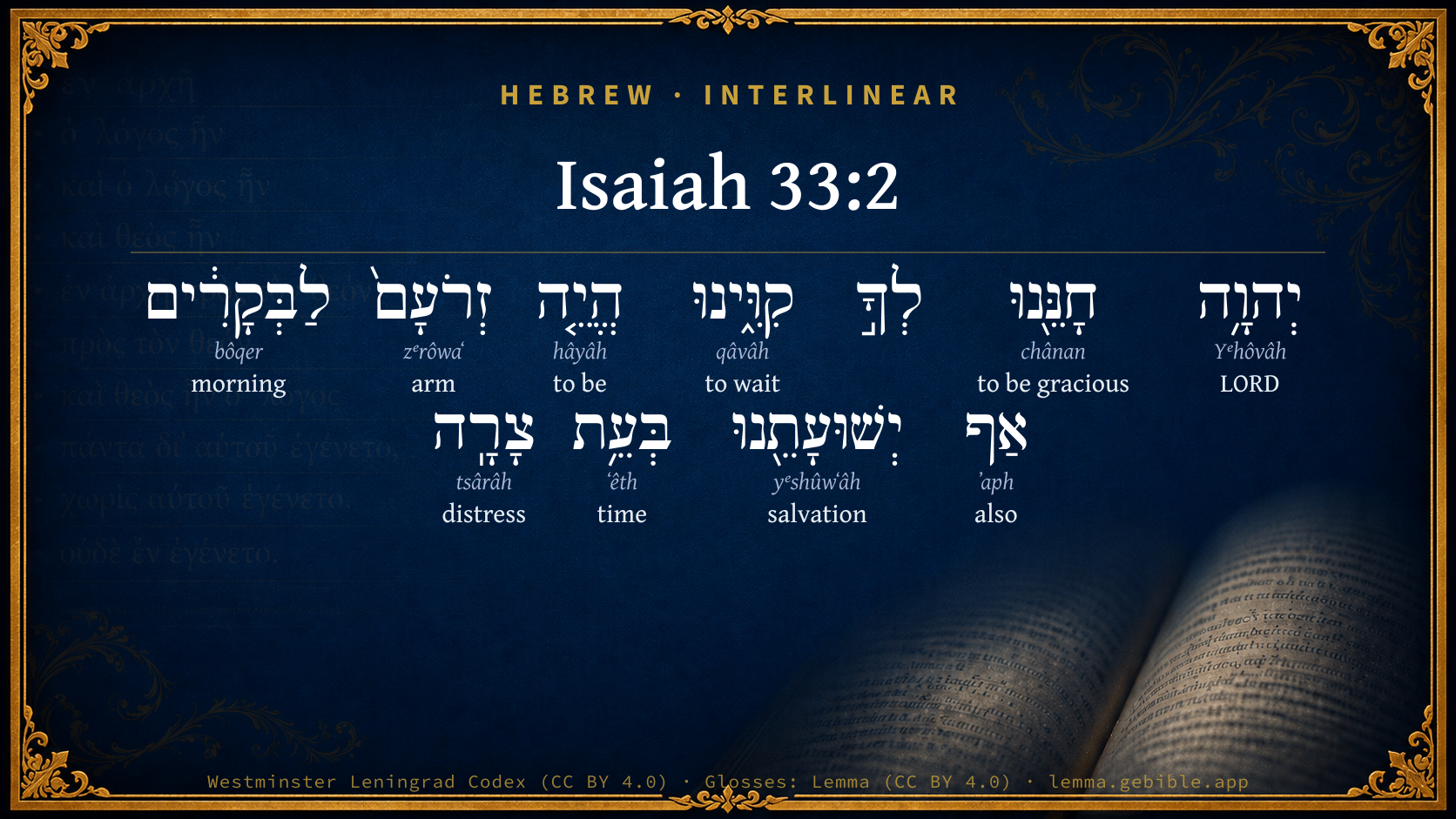
Hebrew (Westminster Leningrad Codex) Isaiah 33:2 appears in the Hebrew Old Testament. The text above is from the Westminster Leningrad Codex. Each word links to its Strong’s number, a concise gloss, and parsing drawn from the Open Scriptures Hebrew Bible morphology. Click any word for its full Brown-Driver-Briggs (BDB) entry.
Download image
Cite this verse

Isaiah 33:2 (World English Bible). Public Domain. Lemma interlinear Bible study tool, https://lemma.gebible.app/v/isaiah/33/2.

Show BibTeX & RIS
BibTeX
RIS
English Translation
Yahweh, be gracious to us; we have waited for you: be our arm every morning, our salvation also in the time of trouble.
World English Bible · Public Domain
Download a study sheet

One document with this verse’s original text, its word-by-word gloss line, the meaning frame, cross-references with their text, attributed commentary, and full source and license credits — printable, and it pastes into notes with its structure intact.

This verse Autodidact and up

Study sheet (.html) Plain text (.txt)

A passage Seminary Student

Up to 50 verses in one chapter. A passage sheet keeps up to 6 commentary sources and 12 cross-references per verse, in the order this page ranks them, and says so on the sheet whenever that leaves anything out. Ask for a single verse and you get the Autodidact verse sheet above.

Everything on this page stays free to read, with no account — the sheet is a download of what is already on screen, not access to it.

Want to remove ads? Support Godless Engineer
Compare translations 3

The same verse in 3 English versions, stacked beneath the original-language interlinear above. Click any original word for its lexicon entry.

Each is an independent rendering of the whole verse — the interlinear is not word-aligned to these translations.

Highlighted words mark where these versions differ — a whole-verse word diff, not a word-by-word alignment.

  • World English Bible Public Domain
    Yahweh, be gracious to us; we have waited for you: be our arm every morning, our salvation also in the time of trouble.
  • King James Version Public Domain
    O LORD, be gracious unto us; we have waited for thee: be thou their arm every morning, our salvation also in the time of trouble.
  • unfoldingWord Literal Text CC BY-SA 4.0
    Yahweh, favor us; we wait for you. Be their arm in the mornings, also our salvation in the time of trouble.

unfoldingWord Literal Text — © unfoldingWord, licensed CC BY-SA 4.0. Word-aligned USFM3 via Door43 (git.door43.org/unfoldingWord/en_ult).

Versions to compare (up to 4)

3 of 4 selected

Show all 18 translations

Every available English version of this verse, each an independent rendering of the whole verse.

  • World English Bible Public Domain
    Yahweh, be gracious to us; we have waited for you: be our arm every morning, our salvation also in the time of trouble.
  • Berean Standard Bible Public Domain
    O LORD, be gracious to us! We wait for You. Be our strength every morning and our salvation in time of trouble.
  • Majority Standard Bible Public Domain
    O LORD, be gracious to us! We wait for You. Be our strength every morning and our salvation in time of trouble.
  • King James Version Public Domain
    O LORD, be gracious unto us; we have waited for thee: be thou their arm every morning, our salvation also in the time of trouble.
  • American Standard Version (1901) Public Domain
    O Jehovah, be gracious unto us; we have waited for thee: be thou our arm every morning, our salvation also in the time of trouble.
  • Revised Version (1885) Public Domain
    O LORD, be gracious unto us; we have waited for thee: be thou their arm every morning, our salvation also in the time of trouble.
  • Geneva Bible (1599) Public Domain
    O Lord, haue mercie vpon vs, wee haue waited for thee: be thou, which waste their arme in the morning, our helpe also in time of trouble.
  • Douay-Rheims (1899) Public Domain
    O Lord, have mercy on us: for we have waited for thee: be thou our arm in the morning, and our salvation in the time of trouble.
  • Young's Literal Translation Public Domain
    O Jehovah, favour us, for thee we have waited, Be their arm, in the mornings, Yea, our salvation in time of adversity.
  • Literal Standard Version CC BY-SA 4.0
    O YHWH, favor us, || We have waited for You, || Be their arm, in the mornings, || Indeed, our salvation in time of adversity.
  • Unlocked Literal Bible CC BY-SA 4.0
    Yahweh, be gracious to us; we wait for you; be our arm every morning, our salvation in the time of trouble.
  • unfoldingWord Literal Text CC BY-SA 4.0
    Yahweh, favor us; we wait for you. Be their arm in the mornings, also our salvation in the time of trouble.
  • Darby Bible Public Domain
    Jehovah, be gracious unto us; we have waited for thee: be their arm every morning, yea, our salvation in the time of trouble.
  • World Messianic Bible Public Domain
    LORD, be gracious to us. We have waited for you. Be our strength every morning, our salvation also in the time of trouble.
  • Webster's Bible Public Domain
    O LORD, be gracious to us; we have waited for thee: be thou their arm every morning, our salvation also in the time of trouble.
  • Free Bible Version CC BY-SA 4.0
    Lord, please be kind to us; we put our confidence in you. Be the strength we rely on every morning; be our salvation in times of trouble.
  • Bible in Basic English Public Domain
    O Lord, have mercy on us; for we have been waiting for your help: be our strength every morning, our salvation in time of trouble.
  • JPS Tanakh (1917) Public Domain
    O LORD, be gracious unto us; we have waited for Thee; be Thou their arm every morning, our salvation also in the time of trouble.

Literal Standard Version (2020), Covenant Press — licensed CC BY-SA 4.0. Text via the HelloAO Bible API (eBible.org). Unlocked Literal Bible (unfoldingWord) — licensed CC BY-SA 4.0. Text via the HelloAO Bible API (eBible.org). unfoldingWord Literal Text — © unfoldingWord, licensed CC BY-SA 4.0. Word-aligned USFM3 via Door43 (git.door43.org/unfoldingWord/en_ult). Free Bible Version, Dr. Jonathan Gallagher — licensed CC BY-SA 4.0. Text via the HelloAO Bible API (eBible.org).

Word by word

More ways to search: Search by grammar → Find every occurrence → Compare this word →

Practice this passage: Drill this verse → Learn its vocabulary →

קִוִּ֑ינוּ
qâvâh
H6960
“to wait”
Verb, Piel, Perfect, 1st Person, Common, Plural
Part of Speech
Verb
Stem
Piel
Form
Perfect
Person
1st Person
Gender
Common
Number
Plural
Full BDB Definition

Origin: a primitive root

TWOT: 1994 , 1995

to wait, look for, hope, expect - (Qal) waiting (participle) - (Piel) - to wait or look eagerly for - to lie in wait for - to wait for, linger for - to collect, bind together - (Niphal) to be collected
  1. יְהוָ֥ה Yᵉhôvâh H3068 “LORD” Noun, Proper
  2. חָנֵּ֖נוּ chânan H2603 “be gracious · us” Verb, Qal, Imperative, 2nd Person, Masculine, Singular + Suffix, Personal, 1st Person, Common, Plural
  3. הֱיֵ֤ה hâyâh H1961 “be” Verb, Qal, Imperative, 2nd Person, Masculine, Singular
  4. זְרֹעָם֙ zᵉrôwaʻ H2220 “arm · their” Noun, Common, Both, Singular, Construct + Suffix, Personal, 3rd Person, Masculine, Plural
  5. לַבְּקָרִ֔ים bôqer H1242 “to/for the · mornings” Preposition, Determined + Noun, Common, Masculine, Plural, Absolute
  6. אַף ʼaph H637 “also” Particle, Accusative
  7. יְשׁוּעָתֵ֖נוּ yᵉshûwʻâh H3444 “salvation · our” Noun, Common, Feminine, Singular, Construct + Suffix, Personal, 1st Person, Common, Plural
  8. בְּעֵ֥ת ʻêth H6256 “in/at · time of” Preposition + Noun, Common, Both, Singular, Construct
  9. צָרָֽה tsârâh H6869 “distress” Noun, Common, Feminine, Singular, Absolute

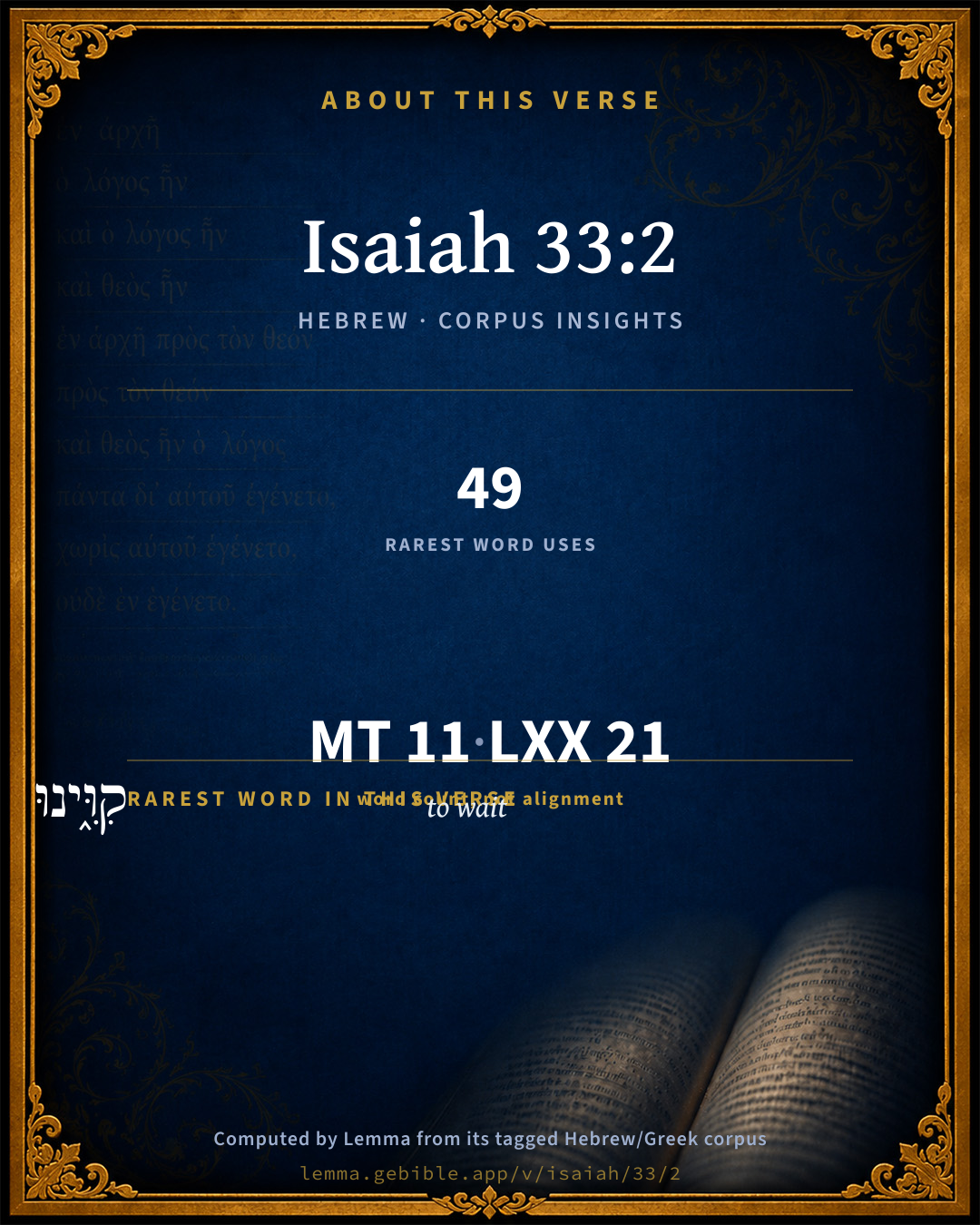
About this verse

These counts appear in no published source. They are computed here, from the morphology-tagged text and Lemma’s own curated glosses. What Lemma adds →

11
words
10
distinct lemmas
Prophets
section

Shared distinctive vocabulary

קִוִּ֑ינוּ to wait H6960 occurs in 45 verses of the Hebrew Bible. Also found in:

Grammatical profile

  • 3 verbs
  • 6 nouns
  • 1 preposition
  • 1 particle

Verb forms

  • חָנֵּ֖נוּ Qal · Imperative
  • קִוִּ֑ינוּ Piel · Perfect
  • הֱיֵ֤ה Qal · Imperative

Hebrew & Septuagint length

In English translation the verse runs 23 words from the Hebrew and 29 from the Septuagint (LXX English) — closely comparable.

A rough comparison of the two English renderings, which tokenize alike — not a word-level alignment.

Word counts can differ between the Hebrew and the Greek without any difference in meaning — e.g. the Hebrew direct-object marker אֵת has no separate Greek word, and Greek often adds the article ὁ.

In the original languages it is 11 Hebrew tokens and 21 Greek tokens — but the two are counted differently (Hebrew bundles its prefixes and suffixes into one token; the Greek is in lemma form), so that isn’t a like-for-like length.

Cross-references

29

Topical passages linked to Isaiah 33:2 in the Treasury of Scripture Knowledge — connected by theme and wording, ordered by reader-vote popularity; previews shown in the World English Bible.

  • 2 Corinthians 1:3–4 Blessed be the God and Father of our Lord Jesus Christ, the Father of mercies and God of all comfort;
  • Isaiah 30:18–19 Therefore will Yahweh wait, that he may be gracious to you; and therefore will he be exalted, that he may have mercy on you: for Yahweh is a God of justice; blessed are all those who wait for him.
  • Isaiah 59:16 He saw that there was no man, and wondered that there was no intercessor: therefore his own arm brought salvation to him; and his righteousness, it upheld him.
  • Psalms 60:11 Give us help against the adversary, For the help of man is vain.
  • Psalms 62:8 Trust in him at all times, you people. Pour out your heart before him. God is a refuge for us. Selah.
  • Exodus 14:27 Moses stretched out his hand over the sea, and the sea returned to its strength when the morning appeared; and the Egyptians fled against it. Yahweh overthrew the Egyptians in the midst of the sea.
  • Psalms 46:1 God is our refuge and strength, A very present help in trouble.
  • Psalms 62:1 My soul rests in God alone. My salvation is from him.
  • Psalms 130:4–8 But there is forgiveness with you, Therefore you are feared.
  • Isaiah 25:9 It shall be said in that day, Behold, this is our God; we have waited for him, and he will save us: this is Yahweh; we have waited for him, we will be glad and rejoice in his salvation.
  • Lamentations 3:25–26 Yahweh is good to those who wait for him, to the soul that seeks him.
  • Psalms 25:3 Yes, no one who waits for you shall be shamed. They shall be shamed who deal treacherously without cause.
  • Psalms 27:13–14 I am still confident of this: I will see the goodness of Yahweh in the land of the living.
  • Psalms 37:39 But the salvation of the righteous is from Yahweh. He is their stronghold in the time of trouble.
  • Psalms 46:5 God is in her midst. She shall not be moved. God will help her at dawn.
  • Psalms 50:15 Call on me in the day of trouble. I will deliver you, and you will honor me."
  • Psalms 62:5 My soul, wait in silence for God alone, For my expectation is from him.
  • Psalms 90:15 Make us glad for as many days as you have afflicted us, For as many years as we have seen evil.
  • Psalms 91:15 He will call on me, and I will answer him. I will be with him in trouble. I will deliver him, and honor him.
  • Psalms 123:2 Behold, as the eyes of servants look to the hand of their master, As the eyes of a maid to the hand of her mistress; So our eyes look to Yahweh, our God, Until he has mercy on us.
  • Isaiah 25:4 For you have been a stronghold to the poor, a stronghold to the needy in his distress, a refuge from the storm, a shade from the heat, when the blast of the awesome ones is as a storm against the wall.
  • Isaiah 26:8 Yes, in the way of your judgments, Yahweh, have we waited for you; to your name, even to your memorial [name], is the desire of our soul.
  • Isaiah 26:16 Yahweh, in trouble have they visited you; they poured out a prayer [when] your chastening was on them.
  • Isaiah 40:10 Behold, the Lord Yahweh will come as a mighty one, and his arm will rule for him: Behold, his reward is with him, and his recompense before him.
  • Jeremiah 2:27–28 who tell a stock, You are my father; and to a stone, You have brought me forth: for they have turned their back to me, and not their face; but in the time of their trouble they will say, Arise, and save us.
  • Jeremiah 14:8 You hope of Israel, the Savior of it in the time of trouble, why should you be as a foreigner in the land, and as a wayfaring man who turns aside to stay for a night?
  • Lamentations 3:23 They are new every morning; great is your faithfulness.
  • Hosea 14:2 Take words with you, and return to Yahweh. Tell him, "Forgive all our sins, And accept that which is good: So we offer like bulls our lips.
  • Psalms 143:8 Cause me to hear your loving kindness in the morning, For I trust in you. Cause me to know the way in which I should walk, For I lift up my soul to you.

Cross-references courtesy of OpenBible.info (CC BY 4.0).

Hebrew and Greek witnesses Masoretic Hebrew ↔ Greek Septuagint

The same verse in the two great witnesses to the Old Testament, shown verse-for-verse.

These are two independent witnesses, not word-aligned to each other, and the Septuagint is shown in lemma (dictionary) form.

Hebrew Isaiah 33:2 Masoretic · Westminster Leningrad Codex

יְהוָ֥ה חָנֵּ֖נוּ לְךָ֣ קִוִּ֑ינוּ הֱיֵ֤ה זְרֹעָם֙ לַבְּקָרִ֔ים אַף יְשׁוּעָתֵ֖נוּ בְּעֵ֥ת צָרָֽה

Yahweh, be gracious to us; we have waited for you: be our arm every morning, our salvation also in the time of trouble.

World English Bible · Public Domain

Greek LXX Isaiah 33:2 Septuagint · lemma form

κύριος ἐλεέω ἐγώ ἐπί σύ γάρ πείθω γίγνομαι ὁ σπέρμα ὁ ἀπειθέω εἰς ἀπώλεια ὁ δέ σωτηρία ἐγώ ἐν καιρός θλῖψις

Lord, have mercy upon us; for we have trusted in you: the seed of the rebellious is gone to destruction, but our deliverance was in a time of affliction.

LXX2012 (modern English Septuagint) · Public Domain

Hebrew: Westminster Leningrad Codex (CC BY 4.0). Greek: Septuagint (public domain); English from LXX2012 (modern English Septuagint) (Public Domain). How the Septuagint differs from the Hebrew →

Targum (Aramaic paraphrase)

1

The Targum is the ancient Jewish Aramaic paraphrase of the Hebrew Scriptures — an interpretive translation, not the Hebrew text itself. Onkelos (literal) and Pseudo-Jonathan (expansive) render the Torah, and Jonathan the Prophets. Coverage is partial: where no permissively-licensed English translation exists for a verse, only the Aramaic is shown. This is verse-level text, not a word-by-word alignment to the Hebrew.

  1. Targum Jonathan Prophets (Joshua–Malachi)
    יְיָ רְחִים עִלָנָא לְמֵימְרָךְ סַבַּרְנָא הֱוֵי תוּקְפָנָא בְּכָל יוֹם אַף פּוּרְקָנָנָא בְּעִידַן עָקָא:

    O Lord, be merciful unto us; we have hoped for Thy WORD: be Thou our strength every day, our salvation also in the time of distress.

    Targum Jonathan — Aramaic: “Mikraot Gedolot” (public domain). English: “Sefaria Community Translation” (CC0 1.0 (public-domain dedication)); “London "Chaldee Paraphrase," 1871” (public domain). Text via Sefaria.

Commentary

Notes on Isaiah 33:2 from classic Christian and Jewish commentators (each source and its license shown beneath its notes). The classic Christian expositions comment on the surrounding passage and are grouped to its opening verse, so a note may address several verses; the Jewish commentaries on the Tanakh (Rashi and others) are per-verse, so they appear only where the commentator wrote on this verse.

Lemma curates 59 commentaries, every one of them public domain or Creative Commons licensed, each selected and text-cleaned for this edition rather than reprinted as found. About our sources →

Trapp's Complete Commentary

John Trapp

Isa 33:2 O LORD, be gracious unto us; we have waited for thee: be thou their arm every morning, our salvation also in the time of trouble.

Ver. 2. O Lord, be gracious unto us.] Brevicula sed pulchra precatio, a short but sweet prayer of the prophet, teaching thereby the people to put the promise in suit, and to do it effectually, using a thong of strong arguments, as here is much in few.

Be thou their arm.] Here the Church seemeth to pray for her children, as they before had prayed for her. Plena eat affectibus haec precatio.

Every morning.] Heb., In the mornings - that is, speedily, seasonably, continually, and for Christ’s sake, Voce enim "matutinis" allusum adiuge sacrificium {a} {Exo 29:39-41}

{a} Scultet., Piscat.

John Trapp, A Commentary or Exposition upon All the Books of the Old and New Testament (1647–1656) — public domain. Text from a community e-Sword module.

The Biblical Illustrator

Joseph S. Exell

Isa_33:2

O Lord, be gracious unto us

An appropriate prayer

They pray--

1.

For those that were employed in military services for them. Be Thou their arm every morning. In our spiritual warfare our own hands are not sufficient for us, nor can we bring anything to pass unless God not only strengthen our arms (Gen_49:24), but be Himself our arm. If God leave us to ourselves any morning we are undone; we must, therefore, every morning commit ourselves to Him, and go forth in His strength to do the work of the day in its day.

2. For the body of the people. Be Thou our salvation, &c.,--ours that sit still, and do not venture into the high places of the field. (M. Henry.)

The Biblical Illustrator, edited by Joseph S. Exell (c. 1880s–1900s) — public domain. Text from a community e-Sword module.

Joseph Benson's Commentary

Isa 33:2. O Lord, be gracious unto us — The prophet and the pious Jews, contemplating the calamity coming upon their country, here direct their prayer unto God for themselves and their people. Be thou their arm — That is, their strength, namely, the strength of all that trust in thee, and wait for thee, Psa 25:3; every morning — Hebrew, לבקרים, in the mornings; that is, every day seasonably and speedily; on all occasions as they need. In mentioning the mornings, the prophet is thought to refer to the time of the morning sacrifice, which was the morning hour of prayer with the pious Jews; but he includes all other times of prayer, in all which he desires God to hear and answer his people, and to be their salvation all the day long, and especially to support them in the time of trouble.

Joseph Benson's Commentary on the Old and New Testaments (1811–1818) — public domain. Text from a community e-Sword module.

The Preacher's Complete Homiletical Commentary

Joseph S. Exell (gen. ed.)

THE SAINT’S ATTITUDE IN THE TIME OF TROUBLE

Isa_33:2. O Lord, be gracious unto us; we have waited for Thee: be Thou their arm every morning, our salvation also in the time of trouble.

Like its predecessor, this prophecy belongs to the time of distress and fear incident on the threatened Assyrian invasion. Dependence on Egypt had failed. So had Hezekiah’s present to the invader. He had accepted the present, but had still pressed on. The south of Judah was covered with his soldiers. Isaiah lifts up this prayer for his country. An example to Christians to interest themselves in the politics of their country, and to include them in their prayers. We have never known the terrible presence of an invader; but there is always occasion for appeal to the divine Governor and Helper. It is no mark of spirituality of mind to exclude national affairs from thought, as belonging to a sphere that has nothing to do with God or with prayer.

The prophet’s eye saw, in the immediate future, the frustration of the invader’s plans. The God of Israel would interpose. The invasion was unjust; the negotiations had been conducted deceitfully by the enemy; ruin would fall on his head (Isa_33:1). But the certainty of deliverance was no reason for the relaxation of effort, or for abstinence from prayer. God’s promise is the encouragement and directory of prayer. Therefore he cries, “O Lord, be gracious unto us,” &c.

The prayer of the text is applicable to any time of trouble in the personal experience of any Christian. It is a time that may come to any one. It should enter into our calculations about the future, however exempt from it at present. It should be prepared for, as for old age, or death. We never know when it bangs over us, nor in what form. To all it comes occasionally; to some frequently; to some constantly; to some severely. Often from quarters whence least expected. Things and persons most precious to us are sometimes the occasion of bitterest grief. The common lot. We can only really prepare for it by the possession of resources which it cannot diminish. This is one of the points at which Christians have so largely the advantage over others. God is always with them, and always accessible.

Our text represents the saint’s attitude in “the time of trouble.” He cries to God and waits on God. He cries as he waits, and waits as he cries.

I. HE CRIES TO GOD.

How precious to have a friend so interested in you that anything you say about your trouble will find an interested listener. It is a relief to speak to such a friend. Many of God’s people find this relief every day. Many a trouble can be told to none but Him who keeps every secret and sympathises with every distress (P. D. 462, 463).

What do we need in the time of trouble? It is all in this prayer: GOD HIMSELF. Each petition resolves itself into something that God is, and is to us.

1. His Graciousness. The root of everything must be the divine disposition. He might be malevolent, unpitying, unmerciful. There might be a cause of separation sufficient to prevent any favourable access to Him. In the case of multitudes there is such a cause. Many live without God, ignore Him, disregard His authority, yet in the time of trouble imagine they may fly to Him, in the face of His word, which says until sin is abandoned there can be no friendship with Him. He has provided a gracious way of reconciliation. The first step we must take is the coming to Him through the Saviour for the mercy that obliterates all past transgressions. In many cases the time of trouble is sent as the means of leading us to the Saviour. To be assured of His gracious disposition while He permits the trouble, goes far towards the comfort of the troubled heart. He loves you although you are under discipline. The sun shines in full splendour although it is hidden behind a cloud. We may wait patiently for the trouble to pass away, so long as we can confidently ask the Lord to be gracious unto us.

2. His Strength. “Be Thou their arm every morning.” The time of trouble reveals our weakness. Mental energy, courage, bodily power often succumb under the pressure of heavy trouble. We realise the value of a strength beyond our own. It is better to pass through “the time of trouble” with God for our arm every morning, than to be exempt from trouble and left without Him. Paul groaned under the pain of his thorn in the flesh and besought the Lord thrice to take it away. But Christ’s assurance, “My grace is sufficient for thee, for my strength is made perfect in weakness,” together with his experience of its sufficiency, made him glory in his infirmity. We need the arm of God for defence against the enemy; to lean upon when ready to faint; to strengthen us for the work that may be necessary to our extrication from trouble.

3. His Salvation. From some troubles salvation cannot be in the shape of restoration of the previously existing state of things. The young man loses his precious wife and child; and in their grave it seems that every interest for him is buried. They cannot be restored. But God’s salvation can come to him in the form of a richer spiritual experience, a deeper acquaintance with His word and way, a completer consecration to His service, and a larger inflowing of divine consolation than he could have known without it. But there are some troubles from which salvation comes by their cessation: sicknesses, and business reverses. They are severe while they continue. But deliverance comes. In some cases greater prosperity is realised than formerly, to which, in God’s wonder-working Providence, the trouble was necessary. Joseph in Egypt Job. The trouble may have been severe temptation. If saved, you are the stronger for it. Cry to God in trouble. Let it be the time of special prayer.

II. HE WAITS ON GOD.

“We have waited for Thee.” This ever accompanies true prayer. The believer looks for the blessing he has asked. It implies,

1. Faith. That God hears. Faith has a very close relation to prayer.

2. Expectation. There may be degrees of confidence, but there must be more or less of expectancy. The sailor’s mother watches at the window for the ship in which her son is coming.

3. Patience. Wait God’s time. Until His end is accomplished. Thus let the Church wait for the coming of Christ, which will be full salvation.

May we know by experience the blessedness of knowing God in time of trouble! Blessed is the people that is in such a case. Come and enjoy this blessedness. Decide for the Lord Jesus Christ. The world is insufficient. Renounce it.—J. Rawlinson.

The Preacher's Complete Homiletical Commentary (gen. ed. Joseph S. Exell; Funk & Wagnalls, c. 1892) — public domain (pre-1929). A full-Bible homiletical/sermon-outline anthology covering 65 of 66 books (2 John is absent from the source module). Text from a community e-Sword module.

Keil & Delitzsch

C. F. Keil & F. Delitzsch

In Isa 33:2 the prophet's word of command is changed into a believing prayer: "Jehovah, be gracious to us; we wait for Thee: be their arm with every morning, yea, our salvation in time of need!" "Their arm," i.e., the power which shelters and defends them, viz., Thy people and my own. "Yea," 'aph, is emphatic. Israel's arm every morning, because the danger is renewed every day; Israel's salvation, i.e., complete deliverance (Isa 25:9), because the culminating point of the trouble is still in prospect.

Keil & Delitzsch — Biblical Commentary on the Old Testament (1861–1891) — public domain (CC PDM 1.0). Text via the HelloAO Bible API. (Old Testament only.)

Lange's Commentary on the Holy Scriptures

2. THE PRAYER OF FAITH QUICKLY HEARD

Isa_33:2-6

2          O Lord, be gracious unto us; 1 we have waited for thee:

Be thou their arm every morning,

Our salvation also in the time of trouble.

3     At the noise of the tumult the people 2 fled;

At the lifting up of thyself the nations 3 were scattered.

4     And your spoil shall be gathered like the gathering of the caterpillar;

As the running to and fro of the locusts shall he run upon them.

5     The Lord is exalted; for he dwelleth on high:

He 4 hath filled Zion with judgment and righteousness.

6     And wisdom and knowledge shall be the stability of the times,

And strength of 5Salvation:

The fear of the Lord is his 6 treasure.

TEXTUAL AND GRAMMATICAL

Isa_33:2. הננו comp. Psa_123:3; Psa_57:2; Psa_51:3, etc.—קִוָּה often in the Pss., mostly with the Accusat. With ל referring to God it occurs only Psa_119:95, compare Psa_69:21. But Isaiah often construes the word thus: Isa_8:17; Isa_25:9; Isa_60:9.

Isa_33:3. נָֽפְצוּ is from נָפַץ (Niph. of פָּצַץ) inflected like the Kal. נפץ, perhaps because פצץ does not occur except in this and in two analogous Niphal forms (Gen_9:19; 1Sa_13:11).

Isa_33:4. אֹסֶף may not be taken passively (with Cappellus, Doederlein, Drechsler, etc.), as appears from the image itself, and from גבים (ἅπ. λεγ. comp. גּוֹב Nah_3:17; גּבַֹי Amo_7:1, certainly a name of the locust, although of uncertain derivation and meaning. Comp. Herz. R. Enc„ VI. p. 70). This latter word is expressly active.—On אֻסַּף אֹסֶף comp. Isa_24:22. אֹסֶף is here as Isa_32:10 a noun (Mic_7:1). As to construction, it is to be regarded as in the acc. modalis.—חסיל only here in Isaiah; see Joe_1:4; Joe_2:25.שׁקק (Isa_29:8) used in the same sense Joe_2:9.—מַשָּׁק , “descursitatio” ἅπ. λεγ.—בּוֹ refers to the camp, not before named, yet ideally present.

Isa_33:5. נשׂגב, Isa_2:11; Isa_2:17; Isa_12:4.—שׁכן מרום again only Isa_57:16; comp. Isa_33:16.—מִלֵּא Piel, again Isa_23:2; Isa_65:11; Isa_65:20.

Isa_33:6. The Plural עתים occurs principally in later books; still also Job_24:1. Only here in Isa.: comp. Psa_31:16.—אמונת עתיך is predicate, the following substantives to דעת are subject.—חֹסֶן “opes, thesaurus” only here in Isaiah comp. Pro_15:6; Pro_27:24;

Jer_20:5; Eze_22:25.—יְשׁוּעֹת Isa_26:18, elsewhere only in the Pss. 18:51; 28:8; 42:6, 12; 43:5, etc.—The suffix in אוצרו relates to the same subject as the suffix in עתיך Interchange of person often occurs in Isaiah, but it is not always so easily traced to its motive as in Isa_33:2. See below in Exeget. and Crit.

EXEGETICAL AND CRITICAL

1. The first wave-circle! In grand, rapid flight the Prophet’s gaze hastens through three stages: he shows what must precede the overthrow of Assyria, then this itself, then its contrast in the remote future. For having by a prayer intimated that believing trust in Jehovah is the condition of salvation (Isa_33:2), he describes the immediately consequent overthrow of Assyria (Isa_33:3-4). But on this present earthly salvation follows for the Prophet at once the Messianic future with its blessings, of which the deliverance from Assyria is a type.

2. O Lord—His treasure.

Isa_33:2-6. This short prayer, that unexpectedly interrupts the prophecy, is assuredly not an involuntary sigh, but it occupies a place in the discourse chosen with deliberation. The Prophet intends two things by it. First he would present to the people what they must do on their part to obtain deliverance. They must believe and confide in the Lord, according to the words “if ye will not believe, surely ye shall not be established” (Isa_7:9), and “he that believes will not yield” (Isa_28:16). But as the Prophet gives, not a warning to pray merely, but an example of it, and himself intercedes, he gives on the one hand an example to men, and on the other hand a proof to God that there are still righteous men in Israel (comp. Gen_18:24 sqq.) that love the people and trust in God. A people from which issues such prayer is no dead heap of ashes. There is a glow in them that can be kindled up again (Isa_42:3). The prayer has the form of those in the Pss. (comp. 12).

The (suffix of the) third person in זרעם “their arm,” that occurs in such harsh dissonance with (the suffixes of) the first person preceding and following, is to be explained, it seems to me, by the word זְרֹעַ “arm” itself. The Prophet means here those called to protect city and state with the power of their arm. He and many others do what they can with heart, and head and otherwise. But when it concerns defence against an outward enemy, then those that serve with the arm are very important. Therefore the prayer that the Lord Himself might be the arm of those who have devoted their arm to the country. Comp. Psa_83:9; Psa_89:11; Psa_89:22, etc.לבקרים comp. Psa_73:14; Psa_101:8. אַף comp. Isa_26:9; Psa_16:6; Psa_18:49, etc. Also ישׁועה is very frequent in the Psa_68:20; Psa_35:3; Psa_62:2, etc.בעת צרה, see Psa_37:39; comp. Psa_20:2; Psa_50:15.

In Isa_33:3-4 is announced the hearing of the prayer. In very drastic form, but, with all its brevity, still vivid, the flight of the Assyrian and the plundering of their camp are depicted. The enemy hear a loud tumult like the onset of an army. But it is no human army: for, as appears from מרממתך and from Isa_29:6; Isa_30:30 sq., the Lord effects that noise. He brings about a panic among them by letting them hear a tumult that has no actual existence (comp. Psa_53:6; Exo_14:24 sq.; Exo_15:16; Jdg_4:15; Jdg_7:22; 1Sa_7:10). The fleeing nations are of course those of Assyria. The Lord arises (comp. Isa_33:10; Isa_30:18; Ps. 21:14; 46:11, etc.), to smite the enemy, The expression is anthropomorphic, he, so to speak, raises himself high aloft. In Isa_33:4 the Prophet addresses the Assyrian. He sees the Israelites plundering his camp, gathering the spoil with a celerity like locusts clearing off a field. Seeing in this coming victory a type of the final, crowning triumph of Jehovah over the world-power, he contemplates his glory in Isa_33:5, chiefly from its inner side. He would intimate that the treasures of salvation, that Israel will then acquire, will, because of a spiritual sort, be more glorious than the goods found in the Assyrian camp (comp. Isa_33:23; Isa_37:36, comp. 2Ki_7:16). On account of this typical relation, the two periods are treated as a connected whole, without regard to their temporal disconnection. In this the Prophet does not contradict what he had said Isa_32:15 of the continuance of the desolation till the initiation of the great regeneration of the last time. For that period of the desolation falls precisely in the period that the Prophet over-leaps from the stand-point of his manner of regarding the matter. He thus sees the Lord elevated on high and withdrawn from every hostile attack because enthroned on high. From this height the Lord fills Zion with right and righteousness, which plainly recalls Isa_32:15-16. Likewise Isa_33:6 recalls Isa_32:17; the very beginning with והוה coincides. But “the stability of thy times” corresponds to what in Isa_32:17 sq., is called “peace, assurance, sure dwelling, quiet resting place.” Thus we must give אמונה here the meaning “security,” a condition that guarantees peace, tranquility, confidence (Isa_33:16). When the times are such that there is no disturbance of the public welfare apprehended, then they have the quality of אמונה, then one may speak of an אמונת עתים. But of course אמונה occurs only here in this sense (comp. נֶאֶֽמָן Isa_33:16). As in Isa_32:16 the security appears as the fruit of moral in workings, so here also. Fulness of salvations, wisdom and knowledge shall be the stability,etc. As in the familiar declaration l’empire c’est la paix the copula has a tropical sense, so here there is the trope of the metonymy, since two things that actually stand related as cause and effect are, apparently, identified in expression. Thus the security of those times is the effect of the treasure, the wealth in treasures of salvation. It will not rest on subjective human possessions, as the women at ease (Isa_32:9) suppose, but upon objective, God-given treasures of salvation. The kind is declared in what follows, viz.: inward, spiritual goods: wisdom and knowledge (on these notions comp. Isa_11:2). “The fear of the Lord” is named last, although it is the beginning of wisdom (Pro_1:7). But it seems to me the Prophet would distinguish between אוֹצָר and חֹסֶן. The fear of the Lord is the treasure-house (אוצר as e.g.Joe_1:17; 2Ch_11:11, etc., = בֵּית הָאוֹצָרJer_50:25, etc.), that hides that treasure in itself. Our passage recalls Isa_11:2 in many ways: also in this that, rightly counted, seven spiritual goods are named: 1) judgment, 2) righteousness, 3) security, 4) riches of salvations, 5) Wisdom , 6) knowledge, 7) the fear of the Lord.

Footnotes:

[1]we wait.

[2]flee.

[3]are.

[4]fills.

[5]Heb. Salvations.

[6]treasure-house.

Lange's Commentary on the Holy Scriptures (Critical, Doctrinal, and Homiletical), ed. John Peter Lange, English translation edited by Philip Schaff (1864–1880) — public domain. Text from a community e-Sword module.

Tyndale Open Study Notes

Tyndale Open Resources

33:2 The godly community prayed for God to be merciful in response to the promise of 30:18.

Tyndale Open Study Notes — © Tyndale Open Resources, licensed CC BY-SA 4.0. Text via the HelloAO Bible API.

Geneva Bible (1599)

Geneva Bible translators

Which helped our fathers so soon as they called upon thee.

He declareth hereby what is the chief refuge of the faithful, when troubles come, to pray, and seek help of God.

Geneva Bible (1599) marginal notes — public domain. Text via Bolls.life.

Jamieson, Fausset & Brown

Robert Jamieson, A. R. Fausset & David Brown

us; we . . . their . . . our--He speaks interceding for His people, separating himself in thought for a moment from them, and immediately returns to his natural identification with them in the word "our."

every morning--each day as it dawns, especially during our danger, as the parallel "time of trouble" shows.

Jamieson, Fausset & Brown — Commentary Critical and Explanatory on the Whole Bible (1871) — public domain (CC PDM 1.0). Text via the HelloAO Bible API.

Adam Clarke's Commentary

Verse 2. Be thou their arm every morning - "Be thou our strength every morning"] For זרעם zeroam, their arm, the Syriac, Chaldee, and Vulgate read זרענו zeroenu, our arm, in the first person of the pronoun, not the third: the edition of Felix Pratensis has זרעתינו zerootheynu in the margin.

The prophet is here praying against the enemies of God's people; and yet this part of the prayer seems to be in their behalf: but from the above authorities it appears that OUR arm is the true reading, though I do not find it confirmed by any of Kennicott's, De Rossi's, or my own MSS. My old MS. Bible has, - Be thou oure arm in erly.

Adam Clarke's Commentary on the Bible (1810–1826) — public domain. Text from a community e-Sword/MySword module.

Ellicott's Commentary for English Readers

(2) O Lord, be gracious . . .—Faith transforms itself into prayer. The prophet will still “wait” upon God. In the change of person, “their arm,” “our salvation,” we hear the very words of the prayer as it was spoken, the first referring to the soldiers who were to fight the battles of their country, the second to the non-combatants who were assembled with Isaiah in supplication.

A Bible Commentary for English Readers, edited by Charles John Ellicott (1878–1897) — public domain. Text from a community e-Sword module.

The Cambridge Bible for Schools and Colleges

gen. ed. J. J. S. Perowne

2. The nation’s prayer to Jehovah. The writer seems to make himself the spokesman of the community, a thing which Isaiah rarely does (see Isa_32:15); nowhere, as here, in a prayer. Cheyne, however, suggests that he speaks in the name of his own disciples, for whose sake he prays that the whole nation may be spared.

be thou their arm] i.e. their strength and defence (Jer_17:5). The force of the pronoun “their” is uncertain; some change it (needlessly perhaps) to “our.” On the phrase “every morning,” cf. ch. Isa_28:19.

The Cambridge Bible for Schools and Colleges (gen. ed. J. J. S. Perowne; Cambridge University Press, 1878–1918) — public domain. Text from a community e-Sword module.

John Gill's Exposition

O Lord, be gracious unto us,.... This is a prayer of the church under the persecutions of antichrist, imploring the grace and favour of God in their miserable and distressed circumstances; desiring his gracious help, assistance, and deliverance; pleading not any merits of their own, but casting themselves upon the mercy and kindness of God:

we have waited for thee; time after time, year after year, in the use of means; hoping for the manifestations of thyself, and kind appearance for us; expecting help and salvation, and still continue to wait, believing the time will come when favour will be shown:

be thou their arm every morning; when they pray unto thee, the morning being the time of prayer; and also be their arm all the day long, to lean and depend upon, to support, protect, and defend them; there is a change of person from the first to the third, usual in prophetic and poetic writings: some take them to be the words of the Old Testament church, praying for the New Testament church; and others a prayer of the church for her children and members. The Vulgate Latin version renders it, "our arm"; and the Syriac version, "our helper"; and the Targum,

"our strength:''

some read the words in connection with the following clause, thus, "be thou", who wast "their arm every morning", referring to their forefathers, whose strength and support the Lord was,

our salvation also in the time of trouble (s); the deliverer of us from the antichristian yoke of bondage, from all his persecutions and oppressions, from the last struggle of the beast, from that hour of trouble and temptation that shall come upon all the earth.

(s) So some in De Dieu.

John Gill's Exposition of the Whole Bible (1746–1763) — public domain (CC PDM 1.0). Text via the HelloAO Bible API.

Albert Barnes' Notes on the Bible

O Lord - This is a solemn prayer to Yahweh, made by the Jews in the apprehension of the invasion of the Assyrian. It is not meant that this prayer was actually offered, but it is a prophetic representation indicating the alarm of the Jews at his approach, and their disposition to throw themselves upon the mercy of God.

We have waited for thee - That is, we have looked for deliverance from this threatened invasion from thy hand (compare the note at Isa 26:8).

Be thou their arm - The arm is a symbol of strengh. It is used in the Scriptures as emblematic of the divine protection, or of the interposition of God in time of calamity and dancer Exo 15:16; Job 40:9; Psa 44:3; Psa 77:15; Psa 89:21; Psa 98:1. Lowth proposes to read ‘our arm instead of ‘their arm;’ and the connection would seem to demand such a reading. The Vugate and the Chaldee read it in this manner, but there is no authority from manuscripts for a change in the text. The truth seems to be, that Isaiah, impelled by prophetic inspiration, here interposes his own feelings as a Jew, and offers his own prayer that God would be the strength of the nation. The form, however, is immediately changed, and he presents the prayer of the people.

Every morning - Constantly; at all times.

In the time of trouble - Referring particularly to the trouble consequent on the invasion of the Assyrians.

Albert Barnes' Notes on the Bible (1834–1885) — public domain. Text from a community e-Sword/MySword module.

Haydock's Catholic Bible Commentary

Morning. Speedily. Hebrew, "mornings," or every day. Ezechias thus addressed God.

George Leo Haydock (1774–1849), Haydock's Catholic Family Bible and Commentary, 1859 edition — public domain. Excludes Psalms (Douay-Rheims chapter numbering differs from Protestant) and Deuterocanonical books (Catholic canon only).

Matthew Poole's English Annotations

O Lord, be gracious unto us; the prophet contemplating the judgment which was now coming upon God’s people, directeth his prayer to God for them.

Their arm; our arm or strength. The change of persons is most frequent in prophetical writings.

Every morning; when we offer the morning sacrifice, and call upon thee; which yet is not meant exclusively, as if he did not desire God’s help at other times; but comprehensively, the morning being put synecdochically for the whole day. The sense is, Help us speedily and continually.

Matthew Poole's English Annotations on the Holy Bible (1683–1685) — public domain. Text from a community e-Sword/MySword module.

Whedon's Commentary on the Bible

Daniel D. Whedon

2. Be gracious unto us — As the prophet puts it, the prayer is calm, but full of assurance. There is no vagueness or uncertainty of hope.

Their arm — Thy people’s and my own (Isaiah’s) “arm,” every morning: for danger presses every additional day of the invasion.

Our salvation — That is, our complete deliverance.

Daniel D. Whedon (gen. ed.), Commentary on the Old and New Testaments (1874–1909) — public domain. Text from a community e-Sword module.

The Pulpit Commentary

O Lord, etc. The mingling of prayer with prophecy is very unusual, and indicative of highly excited feeling. Isaiah realizes fully the danger of his people and nation, and knows that without prayer there is no deliverance. His prayer is at once an outpouring of his own heart, and an example to others. We have waited for thee. (comp. Isa_8:17 Isa_26:8) Their Am; i.e. "the Arm of thy people." Every morning. Continually, day by day, since their need of thy support is continual.

The lesser and the larger mercies.

This prayer includes the striking request, "Be thou their arm every morning, our salvation also in the time of trouble." The words suggest the pertinent and not unprofitable question Are we laid under greater obligation by the lesser mercies of God which we are continually receiving, or by the larger ones which we occasionally receive at his hands? We look at both

I THE LESSER MERCIES WE ARE CONTINUALLY RECEIVING. God is to us "our Arm every morning;" he is our support from day to day, from hour to hour; "in him we live and move and have our being." We may pass many days in which no striking or impressive mercy is bestowed upon us; but we pass no single hour, we spend no fleeting minute, in which some kindnesses do not come from his bountiful hand. Our indebtedness arising from these may be estimated when we consider:

1. Their regularity. The nature of God"s kindnesses is commonly missed by reason of their regularity; they are referred to "law," as if law had any power, in itself, to originate or to sustain. Consequently, they are not traced, as they certainly should be, to the love and care of a Heavenly Father. But their value is immeasurably enhanced by their regularity. How much more "gracious unto us" is our God in that he is "our arm every morning!" in that we can confidently reckon on the morning light, on the evening shadows, on the incoming and outgoing tides, on the returning seasons, and can arrange and act accordingly, than if the Author of nature gave us his blessings irregularly, spasmodically, at such uncertain intervals that we could make no arrangements, and hold no permanent offices, and be in constant doubt as to whether or when our agency would be required!

2. Their constancy. We are leaning on God"s arm continually. It is not merely a matter of frequency; it is not by a permissible hyperbole that the psalmist says, "the goodness of God endureth continually"; (Psa_52:1) nor is it without reason that he asks of God "that his loving-kindness and his truth may continually preserve him". (Psa_40:11) Every year God is crowning with his goodness; he "daily loadeth us with benefits;" he is our arm every morning of our life; each night he lays his hand upon us in sleep and "restores our soul." We may well join in singing"The wings of every hour shall bear Some thankful tribute to thine ear.

For on the wings of every passing hour come many mercies to our hearts and to our homes from the protecting and providing love of God; and we may go yet further and say, or sing, "Minutes came fast, but mercies were more fast and fleet than they." God"s creative power gives us our life, and his constant visitation preserves our spirit. (Job_10:12)

II THE LARGER MERCIES WE SOMETIMES RECEIVE. God is" our salvation also in the time of trouble." The greatness of our indebtedness to him for these his larger, his especial and peculiar loving-kindnesses, we may estimate if we consider:

1. Their frequency. Though infrequent as compared with his constant favors, yet they are not infrequent in themselves, if we count them all national, ecclesiastical, family, individual.

2. Their exceeding preciousness to us who receive them. Who can reckon the worth of one single deliverance from

(1) the gulf of black disbelief; or from

(2) the power of some unholy passion avarice, or lust, or revenge; or from

(3) the misery of some threatened loneliness or (what is far worse than that) some entangling and ruinous alliance; or from

(4) the dark shadow of some false and cruel slander? Only they who have been thus saved in the time of trouble, who have been lifted up and placed on the solid rock of safety, and made to walk again in the sunshine of peace and hope, can say how great is that mercy from the hand of God.

3. Their costliness to the Divine Giver.

(1) If in all human sympathy there is an expenditure of self, which, though most willingly rendered, is yet painful and oppressive to the spirit, shall we not think that there is this element also in him whose sympathy is so much stronger, and whose sensibility is so much finer than ours? (see Luk_19:41Jo Luk_11:35 Heb_4:15)

(2) One great redemptive act the salvation which is in Christ Jesus was wrought at the cost of a Divine incarnation, of sorrow, of shame, of death, tie gave himself for us. We conclude that,

(a) taking this last thought into account, the special mercies of God do incalculably outweigh the constant ones;

(b) that together they constitute an overwhelming reason for worship, for obedience, for consecration;

(c) that we do well to appeal to God in earnest prayer for the special mercies we need, and to wait expectantly for them. "O Lord, be thou gracious unto us; we have waited for thee. C.

HOMILIES BY R. TUCK Ver. 2. Constant renewals of Divine help.

"Be thou their Ann every morning." Prophetic reference is made to that wonderful morning, when the inhabitants of Jerusalem arose, and, looking forth from the walls of the city, beheld the besieging army of Sennacherib a multitude of corpses. (Isa_37:36) The prayer is that every morning of life may bring its witness of as real, if not as striking, helpings and deliverings and defendings of God. The reference to the arm" is specially appropriate, as keeping in view the soldierly defense of the city. The prophet and others may do what they can with heart and head; but in view of defense against an outward enemy, those that serve with the arm are specially important. Therefore we have the prayer that the Lord himself might be the Arm of those who have devoted their arm to the country. Matthew Henry paraphrases thus: "Hezekiah and his princes and all the men of war need continual supplies of strength and courage from thee; supply their need, therefore, and be to them a God all-sufficient. Every morning, when they go forth upon the business of the day, and perhaps have new work to do, and new difficulties to encounter, let them be afresh animated and invigorated, and, "as the day so let the strength be. Treating the text as a basis for meditation, we observe that God has been graciously pleased to arrange our life on earth, not as one continuous and unbroken space of time, but as a succession of brief periods, carefully and regularly separated from each other; a series of days, we call them, divided by ever-recurring nights of sleep. A man"s life is not properly a thing of so much length; it is made up of so many days. Looking back over life, the patriarch Jacob says, "Few and evil have the days of the years of the life of my pilgrimage been, and have not attained unto the days of the years of the lives of my fathers." If our life on earth were one continuous, unbroken scene, it would surely be impossible for any of us to become truly good. So much of our hope of ever winning goodness lies in our being able to try again and again, to begin again and again with each returning day. However hopelessly we may end one day, we may step cheerfully forth to new endeavors as each new morning comes. Then how tenderly helpful is the assurance that we can have the arm of the Lord" for our help every morning! God"s idea of life for us is that it shall be given to us in pieces, separated from each other pieces shaped and fashioned as he may please, and each piece given to us as fresh as if we were really born again every day. God gives us thus, morning by morning, and day-by-day, in order that our thoughts may be fully concentrated on today. Today is ours. To night is not ours. Tomorrow is not ours. No man has any to-morrow until God gives it to him, and then he must call it today. We cannot grasp a whole life; we can grasp the duties of today. What "grace" is for a long and changeful life we do not know, we cannot know. God offers us grace for just the day that begins with this morning. And the arm of the Lord is precisely what we need day by day. Gathering up the scriptural associations of this figure, especially in the Book of Isaiah, the following points may be illustrated.

I EVERY MORNING WE NEED ASSURANCE OF GOD"S ARM TO LEAN ON. The distinction between the godly and the ungodly man cannot be more sharply defined than by saying, "The ungodly man tries to stand by himself, and the godly man loves to lean on another." The change, the renewal, the new birth of a man, finds its expression in this "loving to lean." It is but the gracious response of God to this gracious disposition, that he offers his arm afresh every morning for the good man to lean upon. "On my arm shall they trust.

II EVERY MORNING WE NEED THE ASSURANCE OF GOD"S ARM TO GUIDE US. It is the fact of life, but it is much more than that it is the experience of life, that "it is not in man that walketh to direct his steps." So Isaiah, speaking of the journeyings of God"s people, refers to God who "led them with his glorious arm." That arm is like a signal held out, showing our daily path. It is even the arm and hand that keeps us steadily in the right, the narrow path. The figures of the unknown journey, or voyage, may be used. This journey is taken in stages, and every morning our wise, safe, strong Guide is waiting, ready to give us his good help.

III EVERY MORNING WE NEED THE ASSURANCE OF GOD"S ARM TO DEFEND US. "That arm is not shortened, that it cannot save." How little we realize our day-by-day dependence on Divine providence! "Dangers stand thick and hover round." By what we call "accidents," men and women about us are killed or wounded every day. Some one defends us. It would be well for us if we more clearly saw God"s saving arm defending us continually. Then there are our enemies; some are by circumstance enemies, and some are by willfulness enemies. But how little they ever do that really hurts us! Noisily they dwell around us, like the armies of Sennacherib, but our Defender is there every morning, Shield for each new day. But it is more searching to think of our bad selves and how we need defending from them. Every morning wakes the old self, with some of the old frailties, habits, prejudices, passions. Above all else we need, day by day, the presence and the power of him who alone can defend us from ourselves. R.T.

The Pulpit Commentary (1880–1919), ed. H.D.M. Spence-Jones & Joseph S. Exell — public domain. Text from a community e-Sword module.

John Wesley's Explanatory Notes

O Lord - The prophet contemplating the judgment which was now coming upon God's people, directs his prayer to God for them. Their arm - Our arm or strength. The change of persons is frequent in prophetical writings. Every morning - When we offer the morning sacrifice, and call upon thee: which yet is not meant exclusively, as if he did not desire God's help at other times; but comprehensively, the morning being put for the whole day. The sense is, help us speedily and continually.

John Wesley, Explanatory Notes Upon the Whole Bible (1754–1765) — public domain. Text via the GEBible commentary corpus.

J. A. Alexander on Isaiah

Joseph Addison Alexander

“Jehovah, favor us; for Thee we wait; be their arm in the mornings, also our salvation in time of trouble.” Isaiah here interposes his own feelings, and offers his own prayer that God would be the strength of the nation, and then, with an immediate change of form, presents the prayer of the people. ‘Arm’ is a common Hebrew metaphor for strength or support. As to ‘the mornings’, this is an indefinite expression, understood by some to mean early or quickly, by others every morning, with allusion to the daily attacks of the enemy, or to the daily morning sacrifice.

Joseph Addison Alexander, The Prophecies of Isaiah (1846–1847; New York: Scribner, 1870–1878) — public domain. Text from a community e-Sword module.

unfoldingWord translationNotes

Door43 World Missions Community

be our arm

Here Yahweh's arm refers to his strength. This speaks of Yahweh strengthening them as if Yahweh would use his strength to act for them. AT: "give us strength" (See: Metonymy and Metaphor)

every morning

This refers to the whole day, not just the morning. AT: "every day" (See: Synecdoche)

our salvation

This understood verb "be" may be supplied. Also, the word "salvation" may be expressed with the verb "save." AT: "be our salvation" or "save us" (See: Ellipsis and Abstract Nouns)

in the time of trouble

This refers to the times when they are experiencing trouble. AT: ""when we have troubles" (See: Possession)

translationWords

Yahweh

grace

save

trouble

unfoldingWord translationNotes — © Distant Shores Media and the Door43 World Missions Community, licensed CC BY-SA 4.0. Source: git.door43.org/Door43/en_tn.

Rashi

Rabbi Shlomo Yitzchaki (Rashi)

Be their arm of the spoiled ones in the hand of the spoiler. (Note that we followed other editions of Rashi. Nach Lublin is erroneous in this passage.)

every morning Daily, when they are in straits, also You be our salvation in time of trouble.

Rashi on the Tanakh — English translations: “The Judaica Press complete Tanach with Rashi, translated by A. J. Rosenberg” (CC BY 4.0); “Pentateuch with Rashi's commentary by M. Rosenbaum and A.M. Silbermann, 1929-1934” (public domain); “The Metsudah Tanach series, Lakewood, N.J” (CC BY 4.0); and “The Book of Joshua, Metsudah Publications, 1997” (CC BY 4.0). Text via Sefaria.

Ibn Ezra

Rabbi Abraham ibn Ezra

O Lord, etc. This was to be the prayer of the righteous at the time of the invasion of the Assyrian king; the prayer is given here as a prophecy.

Their arm. The arm of the soldiers.

Ibn Ezra on the Tanakh — English translations: “Sefaria Community Translation” (CC0 1.0 (public-domain dedication)); “Yalkut, Sifsei Chachomim Chumash, Metsudah Publications, 2009” (CC BY 4.0); and “Commentary of Ibn Ezra on Isaiah - trans. by M. Friedlander, 1873” (public domain). Text via Sefaria.

Lesson kit

Teaching starters — assembled from the data on this page, not authored interpretation. Every prompt links to the verse data it draws on. Edit before teaching.

Isaiah, in the Prophets, opens this verse with 11 words (10 distinct Hebrew lemmas). Its most distinctive word is qâvâh (“to wait”). A historical commentator’s framing appears above. Read the whole chapter for the surrounding context.

Discussion questions

  1. The word qâvâh carries the sense “to wait.” How does it shape the verse?
  2. How does Genesis 1:9, which shares the word «to wait», read alongside this verse?
  3. These translations render this verse differently; the difference is in the English rendering, not the original. What questions does that raise?
  4. «חָנֵּ֖נוּ» is a Qal Imperative verb. How does that grammatical form shape the action described?
  5. Compare how Trapp's Complete Commentary and The Biblical Illustrator read this verse. Where do they agree or differ?

Things to notice

Reading settings

Reading text

Shown beneath each verse's original-language words.

Old Testament
Old Testament edition

Read the OT as the Masoretic Hebrew (MT) or the Greek Septuagint (LXX).

English shown for the Greek Septuagint (in the Hebrew ↔ Greek comparison).

Comparing translations? Open the Compare panel on any verse page to stack up to four side by side.