Deuteronomy 32:35

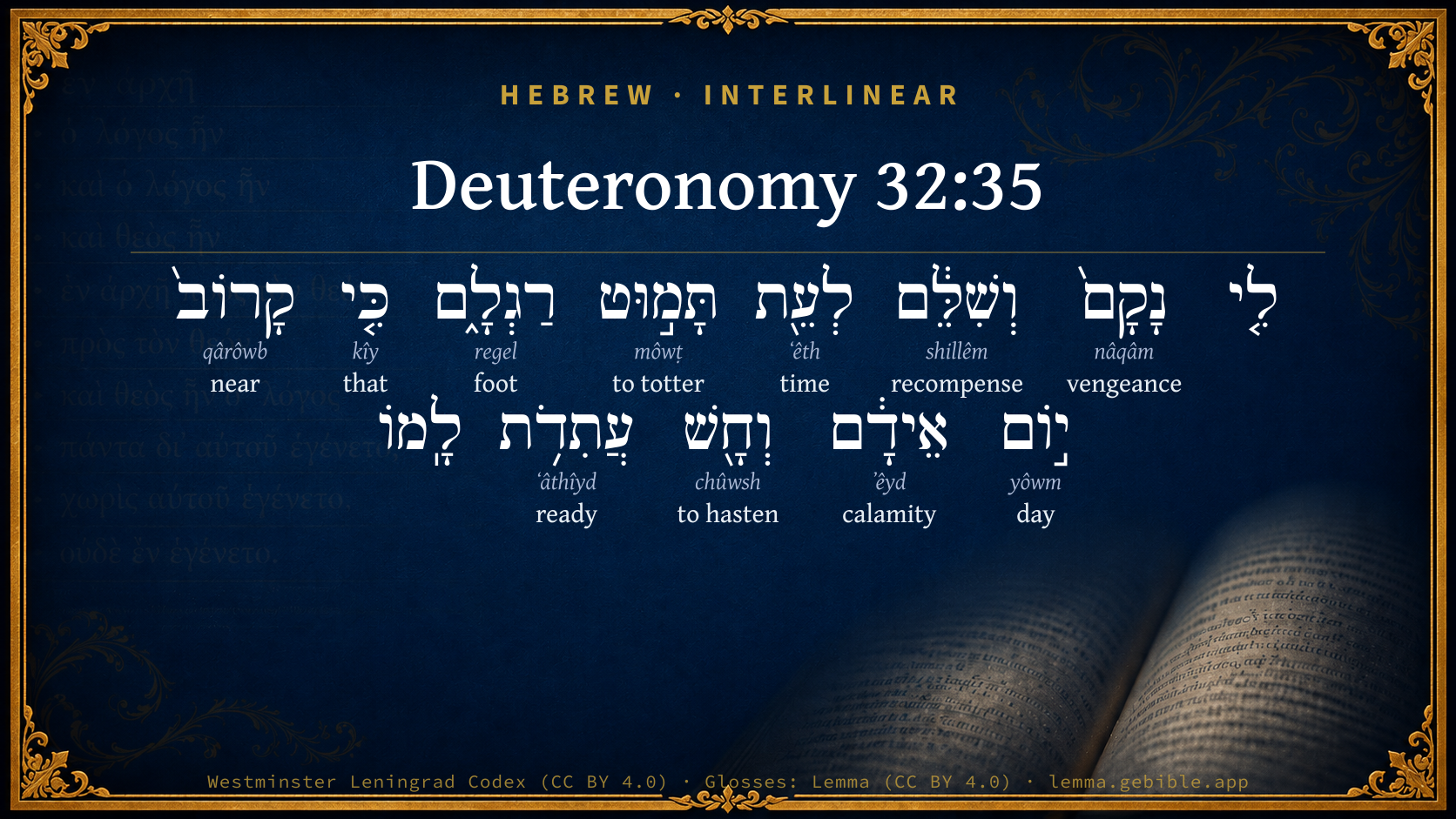
Hebrew (Westminster Leningrad Codex) Deuteronomy 32:35 appears in the Hebrew Old Testament. The text above is from the Westminster Leningrad Codex. Each word links to its Strong’s number, a concise gloss, and parsing drawn from the Open Scriptures Hebrew Bible morphology. Click any word for its full Brown-Driver-Briggs (BDB) entry.
Download image
Cite this verse

Deuteronomy 32:35 (World English Bible). Public Domain. Lemma interlinear Bible study tool, https://lemma.gebible.app/v/deuteronomy/32/35.

Show BibTeX & RIS
BibTeX
RIS
English Translation
Vengeance is mine, and recompense, At the time when their foot shall slide: For the day of their calamity is at hand, The things that are to come on them shall make haste.
World English Bible · Public Domain
Highlights
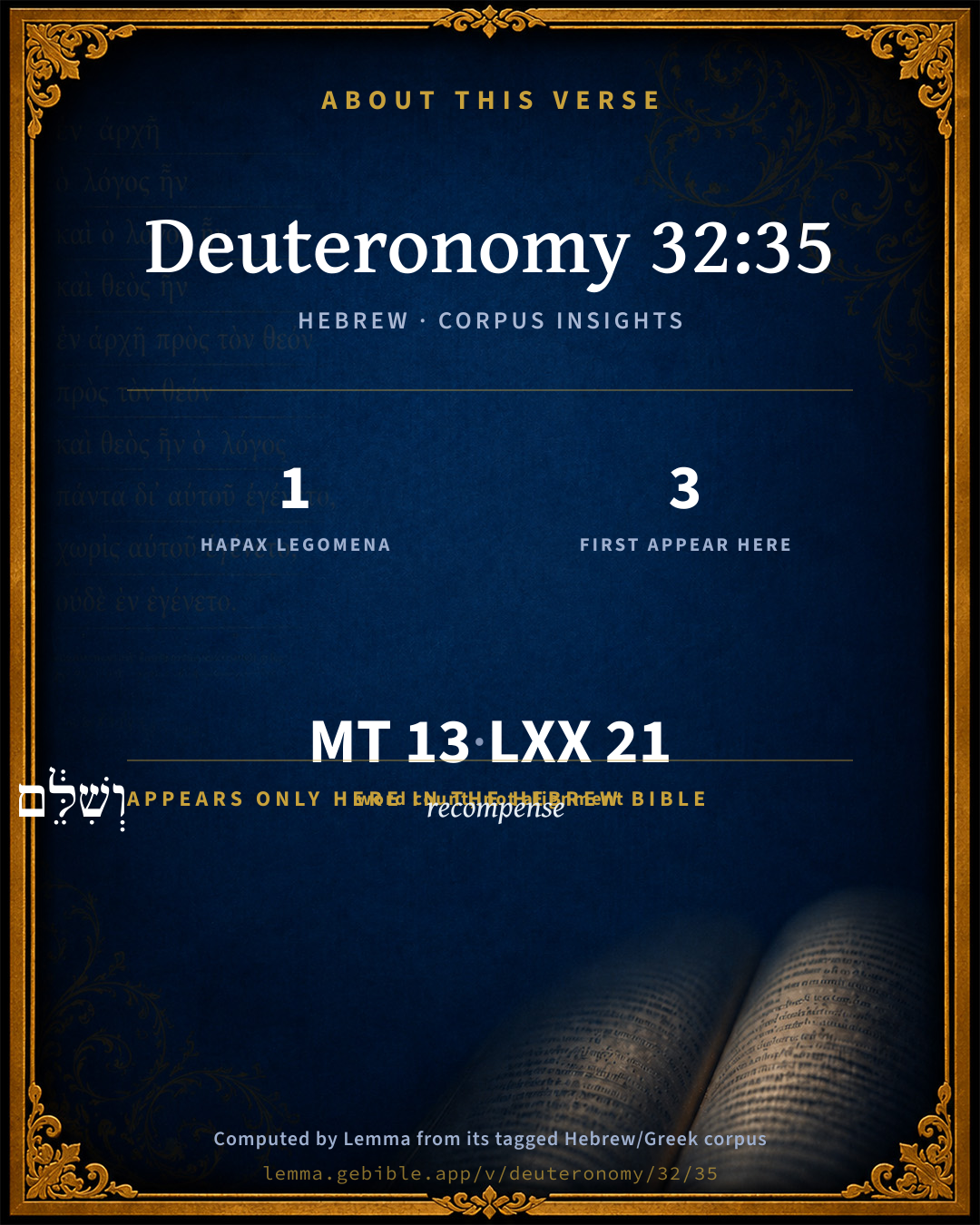
  • 1 hapax legomenon — only here in the Hebrew Bible
  • 3 first appearances in the Hebrew Bible
Full analysis ↓
Download a study sheet

One document with this verse’s original text, its word-by-word gloss line, the meaning frame, cross-references with their text, attributed commentary, and full source and license credits — printable, and it pastes into notes with its structure intact.

This verse Autodidact and up

Study sheet (.html) Plain text (.txt)

A passage Seminary Student

Up to 50 verses in one chapter. A passage sheet keeps up to 6 commentary sources and 12 cross-references per verse, in the order this page ranks them, and says so on the sheet whenever that leaves anything out. Ask for a single verse and you get the Autodidact verse sheet above.

Everything on this page stays free to read, with no account — the sheet is a download of what is already on screen, not access to it.

Want to remove ads? Support Godless Engineer
Compare translations 3

The same verse in 3 English versions, stacked beneath the original-language interlinear above. Click any original word for its lexicon entry.

Each is an independent rendering of the whole verse — the interlinear is not word-aligned to these translations.

Highlighted words mark where these versions differ — a whole-verse word diff, not a word-by-word alignment.

  • World English Bible Public Domain
    Vengeance is mine, and recompense, At the time when their foot shall slide: For the day of their calamity is at hand, The things that are to come on them shall make haste.
  • King James Version Public Domain
    To me belongeth vengeance and recompence; their foot shall slide in due time: for the day of their calamity is at hand, and the things that shall come upon them make haste.
  • unfoldingWord Literal Text CC BY-SA 4.0
    Mine vengeance and recompense, at the time when their foot slips; for the day of their disaster near, and the things prepared for them hasten.’ ts\*

unfoldingWord Literal Text — © unfoldingWord, licensed CC BY-SA 4.0. Word-aligned USFM3 via Door43 (git.door43.org/unfoldingWord/en_ult).

Versions to compare (up to 4)

3 of 4 selected

Show all 18 translations

Every available English version of this verse, each an independent rendering of the whole verse.

  • World English Bible Public Domain
    Vengeance is mine, and recompense, At the time when their foot shall slide: For the day of their calamity is at hand, The things that are to come on them shall make haste.
  • Berean Standard Bible Public Domain
    Vengeance is Mine; I will repay. In due time their foot will slip; for their day of disaster is near, and their doom is coming quickly.”
  • Majority Standard Bible Public Domain
    Vengeance is Mine; I will repay. In due time their foot will slip; for their day of disaster is near, and their doom is coming quickly.”
  • King James Version Public Domain
    To me belongeth vengeance and recompence; their foot shall slide in due time: for the day of their calamity is at hand, and the things that shall come upon them make haste.
  • American Standard Version (1901) Public Domain
    Vengeance is mine, and recompense, At the time when their foot shall slide: For the day of their calamity is at hand, And the things that are to come upon them shall make haste.
  • Revised Version (1885) Public Domain
    Vengeance is mine, and recompence, At the time when their foot shall slide: For the day of their calamity is at hand, And the things that are to come upon them shall make haste.
  • Geneva Bible (1599) Public Domain
    Vengeance and recompence are mine: their foote shall slide in due time: for the day of their destruction is at hand, and the things that shall come vpon them, make haste.
  • Douay-Rheims (1899) Public Domain
    Revenge is mine, and I will repay them in due time, that their foot may slide: the day of destruction is at hand, and the time makes haste to come.
  • Young's Literal Translation Public Domain
    Mine `are' vengeance and recompense, At the due time -- doth their foot slide; For near is a day of their calamity, And haste do things prepared for them.
  • Literal Standard Version CC BY-SA 4.0
    Vengeance and retribution [are] Mine, || At the due time—their foot slides; For near is a day of their calamity, || And things prepared for them have hastened.
  • Unlocked Literal Bible CC BY-SA 4.0
    Vengeance is mine to give, and recompense, at the time when their foot slips; for the day of disaster for them is near, and the things that are to come on them will hurry to happen.”
  • unfoldingWord Literal Text CC BY-SA 4.0
    Mine vengeance and recompense, at the time when their foot slips; for the day of their disaster near, and the things prepared for them hasten.’ ts\*
  • Darby Bible Public Domain
    Vengeance is mine, and recompense, For the time when their foot shall slip. For the day of their calamity is at hand, And the things that shall come upon them make haste.
  • World Messianic Bible Public Domain
    Vengeance is mine, and recompense, at the time when their foot slides, for the day of their calamity is at hand. Their doom rushes at them.”
  • Webster's Bible Public Domain
    To me belongeth vengeance, and recompense; their foot shall slide in due time: for the day of their calamity is at hand, and the things that shall come upon them make haste.
  • Free Bible Version CC BY-SA 4.0
    I make sure justice is done, I will repay. The time is coming when they will fall, their day of disaster is approaching, their doom will soon arrive.”
  • Bible in Basic English Public Domain
    Punishment is mine and reward, at the time of the slipping of their feet: for the day of their downfall is near, sudden will be their fate.
  • JPS Tanakh (1917) Public Domain
    Vengeance is Mine, and recompense, against the time when their foot shall slip; for the day of their calamity is at hand, and the things that are to come upon them shall make haste.

Literal Standard Version (2020), Covenant Press — licensed CC BY-SA 4.0. Text via the HelloAO Bible API (eBible.org). Unlocked Literal Bible (unfoldingWord) — licensed CC BY-SA 4.0. Text via the HelloAO Bible API (eBible.org). unfoldingWord Literal Text — © unfoldingWord, licensed CC BY-SA 4.0. Word-aligned USFM3 via Door43 (git.door43.org/unfoldingWord/en_ult). Free Bible Version, Dr. Jonathan Gallagher — licensed CC BY-SA 4.0. Text via the HelloAO Bible API (eBible.org).

Word by word

More ways to search: Search by grammar → Find every occurrence → Compare this word →

Practice this passage: Drill this verse → Learn its vocabulary →

וְשִׁלֵּ֔ם
shillêm
H8005
“and · recompense”
Conjunction + Noun, Common, Masculine, Singular, Absolute
Part of Speech
Conjunction + Noun
Type
Common
Gender
Masculine
Number
Singular
State
Absolute
Full BDB Definition

Origin: from H7999

TWOT: 2401e

recompense, requital
  1. נָקָם֙ nâqâm H5359 “vengeance” Noun, Common, Masculine, Singular, Absolute
  2. לְעֵ֖ת ʻêth H6256 “to/for · time of” Preposition + Noun, Common, Both, Singular, Construct
  3. תָּמ֣וּט môwṭ H4131 “to totter” Verb, Qal, Imperfect, 3rd Person, Feminine, Singular
  4. רַגְלָ֑ם regel H7272 “foot · their” Noun, Common, Feminine, Singular, Construct + Suffix, Personal, 3rd Person, Masculine, Plural
  5. כִּ֤י kîy H3588 “that” Conjunction
  6. קָרוֹב֙ qârôwb H7138 “near” Adjective, Adjective, Masculine, Singular, Absolute
  7. י֣וֹם yôwm H3117 “day of” Noun, Common, Masculine, Singular, Construct
  8. אֵידָ֔ם ʼêyd H343 “calamity · their” Noun, Common, Masculine, Singular, Construct + Suffix, Personal, 3rd Person, Masculine, Plural
  9. וְחָ֖שׁ chûwsh H2363 “and · to hasten” Conjunction + Verb, Qal, Sequential Perfect, 3rd Person, Masculine, Singular
  10. עֲתִדֹ֥ת ʻâthîyd H6264 “ready” Adjective, Adjective, Feminine, Plural, Absolute

About this verse

These counts appear in no published source. They are computed here, from the morphology-tagged text and Lemma’s own curated glosses. What Lemma adds →

13
words
11
distinct lemmas
Pentateuch
section

Notable vocabulary

1 hapax legomenon — a word that appears only here in the entire Hebrew Bible:

  • וְשִׁלֵּ֔ם recompense H8005

First appearance in Scripture

These words make their first canonical appearance in the Hebrew Bible here:

  • וְשִׁלֵּ֔ם recompense H8005
  • אֵידָ֔ם calamity H343
  • עֲתִדֹ֥ת ready H6264

Shared distinctive vocabulary

עֲתִדֹ֥ת ready H6264 occurs in 6 verses of the Hebrew Bible. Also found in:

Grammatical profile

  • 2 verbs
  • 6 nouns
  • 2 adjectives
  • 2 prepositions
  • 1 conjunction

Verb forms

  • תָּמ֣וּט Qal · Imperfect
  • וְחָ֖שׁ Qal · Sequential Perfect

Hebrew & Septuagint length

In English translation the verse runs 33 words from the Hebrew and 34 from the Septuagint (LXX English) — closely comparable.

A rough comparison of the two English renderings, which tokenize alike — not a word-level alignment.

Word counts can differ between the Hebrew and the Greek without any difference in meaning — e.g. the Hebrew direct-object marker אֵת has no separate Greek word, and Greek often adds the article ὁ.

In the original languages it is 13 Hebrew tokens and 21 Greek tokens — but the two are counted differently (Hebrew bundles its prefixes and suffixes into one token; the Greek is in lemma form), so that isn’t a like-for-like length.

Cross-references

22

Topical passages linked to Deuteronomy 32:35 in the Treasury of Scripture Knowledge — connected by theme and wording, ordered by reader-vote popularity; previews shown in the World English Bible.

  • Romans 12:19 Don't seek revenge yourselves, beloved, but give place to God's wrath. For it is written, "Vengeance belongs to me; I will repay, says the Lord."
  • Nahum 1:2 Yahweh is a jealous God and avenges. Yahweh avenges and is full of wrath. Yahweh takes vengeance on his adversaries, and he maintains wrath against his enemies.
  • Hebrews 10:30 For we know him who said, "Vengeance belongs to me," says the Lord, "I will repay." Again, "The Lord will judge his people."
  • Psalms 73:17–19 Until I entered God's sanctuary, And considered their latter end.
  • 2 Peter 2:3 In covetousness they will exploit you with deceptive words: whose sentence now from of old doesn't linger, and their destruction will not slumber.
  • Deuteronomy 32:43 Rejoice, you nations, [with] his people: For he will avenge the blood of his servants, Will render vengeance to his adversaries, Will make expiation for his land, for his people.
  • Psalms 94:1 Yahweh, you God to whom vengeance belongs, You God to whom vengeance belongs, shine forth.
  • Jeremiah 23:12 Therefore their way shall be to them as slippery places in the darkness: they shall be driven on, and fall therein; for I will bring evil on them, even the year of their visitation, says Yahweh.
  • Nahum 1:6 Who can stand before his indignation? Who can endure the fierceness of his anger? His wrath is poured out like fire, and the rocks are broken apart by him.
  • 2 Peter 3:8–10 But don't forget this one thing, beloved, that one day is with the Lord as a thousand years, and a thousand years as one day.
  • Ezekiel 7:8–9 Now will I shortly pour out my wrath on you, and accomplish my anger against you, and will judge you according to your ways; and I will bring on you all your abominations.
  • Luke 18:7–8 Won't God avenge his chosen ones, who are crying out to him day and night, and yet he exercises patience with them?
  • Jeremiah 6:21 Therefore thus says Yahweh, Behold, I will lay stumbling-blocks before this people; and the fathers and the sons together shall stumble against them; the neighbor and his friend shall perish.
  • Jeremiah 13:16 Give glory to Yahweh your God, before he cause darkness, and before your feet stumble on the dark mountains, and, while you look for light, he turn it into the shadow of death, and make it gross darkness.
  • Habakkuk 2:3 For the vision is yet for the appointed time, and it hurries toward the end, and won't prove false. Though it takes time, wait for it; because it will surely come. It won't delay.
  • 1 Peter 2:8 and, "A stone of stumbling, and a rock of offense." For they stumble at the word, being disobedient, whereunto also they were appointed.
  • Proverbs 4:19 The way of the wicked is like darkness. They don't know what they stumble over.
  • Isaiah 5:19 Who say, "Let him make speed, let him hasten his work, that we may see it; And let the counsel of the Holy One of Israel draw near and come, That we may know it!"
  • Isaiah 8:15 Many shall stumble thereon, and fall, and be broken, and be snared, and be taken.
  • Isaiah 30:12–13 Therefore thus says the Holy One of Israel, "Because you despise this word, and trust in oppression and perverseness, and rely thereon;
  • Isaiah 60:22 The little one shall become a thousand, and the small one a strong nation; I, Yahweh, will hasten it in its time.
  • Romans 13:4 for he is a servant of God to you for good. But if you do that which is evil, be afraid, for he doesn't bear the sword in vain; for he is a minister of God, an avenger for wrath to him who does evil.

Cross-references courtesy of OpenBible.info (CC BY 4.0).

Hebrew and Greek witnesses Masoretic Hebrew ↔ Greek Septuagint

The same verse in the two great witnesses to the Old Testament, shown verse-for-verse.

These are two independent witnesses, not word-aligned to each other, and the Septuagint is shown in lemma (dictionary) form.

Hebrew Deuteronomy 32:35 Masoretic · Westminster Leningrad Codex

לִ֤י נָקָם֙ וְשִׁלֵּ֔ם לְעֵ֖ת תָּמ֣וּט רַגְלָ֑ם כִּ֤י קָרוֹב֙ י֣וֹם אֵידָ֔ם וְחָ֖שׁ עֲתִדֹ֥ת לָֽמוֹ

Vengeance is mine, and recompense, At the time when their foot shall slide: For the day of their calamity is at hand, The things that are to come on them shall make haste.

World English Bible · Public Domain

Greek LXX Deuteronomy 32:35 Septuagint · lemma form

ἐν ἡμέρα ἐκδικήσις ἀντι ἀποδίδωμι ἐν καιρός ὅταν σφάλλω ὁ πούς αὐτός ὅτι ἐγγύς ἡμέρα ἀπώλεια αὐτός καί παραεἰμί ἕτοιμος σύ

In the day of vengeance I will recompense, whenever their foot shall be tripped up; for the day of their destruction is near to them, and the judgments at hand are close upon you.

LXX2012 (modern English Septuagint) · Public Domain

On this verse, The Cambridge Bible for Schools and Colleges discusses the Septuagint’s reading. Read the note in Commentary ↓

Hebrew: Westminster Leningrad Codex (CC BY 4.0). Greek: Septuagint (public domain); English from LXX2012 (modern English Septuagint) (Public Domain). How the Septuagint differs from the Hebrew →

Targum (Aramaic paraphrase)

2

The Targum is the ancient Jewish Aramaic paraphrase of the Hebrew Scriptures — an interpretive translation, not the Hebrew text itself. Onkelos (literal) and Pseudo-Jonathan (expansive) render the Torah, and Jonathan the Prophets. Coverage is partial: where no permissively-licensed English translation exists for a verse, only the Aramaic is shown. This is verse-level text, not a word-by-word alignment to the Hebrew.

  1. Targum Onkelos Torah (Genesis–Deuteronomy)
    קֳדָמַי פֻּרְעֲנוּתָא וַאֲנָא אֲשַׁלֵם לְעִדָן דְיִגְלוּן מֵאַרְעֲהוֹן אֲרֵי קָרִיב יוֹם תְּבָרְהוֹן וּמַבַּע דְעָתִיד לְהוֹן

    (no public-domain English translation for this verse)

    Targum Onkelos — Aramaic: “Onkelos Genesis” (public domain); “Onkelos Exodus” (public domain); “Onkelos Leviticus” (public domain); “Onkelos Numbers” (public domain); “Onkelos Deuteronomy” (public domain). English: “Sefaria Community Translation” (CC0 1.0 (public-domain dedication)); “J.W. Etheridge. The Targums of Onkelos and Jonathan Ben Uzziel on the Pentateuch. London: Longmans, Green, 1862” (public domain). Text via Sefaria.

  2. Targum Pseudo-Jonathan Torah (Genesis–Deuteronomy)
    קֳדָמַי פּוּרְעֲנוּתָא וַאֲנָא אַשְׁלִים לְעִדָן דְתִימוֹט רַגְלֵיהוֹן לְגָלוּתָא אֲרוּם קָרִיב לְמֵיתֵי יוֹם תְּבַרְהוֹן וּמִבְעָא בִּישָׁתָא דִמְעַתְּדָא לְהוֹן

    Vengeance lies before Me, and I will recompense them at the time when their foot shall move to the captivity; for the day of their destruction is coming near, and the evil which is prepared for them maketh haste.

    Targum Pseudo-Jonathan — Aramaic: “Targum Jonathan on Genesis” (public domain); “Targum Jonathan on Exodus” (public domain); “Targum Jonathan on Leviticus” (public domain); “Targum Jonathan on Numbers” (public domain); “Targum Jonathan on Deuteronomy” (public domain). English: “The Targum of Jonathan ben Uzziel, trans. J. W. Etheridge, London, 1862” (public domain). Text via Sefaria.

Commentary

Notes on Deuteronomy 32:35 from classic Christian and Jewish commentators (each source and its license shown beneath its notes). The classic Christian expositions comment on the surrounding passage and are grouped to its opening verse, so a note may address several verses; the Jewish commentaries on the Tanakh (Rashi and others) are per-verse, so they appear only where the commentator wrote on this verse.

Lemma curates 59 commentaries, every one of them public domain or Creative Commons licensed, each selected and text-cleaned for this edition rather than reprinted as found. About our sources →

Trapp's Complete Commentary

John Trapp

Deu 32:35 To me [belongeth] vengeance, and recompence; their foot shall slide in [due] time: for the day of their calamity [is] at hand, and the things that shall come upon them make haste.

Ver. 35. To me belongeth vengeance and recompense.] The Hebrew word for vengeance, זהם, signifies comfort also; for God will be comforted in the execution of his wrath. {Eze 5:13} {See Trapp on "Deu 28:63"} He shows such severity sometimes as if he had blotted that out of his title, {Exo 34:6} and now took up that Emperor’s motto, Fiat iustitia, pereat mundus.

Their foot shall slide in due time.] "They are set in slippery places"; {Psa 73:18} they ever walk as upon a mine of gunpowder ready to be blown up: Nemo crimen gerit in pectore, qui non idem Nemesin in tergo. Nemesis dicitur Aδραστεια, quod ουκ αν τις αυτην αποδρασαιτο. God’s wrath is such, as none can avert or avoid.

John Trapp, A Commentary or Exposition upon All the Books of the Old and New Testament (1647–1656) — public domain. Text from a community e-Sword module.

The Biblical Illustrator

Joseph S. Exell

Deu_32:35

Their foot shall slide in due time.

The awakening of sinners

This is the culmination of the most dreadful denunciation of sinners to be found in the Bible.

I. The insecurity of the sinner.

A sense of sin and impending punishment is ever present in mans heart. Heathen nations of the old and of the new world recognised it, and established forms of religious worship in order to avoid it, But the Bible makes assurance doubly sure, and issues solemn warnings of the fact.

II. The certainty of the result. Human life knows no such thing as remaining in one place. Man is ever going forward or backward--which depends upon himself. Men shut their eyes and fancy themselves secure, None plunge headlong into the extremities of sin at once. Nearly everyone can recollect the first falsehood, the first profane word, the first dishonest act, after they have reached depths of depravity of which they never dreamed. They took the devil for their master, and he presses them hard at every turn. The down-slide is governed by an inexorable law.

III. Consider where they are sliding. Away from virtue, away from peace, away from good company, away from God! Men watch the downward progress of the drunkard with pity and disgust. The wilful wrecking of all that is noble in man seems incomprehensible. (J. O. Peck, D. D.)

The Biblical Illustrator, edited by Joseph S. Exell (c. 1880s–1900s) — public domain. Text from a community e-Sword module.

Joseph Benson's Commentary

Deu 32:35. To me belongeth vengeance — As the supreme Lord and Judge of the world, whose power no force can resist, from whose knowledge no secret can be concealed, and from whose justice no art can escape. Their feet shall slide — Though they think themselves immoveably fixed in their power and prosperity, they shall certainly be visited with national judgments, and overthrown. In due time — Though not so soon as some may expect, yet in that time when it shall be thought most proper, when they have filled up the measure of their sins. At hand — Hebrew, is near. So the Scripture often speaks of those things which are at many hundred years’ distance, to signify, that though they may be afar off as to our measures of time, yet in God’s account they are near, they are as near as may be; when the measure of their sins is once full, the judgment shall not be deferred.

Joseph Benson's Commentary on the Old and New Testaments (1811–1818) — public domain. Text from a community e-Sword module.

Adam Clarke's Commentary

Verse 35. Their foot shall slide in due time, &c.] But Calmet thinks that this verse is spoken against the Canaanites, the enemies of the Jewish people.

Adam Clarke's Commentary on the Bible (1810–1826) — public domain. Text from a community e-Sword/MySword module.

Ellicott's Commentary for English Readers

(35) To me belongeth vengeance, and recompence.—In the Epistle to the Hebrews (Heb_10:30) this sentence is quoted with the first clause of Deu_32:36, “For we know Him that said, Vengeance belongeth unto me. I will recompense, saith the Lord.” And so in Rom_12:19.

Their foot shall slide in due time.—Rather, for the time when their foot shall slide.

A Bible Commentary for English Readers, edited by Charles John Ellicott (1878–1897) — public domain. Text from a community e-Sword module.

The Cambridge Bible for Schools and Colleges

gen. ed. J. J. S. Perowne

35. Mine are vengeance, etc.] Sam. and LXX read for the day of vengeance, etc.; and perhaps rightly, see Ginsburg, Intr. p. 168. Here intended as an assurance to Israel, but in Rom_12:19 as a warning against undertaking revenge oneself, cp. Heb_10:30.

day of their disaster] Jer_18:17; Jer_46:21, Oba_1:13, Psa_18:18 (19).

things destined for them] A late expression.

The Cambridge Bible for Schools and Colleges (gen. ed. J. J. S. Perowne; Cambridge University Press, 1878–1918) — public domain. Text from a community e-Sword module.

John Gill's Exposition

For the Lord shall judge his people,.... The true church and members of it, in opposition to the false and apostate church; his chosen and covenant people, whom he gave to Christ, and who are redeemed by his blood, and effectually called by his grace; the people he shall call out of Babylon, or preserve from the corruptions of it before its fall; and who are the objects of his love and delight; a distinct, peculiar, and special people, near unto him, and all righteous: these he will judge at this time, distinguish between them and the followers of antichrist; he will take their cause in hand, and plead it, and do justice to them; he will right their wrongs and injuries, and take vengeance on their enemies; he will protect and defend them, reign and rule over them. Now will be the time, when the witnesses slain are raised, that he will take to himself his great power and reign, and the time of the dead when they will be judged, and a reward given to his servants and prophets, to his saints, and all that fear his name; and when he will destroy them that have destroyed the earth, Rev 11:17; so the Targum of Jonathan interprets this of the word of the Lord that shall judge his people in mercy:

and repent himself for his servants; by whom are meant not only the ministers of the Gospel, his witnesses that prophesy in sackcloth, and who will be slain when they have finished their testimony; but all that are effectually called by grace, who though they have been the servants of sin, and the vassals of Satan, yet by the grace of God become the servants of God and of righteousness; dislike and cast off their old masters; readily, willingly, and cheerfully, take upon them the yoke of Christ, and freely obey him, constrained by his love, and influenced by views of interest in him: and so serve him without any selfish views, owning that, when they have done all they can, they are but unprofitable servants: now for or on account of these he will repent himself, because of the evils he has suffered to come upon them, being moved with pity, and compassion to them in their miserable circumstances, as they will be in when the witnesses his servants will be slain; not that, properly speaking, repentance is in God; he never changes his mind, counsel, and purposes; he never alters his love, his choice, nor his covenant; or repents of his gifts, and calling of special grace; though he is sometimes said to repent of outward good things he has bestowed, or promised to bestow conditionality; and of evils he has threatened or inflicted; yet this is only to be understood of a change of his outward dealings and dispensations with men, according to his changeable will; and this will be the case now with respect to his servants, whom he will have suffered to be slain, and lie unburied; but repenting or changing his manner of conduct to them will revive them, and cause them to ascend to heaven; see Rev 11:11,

when he seeth that their power is gone; not the hand and power of the enemy, going and prevailing over them, and strong upon them, as the Targum of Jonathan and Jarchi; but rather the hand and power of the righteous, as the Targum of Jerusalem; and respects not their internal power and strength, which they have not in themselves, but in Christ; though the exertion of that power, and the exercise of their graces, as faith, and hope, and love, will be greatly declined; but their external power, and protection which they had from Protestant princes; they being removed, and others not like them succeeding, or apostatizing to the church of Rome: the outward court or national establishments are a fence and protection to the inward court worshippers, or servants of God; when that shall be given to the Gentiles, the Papists, as it will, Rev 11:2; the power or hand, the protecting sheltering hand of the saints, will be gone, and they will become a prey to their adversaries:

and there is none shut up or left; a phrase used to express the miserable state and condition of a people, when none are left, but all are carried off, or cut off, and destroyed, and there is none to help them; see Kg1 14:10; when there are none shut up in garrisons, and left there to defend a people; or there are none shut up in prison, or any left to till the ground; which is sometimes the case when a nation is conquered, and the greater part are carried captives; but it denotes such a general destruction, that there are none remaining any where, and thus it will be at the slaying of the witnesses. This passage has respect to their dead bodies, which will not be shut up in graves, nor any left to bury them, Rev 11:9. There will scarcely be a professor of religion, or any that will appear to favour the witnesses slain in any respect; there will be"none to support and uphold,''as the Targum of Jerusalem; not to support and uphold the true religion, or to help the people of God in these their distresses: and when the Lord shall see all this, he will look upon them with an eye of pity and compassion; he will repent for his servants, according to the multitude of his tender mercies; and will plead their cause, and judge them, and will put on the garments of vengeance, and repay fury and recompense to his and their enemies, Isa 59:15; who will insultingly say as follows.

John Gill's Exposition of the Whole Bible (1746–1763) — public domain (CC PDM 1.0). Text via the HelloAO Bible API.

Haydock's Catholic Bible Commentary

Time. Men are eager to punish their enemies, for fear lest they should escape. But God defers his chastisements frequently in this world, designing to make his enemies feel the weight of his indignation for all eternity. How consoling it is for the just, to think they have God for an avenger! "If thou, says Tertullian, remit the injury, which thou hast received, into his hands, he is the avenger....How much ought patience to endure, in order to make God a debtor." Adeo satisidoneus patientiæ sequester Deus. --- That. Septuagint, "when" (Calmet) they shall fall and come to ruin. (Menochius)

George Leo Haydock (1774–1849), Haydock's Catholic Family Bible and Commentary, 1859 edition — public domain. Excludes Psalms (Douay-Rheims chapter numbering differs from Protestant) and Deuterocanonical books (Catholic canon only).

Matthew Poole's English Annotations

It is my office to punish sin, and therefore as I know their sins, so I will assuredly punish them. Their feet shall slide; they who now think they stand fast and unmovable, they shall fall into utter destruction.

In due time; though not so soon as some may expect it, yet in that time when it shall be most proper and seasonable, when they have filled up the measure of their sins. This due time may be the same with that fulness of time, Gal 4:4, when Christ came into the world, whom this people by wicked hands crucified and slew, Act 2:23, for which wrath came upon them to the uttermost, 1Th 2:15,16.

Is at hand, Heb. is near. So the Scripture oft speaks of those things which are at many hundred years’ distance, to meet with objections arising in men’s minds from the delays of them, and to signify, that though they may be afar off as to our measures of time and expectation of the things, yet in God’s account they are near, they are as near as may be; as soon as ever the fit and the full time is come, they come instantly, they are nearer than sinners would have them; when the measure of their sins is once full, the judgment shall not be deferred.

Matthew Poole's English Annotations on the Holy Bible (1683–1685) — public domain. Text from a community e-Sword/MySword module.

Whedon's Commentary on the Bible

Daniel D. Whedon

35. To me belongeth vengeance, and recompense; their foot shall slide in due time — More literally, vengeance and retribution is mine when their foot shall shake. “The shaking of the foot is a figure representing the commencement of a fall or of stumbling.” — Keil. Comp. Psa_38:16; Psa_94:18. The first part of this verse is quoted in Rom_12:19, and Heb_10:30. It is to be impressed upon the nation that when disasters come to them they are not fortuitous, but inflicted by Jehovah as the punishment for their sins.

Daniel D. Whedon (gen. ed.), Commentary on the Old and New Testaments (1874–1909) — public domain. Text from a community e-Sword module.

The Pulpit Commentary

Render: Vengeance is mine, and retribution for the time when their feet shall totter; for the day of their calamity is at hand, and that which is prepared for them maketh haste. The tottering of the feet represents the incipient fall. God would manifest himself as the Avenger when their calamity began to come upon them.

The Pulpit Commentary (1880–1919), ed. H.D.M. Spence-Jones & Joseph S. Exell — public domain. Text from a community e-Sword module.

John Wesley's Explanatory Notes

Their feet shall slide - They who now think they stand fast and unmoveable, shall fall into utter destruction. In due time - Though not so soon as some may expect, yet in that time when it shall be most proper, when they have filled up the measure of their sins. At hand - Hebrew. is near. So the scripture often speaks of those things which are at many hundred years distance, to signify, that though they may be afar off as to our measures of time, yet in God's account they are near, they are as near as may be, when the measure of their sins is once full, the judgment shall not be deferred.

John Wesley, Explanatory Notes Upon the Whole Bible (1754–1765) — public domain. Text via the GEBible commentary corpus.

unfoldingWord translationNotes

Door43 World Missions Community

General Information:

Moses speaks a poetic song to the people of Israel. This is the end of Moses's quotation of Yahweh's words that begins in Deuteronomy 32:20. (See: Parallelism)

Vengeance is mine to give, and recompense

The words "vengeance" and "recompense" mean basically the same thing. AT: "I will have vengeance and punish Israel's enemies" (See: Doublet)

recompense

to punish or reward a person for what he has done

their foot slips

Something bad has happened to them. AT: "they are helpless" (See: Idiom)

the day of disaster for them

"the time for me to destroy them"

the things that are to come on them will hurry to happen

Yahweh speaks of the bad things that will happen to his enemies as if the bad things were people running eagerly to punish them. AT: "I will punish them quickly" (See: Metaphor)

translationWords

avenge

time

unfoldingWord translationNotes — © Distant Shores Media and the Door43 World Missions Community, licensed CC BY-SA 4.0. Source: git.door43.org/Door43/en_tn.

Rashi

Rabbi Shlomo Yitzchaki (Rashi)

לי נקם ושלם means, with Me is prepared and held in readiness the punishment of vengeance, and it will recompense them according to their doings. As regards the word ושלם, it means that vengeance will pay them their recompense (וְשִׁלַּם is therefore a verb with the Vau conversive, the subject being the noun נקם which precedes it). — But some explain the word וְשִׁלַּם as a noun, having the same meaning as שִׁלּוּם “recompense”, when it would be of the same grammatical form as the noun in the phrase (Jeremiah 5:13) “And the דִּבֵּר is not in them”, where it has the meaning of דִּבּוּר, “Divine utterance”. And when will I recompense them?

לעת תמוט רגלם AT THE TIME WHEN THEIR FOOT SHALL TOTTER — i.e. when the merit of their ancestors upon which they are relying (which is, as it were, their foot, their support) will become exhausted.

כי קרוב יום אידם FOR THE DAY OF THEIR CALAMITY IS AT HAND — i.e. as soon as I shall desire to bring about the day of their calamity, it will be near at hand and held in readiness by Me — that I may bring it by any of the many agencies I have.

וחש עתדת למו means, AND THE THINGS THAT ARE TO COME (עתידות) UPON THEM WILL COME QUICKLY (חש).

וחש — The word חש has the same meaning as the verb in (Isaiah V. 19) “Let him make speed and hasten (יחישה)”. — So far Moses exhorted them with words of reproof, so that this song should be witness against them, i.e., that when the punishment would come upon them they would know (acknowledge) that I told them about this from the very beginning. From here onwards he exhorted them with a statement of the comfort that would come upon them when their punishment would have ended; this being similar to all that is stated above (30:1—2) “And it shall come to pass when [all these things] are come upon thee, the blessing and the curse, … then the Lord thy God will turn they captivity, etc.”

Rashi on the Tanakh — English translations: “The Judaica Press complete Tanach with Rashi, translated by A. J. Rosenberg” (CC BY 4.0); “Pentateuch with Rashi's commentary by M. Rosenbaum and A.M. Silbermann, 1929-1934” (public domain); “The Metsudah Tanach series, Lakewood, N.J” (CC BY 4.0); and “The Book of Joshua, Metsudah Publications, 1997” (CC BY 4.0). Text via Sefaria.

Ramban (Nachmanides)

Rabbi Moshe ben Nachman (Ramban / Nachmanides)

VENGEANCE IS MINE, AND RECOMPENSE. [To Me belongs vengeance] to avenge the cause of Israel from their hands, and Mine is the recompense to pay them according to their deeds for having repudiated Me. AGAINST THE TIME WHEN THEIR FOOT SHALL SLIP — when their measure [of sin] will be full, as it is stated, for the iniquity of the Amorite is not yet full. And Rabbi Abraham ibn Ezra commented that “the meaning thereof is [in line with the verse], yea, even the wicked for the day of evil, this constituting a great secret.”

Ramban (Nachmanides) on the Tanakh — English translation: “Commentary on the Torah by Ramban (Nachmanides). Translated and annotated by Charles B. Chavel. New York, Shilo Pub. House, 1971-1976” (CC BY 4.0). Text via Sefaria.

Lesson kit

Teaching starters — assembled from the data on this page, not authored interpretation. Every prompt links to the verse data it draws on. Edit before teaching.

Deuteronomy, in the Pentateuch, opens this verse with 13 words (11 distinct Hebrew lemmas). Its most distinctive word is shillêm (“recompense”). A historical commentator’s framing appears above. Read the whole chapter for the surrounding context.

Discussion questions

  1. How does “recompense” (shillêm) shape what this verse is saying?
  2. This verse holds 1 word here found nowhere else in the Hebrew Bible. What might the rare word draw attention to?
  3. 3 words here appear for the first time in Scripture. What is being introduced at this debut?
  4. Esther 3:14 shares the word «ready» with this verse. How do the two illuminate each other?
  5. These translations render this verse differently. What is at stake in choosing one wording over another?
  6. The verb «תָּמ֣וּט» is Qal Imperfect. How does its form color the action?
  7. Reading how Trapp's Complete Commentary and The Biblical Illustrator read this verse, where do the two commentators agree and where do they part?

Things to notice

Reading settings

Reading text

Shown beneath each verse's original-language words.

Old Testament
Old Testament edition

Read the OT as the Masoretic Hebrew (MT) or the Greek Septuagint (LXX).

English shown for the Greek Septuagint (in the Hebrew ↔ Greek comparison).

Comparing translations? Open the Compare panel on any verse page to stack up to four side by side.