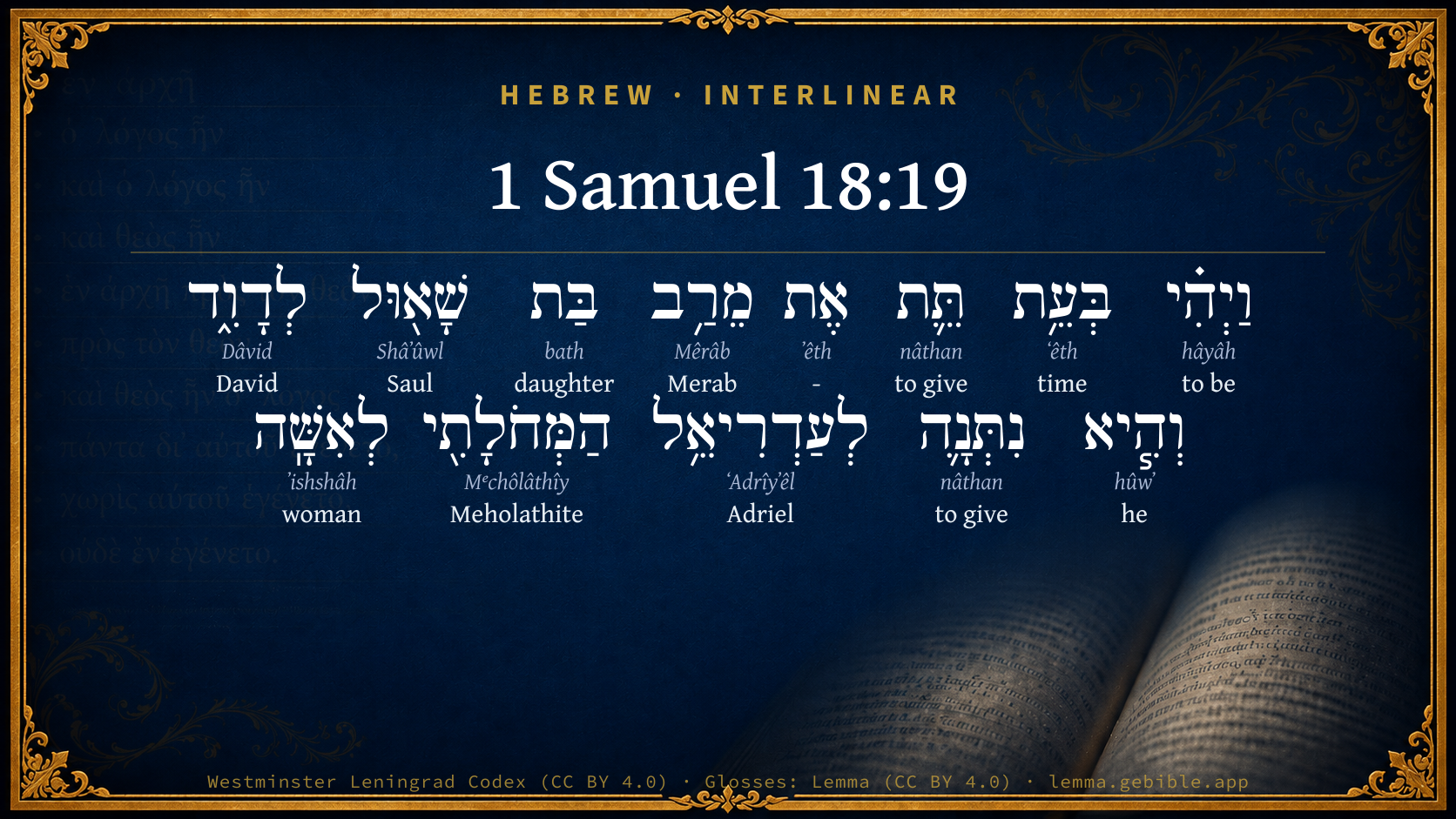
1 Samuel 18:19

Hebrew (Westminster Leningrad Codex) 1 Samuel 18:19 appears in the Hebrew Old Testament. The text above is from the Westminster Leningrad Codex. Each word links to its Strong’s number, a concise gloss, and parsing drawn from the Open Scriptures Hebrew Bible morphology. Click any word for its full Brown-Driver-Briggs (BDB) entry.
Download image
Cite this verse

1 Samuel 18:19 (World English Bible). Public Domain. Lemma interlinear Bible study tool, https://lemma.gebible.app/v/1-samuel/18/19.

Show BibTeX & RIS
BibTeX
RIS
English Translation
But it happened at the time when Merab, Saul's daughter, should have been given to David, that she was given to Adriel the Meholathite as wife.
World English Bible · Public Domain
Highlights
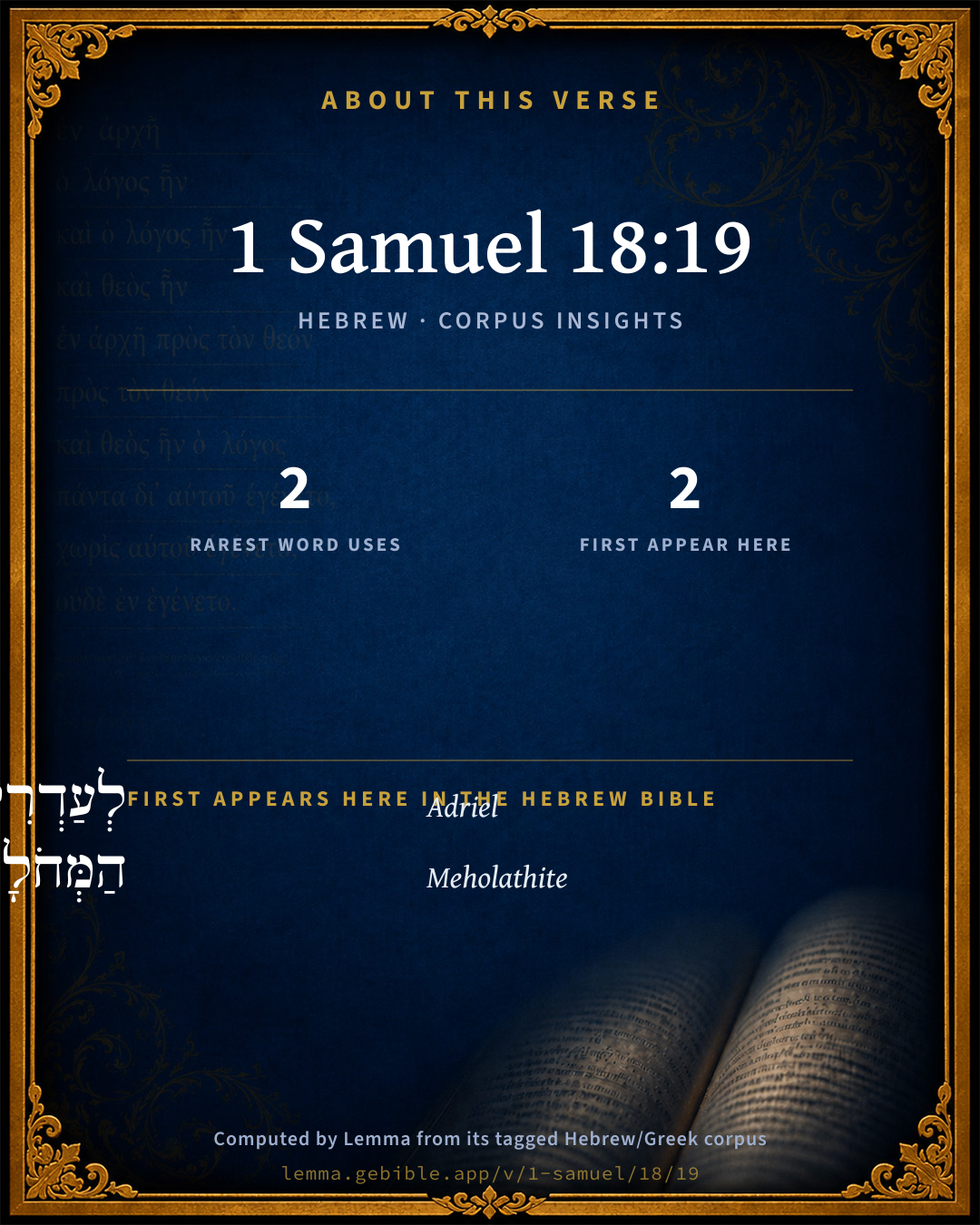
  • 2 first appearances in the Hebrew Bible
Full analysis ↓
Download a study sheet

One document with this verse’s original text, its word-by-word gloss line, the meaning frame, cross-references with their text, attributed commentary, and full source and license credits — printable, and it pastes into notes with its structure intact.

This verse Autodidact and up

Study sheet (.html) Plain text (.txt)

A passage Seminary Student

Up to 50 verses in one chapter. A passage sheet keeps up to 6 commentary sources and 12 cross-references per verse, in the order this page ranks them, and says so on the sheet whenever that leaves anything out. Ask for a single verse and you get the Autodidact verse sheet above.

Everything on this page stays free to read, with no account — the sheet is a download of what is already on screen, not access to it.

Want to remove ads? Support Godless Engineer
Compare translations 3

The same verse in 3 English versions, stacked beneath the original-language interlinear above. Click any original word for its lexicon entry.

Each is an independent rendering of the whole verse — the interlinear is not word-aligned to these translations.

Highlighted words mark where these versions differ — a whole-verse word diff, not a word-by-word alignment.

  • World English Bible Public Domain
    But it happened at the time when Merab, Saul's daughter, should have been given to David, that she was given to Adriel the Meholathite as wife.
  • King James Version Public Domain
    But it came to pass at the time when Merab Saul's daughter should have been given to David, that she was given unto Adriel the Meholathite to wife.
  • unfoldingWord Literal Text CC BY-SA 4.0
    And it happened, at the time to give Merab, the daughter of Saul to David, that she was given to Adriel the Meholathite for a wife.

unfoldingWord Literal Text — © unfoldingWord, licensed CC BY-SA 4.0. Word-aligned USFM3 via Door43 (git.door43.org/unfoldingWord/en_ult).

Versions to compare (up to 4)

3 of 4 selected

Show all 18 translations

Every available English version of this verse, each an independent rendering of the whole verse.

  • World English Bible Public Domain
    But it happened at the time when Merab, Saul's daughter, should have been given to David, that she was given to Adriel the Meholathite as wife.
  • Berean Standard Bible Public Domain
    So when it was time to give Saul’s daughter Merab to David, she was given in marriage to Adriel of Meholah.
  • Majority Standard Bible Public Domain
    So when it was time to give Saul’s daughter Merab to David, she was given in marriage to Adriel of Meholah.
  • King James Version Public Domain
    But it came to pass at the time when Merab Saul's daughter should have been given to David, that she was given unto Adriel the Meholathite to wife.
  • American Standard Version (1901) Public Domain
    But it came to pass at the time when Merab, Saul's daughter, should have been given to David, that she was given unto Adriel the Meholathite to wife.
  • Revised Version (1885) Public Domain
    But it came to pass at the time when Merab Saul’s daughter should have been given to David, that she was given unto Adriel the Meholathite to wife.
  • Geneva Bible (1599) Public Domain
    Howbeit when Merab Sauls daughter should haue bene giuen to Dauid, she was giuen vnto Adriel a Meholathite to wife.
  • Douay-Rheims (1899) Public Domain
    And it came to pass at the time when Merob the daughter of Saul should have been given to David, that she was given to Hadriel the Molathite to wife.
  • Young's Literal Translation Public Domain
    And it cometh to pass, at the time of the giving of Merab daughter of Saul to David, that she hath been given to Adriel the Meholathite for a wife.
  • Literal Standard Version CC BY-SA 4.0
    And it comes to pass, at the time of the giving of Merab daughter of Saul to David, that she has been given to Adriel the Meholathite for a wife.
  • Unlocked Literal Bible CC BY-SA 4.0
    But at the time when Merab, Saul's daughter, should have been given to David, she was given to Adriel the Meholathite as a wife.
  • unfoldingWord Literal Text CC BY-SA 4.0
    And it happened, at the time to give Merab, the daughter of Saul to David, that she was given to Adriel the Meholathite for a wife.
  • Darby Bible Public Domain
    And it came to pass at the time when Merab Saul's daughter should have been given to David, that she was given to Adriel the Meholathite as wife.
  • World Messianic Bible Public Domain
    But at the time when Merab, Saul’s daughter, should have been given to David, she was given to Adriel the Meholathite as wife.
  • Webster's Bible Public Domain
    But it came to pass at the time when Merab Saul's daughter should have been given to David, that she was given to Adriel the Meholathite to wife.
  • Free Bible Version CC BY-SA 4.0
    However, when the time came to give Merab, Saul's daughter, to David, she was given in marriage to Adriel of Meholah instead.
  • Bible in Basic English Public Domain
    But when the time came to give Merab, Saul's daughter, to David, she was given to Adriel of Meholath.
  • JPS Tanakh (1917) Public Domain
    But it came to pass at the time when Merab Saul's daughter should have been given to David, that she was given unto Adriel the Meholathite to wife.

Literal Standard Version (2020), Covenant Press — licensed CC BY-SA 4.0. Text via the HelloAO Bible API (eBible.org). Unlocked Literal Bible (unfoldingWord) — licensed CC BY-SA 4.0. Text via the HelloAO Bible API (eBible.org). unfoldingWord Literal Text — © unfoldingWord, licensed CC BY-SA 4.0. Word-aligned USFM3 via Door43 (git.door43.org/unfoldingWord/en_ult). Free Bible Version, Dr. Jonathan Gallagher — licensed CC BY-SA 4.0. Text via the HelloAO Bible API (eBible.org).

Word by word

More ways to search: Search by grammar → Find every occurrence → Compare this word →

Practice this passage: Drill this verse → Learn its vocabulary →

לְעַדְרִיאֵ֥ל
ʻAdrîyʼêl
H5741
“to/for · Adriel”
Preposition + Noun, Proper
Part of Speech
Preposition + Noun
Type
Proper
Full BDB Definition

Origin: from H5739 and H410

TWOT: None

Adriel = "flock of God" - son of Barzillai, and the man to whom Saul gave his daughter Merab in marriage although she was already promised to David
  1. וַיְהִ֗י hâyâh H1961 “and · to be” Conjunction + Verb, Qal, Sequential Imperfect, 3rd Person, Masculine, Singular
  2. בְּעֵ֥ת ʻêth H6256 “in/at · time of” Preposition + Noun, Common, Both, Singular, Construct
  3. תֵּ֛ת nâthan H5414 “to give” Verb, Qal, Infinitive Construct
  4. אֶת ʼêth H853 “-” Particle, Direct Object
  5. מֵרַ֥ב Mêrâb H4764 “Merab” Noun, Proper
  6. בַּת bath H1323 “daughter of” Noun, Common, Feminine, Singular, Construct
  7. שָׁא֖וּל Shâʼûwl H7586 “Saul” Noun, Proper
  8. לְדָוִ֑ד Dâvid H1732 “to/for · David” Preposition + Noun, Proper
  9. וְהִ֧יא hûwʼ H1931 “and · he” Conjunction + Pronoun, Personal, 3rd Person, Feminine, Singular
  10. נִתְּנָ֛ה nâthan H5414 “to give” Verb, Niphal, Perfect, 3rd Person, Feminine, Singular
  11. הַמְּחֹלָתִ֖י Mᵉchôlâthîy H4259 “the · Meholathite” Particle, Definite Article + Noun, Gentilic, Masculine, Singular, Absolute
  12. לְאִשָּֽׁה ʼishshâh H802 “to/for · woman” Preposition + Noun, Common, Feminine, Singular, Absolute

About this verse

These counts appear in no published source. They are computed here, from the morphology-tagged text and Lemma’s own curated glosses. What Lemma adds →

13
words
12
distinct lemmas
Historical
section

Notable vocabulary

The rarest word here is לְעַדְרִיאֵ֥ל Adriel H5741 — appearing just 2 times in the whole Hebrew Bible.

First appearance in Scripture

These words make their first canonical appearance in the Hebrew Bible here:

  • לְעַדְרִיאֵ֥ל Adriel H5741
  • הַמְּחֹלָתִ֖י Meholathite H4259

Shared distinctive vocabulary

לְעַדְרִיאֵ֥ל Adriel H5741 occurs in 2 verses of the Hebrew Bible. Also found in:

Grammatical profile

  • 3 verbs
  • 8 nouns
  • 1 pronoun
  • 1 particle

Verb forms

  • וַיְהִ֗י Qal · Sequential Imperfect
  • תֵּ֛ת Qal · Infinitive Construct
  • נִתְּנָ֛ה Niphal · Perfect

Repetition

A word recurs within this verse — often emphatic in Hebrew:

  • תֵּ֛ת to give H5414 ×2

Hebrew & Septuagint length

In English translation the verse runs 26 words from the Hebrew and 28 from the Septuagint (LXX English) — closely comparable.

A rough comparison of the two English renderings, which tokenize alike — not a word-level alignment.

Word counts can differ between the Hebrew and the Greek without any difference in meaning — e.g. the Hebrew direct-object marker אֵת has no separate Greek word, and Greek often adds the article ὁ.

Cross-references

3

Topical passages linked to 1 Samuel 18:19 in the Treasury of Scripture Knowledge — connected by theme and wording, ordered by reader-vote popularity; previews shown in the World English Bible.

  • Judges 7:22 They blew the three hundred trumpets, and Yahweh set every man's sword against his fellow, and against all the host; and the host fled as far as Beth-shittah toward Zererah, as far as the border of Abel Meholah, by Tabbath.
  • 2 Samuel 21:8 But the king took the two sons of Rizpah the daughter of Aiah, whom she bore to Saul, Armoni and Mephibosheth; and the five sons of Michal the daughter of Saul, whom she bore to Adriel the son of Barzillai the Meholathite:
  • Judges 14:20 But Samson's wife was [given] to his companion, whom he had used as his friend.

Cross-references courtesy of OpenBible.info (CC BY 4.0).

Hebrew and Greek witnesses Masoretic Hebrew ↔ Greek Septuagint

The same verse in the two great witnesses to the Old Testament, shown verse-for-verse.

These are two independent witnesses, not word-aligned to each other, and the Septuagint is shown in lemma (dictionary) form.

Hebrew 1 Samuel 18:19 Masoretic · Westminster Leningrad Codex

וַיְהִ֗י בְּעֵ֥ת תֵּ֛ת אֶת מֵרַ֥ב בַּת שָׁא֖וּל לְדָוִ֑ד וְהִ֧יא נִתְּנָ֛ה לְעַדְרִיאֵ֥ל הַמְּחֹלָתִ֖י לְאִשָּֽׁה

But it happened at the time when Merab, Saul's daughter, should have been given to David, that she was given to Adriel the Meholathite as wife.

World English Bible · Public Domain

Greek LXX 1 Samuel 18:19 Septuagint · lemma form

καί προςτίθημι εὐλαβέομαι ἀπό δαυίδ ἔτι

But it came to pass at the time when Merob Saul’s daughter should have been given to David, that she was given to Israel the Mothulathite to wife.

LXX2012 (modern English Septuagint) · Public Domain

On this verse, Ellicott's Commentary for English Readers discusses the Septuagint’s reading. Read the note in Commentary ↓

Hebrew: Westminster Leningrad Codex (CC BY 4.0). Greek: Septuagint (public domain); English from LXX2012 (modern English Septuagint) (Public Domain). How the Septuagint differs from the Hebrew →

Targum (Aramaic paraphrase)

1

The Targum is the ancient Jewish Aramaic paraphrase of the Hebrew Scriptures — an interpretive translation, not the Hebrew text itself. Onkelos (literal) and Pseudo-Jonathan (expansive) render the Torah, and Jonathan the Prophets. Coverage is partial: where no permissively-licensed English translation exists for a verse, only the Aramaic is shown. This is verse-level text, not a word-by-word alignment to the Hebrew.

  1. Targum Jonathan Prophets (Joshua–Malachi)
    וַהֲוָה בְּעִידָן דִמְטָא לְמִתַּן יַת מֵרַב בַּת שָׁאוּל לְדָוִד וְהִיא אִתְיְהִיבַת לְעַדְרִיאֵל דְמִמְחוֹלַת לְאִתִּי:

    (no public-domain English translation for this verse)

    Targum Jonathan — Aramaic: “Mikraot Gedolot” (public domain). English: “Sefaria Community Translation” (CC0 1.0 (public-domain dedication)); “London "Chaldee Paraphrase," 1871” (public domain). Text via Sefaria.

Commentary

Notes on 1 Samuel 18:19 from classic Christian and Jewish commentators (each source and its license shown beneath its notes). The classic Christian expositions comment on the surrounding passage and are grouped to its opening verse, so a note may address several verses; the Jewish commentaries on the Tanakh (Rashi and others) are per-verse, so they appear only where the commentator wrote on this verse.

Lemma curates 59 commentaries, every one of them public domain or Creative Commons licensed, each selected and text-cleaned for this edition rather than reprinted as found. About our sources →

Trapp's Complete Commentary

John Trapp

1Sa 18:19 But it came to pass at the time when Merab Saul’s daughter should have been given to David, that she was given unto Adriel the Meholathite to wife.

Ver. 19. At the time when Merab, &c.] This affront and disgrace was done to David purposely to provoke him (as is probable) to do or say something that might bring him under censure, and give Saul some colour to cut him off. But David was too hard for him that way too: leaving it to God to right his wrongs, as indeed he did notably when Merab’s five sons by this Adriel were all hanged. {2Sa 21:8}

John Trapp, A Commentary or Exposition upon All the Books of the Old and New Testament (1647–1656) — public domain. Text from a community e-Sword module.

Joseph Benson's Commentary

1Sa 18:19. She was given unto Adriel — The son of Barzillai, as he is called 2Sa 21:8. This was an act of great injustice, at the same time that it was a most high affront to David, and accordingly this marriage was accursed by God, and the children begotten in it were, by God’s appointment, cut off, 2 Samuel 21. How Jonathan resented this usage of David we are not told. It is likely his duty to his father made him entreat him to take it patiently, and to look upon Saul as sometimes beside himself, and one that did not know what he did.

Joseph Benson's Commentary on the Old and New Testaments (1811–1818) — public domain. Text from a community e-Sword module.

Tyndale Open Study Notes

Tyndale Open Resources

18:19 So: Or But. Either David declined the offer, or Saul reneged.

Tyndale Open Study Notes — © Tyndale Open Resources, licensed CC BY-SA 4.0. Text via the HelloAO Bible API.

Geneva Bible (1599)

Geneva Bible translators

By whom he had five sons which David put to death at the request of the Gibeonites, 2 Sam. 21:8.

Geneva Bible (1599) marginal notes — public domain. Text via Bolls.life.

Ellicott's Commentary for English Readers

(19) She was given unto Adriel.—Saul’s capricious wavering nature, so painfully prominent in the last part of his reign, displayed itself in this sudden change of purpose. It may have been brought about owing to some great fit of jealousy of David; or possibly the large gifts in money or valuables offered by the wealthy Adriel for the princess’s hand may have occasioned this arbitrary act of Saul. Such gifts to the father in return for the daughter’s hand were customary. In the case of such a prize as the Princess Merab, the gift would doubtless have been very costly. David, who was comparatively a poor man, was of course unable to show such liberality; besides, the young hero looked, no doubt, upon the marriage as the fulfilment of the old promise to the victor in the combat with the giant. The marriage, however, of the daughter of King Saul and Adriel was consummated, and was disastrous in its consequences. They had five sons, and they fell victims to the blood revenge exacted by the Gibeonites from the family of Saul: the five hapless youths were “hanged” (we read in 2Sa_21:9) “in the hill before the Lord.” These three verses (17-19) are entirely omitted by the LXX., apparently because they failed to see any reason for Saul’s sudden change of purpose.

A Bible Commentary for English Readers, edited by Charles John Ellicott (1878–1897) — public domain. Text from a community e-Sword module.

The Cambridge Bible for Schools and Colleges

gen. ed. J. J. S. Perowne

19. the Meholathite] Of Abel-Meholah, a town in the Jordan valley near Beth-shan. It was the birth-place of Elisha (1Ki_19:16). Why Saul changed his purpose does not appear. It has been inferred from 1Sa_18:25 that Adriel had given a rich dowry.

The Cambridge Bible for Schools and Colleges (gen. ed. J. J. S. Perowne; Cambridge University Press, 1878–1918) — public domain. Text from a community e-Sword module.

John Gill's Exposition

And Michal, Saul's daughter, loved David,.... His youngest daughter fell in love with him, because of the comeliness of his person, his gallant behaviour, his wise conduct, and the general esteem and reputation he was had in, as may be supposed:

and they told Saul, and the thing pleased him; not that his daughter loved David, or that he should be his son-in-law, but that he should have an opportunity, as he hoped, of destroying David, which he had lost by giving his elder daughter to another; as also of retrieving his credit with the people, which was greatly sunk by using David in the manner he did, who had become the darling of the people.

John Gill's Exposition of the Whole Bible (1746–1763) — public domain (CC PDM 1.0). Text via the HelloAO Bible API.

Albert Barnes' Notes on the Bible

Adriel the Meholathite - The five sons of this marriage perished by the hands of the Gibeonites (marginal reference), where we learn further that the name of Adriel’s father, or ancestor, was Barzillai. His birth-place was Meholah, probably the same as Abel-Meholah. (See 1Ki 19:16 note).

Albert Barnes' Notes on the Bible (1834–1885) — public domain. Text from a community e-Sword/MySword module.

Haydock's Catholic Bible Commentary

Wife. If this were the case, the character of Saul is rendered more despicable and perfidious. David never reclaims Merob, as he did Michol. (Haydock) --- All the children of the former were gibbeted, 2 Kings xxi. 9. The latter was given to David for his destruction, like Cleopatra (Daniel xi. 17,) to Ptolemy. (Tirinus)

George Leo Haydock (1774–1849), Haydock's Catholic Family Bible and Commentary, 1859 edition — public domain. Excludes Psalms (Douay-Rheims chapter numbering differs from Protestant) and Deuterocanonical books (Catholic canon only).

Matthew Poole's English Annotations

When Merab should have been given to David; when the marriage was even ready to be solemnized.

Adriel the Meholathite, the son of Barzillei, as he is called, 2Sa 21:8. This was an act of great injustice and perfidiousness; and accordingly this marriage was accursed by God, and the children begotten in it were by God’s appointment cut off, 2Sa 21.

Matthew Poole's English Annotations on the Holy Bible (1683–1685) — public domain. Text from a community e-Sword/MySword module.

Whedon's Commentary on the Bible

Daniel D. Whedon

19. She was given unto Adriel — In shameful violation of the king’s word.

The Meholathite — Perhaps a native of Abel-Meholah, the home of Elisha, (1Ki_19:16,) and whither Gideon’s three hundred men pursued the Midianites. Jdg_7:22. The sons of this marriage were subsequently put to death by the Gibeonites. 2Sa_21:8.

Daniel D. Whedon (gen. ed.), Commentary on the Old and New Testaments (1874–1909) — public domain. Text from a community e-Sword module.

The Pulpit Commentary

Merab was given unto Adriel. A large dower was doubtless offered to Saul in return for his daughter, and, as he had never wished David to have her, he proved untrue to his word. For the unhappy death of the sons of Merab and Adriel see 2Sa_21:8.

The Pulpit Commentary (1880–1919), ed. H.D.M. Spence-Jones & Joseph S. Exell — public domain. Text from a community e-Sword module.

John Wesley's Explanatory Notes

Adriel - The son of Bar-zillai, as he is called, 2 Sam. xxi, 8. This was an act of great injustice; and accordingly this marriage was accursed by God, and the children begotten in it, were, by God's appointment cut off, 2 Sam. xxi, 8, 9.

John Wesley, Explanatory Notes Upon the Whole Bible (1754–1765) — public domain. Text via the GEBible commentary corpus.

unfoldingWord translationNotes

Door43 World Missions Community

when Merab, Saul's daughter, should have been given to David

This can be stated in active form. AT: "when Saul should have given his daughter Merab to David" (See: Active or Passive)

she was given to Adriel

This can be stated in active form. AT: "Saul gave her to Adriel" (See: Active or Passive)

translationWords

Saul (OT)

David

unfoldingWord translationNotes — © Distant Shores Media and the Door43 World Missions Community, licensed CC BY-SA 4.0. Source: git.door43.org/Door43/en_tn.

Rashi

Rabbi Shlomo Yitzchaki (Rashi)

When the time came to give. When the time arrived which they had set to give her to him, and while they were involved with giving her to him, it turned out that she was given to Adrieil.

Rashi on the Tanakh — English translations: “The Judaica Press complete Tanach with Rashi, translated by A. J. Rosenberg” (CC BY 4.0); “Pentateuch with Rashi's commentary by M. Rosenbaum and A.M. Silbermann, 1929-1934” (public domain); “The Metsudah Tanach series, Lakewood, N.J” (CC BY 4.0); and “The Book of Joshua, Metsudah Publications, 1997” (CC BY 4.0). Text via Sefaria.

Lesson kit

Teaching starters — assembled from the data on this page, not authored interpretation. Every prompt links to the verse data it draws on. Edit before teaching.

1 Samuel, in the Historical, opens this verse with 13 words (12 distinct Hebrew lemmas). Its most distinctive word is ʻAdrîyʼêl (“Adriel”). A historical commentator’s framing appears above. Read the whole chapter for the surrounding context.

Discussion questions

  1. The word ʻAdrîyʼêl carries the sense “Adriel.” How does it shape the verse?
  2. 2 words make their first appearance in Scripture here. What does this debut establish?
  3. How does 2 Samuel 21:8, which shares the word «Adriel», read alongside this verse?
  4. What does the repetition of “to give” (2× in this one verse) do in this verse?
  5. These translations render this verse differently. What is at stake in choosing one wording over another?
  6. «וַיְהִ֗י» is a Qal Sequential Imperfect verb. How does that grammatical form shape the action described?
  7. Compare how Trapp's Complete Commentary and Joseph Benson's Commentary read this verse. Where do they agree or differ?

Things to notice

  • 2 words make their first canonical appearance in Scripture here.
  • These translations choose different wording for 10 words in this verse.
  • “to give” occurs 2× in this single verse.
  • 12 distinct Hebrew lemmas span 13 words in this verse.

Reading settings

Reading text

Shown beneath each verse's original-language words.

Old Testament
Old Testament edition

Read the OT as the Masoretic Hebrew (MT) or the Greek Septuagint (LXX).

English shown for the Greek Septuagint (in the Hebrew ↔ Greek comparison).

Comparing translations? Open the Compare panel on any verse page to stack up to four side by side.