
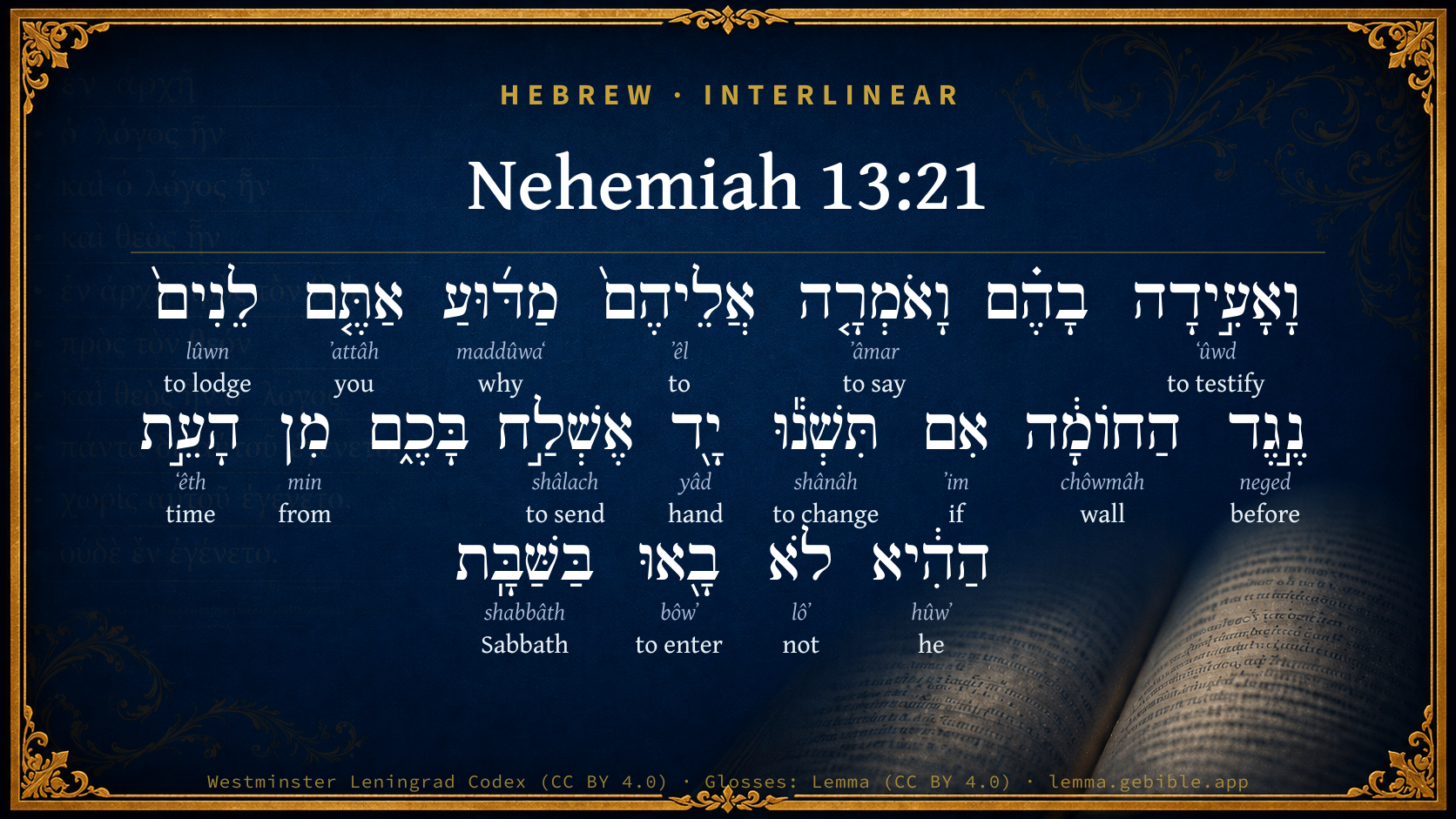
Nehemiah 13:21

Hebrew (Westminster Leningrad Codex) Nehemiah 13:21 appears in the Hebrew Old Testament. The text above is from the Westminster Leningrad Codex. Each word links to its Strong’s number, a concise gloss, and parsing drawn from the Open Scriptures Hebrew Bible morphology. Click any word for its full Brown-Driver-Briggs (BDB) entry.
Download image
Cite this verse

Nehemiah 13:21 (World English Bible). Public Domain. Lemma interlinear Bible study tool, https://lemma.gebible.app/v/nehemiah/13/21.

Show BibTeX & RIS
BibTeX
RIS
English Translation
Then I testified against them, and said to them, Why lodge you about the wall? if you do so again, I will lay hands on you. From that time forth came they no more on the Sabbath.
World English Bible · Public Domain
Download a study sheet

One document with this verse’s original text, its word-by-word gloss line, the meaning frame, cross-references with their text, attributed commentary, and full source and license credits — printable, and it pastes into notes with its structure intact.

This verse Autodidact and up

Study sheet (.html) Plain text (.txt)

A passage Seminary Student

Up to 50 verses in one chapter. A passage sheet keeps up to 6 commentary sources and 12 cross-references per verse, in the order this page ranks them, and says so on the sheet whenever that leaves anything out. Ask for a single verse and you get the Autodidact verse sheet above.

Everything on this page stays free to read, with no account — the sheet is a download of what is already on screen, not access to it.

Want to remove ads? Support Godless Engineer
Compare translations 3

The same verse in 3 English versions, stacked beneath the original-language interlinear above. Click any original word for its lexicon entry.

Each is an independent rendering of the whole verse — the interlinear is not word-aligned to these translations.

Highlighted words mark where these versions differ — a whole-verse word diff, not a word-by-word alignment.

  • World English Bible Public Domain
    Then I testified against them, and said to them, Why lodge you about the wall? if you do so again, I will lay hands on you. From that time forth came they no more on the Sabbath.
  • King James Version Public Domain
    Then I testified against them, and said unto them, Why lodge ye about the wall? if ye do so again, I will lay hands on you. From that time forth came they no more on the sabbath.
  • unfoldingWord Literal Text CC BY-SA 4.0
    And I testified against them, and I said to them, “Why are you lodging in front of the wall? If you repeat, I will stretch out a hand on you!” From that time, they did not come on the sabbath.

unfoldingWord Literal Text — © unfoldingWord, licensed CC BY-SA 4.0. Word-aligned USFM3 via Door43 (git.door43.org/unfoldingWord/en_ult).

Versions to compare (up to 4)

3 of 4 selected

Show all 18 translations

Every available English version of this verse, each an independent rendering of the whole verse.

  • World English Bible Public Domain
    Then I testified against them, and said to them, Why lodge you about the wall? if you do so again, I will lay hands on you. From that time forth came they no more on the Sabbath.
  • Berean Standard Bible Public Domain
    but I warned them, “Why are you camping in front of the wall? If you do it again, I will lay hands on you.” From that time on, they did not return on the Sabbath.
  • Majority Standard Bible Public Domain
    but I warned them, “Why are you camping in front of the wall? If you do it again, I will lay hands on you.” From that time on, they did not return on the Sabbath.
  • King James Version Public Domain
    Then I testified against them, and said unto them, Why lodge ye about the wall? if ye do so again, I will lay hands on you. From that time forth came they no more on the sabbath.
  • American Standard Version (1901) Public Domain
    Then I testified against them, and said unto them, Why lodge ye about the wall? if ye do so again, I will lay hands on you. From that time forth came they no more on the sabbath.
  • Revised Version (1885) Public Domain
    Then I testified against them, and said unto them, Why lodge ye about the wall? if ye do so again, I will lay hands on you. From that time forth came they no more on the sabbath.
  • Geneva Bible (1599) Public Domain
    And I protested among them, and said vnto them, Why tary ye all night about the wall? If ye do it once againe, I will lay hands vpon you. from that time came they no more on the Sabbath.
  • Douay-Rheims (1899) Public Domain
    And I charged them, and I said to them: Why stay you before the wall? if you do so another time, I will lay hands on you. And from that time they came no more on the sabbath.
  • Young's Literal Translation Public Domain
    and I testify against them, and say unto them, `Wherefore are ye lodging over-against the wall? if ye repeat `it', a hand I put forth upon you;' from that time they have not come in on the sabbath.
  • Literal Standard Version CC BY-SA 4.0
    and I testify against them, and say to them, “Why are you lodging in front of the wall? If you repeat [it], I put forth a hand on you”; from that time they have not come in on the Sabbath.
  • Unlocked Literal Bible CC BY-SA 4.0
    But I warned them, “Why do you camp outside the wall? If you do so again, I will lay hands on you!” From that time on they did not come on the Sabbath.
  • unfoldingWord Literal Text CC BY-SA 4.0
    And I testified against them, and I said to them, “Why are you lodging in front of the wall? If you repeat, I will stretch out a hand on you!” From that time, they did not come on the sabbath.
  • Darby Bible Public Domain
    And I testified against them, and said to them, Why do ye pass the night before the wall? if ye do so again, I will lay hands on you. From that time forth they came not on the sabbath.
  • World Messianic Bible Public Domain
    Then I testified against them, and said to them, “Why do you stay around the wall? If you do so again, I will lay hands on you.” From that time on, they didn’t come on the Sabbath.
  • Webster's Bible Public Domain
    Then I testified against them, and said to them, Why lodge ye about the wall? if ye do so again, I will lay hands on you. From that time forth they came no more on the sabbath.
  • Free Bible Version CC BY-SA 4.0
    I warned them, saying, “Why are you spending the night by the wall? If you do that again I'll have you arrested!” After that they didn't come on the Sabbath.
  • Bible in Basic English Public Domain
    Then I gave witness against them and said, Why are you waiting all night by the wall? if you do so again I will have you taken prisoners. From that time they did not come again on the Sabbath.
  • JPS Tanakh (1917) Public Domain
    Then I forewarned them, and said unto them: 'Why lodge ye about the wall? if ye do so again, I will lay hands on you.' From that time forth came they no more on the sabbath.

Literal Standard Version (2020), Covenant Press — licensed CC BY-SA 4.0. Text via the HelloAO Bible API (eBible.org). Unlocked Literal Bible (unfoldingWord) — licensed CC BY-SA 4.0. Text via the HelloAO Bible API (eBible.org). unfoldingWord Literal Text — © unfoldingWord, licensed CC BY-SA 4.0. Word-aligned USFM3 via Door43 (git.door43.org/unfoldingWord/en_ult). Free Bible Version, Dr. Jonathan Gallagher — licensed CC BY-SA 4.0. Text via the HelloAO Bible API (eBible.org).

Word by word

More ways to search: Search by grammar → Find every occurrence → Compare this word →

Practice this passage: Drill this verse → Learn its vocabulary →

תִּשְׁנ֕וּ
shânâh
H8138
“to change”
Verb, Qal, Imperfect, 2nd Person, Masculine, Plural
Part of Speech
Verb
Stem
Qal
Form
Imperfect
Person
2nd Person
Gender
Masculine
Number
Plural
Full BDB Definition

Origin: a primitive root

TWOT: 2421

to repeat, do again, change, alter - (Qal) to change - (Niphal) to be repeated - (Piel) to change, alter - (Hithpael) to disguise oneself
  1. וָאָעִ֣ידָה ʻûwd H5749 “and · to testify” Conjunction + Verb, Hiphil, Sequential Imperfect, 1st Person, Common, Singular + Suffix, h
  2. וָאֹמְרָ֤ה ʼâmar H559 “and · to say” Conjunction + Verb, Qal, Sequential Imperfect, 1st Person, Common, Singular + Suffix, h
  3. אֲלֵיהֶם֙ ʼêl H413 “to · them” Preposition + Suffix, Personal, 3rd Person, Masculine, Plural
  4. מַדּ֜וּעַ maddûwaʻ H4069 “why” Particle, Interrogative
  5. אַתֶּ֤ם ʼattâh H859 “you” Pronoun, Personal, 2nd Person, Masculine, Plural
  6. לֵנִים֙ lûwn H3885 “lodging” Verb, Qal, Participle Active, Masculine, Plural, Absolute
  7. נֶ֣גֶד neged H5048 “before” Preposition
  8. הַחוֹמָ֔ה chôwmâh H2346 “the · wall” Particle, Definite Article + Noun, Common, Feminine, Singular, Absolute
  9. אִם ʼim H518 “if” Conjunction
  10. יָ֖ד yâd H3027 “hand” Noun, Common, Both, Singular, Absolute
  11. אֶשְׁלַ֣ח shâlach H7971 “to send” Verb, Qal, Imperfect, 1st Person, Common, Singular
  12. מִן min H4480 “from” Preposition
  13. הָעֵ֣ת ʻêth H6256 “the · time” Particle, Definite Article + Noun, Common, Both, Singular, Absolute
  14. הַהִ֔יא hûwʼ H1931 “the · he” Particle, Definite Article + Pronoun, Personal, 3rd Person, Feminine, Singular
  15. לֹא lôʼ H3808 “not” Particle, Negative
  16. בָ֖אוּ bôwʼ H935 “to enter” Verb, Qal, Perfect, 3rd Person, Common, Plural
  17. בַּשַּׁבָּֽת shabbâth H7676 “in/at the · Sabbath” Preposition, Determined + Noun, Common, Both, Singular, Absolute

About this verse

These counts appear in no published source. They are computed here, from the morphology-tagged text and Lemma’s own curated glosses. What Lemma adds →

20
words
18
distinct lemmas
Historical
section

Notable vocabulary

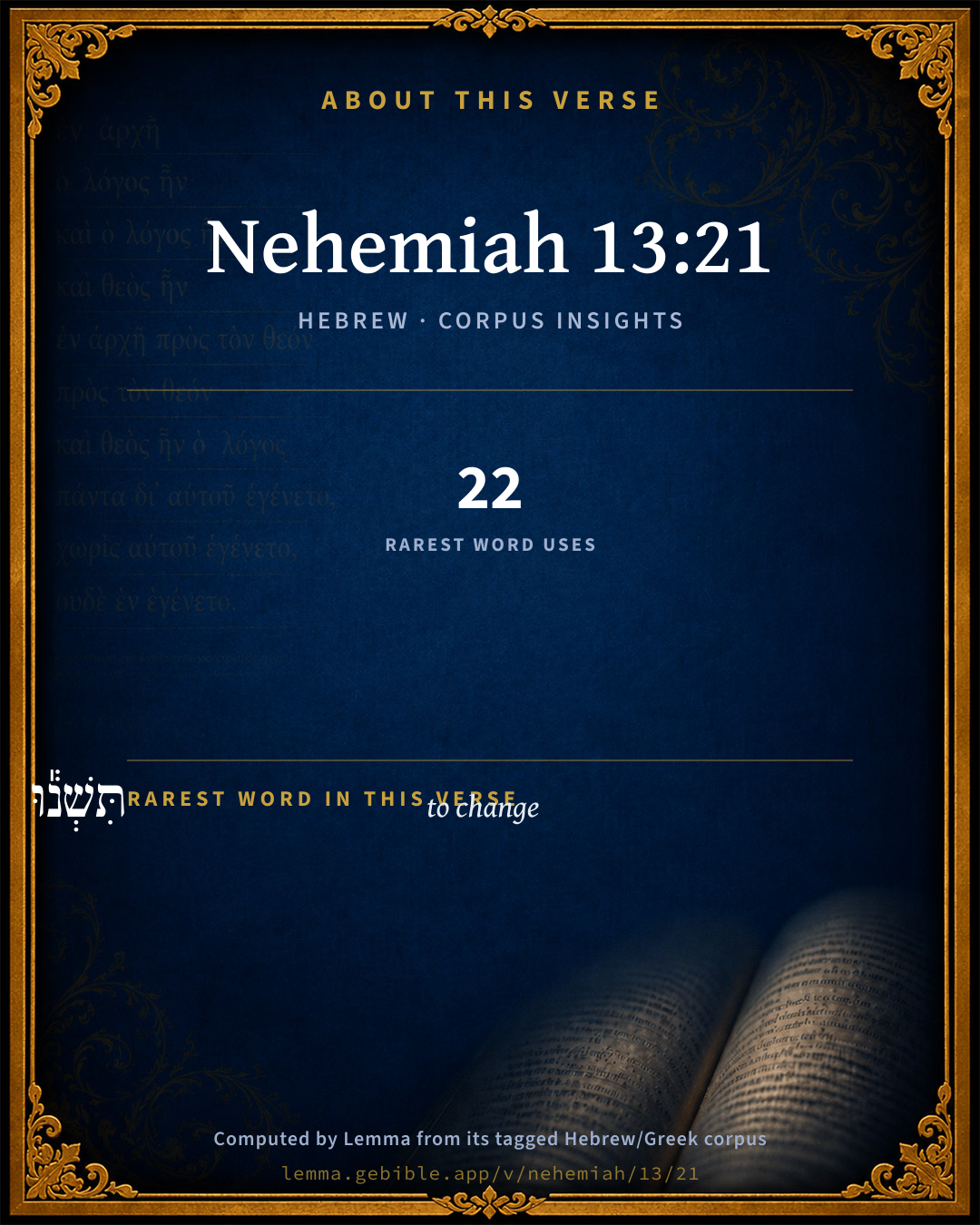
The rarest word here is תִּשְׁנ֕וּ to change H8138 — appearing just 22 times in the whole Hebrew Bible.

Shared distinctive vocabulary

תִּשְׁנ֕וּ to change H8138 occurs in 21 verses of the Hebrew Bible. Also found in:

Grammatical profile

  • 6 verbs
  • 4 nouns
  • 2 pronouns
  • 5 prepositions
  • 1 conjunction
  • 2 particles

Verb forms

  • וָאָעִ֣ידָה Hiphil · Sequential Imperfect
  • וָאֹמְרָ֤ה Qal · Sequential Imperfect
  • לֵנִים֙ Qal · Participle Active
  • תִּשְׁנ֕וּ Qal · Imperfect
  • אֶשְׁלַ֣ח Qal · Imperfect
  • בָ֖אוּ Qal · Perfect

Cross-references

4

Topical passages linked to Nehemiah 13:21 in the Treasury of Scripture Knowledge — connected by theme and wording, ordered by reader-vote popularity; previews shown in the World English Bible.

  • Romans 13:3–4 For rulers are not a terror to the good work, but to the evil. Do you desire to have no fear of the authority? Do that which is good, and you will have praise from the same,
  • Ezra 7:26 Whoever will not do the law of your God, and the law of the king, let judgment be executed on him with all diligence, whether it be to death, or to banishment, or to confiscation of goods, or to imprisonment.
  • 1 Peter 2:14 or to governors, as sent by him for vengeance on evil-doers and for praise to those who do well.
  • Nehemiah 13:15 In those days saw I in Judah some men treading wine-presses on the Sabbath, and bringing in sheaves, and lading donkeys [therewith]; as also wine, grapes, and figs, and all manner of burdens, which they brought into Jerusalem on the Sabbath day: and I testified [against them] in the day in which they sold food.

Cross-references courtesy of OpenBible.info (CC BY 4.0).

Hebrew and Greek witnesses Masoretic Hebrew ↔ Greek Septuagint

The same verse in the two great witnesses to the Old Testament, shown verse-for-verse.

These are two independent witnesses, not word-aligned to each other, and the Septuagint is shown in lemma (dictionary) form.

Hebrew Nehemiah 13:21 Masoretic · Westminster Leningrad Codex

וָאָעִ֣ידָה בָהֶ֗ם וָאֹמְרָ֤ה אֲלֵיהֶם֙ מַדּ֜וּעַ אַתֶּ֤ם לֵנִים֙ נֶ֣גֶד הַחוֹמָ֔ה אִם תִּשְׁנ֕וּ יָ֖ד אֶשְׁלַ֣ח בָּכֶ֑ם מִן הָעֵ֣ת הַהִ֔יא לֹא בָ֖אוּ בַּשַּׁבָּֽת

Then I testified against them, and said to them, Why lodge you about the wall? if you do so again, I will lay hands on you. From that time forth came they no more on the Sabbath.

World English Bible · Public Domain

Greek LXX Structure differs

The Septuagint has no separate book of Nehemiah. Its Greek text is the second half of Esdras B (2 Esdras), chapters 11–23; Ezra is the first half (1–10).

A verse-for-verse comparison isn’t shown here because the chapters and verses don’t line up. Switch to the LXX edition with the MT / LXX toggle above to read the Greek directly.

On this verse, The Cambridge Bible for Schools and Colleges discusses the Septuagint’s reading. Read the note in Commentary ↓

Hebrew: Westminster Leningrad Codex (CC BY 4.0). Greek: Septuagint (public domain); English from a public-domain English Septuagint. How the Septuagint differs from the Hebrew →

Commentary

Notes on Nehemiah 13:21 from classic Christian and Jewish commentators (each source and its license shown beneath its notes). The classic Christian expositions comment on the surrounding passage and are grouped to its opening verse, so a note may address several verses; the Jewish commentaries on the Tanakh (Rashi and others) are per-verse, so they appear only where the commentator wrote on this verse.

Lemma curates 59 commentaries, every one of them public domain or Creative Commons licensed, each selected and text-cleaned for this edition rather than reprinted as found. About our sources →

Trapp's Complete Commentary

John Trapp

Neh 13:21 Then I testified against them, and said unto them, Why lodge ye about the wall? if ye do [so] again, I will lay hands on you. From that time forth came they no [more] on the sabbath.

Ver. 21. Why lodge ye about the wall?] His care was also lest God should be dishonoured in the suburbs. A little fire warms but a little way off, when a great one casteth about its heat far and near. He feared also lest those within the walls, seeing them, might be tempted to wish themselves with them; as when Sulla, the Roman, lay before the walls of Athens, the citizens’ minds were with him, though their bodies were kept from him.

I will lay hands on you] I will lay you fast enough: be packing, therefore. The best way to be rid of sin is to threaten it, punish it, by the practice of mortification, to handle it roughly. We are not debtors to the flesh, Rom 8:12. We owe it nothing but stripes, nothing but the blue eye St Paul gave it, 1Co 9:27, υπωπιαζω.

John Trapp, A Commentary or Exposition upon All the Books of the Old and New Testament (1647–1656) — public domain. Text from a community e-Sword module.

Adam Clarke's Commentary

Verse 21. I will lay hands on you] I will imprison every man of you. This had the desired effect; they came no more.

Adam Clarke's Commentary on the Bible (1810–1826) — public domain. Text from a community e-Sword/MySword module.

The Cambridge Bible for Schools and Colleges

gen. ed. J. J. S. Perowne

21. Why lodge ye about the wall?] R.V. marg. ‘Heb. before’, LXX. ἀπέναντι, Vulg. ‘ex adverso.’ Nehemiah, in his capacity of governor, was able to put his foot down upon this evasion of his law. He threatened the traders that, if they hung about on the outskirts of the walls on the Sabbath, he would treat them as public enemies.

The Cambridge Bible for Schools and Colleges (gen. ed. J. J. S. Perowne; Cambridge University Press, 1878–1918) — public domain. Text from a community e-Sword module.

John Gill's Exposition

And their children spoke half in the speech of Ashdod,.... Which they learned of their mothers, so that it was a mixed language they spoke, partly Jewish and partly Philistine; but some refer this not to their speech, but to the number of their children; that half of them, which Jarchi interprets many of them, spoke in the language of Ashdod, even as many as were most with their mothers, and chiefly brought up by them:

and could not speak in the Jews' language; not at all, or so much as to be understood well, which inclines to the last sense:

but according to the language of each people; their mothers were of, whether of Ashdod, or of Ammon, or of Moab.

John Gill's Exposition of the Whole Bible (1746–1763) — public domain (CC PDM 1.0). Text via the HelloAO Bible API.

Albert Barnes' Notes on the Bible

The lodging of the merchants with their merchandise just outside Jerusalem during the Sabbath, marked their impatience for the moment when they might bring their wares in. This was thought by Nehemiah to be unseemly, and to have an irreligious tendency.

Albert Barnes' Notes on the Bible (1834–1885) — public domain. Text from a community e-Sword/MySword module.

Haydock's Catholic Bible Commentary

On you. To punish you, (Calmet) for thus endeavouring to tempt the people. (Haydock)

George Leo Haydock (1774–1849), Haydock's Catholic Family Bible and Commentary, 1859 edition — public domain. Excludes Psalms (Douay-Rheims chapter numbering differs from Protestant) and Deuterocanonical books (Catholic canon only).

Matthew Poole's English Annotations

I will lay hands on you; I will punish you, and seize your goods. For this was a temptation to covetous or needy Jews, that lived in or near the city, to steal opportunities of buying their commodities, which then they might do with more advantage.

Matthew Poole's English Annotations on the Holy Bible (1683–1685) — public domain. Text from a community e-Sword/MySword module.

Whedon's Commentary on the Bible

Daniel D. Whedon

21. I will lay hands on you — Proceed to violent measures, and arrest and treat you as criminals.

Daniel D. Whedon (gen. ed.), Commentary on the Old and New Testaments (1874–1909) — public domain. Text from a community e-Sword module.

unfoldingWord translationNotes

Door43 World Missions Community

Why do you camp outside the wall?

Nehemiah uses a rhetorical question to rebuke merchants and to emphasize his command. This question can be translated as a statement. The full meaning of this statement can also be made explicit. AT: "You are camping outside the wall against what I commanded." (See: Rhetorical Question and Assumed Knowledge and Implicit Information)

I will lay hands on you!

The word "hands" is a metonym for forceful action. AT: "I will send you away by force!" or "I will remove you by force!" (See: Metonymy)

Call me to mind for this also, my God

"My God, remember me concerning this also." See how you translated a similar phrase in Nehemiah 13:14.

translationWords

hand

Sabbath

command

Levi

pure

sanctify

call

mind

God

mercy

covenant

unfoldingWord translationNotes — © Distant Shores Media and the Door43 World Missions Community, licensed CC BY-SA 4.0. Source: git.door43.org/Door43/en_tn.

Rashi

Rabbi Shlomo Yitzchaki (Rashi)

and I said to them I warned those traffickers.

If you repeat this if you continue to do this a second time.

Since that time From that day on, they did not come on the Sabbath day.

Rashi on the Tanakh — English translations: “The Judaica Press complete Tanach with Rashi, translated by A. J. Rosenberg” (CC BY 4.0); “Pentateuch with Rashi's commentary by M. Rosenbaum and A.M. Silbermann, 1929-1934” (public domain); “The Metsudah Tanach series, Lakewood, N.J” (CC BY 4.0); and “The Book of Joshua, Metsudah Publications, 1997” (CC BY 4.0). Text via Sefaria.

Lesson kit

Teaching starters — assembled from the data on this page, not authored interpretation. Every prompt links to the verse data it draws on. Edit before teaching.

Nehemiah, in the Historical, opens this verse with 20 words (18 distinct Hebrew lemmas). Its most distinctive word is shânâh (“to change”). A historical commentator’s framing appears above. Read the whole chapter for the surrounding context.

Discussion questions

  1. What does “to change” (shânâh) contribute to the verse as a whole?
  2. Genesis 41:32 shares the word «to change» with this verse. How do the two illuminate each other?
  3. These translations render this verse differently; the difference is in the English rendering, not the original. What questions does that raise?
  4. The verb «וָאָעִ֣ידָה» is Hiphil Sequential Imperfect. How does its form color the action?
  5. Reading how Trapp's Complete Commentary and Adam Clarke's Commentary read this verse, where do the two commentators agree and where do they part?

Things to notice

Reading settings

Reading text

Shown beneath each verse's original-language words.

Old Testament
Old Testament edition

Read the OT as the Masoretic Hebrew (MT) or the Greek Septuagint (LXX).

English shown for the Greek Septuagint (in the Hebrew ↔ Greek comparison).

Comparing translations? Open the Compare panel on any verse page to stack up to four side by side.