
Ecclesiastes 9:12

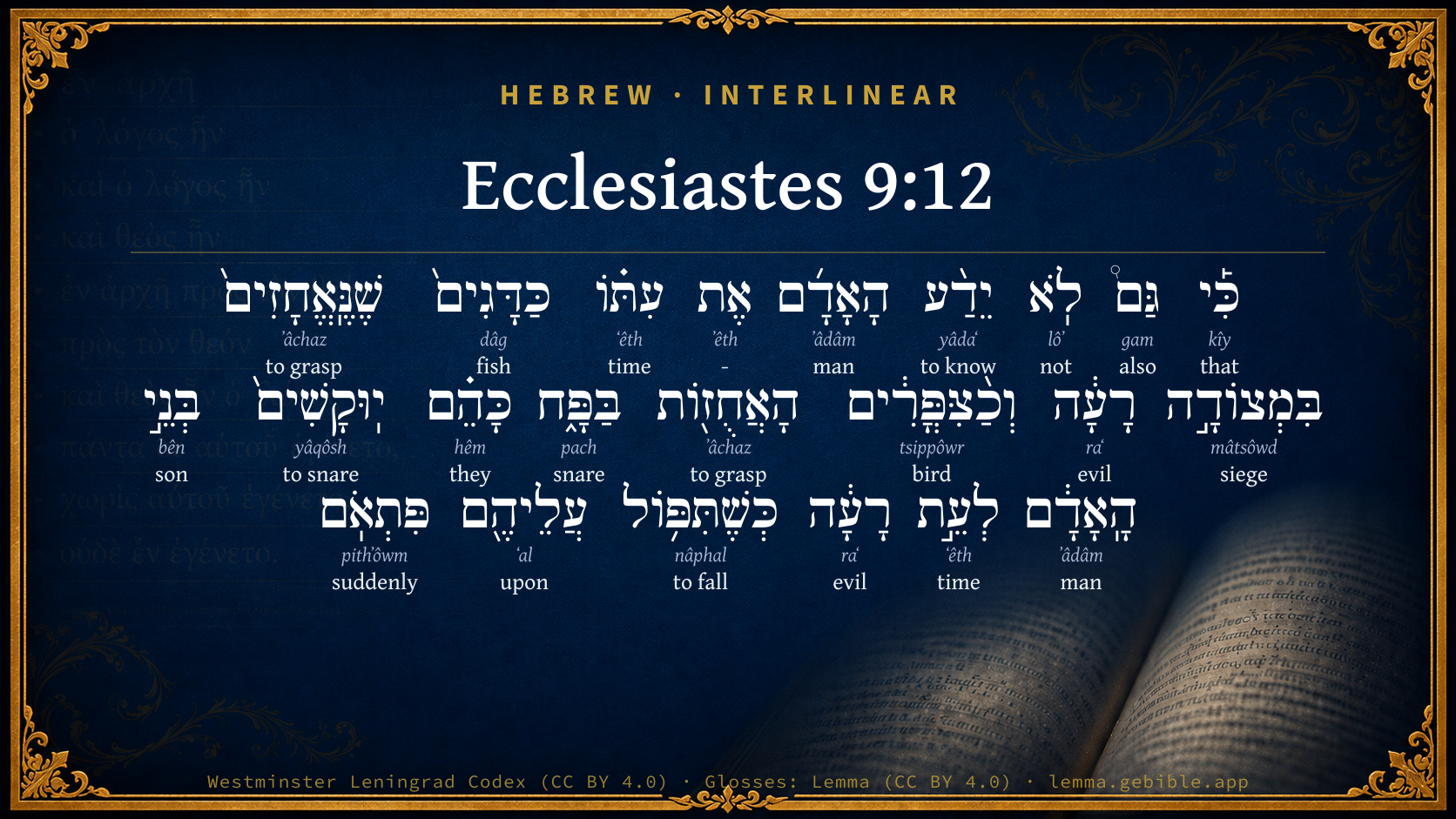
Hebrew (Westminster Leningrad Codex) Ecclesiastes 9:12 appears in the Hebrew Old Testament. The text above is from the Westminster Leningrad Codex. Each word links to its Strong’s number, a concise gloss, and parsing drawn from the Open Scriptures Hebrew Bible morphology. Click any word for its full Brown-Driver-Briggs (BDB) entry.
Download image
Cite this verse

Ecclesiastes 9:12 (World English Bible). Public Domain. Lemma interlinear Bible study tool, https://lemma.gebible.app/v/ecclesiastes/9/12.

Show BibTeX & RIS
BibTeX
RIS
English Translation
For man also doesn't know his time. As the fish that are taken in an evil net, and as the birds that are caught in the snare, even so are the sons of men snared in an evil time, when it falls suddenly on them.
World English Bible · Public Domain
Download a study sheet

One document with this verse’s original text, its word-by-word gloss line, the meaning frame, cross-references with their text, attributed commentary, and full source and license credits — printable, and it pastes into notes with its structure intact.

This verse Autodidact and up

Study sheet (.html) Plain text (.txt)

A passage Seminary Student

Up to 50 verses in one chapter. A passage sheet keeps up to 6 commentary sources and 12 cross-references per verse, in the order this page ranks them, and says so on the sheet whenever that leaves anything out. Ask for a single verse and you get the Autodidact verse sheet above.

Everything on this page stays free to read, with no account — the sheet is a download of what is already on screen, not access to it.

Want to remove ads? Support Godless Engineer
Compare translations 3

The same verse in 3 English versions, stacked beneath the original-language interlinear above. Click any original word for its lexicon entry.

Each is an independent rendering of the whole verse — the interlinear is not word-aligned to these translations.

Highlighted words mark where these versions differ — a whole-verse word diff, not a word-by-word alignment.

  • World English Bible Public Domain
    For man also doesn't know his time. As the fish that are taken in an evil net, and as the birds that are caught in the snare, even so are the sons of men snared in an evil time, when it falls suddenly on them.
  • King James Version Public Domain
    For man also knoweth not his time: as the fishes that are taken in an evil net, and as the birds that are caught in the snare; so are the sons of men snared in an evil time, when it falleth suddenly upon them.
  • unfoldingWord Literal Text CC BY-SA 4.0
    For humanity does not even know his time. Like the fish that are caught in a troublesome net, and like the birds that are caught in the snare— like them, the sons of humanity are snared at a time of misfortune when it falls upon them suddenly.

unfoldingWord Literal Text — © unfoldingWord, licensed CC BY-SA 4.0. Word-aligned USFM3 via Door43 (git.door43.org/unfoldingWord/en_ult).

Versions to compare (up to 4)

3 of 4 selected

Show all 18 translations

Every available English version of this verse, each an independent rendering of the whole verse.

  • World English Bible Public Domain
    For man also doesn't know his time. As the fish that are taken in an evil net, and as the birds that are caught in the snare, even so are the sons of men snared in an evil time, when it falls suddenly on them.
  • Berean Standard Bible Public Domain
    For surely no man knows his time: Like fish caught in a cruel net or birds trapped in a snare, so men are ensnared in an evil time that suddenly falls upon them.
  • Majority Standard Bible Public Domain
    For surely no man knows his time: Like fish caught in a cruel net or birds trapped in a snare, so men are ensnared in an evil time that suddenly falls upon them.
  • King James Version Public Domain
    For man also knoweth not his time: as the fishes that are taken in an evil net, and as the birds that are caught in the snare; so are the sons of men snared in an evil time, when it falleth suddenly upon them.
  • American Standard Version (1901) Public Domain
    For man also knoweth not his time: as the fishes that are taken in an evil net, and as the birds that are caught in the snare, even so are the sons of men snared in an evil time, when it falleth suddenly upon them.
  • Revised Version (1885) Public Domain
    For man also knoweth not his time: as the fishes that are taken in an evil net, and as the birds that are caught in the snare, even so, are the sons of men snared in an evil time, when it falleth suddenly upon them.
  • Geneva Bible (1599) Public Domain
    For neither doth man knowe his time, but as the fishes which are taken in an euill net, and as the birdes that are caught in the snare: so are the children of men snared in the euill time when it falleth vpon them suddenly.
  • Douay-Rheims (1899) Public Domain
    Man knoweth not his own end: but as fishes are taken with the hook, and as birds are caught with the snare, so men are taken in the evil time, when it shall suddenly come upon them.
  • Young's Literal Translation Public Domain
    For even man knoweth not his time; as fish that are taken hold of by an evil net, and as birds that are taken hold of by a snare, like these `are' the sons of man snared at an evil time, when it falleth upon them suddenly.
  • Literal Standard Version CC BY-SA 4.0
    For even man does not know his time; as fish that are taken hold of by an evil net, and as birds that are taken hold of by a snare, the sons of man are snared like these at an evil time when it falls on them suddenly.
  • Unlocked Literal Bible CC BY-SA 4.0
    Surely, no one knows when his time will come. As fish are caught in a deadly net, or birds are caught in a snare, the children of human beings are ensnared by evil times that suddenly fall upon them.
  • unfoldingWord Literal Text CC BY-SA 4.0
    For humanity does not even know his time. Like the fish that are caught in a troublesome net, and like the birds that are caught in the snare— like them, the sons of humanity are snared at a time of misfortune when it falls upon them suddenly.
  • Darby Bible Public Domain
    For man also knoweth not his time: as the fishes that are taken in an evil net, and as the birds that are taken with the snare, like them are the children of men snared in an evil time, when it falleth suddenly upon them.
  • World Messianic Bible Public Domain
    For man also doesn’t know his time. As the fish that are taken in an evil net, and as the birds that are caught in the snare, even so are the sons of men snared in an evil time, when it falls suddenly on them.
  • Webster's Bible Public Domain
    For man also knoweth not his time: as the fishes that are taken in an evil net, and as the birds that are caught in the snare; so are the sons of men snared in an evil time, when it falleth suddenly upon them.
  • Free Bible Version CC BY-SA 4.0
    You can't predict when your end will come. Just like fish caught in a net, or birds caught in a trap, so people are suddenly caught by death when they least expect it.
  • Bible in Basic English Public Domain
    Even man has no knowledge of his time; like fishes taken in an evil net, or like birds taken by deceit, are the sons of men taken in an evil time when it comes suddenly on them.
  • JPS Tanakh (1917) Public Domain
    For man also knoweth not his time; as the fishes that are taken in an evil net, and as the birds that are caught in the snare, even so are the sons of men snared in an evil time, when it falleth suddenly upon them.

Literal Standard Version (2020), Covenant Press — licensed CC BY-SA 4.0. Text via the HelloAO Bible API (eBible.org). Unlocked Literal Bible (unfoldingWord) — licensed CC BY-SA 4.0. Text via the HelloAO Bible API (eBible.org). unfoldingWord Literal Text — © unfoldingWord, licensed CC BY-SA 4.0. Word-aligned USFM3 via Door43 (git.door43.org/unfoldingWord/en_ult). Free Bible Version, Dr. Jonathan Gallagher — licensed CC BY-SA 4.0. Text via the HelloAO Bible API (eBible.org).

Word by word

More ways to search: Search by grammar → Find every occurrence → Compare this word →

Practice this passage: Drill this verse → Learn its vocabulary →

בִּמְצוֹדָ֣ה
mâtsôwd
H4685
“in/at · siege”
Preposition + Noun, Common, Feminine, Singular, Absolute
Part of Speech
Preposition + Noun
Type
Common
Gender
Feminine
Number
Singular
State
Absolute
Full BDB Definition

Origin: from H6679

TWOT: 1885d , 1885e

siege-works, bulwark (noun masculine) - hunting implement, net (noun masculine) - net (noun feminine) - fastness, stronghold (noun feminine)
  1. כִּ֡י kîy H3588 “that” Conjunction
  2. גַּם֩ gam H1571 “also” Particle, Accusative
  3. לֹֽא lôʼ H3808 “not” Particle, Negative
  4. יֵדַ֨ע yâdaʻ H3045 “to know” Verb, Qal, Imperfect, 3rd Person, Masculine, Singular
  5. הָאָדָ֜ם ʼâdâm H120 “the · man” Particle, Definite Article + Noun, Common, Masculine, Singular, Absolute
  6. אֶת ʼêth H853 “-” Particle, Direct Object
  7. עִתּ֗וֹ ʻêth H6256 “time · his” Noun, Common, Both, Singular, Construct + Suffix, Personal, 3rd Person, Masculine, Singular
  8. כַּדָּגִים֙ dâg H1709 “like/as the · fish” Preposition, Determined + Noun, Common, Masculine, Plural, Absolute
  9. שֶׁנֶּֽאֱחָזִים֙ ʼâchaz H270 “who/which · grasped” Particle, Relative + Verb, Niphal, Participle Passive, Masculine, Plural, Absolute
  10. רָעָ֔ה raʻ H7451 “evil” Adjective, Adjective, Feminine, Singular, Absolute
  11. וְכַ֨צִּפֳּרִ֔ים tsippôwr H6833 “and · like/as · birds” Conjunction + Preposition + Noun, Common, Both, Plural, Absolute
  12. הָאֲחֻז֖וֹת ʼâchaz H270 “the · grasped” Particle, Definite Article + Verb, Qal, Participle Passive, Feminine, Plural, Absolute
  13. בַּפָּ֑ח pach H6341 “in/at the · snare” Preposition, Determined + Noun, Common, Masculine, Singular, Absolute
  14. כָּהֵ֗ם hêm H1992 “like/as · they” Preposition + Pronoun, Personal, 3rd Person, Masculine, Plural
  15. יֽוּקָשִׁים֙ yâqôsh H3369 “snared” Verb, Pual, Participle Passive, Masculine, Plural, Absolute
  16. בְּנֵ֣י bên H1121 “sons of” Noun, Common, Masculine, Plural, Construct
  17. הָֽאָדָ֔ם ʼâdâm H120 “the · man” Particle, Definite Article + Noun, Common, Masculine, Singular, Absolute
  18. לְעֵ֣ת ʻêth H6256 “to/for · time of” Preposition + Noun, Common, Both, Singular, Construct
  19. רָעָ֔ה raʻ H7451 “evil” Adjective, Adjective, Feminine, Singular, Absolute
  20. כְּשֶׁתִּפּ֥וֹל nâphal H5307 “like/as · who/which · to fall” Preposition + Particle, Relative + Verb, Qal, Imperfect, 3rd Person, Feminine, Singular
  21. עֲלֵיהֶ֖ם ʻal H5921 “upon · them” Preposition + Suffix, Personal, 3rd Person, Masculine, Plural
  22. פִּתְאֹֽם pithʼôwm H6597 “suddenly” Adverb

About this verse

These counts appear in no published source. They are computed here, from the morphology-tagged text and Lemma’s own curated glosses. What Lemma adds →

23
words
19
distinct lemmas
Wisdom
section

Notable vocabulary

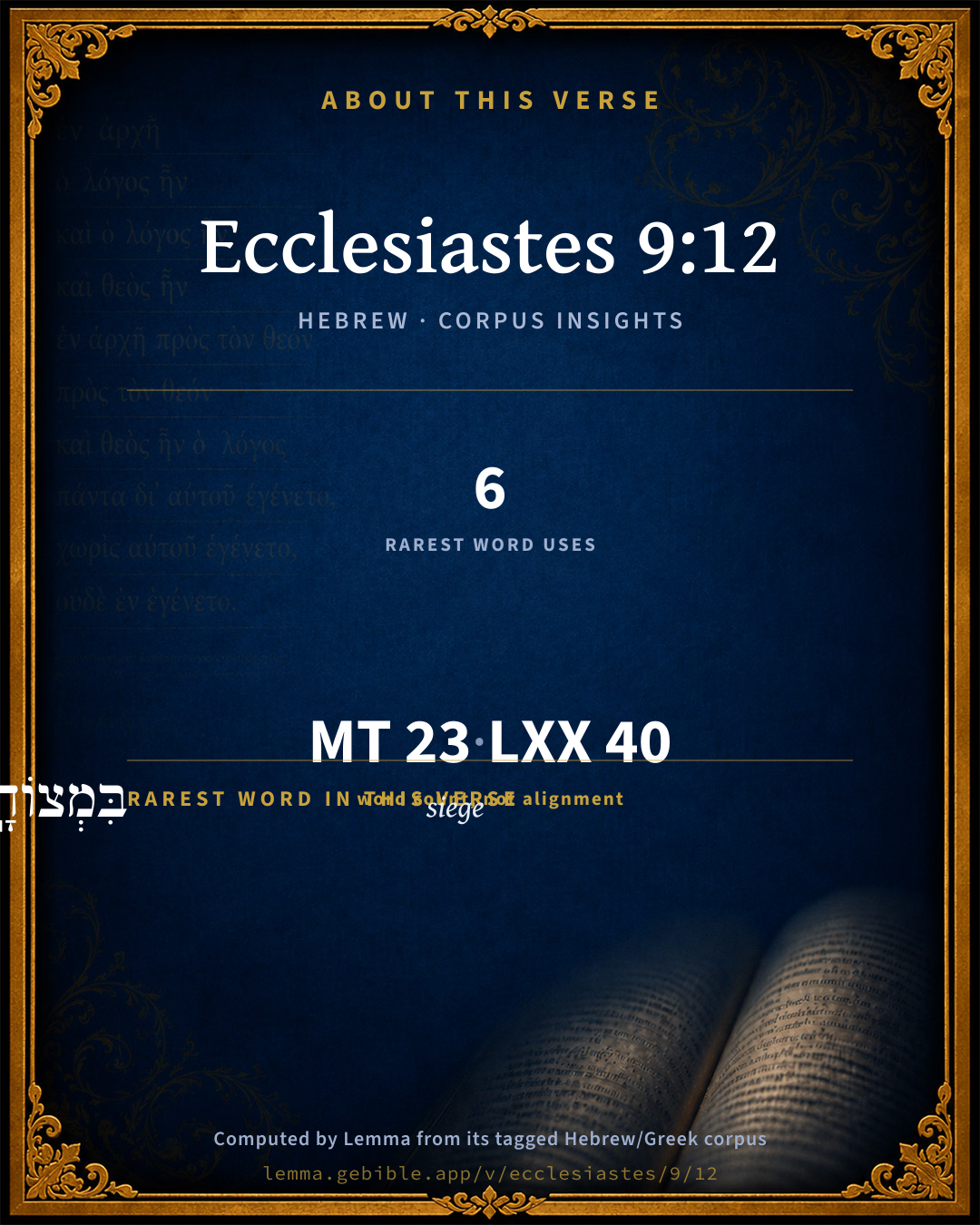
The rarest word here is בִּמְצוֹדָ֣ה siege H4685 — appearing just 6 times in the whole Hebrew Bible.

Shared distinctive vocabulary

בִּמְצוֹדָ֣ה siege H4685 occurs in 6 verses of the Hebrew Bible. Also found in:

Grammatical profile

  • 5 verbs
  • 9 nouns
  • 2 adjectives
  • 1 pronoun
  • 1 preposition
  • 1 conjunction
  • 1 adverb
  • 3 particles

Verb forms

  • יֵדַ֨ע Qal · Imperfect
  • שֶׁנֶּֽאֱחָזִים֙ Niphal · Participle Passive
  • הָאֲחֻז֖וֹת Qal · Participle Passive
  • יֽוּקָשִׁים֙ Pual · Participle Passive
  • כְּשֶׁתִּפּ֥וֹל Qal · Imperfect

Repetition

Words recur within this verse — often emphatic in Hebrew:

  • הָאָדָ֜ם man H120 ×2
  • עִתּ֗וֹ time H6256 ×2
  • שֶׁנֶּֽאֱחָזִים֙ to grasp H270 ×2
  • רָעָ֔ה evil H7451 ×2

Hebrew & Septuagint length

In English translation the verse runs 45 words from the Hebrew and 44 from the Septuagint (LXX English) — closely comparable.

A rough comparison of the two English renderings, which tokenize alike — not a word-level alignment.

Word counts can differ between the Hebrew and the Greek without any difference in meaning — e.g. the Hebrew direct-object marker אֵת has no separate Greek word, and Greek often adds the article ὁ.

In the original languages it is 23 Hebrew tokens and 40 Greek tokens — but the two are counted differently (Hebrew bundles its prefixes and suffixes into one token; the Greek is in lemma form), so that isn’t a like-for-like length.

Cross-references

20

Topical passages linked to Ecclesiastes 9:12 in the Treasury of Scripture Knowledge — connected by theme and wording, ordered by reader-vote popularity; previews shown in the World English Bible.

  • 1 Thessalonians 5:3 For when they are saying, "Peace and safety," then sudden destruction will come on them, like birth pains on a pregnant woman; and they will in no way escape.
  • Luke 21:34–36 "So be careful, or your hearts will be loaded down with carousing, drunkenness, and cares of this life, and that day will come on you suddenly.
  • Proverbs 6:15 Therefore his calamity will come suddenly. He will be broken suddenly, and that without remedy.
  • Proverbs 29:6 An evil man is snared by his sin, But the righteous can sing and be glad.
  • Ecclesiastes 8:5–7 Whoever keeps the commandment shall not come to harm, and his wise heart will know the time and procedure.
  • Job 18:8–10 For he is cast into a net by his own feet, And he wanders into its mesh.
  • Psalms 73:18–20 Surely you set them in slippery places. You throw them down to destruction.
  • Proverbs 7:22–23 He followed her immediately, As an ox goes to the slaughter, As a fool stepping into a noose.
  • Luke 12:20 "But God said to him, 'You foolish one, tonight your soul is required of you. The things which you have prepared--whose will they be?'
  • 2 Corinthians 6:2 for he says, "At an acceptable time I listened to you, In a day of salvation I helped you." Behold, now is the acceptable time. Behold, now is the day of salvation.
  • 2 Timothy 2:26 and they may recover themselves out of the devil's snare, having been taken captive by him to his will.
  • Psalms 11:6 On the wicked he will rain blazing coals; Fire, sulfur, and scorching wind shall be the portion of their cup.
  • Isaiah 30:13 therefore this iniquity shall be to you as a breach ready to fall, swelling out in a high wall, whose breaking comes suddenly in an instant.
  • Habakkuk 1:14–17 and make men like the fish of the sea, like the creeping things, that have no ruler over them?
  • Luke 12:39 But know this, that if the master of the house had known in what hour the thief was coming, he would have watched, and not allowed his house to be broken into.
  • Luke 17:26–31 As it happened in the days of Noah, even so will it be also in the days of the Son of Man.
  • Luke 19:42–44 saying, "If you, even you, had known today the things which belong to your peace! But now, they are hidden from your eyes.
  • 2 Peter 2:12 But these, as unreasoning creatures, born natural animals to be taken and destroyed, speaking evil in matters about which they are ignorant, will in their destroying surely be destroyed,
  • Ecclesiastes 8:11 Because sentence against an evil work is not executed speedily, therefore the heart of the sons of men is fully set in them to do evil.
  • 1 Peter 2:12 having good behavior among the nations, so in that which they speak against you as evil-doers, they may by your good works, which they see, glorify God in the day of visitation.

Cross-references courtesy of OpenBible.info (CC BY 4.0).

Hebrew and Greek witnesses Masoretic Hebrew ↔ Greek Septuagint

The same verse in the two great witnesses to the Old Testament, shown verse-for-verse.

These are two independent witnesses, not word-aligned to each other, and the Septuagint is shown in lemma (dictionary) form.

Hebrew Ecclesiastes 9:12 Masoretic · Westminster Leningrad Codex

כִּ֡י גַּם֩ לֹֽא יֵדַ֨ע הָאָדָ֜ם אֶת עִתּ֗וֹ כַּדָּגִים֙ שֶׁנֶּֽאֱחָזִים֙ בִּמְצוֹדָ֣ה רָעָ֔ה וְכַ֨צִּפֳּרִ֔ים הָאֲחֻז֖וֹת בַּפָּ֑ח כָּהֵ֗ם יֽוּקָשִׁים֙ בְּנֵ֣י הָֽאָדָ֔ם לְעֵ֣ת רָעָ֔ה כְּשֶׁתִּפּ֥וֹל עֲלֵיהֶ֖ם פִּתְאֹֽם

For man also doesn't know his time. As the fish that are taken in an evil net, and as the birds that are caught in the snare, even so are the sons of men snared in an evil time, when it falls suddenly on them.

World English Bible · Public Domain

Greek LXX Ecclesiastes 9:12 Septuagint · lemma form

ὅτι καί γέ οὐ γιγνώσκω ὁ ἄνθρωπος ὁ καιρός αὐτός ὡς ὁ ἰχθύς ὁ θηρεύω ἐν ἀμφίβληστρον κακός καί ὡς ὄρνεον ὁ θηρεύω ἐν παγίς ὡς αὐτός παγιδεύω ὁ υἱός ὁ ἄνθρωπος εἰς καιρός πονηρός ὅταν ἐπιπίπτω ἐπί αὐτός ἄφνω

For surely man also knows not his time: as fishes that are taken in an evil net, and as birds that are caught in a snare; even thus the sons of men are snared at an evil time, when it falls suddenly upon them.

LXX2012 (modern English Septuagint) · Public Domain

On this verse, Trapp's Complete Commentary discusses the Septuagint’s reading. Read the note in Commentary ↓

Hebrew: Westminster Leningrad Codex (CC BY 4.0). Greek: Septuagint (public domain); English from LXX2012 (modern English Septuagint) (Public Domain). How the Septuagint differs from the Hebrew →

Commentary

Notes on Ecclesiastes 9:12 from classic Christian and Jewish commentators (each source and its license shown beneath its notes). The classic Christian expositions comment on the surrounding passage and are grouped to its opening verse, so a note may address several verses; the Jewish commentaries on the Tanakh (Rashi and others) are per-verse, so they appear only where the commentator wrote on this verse.

Lemma curates 59 commentaries, every one of them public domain or Creative Commons licensed, each selected and text-cleaned for this edition rather than reprinted as found. About our sources →

Trapp's Complete Commentary

John Trapp

Ecc 9:12 For man also knoweth not his time: as the fishes that are taken in an evil net, and as the birds that are caught in the snare; so [are] the sons of men snared in an evil time, when it falleth suddenly upon them.

Ver. 12. For man also knoweth not his time.] His end, say the Septuagint and Vulgate; what may befall him in after time, say others.

“ Flebile principium melior fortuna sequatur,

Accidit in puncto quod non speratur in anno. ”

So are the sons of men snared in an evil time.] This is the reddition of the former proposition. As the fishes are taken, &c., so are graceless men snared, &c. Security ushers in their calamity: "When they say, Peace and safety, then sudden destruction breaks in upon them, as travail upon a woman with child, and they shall not escape." {1Th 5:3} God made fair weather before Pharaoh till he was in the heart of the Red Sea. The old world, Sodom, Amnon, Belshazzar, Herod, the rich fool, were all suddenly surprised in the ruff of their jollity. Jerusalem had three years of extraordinary great plenty before her last utter destruction. {a} Philosophers tell us that before a snow the weather will be warmish; when the wind lies, the great rain falls; and the air is most quiet when suddenly there will be an earthquake.

{a} Josephus.

John Trapp, A Commentary or Exposition upon All the Books of the Old and New Testament (1647–1656) — public domain. Text from a community e-Sword module.

The Biblical Illustrator

Joseph S. Exell

Ecc_9:12

Man also knoweth not his time.

Blessed ignorance

If ignorance is bliss, tis folly to be wise. This applies to our ignorance in relation to the future. It is mercy that has woven the veil.

I. If we knew our future, enjoyment would be impossible. Suppose we knew all the bereavements, sufferings, adversities that are before us, and the time, circumstances, and place of our death, would there be any pleasure for us on this earth?

II. If we knew our future, duty would be impracticable. With all the dark events of our future clearly marked out before us, we should stand aghast, and be utterly unfit for the ordinary duties of life.

III. If we knew our future, life would be intolerable. It would be utterly impossible for our fragile natures to bear such a vision. (Homilist.)

Mans ignorance of the time of his death

These words suggest a few thoughts concerning death.

I. It is inevitable. His time: that is, his time to die; fixed by an irrevocable decree (Heb_9:27). Science, art, wealth, all have been tried, to avoid death; but all have failed.

II. It is insidious. The fish is pursuing its own course through the waters, in search of its prey, and unconscious of danger, when, all at once, it finds itself hopelessly entangled in the folds, or caught in the meshes of the fishers net, and there is no escape. The bird is following its instinct, in quest of food, when the limed twig or the baited trap, on which it alights, robs it of its freedom, and consigns it into the hands of the fowler. As blind, oftentimes, is man himself to the coming stroke which is to smite him to the dust.

III. It is unexpected. Boast not thyself of to-morrow, etc. Take heed, for in such an hour as ye think not, etc. (T. Manton, D. D.)

Man knoweth not his time

I. Consider the evidences of the fact--that man knoweth not his time.

1. With respect to men in general, they do not know the time of their visitation. This is evidently the case with the impenitent and unbelieving, who disregard the tokens both of the favour and displeasure of God. The founder melteth in vain, and the wicked are not plucked away. The day of opportunity is lost, perhaps never to be regained. Nor can Christians themselves be wholly acquitted of the charge of inattention. Too apt are we to deprive ourselves of the gracious presence of the Saviour for the want of a little more humility and self-denial.

2. Man knoweth not his time as to the seasonable performance of various duties. Sometimes we have had, loud calls to humiliation and prayer, when, like Israel of old, we have given ourselves up to joy and gladness, slaying oxen, and killing sheep, eating flesh, and drinking wine (Isa_22:13). Sometimes we have had a favourable opportunity of bearing our testimony to the important doctrines of the Gospel, or the equally important duties of practical religion: yet we have neither had a heart nor a tongue to speak, when a few words might have had a very happy effect.

3. We do not know the time when afflictions will come, or when we shall be delivered out of them. God has an appointed time for both. All events are safe in His hands, but they are at the same time concealed. His counsel shall stand, and He will do all His pleasure. We can no more advance or retard Gods work than we can hasten the rising sun, or hinder its going down (Isa_60:22).

4. We know not the time of our continuance in life or departure out of it.

5. We know not the day of judgment, or the final period of all things. Our ignorance in this respect is best suited to that state of subjection to the wisdom and sovereignty of God in which we are placed, and to the nature of that economy which He has established, as well as to the limited extent of our frailties.

II. Inquire the reason why man is left in ignorance of particular times and seasons.

1. It tends to do honour to the Divine government (Pro_25:2).

2. The knowledge of times and seasons would be injurious to us rather than advantageous. Hereby faith, hope, and patience, so much adapted to a probationary state, are kept in continual exercise; and by being exercised are strengthened and increased.

improvement:

1. This subject teaches us to repress a prying and inquisitive temper, and the wish of being wise above what is written (Deu_29:29; Joh_21:21-22).

2. Learn to be thankful for that degree of information which God has been pleased to impart. All that is necessary to be known, both as to faith and practice, is sufficiently revealed; and the more necessary the knowledge, the clearer is the revelation. (B. Beddome, M. A.)

Expectation of long life unwise

I. Why men are so apt to expect to live long in this world. It needs no proof that they are apt to expect that their lives will be prolonged even to old age. It is the inward thought, hope and expectation of those in the morning, in the meridian, and even in the decline of life, that they shall live many days, if not many years. The health they have enjoyed, the dangers they have escaped, the preservation they have experienced, the means they have used and intend to use to lengthen out their days, all serve to corroborate and confirm their pleasing expectation that their lives shall be long continued. But their dread of death is another strong and powerful reason why they cherish the expectation of living to the latest period of human life.

II. Why it is unwise in persons of all ages, characters, and conditions to harbour and cherish the expectation of living long in this world.

1. Because God has designedly concealed the length of their days.

2. Because they are continually liable to innumerable unknown and unavoidable causes of death.

3. Because God, in His providence, is continually and solemnly warning them against such vain expectations. He is continually taking away the child before the youth, the youth before the man, the man of twenty before the man of forty, the man of forty before the man of fifty, or sixty, or seventy, or eighty, or any of a greater age. He promiscuously takes away the useless and the useful, the learned and unlearned, the rich and the poor, the religious and irreligious.

4. It will appear still more unwise and absurd for men to form and cherish high hopes and expectations of living long in this world, if we consider how expressly and repeatedly God, in His Word, has warned and admonished them against it.

improvement:

1. Since mankind are so extremely apt to harbour and cherish expectation of the long continuance of life, there is reason to think that they generally die unexpectedly to themselves.

2. It appears from what has been said that death commonly comes to men in an evil time. To die is the great and last act to be done on the stage of life, and extremely solemn and interesting to the dying and to the living; and a sudden and unexpected time is certainly a very evil time to make the solemn and important transition out of this into the invisible and eternal world.

3. It appears from mens undue expectation of living why bereavements are often so heavy and grievous to be borne. Those who habitually expect to live long in the world themselves are almost equally prone to expect that their relatives and friends will be long-lived; and therefore their sudden and unexpected death brings with it a sudden and unexpected bereavement, which often gives a treble and sometimes a tenfold weight to it.

4. Since death so generally comes suddenly and unexpectedly to the living, we learn the wisdom and importance of early piety.

5. We learn from what has been said why God does cause so many sudden and unexpected deaths to take place in the world. It is undoubtedly designed more for the benefit of the living than for the dying. (N. Emmons, D. D.)

The uncertainty of human life

It is an ancient aphorism that every man thinks all men mortal but himself. Rather than encounter a realizing view of death, and engage in a serious preparation to meet it, men will hazard all consequences. They are like soldiers marching up to the battery of an enemy with their eyes and ears closed, and dreaming of safety because they neither see nor hear the motions of the foe. Death will come, however much a stranger it may be to our thoughts; and it will come with double ruin for having been kept out of view so long. It may come suddenly, like the convulsions of an earthquake which at dead of night buries whole cities in ruins. Man also knoweth not his time; that is, he is ignorant of the time of his death and the time when overwhelming calamities may come upon him. He may be stripped naked in one day like Job; or in the midst of his dreams of earthly happiness he may open his astonished eyes in the world of spirits. As the fishes that are taken in an evil net--while they are wandering securely, or sporting among pearls, or rushing together for food, little thinking of being suddenly drawn up in the concealed net. And as the birds that are caught in the snare, while they are skipping sportively without apprehension, or are eager to pick up the grain which is spread to decoy them to death. So are the sons of men snared in an evil time--while they are sporting and feeding themselves, secure in conscious health, ignorant of the shaft that is festering in their breast. When it falleth suddenly upon them. While they are most secure the arrow of the Almighty reaches their heart. While they are saying, Soul, take thine ease, eat, drink, and be merry, the word comes, Thou fool, this night thy soul shall be required of thee. Where are now the ancient empires of Assyria, and Babylon, and Persia, and Greece, and Rome? Where are the emperors, statesmen, philosophers, and bards of antiquity? Where is now the immense army of Xerxes, which seemed to darken Asia, and to sink with its weight the land of Greece? Where are now the many millions who have filled the world with noise and contention, with fame and folly for a hundred generations? Kingdom has trodden on the heel of kingdom, and nation has followed nation down to the land of forgetfulness. You hang over the grave by a thread on which the flame has seized, and you may look every moment to fall to rise not again till the heavens be no more. Could the veil be drawn from eternity and discover to your astonished eyes the infinitely glorious or dreadful consequences depending on the present life; could then the veil be drawn from the many agents which are constantly striving within you to keep in order your complicated machine, and discover to you the many critical junctures which are daily occurring, which, without making you sensible of it, bring you within a baits breadth of death; could the veil be also drawn from the course of nature around you, and disclose the dangers among which you walk by day and sleep by night; could you thus have a view of your hourly exposures and of the eternal interests at stake, you would start from your dream like a man awoke in a burning house, and flee for your life--ah, whither? whither but to the arms of Christ? (E. D. Griffin, D. D.)

So are the sons of men ensnared.--

Snares in the path of the young

The sad truth here declared has been experienced thousands of times, not only by those who are now alive, but by others who have passed away to their great account. No one likes to be deceived in any matter; and yet how sin is constantly deceiving us! No man is willing to be ensnared by an enemy; and yet how Satan leads us captive at his will! and what a disclosure will the judgment-day present, of fraud and subtlety on the side of sin and Satan--of weakness and compliance on the part of sinners! From among the many sources of danger now presenting themselves to my mind I must select several of the most prominent and powerful.

1. There is the danger of speculativeness in matters of religion. Remember, speeulativeness proves nothing--faith proves all things: speculativeness deceives--faith cannot; speculativeness enfeebles the mind--faith strengthens it; speculativeness receives nothing truly--faith grasps and retains that which is revealed to faith; speculativeness is the false light of a carnal state--faith is the beacon-blaze of God set up in the soul; and this the apostle knew full well, when he said--We walk by faith, not by sight.

2. Another source of danger is indecision with regard to personal religion. Multitudes of young men, we believe, who neither speculate upon the Bible, nor deny or even question its authority, but yield a full respect to religion itself and to the religion of religious friends, are in this sad state of personal indecision. No step of a positive kind has been taken. They wish to be religious--we give them credit for that; but then they are not. They hope to be so by and by--we believe they do; but where is the sustained effort that evidences the reality both of wishes and of hope? Indecision, long persevered in, may at length--and it is a solemn thought--acquire the force of decision, but acting in a wrong direction. It may be decision on the side of ruin, simply because the young man, knowing in a truth, may not have firmness to act on what he knows, nor grace enough, sought in persevering prayer, to decide at once for life, salvation and a glorious immortality, accessible to him at any moment, through faith in Christ Jesus by the Spirit.

3. I have next to set before you the danger of worldly conformity, even when you have been enabled to overcome your natural indecision, and have east in your let with the true people of God. Before this occurs, you are of necessity conformed to the world; it cannot be otherwise; you have no motive for separation from the world till then. In whatever degree a Christian conforms to the habits and principles which govern the world around him, in the same degree is his spirituality in danger of deterioration. And yet how many Christian professors live as like the rest of the world, as if they had never professed to come to a decision on the side of Christi The truth is, that the world makes concessions to religion; and the religion of these modern days is too liberal to withhold compliance to the demands which the world makes in return for its concession. Contact with the world is unavoidable; it is one thing, however, for us to submit to that which must be, but quite another to conform to that which should not be, just because it invites and pleases, or because it threatens. I know it is difficult to maintain your ground when the intercourse between Christians and the world is so familiar; but are you to give way when a difficulty crosses you in the path, and looks you in the face? Are you accustomed to do so in the ordinary pursuits of life? Is there not difficulty in the way of everything that is worth doing? Does not difficulty generally stimulate perseverance? To be aware of difficulty arising from the character of worldly society, with which you cannot perhaps at all times avoid mingling, is, if you will have it so, to be partly armed against it. If you fail in this, the worldly spirit around you will soon cast a successful snare; and you may find by bitter and humbling experience that, as the fishes are taken in an evil net, and as the birds are caught in the snare, so are the sons of men snared in an evil time, when it falleth suddenly upon them. (G. Fisk, LL. B.)

The Biblical Illustrator, edited by Joseph S. Exell (c. 1880s–1900s) — public domain. Text from a community e-Sword module.

Joseph Benson's Commentary

Ecc 9:12. For man also knoweth not his time — Namely, the time of his death, or of some other sore distress, which God is bringing upon him; as fishes are taken in an evil net — While they are sporting and feeding themselves, are suddenly and unexpectedly ensnared to their ruin; so are the sons of men snared — When they are most careless and secure.

Joseph Benson's Commentary on the Old and New Testaments (1811–1818) — public domain. Text from a community e-Sword module.

Geneva Bible (1599)

Geneva Bible translators

That is, he doth not foresee what shall come.

Geneva Bible (1599) marginal notes — public domain. Text via Bolls.life.

Jamieson, Fausset & Brown

Robert Jamieson, A. R. Fausset & David Brown

his time--namely, of death (Ecc 7:15; Isa 13:22). Hence the danger of delay in doing the work of God, as one knows not when his opportunity will end (Ecc 9:10).

evil net--fatal to them. The unexpected suddenness of the capture is the point of comparison. So the second coming of Jesus Christ, "as a snare" (Luk 21:35).

evil time--as an "evil net," fatal to them.

Jamieson, Fausset & Brown — Commentary Critical and Explanatory on the Whole Bible (1871) — public domain (CC PDM 1.0). Text via the HelloAO Bible API.

Adam Clarke's Commentary

Verse 12. As the birds that are caught] Man acts so heedlessly, notwithstanding all his wisdom, and all his warnings, that he is often taken, as a fish is, by the baited hook; and the bird by the baited snare. And thus, an evil time, like the snare, gin, trap, hook, falleth suddenly upon them; and they are taken in a moment, and have no means of escaping. How frequently do we see these comparisons illustrated!

Adam Clarke's Commentary on the Bible (1810–1826) — public domain. Text from a community e-Sword/MySword module.

Ellicott's Commentary for English Readers

(12) Pro_7:23; Eze_12:13; Hos_7:12.

A Bible Commentary for English Readers, edited by Charles John Ellicott (1878–1897) — public domain. Text from a community e-Sword module.

The Cambridge Bible for Schools and Colleges

gen. ed. J. J. S. Perowne

12. as the fishes that are taken in an evil net] The words paint vividly the suddenness of calamities which defeat all men’s purposes and plans. The imagery was a natural one in any country, and meets us in Hosea 7; Eze_12:13; Eze_32:3; Pro_7:23; but it is interesting to note a parallel in the poetry of Greece. So Æschylus:

ἥτʼ ἐπὶ Τροίας πύργοις ἔβαλες

στεγανὸν δίκτυον, ὡς μήτε μέγαν

μήτʼ οὗν νεαρῶν τινʼ ὑπερτελέσαι

μέγα δουλείας

γάγγαμον, ἄτης παναλώτου.

“Who upon the towers of Troïa

Castedst snare of closest meshes,

So that none, full-grown or youthful,

Could o’erleap the net of bondage,

Woe of universal capture.”

Agam. 347–350.

We may compare the parallels, for the illustration drawn from the “snare of the fowler,” of Psa_91:3; Psa_124:7; Pro_1:17; Pro_6:5.

The Cambridge Bible for Schools and Colleges (gen. ed. J. J. S. Perowne; Cambridge University Press, 1878–1918) — public domain. Text from a community e-Sword module.

John Gill's Exposition

For man also knoweth not his time,.... Though it is fixed and settled by the Lord, yet times and seasons are kept in his own power, and not known by men; not the time of his death, nor of any calamity and distress coming upon him, nor the proper season and opportunity of doing himself good, and avoiding evil;

as the fishes that are taken in an evil net, and as the birds that are caught in the snare; as fishes are suddenly taken in a net, unhappy for them, which is at once east over them, while they are sporting and playing in the water, and catching at the bait; and as birds, being decoyed, are unawares taken in a snare; that is, both of them know not the time of their being caught;

so are the sons of men snared in an evil time, when it falleth suddenly upon them; they are no more able to guard against a time of adversity and calamity, and the evil of it, which comes at once upon them, than the poor fishes or silly birds are to avoid the net and snare; and are, like them, at such a time, in the utmost security, indulging themselves in ease and pleasure: so the day of death, and of judgment, will come like a thief in the night; or like a snare upon men, when they think nothing of it, but are giving up themselves to their lusts and pleasures; see Th1 5:2; for pleasure, as Plato says, is the bait of evils, with which men are caught, as fishes with the hook (g).

(g) Apud Ciceronem de Senectute, c. 12. "Hic ubi saepe occultum visus decurrere piscis ad hamum", Horat. Epist. l. 1. Ep. 8. v. 73, 74.

John Gill's Exposition of the Whole Bible (1746–1763) — public domain (CC PDM 1.0). Text via the HelloAO Bible API.

Haydock's Catholic Bible Commentary

With. Hebrew adds, "evil." Net, (Montanus) or hook. (Haydock) --- Them. They may use precautions; but, without God’s aid, they will not succeed, Psalm cxxvi. 1. (Calmet)

George Leo Haydock (1774–1849), Haydock's Catholic Family Bible and Commentary, 1859 edition — public domain. Excludes Psalms (Douay-Rheims chapter numbering differs from Protestant) and Deuterocanonical books (Catholic canon only).

Matthew Poole's English Annotations

His time, to wit, the time of his death, or of some other sore distress which God is bringing upon him; which is opposed to the time of success mentioned in the foregoing verse, and man is said to be ignorant both of the one and of the other.

That are taken in an evil net; that whilst they are sporting and feeding themselves, are suddenly and unexpectedly ensnared to their ruin.

When it falleth suddenly upon them; when they are most careless and secure.

Matthew Poole's English Annotations on the Holy Bible (1683–1685) — public domain. Text from a community e-Sword/MySword module.

Whedon's Commentary on the Bible

Daniel D. Whedon

12. Man… knoweth not his time — “His time” of danger and trial. The most notable illustration in modern times is that of Napoleon, who, at the height of his fortune, made the invasion of Russia, and, losing the finest army the world had ever seen, began his swift and utter downfall.

Also — Better, Even.

His time — Means the “time” of calamity just named. The shrewdest speculator has often made one investment too many.

Birds — This word, without any qualification, means the sparrow, the most familiar bird of Palestine, just as “the flower” means the lily.

Daniel D. Whedon (gen. ed.), Commentary on the Old and New Testaments (1874–1909) — public domain. Text from a community e-Sword module.

The Pulpit Commentary

Man also knoweth not his time; Vulgate, Neseit homo finem suum, understanding "his time" to mean his death-hour; but it may include any misfortune or accident. The particle gain, "also," or "even," belongs to "his time." Not only are results out of man"s control (ver. 11), but his life is in higher hands, and he is never sure of a day. As the fishes that are taken in an evil net, etc. The suddenness and unforeseen nature of calamities that befall men are here expressed by two forcible similes. (comp. Pro_7:23; Eze_12:13 Eze_32:3) Thus Homer ("Iliad," 5:487)

Beware lest ye, as in the meshes caught Of some wide-sweeping net, become the prey And booty of your foes. (Derby. )

So are the sons of men snared in an evil time. Men are suddenly overtaken by calamity, which they are totally unable to foresee or provide against. Our Lord says (Luk_21:35) that the last day shall come as a snare on all that dwell in the earth. (comp. Eze_7:7, Eze_7:12)

The Pulpit Commentary (1880–1919), ed. H.D.M. Spence-Jones & Joseph S. Exell — public domain. Text from a community e-Sword module.

John Wesley's Explanatory Notes

His time - The time of his death, or other distress which God is bringing upon him. Are taken - While they are sporting and feeding themselves. When - When they are most careless and secure.

John Wesley, Explanatory Notes Upon the Whole Bible (1754–1765) — public domain. Text via the GEBible commentary corpus.

Keil & Delitzsch

C. F. Keil & F. Delitzsch

"For man also knoweth not his time: like the fishes which are caught in an evil net, and like the birds which are caught in the snare - like them are the sons of men snared in an evil time, when it suddenly breaks in upon them." The particles גּם כּי are here not so clearly connected as at Ecc 8:12; Ecc 4:14, where, more correctly, the pointing should be גּם כּי (ki with the conjunct. accent); ki rules the sentence; and gam, as to its meaning, belongs to etḣ'itto. The particular has its reason from the general: man is not master of his own time, his own person, and his own life, and thus not of the fruits of his capabilities and his actions, in spite of the previously favourable conditions which appear to place the result beyond a doubt; for ere the result is reached of which he appears to be able to entertain a certainty, suddenly his time may expire, and his term of life be exhausted. Jerome translate 'itto (cf. Ecc 7:17) rightly by finem suum; עת, with the gen. following, frequently (vid., under Job 24:1) means the point of time when the fate of any one is decided, - the terminus where a reckoning is made; here, directly, the terminus ad quem. The suddenness with which men are frequently overtaken with the catastrophe which puts an end to their life, is seen by comparison with the fishes which are suddenly caught in the net, and the birds which are suddenly caught in the snare. With שׁן (that are caught) there is interchanged, in two variations of expression, האחזות, which is incorrectly written, by v. d. Hooght, Norzi, and others, האחזּ.

(Note: Vid., Ed. Knig, Gedanke, Laut u. Accent (1874), p. 72.)

מצו, a net, - of which the plur. form Ecc 7:26 is used, - goes back, as does the similar designation of a bulwark (Ecc 9:14), to the root-conception of searching (hunting), and receives here the epithet "evil." Birds, צפּרים (from a ground-form with a short terminal vowel; cf. Assyr. itṣtṣur, from itṣpur), are, on account of their weakness, as at Isa 31:5, as a figure of tender love, represented in the fem.

The second half of the verse, in conformity with its structure, begins with כּהם (which more frequently occurs as כּמוהם). יוּק .)כּ is part. Pu. for מיקּשׁים (Ewald, 170d); the particip. מ is rejected, and ק is treated altogether as a guttural, the impracticable doubling of which is compensated for by the lengthening of the vowel. The use of the part. is here stranger than e.g., at Pro 11:13; Pro 15:32; the fact repeating itself is here treated as a property. Like the fish and the birds are they, such as are caught, etc. Otherwise Hitz.: Like these are they caught, during the continuance of their life in the evil time ... ; but the being snared does not, however, according to the double figure, precede the catastrophe, but is its consequence. Rightly, Ginsb.: "Like these are the sons of men ensnared in the time of misfortune." רעה might be adj., as at Amo 5:13; Mic 2:3; but since it lies nearer to refer כּשׁתּ to ra'ah than to 'eth, thus ra'ah, like the frequently occurring yom ra'ah (Ecc 7:14; cf. Jer 17:17 with Jer 15:11), may be thought of as genit. An example of that which is here said is found in the fatal wounding of Ahab by means of an arrow which was not aimed at him, so that he died "at the time of the going down of the sun," Ch2 18:33-34.

Keil & Delitzsch — Biblical Commentary on the Old Testament (1861–1891) — public domain (CC PDM 1.0). Text via the HelloAO Bible API. (Old Testament only.)

Rashi

Rabbi Shlomo Yitzchaki (Rashi)

like the fish that are caught with an inferior trap Like large fish that are caught in an inferior and weak trap, and our Rabbis (Ecc. Rabbah) explained: This is a fishhook, which is no more than a sort of needle, yet a large fish is caught with it.

like them, the children of men are trapped with a small and weak trap, like the weak trap and the snare. People stumble at the time of the visitation of their evil, when the time comes for evil to fall upon them suddenly, in an inferior trap, malvayse in Old French, bad, evil.

like them Heb. כָּהֵם, כְּמוֹתָם.

Rashi on the Tanakh — English translations: “The Judaica Press complete Tanach with Rashi, translated by A. J. Rosenberg” (CC BY 4.0); “Pentateuch with Rashi's commentary by M. Rosenbaum and A.M. Silbermann, 1929-1934” (public domain); “The Metsudah Tanach series, Lakewood, N.J” (CC BY 4.0); and “The Book of Joshua, Metsudah Publications, 1997” (CC BY 4.0). Text via Sefaria.

Lesson kit

Teaching starters — assembled from the data on this page, not authored interpretation. Every prompt links to the verse data it draws on. Edit before teaching.

Ecclesiastes, in the Wisdom, opens this verse with 23 words (19 distinct Hebrew lemmas). Its most distinctive word is mâtsôwd (“siege”). A historical commentator’s framing appears above. Read the whole chapter for the surrounding context.

Discussion questions

  1. What does “siege” (mâtsôwd) contribute to the verse as a whole?
  2. Proverbs 12:12 shares the word «siege» with this verse. How do the two illuminate each other?
  3. “man” occurs 2× in this one verse. What is the effect of the repetition?
  4. The translations on this page render this verse differently — a whole-verse word diff, not a word-by-word alignment. What might account for the different wordings?
  5. The verb «יֵדַ֨ע» is Qal Imperfect. How does its form color the action?
  6. Reading how Trapp's Complete Commentary and The Biblical Illustrator read this verse, where do the two commentators agree and where do they part?

Things to notice

Reading settings

Reading text

Shown beneath each verse's original-language words.

Old Testament
Old Testament edition

Read the OT as the Masoretic Hebrew (MT) or the Greek Septuagint (LXX).

English shown for the Greek Septuagint (in the Hebrew ↔ Greek comparison).

Comparing translations? Open the Compare panel on any verse page to stack up to four side by side.