
Deuteronomy 1:18

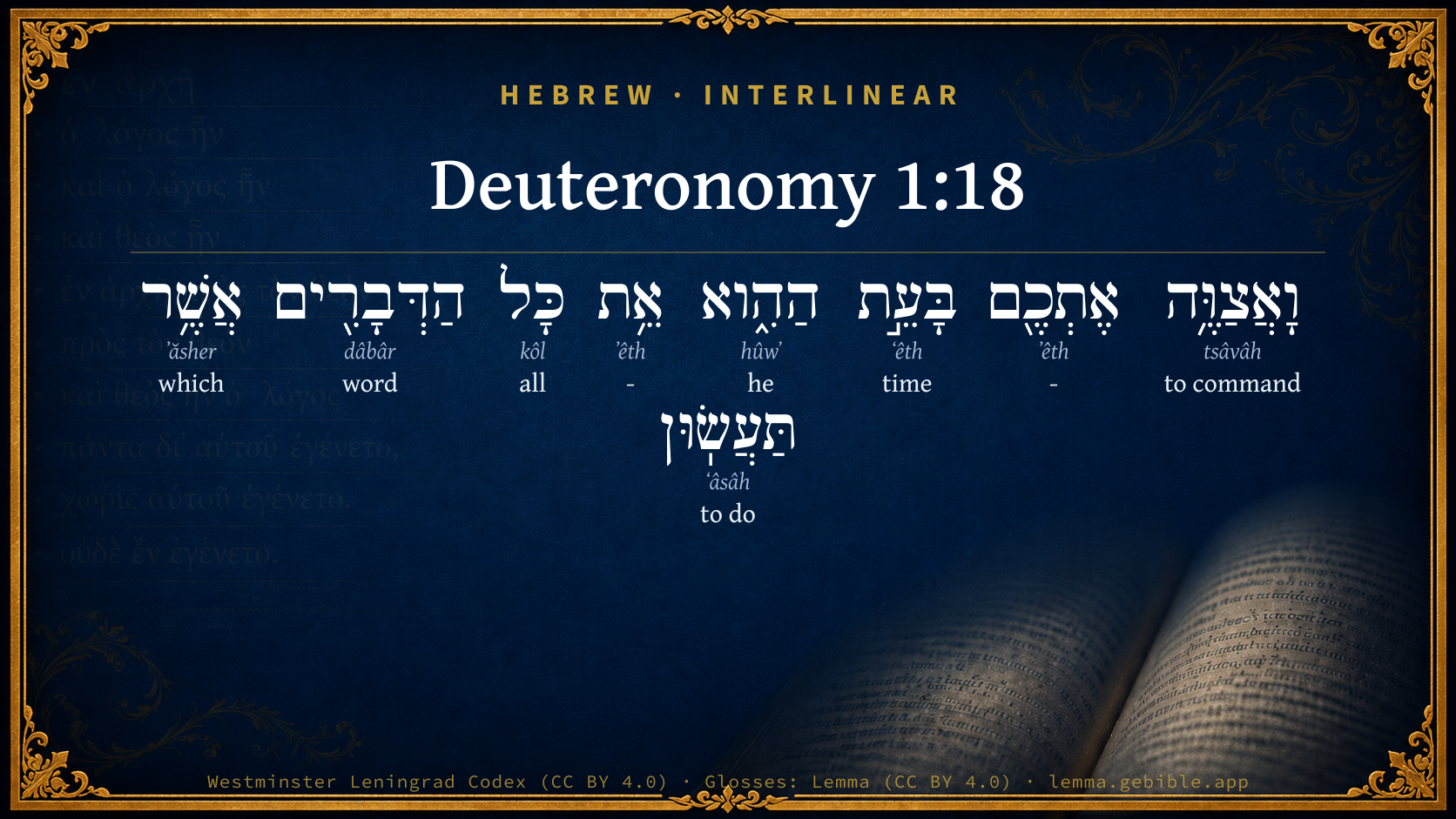
Hebrew (Westminster Leningrad Codex) Deuteronomy 1:18 appears in the Hebrew Old Testament. The text above is from the Westminster Leningrad Codex. Each word links to its Strong’s number, a concise gloss, and parsing drawn from the Open Scriptures Hebrew Bible morphology. Click any word for its full Brown-Driver-Briggs (BDB) entry.
Download image
Cite this verse

Deuteronomy 1:18 (World English Bible). Public Domain. Lemma interlinear Bible study tool, https://lemma.gebible.app/v/deuteronomy/1/18.

Show BibTeX & RIS
BibTeX
RIS
English Translation
I commanded you at that time all the things which you should do.
World English Bible · Public Domain
Download a study sheet

One document with this verse’s original text, its word-by-word gloss line, the meaning frame, cross-references with their text, attributed commentary, and full source and license credits — printable, and it pastes into notes with its structure intact.

This verse Autodidact and up

Study sheet (.html) Plain text (.txt)

A passage Seminary Student

Up to 50 verses in one chapter. A passage sheet keeps up to 6 commentary sources and 12 cross-references per verse, in the order this page ranks them, and says so on the sheet whenever that leaves anything out. Ask for a single verse and you get the Autodidact verse sheet above.

Everything on this page stays free to read, with no account — the sheet is a download of what is already on screen, not access to it.

Want to remove ads? Support Godless Engineer
Compare translations 3

The same verse in 3 English versions, stacked beneath the original-language interlinear above. Click any original word for its lexicon entry.

Each is an independent rendering of the whole verse — the interlinear is not word-aligned to these translations.

Highlighted words mark where these versions differ — a whole-verse word diff, not a word-by-word alignment.

  • World English Bible Public Domain
    I commanded you at that time all the things which you should do.
  • King James Version Public Domain
    And I commanded you at that time all the things which ye should do.
  • unfoldingWord Literal Text CC BY-SA 4.0
    And I commanded you at that time all the things that you should do.

unfoldingWord Literal Text — © unfoldingWord, licensed CC BY-SA 4.0. Word-aligned USFM3 via Door43 (git.door43.org/unfoldingWord/en_ult).

Versions to compare (up to 4)

3 of 4 selected

Show all 18 translations

Every available English version of this verse, each an independent rendering of the whole verse.

  • World English Bible Public Domain
    I commanded you at that time all the things which you should do.
  • Berean Standard Bible Public Domain
    And at that time I commanded you all the things you were to do.
  • Majority Standard Bible Public Domain
    And at that time I commanded you all the things you were to do.
  • King James Version Public Domain
    And I commanded you at that time all the things which ye should do.
  • American Standard Version (1901) Public Domain
    And I commanded you at that time all the things which ye should do.
  • Revised Version (1885) Public Domain
    And I commanded you at that time all the things which ye should do.
  • Geneva Bible (1599) Public Domain
    Also I commanded you the same time all the things which ye should doe.
  • Douay-Rheims (1899) Public Domain
    And I commanded them, saying: Hear them, and judge that which is just: whether he be one of your country, or a stranger.
  • Young's Literal Translation Public Domain
    and I command you, at that time, all the things which ye do.
  • Literal Standard Version CC BY-SA 4.0
    And I command you at that time all the things which you do.
  • Unlocked Literal Bible CC BY-SA 4.0
    I commanded you at that time all the things that you should do.
  • unfoldingWord Literal Text CC BY-SA 4.0
    And I commanded you at that time all the things that you should do.
  • Darby Bible Public Domain
    And I commanded you at that time all the things that ye should do.
  • World Messianic Bible Public Domain
    I commanded you at that time all the things which you should do.
  • Webster's Bible Public Domain
    And I commanded you at that time all the things which ye should do.
  • Free Bible Version CC BY-SA 4.0
    This was also the time I instructed you about everything you had to do.
  • Bible in Basic English Public Domain
    And at that time I gave you all the orders which you were to do.
  • JPS Tanakh (1917) Public Domain
    And I commanded you at that time all the things which ye should do.

Literal Standard Version (2020), Covenant Press — licensed CC BY-SA 4.0. Text via the HelloAO Bible API (eBible.org). Unlocked Literal Bible (unfoldingWord) — licensed CC BY-SA 4.0. Text via the HelloAO Bible API (eBible.org). unfoldingWord Literal Text — © unfoldingWord, licensed CC BY-SA 4.0. Word-aligned USFM3 via Door43 (git.door43.org/unfoldingWord/en_ult). Free Bible Version, Dr. Jonathan Gallagher — licensed CC BY-SA 4.0. Text via the HelloAO Bible API (eBible.org).

Word by word

More ways to search: Search by grammar → Find every occurrence → Compare this word →

Practice this passage: Drill this verse → Learn its vocabulary →

בָּעֵ֣ת
ʻêth
H6256
“in/at the · time”
Preposition, Determined + Noun, Common, Both, Singular, Absolute
Part of Speech
Preposition + Noun
Type
Common
Gender
Both
Number
Singular
State
Absolute
Full BDB Definition

Origin: from H5703

TWOT: 1650b

time - time (of an event) - time (usual) - experiences, fortunes - occurrence, occasion
  1. וָאֲצַוֶּ֥ה tsâvâh H6680 “and · to command” Conjunction + Verb, Piel, Sequential Imperfect, 1st Person, Common, Singular
  2. אֶתְכֶ֖ם ʼêth H853 “- · you” Particle, Direct Object + Suffix, Personal, 2nd Person, Masculine, Plural
  3. הַהִ֑וא hûwʼ H1931 “the · he” Particle, Definite Article + Pronoun, Personal, 3rd Person, Feminine, Singular
  4. אֵ֥ת ʼêth H853 “-” Particle, Direct Object
  5. כָּל kôl H3605 “all of” Noun, Common, Masculine, Singular, Construct
  6. הַדְּבָרִ֖ים dâbâr H1697 “the · words” Particle, Definite Article + Noun, Common, Masculine, Plural, Absolute
  7. אֲשֶׁ֥ר ʼăsher H834 “which” Particle, Relative
  8. תַּעֲשֽׂוּן ʻâsâh H6213 “to do” Verb, Qal, Imperfect, 2nd Person, Masculine, Plural + Suffix, n

About this verse

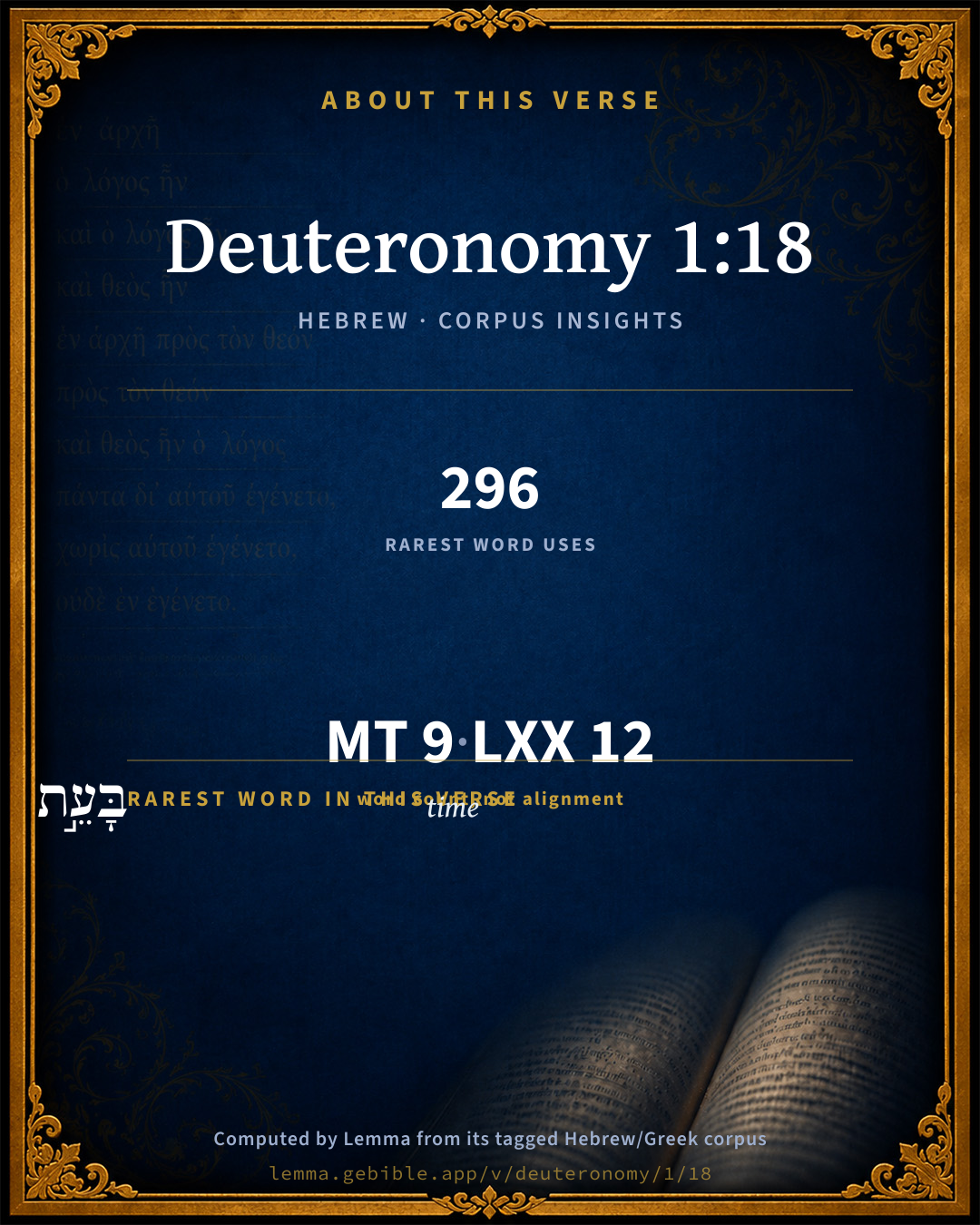
These counts appear in no published source. They are computed here, from the morphology-tagged text and Lemma’s own curated glosses. What Lemma adds →

9
words
8
distinct lemmas
Pentateuch
section

Grammatical profile

  • 2 verbs
  • 3 nouns
  • 1 pronoun
  • 3 particles

Verb forms

  • וָאֲצַוֶּ֥ה Piel · Sequential Imperfect
  • תַּעֲשֽׂוּן Qal · Imperfect

Hebrew & Septuagint length

In English translation the verse runs 13 words from the Hebrew and 15 from the Septuagint (LXX English) — closely comparable.

A rough comparison of the two English renderings, which tokenize alike — not a word-level alignment.

Word counts can differ between the Hebrew and the Greek without any difference in meaning — e.g. the Hebrew direct-object marker אֵת has no separate Greek word, and Greek often adds the article ὁ.

In the original languages it is 9 Hebrew tokens and 12 Greek tokens — but the two are counted differently (Hebrew bundles its prefixes and suffixes into one token; the Greek is in lemma form), so that isn’t a like-for-like length.

Cross-references

7

Topical passages linked to Deuteronomy 1:18 in the Treasury of Scripture Knowledge — connected by theme and wording, ordered by reader-vote popularity; previews shown in the World English Bible.

  • Deuteronomy 4:5 Behold, I have taught you statutes and ordinances, even as Yahweh my God commanded me, that you should do so in the midst of the land where you go in to possess it.
  • Deuteronomy 4:40 You shall keep his statutes, and his commandments, which I command you this day, that it may go well with you, and with your children after you, and that you may prolong your days in the land, which Yahweh your God gives you, forever.
  • Deuteronomy 12:28 Observe and hear all these words which I command you, that it may go well with you, and with your children after you forever, when you do that which is good and right in the eyes of Yahweh your God.
  • Deuteronomy 12:32 Whatever thing I command you, that shall you observe to do: you shall not add thereto, nor diminish from it.
  • Matthew 28:20 teaching them to observe all things that I commanded you. Behold, I am with you always, even to the end of the age." Amen.
  • Acts 20:20 how I didn't shrink from declaring to you anything that was profitable, teaching you publicly and from house to house,
  • Acts 20:27 for I didn't shrink from declaring to you the whole counsel of God.

Cross-references courtesy of OpenBible.info (CC BY 4.0).

Hebrew and Greek witnesses Masoretic Hebrew ↔ Greek Septuagint

The same verse in the two great witnesses to the Old Testament, shown verse-for-verse.

These are two independent witnesses, not word-aligned to each other, and the Septuagint is shown in lemma (dictionary) form.

Hebrew Deuteronomy 1:18 Masoretic · Westminster Leningrad Codex

וָאֲצַוֶּ֥ה אֶתְכֶ֖ם בָּעֵ֣ת הַהִ֑וא אֵ֥ת כָּל הַדְּבָרִ֖ים אֲשֶׁ֥ר תַּעֲשֽׂוּן

I commanded you at that time all the things which you should do.

World English Bible · Public Domain

Greek LXX Deuteronomy 1:18 Septuagint · lemma form

καί ἐντέλλομαι σύ ἐν ὁ καιρός ἐκεῖνος πᾶς ὁ λόγος ὅς ποιέω

And I charged upon you at that time all the commands which you⌃ shall perform.

LXX2012 (modern English Septuagint) · Public Domain

Hebrew: Westminster Leningrad Codex (CC BY 4.0). Greek: Septuagint (public domain); English from LXX2012 (modern English Septuagint) (Public Domain). How the Septuagint differs from the Hebrew →

Targum (Aramaic paraphrase)

2

The Targum is the ancient Jewish Aramaic paraphrase of the Hebrew Scriptures — an interpretive translation, not the Hebrew text itself. Onkelos (literal) and Pseudo-Jonathan (expansive) render the Torah, and Jonathan the Prophets. Coverage is partial: where no permissively-licensed English translation exists for a verse, only the Aramaic is shown. This is verse-level text, not a word-by-word alignment to the Hebrew.

  1. Targum Onkelos Torah (Genesis–Deuteronomy)
    וּפַקֵדִית יָתְכוֹן בְּעִדָנָא הַהִיא יָת כָּל פִּתְגָמַיָא דִי תַעְבְּדוּן

    (no public-domain English translation for this verse)

    Targum Onkelos — Aramaic: “Onkelos Genesis” (public domain); “Onkelos Exodus” (public domain); “Onkelos Leviticus” (public domain); “Onkelos Numbers” (public domain); “Onkelos Deuteronomy” (public domain). English: “Sefaria Community Translation” (CC0 1.0 (public-domain dedication)); “J.W. Etheridge. The Targums of Onkelos and Jonathan Ben Uzziel on the Pentateuch. London: Longmans, Green, 1862” (public domain). Text via Sefaria.

  2. Targum Pseudo-Jonathan Torah (Genesis–Deuteronomy)
    וּפַקֵּדִית יַתְכוֹן בְּעִידָנָא הַהִיא יַת כָּל עַשְרָא פִּתְגָמַיָא דְתַעְבְּדוּן בֵּינֵי דִינֵי מָמוֹנָא לְדִינֵי נַפְשָׁתָא

    And at that time I taught you all the Ten Words which you are to practise about judgments of money, and judgments of life.

    Targum Pseudo-Jonathan — Aramaic: “Targum Jonathan on Genesis” (public domain); “Targum Jonathan on Exodus” (public domain); “Targum Jonathan on Leviticus” (public domain); “Targum Jonathan on Numbers” (public domain); “Targum Jonathan on Deuteronomy” (public domain). English: “The Targum of Jonathan ben Uzziel, trans. J. W. Etheridge, London, 1862” (public domain). Text via Sefaria.

Commentary

Notes on Deuteronomy 1:18 from classic Christian and Jewish commentators (each source and its license shown beneath its notes). The classic Christian expositions comment on the surrounding passage and are grouped to its opening verse, so a note may address several verses; the Jewish commentaries on the Tanakh (Rashi and others) are per-verse, so they appear only where the commentator wrote on this verse.

Lemma curates 59 commentaries, every one of them public domain or Creative Commons licensed, each selected and text-cleaned for this edition rather than reprinted as found. About our sources →

Joseph Benson's Commentary

Deu 1:18. I commanded you, &c. — I instructed you in your duty, by delivering to you, and especially to your judges, the laws, statutes, and judgments revealed unto me by the Lord in Horeb.

Joseph Benson's Commentary on the Old and New Testaments (1811–1818) — public domain. Text from a community e-Sword module.

Ellicott's Commentary for English Readers

(18) And I commanded you at that time all the things which ye should do.—“At that time,” i.e., after your departure from Horeb. This is as much as to say that the exhortations given in Deuteronomy had already been given on the way from Sinai to Kadesh-barnea. (Comp. what has been said above on the two first verses of this chapter.) This verse goes far to justify the view taken there.

A Bible Commentary for English Readers, edited by Charles John Ellicott (1878–1897) — public domain. Text from a community e-Sword module.

The Cambridge Bible for Schools and Colleges

gen. ed. J. J. S. Perowne

18. And I commanded you] A summary reference to all the instructions given at Ḥoreb: cp. E, Exo_18:20; Exo_24:3; Exo_24:7 etc.

The Cambridge Bible for Schools and Colleges (gen. ed. J. J. S. Perowne; Cambridge University Press, 1878–1918) — public domain. Text from a community e-Sword module.

John Gill's Exposition

And I commanded you at that time all the things which ye should do. Delivered to them all the laws, moral, ceremonial, and judicial, which were then given him at Mount Sinai.

And I commanded you at that time all the things which ye should do. Delivered to them all the laws, moral, ceremonial, and judicial, which were then given him at Mount Sinai.

Deuteronomy 1:19

deu 1:19

deu 1:19

deu 1:19And when we departed from Horeb,.... As the Lord commanded them to do, when they were obedient:

we went through all the great and terrible wilderness; the wilderness of Paran, called "great", it reaching from Mount Sinai to Kadeshbarnea, eleven days' journey, as Adrichomius (l) relates; and "terrible", being so hard and dry as not to be ploughed nor sown, and presented to the sight something terrible and horrible, even the very image of death; to which may be added the fiery serpents and scorpions it abounded with, Deu 8:15,

which ye saw by the way of the mountain of the Amorites; that is, in the way that led to the mountain:

as the Lord our God commanded us; to depart from Horeb, and take a tour through the wilderness towards the said mountain:

and we came to Kadeshbarnea; having stayed a month by the way at Kibrothhattaavah, where they lusted after flesh, and seven days at Hazeroth, where Miriam was shut out of the camp for leprosy during that time.

(l) Theatrum Terrae, p. 116.

John Gill's Exposition of the Whole Bible (1746–1763) — public domain (CC PDM 1.0). Text via the HelloAO Bible API.

Matthew Poole's English Annotations

I delivered unto you, and especially unto your judges, all the laws, statues, and judgments revealed unto me by the Lord in Horeb.

Matthew Poole's English Annotations on the Holy Bible (1683–1685) — public domain. Text from a community e-Sword/MySword module.

John Wesley's Explanatory Notes

All the things which ye shall do - I delivered unto you, and especially unto your Judges, all the laws, statutes, and judgments revealed unto me by the Lord in Horeb.

John Wesley, Explanatory Notes Upon the Whole Bible (1754–1765) — public domain. Text via the GEBible commentary corpus.

Rashi

Rabbi Shlomo Yitzchaki (Rashi)

את כל הדברים אשר תעשון [AND I COMMANDED YOU …] ALL THE THINGS THAT YE SHOULD DO — These are the ten things that constitute the difference between civil cases and capital cases (Sifrei Devarim 18:1; cf. Sanhedrin 32a).

Rashi on the Tanakh — English translations: “The Judaica Press complete Tanach with Rashi, translated by A. J. Rosenberg” (CC BY 4.0); “Pentateuch with Rashi's commentary by M. Rosenbaum and A.M. Silbermann, 1929-1934” (public domain); “The Metsudah Tanach series, Lakewood, N.J” (CC BY 4.0); and “The Book of Joshua, Metsudah Publications, 1997” (CC BY 4.0). Text via Sefaria.

Ramban (Nachmanides)

Rabbi Moshe ben Nachman (Ramban / Nachmanides)

AND I COMMANDED YOU AT THAT TIME ALL THE THINGS WHICH YE SHOULD DO. “These are the ten differences between monetary and capital cases.” This is Rashi’s language quoting the Sifre. 18. See Sanhedrin 32a for these ten distinctions between monetary and capital cases. And if so, Moses is speaking here to the judges [previously] mentioned, and he abridged on the ten differences [by not enumerating them], for they are all deduced from verses.And in line with the plain meaning of Scripture, the reference here is to the statutes and laws, the way wherein they must walk, and the deeds they must perform, for he [Moses] personally commanded, warned, and taught Israel all these matters. And the reason for mentioning this [subject] here is because it is known that this was the substance of Jethro’s counsel when he told Moses, Be thou for the people before G-d, Verse 19. meaning that he was to pray in their behalf in the time of their affliction, and he further told him, And thou shalt teach them the statutes and the laws etc., meaning that he, himself, was to teach them the Torah. But regarding the execution of the law, Jethro advised him to appoint judges to assist him, and I have already explained it there. Therefore, Moses related here that when he designated the officers over thousands and hundreds he delegated them only over the execution of justice. He, however, would personally teach them [the people] everything they were to do in accordance with the Torah, because he hearkened to his father-in-law’s counsel and did all that he had said., Verse 24. Now Moses did not mention Jethro’s advice here, nor did he attribute to him anything that Jethro proposed. It appears to me that Moses did not want to mention it [the fact that he was following his father-in-law’s advice] in the presence of all Israel because of his humility, or it may be that it would not be to his honor to mention to that generation that he had married a Cushite woman. It is also possible that the reason [for not mentioning Jethro’s name] was because he had consulted the Divine Glory and this matter was done at the command of the Almighty. 2: “And Moses hearkened to the voice of his father-in-law and did all that ‘amar’ (he, [i.e. G-d] had said” Exodus 18:24). The Mechilta thus explains the word amar as referring to G-d, and not to Jethro.

Ramban (Nachmanides) on the Tanakh — English translation: “Commentary on the Torah by Ramban (Nachmanides). Translated and annotated by Charles B. Chavel. New York, Shilo Pub. House, 1971-1976” (CC BY 4.0). Text via Sefaria.

Lesson kit

Teaching starters — assembled from the data on this page, not authored interpretation. Every prompt links to the verse data it draws on. Edit before teaching.

Deuteronomy, in the Pentateuch, opens this verse with 9 words (8 distinct Hebrew lemmas). Its most distinctive word is ʻêth (“time”). A historical commentator’s framing appears above. Read the whole chapter for the surrounding context.

Discussion questions

  1. What does “time” (ʻêth) contribute to the verse as a whole?
  2. How does Deuteronomy 4:5, which shares this passage’s theme, read alongside this verse?
  3. These translations render this verse differently. What is at stake in choosing one wording over another?
  4. «וָאֲצַוֶּ֥ה» is a Piel Sequential Imperfect verb. How does that grammatical form shape the action described?
  5. Compare how Joseph Benson's Commentary and Ellicott's Commentary for English Readers read this verse. Where do they agree or differ?

Things to notice

Reading settings

Reading text

Shown beneath each verse's original-language words.

Old Testament
Old Testament edition

Read the OT as the Masoretic Hebrew (MT) or the Greek Septuagint (LXX).

English shown for the Greek Septuagint (in the Hebrew ↔ Greek comparison).

Comparing translations? Open the Compare panel on any verse page to stack up to four side by side.