

Psalms 81:15

Hebrew (Westminster Leningrad Codex) Psalms 81:15 appears in the Hebrew Old Testament. The text above is from the Westminster Leningrad Codex. Each word links to its Strong’s number, a concise gloss, and parsing drawn from the Open Scriptures Hebrew Bible morphology. Click any word for its full Brown-Driver-Briggs (BDB) entry.
Download image
Cite this verse

Psalms 81:15 (World English Bible). Public Domain. Lemma interlinear Bible study tool, https://lemma.gebible.app/v/psalms/81/15.

Show BibTeX & RIS
BibTeX
RIS
English Translation
The haters of Yahweh would cringe before him, And their punishment would last forever.
World English Bible · Public Domain
Download a study sheet

One document with this verse’s original text, its word-by-word gloss line, the meaning frame, cross-references with their text, attributed commentary, and full source and license credits — printable, and it pastes into notes with its structure intact.

This verse Autodidact and up

Study sheet (.html) Plain text (.txt)

A passage Seminary Student

Up to 50 verses in one chapter. A passage sheet keeps up to 6 commentary sources and 12 cross-references per verse, in the order this page ranks them, and says so on the sheet whenever that leaves anything out. Ask for a single verse and you get the Autodidact verse sheet above.

Everything on this page stays free to read, with no account — the sheet is a download of what is already on screen, not access to it.

Want to remove ads? Support Godless Engineer
Compare translations 3

The same verse in 3 English versions, stacked beneath the original-language interlinear above. Click any original word for its lexicon entry.

Each is an independent rendering of the whole verse — the interlinear is not word-aligned to these translations.

Highlighted words mark where these versions differ — a whole-verse word diff, not a word-by-word alignment.

  • World English Bible Public Domain
    The haters of Yahweh would cringe before him, And their punishment would last forever.
  • King James Version Public Domain
    The haters of the LORD should have submitted themselves unto him: but their time should have endured for ever.
  • unfoldingWord Literal Text CC BY-SA 4.0
    The haters of Yahweh would cringe before him, and their time would be forever.

unfoldingWord Literal Text — © unfoldingWord, licensed CC BY-SA 4.0. Word-aligned USFM3 via Door43 (git.door43.org/unfoldingWord/en_ult).

Versions to compare (up to 4)

3 of 4 selected

Show all 18 translations

Every available English version of this verse, each an independent rendering of the whole verse.

  • World English Bible Public Domain
    The haters of Yahweh would cringe before him, And their punishment would last forever.
  • Berean Standard Bible Public Domain
    Those who hate the LORD would feign obedience, and their doom would last forever.
  • Majority Standard Bible Public Domain
    Those who hate the LORD would feign obedience, and their doom would last forever.
  • King James Version Public Domain
    The haters of the LORD should have submitted themselves unto him: but their time should have endured for ever.
  • American Standard Version (1901) Public Domain
    The haters of Jehovah should submit themselves unto him: But their time should endure for ever.
  • Revised Version (1885) Public Domain
    The haters of the LORD should submit themselves unto him: but their time should endure for ever.
  • Geneva Bible (1599) Public Domain
    The haters of the Lord should haue bene subiect vnto him, and their time should haue endured for euer.
  • Douay-Rheims (1899) Public Domain
    I should soon have humbled their enemies, and laid my hand on them that troubled them.
  • Young's Literal Translation Public Domain
    Those hating Jehovah feign obedience to Him, But their time is -- to the age.
  • Literal Standard Version CC BY-SA 4.0
    Those hating YHWH should have feigned [obedience] to Him, || And their time would last for all time.
  • Unlocked Literal Bible CC BY-SA 4.0
    May those who hate Yahweh cringe in fear before him! May they be humiliated forever.
  • unfoldingWord Literal Text CC BY-SA 4.0
    The haters of Yahweh would cringe before him, and their time would be forever.
  • Darby Bible Public Domain
    The haters of Jehovah would have come cringing unto him; but their time would have been for ever.
  • World Messianic Bible Public Domain
    The haters of the LORD would cringe before him, and their punishment would last forever.
  • Webster's Bible Public Domain
    \\81:14\\I should soon have subdued their enemies, and turned my hand against their adversaries.
  • Free Bible Version CC BY-SA 4.0
    Those who hate the Lord would cringe before him, forever doomed.
  • Bible in Basic English Public Domain
    The haters of the Lord would be broken, and their destruction would be eternal.
  • JPS Tanakh (1917) Public Domain
    (81-16) The haters of the LORD should dwindle away before Him; and their punishment should endure for ever.

Literal Standard Version (2020), Covenant Press — licensed CC BY-SA 4.0. Text via the HelloAO Bible API (eBible.org). Unlocked Literal Bible (unfoldingWord) — licensed CC BY-SA 4.0. Text via the HelloAO Bible API (eBible.org). unfoldingWord Literal Text — © unfoldingWord, licensed CC BY-SA 4.0. Word-aligned USFM3 via Door43 (git.door43.org/unfoldingWord/en_ult). Free Bible Version, Dr. Jonathan Gallagher — licensed CC BY-SA 4.0. Text via the HelloAO Bible API (eBible.org).

Word by word

More ways to search: Search by grammar → Find every occurrence → Compare this word →

Practice this passage: Drill this verse → Learn its vocabulary →

יְכַֽחֲשׁוּ
kâchash
H3584
“to deceive”
Verb, Piel, Imperfect, 3rd Person, Masculine, Plural
Part of Speech
Verb
Stem
Piel
Form
Imperfect
Person
3rd Person
Gender
Masculine
Number
Plural
Full BDB Definition

Origin: a primitive root

TWOT: 975

to deceive, lie, fail, grow lean, be disappointing, be untrue, be insufficient, be found liars, belie, deny, dissemble, deal falsely - (Qal) to become lean - (Niphal) to cringe, feign obedience - (Piel) - to deceive, deny falsely - to act deceptively - to cringe - to disappoint, fail - (Hithpael) to cringe, feign obedience
  1. מְשַׂנְאֵ֣י sânêʼ H8130 “hating” Verb, Piel, Participle Active, Masculine, Plural, Construct
  2. יְ֭הוָה Yᵉhôvâh H3068 “LORD” Noun, Proper
  3. וִיהִ֖י hâyâh H1961 “and · to be” Conjunction + Verb, Qal, Jussive, 3rd Person, Masculine, Singular
  4. עִתָּ֣ם ʻêth H6256 “time · their” Noun, Common, Both, Singular, Construct + Suffix, Personal, 3rd Person, Masculine, Plural
  5. לְעוֹלָֽם ʻôwlâm H5769 “to/for · forever” Preposition + Noun, Common, Masculine, Singular, Absolute

About this verse

These counts appear in no published source. They are computed here, from the morphology-tagged text and Lemma’s own curated glosses. What Lemma adds →

7
words
6
distinct lemmas
Wisdom
section

Notable vocabulary

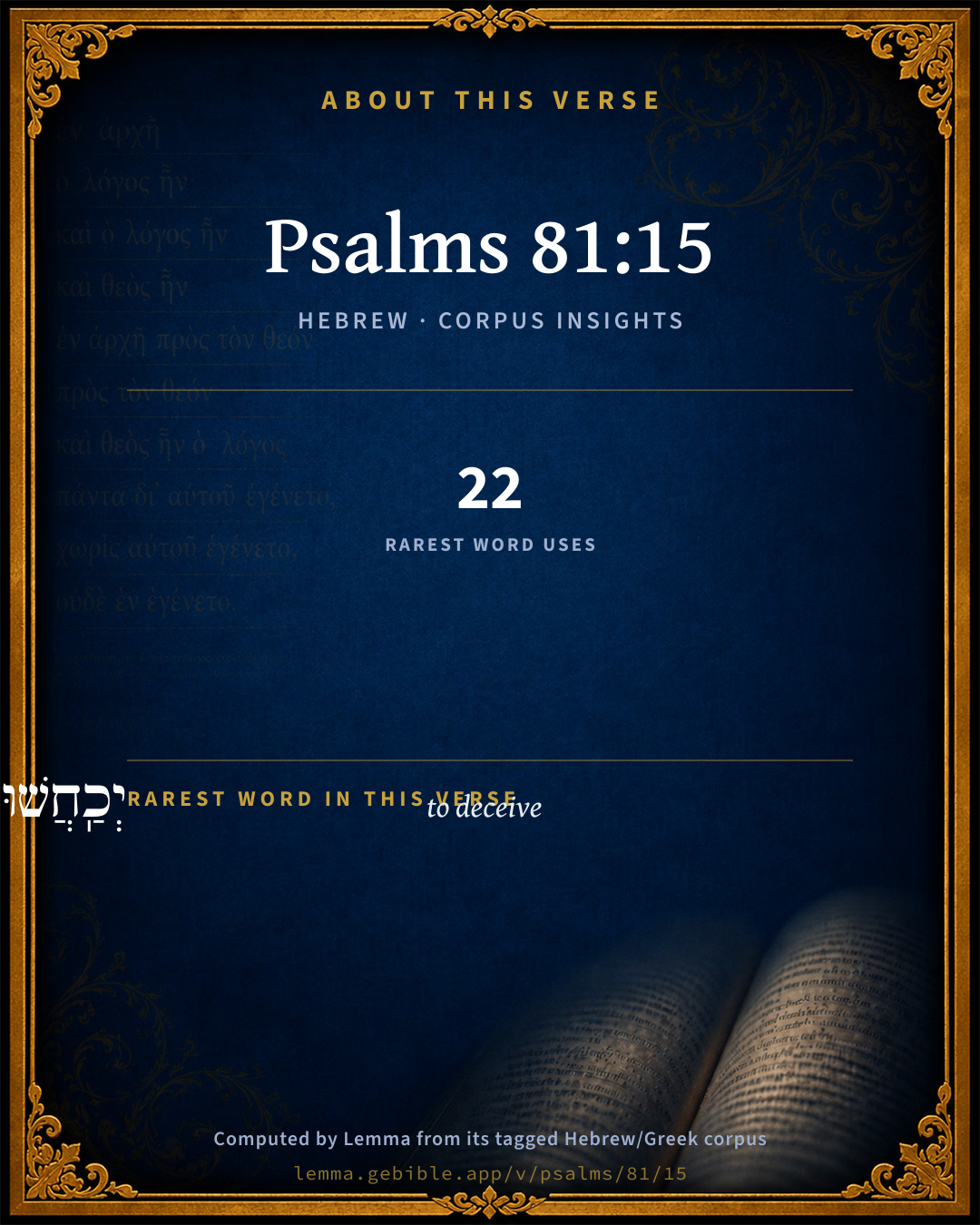
The rarest word here is יְכַֽחֲשׁוּ to deceive H3584 — appearing just 22 times in the whole Hebrew Bible.

Shared distinctive vocabulary

יְכַֽחֲשׁוּ to deceive H3584 occurs in 22 verses of the Hebrew Bible. Also found in:

Grammatical profile

  • 3 verbs
  • 3 nouns
  • 1 preposition

Verb forms

  • מְשַׂנְאֵ֣י Piel · Participle Active
  • יְכַֽחֲשׁוּ Piel · Imperfect
  • וִיהִ֖י Qal · Jussive

Hebrew & Septuagint length

In English translation the verse runs 14 words from the Hebrew and 15 from the Septuagint (LXX English) — closely comparable.

A rough comparison of the two English renderings, which tokenize alike — not a word-level alignment.

Word counts can differ between the Hebrew and the Greek without any difference in meaning — e.g. the Hebrew direct-object marker אֵת has no separate Greek word, and Greek often adds the article ὁ.

Cross-references

11

Topical passages linked to Psalms 81:15 in the Treasury of Scripture Knowledge — connected by theme and wording, ordered by reader-vote popularity; previews shown in the World English Bible.

  • Deuteronomy 7:10 and repays those who hate him to their face, to destroy them: he will not be slack to him who hates him, he will repay him to his face.
  • Psalms 63:3 Because your loving kindness is better than life, My lips shall praise you.
  • Romans 1:30 backbiters, hateful to God, insolent, haughty, boastful, inventors of evil things, disobedient to parents,
  • Romans 8:7 because the mind of the flesh is hostile towards God; for it is not subject to God's law, neither indeed can it be.
  • Exodus 20:5 you shall not bow yourself down to them, nor serve them, for I, Yahweh your God, am a jealous God, visiting the iniquity of the fathers on the children, on the third and on the fourth generation of those who hate me,
  • Psalms 18:44–45 As soon as they hear of me they shall obey me. The foreigners shall submit themselves to me.
  • Psalms 83:2–18 For, behold, your enemies are stirred up. Those who hate you have lifted up their heads.
  • Psalms 102:28 The children of your servants will continue. Their seed will be established before you."
  • Joel 3:20 But Judah will be inhabited forever, And Jerusalem from generation to generation.
  • John 15:22–23 If I had not come and spoken to them, they would not have had sin; but now they have no excuse for their sin.
  • Isaiah 65:22 They shall not build, and another inhabit; they shall not plant, and another eat: for as the days of a tree shall be the days of my people, and my chosen shall long enjoy the work of their hands.

Cross-references courtesy of OpenBible.info (CC BY 4.0).

Hebrew and Greek witnesses Masoretic Hebrew ↔ Greek Septuagint

The same verse in the two great witnesses to the Old Testament, shown verse-for-verse.

You’re reading Greek Psalm 80 (Hebrew Psalm 81). The Septuagint counts the superscription, so verse numbers can differ from the Hebrew — chapter-level alignment, not verse-by-verse. Numbering follows Rahlfs.

These are two independent witnesses, not word-aligned to each other, and the Septuagint is shown in lemma (dictionary) form.

Hebrew Psalms 81:15 Masoretic · Westminster Leningrad Codex

מְשַׂנְאֵ֣י יְ֭הוָה יְכַֽחֲשׁוּ ל֑וֹ וִיהִ֖י עִתָּ֣ם לְעוֹלָֽם

The haters of Yahweh would cringe before him, And their punishment would last forever.

World English Bible · Public Domain

Greek LXX Greek Psalm 80:15 Septuagint · lemma form

ἐν ὁ μηδείς ἄν ὁ ἐχθρός αὐτός ταπεινόω καί ἐπί ὁ θλίβω αὐτός ἐπιβάλλω ὁ χείρ ἐγώ

The Lord's enemies should have lied to him: but their time shall be for ever.

LXX2012 (modern English Septuagint) · Public Domain

Hebrew: Westminster Leningrad Codex (CC BY 4.0). Greek: Septuagint (public domain); English from LXX2012 (modern English Septuagint) (Public Domain). How the Septuagint differs from the Hebrew →

Commentary

Notes on Psalms 81:15 from classic Christian and Jewish commentators (each source and its license shown beneath its notes). The classic Christian expositions comment on the surrounding passage and are grouped to its opening verse, so a note may address several verses; the Jewish commentaries on the Tanakh (Rashi and others) are per-verse, so they appear only where the commentator wrote on this verse.

Lemma curates 59 commentaries, every one of them public domain or Creative Commons licensed, each selected and text-cleaned for this edition rather than reprinted as found. About our sources →

Trapp's Complete Commentary

John Trapp

Psa 81:15 The haters of the LORD should have submitted themselves unto him: but their time should have endured for ever.

Ver. 15. The haters of the Lord should have submitted] Heb. lied, that is, yielded feigned obedience, as Psa 18:44.

But their time should have endured for ever] i.e. Their strength, saith the Chaldee; their tranquillity and prosperity, say others. Theodoret referreth it to the enemies thus: The time of their calamity shall endure for ever, they shall be eternally miserable.

John Trapp, A Commentary or Exposition upon All the Books of the Old and New Testament (1647–1656) — public domain. Text from a community e-Sword module.

J. A. Alexander on Psalms

Joseph Addison Alexander

16. (Psa 81:15) The haters of Jehovah should lie to him, and their time should be for ever. The first phrase is intended to suggest the consolatory thought that the foes of God's people are the foes of God himself. There is no need, therefore, of referring him to Israel or my people; as in Deu 33:29, from which the clause is borrowed. The plurals before and after render this less natural, and as the interests of God and his people are identical, the meaning is the same in either case. To lie is here to yield a feigned obedience to a conqueror or superior enemy. See above, on Psa 18:44; Psa 66:3. Their time, i.e. the continued existence of Israel as the chosen people. Compare 2Sa 7:24.

Joseph Addison Alexander, The Psalms Translated and Explained (1850) — public domain. Text from a community e-Sword module.

Geneva Bible (1599)

Geneva Bible translators

If the Israelites had not broken covenant with God, he would have given them victory against their enemies.

Geneva Bible (1599) marginal notes — public domain. Text via Bolls.life.

Adam Clarke's Commentary

Verse 15. Their time should have endured for ever.] That is, Their prosperity should have known no end.

Adam Clarke's Commentary on the Bible (1810–1826) — public domain. Text from a community e-Sword/MySword module.

John Calvin's Commentaries

15. The haters of Jehovah would have lied to him. Here the same thought is pursued, when the Israelites are informed that their enemies would have humbly submitted to their authority had not their impiety emboldened them to run to excess, when they shook off the yoke of God, and waxed wanton against him. In calling these enemies the enemies of Jehovah, it is intended to censure the folly of the Israelites in breaking the bond of the covenant made between God and them, and thereby separating themselves from him, and preventing him from forthwith engaging in war in their behalf against those who were alike their and his enemies. As earthly princes, when they are disappointed of the assistance promised by their allies, are excited to enter into terms of agreement with their enemies, and in this way avenge themselves on those who have been found to be guilty of perjury and covenant-breakers; so God declares that he had spared his own enemies, because he had been treacherously and wickedly deceived by the people of Israel. Why does he permit his avowed enemies to remain unpunished, and cease for a time to maintain his own glory, if it is not because his object is to set them in contrast with his own rebellious and disobedient people, whom, by this means, he intends to subdue? The meaning of the word כחש, cachash, which we have rendered lied, has been explained in a previous psalm . It is here intimated that peace with the reprobate cannot be looked for except in so far as God restrains their rage by hidden chains. A lion shut up in an iron cage still retains his own nature, but he is kept from mangling and tearing in pieces those who are not even more than five or six feet distant from him. Thus it is with respect to the wicked. They may greedily desire our destruction; but they are unable to accomplish what their hearts are set upon; yea God humbles and abases their fierceness and arrogance, so that they put on the appearance of gentleness and meekness. The amount of the whole is, that it was the fault of the Israelites themselves that their enemies prevailed against them, and insolently triumphed over them; whereas, had they continued the humble and obedient children of God, these enemies would have been in a state of subjection to them. When it is said, their time should have been everlasting, the expression is to be referred to the promises; and so must the abundance of wheat and of honey, with which they would have been fully satisfied. God had solemnly declared that he would be their protector and guardian even to the end. The change, then, which so suddenly befell them is set before them as a matter of reproach, inasmuch as they had deliberately cast away all at once their happy state. The same remarks are applicable to the fruitfulness of the land. How is it to be accounted for that they suffered hunger in the land in which God had promised them abundance of wheat and honey, but because the blessing of God had been withheld on account of their iniquity? By the fat of corn is meant, metaphorically, pure grain, unless it may be thought preferable to understand it of the finest wheat. Some are of opinion that the expression, honey out of the rock, is hyperbolical, implying that honey would have flowed from the very rocks rather than that God would have failed to satisfy his people. But as it is evident from sacred history that honey was found everywhere in the hollows of the rocks so long as they enjoyed the blessing of God, the meaning simply is, that the grace of God would have continued to flow in an unbroken and uniform course, had it not been interrupted by the perverseness and wickedness of the people.

John Calvin's Commentaries (1540-1563) — public domain. Text from the Calvin Translation Society English edition (1840s-50s) via the Christian Classics Ethereal Library (ccel.org). Calvin's coverage is partial (roughly two-thirds of the Bible); uncommented books and verses are honest gaps, never fabricated. The 19th-century editor's footnotes and remarks are omitted so the notes are faithfully Calvin's own voice.

Ellicott's Commentary for English Readers

(15) Submitted.—See Note, Psa_18:44.

Him—i.e., Israel; Jehovah’s enemies being also Israel’s enemies.

Their time—i.e., Israel’s. One of the sudden changes of number so frequent in Hebrew poetry. As a nation Israel would continue to live and prosper.

A Bible Commentary for English Readers, edited by Charles John Ellicott (1878–1897) — public domain. Text from a community e-Sword module.

The Cambridge Bible for Schools and Colleges

gen. ed. J. J. S. Perowne

15. The haters of Jehovah should come cringing unto him,

So that their time should be for ever.

Unto him may mean to Jehovah or to Israel; but apparently the latter. Jehovah’s enemies are the enemies of His people, and He would force them to pay homage, however reluctantly (Psa_66:3 note), to Israel; that so Israel’s time of prosperity might know no end, the nation’s life never fail.

The Cambridge Bible for Schools and Colleges (gen. ed. J. J. S. Perowne; Cambridge University Press, 1878–1918) — public domain. Text from a community e-Sword module.

John Gill's Exposition

He should have fed them also with the finest of the wheat,.... Or the "fat of the wheat (y)"; see Deu 32:14, with the finest flour of it: the Targum is,

"with the best bread of wheat;''

with the best of wheat, and the best bread that can be made of it: Aben Ezra interprets it of the manna, which was better than the fat, or finest, of the wheat, being the corn of heaven, and angels' food, Psa 78:24, but it rather respects what the Israelites would have been continued to be fed with in the land of Canaan, which was a land of wheat, Deu 8:8, and such who hearken to the Lord, and walk in his ways, are fed by him with the Gospel, which is comparable to wheat, and the finest of it, for its choiceness and excellency, for its solidity and substantiality, for its purity and cleanness, and for its being of a nourishing and strengthening nature, see Jer 38:28, and especially Christ, the sum and substance of the Gospel, may be figuratively meant, with whom the saints are fed, and who is compared to a corn of wheat, Joh 12:24 for his preciousness and excellency, for his purity and fruitfulness, and for being the food of his people, the bread of life, for which he was prepared by his sufferings and death; which may be fitly expressed by the threshing, winnowing, and grinding of wheat, and then of kneading the flour, and baking the bread:

and with honey out of the rock would I have satisfied thee; the land of Canaan abounded with hills and rocks, in which bees had their hives, and from whence honey dropped to lower places; and hence the land is said to flow with milk and honey, Exo 3:8, nor is it unusual in other places to find honey in rocks; at Guadaloupe, in the West Indies, we are told (z), honey was found in trees and caves of rocks. Aben Ezra interprets this of the water which flowed out of the rock at Horeb, which was sweeter than honey; but the former sense is best: the rock spiritually and mystically designs Christ, the Rock of salvation, Co1 10:4, the honey out of the rock, the fulness of grace in him, and the blessings of it, the sure mercies of David, and the precious promises of the everlasting covenant; and the Gospel, which is sweeter than the honey or the honeycomb; and with these such are filled and satisfied, who hearken to Christ, and walk in his ways; for, as the whole of what is here said shows what Israel lost by disobedience, it clearly suggests what such enjoy who hear and obey.

(y) "ex adipe frumenti", V. L. Pagninus, Montanus, Musculus; "adipe tritici", Junius & Tremellius, Piscator; so Cocceius, Gejerus, Michaelis. (z) P. Martyr. Decad. 3. lib. 9.

Next: Psalms Chapter 82

John Gill's Exposition of the Whole Bible (1746–1763) — public domain (CC PDM 1.0). Text via the HelloAO Bible API.

Albert Barnes' Notes on the Bible

The haters of the Lord - The enemies of the Lord, often represented as those who hate him - hatred being always in fact or in form connected with an unwillingness to submit to God. It is hatred of his law; hatred of his government; hatred of his plans; hatred of his character. See Rom 1:30; Joh 7:7, Joh 15:18, Joh 15:23-25. Compare Exo 20:5.

Should have submitted themselves unto him - Margin, yielded retained obedience. Hebrew, lied. See the phrase explained in the notes at Psa 18:44. The meaning is, that they would have been so subdued as to acknowledge his authority or supremacy, while it is, at the same time, implied that this would have been forced and not cordial. No external power, though it may so conquer as to make people outwardly obedient, can affect the will, or subdue that. The grace of God alone can do that, and it is the special triumph of grace that it can do it.

But their time - The time of his people. They would have continued to be a happy and a flourishing nation.

Should have endured for ever - Perpetually - as long as they continued to be obedient. If a nation were obedient to the will of God; if it wholly obeyed his laws; if it countenanced by statute no form of sin; if it protected no iniquity; if it were temperate, just, virtuous, honest, there is no reason why its institutions should not be perpetual, or why it should ever be overthrown. Sin is, in all cases, the cause of the ruin of nations, as it is of individuals.

Albert Barnes' Notes on the Bible (1834–1885) — public domain. Text from a community e-Sword/MySword module.

Matthew Poole's English Annotations

The haters of the Lord; all the haters and enemies of God’s people, as the neighbouring nations were; whom he calls haters of God, partly because they hated the Israelites for God’s sake, and for the singularity of their religious worship, as the heathen oft declared; and partly to show the strict league and union which was betwixt God and them, by virtue whereof God had declared all their friends and enemies to be his own, which was a great aggravation of their wickedness.

Should have submitted themselves unto him; should have professed and owned their subjection to him. For the phrase, See Poole "Psa 18:44". Their time, i.e. Israel’s time; the relative belonging to the remoter antecedent; as it is in many other places of Scripture, whereof I have formerly given instances. By their time he means either,

1. Their happy time, as life is oft put for a happy life or State, as Psa 34:12; 49:18 Deu 4:1; 5:33, &c. Or,

2. The duration of their commonwealth. Endured for ever, i.e. lasted for a very long time; whereas now their latter and doleful end is hastening towards them.

Matthew Poole's English Annotations on the Holy Bible (1683–1685) — public domain. Text from a community e-Sword/MySword module.

The Treasury of David

Charles H. Spurgeon

Ver. 15. The haters of the Lord should have submitted themselves unto him. Though the submission would have been false and flattering, yet the enemies of Israel would have been so humiliated that they would have hastened to make terms with the favoured tribes. Our enemies become abashed and cowardly when we, with resolution, walk carefully with the Lord. It is in God's power to keep the fiercest in check, and he will do so if we have a filial fear, a pious awe of him.

But their time should have endured for ever. The people would have been firmly established, and their prosperity would have been stable. Nothing confirms a state or a church like holiness. If we be firm in obedience we shall be firm in happiness. Righteousness establishes, sin ruins.

None.

None.

Psalms 81:16*

Charles H. Spurgeon's The Treasury of David (1869–1885) — public domain. Psalms only. Text from a community e-Sword/MySword module.

Whedon's Commentary on the Bible

Daniel D. Whedon

15. The haters… should have submitted… unto him—Not necessarily in the sense of being converted. The word signifies a forced submission, as in Psa_18:44; Psa_66:3. The majesty of God would have caused his fear and dread to fall upon the nations, and they would have yielded to Israel the homage, at least, of fear. But now they have grown rampant and wanton in oppression toward Israel and blasphemy against God.

Their time should have endured for ever— “Time,” here, should be taken in the sense of duration. If the pronoun refers to the “haters of the Lord,” it means that their time of being held in awe and submission to Israel would have been without end; but if it refers to God’s “people,” (Psa_81:13,) the passage declares their endless prosperity: and the next verse seems to require this latter sense.

Daniel D. Whedon (gen. ed.), Commentary on the Old and New Testaments (1874–1909) — public domain. Text from a community e-Sword module.

The Pulpit Commentary

The haters of the Lord. Israel"s enemies are always spoken of as God"s enemies also. (comp. Psa_3:2, 7 9:3 68:1 79:6, 7, etc.) They "hate" Jehovah, (Psa_21:8 Psa_83:2) not merely as Israel"s Protector, but as the Source of all good, whereas they delight in evil. Should have submitted themselves unto him; rather, should submit themselves, or should yield feigned obedience (Authorized Version, margin). But their time (i.e. Israel"s time) should have endured forever; rather, should endure.

The Pulpit Commentary (1880–1919), ed. H.D.M. Spence-Jones & Joseph S. Exell — public domain. Text from a community e-Sword module.

John Wesley's Explanatory Notes

Him - Unto Israel. Their time - Their happy time.

John Wesley, Explanatory Notes Upon the Whole Bible (1754–1765) — public domain. Text via the GEBible commentary corpus.

unfoldingWord translationNotes

Door43 World Missions Community

who hate Yahweh ... before him

Yahweh is speaking about himself in the third person. AT: "who hate me ... before me" (See: First, Second, or Third Person)

cringe in fear

"bow down in fear" or "fall down in fear"

May they be humiliated forever

This can be stated in active form. AT: "I would humiliate them forever" or "I will punish them forever" (See: Active or Passive)

I would feed Israel with the finest wheat

God causing the best wheat to grow in Israel is spoken of as if he would literally feed the wheat to the people. AT: "I would allow the Israelites to eat the finest wheat" (See: Metaphor)

feed Israel ... satisfy you

Both "Israel" and "you" refer to the Israelites.

honey out of the rock

This refers to wild honey. Bees would build hives in the holes in rocks and make the honey there. (See: Assumed Knowledge and Implicit Information)

translationWords

Yahweh

fear

eternity

wheat

honey

unfoldingWord translationNotes — © Distant Shores Media and the Door43 World Missions Community, licensed CC BY-SA 4.0. Source: git.door43.org/Door43/en_tn.

Rashi

Rabbi Shlomo Yitzchaki (Rashi)

In a short time I would subdue their enemies In a short time I would subdue their enemies.

I would return My hand I would return my blow from upon you to lay it upon them, and then...

Rashi on the Tanakh — English translations: “The Judaica Press complete Tanach with Rashi, translated by A. J. Rosenberg” (CC BY 4.0); “Pentateuch with Rashi's commentary by M. Rosenbaum and A.M. Silbermann, 1929-1934” (public domain); “The Metsudah Tanach series, Lakewood, N.J” (CC BY 4.0); and “The Book of Joshua, Metsudah Publications, 1997” (CC BY 4.0). Text via Sefaria.

Lesson kit

Teaching starters — assembled from the data on this page, not authored interpretation. Every prompt links to the verse data it draws on. Edit before teaching.

Psalms, in the Wisdom, opens this verse with 7 words (6 distinct Hebrew lemmas). Its most distinctive word is kâchash (“to deceive”). A historical commentator’s framing appears above. Read the whole chapter for the surrounding context.

Discussion questions

  1. The word kâchash carries the sense “to deceive.” How does it shape the verse?
  2. How does Genesis 18:15, which shares the word «to deceive», read alongside this verse?
  3. These translations render this verse differently; the difference is in the English rendering, not the original. What questions does that raise?
  4. «מְשַׂנְאֵ֣י» is a Piel Participle Active verb. How does that grammatical form shape the action described?
  5. Compare how Trapp's Complete Commentary and J. A. Alexander on Psalms read this verse. Where do they agree or differ?

Things to notice

Reading settings

Reading text

Shown beneath each verse's original-language words.

Old Testament
Old Testament edition

Read the OT as the Masoretic Hebrew (MT) or the Greek Septuagint (LXX).

English shown for the Greek Septuagint (in the Hebrew ↔ Greek comparison).

Comparing translations? Open the Compare panel on any verse page to stack up to four side by side.