
Deuteronomy 3:4

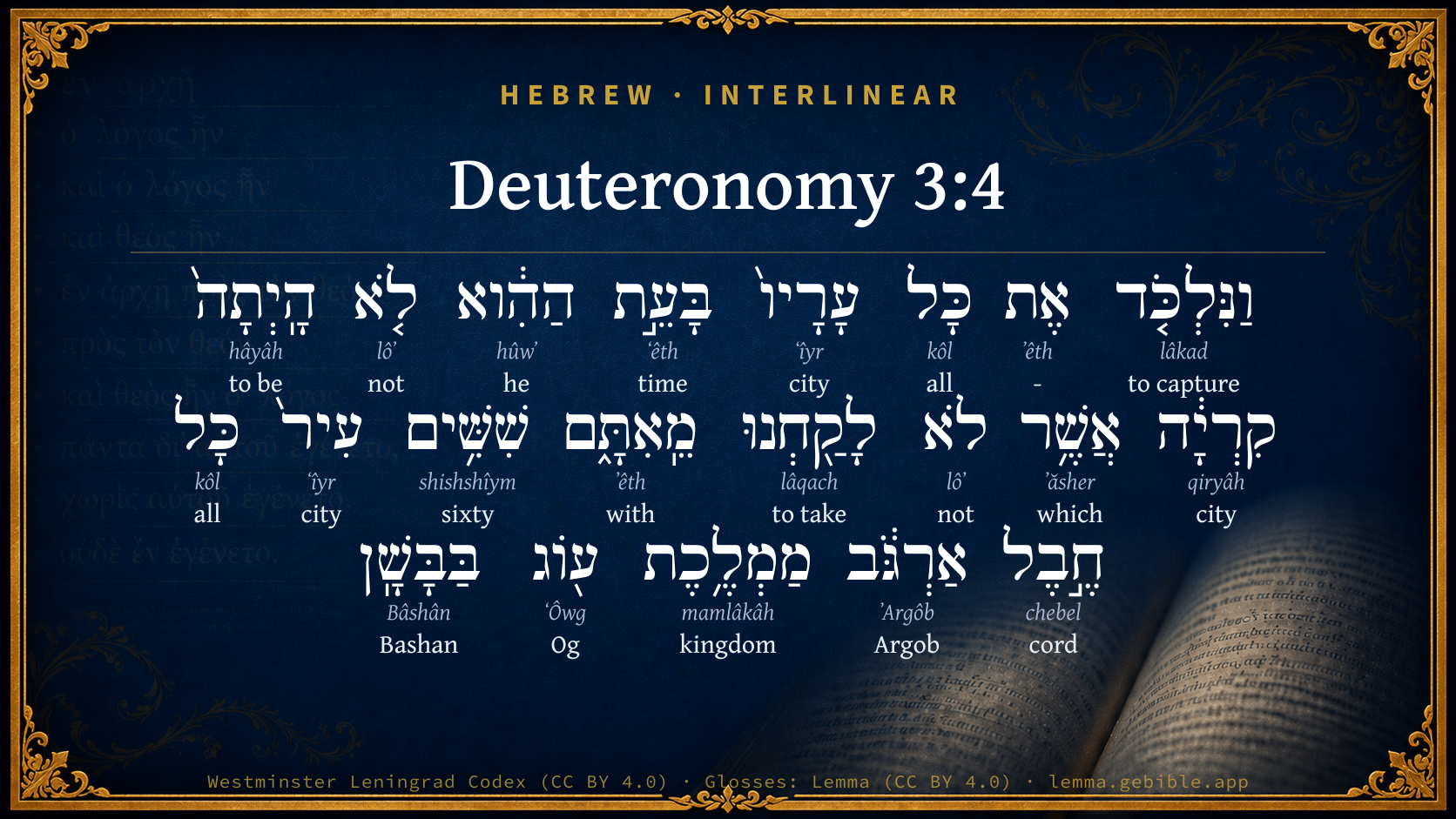
Hebrew (Westminster Leningrad Codex) Deuteronomy 3:4 appears in the Hebrew Old Testament. The text above is from the Westminster Leningrad Codex. Each word links to its Strong’s number, a concise gloss, and parsing drawn from the Open Scriptures Hebrew Bible morphology. Click any word for its full Brown-Driver-Briggs (BDB) entry.
Download image
Cite this verse

Deuteronomy 3:4 (World English Bible). Public Domain. Lemma interlinear Bible study tool, https://lemma.gebible.app/v/deuteronomy/3/4.

Show BibTeX & RIS
BibTeX
RIS
English Translation
We took all his cities at that time; there was not a city which we didn't take from them; sixty cities, all the region of Argob, the kingdom of Og in Bashan.
World English Bible · Public Domain
Highlights
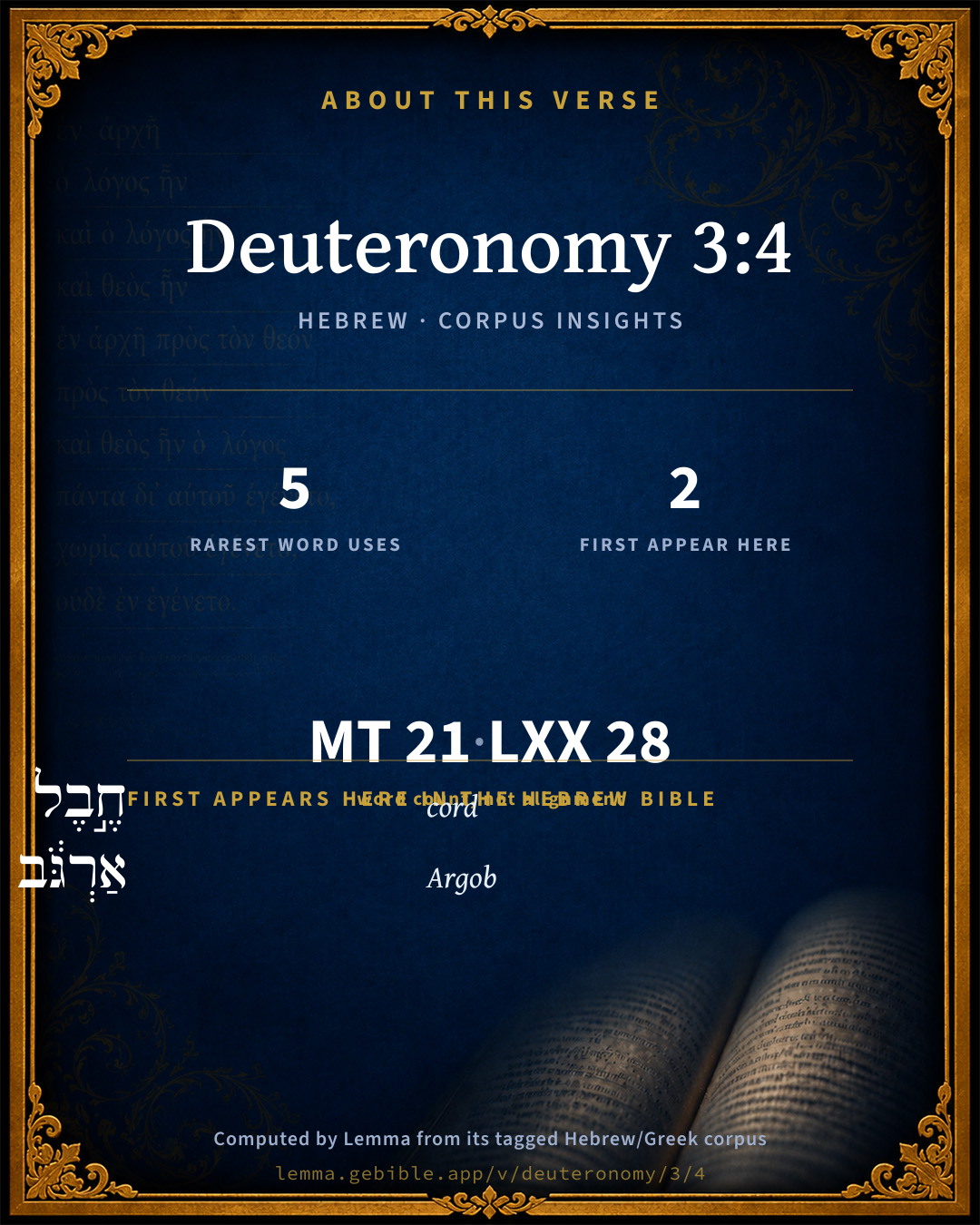
  • 2 first appearances in the Hebrew Bible
Full analysis ↓
Download a study sheet

One document with this verse’s original text, its word-by-word gloss line, the meaning frame, cross-references with their text, attributed commentary, and full source and license credits — printable, and it pastes into notes with its structure intact.

This verse Autodidact and up

Study sheet (.html) Plain text (.txt)

A passage Seminary Student

Up to 50 verses in one chapter. A passage sheet keeps up to 6 commentary sources and 12 cross-references per verse, in the order this page ranks them, and says so on the sheet whenever that leaves anything out. Ask for a single verse and you get the Autodidact verse sheet above.

Everything on this page stays free to read, with no account — the sheet is a download of what is already on screen, not access to it.

Want to remove ads? Support Godless Engineer
Compare translations 3

The same verse in 3 English versions, stacked beneath the original-language interlinear above. Click any original word for its lexicon entry.

Each is an independent rendering of the whole verse — the interlinear is not word-aligned to these translations.

Highlighted words mark where these versions differ — a whole-verse word diff, not a word-by-word alignment.

  • World English Bible Public Domain
    We took all his cities at that time; there was not a city which we didn't take from them; sixty cities, all the region of Argob, the kingdom of Og in Bashan.
  • King James Version Public Domain
    And we took all his cities at that time, there was not a city which we took not from them, threescore cities, all the region of Argob, the kingdom of Og in Bashan.
  • unfoldingWord Literal Text CC BY-SA 4.0
    And we captured all his cities at that time. There was not a city of 60 cities that we did not take from them, all the region of Argob, the kingdom of Og in Bashan.

unfoldingWord Literal Text — © unfoldingWord, licensed CC BY-SA 4.0. Word-aligned USFM3 via Door43 (git.door43.org/unfoldingWord/en_ult).

Versions to compare (up to 4)

3 of 4 selected

Show all 18 translations

Every available English version of this verse, each an independent rendering of the whole verse.

  • World English Bible Public Domain
    We took all his cities at that time; there was not a city which we didn't take from them; sixty cities, all the region of Argob, the kingdom of Og in Bashan.
  • Berean Standard Bible Public Domain
    At that time we captured all sixty of his cities. There was not a single city we failed to take—the entire region of Argob, the kingdom of Og in Bashan.
  • Majority Standard Bible Public Domain
    At that time we captured all sixty of his cities. There was not a single city we failed to take—the entire region of Argob, the kingdom of Og in Bashan.
  • King James Version Public Domain
    And we took all his cities at that time, there was not a city which we took not from them, threescore cities, all the region of Argob, the kingdom of Og in Bashan.
  • American Standard Version (1901) Public Domain
    And we took all his cities at that time; there was not a city which we took not from them; threescore cities, all the region of Argob, the kingdom of Og in Bashan.
  • Revised Version (1885) Public Domain
    And we took all his cities at that time; there was not a city which we took not from them; threescore cities, all the region of Argob, the kingdom of Og in Bashan.
  • Geneva Bible (1599) Public Domain
    And we tooke all his cities the same time, neither was there a citie which we tooke not from them, euen three score cities, and all ye countrey of Argob, the kingdome of Og in Bashan.
  • Douay-Rheims (1899) Public Domain
    Wasting all his cities at one time, there was not a town that escaped us: sixty cities, all the country of Argob the kingdom of Og in Basan.
  • Young's Literal Translation Public Domain
    and we capture all his cities at that time, there hath not been a city which we have not taken from them, sixty cities, all the region of Argob, the kingdom of Og in Bashan.
  • Literal Standard Version CC BY-SA 4.0
    and we capture all his cities at that time; there has not been a city which we have not taken from them—sixty cities, all the region of Argob, the kingdom of Og in Bashan.
  • Unlocked Literal Bible CC BY-SA 4.0
    We took all his cities at that time. There was not one of the sixty cities that we did not take from them—all the region of Argob, the kingdom of Og in Bashan.
  • unfoldingWord Literal Text CC BY-SA 4.0
    And we captured all his cities at that time. There was not a city of 60 cities that we did not take from them, all the region of Argob, the kingdom of Og in Bashan.
  • Darby Bible Public Domain
    And we took all his cities at that time: there was not a town which we took not from them, sixty cities, the whole region of Argob, the kingdom of Og in Bashan.
  • World Messianic Bible Public Domain
    We took all his cities at that time. There was not a city which we didn’t take from them: sixty cities, all the region of Argob, the kingdom of Og in Bashan.
  • Webster's Bible Public Domain
    And we took all his cities at that time, there was not a city which we took not from them, sixty cities, all the region of Argob, the kingdom of Og in Bashan.
  • Free Bible Version CC BY-SA 4.0
    We also captured all his towns. There wasn't a single town among all the sixty that we didn't capture. This included the whole region of Argob, the kingdom of Og in Bashan.
  • Bible in Basic English Public Domain
    At that time we took all his towns; there was not one town of the sixty towns, all the country of Argob, the kingdom of Og in Bashan, which we did not take.
  • JPS Tanakh (1917) Public Domain
    And we took all his cities at that time; there was not a city which we took not from them; threescore cities, all the region of Argob, the kingdom of Og in Bashan.

Literal Standard Version (2020), Covenant Press — licensed CC BY-SA 4.0. Text via the HelloAO Bible API (eBible.org). Unlocked Literal Bible (unfoldingWord) — licensed CC BY-SA 4.0. Text via the HelloAO Bible API (eBible.org). unfoldingWord Literal Text — © unfoldingWord, licensed CC BY-SA 4.0. Word-aligned USFM3 via Door43 (git.door43.org/unfoldingWord/en_ult). Free Bible Version, Dr. Jonathan Gallagher — licensed CC BY-SA 4.0. Text via the HelloAO Bible API (eBible.org).

Word by word

More ways to search: Search by grammar → Find every occurrence → Compare this word →

Practice this passage: Drill this verse → Learn its vocabulary →

אַרְגֹּ֔ב
ʼArgôb
H709
“Argob”
Noun, Proper
Part of Speech
Noun
Type
Proper
Full BDB Definition

Origin: from the same as H7263

TWOT: None

Argob = "heap of clods" - a district or area in Bashan (noun proper locative) - one of king Pekah's officers (noun proper masculine)
  1. וַנִּלְכֹּ֤ד lâkad H3920 “and · to capture” Conjunction + Verb, Qal, Sequential Imperfect, 1st Person, Common, Plural
  2. אֶת ʼêth H853 “-” Particle, Direct Object
  3. כָּל kôl H3605 “all of” Noun, Common, Masculine, Singular, Construct
  4. עָרָיו֙ ʻîyr H5892 “cities · his” Noun, Common, Feminine, Plural, Construct + Suffix, Personal, 3rd Person, Masculine, Singular
  5. בָּעֵ֣ת ʻêth H6256 “in/at the · time” Preposition, Determined + Noun, Common, Both, Singular, Absolute
  6. הַהִ֔וא hûwʼ H1931 “the · he” Particle, Definite Article + Pronoun, Personal, 3rd Person, Feminine, Singular
  7. לֹ֤א lôʼ H3808 “not” Particle, Negative
  8. הָֽיְתָה֙ hâyâh H1961 “to be” Verb, Qal, Perfect, 3rd Person, Feminine, Singular
  9. קִרְיָ֔ה qiryâh H7151 “city” Noun, Common, Feminine, Singular, Absolute
  10. אֲשֶׁ֥ר ʼăsher H834 “which” Particle, Relative
  11. לֹא lôʼ H3808 “not” Particle, Negative
  12. לָקַ֖חְנוּ lâqach H3947 “to take” Verb, Qal, Perfect, 1st Person, Common, Plural
  13. מֵֽאִתָּ֑ם ʼêth H854 “from · with · them” Preposition + Preposition + Suffix, Personal, 3rd Person, Masculine, Plural
  14. שִׁשִּׁ֥ים shishshîym H8346 “sixty” Adjective, Cardinal number, Both, Plural, Absolute
  15. עִיר֙ ʻîyr H5892 “city” Noun, Common, Feminine, Singular, Absolute
  16. כָּל kôl H3605 “all of” Noun, Common, Masculine, Singular, Construct
  17. חֶ֣בֶל chebel H2256 “cord of” Noun, Common, Both, Singular, Construct
  18. מַמְלֶ֥כֶת mamlâkâh H4467 “kingdom of” Noun, Common, Feminine, Singular, Construct
  19. ע֖וֹג ʻÔwg H5747 “Og” Noun, Proper
  20. בַּבָּשָֽׁן Bâshân H1316 “in/at the · Bashan” Preposition, Determined + Noun, Proper

About this verse

These counts appear in no published source. They are computed here, from the morphology-tagged text and Lemma’s own curated glosses. What Lemma adds →

21
words
18
distinct lemmas
Pentateuch
section

Notable vocabulary

The rarest word here is אַרְגֹּ֔ב Argob H709 — appearing just 5 times in the whole Hebrew Bible.

First appearance in Scripture

These words make their first canonical appearance in the Hebrew Bible here:

  • חֶ֣בֶל cord H2256
  • אַרְגֹּ֔ב Argob H709

Shared distinctive vocabulary

אַרְגֹּ֔ב Argob H709 occurs in 5 verses of the Hebrew Bible. Also found in:

Grammatical profile

  • 3 verbs
  • 11 nouns
  • 1 adjective
  • 1 pronoun
  • 1 preposition
  • 4 particles

Verb forms

  • וַנִּלְכֹּ֤ד Qal · Sequential Imperfect
  • הָֽיְתָה֙ Qal · Perfect
  • לָקַ֖חְנוּ Qal · Perfect

Repetition

Words recur within this verse — often emphatic in Hebrew:

  • כָּל all H3605 ×2
  • עָרָיו֙ city H5892 ×2
  • לֹ֤א not H3808 ×2

Hebrew & Septuagint length

In English translation the verse runs 32 words from the Hebrew and 34 from the Septuagint (LXX English) — closely comparable.

A rough comparison of the two English renderings, which tokenize alike — not a word-level alignment.

Word counts can differ between the Hebrew and the Greek without any difference in meaning — e.g. the Hebrew direct-object marker אֵת has no separate Greek word, and Greek often adds the article ὁ.

In the original languages it is 21 Hebrew tokens and 28 Greek tokens — but the two are counted differently (Hebrew bundles its prefixes and suffixes into one token; the Greek is in lemma form), so that isn’t a like-for-like length.

Cross-references

4

Topical passages linked to Deuteronomy 3:4 in the Treasury of Scripture Knowledge — connected by theme and wording, ordered by reader-vote popularity; previews shown in the World English Bible.

  • 1 Kings 4:13 Ben Geber, in Ramoth-gilead (to him [pertained] the towns of Jair the son of Manasseh, which are in Gilead; [even] to him [pertained] the region of Argob, which is in Bashan, sixty great cities with walls and brazen bars);
  • Numbers 32:33–42 Moses gave to them, even to the children of Gad, and to the children of Reuben, and to the half-tribe of Manasseh the son of Joseph, the kingdom of Sihon king of the Amorites, and the kingdom of Og king of Bashan, the land, according to the cities of it with [their] borders, even the cities of the land round about.
  • Joshua 12:4 and the border of Og king of Bashan, of the remnant of the Rephaim, who lived at Ashtaroth and at Edrei,
  • Joshua 13:30–31 Their border was from Mahanaim, all Bashan, all the kingdom of Og king of Bashan, and all the towns of Jair, which are in Bashan, sixty cities:

Cross-references courtesy of OpenBible.info (CC BY 4.0).

Hebrew and Greek witnesses Masoretic Hebrew ↔ Greek Septuagint

The same verse in the two great witnesses to the Old Testament, shown verse-for-verse.

These are two independent witnesses, not word-aligned to each other, and the Septuagint is shown in lemma (dictionary) form.

Hebrew Deuteronomy 3:4 Masoretic · Westminster Leningrad Codex

וַנִּלְכֹּ֤ד אֶת כָּל עָרָיו֙ בָּעֵ֣ת הַהִ֔וא לֹ֤א הָֽיְתָה֙ קִרְיָ֔ה אֲשֶׁ֥ר לֹא לָקַ֖חְנוּ מֵֽאִתָּ֑ם שִׁשִּׁ֥ים עִיר֙ כָּל חֶ֣בֶל אַרְגֹּ֔ב מַמְלֶ֥כֶת ע֖וֹג בַּבָּשָֽׁן

We took all his cities at that time; there was not a city which we didn't take from them; sixty cities, all the region of Argob, the kingdom of Og in Bashan.

World English Bible · Public Domain

Greek LXX Deuteronomy 3:4 Septuagint · lemma form

καί κρατέω πᾶς ὁ πόλις αὐτός ἐν ὁ καιρός ἐκεῖνος οὐ εἰμί πόλις ὅς οὐ λαμβάνω παρά αὐτός ἑξήκοντα πόλις πᾶς ὁ περίχωρος αργοβ βασιλεία ωγ ἐν βασαν

And we mastered all his cities at that time; there was not a city which we took not from them; sixty cities, all the country round about Argob, belonging to king Og in Basan:

LXX2012 (modern English Septuagint) · Public Domain

Hebrew: Westminster Leningrad Codex (CC BY 4.0). Greek: Septuagint (public domain); English from LXX2012 (modern English Septuagint) (Public Domain). How the Septuagint differs from the Hebrew →

Targum (Aramaic paraphrase)

2

The Targum is the ancient Jewish Aramaic paraphrase of the Hebrew Scriptures — an interpretive translation, not the Hebrew text itself. Onkelos (literal) and Pseudo-Jonathan (expansive) render the Torah, and Jonathan the Prophets. Coverage is partial: where no permissively-licensed English translation exists for a verse, only the Aramaic is shown. This is verse-level text, not a word-by-word alignment to the Hebrew.

  1. Targum Onkelos Torah (Genesis–Deuteronomy)
    וּכְבַשְׁנָא יָת כָּל קִרְווֹהִי בְּעִדָנָא הַהִיא לָא הֲוַת קַרְתָּא דִי לָא נְסִבְנָא מִנְהוֹן שִׁתִּין קִרְוִין כָּל בֵּית פָּלָךְ טְרָכוֹנָא מַלְכוּתָא דְעוֹג בְּמַתְנָן

    (no public-domain English translation for this verse)

    Targum Onkelos — Aramaic: “Onkelos Genesis” (public domain); “Onkelos Exodus” (public domain); “Onkelos Leviticus” (public domain); “Onkelos Numbers” (public domain); “Onkelos Deuteronomy” (public domain). English: “Sefaria Community Translation” (CC0 1.0 (public-domain dedication)); “J.W. Etheridge. The Targums of Onkelos and Jonathan Ben Uzziel on the Pentateuch. London: Longmans, Green, 1862” (public domain). Text via Sefaria.

  2. Targum Pseudo-Jonathan Torah (Genesis–Deuteronomy)
    וְכָבַשְׁנָן יַת כָּל קִירְוֵויהּ בְּעִידָנָא הַהִיא לָא הֲוַת קַרְתָּא דְלָא נְסִיבְנָא מִנְהוֹן שִׁתִּין קִרְוִין כָּל תְּחוּם פְּלַךְ טַרְגוֹנָא מַלְכוּתָא דְעוֹג בְּמַתְנָן

    And we subdued all his cities at that time, there was no city which we took not from them, sixty cities, the whole boundary of Targona, the kingdom of Og in Mathnan.

    Targum Pseudo-Jonathan — Aramaic: “Targum Jonathan on Genesis” (public domain); “Targum Jonathan on Exodus” (public domain); “Targum Jonathan on Leviticus” (public domain); “Targum Jonathan on Numbers” (public domain); “Targum Jonathan on Deuteronomy” (public domain). English: “The Targum of Jonathan ben Uzziel, trans. J. W. Etheridge, London, 1862” (public domain). Text via Sefaria.

Commentary

Notes on Deuteronomy 3:4 from classic Christian and Jewish commentators (each source and its license shown beneath its notes). The classic Christian expositions comment on the surrounding passage and are grouped to its opening verse, so a note may address several verses; the Jewish commentaries on the Tanakh (Rashi and others) are per-verse, so they appear only where the commentator wrote on this verse.

Lemma curates 59 commentaries, every one of them public domain or Creative Commons licensed, each selected and text-cleaned for this edition rather than reprinted as found. About our sources →

Tyndale Open Study Notes

Tyndale Open Resources

3:4 Argob might be synonymous with Bashan or might refer to a heavily populated part of Bashan.

Tyndale Open Study Notes — © Tyndale Open Resources, licensed CC BY-SA 4.0. Text via the HelloAO Bible API.

Adam Clarke's Commentary

Verse 4. All the region of Argob] כל חבל ארגב col chebel Argob, all the cable or cord of Argob; this expression, which is used in various other parts of Scripture, (see, in the original, Am 7:17; Mic 2:5; De 32:9; Ps 16:6), shows that anciently land was measured by lines or cords of a certain length, in a similar way to that by the chain among us, and the schoenus or cord among the Egyptians. Some think that it was the region of Argob that was afterwards called the region of Trachonites.

Adam Clarke's Commentary on the Bible (1810–1826) — public domain. Text from a community e-Sword/MySword module.

Ellicott's Commentary for English Readers

(4, 5) These details are not given in Numbers. Professor Porter, in the Griant Cities of Bashan, has well described the impression made upon him by verifying this description in detail. “The whole of Bashan,” he says, “is not larger than an ordinary English county.” That “sixty walled cities, ‘besides unwalled towns a great many,’ should exist in a small province, at such a remote age, far from the sea, with no rivers and little commerce, appeared to be inexplicable. Inexplicable, mysterious though it appeared, it was true. On the spot, with my own eyes, I had now verified it. A list of more than one hundred ruined cities and villages, situated in these mountains alone, I had in my hands; and on the spot I had tested it, and found it accurate, though not complete.” Many of the cities in the mountains are not ruins. Rooms, doors, bars are entire to this day. The region of Argob is distinctly marked out by its natural boundaries, and well described by the same writer.

A Bible Commentary for English Readers, edited by Charles John Ellicott (1878–1897) — public domain. Text from a community e-Sword module.

The Cambridge Bible for Schools and Colleges

gen. ed. J. J. S. Perowne

4. all the region of Argob] So Deuteronomy 13 f.; 1Ki_4:13 and nowhere else. The Heb. for region means a definitely measured or outlined piece of land, and ’Argob seems connected with regeb, clod, and analogous to our ‘glebe.’ The Targums take it as Trachonitis or the Trachon of the Greek period, now the Lejá, the mass of lava, 24 miles by 10 to 20, which lies on Ḥauran like an ebony glacier with irregular crevasses. Sharply marked off by its abrupt edge from the surrounding plain it holds considerable means of subsistence, with the ruins of many villages and towns, and might well have been, at this as at other periods, the centre or distinctive feature of a province or kingdom. The identification with ’Argob, accepted by many, is thus not unnatural; nor if we take ’Argob as meaning ‘clumpy’ is this an unsuitable name for the cleft masses of lava, like frozen mud, of which it is composed. But other parts of Ḥauran are also distinct from the rest, e.g. the fertile en-Ṇukra or ‘Hollow Hearth’ of the Arabs; or the almost as fertile W. slope of the Jebel Ḥauran. Both of these bear ruins of ancient towns, while some may be of immemorial antiquity. Nothing however has been discovered either there or throughout Bashan which is recognisable as older than the Greek period.—Euseb. and Jer. give Ragaba as a village near Geresa, in Gile‘ad, cp. Jos. XIII. Ant. xv. 5; and to-day Rajeb or Rujeb is the name of a Wâdy and village also in Gile‘ad. This is noteworthy in view of the fact that one O.T. tradition appears to connect Argob with Gile‘ad; see below.

The Cambridge Bible for Schools and Colleges (gen. ed. J. J. S. Perowne; Cambridge University Press, 1878–1918) — public domain. Text from a community e-Sword module.

John Gill's Exposition

And we took all his cities at that time,.... Not only Edrei where the battle was fought, and Ashteroth his capital city, but all the rest in his kingdom:

there was not a city which we took not from them; not one stood out, but all surrendered on summons; the number of which follows:

three score cities; which was a large number for so small a country, and shows it to be well inhabited:

all the region of Argob; which was a small province of

the kingdom of Og in Bashan: Aben Ezra and Jarchi observe, that it was called after a man, i.e. whose name was Argob; the Targum of Onkelos names it Tracona, and the Targum of Jonathan Targona, the same with Trachonitis in Josephus and other authors; see Luk 3:1, Jerom relates (h) that in his time, about Gerasa, a city of Arabia, fifteen miles from it to the west, there was a village which was called Arga, which seems to carry in it some remains of the ancient name of this country; and the Samaritan version, in all places where Argob is, calls it Rigobaah; and in the Misnah (i) mention is made of a place called Ragab, beyond Jordan, famous for its being the second place for the best oil.

(h) De loc. Heb. fol. 87. M. (i) Misn. Menachot, c. 8. sect. 3.

John Gill's Exposition of the Whole Bible (1746–1763) — public domain (CC PDM 1.0). Text via the HelloAO Bible API.

Albert Barnes' Notes on the Bible

Threescore cities - Probably the cities of Jair in Bashan described in Deu 3:14 as Bashan-havoth-jair.

All the region of Argob - The Hebrew word here rendered “region,” means literally “rope” or “cable”; and though undoubtedly used elsewhere in a general topographical sense for portion or district (e. g. Jos 17:5), has a special propriety in reference to Argob (mod. Lejah). The name Argob means “stone-heap,” and is paraphrased by the Targums, Trachonitis Luk 3:1, or “the rough country;” titles designating the more striking features of the district. Its borders are compared to a rugged shore-line; hence, its description in the text as “the girdle of the stony country,” would seem especially appropriate. (Others identify Argob with the east quarter of the Hauran.)

Albert Barnes' Notes on the Bible (1834–1885) — public domain. Text from a community e-Sword/MySword module.

Haydock's Catholic Bible Commentary

Country. Hebrew, "the line" with which lands were measured, chap. xxxii. 9. --- Argob may signify rich and fertile; "all that fertile region, the kingdom of Og." Vatable thinks that Basan, Argob, and Trachonitis, denote the same country. But Cellarius observes, that the last mentioned country was ill cultivated and very poor, the inhabitants living mostly in the caverns of rocks, whereas Argob or Basan was adorned with 60 cities.

George Leo Haydock (1774–1849), Haydock's Catholic Family Bible and Commentary, 1859 edition — public domain. Excludes Psalms (Douay-Rheims chapter numbering differs from Protestant) and Deuterocanonical books (Catholic canon only).

Matthew Poole's English Annotations

Argob; a province within Bashan, or at least subject and belonging to Bashan, as appears from Deu 3:13; 1Ki 4:13; called Argob possibly from the name of a man, its former lord and owner.

Matthew Poole's English Annotations on the Holy Bible (1683–1685) — public domain. Text from a community e-Sword/MySword module.

Whedon's Commentary on the Bible

Daniel D. Whedon

4. Threescore cities, all the region of Argob — In every instance in which Argob is mentioned there is accompanying it the descriptive word חבל, rope. Our translators have rendered it “region” in one place and “country” in another. It evidently means a sharply defined border, as if measured by a line or rope. Porter’s Giant Cities of Bashan says: “It thus describes with singular accuracy and minuteness the rocky rampart which encircles the Lejah,” the modern name of Argob. The Argob is a vast field of basalt placed in the midst of a fertile plain. Its surface has an elevation of about thirty feet, and its border is clearly defined by a bank of broken cliffs. In this region were the sixty cities mentioned in the text.

Daniel D. Whedon (gen. ed.), Commentary on the Old and New Testaments (1874–1909) — public domain. Text from a community e-Sword module.

The Pulpit Commentary

Threescore cities; probably the same as the Bashan-havoth jair, afterwards mentioned (ver. 14). The region of Argob, the kingdom of Og in Bashan. The region of Argob comprised the kingdom of Og, and Bashan was another name for the same country; extending from the Jabbok to Hermon, and embracing both the northern part of Gilead, and what was afterwards in a stricter sense Bashan, viz. the land north of the Wady Zerka (hod. Jebel Ajlan) to Hermon. The name Argob is supposed by some to be given to the district from a town of that name, fifteen Roman miles eastward from Gerasa, a city of Arabia (Eusebius); but more probably it is derived from the character of the district, either as deep-soiled (from bgr, a clod), or as rugged and uneven (bwOgr, from bgr; akin to r; to heap up), just as the neighboring district to the east and northeast received the name Traohonitis (from tracwn, rough, rugged); in the Targum, indeed, Trachona (anwkrf) is the name given here for Argob. This district is now known as the province of El-Lejah (The Retreat). It is described as oval in form, about twenty-two miles long by fourteen wide; a plateau elevated about thirty feet above the surrounding plain. Its features are most remarkable. It is composed of a thick stratum of black basalt, which seems to have been emitted in a liquid state from pores in the earth, and to have flowed out on all sides till the whole surface was covered. It is rent and shattered as if by internal convulsion. The cup-like cavities from which the liquid mass was projected are still seen, and also the wavy surface such as a thick liquid generally assumes which cools as it is flowing. There are deep fissures and yawning gulfs with rugged, broken edges; and there are jagged mounds that seem not to have been sufficiently heated to flow, but which were forced up by some mighty agency, and then rent and shattered to their centers. The rock is filled with air-bubbles, and is almost as hard as iron. (Dr. Porter, in Kitto, "Biblical Cyclopaedia," 3:1032; see also the same author"s "Five Years in Damascus," 2:240, etc.; and "The Giant Cities of Bashan"; Burckhardt, "Travels in Syria," p. 110, etc.; Wetstein, "Reisebericht fib. Hauran," p. 82, etc.; a paper by Mr. Cyrill Graham in the Cambridge Essays for 1858; and Smith"s "Dictionary," art. "Trachonitis.") The entire trans-Jordanic region was thus captured by the Israelites.

The Pulpit Commentary (1880–1919), ed. H.D.M. Spence-Jones & Joseph S. Exell — public domain. Text from a community e-Sword module.

Rashi

Rabbi Shlomo Yitzchaki (Rashi)

חבל ארגב [ALL] THE LINE OF ARGOB — We render this in the Targum by בית פלך טרכונא Now I have seen that the Jerusalem Targum of the Scroll of Esther terms a palace טרכונין. I learn from this that חבל ארגב signifies “the province of the Royal Palace”, denoting that the province is called after its name (after the name of the palace). Similarly, also the term ארגוב found in the Book of Kings (2 15:25) where the meaning is that Pekah the son of Remaliah slew Pekahia the son of Menahem near the king’s palace (את ארגוב), I learn that thus (after the palace) was the province named.

Rashi on the Tanakh — English translations: “The Judaica Press complete Tanach with Rashi, translated by A. J. Rosenberg” (CC BY 4.0); “Pentateuch with Rashi's commentary by M. Rosenbaum and A.M. Silbermann, 1929-1934” (public domain); “The Metsudah Tanach series, Lakewood, N.J” (CC BY 4.0); and “The Book of Joshua, Metsudah Publications, 1997” (CC BY 4.0). Text via Sefaria.

Lesson kit

Teaching starters — assembled from the data on this page, not authored interpretation. Every prompt links to the verse data it draws on. Edit before teaching.

Deuteronomy, in the Pentateuch, opens this verse with 21 words (18 distinct Hebrew lemmas). Its most distinctive word is ʼArgôb (“Argob”). A historical commentator’s framing appears above. Read the whole chapter for the surrounding context.

Discussion questions

  1. What does “Argob” (ʼArgôb) contribute to the verse as a whole?
  2. 2 words here appear for the first time in Scripture. What is being introduced at this debut?
  3. Deuteronomy 3:13 shares the word «Argob» with this verse. How do the two illuminate each other?
  4. “all” occurs 2× in this one verse. What is the effect of the repetition?
  5. These translations render this verse differently. What is at stake in choosing one wording over another?
  6. The verb «וַנִּלְכֹּ֤ד» is Qal Sequential Imperfect. How does its form color the action?
  7. Reading how Tyndale Open Study Notes and Adam Clarke's Commentary read this verse, where do the two commentators agree and where do they part?

Things to notice

Reading settings

Reading text

Shown beneath each verse's original-language words.

Old Testament
Old Testament edition

Read the OT as the Masoretic Hebrew (MT) or the Greek Septuagint (LXX).

English shown for the Greek Septuagint (in the Hebrew ↔ Greek comparison).

Comparing translations? Open the Compare panel on any verse page to stack up to four side by side.