
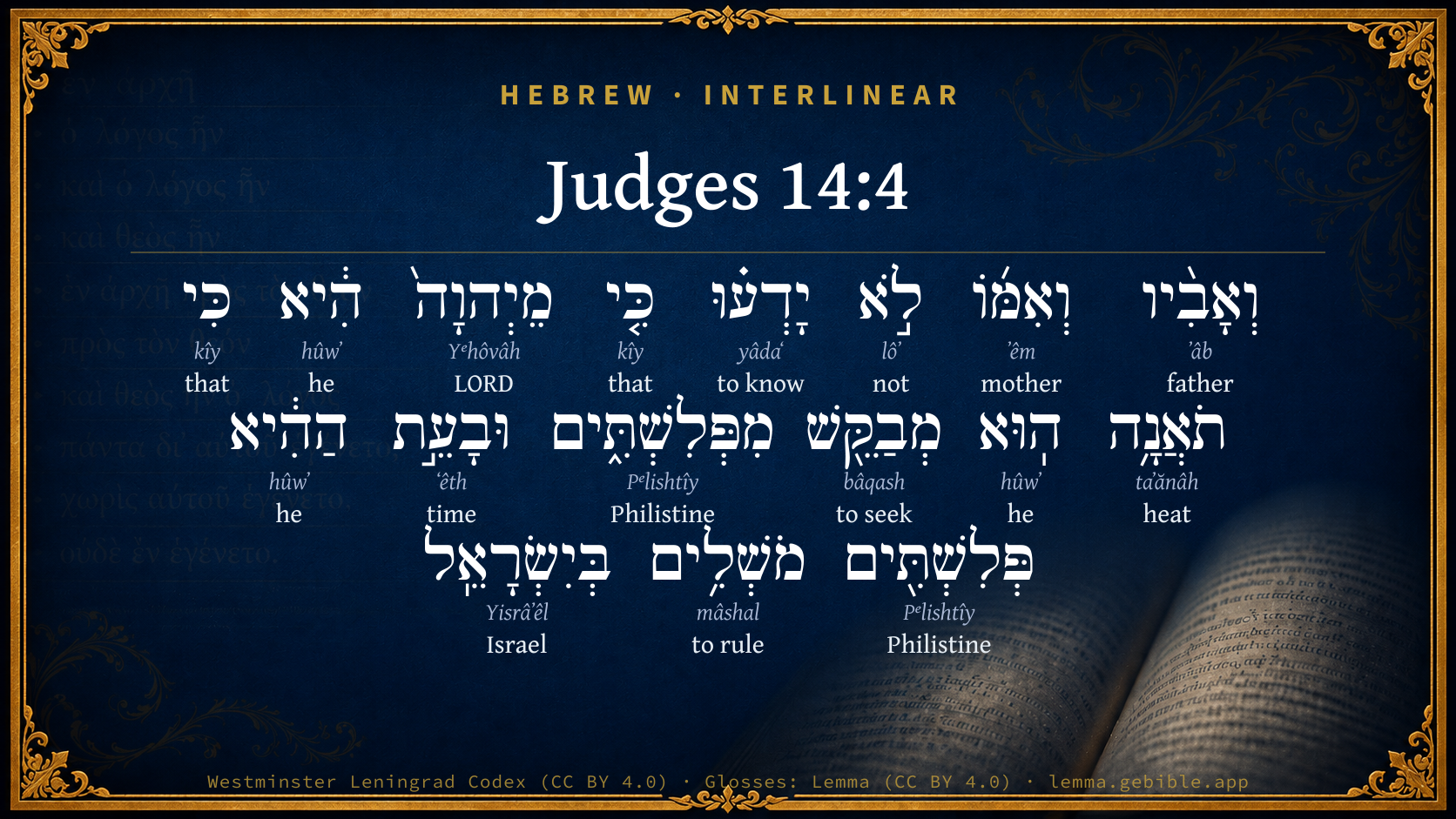
Judges 14:4

Hebrew (Westminster Leningrad Codex) Judges 14:4 appears in the Hebrew Old Testament. The text above is from the Westminster Leningrad Codex. Each word links to its Strong’s number, a concise gloss, and parsing drawn from the Open Scriptures Hebrew Bible morphology. Click any word for its full Brown-Driver-Briggs (BDB) entry.
Download image
Cite this verse

Judges 14:4 (World English Bible). Public Domain. Lemma interlinear Bible study tool, https://lemma.gebible.app/v/judges/14/4.

Show BibTeX & RIS
BibTeX
RIS
English Translation
But his father and his mother didn't know that it was of Yahweh; for he sought an occasion against the Philistines. Now at that time the Philistines had rule over Israel.
World English Bible · Public Domain
Highlights
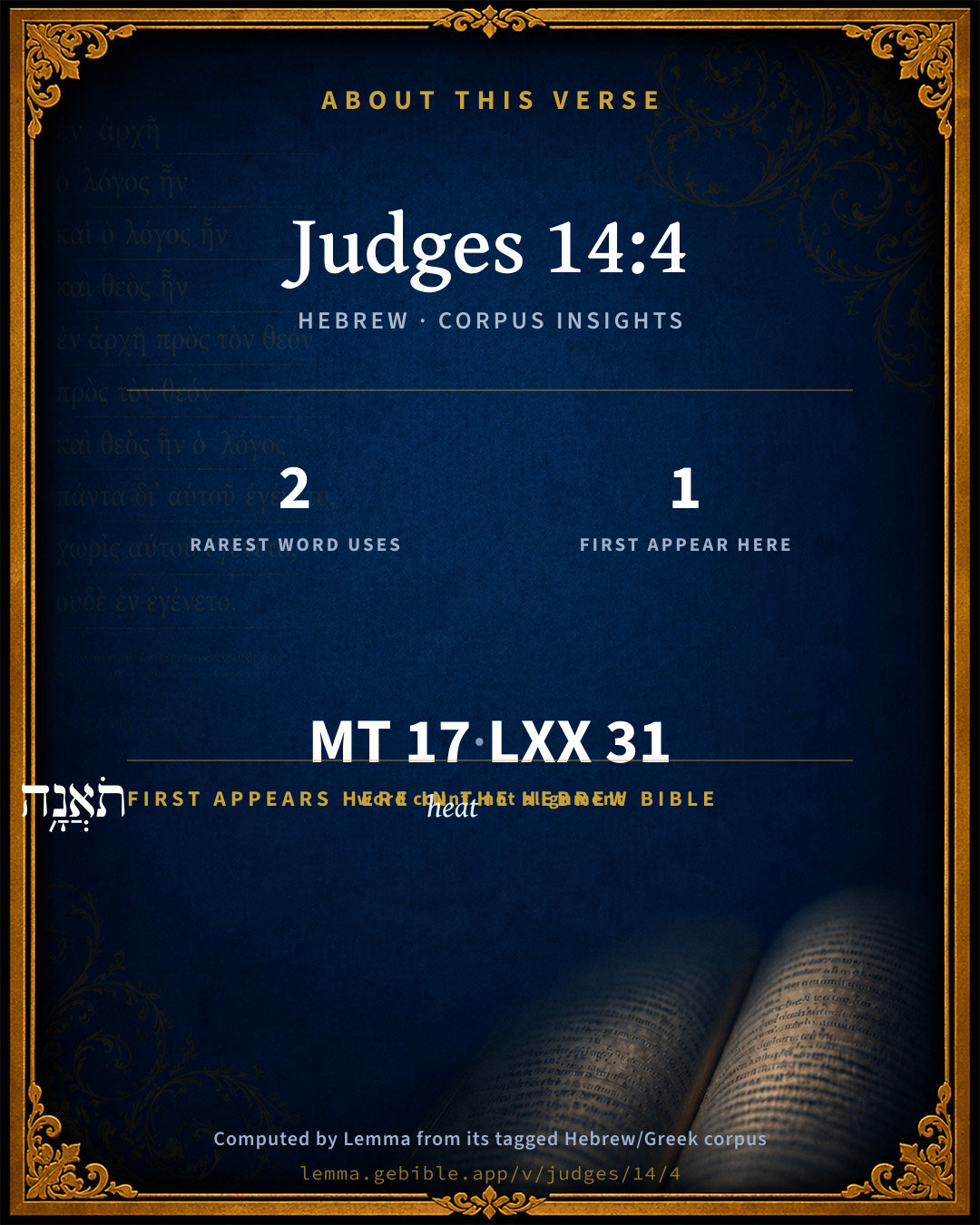
  • 1 first appearance in the Hebrew Bible
Full analysis ↓
Download a study sheet

One document with this verse’s original text, its word-by-word gloss line, the meaning frame, cross-references with their text, attributed commentary, and full source and license credits — printable, and it pastes into notes with its structure intact.

This verse Autodidact and up

Study sheet (.html) Plain text (.txt)

A passage Seminary Student

Up to 50 verses in one chapter. A passage sheet keeps up to 6 commentary sources and 12 cross-references per verse, in the order this page ranks them, and says so on the sheet whenever that leaves anything out. Ask for a single verse and you get the Autodidact verse sheet above.

Everything on this page stays free to read, with no account — the sheet is a download of what is already on screen, not access to it.

Want to remove ads? Support Godless Engineer
Compare translations 3

The same verse in 3 English versions, stacked beneath the original-language interlinear above. Click any original word for its lexicon entry.

Each is an independent rendering of the whole verse — the interlinear is not word-aligned to these translations.

Highlighted words mark where these versions differ — a whole-verse word diff, not a word-by-word alignment.

  • World English Bible Public Domain
    But his father and his mother didn't know that it was of Yahweh; for he sought an occasion against the Philistines. Now at that time the Philistines had rule over Israel.
  • King James Version Public Domain
    But his father and his mother knew not that it was of the LORD, that he sought an occasion against the Philistines: for at that time the Philistines had dominion over Israel.
  • unfoldingWord Literal Text CC BY-SA 4.0
    But his father and his mother did not know that it from Yahweh, for he seeking an occasion against the Philistines. For at that time the Philistines ruling over Israel.

unfoldingWord Literal Text — © unfoldingWord, licensed CC BY-SA 4.0. Word-aligned USFM3 via Door43 (git.door43.org/unfoldingWord/en_ult).

Versions to compare (up to 4)

3 of 4 selected

Show all 18 translations

Every available English version of this verse, each an independent rendering of the whole verse.

  • World English Bible Public Domain
    But his father and his mother didn't know that it was of Yahweh; for he sought an occasion against the Philistines. Now at that time the Philistines had rule over Israel.
  • Berean Standard Bible Public Domain
    (Now his father and mother did not know this was from the LORD, who was seeking an occasion to move against the Philistines; for at that time the Philistines were ruling over Israel.)
  • Majority Standard Bible Public Domain
    (Now his father and mother did not know this was from the LORD, who was seeking an occasion to move against the Philistines; for at that time the Philistines were ruling over Israel.)
  • King James Version Public Domain
    But his father and his mother knew not that it was of the LORD, that he sought an occasion against the Philistines: for at that time the Philistines had dominion over Israel.
  • American Standard Version (1901) Public Domain
    But his father and his mother knew not that it was of Jehovah; for he sought an occasion against the Philistines. Now at that time the Philistines had rule over Israel.
  • Revised Version (1885) Public Domain
    But his father and his mother knew not that it was of the LORD; for he sought an occasion against the Philistines. Now at that time the Philistines had rule over Israel.
  • Geneva Bible (1599) Public Domain
    But his father and his mother knewe not that it came of the Lord, that he should seeke an occasion against the Philistims: for at that time the Philistims reigned ouer Israel.
  • Douay-Rheims (1899) Public Domain
    Now his parents knew not that the thing was done by the Lord, and that he sought an occasion against the Philistines: for at that time the Philistines had dominion over Israel.
  • Young's Literal Translation Public Domain
    And his father and his mother have not known that from Jehovah it `is', that a meeting he is seeking of the Philistines; and at that time the Philistines are ruling over Israel.
  • Literal Standard Version CC BY-SA 4.0
    And his father and his mother have not known that it [is] from YHWH, that He is seeking a meeting of the Philistines; and the Philistines are ruling over Israel at that time.
  • Unlocked Literal Bible CC BY-SA 4.0
    But his father and his mother did not know that this matter came from Yahweh, for he desired to create a conflict with the Philistines (for at that time the Philistines were ruling Israel).
  • unfoldingWord Literal Text CC BY-SA 4.0
    But his father and his mother did not know that it from Yahweh, for he seeking an occasion against the Philistines. For at that time the Philistines ruling over Israel.
  • Darby Bible Public Domain
    His father and mother did not know that it was from the LORD; for he was seeking an occasion against the Philistines. At that time the Philistines had dominion over Israel.
  • World Messianic Bible Public Domain
    But his father and his mother didn’t know that it was of the LORD; for he sought an occasion against the Philistines. Now at that time the Philistines ruled over Israel.
  • Webster's Bible Public Domain
    But his father and his mother knew not that it was of the LORD, that he sought an occasion against the Philistines: for at that time the Philistines had dominion over Israel.
  • Free Bible Version CC BY-SA 4.0
    (His father and mother didn't realize that this was in the Lord's plans, who was looking for an opportunity to deal with the Philistines; because at that time the Philistines ruled over Israel.)
  • Bible in Basic English Public Domain
    Now his father and mother had no knowledge that this was the purpose of the Lord, who had the destruction of the Philistines in mind. Now the Philistines at that time were ruling over Israel.
  • JPS Tanakh (1917) Public Domain
    But his father and his mother knew not that it was of the LORD; for he sought an occasion against the Philistines. Now at that time the Philistines had rule over Israel.

Literal Standard Version (2020), Covenant Press — licensed CC BY-SA 4.0. Text via the HelloAO Bible API (eBible.org). Unlocked Literal Bible (unfoldingWord) — licensed CC BY-SA 4.0. Text via the HelloAO Bible API (eBible.org). unfoldingWord Literal Text — © unfoldingWord, licensed CC BY-SA 4.0. Word-aligned USFM3 via Door43 (git.door43.org/unfoldingWord/en_ult). Free Bible Version, Dr. Jonathan Gallagher — licensed CC BY-SA 4.0. Text via the HelloAO Bible API (eBible.org).

Word by word

More ways to search: Search by grammar → Find every occurrence → Compare this word →

Practice this passage: Drill this verse → Learn its vocabulary →

תֹאֲנָ֥ה
taʼănâh
H8385
“heat”
Noun, Common, Feminine, Singular, Absolute
Part of Speech
Noun
Type
Common
Gender
Feminine
Number
Singular
State
Absolute
Full BDB Definition

Origin: from H579

TWOT: 126a , 126b

occasion, time of heat or oestrous or copulation, sexual drive (of animal) - occasion, opportunity (for a quarrel)
  1. וְאָבִ֨יו ʼâb H1 “and · father · his” Conjunction + Noun, Common, Masculine, Singular, Construct + Suffix, Personal, 3rd Person, Masculine, Singular
  2. וְאִמּ֜וֹ ʼêm H517 “and · mother · his” Conjunction + Noun, Common, Feminine, Singular, Construct + Suffix, Personal, 3rd Person, Masculine, Singular
  3. לֹ֣א lôʼ H3808 “not” Particle, Negative
  4. יָדְע֗וּ yâdaʻ H3045 “to know” Verb, Qal, Perfect, 3rd Person, Common, Plural
  5. כִּ֤י kîy H3588 “that” Conjunction
  6. מֵיְהוָה֙ Yᵉhôvâh H3068 “from · LORD” Preposition + Noun, Proper
  7. הִ֔יא hûwʼ H1931 “he” Pronoun, Personal, 3rd Person, Feminine, Singular
  8. כִּי kîy H3588 “that” Conjunction
  9. הֽוּא hûwʼ H1931 “he” Pronoun, Personal, 3rd Person, Masculine, Singular
  10. מְבַקֵּ֖שׁ bâqash H1245 “seeking” Verb, Piel, Participle Active, Masculine, Singular, Absolute
  11. מִפְּלִשְׁתִּ֑ים Pᵉlishtîy H6430 “from · Philistines” Preposition + Noun, Gentilic, Masculine, Plural, Absolute
  12. וּבָעֵ֣ת ʻêth H6256 “and · in/at the · time” Conjunction + Preposition, Determined + Noun, Common, Both, Singular, Absolute
  13. הַהִ֔יא hûwʼ H1931 “the · he” Particle, Definite Article + Pronoun, Personal, 3rd Person, Feminine, Singular
  14. פְּלִשְׁתִּ֖ים Pᵉlishtîy H6430 “Philistines” Noun, Gentilic, Masculine, Plural, Absolute
  15. מֹשְׁלִ֥ים mâshal H4910 “ruling” Verb, Qal, Participle Active, Masculine, Plural, Absolute
  16. בְּיִשְׂרָאֵֽל Yisrâʼêl H3478 “in/at · Israel” Preposition + Noun, Proper

About this verse

These counts appear in no published source. They are computed here, from the morphology-tagged text and Lemma’s own curated glosses. What Lemma adds →

17
words
13
distinct lemmas
Historical
section

Notable vocabulary

The rarest word here is תֹאֲנָ֥ה heat H8385 — appearing just 2 times in the whole Hebrew Bible.

First appearance in Scripture

This word makes its first canonical appearance in the Hebrew Bible here:

  • תֹאֲנָ֥ה heat H8385

Shared distinctive vocabulary

תֹאֲנָ֥ה heat H8385 occurs in 2 verses of the Hebrew Bible. Also found in:

Grammatical profile

  • 3 verbs
  • 8 nouns
  • 3 pronouns
  • 2 conjunctions
  • 1 particle

Verb forms

  • יָדְע֗וּ Qal · Perfect
  • מְבַקֵּ֖שׁ Piel · Participle Active
  • מֹשְׁלִ֥ים Qal · Participle Active

Repetition

Words recur within this verse — often emphatic in Hebrew:

  • מִפְּלִשְׁתִּ֑ים Philistine H6430 ×2
  • הִ֔יא he H1931 ×3
  • כִּ֤י that H3588 ×2

Hebrew & Septuagint length

In English translation the verse runs 31 words from the Hebrew and 33 from the Septuagint (LXX English) — closely comparable.

A rough comparison of the two English renderings, which tokenize alike — not a word-level alignment.

Word counts can differ between the Hebrew and the Greek without any difference in meaning — e.g. the Hebrew direct-object marker אֵת has no separate Greek word, and Greek often adds the article ὁ.

In the original languages it is 17 Hebrew tokens and 31 Greek tokens — but the two are counted differently (Hebrew bundles its prefixes and suffixes into one token; the Greek is in lemma form), so that isn’t a like-for-like length.

Cross-references

10

Topical passages linked to Judges 14:4 in the Treasury of Scripture Knowledge — connected by theme and wording, ordered by reader-vote popularity; previews shown in the World English Bible.

  • Joshua 11:20 For it was of Yahweh to harden their hearts, to come against Israel in battle, that he might utterly destroy them, that they might have no favor, but that he might destroy them, as Yahweh commanded Moses.
  • Psalms 115:3 But our God is in the heavens. He does whatever he pleases.
  • Judges 13:1 The children of Israel again did that which was evil in the sight of Yahweh; and Yahweh delivered them into the hand of the Philistines forty years.
  • 1 Kings 12:15 So the king didn't listen to the people; for it was a thing brought about of Yahweh, that he might establish his word, which Yahweh spoke by Ahijah the Shilonite to Jeroboam the son of Nebat.
  • 2 Kings 6:33 While he was yet talking with them, behold, the messenger came down to him: and he said, Behold, this evil is of Yahweh; why should I wait for Yahweh any longer?
  • 2 Chronicles 10:15 So the king didn't listen to the people; for it was brought about of God, that Yahweh might establish his word, which he spoke by Ahijah the Shilonite to Jeroboam the son of Nebat.
  • 2 Chronicles 22:7 Now the destruction of Ahaziah was of God, in that he went to Joram: for when he was come, he went out with Jehoram against Jehu the son of Nimshi, whom Yahweh had anointed to cut off the house of Ahab.
  • Deuteronomy 28:48 therefore shall you serve your enemies whom Yahweh shall send against you, in hunger, and in thirst, and in nakedness, and in want of all things: and he shall put a yoke of iron on your neck, until he have destroyed you.
  • Judges 15:11 Then three thousand men of Judah went down to the cleft of the rock of Etam, and said to Samson, "Don't you know that the Philistines are rulers over us? What then is this that you have done to us?" He said to them, As they did to me, so have I done to them.
  • 2 Chronicles 25:20 But Amaziah would not hear; for it was of God, that he might deliver them into the hand [of their enemies], because they had sought after the gods of Edom.

Cross-references courtesy of OpenBible.info (CC BY 4.0).

Hebrew and Greek witnesses Masoretic Hebrew ↔ Greek Septuagint

The same verse in the two great witnesses to the Old Testament, shown verse-for-verse.

These are two independent witnesses, not word-aligned to each other, and the Septuagint is shown in lemma (dictionary) form.

Hebrew Judges 14:4 Masoretic · Westminster Leningrad Codex

וְאָבִ֨יו וְאִמּ֜וֹ לֹ֣א יָדְע֗וּ כִּ֤י מֵיְהוָה֙ הִ֔יא כִּי תֹאֲנָ֥ה הֽוּא מְבַקֵּ֖שׁ מִפְּלִשְׁתִּ֑ים וּבָעֵ֣ת הַהִ֔יא פְּלִשְׁתִּ֖ים מֹשְׁלִ֥ים בְּיִשְׂרָאֵֽל

But his father and his mother didn't know that it was of Yahweh; for he sought an occasion against the Philistines. Now at that time the Philistines had rule over Israel.

World English Bible · Public Domain

Greek LXX Judges 14:4 Septuagint · lemma form

καί ὁ πατήρ αὐτός καί ὁ μήτηρ αὐτός οὐ γιγνώσκω ὅτι παρά κύριος εἰμί ὅτι ἐκδίκησις αὐτός ζητέω ἐκ ὁ ἀλλόφυλος καί ἐν ὁ καιρός ἐκεῖνος ὁ ἀλλόφυλος κυριεύω ἐν ἰσραήλ

And his father and his mother knew not that it was of the Lord, that he sought to be revenged on the Philistines: and at that time the Philistines lorded it over Israel.

LXX2012 (modern English Septuagint) · Public Domain

On this verse, Ellicott's Commentary for English Readers discusses the Septuagint’s reading. Read the note in Commentary ↓

Hebrew: Westminster Leningrad Codex (CC BY 4.0). Greek: Septuagint (public domain); English from LXX2012 (modern English Septuagint) (Public Domain). How the Septuagint differs from the Hebrew →

Targum (Aramaic paraphrase)

1

The Targum is the ancient Jewish Aramaic paraphrase of the Hebrew Scriptures — an interpretive translation, not the Hebrew text itself. Onkelos (literal) and Pseudo-Jonathan (expansive) render the Torah, and Jonathan the Prophets. Coverage is partial: where no permissively-licensed English translation exists for a verse, only the Aramaic is shown. This is verse-level text, not a word-by-word alignment to the Hebrew.

  1. Targum Jonathan Prophets (Joshua–Malachi)
    וַאֲבוּהִי וְאִמֵיהּ לָא יָדְעִין אֲרֵי מִן קֳדָם יְיָ הוּא אֲרֵי תוּסְקָפָא הוּא בָעֵי לְאִתְגְרָאָה בִּפְלִשְׁתָּאֵי וּבְעִידָנָא הַהִיא פְּלִשְׁתָּאֵי שַׁלְטִין בְּיִשְׂרָאֵל:

    (no public-domain English translation for this verse)

    Targum Jonathan — Aramaic: “Mikraot Gedolot” (public domain). English: “Sefaria Community Translation” (CC0 1.0 (public-domain dedication)); “London "Chaldee Paraphrase," 1871” (public domain). Text via Sefaria.

Commentary

Notes on Judges 14:4 from classic Christian and Jewish commentators (each source and its license shown beneath its notes). The classic Christian expositions comment on the surrounding passage and are grouped to its opening verse, so a note may address several verses; the Jewish commentaries on the Tanakh (Rashi and others) are per-verse, so they appear only where the commentator wrote on this verse.

Lemma curates 59 commentaries, every one of them public domain or Creative Commons licensed, each selected and text-cleaned for this edition rather than reprinted as found. About our sources →

Trapp's Complete Commentary

John Trapp

Jdg 14:4 But his father and his mother knew not that it [was] of the LORD, that he sought an occasion against the Philistines: for at that time the Philistines had dominion over Israel.

Ver. 4. For at that time the Philistines had dominion over Israel.] Who had haply sworn fealty and subjection to the Philistines; and therefore Samson was to seek an occasion against them.

John Trapp, A Commentary or Exposition upon All the Books of the Old and New Testament (1647–1656) — public domain. Text from a community e-Sword module.

Geneva Bible (1599)

Geneva Bible translators

To fight against them for the deliverance of Israel.

Geneva Bible (1599) marginal notes — public domain. Text via Bolls.life.

Ellicott's Commentary for English Readers

(4) That it was of the Lord.—All that can be meant is that in this marriage God was overruling the course of events to the furtherance of His own designs. He makes even the weakness and the fierceness of man redound to His praise. (Comp. Jos_11:10; 2Ch_25:20.) See the same phrase in the story of Rehoboam’s folly (1Ki_12:15). “Behold this evil is of the Lord,” says Elisha in 2Ki_6:33. It is the strong sense of the Divine rule which we find even in heathen writers, so that in the very opening lines of Homer we find the poet saying, “that amid all the crimes and passions of men the counsel of Zeus was being accomplished.”

“Achilles’ wrath, to Greece the direful spring

Of woes unnumbered, heavenly goddess sing:

That wrath which hurled to Pluto’s gloomy reign

The souls of mighty chiefs unnumbered slain,

Whose limbs, unburied on the naked shore,

Devouring dogs and hungry vultures tore,

Since great Achilles and Atrides strove,—

Such was the sovereign doom, and such the will of Jove!.”

That he sought an occasion.—Some commentators explain “he” to mean Jehovah, which seems most unlikely. The word rendered “an occasion” is rather, “a quarrel” (LXX., “retribution,” or “vengeance”).

A Bible Commentary for English Readers, edited by Charles John Ellicott (1878–1897) — public domain. Text from a community e-Sword module.

The Cambridge Bible for Schools and Colleges

gen. ed. J. J. S. Perowne

4. It is not actually said that Manoah refused, but the sequel (Jdg_14:5-7) in its original form implies that he did.

he sought an occasion] The subject is Jehovah, cf. Jos_11:20; an occasion, i.e. for a quarrel, cf. 2Ki_5:7. The Philistines had always been the aggressors; an act of retaliation was justifiable.

over Israel] Israel as a whole did not yet exist. The generalized statement probably comes from the editor; cf. Jdg_13:1.

The Cambridge Bible for Schools and Colleges (gen. ed. J. J. S. Perowne; Cambridge University Press, 1878–1918) — public domain. Text from a community e-Sword module.

John Gill's Exposition

And his father and mother knew not that it was of the Lord,.... That he should marry this uncircumcised Philistine; Samson knew it was, and that his desire of having her in marriage did not arise from carnal affection to her merely, being captivated with her beauty and external form, for she was not so very fair, her younger sister was fairer than she, Jdg 15:2 but he perceived it was the mind and will of God that he should take such a person to wife, by the impulse of the Spirit of God upon him, pointing it, unto him, inclining and urging him to it, suggesting the end and design of it, and the opportunity it would give him of quarrelling with the Philistines, and taking vengeance on them; but this his parents were ignorant of, nor did he let them know that this was of God:

that he sought an occasion against the Philistines; in this way, by this means; they might know he sought to get an opportunity to be avenged on them for their oppression, and to attempt the deliverance of Israel; but they knew not that it was the will of God that a way should be opened for it by this means. Samson might be directed by the Lord to reason thus in his mind, that if he proposed to the Philistines to marry one of their daughters, and they should reject his proposal, this would give him a reason to fall out with them, and fall upon them; and if they should agree to such a match, he might expect they would be kind to him, and to his people for his sake, being in alliance with them, or he should resent it, and take occasion from hence to come to a quarrel with them:

for at that time the Philistines had dominion over Israel; had invaded their country, and dwelt in their cities, and made them tributary to them, and used them ill; which Samson observing, was provoked to seek an opportunity of avenging the injuries done them, and of delivering them, and he was directed to it this way.

John Gill's Exposition of the Whole Bible (1746–1763) — public domain (CC PDM 1.0). Text via the HelloAO Bible API.

Albert Barnes' Notes on the Bible

His father and mother very properly opposed Samson’s marriage with a Pagan woman, the daughter of the oppressors of his race. But they could not prevail, because it was the secret purpose of God by these means to “seek occasion” against the Philistines; i. e. to make the misconduct of the father of Samson’s wife, which He foresaw, the occasion of destruction to the Philistines. Compare the marginal references for similar statements.

Albert Barnes' Notes on the Bible (1834–1885) — public domain. Text from a community e-Sword/MySword module.

Haydock's Catholic Bible Commentary

He sought. This may be understood either of the Lord, or rather of Samson. (Calmet) --- Septuagint, "because he himself sought to retaliate upon the Philistines." Hebrew, "that it was of the Lord that, or because he sought an occasion to take," &c. (Haydock)

George Leo Haydock (1774–1849), Haydock's Catholic Family Bible and Commentary, 1859 edition — public domain. Excludes Psalms (Douay-Rheims chapter numbering differs from Protestant) and Deuterocanonical books (Catholic canon only).

Matthew Poole's English Annotations

He sought an occasion against the Philistines; which he knew by very probable conjecture, if not by particular inspiration, that marriage would give him many ways.

Matthew Poole's English Annotations on the Holy Bible (1683–1685) — public domain. Text from a community e-Sword/MySword module.

Whedon's Commentary on the Bible

Daniel D. Whedon

4. It was of the Lord — Our historian is writing SACRED history, and he marks everywhere the working of Divine Providence. Samson was raised up of God to begin to deliver Israel, and therefore every event of his life that was associated with that work was providentially ordered.

That he sought an occasion — Not that Samson had a foreknowledge of what would be the outcome of this marriage, and purposely sought this woman to wife that he might find some opportunity of working mischief and ruin among the Philistines; but that the Lord overruled all these events for the purpose of weakening the Philistines’ power. Samson evidently had some suspicion or impression that the marriage would lead to great results. He at least recognised, as his parents did not, the hand of God in the matter, and he felt assured that his love for the woman, and her righteousness in his eyes, were providential indications that in marrying her he was boldly entering on the great mission of his life. But how the matter would terminate neither he nor his parents then knew.

Against the Philistines — Rather, From the Philistines. The provoking and responsible occasion for Samson to injure the Philistines was to be on their side, not on his.

For at that time — This sentence is added as the general reason why the Lord was providentially preparing the way to weaken and overthrow the Philistine dominion over Israel.

{The theory of the Old Testament language in regard to God’s providence seems to be this: Whatever act of man, however free or wicked, contributes to the higher scheme of Jehovah’s purpose, and so, though divinely disapproved, is divinely recognised, and wrought into the series of events, is roughly said to be of the Lord, and his act and doing. The old Hebraic age had not yet attempted to draw the metaphysical line between God’s will and God’s non-prevention of those sins which are necessarily to be admitted into that system of free-agency from which the highest good shall accrue. Those sins, therefore, which are seen by the inspired writer to adjust into the high scheme of God, and to bring out his intended results, are, in lump, attributed to him. They are not his by approval, by decree, by direct production, nor by fore-ordination; but are only indiscriminately said to be his, because, foreseen by him, they are simply non-prevented, and woven into his complex plan for bringing out the highest good. This is not rightly called a Hebraism in the sense of a Hebrew idiom; but it is a Hebraism in the sense of being a Hebrew style of thought and expression. The Hebrew knew, indeed, that Jehovah was absolutely holy, and men’s sins were wicked, but had never fully adjusted the relation between the two. A later age, when moral thought becomes more defined, raises the question of God’s exact collision with sin, and draws the discriminating line. See notes on Mat_11:25; Act_2:23; Act_4:28; and introductory note to Romans 9.}

Daniel D. Whedon (gen. ed.), Commentary on the Old and New Testaments (1874–1909) — public domain. Text from a community e-Sword module.

The Pulpit Commentary

It was of or from the Lord. It was the method decreed by God"s providence for bringing about a rupture with the Philistines. That he sought. Rather, because he sought. The writer explains the purpose of the providence. It is doubtful whether "he" refers to Samson or to the Lord. Most commentators refer it to Samson; but it is contrary to the whole tenor of Samson"s impetuous course, and to all probability, that he should have asked for the Timnathite damsel merely for the sake of quarreling with the Philistines; whereas the statement that Samson s obstinate determination to take a Philistine wife was the means which God"s secret purpose had fixed upon for bringing about the eventual overthrow of the Philistine dominion is in exact accordance with other declarations of Holy Scripture. (cf. e.g. Exo_7:3, 4 1Sa_2:25 1Ki_12:15 2Ch_10:15 2Ch_22:7 2Ch_25:20) An occasion. The noun only occurs here; but the verb, in its several conjugations, means, to happen at the right time; to bring a person or thing at the right time; (Exo_21:13, deliver, A.V) to be brought at the right time ; (Pro_12:21, happen, A.V) to seek the right time for injuring any one. (2Ki_5:7, seeketh a quarrel, A.V)

The Pulpit Commentary (1880–1919), ed. H.D.M. Spence-Jones & Joseph S. Exell — public domain. Text from a community e-Sword module.

Rashi

Rabbi Shlomo Yitzchaki (Rashi)

As He sought a pretext. An accusation with which to provoke a confrontation against them.

Rashi on the Tanakh — English translations: “The Judaica Press complete Tanach with Rashi, translated by A. J. Rosenberg” (CC BY 4.0); “Pentateuch with Rashi's commentary by M. Rosenbaum and A.M. Silbermann, 1929-1934” (public domain); “The Metsudah Tanach series, Lakewood, N.J” (CC BY 4.0); and “The Book of Joshua, Metsudah Publications, 1997” (CC BY 4.0). Text via Sefaria.

Lesson kit

Teaching starters — assembled from the data on this page, not authored interpretation. Every prompt links to the verse data it draws on. Edit before teaching.

Judges, in the Historical, opens this verse with 17 words (13 distinct Hebrew lemmas). Its most distinctive word is taʼănâh (“heat”). A historical commentator’s framing appears above. Read the whole chapter for the surrounding context.

Discussion questions

  1. The word taʼănâh carries the sense “heat.” How does it shape the verse?
  2. This is the first place “heat” appears in Scripture (first appears here). What does its debut here establish?
  3. How does Jeremiah 2:24, which shares the word «heat», read alongside this verse?
  4. What does the repetition of “Philistine” (2× in this one verse) do in this verse?
  5. These translations render this verse differently. What is at stake in choosing one wording over another?
  6. «יָדְע֗וּ» is a Qal Perfect verb. How does that grammatical form shape the action described?
  7. Compare how Trapp's Complete Commentary and Geneva Bible (1599) read this verse. Where do they agree or differ?

Things to notice

Reading settings

Reading text

Shown beneath each verse's original-language words.

Old Testament
Old Testament edition

Read the OT as the Masoretic Hebrew (MT) or the Greek Septuagint (LXX).

English shown for the Greek Septuagint (in the Hebrew ↔ Greek comparison).

Comparing translations? Open the Compare panel on any verse page to stack up to four side by side.