
Isaiah 49:8

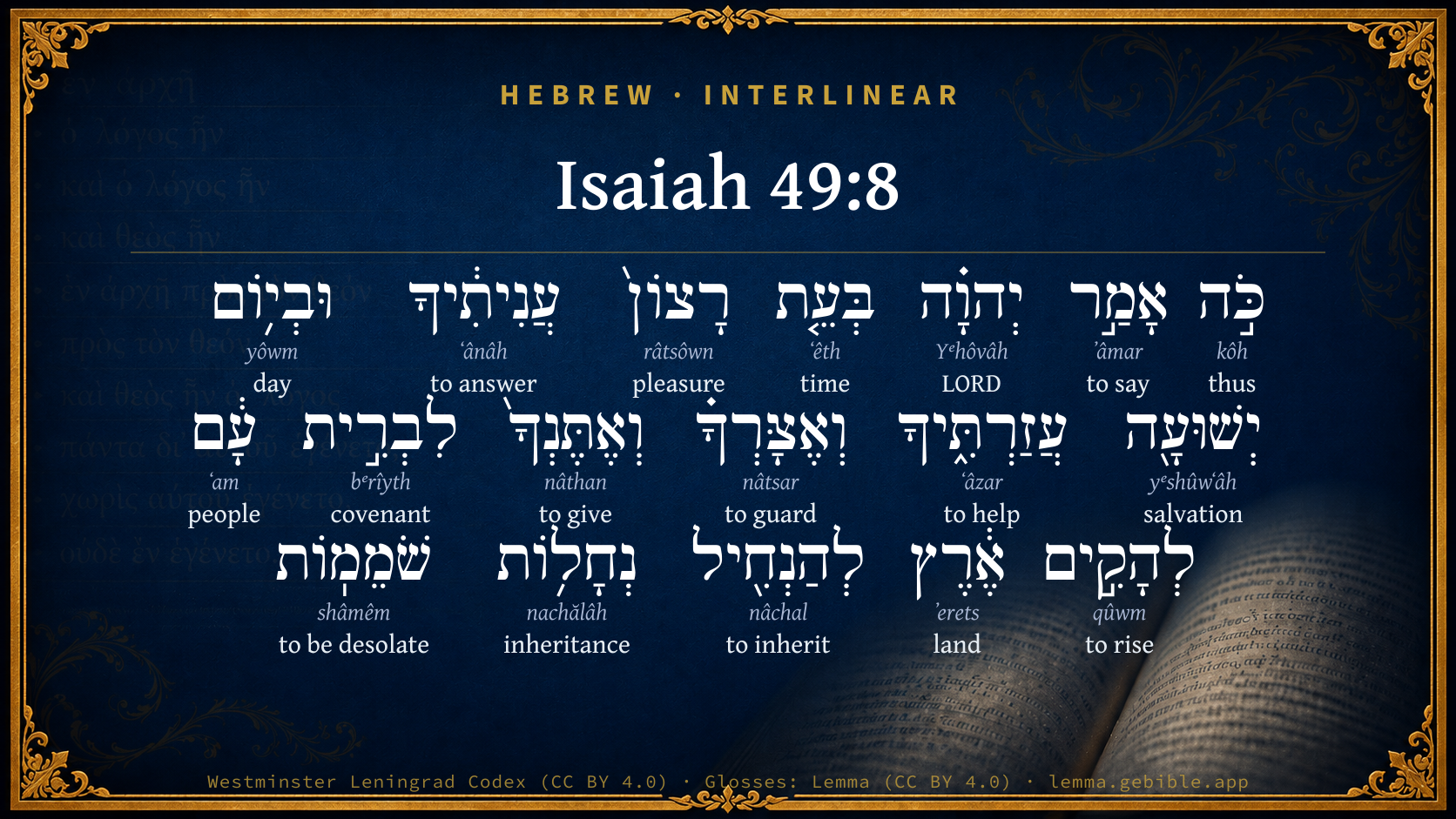
Hebrew (Westminster Leningrad Codex) Isaiah 49:8 appears in the Hebrew Old Testament. The text above is from the Westminster Leningrad Codex. Each word links to its Strong’s number, a concise gloss, and parsing drawn from the Open Scriptures Hebrew Bible morphology. Click any word for its full Brown-Driver-Briggs (BDB) entry.
Download image
Cite this verse

Isaiah 49:8 (World English Bible). Public Domain. Lemma interlinear Bible study tool, https://lemma.gebible.app/v/isaiah/49/8.

Show BibTeX & RIS
BibTeX
RIS
English Translation
Thus says Yahweh, In an acceptable time have I answered you, and in a day of salvation have I helped you; and I will preserve you, and give you for a covenant of the people, to raise up the land, to make them inherit the desolate heritage:
World English Bible · Public Domain
Download a study sheet

One document with this verse’s original text, its word-by-word gloss line, the meaning frame, cross-references with their text, attributed commentary, and full source and license credits — printable, and it pastes into notes with its structure intact.

This verse Autodidact and up

Study sheet (.html) Plain text (.txt)

A passage Seminary Student

Up to 50 verses in one chapter. A passage sheet keeps up to 6 commentary sources and 12 cross-references per verse, in the order this page ranks them, and says so on the sheet whenever that leaves anything out. Ask for a single verse and you get the Autodidact verse sheet above.

Everything on this page stays free to read, with no account — the sheet is a download of what is already on screen, not access to it.

Want to remove ads? Support Godless Engineer
Compare translations 3

The same verse in 3 English versions, stacked beneath the original-language interlinear above. Click any original word for its lexicon entry.

Each is an independent rendering of the whole verse — the interlinear is not word-aligned to these translations.

Highlighted words mark where these versions differ — a whole-verse word diff, not a word-by-word alignment.

  • World English Bible Public Domain
    Thus says Yahweh, In an acceptable time have I answered you, and in a day of salvation have I helped you; and I will preserve you, and give you for a covenant of the people, to raise up the land, to make them inherit the desolate heritage:
  • King James Version Public Domain
    Thus saith the LORD, In an acceptable time have I heard thee, and in a day of salvation have I helped thee: and I will preserve thee, and give thee for a covenant of the people, to establish the earth, to cause to inherit the desolate heritages;
  • unfoldingWord Literal Text CC BY-SA 4.0
    Thus says Yahweh, “In the time of favor I will answer you, and in the day of salvation I will help you. And I will preserve you, and I will give you as a covenant of the people, to raise up the land, to make inherit the inheritances being desolate,

unfoldingWord Literal Text — © unfoldingWord, licensed CC BY-SA 4.0. Word-aligned USFM3 via Door43 (git.door43.org/unfoldingWord/en_ult).

Versions to compare (up to 4)

3 of 4 selected

Show all 18 translations

Every available English version of this verse, each an independent rendering of the whole verse.

  • World English Bible Public Domain
    Thus says Yahweh, In an acceptable time have I answered you, and in a day of salvation have I helped you; and I will preserve you, and give you for a covenant of the people, to raise up the land, to make them inherit the desolate heritage:
  • Berean Standard Bible Public Domain
    This is what the LORD says: “In the time of favor I will answer You, and in the day of salvation I will help You; I will keep You and appoint You to be a covenant for the people, to restore the land, to apportion its desolate inheritances,
  • Majority Standard Bible Public Domain
    This is what the LORD says: “In the time of favor I will answer You, and in the day of salvation I will help You; I will keep You and appoint You to be a covenant for the people, to restore the land, to apportion its desolate inheritances,
  • King James Version Public Domain
    Thus saith the LORD, In an acceptable time have I heard thee, and in a day of salvation have I helped thee: and I will preserve thee, and give thee for a covenant of the people, to establish the earth, to cause to inherit the desolate heritages;
  • American Standard Version (1901) Public Domain
    Thus saith Jehovah, In an acceptable time have I answered thee, and in a day of salvation have I helped thee; and I will preserve thee, and give thee for a covenant of the people, to raise up the land, to make them inherit the desolate heritages:
  • Revised Version (1885) Public Domain
    Thus saith the LORD, In an acceptable time have I answered thee, and in a day of salvation have I helped thee: and I will preserve thee, and give thee for a covenant of the people, to raise up the land, to make them inherit the desolate heritages;
  • Geneva Bible (1599) Public Domain
    Thus sayeth the Lord, In an acceptable time haue I heard thee, and in a day of saluation haue I helped thee: and I will preserue thee, and wil giue thee for a couenant of ye people, that thou maiest raise vp the earth, and obtaine the inheritance of the desolate heritages:
  • Douay-Rheims (1899) Public Domain
    Thus saith the Lord: In an acceptable time I have heard thee, and in the day of salvation I have helped thee: and I have preserved thee, and given thee to be a covenant of the people, that thou mightest raise up the earth, and possess the inheritances that were destroyed:
  • Young's Literal Translation Public Domain
    Thus said Jehovah: `In a time of good pleasure I answered thee, And in a day of salvation I helped thee, And I keep thee, and give thee, For a covenant of the people, To establish the earth, To cause to inherit desolate inheritances.
  • Literal Standard Version CC BY-SA 4.0
    Thus said YHWH: “In a time of good pleasure I answered You, || And in a day of salvation I helped You, || And I keep You, and give You, || For a covenant of the people, || To establish the earth, || To cause to inherit desolate inheritances.
  • Unlocked Literal Bible CC BY-SA 4.0
    This is what Yahweh says, “At a time I decide to show my favor I will answer you, and in a day of salvation I will help you; I will protect you, and give you as a covenant for the people, to rebuild the land, to reassign the desolate inheritance.
  • unfoldingWord Literal Text CC BY-SA 4.0
    Thus says Yahweh, “In the time of favor I will answer you, and in the day of salvation I will help you. And I will preserve you, and I will give you as a covenant of the people, to raise up the land, to make inherit the inheritances being desolate,
  • Darby Bible Public Domain
    Thus saith Jehovah: In a time of acceptance have I answered thee, and in the day of salvation have I helped thee; and I will preserve thee, and give thee for a covenant of the people, to establish the land, to cause to inherit the desolate heritages;
  • World Messianic Bible Public Domain
    The LORD says, “I have answered you in an acceptable time. I have helped you in a day of salvation. I will preserve you and give you for a covenant of the people, to raise up the land, to make them inherit the desolate heritage,
  • Webster's Bible Public Domain
    Thus saith the LORD, In an acceptable time have I heard thee, and in a day of salvation have I helped thee: and I will preserve thee, and give thee for a covenant of the people, to establish the earth, to cause to inherit the desolate heritages:
  • Free Bible Version CC BY-SA 4.0
    This is what the Lord says: I will answer you at the proper time; I will help you on the day of salvation. I will take care of you, and I will give you to the people as my agreement with them, to restore the land and to reassign the parts that have been abandoned.
  • Bible in Basic English Public Domain
    This is the word of the Lord: I have given ear to you at a good time, and I have been your helper in a day of salvation: and I will keep you safe, and will make you a glory for the people, putting the land in order, and giving them the heritages which now are waste;
  • JPS Tanakh (1917) Public Domain
    Thus saith the LORD: In an acceptable time have I answered thee, and in a day of salvation have I helped thee; and I will preserve thee, and give thee for a covenant of the people, to raise up the land, to cause to inherit the desolate heritages;

Literal Standard Version (2020), Covenant Press — licensed CC BY-SA 4.0. Text via the HelloAO Bible API (eBible.org). Unlocked Literal Bible (unfoldingWord) — licensed CC BY-SA 4.0. Text via the HelloAO Bible API (eBible.org). unfoldingWord Literal Text — © unfoldingWord, licensed CC BY-SA 4.0. Word-aligned USFM3 via Door43 (git.door43.org/unfoldingWord/en_ult). Free Bible Version, Dr. Jonathan Gallagher — licensed CC BY-SA 4.0. Text via the HelloAO Bible API (eBible.org).

Word by word

More ways to search: Search by grammar → Find every occurrence → Compare this word →

Practice this passage: Drill this verse → Learn its vocabulary →

רָצוֹן֙
râtsôwn
H7522
“pleasure”
Noun, Common, Masculine, Singular, Absolute
Part of Speech
Noun
Type
Common
Gender
Masculine
Number
Singular
State
Absolute
Full BDB Definition

Origin: from H7521

TWOT: 2207a

pleasure, delight, favour, goodwill, acceptance, will - goodwill, favour - acceptance - will, desire, pleasure, self-will
  1. כֹּ֣ה kôh H3541 “thus” Adverb
  2. אָמַ֣ר ʼâmar H559 “to say” Verb, Qal, Perfect, 3rd Person, Masculine, Singular
  3. יְהוָ֗ה Yᵉhôvâh H3068 “LORD” Noun, Proper
  4. בְּעֵ֤ת ʻêth H6256 “in/at · time of” Preposition + Noun, Common, Both, Singular, Construct
  5. עֲנִיתִ֔יךָ ʻânâh H6030 “to answer · you” Verb, Qal, Perfect, 1st Person, Common, Singular + Suffix, Personal, 2nd Person, Masculine, Singular
  6. וּבְי֥וֹם yôwm H3117 “and · in/at · day of” Conjunction + Preposition + Noun, Common, Masculine, Singular, Construct
  7. יְשׁוּעָ֖ה yᵉshûwʻâh H3444 “salvation” Noun, Common, Feminine, Singular, Absolute
  8. עֲזַרְתִּ֑יךָ ʻâzar H5826 “to help · you” Verb, Qal, Perfect, 1st Person, Common, Singular + Suffix, Personal, 2nd Person, Masculine, Singular
  9. וְאֶצָּרְךָ֗ nâtsar H5341 “and · to guard · you” Conjunction + Verb, Qal, Imperfect, 1st Person, Common, Singular + Suffix, Personal, 2nd Person, Masculine, Singular
  10. וְאֶתֶּנְךָ֙ nâthan H5414 “and · to give · you” Conjunction + Verb, Qal, Imperfect, 1st Person, Common, Singular + Suffix, Personal, 2nd Person, Masculine, Singular
  11. לִבְרִ֣ית bᵉrîyth H1285 “to/for · covenant of” Preposition + Noun, Common, Feminine, Singular, Construct
  12. עָ֔ם ʻam H5971 “people” Noun, Common, Masculine, Singular, Absolute
  13. לְהָקִ֣ים qûwm H6965 “to rise” Preposition + Verb, Hiphil, Infinitive Construct
  14. אֶ֔רֶץ ʼerets H776 “land” Noun, Common, Both, Singular, Absolute
  15. לְהַנְחִ֖יל nâchal H5157 “to inherit” Preposition + Verb, Hiphil, Infinitive Construct
  16. נְחָל֥וֹת nachălâh H5159 “inheritances” Noun, Common, Feminine, Plural, Absolute
  17. שֹׁמֵמֽוֹת shâmêm H8074 “being desolate” Verb, Qal, Participle Active, Feminine, Plural, Absolute

About this verse

These counts appear in no published source. They are computed here, from the morphology-tagged text and Lemma’s own curated glosses. What Lemma adds →

18
words
18
distinct lemmas
Prophets
section

Shared distinctive vocabulary

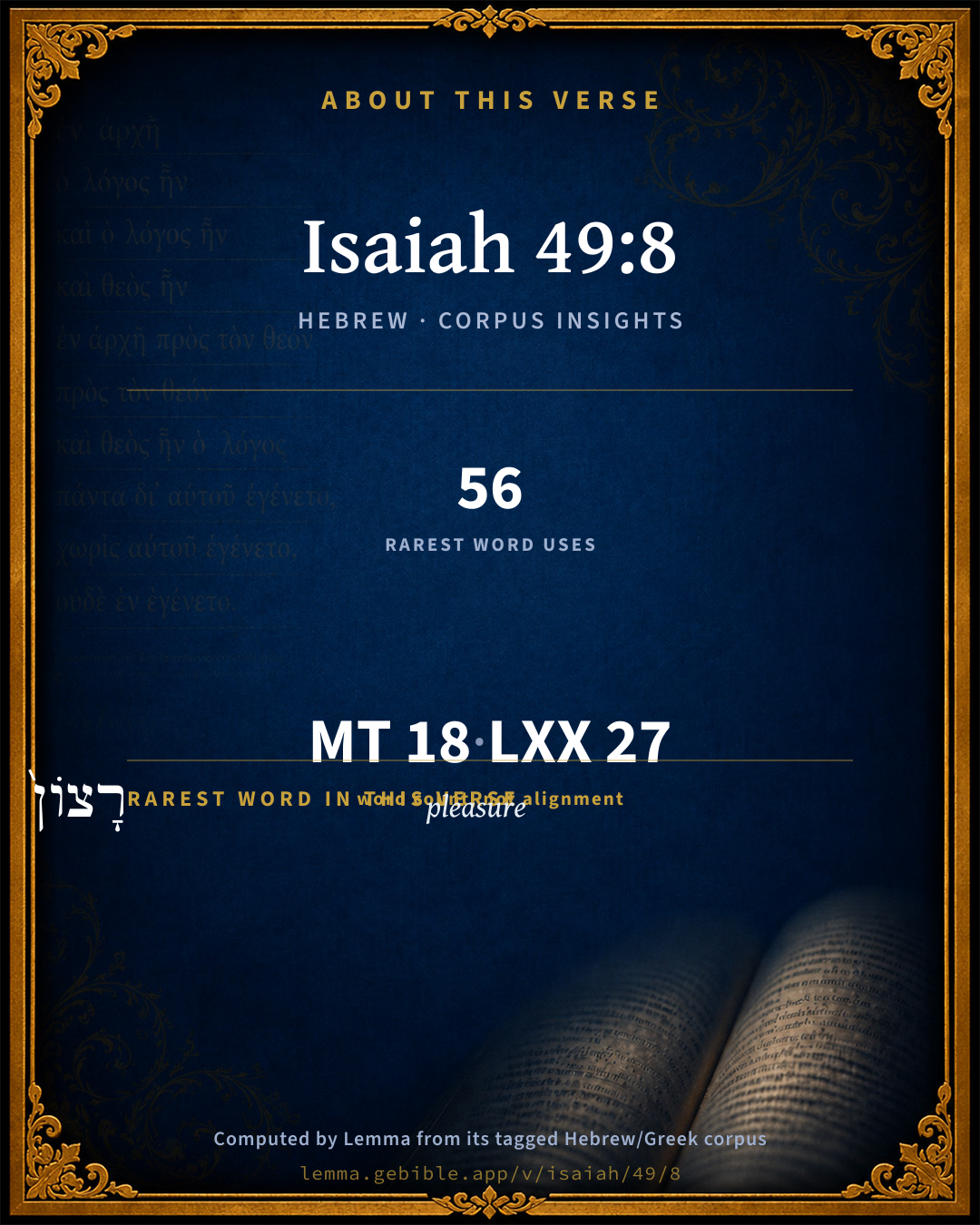
רָצוֹן֙ pleasure H7522 occurs in 56 verses of the Hebrew Bible. Also found in:

Grammatical profile

  • 8 verbs
  • 9 nouns
  • 1 adverb

Verb forms

  • אָמַ֣ר Qal · Perfect
  • עֲנִיתִ֔יךָ Qal · Perfect
  • עֲזַרְתִּ֑יךָ Qal · Perfect
  • וְאֶצָּרְךָ֗ Qal · Imperfect
  • וְאֶתֶּנְךָ֙ Qal · Imperfect
  • לְהָקִ֣ים Hiphil · Infinitive Construct
  • לְהַנְחִ֖יל Hiphil · Infinitive Construct
  • שֹׁמֵמֽוֹת Qal · Participle Active

Hebrew & Septuagint length

In English translation the verse runs 47 words from the Hebrew and 48 from the Septuagint (LXX English) — closely comparable.

A rough comparison of the two English renderings, which tokenize alike — not a word-level alignment.

Word counts can differ between the Hebrew and the Greek without any difference in meaning — e.g. the Hebrew direct-object marker אֵת has no separate Greek word, and Greek often adds the article ὁ.

In the original languages it is 18 Hebrew tokens and 27 Greek tokens — but the two are counted differently (Hebrew bundles its prefixes and suffixes into one token; the Greek is in lemma form), so that isn’t a like-for-like length.

Cross-references

23

Topical passages linked to Isaiah 49:8 in the Treasury of Scripture Knowledge — connected by theme and wording, ordered by reader-vote popularity; previews shown in the World English Bible.

  • 2 Corinthians 6:2 for he says, "At an acceptable time I listened to you, In a day of salvation I helped you." Behold, now is the acceptable time. Behold, now is the day of salvation.
  • Isaiah 42:6 I, Yahweh, have called you in righteousness, and will hold your hand, and will keep you, and give you for a covenant of the people, for a light of the Gentiles;
  • Psalms 69:13 But as for me, my prayer is to you, Yahweh, in an acceptable time. God, in the abundance of your loving kindness, answer me in the truth of your salvation.
  • Isaiah 61:4 They shall build the old wastes, they shall raise up the former desolations, and they shall repair the waste cities, the desolations of many generations.
  • Hebrews 12:24 to Jesus, the mediator of a new covenant, and to the blood of sprinkling that speaks better than that of Abel.
  • Isaiah 58:12 Those who shall be of you shall build the old waste places; you shall raise up the foundations of many generations; and you shall be called The repairer of the breach, The restorer of paths to dwell in.
  • Isaiah 44:26 who confirms the word of his servant, and performs the counsel of his messengers; who says of Jerusalem, She shall be inhabited; and of the cities of Judah, They shall be built, and I will raise up the waste places of it;
  • Isaiah 51:16 I have put my words in your mouth, and have covered you in the shadow of my hand, that I may plant the heavens, and lay the foundations of the earth, and tell Zion, You are my people.
  • Ephesians 2:12–19 that you were at that time separate from Christ, alienated from the commonwealth of Israel, and strangers from the covenants of the promise, having no hope and without God in the world.
  • Hebrews 5:7 He, in the days of his flesh, having offered up prayers and petitions with strong crying and tears to him who was able to save him from death, and having been heard for his godly fear,
  • John 11:41–42 So they took away the stone from the place where the dead man was lying. Jesus lifted up his eyes, and said, "Father, I thank you that you listened to me.
  • Ephesians 1:6 to the praise of the glory of his grace, by which he freely bestowed favor on us in the Beloved,
  • Psalms 2:8 Ask of me, and I will give the nations for your inheritance, The uttermost parts of the earth for your possession.
  • Psalms 75:3 The earth and all its inhabitants quake. I firmly hold its pillars. Selah.
  • Isaiah 26:3 You will keep [him] in perfect peace, [whose] mind [is] stayed [on you]; because he trusts in you.
  • Isaiah 42:1 Behold, my servant, whom I uphold; my chosen, in whom my soul delights: I have put my Spirit on him; he will bring forth justice to the Gentiles.
  • Isaiah 49:19 For, as for your waste and your desolate places, and your land that has been destroyed, surely now shall you be too small for the inhabitants, and those who swallowed you up shall be far away.
  • Isaiah 50:7–9 For the Lord Yahweh will help me; therefore I have not been confounded: therefore have I set my face like a flint, and I know that I shall not be disappointed.
  • Isaiah 54:3 For you shall spread aboard on the right hand and on the left; and your seed shall possess the nations, and make the desolate cities to be inhabited.
  • Isaiah 51:3 For Yahweh has comforted Zion; he has comforted all her waste places, and has made her wilderness like Eden, and her desert like the garden of Yahweh; joy and gladness shall be found therein, thanksgiving, and the voice of melody.
  • Matthew 26:28 for this is my blood of the new covenant, which is poured out for many for the remission of sins.
  • Acts 2:24–32 whom God raised up, having freed him from the agony of death, because it was not possible that he should be held by it.
  • Hebrews 8:6 But now he has obtained a more excellent ministry, by so much as he is also the mediator of a better covenant, which has been enacted on better promises.

Cross-references courtesy of OpenBible.info (CC BY 4.0).

Hebrew and Greek witnesses Masoretic Hebrew ↔ Greek Septuagint

The same verse in the two great witnesses to the Old Testament, shown verse-for-verse.

These are two independent witnesses, not word-aligned to each other, and the Septuagint is shown in lemma (dictionary) form.

Hebrew Isaiah 49:8 Masoretic · Westminster Leningrad Codex

כֹּ֣ה אָמַ֣ר יְהוָ֗ה בְּעֵ֤ת רָצוֹן֙ עֲנִיתִ֔יךָ וּבְי֥וֹם יְשׁוּעָ֖ה עֲזַרְתִּ֑יךָ וְאֶצָּרְךָ֗ וְאֶתֶּנְךָ֙ לִבְרִ֣ית עָ֔ם לְהָקִ֣ים אֶ֔רֶץ לְהַנְחִ֖יל נְחָל֥וֹת שֹׁמֵמֽוֹת

Thus says Yahweh, In an acceptable time have I answered you, and in a day of salvation have I helped you; and I will preserve you, and give you for a covenant of the people, to raise up the land, to make them inherit the desolate heritage:

World English Bible · Public Domain

Greek LXX Isaiah 49:8 Septuagint · lemma form

οὕτως λέγω κύριος καιρός δεκτός ἐπιἀκούω σύ καί ἐν ἡμέρα σωτηρία βοηθέω σύ καί δίδωμι σύ εἰς διαθήκη ἔθνος ὁ καταἵστημι ὁ γῆ καί κληρονομέω κληρονομία ἔρημος

Thus says the Lord, In an acceptable time have I heard you, and in a day of salvation have I succored you: and I have formed you, and given you for a covenant of the nations, to establish the earth, and to cause to inherit the desert heritages:

LXX2012 (modern English Septuagint) · Public Domain

On this verse, Albert Barnes' Notes on the Bible discusses the Septuagint’s reading. Read the note in Commentary ↓

Hebrew: Westminster Leningrad Codex (CC BY 4.0). Greek: Septuagint (public domain); English from LXX2012 (modern English Septuagint) (Public Domain). How the Septuagint differs from the Hebrew →

Targum (Aramaic paraphrase)

1

The Targum is the ancient Jewish Aramaic paraphrase of the Hebrew Scriptures — an interpretive translation, not the Hebrew text itself. Onkelos (literal) and Pseudo-Jonathan (expansive) render the Torah, and Jonathan the Prophets. Coverage is partial: where no permissively-licensed English translation exists for a verse, only the Aramaic is shown. This is verse-level text, not a word-by-word alignment to the Hebrew.

  1. Targum Jonathan Prophets (Joshua–Malachi)
    כִּדְנַן אֲמַר יְיָ בְּעִידַן דְאַתּוּן עָבְדִין רְעוּתִי אֲנָא מְקַבֵּיל צְלוֹתְכוֹן וּבְיוֹם עָקָא אֲנָא מְקַיֵם פּוּרְקַן וְסָעֵיד לְכוֹן וְאֶתְקְנִינָךְ וְאֶתְּנִינָךְ לִקְיַם עַם לַאֲקָמָא צַדִיקַיָא דְשָׁכְבִין בְּעַפְרָא לְאַחְסָנָא יְרוּתָן דְצָדְיָן:

    Thus saith the Lord, at the time when ye do my will, I hear your prayer, and in the day of distress I uphold you with salvation and support; for I will maintain thee, and I will give thee for a covenant with the people, to raise up the righteous that lie in the dust, to cause to inherit the desolate heritages;

    Targum Jonathan — Aramaic: “Mikraot Gedolot” (public domain). English: “Sefaria Community Translation” (CC0 1.0 (public-domain dedication)); “London "Chaldee Paraphrase," 1871” (public domain). Text via Sefaria.

Commentary

Notes on Isaiah 49:8 from classic Christian and Jewish commentators (each source and its license shown beneath its notes). The classic Christian expositions comment on the surrounding passage and are grouped to its opening verse, so a note may address several verses; the Jewish commentaries on the Tanakh (Rashi and others) are per-verse, so they appear only where the commentator wrote on this verse.

Lemma curates 59 commentaries, every one of them public domain or Creative Commons licensed, each selected and text-cleaned for this edition rather than reprinted as found. About our sources →

Trapp's Complete Commentary

John Trapp

Isa 49:8 Thus saith the LORD, In an acceptable time have I heard thee, and in a day of salvation have I helped thee: and I will preserve thee, and give thee for a covenant of the people, to establish the earth, to cause to inherit the desolate heritages;

Ver. 8. In an acceptable time.] Heb., In a time of my good pleasure, or good will - i.e., when of free grace I am pleased to send thee into the world, and to cause the gospel to be preached all abroad, thereby declaring myself fully appeased with the "men of my good will," as the elect are called. {Luk 2:14 2Co 6:2}

Have I heard thee?] Or, Will I hear thee - sc., interceding; and will I help thee - sc., conflicting.

And give thee for a covenant,] i.e., For a mediator of the new covenant, which is ratified by thy blood: as was signified by the book sprinkled with the blood of the slain sacrifice.

To establish the earth.] Had not Christ undertook the shattered condition of the world to uphold it, it had fallen about Adam’s ears.

To cause to inherit the desolate heritages,] i.e., Heaven, forfeited by us in our first parents; or, as others, the countries of the nations now converted.

John Trapp, A Commentary or Exposition upon All the Books of the Old and New Testament (1647–1656) — public domain. Text from a community e-Sword module.

The Biblical Illustrator

Joseph S. Exell

Isa_49:8-13

Thus saith the Lord, In an acceptable time

The world given to Christ

The prophet was looking forward to the Messiah and His times.

It was customary for some kings to grant to favoured ones whatever they requested (Psa_2:8). Gods kingly Son is represented as having asked, and this is the answer

I. THE PROMISED UNIVERSAL DIFFUSION OF THE GOSPEL.

1. It was commenced in the apostolic age.

2. It has been continuing through the ages to the present hour.

3. It will be fully accomplished in the fulness of time. What reasons have we for believing this?

(1) The faithful and unerring promises of Jehovah.

(2) The adaptation of Christianity, above all other forms of religion, to be universal

(3) The present aspect of the world furnishes much reason to hope that the accomplishment of this promise is drawing nigh.

II. THE BLESSEDNESS OF THOSE WHO SHALL EMBRACE IT (Isa_49:9-10). The promise includes--

1. Abundant provisions.

2. Careful protection.

3. Unerring guidance.

III. THE EXULTANT PRAISE WHICH SUCH GLORIOUS PROSPECTS SHOULD AWAKEN (Isa_49:13). We should raise this song--

1. Because of the glory which the fulfilment of this promise will bring to the triune Jehovah.

2. Because of the blessings the Gospel will bring to humanity. Conclusion--Has this Gospel come to you in saving power? (A. Tucker.)

I will preserve thee, and give thee for a covenant of the people

Christ the covenant of His people

I. WHAT THIS COVENANT TOUCHING MANS REDEMPTION IS. A covenant, in the general acceptation of the word, is an agreement between two parties in any thing, or end, upon certain articles or conditions, which both freely consent to. The covenant of grace, or of redemption, is an eternal transaction between the Father and Christ; a consultation and agreement between these two glorious Persons, how man should be saved out of the ruins of the fall, in a way becoming God (Zec_6:13).

II. SUCH A COVENANT HATH PASSED BETWEEN THE FATHER AND THE SON BEFORE ALL WORLDS.

1. There were terms made, or work demanded of the Mediator.

(1) That Christ should take the name of His covenant-people upon Himself, and become their representing Head.

(2) That He should become man.

(3) In this body Christ was to fulfil Gods whole law.

(4) That Christ should seal all His obedience with His blood.

2. There were -promises given. Christ thus firmly and freely consenting, and binding Himself to perform these terms and conditions, the Father makes promises to Him.

(1) That He would fit Christ for His work (Isa_11:1-2;Joh_3:34).

(2) To assist Christ in His work (Psa_89:21-22).

(3) To carry Christ safely and honourably through His work Isa_42:1; Isa_42:4; Psa_89:26).

(4) The Father promised Christ a seed to serve Him; and great glory after this His work was ended (Isa_53:10).

3. There were mutual trusts which the glorious parties reposed in each other.

III. WHO ARE THE PEOPLE FOR WHOM CHRIST WAS GIVEN AS A COVENANT.

1. Such as are brought to seek happiness and life purely upon the footing of this covenant.

2. The messenger of the covenant is their delight (Mal_3:1).

3. Such as have the Spirit of the covenant in their hearts. Wherever the Spirit is given, He comes as a Spirit of grace and supplication. He is a Spirit of liberty. A Spirit of holiness.

IV. WHAT ARE THE BLESSINGS REDOUNDING TO THE PEOPLE BY THIS COVENANT?

1. Their calling is secured.

2. All grace is treasured up for them.

3. Fellowship and communion with God,

4. Eternal life is given (Tit_1:2).

V. USES BY WAY OF DOCTRINE AND PRACTICE.

1. Christ and His seed are comprehended in one and the same covenant.

2. That which is a covenant of grace to us, is a covenant of works to Christ.

3. We learn the meaning of those phrases wherein God is said to make a covenant with man.

4. We see the ground of the salvation of Old Testament saints. They were justified and saved upon the foot of this covenant.

5. The substance of the covenant was the same, under both testaments; only the dispensation of it varies. The covenant made with Abraham, Jacob, David, &c., was a covenant, not of works, but of grace.

6. Why Christ is called the covenant of His people. It is because He is all in all in this covenant. Practical uses--

(1) Admire the love and grace of this covenant.

(2) Look more at Christ in every covenant-blessing.

(3) This may be improved for the believers comfort, whatever his wants are; it is a sure covenant, an ordered covenant, a full covenant; Christ is thy covenant, therefore in all thy dangers, weaknesses, snares, thou art safe; in all thy wants thou art provided for; in all thy fears thou art prevented. (J. Hill.)

Christ in the covenant

We believe that our Saviour has very much to do with the covenant of eternal salvation. We have been accustomed to regard Him as the Mediator of the covenant, as the Surety of the covenant, and as the scope or substance of the covenant. I shall dwell on Christ as one great and glorious article of the covenant which God has given to His children.

I. Here is a GREAT POSSESSION--Jesus Christ by the covenant is the property of every believer.

1. Jesus Christ is ours in all His attributes. He has a double set of attributes, seeing that there are two natures joined in glorious union in one person. He has the attributes of very God, and He has the attributes of perfect man; and whatever these may be, they are each one of them the perpetual property of every believing child of God.

2. In all His offices. Is He a Prophet? He is thy Prophet. Is He a Priest? He is thy Priest. Is He a King? He is thy King. Is He a Redeemer? He is thy Redeemer. Is He an Advocate? He is thy Advocate. Is He a Forerunner? He is thy Forerunner. Is He a Surety of the covenant? He is thy Surety. In every name He bears, in every- crown He wears, in every vestment in which He is arrayed, He is the believer s own.

3. In every one of His works, whether they be works of suffering or of duty, they are the property of the believer. Circumcised in Christ. Buried with Christ in baptism unto death. I die in Christ. I am buried with Christ. We are risen together with Christ. He hath made us sit together in heavenly places.

4. In the person of Christ dwelleth all the fulness of the Godhead bodily. And of His fulness have we received, and grace for grace. All the fulness of Christ to restrain thee, to preserve thee; all that fulness of power, of love, of purity, which is stored up in the person of the Lord Jesus Christ, is thine.

5. The very life of Christ is the property of the believer. Because I live ye shall live also. Ye are dead; and your life--where is it? It is hid with Christ in God.

6. Best of all, the person of Jesus Christ is the property of the Christian.

II. FOR WHAT PURPOSE DOES GOD PUT CHRIST IN THE COVENANT?

1. In order to comfort every coming sinner.

2. To confirm the doubting saint.

3. Because there are many things there that would be nought without Him. His great redemption is in the covenant, but we have no redemption except through His blood. His righteousness is in the covenant, but I can have no righteousness apart from that which Christ has wrought out, and which is imputed to me by God. My eternal perfection is in the covenant, but the elect are only perfect in Christ. In fact, if you take Christ out of the covenant, you have just done the same as if you should break the string of a necklace; all the jewels, or beads, or corals, drop off and separate from each other.

4. Christ is in the covenant to be used.

III. Here is A PRECEPT, and what shall the precept be? Christ is ours; then be ye Christs. Show the world that you are His in practice. When tempted to sin, reply, I cannot do this great wickedness, for I am one of Christs When wealth is before thee to be won by sin, touch it not: say that thou art Christs. Are you exposed in the world to difficulties and dangers? Stand fast in the evil day, remembering that you are one of Christs. Are you in a field where much is to be done, and others are sitting down idly and lazily doing nothing? Go at your work, and when the sweat stands upon your brow and you are bidden to stay, say, No, I cannot stop; I am one of Christs. When the syren song of pleasure would tempt thee from the path of right, reply, Hush your strains, O temptress; I am one of Christs. When the cause of God needs thee, give thyself to it, for thou art Christs. And now, I must say one word to those who have never laid hold of the covenant. I sometimes hear it whispered that there are men who trust to the uncovenanted mercies of God. Let me solemnly assure you that there is now no such thing as uncovenanted mercy. Mayhap, poor, convinced sinner, thou darest not take hold of the covenant to-day. I dare not come; I am so unworthy, you say. Hear, then: my Master bids you come, and will you be afraid after that? (C. H. Spurgeon.)

The Biblical Illustrator, edited by Joseph S. Exell (c. 1880s–1900s) — public domain. Text from a community e-Sword module.

Joseph Benson's Commentary

Isa 49:8. Thus saith the Lord — God the Father unto Christ; In an acceptable time — Hebrew, רצון בעת, in the season of acceptance, as Bishop Lowth renders it, or, in a time of good-will, according to others: in that time when God shall, in a special manner, manifest his good-will to the sons of men; in the day of his grace and man’s salvation, that is, in the time of the gospel, which was, and is, the time of God’s peculiar good-will toward men, Luk 2:14. In the days of thy flesh, when thou shalt offer up prayers and supplications, with strong crying and tears, Heb 5:7; have I heard — Or, will I hear, thee — Though not so as to deliver thee from death, yet so as to support thee under thy sufferings, to give a blessed success to thy labours, and to crown thee with glory and honour. And in a day of salvation — In the time which I have appointed for the effecting man’s redemption; have I helped — Or, will I help, thee — Namely, upon earth, till thy work be finished; and preserve thee — Unto that eternal kingdom and glory which is prepared for thee. And give thee for a covenant of the people — To be the Mediator and Surety of that covenant which is made between me and all my people, that is, all penitent and believing persons, whether Jews or Gentiles. To establish the earth — To settle the church upon firm foundations, and compose the great differences in the world between God and man, Jews and Gentiles, Eph 2:13-16; as also to establish truth and righteousness upon earth, and subdue those lusts and passions which are the great disturbers of human society: to do which things was the great design of God in sending his Son into the world. To cause to inherit desolate heritages — That desolate places may be repaired and possessed: or to bring the heathen, who are in a desolate and forlorn condition, to be Christ’s inheritance, according to Psa 2:8.

Joseph Benson's Commentary on the Old and New Testaments (1811–1818) — public domain. Text from a community e-Sword module.

The Preacher's Complete Homiletical Commentary

Joseph S. Exell (gen. ed.)

CHRIST IN THE COVENANT

Isa_49:8. I will give Thee for a covenant of the people.

We all believe that our Saviour has very much to do with the covenant of eternal salvation. We have been accustomed to regard Him as the Mediator of the covenant, as the surety of the covenant, and as the scope or substance of the covenant (see pp. 113–115). But now I shall dwell on Christ, not as the Mediator, nor as the surety, nor as the scope of the covenant, but as one great and glorious article of the covenant which God has given to His children.

I. EXAMINE THIS PROPERTY.

Here is a great possession. Jesus Christ by covenant is the property of every believer. By this we must understand Jesus Christ in many different senses.

1. He is ours, in all His attributes. He has a double set of attributes, seeing that there are two natures joined in glorious union in one person. He has the attributes of very God, and He has the attributes of perfect man; and whatever these may be, they are each one of them the perpetual property of every believing child of God.

2. He is ours, in all His offices—prophet, priest, king, &c. How varied is the value to us of this property!

3. Christ is the believer’s in every one of His works. Whether they be works of suffering or of duty, they are the property of the believer.

4. His fulness is ours (Col_2:9; Joh_1:16).

5. The very life of Christ is the property of the believer. “Because I live, ye shall live also.” “Ye are dead; and your life”—where is it? It is “hid with Christ in God.”

6. And best of all, the person of Jesus Christ is the property of the Christian. The wife loveth her husband; she loveth his house and his property; she loveth him for all that he giveth her, for all the bounty he confers, and all the love he bestows; but his person is the object of her affections. So with the believer; he blesses Christ for all He does and all He is.

But oh! it is Christ that is everything. He does not care so much about His offices as he does about the Man Christ.

II. THE PURPOSE FOR WHICH IT WAS CONVEYED TO US.

1. Christ is in the covenant in order to comfort every coming sinner. “Oh,” says the sinner who is coming to God, “I cannot lay hold on such a great covenant as that, I cannot believe that heaven is provided for me,” &c. Here comes in the thought that Christ is in the covenant. Sinner, canst thou lay hold on Christ? Canst thou say,

“Nothing in my hand I bring,

Simply to Thy cross I cling?”

Well, if thou hast got that, it was put in on purpose for thee to hold fast by. God’s covenant mercies all go together, and if thou hast laid hold on Christ, thou hast gained every blessing in the covenant. That is one reason why Christ was put there.

2. Christ is put also to confirm the doubting saint. Sometimes he cannot read his interest in the covenant. So he lays hold of Christ, and were it not for that even the believer dare not come at all.

3. It was necessary that Christ should be in the covenant, because there are many things there which would be nought without Him. Our great redemption is in the covenant, but we have no redemption except “through His blood.”

4. Christ is in the covenant to be used. Believer, use Him. Thou dost not use thy Christ as thou oughtest to do. Why, man, when thou art in trouble, &c., why dost thou not go and tell Him? Has He not a sympathising heart, and can He not comfort and relieve thee? There is nothing Christ dislikes more than for His people to make a show-thing of Him and not to use Him.

III. A PRECEPT; and what shall the precept be? Christ is ours; then be ye Christ’s. Ye are Christ’s, ye know right well. Ye are His, by your Father’s donation, when He gave you to the Son, &c. Show the world that you are His in practice. Stand fast in the evil day, remembering that you are one of Christ’s.

CONCLUSION.—Some of you have never laid hold of the covenant. I sometimes hear it whispered, and sometimes read it, that there are men who trust to the uncovenanted mercies of God. Let me solemnly assure you that there is now no such thing in heaven as uncovenanted mercy; there is no such thing beneath God’s sky or above it, as uncovenanted grace towards men. All ye can receive, and all you ever ought to hope for, must be through the covenant of free grace, and that alone. Mayhap, poor convinced sinner, thou darest not take hold of the covenant to-day. Canst thou not trust to Christ?

“Are not His mercies rich and free?

Then say, poor soul, why not for thee?”

“I dare not come; I am so unworthy,” you say. Hear, then, my Master bids you come, and will you fear after that? “Come unto Me, all ye that labour and are heaven laden, and I will give you rest.”—C. H. Spurgeon: Metropolitan Tabernacle Pulpit, vol. ii. pp. 393–400.

THE WORLD GIVEN TO CHRIST

(Missionary Sermon.)

Isa_49:8-13. Thus saith the Lord, &c.

The prophet was looking forward, under the guidance of the Holy Spirit, to the Messiah and His times, and here states several important truths respecting His great mission.

Customary for some kings to grant to favoured ones whatever they requested. God says to His kingly Son, “Ask of Me, and I shall give,” &c. (Psa_2:8). Here He is represented as having asked, and this is the answer, and the assurance that JEHOVAH would in His own good time make Him the means of salvation to all mankind. Consider—

I. THE PROMISED UNIVERSAL DIFFUSION OF THE GOSPEL.

1. It was commenced in the apostolic age. “The word of the Lord grew and mightily prevailed” over the various forms of error, superstition, idolatry, &c.

2. It has been continuing through the ages to the present hour. Rapidly and extensively during the present century. [1501]

[1501] Look at America, with its 25,000 ministers and millions of Church members. Look at the Fijian Islands. Half a century ago the blackest spot upon the map of the world, but if you ask the watchman, “what of the night” that brooded on these islands, he answers from the watch-towers of Omniscience that it is gone! “Poor Fiji,” the by-word of the nations, is become more Christian than the land that sent her Christ. Look at India. Contact with Western civilisation, education, and missionary enterprise, like the secret waters of three mighty subterranean tides, have sapped the ancient temple of Indian superstition; it trembles to its fall, and all kingdoms are shaken that that which cannot be shaken may remain. The Spirit broods over the profound depths of the heart of India, and the light is breaking. India is in search of a religion, and not long since a leading Hindu gentleman said to a famous Indian missionary that, “so far as he could see, the future sovereign of India would be Jesus Christ of Nazareth.” It is thus the Gospel is rapidly and extensively spreading.—W. J. Dawson.

3. It will be fully accomplished in “the fulness of time.” Innumerable triumphs have already been gained over sin and Satan, and the gospel will go forth conquering and to conquer. The most distant nations shall submit to Christ (Isa_49:12; Mat_8:11; H. E. I. 979, 1161–1168). [1504]

[1504] India, with her 240,000,000, and China (“Sinim,” most commentators are agreed that this refers to China) with her 400,000,000 inhabitants, shall gather round the central point of bliss—the largest kingdom of the world shall be converted (Isa_49:12).

“Many thousands have looked upon ‘The Dream of Pilate’s Wife,’ that great picture of that great commentator in colour, Gustave Doré, and have marked as its most wonderful conception the distant Calvary with its empty cross bathed in mysterious light, and the innumerable throngs that toil upward to it with their shining faces, and the deep night-sky that seems to over-brim with angels. So the cross will shine at last above the dark continent where Moffat lived, and Livingstone died praying; over India where Carey planted his forlorn hope, and grand old Samuel Wesley would have gladly laid his dust; and the shining hosts shall be the souls of all the saved, and the wondrous light the morning of the new heaven filling the new earth; for Christ will have drawn all men unto Himself.”—W. J. Dawson.

What reasons have we for believing this? We have—

(1.) The faithful and unerring promises of JEHOVAH (Psa_2:8; Psa_22:27; Psa_72:17; Isa_40:5; Isa_44:2 &c.) Believe these promises. Labour and pray for their accomplishment. Especially pray for the power of the Holy Spirit to render all the means which are employed effectual. Ponder them as a source of continual encouragement.

(2.) The adaptation of Christianity, above all other forms of religion, to be universal. [1507]

[1507] H. E. I. 1152—In all the forms of false religion with which our world is filled, there is something which renders them unfit or impracticable for universal adoption. Some are adapted to particular climates only; others to particular states of society; a third class to particular orders of men; so that, in their very nature, they cannot be universal. But when we examine the religion of Jesus Christ, in its New Testament form, we find it divested of every feature and circumstance adapted to confine it to any particular territory or people. Its doctrines, its worship, and its system of moral duty, are all equally adapted to universality.… “Christ gives to the soul of heathendom that which it wants, and that which none other can give. (1.) A Deity in which all hearts can unite in supreme love. (2.) A creed in which all intellects can repose with unwavering confidence. (3.) A law which all consciences can approve without suspicion. (4.) An enterprise in which all souls can work without hesitancy or lack of interest.”

(3.) The present aspect of the world furnishes much reason to hope that the accomplishment of this promise is drawing nigh. The whole world is practically open to the missionaries of the Cross. The progress of various forms of improvement throughout the civilised world—facilities for intercourse between the nations—extension of commerce—numerous translations of the Bible. The progress of public sentiment in regard to the conversion of the world. The probable prevalence of the English language, &c.

II. THE BLESSEDNESS OF THOSE WHO SHALL EMBRACE IT (Isa_49:9-10). The figure is taken from the shepherd leading home his flock, &c. “It is a most beautiful image of the tender care of the Great Shepherd of His people in a world like this—a world, in its main features, in regard to real comforts, not unaptly compared to barren hills, and pathless, burning sands.”

The promise includes—

1. Abundant provisions.

2. Careful protection.

3. Unerring guidance (see p. 336).

III. THE EXULTANT PRAISE WHICH SUCH GLORIOUS PROSPECTS SHOULD AWAKEN (Isa_49:3). It is common with our prophet thus to interject a song of praise on the announcement of any great and glorious event, and to call on the heavens and the earth to rejoice together (ch. 12; Isa_42:10-11; Isa_44:23).

We should raise this song—

1. Because of the glory which the fulfilment of this promise will bring to the Triune Jehovah. Here we have a test to apply to ourselves. Every true child of God spontaneously rejoices in this expectation, just as every true patriot rejoices in any certainty of the future glory of his country.

2. Because of the blessings the Gospel will bring to humanity. The universal prevalence of righteousness—peace—benevolence—social elevation and secular prosperity. Wherever Christianity is received, it effects great changes in the moral and social condition of the people. What has it done in our own and other lands? Christ will rectify all wrongs, and when God is glorified man shall be honoured. “Truth shall spring out of the earth,” &c. Animating, delightful, glorious prospect! When will it be realised? Not informed. All calculations respecting it vain.

CONCLUSION.—Has this Gospel come to you, not in word only, but in power, and in the Holy Ghost, and in much assurance? It has come in word, but unless it comes in saving power also, it has not accomplished its design, &c. (Psa_2:10-12).—Alfred Tucker.

The Preacher's Complete Homiletical Commentary (gen. ed. Joseph S. Exell; Funk & Wagnalls, c. 1892) — public domain (pre-1929). A full-Bible homiletical/sermon-outline anthology covering 65 of 66 books (2 John is absent from the source module). Text from a community e-Sword module.

Tyndale Open Study Notes

Tyndale Open Resources

49:8 God acts at just the right time to accomplish his purposes (Acts 1:7; 2 Cor 6:2). Israel returned to reestablish the land of Israel after the Exile. The land was restored and the city rebuilt beginning with Cyrus’s edict (Isa 44:26-28).

Tyndale Open Study Notes — © Tyndale Open Resources, licensed CC BY-SA 4.0. Text via the HelloAO Bible API.

Geneva Bible (1599)

Geneva Bible translators

Signifying, that before Christ renew the earth by his word, there is nothing but confusion and disorder.

Thus he speaketh of his Church when he would show his mercy toward it, 2 Cor. 6:2.

Meaning, Christ alone.

Geneva Bible (1599) marginal notes — public domain. Text via Bolls.life.

Jamieson, Fausset & Brown

Robert Jamieson, A. R. Fausset & David Brown

Messiah is represented as having asked for the grace of God in behalf of sinners; this verse contains God the Father's favorable answer.

an acceptable time--"In a time of grace" [HENGSTENBERG]. A limited time (Isa 61:2; Co2 6:2). The time judged by God to be the best fitted for effecting the purposes of His grace by Messiah.

heard thee-- (Psa 2:8; Heb 5:7).

day of salvation--when "the fulness of time" (Gal 4:4) shall have come. The day of salvation is "to-day" (Heb 4:7).

helped--given Thee the help needed to enable Thee, as man, to accomplish man's salvation.

preserve--from the assaults and efforts of Satan, to divert Thee from Thy voluntary death to save man.

covenant of the people--(See on Isa 42:6). "The people," in the singular, is always applied exclusively to Israel.

establish the earth--rather, "to restore the land," namely, Canaan to Israel. Spiritually, the restoration of the Church (the spiritual Israel) to the heavenly land forfeited by man's sin is also included.

cause to inherit . . . desolate heritages--image from the desolate state of Judea during the Babylonish captivity. Spiritually, the Gentile world, a moral waste, shall become a garden of the Lord. Literally, Judea lying desolate for ages shall be possessed again by Israel (compare Isa 61:7, "in their land"). Jesus, the antitype of, and bearing the same name as Joshua (Heb 4:8), shall, like him, divide the land among its true heirs (Isa 54:3; Isa 61:4).

Jamieson, Fausset & Brown — Commentary Critical and Explanatory on the Whole Bible (1871) — public domain (CC PDM 1.0). Text via the HelloAO Bible API.

Ellicott's Commentary for English Readers

(8) In an acceptable time.—Literally, in the season of good pleasure. The message is borne in on the soul of the servant as the secret of confidence and strength. It will be his work to be the link in a new covenant with the people, an idea afterwards developed by Jeremiah (Jer_31:31), and reaching its fulfilment in Mat_26:28; Luk_22:20.

To cause to inherit the desolate heritages.—The prophet may have thought of a literal fulfilment such as was probably in part accomplished by Zerubbabel. We, seeing the prediction in the light of its fulfilment, look to the spiritual inheritance.

A Bible Commentary for English Readers, edited by Charles John Ellicott (1878–1897) — public domain. Text from a community e-Sword module.

The Cambridge Bible for Schools and Colleges

gen. ed. J. J. S. Perowne

8. In an acceptable time] Better: in a season of favour. Cf. ch. Isa_41:2, and the citation in 2Co_6:2.

for a covenant of the people] See on ch. Isa_42:6.

to establish the earth &c.] Render: to restore (see Isa_49:6) the land (of Israel), to allot (Deu_21:16) the desolate heritages. It may be difficult to decide whether Jehovah Himself or His Servant is the implicit subject of these verbs, the Heb. construction being ambiguous. The latter sense is certainly the more natural; although it is only in a figure that the repeopling &c. of the land can be attributed to the agency of the ideal Israel: “what is done for the sake of the Servant, is done by him” (Dillmann).

8–12. A picture of the emancipation and return of the exiles.

The Cambridge Bible for Schools and Colleges (gen. ed. J. J. S. Perowne; Cambridge University Press, 1878–1918) — public domain. Text from a community e-Sword module.

John Gill's Exposition

Thus saith the Lord,.... These are the words of God the Father to his Son continued; the Jews themselves interpret them of the Messiah (z):

in an acceptable time have I heard thee: this was the time when Christ was here on earth, when he became incarnate, and suffered and died for his people: this was an acceptable time to God the Father; his very sufferings were acceptable; his sacrifice was of a sweet smelling savour; his righteousness was well pleasing to him; for by all this his perfections were glorified, his purposes were answered, his covenant and promises fulfilled, and his people saved: it was acceptable to men, the things that were now done and procured; as pardon of sin, peace and reconciliation, a justifying righteousness, and complete salvation; which is worthy the acceptation of all that are lost and undone, and see themselves so, and that nothing they can do will save them: or "in a time of good will" (a); such was the time of Christ's first coming; it was good will to men, Luk 2:14. God showed his good will to men by the Person whom he sent to save them, his own, only, and beloved Son; and by sending him to save sinners, the chief of sinners, even enemies; and this time was fixed and settled by the good will and pleasure of God; and during this time the Lord heard Christ; he always heard him interceding for himself, and for his people; he heard him in the garden, and on the cross, and at all other times; see Heb 5:7.

and in a day of salvation have I helped thee; at the time when he wrought out the salvation of his people, then he helped him in it, and through it, as he promised him, and as Christ believed he would, Isa 42:1. This is to be understood of him as man and Mediator, and to show the greatness of the work of salvation, and the concern of God in it; otherwise, as Christ is the mighty God, he needed no help, and his own arm brought salvation to him:

and I will preserve thee; as he did from his enemies in life, in his infancy, and when grown up, that his life might not be taken away before his time; from being overcome by his enemies in the garden, and on the cross; from the power of death and the grave, by raising him up from thence; he preserved him to his kingdom and glory, and now retains him in heaven until the time of the restitution of all things; and will preserve his seed, and his throne, his cause, and interest, to the end of time:

and give thee for a covenant of the people; Jews and Gentiles, all that are given to him, and whom he redeems by his blood, whom the Spirit sanctifies, and applies the blessings and promises of the covenant to; which is to be understood of the covenant of grace: Christ is said to be given for it unto them, he being a covenantee in it; the representative of these people in it; the surety of it for them; the Mediator and messenger of it to them; and the ratifier and confirmer of it; and as he is the great blessing of it, the sum and substance of it; and as all the blessings and promises of it are in him; and this may respect the constitution of the covenant from everlasting, and the manifestation of it in time; and this is a gift of God honourable to Christ, of free grace to his people, very comprehensive and unspeakable. Kimchi says this refers to the times of the Messiah: and the end of all this is

to establish the earth; not the land of Judea, but the whole earth; which, were it not for Christ, and his covenant and suretyship engagements for his people, and for the sake of them, and their salvation, would long ago have been dissolved and broke to pieces; but he bears up the pillars of it; and, when he has gathered in all his people, will destroy it: or the end in his being given for a covenant was to "raise up" the fallen inhabitants of the earth, for so the word (b) may be rendered; or to raise up the elect of God unto life, who were obnoxious to death; or to establish, settle, and confirm the church of God on earth; see Psa 89:36. The Targum is, "to raise up the righteous that lie in the dust", referring it to the resurrection of the dead:

to cause to inherit the desolate heritages; the desolate cities of Judah, or the Gentile world, which was like a desolate wilderness: it seems to denote the desolate condition of the church, which should become comfortable and flourishing through the numerous conversions of Jews and Gentiles, as the fruit and effect of the covenant of grace made with Christ; in which the Heathen were given for his inheritance, and the uttermost parts of the earth for his possession, Psa 2:8.

(z) In Pesikta Rabbati in Yalkut in loc. (a) "in tempore gratuitae voluntatis", Munster; "in tempore placito", V. L. Pagninus; "beneplaciti", Piscator. (b) "ad suscitandam terram", Pagninus, Montanus; "ut erigas terram", Piscator; "ad erigendam terram", Vitringa.

John Gill's Exposition of the Whole Bible (1746–1763) — public domain (CC PDM 1.0). Text via the HelloAO Bible API.

Albert Barnes' Notes on the Bible

Thus saith the Lord - Still an address to the Messiah, and designed to give the assurance that he should extend the true religion, and repair the evils of sin on the earth. The Messiah is represented as having asked for the divine favor to attend his efforts, and this is the answer, and the assurance that his petition had not been offered in vain.

In an acceptable time - Hebrew, ‘In a time of delight or will,’ that is, a time when Yahweh was willing, or pleased to hear him. The word רצין râtsôn means properly delight, satisfaction, acceptance Pro 14:35; Isa 56:7; will, or pleasure Est 8:1; Psa 40:9; Dan 8:4-11; then also goodwill, favor, grace Pro 16:15; Pro 19:12. The Septuagint renders this, Καιρῷ δεκτῷ Kairō dektō - ‘In an acceptable time.’ So Jerome, Gesenius, and Hengstenberg render it, ‘In a time of grace or mercy.’ The main idea is plain, that Yahweh was well pleased to hear him when he called upon him, and would answer his prayers. In a time of favor; in a time that shall be adjudged to be the best fitted to the purposes of salvation, Yahweh will be pleased to exalt the Messiah to glory, and to make him the means of salvation to all mankind.

Have I heard thee - Have I heard thy petitions, and the desires of thy heart. The giving of the world to the Messiah is represented as in answer to his prayer in Psa 2:8 :

Ask of me, and I shall give time the pagan for thine inheritance,

And the uttermost parts of the earth for thy possession.

And in a day of salvation - In a time when I am disposed to grant salvation; when the period for imparting salvation shall have arrived.

Have I helped thee - Have I imparted the assistance which is needful to accomplish the great purpose of salvation to the world. This passage is quoted by Paul in 2Co 6:2, and is by him applied to the times of the Messiah. It means that the time would come, fixed by the purpose of God, which would be a period in which he would be disposed, that is, well pleased, to extend salvation to the world through the Messiah: and that in that time he would afford all the requisite aid and help by his grace, for the extension of the true religion among the nations.

I will preserve thee - That is, the cause of the Redeemer would be dear to the heart of God, and he would preserve that cause from being destroyed on the earth.

And give thee for a covenant of the people - The ‘people’ (עם 'âm) refers doubtless primarily to the Jews - the better portion of the Israelite people - the true Israel Rom 2:28-29. To them he was first sent, and his own personal work was with them (see the notes at Isa 49:6). On the meaning of the phrase ‘for a covenant,’ see the notes at Isa 42:6.

To establish the earth - Margin, as Hebrew, ‘To raise up.’ The language is derived from restoring the ruins of a land that has been overrun by an enemy, when the cities have been demolished, and the country laid waste. It is to be taken here in a spiritual sense, as meaning that the work of the Messiah would be like that which would be accomplished if a land lying waste should be restored to its former prosperity. In regard to the spiritual interests of the people, he would accomplish what would be accomplished if there should be such a restoration; that is, he would recover the true Israel from the ravages of sin, and would establish the church on a firm foundation.

To cause to inherit the desolate heritages - The image here is taken from the condition of the land of Israel during the Babylonian captivity. It was in ruins. The cities were all desolate. Such, spiritually, would be the condition of the nation when the Messiah should come; and his work would be like restoring the exiles to their own land, and causing them to re-enter on their former possessions. The one would be an appropriate emblem of the other; and the work of the Messiah would be like rebuilding dilapidated towns; restoring fertility to desolate fields; replanting vineyards and olive gardens; and diffusing smiling peace and plenty over a land that had been subjected to the ravages of fire and sword, and that had long been a scene of mournful desolation.

Albert Barnes' Notes on the Bible (1834–1885) — public domain. Text from a community e-Sword/MySword module.

Matthew Poole's English Annotations

Thus saith the Lord, God the Father, unto Christ, In an acceptable time, Heb. In a time of good-will; in that time when I shall have, and in a special manner manifest, my good-will unto the sons of men; in the day of my grace, and of man s salvation, as this phrase is explained in the next clause; in the time of the gospel, which is the time of God’s good-will towards men, as the host of heaven declared at the birth of Christ, Luk 2:14; In the days of thy flesh, when thou didst offer up prayers and supplications with strong crying and tears unto him that was able to save thee from death, as we read, Heb 5:7, which text is a good comment upon this place. Heard thee; though not so as to deliver thee from death and from the sense of my wrath, yet so as to keep thee from sinking under these burdens, and so as thou shouldst not be holden under the pains or power of death, Act 2:24, and so as to crown thee with glory and honour, and a blessed success of all thy labours and sufferings.

In a day of salvation; in the time of grace and of the gospel, which I have appointed for the working out of man’s salvation by thee.

I will preserve thee upon earth till thy work be finished, and unto that eternal kingdom and glory which is prepared for thee.

Give thee for a covenant; to be the Mediator and Surety of that covenant, which is made between me and them; as Christ is called, Heb 7:22; 8:6; to renew and confirm the covenant, which the Messiah is said to do, Dan 9:27, by his own blood, by which God and men are reconciled and united one to the other. And therefore he may well be called the covenant by a known metonymy, which is very usual in such eases, as upon the same account circumcision, the sign of the covenant, is called God’s covenant, Gen 17:10, and the paschal lamb is called the passover, Exo 12:11, and the sacramental cup is called the new testament, Luk 22:20, and the communion of the blood of Christ, 1Co 10:16. Of the people; indefinitely of all my people, not only Jews, but also the Gentiles, as may be gathered from the context, and by comparing this place with Isa 42:6, where the same phrase is used; from both which places it is most manifest that the Messiah is designed, and not Isaiah, to whom this and divers other phrases here used cannot be ascribed without great force.

To establish the earth; to compose and settle the earth, and the inhabitants thereof, by making peace between God and men, and between Jews and Gentiles, and by establishing truth, and righteousness, and holiness upon earth, and by subduing those lusts and passions which are the great disturbers of human society; which was the design of God in sending, and of Christ in coming into the world.

To cause to inherit the desolate heritages; that desolate places may be repaired and repossessed. That Christ may possess the heathen, according to Psa 2:8, who were in a spiritual sense in a most desolate and forlorn condition.

Matthew Poole's English Annotations on the Holy Bible (1683–1685) — public domain. Text from a community e-Sword/MySword module.

Whedon's Commentary on the Bible

Daniel D. Whedon

8-10. In an acceptable time — Better, in a time of favour; that is, in the far future times, when Providence shall guide to changes in favour of men’s hearing, pondering, and accepting the Gospel. The same idea is in the parallel expression, in a day of salvation. Then God is the infinite helper; then he restores to infinite honour for the endured humiliation.

Covenant of the people — In Isa_49:7 Israel has the name goi, as if Gentiles not in God’s covenant; here the Church, though composed mainly of Gentiles, has the name am, people, usually given to Israel. Gentiles, once not a people, are to become the people of God. Rom_9:24-26; 1Pe_2:10. Messiah is to seal his covenant with this new people.

Desolate — Explained in the next verse. This verse shows that the “desolate” places are not waste places in Judea, but the moral wastes of the heathen world. Isa_43:6-7.

In a day of salvation it shall avail for God’s Anointed to say to all feeling themselves captives:

Go forth — From your prison house; come out from your darkness. Feed in all fresh pastures, in valleys, and on every height. Easy will it be, as the Shepherd of souls, for Messiah to gather to his fold every one hitherto straying, and bare hills shall then afford abundant pasturage. Spiritual manna and living waters shall be everywhere at hand, together with protection from all heat and cold. The figures here so common with our prophet furnish a full storehouse of illustrations in the New Testament (see especially Rev_7:16-17) as applied to practical religion. The promises of Psalms 23 are here made universal to Christian believers.

Daniel D. Whedon (gen. ed.), Commentary on the Old and New Testaments (1874–1909) — public domain. Text from a community e-Sword module.

The Pulpit Commentary

In an acceptable time; literally, in a time of good pleasure; i.e. the time fixed by my good pleasure from the creation of the world. Heard thee... helped thee. The Father "heard" and "helped" the only begotten Son through the whole period of his earthly ministry. (Luk_2:40, 52Jo 3:2 8:28 12:28 14:10, etc.) I will give thee for a Covenant of the people. (comp. Isa_42:6, and the comment, ad loc. ) To establish the earth; rather, as in ver. 6, to raise up the earth, to lift it out of its existing condition of meanness and degradation. To cause to inherit the desolate heritages; i.e. to cause the desolate heritages of the earth the places devoid of trite religion to be possessed, and as it were "inherited," by those who would introduce into them the true knowledge of God. As Israel inherited Canaan, (Deu_3:28 Jos_1:6) so would Christian nations inherit many "desolate heritages," where ignorance and sin prevailed, with the result that light would penetrate into the dark regions, and, ultimately, all flesh see the salvation of God.

Vers. 8-12. The kingdom of Christ: a missionary sermon.

In an elevated strain, full of high hope and touched with the pure joy of anticipation, the prophet writes of Messiah"s kingdom. He calls our attention to

I ITS MOST STRIKING CHARACTERISTICS.

1. Spiritual restoration. "To establish the earth," or rather to restore the land, and to bring about the repossession by their true owners of the "desolate heritages." In the kingdom of Christ humanity, that had "lain waste" and had produced all kinds of noxious and ugly growths, should be recultivated, bear its own true feints of peace and righteousness, and be a land restored.

2. Spiritual freedom. To the prisoners of sin, of folly, and of vice, the commanding word will be addressed, "Go forth" (ver. 9); and they will walk in the atmosphere of sacred freedom.

3. Abundance of truth. The disciples of Christ are the children of light;" they walk in the light of his holy truth (ver. 9).

4. The sheltering and providing power of the sovereign Saviour. The present Lord shall satisfy their hungering hearts, shall slake their spirits" thirst, shall shelter them from the heats of strong temptation, shall supply them with all-sufficient grace for their recurring need (ver. 10). All its swings are in him and he is near to minister to all their wants.

II THE OPENNESS OF THE WAY TO ITS FULL ESTABLISHMENT. (Vers. 11, 12.) In the arrangements of Divine providence, when Jesus Christ came and introduced his gospel to the world, there were ready three things that were wanted to carry it over the world.

1. A missionary people supplied by the Jewish nation, in whom were all the elements of moral worth and religious enthusiasm.

2. A suitable language supplied by the Greeks.

3. A highway to distant lands supplied by Roman roads and Roman laws. And the new faith, which seemed certain to perish as soon as it was born, grew and spread on every hand. It was as if the very obstructions were "away." Difficulties disappeared; a "great door and effectual was opened." And in our time the way is being further opened. Exploration, human science, international treaties, even war itself, is levelling the separating hills and bridging the dividing gulfs; and even into the very heart of China (Sinim?) the missionary is penetrating with the truth of Christ.

III ITS ACCEPTABLE HOUR. The era in which we live is one in which the Father of all is disposed to bless and save. It is "a day of salvation." The atoning work is wrought; the Divine Spirit is ready to regenerate and renew; the Word of truth and grace is multiplied; great is the company of the preachers.; the Churches of Christ are fast awaking to a sense of their obligation and their opportunity. It is a time to pray, to work, and to look for God"s favouring presence and redeeming power. C.

"The acceptable time.

Called also a "day of salvation." There can be no doubt that by this expression is meant the period of the new dispensation, at the commencement of which the Messiah appeared, to effect the work of human redemption, and during which the blessings of that redemption are being communicated to mankind. We may say it is the period in which God had reconciled the world unto himself; in which sinful men can come to God, and deal with him in respect of their sins, through an appointed Mediator. "All our happiness results from the Son"s interest in the Father, and the prevalency of his intercession, that he always heard him. And this makes the gospel-time an acceptable time, welcome to us, because we are accepted of God, and reconciled and recommended to him" (Matthew Henry). Our Lord used this expression in his remarkable Messianic sermon at Nazareth, declaring that he had. come to proclaim the "acceptable year of the Lord", (Luk_14:19) probably taking his figure from the joyousness of the Jewish year of jubilee. From this passage, what is understood as a "simple gospel sermon" may be preached.

I THERE MAY BE HINDRANCES TO DIVINE ACCEPTANCE. Get right apprehensions of God, and it will be understood that, under some circumstances, he cannot accept he must reject, he must frown, he must be against man. Acceptance, to be any moral good to us, must be based on righteousness. We do not care for acceptance unless we are quite sure that God is right in accepting. Illustrate this in connection with the three prominent figures we use for God.

1. King. Certainly a king cannot always accept his subjects.

2. Moral Governor. A very intangible figure. But the addition of the word "moral" shows clearly that conditions are involved.

3. Father. True lathers must sometimes hold off their sons.

II THE HINDRANCES MAY BE SUCH AS WE PUT IN THE WAY. It is easy to say the hindrances are our sins; it is much more searching to say they are the sinfulness of which our sins are the expression. It would be easy to forgive sins, if our sinfulness were put away. And Christ"s mission brought to us an "acceptable time," because it bore upon getting away both the sinfulness and the sin.

III THE HINDRANCES MAY BE SUCH AS GOD MUST PUT IN THE WAY. This the preacher must deal with according to the notions he has of God"s Law and God"s righteousness. He has demands; acceptance must be hindered until they are reasonably met.

IV WHEN GOD AND MAN AGREE TO PUT THE HINDRANCES AWAY, THE ACCEPTABLE TIME HAS COME. Man must put away his sinfulness in penitence. God will put away his claims in mercy; and righteousness and peace can kiss each other. Christ bears mediatorial relations both to God and man. R.T.

The Pulpit Commentary (1880–1919), ed. H.D.M. Spence-Jones & Joseph S. Exell — public domain. Text from a community e-Sword module.

John Wesley's Explanatory Notes

The Lord - God the Father unto Christ. Heard thee - Though not so as to deliver thee from death; yet so as to crown thee with glory and honour. For a covenant - To be the Mediator and surety of that covenant, which is made between me and them. To establish - To establish truth and righteousness upon earth, and subdue those lusts and passions, which are the great disturbers of human society. Desolate heritages - That desolate places may be repaired and repossessed. That Christ may possess the Heathen, who were in a spiritual sense in a most desolate condition.

John Wesley, Explanatory Notes Upon the Whole Bible (1754–1765) — public domain. Text via the GEBible commentary corpus.

Keil & Delitzsch

C. F. Keil & F. Delitzsch

The next two vv. describe (though only with reference to Israel, the immediate circle) what is the glory of the vocation to which Jehovah, in accordance with His promise, exalts His chosen One. "Thus saith Jehovah, In a time of favour have I heard thee, and in the day of salvation have I helped thee: and I form thee, and set thee for a covenant of the people, to raise up the land, to apportion again desolate inheritances, saying to prisoners, Go ye out: to those who are in darkness, Come ye to the light." Jehovah heard His servant, and came to his help when he prayed to Him out of the condition of bondage to the world, which he shared with his people. He did it at the time for the active display of His good pleasure, and for the realizing of salvation, which had been foreseen by Him, and had now arrived. The futures which follow are to be taken as such. The fact that Jehovah makes His servant "a covenant of the people," i.e., the personal bond which unites Israel and its God in a new fellowship (see Isa 42:6), is the fruit of his being heard and helped. The infinitives with Lamed affirm in what way the new covenant relation will be made manifest. The land that has fallen into decay rises into prosperity again, and the desolate possessions return to their former owners. This manifestation of the covenant grace, that has been restored to the nation again, is effected through the medium of the servant of Jehovah. The rendering of the lxx is quite correct: τοῦ καταστῆσαι τὴν γῆν καὶ κληρονομῆσαι κληρονομίας ἐρήμους λέγοντα לאמר is a dicendo governed by both infinitives. The prisoners in the darkness of the prison and of affliction are the exiles (Isa 42:22). The mighty word of the servant of Jehovah brings to them the light of liberty, in connection with which (as has been already more than once observed) the fact should be noticed, that the redemption is viewed in connection with the termination of the captivity, and, in accordance with the peculiar character of the Old Testament, is regarded as possessing a national character, and therefore is purely external.

The person of the servant of Jehovah now falls into the background again, and the prophecy proceeds with a description of the return of the redeemed. "They shall feed by the ways, and there is pasture for them upon all field-hills. They shall not hunger nor thirst, and the mirage and sun shall not blind them: for He that hath mercy on them shall lead them, and guide them by bubbling water-springs. And I make all my mountains ways, and my roads are exalted. Behold these, they come from afar; and, behold, these from the north and from the sea; and these from the land of the Sinese." The people returning home are represented as a flock. By the roads that they take to their homes, they are able to obtain sufficient pasture, without being obliged to go a long way round in order to find a sufficient supply; and even upon bare sandy hills (Isa 41:18) there is pasture found for them. Nothing is wanting; even the shârâb (see Isa 35:7) and the sun do not hurt them, the former by deceiving and leading astray, the latter by wearying them with its oppressive heat: for He whose compassion has been excited by their long pining misery (Isa 41:17-20) is leading them, and bringing them along in comfort by bubbling springs of real and refreshing water (ינחל, as Petrarch once says of shepherds, Move la schira sua soavemente). Jehovah also makes all the mountains into roads for those who are returning home, and the paths of the desert are lifted up, as it were, into well-made roads (yerumūn, Ges. 47, Anm. 4). They are called my mountains and my highways (differently from Isa 14:25), because they are His creation; and therefore He is also able to change them, and now really does change them for the good of His people, who are returning to the land of their forefathers out of every quarter of the globe. Although in Psa 107:3 yâm (the sea) appears to stand for the south, as referring to the southern part of the Mediterranean, which washes the coast of Egypt, there is no ground at all in the present instance for regarding it as employed in any other than its usual sense, namely the west; mērâchōq (from far) is therefore either the south (cf., Isa 43:6) or the east, according to the interpretation that we give to 'erets Sı̄nı̄m, as signifying a land to the east or to the south.

The Phoenician Sinim (Ges. Isa 10:17), the inhabitants of a fortified town in the neighbourhood of Area, which has now disappeared, but which was seen not only by Jerome, but also by Mariono Sanuto (de castro Arachas ad dimidiam leucam est oppidum Sin), cannot be thought of, for the simple reason that this Sin was too near, and was situated to the west of Babylon and to the north of Jerusalem; whilst Sin (= Pelusium) in Egypt, to which Ewald refers, did not give its name to either a tribe or a land. Arias Montanus was among the first to suggest that the Sinim are the Sinese (Chinese); and since the question has been so thoroughly discussed by Gesenius (in his Commentary and Thesaursu), most of the commentators, and also such Orientalists as Langles (in his Recherches asiatiques), Movers (in his Phoenicians), Lassen (in his Indische Alterthumskunde, i. 856-7), have decided in favour of this opinion. The objection brought against the supposition, that the name of the Chinese was known to the nations of the west at so early a period as this, viz., that this could not have been the case till after the reign of the emperor Shi-hoang-ti, of the dynasty of Thsin, who restored the empire that had been broken up into seven smaller kingdoms (in the year 247 b.c.), and through whose celebrated reign the name of his dynasty came to be employed in the western nations as the name of China generally, is met by Lassen with the simple fact that the name occurs at a much earlier period than this, and in many different forms, as the name of smaller states into which the empire was broken up after the reign of Wu-wang (1122-1115 b.c.). "The name Θῖναι (Strabo), Σῖναι (Ptol.), Τζίνιτζα (Kosmas), says the Sinologist Neumann, did not obtain currency for the first time from the founder of the great dynasty of Tsin; but long before this, Tsin was the name of a feudal kingdom of some importance in Shen-si, one of the western provinces of the Sinese land, and Fei-tse, the first feudal king of Tsin, began to reign as early as 897 b.c." It is quite possible, therefore, that the prophet, whether he were Isaiah or any other, may have heard of the land of the Sinese in the far east, and this is all that we need assume; not that Sinese merchants visited the market of the world on the Euphrates (Movers and Lassen), but only that information concerning the strange people who were so wealthy in rare productions, had reached the remote parts of the East through the medium of commerce, possibly from Ophir, and through the Phoenicians. But Egli replies: "The seer on the streams of Babel certainly could not have described any exiles as returning home from China, if he had not known that some of his countrymen were pining there in misery, and I most positively affirm that this was not the case." What is here assumed - namely, that there must have been a Chinese diaspora in the prophet's own time - is overthrown by what has been already observed in Isa 11:11; and we may also see that it is to purely by accident that the land of the Sinese is given as the farthest point to the east, from my communications concerning the Jews of China in the History of the Post-biblical Poetry of the Jews (1836, pp. 58-62, cf., p. 21). I have not yet seen Sionnet's work, which has appeared since, viz., Essai sur les Juifs de la Chine et sur l'influence, qu'ils ont eue sur la litrature de ce vaste empire, avant l're chrtienne; but I have read the Mission of Enquiry to the Jews in China in the Jewish Intelligence, May 1851, where a facsimile of their thorah is given. The immigration took place from Persia (cf., ‛Elâm, Isa 11:11), at the latest, under the Han dynasty (205 b.c.-220 a.d.), and certainly before the Christian era.

Keil & Delitzsch — Biblical Commentary on the Old Testament (1861–1891) — public domain (CC PDM 1.0). Text via the HelloAO Bible API. (Old Testament only.)

J. A. Alexander on Isaiah

Joseph Addison Alexander

“Thus saith Jehovah, In a time of favor have I heard (or answered) thee, and in a day of salvation have I helped thee.” The common version, ‘an acceptable time’, does not convey the sense of the original, which signifies a suitable or appointed time for showing grace or favor. The object of address is still the Messiah and His people, whose great mission is again described. “And I will keep thee, and will give thee for a covenant of the people,” (i.e., of men in general (see above, Isa 42:7)), “to raise up the earth,” or world from its present state of ruin, “and to cause to inherit the desolate heritages,” the moral wastes of heathenism. There is allusion to the division of the land by Joshua. Here again we have clear apostolical authority for applying this description to the Church, or people of God, as the Body of which Christ is the Head. Paul says to the Corinthians, "We then as workers together (with him) beseech you also that ye receive not the word of God in vain. For he saith, I have heard thee in a time accepted, and in the day of salvation have I succored thee." What follows is no part of the quotation but Paul’s comment on it. "Behold, now is the accepted time; behold, now is the day of salvation" (2Co 6:2). This, taken in connection with the citation of v. 6 in Act 13:47, precludes the supposition of an accidental or unmeaning application of this passage to the people or ministers of Christ as well as to Himself.

Joseph Addison Alexander, The Prophecies of Isaiah (1846–1847; New York: Scribner, 1870–1878) — public domain. Text from a community e-Sword module.

Scofield Reference Notes

C. I. Scofield

Verse Heading: Israel to preserved and restored

The Lord Jesus and the believing remnant of Israel are here joined. What is said is true of both.

The Scofield Reference Bible (1917 edition), notes by C. I. Scofield — public domain. Text from a community e-Sword module.

unfoldingWord translationNotes

Door43 World Missions Community

At a time I decide to show my favor I will answer you, and in a day of salvation I will help you

These two clauses mean basically the same thing. (See: Parallelism)

I will answer you

Here "you" refers to Yahweh's servant.

in a day of salvation

The word "salvation" can be translated as a verb. AT: "when the time comes for me to save you" (See:Abstract Nouns)

give you as a covenant for the people

Here the word "covenant" is a metonym for the one who establishes or mediates a covenant. See how you translated a similar phrase in Isaiah 42:6. AT: "make you be the mediator of a covenant with the people" (See: Metonymy)

to rebuild the land

Here the word "land" represents the cities in the land that had been destroyed. AT: "to rebuild the ruined places in the land" (See: Metonymy)

to reassign the desolate inheritance

Yahweh speaks of the land as if it were an inheritance that the people of Israel received as a permanent possession. It is implied that the servant is to reassign the land to the people of Israel. AT: "to reassign the desolate land to the people of Israel as their inheritance" (See: Metaphor and Assumed Knowledge and Implicit Information)

translationWords

Yahweh

favor

save

covenant

people group

desolate

inherit

unfoldingWord translationNotes — © Distant Shores Media and the Door43 World Missions Community, licensed CC BY-SA 4.0. Source: git.door43.org/Door43/en_tn.

Rashi

Rabbi Shlomo Yitzchaki (Rashi)

In a time of favor In the time of prayer, when you seek My favor and appease Me.

and on a day of salvation When you need salvation.

and I will watch you Heb. וְאֶצָּרְךָ, and I will watch you.

for a people of a covenant to be a people of a covenant to Me.

to establish a land The land of Israel, chosen by Me from all lands.

Rashi on the Tanakh — English translations: “The Judaica Press complete Tanach with Rashi, translated by A. J. Rosenberg” (CC BY 4.0); “Pentateuch with Rashi's commentary by M. Rosenbaum and A.M. Silbermann, 1929-1934” (public domain); “The Metsudah Tanach series, Lakewood, N.J” (CC BY 4.0); and “The Book of Joshua, Metsudah Publications, 1997” (CC BY 4.0). Text via Sefaria.

Ibn Ezra

Rabbi Abraham ibn Ezra

בעת רצון עניתיך In an acceptable time I have heard thee. This expression is likewise a proof of the correctness of my opinion. Many, in opposition to the context, refer the pronoun thee to Cyrus. R. Moses thinks that the preposition ב in בעת רצון has the same meaning as in במרחב יה (Ps. 118:5), namely: with. It is not at all unlikely that his opinion is right.

Ibn Ezra on the Tanakh — English translations: “Sefaria Community Translation” (CC0 1.0 (public-domain dedication)); “Yalkut, Sifsei Chachomim Chumash, Metsudah Publications, 2009” (CC BY 4.0); and “Commentary of Ibn Ezra on Isaiah - trans. by M. Friedlander, 1873” (public domain). Text via Sefaria.

Lesson kit

Teaching starters — assembled from the data on this page, not authored interpretation. Every prompt links to the verse data it draws on. Edit before teaching.

Isaiah, in the Prophets, opens this verse with 18 words (18 distinct Hebrew lemmas). Its most distinctive word is râtsôwn (“pleasure”). A historical commentator’s framing appears above. Read the whole chapter for the surrounding context.

Discussion questions

  1. The word râtsôwn carries the sense “pleasure.” How does it shape the verse?
  2. Genesis 49:6 shares the word «pleasure» with this verse. How do the two illuminate each other?
  3. The translations on this page render this verse differently — a whole-verse word diff, not a word-by-word alignment. What might account for the different wordings?
  4. The verb «אָמַ֣ר» is Qal Perfect. How does its form color the action?
  5. Reading how Trapp's Complete Commentary and The Biblical Illustrator read this verse, where do the two commentators agree and where do they part?

Things to notice

Reading settings

Reading text

Shown beneath each verse's original-language words.

Old Testament
Old Testament edition

Read the OT as the Masoretic Hebrew (MT) or the Greek Septuagint (LXX).

English shown for the Greek Septuagint (in the Hebrew ↔ Greek comparison).

Comparing translations? Open the Compare panel on any verse page to stack up to four side by side.