
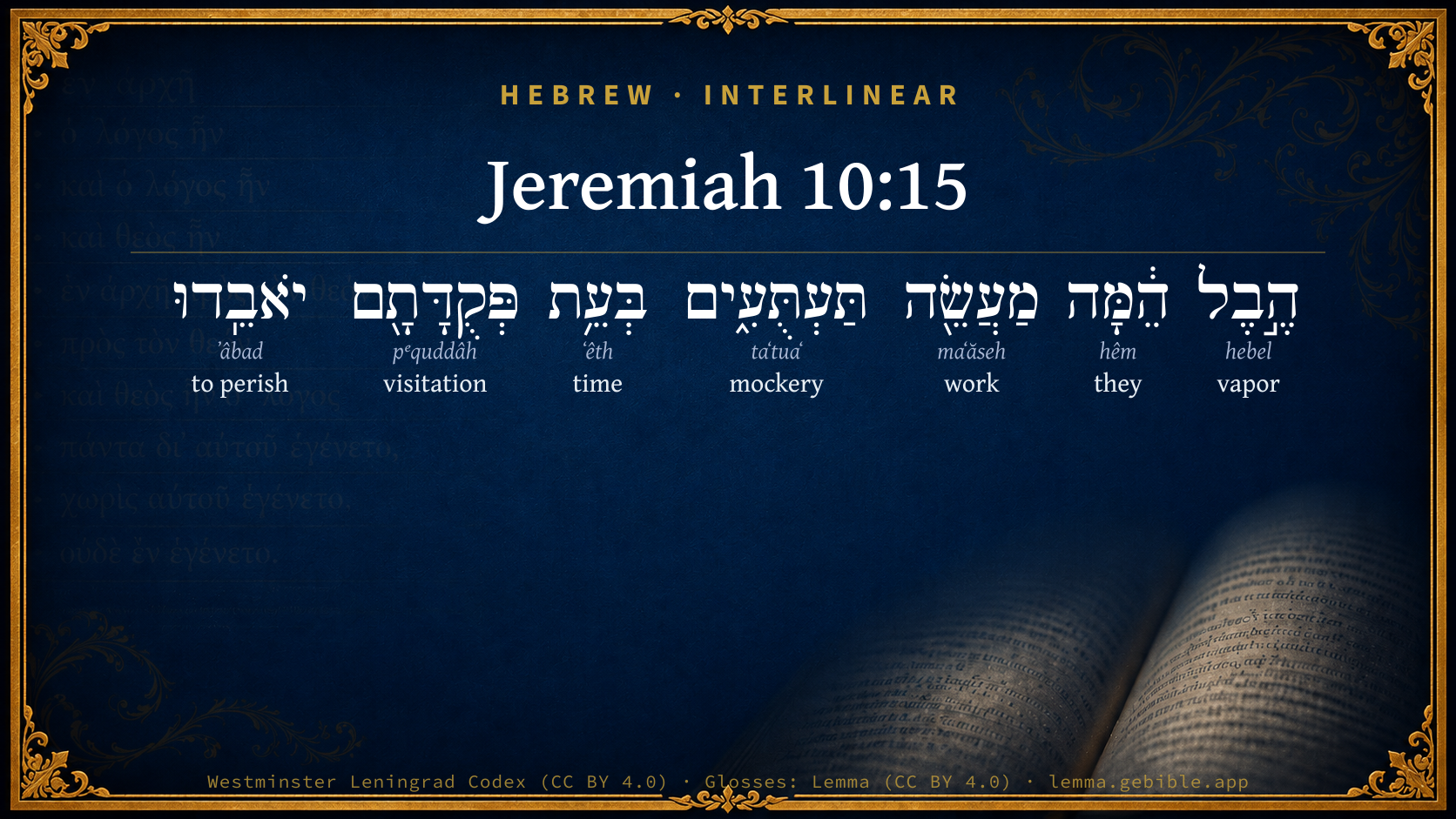
Jeremiah 10:15

Hebrew (Westminster Leningrad Codex) Jeremiah 10:15 appears in the Hebrew Old Testament. The text above is from the Westminster Leningrad Codex. Each word links to its Strong’s number, a concise gloss, and parsing drawn from the Open Scriptures Hebrew Bible morphology. Click any word for its full Brown-Driver-Briggs (BDB) entry.
Download image
Cite this verse

Jeremiah 10:15 (World English Bible). Public Domain. Lemma interlinear Bible study tool, https://lemma.gebible.app/v/jeremiah/10/15.

Show BibTeX & RIS
BibTeX
RIS
English Translation
They are vanity, a work of delusion: in the time of their visitation they shall perish.
World English Bible · Public Domain
Highlights
  • 1 first appearance in the Hebrew Bible
Full analysis ↓
Download a study sheet

One document with this verse’s original text, its word-by-word gloss line, the meaning frame, cross-references with their text, attributed commentary, and full source and license credits — printable, and it pastes into notes with its structure intact.

This verse Autodidact and up

Study sheet (.html) Plain text (.txt)

A passage Seminary Student

Up to 50 verses in one chapter. A passage sheet keeps up to 6 commentary sources and 12 cross-references per verse, in the order this page ranks them, and says so on the sheet whenever that leaves anything out. Ask for a single verse and you get the Autodidact verse sheet above.

Everything on this page stays free to read, with no account — the sheet is a download of what is already on screen, not access to it.

Want to remove ads? Support Godless Engineer
Compare translations 3

The same verse in 3 English versions, stacked beneath the original-language interlinear above. Click any original word for its lexicon entry.

Each is an independent rendering of the whole verse — the interlinear is not word-aligned to these translations.

Highlighted words mark where these versions differ — a whole-verse word diff, not a word-by-word alignment.

  • World English Bible Public Domain
    They are vanity, a work of delusion: in the time of their visitation they shall perish.
  • King James Version Public Domain
    They are vanity, and the work of errors: in the time of their visitation they shall perish.
  • unfoldingWord Literal Text CC BY-SA 4.0
    They are vain, the work of mockery; they will perish at the time of their visitation.

unfoldingWord Literal Text — © unfoldingWord, licensed CC BY-SA 4.0. Word-aligned USFM3 via Door43 (git.door43.org/unfoldingWord/en_ult).

Versions to compare (up to 4)

3 of 4 selected

Show all 18 translations

Every available English version of this verse, each an independent rendering of the whole verse.

  • World English Bible Public Domain
    They are vanity, a work of delusion: in the time of their visitation they shall perish.
  • Berean Standard Bible Public Domain
    They are worthless, a work to be mocked. In the time of their punishment they will perish.
  • Majority Standard Bible Public Domain
    They are worthless, a work to be mocked. In the time of their punishment they will perish.
  • King James Version Public Domain
    They are vanity, and the work of errors: in the time of their visitation they shall perish.
  • American Standard Version (1901) Public Domain
    They are vanity, a work of delusion: in the time of their visitation they shall perish.
  • Revised Version (1885) Public Domain
    They are vanity, a work of delusion: in the time of their visitation they shall perish.
  • Geneva Bible (1599) Public Domain
    They are vanitie, and the worke of errours: in the time of their visitation they shall perish.
  • Douay-Rheims (1899) Public Domain
    They are vain things and a ridiculous work: in the time of their visitation they shall perish.
  • Young's Literal Translation Public Domain
    Vanity `are' they, work of erring ones, In the time of their inspection they perish.
  • Literal Standard Version CC BY-SA 4.0
    They [are] vanity, work of erring ones, || They perish in the time of their inspection.
  • Unlocked Literal Bible CC BY-SA 4.0
    They are useless, the work of mockers; they will perish at the time of their punishment.
  • unfoldingWord Literal Text CC BY-SA 4.0
    They are vain, the work of mockery; they will perish at the time of their visitation.
  • Darby Bible Public Domain
    They are vanity, a work of delusion: in the time of their visitation they shall perish.
  • World Messianic Bible Public Domain
    They are vanity, a work of delusion. In the time of their visitation they will perish.
  • Webster's Bible Public Domain
    They are vanity, and the work of errors: in the time of their visitation they shall perish.
  • Free Bible Version CC BY-SA 4.0
    They are useless, an object to be laughed at. They will be destroyed at the time of their punishment.
  • Bible in Basic English Public Domain
    They are nothing, a work of error: in the time of their punishment, destruction will overtake them.
  • JPS Tanakh (1917) Public Domain
    They are vanity, a work of delusion; in the time of their visitation they shall perish.

Literal Standard Version (2020), Covenant Press — licensed CC BY-SA 4.0. Text via the HelloAO Bible API (eBible.org). Unlocked Literal Bible (unfoldingWord) — licensed CC BY-SA 4.0. Text via the HelloAO Bible API (eBible.org). unfoldingWord Literal Text — © unfoldingWord, licensed CC BY-SA 4.0. Word-aligned USFM3 via Door43 (git.door43.org/unfoldingWord/en_ult). Free Bible Version, Dr. Jonathan Gallagher — licensed CC BY-SA 4.0. Text via the HelloAO Bible API (eBible.org).

Word by word

More ways to search: Search by grammar → Find every occurrence → Compare this word →

Practice this passage: Drill this verse → Learn its vocabulary →

About this verse

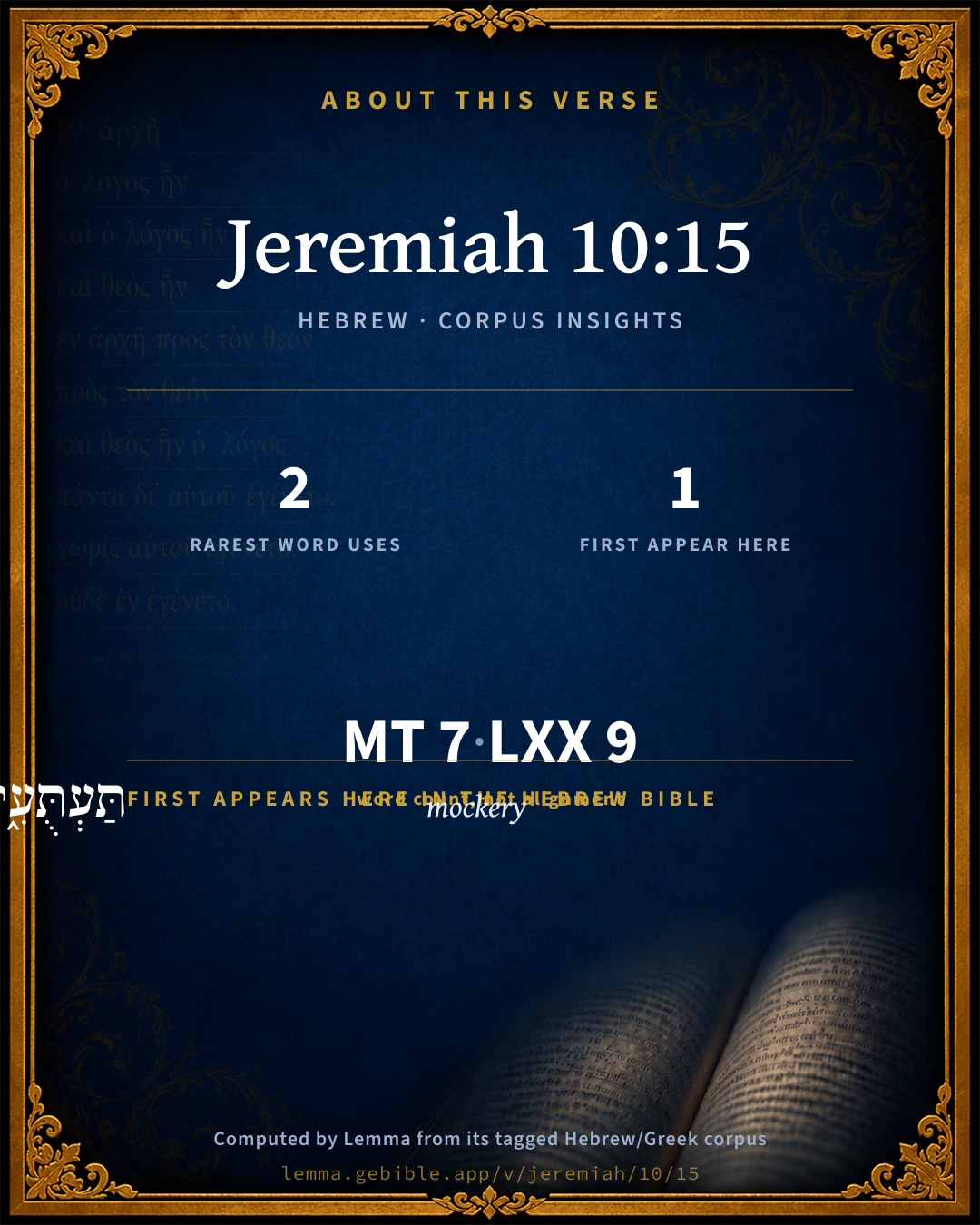
These counts appear in no published source. They are computed here, from the morphology-tagged text and Lemma’s own curated glosses. What Lemma adds →

7
words
7
distinct lemmas
Prophets
section

Notable vocabulary

The rarest word here is תַּעְתֻּעִ֑ים mockery H8595 — appearing just 2 times in the whole Hebrew Bible.

First appearance in Scripture

This word makes its first canonical appearance in the Hebrew Bible here:

  • תַּעְתֻּעִ֑ים mockery H8595

Shared distinctive vocabulary

תַּעְתֻּעִ֑ים mockery H8595 occurs in 2 verses of the Hebrew Bible. Also found in:

Grammatical profile

  • 1 verb
  • 5 nouns
  • 1 pronoun

Verb forms

  • יֹאבֵֽדוּ Qal · Imperfect

Hebrew & Septuagint length

In the original languages it is 7 Hebrew tokens and 9 Greek tokens — but the two are counted differently (Hebrew bundles its prefixes and suffixes into one token; the Greek is in lemma form), so that isn’t a like-for-like length.

Cross-references

15

Topical passages linked to Jeremiah 10:15 in the Treasury of Scripture Knowledge — connected by theme and wording, ordered by reader-vote popularity; previews shown in the World English Bible.

  • Isaiah 41:24 Behold, you are of nothing, and your work is of nothing; an abomination is he who chooses you.
  • Jeremiah 14:22 Are there any among the vanities of the nations that can cause rain? or can the sky give showers? Aren't you he, Yahweh our God? therefore we will wait for you; for you have made all these things.
  • Jeremiah 51:18 They are vanity, a work of delusion: in the time of their visitation they shall perish.
  • Isaiah 2:18–21 The idols shall utterly pass away.
  • Jeremiah 8:12 Were they ashamed when they had committed abomination? nay, they were not at all ashamed, neither could they blush: therefore shall they fall among those who fall; in the time of their visitation they shall be cast down, says Yahweh.
  • Jeremiah 8:19 Behold, the voice of the cry of the daughter of my people from a land that is very far off: isn't Yahweh in Zion? Isn't her King in her? Why have they provoked me to anger with their engraved images, and with foreign vanities?
  • Jonah 2:8 Those who regard lying vanities forsake their own mercy.
  • Zechariah 13:2 It will come to pass in that day, says Yahweh of Hosts, that I will cut off the names of the idols out of the land, and they will no more be remembered; and also I will cause the prophets and the spirit of impurity to pass out of the land.
  • Deuteronomy 32:21 They have moved me to jealousy with that which is not God; They have provoked me to anger with their vanities: I will move them to jealousy with those who are not a people; I will provoke them to anger with a foolish nation.
  • 1 Samuel 12:21 and don't turn aside; for [then would you go] after vain things which can't profit nor deliver, for they are vain.
  • Isaiah 41:29 Behold, all of them, their works are vanity [and] nothing; their molten images are wind and confusion.
  • Jeremiah 10:8 But they are together brutish and foolish: the instruction of idols! it is but a stock.
  • Jeremiah 10:11 Thus shall you say to them, The gods that have not made the heavens and the earth, these shall perish from the earth, and from under the heavens.
  • Zephaniah 1:3–4 I will sweep away man and animal. I will sweep away the birds of the sky, the fish of the sea, and the heaps of rubble with the wicked. I will cut off man from the surface of the earth, says Yahweh.
  • Acts 14:15 "Men, why are you doing these things? We also are men of like passions with you, and bring you good news, that you should turn from these vain things to the living God, who made the sky and the earth and the sea, and all that is in them;

Cross-references courtesy of OpenBible.info (CC BY 4.0).

Hebrew and Greek witnesses Masoretic Hebrew ↔ Greek Septuagint

The same verse in the two great witnesses to the Old Testament, shown verse-for-verse.

These are two independent witnesses, not word-aligned to each other, and the Septuagint is shown in lemma (dictionary) form.

Hebrew Jeremiah 10:15 Masoretic · Westminster Leningrad Codex

הֶ֣בֶל הֵ֔מָּה מַעֲשֵׂ֖ה תַּעְתֻּעִ֑ים בְּעֵ֥ת פְּקֻדָּתָ֖ם יֹאבֵֽדוּ

They are vanity, a work of delusion: in the time of their visitation they shall perish.

World English Bible · Public Domain

Greek LXX Structure differs

In the Septuagint, Jeremiah is about an eighth shorter than the Hebrew and arranges its material differently — the Oracles Against the Nations (Hebrew chapters 46–51) appear in the middle of the Greek book, after 25:13. Because the chapter and verse boundaries do not line up, a verse-for-verse comparison with the Hebrew is not shown.

A verse-for-verse comparison isn’t shown here because the chapters and verses don’t line up. Switch to the LXX edition with the MT / LXX toggle above to read the Greek directly.

Hebrew: Westminster Leningrad Codex (CC BY 4.0). Greek: Septuagint (public domain); English from a public-domain English Septuagint. How the Septuagint differs from the Hebrew →

Targum (Aramaic paraphrase)

1

The Targum is the ancient Jewish Aramaic paraphrase of the Hebrew Scriptures — an interpretive translation, not the Hebrew text itself. Onkelos (literal) and Pseudo-Jonathan (expansive) render the Torah, and Jonathan the Prophets. Coverage is partial: where no permissively-licensed English translation exists for a verse, only the Aramaic is shown. This is verse-level text, not a word-by-word alignment to the Hebrew.

  1. Targum Jonathan Prophets (Joshua–Malachi)
    לְמָא אִינוּן עוֹבֵד תּוּלְעָבָא בְּעִדַן דְאַסְעַר עֲלֵיהוֹן חוֹבֵיהוֹן יֵיבְדוּן:

    (no public-domain English translation for this verse)

    Targum Jonathan — Aramaic: “Mikraot Gedolot” (public domain). English: “Sefaria Community Translation” (CC0 1.0 (public-domain dedication)); “London "Chaldee Paraphrase," 1871” (public domain). Text via Sefaria.

Commentary

Notes on Jeremiah 10:15 from classic Christian and Jewish commentators (each source and its license shown beneath its notes). The classic Christian expositions comment on the surrounding passage and are grouped to its opening verse, so a note may address several verses; the Jewish commentaries on the Tanakh (Rashi and others) are per-verse, so they appear only where the commentator wrote on this verse.

Lemma curates 59 commentaries, every one of them public domain or Creative Commons licensed, each selected and text-cleaned for this edition rather than reprinted as found. About our sources →

Trapp's Complete Commentary

John Trapp

Jer 10:15 They [are] vanity, [and] the work of errors: in the time of their visitation they shall perish.

Ver. 15. They are vanity.] Vanity, in its largest extent, is properly predicated of them.

And the work of errors.] Mere mockeries, making men to embrace vanity for verity.

In the time of their visitation.] See on Isa 46:1.

John Trapp, A Commentary or Exposition upon All the Books of the Old and New Testament (1647–1656) — public domain. Text from a community e-Sword module.

Jamieson, Fausset & Brown

Robert Jamieson, A. R. Fausset & David Brown

errors--deceptions; from a Hebrew root, "to stutter"; then meaning "to mock."

their visitation they--When God shall punish the idol-worshippers (namely, by Cyrus), the idols themselves shall be destroyed [ROSENMULLER] (Jer 10:11).

Jamieson, Fausset & Brown — Commentary Critical and Explanatory on the Whole Bible (1871) — public domain (CC PDM 1.0). Text via the HelloAO Bible API.

John Calvin's Commentaries

He confirms the same thing. What he called before falsehood, שקר, shikor, he calls now vanity, הבל ebel. They are vanity, he says. He had said that they were falsehood, which means, that men were grossly deceived when they sought the presence of God in dead things, now he says, that they were vanity, and also the work of illusions; but some render the last word “mockeries,” taking it in a passive sense; and hence the Chaldee interpreter renders it, “a thing worthy of ridicule and laughter.” But I prefer to take it for imposture or deception. Jacob said to his mother, “I shall be found in the eyes of my father a deceiver;” but some render the word there “a mocker.” But Jacob, on the contrary, meant that he should be found out as one of no credit, or acting in guile, as though he had said, “I shall be an impostor, and rny father will flnd out the fraud.” So also in this place, he calls idols the work of deceptions, by which men infatuated themselves. He does not then teach us here that idols deserved to be ridiculed, but he refers to the madness of those who imagined that they were gods, for he had before called them vanity and falsehood; and there is no doubt but that in these various ways he repeats and confirms the same thing.

He afterwards adds, In the time of their visitation they shall perish The pronoun “their” may be applied to idols or to the Chaldeans: when the time of visitation shall come; that is, when God shall punish the enemies of his Church, then their idols shall perish: or, when the time shall come for God to visit the idols, they shall perish. Either sense may be admitted; and indeed as to the subject in hand, there is no difference.

The Israelites might have objected and said, “How is it then that false gods, whom men have devised for themselves, are worshipped, and are in great esteem and highly regarded? How does God suffer and overlook this?” The Israelites might have raised an objection of this kind. Therefore the Prophet answers them, They shall perish; but it shall be at the time of visitation It is an exhortation to patience, that the faithful might not despond or be weakened in their hopes, though they saw silver gods carried on men’s shoulders, though they saw wood and stone set on elevated places, and incense burnt to them and sacrifices offered to them. Though then they saw idols in such esteem, they were not yet to despair or fall away from true religion, for the time of visitation was to be looked for, when God would execute his judgment on the false gods as well as on their worshippets. We now understand why he speaks of visitation. It follows —

John Calvin's Commentaries (1540-1563) — public domain. Text from the Calvin Translation Society English edition (1840s-50s) via the Christian Classics Ethereal Library (ccel.org). Calvin's coverage is partial (roughly two-thirds of the Bible); uncommented books and verses are honest gaps, never fabricated. The 19th-century editor's footnotes and remarks are omitted so the notes are faithfully Calvin's own voice.

Ellicott's Commentary for English Readers

(15) The work of errors.—Better, a work of mockery, i.e., worthy of that and of that only, the word being apparently substituted, after Jeremiah’s manner, for the technical word, not unlike in sound, which is translated “image work” in 2Ch_3:10.

In the time of their visitation.—i.e., in the time when they are visited with punishment, as in 1Pe_2:12; Isa_10:3, and Luk_19:44.

A Bible Commentary for English Readers, edited by Charles John Ellicott (1878–1897) — public domain. Text from a community e-Sword module.

The Cambridge Bible for Schools and Colleges

gen. ed. J. J. S. Perowne

15. delusion] rather (with mg.) mockery, bringing scorn upon those who trust in them. The last clause of the v. refers to the fate which may be expected to befall the idols when “the day of the Lord” comes. Cp. Isa_2:12 ff.

The Cambridge Bible for Schools and Colleges (gen. ed. J. J. S. Perowne; Cambridge University Press, 1878–1918) — public domain. Text from a community e-Sword module.

John Gill's Exposition

They are vanity,.... They are the fruit of the vain imagination of men; to worship them shows the vanity of the human mind; and they are vain things to trust to:

and the work of errors; of erroneous men, and which lead men into errors; and are worthy to be laughed at, as the Targum paraphrases it.

In the time of their visitation they shall perish; or in the time that I shall visit upon them their sins, as the Targum; that is, when Babylon should be destroyed by the Medes and Persians, as Kimchi interprets it; when their idols were destroyed also; see Isa 46:1.

John Gill's Exposition of the Whole Bible (1746–1763) — public domain (CC PDM 1.0). Text via the HelloAO Bible API.

Albert Barnes' Notes on the Bible

Rather, “They are vanity, a work of mockery,” deserving only ridicule and contempt.

Albert Barnes' Notes on the Bible (1834–1885) — public domain. Text from a community e-Sword/MySword module.

Matthew Poole's English Annotations

They are vanity, and the work of errors; either in their rise, as springing from men of corrupt minds, or the foundation of them; a metonymy of the effect; teachers and encouragers of lies, Hab 2:18; things rather to be scoffed at and derided, than adored and worshipped; and it is expressed in the plural number, to note the multiplicity of them.

In the time of their visitation they shall perish; when God shall have a controversy with them, shall come to reckon with Babylon and her idols, they and their worshippers shall be destroyed, alluding possibly to the manner of the pagan conquests, who were wont to carry away both persons and the idols of the country, and either break them to pieces, or burn them; thus were they served by, the Persians: see on Isa 46:1. This possibly may be spoken by way of encouragement to the Jews, that took offence at the Chaldean idols that were set up in their sight; that God may strengthen their patience he tells them he visits them in mercy, and their enemies in judgment; he will destroy those idols.

Matthew Poole's English Annotations on the Holy Bible (1683–1685) — public domain. Text from a community e-Sword/MySword module.

Whedon's Commentary on the Bible

Daniel D. Whedon

15. Work of errors — Rather, of mockery; a thing that deserves only ridicule and contempt, and brings it upon all its votaries.

Daniel D. Whedon (gen. ed.), Commentary on the Old and New Testaments (1874–1909) — public domain. Text from a community e-Sword module.

The Pulpit Commentary

The very essence of idols is vanity; they are unreal as "a breath;" they are, not so much the work of errors as a work of mockery, i.e. not opus rise dignum, but a work which rewards the efforts bestowed upon its production by disappointment.

The Pulpit Commentary (1880–1919), ed. H.D.M. Spence-Jones & Joseph S. Exell — public domain. Text from a community e-Sword module.

John Wesley's Explanatory Notes

Visitation - When God shall come to reckon with Babylon and her idols.

John Wesley, Explanatory Notes Upon the Whole Bible (1754–1765) — public domain. Text via the GEBible commentary corpus.

Rashi

Rabbi Shlomo Yitzchaki (Rashi)

at the time of their visitation When I will visit retribution upon them.

Rashi on the Tanakh — English translations: “The Judaica Press complete Tanach with Rashi, translated by A. J. Rosenberg” (CC BY 4.0); “Pentateuch with Rashi's commentary by M. Rosenbaum and A.M. Silbermann, 1929-1934” (public domain); “The Metsudah Tanach series, Lakewood, N.J” (CC BY 4.0); and “The Book of Joshua, Metsudah Publications, 1997” (CC BY 4.0). Text via Sefaria.

Lesson kit

Teaching starters — assembled from the data on this page, not authored interpretation. Every prompt links to the verse data it draws on. Edit before teaching.

Jeremiah, in the Prophets, opens this verse with 7 words (7 distinct Hebrew lemmas). Its most distinctive word is taʻtuaʻ (“mockery”). A historical commentator’s framing appears above. Read the whole chapter for the surrounding context.

Discussion questions

  1. What does “mockery” (taʻtuaʻ) contribute to the verse as a whole?
  2. The word “mockery” first appears here in Scripture. What is being introduced at this debut?
  3. Jeremiah 51:18 shares the word «mockery» with this verse. How do the two illuminate each other?
  4. The translations on this page render this verse differently — a whole-verse word diff, not a word-by-word alignment. What might account for the different wordings?
  5. The verb «יֹאבֵֽדוּ» is Qal Imperfect. How does its form color the action?
  6. Reading how Trapp's Complete Commentary and Jamieson, Fausset & Brown read this verse, where do the two commentators agree and where do they part?

Things to notice

Reading settings

Reading text

Shown beneath each verse's original-language words.

Old Testament
Old Testament edition

Read the OT as the Masoretic Hebrew (MT) or the Greek Septuagint (LXX).

English shown for the Greek Septuagint (in the Hebrew ↔ Greek comparison).

Comparing translations? Open the Compare panel on any verse page to stack up to four side by side.