

Judges 11:26

Hebrew (Westminster Leningrad Codex) Judges 11:26 appears in the Hebrew Old Testament. The text above is from the Westminster Leningrad Codex. Each word links to its Strong’s number, a concise gloss, and parsing drawn from the Open Scriptures Hebrew Bible morphology. Click any word for its full Brown-Driver-Briggs (BDB) entry.
Download image
Cite this verse

Judges 11:26 (World English Bible). Public Domain. Lemma interlinear Bible study tool, https://lemma.gebible.app/v/judges/11/26.

Show BibTeX & RIS
BibTeX
RIS
English Translation
While Israel lived in Heshbon and its towns, and in Aroer and its towns, and in all the cities that are along by the side of the Arnon, three hundred years; why didn't you recover them within that time?
World English Bible · Public Domain
Download a study sheet

One document with this verse’s original text, its word-by-word gloss line, the meaning frame, cross-references with their text, attributed commentary, and full source and license credits — printable, and it pastes into notes with its structure intact.

This verse Autodidact and up

Study sheet (.html) Plain text (.txt)

A passage Seminary Student

Up to 50 verses in one chapter. A passage sheet keeps up to 6 commentary sources and 12 cross-references per verse, in the order this page ranks them, and says so on the sheet whenever that leaves anything out. Ask for a single verse and you get the Autodidact verse sheet above.

Everything on this page stays free to read, with no account — the sheet is a download of what is already on screen, not access to it.

Want to remove ads? Support Godless Engineer
Compare translations 3

The same verse in 3 English versions, stacked beneath the original-language interlinear above. Click any original word for its lexicon entry.

Each is an independent rendering of the whole verse — the interlinear is not word-aligned to these translations.

Highlighted words mark where these versions differ — a whole-verse word diff, not a word-by-word alignment.

  • World English Bible Public Domain
    While Israel lived in Heshbon and its towns, and in Aroer and its towns, and in all the cities that are along by the side of the Arnon, three hundred years; why didn't you recover them within that time?
  • King James Version Public Domain
    While Israel dwelt in Heshbon and her towns, and in Aroer and her towns, and in all the cities that be along by the coasts of Arnon, three hundred years? why therefore did ye not recover them within that time?
  • unfoldingWord Literal Text CC BY-SA 4.0
    In the dwelling of Israel in Heshbon and in its daughters and in Aroer and in its daughters and in all of the cities that upon the banks of the Arnon, 300 years, why then did you not deliver during that time?

unfoldingWord Literal Text — © unfoldingWord, licensed CC BY-SA 4.0. Word-aligned USFM3 via Door43 (git.door43.org/unfoldingWord/en_ult).

Versions to compare (up to 4)

3 of 4 selected

Show all 18 translations

Every available English version of this verse, each an independent rendering of the whole verse.

  • World English Bible Public Domain
    While Israel lived in Heshbon and its towns, and in Aroer and its towns, and in all the cities that are along by the side of the Arnon, three hundred years; why didn't you recover them within that time?
  • Berean Standard Bible Public Domain
    For three hundred years Israel has lived in Heshbon, Aroer, and their villages, as well as all the cities along the banks of the Arnon. Why did you not take them back during that time?
  • Majority Standard Bible Public Domain
    For three hundred years Israel has lived in Heshbon, Aroer, and their villages, as well as all the cities along the banks of the Arnon. Why did you not take them back during that time?
  • King James Version Public Domain
    While Israel dwelt in Heshbon and her towns, and in Aroer and her towns, and in all the cities that be along by the coasts of Arnon, three hundred years? why therefore did ye not recover them within that time?
  • American Standard Version (1901) Public Domain
    While Israel dwelt in Heshbon and its towns, and in Aroer and its towns, and in all the cities that are along by the side of the Arnon, three hundred years; wherefore did ye not recover them within that time?
  • Revised Version (1885) Public Domain
    While Israel dwelt in Heshbon and her towns, and in Aroer and her towns, and in all the cities that are along by the side of Arnon, three hundred years; wherefore did ye not recover them within that time?
  • Geneva Bible (1599) Public Domain
    When Israel dwelt in Heshbon and in her townes, and in Aroer and in her townes, and in all the cities that are by the coastes of Arnon, three hundreth yeeres? why did ye not then recouer them in that space?
  • Douay-Rheims (1899) Public Domain
    Whereas he hath dwelt in Hesebon, and the villages thereof, and in Aroer, and its villages, and in all the cities near the Jordan, for three hundred years. Why have you for so long a time attempted nothing about this claim?
  • Young's Literal Translation Public Domain
    In Israel's dwelling in Heshbon and in its towns, and in Aroer and in its towns, and in all the cities which `are' by the sides of Arnon three hundred years -- and wherefore have ye not delivered them in that time?
  • Literal Standard Version CC BY-SA 4.0
    In Israel’s dwelling in Heshbon and in its towns, and in Aroer and in its towns, and in all the cities which [are] by the sides of Arnon [for] three hundred years—and why have you not delivered them in that time?
  • Unlocked Literal Bible CC BY-SA 4.0
    While Israel lived for three hundred years in Heshbon and its villages, and in Aroer and its villages, and in all the cities that are along the banks of the Arnon—why then did you not take them back during that time?
  • unfoldingWord Literal Text CC BY-SA 4.0
    In the dwelling of Israel in Heshbon and in its daughters and in Aroer and in its daughters and in all of the cities that upon the banks of the Arnon, 300 years, why then did you not deliver during that time?
  • Darby Bible Public Domain
    While Israel dwelt in Heshbon and its villages, and in Aro'er and its villages, and in all the cities that are on the banks of the Arnon, three hundred years, why did you not recover them within that time?
  • World Messianic Bible Public Domain
    Israel lived in Heshbon and its towns, and in Aroer and its towns, and in all the cities that are along the side of the Arnon for three hundred years! Why didn’t you recover them within that time?
  • Webster's Bible Public Domain
    While Israel dwelt in Heshbon and her towns, and in Aroer and her towns, and in all the cities that are along by the borders of Arnon, three hundred years? why therefore did ye not recover them within that time?
  • Free Bible Version CC BY-SA 4.0
    Israelites have been living in Heshbon, Aroer, their villages, and in all the towns along the banks of the Arnon River for three hundred years. Why didn't you take them back during that time?
  • Bible in Basic English Public Domain
    While Israel was living in Heshbon and its daughter-towns and in Aroer and its daughter-towns and in all the towns which are by the side of the Arnon, for three hundred years, why did you not get them back at that time?
  • JPS Tanakh (1917) Public Domain
    While Israel dwelt in Heshbon and its towns, and in Aroer and its towns, and in all the cities that are along by the side of the Arnon, three hundred years; wherefore did ye not recover them within that time?

Literal Standard Version (2020), Covenant Press — licensed CC BY-SA 4.0. Text via the HelloAO Bible API (eBible.org). Unlocked Literal Bible (unfoldingWord) — licensed CC BY-SA 4.0. Text via the HelloAO Bible API (eBible.org). unfoldingWord Literal Text — © unfoldingWord, licensed CC BY-SA 4.0. Word-aligned USFM3 via Door43 (git.door43.org/unfoldingWord/en_ult). Free Bible Version, Dr. Jonathan Gallagher — licensed CC BY-SA 4.0. Text via the HelloAO Bible API (eBible.org).

Word by word

More ways to search: Search by grammar → Find every occurrence → Compare this word →

Practice this passage: Drill this verse → Learn its vocabulary →

וּבְעַרְע֣וֹר
ʻĂrôwʻêr
H6177
“and · in/at · Aroer”
Conjunction + Preposition + Noun, Proper
Part of Speech
Conjunction + Preposition + Noun
Type
Proper
Full BDB Definition

Origin: the same as H6176

TWOT: None

Aroer = "ruins" - a city on the north bank of the river Arnon, the southern point of the territory of Sihon the king of the Amorites and later of Reuben; modern 'Arair' - a city in Ammon near the Jabbok belonging to Gad - a town in southern Judah
  1. בְּשֶׁ֣בֶת yâshab H3427 “in/at · to dwell” Preposition + Verb, Qal, Infinitive Construct
  2. יִ֠שְׂרָאֵל Yisrâʼêl H3478 “Israel” Noun, Proper
  3. בְּחֶשְׁבּ֨וֹן Cheshbôwn H2809 “in/at · Heshbon” Preposition + Noun, Proper
  4. וּבִבְנוֹתֶ֜יהָ bath H1323 “and · in/at · daughters · her” Conjunction + Preposition + Noun, Common, Feminine, Plural, Construct + Suffix, Personal, 3rd Person, Feminine, Singular
  5. וּבִבְנוֹתֶ֗יהָ bath H1323 “and · in/at · daughters · her” Conjunction + Preposition + Noun, Common, Feminine, Plural, Construct + Suffix, Personal, 3rd Person, Feminine, Singular
  6. וּבְכָל kôl H3605 “and · in/at · all of” Conjunction + Preposition + Noun, Common, Masculine, Singular, Construct
  7. הֶֽעָרִים֙ ʻîyr H5892 “the · cities” Particle, Definite Article + Noun, Common, Feminine, Plural, Absolute
  8. אֲשֶׁר֙ ʼăsher H834 “which” Particle, Relative
  9. עַל ʻal H5921 “upon” Preposition
  10. יְדֵ֣י yâd H3027 “hands of” Noun, Common, Both, Dual, Construct
  11. אַרְנ֔וֹן ʼArnôwn H769 “Arnon” Noun, Proper
  12. שְׁלֹ֥שׁ shâlôwsh H7969 “three” Adjective, Cardinal number, Feminine, Singular, Absolute
  13. מֵא֖וֹת mêʼâh H3967 “hundred” Adjective, Cardinal number, Both, Plural, Absolute
  14. שָׁנָ֑ה shâneh H8141 “year” Noun, Common, Feminine, Singular, Absolute
  15. וּמַדּ֥וּעַ maddûwaʻ H4069 “and · why” Conjunction + Particle, Interrogative
  16. לֹֽא lôʼ H3808 “not” Particle, Negative
  17. הִצַּלְתֶּ֖ם nâtsal H5337 “to rescue” Verb, Hiphil, Perfect, 2nd Person, Masculine, Plural
  18. בָּעֵ֥ת ʻêth H6256 “in/at the · time” Preposition, Determined + Noun, Common, Both, Singular, Absolute
  19. הַהִֽיא hûwʼ H1931 “the · he” Particle, Definite Article + Pronoun, Personal, 3rd Person, Feminine, Singular

About this verse

These counts appear in no published source. They are computed here, from the morphology-tagged text and Lemma’s own curated glosses. What Lemma adds →

20
words
19
distinct lemmas
Historical
section

Notable vocabulary

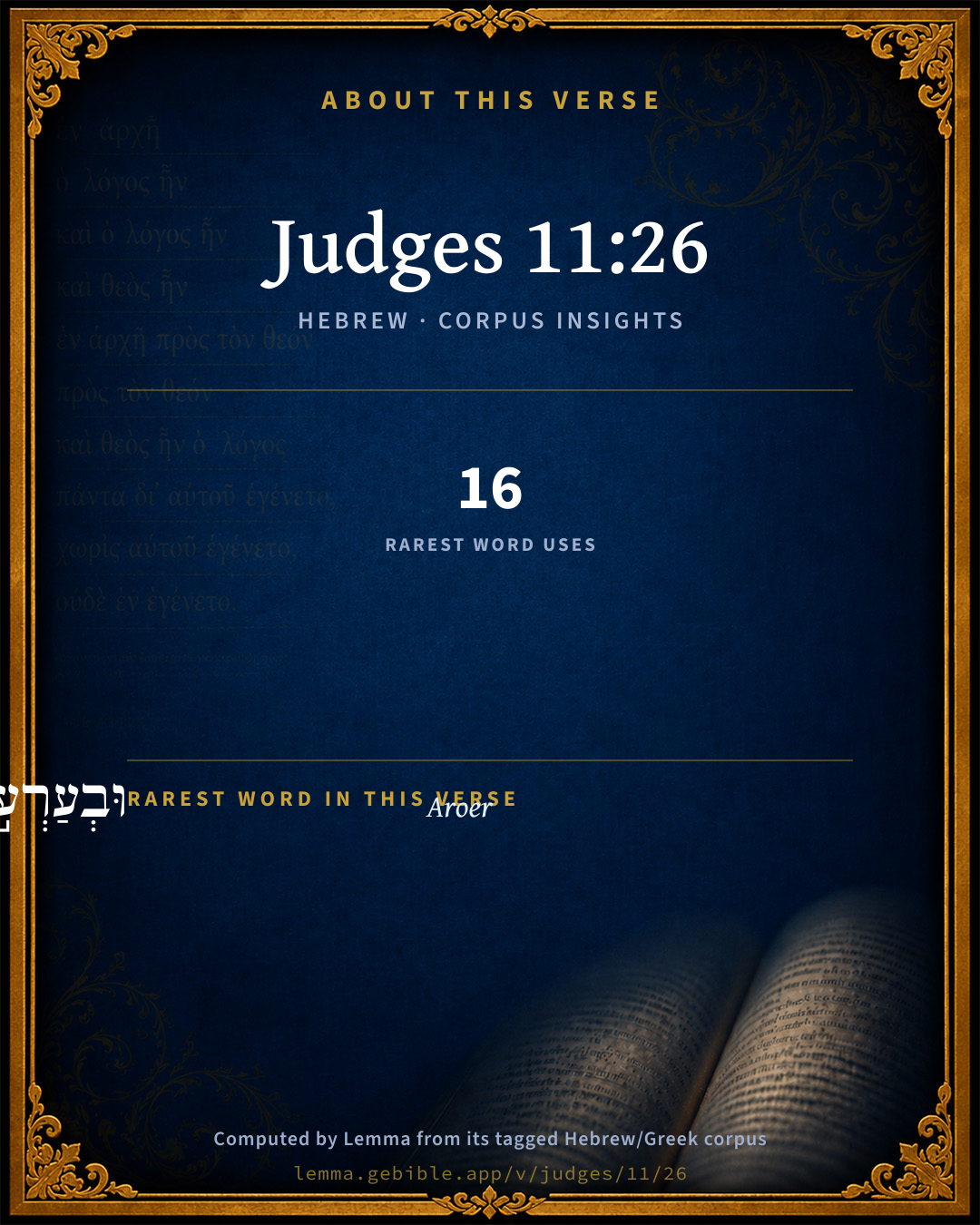
The rarest word here is וּבְעַרְע֣וֹר Aroer H6177 — appearing just 16 times in the whole Hebrew Bible.

Shared distinctive vocabulary

וּבְעַרְע֣וֹר Aroer H6177 occurs in 16 verses of the Hebrew Bible. Also found in:

Grammatical profile

  • 2 verbs
  • 11 nouns
  • 2 adjectives
  • 1 pronoun
  • 1 preposition
  • 3 particles

Verb forms

  • בְּשֶׁ֣בֶת Qal · Infinitive Construct
  • הִצַּלְתֶּ֖ם Hiphil · Perfect

Repetition

A word recurs within this verse — often emphatic in Hebrew:

  • וּבִבְנוֹתֶ֜יהָ daughter H1323 ×2

Hebrew & Septuagint length

In English translation the verse runs 39 words from the Hebrew and 39 from the Septuagint (LXX English) — the same length.

A rough comparison of the two English renderings, which tokenize alike — not a word-level alignment.

Word counts can differ between the Hebrew and the Greek without any difference in meaning — e.g. the Hebrew direct-object marker אֵת has no separate Greek word, and Greek often adds the article ὁ.

Cross-references

17

Topical passages linked to Judges 11:26 in the Treasury of Scripture Knowledge — connected by theme and wording, ordered by reader-vote popularity; previews shown in the World English Bible.

  • Deuteronomy 2:36 From Aroer, which is on the edge of the valley of the Arnon, and [from] the city that is in the valley, even to Gilead, there was not a city too high for us; Yahweh our God delivered up all before us:
  • Numbers 21:25–30 Israel took all these cities: and Israel lived in all the cities of the Amorites, in Heshbon, and in all the towns of it.
  • Deuteronomy 2:24 Rise up, take your journey, and pass over the valley of the Arnon: behold, I have given into your hand Sihon the Amorite, king of Heshbon, and his land; begin to possess it, and contend with him in battle.
  • Deuteronomy 3:2 Yahweh said to me, Don't fear him; for I have delivered him, and all his people, and his land, into your hand; and you shall do to him as you did to Sihon king of the Amorites, who lived at Heshbon.
  • Deuteronomy 3:6 We utterly destroyed them, as we did to Sihon king of Heshbon, utterly destroying every inhabited city, with the women and the little ones.
  • Joshua 11:18 Joshua made war a long time with all those kings.
  • Joshua 12:2 Sihon king of the Amorites, who lived in Heshbon, and ruled from Aroer, which is on the edge of the valley of the Arnon, and [the city that is in] the middle of the valley, and half Gilead, even to the river Jabbok, the border of the children of Ammon;
  • Joshua 12:5 and ruled in Mount Hermon, and in Salecah, and in all Bashan, to the border of the Geshurites and the Maacathites, and half Gilead, the border of Sihon king of Heshbon.
  • Joshua 13:10 and all the cities of Sihon king of the Amorites, who reigned in Heshbon, to the border of the children of Ammon;
  • Joshua 23:1 It happened after many days, when Yahweh had given rest to Israel from all their enemies round about, and Joshua was old and well stricken in years;
  • Judges 3:11 The land had rest forty years. Othniel the son of Kenaz died.
  • Judges 3:30 So Moab was subdued that day under the hand of Israel. The land had rest eighty years.
  • Judges 5:31 So let all your enemies perish, Yahweh: But let those who love him be as the sun when he goes forth in his might. The land had rest forty years.
  • Judges 8:28 So Midian was subdued before the children of Israel, and they lifted up their heads no more. The land had rest forty years in the days of Gideon.
  • Judges 9:22 Abimelech was prince over Israel three years.
  • Judges 10:2–3 He judged Israel twenty-three years, and died, and was buried in Shamir.
  • Judges 10:8 They vexed and oppressed the children of Israel that year: eighteen years [oppressed they] all the children of Israel that were beyond the Jordan in the land of the Amorites, which is in Gilead.

Cross-references courtesy of OpenBible.info (CC BY 4.0).

Hebrew and Greek witnesses Masoretic Hebrew ↔ Greek Septuagint

The same verse in the two great witnesses to the Old Testament, shown verse-for-verse.

These are two independent witnesses, not word-aligned to each other, and the Septuagint is shown in lemma (dictionary) form.

Hebrew Judges 11:26 Masoretic · Westminster Leningrad Codex

בְּשֶׁ֣בֶת יִ֠שְׂרָאֵל בְּחֶשְׁבּ֨וֹן וּבִבְנוֹתֶ֜יהָ וּבְעַרְע֣וֹר וּבִבְנוֹתֶ֗יהָ וּבְכָל הֶֽעָרִים֙ אֲשֶׁר֙ עַל יְדֵ֣י אַרְנ֔וֹן שְׁלֹ֥שׁ מֵא֖וֹת שָׁנָ֑ה וּמַדּ֥וּעַ לֹֽא הִצַּלְתֶּ֖ם בָּעֵ֥ת הַהִֽיא

While Israel lived in Heshbon and its towns, and in Aroer and its towns, and in all the cities that are along by the side of the Arnon, three hundred years; why didn't you recover them within that time?

World English Bible · Public Domain

Greek LXX Judges 11:26 Septuagint · lemma form

ἐν ὁ οἰκέω ἐν εσεβων καί ἐν ὁ ὅριον αὐτός καί ἐν γῆ αροηρ καί ἐν ὁ ὅριον αὐτός καί ἐν πᾶς ὁ πόλις ὁ παρά ὁ ἰορδάνης τριακόσιοι ἔτος καί διά τίς οὐ ῥύομαι αὐτός ἐν ὁ καιρός ἐκεῖνος

when Israel lived in Esebon and in its coasts, and in the land of Aroer and in its coasts, and in all the cities by Jordan, three hundred years? and therefore did you not recover them in that time?

LXX2012 (modern English Septuagint) · Public Domain

On this verse, Ellicott's Commentary for English Readers discusses the Septuagint’s reading. Read the note in Commentary ↓

Hebrew: Westminster Leningrad Codex (CC BY 4.0). Greek: Septuagint (public domain); English from LXX2012 (modern English Septuagint) (Public Domain). How the Septuagint differs from the Hebrew →

Targum (Aramaic paraphrase)

1

The Targum is the ancient Jewish Aramaic paraphrase of the Hebrew Scriptures — an interpretive translation, not the Hebrew text itself. Onkelos (literal) and Pseudo-Jonathan (expansive) render the Torah, and Jonathan the Prophets. Coverage is partial: where no permissively-licensed English translation exists for a verse, only the Aramaic is shown. This is verse-level text, not a word-by-word alignment to the Hebrew.

  1. Targum Jonathan Prophets (Joshua–Malachi)
    כַּד יָתֵיב יִשְׂרָאֵל בְּחֶשְׁבּוֹן וּבְכַפְרָנָהָא וּבְעַרְעוֹר וּבְכַפְרָנָהָא וּבְכָל קִרְוַיָא דְעַל תְּחוּמֵי אַרְנוֹן תְּלַת מְאָה שְׁנִין וּמָא דֵין לָא שְׁזַבְתּוּן בְּעִדָנָא הַהִיא:

    (no public-domain English translation for this verse)

    Targum Jonathan — Aramaic: “Mikraot Gedolot” (public domain). English: “Sefaria Community Translation” (CC0 1.0 (public-domain dedication)); “London "Chaldee Paraphrase," 1871” (public domain). Text via Sefaria.

Commentary

Notes on Judges 11:26 from classic Christian and Jewish commentators (each source and its license shown beneath its notes). The classic Christian expositions comment on the surrounding passage and are grouped to its opening verse, so a note may address several verses; the Jewish commentaries on the Tanakh (Rashi and others) are per-verse, so they appear only where the commentator wrote on this verse.

Lemma curates 59 commentaries, every one of them public domain or Creative Commons licensed, each selected and text-cleaned for this edition rather than reprinted as found. About our sources →

Trapp's Complete Commentary

John Trapp

Jdg 11:26 While Israel dwelt in Heshbon and her towns, and in Aroer and her towns, and in all the cities that [be] along by the coasts of Arnon, three hundred years? why therefore did ye not recover [them] within that time?

Ver. 26. Three hundred years.] So he calleth the time for a round number, making the most of it, now that he pleadeth prescription.

John Trapp, A Commentary or Exposition upon All the Books of the Old and New Testament (1647–1656) — public domain. Text from a community e-Sword module.

Joseph Benson's Commentary

Jdg 11:26. Three hundred years — Not precisely, but about that time, either from their coming out of Egypt, or from their first conquest of those lands. Here he pleads prescription, which by all men is reckoned a just title, and it is fit it should be so, for the good of the world; because otherwise a door would be opened both to kings and private persons for infinite contentions and confusions. And the prescription he pleads was for a long space of time, during which none of the kings of Moab or Ammon had pretended a right to this country, much less contested it with them. Wherefore did ye not recover them within that time? — No answer could be given to this question, why, in so long a time, they never asserted their claim till now.

Joseph Benson's Commentary on the Old and New Testaments (1811–1818) — public domain. Text from a community e-Sword module.

Geneva Bible (1599)

Geneva Bible translators

Meaning, their towns.

Geneva Bible (1599) marginal notes — public domain. Text via Bolls.life.

Ellicott's Commentary for English Readers

(26) While Israel dwelt in Heshbon.—See Num_21:25. This is an argument from undisputed possession.

In Aroer and her towns.—These had been assigned to the tribe of Gad (Num_32:34).

In all the cities that be along by the coast of Arnon.—The LXX. read Jordan.

Three hundred years.—There is an almost insuperable difficulty in making out any reasonable scheme of chronology even by accepting this as a round number, because it is difficult to reconcile with nine or ten genealogies which have been preserved to us, and which represent the period between the conquest and David by seven or eight generations. Now the period covered by these genealogies includes the judgeship of Samuel and the reign of Saul—at least seventy years; and seven or eight generations cannot possibly span 370 years. The hypothesis that in all these genealogies—even the four times repeated genealogy of David—generations are always omitted is very improbable. The chronology of the Jews is confessedly loose and uncertain, and it seems quite possible that “three hundred years” may be a marginal gloss which has crept into the text. What makes this more probable is that the words not only create an immense chronological difficulty, but (1) are quite needless to Jephthah’s argument, and (2) actually conflict with the rest of the sentence, which refers to Balak alone; the argument being, If Balak, “at that time” (as the words should be rendered), did not advance any claim, what right have you to do so now? If, however, in spite of these difficulties, the clause be genuine, and if there has not been one of the clerical errors which are so common where numerals are concerned, it seems possible that 300 years may be counted inclusively, e.g., 100 full years since the death of Joshua and nominal completion of the conquest of Canaan, with parts of a century before and after it. Certainly this is a recognised mode of reckoning time among the Jews. For instance, if a king began to reign on December 30, 1879, and died on January 2, 1881, they would say that he had reigned three years. Whatever explanations we may adopt, there is nothing but conjecture to go upon. (See Introduction.)

Within that time.—This is a mistranslation, due probably to the perplexity caused by the “three hundred years.” The Hebrew has “in that time,” i.e., at that crisis. It was obvious, without special mention, that they had remained in possession ever since Balak’s day, and in the most ancient times it was admitted that lapse of time secured possession (Isocr. Ep. ad Aechid., p. 121; Tac. Ann. vi. 31).

A Bible Commentary for English Readers, edited by Charles John Ellicott (1878–1897) — public domain. Text from a community e-Sword module.

The Cambridge Bible for Schools and Colleges

gen. ed. J. J. S. Perowne

26. While Israel dwelt] Rather When I. settled. For her towns see on Jdg_1:27.

Aroer … Arnon] The LXX reads Jazer (cod. A) … Jordan (so Vulgate), which looks like the original text. Jazer lay on the Ammonite border, Num_21:24 (LXX), 32, 2Sa_24:5, and is associated with Heshbon in Jos_21:39; it suits the present context better than Aroer (now ‘Ar‘âir) in the extreme S. of Moab. Moreover, since ‘Aroer and her towns’ were situated on the north side of the Arnon, the words which follow in the present text, ‘and in all the cities that are along by the side of Arnon,’ add nothing to the description; Jordan gives us exactly what is wanted.

three hundred years] The total number of years assigned to the oppressions and to the periods of the Judges in the preceding chapters comes to 319, or, omitting the Ammonite oppression, to 301. The round number 300 seems, therefore, to be calculated upon the basis of the chronological scheme introduced into the book by the editor of the framework. Thus three hundred years must have been inserted into the narrative, to the disturbance of the proper sense of the clause which follows: within that time is an incorrect rendering; the words mean at that time (cf. Jdg_3:29, Jdg_4:4, Jdg_12:6 etc.), i.e. when Israel settled in Heshbon.

The Cambridge Bible for Schools and Colleges (gen. ed. J. J. S. Perowne; Cambridge University Press, 1878–1918) — public domain. Text from a community e-Sword module.

John Gill's Exposition

Wherefore I have not sinned against thee,.... Had done him no injury, not wronged him of anything, nor had taken away any part of his country from him; this Jephthah said in the name of all Israel, of whom he was governor:

but thou doest me wrong to war against me; meaning that he had no just cause to commence a war against Israel, but acted an injurious part; and seeing things could not be adjusted in an amicable way, but must be decided by the sword, he leaves the affair with the Lord, and appeals to him:

the Lord the Judge; the Judge of the whole earth, the omniscient God, that knows all things, the right and wrong of every cause, on which side truth and justice lie:

be Judge this day between the children of Israel and the children of Ammon; not that he expected a decision of the controversy between them would be made that precise and exact day; but that from henceforward the Lord would appear, by giving success to that party which was in the right in this contest.

John Gill's Exposition of the Whole Bible (1746–1763) — public domain (CC PDM 1.0). Text via the HelloAO Bible API.

Haydock's Catholic Bible Commentary

He. Hebrew, "While Israel," &c. --- Years. He makes use of a round number. (Haydock) --- Chronologists generally suppose that either more or fewer years had elapsed; (Menochius) and the Scripture only relates what Jephte said. (Sa) --- The Jews reckon 394. Some date from the coming out of Egypt 305. (Calmet) --- Petau has 365. But as Jephte only speaks of the time during which the Israelites had occupied the land, the 40 years’ sojournment must be deducted, and still Petau will have 25 years too many; (Haydock) whereas "those who adduce the title of prescription, are accustomed rather to increase than to diminish the length of time." (Usher, p. 74.) --- Hence this author allows only 263 years. Houbigant comes rather nearer to the number of Jephte, and reckons 281, which the ambassadors might represent, in a round number as 300. (Proleg.) --- Salien almost agrees with Usher dating 306 years from the exit, and 266 from the victory over Sehon. He observes, with Eusebius, that Hercules instituted the Olympic games in the first year of Jephte, in the year of the world 2849. But they were restored, and became a famous epoch only 400 years after. He place the first rape of Helen by Theseus at the same time, when she was about 12 years ole. In her 24th, she was stolen again by Paris, and gave occasion to the famous siege of Troy. (Haydock)

George Leo Haydock (1774–1849), Haydock's Catholic Family Bible and Commentary, 1859 edition — public domain. Excludes Psalms (Douay-Rheims chapter numbering differs from Protestant) and Deuterocanonical books (Catholic canon only).

Matthew Poole's English Annotations

Three hundred years; not precisely, but about that time; either from their coming out of Egypt, or from their first conquest of those lands; and thus numbers are oft expressed: see Num 1:46; 2:32; 11:21; Jdg 20:46. He urgeth prescription, which is by all men reckoned a just title, and it is fit it should be so for the good of the world, because otherwise the door would be opened both to kings and to private persons for infinite contentions and confusions.

Matthew Poole's English Annotations on the Holy Bible (1683–1685) — public domain. Text from a community e-Sword/MySword module.

Whedon's Commentary on the Bible

Daniel D. Whedon

26. Three hundred years — This of all others was the most overwhelming refutation of Ammon’s claims. The peaceful possession of a country for such a period was of itself an all-sufficient title to possession — a “statute of limitations:” “for,” says Le Clerc, “if there be no rule respecting time, and long possession is of no value, nothing could ever be safely possessed by any people, nor would there ever be an end of wars and dissensions.”

Daniel D. Whedon (gen. ed.), Commentary on the Old and New Testaments (1874–1909) — public domain. Text from a community e-Sword module.

The Pulpit Commentary

The occupation of the cities and villages referred to is related Num_21:23 and following verses, and in Deu_2:36; see too Jos_12:2. Aroer is not mentioned among the cities of Moab taken by the Amorites in the ancient book quoted in Num_21:27-30, and it has been conjectured that it may have been built by the Amorites to secure their new frontier. It is described by Eusebius and Jerome in the "Onomasticon" as built on a hill overhanging the bank of the Amen, and a ruin called Arair has been found on the very spot so described. The Aroer mentioned in ver. 33 (where see note) is probably a different place. By the coasts of Arnon, i.e. on the banks. The Septuagint for Arnon reads Jordan, which was the western boundary, as Arnon was the southern (ver. 22). The corresponding description in Deu_2:36 is, From Aroer, which is by the brink of the river of Arnon, and from the city that is by the river, even unto Gilead:, there was not owe city too strong for us: the Lord our God delivered all unto us. Three hundred years. These words seem quite unintelligible and out of place. They are also chronologically impracticable. One expects the number of the cities, as in ver. 33, rather than the number of years; and it is remarkable that the whole number of cities taken by the Israelites on the cast of Jordan must have been just about 300, since the half-tribe of Manasseh had sixty. If Gad and Reuben had the same proportion, it would be exactly 300 (5 60). Within that time. The Hebrew phrase, which occurs about seventy times, invariably means at that time, and here can only refer to the time of the first settlement in the days of Balak, of which he had been speaking another proof that the enumeration three hundred years is out of place here. If the reading years is not, as above suggested, an error for cities, the whole sentence, three hundred years, may very probably be an interpolation by a professed chronologist. The adding up of all the numbers of the servitudes and rests given in the book gives 301 years from the commencement of the oppression by Chushan-rishathaim to the death of Jair. But this method of reckoning gives the impossible period of 600 years from the exodus to the building of temple.

The Pulpit Commentary (1880–1919), ed. H.D.M. Spence-Jones & Joseph S. Exell — public domain. Text from a community e-Sword module.

John Wesley's Explanatory Notes

Three hundred years - Not precisely, but about that time, either from their coming out of Egypt; or, from their first conquest of those lands. He urges prescription, which is by all men reckoned a just title, and it is fit it should be so for the good of the world, because otherwise the door would be opened both to kings, and to private persons, for infinite contentions and confusions.

John Wesley, Explanatory Notes Upon the Whole Bible (1754–1765) — public domain. Text via the GEBible commentary corpus.

unfoldingWord translationNotes

Door43 World Missions Community

General Information:

Jephthah's messengers continue to speak.

three hundred years

"300 years" (See: Numbers)

Heshbon

Translate the name of this city the same way that you did in Judges 11:19.

Aroer

This is the name of a city. (See: How to Translate Names)

Arnon

Translate the name of this city the same way that you did in Judges 11:13.

why then did you not take them back during that time?

Jephthah is rebuking the king of the Ammonites with a rhetorical question. This question can be translated as a statement. AT: "you should have taken them back during that time." or "now it is too late; you should have taken them back long ago." (See: Rhetorical Question)

I have not done you wrong, but you are doing me wrong by attacking me

Jephthah is speaking to the Sihon. Here Jephthah speaks about the Israelites as though they were himself and of the Ammonites as if they were Sihon their king. AT: "The Israelites have not done wrong to your people, but your people are doing us wrong by attacking us" (See: Synecdoche)

done you wrong ... doing me wrong

This is an idiom. To do someone wrong means to do something wrong to them. AT: "treated you wrongly ... treating me wrongly" or "treated you unfairly ... treating me unfairly" (See: Idiom)

translationWords

Israel

wrong

Yahweh

judge, judges

Ammon

king

Jephthah

unfoldingWord translationNotes — © Distant Shores Media and the Door43 World Missions Community, licensed CC BY-SA 4.0. Source: git.door43.org/Door43/en_tn.

Rashi

Rabbi Shlomo Yitzchaki (Rashi)

Adjoining [lit. by the hands of] Arnon. Near Arnon. These cities had belonged to Moav, but they recognized that they could not lay claim to them, since they were confiscated from Sichon, who had annexed them from the king of Moav.

Three centuries from the conquest of the land in the days of Yehoshua, until Yiftoch. This teaches us concerning the years of the Judges mentioned until now—whether the years of subjugation by the nations are included in the reckoning of the days of the Judge, or not. We learn in Seder Olam: Yehoshua directed Yisroel for twenty eight years—I am not aware of any Scriptural derivation for this. Asniel for forty years, the years of subjugation by Cushan Rishasaim are included. Afterward, Ehud for eighty years, with the eighteen years of subjugation by Eglon included. This totals one hundred forty eight years. Devorah for forty years, with the years of subjugation by Yavin included, totaling one hundred eighty eight years. Afterward, seven years of subjugation by Midyon, forty years of Gidon, and three of Avimelech, totaling two hundred thirty eight years. Afterward, twenty three years of Tola and twenty two of Yair, with one year overlapping both, and eighteen years of the Bnei Ammon until Yiftoch's appearance. This totals three hundred.

Rashi on the Tanakh — English translations: “The Judaica Press complete Tanach with Rashi, translated by A. J. Rosenberg” (CC BY 4.0); “Pentateuch with Rashi's commentary by M. Rosenbaum and A.M. Silbermann, 1929-1934” (public domain); “The Metsudah Tanach series, Lakewood, N.J” (CC BY 4.0); and “The Book of Joshua, Metsudah Publications, 1997” (CC BY 4.0). Text via Sefaria.

Lesson kit

Teaching starters — assembled from the data on this page, not authored interpretation. Every prompt links to the verse data it draws on. Edit before teaching.

Judges, in the Historical, opens this verse with 20 words (19 distinct Hebrew lemmas). Its most distinctive word is ʻĂrôwʻêr (“Aroer”). A historical commentator’s framing appears above. Read the whole chapter for the surrounding context.

Discussion questions

  1. What does “Aroer” (ʻĂrôwʻêr) contribute to the verse as a whole?
  2. Numbers 32:34 shares the word «Aroer» with this verse. How do the two illuminate each other?
  3. “daughter” occurs 2× in this one verse. What is the effect of the repetition?
  4. These translations render this verse differently. What is at stake in choosing one wording over another?
  5. The verb «בְּשֶׁ֣בֶת» is Qal Infinitive Construct. How does its form color the action?
  6. Reading how Trapp's Complete Commentary and Joseph Benson's Commentary read this verse, where do the two commentators agree and where do they part?

Things to notice

Reading settings

Reading text

Shown beneath each verse's original-language words.

Old Testament
Old Testament edition

Read the OT as the Masoretic Hebrew (MT) or the Greek Septuagint (LXX).

English shown for the Greek Septuagint (in the Hebrew ↔ Greek comparison).

Comparing translations? Open the Compare panel on any verse page to stack up to four side by side.