
Ecclesiastes 3:6

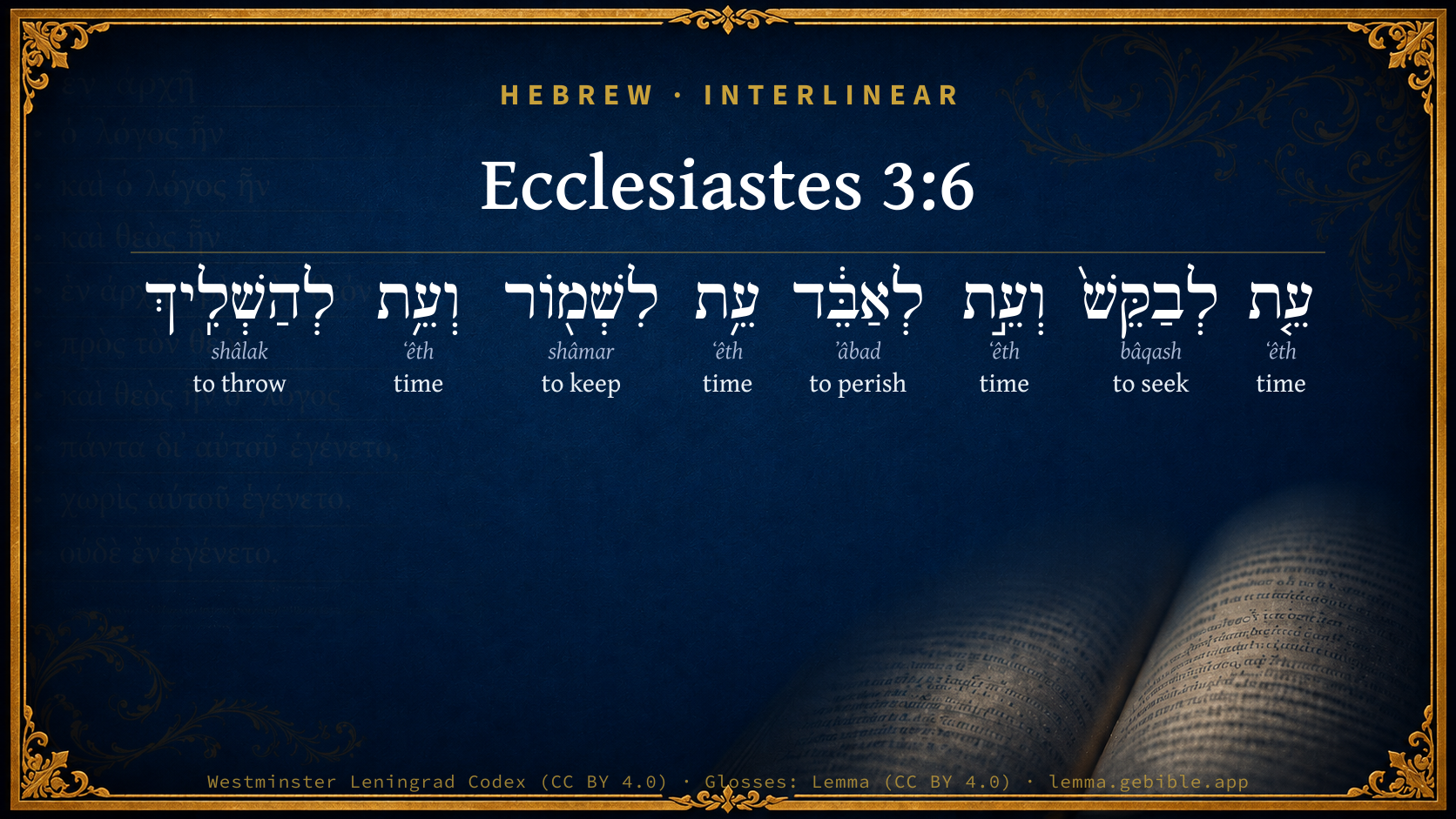
Hebrew (Westminster Leningrad Codex) Ecclesiastes 3:6 appears in the Hebrew Old Testament. The text above is from the Westminster Leningrad Codex. Each word links to its Strong’s number, a concise gloss, and parsing drawn from the Open Scriptures Hebrew Bible morphology. Click any word for its full Brown-Driver-Briggs (BDB) entry.
Download image
Cite this verse

Ecclesiastes 3:6 (World English Bible). Public Domain. Lemma interlinear Bible study tool, https://lemma.gebible.app/v/ecclesiastes/3/6.

Show BibTeX & RIS
BibTeX
RIS
English Translation
A time to seek, And a time to lose; A time to keep, And a time to cast away;
World English Bible · Public Domain
Download a study sheet

One document with this verse’s original text, its word-by-word gloss line, the meaning frame, cross-references with their text, attributed commentary, and full source and license credits — printable, and it pastes into notes with its structure intact.

This verse Autodidact and up

Study sheet (.html) Plain text (.txt)

A passage Seminary Student

Up to 50 verses in one chapter. A passage sheet keeps up to 6 commentary sources and 12 cross-references per verse, in the order this page ranks them, and says so on the sheet whenever that leaves anything out. Ask for a single verse and you get the Autodidact verse sheet above.

Everything on this page stays free to read, with no account — the sheet is a download of what is already on screen, not access to it.

Want to remove ads? Support Godless Engineer
Compare translations 3

The same verse in 3 English versions, stacked beneath the original-language interlinear above. Click any original word for its lexicon entry.

Each is an independent rendering of the whole verse — the interlinear is not word-aligned to these translations.

Highlighted words mark where these versions differ — a whole-verse word diff, not a word-by-word alignment.

  • World English Bible Public Domain
    A time to seek, And a time to lose; A time to keep, And a time to cast away;
  • King James Version Public Domain
    A time to get, and a time to lose; a time to keep, and a time to cast away;
  • unfoldingWord Literal Text CC BY-SA 4.0
    a time to seek and a time to lose, a time to keep and a time to throw away,

unfoldingWord Literal Text — © unfoldingWord, licensed CC BY-SA 4.0. Word-aligned USFM3 via Door43 (git.door43.org/unfoldingWord/en_ult).

Versions to compare (up to 4)

3 of 4 selected

Show all 18 translations

Every available English version of this verse, each an independent rendering of the whole verse.

  • World English Bible Public Domain
    A time to seek, And a time to lose; A time to keep, And a time to cast away;
  • Berean Standard Bible Public Domain
    a time to search and a time to count as lost, a time to keep and a time to discard,
  • Majority Standard Bible Public Domain
    a time to search and a time to count as lost, a time to keep and a time to discard,
  • King James Version Public Domain
    A time to get, and a time to lose; a time to keep, and a time to cast away;
  • American Standard Version (1901) Public Domain
    a time to seek, and a time to lose; a time to keep, and a time to cast away;
  • Revised Version (1885) Public Domain
    a time to seek, and a time to lose; a time to keep, and a time to cast away;
  • Geneva Bible (1599) Public Domain
    A time to seeke, and a time to lose: a time to keepe, and a time to cast away.
  • Douay-Rheims (1899) Public Domain
    A time to get, and a time to lose. A time to keep, and a time to cast away.
  • Young's Literal Translation Public Domain
    A time to seek, And a time to destroy. A time to keep, And a time to cast away.
  • Literal Standard Version CC BY-SA 4.0
    A time to seek, || And a time to destroy. A time to keep, || And a time to cast away.
  • Unlocked Literal Bible CC BY-SA 4.0
    There is a time to look for things and a time to stop looking, a time to keep things and a time to throw away things,
  • unfoldingWord Literal Text CC BY-SA 4.0
    a time to seek and a time to lose, a time to keep and a time to throw away,
  • Darby Bible Public Domain
    A time to seek, and a time to lose; A time to keep, and a time to cast away;
  • World Messianic Bible Public Domain
    a time to seek, and a time to lose; a time to keep, and a time to cast away;
  • Webster's Bible Public Domain
    A time to get, and a time to lose; a time to keep, and a time to cast away;
  • Free Bible Version CC BY-SA 4.0
    A time of searching, and a time of giving up searching. A time of keeping, and a time of throwing away.
  • Bible in Basic English Public Domain
    A time for search and a time for loss; a time to keep and a time to give away;
  • JPS Tanakh (1917) Public Domain
    A time to seek, and a time to lose; a time to keep, and a time to cast away;

Literal Standard Version (2020), Covenant Press — licensed CC BY-SA 4.0. Text via the HelloAO Bible API (eBible.org). Unlocked Literal Bible (unfoldingWord) — licensed CC BY-SA 4.0. Text via the HelloAO Bible API (eBible.org). unfoldingWord Literal Text — © unfoldingWord, licensed CC BY-SA 4.0. Word-aligned USFM3 via Door43 (git.door43.org/unfoldingWord/en_ult). Free Bible Version, Dr. Jonathan Gallagher — licensed CC BY-SA 4.0. Text via the HelloAO Bible API (eBible.org).

Word by word

More ways to search: Search by grammar → Find every occurrence → Compare this word →

Practice this passage: Drill this verse → Learn its vocabulary →

About this verse

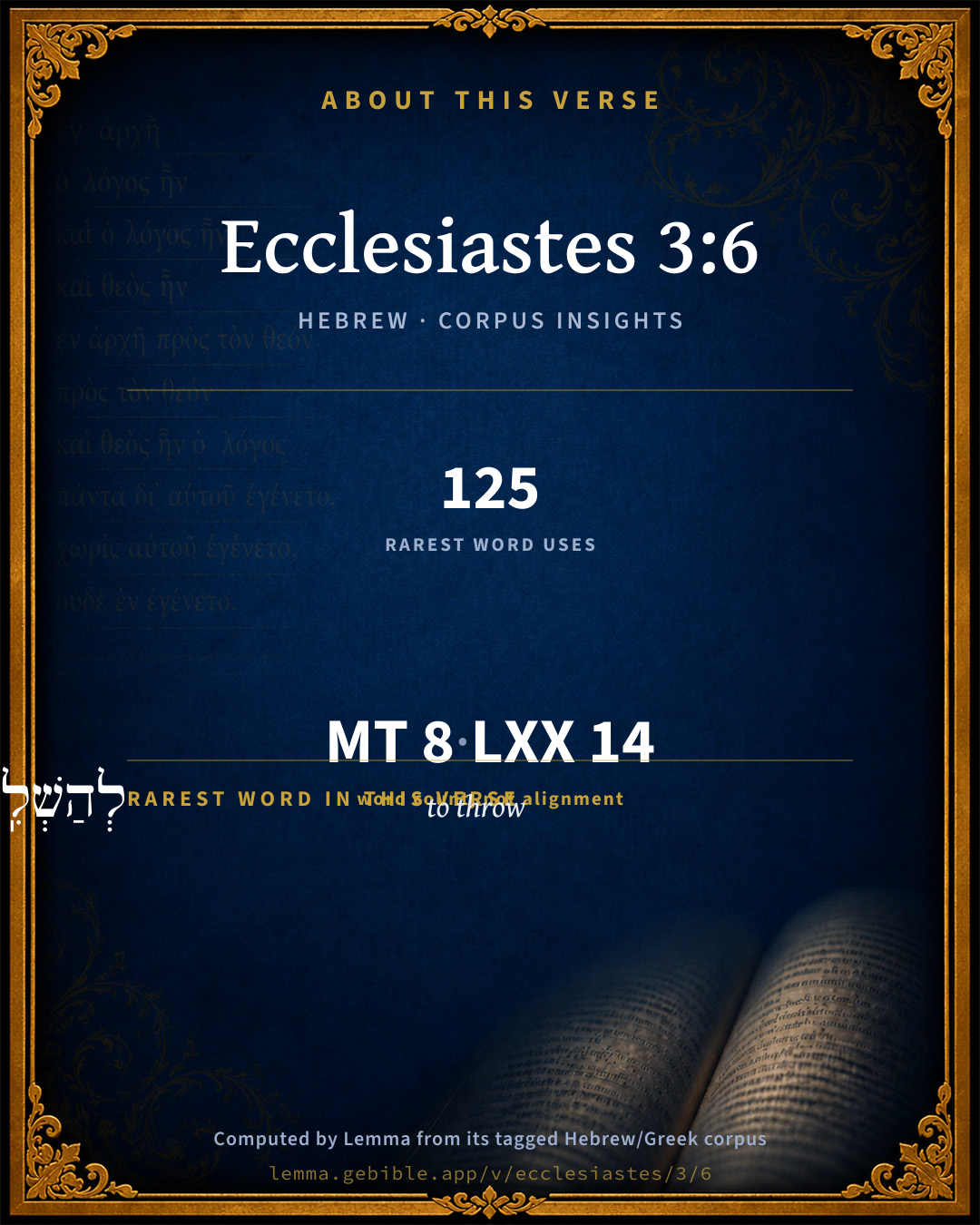
These counts appear in no published source. They are computed here, from the morphology-tagged text and Lemma’s own curated glosses. What Lemma adds →

8
words
5
distinct lemmas
Wisdom
section

Grammatical profile

  • 4 verbs
  • 4 nouns

Verb forms

  • לְבַקֵּשׁ֙ Piel · Infinitive Construct
  • לְאַבֵּ֔ד Piel · Infinitive Construct
  • לִשְׁמ֖וֹר Qal · Infinitive Construct
  • לְהַשְׁלִֽיךְ Hiphil · Infinitive Construct

Repetition

A word recurs within this verse — often emphatic in Hebrew:

  • עֵ֤ת time H6256 ×4

Hebrew & Septuagint length

In English translation the verse runs 19 words from the Hebrew and 19 from the Septuagint (LXX English) — the same length.

A rough comparison of the two English renderings, which tokenize alike — not a word-level alignment.

Word counts can differ between the Hebrew and the Greek without any difference in meaning — e.g. the Hebrew direct-object marker אֵת has no separate Greek word, and Greek often adds the article ὁ.

In the original languages it is 8 Hebrew tokens and 14 Greek tokens — but the two are counted differently (Hebrew bundles its prefixes and suffixes into one token; the Greek is in lemma form), so that isn’t a like-for-like length.

Cross-references

20

Topical passages linked to Ecclesiastes 3:6 in the Treasury of Scripture Knowledge — connected by theme and wording, ordered by reader-vote popularity; previews shown in the World English Bible.

  • Philippians 3:7–8 However, what things were gain to me, these have I counted loss for Christ.
  • Luke 9:24–25 For whoever desires to save his life will lose it, but whoever will lose his life for my sake, the same will save it.
  • Mark 8:35–37 For whoever wants to save his life will lose it; and whoever will lose his life for my sake and the Gospel's will save it.
  • Matthew 16:25–26 For whoever desires to save his life will lose it, and whoever will lose his life for my sake will find it.
  • 2 Kings 5:26 He said to him, Didn't my heart go with you, when the man turned from his chariot to meet you? Is it a time to receive money, and to receive garments, and olive groves and vineyards, and sheep and oxen, and men-servants and maid-servants?
  • Psalms 112:9 He has dispersed, he has given to the poor. His righteousness endures forever. His horn will be exalted with honor.
  • Ecclesiastes 11:1 Cast your bread on the waters; For you shall find it after many days.
  • Matthew 19:29 Everyone who has left houses, or brothers, or sisters, or father, or mother, or wife, or children, or lands, for my name's sake, will receive one hundred times, and will inherit eternal life.
  • Mark 10:28–30 Peter began to tell him, "Behold, we have left all, and have followed you."
  • Hebrews 10:34–35 For you both had compassion on me in my chains, and joyfully accepted the plundering of your possessions, knowing that you have for yourselves a better possession and an enduring one in the heavens.
  • Acts 27:19 On the third day, they threw out the ship's tackle with their own hands.
  • Genesis 30:30–43 For it was little which you had before I came, and it has increased to a multitude. Yahweh has blessed you wherever I turned. Now when will I provide for my own house also?"
  • Genesis 31:18 and he carried away all his cattle, and all his substance which he had gathered, the cattle of his getting, which he had gathered in Paddan Aram, to go to Isaac his father to the land of Canaan.
  • Exodus 12:35–36 The children of Israel did according to the word of Moses; and they asked of the Egyptians jewels of silver, and jewels of gold, and clothing.
  • Deuteronomy 8:17–18 and [lest] you say in your heart, My power and the might of my hand has gotten me this wealth.
  • 2 Kings 7:15 They went after them to the Jordan: and, behold, all the way was full of garments and vessels, which the Syrians had cast away in their haste. The messengers returned, and told the king.
  • Isaiah 2:20 In that day, men shall cast away their idols of silver, And their idols of gold, Which have been made for themselves to worship, To the moles and to the bats;
  • Jonah 1:5 Then the mariners were afraid, and cried every man to his god. They threw the cargo that was in the ship into the sea, to lighten it. But Jonah had gone down into the innermost parts of the ship, and he was laying down, and was fast asleep.
  • Acts 27:38 When they had eaten enough, they lightened the ship, throwing out the wheat into the sea.
  • 2 Kings 8:9 So Hazael went to meet him, and took a present with him, even of every good thing of Damascus, forty camels' burden, and came and stood before him, and said, Your son Benhadad king of Syria has sent me to you, saying, Shall I recover of this sickness?

Cross-references courtesy of OpenBible.info (CC BY 4.0).

Hebrew and Greek witnesses Masoretic Hebrew ↔ Greek Septuagint

The same verse in the two great witnesses to the Old Testament, shown verse-for-verse.

These are two independent witnesses, not word-aligned to each other, and the Septuagint is shown in lemma (dictionary) form.

Hebrew Ecclesiastes 3:6 Masoretic · Westminster Leningrad Codex

עֵ֤ת לְבַקֵּשׁ֙ וְעֵ֣ת לְאַבֵּ֔ד עֵ֥ת לִשְׁמ֖וֹר וְעֵ֥ת לְהַשְׁלִֽיךְ

A time to seek, And a time to lose; A time to keep, And a time to cast away;

World English Bible · Public Domain

Greek LXX Ecclesiastes 3:6 Septuagint · lemma form

καιρός ὁ ζητέω καί καιρός ὁ ἀποὀλλύω καιρός ὁ φυλάσσω καί καιρός ὁ ἐκβάλλω

a time to seek, and a time to lose; a time to keep, and a time to cast away;

LXX2012 (modern English Septuagint) · Public Domain

Hebrew: Westminster Leningrad Codex (CC BY 4.0). Greek: Septuagint (public domain); English from LXX2012 (modern English Septuagint) (Public Domain). How the Septuagint differs from the Hebrew →

Commentary

Notes on Ecclesiastes 3:6 from classic Christian and Jewish commentators (each source and its license shown beneath its notes). The classic Christian expositions comment on the surrounding passage and are grouped to its opening verse, so a note may address several verses; the Jewish commentaries on the Tanakh (Rashi and others) are per-verse, so they appear only where the commentator wrote on this verse.

Lemma curates 59 commentaries, every one of them public domain or Creative Commons licensed, each selected and text-cleaned for this edition rather than reprinted as found. About our sources →

Trapp's Complete Commentary

John Trapp

Ecc 3:6 A time to get, and a time to lose; a time to keep, and a time to cast away;

Ver. 6. A time to get.] Heb., To seek; for men do but seek here, they do not properly get what they cannot long hold. How much better therefore were it to seek God! Cuius inventio est ipsum semper quaerere (as Nyssen hath it here), the finding of whom is always to seek him, and in seeking of whom there is so great reward. {Heb 11:6} "Seek ye me and ye shall live." {Amo 5:4} "Seek him that maketh the seven stars and Orion." {Amo 5:8} Seek him "in a time when he may be found." {Psa 32:6} "Now is the accepted time, now is the day of salvation." {2Co 6:2} Take the present "now," and be serious, and then God scorns to do as heathen idols did - viz., to say to the seed of Jacob, "Seek ye me in vain." {Isa 45:19} How greedy are men of getting gain! {a} Get God, and you get all: Habet omnia qui habet habentem omnia. {b}

And a time to lose.] There is an "uncertainty" in riches; {1Ti 6:17} a "deceitfulness"; {Mar 4:19} a "lie." {Joh 8:44} They were never true to those that trusted them; subject they are to vanity or violence. {Mat 6:19-21} How seldom do gamesters grow rich! Vitrea est fortuna; cum splendot, frangitur. {c} And as they say of the metal they make glass of: it is nearest melting when it shines brightest in the fire; so are many rich men nearest ruin when at greatest lustre, as Haman, Herod, Pythias, &c.

A time to keep.] It is good for a man to keep somewhat by him. Bonus servatius facit bonum bonifacium, according to the Dutch blunt proverb, ‘A good saver makes a good well doer.’ {See Trapp on "Pro 6:8"}

And a time to cast away.] To "cast bread upon the waters," {Ecc 11:1} upon those poor creatures that, pinched with penury, water their plants, feed upon tears. And although bread and other comforts cast upon such may seem cast down the waters, because no hope of recompense, yet thou shalt be "recompensed at the resurrection of the just," saith Christ to such, and blessed in the meanwhile. {Luk 14:14} Temporalia Dei servis impensa non pereunt, sed parturiunt, Alms perisheth not, but is put to use.

{a} Kερδαινοντες ου κοπιωμεν. - Naz.

{b} Augustine.

{c} Mimus.

John Trapp, A Commentary or Exposition upon All the Books of the Old and New Testament (1647–1656) — public domain. Text from a community e-Sword module.

Jamieson, Fausset & Brown

Robert Jamieson, A. R. Fausset & David Brown

time to get--for example, to gain honestly a livelihood (Eph 4:23).

lose--When God wills losses to us, then is our time to be content.

keep--not to give to the idle beggar (Th2 3:10).

cast away--in charity (Pro 11:24); or to part with the dearest object, rather than the soul (Mar 9:43). To be careful is right in its place, but not when it comes between us and Jesus Christ (Luk 10:40-42).

Jamieson, Fausset & Brown — Commentary Critical and Explanatory on the Whole Bible (1871) — public domain (CC PDM 1.0). Text via the HelloAO Bible API.

Adam Clarke's Commentary

Verse 6. A time to get, - to lose, - to keep, - to cast away]

___________________ "Commerce produces wealth,

Whilst time of gaining lasts; from every point

Blow prosperous gales. Now heaven begins to lower,

And all our hopes are blasted. Prudence bids,

One while, our treasure to reserve, and then

With liberal hand to scatter wide. How oft

In raging storms, the owner wisely casts

Into the deep his precious merchandise,

To save the foundering bark!

Adam Clarke's Commentary on the Bible (1810–1826) — public domain. Text from a community e-Sword/MySword module.

Ellicott's Commentary for English Readers

(6) To lose.—Elsewhere this word means to destroy, but in the later Hebrew it comes to mean to lose, like the Latin “perdere.”

A Bible Commentary for English Readers, edited by Charles John Ellicott (1878–1897) — public domain. Text from a community e-Sword module.

The Cambridge Bible for Schools and Colleges

gen. ed. J. J. S. Perowne

6. A time to get, and a time to lose] The getting or the losing refer primarily, we can scarcely doubt, to what we call property. There are times when it is better and wiser to risk the loss of all we have rather than to set our minds on acquiring more. Something like this lesson we have in our Lord’s paradox “whosoever will (wills to) save his life shall lose it, and whosoever will lose his life for my sake shall find it” (Mat_16:25). In earthly, as in heavenly, things it is the note of a wise man that he knows when to be content to lose. So the Satirist condemns the folly of those who are content,

“Propter vitam vivendi perdere causas.”

“And for mere life to lose life’s noblest ends.”

Juven. Sat. viii. 84.

a time to keep, and a time to cast away] The second couplet though closely allied with the foregoing is not identical with it. What is brought before us here is “keeping” as distinct from “getting,” and the voluntarily casting away (2Ki_7:15) what we know we have, as distinct from the loss of a profit more or less contingent. And here too, as life passes on, it presents occasions when now this, now that, is the choice of wisdom. So the sailor, in danger of shipwreck, casts out his cargo, his tackling, the “furniture” of his ship (Act_27:18-19; Act_27:38).

The Cambridge Bible for Schools and Colleges (gen. ed. J. J. S. Perowne; Cambridge University Press, 1878–1918) — public domain. Text from a community e-Sword module.

John Gill's Exposition

A time to get, and a time to lose,.... To get substance, as the Targum, and to lose it; wealth and riches, honour and glory, wisdom and knowledge: or, "to seek, and to lose" (i); a time when the sheep of the house of Israel, or God's elect, were lost, and a time to seek them again; which was, lone by Christ in redemption, and by the Spirit of God, in effectual calling;

a time to keep, and a time to cast away; to keep a thing, and to cast it away, into the sea, in the time of a great tempest, as the Targum; as did the mariners in the ship in which Jonah was, and those in which the Apostle Paul was, Jon 1:5; It may be interpreted of keeping riches, and which are sometimes kept too close, and to the harm of the owners of them; and of scattering them among the poor, or casting them upon the waters; see Ecc 5:13.

(i) "tempus quaerendi", Pagninus, Montanus, Tigurine version, Piscator, Mercerus, Gejerus, Rambachius.

John Gill's Exposition of the Whole Bible (1746–1763) — public domain (CC PDM 1.0). Text via the HelloAO Bible API.

Albert Barnes' Notes on the Bible

Get ... lose - Rather, seek, and a time to give up for lost.

Albert Barnes' Notes on the Bible (1834–1885) — public domain. Text from a community e-Sword/MySword module.

Matthew Poole's English Annotations

A time to lose; when men shall lose their estates, either by God’s providence, or by their own choice.

A time to cast away; when a man shall cast away his goods voluntarily, as in a storm to save his life, as Jon 1:5; Act 27:18,19; or out of love and obedience to God, as Mat 10:37,39; Heb 10:34.

Matthew Poole's English Annotations on the Holy Bible (1683–1685) — public domain. Text from a community e-Sword/MySword module.

Whedon's Commentary on the Bible

Daniel D. Whedon

6. To keep… to cast away — The reference in this verse is to the change of our tastes and likings, by which we come to reject what once we sought, either carelessly losing it, or intentionally throwing it away. Koheleth regards this as not coming from mere fancy, but from law.

Daniel D. Whedon (gen. ed.), Commentary on the Old and New Testaments (1874–1909) — public domain. Text from a community e-Sword module.

The Pulpit Commentary

A time to get (seek), and a time to lose. The verb abad, in piel, is used in the sense of "to destroy", (Ecc_7:7) and it is only in late Hebrew that it signifies, as here, "to lose." The reference is doubtless to property, and has no connection with the last clause of the preceding verse, as Delitzsch would opine. There is a proper and lawful pursuit of wealth, and there is a wise and prudent submission to its inevitable loss. The loss here is occasioned by events over which the owner has no control, differing from that in the next clause, which is voluntary. The wise man knows when to exert his energy in improving his fortune, and when to hold his hand and take failure without useless struggle. Loss, too, is sometimes gain, as when Christ"s departure in the flesh was the prelude and the occasion of the sending of the Comforter; (Joh_16:7) and there are many things of which we know not the real value till they are beyond our grasp. A time to keep, and a time to cast away. Prudence will make fast what it has won, and will endeavor to preserve it unimpaired. But there are occasions when it is wiser to deprive one"s self of some things in order to secure more important ends, as when sailors throw a cargo, etc., overboard in order to save their ship. (comp. Act_27:18, Act_27:19, Act_27:38) And in higher matters, such as almsgiving, this maxim holds good: "There is that scattereth, and yet increaseth.... The liberal soul shall be made fat, and he that watereth shall be watered also himself". (Pro_11:24, Pro_11:25) Plumptre refers to Christ"s so-called paradox," Whosoever would (onv a qelh) save his life shall lose it, and whosoever shall lose his life for my sake shall find it". (Mat_16:25)

The Pulpit Commentary (1880–1919), ed. H.D.M. Spence-Jones & Joseph S. Exell — public domain. Text from a community e-Sword module.

John Wesley's Explanatory Notes

To life - When men lose their estates, either by God's providence, or by their own choice. To cast away - When a man casts away his goods voluntarily, as in a storm, to save his life, or out of love and obedience to God.

John Wesley, Explanatory Notes Upon the Whole Bible (1754–1765) — public domain. Text via the GEBible commentary corpus.

Keil & Delitzsch

C. F. Keil & F. Delitzsch

"To seek has its time, and to lose has its time; to lay up has its time, and to throw away has its time." Vaihinger and others translate לאבּד, to give up as lost, which the Pih. signifies first as the expression of a conscious act. The older language knows it only in the stronger sense of bringing to ruin, making to perish, wasting (Pro 29:3). But in the more modern language, אבד, like the Lat. perdere, in the sense of "to lose," is the trans. to the intrans. אבד, e.g., Tahoroth; viii. 3, "if one loses (המאבּד) anything," etc.; Sifri, at Deu 24:19, "he who has lost (מאבּד) a shekel," etc. In this sense the Palest.-Aram. uses the Aphel אובד, e.g., Jer. Meza ii. 5, "the queen had lost (אובדת) her ornament." The intentional giving up, throwing away from oneself, finds its expression in להשׁ.

The following pair of contrasts refers the abandoning and preserving to articles of clothing: -

Keil & Delitzsch — Biblical Commentary on the Old Testament (1861–1891) — public domain (CC PDM 1.0). Text via the HelloAO Bible API. (Old Testament only.)

unfoldingWord translationNotes

Door43 World Missions Community

General Information:

The writer continues with merisms to describe various aspects of life from one extreme to the other. (See: Merism)

unfoldingWord translationNotes — © Distant Shores Media and the Door43 World Missions Community, licensed CC BY-SA 4.0. Source: git.door43.org/Door43/en_tn.

Rashi

Rabbi Shlomo Yitzchaki (Rashi)

A time to seek As it is stated (Ezek. 34:16): “I will seek the lost,” concerning those of Israel gone astray.

and a time to lose and a time when He lost them in exile, as it is said (Lev. 26:38): “And you will become lost among the nations.”

a time to keep (Num. 6:24): “May the Lord bless you and keep you,” when you do His will.

and a time to cast away (Deut. 29:27): “and cast them into another land.”

Rashi on the Tanakh — English translations: “The Judaica Press complete Tanach with Rashi, translated by A. J. Rosenberg” (CC BY 4.0); “Pentateuch with Rashi's commentary by M. Rosenbaum and A.M. Silbermann, 1929-1934” (public domain); “The Metsudah Tanach series, Lakewood, N.J” (CC BY 4.0); and “The Book of Joshua, Metsudah Publications, 1997” (CC BY 4.0). Text via Sefaria.

Lesson kit

Teaching starters — assembled from the data on this page, not authored interpretation. Every prompt links to the verse data it draws on. Edit before teaching.

Ecclesiastes, in the Wisdom, opens this verse with 8 words (5 distinct Hebrew lemmas). Its most distinctive word is shâlak (“to throw”). A historical commentator’s framing appears above. Read the whole chapter for the surrounding context.

Discussion questions

  1. How does “to throw” (shâlak) shape what this verse is saying?
  2. How does Philippians 3:7–8, which shares this passage’s theme, read alongside this verse?
  3. What does the repetition of “time” (4× in this one verse) do in this verse?
  4. The translations on this page render this verse differently — a whole-verse word diff, not a word-by-word alignment. What might account for the different wordings?
  5. «לְבַקֵּשׁ֙» is a Piel Infinitive Construct verb. How does that grammatical form shape the action described?
  6. Compare how Trapp's Complete Commentary and Jamieson, Fausset & Brown read this verse. Where do they agree or differ?

Things to notice

Reading settings

Reading text

Shown beneath each verse's original-language words.

Old Testament
Old Testament edition

Read the OT as the Masoretic Hebrew (MT) or the Greek Septuagint (LXX).

English shown for the Greek Septuagint (in the Hebrew ↔ Greek comparison).

Comparing translations? Open the Compare panel on any verse page to stack up to four side by side.