
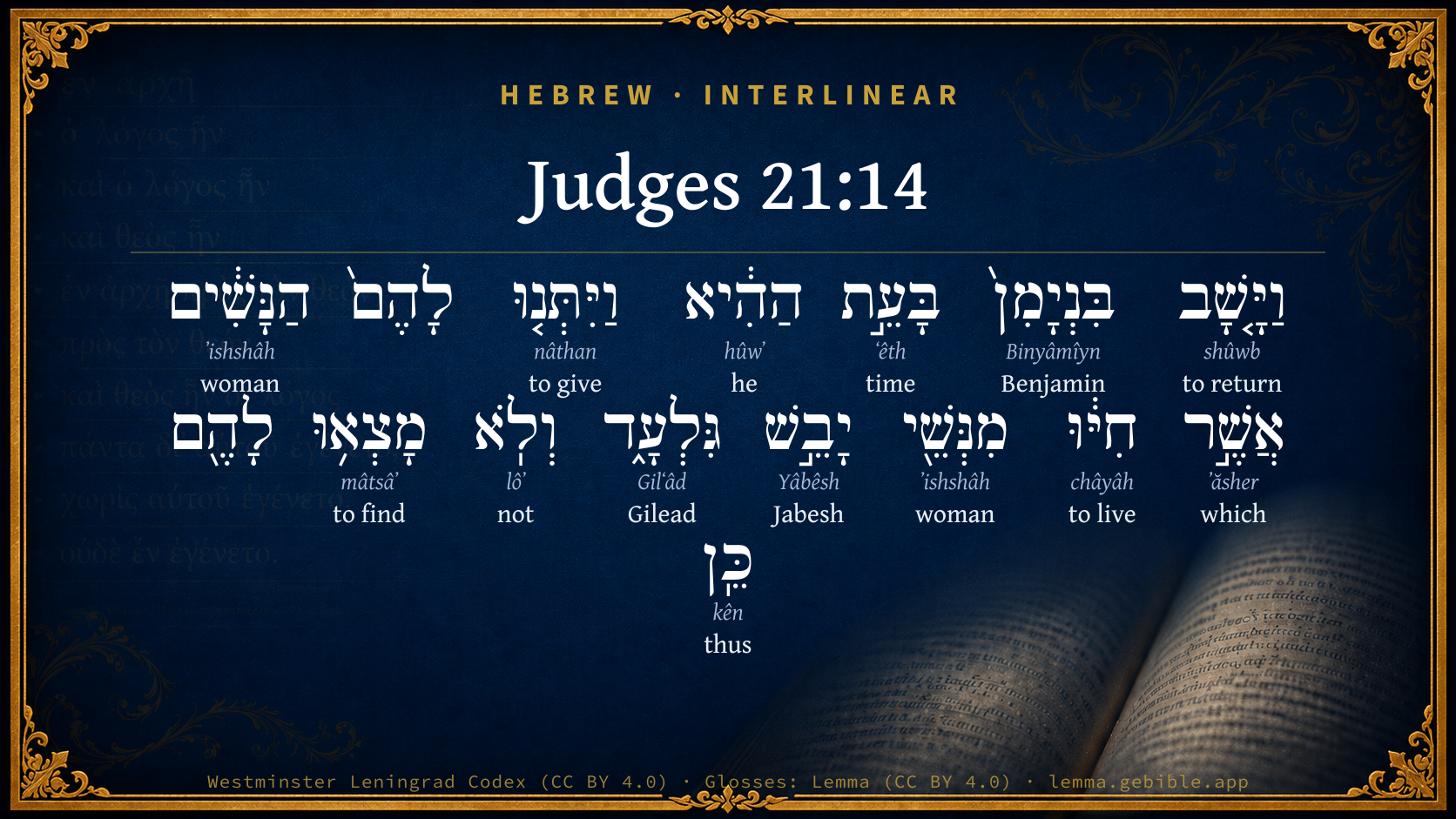
Judges 21:14

Hebrew (Westminster Leningrad Codex) Judges 21:14 appears in the Hebrew Old Testament. The text above is from the Westminster Leningrad Codex. Each word links to its Strong’s number, a concise gloss, and parsing drawn from the Open Scriptures Hebrew Bible morphology. Click any word for its full Brown-Driver-Briggs (BDB) entry.
Download image
Cite this verse

Judges 21:14 (World English Bible). Public Domain. Lemma interlinear Bible study tool, https://lemma.gebible.app/v/judges/21/14.

Show BibTeX & RIS
BibTeX
RIS
English Translation
Benjamin returned at that time; and they gave them the women whom they had saved alive of the women of Jabesh Gilead: and yet so they weren't enough for them.
World English Bible · Public Domain
Download a study sheet

One document with this verse’s original text, its word-by-word gloss line, the meaning frame, cross-references with their text, attributed commentary, and full source and license credits — printable, and it pastes into notes with its structure intact.

This verse Autodidact and up

Study sheet (.html) Plain text (.txt)

A passage Seminary Student

Up to 50 verses in one chapter. A passage sheet keeps up to 6 commentary sources and 12 cross-references per verse, in the order this page ranks them, and says so on the sheet whenever that leaves anything out. Ask for a single verse and you get the Autodidact verse sheet above.

Everything on this page stays free to read, with no account — the sheet is a download of what is already on screen, not access to it.

Want to remove ads? Support Godless Engineer
Compare translations 3

The same verse in 3 English versions, stacked beneath the original-language interlinear above. Click any original word for its lexicon entry.

Each is an independent rendering of the whole verse — the interlinear is not word-aligned to these translations.

Highlighted words mark where these versions differ — a whole-verse word diff, not a word-by-word alignment.

  • World English Bible Public Domain
    Benjamin returned at that time; and they gave them the women whom they had saved alive of the women of Jabesh Gilead: and yet so they weren't enough for them.
  • King James Version Public Domain
    And Benjamin came again at that time; and they gave them wives which they had saved alive of the women of Jabeshgilead: and yet so they sufficed them not.
  • unfoldingWord Literal Text CC BY-SA 4.0
    So Benjamin returned at that time, and they gave to them the women who were alive from the women of Jabesh Gilead. But they did not find enough for them.

unfoldingWord Literal Text — © unfoldingWord, licensed CC BY-SA 4.0. Word-aligned USFM3 via Door43 (git.door43.org/unfoldingWord/en_ult).

Versions to compare (up to 4)

3 of 4 selected

Show all 18 translations

Every available English version of this verse, each an independent rendering of the whole verse.

  • World English Bible Public Domain
    Benjamin returned at that time; and they gave them the women whom they had saved alive of the women of Jabesh Gilead: and yet so they weren't enough for them.
  • Berean Standard Bible Public Domain
    And at that time the Benjamites returned and were given the women who were spared from Jabesh-gilead. But there were not enough women for all of them.
  • Majority Standard Bible Public Domain
    And at that time the Benjamites returned and were given the women who were spared from Jabesh-gilead. But there were not enough women for all of them.
  • King James Version Public Domain
    And Benjamin came again at that time; and they gave them wives which they had saved alive of the women of Jabeshgilead: and yet so they sufficed them not.
  • American Standard Version (1901) Public Domain
    And Benjamin returned at that time; and they gave them the women whom they had saved alive of the women of Jabesh-gilead: and yet so they sufficed them not.
  • Revised Version (1885) Public Domain
    And Benjamin returned at that time; and they gave them the women which they had saved alive of the women of Jabesh-gilead: and yet so they sufficed them not.
  • Geneva Bible (1599) Public Domain
    And Beniamin came againe at that time, and they gaue them wiues which they had saued aliue of the women of Iabesh Gilead: but they had not so ynough for them.
  • Douay-Rheims (1899) Public Domain
    And the children of Benjamin came at that time, and wives were given them of the daughters of Jabes Galaad: but they found no others, whom they might give in like manner.
  • Young's Literal Translation Public Domain
    and Benjamin turneth back at that time, and they give to them the women whom they have kept alive of the women of Jabesh-Gilead, and they have not found for `all of' them so.
  • Literal Standard Version CC BY-SA 4.0
    and Benjamin turns back at that time, and they give to them the women whom they have kept alive of the women of Jabesh-Gilead, and they have not found for [all of] them so.
  • Unlocked Literal Bible CC BY-SA 4.0
    The Benjamites returned at that time and they were given the women of Jabesh Gilead, but there were not enough women for all of them.
  • unfoldingWord Literal Text CC BY-SA 4.0
    So Benjamin returned at that time, and they gave to them the women who were alive from the women of Jabesh Gilead. But they did not find enough for them.
  • Darby Bible Public Domain
    And Benjamin returned at that time; and they gave them the women whom they had saved alive of the women of Ja'besh-gil'ead; but they did not suffice for them.
  • World Messianic Bible Public Domain
    Benjamin returned at that time; and they gave them the women whom they had saved alive of the women of Jabesh Gilead. There still weren’t enough for them.
  • Webster's Bible Public Domain
    And Benjamin came again at that time; and they gave them wives which they had saved alive of the women of Jabesh-gilead: and yet so they sufficed them not.
  • Free Bible Version CC BY-SA 4.0
    So the men of Benjamin went back home, and the Israelites gave them the four hundred women from Jabesh-gilead who had been spared as wives. However, there weren't enough for all of them.
  • Bible in Basic English Public Domain
    Then Benjamin came back; and they gave them the women whom they had kept from death among the women of Jabesh-gilead: but still there were not enough for them.
  • JPS Tanakh (1917) Public Domain
    And Benjamin returned at that time; and they gave them the women whom they had saved alive of the women of Jabesh-gilead; and yet so they sufficed them not.

Literal Standard Version (2020), Covenant Press — licensed CC BY-SA 4.0. Text via the HelloAO Bible API (eBible.org). Unlocked Literal Bible (unfoldingWord) — licensed CC BY-SA 4.0. Text via the HelloAO Bible API (eBible.org). unfoldingWord Literal Text — © unfoldingWord, licensed CC BY-SA 4.0. Word-aligned USFM3 via Door43 (git.door43.org/unfoldingWord/en_ult). Free Bible Version, Dr. Jonathan Gallagher — licensed CC BY-SA 4.0. Text via the HelloAO Bible API (eBible.org).

Word by word

More ways to search: Search by grammar → Find every occurrence → Compare this word →

Practice this passage: Drill this verse → Learn its vocabulary →

יָבֵ֣שׁ
Yâbêsh
H3003
“Jabesh”
Noun, Proper
Part of Speech
Noun
Type
Proper
Full BDB Definition

Origin: the same as H3002 (also Yabeysh yaw-bashe')

TWOT: None

Jabesh = "dry" - a town in the territory of Gilead; according to Eusebius, it is beyond the Jordan, 6 miles (10 kilometers) from Pella, on the mountain road to Gerasa; site unknown but may be modern 'Wadi Yabes' (noun proper locative) - father of Shallum, the 15th king of the northern kingdom (noun proper masculine)
  1. וַיָּ֤שָׁב shûwb H7725 “and · to return” Conjunction + Verb, Qal, Sequential Imperfect, 3rd Person, Masculine, Singular
  2. בִּנְיָמִן֙ Binyâmîyn H1144 “Benjamin” Noun, Proper
  3. בָּעֵ֣ת ʻêth H6256 “in/at the · time” Preposition, Determined + Noun, Common, Both, Singular, Absolute
  4. הַהִ֔יא hûwʼ H1931 “the · he” Particle, Definite Article + Pronoun, Personal, 3rd Person, Feminine, Singular
  5. וַיִּתְּנ֤וּ nâthan H5414 “and · to give” Conjunction + Verb, Qal, Sequential Imperfect, 3rd Person, Masculine, Plural
  6. הַנָּשִׁ֔ים ʼishshâh H802 “the · women” Particle, Definite Article + Noun, Common, Feminine, Plural, Absolute
  7. אֲשֶׁ֣ר ʼăsher H834 “which” Particle, Relative
  8. חִיּ֔וּ châyâh H2421 “to live” Verb, Piel, Perfect, 3rd Person, Common, Plural
  9. מִנְּשֵׁ֖י ʼishshâh H802 “from · women of” Preposition + Noun, Common, Feminine, Plural, Construct
  10. גִּלְעָ֑ד Gilʻâd H1568 “Gilead” Noun, Proper
  11. וְלֹֽא lôʼ H3808 “and · not” Conjunction + Particle, Negative
  12. מָצְא֥וּ mâtsâʼ H4672 “to find” Verb, Qal, Perfect, 3rd Person, Common, Plural
  13. כֵּֽן kên H3651 “thus” Particle, Demonstrative

About this verse

These counts appear in no published source. They are computed here, from the morphology-tagged text and Lemma’s own curated glosses. What Lemma adds →

16
words
13
distinct lemmas
Historical
section

Notable vocabulary

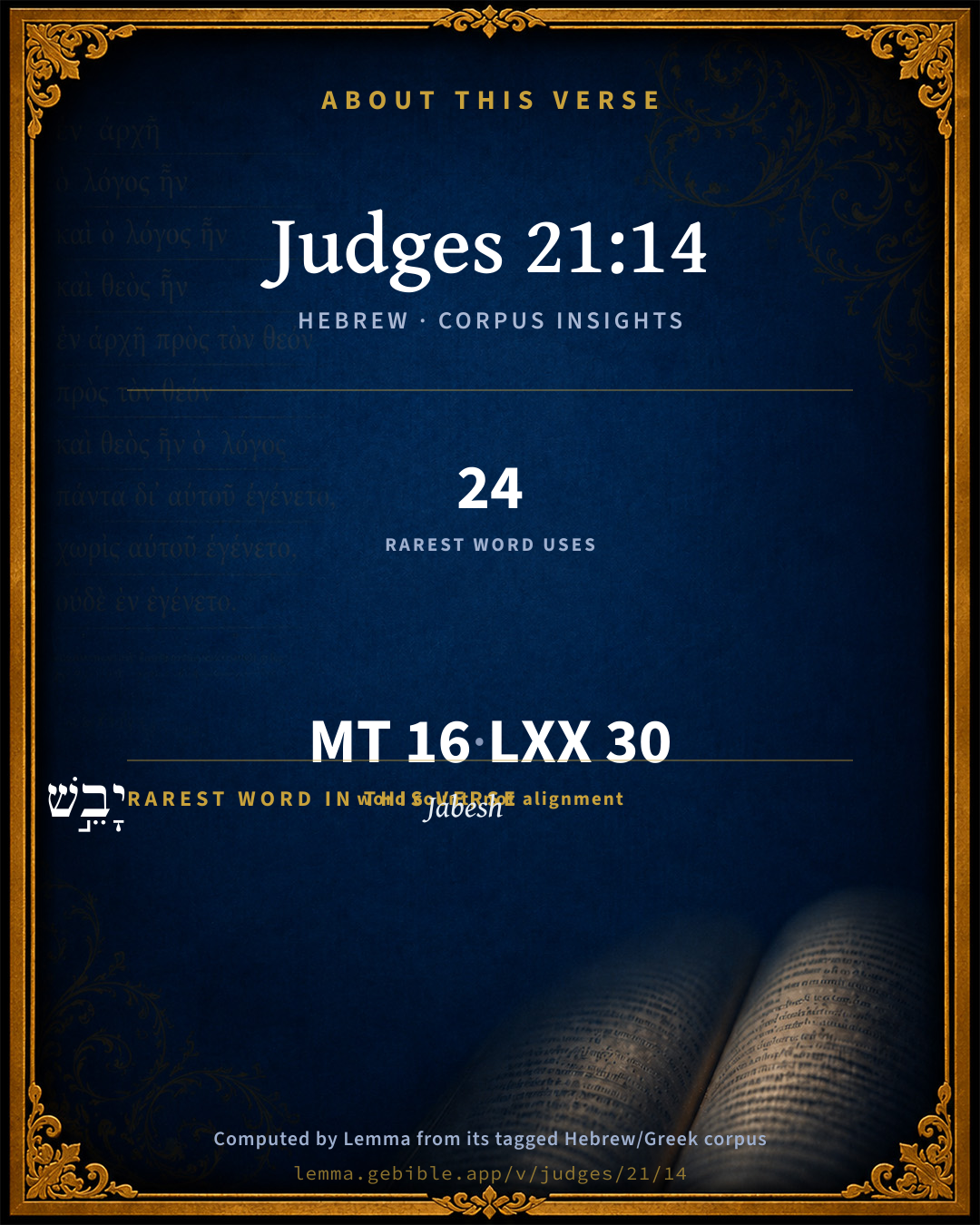
The rarest word here is יָבֵ֣שׁ Jabesh H3003 — appearing just 24 times in the whole Hebrew Bible.

Shared distinctive vocabulary

יָבֵ֣שׁ Jabesh H3003 occurs in 21 verses of the Hebrew Bible. Also found in:

Grammatical profile

  • 4 verbs
  • 6 nouns
  • 1 pronoun
  • 2 prepositions
  • 3 particles

Verb forms

  • וַיָּ֤שָׁב Qal · Sequential Imperfect
  • וַיִּתְּנ֤וּ Qal · Sequential Imperfect
  • חִיּ֔וּ Piel · Perfect
  • מָצְא֥וּ Qal · Perfect

Repetition

A word recurs within this verse — often emphatic in Hebrew:

  • הַנָּשִׁ֔ים woman H802 ×2

Hebrew & Septuagint length

In English translation the verse runs 30 words from the Hebrew and 35 from the Septuagint (LXX English) — closely comparable.

A rough comparison of the two English renderings, which tokenize alike — not a word-level alignment.

Word counts can differ between the Hebrew and the Greek without any difference in meaning — e.g. the Hebrew direct-object marker אֵת has no separate Greek word, and Greek often adds the article ὁ.

In the original languages it is 16 Hebrew tokens and 30 Greek tokens — but the two are counted differently (Hebrew bundles its prefixes and suffixes into one token; the Greek is in lemma form), so that isn’t a like-for-like length.

Cross-references

3

Topical passages linked to Judges 21:14 in the Treasury of Scripture Knowledge — connected by theme and wording, ordered by reader-vote popularity; previews shown in the World English Bible.

  • 1 Corinthians 7:2 But, because of sexual immoralities, let each man have his own wife, and let each woman have her own husband.
  • Judges 20:47 But six hundred men turned and fled toward the wilderness to the rock of Rimmon, and abode in the rock of Rimmon four months.
  • Judges 21:12 They found among the inhabitants of Jabesh Gilead four hundred young virgins, who had not known man by lying with him; and they brought them to the camp to Shiloh, which is in the land of Canaan.

Cross-references courtesy of OpenBible.info (CC BY 4.0).

Hebrew and Greek witnesses Masoretic Hebrew ↔ Greek Septuagint

The same verse in the two great witnesses to the Old Testament, shown verse-for-verse.

These are two independent witnesses, not word-aligned to each other, and the Septuagint is shown in lemma (dictionary) form.

Hebrew Judges 21:14 Masoretic · Westminster Leningrad Codex

וַיָּ֤שָׁב בִּנְיָמִן֙ בָּעֵ֣ת הַהִ֔יא וַיִּתְּנ֤וּ לָהֶם֙ הַנָּשִׁ֔ים אֲשֶׁ֣ר חִיּ֔וּ מִנְּשֵׁ֖י יָבֵ֣שׁ גִּלְעָ֑ד וְלֹֽא מָצְא֥וּ לָהֶ֖ם כֵּֽן

Benjamin returned at that time; and they gave them the women whom they had saved alive of the women of Jabesh Gilead: and yet so they weren't enough for them.

World English Bible · Public Domain

Greek LXX Judges 21:14 Septuagint · lemma form

καί ἐπιστρέφω βενιαμίν πρός ὁ υἱός ἰσραήλ ἐν ὁ καιρός ἐκεῖνος καί δίδωμι αὐτός ὁ υἱός ἰσραήλ ὁ γυνή ὅς ζωοποιέω ἀπό ὁ θυγάτηρ ιαβις γαλαάδ καί ἀρέσκω αὐτός οὕτως

And Benjamin returned to the children of Israel at that time, and the children of Israel gave them the women whom they had save alive of the daughters of Jabis Galaad; and they were content.

LXX2012 (modern English Septuagint) · Public Domain

Hebrew: Westminster Leningrad Codex (CC BY 4.0). Greek: Septuagint (public domain); English from LXX2012 (modern English Septuagint) (Public Domain). How the Septuagint differs from the Hebrew →

Targum (Aramaic paraphrase)

1

The Targum is the ancient Jewish Aramaic paraphrase of the Hebrew Scriptures — an interpretive translation, not the Hebrew text itself. Onkelos (literal) and Pseudo-Jonathan (expansive) render the Torah, and Jonathan the Prophets. Coverage is partial: where no permissively-licensed English translation exists for a verse, only the Aramaic is shown. This is verse-level text, not a word-by-word alignment to the Hebrew.

  1. Targum Jonathan Prophets (Joshua–Malachi)
    וְתָבוּ בְנֵי בִנְיָמִין בְּעִידָנָא הַהִיא וִיהָבוּ לְהוֹן נְשִׁין דְקַיְמוּ מִנְשֵׁי יָבֵשׁ גִלְעָד וְלָא סַפִּיקוּ לְהוֹן כֵּן:

    (no public-domain English translation for this verse)

    Targum Jonathan — Aramaic: “Mikraot Gedolot” (public domain). English: “Sefaria Community Translation” (CC0 1.0 (public-domain dedication)); “London "Chaldee Paraphrase," 1871” (public domain). Text via Sefaria.

Commentary

Notes on Judges 21:14 from classic Christian and Jewish commentators (each source and its license shown beneath its notes). The classic Christian expositions comment on the surrounding passage and are grouped to its opening verse, so a note may address several verses; the Jewish commentaries on the Tanakh (Rashi and others) are per-verse, so they appear only where the commentator wrote on this verse.

Lemma curates 59 commentaries, every one of them public domain or Creative Commons licensed, each selected and text-cleaned for this edition rather than reprinted as found. About our sources →

Trapp's Complete Commentary

John Trapp

Jdg 21:14 And Benjamin came again at that time; and they gave them wives which they had saved alive of the women of Jabeshgilead: and yet so they sufficed them not.

Ver. 14. And Benjamin came again at that time.] They believed their brethren, and obeyed their voice. Had they done so at first, and not tried it out with them, they had redeemed their own sorrows, and been much happier. But bought wit, they say, is best.

John Trapp, A Commentary or Exposition upon All the Books of the Old and New Testament (1647–1656) — public domain. Text from a community e-Sword module.

Geneva Bible (1599)

Geneva Bible translators

For there lacked two hundred.

Geneva Bible (1599) marginal notes — public domain. Text via Bolls.life.

Adam Clarke's Commentary

Verse 14. Yet so they sufficed them not.] There were six hundred men at Rimmon, and all the young women they saved from Jabesh were only four hundred; therefore, there were two hundred still wanting.

Adam Clarke's Commentary on the Bible (1810–1826) — public domain. Text from a community e-Sword/MySword module.

Ellicott's Commentary for English Readers

(14) Came again—i.e., returned to their desolate towns.

Yet so they sufficed them not.—There would still be 200 Benjamites left without wives.

A Bible Commentary for English Readers, edited by Charles John Ellicott (1878–1897) — public domain. Text from a community e-Sword module.

The Cambridge Bible for Schools and Colleges

gen. ed. J. J. S. Perowne

14. and yet so they sufficed them not] i.e. the 400 virgins were not sufficient for the 600 Benjamite survivors; a prosaic attempt to harmonize with the old story in Jdg_21:15-23, as though the rape at Shiloh were a supplementary device to bring the number of wives up to the total required; cf. Jdg_21:16 a. Lit. the phrase may be rendered and they (the Israelites) did not find enough for them even so, cf. Num_11:22; as a rule enough is expressed in the Heb., Lev_12:8; Lev_25:26; Lev_25:28.

The Cambridge Bible for Schools and Colleges (gen. ed. J. J. S. Perowne; Cambridge University Press, 1878–1918) — public domain. Text from a community e-Sword module.

John Gill's Exposition

And Benjamin came again at that time,.... The six hundred Benjaminites returned with the messengers at the same time to the people of Israel, putting confidence in the assurances they had given them of peace and safety:

and they gave them wives which they had saved alive of the women of Jabeshgilead; in doing which they supposed they had not violated their oath, since though they had sworn that they would not give their own daughters, they had not sworn they would not give the daughters of others; and besides, as the men of Jabeshgilead were not at Mizpeh when the oaths were made, they had taken none, and so their daughters might be given in marriage to the Benjaminites, notwithstanding that oath:

and yet so they sufficed them not; there were not wives enough for them all; for they were six hundred men, whereas the daughters of the inhabitants of Jabeshgilead were but four hundred, so that there were two hundred more wanting. Abarbinel interprets the word we render "so" in a different manner, by "right", as in Num 27:7 and gives the sense thus, that it was not a point of justice and judgment to do this to the daughters of Jabeshgilead, namely, to save and give them in marriage; but they did this because the people repented for Benjamin, as follows.

John Gill's Exposition of the Whole Bible (1746–1763) — public domain (CC PDM 1.0). Text via the HelloAO Bible API.

Matthew Poole's English Annotations

Benjamin; the poor remainders of the tribe of Benjamin.

Matthew Poole's English Annotations on the Holy Bible (1683–1685) — public domain. Text from a community e-Sword/MySword module.

The Pulpit Commentary

Benjamin came again, i.e. returned to their own homes in the tribe of Benjamin, as in ver. 23. Yet so they sufficed them net or, Yet so they (the Israelites) did not provide enough for them (the Benjamites); or, Yet so they (the Benjamites) had not enough for themselves.

The Pulpit Commentary (1880–1919), ed. H.D.M. Spence-Jones & Joseph S. Exell — public domain. Text from a community e-Sword module.

Rashi

Rabbi Shlomo Yitzchaki (Rashi)

This did not satisfy They were insufficient for them.

Rashi on the Tanakh — English translations: “The Judaica Press complete Tanach with Rashi, translated by A. J. Rosenberg” (CC BY 4.0); “Pentateuch with Rashi's commentary by M. Rosenbaum and A.M. Silbermann, 1929-1934” (public domain); “The Metsudah Tanach series, Lakewood, N.J” (CC BY 4.0); and “The Book of Joshua, Metsudah Publications, 1997” (CC BY 4.0). Text via Sefaria.

Lesson kit

Teaching starters — assembled from the data on this page, not authored interpretation. Every prompt links to the verse data it draws on. Edit before teaching.

Judges, in the Historical, opens this verse with 16 words (13 distinct Hebrew lemmas). Its most distinctive word is Yâbêsh (“Jabesh”). A historical commentator’s framing appears above. Read the whole chapter for the surrounding context.

Discussion questions

  1. What does “Jabesh” (Yâbêsh) contribute to the verse as a whole?
  2. Judges 21:8 shares the word «Jabesh» with this verse. How do the two illuminate each other?
  3. “woman” occurs 2× in this one verse. What is the effect of the repetition?
  4. These translations render this verse differently; the difference is in the English rendering, not the original. What questions does that raise?
  5. The verb «וַיָּ֤שָׁב» is Qal Sequential Imperfect. How does its form color the action?
  6. Reading how Trapp's Complete Commentary and Geneva Bible (1599) read this verse, where do the two commentators agree and where do they part?

Things to notice

Reading settings

Reading text

Shown beneath each verse's original-language words.

Old Testament
Old Testament edition

Read the OT as the Masoretic Hebrew (MT) or the Greek Septuagint (LXX).

English shown for the Greek Septuagint (in the Hebrew ↔ Greek comparison).

Comparing translations? Open the Compare panel on any verse page to stack up to four side by side.