
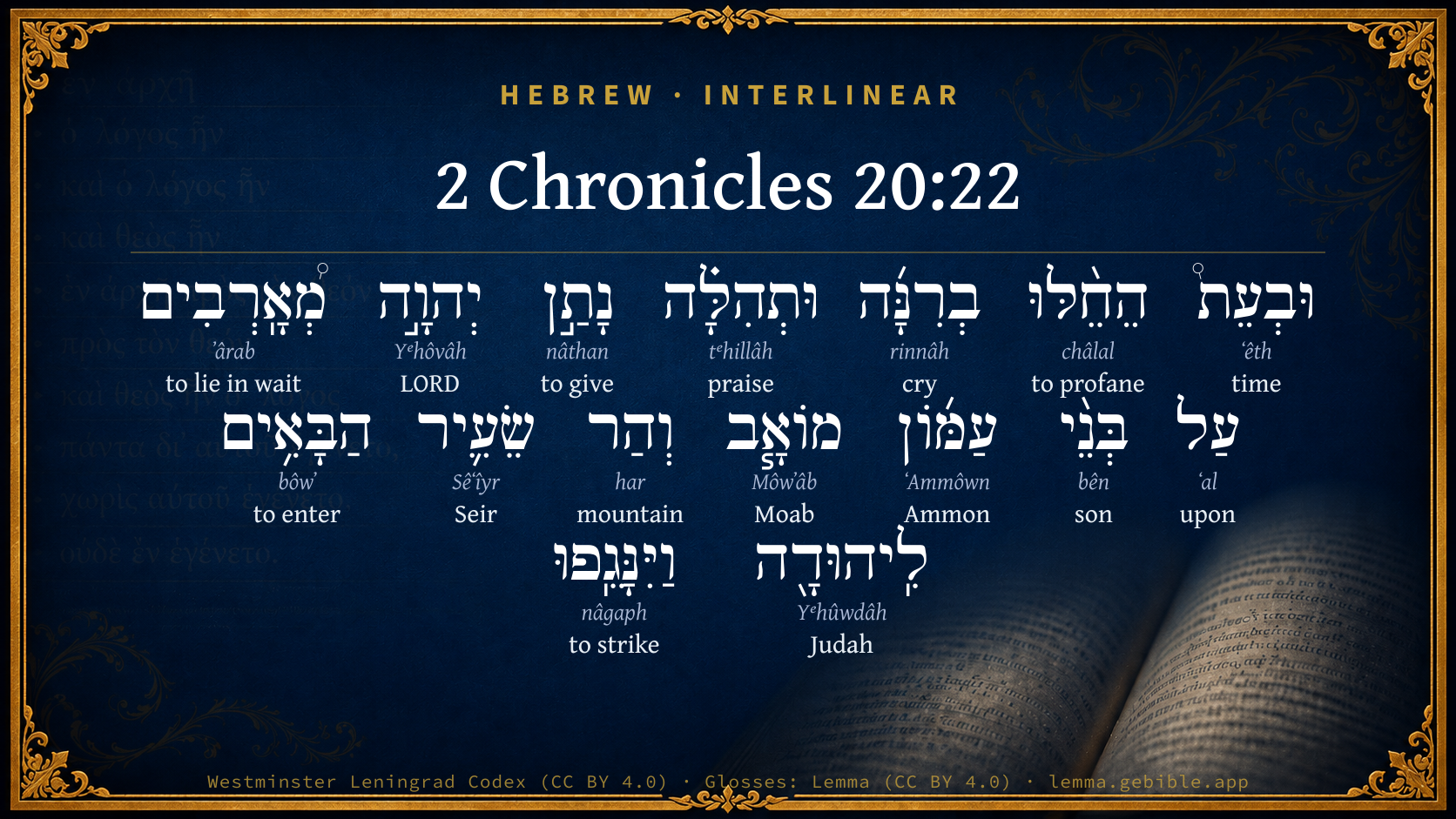
2 Chronicles 20:22

Hebrew (Westminster Leningrad Codex) 2 Chronicles 20:22 appears in the Hebrew Old Testament. The text above is from the Westminster Leningrad Codex. Each word links to its Strong’s number, a concise gloss, and parsing drawn from the Open Scriptures Hebrew Bible morphology. Click any word for its full Brown-Driver-Briggs (BDB) entry.
Download image
Cite this verse

2 Chronicles 20:22 (World English Bible). Public Domain. Lemma interlinear Bible study tool, https://lemma.gebible.app/v/2-chronicles/20/22.

Show BibTeX & RIS
BibTeX
RIS
English Translation
When they began to sing and to praise, Yahweh set liers-in-wait against the children of Ammon, Moab, and Mount Seir, who had come against Judah; and they were struck.
World English Bible · Public Domain
Download a study sheet

One document with this verse’s original text, its word-by-word gloss line, the meaning frame, cross-references with their text, attributed commentary, and full source and license credits — printable, and it pastes into notes with its structure intact.

This verse Autodidact and up

Study sheet (.html) Plain text (.txt)

A passage Seminary Student

Up to 50 verses in one chapter. A passage sheet keeps up to 6 commentary sources and 12 cross-references per verse, in the order this page ranks them, and says so on the sheet whenever that leaves anything out. Ask for a single verse and you get the Autodidact verse sheet above.

Everything on this page stays free to read, with no account — the sheet is a download of what is already on screen, not access to it.

Want to remove ads? Support Godless Engineer
Compare translations 3

The same verse in 3 English versions, stacked beneath the original-language interlinear above. Click any original word for its lexicon entry.

Each is an independent rendering of the whole verse — the interlinear is not word-aligned to these translations.

Highlighted words mark where these versions differ — a whole-verse word diff, not a word-by-word alignment.

  • World English Bible Public Domain
    When they began to sing and to praise, Yahweh set liers-in-wait against the children of Ammon, Moab, and Mount Seir, who had come against Judah; and they were struck.
  • King James Version Public Domain
    And when they began to sing and to praise, the LORD set ambushments against the children of Ammon, Moab, and mount Seir, which were come against Judah; and they were smitten.
  • unfoldingWord Literal Text CC BY-SA 4.0
    And at the time they began in cry of jubilation and praise, Yahweh placed ambushers against the sons of Ammon, Moab, and Mount Seir who were coming to Judah. And they were struck.

unfoldingWord Literal Text — © unfoldingWord, licensed CC BY-SA 4.0. Word-aligned USFM3 via Door43 (git.door43.org/unfoldingWord/en_ult).

Versions to compare (up to 4)

3 of 4 selected

Show all 18 translations

Every available English version of this verse, each an independent rendering of the whole verse.

  • World English Bible Public Domain
    When they began to sing and to praise, Yahweh set liers-in-wait against the children of Ammon, Moab, and Mount Seir, who had come against Judah; and they were struck.
  • Berean Standard Bible Public Domain
    The moment they began their shouts and praises, the LORD set ambushes against the men of Ammon, Moab, and Mount Seir who had come against Judah, and they were defeated.
  • Majority Standard Bible Public Domain
    The moment they began their shouts and praises, the LORD set ambushes against the men of Ammon, Moab, and Mount Seir who had come against Judah, and they were defeated.
  • King James Version Public Domain
    And when they began to sing and to praise, the LORD set ambushments against the children of Ammon, Moab, and mount Seir, which were come against Judah; and they were smitten.
  • American Standard Version (1901) Public Domain
    And when they began to sing and to praise, Jehovah set liers-in-wait against the children of Ammon, Moab, and mount Seir, that were come against Judah; and they were smitten.
  • Revised Version (1885) Public Domain
    And when they began to sing and to praise, the LORD set liers in wait against the children of Ammon, Moab, and mount Seir, which were come against Judah; and they were smitten.
  • Geneva Bible (1599) Public Domain
    And when they began to shoute, and to prayse, the Lord layed ambushments against the children of Ammon, Moab, and mount Seir, which were come against Iudah, and they slewe one another.
  • Douay-Rheims (1899) Public Domain
    And when they began to sing praises, the Lord turned their ambushments upon themselves, that is to say, of the children of Ammon, and of Moab, and of mount Seir, who were come out to fight against Juda, and they were slain.
  • Young's Literal Translation Public Domain
    And at the time they have begun with singing and praise, Jehovah hath put ambushments against the sons of Ammon, Moab, and mount Seir, who are coming in to Judah, and they are smitten,
  • Literal Standard Version CC BY-SA 4.0
    And at the time they have begun with singing and praise, YHWH has put ambushes against the sons of Ammon, Moab, and Mount Seir, who are coming in to Judah, and they are struck,
  • Unlocked Literal Bible CC BY-SA 4.0
    When they began to sing and to praise, Yahweh set men in ambush against the people of Ammon, Moab, and Mount Seir, who were coming against Judah. They were defeated.
  • unfoldingWord Literal Text CC BY-SA 4.0
    And at the time they began in cry of jubilation and praise, Yahweh placed ambushers against the sons of Ammon, Moab, and Mount Seir who were coming to Judah. And they were struck.
  • Darby Bible Public Domain
    And when they began the song of triumph and praise, Jehovah set liers-in-wait against the children of Ammon, Moab, and mount Seir, who had come against Judah, and they were smitten.
  • World Messianic Bible Public Domain
    When they began to sing and to praise, the LORD set ambushers against the children of Ammon, Moab, and Mount Seir, who had come against Judah; and they were struck.
  • Webster's Bible Public Domain
    And when they began to sing and to praise, the LORD set ambushes against the children of Ammon, Moab, and mount Seir, who were come against Judah; and they were smitten.
  • Free Bible Version CC BY-SA 4.0
    As soon as they started singing and praising, the Lord ambushed the men of Ammon, Moab, and Mount Seir who were coming to attack Judah, and they were defeated.
  • Bible in Basic English Public Domain
    And at the first notes of song and praise the Lord sent a surprise attack against the children of Ammon and Moab and the people of Mount Seir, who had come against Judah; and they were overcome.
  • JPS Tanakh (1917) Public Domain
    And when they began to sing and to praise, the LORD set liers-in-wait against the children of Ammon, Moab, and mount Seir, that were come against Judah; and they were smitten.

Literal Standard Version (2020), Covenant Press — licensed CC BY-SA 4.0. Text via the HelloAO Bible API (eBible.org). Unlocked Literal Bible (unfoldingWord) — licensed CC BY-SA 4.0. Text via the HelloAO Bible API (eBible.org). unfoldingWord Literal Text — © unfoldingWord, licensed CC BY-SA 4.0. Word-aligned USFM3 via Door43 (git.door43.org/unfoldingWord/en_ult). Free Bible Version, Dr. Jonathan Gallagher — licensed CC BY-SA 4.0. Text via the HelloAO Bible API (eBible.org).

Word by word

More ways to search: Search by grammar → Find every occurrence → Compare this word →

Practice this passage: Drill this verse → Learn its vocabulary →

בְרִנָּ֜ה
rinnâh
H7440
“in/at · cry”
Preposition + Noun, Common, Feminine, Singular, Absolute
Part of Speech
Preposition + Noun
Type
Common
Gender
Feminine
Number
Singular
State
Absolute
Full BDB Definition

Origin: from H7442

TWOT: 2179c

ringing cry - of entreaty, supplication - in proclamation, joy, praise
  1. וּבְעֵת֩ ʻêth H6256 “and · in/at · time” Conjunction + Preposition + Noun, Common, Both, Singular, Absolute
  2. הֵחֵ֨לּוּ châlal H2490 “to profane” Verb, Hiphil, Perfect, 3rd Person, Common, Plural
  3. וּתְהִלָּ֗ה tᵉhillâh H8416 “and · praise” Conjunction + Noun, Common, Feminine, Singular, Absolute
  4. נָתַ֣ן nâthan H5414 “to give” Verb, Qal, Perfect, 3rd Person, Masculine, Singular
  5. יְהוָ֣ה Yᵉhôvâh H3068 “LORD” Noun, Proper
  6. מְ֠אָֽרְבִים ʼârab H693 “lying in wait” Verb, Piel, Participle Active, Masculine, Plural, Absolute
  7. עַל ʻal H5921 “upon” Preposition
  8. בְּנֵ֨י bên H1121 “sons of” Noun, Common, Masculine, Plural, Construct
  9. עַמּ֜וֹן ʻAmmôwn H5983 “Ammon” Noun, Proper
  10. מוֹאָ֧ב Môwʼâb H4124 “Moab” Noun, Proper
  11. וְהַר har H2022 “and · mountain of” Conjunction + Noun, Common, Masculine, Singular, Construct
  12. שֵׂעִ֛יר Sêʻîyr H8165 “Seir” Noun, Proper
  13. הַבָּאִ֥ים bôwʼ H935 “the · entering” Particle, Definite Article + Verb, Qal, Participle Active, Masculine, Plural, Absolute
  14. לִֽיהוּדָ֖ה Yᵉhûwdâh H3063 “to/for · Judah” Preposition + Noun, Proper
  15. וַיִּנָּגֵֽפוּ nâgaph H5062 “and · to strike” Conjunction + Verb, Niphal, Sequential Imperfect, 3rd Person, Masculine, Plural

About this verse

These counts appear in no published source. They are computed here, from the morphology-tagged text and Lemma’s own curated glosses. What Lemma adds →

16
words
16
distinct lemmas
Historical
section

Shared distinctive vocabulary

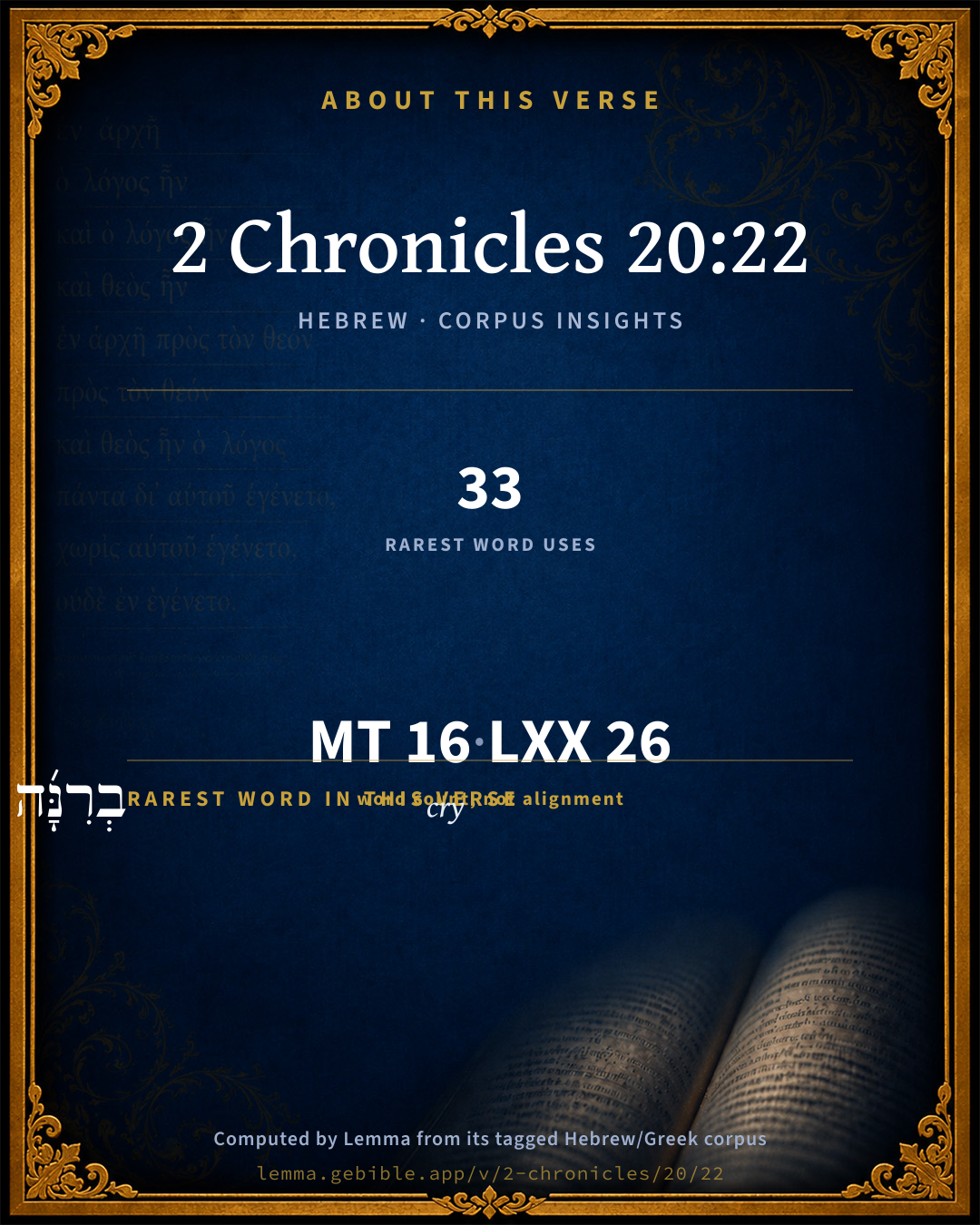
בְרִנָּ֜ה cry H7440 occurs in 33 verses of the Hebrew Bible. Also found in:

Grammatical profile

  • 5 verbs
  • 10 nouns
  • 1 preposition

Verb forms

  • הֵחֵ֨לּוּ Hiphil · Perfect
  • נָתַ֣ן Qal · Perfect
  • מְ֠אָֽרְבִים Piel · Participle Active
  • הַבָּאִ֥ים Qal · Participle Active
  • וַיִּנָּגֵֽפוּ Niphal · Sequential Imperfect

Hebrew & Septuagint length

In English translation the verse runs 29 words from the Hebrew and 34 from the Septuagint (LXX English) — closely comparable.

A rough comparison of the two English renderings, which tokenize alike — not a word-level alignment.

Word counts can differ between the Hebrew and the Greek without any difference in meaning — e.g. the Hebrew direct-object marker אֵת has no separate Greek word, and Greek often adds the article ὁ.

In the original languages it is 16 Hebrew tokens and 26 Greek tokens — but the two are counted differently (Hebrew bundles its prefixes and suffixes into one token; the Greek is in lemma form), so that isn’t a like-for-like length.

Cross-references

9

Topical passages linked to 2 Chronicles 20:22 in the Treasury of Scripture Knowledge — connected by theme and wording, ordered by reader-vote popularity; previews shown in the World English Bible.

  • 1 Samuel 14:20 Saul and all the people who were with him were gathered together, and came to the battle: and, behold, every man's sword was against his fellow, [and there was] a very great confusion.
  • Ezekiel 38:21 I will call for a sword against him to all my mountains, says the Lord Yahweh: every man's sword shall be against his brother.
  • Judges 7:22 They blew the three hundred trumpets, and Yahweh set every man's sword against his fellow, and against all the host; and the host fled as far as Beth-shittah toward Zererah, as far as the border of Abel Meholah, by Tabbath.
  • 2 Kings 6:17 Elisha prayed, and said, Yahweh, Please open his eyes, that he may see. Yahweh opened the eyes of the young man; and he saw: and, behold, the mountain was full of horses and chariots of fire round about Elisha.
  • Isaiah 19:2 I will stir up the Egyptians against the Egyptians: and they shall fight everyone against his brother, and everyone against his neighbor; city against city, [and] kingdom against kingdom.
  • Psalms 35:5–6 Let them be as chaff before the wind, Yahweh's angel driving them on.
  • 2 Chronicles 13:13 But Jeroboam caused an ambush to come about behind them: so they were before Judah, and the ambush was behind them.
  • 2 Chronicles 20:10 Now, behold, the children of Ammon and Moab and Mount Seir, whom you would not let Israel invade, when they came out of the land of Egypt, but they turned aside from them, and didn't destroy them;
  • 1 Samuel 14:16 The watchmen of Saul in Gibeah of Benjamin looked; and, behold, the multitude melted away, and they went [here] and there.

Cross-references courtesy of OpenBible.info (CC BY 4.0).

Hebrew and Greek witnesses Masoretic Hebrew ↔ Greek Septuagint

The same verse in the two great witnesses to the Old Testament, shown verse-for-verse.

These are two independent witnesses, not word-aligned to each other, and the Septuagint is shown in lemma (dictionary) form.

Hebrew 2 Chronicles 20:22 Masoretic · Westminster Leningrad Codex

וּבְעֵת֩ הֵחֵ֨לּוּ בְרִנָּ֜ה וּתְהִלָּ֗ה נָתַ֣ן יְהוָ֣ה מְ֠אָֽרְבִים עַל בְּנֵ֨י עַמּ֜וֹן מוֹאָ֧ב וְהַר שֵׂעִ֛יר הַבָּאִ֥ים לִֽיהוּדָ֖ה וַיִּנָּגֵֽפוּ

When they began to sing and to praise, Yahweh set liers-in-wait against the children of Ammon, Moab, and Mount Seir, who had come against Judah; and they were struck.

World English Bible · Public Domain

Greek LXX 2 Chronicles 20:22 Septuagint · lemma form

καί ἐν ὁ ἄρχω ὁ αἴνεσις αὐτός ὁ ἐξομολόγησις δίδωμι κύριος πολεμέω ὁ υἱός αμμων ἐπί μωαβ καί ὄρος σηιρ ὁ ἐκἔρχομαι ἐπί ἰούδας καί τροπόω

And when they began the praise and thanksgiving, the Lord caused the children of Ammon to fight against Moab, and the inhabitants of mount Seir that came out against Juda; and they were routed.

LXX2012 (modern English Septuagint) · Public Domain

On this verse, Ellicott's Commentary for English Readers discusses the Septuagint’s reading. Read the note in Commentary ↓

Hebrew: Westminster Leningrad Codex (CC BY 4.0). Greek: Septuagint (public domain); English from LXX2012 (modern English Septuagint) (Public Domain). How the Septuagint differs from the Hebrew →

Commentary

Notes on 2 Chronicles 20:22 from classic Christian and Jewish commentators (each source and its license shown beneath its notes). The classic Christian expositions comment on the surrounding passage and are grouped to its opening verse, so a note may address several verses; the Jewish commentaries on the Tanakh (Rashi and others) are per-verse, so they appear only where the commentator wrote on this verse.

Lemma curates 59 commentaries, every one of them public domain or Creative Commons licensed, each selected and text-cleaned for this edition rather than reprinted as found. About our sources →

Jamieson, Fausset & Brown

Robert Jamieson, A. R. Fausset & David Brown

THE OVERTHROW OF HIS ENEMIES. (Ch2 20:22-30)

when they began to sing and to praise the Lord set ambushments against the children of Ammon, Moab, and Mount Seir--Some think that this was done by angels in human form, whose sudden appearance diffused an uncontrollable panic. Others entertain the more probable opinion that, in the camp of this vast horde, composed of different tribes, jealousies and animosities had sprung up, which led to widespread dissensions and fierce feuds, in which they drew the sword against each other. The consequence was, that as the mutual strife commenced when the Hebrew procession set out from Jerusalem, the work of destruction was completed before Jehoshaphat and his people arrived at the battlefield. Thus easy is it for God to make the wrath of man to praise Him, to confound the counsels of His enemies and employ their own passions in defeating the machinations they have devised for the overthrow of His Church and people.

Jamieson, Fausset & Brown — Commentary Critical and Explanatory on the Whole Bible (1871) — public domain (CC PDM 1.0). Text via the HelloAO Bible API.

Ellicott's Commentary for English Readers

(22) And when they began.—Literally, And at the. time when they began with shouting and praise. (Comp. Deu_16:9, to begin with.) They had now reached the neighbourhood of the enemy; and their joyful pæan was the signal for a Divine interposition. (Comp. Jos_6:16; Jos_6:20, and Psa_46:6.)

The Lord set ambushments.—Jehovah placed liers in wait (Jdg_9:25). (nâthan here is equivalent in meaning to sâm there.)

Come against.—Come into, i.e., invade (2Ch_20:10).

They were smitten.—Right, according to the ordinary usage. (See 1Ch_19:16; 1Ch_19:19, “put to the worse.”) This statement anticipates what follows. The ancient translators felt a difficulty here, as is evident from their versions. Thus the LXX. has, “The Lord made the sons of Ammon to war upon Moab and Mount Seir, who came out against Judah; and they were routed.” The Vulg., “The Lord turned their ambushment against themselves, viz., that of the sons of Amnion and Moab and Mount Seir, who had gone forth to fight against Judah, and they were smitten.”

The Syriac (and Arabic) travesty 2Ch_20:21 and the first clause of 2Ch_20:22 thus: “And he stood in the middle of the people, and said, Come, let us give thanks unto the Lord, and let us laud the splendour of his holiness, when he goeth out before our hosts, and maketh war for us with our foes: and be saying, Give thanks unto the Lord, for he is good, and his goodness endureth for ever. The hills began praising, and the mountains began rejoicing.”They then continue as in 2Ch_20:24, omitting “The Lord set ambushments . . . they were smitten.”

The self-destruction of the allied hordes was undoubtedly providential, but it need not have been miraculous. How was it brought about? The answer depends on the meaning of the term “liers in wait.” Were angels meant, as some have thought (Ewald’s böser Geister), a more appropriate and less ambiguous term would have been employed to express their agency. Nor is it likely that a Judean ambuscade is thus obscurely mentioned without any further reference or explanation: indeed it is evident from 2Ch_20:15; 2Ch_20:17; 2Ch_20:24, that the part of the Judeans was that of mere spectators of an accomplished fact. Nor, finally, must we suppose that “the waylaying was done by a section of the confederates themselves, probably certain of the Maonites.”

The truth appears to be that some portion of the unwieldy and straggling host was suddenly attacked by a lurking band of Bedawi freebooters. In the providence of God the partial confusion which thus originated speedily became a universal panic. The Ammonites and Moabites instantly suspected their less civilised allies, the Maonites, of treachery, and fell upon them in a frenzy of revenge; after which, maddened by slaughter and mutual suspicion, and the memory of ancient feuds, they turned their reeking swords against each other, and the strife only ended with the self-annihilation of the allies. The occurrence is thus to some extent parallel with the self-destruction of the Midianite hordes, when thrown into confusion by the stratagem of Gideon (Jdg_7:22).

The marvellous result, marvellously predicted, was brought to pass by a perfectly natural sequence of events, just as was Elisha’s prophecy of plenty to famine-stricken Samaria, though at the time when it was uttered fulfilment seemed impossible, unless the Lord were to “make windows in heaven,” and pour down supplies from thence by a visible miracle. In neither case was the course of events foreseen by the prophet, but only their issue. (See 2 Kings 7)

A Bible Commentary for English Readers, edited by Charles John Ellicott (1878–1897) — public domain. Text from a community e-Sword module.

Trapp's Complete Commentary

John Trapp

2Ch 20:22 And when they began to sing and to praise, the LORD set ambushments against the children of Ammon, Moab, and mount Seir, which were come against Judah; and they were smitten.

Ver. 22. And when they began to sing and to praise.] So at the siege of Mountabon, the people of God using daily humiliation as their service would permit, did sing a psalm after and immediately before their sallying forth. With which practice the enemy coming acquainted, ever upon the singing of the psalm, after which they expected a sally, they would so quake and tremble, crying, "They come, they come," as though the wrath of God and the rage of all the creatures had been breaking out upon them.

The Lord set ambushments.] Furor hostibus a Deo immissus ut in se invicem efferati saevire non desisterent, donec mutuis caedibus sese prostravissent. The wrath of God wrought their ruin, as by an ambush, unexpectedly and irresistibly. Some understand this ambush of the holy angels, sent suddenly in upon them to slay them; whereupon they mistaking the matter, and supposing it had been their own companions, flew upon them, and so sheathed their swords in one another’s bowels.

John Trapp, A Commentary or Exposition upon All the Books of the Old and New Testament (1647–1656) — public domain. Text from a community e-Sword module.

Joseph Benson's Commentary

2Ch 20:22. When they began to sing and to praise — So acceptable are the fervent prayers and praises of God’s people to him, and so terrible to their enemies! The Lord set ambushments — Hebrew, מארבים, mearebim, insidiantes, persons lying in wait, or plotting, and laying snares. The meaning seems to be, as appears from the next verse, that God raised jealousies and animosities among their enemies themselves, which by degrees broke forth, first into secret plots, snares, and ambushments, which one party contrived and laid for another, against which they had conceived some grudge; and then into a general confusion, and open hostilities and outrages, to the destruction of one another throughout the whole army. So vain are all men’s attempts against God, who needs none to destroy his enemies but themselves, and their own mistakes and passions, which he can, when he pleases, arm against them.

Joseph Benson's Commentary on the Old and New Testaments (1811–1818) — public domain. Text from a community e-Sword module.

Geneva Bible (1599)

Geneva Bible translators

Meaning, the Idumeans which dwelt in mount Seir.

Geneva Bible (1599) marginal notes — public domain. Text via Bolls.life.

Adam Clarke's Commentary

Verse 22. The Lord set ambushments] "The WORD of the Lord placed snares among the children of Ammon and Moab; and the inhabitants of the mountain of Gibla, who came to fight with Judah; and they were broken to pieces:" so the Targum.

Houbigant translates the place thus: "The Lord set against the children of Ammon and Moab ambushments of those who came from Mount Seir against Judah; and the children of Ammon and Moab were smitten: but they afterwards rose up against the inhabitants of Mount Seir, and utterly destroyed them; who being destroyed, they rose up one against another, and mutually destroyed each other." This is probably the meaning of these verses. Calmet's version is not very different.

Adam Clarke's Commentary on the Bible (1810–1826) — public domain. Text from a community e-Sword/MySword module.

The Cambridge Bible for Schools and Colleges

gen. ed. J. J. S. Perowne

22. the Lord set ambushments] R.V. the LORD set liers in wait. All that is meant by this is that the Lord suggested to Jehoshaphat the plan of setting an ambush; cp. Jos_8:2 (where it is said that the Lord suggested the same plan to Joshua). Jehoshaphat himself marched with the bulk of his forces, but the flower of the Judæan army was probably disposed in ambush. G. A. Smith (Hist. Geography, p. 272) points out that the country between En-gedi and Tekoa is well suited for attack by surprise.

The Cambridge Bible for Schools and Colleges (gen. ed. J. J. S. Perowne; Cambridge University Press, 1878–1918) — public domain. Text from a community e-Sword module.

John Gill's Exposition

And when they began to sing and to praise,.... They sung more or less all the way they went, from the time they set out, but when they came nearer the enemy, they sung louder and louder:

the Lord set ambushments against the children of Ammon, Moab, and Mount Seir, which came against Judah; some take them to be their own ambushments, which they set for the destruction of Judah; but the Lord turned them against their own confederates, mistaking them for Jews; so the Vulgate Latin version,

"the Lord turned their ambushments against themselves;''or rather these were angels, who appeared in the form of the Edomites, and so fell upon the Ammonites and Moabites:

and they were smitten; by them, many of them were destroyed; hence it follows,

John Gill's Exposition of the Whole Bible (1746–1763) — public domain (CC PDM 1.0). Text via the HelloAO Bible API.

Albert Barnes' Notes on the Bible

The Lord set ambushments - These liers in wait have been regarded as angels employed by God to confuse the host and cause its destruction, so that the Moabites and Ammonites first united to destroy the Edomites, and then turned upon each other.

Albert Barnes' Notes on the Bible (1834–1885) — public domain. Text from a community e-Sword/MySword module.

Haydock's Catholic Bible Commentary

Ambushments, placed by the Moabites, (M.) and Ammonites, (H.) against Juda. Some detachments of Mount Seir, perhaps, coming suddenly on them, were taken for foes, and slaughtered. H.

George Leo Haydock (1774–1849), Haydock's Catholic Family Bible and Commentary, 1859 edition — public domain. Excludes Psalms (Douay-Rheims chapter numbering differs from Protestant) and Deuterocanonical books (Catholic canon only).

Matthew Poole's English Annotations

When they began to sing and to praise; so acceptable are the fervent prayers of God’s people to God, and so terrible to their enemies.

Ambushments, or, liers in wait; either,

1. The holy angels, who appeared in the shape of men, and possibly put on the appearances and visages of Moabites or Ammonites, and in that shape slew the rest, who supposing this slaughter to be done by a part of their own army, fell upon them, and so broke forth into mutual slaughters. Or,

2. God raised jealousies and animosities amongst themselves, which by degrees broke forth first into secret ambushments, which one party laid for another, and then into open hostilities and outrages to their utter destruction. So vain are all men’s attempts against God, who needs none to destroy his enemies but themselves, and their own mistakes and passions, which he can when he pleaseth arm against them.

Matthew Poole's English Annotations on the Holy Bible (1683–1685) — public domain. Text from a community e-Sword/MySword module.

Whedon's Commentary on the Bible

Daniel D. Whedon

22. The Lord set ambushments against… Ammon, Moab… mount Seir — The word rendered ambushments is מארבים, liers in wait. Compare Jdg_9:29. A measure of uncertainty must ever rest upon the question, Who were these liers in wait? They were not men of Judah, for these were not to fight. 2Ch_20:15; 2Ch_20:17. Nor were they portions of the invading army, who, by mistake, fell to fighting one another, for such could not be properly called liers in wait. Many expositors, ancient and modern, think that they were angels sent by God to confuse and overthrow the enemies of his people. But it would be very strange for the sacred writer to call angels “liers in wait.” Had he meant angels he would most likely have said so. More probably the ambush was composed of a band of daring marauders, not belonging to either army, who, greedy for spoil, attacked the combined army unexpectedly and with such fury as to put them all in confusion, and “every man’s sword was turned against his fellow.” Compare Jdg_7:22, and 1Sa_14:20. Perhaps these marauders themselves perished in the general fray. In all this the sacred writer saw the hand of Jehovah.

Daniel D. Whedon (gen. ed.), Commentary on the Old and New Testaments (1874–1909) — public domain. Text from a community e-Sword module.

The Pulpit Commentary

Set ambushments. The Hebrew is m tn; i.e. "set persons lying in wait," or "in ambush" (piel part. plur. of bra;). So Jud_1:9:25, but kal participle with apparently future equivalent meaning occurs eighteen times in Joshua, Judges, Samuel, Ezra, Jeremiah, and Lamentations. Who the persons were, supernatural or not, or what their mode of operation, is not told, and is not plain. The effects are quite plain that first the two confederates, Moab and Ammon, thought they saw reason to fall on them "of Mount Seir," and secondly, having this done, to fall on one another to the end of mutual extermination. They were smitten. The marginal, "they smote one another," may be better, but it is not at all necessary, the meaning being that collectively they became the smitten instead of the smiters!

The Pulpit Commentary (1880–1919), ed. H.D.M. Spence-Jones & Joseph S. Exell — public domain. Text from a community e-Sword module.

John Wesley's Explanatory Notes

To sing - So acceptable are the fervent prayers of God's people to God, and so terrible to their enemies. Ambushments - Or, liers in wait, either

1. the holy angels, who appeared in the shape of men, and possibly put on the appearances and visages of the Moabites or Ammonites, and in that shape slew the rest, who supposing this slaughter to be done by a part of their own army, fell upon them, and so broke forth into mutual slaughters. Or,

2. God raised jealousies and animosities among themselves, which broke forth, first into secret ambushments, which one party laid for another, and then into open hostilities to their utter destruction. So vain are all mens attempts against God, who needs none to destroy his enemies but themselves, and their own mistakes, and passions, which he can, when he pleaseth, arm against them.

John Wesley, Explanatory Notes Upon the Whole Bible (1754–1765) — public domain. Text via the GEBible commentary corpus.

Keil & Delitzsch

C. F. Keil & F. Delitzsch

And at the time when they (having come into the neighbourhood of the hostile camp) began with singing and praising, Jahve directed liers in wait against the sons of Ammon, Moab, and Mount Seir, who were come against Judah, and they were smitten. מארבים denotes liers in wait, men hidden in ambush and lying in wait (Jdg 9:25). Who are here meant cannot be ascertained with certainty. Some of the older commentators, Ew. and Berth., think it refers to powers, angels sent by God, who are called insidiatores, because of the work they had to do in the army of the hostile peoples. But the passages where the interposition of heavenly powers is spoken of are different (cf. Kg2 6:17; Kg2 19:35), and it is not probable that heavenly powers would be called מארבים. Most probably earthly liers in wait are meant, who unexpectedly rushed forth from their ambush upon the hostile army, and raised a panic terror among them; so that, as is narrated in Ch2 20:23., the Ammonites and Moabites first turned their weapons against the inhabitants of Mount Seir, and after they had exterminated them, began to exterminate each other. But the ambush cannot have been composed of men of Judah, because they were, according to Ch2 20:15 and Ch2 20:17, not to fight, but only to behold the deliverance wrought by the Lord. Probably it was liers in wait of the Seirites, greedy of spoil, who from an ambush made an attack upon the Ammonites and Moabites, and by the divine leading put the attacked in such fear and confusion, that they turned furiously upon the inhabitants of Mount Seir, who marched with them, and then fell to fighting with each other; just as, in Jdg 7:22., the Midianites were, under divine influence, so terrified by the unexpected attack of the small band led by Gideon, that they turned their swords against and mutually destroyed each other. שׂ בּיושׁבי וּככלּותם, and when they had come to an end (were finished) among the inhabitants of Seir, when they had massacred these, they helped the one against the other to destruction (משׁחית is a substantive, as Ch2 22:4; Eze 5:16, etc.).

Keil & Delitzsch — Biblical Commentary on the Old Testament (1861–1891) — public domain (CC PDM 1.0). Text via the HelloAO Bible API. (Old Testament only.)

unfoldingWord translationNotes

Door43 World Missions Community

to sing and to praise

They were singing to Yahweh. AT: "to sing and to praise Yahweh" (See: Ellipsis)

Yahweh set men

This means that Yahweh caused some of the enemy soldiers to ambush other enemy soldiers. AT: "Yahweh set some enemy soldiers" (See: Assumed Knowledge and Implicit Information)

ambush

a surprise attack

Mount Seir

Translate the name of this place the same as in 2 Chronicles 20:10. (See: How to Translate Names)

They were defeated

This can be stated in active form. AT: "They defeated them" or "They defeated those they had ambushed" (See: Active or Passive)

to completely kill them and destroy them

These two phrases mean basically the same thing. The second intensifies the first. AT: "to completely annihilate them" (See: Doublet)

When they had finished with

This refers to after they had destroyed them. AT: "When they had finished killing" (See: Assumed Knowledge and Implicit Information)

translationWords

Ammon

Moab

unfoldingWord translationNotes — © Distant Shores Media and the Door43 World Missions Community, licensed CC BY-SA 4.0. Source: git.door43.org/Door43/en_tn.

Rashi

Rabbi Shlomo Yitzchaki (Rashi)

the Lord placed liers-in-wait He placed liers-in-wait to annihilate them and destroy them. An example is found in the case of Abijah the son of Rehoboam (13:13): “And Jeroboam turned the ambush.” Similarly, the Holy One, blessed be He, turned them one against another, and later, Moab returned and aided the children of Ammon, and they both rose up against the children of Seir.

Rashi on the Tanakh — English translations: “The Judaica Press complete Tanach with Rashi, translated by A. J. Rosenberg” (CC BY 4.0); “Pentateuch with Rashi's commentary by M. Rosenbaum and A.M. Silbermann, 1929-1934” (public domain); “The Metsudah Tanach series, Lakewood, N.J” (CC BY 4.0); and “The Book of Joshua, Metsudah Publications, 1997” (CC BY 4.0). Text via Sefaria.

Lesson kit

Teaching starters — assembled from the data on this page, not authored interpretation. Every prompt links to the verse data it draws on. Edit before teaching.

2 Chronicles, in the Historical, opens this verse with 16 words (16 distinct Hebrew lemmas). Its most distinctive word is rinnâh (“cry”). A historical commentator’s framing appears above. Read the whole chapter for the surrounding context.

Discussion questions

  1. The word rinnâh carries the sense “cry.” How does it shape the verse?
  2. 1 Kings 8:28 shares the word «cry» with this verse. How do the two illuminate each other?
  3. The translations on this page render this verse differently — a whole-verse word diff, not a word-by-word alignment. What might account for the different wordings?
  4. The verb «הֵחֵ֨לּוּ» is Hiphil Perfect. How does its form color the action?
  5. Reading how Jamieson, Fausset & Brown and Ellicott's Commentary for English Readers read this verse, where do the two commentators agree and where do they part?

Things to notice

Reading settings

Reading text

Shown beneath each verse's original-language words.

Old Testament
Old Testament edition

Read the OT as the Masoretic Hebrew (MT) or the Greek Septuagint (LXX).

English shown for the Greek Septuagint (in the Hebrew ↔ Greek comparison).

Comparing translations? Open the Compare panel on any verse page to stack up to four side by side.